Tag Archives: memories

Memories of My Grandparents Or Why I Always Read Street Signs

8 May

I can be annoying when driving or sitting in the passenger seat of a car. Why? Because I read all the road signs…out loud…always: street signs, billboards, ads. If it is on the street or the highway, I read it.   And I read quickly. When you learn to read by reading street signs, you learn to recognize letters and words and read before the car passes the sign.

I did, in fact, learn to read, or at least enhance my reading through verbalizing what was written on signs.  Although we had plenty of books in our house, it was street signs that were important. My maternal grandmother started this habit. She read every street sign as my grandfather drove. When I was a child I did not know why, I just knew we had to read all the signs. As a teen, I realized the importance of reading signs when Grandpa was driving.

My maternal grandparents came to the US from Europe in the early 1920s. Although my grandmother went to night school and learned to read and write English, my grandfather never did. He was great in Yiddish, Hebrew and Polish. But English, he never really learned. So it was Grandma who read the papers, kept the books and read the street signs for him.

Grandpa did drive the car. I guess driver’s licenses were easier to get back then. No written tests I assume, because Grandpa could not read or write English well. He could read slowly and write his name. But overall not well enough to read the street signs. To make finding their destination easier, in the times of no GPS telling you what to do, my grandmother would always read the street signs to let him know exactly where we were: Stop, Yield, Merge were easy. I know he learned to recognize those signs over time.

But my Grandma did not stop there, she read all those street signs as to where you were and special billboards as we drove along. If there was a sign, she read it. Eventually, we just read along starting at a unusually early age. I think at times there was a race to see who could read the signs first, as my sister and my brother and my Mother also read the street signs.

My Grandpa needed it. My Dad never said anything about it. Perhaps he thought it was cute when we were children. In reality, it is a habit I cannot stop. I still do it. I read when I am driving, or when someone else is driving.   Lately the ones that really get my reading mind in gear are in Missouri. They have all these electronic billboards that say things like, “Buckle up, MODOT cares.” I read all of them out loud. I cannot read them silently. Part of reading a street sign is to read for everyone to hear. At one point while we were driving to St. Louis, my husband piped up and said, “Don’t get into an accident reading all those MODOT signs.”

My husband probably had no idea why I always read the signs. But he puts up with it and has not said anything about it in years. At one point early in our relationship, he did say something about being able to read for himself. But that stopped when our children were little. I think he thought I was reading for them. But I was not.   I was just continuing a childhood habit.

To be honest, I usually do not read the signs around our home and neighborhood. Those are not necessary to read. However, as soon as I get on a highway and, especially, if I am in a new place, I start reading those signs.  Last year we had a road trip to Minneapolis. It was a road sign Bonanza, especially after my GPS stopped working. (We accidentally popped out the little disk.)

I have a few friends who I know find it annoying when they are driving with me. I think they think I do it when I have nothing else to say, just to hear my own voice. But that is not the reason. Reading signs is second nature. I remember long car rides to the Catskills with my grandparents. I hear my Grandma’s voice as we drive along. And I know we will be safe. We know where we are going.

Am I A Passover Slacker?

14 Apr

I am feeling like a slacker. I was at a meeting recently with several other Jewish women. One said “I made my chicken soup today. ”

We all knew what she meant. She was getting her food ready for Pesach. Wow. I am always amazed at those who start cooking over a week in advance.

I have not even started cooking. I have started cleaning. And I did start buying matzah and other staples. But cooking. No!

I really felt badly when the numbers started coming. 30, 25, 24. I am only having 14 and only second night. First night I am going to a friend who is hosting 45 people. All of these women either empty their family rooms of all furniture or set the Seder up in their basements. With just 14, I can use my dining room. I am a Pesach slacker!

Seder Table

2014 Passover Seder. 

However we all agreed that under 25 is the best number for Seder. Large enough to be inclusive but not so big you feel overwhelmed.

There is a definite learning experience that comes with making a Seder. I think it is Passover Seder that creates the ability for most Jewish mothers to easily have extra people for dinner. After preparing a Seder any other meal is simply a breeze.  After cleaning, chopping, cooking and creating the festive Seder meal, nothing can faze me.

We learn so young. I cannot remember the first time I helped prepare for a Seder. I learned to make charosets as a small child. I loved sprinkling the cinnamon into the mixture. There are a few recipes that were only pulled out for Pesach. Most we could just cook as we went along. It was a brain memory. But at the time for the Seder all was in order.

We always did one Seder with my Dad’s family when I was little.  It was at my Uncle Bernie and Aunt Mickey’s house after my grandmother could no longer fit us all in.  And we did the second seder at my Mother’s family.  Sometimes Mom made it, sometimes my Aunt Paula and Uncle Stanley.  But we all knew the routine. And everyone brought something to the table.

I have friends who ask me how I can make a party or dinner without days of planning?  And I am surprised. Without the need to make charosets, Maror, five courses and all the other special  foods demanded for the Seder meal,  any other dinner creates no anxiety. It just easily occurs.

Like so many, I always prepare more food than we need. I never want anyone to go hungry and there always has to be enough for one more, or two, if needed.

Preparing the Pesach Seders taught me how to organize, use my time wisely, plan for the future and make my guests comfortable while running an extraordinary busy meal. We learn to have everything set to go and how to effectively clean between courses and after the meal.

I have a special scrapper just to get the matzah crumbs off the table!

Perhaps I am not a Passover slacker!  My Seder meal will be ready when we need it as it has been in the past and will be in the future.

The Necklace I Never Wear

2 Apr

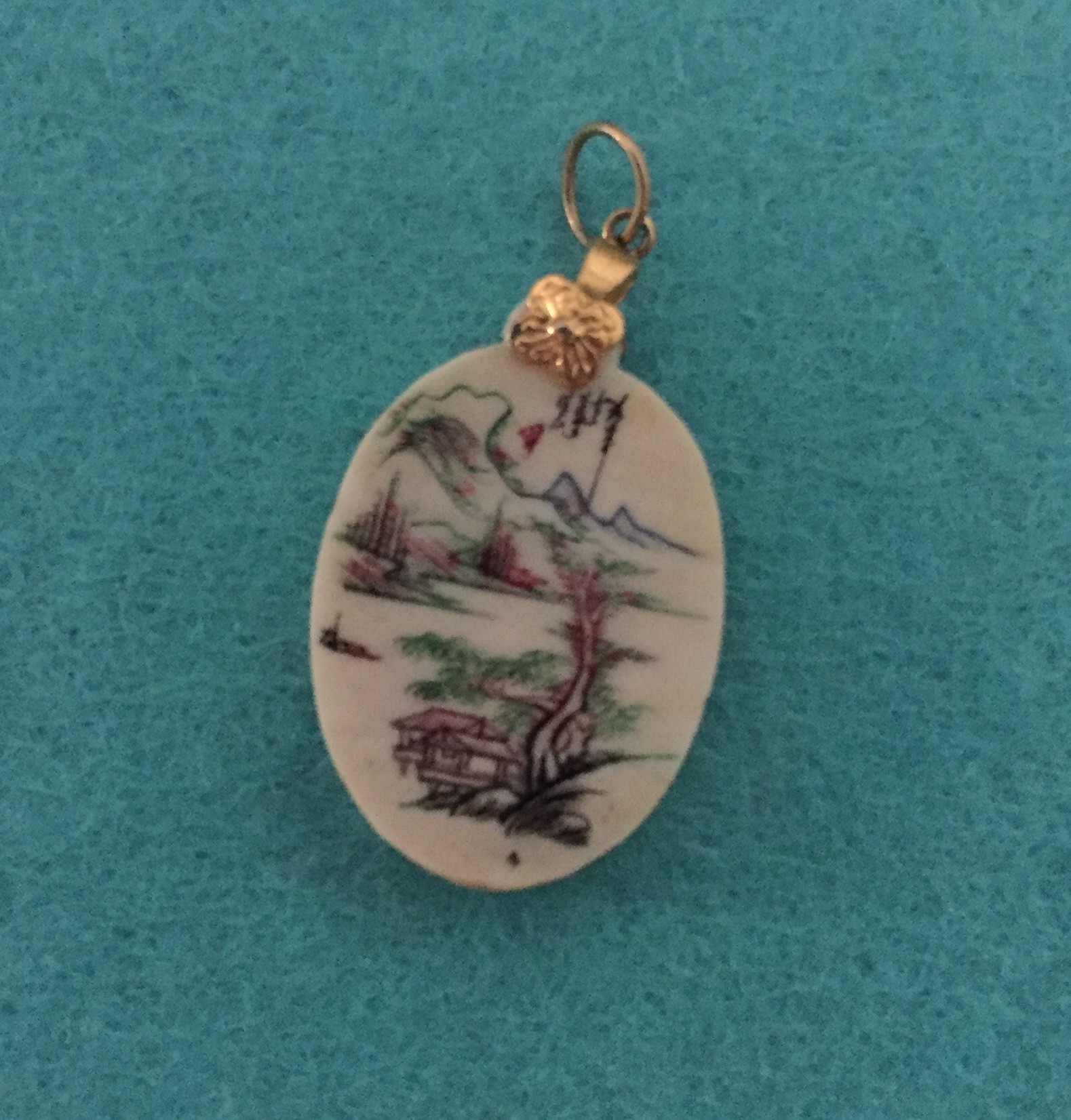
In a box in my closet is a small scrimshaw necklace that I never wear. I will never give it away. I will never sell it. I hope one day one of my children will take it.

The necklace I purchased with the money from Zeisel.

The necklace I purchased with the money from Zeisel.

It is not that old. I bought it when I was 20, when I spent my sophomore year of college in Israel, 1974 to 1975.

Many holocaust survivors were still alive. Some of them related to me through my maternal grandparents who were both from Europe. My grandparents came to the USA in the 1920s. But most of their family remained behind. Many perished, others survived and moved to Israel.

My grandmother went to Europe in 1931 with my Mom and uncle. I have written about this before. She stayed on the farm owned by her in-laws. While she was there her mother-in-law, my great grandmother Chava, gave her some family items. Two pieces of jewelry, a pearl necklace and an opal ring; and several embroidered and handmade pieces that Chava had made.   I own all but the pearl necklace. They were all given to me as the one named for Chava.

The pearl necklace disappeared in 1931. My grandmother went to use the shower at her inlaws. She took off the necklace to bathe and forgot to put it back on. When she realized it was gone, she went back to the bathroom. It was missing.

But she knew who took it. Zeisel. He was the only one who had been in the bathroom. But he denied taking it. And that was the end of the matter for 43 years, until I went to Israel for a year of college.

A month after I arrived in Israel, I received a letter from my grandmother telling me the story of the pearls. I had never heard it before. In the letter she wrote that the ‘goniff,’ Zeisel Feuer, my grandfather’s cousin, was going to give me some money to pay her back for the necklace he stole in 1931. I was to take the money and give my great uncle, her brother, half the money. The other half was to buy myself a necklace because I should have the pearls.

What? Was my grandmother insane?   I did not really want to do this.

I wrote her back saying that I thought 43 years meant the statute of limitations on a theft were over. And that she needed to let it go. And I did not need to have the necklace. But a few weeks later I received another letter instructing me how to find Zeisel in Tel Aviv. He worked at bakery on a specific street and I was to go there and speak to him. She said I had no choice. I had to do this. It was important to both of them to end this. And I would be the one to fix it. What?

Grandma ordered, so I obeyed. The next time I was in Tel Aviv, I went to the bakery. There was a man who looked so much like my grandfather, except smaller and bent. I knew it had to Zeisel. I introduced my self. He held for minute and had me sit at a table. He brought tea and a pastry. I waited while he finished working. Then we walked back to his apartment.

There he gave me Israeli lire, which in US would be worth about $100. And he told this story.

He was married with two children. He had a wonderful life. But he wanted more for his family. So when my grandmother left the pearls in the bathroom, he thought, “She lives in America. She is rich and has money. She does not need this necklace.” And he took it. And he lied.

In return the Nazis came. They killed his wife. They killed his children. They tortured him. He could no longer have any children.

And he knew that taking the necklace had brought all this pain to him and his family. And before he died he had to make amends. So he gave me the money. I was to do with the money whatever my grandmother said.  He had made peace.

I was stunned. I was 19. I did not know what to say but to cry.   When I left him, I took the money back to my dorm in Jerusalem at Hebrew University. A few weeks later I took half the money to my Uncle Isaac. The other money I kept in my room.

Each time I went to Tel Aviv after that, I always went to the bakery to see Zeisel. He always gave me tea and a pastry.   There were not many phones in Israel at the time. So I could not call in advance. I would just show up, or send him a letter telling him when I thought I would come. When my parents came to Israel that December of 1974, I took them to meet Zeisel and speak to him. It was a meeting my parents never forget as well.

In January I turned 20. I finally spent the $50 on a necklace for me. A necklace that carried so much pain. I could not wear it even though I knew my grandmother wanted me to have this jewelry from my great grandmother. So I keep it in a box in my closet. I know it is there. I know it is safe. It will not be lost. But I cannot wear it. When I see it, I always think of Zeisel and how much he lost.

It was not the pearl necklace that doomed his family. It was the rise of hatred. But he did steal it.  So for him giving me the money was closure. He had repented; he had done his “tashuvah.”  But for me it was the beginning of truly understanding the past.

I have written about the Zeisel and the pearl necklace before. It is a story that stays in my heart and my soul. But I have never talk about what I bought with the money. In my mind it is just not enough. It does not make up for the suffering surrounding one pearl necklace.  Zeisel was also the person who let my grandfather know that his entire family had perished in the Shoah.  He is forever bound in our family history.

Zeisel, my grandparents and my parents have all passed away. I am the only one who can remember this story. And so I tell it again.


https://zicharonot.wordpress.com/2014/08/22/i-believe-mystically-and-magically-great-grandma-chava-watches-over-me/


Trouble with the Office: An American Bialystoker Story

21 Mar

The following is a report my Great Grandfather, Louis Goldman, made in a 1937 issue of the Bialystoker Stimme. It explains the reason why the Bialystoker Bikur Cholim decided that the organization needed its own offices. It seems asking for help from the community was just not working out. It gives the history of the decision to rent its own office. I think this might have be the precursor of the Bialystoker Home for the Aged, which was built over two years in 1929-1931.

Here is his article, as translated by my friend Blumah and edited a bit by me for clarity.

“The Bialystoker landsman in that time mostly lived in the East side (of New York City). The Bikur Cholim decided to put in that neighborhood a place for the sick people to receive help without difficulty. So they would be close to their neighborhood.

They arranged for a doctor and arranged for a pharmacist to get them medicine.

It was decided to give to the poor sick people a free pass to see the doctor and also pay for the medicine.

A certain landsman, who had a hot dog /salami store on Essex Street, gave his store for the sick people to come to receive these passes and papers. This became the office where they could get the papers. But there was a problem: The store keeper would give out these free passes like a prize to his own customers who would buy meat from him. (This was not what was intended so,) It was decided to rent a place somewhere else.

Next they found a butcher store from one of the landsman, Philip T. However there was not very convenient for several reasons.

They moved the office again to a new place. To “Fisher” who had a printing shop on Clinton Street. But Fisher started asking every month for new ‘additions’. (Not sure if he wanted more money or what he is wanting. Probably more money.)

So the Bikur Cholim decided once and for all to rent a permanent office for themselves. It was decided that this office could also act as a club for the active members. Also there would always be a secretary who would be paid and who would take care all of the cases for the Bikur Cholim.”

As my great grandfather, or the editor of the Bialystoker Stimme, entitled the article, “Trouble with the Office,” I think that was a fine assessment.  Personally I loved how the store owner gave out free medical passes to his customers.  One way to build a clientele, even though it was not ‘kosher.’  I know that they were trying their best to help their landsmen in need, without using the money needlessly.  Building an office might have seemed that way to them.  But eventually, having a paid secretary made more sense.

The history of the Bialystoker Home For the Aged and the Bialysotker landsmanshaft, immigrant organization, can be found in the NY Landmarks Preservation Commission Report of May 21, 2012. See link below:

http://www.nyc.gov/html/lpc/downloads/pdf/reports/2529.pdf

The part of this story that impacts my great grandfather’s article, is this small section from the report:

“In its first year of existence the Bialystoker Center was located in an old building at 228 East Broadway just few houses down from the basement location of the Bikur Cholim. In 1922-23 it replaced the aging structure with a new five-story headquarters, which included office space not just for its own use but also provided meeting rooms for affiliated associations.”

So I assume the offices that my great grandfather is writing about was this office on 228 East Broadway. Eventually, definitely by 1937 when his article was written, the Bikur Cholim offices were included in the beautiful building that was finished in 1931.

As I have said in earlier articles about my great grandfather,  I am so proud to be his descendant.  Each of these articles brings him to life.


Joyous Occasions in Discovered In Yiddish

14 Mar
IMG_6556

My Uncle Bernie and part of the article about his bar mitzvah.


Besides articles about my Great Grandfather Louis Goldman/Baruch Lev Litwack, there were also announcements of family events in the Bialystoker Stimme magazines under the title “Simcha by Landslight,”   or “Joyous Events by our community members.”   I found three events in Yiddish about my extended family members, which my friend, Blumah, translated for me as well.

The first was about my Uncle Bernie, or Bernard, about his bar mitzvah:

“A nice bar mitzvah party took place on Shabbat. The 11 of June by Mr. Bernard.  A nice, accomplished young man, the son Mr. and Mrs. H Rosenberg and the grandson of our dear friends and active community members Louis and Ray Goldman from the Bronx.

A nice private group of close family celebrated by the simcha. They wished much nachas to the parents from this bar mitzvah boy.

As is well known, Mr. and Mrs. Louis Goldman, the grandfather and grandmother, are actively in the Bialystoker Center and the Ladies Auxiliary.

Mr. Goldman is now the president of the Bialystoke charity organization that was the Bialystoke Free loan society: Bialystoke Somech Noflim, (It was started in 1886 in the USA.) This is he oldest charity association that the Bialystoke started.

We wish the zayde and bubie, and the parents to live to have much nachas and much joy from Bernard and the other children.”

I loved that even in an announcement of my uncle’s bar mitzvah, it was important to the writer to list my great grandfather and great grandmother’s accomplishments in the Bialystoke societies.   I am thinking it is to give them even more ‘kovod,’ honor. Or perhaps it is to encourage others to volunteer?

In later years, when the Bialystoker Stimme had more English, there is another Bar Mitzvah announcement for my father. But it is much shorter and written in English.

One of my father’s cousin’s is also mentioned in “Joyous Occasions.” My Dad’s first cousin David M. made the Yiddish paper, in a shorter and less flowery article.

“The Goldman’s talented grandson, David M., graduates with honors. The 16 year old grandson of our active members, Mr. and Mrs. Louis Goldman, of the Bronx. He just graduated from Townsend Harris High School. He was immediately accepted in City College. We wish the parents Mr. and Mrs. Eli Marks and the grandparents of David much nachas from their very capable David.”

The final “Joyous Occasion” in Yiddish was my great Uncle Sam’s wedding announcement, for his first marriage. I never knew the woman mentioned in this announcement. But I do know that they had one daughter. I honestly only remember meeting her when I was a young child. I think the family lost touch with her.

“Sunday Dec. 11, our friends, Mr. and Mrs. Louis Goldman brought their youngest child to the Huppah: Samuel with the beautiful, intelligent Miss Otta Schmuckler. The wedding was private, and the supper was afterwards celebrated in Central Plaza, where many friends from both sides were part of the joyous occasion.

We wish Mr. and Mrs. Louis Goldman and the young couple much nachas.”

The only thing I can say about this announcement is that I always thought his first wife’s name was Yetta. And that might have been the name she used in English.

Every one of these little Yiddish articles is like a jewel for me. I find out tiny bits about my family’s life in the 1920 – 1940s. I see pieces of my Dad’s childhood. He probably was at all these simchas: his brother’s bar mitzvah, his cousin’s graduation party, his uncle’s wedding. We do have a few photos from this time. But I have never seen the photos of my uncle and my Dad’s cousin that shown in these articles.

The Bialystoker Stimme continues to be a treasure for me and I hope for my family.


https://zicharonot.wordpress.com/2016/03/08/louis-of-the-blessed-heart/


Louis of the Blessed Heart

8 Mar
image

A photo of my great grandfather, Louis Goldman, and the article about him.


I knew my great grandfather, Louis Goldman, had a good heart. His Hebrew name, Baruch Lev, ‘blessed heart,’ echoed his kindness. Now thanks to the books I found in the Catskills’ bookcase, I know even more of what a “mensch” and a “guttah neshumah” he was to many people.

I found two larger articles about my great grandfather in the bound Bialystoker Stimme magazines I found last summer. And finally, I was able to meet with my friend, Blumah, who translated these articles for me. What a blessing and what a joy! This blog is about one of the articles.

The article from 1938 honors him on the 50th anniversary of his arrival in America. So I now know that he arrived in 1888, when he was a teen. I already knew he married my great grandmother in January 1894.

The article is in praise of Louis Goldman, born Baruch Lev Litvak.  This is paraphrased, but close to the translation:

“It is already 50 years that Goldman is an American, and he still looks like a young man. He remembers things as if he had just yesterday came off the ship. He is like a walking encyclopedia,   He knows things as if they are ‘in his vest pocket.’ In general he knows many people.

He has the honor of being president of the oldest Bialystoker organization the ‘Somach Naflim,’ helping the fallen (Free Loan Society). And he is the vice president of the Center. (Bialystoker Home for the Aged.)

He acts with great warm love with the Home for the Aged. ‘He is the one and only one in the way he gives love and warmth, there is nobody that can be compared to him.’

In addition to bringing in friends whom he strongly interested in this project (Home for the Aged), his beloved institution, he also brought in his wife, children and grandchildren to be involved.

The grandchildren Goldman are already involved.   (This included my Dad and his siblings.)

With out a doubt, the children and grandchildren honor their father/ grandfather. If these children do not outshine him, they will put out less effort.   They will not do less than what you expect a human being to achieve.

Such an exceptional feeling!

From good dough, the saying goes, good baked goods will come out. (Such a wonderful analogy as his parents were bakers.)

Few fathers and grandfathers have the merit to have such an influence on their families. Especially in our world .

We are proud of the true, great honor of Louis Goldman!

A little bit of jealousy we could feel about him. But we still hope that he will bring his great grandchildren to the same level.”

WOW! My heart was so filled with love  and joy as Blumah read and translated for me.  Some of the words I could understand with my limited Yiddish.  But the overall sentiment was so loving. It made me proud to be his great granddaughter.

My Great Grandfather’s legacy continues into the next generations.   My Dad was president of his synagogue for 11 years and remained on the board until his death. My parents and grandparents and aunts and uncles would go to the Bialystoker Home for the Aged benefit dinners each year.

I continue work for the Jewish community as a board member of our synagogue, and many other Jewish and secular organizations.

My daughter works for the Peres Center for Peace in Yaffo, Israel. I think my great grandfather, her great, great grandfather would kvell with naches.

But it is not just my immediate family that continues in this tradition. My siblings, my cousins and their children also live a life of gemalut chasidim, doing good works.

I believe that our ancestor, Louis Goldman would be proud of us as we are of his good works.

The gene to do good, to be agents of tzedakah, is strong in our family. It is our Force. And I am so proud to be descendant from this man, Baruch Lev. Louis of the blessed heart.


(See links below to other blogs about Louis and the books I found.)

Mensch, good person; Guttah Neshuman, A good soul; Kvell, bursting with pride; Naches, proud enjoyment; Gemalut chasidm, doing good works.


https://zicharonot.wordpress.com/2015/08/16/treasures-in-the-bookcase/


https://zicharonot.wordpress.com/2015/10/10/12-delancey-street-and-my-family/


https://zicharonot.wordpress.com/2015/10/21/another-bialystok-treasure-investigated/


https://zicharonot.wordpress.com/2014/12/01/take-mom-to-work-day-at-the-peres-center-for-peace-in-jaffa-israel/


I Want My Sandy Back: Our Short Duration of Dog Ownership in 1961

6 Mar

When I was about six years old my father got us a dog. Sandy, a beautiful Cocker Spaniel, was so wonderful   We were in the Catskills for the summer when Dad brought the dog to the bungalow. My brother and I were ecstatic.

My sister was just a toddler, so I am not sure how she felt, but she seemed to love the dog as well. Her favorite game was to ride Sandy like a horse. Since she was so little, and Sandy so active, they both had a good time.   My sister seems to remember that the horse riding was my idea. That could have been, I loved horses!

We got to name him, because the dog’s given name was Harry, which was my grandfather’s name. So the first thing we did was have a family conference to name the dog. His name matched his color, a beautiful golden brown.

We often let Sandy run free on the fenced in front lawn of the bungalow colony, right outside our front door. My other grandfather would stand and laugh at the dog running crazy circles. He would scratch his head and say in Yiddish, “Look at that meshuggahan hundt (crazy dog)!”

The summer was wonderful. It was easy to take Sandy on walks, and he had space to run around in the bungalow colony. But then Labor Day came and it was time to return to North Bergen.

We lived in the second floor apartment of a three-story home on Third Avenue.   Sandy was not as happy there as he had been in the Catskills, even though my brother, sister and I showered love on our dog. His adventures became mainly indoor adventuress; not great for an outdoor dog.

In fact, my brother remembers that my parents would put Sandy in the bathroom at night, so he would not roam the apartment. One Sunday morning, my brother got up early and went to the bathroom. He found my young sister wrapping the dog in all the toilet paper!

“What a mess to clean up as he ran around the apartment trailing toilet paper!” My brother remembered.

Actually, overall, having a dog in our apartment was not going very well.

My parents and my brother were usually the ones to walk him. It was a hassle to get him down the stairs and out to the street several times a day. My brother and I were in school. And my Mom was home with my sister, who was still sleeping in a crib. I think my Mom was getting very tired of dog ownership.

Then one day I offered to take Sandy for a walk. I bundled up and took him downstairs. As we were walking, he pulled me into the street. Someone helped me get Sandy back on the sidewalk. I was not going to tell my MOM. But one of the neighbors did. (In those days, every neighbor was like another parent!)

That was the final straw for my Mom. Sandy had to go. “It was not safe to have a dog in the city. It was not fair to Sandy to be locked up in an apartment,” was what my parents told us.

My brother tried to talk them out of giving Sandy away. He promised to walk him every day, if they let us keep our dog. But it did not help.

Soon after that, my Dad found someone who had plenty of land to take Sandy. I still remember the day he came to take our pet. I hid Sandy under my sister’s crib and put the sides down. I put pillows all around to hide him. But it did not work. Sandy followed me out and left our lives forever.

I remember crying for days, “I Want MY Sandy back! I want my Sandy BACK!” I am sure my crying and whining drove my parents crazy. But they were patient and explained over and over how this was better for the dog.

Nothing worked. I never saw Sandy again. However, my parents did report back at least once, that he was loving his life on a farm.

To this day, I cannot watch Disney’s “Lady and the Tramp” without thinking of my Sandy. This was my daughter’s favorite movie when she was a child. I watched it almost every day. Each time I watched I would think of my cocker spaniel.

I have never owned a dog after Sandy. My husband and I always had cats. I think part of the reason for me, was that I never wanted a dog to pull someone in the street and be sent away. Cats stay indoors and care for themselves in many ways.

It was just about five months that Sandy was in our family. He arrived in the early summer while we were in the Catskills and was gone by Hanukkah in North Bergen.

Many times I wished I lived in the Catskills throughout the year so that we could have kept Sandy.

Mazel and Good Luck: My Middle Eastern Hamsa and Native American Hand Symbol Collection

26 Jan

I have always been a bit superstitious. Perhaps it is because my grandparents had little things they did to keep evil away and bring good luck. Their Eastern European/Jewish roots had me putting red ribbons or thread on my children’s cribs; saying Yiddish phrases that warded off the evil eye whenever someone said something nice about my children; and learning about the power of a name.

When I went to Israel as a college sophomore, I came in contact for the first time with the hamsa, the palm-shaped, Middle Eastern sign to keep evil away. Specifically, a hamsa usually has the symbol an eye in the middle of the palm to ward off the evil eye, the “ayin hora.”

image

The first hamsa I purchased.  It is not totally traditional because it depicts a true hand, not the three finger/two thumb usual hamsa.

On the “My Jewish Learning” website it states that the hamsa has been seen by different groups as a Jewish, Christian and Islamic amulet, and even a pagan fertility symbol. But in now it is recognized as a “kabbalistic amulet and is an important symbol in Jewish art.”

I became intrigued by the hamsa and its ‘magical’ powers to bring “mazel,” good luck, and keep evil away when I was a college student. The first hamsa I purchased was for my parents. This wall plaque adorned the wall near the entrance to their home for over 35 years.   When they passed away, I brought it to my home, where it now hangs near my front door.

I wish I could say that is the only hamsa I have purchased. But it is not. For years, it was very difficult to find one. Occasionally an artist would draw or design a hamsa. Then, about 10 -12 years ago, hamsa art went crazy. I started seeing them in stores and catalogues that had a Jewish base. But I even found them in regular gift stores.

I purchased hamsas to bless new babies and homes. They are made of so many different materials: metals, ceramics, glass, pottery, clay, fabric. Each artist has his or her own vision. They can be wall hangings, picture frames, designs on tzedakah boxes, trivets, jewelry. I even have a hamsa mezuzah! That must have double positive energy!

I have seen necklaces, bracelets, earrings and pins made in the shape of a hamsa. I admit I own some.

image

Left: The Middle Eastern Hamsa; Right: the Native American Hand Symbol

About six years ago I found out that the hand symbol for protection was not just a middle eastern amulet.   I was in Arizona on vacation, in a ‘western’ store, when I came upon a hand with a circular spiral design in the center. This hand symbol, I found out “represents spiritual power, strength, domination and protection” for Native American warriors, according to the Warpaths2Peacepipes website.

So, of course, I purchased some of these hand symbols as well. They are different. The Native American hands actually look like hands, whereas the hamsa usually has a large center palm and three normal fingers, but what looks like two thumbs one on each side.

For me, their similar designs which provides the same message of protection for those who wear them makes sense. How many times to we hold up our hand to say, Stop!” And so with the hand we ask people to back off, calm down and stay away.

image

Top two designs are hamsa, the bottom one is a hand symbol.

Thus cultures in two distant parts of the world created similar symbols for protection. I love it. My hamsa/hand symbol collection is intertwined with art from both displayed together.

But I must add that one type of Native American hand symbols is actually called the Hand Eye symbol. This symbol looks remarkably like the hamsa. This symbol was used by a group of Native American called the “Mississippian culture of the Mound Builders.” It was an important symbol for them but there is a belief that it related to entry to heaven and a solar deity. (According to the Warpaths2Peacepipes web site.)

Although it is not a protection amulet to me it seems to still send out positive energy with its relationship to heaven.

Perhaps my collection cannot truly do anything for me. But in my mind, it cannot hurt to have these symbols of protection and love and strength scattered throughout my house.


http://www.myjewishlearning.com/article/hamsa/

http://www.warpaths2peacepipes.com/native-american-symbols/hand-symbol.htm


Oh Canada: My love of Canada Was Nurtured in High School

23 Jan

I have been fascinated with Canada ever since I read my first “Anne of Green Gables” book. The books made me want to see Prince Edward Island and the people of the island, and I loved the character of Anne Shirley. But it wasn’t till I was in my junior or senior year at North Bergen High School that I was able to really learn something about modern Canada.

At school, the administration decided to have these little one-quarter classes. You had a choice to take one or two each semester. Among the classes offered was one about Canada by Ann-Ruth Enowitz, a history/social studies teacher. For me she brought Canada to life. And my desire to see Canada and learn more about it intensified.

I loved her class. I liked her as well. We learned about the provinces, the history with England, France and the United States. We even learned to sing the Canadian national anthem, “O Canada!”. There were just a few of us in the class. I think we met in a conference room in the library.

Although I had not been to Canada, I knew that many Canadians came down to New York. It was so close to travel and visit. Many had families in both countries. But for me, the closest I came to Canada was the Canadian exhibit at Disney World’s Epcot Center. But I wanted the real thing!

The class only piqued my interest!

My first trip was to Montreal for a family wedding. My plane was late, of course, and I could not remember the name of the hotel. But luckily I had the address of the party I was supposed to go to that night. By the time the taxi got me there, the party was over. But my mom and dad were sitting on the stoop waiting for me. In the time before cell phones, they were worried and could only hope and wait for me.

Once that emergency passed, I had a great time. We went on tours around Montreal. I loved the old town by the river and visiting all the French sites. We enjoyed the wedding, and my love of Canada continued.

My next trip to a Canadian city occurred when my husband and I were living in Ann Arbor, Michigan. It was a hop and a skip to get to Windsor, Canada. Many people went shopping there because the dollar bought more. My friend Ginny and took a trip there to shop. I will admit I almost caused a big problem at the border, but we finally got through.

My husband and I went back for a week’s vacation, driving through Canada; negotiating the weird signs. The signs don’t say, ‘merge’; they say ‘squeeze.’ Or they did. We went to Stafford and saw a Shakespearean play.   We drove to Toronto…just missing the traffic for the Pope. We got there the day after he left, but all the barricades were still around. It was September 1984.

We made our way all the way to Niagara Falls and spent a day and night there: taking the boat ride to the falls, walking along the Canadian side. We drove back along a southern route, but stayed in Canada. We stopped at Alexander Graham Bell’s’ home and the Royal Botanical Gardens. I loved that trip.

Ms. Enowitz’ class so many years before helped me on all these trips. She had spent much time on Toronto, Montreal and Niagara Falls, discussing border issues, and the wars between the French and English, as well as the US and Canada. Who knew that we once went to war with Canada!!! But her history lessons came to life as we visited forts and cities along the way.

Houseboats Vancouver

Some of the houseboats we saw as we walked to Stanley Park.

Many years later I went to Vancouver.  My husband was there for a meeting, and I was there to see the sites. But he had some time off and we took long walks and visited Stanley Park together and looked at all the houseboats along the way. I went to museums and Granville Island with a friend.

It was just two years after 9/11 and security was very tight. There were talks of terrorist trying to get over the border from Canada to the USA. So perhaps it was not the smartest move on our part to fly home on September 11. But it was my Dad’s birthday. And my parents were staying with our children. I promised my Dad he would be off duty for his birthday.

For some reason, security focused on my husband. They checked him at least three times. And even when I went down the walkway to the plane, I noticed he was gone. I walked back and there at the entrance they made take off his shoes and were checking him again.

But we still loved Vancouver. I always thought we would take our children there, but never did; just a pass through on the way to Alaska.

Another trip to Canada with my husband took us to Montreal as we started a cruise up the St. Lawrence Seaway. We spent several days first just walking around Montreal. The first stop on the cruise was a day in Quebec City. I loved it there so much, a few years later we travel to Quebec City and spent a week there. This French and English town is so interesting. Like being in Europe, but staying in North America.

We also went to Halifax, where several important battles were fought, and the survivors and victims of the Titanic were taken to after their recovery.

However, most important part of the cruise was finally making my way to Prince Edward Island and visiting all the sites made famous by Lucy Maud Montgomery (LMM) and her Ann of Green Gables books. I told my husband in advance that we had to do the Ultimate Green Gables tour. He agreed. And my favorite part of the cruise occurred on this tour.

Green Gables

Green Gables, the Anne Shirley home!

My husband was not an Anne Shirley fan. He knew nothing about her, nor about Lucy Maud Montgomery. Needless to say he was not as excited as the other 50 or so mainly women on the bus. So when we got to Green Gables, the house owned by LMM’s aunt and uncle that the house in the stories was based on, my husband was not that impressed.

Anne Shirley's room

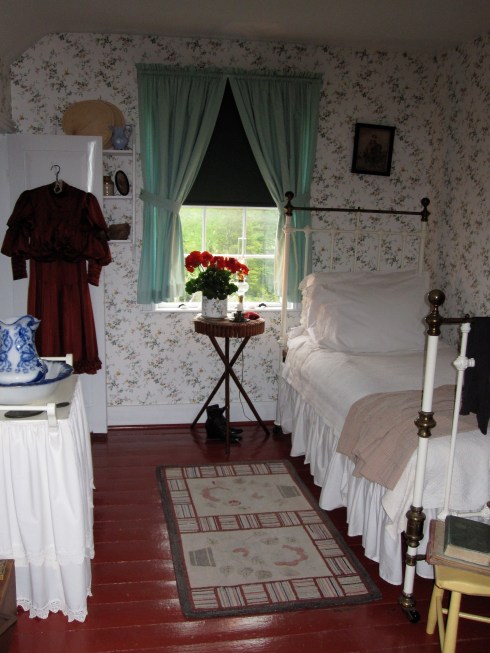
Anne Shirley’s “room,” at the top of the stairs.

And when we went up the tiny staircase to the second floor, the tour guide said as you get up the stairs look to you left and you will see Anne Shirley’s room. I was so excited; I exited the staircase, with my camera ready and started taking photos. My husband said, “You know, Anne Shirley was just a fictional character and that is not her room.”

I turned to say something back to him so he would understand my joy and not undercut it! But I did not need to say anything; the woman behind him said, “You know you could just go back to the bus.”

From that point on my husband was silent. He just enjoyed the rest of the tour realizing he was with a bunch of Anne Shirley fanatics. And I had pure joy.

I thought that was it. I had satisfied my Canadian obsession. But then my daughter became engaged to a Canadian. I now learned that you can put maple syrup on everything you eat and there are such things as maple syrup lollipops.

To this day I think of Ms. Enowitz whenever I travel to Canada. It was a very brief class, but one I always remember.


The I Cannot Decide What To Do. Really.

11 Jan

The summer before my mother died (2010) she told me that one of her regrets was losing touch with the family of one of her best friend, Evelyn Daitch (Deutch).   She showed me pictures of the two of them together when they were young women.(I have since found out it was spelled Duetch.)

Evelyn Daitch Manowitz

Evelyn in West New York, New Jersey.  December 1945.

Evelyn married and moved to Texas with her husband, Cy (Seymour) Manowitz. Mom and she kept in touch throughout their lives, until Evelyn passed away in her 50s from cancer. And then Mom lost touch.

She asked me to find Evelyn’s family on the internet. She said, “You know how that internet works. I bet you can find them.” Also I lived in the Midwest, so she thought Dallas, Texas, is close to Kansas City.   I did ask some of my friends who were originally from Texas, if they knew the Manowitz family. But no one did.

Grandma Mom 1945

My Mom in West New York, NJ.  Same day as Evelyn. Note the matching outfits!

Then so much happened. Mom took ill suddenly died. My Dad died nine months later. There were other painful family tragedies. I did not have the energy to even remember this.

So I did not complete this mission.

But recently I have been on a roll completing things my Mom left behind. I finished two afgans she had started. My siblings and I cleaned out both homes. I gave her sewing machine to someone who loves to quilt.

So this weekend, I finally looked at the note that I kept in front of my computer with the family’s names, and went on line. Within minutes, I found Evelyn’s husband in Texas. He is 90 years old.

Should I even contact him? I have his address.   I could send him a letter with a copy of a photo of Evelyn. Or should I let this be? I have fulfilled Mom’s request. I found Evelyn’s family.

Evelyn passed away almost 30 years ago. I am not sure her husband would want a message of love from someone else who passed away.   I am not sure what his mental state is these days. I do not know him.

I have his address.   I have his name. I have at least one photo of Evelyn.

But he is not family. And I really do not want to disturb him with a piece of the past that cannot change anything. My Mom is now dead. She wanted to contact Evelyn’s family when she was alive. She did not know she would become ill.

I think finding Evelyn’s family was the last thing I wanted to do for my Mom. And it is done. I don’t think I have to contact him

But part of me cannot decide what to do….really.

Thanks to members of Tracing the Tribe, I know Seymour passed away over a year ago. But that someone with the same last name lives in his house. So I sent a letter with the copy of the photo. Another TTT member found a nephew on Facebook. So I messaged him. I hope to give this photo to a family member. Thank you all for the help.