Tag Archives: genealogy

Epiphany, Excitement, Discovery, Disappointment, Hope

16 Nov

In searching for my ancestors, I have learned that not everything turns out as I hoped. But part of the search is the excitement of discovery and sometimes just the process itself.
Museum brochure

While in Seattle with my husband, I decided we needed to go to the Klondike Gold Rush Museum, a National Park Service site. We had been to Alaska and seen the town of Skagway where the hordes of people climbed to start a cold and difficult journey to find gold. We have ridden on the White Railroad train to see the path these souls walked to the Yukon Territory.

But to be honest I never connected Seattle with the gold rush. Now I know I was wrong. Almost seventy percent of all those who joined the gold rush came through Seattle. It was the hub for stocking up with the many supplies needed. The idea to come to Seattle was reinforced by a strong media campaign by a Seattle in 1897-98 to encourage people to come to Seattle first.

After visiting the museum, I had an epiphany! I knew my great grandfather had abandoned his family in New York to go to Seattle in the late 1890s, but I never could understand why Seattle. Now I think I know. He joined the adventure seekers looking for gold.

My great grandfather did not return home after his adventure. I wrote about this in the blog below.

Seattle Public Library

Genealogy on the ninth floor!

Being in Seattle for a few days, I decided my next stop needed to be the Seattle Public Library! So in the morning I set off. The staff was so helpful. Who knew there would be a genealogist on staff! Many thanks to John, who helped me explore. And to the other kind staff member who got me started until John came to work.
The old city directories.

I started by looking through the Seattle City directories. I searched from 1898 through 1924. My excitement was high. I found three men named Abraham Rosenberg in my search. The first seemed the most positive. With finding his death certificate we saw that he was born about the time, 1868, that perhaps my great grandfather was born. I found him in the books beginning in 1917.

The wrong Abraham Rosenberg, 1917 city directory.

But it was a disappointing find. We found his obit, and from there realized he only had lived in Seattle from 1916. Could not be my lost ancestor. Not only that he had children at the same time my family was growing back east, in the late 1890s.

John and I were disappointed together. He searched for every reference he could for Abraham Rosenberg in different spellings and in Spokane as well as Seattle.

I am not giving up hope. I vaguely remember that my great grandfather lived a long life. It might be that he died in 1963, those death certificate records are not yet on line.

I know my grandfather found his father in Seattle in 1902 or 1903. So I know he existed.
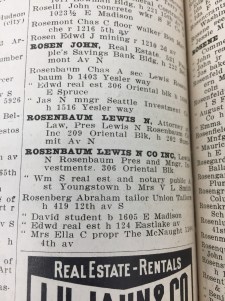
An earlier Abraham Rosenberg.

I went back in time. And found in the 1904 and 1905 city directories an Abraham Rosenberg is listed. He is a tailor! My grandfather was a tailor. Could it be my missing ancestor? We might not have found him traces of him in other records. But I am positive that I will one day find him. I will not give up hope.

The process is part of the adventure. I had a wonderful adventure and met the nicest staff at the library!

The Sad Scandal That Forever Scarred My Grandpa Harry

Working on An Ancestor Mystery

20 Jun

You would think that with my niece’s wedding in two days my sister (the mother of the bride) and I would focus on the wedding. But not us. After a day of running wedding related errands, my sister and niece were putting together a display about our family weddings, when my sister and I got into a mini dispute over a wedding date.

This lead to my sister logging into her ancestory account to check the date, which of course led us into a lengthy look into our family mystery: our paternal grandfather’s family.

Once again we started searching for his family on the census documents and in other areas. We know his birthdate and the names of some of his siblings. And we think we found his family. We knew of six siblings in his family. We are now up to eight in the 1905 census. But there is one brother not yet listed. And we cannot find another census with the family listed. So we honestly do not think this is our family. We need to investigate more.

But that is not our only mystery. Sometimes the documents have all but one child born in the USA. Others show all but one born in a Russia. Some say the father, our great grandfather came in 1880 or earlier. Others say 1890. We know he was born in 1859 and his wife in 1865 we know they married in 1883 and started having children in 1885. The biggest problem is their very common names. If only we could find documents with the original last name of Grau instead of looking for Rosenberg.

We know our great grandfather abandoned the family when our grandpa was about 13. It is now looking as if grandpa might have been a bit older.

The names are so common that we have to be careful we are staying with the right family when we search. And it is difficult and confusing.

In the midst of this research, while I was looking for a post relating to my paternal grandfather’s family, I found a post I put up a while ago of two young girls which was never translated. This lead us down another path and, thanks to a Tracing The Tribe member, connected us to a relative on my maternal grandmother’s family. I need to do a bit more research before I can write about this photo.

But we have found a photo of my grandmother and what looks to be this woman. We know my grandmother visited family in Breslau in 1931, where this woman lived. And we know her mother has the same name of our great grandfather’s sister. So we are pretty sure she, this women murdered in The Shoah, is grandma’s first cousin.

My sister and I love mysteries and searching for our family in Europe. Identifying our family who perished in the Shoah is important to us. We want their names to stay in our memories.

So at my niece’s wedding, I sat with my mother’s first cousin and showed her some of the information. Sometimes she remembers a name or knew someone that my siblings and I never met.

My grandmother left Poland when she was 16 in 1922, while my great aunt stayed until 1936, when she was 22. So she had stronger connections with the extended family in Poland right before the war.

However, with this family member, my cousin had no memory to share. In fact she did not seem to know about the cousins my grandmother visited in Breslau in 1931. However she reminded me that my grandma was 8 years older than her mother.

We have one last link. The Yad Vshem testimony was submitted in 1999. I have a contact name and address. I know the person who submitted it would probably be in her 80s now. But I plan to send her a letter with our information and copies of the three photos I have. Perhaps we can make a connection.

Murdered In Belzec

5 Jun

I have not gone to the Yad Veshem website in years.  I already had all the information about my great grandparents.  But in writing about a mystery cousin, several people suggested I go see if he was listed at Yad VeShem.  He is not.  So I will assume he survived, (optimistic I know) and look elsewhere. (See blog below.)

However, the website looked so different, I decided to look at my great grandparents again. I knew that there was an entry for both of them. But when I first saw it, I could not read much of it.  Now it is all translated into English. More important, it was put up by a survivor, a cousin, someone I met in Israel in 1976 with my grandmother: Shalom Hollander.

I had not seen his name in 42 years.  When we met, in Haifa or Tel Aviv, Grandma and Shalom only spoke in Yiddish.  And at the time, although I did understand some of what they said, I did not really pay attention.  I heard so many holocaust stories when I was with grandma that month, and I was just 20.  (See link blog below.)

It has been many years since I last looked at the listing in Yad VeShem.   Besides their updated website, I have been on a mission to record what has happened to my family.

Recently I listened to an audio tape made by my grandfather in 1981.  I had it made into a cd earlier this year. (See link below.) In it he talks about the village where he grew up.  We always thought it was in Mielec.  Which it was to a degree, but it was actually in a small village near Mielec called Trzciana.

We knew that my great grandmother, Chava, was killed near her home. That she had been hidden and did not go to the concentration camps.  The Yad VeShem records confirm that she was murdered in Mielec/Trzciana.

I did not know which concentration camp my family had perished. I only knew that they had all died.   However the testimony provided by Shalom Hollander is clear.  They were murdered in Belzec.  I am not so sure I am happy about that. But I now know that is where Gimple Feuer, my great grandfather died.

In Belzec approximately 500,000 Jews were murdered. Nazis were killing people at Belzec for nine and a half months.  Thus, I now also know that my family was murdered between March 17 to December 1942.  But at Belzec the Nazis not only murdered and buried my family, when the war was near the end, the Nazis secretly dug up their bodies and burned them.   Most depressing is that of all the Jews who were sent to Belzec only seven survived according to Wikipedia.

In the past I have also tried to find any reference to my grandfather’s siblings.  My biggest problem is that I do not know his sisters’ married names.  However, the most amazing aspect of going to the Yad Veshem datebase this time is that I found one of my Grandpa’s siblings: Shimon. Born in 1910.  Single.  A merchant.  Murdered in Belzec.  I knew all my grandfather’s siblings died. But I never saw it in writing before: Murdered in Belzec.

Shalom also did the records for his own parents.  Mordechai Amsterdam, a cousin of my great grandma; and Tova (Tauba) Holander Amsterdam.  His parents were probably cousins as well, as we were all related: Amsterdam, Feuer, Hollander, Brenner.

But there it is.  Murdered in Belzec.  No one is named for Shimon.   I do not think Shalom Hollander had a family.  Or at least I did not meet them in Israel.  I guess my next job is to search for any of Shalom’s descendants.

I am still stuck on those three words.  Murdered in Belzec.

Thanks to Tracing the Tribe members for their suggestions, especially Amy.

https://en.wikipedia.org/wiki/Be%C5%82%C5%BCec_extermination_camp

https://zicharonot.com/2018/06/04/the-mystery-of-abraham-prantki/

https://zicharonot.com/2018/05/15/my-grandpas-voice-can-still-be-heard/

https://zicharonot.com/2018/05/01/zysel-ziesel-feuer-survivor/

https://zicharonot.com/2014/04/28/speaking-yiddish-always-brings-me-holocaust-memories/

The Mystery of Abraham Prantki

4 Jun

As I search through the photo album we found hidden in my grandparent’s attic, I am still finding mysteries and photos of people who were never identified.  But this time, I found one, or should I say two, that were different.

I found two copies of the same photo postcard sent in 1923.  The young man identifies himself as Abraham Prantki.  The cards are made out to my grandmother and to her Aunt Gussie. They say the same thing, “For friendly memories I send my picture to… “

So now the questions.  He sends the one to Tante Gussie, I think.  It might say Tante Sunia?  But the last name is the name of my great-great aunt.  I am assuming that is who he meant? Maybe?

Is he really her nephew, and my grandma’s cousin?  If so then he would be from my great grandfather’s side.  He had five sisters.  I know the descendants of two of them.  However, they were from Poland. So why is this postcard written in German?  But then, they must have read German if that is the language he wrote to them in.  Actually,  my grandmother was well educated. She spoke and read several languages.

The other odd thing… on the top right of the photo addressed to the Tante, there is writing in another handwriting. I have no idea what that says.

I would love to claim him and put him somewhere on my family tree.  He looks a bit like my grandmother’s family. Like he could be related.  But it is just too nebulous.  What do you think?  A first cousin?  A border?  A relative?  Or just a friend?

And then the date, 1923.  My grandmother had been in the USA just a year.  She was 17 and living with her Aunt Gussie.  She married my grandfather in 1925.  So I have to ask, did Abraham Prantki survive?

So many questions.  I might know his name, but I still do not know who he is and what happened to him.

(Thank you to a member of Tracing the Tribe who translated the German on the postcards for me.  Update with more translations:  It seems he did address the one postcard to his cousin and the other to his aunt.  So I say YES a cousin.  I now know that his mother was one of three women, maiden name either Sura Szenk, Esther Szenk or Leba Szenk.  I will check Yad VShem.  Thank you all!)

These two previous posts discuss my grandmother’s family.

Grandma Thelma Knows What She Knows

Speaking Yiddish Always Brings Me Holocaust Memories

Your Heart Just Gets Larger

26 Jan

Recently my cousin uncovered a photo, I had never seen before. When my Grandma Esther died, my Dad and his siblings divided up the family photos.  My cousin is now investigating the ones in her Dad and Mom’s album. This photo actually had something written on the back of it.  And I am the one with the story, because of my story.


When I married, I never expected infertility. I was in love, we were healthy, there were no problems. So when decided to get pregnant, I was devastated when we seemed unable to have children.

After the first year , I was sent on to a specialist and started on years of tests, surgeries and medical treatments.  Throughout this all, I had one major supporter, my Grandma Esther.  In her late 80s, Grandma was not one to let me give up. During a time when long distance phone calls cost extra before 11 pm, Grandma became my late night phone call.

I lived in Kansas, so when my phone rang after 10 pm, I knew it was an East Coast call. If it was not my parents, it was Grandma Esther with advise!  Her first calls were to tell me that she also had problems when she first tried to have children. She told me to stop stressing and go to the ocean. She and grandpa went to the ocean and she got pregnant with my uncle.

Well, I could not go to the ocean from Kansas. But I felt the love. Over the next few years Grandma’s phone calls came with more involved medical advise. I could see in my mind’s eye, multitudes of grandmas sitting around and coming up with cures.

Eventually I did have a healthy baby girl. My Grandma was so excited. At age 88, she flew to Kansas to be here for my daughter’s naming. Grandma’s advise did not end. Having nursed three infants, she was an expert. She announced one day that I was doing it all wrong. “If you are going to nurse, you need to do it the right way,” she said. With in minutes she had placed cushions and a footstool around me, and nursing became so much easier.

I wish I could say that was the end of my struggles, but it was not. I was unable to have another pregnancy. But I was not done with motherhood. My husband and I turned to adoption.

It was not easy. We had two strikes against us. One, we already had one child. Two, we were Jewish. Agencies in Kansas were basically religion based. We were told we could register, but when a better qualified (Christian) family came, we would be put to the back of the line.  We tried private adoption. But two weeks before the baby was born, the mom changed her mind. Again difficult.

Finally we found the Adam’s Center, a local agency that helped Jewish families.  No longer in existence, it helped about three dozen families adopt babies. Not all were Jewish.  We were one of the fortunate ones, and our son arrived.

My Dad was a bit nervous about this. On his way home from a business trip in California, he stopped in Kansas to meet his newest grandson. My sister called in advance, “Dad is nervous that he won’t love him the same.”

No worries. Dad arrived. I put the baby in his arms. My Dad looked up and said, “how could you not love that punim, that face.”  And then he told me, “With each child and grandchild, you do not split the love you have. No your heart just gets bigger and bigger.”  My parents had big hearts.

Dad was still nervous about how his mother, my Grandma Esther, would react. As far as he knew, there had never been an adoption in the family. How little he knew.

Grandma was now 92.  She did not fly out, but she called. She was so happy and told me the story of her cousin, Messuganah Esther.  She told me  in the old days, early 1900s, people, who had no children,  often adopted orphan children. Most of the time they were related. But sometimes, they were the children of friends. I must say that orphan sometimes just meant one parent had died.

In any case, my Great Grandmother Ray, had a sister, Chamka.  When Chamka finally made it out of the Bialystok region to join her siblings in the USA, she was a widow with three young children. And she was pregnant.  What was she to do?  Her sister Sarah had no children. and Sarah had a good job and could support a child.  So when Chamka gave birth, the daughter Esther, was given to Sarah to raise. Because so many girls were named Esther, she received the nickname, Meshugganah Esther. (See previous blog, Too Many Esthers.)

The photo is touching. It shows Chamka (Champy) holding Meshugganah Esther’s daughter, Lenore.  And it tells part of the story on the back.


Needless to say, when I brought my son back East for the first time, my Grandma Esther showered him with the same love she gave every great grandchild. She had a handmade afghan waiting for him as she did for all 18 of her great grandchildren. Because in my family, with every child, grandchild and great grandchild, you do not divide your love, your heart only gets larger and able to hold more love.

My Familiar Ancestor, Who We Cannot Identify

19 Dec

My cousin posted photos yesterday in the hope I could help identify them. None of them had any identifying information.  Several we could figure out, they were mainly our great grandparents and one great uncle. Several are children I has never seen before, perhaps they were from her Mother’s side.  And then there was this photo. A young women who looks much as I did as a young woman. She could be me.

Mystery woman, a relative?
Joan Steiner and me graduation

My college graduation.

25443154_10155546166033183_2957816772560436060_n

A mystery couple; is it the same woman?

I see so many similarities: our hair, our eyebrows, our noses, our resting face, our lips.  My glasses hide my eyes, but believe me they are similar. When I first saw the photo, I was startled.  Under it my cousin had written: You resemble this woman.  And I do.

I am now haunted by her. Who is she? Is she a great aunt? A cousin?  I am relatively sure she is NOT a grandmother of some generation.  But if I was a time traveler, I think I would be her.

I also love her dress.  There is a bit of sparkle on the collar.  All who know me, know that I love sparkle. I could wear a dress like that.  Perhaps not the high collar.  I do not like turtle neck shirts or high collars of any sort.  The dress itself, is something I would wear.  I imagine that it is blue, my favorite color.

I think she is my doppelganger.  I cannot quite get her out of my mind now.  She also looks a bit like some of my cousin’s daughters.  The family genes are strong. I really want to know who she is? Where she ended up?

This photo was taken in the USA at a photo studio on Grand Street, NYC.  So I at least do not have to worry about her dying in the Shoah.  I think she might be one of my grandfather’s five or six sisters.  I only ever met one as a child.  There were four or five we never knew.

We have another photo taken at the same studio.  Is this her as well?  Or a sister?  I am similar to her as well.  I think it might be her a few years older, with her husband.  She has rings on her fingers now.  But she is still wearing a top with a little drama to it, with all that lace!

Then there is the location of Grand Street, in lower Manhattan.  It runs parallel and a bit to the south of Delancey Street.  My grandfather and great grandfather had a tailor shop on Delancey Street. Also the Bialystoker Synagogue is on Grand Street!  Well we are all Bialystokers!  The synagogue started life as a Methodist Episcopal Church, built in 1826.  In 1905 it was purchased to be a synagogue.  But more important it was started by the Chevra Anshei Chessed of Bialystok, and our great grandfather was extremely active in all Bialystoke communal organizations. The synagogue is an historic landmark. I think I need to go and see this synagogue!!!

I am sure she is related somehow.  There are so many connections. I just wish I knew how! I do not think I ever will unless another photo turns up with a name!

In my heart, I wish that my ancestors had put names on the back of all the photos.  The ones with names in Yiddish, or Hebrew, or Polish or German are so wonderful because we actually have a name.  But the many photos that remain forever nameless sit in albums and wait for a name that will probably never come. This lack of identification concerns me as we go on to web-based photo collections.  We need to keep some sort of identification for generations to come.

But for now, I will look at this photo of my familiar but unknown relative and truly wish I knew who this woman is, and how she might be related to me.

https://zicharonot.wordpress.com/2016/03/08/louis-of-the-blessed-heart/

https://zicharonot.wordpress.com/2015/10/10/12-delancey-street-and-my-family/

https://images.search.yahoo.com/yhs/search?p=Bialystoker+Synagogue+on+Grand+Street+image

The Mysterious Kalsbad Photos: Who Are They?

6 Jun

June 26, 1931. My Grandmother was in Europe with my Mother and my Uncle. She left them at the farm owned by my great grandparents in Poland while she went to Karlsbad (Karlovy Vary), Czechoslovia to take the waters and revive her health.

The doctors in the United States told her that she was going to die. She had been pregnant again in the USA. But doctors terminated the pregnancy through a very illegal abortion in an effort to save her life. But still she was sick. So she decided she would not burden my Grandfather with two young children, 5 and 2. She would take them to Europe to live with his parents and she would die there. He, then, would be free to continue his life.

I once asked my Grandfather, why he let her go. “She was a sick woman,” he told me. “I had to let her do what she thought was best.”

“Would you have left Mom and Uncle Stanley in Europe?” I asked. This was a very important question. His entire family perished. If he had left them, I would not be here.

He looked me in the eye, and said, “As soon as she died I was going to get on a boat and return with my children. I would never leave them there. “

His words made me feel a bit better. But if Grandma had died the world my Mom and Uncle lived in would have been very different. But at least I know my grandfather would not have abandoned them in Poland.

Luckily Grandma did get well. She stayed in Europe for six to eight months and then returned to the USA with my Mom and Uncle. She saw the rise of Hitler coming and now had a new purpose: get the family out. She could not save as many as she wanted. But she tried.

Grandma Thelam, Carlsbad

Grandma is sitting in the front. The date and place were added by my Mom. I think the two women are related. This is the photo we knew about.

We have several items from that trip to Europe. We have a ceramic vase that stays in her breakfront/curio cabinet in our Catskills’ home. We have stories about the trip.  We have a few photos. We knew of one. Grandma is with two other women. We have no ideal who they are. But I think they are related to her, one women sort of looks like her sister-in-law. We are not sure. There is no identifications on the back.

But I recently found another.

FullSizeRender (10)

Grandma is in back row on the left wearing a white hat.

It is a group photo. In the very back row, near the center is a woman in a white hat, that is my grandmother. She is 26 years old.

I do not know the other people. Are they family members who perished? Or are they just other people who are in Karlsbad? Sometimes I imagine that they are just other people at the resort who were pulled together for a group photo that the photographer would then sell to tourists.   Other times I imagine that people in the photo look like family, especially the man in the front on the left. But I honestly do not know.

This photo is different from the others we have from that trip. There is writing in Yiddish and English. The English is easy, her name and the address where she stayed in Karlsbad. Or is it a place she visited?

The Yiddish is more exciting to me. It is the only letter I have seen that she wrote to my Grandfather. (Thank you members of the Tracing the Tribe Facebook Group for translations!)

It says: “As a souvenir from your faithful wife, who hopes, to meet you again in good health.” Another translated it as “A souvenir from your devoted wife, who hopes to return to you in good health.”

Either makes sense. She was sick. She was away from my grandfather. She wanted to be reunited with her family and be healthy.

And that all happened. She returned to the US and lived an additional 50 years. And 80 years later, I keep finding treasures in her photo album!


https://zicharonot.wordpress.com/2014/04/28/speaking-yiddish-always-brings-me-holocaust-memories/

“Who are you?” These Photos Call Out to Me

3 Nov

I look through this photo album and I cringed. There are so many unnamed children and adults. Did they survive? How are they related? Who are you? Who ARE you?

For some I am fortunate, there are names written on the back of the photos in English, or German or Yiddish. And someone can translate the names for me. The English ones are easy, I usually know who they are and how they are related. Some are photos of people I knew about, but had not seen.  Some I post on Tracing the Tribe Facebook group to see if someone can translate the words written on the backs for me.

Others are photos of people now identified as a cousin. But I have no idea who they are? How they are related? Or what happened to them during or perhaps after the Shoah? The photos are from the 1920s and 1930s in Europe. It is almost painful to look at these photos because I do not know what happened.   And I imagine the worst. I only can look at a few photos at a time.

My grandmother's first cousin, Dora, and her husband. My grandmother’s first cousin, Dora, and her husband.

The ones I know give me a chill.   I see one of a couple, Dora and Max, from what I think is their wedding in 1924. Oh My. I met Dora in Israel in 1975 when I took my Grandma Thelma to Israel to see her brother and family.   She had not seen her brother since 1932, over 40 years. Much had happened to them and to their family.

While in Israel on this trip, I met many family members who came specifically to see my grandmother. Although I had lived in Israel and gone to college there for a year, I had not met these people before.

But really of the new family members I met, I remember Dora and her daughter the best.   I still l can hear her daughter asking me all sorts of questions about my grandmother. When I questioned her, she responded saying basically, “Look I am told that this Thelma is my mother’s first cousin. My mother lost so much in the war, I want to be sure who she is before I bring her to see this Thelma.”

And so I answered the questions. The answers were right. My grandmother and Dora were first cousins. They had not seen each other also in over 40 years.

They spoke only in Yiddish.

I will never forget their meeting. I will never forget the tears and the pain as Dora told my grandmother what had happened. I will never forget seeing them sit together on the couch in our room holding hands and crying. Dora’s daughter, who was the age of my mother, handing them tissues. I was overwhelmed. I was just 20, and this was beyond my abilities to cope. I sat and I listened and I watched.

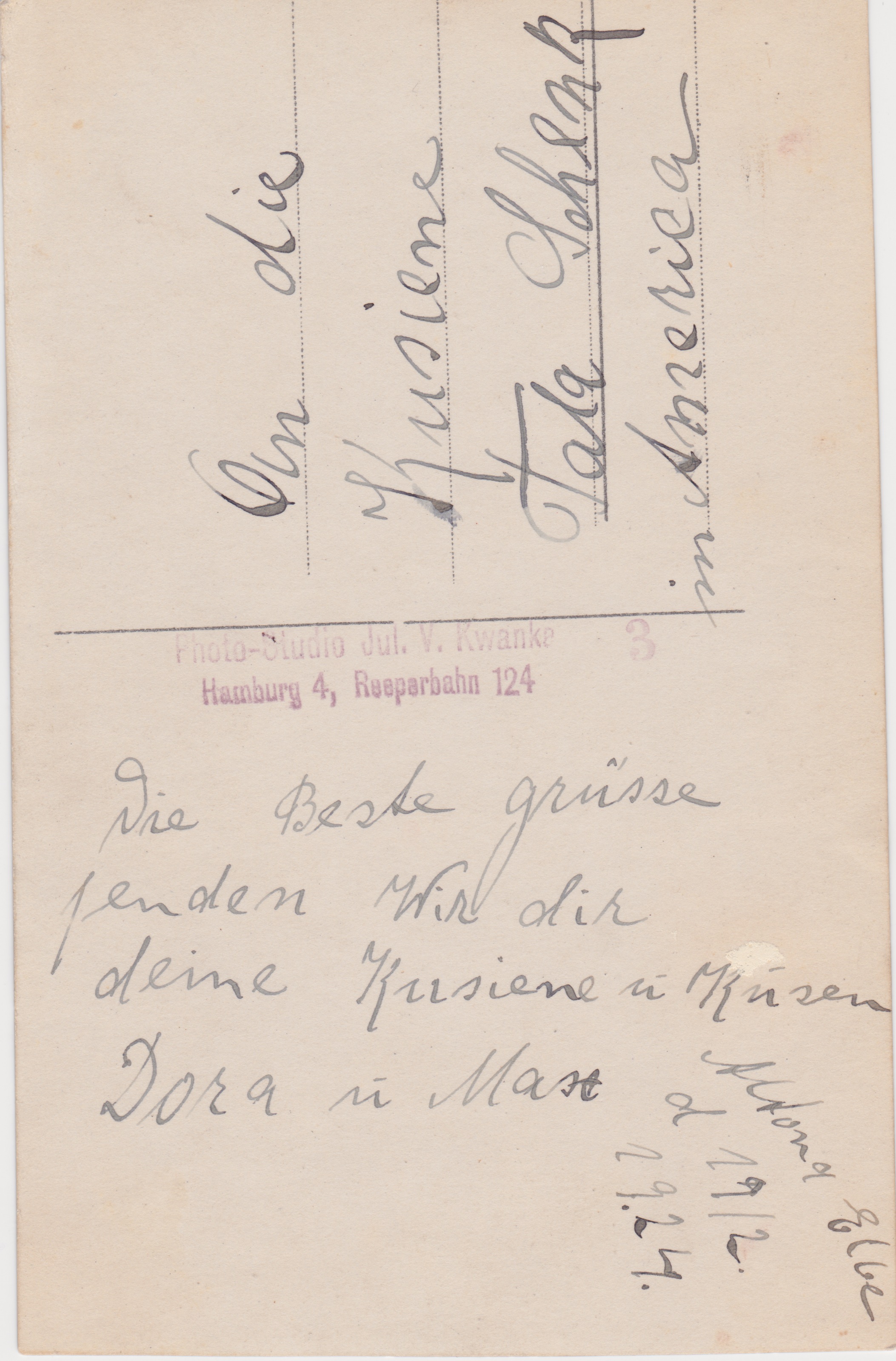
The back of the photo with the inscription. The back of the photo with the inscription.

So to open this album and see a photo of Dora and her husband from 1924 almost breaks my heart. A photo inscribed to my grandmother: “Die Kusiene Taba Schenk in America, Die Beste grusse fenden wir dir deine kusiene   Dora and Max 11/2/1924.”

Taba Schenk, Tova Szenk, my grandmother’s maiden name. My grandparents married a few months later, and my grandmother became Tova/Thelma Amsterdam.

In the photo, Dora is a young woman, but she looks just like the woman I met so many years ago in a hotel in Tel Aviv. She is not as old of course. But the face is the same. She is cleared eyed holding on to a long strand of pearls, her husband sitting next to her.
Dora’s life changed with the war.   But she survived. She had children and grandchildren. And eventually reunited for a visit with her kusiene Tova.

About the photo album:

https://zicharonot.wordpress.com/2014/08/19/old-photographs-bring-memories-to-life/

https://zicharonot.wordpress.com/2015/06/13/finding-katie/

An earlier post about the trip to Israel with my Grandma:  https://zicharonot.wordpress.com/2014/04/28/speaking-yiddish-always-brings-me-holocaust-memories/

Another Bialystok Treasure Investigated

21 Oct
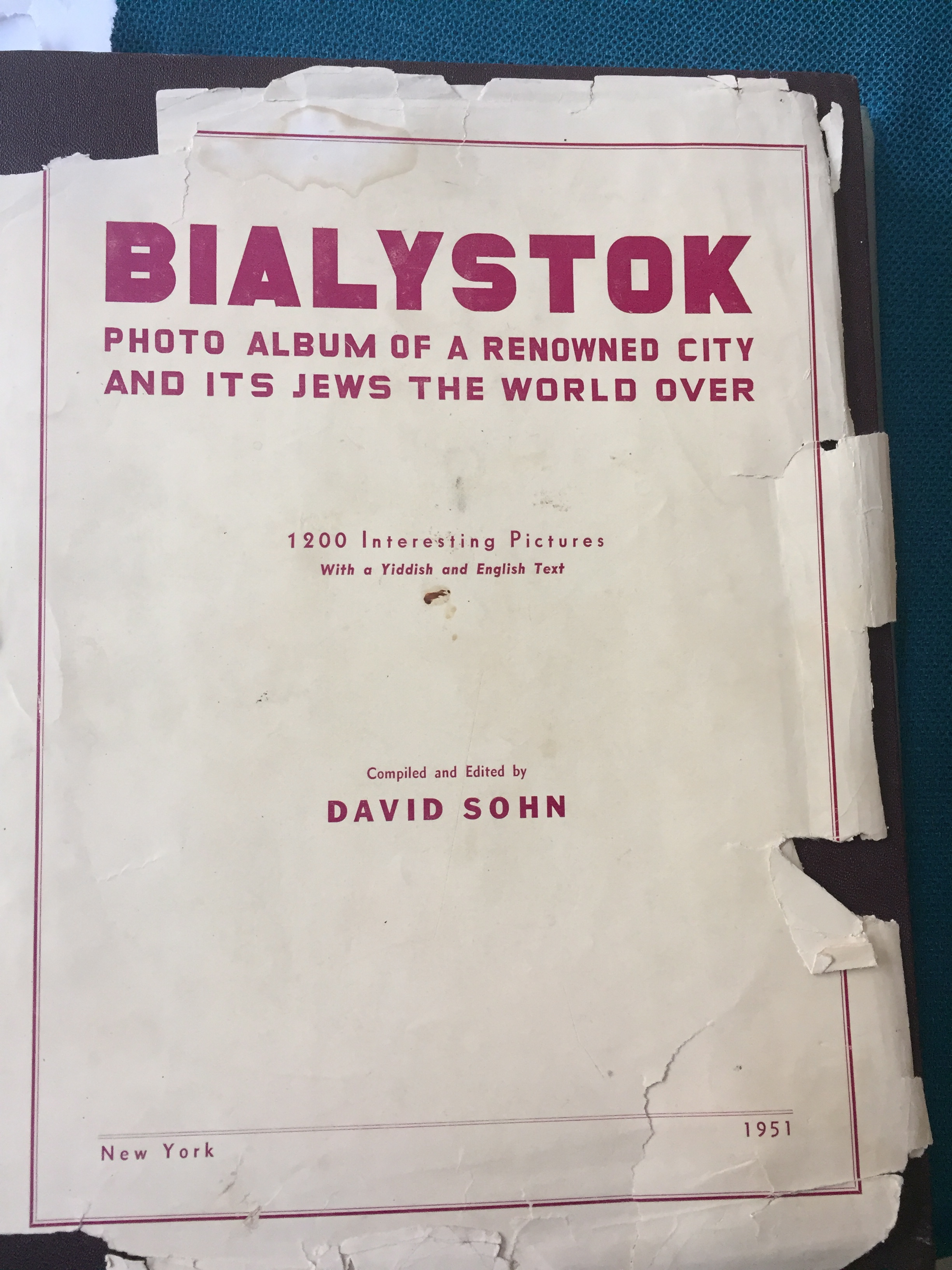
The book's cover is not in great shape, but the book itself is wonderful.

The book’s cover is not in great shape, but the book itself is wonderful.

Among the items that became part of my custodial responsibility was the book: Bialystok Photo Album of a Renowned City and Its Jews The World Over. Compiled and Edited by David Sohn, in 1951. The book attempts to show life in Bialystok before World War II; information about the Holocaust and the 60,000 Jews from Bialystok who were murdered; and show that life continued for those who survived and who lived throughout the Disapora. One two-page spread is so emotional as it lists the horrible events that happened to the Jews of Bialystok during the Shoah.

Two important pages.

Two important pages.

My great grandparents, Louis Goldman (Baruck Lev Litwack) and his wife, Ray Goldman (nee Rachel Wolff) were extremely active in the Bialystok society in New York City and were part of the large number of landsmen from Bialystok who helped to create the Bialystok Home for the Aged in NYC.

Although my Great Grandfather died in 1941, my family was still active in the Bialystok organizations in NYC. And my Great Grandmother Ray continued in a leadership role after her husband’s death.

I had placed this book in a pile of other books about Europe, but had not really searched through it for a while. I know I looked at it when we cleaned out our parent’s apartment and kept it as something worth investigating. But it went to the side as I dealt with other issues.

This week I decided to really look at it and see what I could fine. Thanks to my Aunt Leona, who passed away just four years ago, I did not have to look far. There was a handwritten note from my Aunt, with page numbers and identifications. I loved my Aunt Leona.

My Great Great Grandfather, a leading baker.

My Great Great Grandfather, a leading baker.

My Great Great Grandmother.

My Great Great Grandmother.

Photos of one set of my paternal great great grandparents are in this book.   Jacob Zev Litwack and Rashe Goldman were the parents of my great grandfather Louis Goldman.   I was a little confused at first because I knew that in Europe my great great grandparents went by the names Yaacov and Rashe Litwack. But I realized that Rashe Goldman could be changed for two reasons. First her maiden name was Goldberg, so this could be a mistake. Also, since her son took the name Goldman when he came to the USA, the name on the photo could just reflect his new name.

Whatever, the case, my Aunt definitely identifies them as her grandfather’s parents.   It is also exciting to see that their occupation is also mentioned: leading bakers.   When my great grandfather came to the USA, he became a tailor.

There are many photos of my Great Grandma Ray. One by herself and several in group shots.   And then there are pages of the “Deceased Leaders of Our Landmanshaft.” On one of those pages is my Great Grandfather Louis. Right there it says, Chairman of Bikur Cholim and a co-founder of the Bialystoker Center and Home for the Aged.

It makes me so proud that my great grandparents were so active in tzedakah and good deeds.   It is a tradition that continues in our family. So many members of my family have been active in volunteer work for the Jewish community. My Dad was the president of his synagogue for 11 years, and served in many volunteer roles throughout his life. My parents were always supporters of the Bialystoker Home, as were my grandparents.

And I like to say that the tradition continues on in my daughter. I think her great great great grandparents would be proud to know that she lives in Israel and works for a non-profit that promotes peace, The Peres Center for Peace.

But there was a surprise. There is another Ray circled in the book. Ray Nosoff. I had not heard that name before. But my aunt’s notes came in handy. Ray Nosoff is the niece of Louis Goldman. Her maiden last name was Kramer and her mother was Louis’ sister. She lived in Brooklyn.   After googling her name on line, I found out that she was born in 1887 and died in 1966 and was buried in Washington Cemetery in New York. Which makes total sense as my great grandparents are also buried there!   I also found the names of her two of her children.

This was exciting, as Louis Goldman was the next great grandparent that I wanted to investigate.   I had already found out much about his wife, Ray Wolff Goldman. But had not much to go on for Louis.

I now know his parents were bakers. His sister also immigrated to the United States and their family was also active in the Bialystok organizations.

I have more investigating to do, but I have started on another genealogy journey thanks to another Bialystok treasure.


To view Ray Wolff Goldman’s family: https://zicharonot.wordpress.com/2015/01/27/serendipity-wins-in-finding-a-family-connection/

Treasures in the Bookcase

16 Aug
Bound Copies of the Bialystoker Stimme from 1922-1941. Several were personalized.

Bound Copies of the Bialystoker Stimme from 1922-1941. Several were personalized.

I honestly thought that we had discovered all the treasures in our Catskills house. Last summer my siblings and I had torn the house apart, filling a 20-cubic yard dumpster with unused and unusable items.   We had discovered a mother lode of photos and a photo album from the 1920s that I am still slowly scanning and finding more information about our maternal grandmother and her family.

But I had forgotten about the old bookcase in the corner of the living room. I actually did not think about it until the very last day we were in the Catskills this summer, when I got a ‘jubba’ as my grandfather would say — a feeling that I had to open the glass door.

My Grandma Esther's bookcase in the corner.

My Grandma Esther’s bookcase in the corner.

We now call it my brother’s bookcase. But in reality it was my paternal grandmother’s and before her it belonged to her parents. Since they lived in the same apartment, there was no real distinction. The bookcase came with the books in it after my Grandma Esther passed away. Over the years, new books were put in and the older books migrated to the bottom shelf.

We have placed it along side the fireplace behind the television. It acts as part of a wall, so that the area behind the fireplace can be used as a bedroom when needed. This semi-room holds an old upright piano, a trundle bed that opens up to two twins, and a computer desk. So we usually do not even think of this piece of furniture as a bookcase, but more of a wall divider.

In any case, my ‘jubba’ called me over to the bookcase about an hour before we were planning to drive home. And inside of it, I found treasures! Nine books containing bound copies of the Bialystoker Stimme from 1922 through 1941, as well as a 45th anniversary book.   My great grandparents, Louis and Rae (Rachel) Goldman, were very active in the Bialyskoker group in New York City that founded the Bialystoker Home for the Aged.   In fact, he was on several important committees and boards.

My great grandfather top right.

My great grandfather top right.

My great grandfather was elected to the board, or re-elected in 1936. Louis Goldman.

My great grandfather was elected to the board, or re-elected in 1936. Louis Goldman.

While just skimming through the bound copies, I found announcements of both my Dad’s and Uncle’s bar mitzvah. These were in English. The Bialystoker Stimmer was printed mainly in Yiddish. But there were also a few English pages or a few English paragraphs in almost every copy. I also found photos of my great grandfather on several pages that announced committee and board members.

His 70th birthday

His 70th birthday

But the best was a photo of him and a paragraph in Yiddish celebrating his 70th birthday. I can read enough Yiddish to recognize his name and a few other words. To be honest, I do not know what it says yet. But I will find out.

That was with just a quick skim. I needed these books.

I told my sister that I had to ship them home and search them. Since we found the books in what is my brother’s bookcase, my sister sent him a text asking if I could ship them to Kansas.

They both agreed that the books should come home with me, as I am acting as the family historian.   I was so excited. It was well worth the $40 I spent at Staples to ship them home.

Today the books arrived!

An article about my great grandfather. I also need to get this translated.

An article about my great grandfather. I also need to get this translated.

As I continued to go through the books, I found what appears an article about him. It, too, is all in Yiddish. I know I will need it translated. I am excited to know what it says about him. I know he was a tailor.

My Dad's first cousin, David, 1938. I think he graduated high school at age 16, but I need a translation.

My Dad’s first cousin, David, 1938. I think he graduated high school at age 16, but I need a translation.

I cannot read all the Yiddish, except really for the names and a few words. But in skimming the books I sometimes see a photo that jumps out at me. Like the one of my Dad’s first cousins, David. Well, it looked like a very young David. I was right, it was him at age 16, when he graduated high school. This article is also in Yiddish. I need a translator!!!

I realize that I will never know if my great grandparents were mentioned in other places. But I am taking photos of every page that has a photo or a mention of my family that I can find.

But besides the book, I posted the photo of my great grandfather Louis Goldman and the small article on the “Tracing the Tribe” Facebook group. I was hoping someone would be able to translate it for me. Although that has not yet happened, I remain hopeful. But someone posted a link to the Bialystoker Center Yahrzeit Cards website. There I found the yahrzeits for my great grandparents, my grandparents and my great aunt. I will say that the Hebrew name for my grandfather is wrong on the site. But it is definitely him. That was also interesting to see.

I started with the books from the 1940s, I am now in the 1920s.  There is much more Yiddish and much less English in these earlier books.  I am hoping to still find more treasures in them.  But to see members of my family mentioned in these early archives makes me so happy.  I knew my great grandfather was an active volunteer.  These books confirm what I had heard.  My heart is happy.

I hope to find a good home for these books after I am done investigating them. There are many other families mentioned in the books.   I do not know how many people saved them.   In our case it was benign neglect. We did not know they were there, so they were just ignored.   And allowed to survive. A happy, lucky find for me and my family.

PS: Thanks to Sabena and her Yiddish teacher who translated the paragraph about my great grandfather:  “Mr. Luis Goldman, has just become a septigenerian (70), and if he himself hadn’t told us, we would certainly not believed it. Mr. Goldman is among the most active people in Sumkh Nuflim (I think that’s a place) in the Center and in the old age home where his work is greatly admired. We wish him a lot of further birthdays with joy in his family.”

PPS:  The Yiddish Book Center in Amherst, MA, would love to have the Bialystoker Stimme books!

http://kehilalinks.jewishgen.org/bialygen/Yahrzeit.htm