Tag Archives: family

What I Learned at a Harry Chapin Concert and Why I am Thankful For the Lesson

26 Nov

I went to my first concert at Drew University to hear Harry Chapin. I had been to musicals on Broadway, opera performances at the Met, and symphony concerts. I had even been in Central Park in 1973 when Carole King gave a free concert. I along with tens of thousands of people packed the park. I really did not see her, but I remember the sights and the sounds.

And of course, I was close to Woodstock in 1969 since it was held just a mile and a half from our summer home. With the acoustics and the hundreds of thousands of people, Woodstock actually came to me. I could feel the ground shake and the music rock from my bungalow. It really was a memorable experience.

But I had never ever been to a ‘rock’ concert before, where I actually could see the performer up close. The Harry Chapin concert at Drew was my first such experience.

I have never forgotten his concert, even though I have been to many concerts since then and have seen performances by many musicians. I do not know how, but I was able to sit near the front of the room with my friends. I don’t know how we squeezed so far forward. Did we have tickets with seat assignments? Who remembers ? All I know is that we had great seats! If we actually sat. I sort of remember standing most of the time.

I do know that Harry Chapin touched my soul that night. He sang, “Cat’s in the Cradle,” among many other songs. But it was this song that has stayed with me throughout my life. Listening to him sing that song made me happy and thankful that my Dad always paid attention to us. My Dad always found time to be with us and give us attention.

At the end of the song when the son does not have time for his father, I teared up. Even though I was not quite 20, I already felt his angst of not connecting.

Although the words of that song made me sad, I loved Harry Chapin’s voice and I loved the story lyrics of his ballads. I became a forever Harry Chapin fan.

I owned his records, and then when records (or vinyls) became obsolete, I purchased his songs on CD and ripped them onto my computer and cell phone.

When I had my own children, I took to my heart the lyrics of “Cat’s in the Cradle.” I always made sure that my husband and I had time with our children. My husband, as a physician, was busy. But he always had time to be in charge of bath time and to read bedtime stories to our children.

It was a tradition that he hated missing when he was out of town. And our children hated when he was gone. My bedtime reading was never good enough because Dad made every character special with a different voice. When he read the Harry Potter books…. All the Harry Potter books… we would all sit in the bedroom to listen to him read. Yes, he even read to us when our children could read the books by themselves. Our daughter would zoom through the books by herself, but still come in to hear my husband read.

He always stopped after one or two chapters and we would beg for more. “Just a little bit more, please.” Sometimes he would give in and read a bit more. But it really was never enough. He was and is a great Dad.

So when my children say, “I’m gonna be like him,” I know that they mean they will be good parents who spend time with their children. Not distant parents who missed the best times of their children’s lives.

Over the years other concerts have made an impression: Paul Simon; Brian Wilson; James Taylor; Peter, Paul and Mary. My husband and I took our children to see Weird Al Yankovic…twice. Two family outings I do not think we will ever forget. (The third time they wanted to go, they were old enough to go without us!)

In the past year I have been to three concerts by some of my favorite ‘oldies’: James Taylor, Neil Diamond, Diana Ross. All of them have songs that I love. And have meaning for me. James Taylor’s “You’ve Got a Friend,” reminds me of the summer I was 16. Diana Ross has many songs I love. And Neil Diamond’s songs make me want to dance.

It is a different feeling when I go to see these concerts. Yes for Diana Ross, we were all on our feet almost the entire concert singing and dancing along. I enjoyed the crowds singing along with Neil Diamond at the Sprint Center in Kansas City and at the wonderful concert at the Starlight Theater to listen to James Taylor.

But nothing compares to that first concert at Drew. The excitement I felt walking from the dorms; the anticipation of being with so many people listening to a favorite singer; the joy of being there and seeing him in person: it was fantastic.

A moment I will never forget mainly due to a song that impacted my life. I was so fortunate not to have a far away father who had no time. I have heard this following many times, “You never hear anyone say I wish I had spent more time at work, rather they say, I wish I had more time with my family.”

I am thankful that in my world family came first.


http://www.azlyrics.com/lyrics/harrychapin/catsinthecradle.html
The Lighthouses That Made Me Feel Safe

22 Nov

When I was a little girl, my family drove every weekend from North Bergen, New Jersey, into New York City to have dinner with my paternal grandparents and my father’s family. We had to drive over the George Washington Bridge and into the Bronx.

My favorite part of this drive was usually on the way home. Then sometimes my Dad would drive in a round about way so we came to a point where we could see the little red lighthouse under the bridge. We did not always see it, but when we did it made me happy!

We had often read the book by Hildegarde Swift, “The Little Red Lighthouse and the Great Gray Bridge.” It was one of my favorites. I loved the story about the lighthouse being happy till the bridge was built, and then had to realize it was still important. I loved that little lighthouse that lives in Washington Park. So those little excursions to see it filled me with joy.

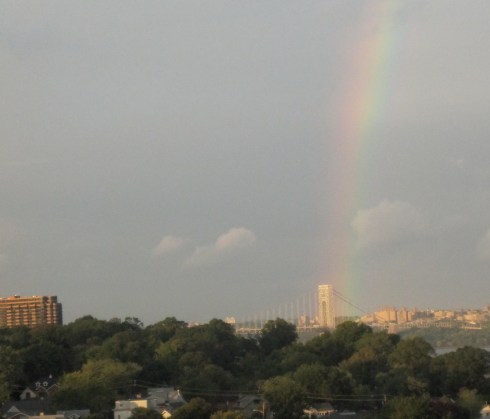
Rainbow and bridge

Near the bottom of the rainbow stands the little red lighthouse. View from my parents apartment.

Even now, whenever I am back east, I try to get a glimpse of the lighthouse. But it is much harder to see from the roads with all the barriers up, unlike the 60s when it was more open.

When my siblings and I were married, my parents moved into an apartment in Cliffside Park. Their view overlooked the Hudson River. From my parent’s apartment we could look north and see the George Washington Bridge and the New York City skyline. Whenever I was there I would try, perhaps through the trees, with binoculars, to see the little red lighthouse.

I really not see it. But I would imagine it sitting across the river just under the bridge, at the end of a rainbow.   In my mind it was always saving people, even though it had not be used in decades. The lighthouse was placed on the National Register of Historic Places in 1979.

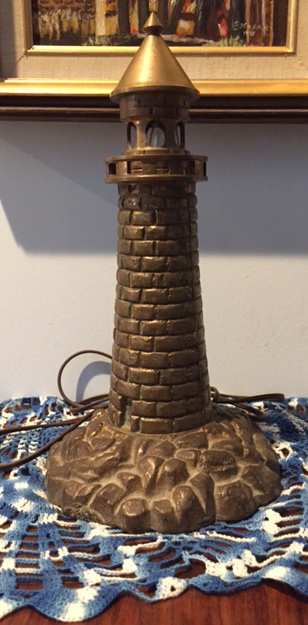
I know it is more than just the book and the adorableness of this little red beacon that made me love lighthouses. Our family had its own attachment to the security a lighthouse provides. My maternal grandparents had a lighthouse nightlight that kept us safe at night in the Catskills.

Lighthouse in the Catskills

The lighthouse nightlight in the Catskills house.

Night in Kauneonga Lake is extremely dark. There are no street lights. And when the night comes and the lights go out…it can be scary for children. Well for adults too, if you do not like the dark. And I do not like the dark!

It was this little lighthouse nightlight that made me feel safe.   It was not the usual nightlight. This heavy brass sculpture has a tiny light bulb in the top that can be switched on and off. Throughout my life, well since about 1964, it sat on a table at the bottom of the stairs. And every night that I spent at my grandparents’ and then my parent’s Catskill home, this lighthouse’s small beacon illuminated the scary dark nights. It was a beacon that kept use all safe. I loved that little lighthouse, as did my siblings and all the grandchildren.

The watchtower nightlight

My watchtower nightlight.

So when my children were little, I also bought a ceramic lighthouse/tower/nightlight that I kept it at the bottom of my stairs, in deference and in honor of the lighthouse I so remembered and loved. My nightlight was not really a lighthouse. It is more of watch tower with a dragon guarding it. But it was the idea of it that made me want to own it and use it in my house. It reminded of my grandparent’s nightlight.

Lighthouse

The Catskills lighthouse in my house.

I now have both nightlights.   After my parents passed away, and we divided some of the belongings, I took the lighthouse back to Kansas with me. I have it sitting on a small half table, just as it sat on a small half table in the Catskills. I have it near the bottom of the stairs. But it is not plugged in anymore. The cord is frayed and I am concerned about the chances of sparks. But I see daily, and I remember the glow of its light.

Across from it is the newer nightlight watch tower. The watch tower is plugged in, but with no children at home, I no longer turn it on. Both lights are out now. But in this troubled time, I still l feel a sense of security when I see a lighthouse and my lighthouse night lights.  I imagine sometimes that they nod to each other and whisper, “we kept them safe.”


https://en.wikipedia.org/wiki/Little_Red_Lighthouse

Making The Chuppah For My Daughter’s Wedding Brings Me Joy

17 Nov

My daughter is getting married in less than ten months now. Although they announced their engagement six months ago, and I should be used to the idea, I am still excited and a bit anxious. I want it to be a beautiful wedding. And I wanted to do something special for her. So I decided I would crochet her chuppah, the wedding canopy.

Cotton thread

The cotton thread which will become the chuppah for my daughter’s wedding.

I am a crazed crocheter. I make doilies and baby blankets out of cotton yarn. Crocheting is how I relax.   For my son’s bar mitzvah, I made over 60 head coverings for the married women who attended the service. Of course we bought kippot for the men. But I wanted the women to have something special as well. And even though his bar mitzvah was 12 year ago, I still occasionally see someone wearing one of the coverings I made at our congregation.

I did not make anything for my daughter’s bat mitzvah. She occasionally would mention to me what I did for my son’s event, and not for hers. But I explained that I was not crocheting as much then. And eventually I would do something for her. The time has come.

When I first suggested making her chuppah, she told me that I did not have to take on such an extensive project. Then she posted a photo of a wedding gown someone crocheted on my Facebook page. It was beautiful. But I knew I could not do that. However, some of my friends (one in particular) went crazy and started sending me lots of Pinterest photos of crocheted wedding gowns.   They were stunning. But with my daughter living out of the country, I thought that would be too difficult.

So this summer I started working on a sample of the chuppah I thought I would make for my daughter to see when she came in to do wedding gown shopping. It was NOT a hit. She did not like the pattern I chose at all. I had to start looking again. She gave me some ideas of what she liked and then left it at that.

But her fiancée was more enthusiastic. His comments included: You can also make all the head coverings: kippot for the men and chapel covers for the women. How about you crochet me a new tallit. That would be great you can make me my tallit. I know how to but the tzitzi on.”

It is traditional for some Jewish families for the bride to buy her husband a tallit before they get married. I bought my husband his tallit.

I was not going to crochet a tallit. OY Gevalt. That was just too much pressure. I would like to say he was teasing to a degree. But I think a bit of him really wanted me to make one. (Actually my daughter says he really wants me to make one….but I do not think so!)

I still might make coverings for the women for the ceremony. But I do not think I am going to crochet all the kippot.

However, I am now working on the chuppah. I found a pattern my daughter likes and approves.   I have started making the squares and crocheting the pattern.   I am about 1/14 of the way. With just nine months to go, I have to keep busy. When my husband and I travel, I take part of the cotton yarn with me and I crochet the inner flower that will be at the center of every square.

Flight delays are a perfect time for heavy duty crocheting.   Volunteering at a registration table also serves as a perfect time for crocheting. Except when people keept asking what I was making and then want to look at it.   It reminds be that thread crocheting is almost a lost art. Many women, young and old, told me about someone that used to know who could crochet as I do, usually their mothers or grandmothers.   And it was my grandmother who taught me over 50 years ago.

They love looking at my work and telling me what their loved one made for them years ago. One woman told be about the veil another woman made for her daughter…a crocheted veil.   My heart is going there as well. But my brain says, STOP!

I get a bit anxious when I am sitting at a meeting and not crocheting. I feel like I should bring it everywhere with me. But would that be rude?   I am under a time crunch. And I want it to be perfect.

I will be honest, the chuppah I crochet will not be the only canopy over my daughter and her future husband.   We have the final tallit my Dad wore. When he passed away we buried two tallisim with him: his bar mitzvah and wedding ones. But this one we kept as our Mom purchased it especially when he became president of his shul. My son now uses it for services. But we (my siblings and I) agreed it would be used as part of the wedding chuppah for each of the grandchildren.

The beauty of the chuppah I am making is that after the wedding, it can be used as a tablecloth. It will have a life after the wedding.   I hope whenever they use it they will feel my love surround them and their marriage.

For now, all my other projects are on hold! I will stop making baby blankets and doilies. Well that is my plan, except people I know keep having babies. So perhaps I will have to sneak a few in.

And it is possible, just possible, I might have to add some crochet elements for my daughter’s veil. We will see.

In the meantime, I am making the chuppah for my daughter’s wedding, which brings me joy.

img_9903

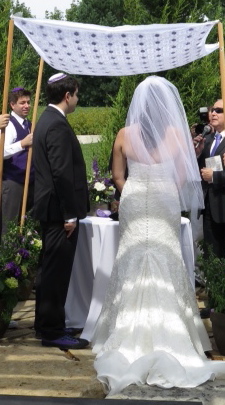
My daughter and son-in-law under the huppah I made.


Chuppah: wedding canopy

Kippot: head covering

Tallit: prayer shawl

Tzitzi: Fringes on the four courners of a tallit


https://zicharonot.wordpress.com/2014/02/13/knitting-and-crocheting-brings-love-and-memories/

https://zicharonot.wordpress.com/2014/12/25/i-am-proud-to-be-a-cotton-thread-yarn-addict/

Museums Help Me Honor Our Relatives Who Served on Veterans’ Day

10 Nov

On November 11, every year I go over to the Korean War Memorial that was established just about a mile from my home. Years ago I put a stone in the memorial for my Dad who served in Korea as a forward observer.

A portion of the Korean War Memorial in Kansas.

A portion of the Korean War Memorial in Kansas.

The truth is my Dad loved military history. He loved reading about the Civil War, World War 1 and World War 2. I have visited many museums just to see them and to think about my Dad. In Kansas City we are fortunate to have the National World War One Museum and Liberty Memorial. It was remodeled over five years ago. My husband and I went to check it out to see if my Dad would be able to navigate its halls and exhibits. We thought he would love it. Unfortunately my Dad passed away before we could take him there.

We are also fortunate to have two presidential libraries nearby that also speak about our country’s efforts in war. We have been to the President Truman Library in Independence, Missouri, and the Eisenhower Library in Salina, Kansas.  Both have significant information about the Second World War and dedicate a portion of the libraries to the presidents involvement and service.

About 14 years ago I went to the National World War Two Museum in New Orleans. I took my children with me; they were then 15 and 11. We walked through the entire exhibit. That day there was a special ceremony in the lobby as veterans were being presented awards. The entire time we were there, we spoke about how much Grandpa would love this museum! I bought my Dad a book and some other memorabilia from the museum. I know he wanted to see it one day.

We also visited a small Civil War museum in New Orleans, called the Confederate Memorial Hall Museum. It has been a part of New Orleans since 1891. This small museum supposedly houses the second largest collection of Civil War items. Dad would have loved it as well.

I have been to Hawaii and visited the USS Arizona Memorial and seen the droplets of oil floating to the surface of Pearl Harbor, like droplets of tears still escaping. I have walked through the USS Missouri and saw the spot where the treaty that ended the Pacific War was signed.

I have visited military cemeteries: Arlington National Cemetery, The National Memorial Cemetery of the Pacific, and the Ft. Leavenworth National Cemetery. I have seen my father buried with full military honors including a flag-draped coffin, the folding and presentation of the flag and a serviceman on the bugle playing Taps.

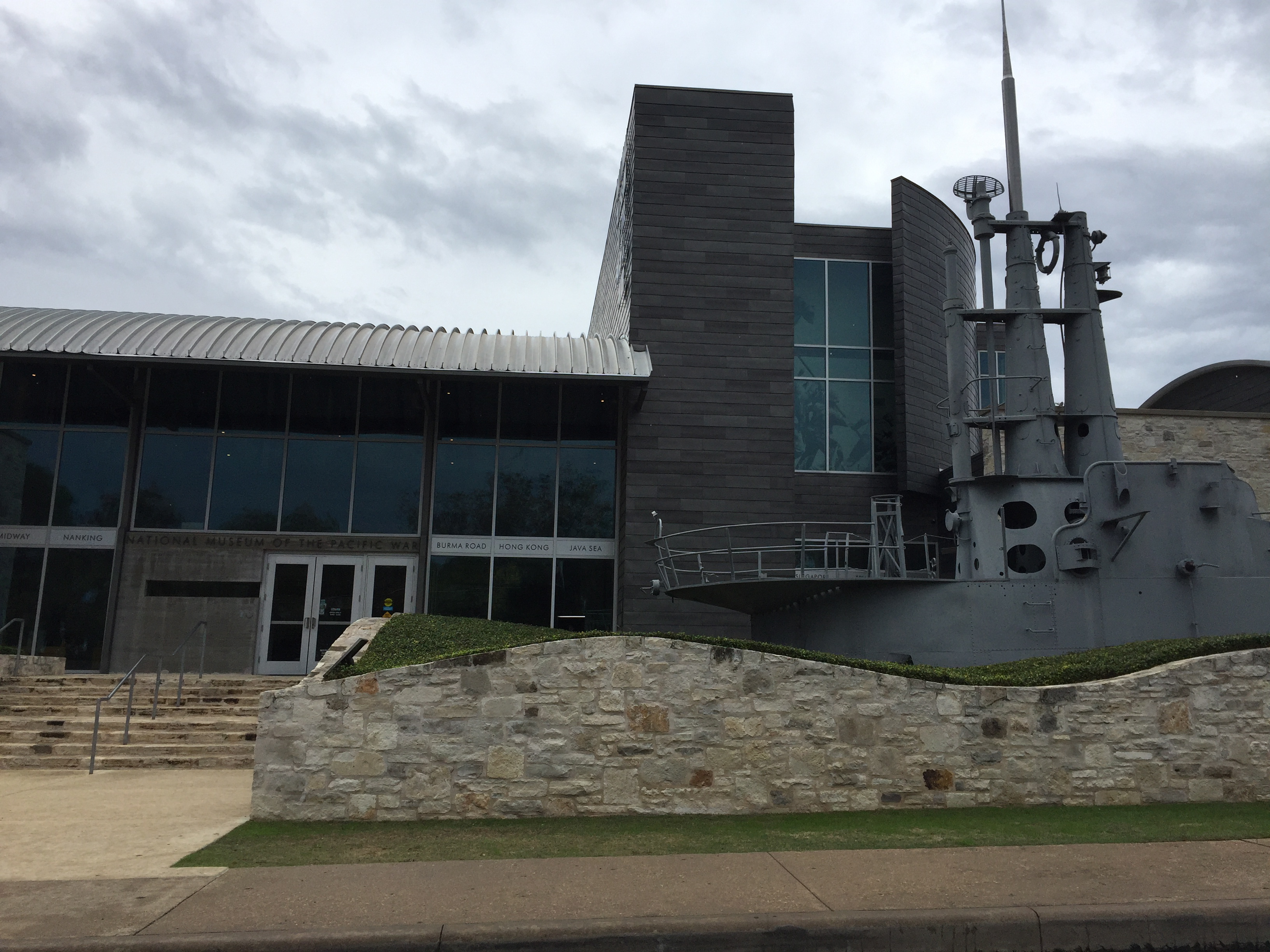
The Museum of the Pacific War in Fredericksburg, Texas.

The Museum of the Pacific War in Fredericksburg, Texas.

This weekend in my continued efforts to honor veterans and their service, I spent a day in Fredericksburg, Texas. I was in San Antonio for a meeting with my husband. A good friend picked me up from the hotel for this field trip to the National Museum of the Pacific War. Who knew it even existed! We wandered through the halls and learned about what was happening in China and Japan that led to their entrance into the war. We saw planes and submarines.   A replica of the atomic bomb hangs from one of the ceilings.

I saw information about Manila and the infamous Bataan Death March. That stands out in my memory as my husband’s Aunt Grace was one of the nurses in Bataan. She was one of the few who were evacuated from the island on a submarine and so did not have to suffer through the march and the horrible internment. I was able to show my friend the book, We Band of Angels, which features two pictures of Aunt Grace in group photos.

The walkway memorial to presidents.

The walkway memorial to presidents.

We then walked through a memorial to our country’s presidents to the Nimitz Hotel founded by the family of Admiral Chester Nimitz. It is now a museum honoring his memory and his work as the Admiral of the Pacific Fleet. I believe I honored those who serve by visiting these museums.

And always on Veterans’ Day I think of my Dad, who served in Korea. My Uncles Bernie and Stanley who served in World War Two; My husband’s Uncles Ben and Fred who were military physicians in World War Two; His Uncle Richard who served in Korea; and his Aunt Grace and Aunt Florence who were nurses in World War Two. My husband’s grandfather served in World War 1. And not to leave anyone out, I also think of my husband’s and my cousins who served in all of these wars including Vietnam.

Museums do not tell the full story. They cannot transmit the heartache that follows a person throughout their life because of the things they saw, the odors they smelt, the lives that were lost and the changes it caused in their psyche. But for me to visit these museums, I feel I am showing respect for the sacrifices these veterans made for all of us. I am proud there are so many veterans in our family!

“Who are you?” These Photos Call Out to Me

3 Nov

I look through this photo album and I cringed. There are so many unnamed children and adults. Did they survive? How are they related? Who are you? Who ARE you?

For some I am fortunate, there are names written on the back of the photos in English, or German or Yiddish. And someone can translate the names for me. The English ones are easy, I usually know who they are and how they are related. Some are photos of people I knew about, but had not seen.  Some I post on Tracing the Tribe Facebook group to see if someone can translate the words written on the backs for me.

Others are photos of people now identified as a cousin. But I have no idea who they are? How they are related? Or what happened to them during or perhaps after the Shoah? The photos are from the 1920s and 1930s in Europe. It is almost painful to look at these photos because I do not know what happened.   And I imagine the worst. I only can look at a few photos at a time.

My grandmother's first cousin, Dora, and her husband. My grandmother’s first cousin, Dora, and her husband.

The ones I know give me a chill.   I see one of a couple, Dora and Max, from what I think is their wedding in 1924. Oh My. I met Dora in Israel in 1975 when I took my Grandma Thelma to Israel to see her brother and family.   She had not seen her brother since 1932, over 40 years. Much had happened to them and to their family.

While in Israel on this trip, I met many family members who came specifically to see my grandmother. Although I had lived in Israel and gone to college there for a year, I had not met these people before.

But really of the new family members I met, I remember Dora and her daughter the best.   I still l can hear her daughter asking me all sorts of questions about my grandmother. When I questioned her, she responded saying basically, “Look I am told that this Thelma is my mother’s first cousin. My mother lost so much in the war, I want to be sure who she is before I bring her to see this Thelma.”

And so I answered the questions. The answers were right. My grandmother and Dora were first cousins. They had not seen each other also in over 40 years.

They spoke only in Yiddish.

I will never forget their meeting. I will never forget the tears and the pain as Dora told my grandmother what had happened. I will never forget seeing them sit together on the couch in our room holding hands and crying. Dora’s daughter, who was the age of my mother, handing them tissues. I was overwhelmed. I was just 20, and this was beyond my abilities to cope. I sat and I listened and I watched.

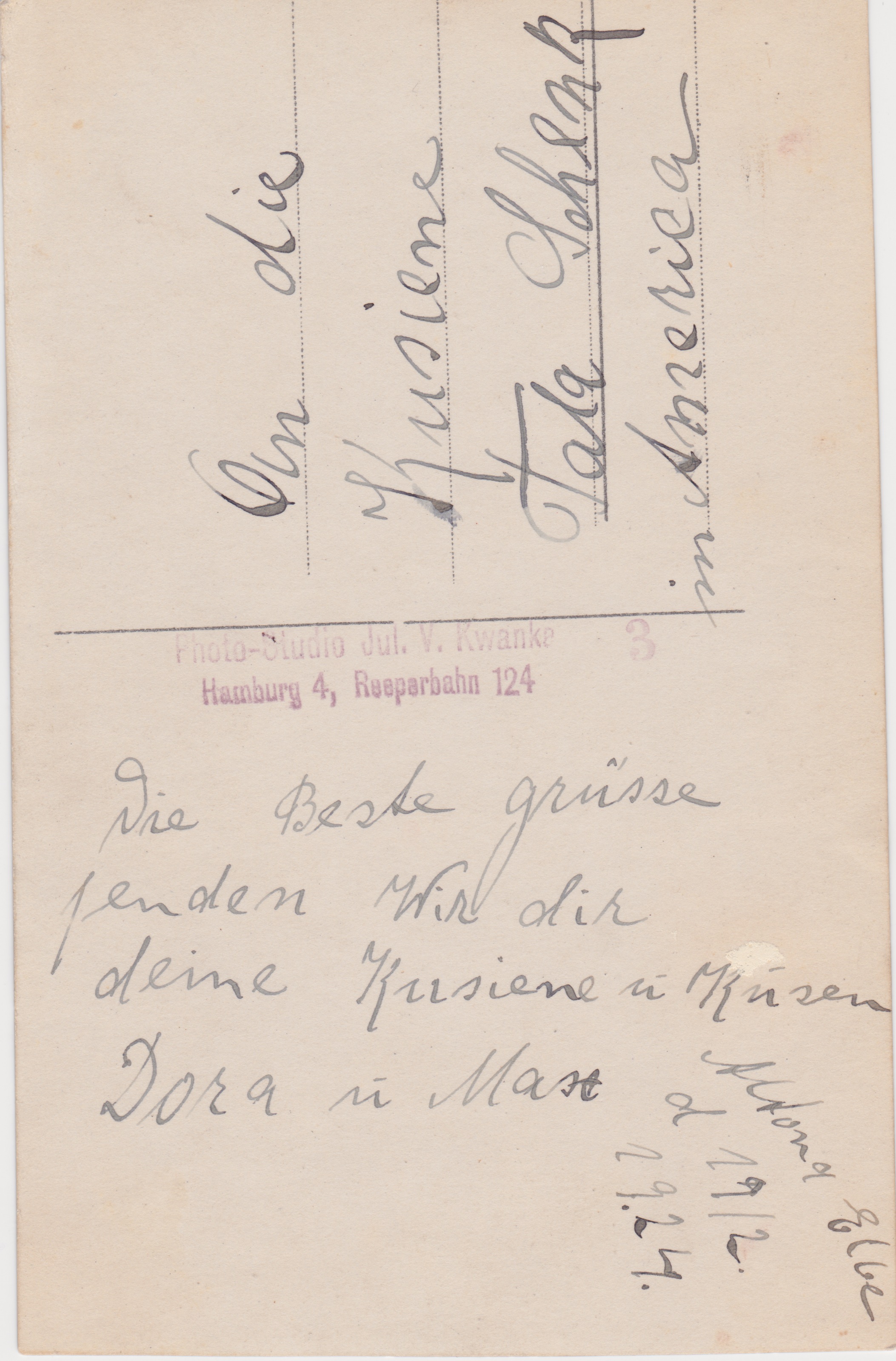
The back of the photo with the inscription. The back of the photo with the inscription.

So to open this album and see a photo of Dora and her husband from 1924 almost breaks my heart. A photo inscribed to my grandmother: “Die Kusiene Taba Schenk in America, Die Beste grusse fenden wir dir deine kusiene   Dora and Max 11/2/1924.”

Taba Schenk, Tova Szenk, my grandmother’s maiden name. My grandparents married a few months later, and my grandmother became Tova/Thelma Amsterdam.

In the photo, Dora is a young woman, but she looks just like the woman I met so many years ago in a hotel in Tel Aviv. She is not as old of course. But the face is the same. She is cleared eyed holding on to a long strand of pearls, her husband sitting next to her.
Dora’s life changed with the war.   But she survived. She had children and grandchildren. And eventually reunited for a visit with her kusiene Tova.

About the photo album:

https://zicharonot.wordpress.com/2014/08/19/old-photographs-bring-memories-to-life/

https://zicharonot.wordpress.com/2015/06/13/finding-katie/

An earlier post about the trip to Israel with my Grandma:  https://zicharonot.wordpress.com/2014/04/28/speaking-yiddish-always-brings-me-holocaust-memories/

Another Bialystok Treasure Investigated

21 Oct
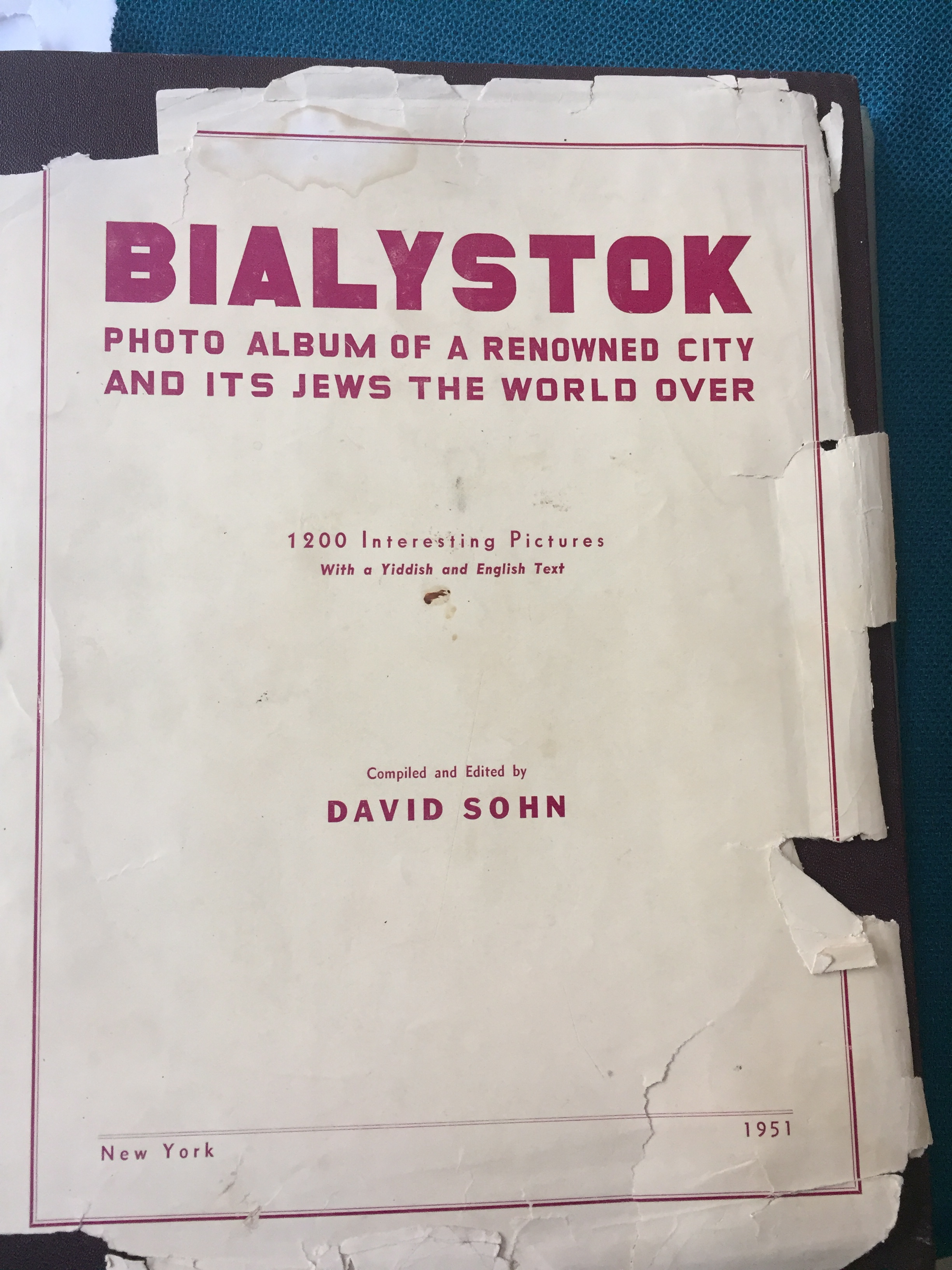
The book's cover is not in great shape, but the book itself is wonderful.

The book’s cover is not in great shape, but the book itself is wonderful.

Among the items that became part of my custodial responsibility was the book: Bialystok Photo Album of a Renowned City and Its Jews The World Over. Compiled and Edited by David Sohn, in 1951. The book attempts to show life in Bialystok before World War II; information about the Holocaust and the 60,000 Jews from Bialystok who were murdered; and show that life continued for those who survived and who lived throughout the Disapora. One two-page spread is so emotional as it lists the horrible events that happened to the Jews of Bialystok during the Shoah.

Two important pages.

Two important pages.

My great grandparents, Louis Goldman (Baruck Lev Litwack) and his wife, Ray Goldman (nee Rachel Wolff) were extremely active in the Bialystok society in New York City and were part of the large number of landsmen from Bialystok who helped to create the Bialystok Home for the Aged in NYC.

Although my Great Grandfather died in 1941, my family was still active in the Bialystok organizations in NYC. And my Great Grandmother Ray continued in a leadership role after her husband’s death.

I had placed this book in a pile of other books about Europe, but had not really searched through it for a while. I know I looked at it when we cleaned out our parent’s apartment and kept it as something worth investigating. But it went to the side as I dealt with other issues.

This week I decided to really look at it and see what I could fine. Thanks to my Aunt Leona, who passed away just four years ago, I did not have to look far. There was a handwritten note from my Aunt, with page numbers and identifications. I loved my Aunt Leona.

My Great Great Grandfather, a leading baker.

My Great Great Grandfather, a leading baker.

My Great Great Grandmother.

My Great Great Grandmother.

Photos of one set of my paternal great great grandparents are in this book.   Jacob Zev Litwack and Rashe Goldman were the parents of my great grandfather Louis Goldman.   I was a little confused at first because I knew that in Europe my great great grandparents went by the names Yaacov and Rashe Litwack. But I realized that Rashe Goldman could be changed for two reasons. First her maiden name was Goldberg, so this could be a mistake. Also, since her son took the name Goldman when he came to the USA, the name on the photo could just reflect his new name.

Whatever, the case, my Aunt definitely identifies them as her grandfather’s parents.   It is also exciting to see that their occupation is also mentioned: leading bakers.   When my great grandfather came to the USA, he became a tailor.

There are many photos of my Great Grandma Ray. One by herself and several in group shots.   And then there are pages of the “Deceased Leaders of Our Landmanshaft.” On one of those pages is my Great Grandfather Louis. Right there it says, Chairman of Bikur Cholim and a co-founder of the Bialystoker Center and Home for the Aged.

It makes me so proud that my great grandparents were so active in tzedakah and good deeds.   It is a tradition that continues in our family. So many members of my family have been active in volunteer work for the Jewish community. My Dad was the president of his synagogue for 11 years, and served in many volunteer roles throughout his life. My parents were always supporters of the Bialystoker Home, as were my grandparents.

And I like to say that the tradition continues on in my daughter. I think her great great great grandparents would be proud to know that she lives in Israel and works for a non-profit that promotes peace, The Peres Center for Peace.

But there was a surprise. There is another Ray circled in the book. Ray Nosoff. I had not heard that name before. But my aunt’s notes came in handy. Ray Nosoff is the niece of Louis Goldman. Her maiden last name was Kramer and her mother was Louis’ sister. She lived in Brooklyn.   After googling her name on line, I found out that she was born in 1887 and died in 1966 and was buried in Washington Cemetery in New York. Which makes total sense as my great grandparents are also buried there!   I also found the names of her two of her children.

This was exciting, as Louis Goldman was the next great grandparent that I wanted to investigate.   I had already found out much about his wife, Ray Wolff Goldman. But had not much to go on for Louis.

I now know his parents were bakers. His sister also immigrated to the United States and their family was also active in the Bialystok organizations.

I have more investigating to do, but I have started on another genealogy journey thanks to another Bialystok treasure.


To view Ray Wolff Goldman’s family: https://zicharonot.wordpress.com/2015/01/27/serendipity-wins-in-finding-a-family-connection/

12 Delancey Street and My Family

10 Oct

My Grandma Esther often talked about Delancey Street. Born in New York City in 1898, she would often regale me with stories about growing up in NYC before there were cars. I knew she had a strong connection to this one street in the Bowery, but I was not sure why.

I always loved the movie, “Crossing Delancey,” because I felt like I knew Delancey Street from my paternal grandmother’s stories. It shows a more modern Delancey Street, but the feel and atmosphere of this ethnic area remains strong in the movie.

Ad about my grandfather's tailor shop. Ad about my grandfather’s tailor shop.

Then this summer I found a wonderful ad in an old Bialystoker Stimme, I found in my parent’s Catskills home. The ad is for my Grandfather’s tailor shop at 12 Delancey Street.  It says in the top right, formally of G & R. The G was for my great grandfather, Louis Goldman.   My Grandpa Harry worked with my great grandfather as a tailor, and eventually married Louis Goldman’s daughter, my Grandma Esther.

I love how the ad is in English and Yiddish.   My great grandparents were from the Bialystoker area of Poland/Russia.  They spoke only Yiddish at home.  In fact my Dad spoke Yiddish as his first language.  So it makes sense that my Grandfather would advertise his business in both languages, especially in this bi-lingual publication.

My Great Grandfather Louis and Great Grandmother Rae in 1894 around the time of their wedding. My Great Grandfather Louis and Great Grandmother Rae in 1894 around the time of their wedding.
Grandpa Harry and Grandma Esther on their engagement in 1921. Grandpa Harry and Grandma Esther on their engagement in 1921.

They not only worked together, my great grandparents, my grandparents and eventually my Dad and his siblings all lived together. With her Dad and her future husband working on Delancey Street, no wonder that my Grandmother had so many stories about being there and what it was like.

She would tell me about the horses, the peddlers and the crowds of people. She told me how you had to be so careful when you crossed the street.   She could even tell me about the first cars that went up and down Delancey and how it would frighten the horses.

Delancey Street was one of the main ‘drags’ in the Lower East Side; an area with shops, restaurants and so many people. To have a store on Delancey Street was wonderful. And the tailor shop was so close to Bowery Street! The street the Bowery Section was named after! I never knew that is where his tailor shop was located. By the time I arrived my Grandfather was long retired, and did most of his sewing in the spare room of their apartment.

I like how the ad mentions all the nearby sites. It is close to a subway stop. Still is. I checked on Google Maps. It was close to Christie Street, a misspelling as on Google Maps it is written as Chrystie Street, with a ‘y’ not an ‘I’. But who knows, back in the 1930s it was spelled with an ‘I.’

Google Maps also let me see that there is now a bar in the building where the tailor shop was located. The bar covers both 10 and 12 Delancey Street. I am not sure how my grandparents would feel about that. But I am sure it is still the same building!

Just a few doors from my Grandfather’s tailor shop was the Bowery Ballroom. This building was completed in 1929 and stood empty for some time, but eventually became a high quality store…so close to my grandfather’s tailor shop.

Further down Delancey Street was Ratner’s kosher dairy restaurant. I remember going to Ratner’s with my parents and grandparents. But perhaps we went to the one on Second Avenue, and not the one on Delancey Street. I cannot imagine we would have gone there and my Grandmother not pointing out where the tailor shop had been located.

The wonderful Tenement Museum at 97 Orchard Street is just off Delancey Street as well. It is just a few blocks from the tailor shop. I wonder if the people who lived there visited my great grandfather or grandfather and their shop? It is possible. My great grandfather was born probably in the early 1870s and married my great grandmother Rae in 1894. My grandfather was born in 1889. I am not sure when the store opened on Delancey Street, but it was there in the early part of the 20th Century.

My Grandpa Harry was a great tailor! When I studied sewing in high school, it was my Grandpa who taught me how to match plaids and how to make pockets perfectly. He taught me about French seams and other important sewing techniques.

When my grandparents moved from their three-bedroom apartment into a much smaller place in Co-op City, I was distressed to learn they had given away his old treadle sewing machine. But since I had no space for it, I guess it had to go. It should have gone to a museum. This was the last connection to the tailor shop.

In the end it does not matter. The most important information for me is the fact that the tailor shop was on Delancey Street! Now I can let my imagination run wild. I can watch “Crossing Delancey” with different eyes. Looking for the location of my family’s tailor shop. And thinking about Delancey Street and my family.

A blog about finding the Bialystoker Stimme magazines: https://zicharonot.wordpress.com/2015/08/16/treasures-in-the-bookcase/

A Photo Triggers Driving Memories

7 Oct
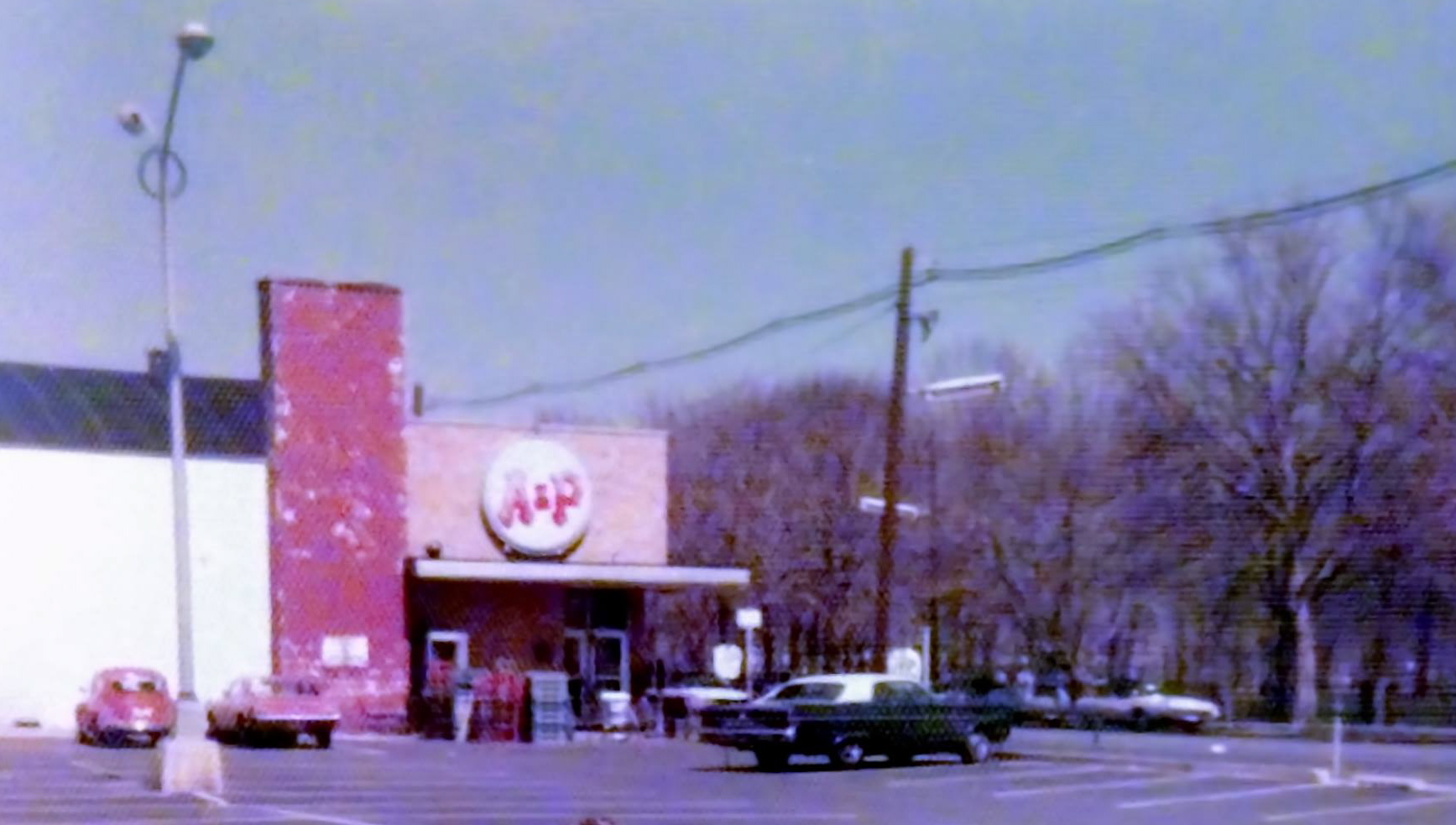
AP parking lot photo from Cindy Bottcher

A&P Parking lot, photo from Cindy Bottcher on the Town of North Bergen Facebook group.

The photograph on the North Bergen Facebook group page brought a flood of memories. It showed the parking lot of the A & P grocery store, a store that has been closed for many years. The photo showed the somewhat empty parking lot and to the left, alone by itself, a single light pole. I know that light pole well!!

It was in 1972. I had recently received my driver’s license. Mom and I went to the grocery store together. At that time the parking lot at the A & P was packed. I easily parked the car in the only empty spot by the light pole. Later when we left the store, Mom once again let me be the driver. As I put the car in gear I made a slight error. I went into drive instead of reverse, and I hit the light pole. It made a dent in the front bumper. My first fender-bender.

I was so upset. I knew my Dad was not going to be very happy about this! I had already had a mishap with the garage door during the summer. My father had told me NOT to attempt to park in the garage when I went driving with my brother in the Catskills. When we return home, I decided to try. My brother did not stop me, so I always sort of blame him. In any case, I misjudged as I entered the garage and off came the car’s side view mirror.

Dad was not happy with me.

So now it was a few months later, and I hit the light pole. My Mom and I looked at the damage. It was not too bad. My Mom was calm. “Better the light pole than another car,” she told me. Then she offered to tell my Dad that she had hit the pole. We agreed that he would be much calmer that way.

So home we went, and my Mom took the responsibility for the accident. The parking lot was busy. She got distracted. She hit the pole. My guilty face probably gave me away. “Who really hit the pole?” My Dad demanded. My Mom kept up the pretense.

A few days later my Dad announced at dinner, that it did not bother him that I hit the pole (ha), but it did bother him that I let my Mom take the blame (This part is true). My Mom still stuck up for me. It was her idea. I just agreed. However, now as an adult I do agree that we should have been truthful…somewhat. My Dad was much calmer a few days later when he actually learned the truth, than he would have been when it happened.

However, I never liked to drive in New Jersey after that. Luckily we had wonderful mass transit. I took buses, trains, subways and taxies wherever I wanted to go.

The following year, when I was a senior in high school, my parents went to India for three weeks. I was in charge of my sister. And I had to drive. We needed groceries. We were invited to friends’ homes for dinner. We had to go to school in the cold winter. I was getting much better and began to lose my fear of driving.

My parents left us with many phone numbers of people who could help in an emergency. Friends and relatives were on call. One of my Mom’s friends called every morning as a back up alarm clock to make sure we got off to school on time. So many people called to invite us for dinner, we never used the meals my Mom had cooked and froze for us.

But for me the most important person was my Dad’s business colleague and friend, Normie P.   One night I took my sister to the movies. We came home, and I forgot to turn the lights off.   The next day the car was dead in the street. We had drained the battery. At the time I did not know that. Normie and his son came and fixed it for us. I will never forget them in their work suits, jump-starting the car. We had to drive to school immediately, but take the long way to recharge the battery.

When I moved to the Midwest for graduate school, I was extremely concerned about driving here. But it was a breeze. The traffic was nothing compared to the traffic in the New York City area and in New Jersey. I drove downtown with ease. I found the perfect place for me to drive. I met my husband, and he let me use his old Buick to do my school assignments. Driving is easy in his opinion.

However, he learned his lessons about New Jersey.  I remember the first time my husband drove in North Bergen and West New York. He continually got stuck behind double-parked cars. I kept telling him to move over.

“What do you mean they are double parked?!” He demanded. “That is illegal.”

“Not here,” I told him.

He thought people in New Jersey were crazy.

We also made him drive into New York City one time. It might have been a bit cruel. But he needed to see what we were talking about.   Growing up in St. Louis, he had never experienced REAL traffic.

For years, when I went home to Jersey, my Dad would drive. As he aged, I had to take over some driving for him. And after my parents passed away, the driving ended as well. My sister or brother do most of the driving for me. I am once again in the passenger seat. I usually do not mind.

To this day, I do not like to drive on the highways of New Jersey. I am fine in the lovely highways of Kansas and Missouri.   I am fine in the local driving of my daily life.

But occasionally I get the urge to drive when I am back East visiting. I decided that Catskill driving is the best for me.   And now I have no problems at all pulling into a garage. It is something I do multiple times a day.

It is amazing what one photo can do for memories. I will always remember that A& P parking lot and light pole.

Honey for Rosh Hashannah and a Sweet, Wonderful Year!

11 Sep
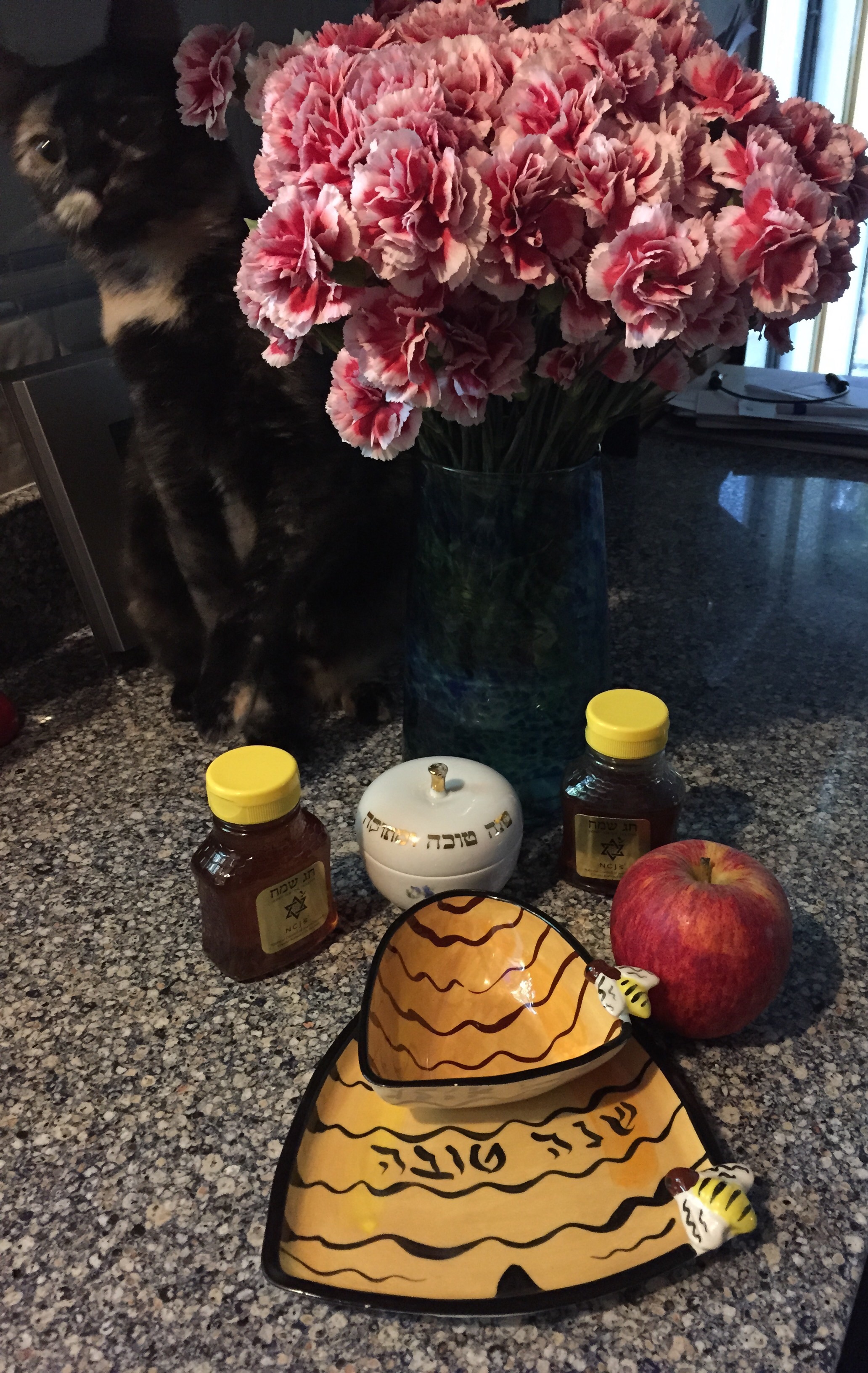
Honey, apples, serving dishes, flowers and my kitten make the holiday sweet and happy.

Honey, apples, serving dishes, flowers and my kitten make the holiday sweet and happy.

We must have honey for Rosh Hashannah: honey for our apples, honey for our challah, honey in our cakes. Honey brings the knowledge that the year will be sweet. And even in times of sorrow, we must think of the happy sweetness of honey.

For over ten years my local section of National Council of Jewish Women has been selling honey for Rosh Hashannah. A dedicated group of women organize this fund raising mitzvah. We enjoy the camaraderie of packing the honey and signing cards. Each year we send out almost 1000 boxes of honey throughout the USA to family and friends.

I enjoy helping with this fundraiser both as a volunteer and as a contributor. It is one good deed, one act of Tzedakah, that I truly enjoy. Each year it seems that I send out more and more honey to my family and friends. Most of the honey I send out goes to people who live far from me. It is a way for me to be part of their holiday experience.

It is a joy to know that these people/families will have honey for the holidays. And they will know that my husband and I are thinking of them.

For many it has become a tradition. I get phone calls and emails asking me if the honey is still coming. Of course it is. I will continue to buy honey as long as NCJW has this fundraiser.

I love getting the thank you emails when the honey arrives. One friend even sent me a photo of her honey in her thanks. Another cousin in California told me that she would definitely be using her honey. From New York I heard “We got your honey! Thank you!” A friend in Massachusetts sent a note that just entitled “Sweetness,” because getting honey is that!

I know getting honey makes people happy, which makes me happy. The recipients know my family and I am sending them love as well as sweetness. We are helping to make their holiday and New Year as wonderful as can be. And sweetness from honey helps.

When my daughter was in college, I sent honey to her and her friends, some who were not even Jewish. They called it the ‘holy honey’ and used it not only for Rosh Hashannah, but also whenever they were feeling sick or blue. Tea and ‘holy honey’ cheered everyone up! What a way to make a year sweet and healthy!

On Rosh Hashannah I take out my special honey and apple set. I actually have several now. The one I used when the children were little looks like a bee hive. They loved it.   I also have the honey bowl my parents used for their holiday. Each year I use them as we dip our apples and challah into honey.

The holiday is soon. My raisin challah and honey cake are ordered. My NCJW honey is ready to be opened. My holiday meals are planned. Whenever I get ready for Rosh Hashannah, I remember celebrating the holidays with my family, with my maternal grandparents.  My grandfather was a baker and his special, round Rosh Hashannah challahs were delicious.  So sweet and so wonderful dipped in honey.

As we celebrate I try to think of all the joy and happiness that is in the world, and block out the sadness. Although we cannot forget what is happening, for this moment in time we celebrate and prepare for the time of forgiveness and repentance. But for now:

L’shana tova u metuka! May you all have a good and sweet year.

Treasures in the Bookcase

16 Aug
Bound Copies of the Bialystoker Stimme from 1922-1941. Several were personalized.

Bound Copies of the Bialystoker Stimme from 1922-1941. Several were personalized.

I honestly thought that we had discovered all the treasures in our Catskills house. Last summer my siblings and I had torn the house apart, filling a 20-cubic yard dumpster with unused and unusable items.   We had discovered a mother lode of photos and a photo album from the 1920s that I am still slowly scanning and finding more information about our maternal grandmother and her family.

But I had forgotten about the old bookcase in the corner of the living room. I actually did not think about it until the very last day we were in the Catskills this summer, when I got a ‘jubba’ as my grandfather would say — a feeling that I had to open the glass door.

My Grandma Esther's bookcase in the corner.

My Grandma Esther’s bookcase in the corner.

We now call it my brother’s bookcase. But in reality it was my paternal grandmother’s and before her it belonged to her parents. Since they lived in the same apartment, there was no real distinction. The bookcase came with the books in it after my Grandma Esther passed away. Over the years, new books were put in and the older books migrated to the bottom shelf.

We have placed it along side the fireplace behind the television. It acts as part of a wall, so that the area behind the fireplace can be used as a bedroom when needed. This semi-room holds an old upright piano, a trundle bed that opens up to two twins, and a computer desk. So we usually do not even think of this piece of furniture as a bookcase, but more of a wall divider.

In any case, my ‘jubba’ called me over to the bookcase about an hour before we were planning to drive home. And inside of it, I found treasures! Nine books containing bound copies of the Bialystoker Stimme from 1922 through 1941, as well as a 45th anniversary book.   My great grandparents, Louis and Rae (Rachel) Goldman, were very active in the Bialyskoker group in New York City that founded the Bialystoker Home for the Aged.   In fact, he was on several important committees and boards.

My great grandfather top right.

My great grandfather top right.

My great grandfather was elected to the board, or re-elected in 1936. Louis Goldman.

My great grandfather was elected to the board, or re-elected in 1936. Louis Goldman.

While just skimming through the bound copies, I found announcements of both my Dad’s and Uncle’s bar mitzvah. These were in English. The Bialystoker Stimmer was printed mainly in Yiddish. But there were also a few English pages or a few English paragraphs in almost every copy. I also found photos of my great grandfather on several pages that announced committee and board members.

His 70th birthday

His 70th birthday

But the best was a photo of him and a paragraph in Yiddish celebrating his 70th birthday. I can read enough Yiddish to recognize his name and a few other words. To be honest, I do not know what it says yet. But I will find out.

That was with just a quick skim. I needed these books.

I told my sister that I had to ship them home and search them. Since we found the books in what is my brother’s bookcase, my sister sent him a text asking if I could ship them to Kansas.

They both agreed that the books should come home with me, as I am acting as the family historian.   I was so excited. It was well worth the $40 I spent at Staples to ship them home.

Today the books arrived!

An article about my great grandfather. I also need to get this translated.

An article about my great grandfather. I also need to get this translated.

As I continued to go through the books, I found what appears an article about him. It, too, is all in Yiddish. I know I will need it translated. I am excited to know what it says about him. I know he was a tailor.

My Dad's first cousin, David, 1938. I think he graduated high school at age 16, but I need a translation.

My Dad’s first cousin, David, 1938. I think he graduated high school at age 16, but I need a translation.

I cannot read all the Yiddish, except really for the names and a few words. But in skimming the books I sometimes see a photo that jumps out at me. Like the one of my Dad’s first cousins, David. Well, it looked like a very young David. I was right, it was him at age 16, when he graduated high school. This article is also in Yiddish. I need a translator!!!

I realize that I will never know if my great grandparents were mentioned in other places. But I am taking photos of every page that has a photo or a mention of my family that I can find.

But besides the book, I posted the photo of my great grandfather Louis Goldman and the small article on the “Tracing the Tribe” Facebook group. I was hoping someone would be able to translate it for me. Although that has not yet happened, I remain hopeful. But someone posted a link to the Bialystoker Center Yahrzeit Cards website. There I found the yahrzeits for my great grandparents, my grandparents and my great aunt. I will say that the Hebrew name for my grandfather is wrong on the site. But it is definitely him. That was also interesting to see.

I started with the books from the 1940s, I am now in the 1920s.  There is much more Yiddish and much less English in these earlier books.  I am hoping to still find more treasures in them.  But to see members of my family mentioned in these early archives makes me so happy.  I knew my great grandfather was an active volunteer.  These books confirm what I had heard.  My heart is happy.

I hope to find a good home for these books after I am done investigating them. There are many other families mentioned in the books.   I do not know how many people saved them.   In our case it was benign neglect. We did not know they were there, so they were just ignored.   And allowed to survive. A happy, lucky find for me and my family.

PS: Thanks to Sabena and her Yiddish teacher who translated the paragraph about my great grandfather:  “Mr. Luis Goldman, has just become a septigenerian (70), and if he himself hadn’t told us, we would certainly not believed it. Mr. Goldman is among the most active people in Sumkh Nuflim (I think that’s a place) in the Center and in the old age home where his work is greatly admired. We wish him a lot of further birthdays with joy in his family.”

PPS:  The Yiddish Book Center in Amherst, MA, would love to have the Bialystoker Stimme books!

http://kehilalinks.jewishgen.org/bialygen/Yahrzeit.htm