Tag Archives: grandparents

Kauneonga Lake Was A Peaceful Winter Wonderland

13 Dec

Unlike many bungalow colony owners, my grandparents eventually moved up to the Catskills to live full time in the 1960s. For a while they kept a small apartment in the building they owned in West New York, NJ, which was above their original bakery. But eventually they sold that building and no longer traveled back to the “city” in the winters.

Their home in Kauneonga Lake was a ‘winter’ home, and not a small bungalow. It was warm and cozy. They would close off the parts of the house they did not use in the winter. It was a bit scary at first when the furnace turned on as we could actually see the flames through an open grill in the floor. After a few years they replaced this antique system and the house was warmer. There was also a beautiful stone fireplace that helped to keep the house warm.

With my mother’s parents in the Catskills, for my family that meant we would have to travel up to the Catskills in the winter time and visit my grandparents. Usually we went when there was a long weekend, or a holiday. We knew that there would be snow and cold. The snow was sometimes several feet deep. We would be spending most of our time indoors playing cards, board games, watching television and talking.

When we did go outside we would bundle up with every scarf and hat we could find. I would double glove my hands for warmth! BRRRR! We often would sled down the hill in the front lawn and sometimes we would walk into town.

The walks to town were special in the winter. We would walk to the lake and then ACROSS the lake into town. The lake was so frozen that people would actually drive their cars across it in the winter months.

I loved walking on the lake.   It was exciting to step out on to what was usually water and sort of skim my feet across the top. Others would ice skate. Some people fished in the lake and cut holes into the ice to reach the moving water where the fish survived the harsh winters.

In later years, my parents kept cross-country skis up at the house for those days when traveling by car was impossible. They would just stay home and ski in the yard and around the area just for the fun and exercise. My memories do not include skiing, although I think my younger sister did some cross country skiing when she visited. ( My sister reminded me that they also had snow shoes, and our mother enjoyed using them in the winter.)

During my freshman year of college, my parents drove up during winter break for an overnight with my grandparents, and left me up there with them. My grandmother was lonely and needed company. That was my job. Keep Grandma entertained for a week or so.

It snowed and snowed and snowed. And even though my grandfather had someone who usually plowed the long driveway, we still had to dig out. I remember that we could not get plowed for several days. So Grandpa decided we would make a one-car lane through the snow.  Did I tell you it was a very long driveway!

We would go out and shovel for 30 or 40 minutes and then go in for something warm to drink or a cup of soup. My grandma was not a great cook, but she made excellent soup. And on a cold day it was beyond delicious.

That year, for the first time in my life, my face broke out in acne. I think it was the stress of being a college student and living away from home for the first time. My grandmother had a solution. In Poland, where she spent her childhood, there were no fancy medicines, there was just natural solutions to acne. And she wanted to try them all on me.

Every time I went outside she would yell out, “Put some snow on your face. It will help.” And every time I walked back in, she would ask if I had put some snow on my face, which I did. But she was making me a bit upset.

My grandfather finally told her to leave me alone. When that did not work, he took action. When we came in after shoveling for a while, he walked in after me. And when Grandma said, “Did you put snow on your face?” He walked right up to her, and rubbed snow all over her face. She laughed hysterically. And he said, “How do you like to have snow on your face! Enough with the snow!“ That was it. She did not bug about snow again.  (I will be honest, the snow did dry out the acne, and helped to clear it up.  But it was so COLD.)

When the weather was nice, we would visit with the few others who braved the winters. My grandparents had several good friends up there, although most went to Florida for the winters. The people who stayed up throughout the year watched out for each other. There was always someone calling to make sure they were okay or if they needed food.

Winters in Kauneonga Lake were so peaceful. I loved the quiet time to read. I loved visiting with my grandparents and hearing their stories. I even loved when my parents and siblings were there as well and we had major snow ball fights outside. Those were not so peaceful. But to see the giant pine trees covered in snow; to see the lake frozen; and to see people helping each other gave me wonderful memories.
My Grandma’s Ledger Books Remind Me of Her Financial Lessons

7 Dec

image

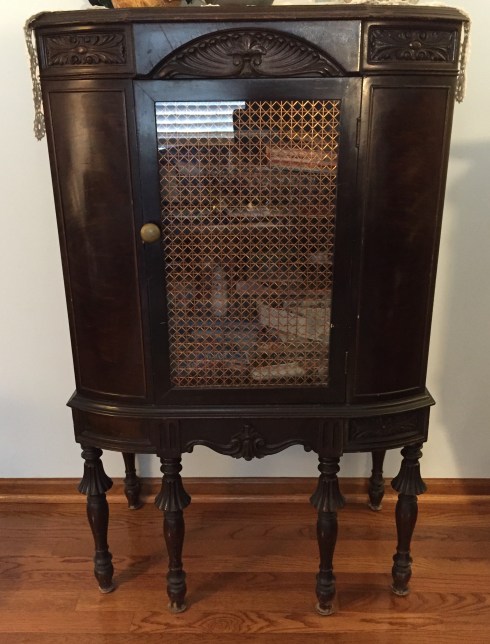
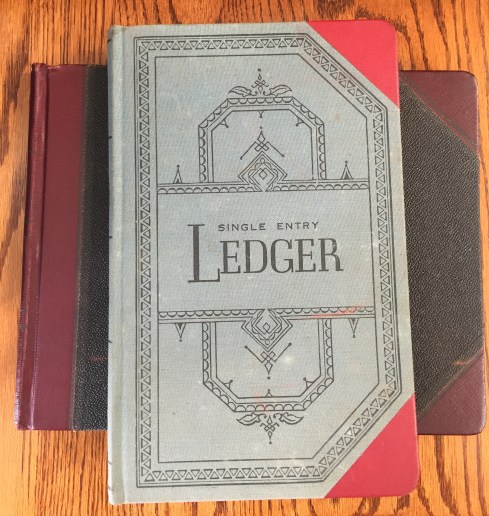
In 1985, when I moved into my house, my mother sent me some of my grandparents’ furniture that had been promised to me. Included in the furniture was an old radio cabinet that had been turned in to a shelved cabinet with the radio removed. Inside the cabinet were some of my grandmother’s ledger books and other items. My Mom had not cleaned it out. She sent it to me filled with the stuff she did not want to deal with by herself.

Thirty years later, I still have the radio cabinet and the ledger books. And at times I look into the books to realize how far my grandparents came in their journey as immigrants. How their strength became part of our lives.

My grandmother came to America by herself from Poland when she was 16 years old. She met my grandfather and married him when she was 19, about 1925.  She went to night school and learned English. They opened a bakery and became successful in business. They also owned a small bungalow colony in the Catskills. They were able to bring some family members over before the Holocaust and they donated to many charities. During the Depression they allowed families to buy food on credit, knowing that they would not be getting anything from many of these families.

My grandfather left Europe when he was 18. His journey to America took two years. He married my grandmother when he was 25. And he had a bakery and owned property.

My grandparents are the American success story. As immigrants who came to the United States with nothing in the early 1920s, they built a good life. The ledgers I found in the old radio cabinet show their desire to save and make their lives and the lives of their children and grandchildren better. The ledgers go from 1959 to 1968 and show every purchase of stock and every bank deposit and interest. It shows how their portfolio grew during these years.

I still remember spending time with my grandmother on what I called her ‘bank tour.’ Grandma Thelma did not totally trust banks. She had lived through the Great Depression. So she kept her money in a variety of banks. And at the end of each month she would take her bank deposit books to each bank to get the interest amount stamped into the book. It was an all day event, with a break for lunch. I remember her showing me my book and letting me see how much I had. She would tell me that you start with a little bit, and it keeps on growing.

Grandma was a true believer in saving your pennies. In fact she saved every silver coin that came into their bakery. When she passed away, we found silver dollars, silver half dollars, silver quarters and silver dimes hidden in every purse and pocketbook and coat pocket in her home. Those were worth more as they aged. More than they would have been worth in a bank. She also had several ‘pushka,’ little hoards of cash hidden around the house.  You never knew when you needed a bit of cash.

image

The ledger books were her way to keep track of every cent they had. She often bought 20, 25 or 50 shares of a stock. She kept records as she bought more or sold a stock that she no longer liked. She wrote down how much each stock was worth when a statement came. There were no computers then, so she kept all her information written in a ledger book.

My grandmother loved to play the stock market. And these ledger books show exactly what she bought, when she bought it and when she sold it for how much. Even the serial numbers of the stock certificates are written in the books.

I love looking at her handwriting. It was excellent when she was young. Every page was organized. And when she sold a stock she would cross it out and write sold across the entry. I can see her analyzing every purchase and sale. Grandma was a force to be reckoned with. I would have hated to be her stock broker!

For example in 1957 she had 25 shares of Con Edison that she purchased for $1123.23.   She sold two shares in 1960 for $156.27 and two shares in 1961 for $100. I am assuming she needed to buy something then, and needed the cash. I cannot understand any other reason to sell just a few shares. But then she sold the rest of her 21 shares in December 1964 for $2019.95. She made money. Altogether she doubled her money! On November 30, 1966, she bought 25 shares again for $857.19. I wonder if she made more. I don’t know if she sold this, or it stayed in my grandparents’ estate. The entries end in 1968. I wonder if she had a new way of keeping track?

I love that she owned 50 shares of the Atchison, Topeka and Santa Fe Railroad, as I live in Kansas. She bought it in January of 1968 for $1469.50. Who knew? She bought many different stocks and bonds. Grandma believed in a diversified portfolio. That is apparent.

Grandma ran the business. And she was smart. Grandpa ran the bakery. He never really learned to read English. So he relied on Grandma to take care of the finances. And she did. She loved to discuss the stock market with certain select people. I think they liked speaking with her as well because she was so knowledgeable.

From my grandmother I learned to be aware of my financial situation. I learned how important it was to save money and invest wisely! I learned that it was correct and smart for any woman to know exactly what the family financial situation was and where all the investments are located. In fact, I learned it was a woman’s right to know.

This has been a guiding force in my life to be honest. As I see other women in situations that are so stressful. Some times due to divorce, sometimes due to the death of a spouse, I have seen women who have no idea where their investments are and how much they really have to support them. My grandmother would have been horrified.

The ledger books filled with my grandmother’s writing and investments are a reminder of my grandparents’ success and their investment in all of our futures.   They were able to leave a financial inheritance to both of their children and a little something to each grandchild. But most of all I am thankful for the lessons on savings, investing and knowledge that my grandmother taught to me.

The Lighthouses That Made Me Feel Safe

22 Nov

When I was a little girl, my family drove every weekend from North Bergen, New Jersey, into New York City to have dinner with my paternal grandparents and my father’s family. We had to drive over the George Washington Bridge and into the Bronx.

My favorite part of this drive was usually on the way home. Then sometimes my Dad would drive in a round about way so we came to a point where we could see the little red lighthouse under the bridge. We did not always see it, but when we did it made me happy!

We had often read the book by Hildegarde Swift, “The Little Red Lighthouse and the Great Gray Bridge.” It was one of my favorites. I loved the story about the lighthouse being happy till the bridge was built, and then had to realize it was still important. I loved that little lighthouse that lives in Washington Park. So those little excursions to see it filled me with joy.

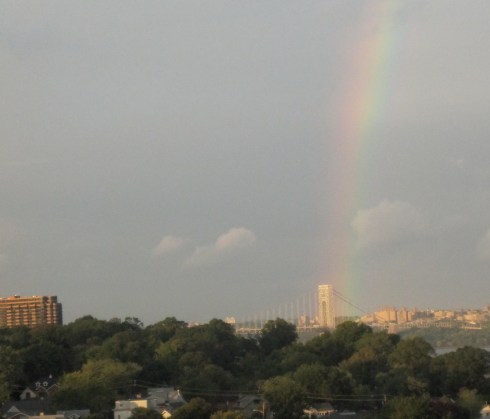
Rainbow and bridge

Near the bottom of the rainbow stands the little red lighthouse. View from my parents apartment.

Even now, whenever I am back east, I try to get a glimpse of the lighthouse. But it is much harder to see from the roads with all the barriers up, unlike the 60s when it was more open.

When my siblings and I were married, my parents moved into an apartment in Cliffside Park. Their view overlooked the Hudson River. From my parent’s apartment we could look north and see the George Washington Bridge and the New York City skyline. Whenever I was there I would try, perhaps through the trees, with binoculars, to see the little red lighthouse.

I really not see it. But I would imagine it sitting across the river just under the bridge, at the end of a rainbow.   In my mind it was always saving people, even though it had not be used in decades. The lighthouse was placed on the National Register of Historic Places in 1979.

I know it is more than just the book and the adorableness of this little red beacon that made me love lighthouses. Our family had its own attachment to the security a lighthouse provides. My maternal grandparents had a lighthouse nightlight that kept us safe at night in the Catskills.

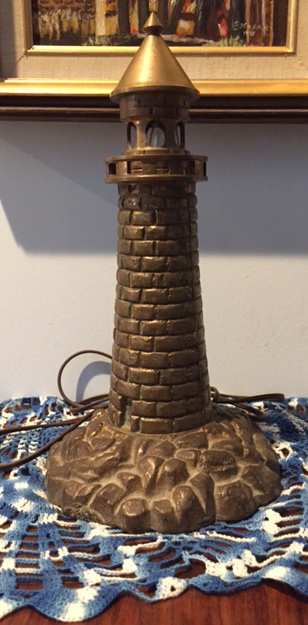
Lighthouse in the Catskills

The lighthouse nightlight in the Catskills house.

Night in Kauneonga Lake is extremely dark. There are no street lights. And when the night comes and the lights go out…it can be scary for children. Well for adults too, if you do not like the dark. And I do not like the dark!

It was this little lighthouse nightlight that made me feel safe.   It was not the usual nightlight. This heavy brass sculpture has a tiny light bulb in the top that can be switched on and off. Throughout my life, well since about 1964, it sat on a table at the bottom of the stairs. And every night that I spent at my grandparents’ and then my parent’s Catskill home, this lighthouse’s small beacon illuminated the scary dark nights. It was a beacon that kept use all safe. I loved that little lighthouse, as did my siblings and all the grandchildren.

The watchtower nightlight

My watchtower nightlight.

So when my children were little, I also bought a ceramic lighthouse/tower/nightlight that I kept it at the bottom of my stairs, in deference and in honor of the lighthouse I so remembered and loved. My nightlight was not really a lighthouse. It is more of watch tower with a dragon guarding it. But it was the idea of it that made me want to own it and use it in my house. It reminded of my grandparent’s nightlight.

Lighthouse

The Catskills lighthouse in my house.

I now have both nightlights.   After my parents passed away, and we divided some of the belongings, I took the lighthouse back to Kansas with me. I have it sitting on a small half table, just as it sat on a small half table in the Catskills. I have it near the bottom of the stairs. But it is not plugged in anymore. The cord is frayed and I am concerned about the chances of sparks. But I see daily, and I remember the glow of its light.

Across from it is the newer nightlight watch tower. The watch tower is plugged in, but with no children at home, I no longer turn it on. Both lights are out now. But in this troubled time, I still l feel a sense of security when I see a lighthouse and my lighthouse night lights.  I imagine sometimes that they nod to each other and whisper, “we kept them safe.”


https://en.wikipedia.org/wiki/Little_Red_Lighthouse

“Who are you?” These Photos Call Out to Me

3 Nov

I look through this photo album and I cringed. There are so many unnamed children and adults. Did they survive? How are they related? Who are you? Who ARE you?

For some I am fortunate, there are names written on the back of the photos in English, or German or Yiddish. And someone can translate the names for me. The English ones are easy, I usually know who they are and how they are related. Some are photos of people I knew about, but had not seen.  Some I post on Tracing the Tribe Facebook group to see if someone can translate the words written on the backs for me.

Others are photos of people now identified as a cousin. But I have no idea who they are? How they are related? Or what happened to them during or perhaps after the Shoah? The photos are from the 1920s and 1930s in Europe. It is almost painful to look at these photos because I do not know what happened.   And I imagine the worst. I only can look at a few photos at a time.

My grandmother's first cousin, Dora, and her husband. My grandmother’s first cousin, Dora, and her husband.

The ones I know give me a chill.   I see one of a couple, Dora and Max, from what I think is their wedding in 1924. Oh My. I met Dora in Israel in 1975 when I took my Grandma Thelma to Israel to see her brother and family.   She had not seen her brother since 1932, over 40 years. Much had happened to them and to their family.

While in Israel on this trip, I met many family members who came specifically to see my grandmother. Although I had lived in Israel and gone to college there for a year, I had not met these people before.

But really of the new family members I met, I remember Dora and her daughter the best.   I still l can hear her daughter asking me all sorts of questions about my grandmother. When I questioned her, she responded saying basically, “Look I am told that this Thelma is my mother’s first cousin. My mother lost so much in the war, I want to be sure who she is before I bring her to see this Thelma.”

And so I answered the questions. The answers were right. My grandmother and Dora were first cousins. They had not seen each other also in over 40 years.

They spoke only in Yiddish.

I will never forget their meeting. I will never forget the tears and the pain as Dora told my grandmother what had happened. I will never forget seeing them sit together on the couch in our room holding hands and crying. Dora’s daughter, who was the age of my mother, handing them tissues. I was overwhelmed. I was just 20, and this was beyond my abilities to cope. I sat and I listened and I watched.

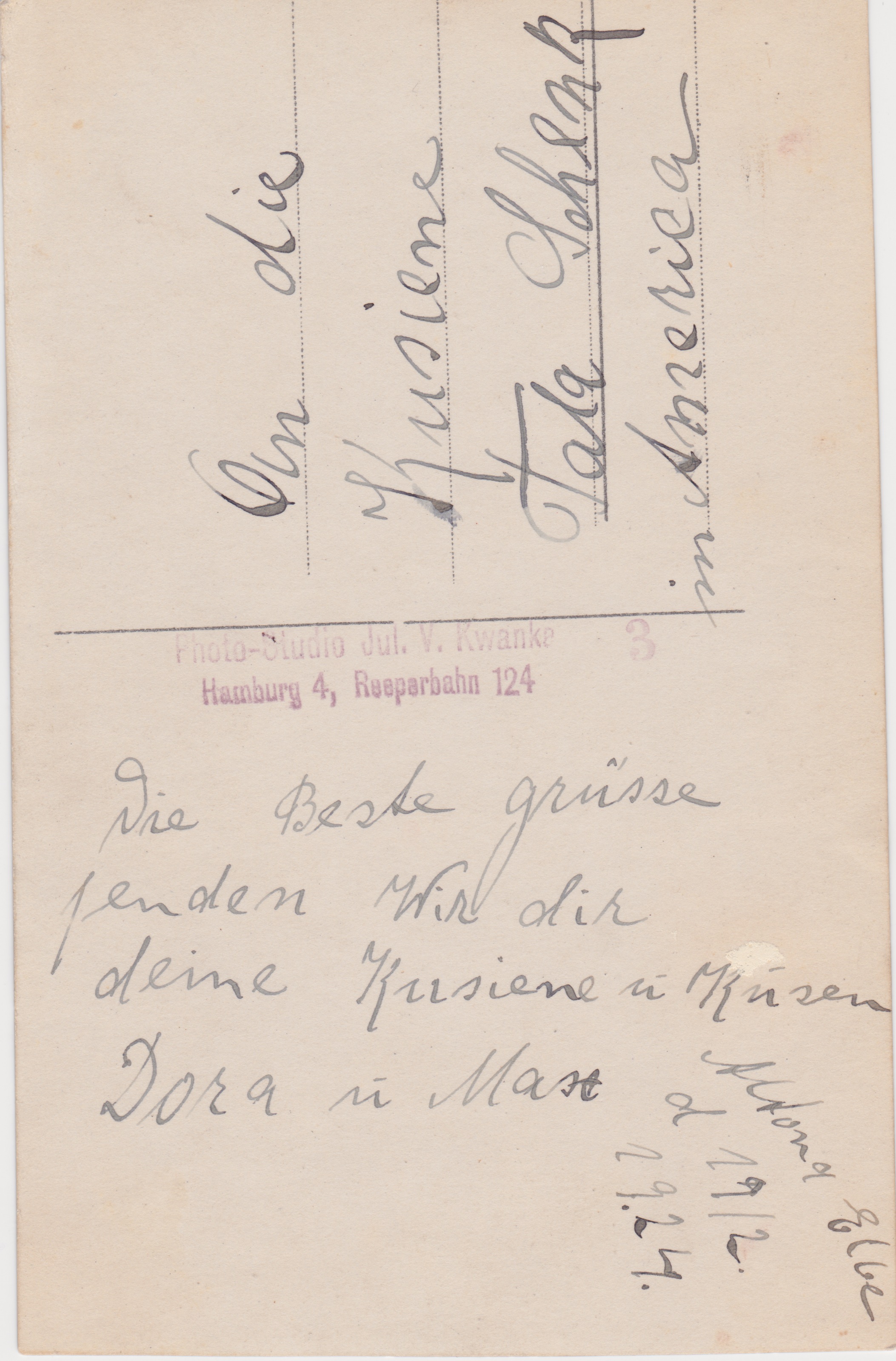
The back of the photo with the inscription. The back of the photo with the inscription.

So to open this album and see a photo of Dora and her husband from 1924 almost breaks my heart. A photo inscribed to my grandmother: “Die Kusiene Taba Schenk in America, Die Beste grusse fenden wir dir deine kusiene   Dora and Max 11/2/1924.”

Taba Schenk, Tova Szenk, my grandmother’s maiden name. My grandparents married a few months later, and my grandmother became Tova/Thelma Amsterdam.

In the photo, Dora is a young woman, but she looks just like the woman I met so many years ago in a hotel in Tel Aviv. She is not as old of course. But the face is the same. She is cleared eyed holding on to a long strand of pearls, her husband sitting next to her.
Dora’s life changed with the war.   But she survived. She had children and grandchildren. And eventually reunited for a visit with her kusiene Tova.

About the photo album:

https://zicharonot.wordpress.com/2014/08/19/old-photographs-bring-memories-to-life/

https://zicharonot.wordpress.com/2015/06/13/finding-katie/

An earlier post about the trip to Israel with my Grandma:  https://zicharonot.wordpress.com/2014/04/28/speaking-yiddish-always-brings-me-holocaust-memories/

Another Bialystok Treasure Investigated

21 Oct
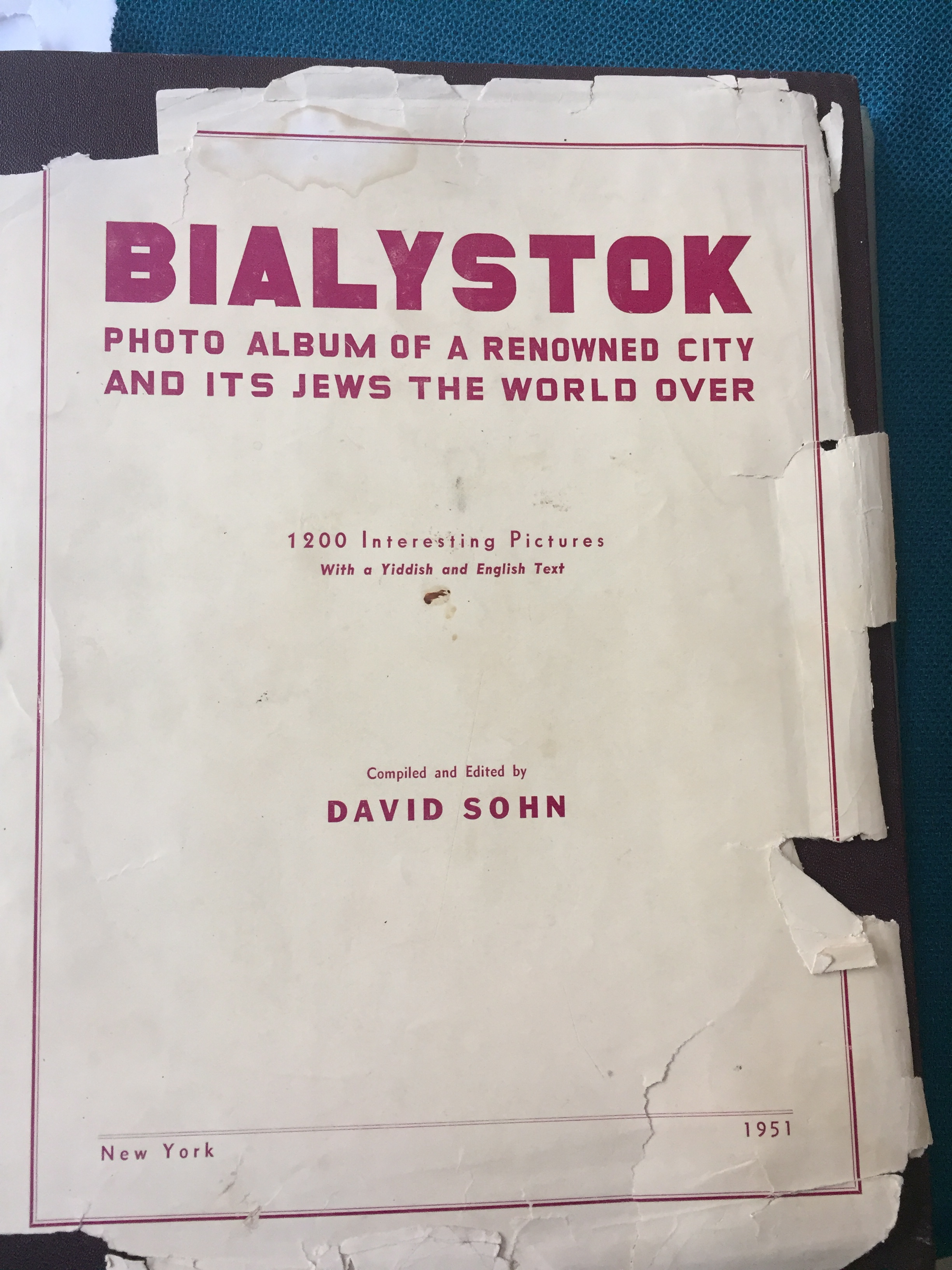
The book's cover is not in great shape, but the book itself is wonderful.

The book’s cover is not in great shape, but the book itself is wonderful.

Among the items that became part of my custodial responsibility was the book: Bialystok Photo Album of a Renowned City and Its Jews The World Over. Compiled and Edited by David Sohn, in 1951. The book attempts to show life in Bialystok before World War II; information about the Holocaust and the 60,000 Jews from Bialystok who were murdered; and show that life continued for those who survived and who lived throughout the Disapora. One two-page spread is so emotional as it lists the horrible events that happened to the Jews of Bialystok during the Shoah.

Two important pages.

Two important pages.

My great grandparents, Louis Goldman (Baruck Lev Litwack) and his wife, Ray Goldman (nee Rachel Wolff) were extremely active in the Bialystok society in New York City and were part of the large number of landsmen from Bialystok who helped to create the Bialystok Home for the Aged in NYC.

Although my Great Grandfather died in 1941, my family was still active in the Bialystok organizations in NYC. And my Great Grandmother Ray continued in a leadership role after her husband’s death.

I had placed this book in a pile of other books about Europe, but had not really searched through it for a while. I know I looked at it when we cleaned out our parent’s apartment and kept it as something worth investigating. But it went to the side as I dealt with other issues.

This week I decided to really look at it and see what I could fine. Thanks to my Aunt Leona, who passed away just four years ago, I did not have to look far. There was a handwritten note from my Aunt, with page numbers and identifications. I loved my Aunt Leona.

My Great Great Grandfather, a leading baker.

My Great Great Grandfather, a leading baker.

My Great Great Grandmother.

My Great Great Grandmother.

Photos of one set of my paternal great great grandparents are in this book.   Jacob Zev Litwack and Rashe Goldman were the parents of my great grandfather Louis Goldman.   I was a little confused at first because I knew that in Europe my great great grandparents went by the names Yaacov and Rashe Litwack. But I realized that Rashe Goldman could be changed for two reasons. First her maiden name was Goldberg, so this could be a mistake. Also, since her son took the name Goldman when he came to the USA, the name on the photo could just reflect his new name.

Whatever, the case, my Aunt definitely identifies them as her grandfather’s parents.   It is also exciting to see that their occupation is also mentioned: leading bakers.   When my great grandfather came to the USA, he became a tailor.

There are many photos of my Great Grandma Ray. One by herself and several in group shots.   And then there are pages of the “Deceased Leaders of Our Landmanshaft.” On one of those pages is my Great Grandfather Louis. Right there it says, Chairman of Bikur Cholim and a co-founder of the Bialystoker Center and Home for the Aged.

It makes me so proud that my great grandparents were so active in tzedakah and good deeds.   It is a tradition that continues in our family. So many members of my family have been active in volunteer work for the Jewish community. My Dad was the president of his synagogue for 11 years, and served in many volunteer roles throughout his life. My parents were always supporters of the Bialystoker Home, as were my grandparents.

And I like to say that the tradition continues on in my daughter. I think her great great great grandparents would be proud to know that she lives in Israel and works for a non-profit that promotes peace, The Peres Center for Peace.

But there was a surprise. There is another Ray circled in the book. Ray Nosoff. I had not heard that name before. But my aunt’s notes came in handy. Ray Nosoff is the niece of Louis Goldman. Her maiden last name was Kramer and her mother was Louis’ sister. She lived in Brooklyn.   After googling her name on line, I found out that she was born in 1887 and died in 1966 and was buried in Washington Cemetery in New York. Which makes total sense as my great grandparents are also buried there!   I also found the names of her two of her children.

This was exciting, as Louis Goldman was the next great grandparent that I wanted to investigate.   I had already found out much about his wife, Ray Wolff Goldman. But had not much to go on for Louis.

I now know his parents were bakers. His sister also immigrated to the United States and their family was also active in the Bialystok organizations.

I have more investigating to do, but I have started on another genealogy journey thanks to another Bialystok treasure.


To view Ray Wolff Goldman’s family: https://zicharonot.wordpress.com/2015/01/27/serendipity-wins-in-finding-a-family-connection/

12 Delancey Street and My Family

10 Oct

My Grandma Esther often talked about Delancey Street. Born in New York City in 1898, she would often regale me with stories about growing up in NYC before there were cars. I knew she had a strong connection to this one street in the Bowery, but I was not sure why.

I always loved the movie, “Crossing Delancey,” because I felt like I knew Delancey Street from my paternal grandmother’s stories. It shows a more modern Delancey Street, but the feel and atmosphere of this ethnic area remains strong in the movie.

Ad about my grandfather's tailor shop. Ad about my grandfather’s tailor shop.

Then this summer I found a wonderful ad in an old Bialystoker Stimme, I found in my parent’s Catskills home. The ad is for my Grandfather’s tailor shop at 12 Delancey Street.  It says in the top right, formally of G & R. The G was for my great grandfather, Louis Goldman.   My Grandpa Harry worked with my great grandfather as a tailor, and eventually married Louis Goldman’s daughter, my Grandma Esther.

I love how the ad is in English and Yiddish.   My great grandparents were from the Bialystoker area of Poland/Russia.  They spoke only Yiddish at home.  In fact my Dad spoke Yiddish as his first language.  So it makes sense that my Grandfather would advertise his business in both languages, especially in this bi-lingual publication.

My Great Grandfather Louis and Great Grandmother Rae in 1894 around the time of their wedding. My Great Grandfather Louis and Great Grandmother Rae in 1894 around the time of their wedding.
Grandpa Harry and Grandma Esther on their engagement in 1921. Grandpa Harry and Grandma Esther on their engagement in 1921.

They not only worked together, my great grandparents, my grandparents and eventually my Dad and his siblings all lived together. With her Dad and her future husband working on Delancey Street, no wonder that my Grandmother had so many stories about being there and what it was like.

She would tell me about the horses, the peddlers and the crowds of people. She told me how you had to be so careful when you crossed the street.   She could even tell me about the first cars that went up and down Delancey and how it would frighten the horses.

Delancey Street was one of the main ‘drags’ in the Lower East Side; an area with shops, restaurants and so many people. To have a store on Delancey Street was wonderful. And the tailor shop was so close to Bowery Street! The street the Bowery Section was named after! I never knew that is where his tailor shop was located. By the time I arrived my Grandfather was long retired, and did most of his sewing in the spare room of their apartment.

I like how the ad mentions all the nearby sites. It is close to a subway stop. Still is. I checked on Google Maps. It was close to Christie Street, a misspelling as on Google Maps it is written as Chrystie Street, with a ‘y’ not an ‘I’. But who knows, back in the 1930s it was spelled with an ‘I.’

Google Maps also let me see that there is now a bar in the building where the tailor shop was located. The bar covers both 10 and 12 Delancey Street. I am not sure how my grandparents would feel about that. But I am sure it is still the same building!

Just a few doors from my Grandfather’s tailor shop was the Bowery Ballroom. This building was completed in 1929 and stood empty for some time, but eventually became a high quality store…so close to my grandfather’s tailor shop.

Further down Delancey Street was Ratner’s kosher dairy restaurant. I remember going to Ratner’s with my parents and grandparents. But perhaps we went to the one on Second Avenue, and not the one on Delancey Street. I cannot imagine we would have gone there and my Grandmother not pointing out where the tailor shop had been located.

The wonderful Tenement Museum at 97 Orchard Street is just off Delancey Street as well. It is just a few blocks from the tailor shop. I wonder if the people who lived there visited my great grandfather or grandfather and their shop? It is possible. My great grandfather was born probably in the early 1870s and married my great grandmother Rae in 1894. My grandfather was born in 1889. I am not sure when the store opened on Delancey Street, but it was there in the early part of the 20th Century.

My Grandpa Harry was a great tailor! When I studied sewing in high school, it was my Grandpa who taught me how to match plaids and how to make pockets perfectly. He taught me about French seams and other important sewing techniques.

When my grandparents moved from their three-bedroom apartment into a much smaller place in Co-op City, I was distressed to learn they had given away his old treadle sewing machine. But since I had no space for it, I guess it had to go. It should have gone to a museum. This was the last connection to the tailor shop.

In the end it does not matter. The most important information for me is the fact that the tailor shop was on Delancey Street! Now I can let my imagination run wild. I can watch “Crossing Delancey” with different eyes. Looking for the location of my family’s tailor shop. And thinking about Delancey Street and my family.

A blog about finding the Bialystoker Stimme magazines: https://zicharonot.wordpress.com/2015/08/16/treasures-in-the-bookcase/

Autumn Memories of the Great Fire

26 Sep

This is a memory of a Catskills event that could have been a disaster. It is about the day my brother and I almost set the entire forest on fire. I still get a cringe in my stomach when I think about it. But to be absolutely truthful, I also have to tell the not so happy stories as well.

My grandparents had purchased the ‘big house,’ about 1/3 of a mile up the road from their bungalow colony in Kauneonga Lake. When the purchase was made, the house and the bungalow behind it were a bit neglected. They were still livable, but there was much maintenance that had to be done to bring the property back to life.

Among the issues was that the brush and trees had grown up around the bungalow. This had to be cleared out … eventually.

It was September, probably around 1963, the year after they had bought the property. We had spent our first summer there, living in the bungalow, instead of at the colony.

My brother believes it happened in the spring. All I remember was the grey. 

That summer one of the boys, who lived in the house next to the ‘big house,’ shown my brother and I how he made fire circles in the forest behind our homes and set fires. He was a few years older than us and seemed very sure of what he was doing.  We were intrigued. It was fascinating and scary at the same time. We never made the fires, we just watched him.
That fall, when we went back up to the Catskills for my Dad to help my Grandfather close up the bungalows, my brother and I went into the woods behind the bungalow at the big house and made a fire circle.

I hate to even say what happened next. But compulsion for the truth is making me.

We were young. I was 8 and my brother was 9. ( My brother thinks we were a bit older.) We did not make a very good fire circle. The rocks did not completely form a circle. The leaves were all around. It was now autumn and the leaves and brush were dry. Even though we had water with us, we did not have enough. And, yes, the fire escaped from the circle.

My brother said the problem was the wind. When Billy taught him to make the fires there was no wind. He had started two or three that were no problem. He had me come out to see the last one, which escaped. 

My brother and I were frantic. We tried to put it out. We threw water on it. We stomped on it. But it would not go out and it was getting bigger.  We got our sister out of the bungalow. 

We ran to the house and told Grandma and Mom that there was a FIRE. We had no phone and no car there. They told us to run to the bungalows and tell Dad and Grandpa. I don’t think we ever ran as fast in our lives. My brother was ahead of me.   We screamed when we got to the bungalows, “There’s a fire at the house! A fire!”

Grandpa and Dad came running!

I honestly do not remember how they called the fire department. Except there was a phone in the laundry house, perhaps it was still connected. Or perhaps one of them drove into town. It is a blur in my mind.

My brother said that Grandma ran to Finks and they called to report the fire. 

They drove back to the house. I think my brother and I walked back. As we walked, we could hear the loud noise as the volunteer fire department sirens went off. When we arrived at the house , Grandpa and Dad were already at the bungalow. It seemed as if dozens of cars were their with all the volunteer firemen. Then the fire engine arrived and drove up the long driveway to the bungalow.

We were lucky. The firemen put out the flames before they reached the bungalow or any other buildings. The fire never made it to the woods. The forest was safe as was the bungalow colony (Top Hill) that backed up to the side of our woods.

The brush and small trees to the sides and behind the bungalow were brunt and now filled with water.

The fire chief and my Dad and Grandpa talked for a while. My brother and I were scared. We knew we were in BIG trouble.

They came to talk to us. “We think it was spontaneous combustion,” they told us. “There were lots of bottles and rags hidden in the brush. We think that is what caused the fire.”

“What is spontaneous combustion?” I wanted to know but I kept quiet. They think that is what started the fire? I felt a sense of immense relief. We were not going to go to jail!!!

My brother and I nodded our heads. Of course they all knew the truth. But that is what the volunteer fire chief was going to put in his report. He knew us and our parents and our grandparents.

The firemen cleaned up, packed up their gear and left our property. They told my Dad to keep a hose near the scene of the fire, and keep checking it to make sure there were no flare ups. I think he watched it through out the night.  But there were no problems. The fire was OUT!

My brother and I walked back with our parents and grandparents to see what had happened. Grandpa and Dad sort of smiled at each other. “Well at least you cleared out the brush,” we were told. “But do not ever light a fire again. You could have set the entire woods on fire!!!’

We were told not to ever touch fire again. This was said to us multiple times for the rest of the weekend.  I think because we were so scared, they decided our fear was punishment enough.  Our only punishment: my brother and I had to help clean out the brunt brush, grass, small trees and junk that was left behind the bungalow under the watchful eye of my grandfather.

My brother says he had to dig out all the burnt blueberry bushes and clean out all the brush and plant the new grass. I did not have to do as much. 

We never, ever set another fire!

I have been scared of fire ever since. I always worry that it will get out of control. I don’t own a fire pit. I never light my fireplaces. I keep fire away from me. The memories of the Great Fire have stayed with me forever.


The Legacy of Woodstock

17 Aug
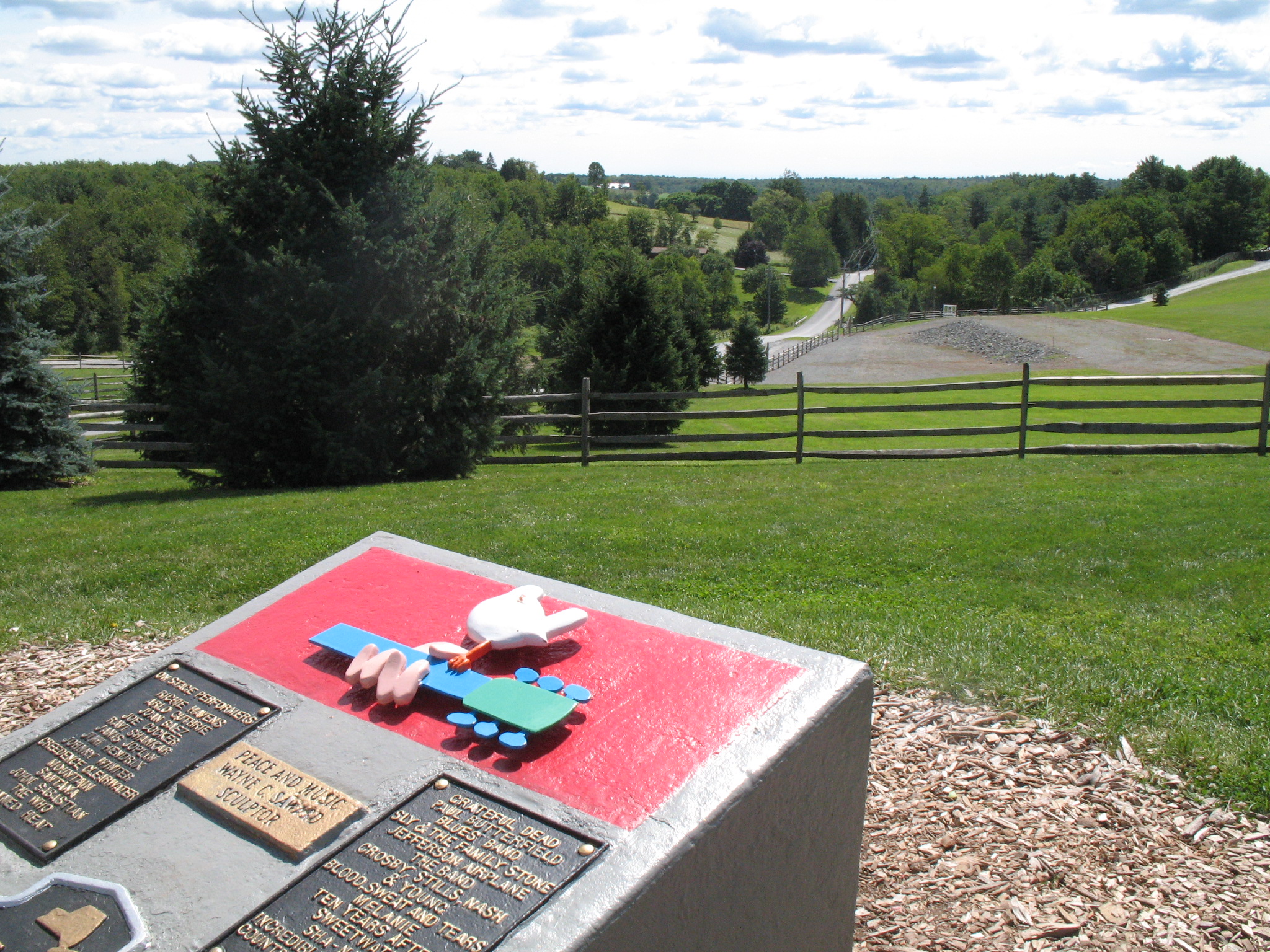
The view toward the stage and West Shore Road.

The view toward the stage and West Shore Road.

It is amazing to me that an event that divided a community; created havoc and orderly chaos; memories that lasted a life time, both bitter and joyful, is now the reason why the Town of BethEl, White Lake and Kauneonga Lake in Sullivan County, NY, might actually survive.

It was the Woodstock Festival that put these small towns in the eyes of the nation. I remember that weekend and the weeks that follow so well. My grandparents owned a small bungalow colony in Kauneonga Lake and we spent each summer there for my life. My grandparents had made Kauneonga Lake their year-round residence. They knew everyone. They were active in the community and the synagogue.

And I remember the hostilities and disruption that came after the festival was over and most of the people had left.   I say most because a small group stayed behind and never left the area.

I see my Dad trying to direct traffic in front our home. And letting a few vehicles park on our long driveway and front lawn.   I remember the people who came to ask if my grandfather would let helicopters land on our lawn. (That would be a NO.)

I remember the police on horseback trying to ride up the hill to the Woodstock site.

And I remember the mess afterwards. The days upon days to clean up the debris left behind.

The symbol used throughout the town of Kauneonga Lake.

The symbol used throughout the town of Kauneonga Lake.

But now that same event that caused pain for many, especial the Yasgurs, is now the reason for renewal.  It so amazes me now that the sign of a bird on a guitar that was so hated by some of the townspeople, is now redone as a bird on a leaf and is  symbol used in the town. And even a horse stable uses a take off of the iconic sign as its symbol. Wow! How the attitudes have changed.

Even a stable uses a sign to remember Woodstock.

Even a stable uses a sign to remember Woodstock.

At first the site of the Woodstock Festival became a legend and people would come up each summer on a pilgrimage to see it and talk about it. There was no monument. A group of people, the remains of the Hog Farmers who had helped at the concert, who hung out there to tell the story. Over time a monument was built, and the field was left empty.

Those who love the area owe thanks to one family’s vision, Alan Gerry and the Gerry Foundation. I believe it is thanks to him that the area is surviving the loss of income from the bungalow colonies. As the colonies closed or came under the ownership of orthodox Jewish communities, the area became desolate. But then in 1997 the Gerry family began it’s interest in the Woodstock site.

With the development of the Bethel Woods Center for the Arts, Bethel and White Lake and Kauneonga Lake have had a small rebirth. Each summer I come up and I see new restaurants, new stores, new houses even. On the weekends I hear the sounds of cars whizzing by our home before and after concerts.

People come to hear the music and to visit the Bethel Woods Museum. Every summer I take a journey the almost two miles to visit the Woodstock site and take a photo. I remember the blocked roads, the multitudes of people. I remember my grandfather’s reactions to all the young adults walking by our home. “Where are their mothers?” He kept asking as he shook his head.

But along with the memories of 46 years ago, I also see the new site. I have to tell you, it is wonderful!


Treasures in the Bookcase

16 Aug
Bound Copies of the Bialystoker Stimme from 1922-1941. Several were personalized.

Bound Copies of the Bialystoker Stimme from 1922-1941. Several were personalized.

I honestly thought that we had discovered all the treasures in our Catskills house. Last summer my siblings and I had torn the house apart, filling a 20-cubic yard dumpster with unused and unusable items.   We had discovered a mother lode of photos and a photo album from the 1920s that I am still slowly scanning and finding more information about our maternal grandmother and her family.

But I had forgotten about the old bookcase in the corner of the living room. I actually did not think about it until the very last day we were in the Catskills this summer, when I got a ‘jubba’ as my grandfather would say — a feeling that I had to open the glass door.

My Grandma Esther's bookcase in the corner.

My Grandma Esther’s bookcase in the corner.

We now call it my brother’s bookcase. But in reality it was my paternal grandmother’s and before her it belonged to her parents. Since they lived in the same apartment, there was no real distinction. The bookcase came with the books in it after my Grandma Esther passed away. Over the years, new books were put in and the older books migrated to the bottom shelf.

We have placed it along side the fireplace behind the television. It acts as part of a wall, so that the area behind the fireplace can be used as a bedroom when needed. This semi-room holds an old upright piano, a trundle bed that opens up to two twins, and a computer desk. So we usually do not even think of this piece of furniture as a bookcase, but more of a wall divider.

In any case, my ‘jubba’ called me over to the bookcase about an hour before we were planning to drive home. And inside of it, I found treasures! Nine books containing bound copies of the Bialystoker Stimme from 1922 through 1941, as well as a 45th anniversary book.   My great grandparents, Louis and Rae (Rachel) Goldman, were very active in the Bialyskoker group in New York City that founded the Bialystoker Home for the Aged.   In fact, he was on several important committees and boards.

My great grandfather top right.

My great grandfather top right.

My great grandfather was elected to the board, or re-elected in 1936. Louis Goldman.

My great grandfather was elected to the board, or re-elected in 1936. Louis Goldman.

While just skimming through the bound copies, I found announcements of both my Dad’s and Uncle’s bar mitzvah. These were in English. The Bialystoker Stimmer was printed mainly in Yiddish. But there were also a few English pages or a few English paragraphs in almost every copy. I also found photos of my great grandfather on several pages that announced committee and board members.

His 70th birthday

His 70th birthday

But the best was a photo of him and a paragraph in Yiddish celebrating his 70th birthday. I can read enough Yiddish to recognize his name and a few other words. To be honest, I do not know what it says yet. But I will find out.

That was with just a quick skim. I needed these books.

I told my sister that I had to ship them home and search them. Since we found the books in what is my brother’s bookcase, my sister sent him a text asking if I could ship them to Kansas.

They both agreed that the books should come home with me, as I am acting as the family historian.   I was so excited. It was well worth the $40 I spent at Staples to ship them home.

Today the books arrived!

An article about my great grandfather. I also need to get this translated.

An article about my great grandfather. I also need to get this translated.

As I continued to go through the books, I found what appears an article about him. It, too, is all in Yiddish. I know I will need it translated. I am excited to know what it says about him. I know he was a tailor.

My Dad's first cousin, David, 1938. I think he graduated high school at age 16, but I need a translation.

My Dad’s first cousin, David, 1938. I think he graduated high school at age 16, but I need a translation.

I cannot read all the Yiddish, except really for the names and a few words. But in skimming the books I sometimes see a photo that jumps out at me. Like the one of my Dad’s first cousins, David. Well, it looked like a very young David. I was right, it was him at age 16, when he graduated high school. This article is also in Yiddish. I need a translator!!!

I realize that I will never know if my great grandparents were mentioned in other places. But I am taking photos of every page that has a photo or a mention of my family that I can find.

But besides the book, I posted the photo of my great grandfather Louis Goldman and the small article on the “Tracing the Tribe” Facebook group. I was hoping someone would be able to translate it for me. Although that has not yet happened, I remain hopeful. But someone posted a link to the Bialystoker Center Yahrzeit Cards website. There I found the yahrzeits for my great grandparents, my grandparents and my great aunt. I will say that the Hebrew name for my grandfather is wrong on the site. But it is definitely him. That was also interesting to see.

I started with the books from the 1940s, I am now in the 1920s.  There is much more Yiddish and much less English in these earlier books.  I am hoping to still find more treasures in them.  But to see members of my family mentioned in these early archives makes me so happy.  I knew my great grandfather was an active volunteer.  These books confirm what I had heard.  My heart is happy.

I hope to find a good home for these books after I am done investigating them. There are many other families mentioned in the books.   I do not know how many people saved them.   In our case it was benign neglect. We did not know they were there, so they were just ignored.   And allowed to survive. A happy, lucky find for me and my family.

PS: Thanks to Sabena and her Yiddish teacher who translated the paragraph about my great grandfather:  “Mr. Luis Goldman, has just become a septigenerian (70), and if he himself hadn’t told us, we would certainly not believed it. Mr. Goldman is among the most active people in Sumkh Nuflim (I think that’s a place) in the Center and in the old age home where his work is greatly admired. We wish him a lot of further birthdays with joy in his family.”

PPS:  The Yiddish Book Center in Amherst, MA, would love to have the Bialystoker Stimme books!

http://kehilalinks.jewishgen.org/bialygen/Yahrzeit.htm

My Grandma Always Won At Solitaire

11 Aug

Grandma Thelma was not a good loser. In fact, I would have to say that she hated to lose, especially at cards. It did not matter who she played with, a solitary game or against one of her grandchildren. Losing was not an option for grandma.

She loved to play solitaire. And her endless days in the Catskills during the winter months gave her plenty of time to play. But she played even in the summer when there were many people up for the summer.

Grandma would eagerly deal out her seven piles of cards and start a game. But if it wasn’t going well, she might add an eighth pile. Or perhaps count out her three cards in a slightly different manner. Or maybe check the cards that were turned over to see where the card was that she needed.  She would then work to get that card uncovered.

We would protest! “Grandma, That is cheating!”  She always denied it. To her it was winning. Why play a game by yourself if you were going to lose?  She said she was not cheating, she was just changing the rules.  But rules are meant to be followed.  Not to Grandma, if she had followed the rules, she once told me, she would not be here. She would have died in the Shoah.  So you make the rules so that you win. To some degree I could not argue with that.

However, there were times she would never make up her own rules. During the summertime daily canasta games with three longtime friends (including my other grandma), she played honestly.  Doing anything else would have been a disaster. And when you play with a partner, it is much more difficult to make your own rules, since you both have to play as a team.  But to be honest team work was not my Grandma’s strong point.

She also never cheated during the weekly gin rummy game that the women of the colony played when the husbands were in the City. It was for money! A penny or two per point depending on the win. When she played for money, she always followed the official rules.

But with her grandchildren, the three of us who spent the summers in the Catskills, she would often follow her own rules.   Sometimes is was as simple as taking a peek at our hands.  I admit we were a little lax on holding our cards close to our chest.  But when playing gin rummy with Grandma, we learned quickly to keep our cards hidden. She would warn us once if we held our cards where she could see them. But if we made that mistake again, forget about it, she looked.

On rainy days, when we were stuck inside for the entire day, my Mom would often ‘kick’ us out of the bungalow and send us across the lawn to our Grandparent’s house.  They lived there throughout the year and had a television.  But that was not our true reason for going.  With our Grandparents we played cards or baked or just visited.  The card games, however, were epic battles.  They could go on for hours as we played gin rummy for points.  Or perhaps a canasta game, the three grandchildren and Grandma.  Or perhaps a canasta game for two.  Hours of entertainment,  And my Mom would get a break.

My brother believes (and it is true) that she would rearrange the deck, stacking it in her favor, if you had to leave the room for a minute. I remember often calling for someone to watch Grandma while I ran to the bathroom.I would bring my cards with me,  I knew that if I left my hand unattended, I would not win.  Sometimes, if my brother or sister were around,  I just asked one of them to play out the hand.

You might think that she not a good role model by all this ‘cheating.’  But she really was so obvious about it, and never sneaky, that I am a little adverse to calling it cheating.  We knew exactly what was happening.  We knew she just did not like to lose, but at the same time she knew that she was not really winning.

It became a running joke.  I remember once telling a friend that my Grandma always won at cards.  She was amazed. “How did she do that?” My friend asked.  “She must have been really lucky.”

“Well, luck had nothing to do with it,” I admitted.  “She created her own rules.  And in her rulebook, my Grandma always won.”