Tag Archives: grandparents

The Mysterious Kalsbad Photos: Who Are They?

6 Jun

June 26, 1931. My Grandmother was in Europe with my Mother and my Uncle. She left them at the farm owned by my great grandparents in Poland while she went to Karlsbad (Karlovy Vary), Czechoslovia to take the waters and revive her health.

The doctors in the United States told her that she was going to die. She had been pregnant again in the USA. But doctors terminated the pregnancy through a very illegal abortion in an effort to save her life. But still she was sick. So she decided she would not burden my Grandfather with two young children, 5 and 2. She would take them to Europe to live with his parents and she would die there. He, then, would be free to continue his life.

I once asked my Grandfather, why he let her go. “She was a sick woman,” he told me. “I had to let her do what she thought was best.”

“Would you have left Mom and Uncle Stanley in Europe?” I asked. This was a very important question. His entire family perished. If he had left them, I would not be here.

He looked me in the eye, and said, “As soon as she died I was going to get on a boat and return with my children. I would never leave them there. “

His words made me feel a bit better. But if Grandma had died the world my Mom and Uncle lived in would have been very different. But at least I know my grandfather would not have abandoned them in Poland.

Luckily Grandma did get well. She stayed in Europe for six to eight months and then returned to the USA with my Mom and Uncle. She saw the rise of Hitler coming and now had a new purpose: get the family out. She could not save as many as she wanted. But she tried.

Grandma Thelam, Carlsbad

Grandma is sitting in the front. The date and place were added by my Mom. I think the two women are related. This is the photo we knew about.

We have several items from that trip to Europe. We have a ceramic vase that stays in her breakfront/curio cabinet in our Catskills’ home. We have stories about the trip.  We have a few photos. We knew of one. Grandma is with two other women. We have no ideal who they are. But I think they are related to her, one women sort of looks like her sister-in-law. We are not sure. There is no identifications on the back.

But I recently found another.

FullSizeRender (10)

Grandma is in back row on the left wearing a white hat.

It is a group photo. In the very back row, near the center is a woman in a white hat, that is my grandmother. She is 26 years old.

I do not know the other people. Are they family members who perished? Or are they just other people who are in Karlsbad? Sometimes I imagine that they are just other people at the resort who were pulled together for a group photo that the photographer would then sell to tourists.   Other times I imagine that people in the photo look like family, especially the man in the front on the left. But I honestly do not know.

This photo is different from the others we have from that trip. There is writing in Yiddish and English. The English is easy, her name and the address where she stayed in Karlsbad. Or is it a place she visited?

The Yiddish is more exciting to me. It is the only letter I have seen that she wrote to my Grandfather. (Thank you members of the Tracing the Tribe Facebook Group for translations!)

It says: “As a souvenir from your faithful wife, who hopes, to meet you again in good health.” Another translated it as “A souvenir from your devoted wife, who hopes to return to you in good health.”

Either makes sense. She was sick. She was away from my grandfather. She wanted to be reunited with her family and be healthy.

And that all happened. She returned to the US and lived an additional 50 years. And 80 years later, I keep finding treasures in her photo album!


https://zicharonot.wordpress.com/2014/04/28/speaking-yiddish-always-brings-me-holocaust-memories/

Holding My Grandparent’s Naturalization Papers Overwhelms Me

23 May


imageI have a small leather case that is inscribed with the words Certificate of Citizenship.  Enclosed are my grandparents naturalization papers that change them from immigrants to citizens.

I hold the papers in my hands and I wonder what my grandparents were thinking. Here are the legal documents that made them naturalized citizens of the United States of America. They were no longer Polish citizens. They were free of the past, or were they?

image

One paper is 84 years old.   My Grandmother became an American in 1932. She was 27 years old. I know she had just returned from a trip to Europe to regain her health and see her family and my grandfather’s family. She took her two small children, my mother and my uncle, with her for six months in Poland. And then she came home, a changed woman with a mission. Get as many family members out of Europe as possible.   Grandma was smart. She saw the coming tide of Hitler and his anti-Semitism. What would she think now with the new rise of hatred and xenophobia throughout the world?

The seal encompasses her photo. Her certificate has a small burn in it. The paper was folded when it happened. I can see my grandfather smoking a cigarette with an ash hanging off as it falls on the papers. I know my grandmother must have been furious. It looks like that type of burn to me. I am glad that my children have never seen a cigarette burn. When my father and grandfather smoked, papers often got singed.   But by the time my children were born, there were no more smokers in my family.

There on her paper is a space for Race. It says Hebrew. I wonder if she worried about that word on her papers? They were not yet putting yellow stars on Jews when she was in Europe. Even though she was worried, perhaps, being here made her feel safe enough. The good news is that 11 years later, when my grandfather became a citizen, there was no longer a space for Race. This item was removed from the naturalization papers. It makes me happy to see this change.

image

I wonder why Grandpa waited so long? He came to the USA in 1920. Did he originally think he would go back one day? Maybe. But the war probably changed his mind. He became a citizen in the midst of World War II — the war that destroyed his family. The war that murdered his parents and his siblings, his nieces and his nephews, his aunts and uncles, his cousins and his friends. Almost all perished. He did not yet officially know this in 1943. But perhaps he knew, since all letters stopped coming and there was no more contact with his family. It was not till after the war that he knew they had all died.

On this paper I see my grandparents’ signatures. I usually did not see it. To me Grandma only signed all letters Love, Grandma Thelma. Grandpa never wrote letters. In his later years, he forgot how to write his name in English. He only remembered how to write it in Hebrew. But here I see his signature. It gives me a thrill to see these names on these certificates.

image

On the back of Grandpa’s certificate of naturalization is an additional note. It was when he became an official citizen that he legally changed his name from Nisson to Nathan. He put away his Yiddish/Hebrew name and moved to an English name. This is the name I gave my son. Nissan, Nathan. He was born 11 months after Grandpa died. It seemed right that he should have his name.

By the time Grandpa became a citizen they had moved to the home they lived in for over 30 years. This was the location of their bakery in West New York, New Jersey. A home and a bakery where I spent many hours and enjoyed so much love. The same address where I spent the first three years of my life. Where my parents spent the first six years of their married life.

When I hold my grandparents’ citizenship papers I am overwhelmed. Because they moved here and left their homes when they were so young, 18 and 16, I am alive. Because they made a conscious choice my children have freedom. Because they were able to immigrate to the United States, we live in freedom.

I hope the United States will continue to be a beacon of light to immigrants throughout the world, as it was for my grandparents.


https://zicharonot.wordpress.com/2014/06/25/how-world-war-i-saved-my-family-or-my-grandpa-was-a-draft-dodger/

https://zicharonot.wordpress.com/2014/08/22/i-believe-mystically-and-magically-great-grandma-chava-watches-over-me/


https://zicharonot.wordpress.com/2014/05/29/grandma-thelma-knows-what-she-knows/


https://zicharonot.wordpress.com/2014/04/28/speaking-yiddish-always-brings-me-holocaust-memories/


Drinking An Ooglie Mooglie/Gogli Mogli Always Made A Sore Throat Feel Better

11 May

Recently while at lunch with my Kansas Yiddish buddy, we were talking about how some children did not like eggs and the ways their mothers snuck eggs into their diet.

I told how my husband hated eggs so much, his mother would make him chocolate chip pancakes so that he would have eggs without knowing. Not such a harsh way to eat eggs! In fact, I laughed about it. But it was a tradition my husband continued with our children.  Scrambled eggs were not the right Sunday morning breakfast in his mind,  you gave your children pancakes and biscuits to have them eat eggs.

My friend’s mother had a sneakier way to get her to eat eggs. My friend would drink a malted after school each day. Her mother would mix a raw egg into my friend’s malted. She was surprised that her mother would do such a thing. When she found out what her mother was doing from her young uncle, she never trusted those special drinks again.

“It was a good thing I never got salmonella,” my friend said.

But then they did not think about salmonella over 50 years ago….okay I am giving away our ages.  In fact, serving raw eggs was considered a delicacy. Personally, I was not surprised about putting raw eggs in a drink. I asked her, “Well didn’t you ever have an ooglie mooglie?”

“What are you talking about?” She said as she looked at me as if I was crazy.

I could not believe she never had one of this special ‘treats’ when she had a sore throat or cold. Raw egg mixed with sugar and beaten till it was smooth and frothy, an Oogle Moogle or Ooglie Moogli was a treat that I had on occasion from my grandmother.  But never from my own mother.

However, when I lived in Israel during my sophomore year of college, I had many occasions to have an Oogle Moogle from my great aunt and uncle.   Holocaust survivors, they often made this treat for their daughter, who loved them. She would have them all the time if she could.   I remember the first time they made one for me,  I was so sick.  She wanted one as well!   But they only made one for me!  It was delicious.

I told all this to my friend, and to prove I was not crazy, I googled (LOL) oogle moogle. And there on Wikipedia was an entire page devoted to this treat, I show the first paragraph here:

“Kogel mogelGogl-MoglGogel-MogelGogol-Mogol (Russian: Гоголь-моголь), Gogli-Mogli, or Gogle-mogle (Yiddish: גאָגל-מאָגל‎) is an egg-based homemade dessert popular in Central Europe and Caucasus. It is made from egg yolkssugar, and flavorings such as honeyvanillacocoa or rum, similar to eggnog. In its classic form it is served slightly chilled or at room temperature. Served warm or hot, it is considered a home remedy for sore throats. As a home remedy it could be of Russian or Yiddish origin. Variations include milk, honey and soda.[1][2] https://en.wikipedia.org/wiki/Kogel_mogel

There was my proof, except the name was slightly different: Gogli Mogli. Perhaps I had misunderstood what it was called, but probably over time, I just forgot and changed the pronunciation. It did not matter, my friend still had never heard of it.

But since she never liked eggs, I cannot imagine that her mother or any relative would ever offer her a drink made primarily of eggs and sugar. Whereas I can still see my great uncle mixing the drink and stirring it so quickly till it turned to forth. To me the memory of an Ooglie Mooglie or a Gogli Mogli is a wonderful memory, especially when I am suffering with a sore throat. It would make it feel so much better.

Memories of My Grandparents Or Why I Always Read Street Signs

8 May

I can be annoying when driving or sitting in the passenger seat of a car. Why? Because I read all the road signs…out loud…always: street signs, billboards, ads. If it is on the street or the highway, I read it.   And I read quickly. When you learn to read by reading street signs, you learn to recognize letters and words and read before the car passes the sign.

I did, in fact, learn to read, or at least enhance my reading through verbalizing what was written on signs.  Although we had plenty of books in our house, it was street signs that were important. My maternal grandmother started this habit. She read every street sign as my grandfather drove. When I was a child I did not know why, I just knew we had to read all the signs. As a teen, I realized the importance of reading signs when Grandpa was driving.

My maternal grandparents came to the US from Europe in the early 1920s. Although my grandmother went to night school and learned to read and write English, my grandfather never did. He was great in Yiddish, Hebrew and Polish. But English, he never really learned. So it was Grandma who read the papers, kept the books and read the street signs for him.

Grandpa did drive the car. I guess driver’s licenses were easier to get back then. No written tests I assume, because Grandpa could not read or write English well. He could read slowly and write his name. But overall not well enough to read the street signs. To make finding their destination easier, in the times of no GPS telling you what to do, my grandmother would always read the street signs to let him know exactly where we were: Stop, Yield, Merge were easy. I know he learned to recognize those signs over time.

But my Grandma did not stop there, she read all those street signs as to where you were and special billboards as we drove along. If there was a sign, she read it. Eventually, we just read along starting at a unusually early age. I think at times there was a race to see who could read the signs first, as my sister and my brother and my Mother also read the street signs.

My Grandpa needed it. My Dad never said anything about it. Perhaps he thought it was cute when we were children. In reality, it is a habit I cannot stop. I still do it. I read when I am driving, or when someone else is driving.   Lately the ones that really get my reading mind in gear are in Missouri. They have all these electronic billboards that say things like, “Buckle up, MODOT cares.” I read all of them out loud. I cannot read them silently. Part of reading a street sign is to read for everyone to hear. At one point while we were driving to St. Louis, my husband piped up and said, “Don’t get into an accident reading all those MODOT signs.”

My husband probably had no idea why I always read the signs. But he puts up with it and has not said anything about it in years. At one point early in our relationship, he did say something about being able to read for himself. But that stopped when our children were little. I think he thought I was reading for them. But I was not.   I was just continuing a childhood habit.

To be honest, I usually do not read the signs around our home and neighborhood. Those are not necessary to read. However, as soon as I get on a highway and, especially, if I am in a new place, I start reading those signs.  Last year we had a road trip to Minneapolis. It was a road sign Bonanza, especially after my GPS stopped working. (We accidentally popped out the little disk.)

I have a few friends who I know find it annoying when they are driving with me. I think they think I do it when I have nothing else to say, just to hear my own voice. But that is not the reason. Reading signs is second nature. I remember long car rides to the Catskills with my grandparents. I hear my Grandma’s voice as we drive along. And I know we will be safe. We know where we are going.

The Necklace I Never Wear

2 Apr

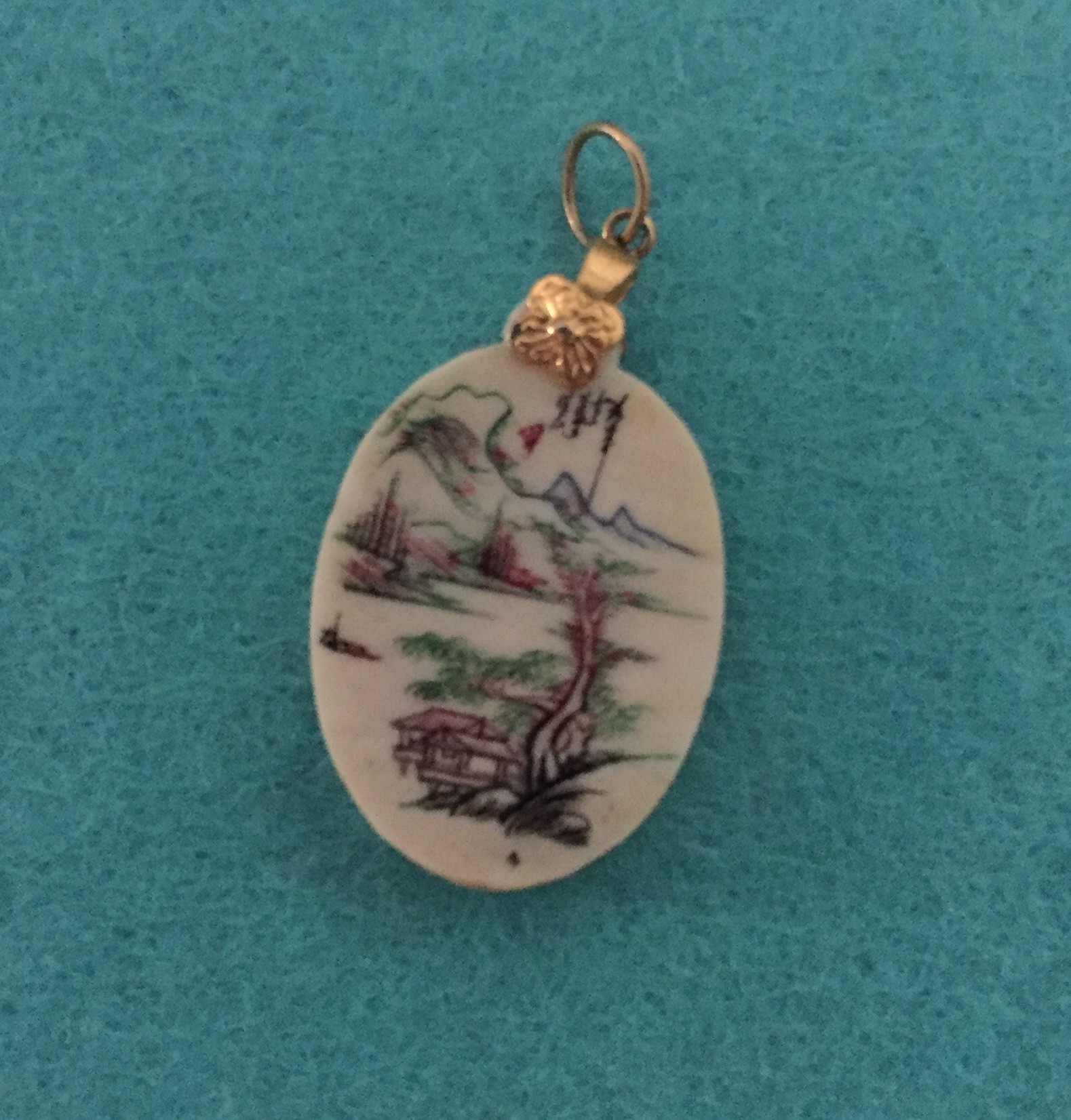
In a box in my closet is a small scrimshaw necklace that I never wear. I will never give it away. I will never sell it. I hope one day one of my children will take it.

The necklace I purchased with the money from Zeisel.

The necklace I purchased with the money from Zeisel.

It is not that old. I bought it when I was 20, when I spent my sophomore year of college in Israel, 1974 to 1975.

Many holocaust survivors were still alive. Some of them related to me through my maternal grandparents who were both from Europe. My grandparents came to the USA in the 1920s. But most of their family remained behind. Many perished, others survived and moved to Israel.

My grandmother went to Europe in 1931 with my Mom and uncle. I have written about this before. She stayed on the farm owned by her in-laws. While she was there her mother-in-law, my great grandmother Chava, gave her some family items. Two pieces of jewelry, a pearl necklace and an opal ring; and several embroidered and handmade pieces that Chava had made.   I own all but the pearl necklace. They were all given to me as the one named for Chava.

The pearl necklace disappeared in 1931. My grandmother went to use the shower at her inlaws. She took off the necklace to bathe and forgot to put it back on. When she realized it was gone, she went back to the bathroom. It was missing.

But she knew who took it. Zeisel. He was the only one who had been in the bathroom. But he denied taking it. And that was the end of the matter for 43 years, until I went to Israel for a year of college.

A month after I arrived in Israel, I received a letter from my grandmother telling me the story of the pearls. I had never heard it before. In the letter she wrote that the ‘goniff,’ Zeisel Feuer, my grandfather’s cousin, was going to give me some money to pay her back for the necklace he stole in 1931. I was to take the money and give my great uncle, her brother, half the money. The other half was to buy myself a necklace because I should have the pearls.

What? Was my grandmother insane?   I did not really want to do this.

I wrote her back saying that I thought 43 years meant the statute of limitations on a theft were over. And that she needed to let it go. And I did not need to have the necklace. But a few weeks later I received another letter instructing me how to find Zeisel in Tel Aviv. He worked at bakery on a specific street and I was to go there and speak to him. She said I had no choice. I had to do this. It was important to both of them to end this. And I would be the one to fix it. What?

Grandma ordered, so I obeyed. The next time I was in Tel Aviv, I went to the bakery. There was a man who looked so much like my grandfather, except smaller and bent. I knew it had to Zeisel. I introduced my self. He held for minute and had me sit at a table. He brought tea and a pastry. I waited while he finished working. Then we walked back to his apartment.

There he gave me Israeli lire, which in US would be worth about $100. And he told this story.

He was married with two children. He had a wonderful life. But he wanted more for his family. So when my grandmother left the pearls in the bathroom, he thought, “She lives in America. She is rich and has money. She does not need this necklace.” And he took it. And he lied.

In return the Nazis came. They killed his wife. They killed his children. They tortured him. He could no longer have any children.

And he knew that taking the necklace had brought all this pain to him and his family. And before he died he had to make amends. So he gave me the money. I was to do with the money whatever my grandmother said.  He had made peace.

I was stunned. I was 19. I did not know what to say but to cry.   When I left him, I took the money back to my dorm in Jerusalem at Hebrew University. A few weeks later I took half the money to my Uncle Isaac. The other money I kept in my room.

Each time I went to Tel Aviv after that, I always went to the bakery to see Zeisel. He always gave me tea and a pastry.   There were not many phones in Israel at the time. So I could not call in advance. I would just show up, or send him a letter telling him when I thought I would come. When my parents came to Israel that December of 1974, I took them to meet Zeisel and speak to him. It was a meeting my parents never forget as well.

In January I turned 20. I finally spent the $50 on a necklace for me. A necklace that carried so much pain. I could not wear it even though I knew my grandmother wanted me to have this jewelry from my great grandmother. So I keep it in a box in my closet. I know it is there. I know it is safe. It will not be lost. But I cannot wear it. When I see it, I always think of Zeisel and how much he lost.

It was not the pearl necklace that doomed his family. It was the rise of hatred. But he did steal it.  So for him giving me the money was closure. He had repented; he had done his “tashuvah.”  But for me it was the beginning of truly understanding the past.

I have written about the Zeisel and the pearl necklace before. It is a story that stays in my heart and my soul. But I have never talk about what I bought with the money. In my mind it is just not enough. It does not make up for the suffering surrounding one pearl necklace.  Zeisel was also the person who let my grandfather know that his entire family had perished in the Shoah.  He is forever bound in our family history.

Zeisel, my grandparents and my parents have all passed away. I am the only one who can remember this story. And so I tell it again.


https://zicharonot.wordpress.com/2014/08/22/i-believe-mystically-and-magically-great-grandma-chava-watches-over-me/


Trouble with the Office: An American Bialystoker Story

21 Mar

The following is a report my Great Grandfather, Louis Goldman, made in a 1937 issue of the Bialystoker Stimme. It explains the reason why the Bialystoker Bikur Cholim decided that the organization needed its own offices. It seems asking for help from the community was just not working out. It gives the history of the decision to rent its own office. I think this might have be the precursor of the Bialystoker Home for the Aged, which was built over two years in 1929-1931.

Here is his article, as translated by my friend Blumah and edited a bit by me for clarity.

“The Bialystoker landsman in that time mostly lived in the East side (of New York City). The Bikur Cholim decided to put in that neighborhood a place for the sick people to receive help without difficulty. So they would be close to their neighborhood.

They arranged for a doctor and arranged for a pharmacist to get them medicine.

It was decided to give to the poor sick people a free pass to see the doctor and also pay for the medicine.

A certain landsman, who had a hot dog /salami store on Essex Street, gave his store for the sick people to come to receive these passes and papers. This became the office where they could get the papers. But there was a problem: The store keeper would give out these free passes like a prize to his own customers who would buy meat from him. (This was not what was intended so,) It was decided to rent a place somewhere else.

Next they found a butcher store from one of the landsman, Philip T. However there was not very convenient for several reasons.

They moved the office again to a new place. To “Fisher” who had a printing shop on Clinton Street. But Fisher started asking every month for new ‘additions’. (Not sure if he wanted more money or what he is wanting. Probably more money.)

So the Bikur Cholim decided once and for all to rent a permanent office for themselves. It was decided that this office could also act as a club for the active members. Also there would always be a secretary who would be paid and who would take care all of the cases for the Bikur Cholim.”

As my great grandfather, or the editor of the Bialystoker Stimme, entitled the article, “Trouble with the Office,” I think that was a fine assessment.  Personally I loved how the store owner gave out free medical passes to his customers.  One way to build a clientele, even though it was not ‘kosher.’  I know that they were trying their best to help their landsmen in need, without using the money needlessly.  Building an office might have seemed that way to them.  But eventually, having a paid secretary made more sense.

The history of the Bialystoker Home For the Aged and the Bialysotker landsmanshaft, immigrant organization, can be found in the NY Landmarks Preservation Commission Report of May 21, 2012. See link below:

http://www.nyc.gov/html/lpc/downloads/pdf/reports/2529.pdf

The part of this story that impacts my great grandfather’s article, is this small section from the report:

“In its first year of existence the Bialystoker Center was located in an old building at 228 East Broadway just few houses down from the basement location of the Bikur Cholim. In 1922-23 it replaced the aging structure with a new five-story headquarters, which included office space not just for its own use but also provided meeting rooms for affiliated associations.”

So I assume the offices that my great grandfather is writing about was this office on 228 East Broadway. Eventually, definitely by 1937 when his article was written, the Bikur Cholim offices were included in the beautiful building that was finished in 1931.

As I have said in earlier articles about my great grandfather,  I am so proud to be his descendant.  Each of these articles brings him to life.


Joyous Occasions in Discovered In Yiddish

14 Mar
IMG_6556

My Uncle Bernie and part of the article about his bar mitzvah.


Besides articles about my Great Grandfather Louis Goldman/Baruch Lev Litwack, there were also announcements of family events in the Bialystoker Stimme magazines under the title “Simcha by Landslight,”   or “Joyous Events by our community members.”   I found three events in Yiddish about my extended family members, which my friend, Blumah, translated for me as well.

The first was about my Uncle Bernie, or Bernard, about his bar mitzvah:

“A nice bar mitzvah party took place on Shabbat. The 11 of June by Mr. Bernard.  A nice, accomplished young man, the son Mr. and Mrs. H Rosenberg and the grandson of our dear friends and active community members Louis and Ray Goldman from the Bronx.

A nice private group of close family celebrated by the simcha. They wished much nachas to the parents from this bar mitzvah boy.

As is well known, Mr. and Mrs. Louis Goldman, the grandfather and grandmother, are actively in the Bialystoker Center and the Ladies Auxiliary.

Mr. Goldman is now the president of the Bialystoke charity organization that was the Bialystoke Free loan society: Bialystoke Somech Noflim, (It was started in 1886 in the USA.) This is he oldest charity association that the Bialystoke started.

We wish the zayde and bubie, and the parents to live to have much nachas and much joy from Bernard and the other children.”

I loved that even in an announcement of my uncle’s bar mitzvah, it was important to the writer to list my great grandfather and great grandmother’s accomplishments in the Bialystoke societies.   I am thinking it is to give them even more ‘kovod,’ honor. Or perhaps it is to encourage others to volunteer?

In later years, when the Bialystoker Stimme had more English, there is another Bar Mitzvah announcement for my father. But it is much shorter and written in English.

One of my father’s cousin’s is also mentioned in “Joyous Occasions.” My Dad’s first cousin David M. made the Yiddish paper, in a shorter and less flowery article.

“The Goldman’s talented grandson, David M., graduates with honors. The 16 year old grandson of our active members, Mr. and Mrs. Louis Goldman, of the Bronx. He just graduated from Townsend Harris High School. He was immediately accepted in City College. We wish the parents Mr. and Mrs. Eli Marks and the grandparents of David much nachas from their very capable David.”

The final “Joyous Occasion” in Yiddish was my great Uncle Sam’s wedding announcement, for his first marriage. I never knew the woman mentioned in this announcement. But I do know that they had one daughter. I honestly only remember meeting her when I was a young child. I think the family lost touch with her.

“Sunday Dec. 11, our friends, Mr. and Mrs. Louis Goldman brought their youngest child to the Huppah: Samuel with the beautiful, intelligent Miss Otta Schmuckler. The wedding was private, and the supper was afterwards celebrated in Central Plaza, where many friends from both sides were part of the joyous occasion.

We wish Mr. and Mrs. Louis Goldman and the young couple much nachas.”

The only thing I can say about this announcement is that I always thought his first wife’s name was Yetta. And that might have been the name she used in English.

Every one of these little Yiddish articles is like a jewel for me. I find out tiny bits about my family’s life in the 1920 – 1940s. I see pieces of my Dad’s childhood. He probably was at all these simchas: his brother’s bar mitzvah, his cousin’s graduation party, his uncle’s wedding. We do have a few photos from this time. But I have never seen the photos of my uncle and my Dad’s cousin that shown in these articles.

The Bialystoker Stimme continues to be a treasure for me and I hope for my family.


https://zicharonot.wordpress.com/2016/03/08/louis-of-the-blessed-heart/


Louis of the Blessed Heart

8 Mar
image

A photo of my great grandfather, Louis Goldman, and the article about him.


I knew my great grandfather, Louis Goldman, had a good heart. His Hebrew name, Baruch Lev, ‘blessed heart,’ echoed his kindness. Now thanks to the books I found in the Catskills’ bookcase, I know even more of what a “mensch” and a “guttah neshumah” he was to many people.

I found two larger articles about my great grandfather in the bound Bialystoker Stimme magazines I found last summer. And finally, I was able to meet with my friend, Blumah, who translated these articles for me. What a blessing and what a joy! This blog is about one of the articles.

The article from 1938 honors him on the 50th anniversary of his arrival in America. So I now know that he arrived in 1888, when he was a teen. I already knew he married my great grandmother in January 1894.

The article is in praise of Louis Goldman, born Baruch Lev Litvak.  This is paraphrased, but close to the translation:

“It is already 50 years that Goldman is an American, and he still looks like a young man. He remembers things as if he had just yesterday came off the ship. He is like a walking encyclopedia,   He knows things as if they are ‘in his vest pocket.’ In general he knows many people.

He has the honor of being president of the oldest Bialystoker organization the ‘Somach Naflim,’ helping the fallen (Free Loan Society). And he is the vice president of the Center. (Bialystoker Home for the Aged.)

He acts with great warm love with the Home for the Aged. ‘He is the one and only one in the way he gives love and warmth, there is nobody that can be compared to him.’

In addition to bringing in friends whom he strongly interested in this project (Home for the Aged), his beloved institution, he also brought in his wife, children and grandchildren to be involved.

The grandchildren Goldman are already involved.   (This included my Dad and his siblings.)

With out a doubt, the children and grandchildren honor their father/ grandfather. If these children do not outshine him, they will put out less effort.   They will not do less than what you expect a human being to achieve.

Such an exceptional feeling!

From good dough, the saying goes, good baked goods will come out. (Such a wonderful analogy as his parents were bakers.)

Few fathers and grandfathers have the merit to have such an influence on their families. Especially in our world .

We are proud of the true, great honor of Louis Goldman!

A little bit of jealousy we could feel about him. But we still hope that he will bring his great grandchildren to the same level.”

WOW! My heart was so filled with love  and joy as Blumah read and translated for me.  Some of the words I could understand with my limited Yiddish.  But the overall sentiment was so loving. It made me proud to be his great granddaughter.

My Great Grandfather’s legacy continues into the next generations.   My Dad was president of his synagogue for 11 years and remained on the board until his death. My parents and grandparents and aunts and uncles would go to the Bialystoker Home for the Aged benefit dinners each year.

I continue work for the Jewish community as a board member of our synagogue, and many other Jewish and secular organizations.

My daughter works for the Peres Center for Peace in Yaffo, Israel. I think my great grandfather, her great, great grandfather would kvell with naches.

But it is not just my immediate family that continues in this tradition. My siblings, my cousins and their children also live a life of gemalut chasidim, doing good works.

I believe that our ancestor, Louis Goldman would be proud of us as we are of his good works.

The gene to do good, to be agents of tzedakah, is strong in our family. It is our Force. And I am so proud to be descendant from this man, Baruch Lev. Louis of the blessed heart.


(See links below to other blogs about Louis and the books I found.)

Mensch, good person; Guttah Neshuman, A good soul; Kvell, bursting with pride; Naches, proud enjoyment; Gemalut chasidm, doing good works.


https://zicharonot.wordpress.com/2015/08/16/treasures-in-the-bookcase/


https://zicharonot.wordpress.com/2015/10/10/12-delancey-street-and-my-family/


https://zicharonot.wordpress.com/2015/10/21/another-bialystok-treasure-investigated/


https://zicharonot.wordpress.com/2014/12/01/take-mom-to-work-day-at-the-peres-center-for-peace-in-jaffa-israel/


Mazel and Good Luck: My Middle Eastern Hamsa and Native American Hand Symbol Collection

26 Jan

I have always been a bit superstitious. Perhaps it is because my grandparents had little things they did to keep evil away and bring good luck. Their Eastern European/Jewish roots had me putting red ribbons or thread on my children’s cribs; saying Yiddish phrases that warded off the evil eye whenever someone said something nice about my children; and learning about the power of a name.

When I went to Israel as a college sophomore, I came in contact for the first time with the hamsa, the palm-shaped, Middle Eastern sign to keep evil away. Specifically, a hamsa usually has the symbol an eye in the middle of the palm to ward off the evil eye, the “ayin hora.”

image

The first hamsa I purchased.  It is not totally traditional because it depicts a true hand, not the three finger/two thumb usual hamsa.

On the “My Jewish Learning” website it states that the hamsa has been seen by different groups as a Jewish, Christian and Islamic amulet, and even a pagan fertility symbol. But in now it is recognized as a “kabbalistic amulet and is an important symbol in Jewish art.”

I became intrigued by the hamsa and its ‘magical’ powers to bring “mazel,” good luck, and keep evil away when I was a college student. The first hamsa I purchased was for my parents. This wall plaque adorned the wall near the entrance to their home for over 35 years.   When they passed away, I brought it to my home, where it now hangs near my front door.

I wish I could say that is the only hamsa I have purchased. But it is not. For years, it was very difficult to find one. Occasionally an artist would draw or design a hamsa. Then, about 10 -12 years ago, hamsa art went crazy. I started seeing them in stores and catalogues that had a Jewish base. But I even found them in regular gift stores.

I purchased hamsas to bless new babies and homes. They are made of so many different materials: metals, ceramics, glass, pottery, clay, fabric. Each artist has his or her own vision. They can be wall hangings, picture frames, designs on tzedakah boxes, trivets, jewelry. I even have a hamsa mezuzah! That must have double positive energy!

I have seen necklaces, bracelets, earrings and pins made in the shape of a hamsa. I admit I own some.

image

Left: The Middle Eastern Hamsa; Right: the Native American Hand Symbol

About six years ago I found out that the hand symbol for protection was not just a middle eastern amulet.   I was in Arizona on vacation, in a ‘western’ store, when I came upon a hand with a circular spiral design in the center. This hand symbol, I found out “represents spiritual power, strength, domination and protection” for Native American warriors, according to the Warpaths2Peacepipes website.

So, of course, I purchased some of these hand symbols as well. They are different. The Native American hands actually look like hands, whereas the hamsa usually has a large center palm and three normal fingers, but what looks like two thumbs one on each side.

For me, their similar designs which provides the same message of protection for those who wear them makes sense. How many times to we hold up our hand to say, Stop!” And so with the hand we ask people to back off, calm down and stay away.

image

Top two designs are hamsa, the bottom one is a hand symbol.

Thus cultures in two distant parts of the world created similar symbols for protection. I love it. My hamsa/hand symbol collection is intertwined with art from both displayed together.

But I must add that one type of Native American hand symbols is actually called the Hand Eye symbol. This symbol looks remarkably like the hamsa. This symbol was used by a group of Native American called the “Mississippian culture of the Mound Builders.” It was an important symbol for them but there is a belief that it related to entry to heaven and a solar deity. (According to the Warpaths2Peacepipes web site.)

Although it is not a protection amulet to me it seems to still send out positive energy with its relationship to heaven.

Perhaps my collection cannot truly do anything for me. But in my mind, it cannot hurt to have these symbols of protection and love and strength scattered throughout my house.


http://www.myjewishlearning.com/article/hamsa/

http://www.warpaths2peacepipes.com/native-american-symbols/hand-symbol.htm


My Doll Survived Because of the Catskills Attic

19 Dec
IMG_0015

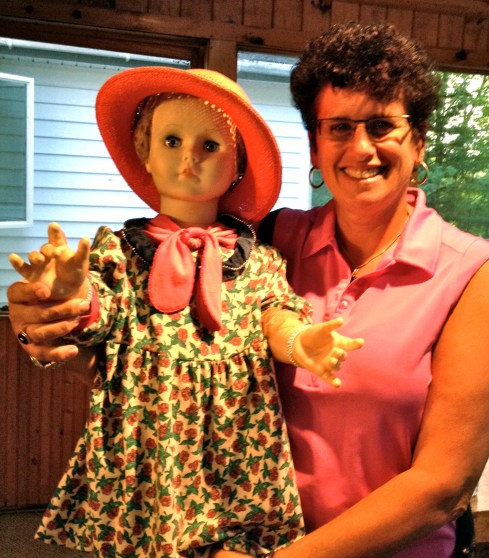
In the Catskills Betsy, my doll, with my cousin who has finally made friends with her.


I only have one toy left from my childhood. It is not that I purposely saved it because I loved it the best. I actually had other toys that I loved more. But this toy survived because of her journey to the Catskills.

When my sister was born, I was gifted a large standing doll. The doll is over two and half feet tall. I did love her. And I believe I named her Betty or Betsy or perhaps Becky, which was what my Dad called my Mom, even though that was not her name. I kept her in my bedroom and I loved her!

I remember when the doll arrived. She had a pink dress, light brown hair, pink shoes and socks. My Grandma Esther knitted her another beautiful pink dress. I enjoyed playing with her, but there was a problem. She was so big , I really could not cuddle with her. She was best for tea parties, playing school and perhaps discussing an issue. She seemed so real. And that was her biggest problem.

Betsy was so real looking. During the day she was not a problem, but if you woke up in the middle of the night, she would be standing there staring at you with her big eyes open! My sister and I were used to her, but one of my cousins lived in fear of her. She was afraid to sleep when the doll was in the room.

She really was too big for the apartment we lived in during the winters in New Jersey. So Betsy the doll moved up to our Catskill’s bungalow in Kauneonga Lake to be used only in the summer time. In the Catskills we had much more room to play. And she loved being up there.

Eventually I outgrew playing with the doll. But my sister grew to love her. She says, “I loved to play with her and thought of her as mine, since you had outgrown her.”

In time, Betsy moved from our bungalow to my maternal grandparent’s house, until one summer when she was gone. That is what happened with toys. They just disappeared when you outgrew them. I assumed she was given away.

To be honest I don’t think I even looked for her. There is so much to do in the summer time. And Betsy was no longer an important part of my life. She lived in my memories.

But my sister still had a relationship with Betsy. The doll was moved to the attic bedrooms of my grandparent’s Catskills winter home. My sister would play with her and see her when she went to visit in the winters. I was four years older, so while I was away at college, my sister was still spending time in the Catskills in the fall and winter. “Remember,” she told me, ”we did not go into the attic that much in the summer. ” Of course not…it was HOT up therein the summer, but wonderful in the winter.

After my sister went away to college, the doll was put into a closet and eventually forgotten. At some point my grandparents moved her from a closet to one of the hidden nooks.

But Betsy was not totally forgotten. We often talked about my big doll and how scary she was at night, or when you weren’t expecting to see her. We would remember the people who came in and were frightened the first time they saw her thinking she was a real toddler.

Years later, when I was in my early 30s, after both my grandparents had passed away,  my parents inherited the house in the Catskills. They started the process of cleaning it out. We all helped. I was assigned the two bedrooms in the attic, cleaning out the nooks that were hidden in the crawlspace walls of the bedrooms.

Usually the doors into these spaces were covered by the beds. But we moved the beds away and went in to clean them out.   I was surprised to find one perfectly clean except there, lying on the floor, was Betsy! She was a little ragged. Her clothes were gone. Her hair was a little messy. But she had survived, alone in that hidden space for years!

I was excited. I now had a toddler daughter, and I thought she would love Betsy.

I brought the doll downstairs. My mom, sister and I washed and cleaned her up.   She needed clothing!   My daughter wanted to give her some of her clothes, but we decided to buy her something just for her.

The women (Mom, my sister, my daughter and I) went to the Apollo Mall in Monticello and we purchased a 2 Toddler dress. I also found her a beautiful pink straw hat. She looked refreshed and wonderful.  Eventually the granddaughters gave her some lovely bracelets as well!

It took us a while to decide where she would stay. No one wanted her in a bedroom. TOO scary. My parents decided to put her in the stone room, where new generation of girls began to play with her…the granddaughters. But she would not disturb anyone’s sleep.

To this day, 25 years later, Betsy still stands in the stone room by the back door, which is the door that welcomes our guests. She has a purse; she has the same dress; she does not always wear her hat. She guards the door! Some people are startled when they first walk in. But she does not look so real anymore.

However, my cousin, who was afraid of her as a child, still had a little fright when she entered the stone room and saw her for the first time as an adult. She had to share her scary Betsy stories. I think after the sharing, she was able to become friends with Betsy.

My parents have both passed away. My siblings and I own the Catskills house. Betsy stands guard. She is a wonderful reminder of my childhood.
It seems Betsy is a Patty Play Pal doll. Thanks to Maxene for the information.