Tag Archives: Gaudi

Gaudi’s Casa Botines, or La Casa Del Dragon

6 May

I really enjoyed our time in Leon. Besides my interest in the bits of Jewish history that still remained, I was also intrigued to learn that a building designed by Antoni Gaudi was there are well.

My two trips to Barcelona have made me a Gaudi fan.  While there, I made a point of visiting all of the Gaudi sites that are open to the public.  To have another Gaudi site to see in Leon was an unexpected joy. 
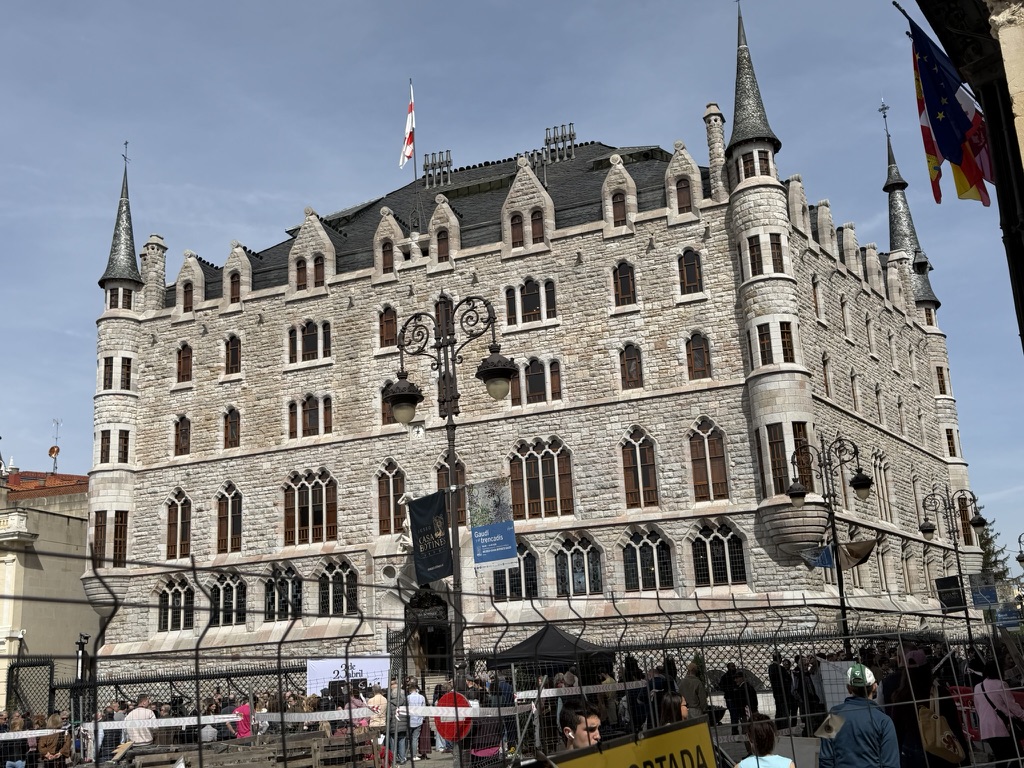
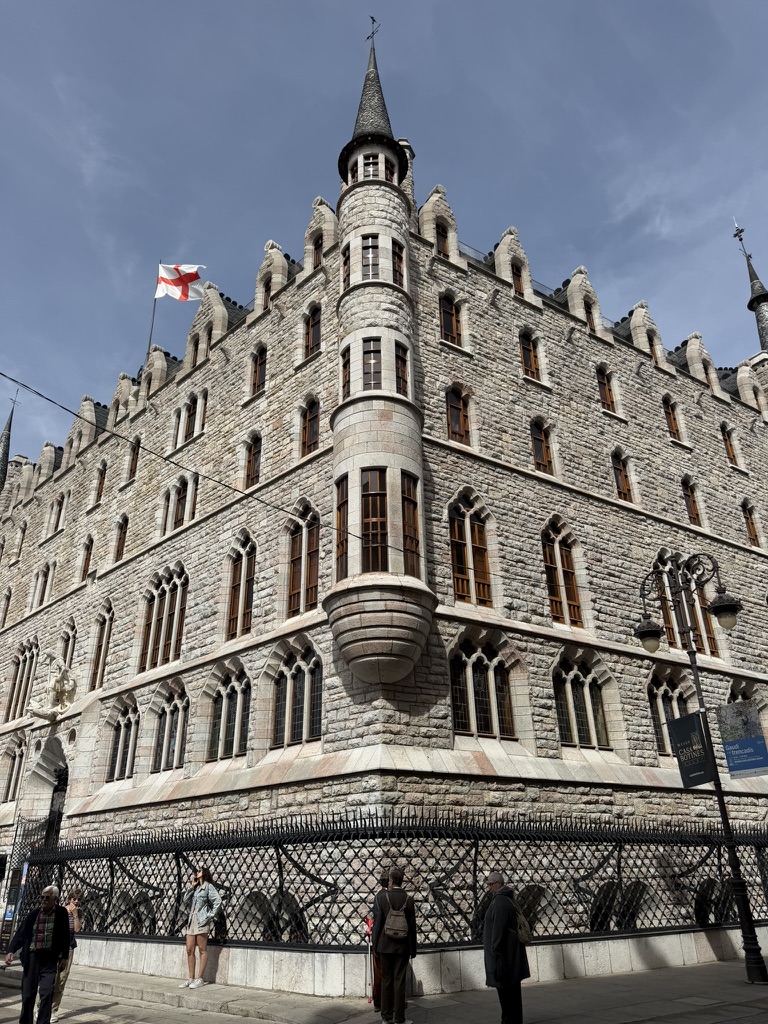
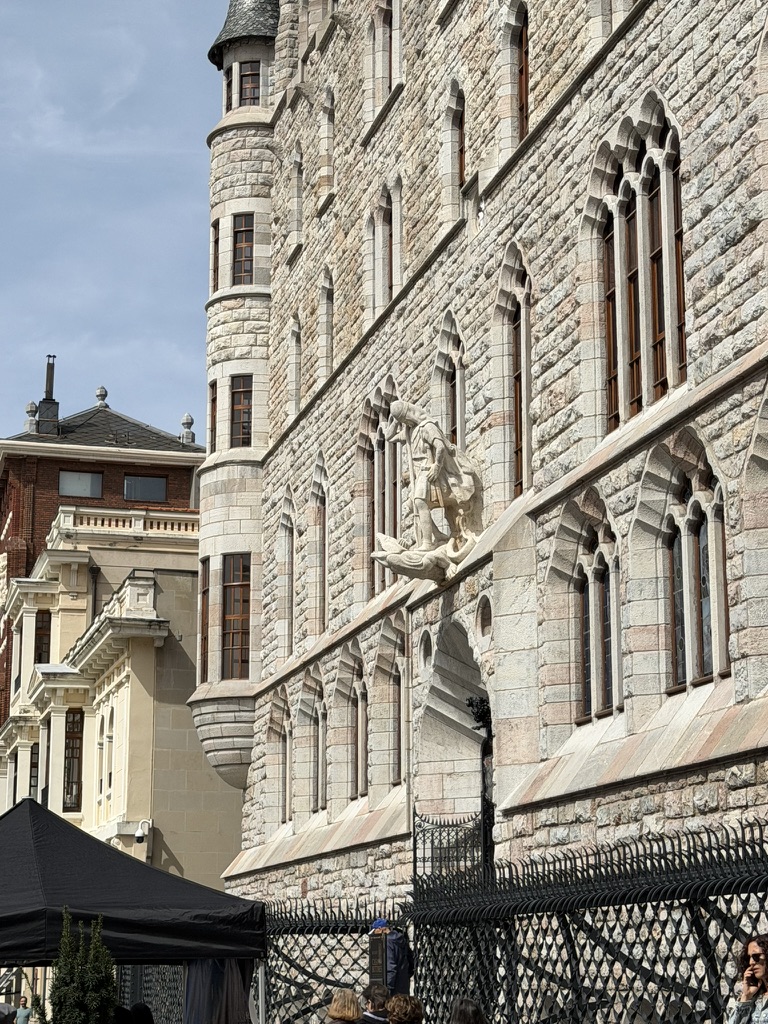
Unlike Casa Batllo, Casa Vincens or Casa Mila, from the outside Casa Botines seems simple and calm. Situated on San Marcelo Square, it is a large rectangle building whose main eccentrics are noticeable in the four corner turrets and towers, the notable wrought iron fence and the sculpture of Saint George and the Dragon above the front door.  (Which is why it is also known as the Dragon House.) Gaudi designed the sculpture, while Lorenzo Matamala actually carved it.

I loved the gate and fence. It seemed to reflect the idea of a dragon protecting the house in my mind.
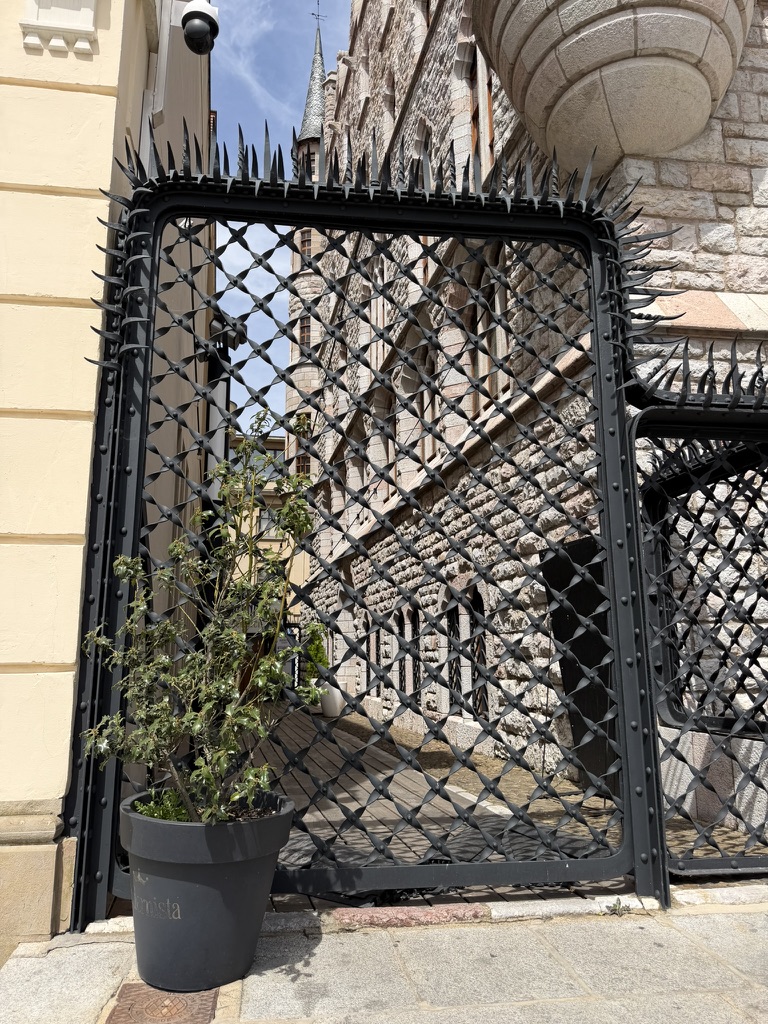
The side gate.

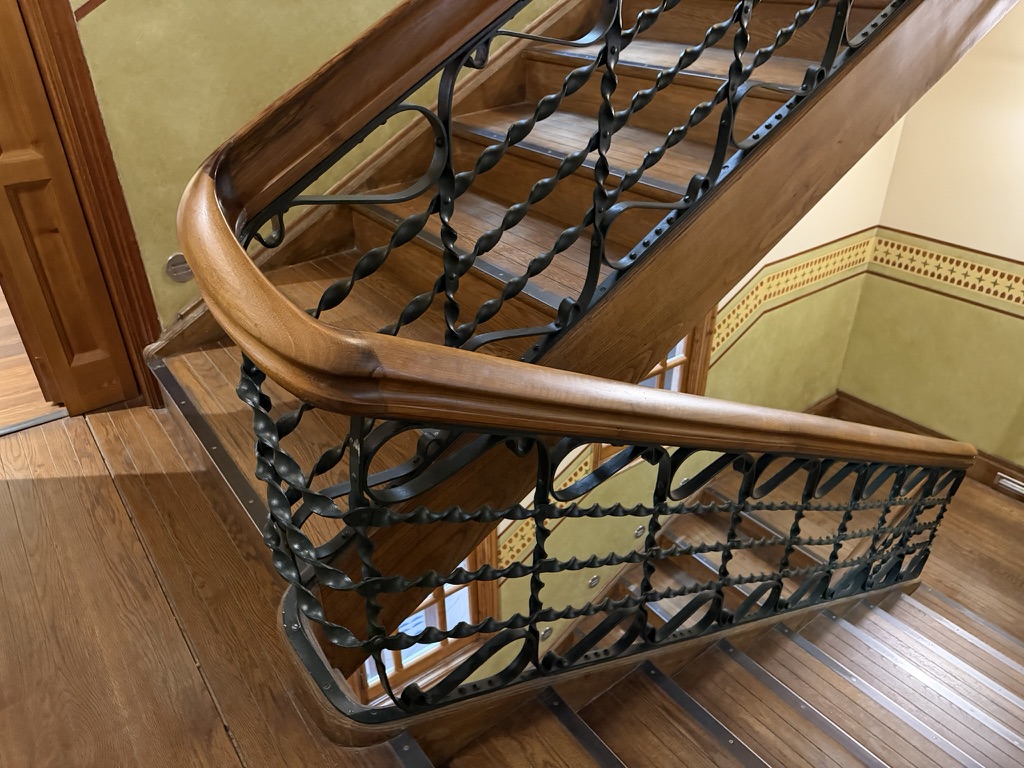
Inside the house is also much simpler than other Gaudi creations. This makes sense as it is one of Gaudi’s earlier works. Cassa Batllo was built in 1902-4 and Park Quell from 1900 – 1914.  Cas Botines was built decade earlier, in the 1890s, so perhaps Gaudi had not yet reached the apex of his most creative and inspired and colorful visions.  Thus the Casa Botines seems a bit conservative after seeing his other works.  Many are filled with vibrant colors and art.  Whereas Casa Botines is mainly defined by the woodwork and staircase. Although there are stained class windows and colored glass in the house.
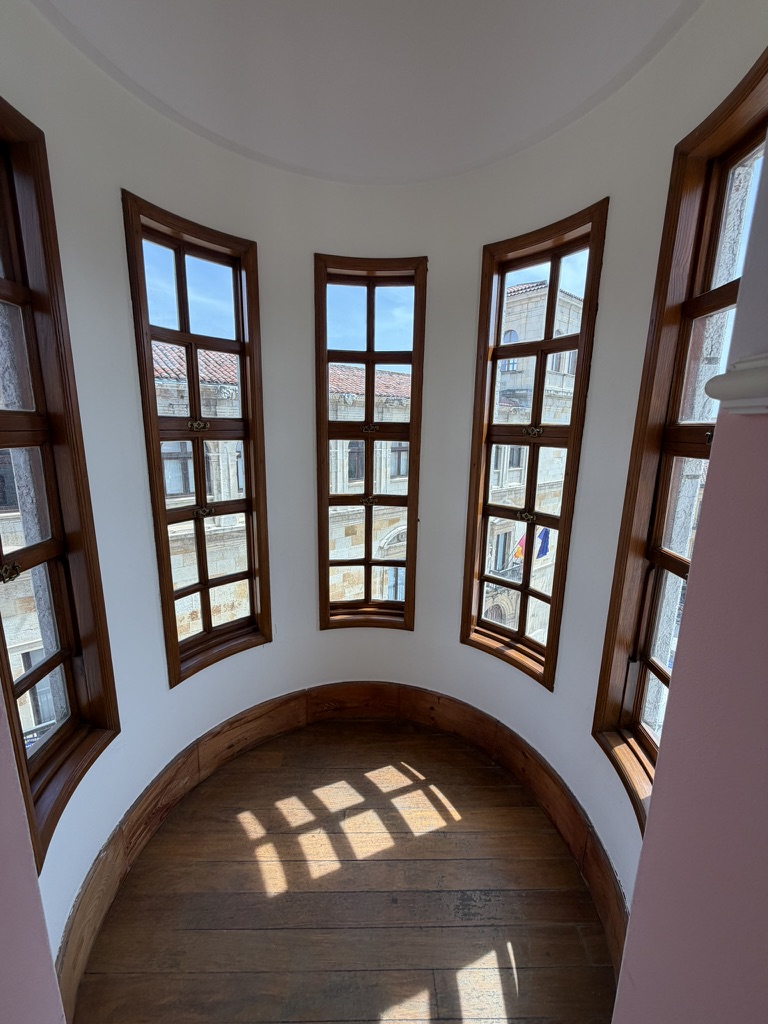
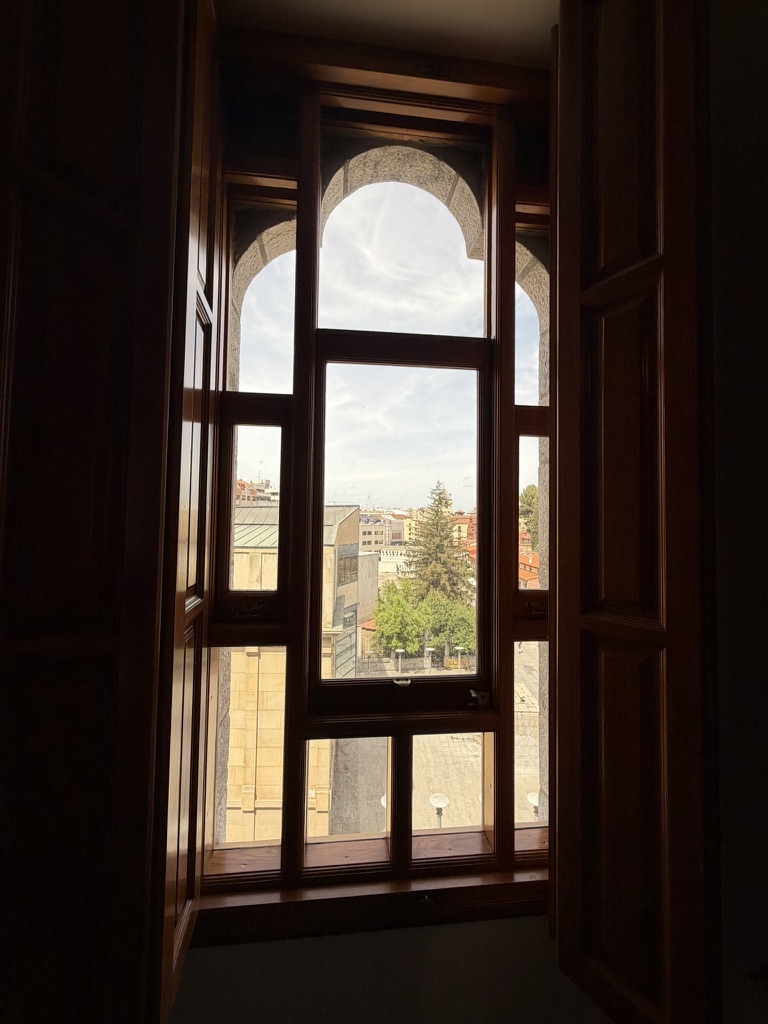
The woodwork is beautiful as in all Gaudi’s homes. The window frames, doorways, floors and staircases are stunning.  I love the windows in the turrets and also the multi-paned window that frame the outdoor scenes.  I can imagine living there and enjoying the warmth of the wood.  However, Casas Botines was not actually built as a home, rather as the headquarters for a business.
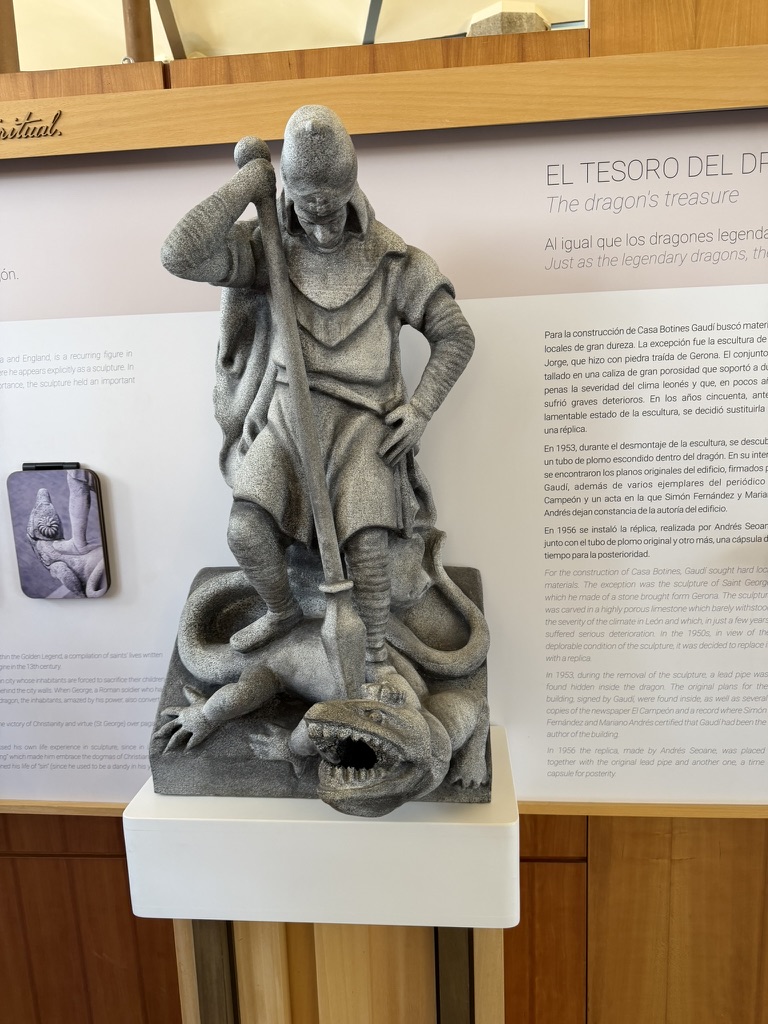
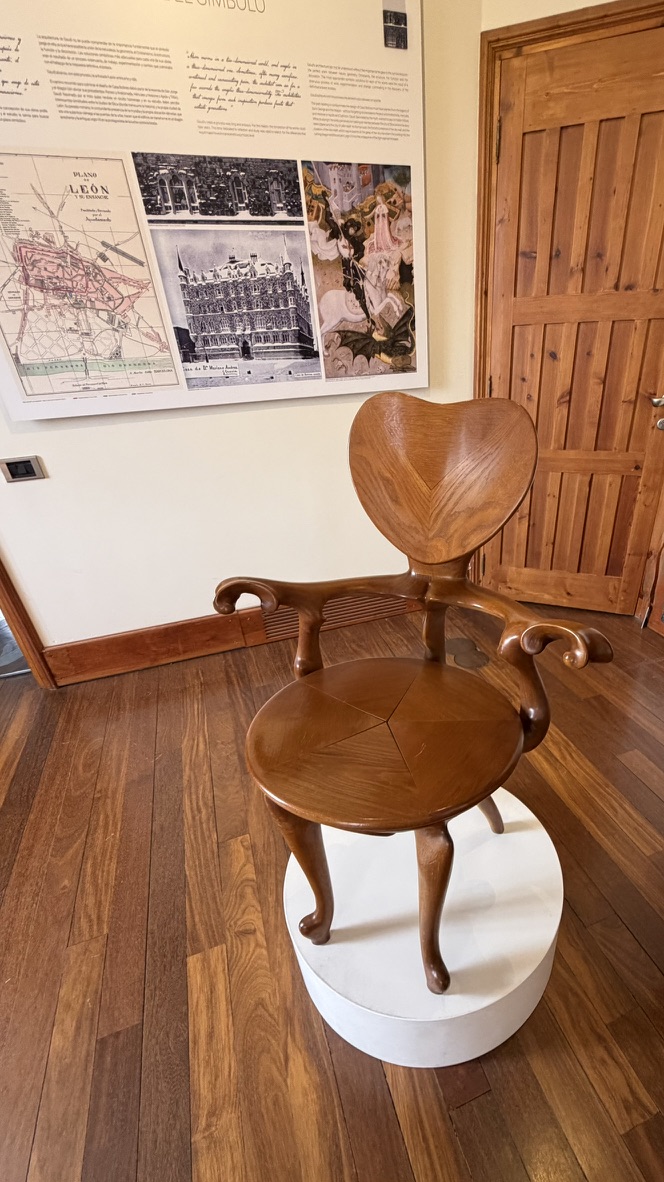
Currently, Casa Botines is a museum about Gaudi.  The rooms have some furniture that he created, including a heart chair, which I loved.  There is much information about the building of the Casa Botines and about Gaudi.  But there are also some items that make no sense to me as to why they are there.  Like the dentist’s office set up in one of the rooms. But I think that is because a dentist used to live there.

Outside the house, in the courtyard, sits a statue of Gaudi sitting on a bench and sketching. I imagine him looking at the space and trying to plan what he would build there. I always wondered how he came up with his fantastical ideas. Of course they always began with a sketch.
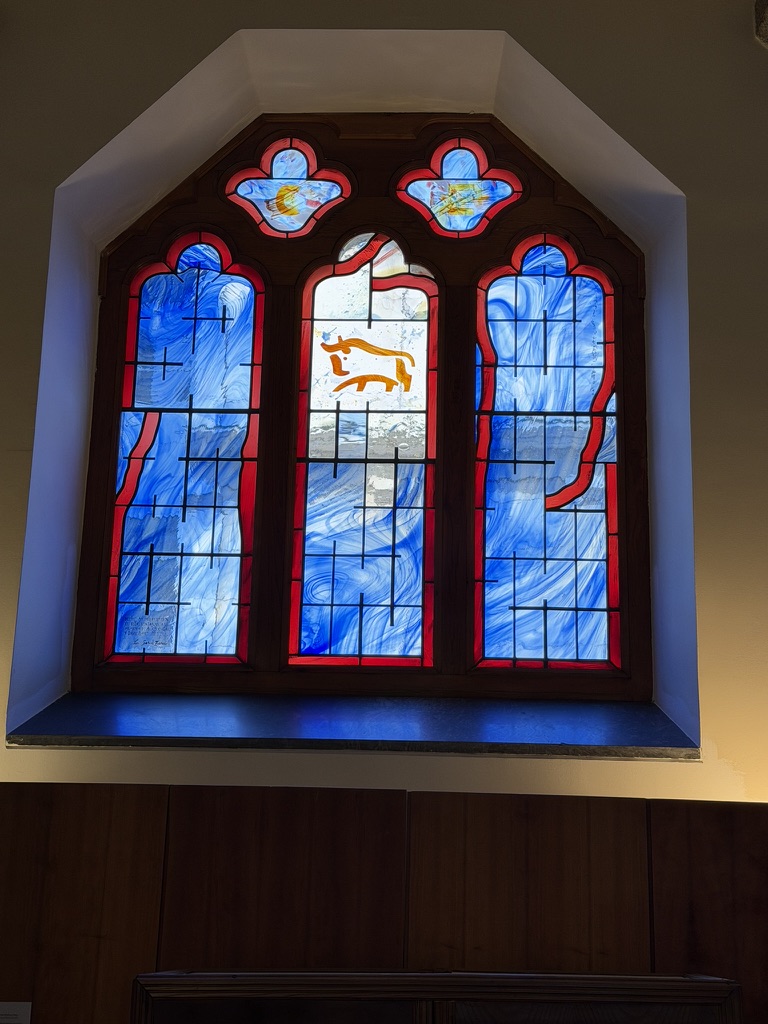
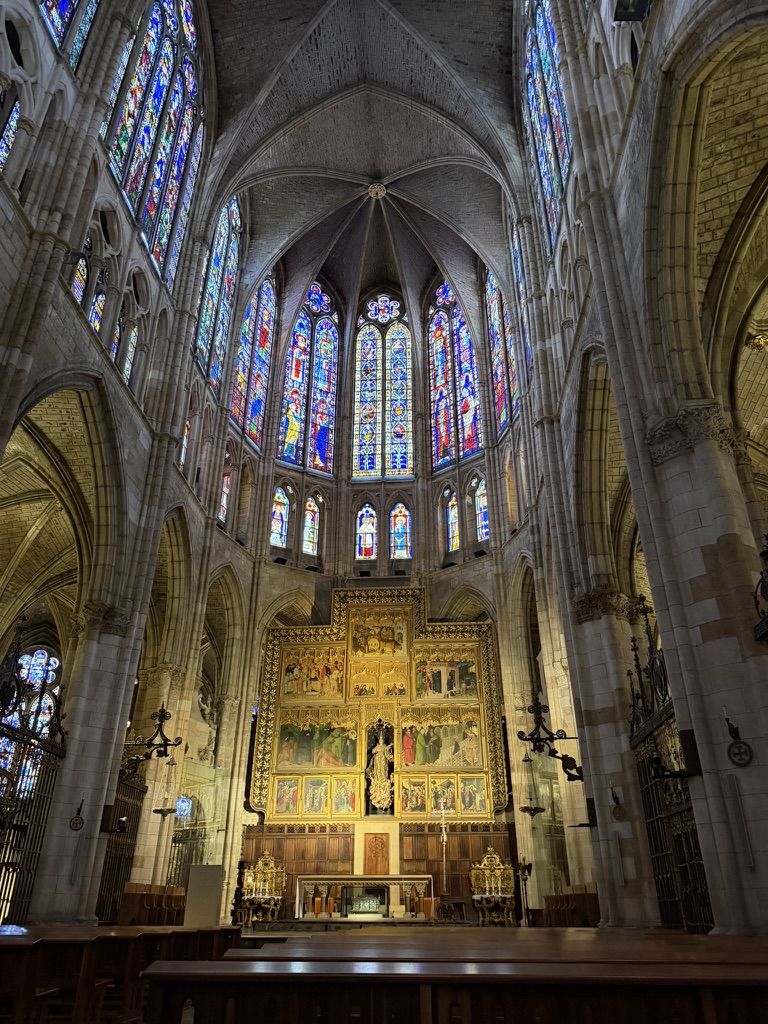
On a side note, according to our tour guide, Gaudi’s visits to the cathedral in Leon, with its many stain glass windows, vibrant colors and extremely high ceilings, was inspiration for his masterpiece, the Basilica of the Sagrada Familia in Barcelona.  Perhaps, a bit. But actually they are very different.

You can learn about my previous experiences with Gaudi in these two blogs:
Missing the Frank Gehry Museum, My Only Regret

2 Apr

Now that my trip is over, I must admit my one disappointment: not seeing Frank Gehry museum building in Panama City. 

Although I have never studied architecture, there are certain architects whose works intrigue me. I have written about Gaudi and Hundertwasser in a previous post (see below). 

But I also love the work of Canadian-born architect Frank Gehry. I just love his whimsical style just as I love the unusual designs of  Gaudi and Hundretwasser, who built structures before him. And although they worked in more natural materials, for me Geary’s modern  metal structures seem to meld into my love of slightly weird edifices. 

I think I also have an affinity to him as he was born one day after my mother’s birthday in February 1929 to an  immigrant Polish- Jewish mother, as was my mom.  

I love the Stata Center, the University building he designed for MIT in Boston. Walking around and inside and outside of this building just gave me joy. I loved the unusual angles.  

In Minneapolis viewing the museum from a bridge.


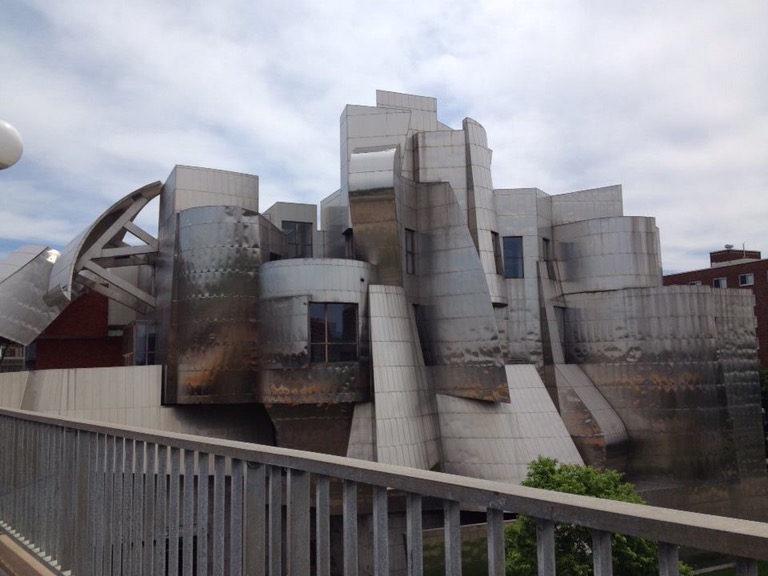
In Minneapolis we enjoyed time meandering through the Weisman Art Museum he designed near the University of Minnesota campus. When we walked away, I noticed a bridge which I immediately said had to be designed by Gehry as well.  I was right. My confirmation was a quick text to a young women I know who studied architecture at the university. 

Concert time


In Chicago I have enjoyed concerts at Millennium Park in the outdoor Jay Pritzker Pavillion theater that Gehry designed. The massive metal structure that surrounds the stage provides great acoustics and, for me, a welcoming embrace. It seems to reach out and say, “Pay attention!” I have meandered along the Millennium Bridge in the park. And I have yelled at teens trying to skate board along its lovely metal sides.

I have seen Geary’s famous fish sculpture in Barcelona, the city of Gaudi. This gives me joy I love that there are structures built by both done a century apart.  Although Gaudi’s famous church is still under construction. 

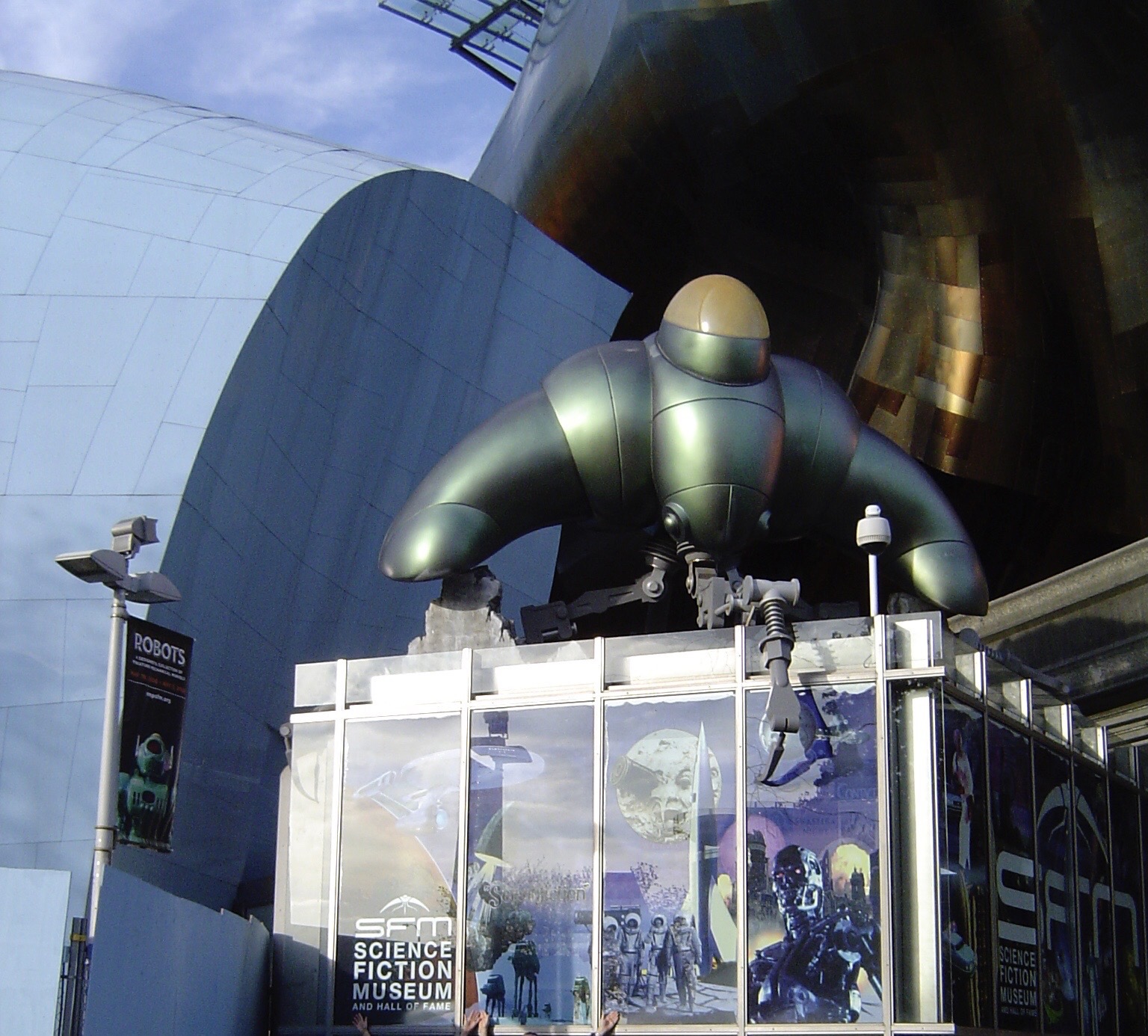
At the Museum of Pop Culture, the Gehry alien.


I visited the Museum of Pop Culture in Seattle and loved the Science Fiction Museum inside. I, of course, love the alien inspired figure over the entrance to the science fiction section. I enjoyed walking along the outside of this unique structure, loving the different forms and bright reddish color center.  

So it is not a surprise that I had signed up for a tour of the Biomuseo in Panama City that Gehry designed. Unfortunately, this tour was cancelled due to lack of registrations. How frustrating!  People signed up to go shopping in Panama City, but not tour the museum. 

And no we could not go on our own. We had docked in Colon for a short stay. The only way to get there was by a ship offered tour. I would have loved to really see the building, not just photos. Also the topic focusing on the changes in Panama due to the Canal would have been fascinating. 

So I must admit,  my only regret of our South American/Panama Canal vacation was missing a trip to this museum. I guess I will have to go back. 
https://zicharonot.wordpress.com/2015/07/06/my-architectural-love-affair-with-hundertwasser-and-gaudi/

My Architectural Love Affair With Hundertwasser and Gaudi

6 Jul

In the summer of 1999, my husband and I took our children on a tour of Austria and Hungary, primarily to see these countries and to view the total eclipse of the sun that would be visible that summer. We were heading to Hervis, Hungary, for the best viewing.

Before the trip up to the mountains, we stayed for several days in Vienna. It was an informative trip as we went to the Jewish Museum, Judenplatz, other museums and visited the home of the white stallions. (See below for links to another blog about this trip.)

But along the way I was introduced to the work of Friedensreich Hundertwasser, the Austrian architect who was born in 1928, the same year as my father, and who had survived the Shoah with his Jewish mother by passing as Catholic, the religion of his father. In Vienna we saw the most unusual apartment building designed by him, The Hundretwasserhaus. This crazy looking building was multicolored, unusually shaped and had trees growing everywhere.

IMG_6071

But the most wonderful part of our visit that year, was our accommodations at what my then 8-year-old son called the ‘Wacky Hotel.’ But whom others call Hundretwasser’s Rogner Bad Blumau, a hotel that includes thermal baths and pools. The hotel has no rhyme or reason that an adult can see. But it has sparks of imagination that enchant a child. I was enthralled.   I became a Hundertwasser lover. Even though I have no background in architecture.

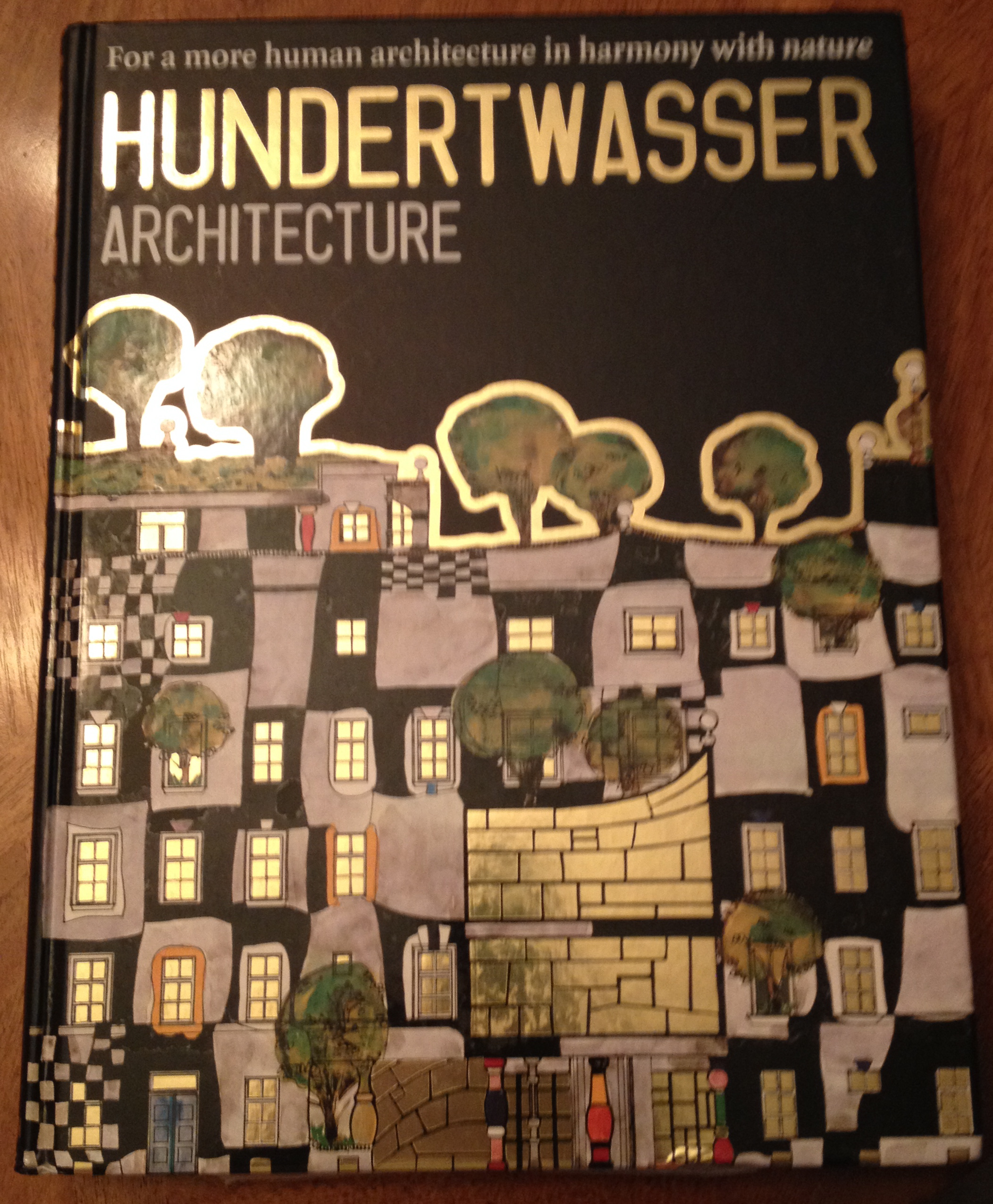
Our stay there was delightful, from the curving paths to the unusual windows to the wonderful pools and colorful design. I bought books about Hundretwasser. I was intrigued by his desire to help nature and bring all things natural to his architecture. Yes, I think he went a little far at times, but I so enjoyed his work.

I was also intrigued by his personal history and his survival. Born Friedrick Stowasser, he changed his name after the war to focus on his desire for peace and harmony with nature. I think I was also aware of another connection, my maternal grandfather was also from a part of Austria. He had moved to the USA in the 1920s, but like Hundretwasser, my grandfather lost almost 100 members of his family during the Shoah. Hundretwasser’s mother lost many of her family members as well. Our connection was that both of our families had been decimated by the Shoah.

I would love to see all the buildings Hundretwasser designed, but I realize this would be impossible. However, there is a winery in California, The Quixote Winery that I have to see! I love how he uses the natural contours of the ground and a need to protect the environment in his designs. I would love to see this winery in person.

My profound interest in Hundertwasser’s works lead to my interest in another European architect, Antoni Gaudi, from Spain.   Although he died three years before Hundretwasser was born, I see his influence in the work of my Austrian artist. For Gaudi, his Catholic religion was an important part of his designs. Not so for Hundretwasser, even though he was baptized to survive. But the form of their buildings and their interest in natural design fit so well together.

The towers on their buildings, the use of stone and color, the curves and contours reflect each other. Although Gaudi used religion to influence his art, and Hundretwasser used nature.

Church of Sagrada Familia

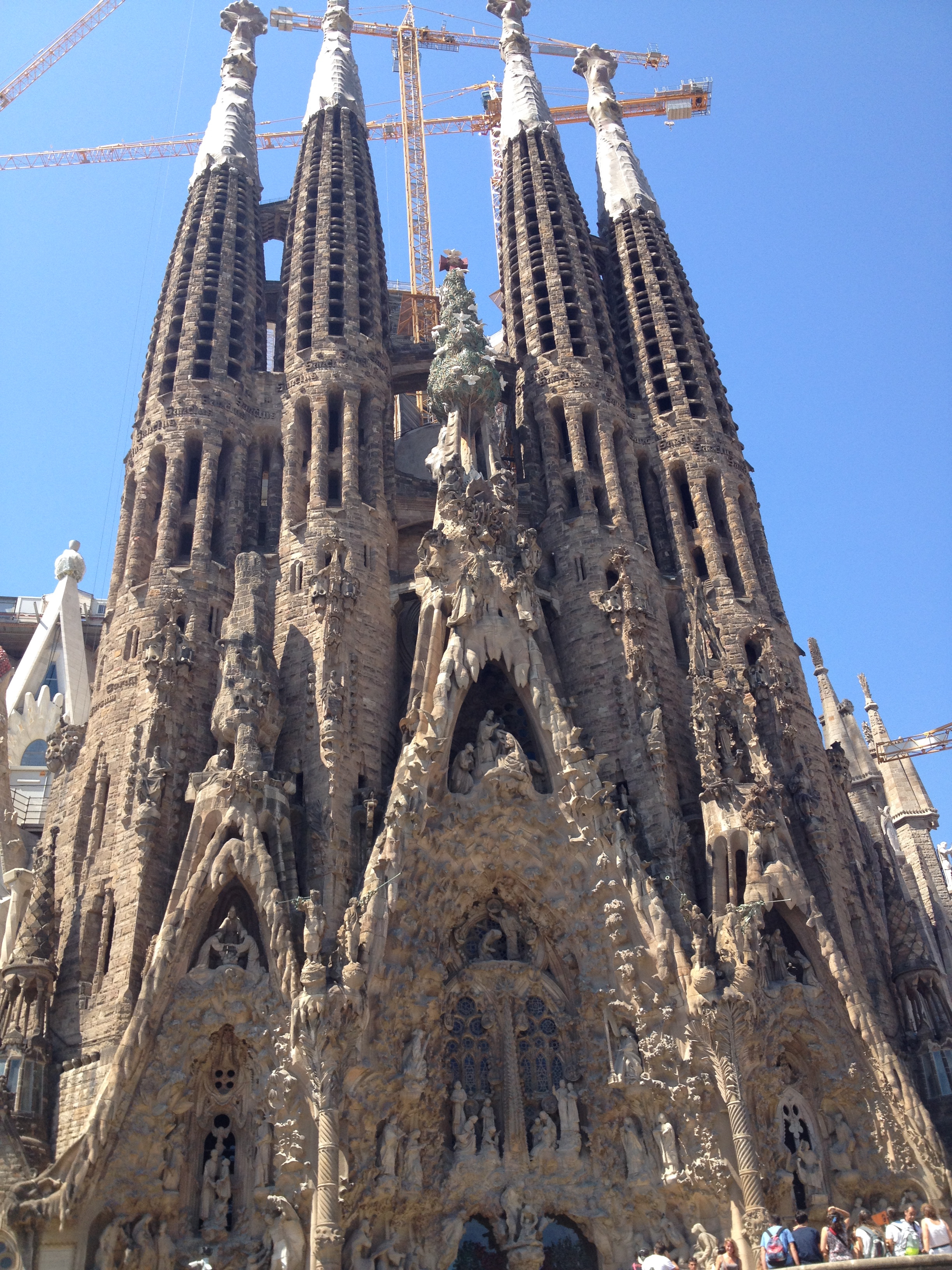
So, of course, on our recent trip to Europe and Barcelona, I had to go to see some of Guadi’s designs. The amazing church, the Sagrada Familia, which has been in progress for over 120 years! Wow! What a creation! My husband envisioned termite hills reflected in the towers. Our tour guide was not too happy with that comparison. But it is true. The towers do look like termite hills to us!

Casa Batllo Casa Batllo

We toured the Casa Batllo. I loved it! The mushroom fireplace, the lovely curved doors and windows, the delightful stone and tile-encrusted façade all brought me some joy! The private garden in the back on part of the roof was enchanting.

Unfortunately we could not get tickets to Park Guell, so I guess I will have to go back to Barcelona one day to view this park and see how it compares to the Rogner Bad Blumau.

I find it so unusual that one man, born in the mid 1850s and dying in 1926, who based his architecture on his religious beliefs; and another man born in 1928, who died in 2000, and had to escape from religious persecution, both designed buildings with such unique and imaginative styles.

Although some believe the word gaudy comes from Antoine Gaudi’s name, it does not. My search of several dictionaries revealed that the word, gaudy, was first used in the 1500s to mean garish or flashy. Yes, it is somewhat like Gaudi’s buildings, but in this case his name was not the reason for the word, just a serendipitous event.

And although some might call Gaudi’s works gaudy, to me they are inspiration! To me, to be honest, neither the work of Gaudi nor the work of Hundretwasser should ever be considered gaudy, rather they should be seen as works of imagination! Just as the song about Figment in the Disney ride “Imagination” used to say, “One little spark of inspiration is at the heart of all creation!”

I believe their designs will be joy to many others for generations because they hold the spark of imagination. And so I will continue my architectural love affair with their buildings.

Update with a newest Gaudi visit: https://zicharonot.com/2018/10/08/i-do-love-gaudi-my-second-barcelona-gaudi-adventure/

https://zicharonot.wordpress.com/2015/04/19/behind-the-beauty-and-facades-of-vienna/

tour the rogner bad blumau spa, designed by friedensreich hundertwasser

My second Gaudí adventure: https://zicharonot.com/2018/10/08/i-do-love-gaudi-my-second-barcelona-gaudi-adventure/