A Garden is A Great Place to Unwind

27 Aug

Being outside, enjoying plants and gardens, is to me a gift.  I love my gardens, but personally, I do not like to garden.  I have many friends who enjoy being outside and weeding, planting and keeping their gardens lovely.   I love to have my gardens planted and maintained by my husband and a gardener.  But I love my plants, my trees and my flowers.

For many years my father would garden for me whenever he came out to visit.  He loved it!  My husband and dad dug many of my flower beds and did all the original plantings.  But later in life, when he was not moving as much, he still helped put out the mulch.  And eventually we would put a chair in the shade and let him direct all the gardening.  Once he passed away, I really left the gardening to my husband and “John” the gardener, who we had hired when my dad stopped being able to do as much.

I make decisions as to what I like and where it should go. But then I step back and let others do the work.  I love nature, but my way.

My love of gardens extends to my joy in walking through public gardens.  When I can, on my journeys, I try to visit botanical gardens.  I have been to gardens in Canada, an especially lovely peony garden in Quebec City; and throughout the USA, including close to home, like the local Arboretum, a favorite place to walk.

In my recent travels to Hawaii and California, I spent much of my time enjoying gardens.  Let’s be honest, Hawaii is just one giant garden.  We were there two weeks before Hurricane Lane hit, so I am hoping that the lovely Flora on the Big Island of Hawaii survived.

On Maui we went to the Maui Tropical Plantation.   I call it a botanical garden of fruit bearing plants, besides just being lush and lovely.  We took a tram ride with a young woman who not only told us what was grown, she even showed us the correct way to open a coconut.  I am sure she shows everyone and does the same speech.  But it was fun.

We enjoyed walking the grounds and seeing the beautiful plants.

So when we were in California a week later for a wedding, we had some time to just relax with my siblings.  The one place I thought we would all like was the Alta Vista Botanical Gardens, which turn out to be just great.  Only problem, most of the paths are not paved: wear closed shoes!!

Among our favorite spots was the Children’s Discovery Trail with its beautiful flowers, giant dragon sculpture and musical garden. We liked the tropical garden with the dinosaurs hidden among the plants, Dino Digs.  In fact, I loved many of the art pieces hidden among the plantings. We walked through the Australian garden, the reception rose garden, and the ceremonial garden as well.  I will admit, we did not walk down to some of the lower gardens, but from our view they were fantastic.

I hope everyone has the chance to be outside and enjoy the garden of their choice.  It truly is a wonderful way to relax.


“LOST” in Hawaii on Ohau’s North Shore

21 Aug

(My fifth favorite part of Hawaii.)

My husband is a LOST fanatic.  Yes, he is one of those people who watches the series over and over again to revel in every single aspect of it.   I liked LOST, but it got a bit too much for me.  I just could not suspend my disbelief when it came to that Smoke Monster.

However, when he told me he wanted to go to the North Shore of Ohau and see some of the places where LOST was filmed, I had to agree to get lost in the memories of LOST.  I hired a private tour guide, Josh, who did just that.  Luckily, Josh was also a LOST fanatic who lives on the North Shore, so finding the spots was easy!

img_8738

Nu’uanu Pali Lookout has beautiful views of the islands windward coast.

After leaving Honolulu and seeing a few sites along the way, including the Nu’uanu Pali Lookout, with its magnificent views of the windward coast, we made it to the North Shore.  Although Nu’uanu Pali Road and the Lookout were not part of the filming of LOST, the overlook was a great place to see the areas where the show was filmed.

First stop on the North Shore was getting a to-go lunch at a great little restaurant.  Josh then took us to our first LOST spot, Mokule’a Beach, where the first season of LOST was filmed,including all the beach scenes and the plane crash.

We sat on a log and made believe we were Lost as we ate our lunch and watched the beach goers swim and enjoy the surf.  We also watched groups of tourists come to visit the site, just as we had.   We spent time walking the beach, while my husband tried to figure out where certain scenes were filmed.  I took photos and had a great time just enjoying the lovely scenery and the ocean breezes.

By the way, the scenes with the Smoke Monster were also filmed on the beach, but looking inland.  I took a few photos, but not sure if I got the exact location.

img_8749

The Waialua Sugar Mill. This building is now a soap factory. It was part of the Nigerian Village.

Then we took off for our next stop, an old sugar mill, Waialua Sugar Mill.  It now has a surf board shop and the North Shore Soap Factory.  While there I enjoyed watching soap being made and buying an assortment of locally made soaps as gifts.  We also visited the surf board shop where Josh explained the sport of surfing to us.  He used to be a professional surfer, and still goes every day.

Why is this spot so important?  Well it was the sited of Mr. Eko’s Nigerian Village.  That cone shaped building was also in LOST.   As my husband figure out each spot…not on his own, he actually was using a website to match the spot with its LOST identity… his excitement increased.   Did I tell you he was a LOST fanatic!

From there we went to a lovely lookout point next to a nature preserve where the Nene, the state bird of Hawaii, nest.  The road is closed, and you must walk in to the preserve.

img_8780

Close to the YMCA Camp. Looking toward the preserve for the Nene birds. The camp is to the left down the main road.

But the most important part of going to this preserve and lookout point, is that it is on the same road as the YMCA Camp Erdman.  In fact, we passed the camp on the way to the preserve.  Our guide actually went to this camp as a boy.  It is still a summer camp, and we could see campers from the road.  But for LOST fans it is something more.  It is the home of the Dharma Initiative.  It is the site of the Barracks, the village of the others, and the Dharma Processing Center, which is the camp’s Assembly Hall.  Since we only saw it as we drove past, camp was in session, I have no photos.

That ended our LOST location tour.  Unfortunately, we did not have time to see any more, as my request was to see sites of Hawaiian culture. (See blog about the birthing stones.).  And we had to get to the airport for our return flight to the mainland. We had planned to go to the Byodo-In Temple,  but did not have the time.

Hawaii is a wonderful place to visit.  Getting lost in the fanatic world of LOST fans was just fine, because even though I am not a LOST fanatic, the sites are so stunningly beautiful.  Aloha.


For those interested, this is the website we used to find LOST locations:   https://www.tripsavvy.com/filming-locations-for-abc-lost-1533555


Waterfalls Brighten My Days

19 Aug

(My fourth favorite experience in Hawaii .)

Something about waterfalls makes me happy. Watching the energy of the water as it rushes to the falls and then seeing it come over the edge is exhilarating.

So when I saw that among the tours offered on the Big Island was a Tropical Waterfall Tour, I knew I had to sign up.

Years ago, when we went to Hawaii, we visited Akaka Falls State Park. We loved the seeing this high, over 400 foot, fall. But this would be different, we would visit four different waterfalls.

So on this trip I was delighted to find this trip.

It was lovely. Our tour guide, Kurt from Hawaii Forest and Trails, was wonderful.

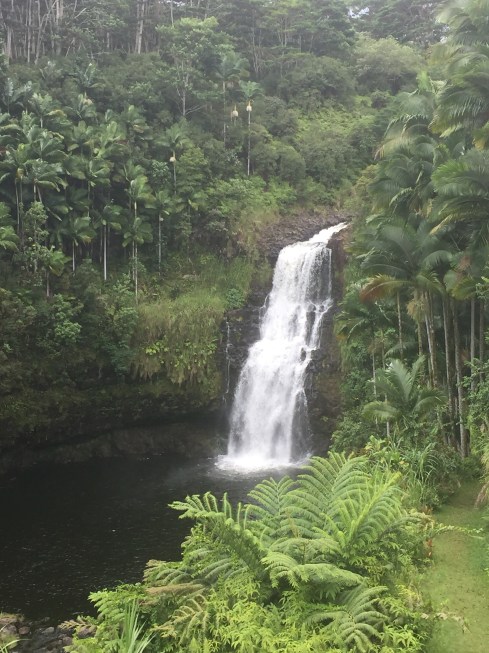
Among the falls we saw were Rainbow Falls, known for the rainbow that firms when you see it at certain times of day. We saw it from the private Oak Ranch.

My favorite falls was the duo Falls of WaiLuku and WaiAu. We also saw these from a private viewing site on OK Ranch.

Another favorite was the falls we saw from the grounds of a bed and breakfast. We were able with walk down to bottom of this waterfall and even swim in the pond.

It was an excellent trip and I recommend it.

My Third Grand Canyon: Waimea Canyon, Kauai

15 Aug

(As well as my third favorite spot in Hawaii.)

I guess I am on a roll to see every “Grand Canyon” there is!

I finally saw the true Grand Canyon two years ago.  And I loved it.  We went to the West Rim and were able to walk at above the Grand Canyon on the Skywalk, and also visited Eagle Point.  These are located on the grounds of the Hualapai Tribe’s Reseravation, and are not part of the Grand Canyon National Park.  But it is a wonderful experience.  The Grand Canyon is 277 miles long and as much as 18 miles wide.  The deepest part is 6,093 feet.  It is a very big canyon.

Last August I was in Yellowstone National Park, and visited the Yellowstone Canyon, where the Yellowstone River flows in to a valley forming a canyon. This is called the Grand Canyon of the Yellowstone.   A beautiful site, we were able to view the magnificent waterfall that helps create the canyon.  This canyon is 24 miles long, as much as ¾ of a mile wide and up to 1200 feet deep. Yellowstone Canyon is in Yellowstone National Park.  It is where I finally got my senior park entrance card!

So, of course, when I knew we were going to go to Kauai, I knew we had to go to Waimea Canyon to see the Grand Canyon of the Pacific.  This canyon is 14 miles long, one mile wide and up to 3600 feet deep.  It is part of the Waimea Canyon State Park.


From the Waimea Canyon Lookout, you can see, off in the distance, some of the waterfalls that feed the river below and form the canyon.  But it is much easier to seem them with binoculars.

The biggest difference between this canyon and the other canyons, is that these mountains and canyon is all volcanic material.  So there is really no strata of stone like you see on the rocky canyons, like the Grand Canyon.

But it does not matter, all three of these canyons are magnificent in their own ways.   I am so glad that I have had the experience to see them all.  I will let the pictures explain.

Pu’uhonua o Honaunau National Historical Park

14 Aug

(My second favorite stop on my Hawaiian trip.See link to first one below.)

On the Big Island of Hawaii, we visited the Pu’uhonua o Honaunau National Historical Park.  This is the site of a Pu’uhonua, a Place of Refuge, as well as Royal Grounds for the rulers of the islands.

I love history and learning about other cultures.  So on this trip, I tried to learn as much as I could about the Hawaiian culture.  As with our visit to the birthing stones, the Pu’uhonua o Honaunau is also a scared site that should be treated with respect.  It also met another bucket list item of mine, I am trying to visit a National Park in every state!

In ancient times if a person broke a kapu, or a scared law, they often would be punished with a death sentence.  But there was a chance of survival.  If the person was able to escape and get to a place of refuge, a Pu’uhonua, a priest there could save him/her by absolving him/her of the kapu.  It was not easy to get to a place of refuge.

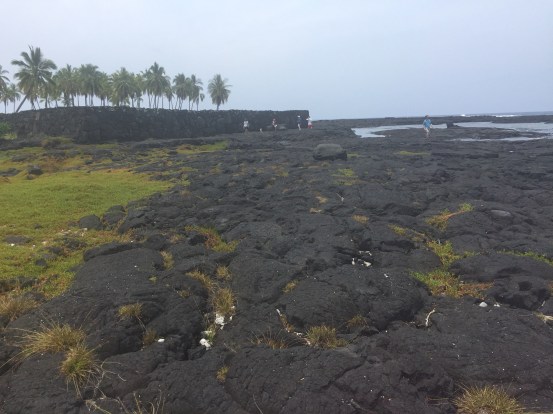
img_8614

Looking toward the place of refuge and the lava reef that surrounds it.

At Pu’uhonua O Honaunau the easiest access was from the sea.  However, you had to conquer the waves crashing ashore and a field of tough lava to reach the safety of the priest.  At the same time, you could not step over to the Royal Grounds, or you would be breaking another kapu.

Over the years, most of the refuge sites were destroyed by missionaries who wanted to dissuade these practices or neglect from disuse. Although other sites still exist, nothing remains of the refuge buildings.   In 1961, the National Park Service opened this National Park with a restored place of refuge, as well as the royal grounds that were next to it.

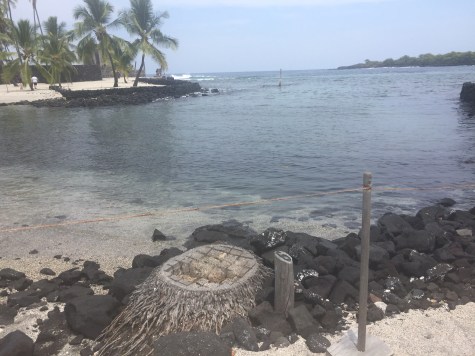
img_8595

The Royal Ground’s Keone’ele Cove

It is a lovely site with a small, natural cove, Keone’ele Cove, once used by the ali’I, the royal families.   Throughout the site, the lava rocks and flows create beautiful formation.  There are recreations of some of the buildings and wooden images, ki’i, representing the gods.

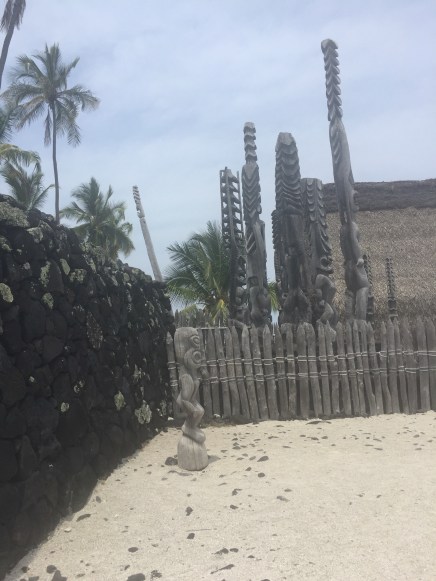
img_8602

Stone wall, ki’i and mausoleum

The Great Wall, a long, high wall built of rocks, without any mortar, separates the Royal Grounds from the Pu’uhonua.  The wall is over 400 years old!  My husband thinks that those who were rescued by the priests probably had to help build the walls.  He could be right.

Several times each day, visitors can hear a talk by a park ranger.  That was not available the time we were there. But you can download a guided tour on your smart phone, or just follow the guided tour in the park brochure.  We used the park brochure, following the trails and looking for the items that were numbered. It took about an hour to walk the site.

There is also a little gift shop run by the Park Service.  Children can receive a junior park ranger workbook and fill it out.   When we were there two sisters turned in their booklets and were made official junior park rangers!

The Pu’uhohua is well worth a visit. It takes you back in time and helps to understand the culture that was Hawaii before Western civilization changed it forever.


A Burst of Emotion: Kukaniloko Birthing Stones Sacred Site


A Burst of Emotion: Kukaniloko Birthing Stones Sacred Site

13 Aug

(We recently cruised around the Hawaiian Islands.  This is the first of five blogs about my favorite spots.)

Fertility, pregnancy, healthy births, all topics that are important even today.  Childbirth is, at times,  life threatening for the mother and for the infant.  In ancient Hawaiian times, women went to sacred spaces in an effort to safely give birth.   In Oahu, there is such a space dedicated to the women of the royal family.

Fertility for those who cannot conceive is also a painful topic.   At the Kukaniloko Birthing Stones Sacred Site, these two quests: a safe and pain free birth, and the request for a pregnancy come together.

img_8786

Before we arrived at this sacred site, our guide pointed out part of the Wai’anea Range on Oahu.  As you drive along the Kamehameha Highway, part of this mountain range looks like a giant sleeping pregnant woman,  the “Wahine Hapai.”  You can see her head, then breasts then pregnant belly rising to the sky.  She embodies fertility and health.

He told us that Wahine Hapai overlooks a sacred site that many tourists do not go to but thought we would like to see.  (Perhaps because my husband is a pediatrician.)  The  Kukaniloki Birthing Stones Site is unmarked and is not easy to find.  There is just a small indentation of an  entrance off the highway, with a gated road.

Before we walked down a bright red dirt road to reach the site, we read the warnings that this was a sacred site and we should respect it. “Do not sit on the stones. Do not move or wrap the rocks. Do not trample the plants.” These were the top three rules.  I thought I was ready to visit.  But in reality, it was much more emotional than I thought it would be.

img_8794

It is a quiet spot, an oasis of trees and stones in the middle of a field. The first indication that you are entering the sacred site, is two stones standing by the entrance.  These were two of the birthing stones: One to sit on and one to lean up against. They have been moved from their original place in the grove of trees.  Just past these stones are two parallel lines of smaller stones, leading to the tree-shaded main site, where the trees surround a group of large stones.  Behind the site, watching from above is the Wahine Hapai, the pregnant woman, helping those in labor.

img_8801

In my effort to know more, I looked up information on line when I returned to the ship.  I read that the two line of stones were for the chiefs to sit on, while a royal woman gave birth.  The chiefs came to help her through this time. It is also said that women who gave birth here felt no pain.

My husband and I were not alone in our visit.

img_8802

Walking along the two lines of stones, I noticed a woman squatting by each stone, touching her forehead to the stone and praying.  She went down each line, holding the stones between her two hands, resting her head, then moving on.   I was not close enough to hear what she said. I tried to give her space, but I knew in my heart what was happening.  I could almost hear her prayers for a pregnancy and for a child of her own. And my heart opened.  I began to pray silently with her.  Sending my positive energy to comingle with hers.  Hoping perhaps a stranger who knew her pain could add to her prayers.

Do Not tell me this is a ridiculous quest. 

I too suffered from infertility and prayed to become pregnant.  I spent days, weeks, months and years wondering why everyone else was able to get pregnant but me.  I hated family gatherings, where all the new babies would be the center of attention and people would ask me when I planned to start my family.  Little did they know of the emotional pain I was in just being there.  I lost my faith for a time.  At the high holidays when we read about Hannah, I left the service.  It was just too difficult to bear.

Although I am now way past the age of giving birth, and I do have two children, I carry that black hole of pain in my heart.  I keep it covered.  I try not to visit it.  I moved on, I believed.  But watching this woman in her prayers removed the cover I keep over this abyss of pain, and I felt tears rise to my eyes. No one could truly help her.  No words can ever make that pain go away.  Watching your friends and relatives get pregnant is a slap. Each month a new cycle is just a reminder that you failed once again.  It is an enormous, deep black hole of grief.  And I saw that grief on this woman’s face.

She was not alone.  A young man squatted close to the square enclosed area where the trees and many birthing stones were assembled.  You cannot enter this sacred area.  But he sat just outside the roped off area, watching.

I felt the spirit of their prayers around me.  It would be hard not to feel it.

We did not spend too much time at the site.  I took a few photos, and then told my husband it was time to go.  I wanted to give them the privacy they needed. (I learned later that although tourists might not visit it, the site was well visited by locals who celebrated the birth of their children or who were wanted to have children.)

As we walked away, my memories and my prayers rose up.  I hope that the Kukaniloko Birthing Stone Sacred Site, and the energy of life and birth within it, helped her move forward.

This was my most memorable spot in all of Hawaii.

Discovering Karola’s Kielce Pogrom Testimony

12 Aug

In February 2017 I published a blog about discovering my grandmother’s cousin was in Kielce, Poland, during the Pogrom in July 1946. (See blog link below.) Since then I have been continuing my research on the lost remnants of my grandparent’s families.  Along the way, I have discovered more about Karola.

First off, I now know her entire name, which brings me more understanding. Korala’s mother and my great grandmother were sisters.  My grandmother was her first cousin.

Our families did keep in touch.  My father often went to Paris on business, occasionally my Mom would accompanied him and would visit a cousin who lived there.  That cousin was Karola.  She had changed her name from the Polish sounding to a more French name, and of course I recognized the last name.

In any case, it was when I found the village where my great grandmother was born, that I found also the Viroshov Yitzkor Book published in 1970.   In it, written in Yiddish, was Karola’s testimony about the Kielce Pogrom.   I must thank my friend, Blumah W., the local Chabbad rebbetzin, who spent several hours with me as she translated this moving memory.

I think with what is going on in Poland today, with the country’s wanting to deny their people’s involvement in the Nazi’s intent to destroy and annihilate the Jewish population.  Karola’s story and memory is even more important because it tells the truth of what really happened in the years pre, during and after the war.

The Kielce Pogrom By Karola Manes F. as translated by Blumah W.

 “A lot has already been told about the ferocious anti-Semitism of how the majority of Polish treated their Jewish neighbors during all the years of the Polish existence. It is still fresh in memory.  The anti- Jewish politics in pre-war Poland using power against the Jewish workers and merchants, and the hooligans acting against the Jewish young students. 

        Also, during the time of the War, being under the German occupation, the Poles did not forget their anti-Semitic tradition.  They were very much supportive of the Nazi program and worked with the Nazis for the annihilation of the Jewish nation.  (“G-d forbid,” added by Blumah.)

          When the war finished, the Jewish remnants were hidden in different places. A few Jewish people who were saved began to look in their birth places for their relatives; their flesh and blood.   Also, then there came upon these survivors, unruly/wild Polish bandits, bands of Poles, who murdered these few left over Jews.

           The culmination point of this ferocious Polish behavior was the tragic well-known Kielce Pogrom, which was accomplish over these few ‘leftovers’ in the summer of the year 1946.

            Being be that I was in that time in Kielce where I lived through this tragic chapter, then I will tell what happened during this incident.

            After the war, in Kielce there was the concentration of a larger group of Jews.  The portion of them came from hidden places and from the forests, where they were involved with the armed partisans combat.  Larger groups from back from Russia, where they found themselves during the time of the war.  In order to deal with stream of survivors, a Jewish committee was formed that found themselves on Planty Street. 

           The Polish people right away, in the first days, immediately began to agitate and incite against the Jews.  “TOO many of you remained!”  They said with extreme hate.

           The first provocation was when someone threw the dead body of a Christian woman into the Jewish compound.  It was accompanied with an incitement that they said the Jews murdered this woman.

           Only at night, Russian soldiers came dressed in Polish uniforms and made order. They arrested a number of Polish hooligans.   The next morning, on the way to the funeral, the Jewish people accompanying the dead, were guarded by the Russian soldiers in order to avoid any further incidents by the wild and unruly Polish population

            May these words act as a monument for the holy martyrs of the Kielce Pogrom; May G-d avenge their blood. “

In the last paragraphs, Karola does not talk about how people were murdered or what truly happened on the day of the pogrom.  Instead she talks about the fact that it was Russian soldiers who stopped the pogrom by dispersing the Polish hooligans.

To be honest, I was a bit disappointed.  I wanted to know from her mouth/her pen what truly happened. What she as a survivor saw.  But then, I realized, it was too much.  She had survived a ghetto, a concentration camp and now a pogrom, who am I to want more from her?

What Happened To Karola?


No Lava For Us

8 Aug

A year ago we booked a cruise around the Hawaiian Islands, not knowing that two months before Kilauea would erupt. Thousands of people have been displaced. Homes destroyed. Land masses changed. Roads blocked. Luckily not many hurt or injured!

Eighteen years ago we spent a week on the Big Island. We spent hours on Kilauea walking around the rim of the caldera, going to the museum, walking through a lava tube. The park is closed now due to the eruption. We have heard that the museum has massive damage due to the many earthquakes that have assaulted the volcano area.

No one is allowed close to the volcano and the lava.

During our day in Hilo visiting a bevy of waterfalls, we were able to see steam rising from Kilauea from a distance. We were high above Hilo with a view to the volcano. Our guide told us then that the lava flow was decreasing and almost ceased.

But we thought we would still be able to get a glimpse of the glowing lava from the ocean and our ship.

That evening as the ship set sail, we rearranged dinner schedule to be able to stand in the starboard side of the ship as we sailed pass the lava flow. Hundreds joined us waiting to see the lava. It was a joyous atmosphere.

Then the announcement: the lava had stopped flowing the day before. They were hoping we could still see the glowing embers. But no, the crust has solidified and the red hot embers of flowing lava could not be seen. If it was daylight, we might have seen steam. But now nothing!

Everyone left the deck. Except a few including us. My husband lifting his binoculars and stared intently into the pitch black and stared across to the land, where there was no sign of life. No lava flow. The disappointment was keen. There was nothing to do but go inside to eat a late dinner and continue on.

I must admit two nights before I had a dream that the advent of Hurricane Hector put out the volcano. When I told my husband the dream, he laughed. He is not laughing anymore. But the good news is the hurricane went way south of Hawaii. And for the people of the Big Island, peace from Pele the Goddess of Fire and volcanoes has come.

Boleslawiec Pottery Pieces Create a Feeling of Despondency

15 Jul

(I found out on September 24, 2018, that there are actually two Boleslawiec.  The village my grandmother came from is different from the one the pottery comes from in Poland. But since they are intertwined in my mind, the blog still is accurate.)

Lately I have been seeing the name of the city, Boleslawiec, quite a bit because of the beautiful Polish ceramic pottery that is created there and sold throughout the world.   As I walked through the historic section of St. Charles, Missouri, I saw a store dedicated to this pottery.  My sister-in-law and I walked through and admired all the lovely blue-toned, designed pottery.

Later that month, I was in Tuesday Morning, a discount store, that had a selection of this pottery as well.  Here, I actually purchased a piece of the pottery in the shape of a heart as a memory of my grandmother who grew up in Boleslawiec.  But my remembrance of my Grandmother is not her love of her home town, but rather to remember how much my grandmother hated Boleslawiec.  How excited she was when she was 16 to get her exit visa to the USA.  Leaving Boleslawiec was the best thing that happened to my Grandma.  It really was not a friendly spot for Jewish inhabitants.

In 1925 there were 103 Jewish people in Boleslaweic.  In 1933 the town of Boleslawiec had over 19,500 people, but only just over 100 Jewish residents.  By 1938 there were just 64 remained. My family was among those who lived there.  And after World War 2, there were no Jews left in the city.
img_5528

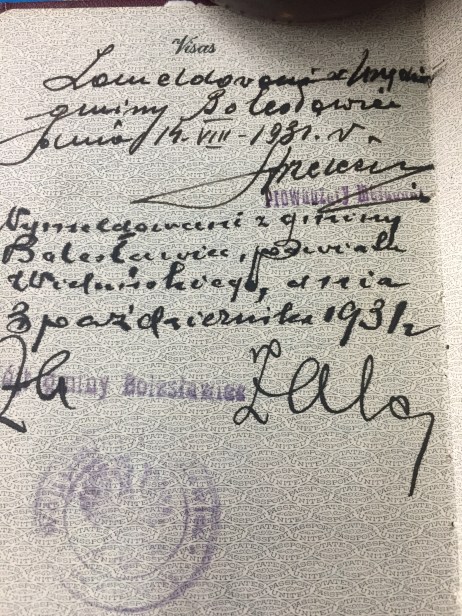
The special visa for 1931 visit to Boleslawiec.

My Grandma left Boleslawiec in 1922 to escape to the United States.  In 1931 she returned to Boleslawiec with my mother and uncle.  They stayed for several months.  We even have a special visa in the passport used by my Mom and Uncle that gives them permission to be in Boleslawiec.

It was during this visit that Grandma became aware of how bad it was for Jews in Europe.  Upon her return to the USA, she immediately began to work to get family members out.  She was able to rescue her father and her sister, who she brought to the United States. She could not rescue her two brothers and their spouses, but they did survive. Her mother, my great grandmother, Sara Manes Szenk,  died in 1919 as did a younger sister. (See blogs below.)

She was right to worry.  On Krystalnacht, November 9-10, 1938, Jewish business and the synagogue were set on fire.  They were destroyed.  Now just an empty lot is left.  The cemetery was also destroyed.  The few tombstones or matzevot left are at The Museum of Ceramics.   So my Great Grandma Sara’s grave — Sara, who I am also named for — is now unmarked, as are the other relatives who died before the Shoah.  An empty field marks the spot of the Jewish cemetery.  Luckily my great grandfather and aunt were already in the USA by then.   And my great uncles had fled.

Members  of Grandma’s family were murdered in the war. (See Blog about Speaking Yiddish below.).  I have not been able to find everyone.  But since the names Manes and Szenk were the surnames of her parents, I will claim all the Jewish people who lived in Boleslawiec who perished and had those surnames or maiden names.  I cannot claim for sure that they are related to me.  But in a town with just 100 Jewish members, I feel a strong level of confidence that they are my family.

Moshe Schenk(Szenk) and his wife, Yenta Fridel Schenk(Szenk), from Boleslawiec died in the Chelmo Death Camp in Poland in 1942.  Moshe’ siblings died as well:  Hana Leah and Bluma, also Bluma’s daughter Sara.  Two people wrote testimony for Moshe Schenk/Mosze Szenk: an uncle and a cousin.  That cousin also left testimony for Hana Leah, while the daughter/sister of Bluma and Sara, left testimony of their murders.

Many people who died in Chelmo were transferred there from the Lodz Ghetto in 1942.  So I will assume that these relatives were taken from Boleslawiec, to the Lodz Ghetto before their murders at Chelmo.  The Lodz Ghetto was the second largest ghetto in Poland.  Later, when the ghetto was destroyed in August 1944, many were taken to Auschwitz as well. Of the 68,000 Jews who were imprisoned there, 877 Jews remained hidden and were liberated by the Russians. When the war was over, only 10,000 Jews of Lodz Province remained alive. (Wikipedia).

Besides my Szenk/Schenk family who were murdered, there were at least four members of the Manes family killed: Franka Manes and three of her adult children: Sara, Eli and Reize.  Their sister entered the testimony in Yad VaShem.

I know that others perished as well because I met some of the survivors of Boleslawiec. I still cannot find their names, and that truly disturbs me. But the Manes family was from another small town nearby.  I have not yet completed my research about what happened in that village, but it was also in Lodz.  So I would assume the same route, Lodz Ghetto then Chelmo or Auschwitz.

When people think of the Polish city of Boleslawiec, they think of the beautiful pottery.   And only that.  I wish I could think that way as well.  Blue is my favorite color, and the pottery truly is lovey.  I know people who collect it.

I look at the lovely ceramic heart on my kitchen counter, and I think that it is amazing how a piece of lovely pottery that brings joy to so many people, brings me a feeling of despondency.   It is a symbol to me that people can create beautiful objects,  but carry biased hatred in their hearts. Even allowing that hatred to contribute to the deaths of others.  Unfortunately, I see that hatred rising again and happening today. So I look at the heart and I hope that kindness overcomes hatred.

Three websites, besides Wikipedia,  have helped me in the search about my Grandmother’s family who lived in Boleslawiec, Poland, located in the Province of Lodz.   Thank you to Jewish Gen; Vtrual Shtel; and my obsession, the Yad VaShem Database.

Update, There are actually two Boleslawiec cities in Poland.  The larger one is where the pottery is made; my grandmother probably lived in the smaller one.  But the pottery still brings the same response in my heart.

https://zicharonot.com/2014/04/28/speaking-yiddish-always-brings-me-holocaust-memories/

https://zicharonot.com/2017/12/04/the-us-passport-a-matter-of-life/

https://zicharonot.com/2016/10/01/the-rosh-hashannah-card-has-a-story/

The Yad VaShem Shoah Database: Each Name Becomes A Memory

11 Jul

The Yad VaShem Shoah database is killing me, while at the same time becoming addictive.  I have learned the secret of advance search where you can enter the name of a person who has given testimony and find all the other people that person has remembered.

For me it has been a personal trial as I try to find all the family names, while at the same time finding so many names, knowing that hundreds of family members perished in the Shoah.  My grandfather’s family all lived in a small area of Galicia surrounding the village of Mielec.

I enter names that are common to my family and I search.  Today I found a Tova Gital Feuer (her maiden name).  Those are two names that are used over and over again in my grandfather’s family.   Gital was the name of my great-great grandmother.  This Gital Tova/Tova Gital was born in 1889 in Mielec and died when she was 54 in Belzec 1942. That is where my great grandfather and great uncle also perished:  in Belzec.  They are sure to have been cousins of some sort, since they had the same last name in such a small town.

The person who gave testimony was Gital Tova’s daughter Ruth, who survived and made a new live in Israel.  But her immediate family did not survive.  Her father, Abraham, died in Treblinka.   Two of her brothers,  Lieb Arie and Anczel/Anshel died in the Debica/Dembitz Murder Site.  Anshel was a Polish soldier, I find that amazing.  He was 21 when he perished.

Debica/Dembitz was so close to where my grandfather and his family lived. It was actually part of the same area, and one set of his grandparents lived in Debica/Dembitz.

According to Wikipedia, the Nazi’s built a military base in 1941 in Debica.  They had 15,000 slave laborers who perished, including 7,500 Jews, 5000 Soviet POWs and 2500 Poles.  Their remains were buried in a nearby cemetery.  In Debica, the Nazis forced all of the Jews in to a ghetto and then murdered most of them there and in Auschwitz.
I had not heard of the Debica/Dembitz Murder Site. So I searched some more.   I found that in a Jewish Gen document. “The Murder of the Jews of Dembitz” by Reuven Siedlisker-Sarid, translated by Jerrold Landau.

This testimony tells about the formation of the ghetto, and that until 1943 the Jews were murdered in Belzec.  I believe this description is the Debica Murder Site that Ruth meant, as reported in the testimony:

“The Gestapo men approached the rows of kneeling people,and removed about 180 or 200 men. Those were placed on transport trucks and driven by the S. S. men to the edge of the Wilicka Forest at Lisa Gora. They were brought into the forest and shot into a communal grave that had previously been prepared by the Polish Junaks. The Junaks were then called to cover over the grave at the conclusion of the dreadful murder. This took place on the 7th of Av, 5702 (1942).”https://www.jewishgen.org/yizkor/debica/Dem141.html

Now I know about the murder site. All I can think is how horrible is that!   I have no idea how many members of my family died there. I have found so many horrible ways that my family members were killed by hatred.

Ruth’s parents and two brothers were not the only ones to be murdered:  In all seven of her siblings were killed: Lieb Arie and Anczel/Anshel in Debica; Shumel, 19; Simcha, 6 or 8, in Asuchwitz; Eliezar, 13; Mala/Malka, 23; Hanna, 14, Belzec.

I wish the list ended there, but Ruth also testified about the deaths of her aunts and Uncle Zlata, Sima and Hershel.   Another Aunt and Uncle: Hava and Zalman, and their 17-year- old son, Nissan.  These names got to me in a personal way.  My name is Hava, named for my great grandmother who perish in the Shoah.  And my grandfather was also Nissan Feuer.  It could have been us.

All were from Mielec.  And although Zlata and her husband Hershel and Sima were from Ruth’s father’s side, and might not be directly related to me, I claim them.  My great great grandfather on my grandfather’s maternal side was named Hershel.  He was both my great grandmother and great grandfather’s grandfather.  They were first cousins.  So many cousins married each other in Europe!

Ruth also gave testimony on several friends and acquaintances who also perished.   Ten more people.  I assume she saw them die either in the ghetto, or the death camps.  I do not believe I am related to any of them, as she did not mention a family relationship.

Of the 4,000 Jewish people who lived in the Mielec/Dembitz area only about 200 survived the war and the death camps.

I wish that I would not keep finding these horrific bits of information.  I wish I could stop searching the Yad VShem website.  Years ago, when I first tried researched my family, I tried the website database, but it was not as good as it is now.   Something makes me continue to search.   I continue to find more names to keep in my memory and in my heart.  Each name adds to my understanding of my grandfather and how important was for him to have our family.  Each name helps understand my Grandmother and her reactions when we traveled to Israel in 1976.  They lost so much in the Shoah.

For Ruth’s family, I feel a teeny, tiny less sad because Ruth survived.  She married.  I hope she had children, who had children, who had children to keep the memory and names of her parents, siblings, aunts and uncles, and cousins alive.  I hope she was able to live a happy life.  She entered these names in 1999.

For me each name I find is a blessing and a remembrance that I hope will keep in the hearts of my family.

Baruch Dayan HaEmet.


Here is one other blog about my Yad VaShem searches:  https://zicharonot.com/2018/06/07/the-sorrow-of-shalom-hollander/