Archive | Uncategorized RSS feed for this section

We Always Have Our Minds, We Must Use Them

21 Jul

“They can never take your education or your mind,” my Grandfather told me. He escaped from Europe in 1918 in an effort to avoid service in the military. For a Jew in 1918, a military career was not a good option.

Although Grandpa’s formal education ended, he was a strong believer in education for his children and grandchildren. He came to a country, that although it had quotas for college at the time, there was still an opportunity to get an advanced education for everyone. In New York City, many children of immigrants went to CCNY, City College of New York, where education was basically free!

He would be proud to know that five of his great grandchildren have or are working on secondary degrees: four master’s degrees already completed, one in progress and a PhD on its way. No one can take this education away.

We are the people of the book, the Torah. We are a people who stress learning and education. My family is one that continues this tradition. In this country we have had the opportunity to learn at any college or university. We have had the freedom to study Torah as free and independent people.

My Grandfather never learned to read English well. We grew up reading street signs for him as he drove. In fact, I learned to read by listening to my Grandmother read to him.   My Grandmother also came from Europe and was fortunate enough to go to night school to learn English.

But do not think my Grandfather was uneducated. He was not. He was literate in Yiddish, Hebrew and Polish, as was my Grandmother. English was their fourth language.

My Grandfather was a Cohen, from the priestly group of Judaism.   He had a beautiful voice. When I was a small child, I loved to sit under his tallit with him as he chanted the prayers.

I also stress education.   I have taught high school. I work at a school now. And I made it clear to my children, from infancy, that education was the most important job they had.

No matter what you do in life. No matter where you live. Nothing can ever take your education away from you.

In Israel they know this. Recently Shimon Peres, the 93-year-old, past president, said: “In Israel, a land lacking natural resources, we learned to appreciate our greatest resource, our minds.”

This is a truth for everyone.   Education and your mind are always yours. No one can take these away.

The United States has been a country of immigrants; a country where people can get an education. Where people can read the books they want to read, study the topics they want to study; use their minds to be whatever they want to be. The USA is a country of free speech and freedom of religion.

I hope it continues. We always have our education and our minds. I hope people use their minds this November.  I hope they remember that we all came from elsewhere.  Use their minds and their education to do what is best to keep our country free, to keep the haven for immigrants alive, to avoid the pitfalls we see in Europe.  The world is a scary place right now.  But we need to use our minds to keep out fear and to reject those who would use fear and hatred to change American.

Donating My Holocaust Books to the Right Place

12 Jul

image

My husband and I are members of the Midwest Center for Holocaust Education (MCHE) in Kansas. There is an important reason for our support. I was named for my great grandmother who was hidden during the Shoah and then murdered by the people who stole her property. In her memory I feel it is important to keep contact with Holocaust organizations.

Since MCHE started, I have attended a few events and made financial donations. This year, we were among those honored for our 20 years of support. But two years ago, I became a bit more involved. I started serving as a preliminary judge for its White Rose Essay Contest. Open to students in eighth through twelfth grade, it is held each year in the Kansas City area. Preliminary judges help to weed the multitude of admissions down to ten in each category 8th and 9th grade/ 10th – 12th grade.

I enjoy reading the essays. It is amazing what some of these students do under the guidance of their teachers. The students have to research a specific topic, which changes each year, using both internet sources and books, many of which are held in the MCHE library.

I look forward to the essay contest each year and being a part of this process. I learn the stories of survivors as I read these essays, which has helped to encourage me on my path to discovering more about my family.

I have a collection of Holocaust books, both non-fiction and fiction. I have way too many books to be honest. Even with a Kindle, I still cannot let go of books very easily. But this weekend I had an urge to purge my bookshelf of books I no longer read.   And a thought occurred.   I had read all these Holocaust books, some several times. Perhaps the MCHE could use them for the White Rose contest, as well as for other researchers.

With that goal in mind, after two days of sorting through my books, I found 17 I was willing to part with and which I thought could be used for research. These 17 non-fiction books pertaining to the Shoah only touch the surface of my collection. But for me it is a positive start.

I contacted MCHE and offered my books.   There were six the historian definitely wanted for the library. The books were already in the car waiting to go. As soon as I got the email, I sorted the books into two groups and took all of the books over.

When I entered the Center, the director said, “Were you waiting in your car for my email?”

I smiled. “The books were in the car,” I admitted.

I did arrive within an hour of getting her email. To be honest, I really wanted a good home for these books where they would be used and appreciated. I think I found that home.

But on the other hand, I was worried that I would go through the books again and change my mind. It is difficult for me to relinquish a book. I even emailed my daughter with a list of the books and asked her opinion.

“I am planning to donate the following. If you have a feeling for any of these books speak now,” I wrote her.

She responded with one word: Donate.

The books they did not want for their library they will offer for sale to their members. That would be fine with me, as the income would still go to MCHE.

However, as I spoke to the Director I suggested they review my books. All were in excellent shape. Perhaps they should replace the books on their shelves with my almost pristine copies? She agreed this was a great idea. It made me feel even better. Perhaps even more of my books would remain on the shelves of the library.

Whatever MCHE and its historian do with my books, I am glad. I am letting go. When I get my letter acknowledging the donation, I will think about those who will continue to read and use my books and know that I donated my books to the right place.


http://mchekc.org/white-rose-student-essay-contest/


What I Think About on The 2016 Fourth of July

4 Jul

I am a fortunate person. My paternal great grandparents immigrated to the United States in the 1880s, and my maternal grandparents arrived in the early 1920s, before the Immigration Act of 1924 severely limited immigration and imposed a strict quota system. It was a bigoted act designed to limit immigration of Africans as well as Southern Europeans and Eastern Europeans.   It actually banned the immigration of Arabs and Asians.   It was due to this horrible act that so many Jewish people trying to escape Nazi Germany were banned from entering the United States and were murdered.

Finally, the Immigration and Nationality Act of 1965 was passed and enacted on June 30, 1968, just in time for a Fourth of July celebration. It ended the strict limits of the quota systems and allowed preference visa categories that took into account an immigrant who had family members who were citizens, as well as an immigrant’s special skills.

Think of what this act might have meant for tens of thousands of Jews stuck in Europe. In my own family, the 1924 act caused the death of my grandfather’s family. He was able to get Visa’s for his parents, but not for his siblings. His parents refused to leave. And so everyone perished in the Holocaust.   My grandmother was able to get a visa for her father and younger sister, but not her brothers. Fortunately they survived.

The Immigration Act of 1990 increased the total immigration allowed and the number of visas from the 1965 law. But also in the 1990s other laws were passed to make it more difficult for legal and illegal immigrants adding reasons for deportations, according to a Wikipedia article on “The Laws Concerning Immigration.”

But the world changed on September 11, 2001, and along with it views on immigration. People got scared. We began to allow fear to rule the country. And if we do that, we let the terrorist win through fear. That is what they want.

We seemed to have gone back to the ways of the 1920s, when the white men in power seemed so afraid of those that were different. Many restrictive laws were enacted before women had the right to vote. The 19th Amendment was only ratified on August 18, 1920. At first many women did not vote. It took time for women to stand up and have their voices heard.

I cannot prove that having women’s votes changed the direction of the United States, but I believe that women voters have influenced many aspects of life in the USA.

The fact that we now have three women on the Supreme Court has made a difference. The fact that we have women in office on all levels of government: local, state, national, has made a difference. The fact that we have had women running for the two highest offices in the USA: vice president and president, has made a difference.

I am so proud and glad to be a citizen of the United States of America. I am so glad that my ancestors made the journey to the USA in times that were so difficult and were allowed to settle here and become citizens.

I hope that we all remember what is written in the Declaration of Independence:

“We hold these truths to be self-evident, that all men are created equal, that they are endowed by their Creator with certain unalienable Rights, that among these are Life, Liberty and the pursuit of Happiness.–That to secure these rights, Governments are instituted among Men, deriving their just powers from the consent of the governed, –That whenever any Form of Government becomes destructive of these ends, it is the Right of the People to alter or to abolish it, and to institute new Government, laying its foundation on such principles and organizing its powers in such form, as to them shall seem most likely to effect their Safety and Happiness.”

We must not let fear of the other make us forget that the United States was founded by the ‘other.’ Everyone who signed the original Declaration of Independence was the descendant of an immigrant. We were not perfect. The treatment of the Native Americans and slave ownership was not right. But the founders did their best with the information they had. The Constitution helped them make changes to reflect the society. Slavery ended, women got the right to vote.

With the death of Elie Wiesel, we must remember his words as he reminded us of the Shoah and our responsibility to keep another one from happening: “We must always take sides. Neutrality helps the oppressor, never the victim. Silence encourages the tormentor, never the tormented.”

And we must side with the victim. We are a country founded by people searching for religious freedom, searching for a place to live with freedoms and the rights to be as equal as anyone else.

This Fourth of July, we must not give in to fear and hatred. We must protect those fleeing from war. We must not become a bigoted, hateful country. We must remain the defender of the victim. That is the heritage I want to rejoice on this July Fourth.


Serenity In Alaska Fractured

13 Jun


Alaska. Serene. Snow topped mountains. Glaciers.  Abundance of trees. Clouds. Drizzle. The perfect spot for a serene, peaceful and relaxing cruise. 

The bad side of cruising now is unlimited wifi. The worse part of wifi is being connected to the world. When I first cruised, 36 years ago, there was no phone service; no television. My husband and I still do not watch television when cruising. 

But the Internet, emails, Facebook, and the world can now reach out and fracture the serenity. 

I am an advocate for gun control. I say all automatic and semi automatic weapons must be banned. I say the NRA and its lobby are killing us by allowing the mentally ill and terrorists get guns. 

The NRA members are not acting like patriots, as they support a way for terrorists to get guns. Especially loopholes for Internet and gun show sales. 

I say vote out all legislators who receive money from the NRA. There are many more of us then them. Support legislators who take a stand against gun violence!

I am tired of my vacations being destroyed by reports  of mass murders, this time senseless killings in Orlando. And week after week after week. Do not tell me guns don’t kill. 

You would think after Sandy Hook people would understand. But no. Instead across the country schools have become little fortresses.  Children learn by drills what to do if a killer enters their building. A sad reflection on our world. 

I am, like many others, praying for a return to serenity of a peaceful world. A world where a vacation cannot be destroyed by reports of mass murders. 
Petitions.whitehouse.gov.    Go to Ban the AR-15 From Civilian Ownership. 

Remembering Our Bodies, Ourselves Thanks to an NPR report

2 Jun
My original Our Bodies, Ourselves Books

My original Our Bodies, Ourselves Books

Listening to NPR while driving in my car is a joy. Almost every day I find out something new. Today while driving I listened to a program about Our Bodies OurSelves, and how it was saved through internet crowd funding. Robin Young, of “Here & Now,” spoke to the new executive director, Julie Childers, who went to college in Tulsa, Oklahoma.   That made me laugh. The new ED of  the “Our Bodies Ourselves” organization went to college in what is now a state worse than Kansas. Ugh! Oklahoma has not been very good to women’s issues. Maybe that is why she is working on this important book.

In any case, when I got home, I pulled out my 1976, second edition copy of Our Bodies, Ourselves and my 1978 first edition of Ourselves And Our Children.   There was still a paper napkin marking a spot in the book that I obviously felt was important.  I was 21, and a college junior when I purchased my copy.

For those of you who might not know, before Our Bodies, Ourselves there was a dearth of information for women about their own health issues. The medical field seemed to be ruled by men, who did not really understand women’s health issues. I, personally, had horrible time during my menstrual cycles. And was told as a young girl that it just me. And I should get over it.

Years later, when I was in my mid 20s, I found out I had endometriosis, which was causing my horrible periods. I only found out when I was going to an infertility doctor who, even though was a man, truly helped women.  (There were some!)

To be honest, now I only go to women doctors for my major health needs. I grew up in a time when men really did not get it!

It was Our Bodies, Ourselves that helped me. I know I am one of millions, who must thank the Boston Women’s Health Book Collective and their work to help women learn about their own bodies, their sexuality and their health care.

Although I have not taken to the streets, I have been a strong supporter of women’s rights, and their reproductive rights, throughout my adult years. Our Bodies, Ourselves was my second awakening to women’s rights issues. My first occurred the day before my 18th birthday, when the “Roe Vs Wade” decision was announced.

The young women today have lived their lives not knowing the battles of the 70s and early 80s.   They do not have the workplace issues we faced. But most important, with the rise in so many more women doctors, they no longer face the condescending attitudes to our health care needs that we often faced.

I thank Our Bodies, Ourselves for this awakening of women’s health needs and the evolution of medical care.

http://hereandnow.wbur.org/2016/06/02/our-bodies-ourselves


https://en.wikipedia.org/wiki/Our_Bodies,_Ourselves


Holding My Grandparent’s Naturalization Papers Overwhelms Me

23 May


imageI have a small leather case that is inscribed with the words Certificate of Citizenship.  Enclosed are my grandparents naturalization papers that change them from immigrants to citizens.

I hold the papers in my hands and I wonder what my grandparents were thinking. Here are the legal documents that made them naturalized citizens of the United States of America. They were no longer Polish citizens. They were free of the past, or were they?

image

One paper is 84 years old.   My Grandmother became an American in 1932. She was 27 years old. I know she had just returned from a trip to Europe to regain her health and see her family and my grandfather’s family. She took her two small children, my mother and my uncle, with her for six months in Poland. And then she came home, a changed woman with a mission. Get as many family members out of Europe as possible.   Grandma was smart. She saw the coming tide of Hitler and his anti-Semitism. What would she think now with the new rise of hatred and xenophobia throughout the world?

The seal encompasses her photo. Her certificate has a small burn in it. The paper was folded when it happened. I can see my grandfather smoking a cigarette with an ash hanging off as it falls on the papers. I know my grandmother must have been furious. It looks like that type of burn to me. I am glad that my children have never seen a cigarette burn. When my father and grandfather smoked, papers often got singed.   But by the time my children were born, there were no more smokers in my family.

There on her paper is a space for Race. It says Hebrew. I wonder if she worried about that word on her papers? They were not yet putting yellow stars on Jews when she was in Europe. Even though she was worried, perhaps, being here made her feel safe enough. The good news is that 11 years later, when my grandfather became a citizen, there was no longer a space for Race. This item was removed from the naturalization papers. It makes me happy to see this change.

image

I wonder why Grandpa waited so long? He came to the USA in 1920. Did he originally think he would go back one day? Maybe. But the war probably changed his mind. He became a citizen in the midst of World War II — the war that destroyed his family. The war that murdered his parents and his siblings, his nieces and his nephews, his aunts and uncles, his cousins and his friends. Almost all perished. He did not yet officially know this in 1943. But perhaps he knew, since all letters stopped coming and there was no more contact with his family. It was not till after the war that he knew they had all died.

On this paper I see my grandparents’ signatures. I usually did not see it. To me Grandma only signed all letters Love, Grandma Thelma. Grandpa never wrote letters. In his later years, he forgot how to write his name in English. He only remembered how to write it in Hebrew. But here I see his signature. It gives me a thrill to see these names on these certificates.

image

On the back of Grandpa’s certificate of naturalization is an additional note. It was when he became an official citizen that he legally changed his name from Nisson to Nathan. He put away his Yiddish/Hebrew name and moved to an English name. This is the name I gave my son. Nissan, Nathan. He was born 11 months after Grandpa died. It seemed right that he should have his name.

By the time Grandpa became a citizen they had moved to the home they lived in for over 30 years. This was the location of their bakery in West New York, New Jersey. A home and a bakery where I spent many hours and enjoyed so much love. The same address where I spent the first three years of my life. Where my parents spent the first six years of their married life.

When I hold my grandparents’ citizenship papers I am overwhelmed. Because they moved here and left their homes when they were so young, 18 and 16, I am alive. Because they made a conscious choice my children have freedom. Because they were able to immigrate to the United States, we live in freedom.

I hope the United States will continue to be a beacon of light to immigrants throughout the world, as it was for my grandparents.


https://zicharonot.wordpress.com/2014/06/25/how-world-war-i-saved-my-family-or-my-grandpa-was-a-draft-dodger/

https://zicharonot.wordpress.com/2014/08/22/i-believe-mystically-and-magically-great-grandma-chava-watches-over-me/


https://zicharonot.wordpress.com/2014/05/29/grandma-thelma-knows-what-she-knows/


https://zicharonot.wordpress.com/2014/04/28/speaking-yiddish-always-brings-me-holocaust-memories/


Memories of My Grandparents Or Why I Always Read Street Signs

8 May

I can be annoying when driving or sitting in the passenger seat of a car. Why? Because I read all the road signs…out loud…always: street signs, billboards, ads. If it is on the street or the highway, I read it.   And I read quickly. When you learn to read by reading street signs, you learn to recognize letters and words and read before the car passes the sign.

I did, in fact, learn to read, or at least enhance my reading through verbalizing what was written on signs.  Although we had plenty of books in our house, it was street signs that were important. My maternal grandmother started this habit. She read every street sign as my grandfather drove. When I was a child I did not know why, I just knew we had to read all the signs. As a teen, I realized the importance of reading signs when Grandpa was driving.

My maternal grandparents came to the US from Europe in the early 1920s. Although my grandmother went to night school and learned to read and write English, my grandfather never did. He was great in Yiddish, Hebrew and Polish. But English, he never really learned. So it was Grandma who read the papers, kept the books and read the street signs for him.

Grandpa did drive the car. I guess driver’s licenses were easier to get back then. No written tests I assume, because Grandpa could not read or write English well. He could read slowly and write his name. But overall not well enough to read the street signs. To make finding their destination easier, in the times of no GPS telling you what to do, my grandmother would always read the street signs to let him know exactly where we were: Stop, Yield, Merge were easy. I know he learned to recognize those signs over time.

But my Grandma did not stop there, she read all those street signs as to where you were and special billboards as we drove along. If there was a sign, she read it. Eventually, we just read along starting at a unusually early age. I think at times there was a race to see who could read the signs first, as my sister and my brother and my Mother also read the street signs.

My Grandpa needed it. My Dad never said anything about it. Perhaps he thought it was cute when we were children. In reality, it is a habit I cannot stop. I still do it. I read when I am driving, or when someone else is driving.   Lately the ones that really get my reading mind in gear are in Missouri. They have all these electronic billboards that say things like, “Buckle up, MODOT cares.” I read all of them out loud. I cannot read them silently. Part of reading a street sign is to read for everyone to hear. At one point while we were driving to St. Louis, my husband piped up and said, “Don’t get into an accident reading all those MODOT signs.”

My husband probably had no idea why I always read the signs. But he puts up with it and has not said anything about it in years. At one point early in our relationship, he did say something about being able to read for himself. But that stopped when our children were little. I think he thought I was reading for them. But I was not.   I was just continuing a childhood habit.

To be honest, I usually do not read the signs around our home and neighborhood. Those are not necessary to read. However, as soon as I get on a highway and, especially, if I am in a new place, I start reading those signs.  Last year we had a road trip to Minneapolis. It was a road sign Bonanza, especially after my GPS stopped working. (We accidentally popped out the little disk.)

I have a few friends who I know find it annoying when they are driving with me. I think they think I do it when I have nothing else to say, just to hear my own voice. But that is not the reason. Reading signs is second nature. I remember long car rides to the Catskills with my grandparents. I hear my Grandma’s voice as we drive along. And I know we will be safe. We know where we are going.

Am I A Passover Slacker?

14 Apr

I am feeling like a slacker. I was at a meeting recently with several other Jewish women. One said “I made my chicken soup today. ”

We all knew what she meant. She was getting her food ready for Pesach. Wow. I am always amazed at those who start cooking over a week in advance.

I have not even started cooking. I have started cleaning. And I did start buying matzah and other staples. But cooking. No!

I really felt badly when the numbers started coming. 30, 25, 24. I am only having 14 and only second night. First night I am going to a friend who is hosting 45 people. All of these women either empty their family rooms of all furniture or set the Seder up in their basements. With just 14, I can use my dining room. I am a Pesach slacker!

Seder Table

2014 Passover Seder. 

However we all agreed that under 25 is the best number for Seder. Large enough to be inclusive but not so big you feel overwhelmed.

There is a definite learning experience that comes with making a Seder. I think it is Passover Seder that creates the ability for most Jewish mothers to easily have extra people for dinner. After preparing a Seder any other meal is simply a breeze.  After cleaning, chopping, cooking and creating the festive Seder meal, nothing can faze me.

We learn so young. I cannot remember the first time I helped prepare for a Seder. I learned to make charosets as a small child. I loved sprinkling the cinnamon into the mixture. There are a few recipes that were only pulled out for Pesach. Most we could just cook as we went along. It was a brain memory. But at the time for the Seder all was in order.

We always did one Seder with my Dad’s family when I was little.  It was at my Uncle Bernie and Aunt Mickey’s house after my grandmother could no longer fit us all in.  And we did the second seder at my Mother’s family.  Sometimes Mom made it, sometimes my Aunt Paula and Uncle Stanley.  But we all knew the routine. And everyone brought something to the table.

I have friends who ask me how I can make a party or dinner without days of planning?  And I am surprised. Without the need to make charosets, Maror, five courses and all the other special  foods demanded for the Seder meal,  any other dinner creates no anxiety. It just easily occurs.

Like so many, I always prepare more food than we need. I never want anyone to go hungry and there always has to be enough for one more, or two, if needed.

Preparing the Pesach Seders taught me how to organize, use my time wisely, plan for the future and make my guests comfortable while running an extraordinary busy meal. We learn to have everything set to go and how to effectively clean between courses and after the meal.

I have a special scrapper just to get the matzah crumbs off the table!

Perhaps I am not a Passover slacker!  My Seder meal will be ready when we need it as it has been in the past and will be in the future.

The Necklace I Never Wear

2 Apr

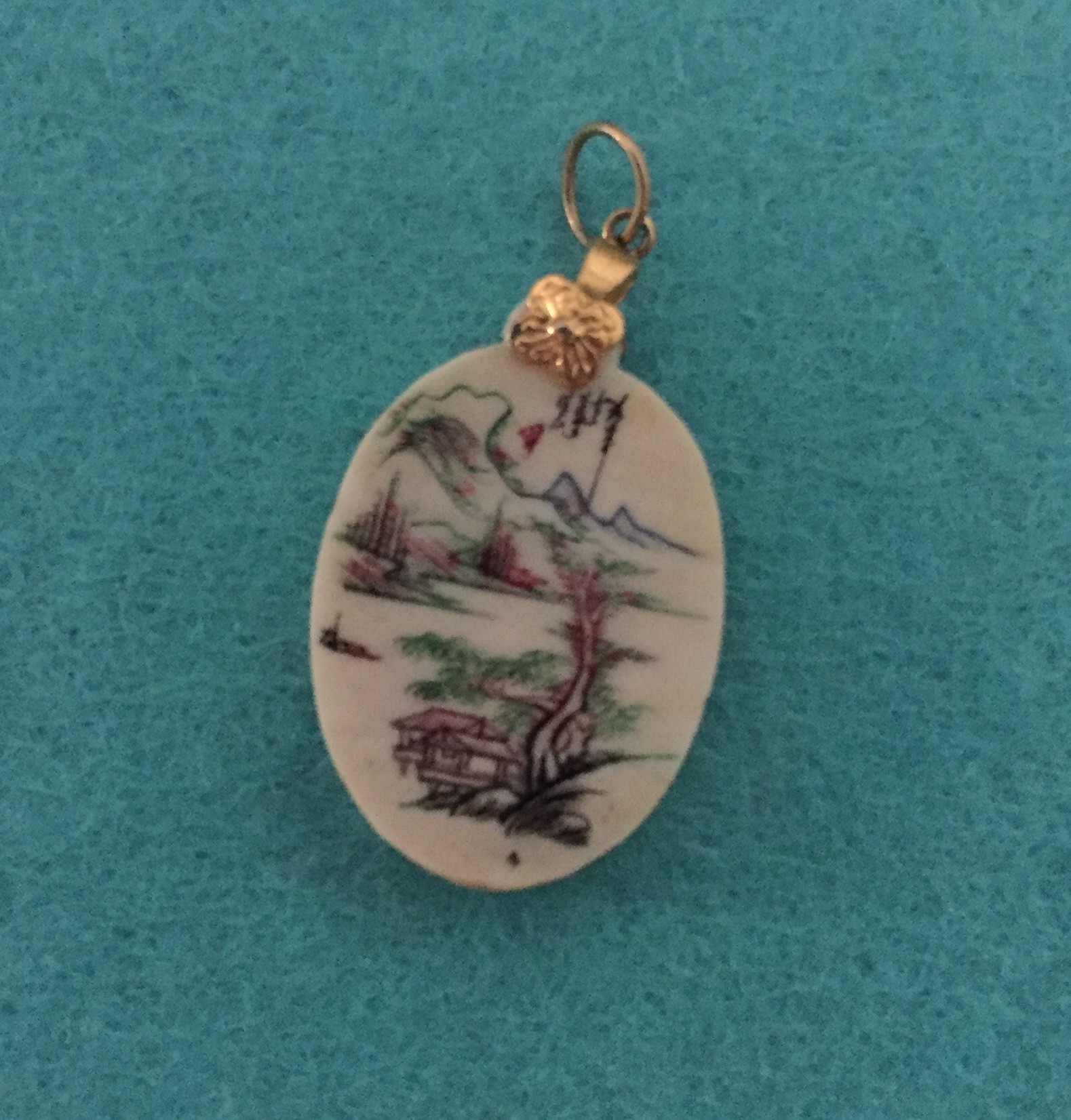
In a box in my closet is a small scrimshaw necklace that I never wear. I will never give it away. I will never sell it. I hope one day one of my children will take it.

The necklace I purchased with the money from Zeisel.

The necklace I purchased with the money from Zeisel.

It is not that old. I bought it when I was 20, when I spent my sophomore year of college in Israel, 1974 to 1975.

Many holocaust survivors were still alive. Some of them related to me through my maternal grandparents who were both from Europe. My grandparents came to the USA in the 1920s. But most of their family remained behind. Many perished, others survived and moved to Israel.

My grandmother went to Europe in 1931 with my Mom and uncle. I have written about this before. She stayed on the farm owned by her in-laws. While she was there her mother-in-law, my great grandmother Chava, gave her some family items. Two pieces of jewelry, a pearl necklace and an opal ring; and several embroidered and handmade pieces that Chava had made.   I own all but the pearl necklace. They were all given to me as the one named for Chava.

The pearl necklace disappeared in 1931. My grandmother went to use the shower at her inlaws. She took off the necklace to bathe and forgot to put it back on. When she realized it was gone, she went back to the bathroom. It was missing.

But she knew who took it. Zeisel. He was the only one who had been in the bathroom. But he denied taking it. And that was the end of the matter for 43 years, until I went to Israel for a year of college.

A month after I arrived in Israel, I received a letter from my grandmother telling me the story of the pearls. I had never heard it before. In the letter she wrote that the ‘goniff,’ Zeisel Feuer, my grandfather’s cousin, was going to give me some money to pay her back for the necklace he stole in 1931. I was to take the money and give my great uncle, her brother, half the money. The other half was to buy myself a necklace because I should have the pearls.

What? Was my grandmother insane?   I did not really want to do this.

I wrote her back saying that I thought 43 years meant the statute of limitations on a theft were over. And that she needed to let it go. And I did not need to have the necklace. But a few weeks later I received another letter instructing me how to find Zeisel in Tel Aviv. He worked at bakery on a specific street and I was to go there and speak to him. She said I had no choice. I had to do this. It was important to both of them to end this. And I would be the one to fix it. What?

Grandma ordered, so I obeyed. The next time I was in Tel Aviv, I went to the bakery. There was a man who looked so much like my grandfather, except smaller and bent. I knew it had to Zeisel. I introduced my self. He held for minute and had me sit at a table. He brought tea and a pastry. I waited while he finished working. Then we walked back to his apartment.

There he gave me Israeli lire, which in US would be worth about $100. And he told this story.

He was married with two children. He had a wonderful life. But he wanted more for his family. So when my grandmother left the pearls in the bathroom, he thought, “She lives in America. She is rich and has money. She does not need this necklace.” And he took it. And he lied.

In return the Nazis came. They killed his wife. They killed his children. They tortured him. He could no longer have any children.

And he knew that taking the necklace had brought all this pain to him and his family. And before he died he had to make amends. So he gave me the money. I was to do with the money whatever my grandmother said.  He had made peace.

I was stunned. I was 19. I did not know what to say but to cry.   When I left him, I took the money back to my dorm in Jerusalem at Hebrew University. A few weeks later I took half the money to my Uncle Isaac. The other money I kept in my room.

Each time I went to Tel Aviv after that, I always went to the bakery to see Zeisel. He always gave me tea and a pastry.   There were not many phones in Israel at the time. So I could not call in advance. I would just show up, or send him a letter telling him when I thought I would come. When my parents came to Israel that December of 1974, I took them to meet Zeisel and speak to him. It was a meeting my parents never forget as well.

In January I turned 20. I finally spent the $50 on a necklace for me. A necklace that carried so much pain. I could not wear it even though I knew my grandmother wanted me to have this jewelry from my great grandmother. So I keep it in a box in my closet. I know it is there. I know it is safe. It will not be lost. But I cannot wear it. When I see it, I always think of Zeisel and how much he lost.

It was not the pearl necklace that doomed his family. It was the rise of hatred. But he did steal it.  So for him giving me the money was closure. He had repented; he had done his “tashuvah.”  But for me it was the beginning of truly understanding the past.

I have written about the Zeisel and the pearl necklace before. It is a story that stays in my heart and my soul. But I have never talk about what I bought with the money. In my mind it is just not enough. It does not make up for the suffering surrounding one pearl necklace.  Zeisel was also the person who let my grandfather know that his entire family had perished in the Shoah.  He is forever bound in our family history.

Zeisel, my grandparents and my parents have all passed away. I am the only one who can remember this story. And so I tell it again.


https://zicharonot.wordpress.com/2014/08/22/i-believe-mystically-and-magically-great-grandma-chava-watches-over-me/


Trouble with the Office: An American Bialystoker Story

21 Mar

The following is a report my Great Grandfather, Louis Goldman, made in a 1937 issue of the Bialystoker Stimme. It explains the reason why the Bialystoker Bikur Cholim decided that the organization needed its own offices. It seems asking for help from the community was just not working out. It gives the history of the decision to rent its own office. I think this might have be the precursor of the Bialystoker Home for the Aged, which was built over two years in 1929-1931.

Here is his article, as translated by my friend Blumah and edited a bit by me for clarity.

“The Bialystoker landsman in that time mostly lived in the East side (of New York City). The Bikur Cholim decided to put in that neighborhood a place for the sick people to receive help without difficulty. So they would be close to their neighborhood.

They arranged for a doctor and arranged for a pharmacist to get them medicine.

It was decided to give to the poor sick people a free pass to see the doctor and also pay for the medicine.

A certain landsman, who had a hot dog /salami store on Essex Street, gave his store for the sick people to come to receive these passes and papers. This became the office where they could get the papers. But there was a problem: The store keeper would give out these free passes like a prize to his own customers who would buy meat from him. (This was not what was intended so,) It was decided to rent a place somewhere else.

Next they found a butcher store from one of the landsman, Philip T. However there was not very convenient for several reasons.

They moved the office again to a new place. To “Fisher” who had a printing shop on Clinton Street. But Fisher started asking every month for new ‘additions’. (Not sure if he wanted more money or what he is wanting. Probably more money.)

So the Bikur Cholim decided once and for all to rent a permanent office for themselves. It was decided that this office could also act as a club for the active members. Also there would always be a secretary who would be paid and who would take care all of the cases for the Bikur Cholim.”

As my great grandfather, or the editor of the Bialystoker Stimme, entitled the article, “Trouble with the Office,” I think that was a fine assessment.  Personally I loved how the store owner gave out free medical passes to his customers.  One way to build a clientele, even though it was not ‘kosher.’  I know that they were trying their best to help their landsmen in need, without using the money needlessly.  Building an office might have seemed that way to them.  But eventually, having a paid secretary made more sense.

The history of the Bialystoker Home For the Aged and the Bialysotker landsmanshaft, immigrant organization, can be found in the NY Landmarks Preservation Commission Report of May 21, 2012. See link below:

http://www.nyc.gov/html/lpc/downloads/pdf/reports/2529.pdf

The part of this story that impacts my great grandfather’s article, is this small section from the report:

“In its first year of existence the Bialystoker Center was located in an old building at 228 East Broadway just few houses down from the basement location of the Bikur Cholim. In 1922-23 it replaced the aging structure with a new five-story headquarters, which included office space not just for its own use but also provided meeting rooms for affiliated associations.”

So I assume the offices that my great grandfather is writing about was this office on 228 East Broadway. Eventually, definitely by 1937 when his article was written, the Bikur Cholim offices were included in the beautiful building that was finished in 1931.

As I have said in earlier articles about my great grandfather,  I am so proud to be his descendant.  Each of these articles brings him to life.