Archive | Memories RSS feed for this section

Bells Chiming Make Me Feel Better

15 Jul

When I was a child, and home sick, my mother would give me a little bell to ring if I needed her.   My brother and sister also had the use of the bell when they were sick.  I loved that bell.  I knew as long as I had that bell, my Mom or my Dad would come into the room and make me feel better just by being there. Its sound brought me comfort.

img_4176

Space shuttle bell on the left; Tinkerbell bells in the back.  Chilean bells in the front.

So, of course, when I had children, I also wanted them to have a special bell to ring for me.  I tried many.  For my daughter, I tried a little plain bell first.  But the sound was really dull.  With her bedroom upstairs, I needed something that would sound better and stronger.  We found one in Disney World.  A little Tinkerbell bell that was perfect, as my daughter loved Tinkerbell.   In fact, my Dad would call her ‘Tink’ all the time.  Although in reality, she thought she was Tigerlily.  That is a story for another day!

When that Tinkerbell bell eventually broke from use, we purchase a new one. It was not the same for her.  Too bright, not darkened with use.  But luckily, we were able to rehang the original bell, fixing it and reclaiming its tinker.

For my son, I purchased a bell from the Kennedy Space Center.  I am not sure why the space center sold bells, but the sound was good.  Since my son liked space ships and rockets, this bell was perfect for him, with its dangling space shuttle.

Whenever they were sick, I would give each of them their special bell to call me when needed.  Did it always work?  No, not often.  Usually they would just call me, and I would come. But for me it was a comfort to know they had a bell.  In my mind, having a bell was about continuity and love. By giving them a bell, I was giving them the power to bring me to them, like a magical wish.

I always have been attracted to the sound of bells. I love listening to handbell choirs. There was even a Hershey’s television commercial that used chocolate kisses as bells.  I loved it.  So when I travel, if I see an interesting bell, I am attracted to it.    I did fine some lovely bells in Chile a few years ago. To be honest, although they are lovely to look at, they do not sound good at all.   In fact, no bell quite sounds as good as my mother’s bell.

Actually, I have my mother’s bell, so I really need no other.   I believe my Mom brought to me when she came to visit one time because she knew my attachment to it.   I keep it in my family room.

It is a small brass bell, with a bit of red trim, set in a holder.  On the bottom it says “Made In India.”  But 60 years ago, when my mother first had this bell, I do not think there were many things from India for sale in the USA.  I now know that it is called an elephant claw bell, because of the shape of the bottom.   I have seen several similar bells with base for sale on line.  Sometimes they are called “antique ceremonial meditation bells.”

I can see it being a meditation bell, as It has the loveliest of tones. My bell has the same tones as those used by my yoga instructor to indicate the end of class.  But for my bell, when I ring it, my soul and heart returns to those happy memories. And I see my Mom in my mind — my young mom, the mother of three small children.

Another bell was important to my family. We used it only in the Catskills, my Mom and my Grandma used a large metal dinner or cow bell to call us to come in.  The bell hung outside the door of my grandparents’ house, facing the back towards our bungalow.  We had four acres of land including woods, so they often did not know where we, the children, were playing. Sometimes we were at our neighbors’ yards playing. It did not matter, when heard that large bell ringing, we knew to come.

Grandma would also ring that bell when she wanted one of us to come down to her house to get something or do something for her.  My mother would ring to bring us in, yelling our names along with sounding the bell.  It was used daily.  When she had grandchildren, my Mom used the bell to call them in as well.

Th bell is still at our Catskills’ home waiting for another generation to be called. Its loud clanging, not so beautiful in tone, but beautiful in memories.

The sound of bells chiming almost always puts me in a good mood and make me feel better.


https://www.thetabernaclechoir.org/videos/carol-of-the-bells-mormon-tabernacle-choir.html


https://www.youtube.com/watch?v=Pe4IZ7aGikw


For My Grandpa, Being a Kohan Was His Joy and Duty

27 Jun
Inside Shul in Kauneonga Lake

My Cousin took this photo from the women’s balcony, at least 30 years ago. My Grandfather is standing on the right, walking away from the bima.

My maternal Grandpa was a Kohan, a descendant of the Priests of Israel.  Even today, Kohanim have roles and duties that are part of their lives.  Grandpa was born in Galicia, an area of Austria/Poland that often changed borders.  He came to the USA in 1920.  And eventually owned his own kosher bakery in New Jersey, as well as a small bungalow colony in the Catskills.  But he always kept the rules of the Kohanim.

Grandpa often served as the Kohan during the Pidyon ha Ben ceremony.  This ceremony is also called the redemption of the first born.  In biblical times the first-born child, if it is a son, of an Israelite family had to be given to the Kohanim.   The family needs to present five silver coins to a representative of the Kohanim.  My grandfather was often asked to serve as this representative.   He would lead the ceremony and take the silver coins, which he kept until the boy was bar mitzvah, when he would return the coins as part of the child’s bar mitzvah gift.

I remember as a child being at a Pidyon ha Ben service.  I was so intrigued by the ceremony.  But I think more by the money.  I asked what Grandpa did with all the silver coins.  My Grandma told me that Grandpa did not use that money.  He saved it in a special place to return to the boy when he was older.

I wonder how they could keep track of that money.  But then my grandparents owned a kosher bakery, and my grandmother saved every silver coin that came into the store.  When she died, we found 900 silver coins, from dimes to silver dollars.  They were divided up so that everyone one of their descendants had some.  I still have mine.

Grandpa rarely went to a cemetery.   In fact, I don’t remember him ever going to a cemetery. He always paid shiva calls, but not the funeral.  Kohanim do not go near the dead. He did not go into a service until my grandmother died.   Kohanim do not go near the dead.  In fact, some Jewish funeral homes are built with two foundations, so that Kohanim can stay in the outer area during a funeral. There but not in the same structure.  I can still see my Grandpa during my Grandma’s funeral, even though it was almost 40 years ago.

Grandpa went to services on Shabbat.  He made so many Kohan aliyot at Shabbat services.  When they moved to the Catskills full time.  He was often the only Kohan at shul.  It became his responsibility to go every week and be the Kohan.  He took this honor seriously.

When he was in his later years, over 80, he would drive partway to shul and then walk the distance that he could walk.  Although he was brought up not driving on Shabbat or working, in the 1980s at his shul in Kauneonga Lake, people drove to services, even parking on the grounds of the shul, Congregation Temple Beth El. But not Grandpa.  He would park by Sylvia’s clothing store, up the hill from the main part of Kauneonga Lake and easier for him to walk.  I once asked him why he didn’t just park at the shul.   His response, “I walk as far as I can, because I can do that for Shabbat.”

On the high holidays he was often the only Kohan at the Kauneonga Lake shul.  On the high holidays he would sit in the men’s section with his tallit wrapped over his head covering his eyes.  When I was little my favorite time was sitting with him in shul with his tallit covering me as well.  He kept his hands over his eyes under the tallit as he davened.  His emotions during the high holidays was overwhelming.  My sister said it was her strongest memory, how upset and emotional he would get them, as Grandpa usually had a great sense of joy.  But then as an adult she realized that the pain of the Shoah came to him then.  He was the only one left of his family.  All perished in Europe, while he was already in the USA.

Sometimes he was the only Kohan at shul to perform the Birkat Kohanim, the Priestly Blessings.  Grandpa had a beautiful singing voice.  He often sang to us in Yiddish. During the Priestly Blessings, he sang for everyone and blessing the entire congregation.  At times there were other Kohanim present, especially if the holidays were early in September.  Then Grandpa would be joined by others on the bima.

At some point, another Kohan moved to the Kauneonga Lake area and also went to services.  Grandpa was thrilled.  Sometimes he would not go to services on Shabbat.  He would say, “Let the other guy have a chance.”

It was this statement that brought this story to my mind last weekend..  My husband is a Levi.  He goes to minyan every Wednesday, but to Shabat services about once a month. He almost always gets Levi.  Our congregation only has three Levis who come weekly.  They, like my grandfather, are happy when another guy comes. This week the Gabbi came and said, “Do you want Levi?” “Sure,” was my husband’s response.  “Good because the others say they don’t want it today, you should take it.”  During this short conversation, in my mind’s eye, I could see my Grandpa’s smiling and laughing.

Grandpa took his role as a Kohan with joy and fulfilled his duty.  I know he would be happy seeing my husband fulfilling his duty as well.


https://www.chabad.org/library/article_cdo/aid/1008437/jewish/Birkat-Kohanim-Melody.htm


My Obsession With Grandma’s Album Leads to the Shoah

17 Jun

My Tante Esther played an important role in my life.  My grandmother’s younger sister, Tante Esther came to the USA in 1936 along with my great grandfather.  My grandmother was able to bring them here and away from Poland.

Tante Esther and her husband, Uncle Leo, lived close to us in North Bergen, New Jersey.  Uncle Leo also came from Europe, from Germany, and worked for my grandparents at their bakery in West New York, New Jersey.  He was not family then, just someone who needed a job.  When my Tante came over, she married my Uncle.  Grandma had already told Uncle Leo not to get serious about any one, as she had a sister for him.

Uncle Leo worked with my grandfather as long as the bakery was in existence.  It was Uncle Leo who dropped off a box of bakery goods every Sunday morning on his way home from baking all night.  It was Uncle Leo who once brought my brother home from the bakery after my brother had mixed the sugar with the salt.  I still remember, my brother being handed off to my Dad with Uncle Leo’s terse words, “Here Take Him,” before he left to return to the bakery.  My Mom had to call my grandmother to find out what had happened.

We often saw Uncle Leo at our synagogue, Temple Beth El.  He always had candy in his pocket, so we always made sure to give him a hug and say hello.  We loved him for other reasons, but the candy was always special.

My grandmother came to the USA when she was 16 years old.  I have written about Grandma and her family many times.    As I have written about her photo album filled with unidentified photos.

Here are two more photos.   Luckily my cousin is still alive and can help identify her mother.  She is positive that her mother is the woman on the left in the photo of the two women and two boys.

But the other photo, my cousin says is not her mother.    I thought it was.  But after having the back translated by several different people on the groups Tracing the Tribe and Jewish Ancestry in Poland, I think my cousin is right.  This is not her mother!

Inscribed on the back is a note to Talci, or Talei, or Palci,  as a remembrance from Estera.  My grandmother used the name Tala in Europe.  I assume, Talei could be a nickname. But I would think that if the photo was her sister, the message would have mentioned that!!!  Thus, I am thinking this is a cousin about the same age and named for the same person as my Tante Esther!  Definitely not my Tante.  I put the picture here so you can see how difficult this becomes in identifying people.

As for the photo with the two women and the boys, I am stymied as to who the other woman and the boys could be.  I know my grandmother had many first cousins. I am assuming they are members of the family. Someone important to my grandmother for a photo to be sent from Poland.

My obsession with these photos  makes me know who I hope it is.  I hope and wish it is her cousin Tova Malcha and perhaps these are her  sons.  Tova and her family were murdered in the Shoah.  I have no idea how many children she had or her married name. There are 135 people with her maiden name murdered from the town she lived in Viroshov/Wieruszow Poland.  I know she died and her family died.  What I do know, I heard as a young woman when my grandmother met with Tova Malcha’s brother in 1976 in Israel.  (Read blog below.)

I have no identified photo of her.  But I am hoping that when this photo was sent to my grandmother, sometime after she moved to the USA, that the two women she loved the most, her sister and her first cousin, her best friend, were in this photo.  (See blog below.)

But I know it could be someone else.  Another cousin perhaps?  I have written about others.  All I know is that when I search through this album, many times I am caught up in the Shoah.  I end up at the Yad VeShem database searching for names that match these photos.   Then I cannot look at the album again for months.

https://zicharonot.com/2014/04/28/speaking-yiddish-always-brings-me-holocaust-memories/

https://zicharonot.com/2018/07/20/viroshov-wieruszow-a-jewish-community-destroyed/

https://zicharonot.com/2018/07/11/the-yad-vashem-shoah-database-each-name-becomes-a-memory/

https://zicharonot.com/2018/06/26/amazing-what-information-two-photos-can-provide/

https://zicharonot.com/2015/11/03/who-are-you-these-photos-call-out-to-me/


Loving All Things Dr. Seuss

10 Jun

I am a bit obsessive compulsive.  For me that means when I like something, I want to know everything about it.  When I like an architect, I study his or her work.  When I like the books written by a certain author, I also want to learn about the author.  When I like art, I need to know about the artist.   I think it all started with Dr. Seuss.

img_3883

My collection of Dr. Seuss books.

I believe I remember the first time my Dad read One Fish, Two Fish, Red Fish, Blue Fish to me.  I can see myself sitting on one leg with my brother on the other leg.  We are wearing footsie pajamas.  I loved that book.  I also loved Go Dog Go!   The pictures, the language, the rhymes all contributed to my anticipation of a new book by Dr. Seuss.  I loved all books Seussical.  I wanted my parents to read them to me again and again and again.  In fact, I learned to read by reading Dr. Seuss books.

And who can ever forget The Cat In The Hat?  I am always worried that the house will still be a mess when Mom gets home.  Even when I am the Mom!!

Of course, when I had children, I made sure that all the Dr. Seuss books were in my home for me to read to my children.  Which I did as much as possible.  Although my children are grown, I keep those books as I await the arrival of grandchildren.  I know that I will be excited to read these books to a new generation.

Among our favorites was The Lorax, as my husband and I are committed to keeping our world as green as possible.  Reading The Lorax is a wonderful way to explain what happens when people do not care for or protect the world and the environment.  We used to watch the 1972 animated movie about The Lorax when our children were little. Yes, we own a 1990s VHS of this movie!  I guess it is a collector’s item now.  We have seen the new 2012 Dr. Seuss’ The Lorax, but for me the original is best.

My husband loves these books as well, especially And To Think That I Saw It On Mulberry Street.  Why that one?  Because he grew up on Mulberry Street in St. Louis!

When our children were little we were excited when “Seussical the Musical” was presented by the local children’s theater. I especially loved the songs, Oh, The Thinks You Can Think and How Lucky You Are! (See link to songs below.)

When the book, Dr. Seuss & Mr. Geisel: A Biography was published in the 1990s, I had to have it.  Reading it was somewhat eye-opening.  Theodor Geisel was a much different man than his alter ego, Dr. Seuss.  I was a bit disappointed in what I read, but how could I not still love what he created?  So I did. I also learned from the book, that he lived just north of San Diego for the last part of his life.

img_3884

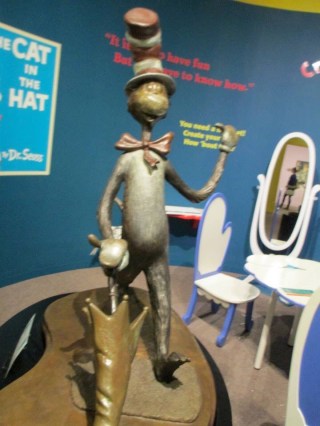
The Cat In The Cat at Ingenious! The World of Dr. Seuss

In 2015, while spending a few days in San Diego, I wondered about finding something related to Dr. Seuss while we were there.  I did not have to look too hard.  While we were visiting museums in Balboa Park, we came upon a Dr. Seuss exhibit at the History Museum: “Ingenious! The World of Dr. Seuss.”   Serendipity to be there at the right time! 

The artwork, the statues, the rooms set up like scenes from his books.  All of these gave me joy. The exhibit is closed now, but I can always remember it because I purchased the book that went with the exhibit.  I also purchased Dr. Seuss Goes to War: The World War 11 Editorial Cartoons of Theodor Geisel. They actually mailed the books home to me, as I had no room in my luggage. But I needed those books! I still enjoy them.

But my love of all things Seuss does not end with books, books and more books.  Four years ago, I discovered that there was an area at Universal Studios in Florida called Seuss Landing.  Is it possible to find a more delightful spot for a Seuss addict?  No.  We went to see the Harry Potter worlds of Hogwarts and Diagon Alley, which were quite wonderful.  But when I found Seuss Landing on our way out of the park, I knew I had found my happy place.

I realized I loved Seuss Landing more than the World of Harry Potter.  Do not get me wrong.  I purchased a Luna inspired magic wand that I can use to work magic.  I loved the atmosphere, the shops, the rides and the food of Diagon Alley.  But the world of Dr. Seuss still has my heart.

A few weeks ago we went back to Universal.  Yes, we did visit Hogwarts again.  And yes, I did have my wand with me.  And yes, I had fun.  But the magic for me was returning to Seuss Landing.


It was our first stop beginning our day at Universal, and our last stop on the way out.

I enjoyed walking all over this area with all the children and their families.  My husband and brother-in-law were with me.  Luckily, they are both pediatricians, so being around many children does not frighten them.  My husband went on two of the rides with me, and the three of us rode together for the Cat in Hat ride.

Just walking around makes me happy!  Seeing all the places from his books come to life delights me.  I love the book store filled with the many children’s books he created.  Yes, I went to the gift stores. This time I did not buy very much, as I had stocked up the last time we were there.  However, I do not mind the rides that end in a store, which usually drives me crazy.   In a Seuss Landing store, I just browse with a smile on my face.

Harry Potter World is wonderful,  but crowded with the many Harry Potter fans.  Seuss Landing is delightful, and not as crowded.  It is a great place to bring your younger children and enjoy going into a great world of imagination. An imagination that is not frightening at all, just fun!


https://www.youtube.com/watch?v=36b07-zZZ8A

https://www.youtube.com/watch?v=VOIh1uVb6as


This Jacket is a Survivor!

20 May

img_3411

I am cleaning out my cedar chest.  I had no idea what was piled up inside.  But surprises keep coming! My biggest surprise find was a jacket belonging to my mother.  I honestly forgot it was there.  I thought I had lost it in my many moves years ago.  But here it is:  A grayish brown wool jacket.  It is definitely from the late 1940s/early 1950s in both style and by history.

This is not just any jacket.  It was made by my mother’s uncles.  I am not sure which one, either David or Isaac.  They survived the Shoah because they were tailors.  When they escaped Poland they headed into Russia, where I am told they worked making soldiers’ uniforms.  I have no proof of this. But that is the story I was told.

After the war, they ended up in Italy first, where they waited for papers.  My uncles had my grandmother and another sister in the United States.  My aunts had relatives, sisters I think, in Australia.  They decided they would go to live in whatever country and near whoever sent visas first.  They just wanted out of Europe and away from fear.

The visas came from Australia.  So they went to Melbourne.  This jacket was made by my uncles in Melbourne after they settled there and sent to my mother in the United States.  Can you image? I can’t.

I know they were in contact throughout their journey of survival.   I know that my grandmother and aunt tried to get them visas to the USA and sent them money to survive after the war.

I know that they helped to support them throughout their lives.  My Uncle David died when he was in his late 30s in Australia.  He is buried in a Jewish cemetery in Melbourne.  Eventually the survivors, my Uncle Isaac, his wife Bronia and, David’s widow, Rosa moved to Israel with my cousin, where she still lives with her family.

When they moved to Israel, we sent care packages to them.  It was 1965 or 1966.  I still remember when I was 11 learning about my cousin. We became pen pals, writing back and forth for many years.  We still keep in contact, but now through What’s Ap and Facebook.

The year (1974-75) I studied at Hebrew University in Israel, I would spend time with my family, my uncle, aunts and cousin in Kiriat Haim, which is just north of Haifa.   During one visit, Uncle Isaac surprised me with a bag to carry my school supplies when I traveled from Jerusalem to visit family.  He also made me a pillow to decorate my room.  I was a great bag for that as it was the perfect size with a zipper.  And no one else had anything like.  I actually used it to go to class.  I still have both of these items.

After my return from Israel, my mother gave the jacket to me.  It longer fit her and she thought I would wear it.   Since I spent so much time with my family in Israel, the jacket carried so many emotions with it.  When I was younger, I would wear the jacket and think of all my great uncles and aunts went through during the war.  How they survived the war and got out of Europe.  It is a jacket of survival and strength in my mind.

So I guess I will continue to keep this jacket.  It has a few moth-eaten areas.  The color has faded.  But to me, its symbol of survival and new lives makes it so valuable.  It tells me to never give up.  To survive and be a survivor.


The Rosh Hashannah Card Has A Story


Speaking Yiddish Always Brings Me Holocaust Memories


My Grandmother’s Mysterious Black Notebook

13 May
img_3335-1

The black notebook.

I have a book.  It is small.  About eight inches by nine inches.  It has a black cover.  Inside are 33 lined pages, so total of 66 pages that can be written on.

It seems to be a diary.  Most of the pages, about 40, have entries that are dated in 1921.  So my book is almost 100 years old.  Two of the names I recognize.  My grandmother and her first cousin, Abraham, who perished in the Shoah.  The other names I am not sure about.  But these entries, even though they have different names, seem to be written by the same person.  My grandmother perhaps?  Or are they really two separate handwriting.  Now that I look at this page below, it seems as if two different people wrote. But many of the pages have the same writing and not changes like this one.

img_3332

Entries from March 1921 with my grandmother Tala Szenk and her cousin Abram Prentki’s names.

Some of the entries look like they could be poems.   Did they write these poems, or did they just copy them from some book?  It does show how my grandmother was educated in Poland.  Her father was a teacher. Grandma could read, write and speak in Polish, Hebrew and Yiddish.  After she came to America, she went to night school to learn English.

img_3337

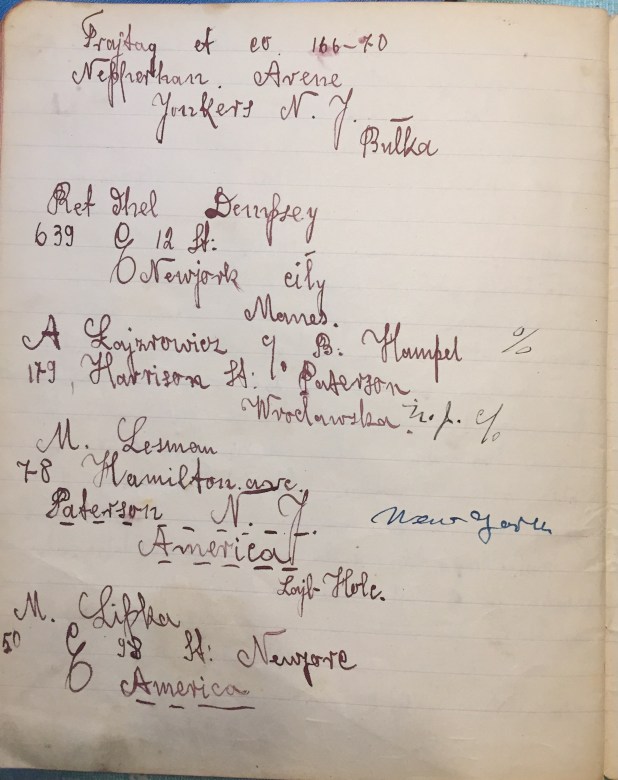
See Lipka, her relatives she stayed with when she arrived in America.

In the middle of the book are names and addresses in English.  Names of people living in New York and New Jersey.  Hidden, I think, in the middle of the book.  Her escape plan?   My grandmother came to the United States when she was 16 in 1922.  I see the last name of the aunt and uncle who allowed her to live with them in the United States.  They must have sponsored her as well.  The name is Lipka.

It is all written in Polish.  But I can understand the names, because I recognize them.  And the name of my grandmother and her cousin jump out at me.  Especially since I have written about this cousin and not knowing who he was at first.  And then here he is embedded with her in this book.

img_3338

Who wrote these pages?

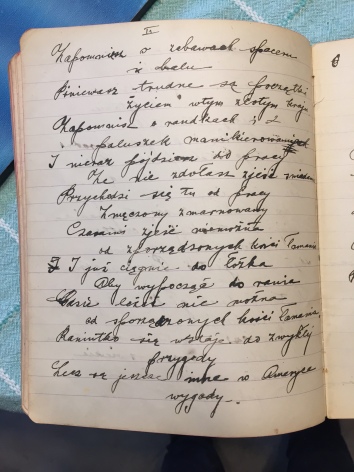
After the journal entries, if that is what they are, comes some blank pages, and then six pages written in a different handwriting.  It looks like a poem.  But I am not sure.  I am not sure what any of it is.

The last four pages are in Yiddish. Those I have had translated.  We think it is a story, perhaps not true, perhaps yes.   About a girl who meets non-Jewish man and how it ends in sadness.  The beginning reminds of the story of Tveye and his daughter Chava.  But this story does not end happily.  Did she read a book and decided to write that story?  I don’t know. I don’t know if she is writing about someone she knew or making up a story.   Perhaps the other entries would give me information. Perhaps.

img_3336

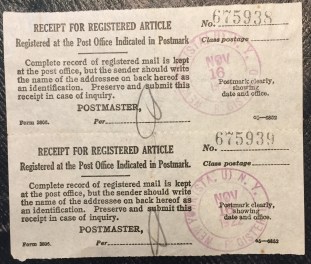
Why did she save this receipt as well?

Inside the book is a receipt for registered mail sent on November 16, 1922.  Did she send something back to her father and her siblings after she arrived in America?  I wish I knew.

My grandmother passed away 38 years ago.  I wish I had seen this book when she was alive so I could ask her what all this is!  We found it long after she died and my parents died.  It was hidden in the bottom of a box in the attic of their Catskills home.  Not thrown away, but saved for me to one day find.

This book is a mystery to me.  I need someone who reads Polish and can translate this book for me.  I love a mystery, but even more, I love the solution to a mystery!


Two blogs about Abraham Prentki:

https://zicharonot.com/2018/06/04/the-mystery-of-abraham-prantki/


https://zicharonot.com/2018/06/26/amazing-what-information-two-photos-can-provide/

The Keeper of the Records

6 May

In my family, I have become the keeper of the records.  I believe it is because I actually do something with them.  I scan them in to the computer; I research these records; I write about them; and then I share the information with my family through my blogs.  I hope that my doing this will keep these memories alive for future generations.

So recently, when I was in New Jersey, I asked my sister where she had put our parents’ wedding album, as my sister wanted it when we cleaned out our parents’ home.  It was easily accessible, so I looked through it, searching for a particular photo.  I had seen it the album many times, so knew it was included.

The biggest problem with this album is that the photos are encased in plastic. That must have been the style as I have seen other albums from this era also with plastic.  So those photos are difficult to photograph or scan, as you see here.

img_3065

My parents listening to the reading of their ketubah.

I found what I was looking for: a photo with my parents’ ketubah, Jewish marriage license.  It was important for me because I have both their marriage license and the engagement agreement that was signed at the same time.

The engagement contract is in disrepair.  I hate even taking it out of its’ envelop, but I did for a photo.  It is signed by both of my grandfathers. It was kept in an envelop addressed to my Dad at my grandparents’ bakery.

img_3219

The ketubah is in much better shape.  Written in both English and Hebrew, it is pretty simple.  Not an artist drawing, but rather a form Ketubah filled in by the Rabbi.  The most important part for me is that it lists my mother’s Hebrew/Yiddish name.  We sometimes had a debate on that as my grandparents, and sometimes my dad, would call her ‘Fegilah,” little bird.  But we were pretty sure her name in Yiddish was Freida, which is confirmed with the ketubah.

The photo with the ketubah almost makes me laugh.  Their wedding was arranged quickly.  Dad was in the army and going to Korea.  Yet there he is in tails and a top hat!  My Mom is standing by the huppah in a veil that almost hides her face. It is much denser than the veil my sister, sister-in-law, and I wore, and our daughters.

They both look so serious.  It is difficult to believe that they were just 22 years old. My uncle, my Mother’s brother, is there as well.  Thanks to him we actually have a movie of my parents’ wedding!  No voices, but all the action is shown.

To me having this photo together with the ketubah is important.  It is a link that ties the document to the people in it.  Now forever together in this blog.

I think that is why I am the designated keeper of the records.

Ring Jells Addiction Started in The Catskills

21 Apr

Sometimes I read a note on Facebook that just touches my soul.  It happened now.  Someone posted about meeting a woman shopping for Passover food in a grocery store.  She was crying while holding a box of Joyva Ring Jells in her hands.   It seemed her mother passed away, and this would be the first seder without her.  Her mother loved Ring Jells, and the sight of this box made her cry.

img_2882

This box is now empty.  But I enjoyed every one.

That should be my children one day.  I love Ring Jells.  While I cook my seder meals and prepare for the long hours ahead, I eat these throughout the day, to me, they are the most delicious chocolate covered sweets.   I am basically addicted to them. The taste of raspberry and chocolate together delights me. Thank goodness I only find them during the holidays.

My addiction started when I was 16 years old working behind the deli and cheese counter at the Daitch Shopwell in Monticello, Sullivan County New York.   It is here that I served the women and men who spent their summers relaxing, cutting their cheese selections and their deli orders.   I worked at this supermarket for three summers, earning spending money and preparing for the costs of college.

But it is also where I learned to love Joyva Ring Jells.  We sold them in the dairy section of the deli, along with all the cheese.  We had a large display of them. Hundreds of ring jells for sale by the pound.  I loved them.  I have to admit it, I would snack on them.  Not eating tons.  But at least two or three each shift I worked.   Eventually the manager told me to stop.  And buy some.  So I did.  I would weigh out 3-5, pay for them, and keep them behind the counter with me.  Snacking as needed.  When the weekends were busy with crazy customers, I really did need them to get me through the day.

img_2885

Marshmallow twists live in my freezer.

I did not realize they were a special Passover treat.  In our house, my Mom was a Joyva Marshmallow twist fancier.  She would buy them at Pesach and keep them in the freezer all year to snack on.  Did you ever eat frozen marshmallow twists?  At first you have to be careful not to hurt your teeth, but after a bit they melt just a little and are delicious.  I admit I still have some in my freezer from last year.   Usually you had to get just plain white ones.  However, sometimes we could find the ones with pink insides!

After I learned about jell rings, I had to have those as well.  My sister and I favored them over the Marshmallow twists, which I think made Mom happy.  She would share them with everyone, but now had more for herself.

The ring jells, on the other hand, were the perfect snack.  I would take two  or three at a time, stick them on my fingers,  and get ready to eat.  We do crazy things when we were younger.

When I left the east coast for the middle of the country, I had an issue.  I could not find them in Kansas. But when my parents were alive and visiting, they would bring boxes of Ring Jells and Marshmallow twists with them. So we never suffered during the Pesach holiday.   They also brought Bartons candies, another treat that was nowhere to be found in Kansas City. Eventually these treats came out west, and  I could get them on my own.

Ring Jells are comfort food for my sister and me.  I am going to visit her the end of the week.  I sent her the following text message on the Thursday before Pesach: “So I purchased one box of raspberry jelly rings to bring to you. And one for my home. Cause I have to have some.  But I had three today and I feel better.”

She wrote back: “I bought two boxes for when you are here! LOL”

My response: “LOL I will leave mine at home.  We do not need three.  Great minds think alike.”

A number of years ago we went through a difficult time. We lost our parents and aunt in less than a year.  Five months later, erev Pesach, my sister’s husband also passed. It was a horrible time.   I did not know how we would survive that holiday.  But I have to say, our friends knew of our need and ring jell addiction.  Friends filled the house.

I don’t know how many of them went shopping. But in days we had boxes upon boxes of ring jells.  In the evenings, when most everyone had left, my sister and I ate ring jells and talked.   It was a Pesach that tried our souls.  And I hate to be trite, but the ring jells gave us a small amount of comfort in our first Pesach without these beloved family members.  (And a mighty thank you to all who purchased them for us.  I don’t know if I ever told you how important they were in this horrible time.)

Special foods bring memories and joy.  For me Joyva jell rings helped me through preparing seders and difficult times. They bind me with my sister.   I could see my children crying over them when I leave this world.  But I don’t think they will buy or eat them.  This addiction will probably end with me.

A zissel Pesach to all.


My Jobs Behind a Deli Counter: Daitch Shopwell and Butensky’s


My Experience on the OC — Orientation Committee 1976

13 Apr
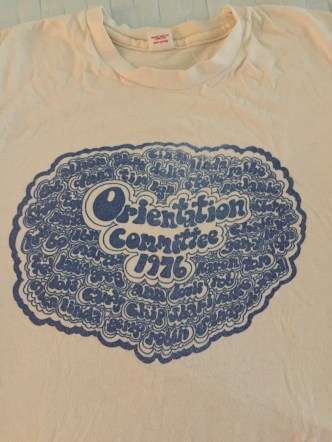
img_2785

My OC t-shirt. My name is on the lower left.

There is one article of Drew clothing that I kept for 43 years and will probably continue to keep.  It is my orientation committee t-shirt from 1976.  I think that fact that it was the bicentennial of American Revolutionary War, besides marking one of my favorite Drew activities, gives it a special place in my heart.

I started my Drew career like all the other freshmen, a little excited, a little frightened, and really having never lived away from home.    But my sophomore year was much different.  I left the Drew campus to study in Israel at the Hebrew University in Jerusalem.

This was unusual at the time for two reasons: because most people studied abroad in their junior year and because I went eight months after the Yom Kippur War.  Life in Israel was still disrupted. I won’t go through all my experiences, but I will say I came back to the USA afraid of nothing.

When I came back, I wanted to become part of the Drew community.  Many of my friends have formed new bonds while I was gone.  My dorm room was chosen by my freshman roommate, we were going to live in a suite in Foster.  But we would not be sharing a room. She had a new friend who would be her official roommate.  And I would be living with someone I really did not know.  But it was fine.  We had a great year in that suite!

I decided I wanted to change my major and study English literature and writing.  This meant I had to take some lower level classes.  I decided also that I would graduate in 3 ½ years since I had received 12 credits of language for the intensive Hebrew Ulpan I had attended in the summer when I first arrived in Israel.  For me that meant taking 18 credits a semester, six classes, for the next three semesters, and attend at least one class in a January term, a new idea at Drew.

I also wanted to get involved. And I did.  I joined a number of clubs; started working on the school newspaper, The Acorn; did a bit in student government; and learned about the yearbook, which I would help edit in the next year.  With my Israel experience still on my mind, I joined and became a leader of the Jewish Students Group.   Because I wanted to do something to help others, I also got involved in the Orientation Committee, which helped new students in the fall to learn about the campus and settle in before everyone else arrived.

I must admit, besides working on the Acorn, my favorite activity was the Orientation Committee.  I loved the preplanning, but I especially loved being on campus early.  It was so beautiful.  The Drew campus is one of the most beautiful campuses.   And being there in the quiet was extraordinary.  We helped freshmen move into their dorms.  We watched as parents tried to direct and arrange for the last time.  We saw tears and hugs, while helping the freshmen as their parents drove off.  Most important, we made their first few days enjoyable and welcoming.

I loved Drew so much, I wanted my daughter to think about it for her college career. I took my daughter to visit Drew the summer before her junior year of high school.  We took an official tour of the campus.  But as we walked the grounds and looked at the newer buildings along with the old, I filled her in with my stories.  Stories that our tour guide, a Drew student, also seemed to enjoy.  I think the beauty of the campus drew her in to the Drew family.  As she also went to Drew and became an alumna.

I now have several Drew hoodies and shirts.  In the winter, I always wear my Drew sweatshirt proudly.  These are great additions to my wardrobe.  However, the almost 43-year-old t-shirt in my dresser is my fondest Drew article.   It reminds me of my last semester of college, as I did finish that January.   It reminds me of the friends I made then and still have today.   It reminds me of the beautiful campus, which I was able to share with my daughter.

Most of all it reminds me of an obligation to welcome the stranger to campus.  To make all new students feel comfortable as they adjusted to their new life as a college student.  Much as today I try to make all feel welcome in my life.  While I learned much at Drew, serving on the Orientation Committee gave me some of my favorite life lessons.


Some other blogs about Drew:

Remembering My College During Graduation Season

End of the School Year Has Me Bringing Out My Old Yearbooks


The Great Alie Street Synagogue: My husband’s Family London Ties

4 Apr

My husband’s grandparents were married on the 16 day of Ab/Av in the year 5663, which corresponds to August 9, 1903.  We knew that they were married in London.  His grandmother Esther was English.  His grandfather, Leon, was from eastern Europe. He had studied medicine and moved to England to practice.  He met his wife in an emergency room, when she needed medical assistance for an injured hand.

img_2709

The copy of their Ketubah.  I found out that the ketubah survived a fire, which left the smudge.

But that was all that I knew.   Recently I found a copy of the front page of their marriage license or Ketubah in both English and Hebrew.

Esther, the daughter of Avraham Moshe, married Yehuda Leb, the son of Aaron Benjamin in the Great Alie Street Synagogue in Aldgate, London.  In Hebrew letters above the English words naming the shul were the words, the Bayt Kenesset DaKalish, which stands for the Kalisher Synagogue.

Once I found this document, I had to do my research, which led to more questions!  I knew that my husband’s grandmother was known as Esther.  She has several descendants named for her.  Her husband did not use Yehudah or Leb, he was known as Leon.   And he also has grandchildren named for him.  I assume he could not find an English name that he liked for his first name, so went with his second name?

My biggest question relates to the date of their marriage. From the JCR-UK records I found on Jewish Gen, I learned that the Great Alie Street Synagogue was also known as the Kalischer Synagogue, named after a previous congregation.  In fact, the Kalischer merged with the Great Alie Street Synagogue, and the same rabbi served the new congregation, Rabbi Israel Dainow.   I wish I had the back page with the witnesses to see if he had officiated at their marriage.  Our ancestors were married in the congregation just eight years after it was established.

My main question deals with the date of their marriage.  The document states they were married on August 9, 1903. However, in the information I found, it says that the synagogue was closed for repairs, only reopening and being re-consecrated on September 18, 1903.  Did it close after they were married?  Were they married elsewhere by the Rabbi and so given a ketubah from that synagogue?  I guess I will never know.

This was not a big congregation, not having much more than 110-120 members from the 1896 to 1915 time period.  It was formed when two congregations merged: the Kalischer Synagogue, named for the town of Kalisz, Poland; and the Windsor Street Chevra/Windsor Street Synagogue.

This orthodox synagogue closed in 1969 and the building was demolished.  That always makes me sad.  I will never get to see it.  However, the congregation membership continued on for several decades merging along with others into the Fieldgate Street Great Synagogue. But eventually, in 2014, services ended  and the building was sold.

My husband’s grandparents came to the USA in the early 1900s.  They ended up in Kansas. The parents of ten children, they have great grandchildren and great-great grandchildren,  throughout the USA and Israel.

See blogs below.


https://zicharonot.com/2019/01/11/cemetery-records-impacts-family-stories/


https://zicharonot.com/2017/01/05/the-antique-european-hannukiah/


https://www.jewishgen.org/jcr-uk/London/EE_alie/index.htm