Archive | Gold Rosen Blogs RSS feed for this section

A 1920’s Car Ride

30 Jun
img_0072

My grandparents are the couple sitting together in the back seat.

A few months ago my cousin searched through her mother’s trove of photos and found several that she sent on to me.   One of the most intriguing ones for me was the photo of my grandparents in the back seat of a car, in front is another couple and in the back seat, a third man.

What were they doing?  Where were they going?  Who were the other three people?  I have no idea.  But that photo of my grandparents in the car has to be from when they were engaged or just married in the early 1920s.

My grandmother used to tell be stories about growing up in the New York City of the early 1900s.  She was born in 1898, before the day of cars.  It was not until 1913 with the advent of the Model T that cars were mass produced and easily seen on the streets.

Grandma told me that the first time she ever saw a car it caused a ruckus. All the horses were startled and tried to run.  At the time there were no traffic laws for cars, which added to the chaos.  But change came, and the cars eventually took over from the horses.

Although Grandma told me wonderful stories during our summers in the Catskills, she never told me about her first time in a car.  I do know that Grandma never learned to drive a car.  She had her children and eventually her grandchildren to drive her to and from the Catskills and to the store.  And when she was in the City, she always took buses or the subway.

In this photo, my grandparents look comfortable.  The man in the driver’s seat looks older than the others.  Perhaps he is driving the two couples somewhere for a date night?  I wish I knew because my grandfather is almost smiling, and to be honest he did not smile very much at all.

Whatever was happening, it must have had some significance because they took a photo.  But the best part is that they look happy.     I am so glad my cousin shared this photo with me.

12 Delancey Street and My Family

Updated Esthers

8 May

A while ago I wrote two blogs:  “Too Many Esthers” and “Your Heart Just Gets Larger” (links below).  I realized that they  needed to be a bit condensed and combined.  The following is a new blog combining these two.  I read it last week at the Cloud Burst program at Congregation Beth Torah in Kansas, and felt I had to share this new version here.

My Grandma Esther had a problem with her name.  She did not mind that she was named after her grandmother, Esther (Etka) Lew Wolf(f).  She enjoyed being named after the heroine of the Purim story.  She just hated that she had four first cousins all named Esther and all named for the same grandmother.

This caused her years of anguish….really.  She even told me about it when I sat down with her in the 1970s to get her family history.   She was already 80 when we spoke.  But it still bothered her that there were so many Esthers.

Why?  Because each of the Esthers, except for the oldest, was given a family nick name to designate which Esther people were talking about.  There was Pepi Esther; Meshuganah Esther, Curly Esther, Little Esther, and of course, Esther (the oldest who could just be that).

When you look at the family tree, it is confusing, so many Esthers and some with the exact same first and last names! Part of the genealogist nightmare. They were all born in the late 1890s, when census taking was not as organized as now. But my Grandmother’s memory was fantastic.  So I have an accurate listing of all her aunts and uncles and cousins, including the many Esthers.

My Grandma was Curly Esther, because she had very curly hair.  Thank goodness she was not called Meshuganah Esther, she told me, that would have made her so mad. But then she said,  Meshuganah Esther was really crazy.  So there you go.  But I think, did the name depict her, or did she conform to the nick name she was given?  We will never know.

Grandma told me NEVER EVER to give my child the same name as another first cousin.   It is too confusing.  That is why, when my Dad was born, although he was given the Hebrew name David, his English name just started with a D.   He already had a first cousin named, David, and Grandma was not taking any chances!!. Her children would not have nicknames!

The Esther story followed me to Ann Arbor, Michigan.  My husband and I spent two years there when he was studying.  Grandma said, you have cousins there.  You should go for Passover.  He is the son of Pepi Esther, Joel.  So of course, my husband and I had seder with my second cousin once removed and his family.

When we were ready to leave, I told him to say hi to his Mom, Pepi Esther.  He had NO idea what I was talking about.  Pepi Esther did not suffer the same trauma as my grandmother.   My cousin called me later that week to tell me he spoke to his Mom and found out about the Esthers.  He was laughing as he told me about his conversation with her:  “All my cousins call me Pepi,” she said.  “We just never used it at home.”

Later, when I had my first child, I received a sweater in the mail.  Knitted and sent with love, from ‘Pepi’ Esther.

Needless to say, I was careful about how I named my children.  Since my daughter was the first grandchild on one side, and only the second girl on the other side, I was safe.  She was the only one named after her grandmother who had passed away a year before she was born.  And, although I used her Hebrew name, my daughter’s English name was different.

My son also was the only one named for my grandfather and my husband’s uncle. So no duplicate names there either.  However, the fact that we adopted our son, made it possible for me to learn more about the story of Meshuganna Esther.

My dad was nervous about how his mother, my Grandma Esther, would react to our adopting a child. As far as he knew, there had never been an adoption in the family. How little he knew.

Grandma was now 92 and living in New York.  She called because was so happy about my son and told me more about the story of her cousin, Meshuganah Esther.  She told me in the old days, late 1890s/early 1900s, people, who had no children, often adopted orphan children. Most of the time they were related. But sometimes, they were the children of friends. I must say that orphan sometimes just meant one parent had died, usually the father.

In any case, my Great Grandmother Ray, had a sister, Chamka.  When Chamka finally made it out of the Bialystok region to join her siblings in the USA, she was a widow with three young children. And she was pregnant.  What was she to do?  Her sister Sarah had no children. and Sarah had a good job and could support a child.  When Chamka gave birth, the daughter Esther, was given to Sarah to raise. Because so many girls were named Esther, she received the nickname, Meshuganna Esther.

One of my cousins recently discover a photo of a grandmother and her granddaughter.  The photo is touching. It actually shows Chamka holding Meshuganna Esther’s daughter, Lenore.  And it tells part of the story on the back.

Tante Chamky and Lenore.  Lenore was Meshuganna Esther’s daughter. Esther was raised by Tante Sarah but was really Champka’s daughter.

My cousin wanted to know if I knew the story.  Of course I did.  And I told her.

In my mind, I wondered, is this why they called her Meshuganna Esther?  Because she was raised by her aunt as her mother and it confused her siblings and her cousins?  I am not sure.

But I do know that Meshuganna Esther named her daughter after someone named, Leah and named her daughter Lenore.  My Grandma Esther names her daughter after the same person and named her Leona.  The two of them had learned their naming lesson.

And I also know, I would never call anyone Curly or Meshuganna. I know my Grandma would disapprove.

Too Many Esthers!

Your Heart Just Gets Larger

Your Heart Just Gets Larger

26 Jan

Recently my cousin uncovered a photo, I had never seen before. When my Grandma Esther died, my Dad and his siblings divided up the family photos.  My cousin is now investigating the ones in her Dad and Mom’s album. This photo actually had something written on the back of it.  And I am the one with the story, because of my story.


When I married, I never expected infertility. I was in love, we were healthy, there were no problems. So when decided to get pregnant, I was devastated when we seemed unable to have children.

After the first year , I was sent on to a specialist and started on years of tests, surgeries and medical treatments.  Throughout this all, I had one major supporter, my Grandma Esther.  In her late 80s, Grandma was not one to let me give up. During a time when long distance phone calls cost extra before 11 pm, Grandma became my late night phone call.

I lived in Kansas, so when my phone rang after 10 pm, I knew it was an East Coast call. If it was not my parents, it was Grandma Esther with advise!  Her first calls were to tell me that she also had problems when she first tried to have children. She told me to stop stressing and go to the ocean. She and grandpa went to the ocean and she got pregnant with my uncle.

Well, I could not go to the ocean from Kansas. But I felt the love. Over the next few years Grandma’s phone calls came with more involved medical advise. I could see in my mind’s eye, multitudes of grandmas sitting around and coming up with cures.

Eventually I did have a healthy baby girl. My Grandma was so excited. At age 88, she flew to Kansas to be here for my daughter’s naming. Grandma’s advise did not end. Having nursed three infants, she was an expert. She announced one day that I was doing it all wrong. “If you are going to nurse, you need to do it the right way,” she said. With in minutes she had placed cushions and a footstool around me, and nursing became so much easier.

I wish I could say that was the end of my struggles, but it was not. I was unable to have another pregnancy. But I was not done with motherhood. My husband and I turned to adoption.

It was not easy. We had two strikes against us. One, we already had one child. Two, we were Jewish. Agencies in Kansas were basically religion based. We were told we could register, but when a better qualified (Christian) family came, we would be put to the back of the line.  We tried private adoption. But two weeks before the baby was born, the mom changed her mind. Again difficult.

Finally we found the Adam’s Center, a local agency that helped Jewish families.  No longer in existence, it helped about three dozen families adopt babies. Not all were Jewish.  We were one of the fortunate ones, and our son arrived.

My Dad was a bit nervous about this. On his way home from a business trip in California, he stopped in Kansas to meet his newest grandson. My sister called in advance, “Dad is nervous that he won’t love him the same.”

No worries. Dad arrived. I put the baby in his arms. My Dad looked up and said, “how could you not love that punim, that face.”  And then he told me, “With each child and grandchild, you do not split the love you have. No your heart just gets bigger and bigger.”  My parents had big hearts.

Dad was still nervous about how his mother, my Grandma Esther, would react. As far as he knew, there had never been an adoption in the family. How little he knew.

Grandma was now 92.  She did not fly out, but she called. She was so happy and told me the story of her cousin, Messuganah Esther.  She told me  in the old days, early 1900s, people, who had no children,  often adopted orphan children. Most of the time they were related. But sometimes, they were the children of friends. I must say that orphan sometimes just meant one parent had died.

In any case, my Great Grandmother Ray, had a sister, Chamka.  When Chamka finally made it out of the Bialystok region to join her siblings in the USA, she was a widow with three young children. And she was pregnant.  What was she to do?  Her sister Sarah had no children. and Sarah had a good job and could support a child.  So when Chamka gave birth, the daughter Esther, was given to Sarah to raise. Because so many girls were named Esther, she received the nickname, Meshugganah Esther. (See previous blog, Too Many Esthers.)

The photo is touching. It shows Chamka (Champy) holding Meshugganah Esther’s daughter, Lenore.  And it tells part of the story on the back.


Needless to say, when I brought my son back East for the first time, my Grandma Esther showered him with the same love she gave every great grandchild. She had a handmade afghan waiting for him as she did for all 18 of her great grandchildren. Because in my family, with every child, grandchild and great grandchild, you do not divide your love, your heart only gets larger and able to hold more love.

My Familiar Ancestor, Who We Cannot Identify

19 Dec

My cousin posted photos yesterday in the hope I could help identify them. None of them had any identifying information.  Several we could figure out, they were mainly our great grandparents and one great uncle. Several are children I has never seen before, perhaps they were from her Mother’s side.  And then there was this photo. A young women who looks much as I did as a young woman. She could be me.

Mystery woman, a relative?
Joan Steiner and me graduation

My college graduation.

25443154_10155546166033183_2957816772560436060_n

A mystery couple; is it the same woman?

I see so many similarities: our hair, our eyebrows, our noses, our resting face, our lips.  My glasses hide my eyes, but believe me they are similar. When I first saw the photo, I was startled.  Under it my cousin had written: You resemble this woman.  And I do.

I am now haunted by her. Who is she? Is she a great aunt? A cousin?  I am relatively sure she is NOT a grandmother of some generation.  But if I was a time traveler, I think I would be her.

I also love her dress.  There is a bit of sparkle on the collar.  All who know me, know that I love sparkle. I could wear a dress like that.  Perhaps not the high collar.  I do not like turtle neck shirts or high collars of any sort.  The dress itself, is something I would wear.  I imagine that it is blue, my favorite color.

I think she is my doppelganger.  I cannot quite get her out of my mind now.  She also looks a bit like some of my cousin’s daughters.  The family genes are strong. I really want to know who she is? Where she ended up?

This photo was taken in the USA at a photo studio on Grand Street, NYC.  So I at least do not have to worry about her dying in the Shoah.  I think she might be one of my grandfather’s five or six sisters.  I only ever met one as a child.  There were four or five we never knew.

We have another photo taken at the same studio.  Is this her as well?  Or a sister?  I am similar to her as well.  I think it might be her a few years older, with her husband.  She has rings on her fingers now.  But she is still wearing a top with a little drama to it, with all that lace!

Then there is the location of Grand Street, in lower Manhattan.  It runs parallel and a bit to the south of Delancey Street.  My grandfather and great grandfather had a tailor shop on Delancey Street. Also the Bialystoker Synagogue is on Grand Street!  Well we are all Bialystokers!  The synagogue started life as a Methodist Episcopal Church, built in 1826.  In 1905 it was purchased to be a synagogue.  But more important it was started by the Chevra Anshei Chessed of Bialystok, and our great grandfather was extremely active in all Bialystoke communal organizations. The synagogue is an historic landmark. I think I need to go and see this synagogue!!!

I am sure she is related somehow.  There are so many connections. I just wish I knew how! I do not think I ever will unless another photo turns up with a name!

In my heart, I wish that my ancestors had put names on the back of all the photos.  The ones with names in Yiddish, or Hebrew, or Polish or German are so wonderful because we actually have a name.  But the many photos that remain forever nameless sit in albums and wait for a name that will probably never come. This lack of identification concerns me as we go on to web-based photo collections.  We need to keep some sort of identification for generations to come.

But for now, I will look at this photo of my familiar but unknown relative and truly wish I knew who this woman is, and how she might be related to me.

https://zicharonot.wordpress.com/2016/03/08/louis-of-the-blessed-heart/

https://zicharonot.wordpress.com/2015/10/10/12-delancey-street-and-my-family/

https://images.search.yahoo.com/yhs/search?p=Bialystoker+Synagogue+on+Grand+Street+image

Too Many Esthers!

16 Nov

My Grandma Esther had a problem with her name.  She did not mind that she was named after her grandmother, Esther (Etka) Lew Wolf(f).  She enjoyed being named after the heroine of the Purim story.  She just hated that she had four first cousins all named Esther and all named for the same grandmother.

This caused her years of anguish….really.  She even told me about it when I sat down with her in the 1970s to get her family history.   She was already 80 when we spoke.  But  it still bothered her that there were so many Esthers.

Why?  Because each of the Esthers, except for the oldest, was given a nick name to  designate which Esther people were talking about.  There was Pepi Esther; Meshuganah Esther, Curly Esther, Little Esther, and of course, Esther (the oldest who could just be that).

When you look at the family tree, it is confusing, so many Esthers and some with the exact same first and last names! Part of the genealogist nightmare.. They were all born in the late 1890s, when census taking was not as organized as now. But my Grandmother’s memory was fantastic.  So I have an accurate listing of all her aunts and uncles and cousins, including the many Esthers.

img_5448

My Grandma ‘Curly’ Esther with her three curly haired children.

My Grandma was Curly Esther, because she had very curly hair.  Thank goodness she was not called Meshuganah Esther, she told me,  that would have made her so mad. But then she said,  Meshuganah Esther was really crazy.  So there you go.  But I think, did the name depict her, or did she conform to the nick name she was given?  We will never know.

Grandma told me NEVER EVER to give my child the same name as another first cousin.   It is too confusing.  That is why, when my Dad was born, although he was given the Hebrew name David, his English name just started with a D.   He already had a first cousin named, David, and Grandma was not taking any chances!!. Her children would not have nicknames!

The Esther story followed me to Ann Arbor, Michigan.  My husband and I spent two years there when he was studying.  Grandma said, you have cousins there.  You should go for Passover.  He is the son of Pepi Esther, Joel.  So of course, my husband and I had seder with my second cousin once removed and his family.

When we were ready to leave, I told him to say hi to his Mom, Pepi Esther.  He had NO idea what I was talking about.  Pepi Esther did not suffer the same trauma as my grandmother.   My cousin called me later that week to tell me he spoke to his Mom and found out about the Esthers.  He was laughing as he told me about his conversation with her:  “All my cousins call me Pepi,” she said.  “We just never used it at home.”

Later, when I had my first child, I received a sweater in the mail.  Knitted and sent with love, from ‘Pepi’ Esther.

Needless to say, I was careful about how I named my children.  Since my daughter was the first grandchild on one side, and only the second girl on the other side, I was safe.  She was the only one named after her grandmother who had passed away a year before she was born.  And, although I used her Hebrew name,  my daughter’s English name was different.. My son also was the only one named for my grandfather and my husband’s uncle.. So no duplicate names there either.

However, I now understand my Grandmother’s issue.  My husband and I each have a nephew named Josh.  Well they are both our nephews, but from different sides.   Whenever we talk about them, we add a qualifier, usually their last name or the name of their father.

I would never call anyone Curly or Meshuganah.. I know my Grandma would disapprove.

The Missing Link in My Family History or My Biggest Genealogy Block

25 Oct


Harry Rosenberg

We think this is Grandpa Harry on his bar mitzvah day.

Help!

I know basically nothing about one set of my paternal great grandparents. My grandfather, Harry Rosenberg… Hersh Zvi ben Avraham, was the son of Abraham and Sarah Rosenberg. His father, Abraham, abandoned the family when my grandfather was about 13 or 14. Grandpa was borned in 1888 or 1889. So in 1901 or 1902, his father left and ended up in the Seattle, Washington, area. He came back to the east coast around September 1941, because he showed up at my Dad’s bar mitzvah. I know that he had a second wife, or a woman that he lived with on the West Coast. He supposedly became quite wealthy. Who knows?

Grandpa was born in New York, the oldest of six children: Harry, “Hady” (Harriet), Jacob, Muriel and two maiden sister.  (I am thinking one of my great grandparent’s parents had an H sound in their name, since both my grandfather and his oldest sister were Harry and Harriet.)

After Grandpa traveled to the west coast to find his father, he returned to New York to help support his sibling. He was a tailor. And through his work, all five of his siblings went to college Grandpa never did.   He found out much later that his mother had lied to him for many years.   She had been getting money from her husband, but never told my grandfather, and so kept him working for the family. (See blog post below: “The Sad Scandal That Forever Scarred My Grandpa Harry )

Grandpa married my grandmother, Esther Goldman, on February 26, 1922. He died February 29, 1984.

I know that Jacob got married and had a son named, Betram, and a daughter, Delilah. Delilah was around the same age as my Aunt, so born around 1931. I know because my Aunt would go to their house for piano lessons once a week. They lived in New York City at least until the 1940s. But supposedly he was an important lawyer and moved to England at some point and never came back to the USA.

404868_10150550937698566_1584121025_n

Standing: Great Uncle Lenny, Great Aunt Hady, Grandpa Harry, Grandma Esther. Seating are my great grandmother and great aunt from my Grandma’s side.

Haddie married Lenny.   I knew them when I was a child. They lived to the end of their lives in Sullivan County, New York, in the Monticello area. (See blog post below: The Littlest Gambler: Learning about Horse Races in The Catskills.)

The two maiden sisters, and Muriel, I never knew. But Muriel also married and had sons. But that is all I know. The only story I know is that my grandmother asked them if they had any names they wanted when my aunt and uncle were born. Hence my Uncle’s middle name was Prime, and my Aunt’s middle name was Gwendolyn.   Grandma did not offer when my Dad was born.

I know my great grandfather’s original last name was “Grau.” He was one of three to five brothers who came to the USA at different times. We believe they all took different names.

I know nothing else. I do not even know my great grandmother’s maiden name. I don’t know when she was born or when she died. I do not know when my great grandparents’ married. But I know it had to be on or before 1888. I do not know when they moved to the USA.  We have no known photos of my great grandparents.

I am hoping one of the wonderful researchers from Tracing the Tribe can help me.

I would appreciate it. My Grandpa Harry’s family is the missing link in my research.


https://zicharonot.wordpress.com/2015/06/14/the-sad-scandal-that-forever-scarred-my-grandpa-harry/

https://zicharonot.wordpress.com/2015/02/18/the-littlest-gambler-learning-about-horse-races-in-the-catskills/

Trouble with the Office: An American Bialystoker Story

21 Mar

The following is a report my Great Grandfather, Louis Goldman, made in a 1937 issue of the Bialystoker Stimme. It explains the reason why the Bialystoker Bikur Cholim decided that the organization needed its own offices. It seems asking for help from the community was just not working out. It gives the history of the decision to rent its own office. I think this might have be the precursor of the Bialystoker Home for the Aged, which was built over two years in 1929-1931.

Here is his article, as translated by my friend Blumah and edited a bit by me for clarity.

“The Bialystoker landsman in that time mostly lived in the East side (of New York City). The Bikur Cholim decided to put in that neighborhood a place for the sick people to receive help without difficulty. So they would be close to their neighborhood.

They arranged for a doctor and arranged for a pharmacist to get them medicine.

It was decided to give to the poor sick people a free pass to see the doctor and also pay for the medicine.

A certain landsman, who had a hot dog /salami store on Essex Street, gave his store for the sick people to come to receive these passes and papers. This became the office where they could get the papers. But there was a problem: The store keeper would give out these free passes like a prize to his own customers who would buy meat from him. (This was not what was intended so,) It was decided to rent a place somewhere else.

Next they found a butcher store from one of the landsman, Philip T. However there was not very convenient for several reasons.

They moved the office again to a new place. To “Fisher” who had a printing shop on Clinton Street. But Fisher started asking every month for new ‘additions’. (Not sure if he wanted more money or what he is wanting. Probably more money.)

So the Bikur Cholim decided once and for all to rent a permanent office for themselves. It was decided that this office could also act as a club for the active members. Also there would always be a secretary who would be paid and who would take care all of the cases for the Bikur Cholim.”

As my great grandfather, or the editor of the Bialystoker Stimme, entitled the article, “Trouble with the Office,” I think that was a fine assessment.  Personally I loved how the store owner gave out free medical passes to his customers.  One way to build a clientele, even though it was not ‘kosher.’  I know that they were trying their best to help their landsmen in need, without using the money needlessly.  Building an office might have seemed that way to them.  But eventually, having a paid secretary made more sense.

The history of the Bialystoker Home For the Aged and the Bialysotker landsmanshaft, immigrant organization, can be found in the NY Landmarks Preservation Commission Report of May 21, 2012. See link below:

http://www.nyc.gov/html/lpc/downloads/pdf/reports/2529.pdf

The part of this story that impacts my great grandfather’s article, is this small section from the report:

“In its first year of existence the Bialystoker Center was located in an old building at 228 East Broadway just few houses down from the basement location of the Bikur Cholim. In 1922-23 it replaced the aging structure with a new five-story headquarters, which included office space not just for its own use but also provided meeting rooms for affiliated associations.”

So I assume the offices that my great grandfather is writing about was this office on 228 East Broadway. Eventually, definitely by 1937 when his article was written, the Bikur Cholim offices were included in the beautiful building that was finished in 1931.

As I have said in earlier articles about my great grandfather,  I am so proud to be his descendant.  Each of these articles brings him to life.


Joyous Occasions in Discovered In Yiddish

14 Mar
IMG_6556

My Uncle Bernie and part of the article about his bar mitzvah.


Besides articles about my Great Grandfather Louis Goldman/Baruch Lev Litwack, there were also announcements of family events in the Bialystoker Stimme magazines under the title “Simcha by Landslight,”   or “Joyous Events by our community members.”   I found three events in Yiddish about my extended family members, which my friend, Blumah, translated for me as well.

The first was about my Uncle Bernie, or Bernard, about his bar mitzvah:

“A nice bar mitzvah party took place on Shabbat. The 11 of June by Mr. Bernard.  A nice, accomplished young man, the son Mr. and Mrs. H Rosenberg and the grandson of our dear friends and active community members Louis and Ray Goldman from the Bronx.

A nice private group of close family celebrated by the simcha. They wished much nachas to the parents from this bar mitzvah boy.

As is well known, Mr. and Mrs. Louis Goldman, the grandfather and grandmother, are actively in the Bialystoker Center and the Ladies Auxiliary.

Mr. Goldman is now the president of the Bialystoke charity organization that was the Bialystoke Free loan society: Bialystoke Somech Noflim, (It was started in 1886 in the USA.) This is he oldest charity association that the Bialystoke started.

We wish the zayde and bubie, and the parents to live to have much nachas and much joy from Bernard and the other children.”

I loved that even in an announcement of my uncle’s bar mitzvah, it was important to the writer to list my great grandfather and great grandmother’s accomplishments in the Bialystoke societies.   I am thinking it is to give them even more ‘kovod,’ honor. Or perhaps it is to encourage others to volunteer?

In later years, when the Bialystoker Stimme had more English, there is another Bar Mitzvah announcement for my father. But it is much shorter and written in English.

One of my father’s cousin’s is also mentioned in “Joyous Occasions.” My Dad’s first cousin David M. made the Yiddish paper, in a shorter and less flowery article.

“The Goldman’s talented grandson, David M., graduates with honors. The 16 year old grandson of our active members, Mr. and Mrs. Louis Goldman, of the Bronx. He just graduated from Townsend Harris High School. He was immediately accepted in City College. We wish the parents Mr. and Mrs. Eli Marks and the grandparents of David much nachas from their very capable David.”

The final “Joyous Occasion” in Yiddish was my great Uncle Sam’s wedding announcement, for his first marriage. I never knew the woman mentioned in this announcement. But I do know that they had one daughter. I honestly only remember meeting her when I was a young child. I think the family lost touch with her.

“Sunday Dec. 11, our friends, Mr. and Mrs. Louis Goldman brought their youngest child to the Huppah: Samuel with the beautiful, intelligent Miss Otta Schmuckler. The wedding was private, and the supper was afterwards celebrated in Central Plaza, where many friends from both sides were part of the joyous occasion.

We wish Mr. and Mrs. Louis Goldman and the young couple much nachas.”

The only thing I can say about this announcement is that I always thought his first wife’s name was Yetta. And that might have been the name she used in English.

Every one of these little Yiddish articles is like a jewel for me. I find out tiny bits about my family’s life in the 1920 – 1940s. I see pieces of my Dad’s childhood. He probably was at all these simchas: his brother’s bar mitzvah, his cousin’s graduation party, his uncle’s wedding. We do have a few photos from this time. But I have never seen the photos of my uncle and my Dad’s cousin that shown in these articles.

The Bialystoker Stimme continues to be a treasure for me and I hope for my family.


https://zicharonot.wordpress.com/2016/03/08/louis-of-the-blessed-heart/


Louis of the Blessed Heart

8 Mar
image

A photo of my great grandfather, Louis Goldman, and the article about him.


I knew my great grandfather, Louis Goldman, had a good heart. His Hebrew name, Baruch Lev, ‘blessed heart,’ echoed his kindness. Now thanks to the books I found in the Catskills’ bookcase, I know even more of what a “mensch” and a “guttah neshumah” he was to many people.

I found two larger articles about my great grandfather in the bound Bialystoker Stimme magazines I found last summer. And finally, I was able to meet with my friend, Blumah, who translated these articles for me. What a blessing and what a joy! This blog is about one of the articles.

The article from 1938 honors him on the 50th anniversary of his arrival in America. So I now know that he arrived in 1888, when he was a teen. I already knew he married my great grandmother in January 1894.

The article is in praise of Louis Goldman, born Baruch Lev Litvak.  This is paraphrased, but close to the translation:

“It is already 50 years that Goldman is an American, and he still looks like a young man. He remembers things as if he had just yesterday came off the ship. He is like a walking encyclopedia,   He knows things as if they are ‘in his vest pocket.’ In general he knows many people.

He has the honor of being president of the oldest Bialystoker organization the ‘Somach Naflim,’ helping the fallen (Free Loan Society). And he is the vice president of the Center. (Bialystoker Home for the Aged.)

He acts with great warm love with the Home for the Aged. ‘He is the one and only one in the way he gives love and warmth, there is nobody that can be compared to him.’

In addition to bringing in friends whom he strongly interested in this project (Home for the Aged), his beloved institution, he also brought in his wife, children and grandchildren to be involved.

The grandchildren Goldman are already involved.   (This included my Dad and his siblings.)

With out a doubt, the children and grandchildren honor their father/ grandfather. If these children do not outshine him, they will put out less effort.   They will not do less than what you expect a human being to achieve.

Such an exceptional feeling!

From good dough, the saying goes, good baked goods will come out. (Such a wonderful analogy as his parents were bakers.)

Few fathers and grandfathers have the merit to have such an influence on their families. Especially in our world .

We are proud of the true, great honor of Louis Goldman!

A little bit of jealousy we could feel about him. But we still hope that he will bring his great grandchildren to the same level.”

WOW! My heart was so filled with love  and joy as Blumah read and translated for me.  Some of the words I could understand with my limited Yiddish.  But the overall sentiment was so loving. It made me proud to be his great granddaughter.

My Great Grandfather’s legacy continues into the next generations.   My Dad was president of his synagogue for 11 years and remained on the board until his death. My parents and grandparents and aunts and uncles would go to the Bialystoker Home for the Aged benefit dinners each year.

I continue work for the Jewish community as a board member of our synagogue, and many other Jewish and secular organizations.

My daughter works for the Peres Center for Peace in Yaffo, Israel. I think my great grandfather, her great, great grandfather would kvell with naches.

But it is not just my immediate family that continues in this tradition. My siblings, my cousins and their children also live a life of gemalut chasidim, doing good works.

I believe that our ancestor, Louis Goldman would be proud of us as we are of his good works.

The gene to do good, to be agents of tzedakah, is strong in our family. It is our Force. And I am so proud to be descendant from this man, Baruch Lev. Louis of the blessed heart.


(See links below to other blogs about Louis and the books I found.)

Mensch, good person; Guttah Neshuman, A good soul; Kvell, bursting with pride; Naches, proud enjoyment; Gemalut chasidm, doing good works.


https://zicharonot.wordpress.com/2015/08/16/treasures-in-the-bookcase/


https://zicharonot.wordpress.com/2015/10/10/12-delancey-street-and-my-family/


https://zicharonot.wordpress.com/2015/10/21/another-bialystok-treasure-investigated/


https://zicharonot.wordpress.com/2014/12/01/take-mom-to-work-day-at-the-peres-center-for-peace-in-jaffa-israel/


Another Bialystok Treasure Investigated

21 Oct
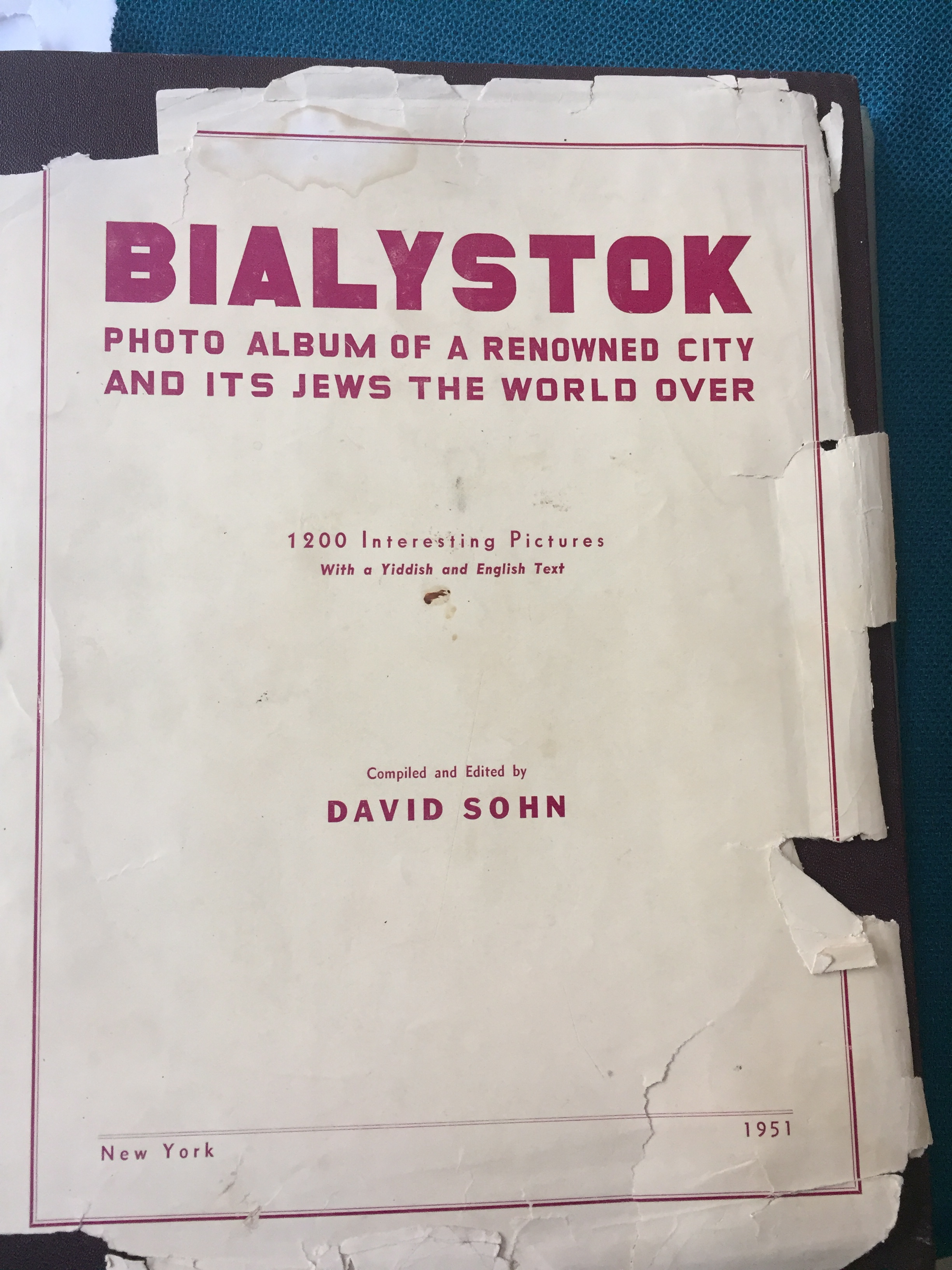
The book's cover is not in great shape, but the book itself is wonderful.

The book’s cover is not in great shape, but the book itself is wonderful.

Among the items that became part of my custodial responsibility was the book: Bialystok Photo Album of a Renowned City and Its Jews The World Over. Compiled and Edited by David Sohn, in 1951. The book attempts to show life in Bialystok before World War II; information about the Holocaust and the 60,000 Jews from Bialystok who were murdered; and show that life continued for those who survived and who lived throughout the Disapora. One two-page spread is so emotional as it lists the horrible events that happened to the Jews of Bialystok during the Shoah.

Two important pages.

Two important pages.

My great grandparents, Louis Goldman (Baruck Lev Litwack) and his wife, Ray Goldman (nee Rachel Wolff) were extremely active in the Bialystok society in New York City and were part of the large number of landsmen from Bialystok who helped to create the Bialystok Home for the Aged in NYC.

Although my Great Grandfather died in 1941, my family was still active in the Bialystok organizations in NYC. And my Great Grandmother Ray continued in a leadership role after her husband’s death.

I had placed this book in a pile of other books about Europe, but had not really searched through it for a while. I know I looked at it when we cleaned out our parent’s apartment and kept it as something worth investigating. But it went to the side as I dealt with other issues.

This week I decided to really look at it and see what I could fine. Thanks to my Aunt Leona, who passed away just four years ago, I did not have to look far. There was a handwritten note from my Aunt, with page numbers and identifications. I loved my Aunt Leona.

My Great Great Grandfather, a leading baker.

My Great Great Grandfather, a leading baker.

My Great Great Grandmother.

My Great Great Grandmother.

Photos of one set of my paternal great great grandparents are in this book.   Jacob Zev Litwack and Rashe Goldman were the parents of my great grandfather Louis Goldman.   I was a little confused at first because I knew that in Europe my great great grandparents went by the names Yaacov and Rashe Litwack. But I realized that Rashe Goldman could be changed for two reasons. First her maiden name was Goldberg, so this could be a mistake. Also, since her son took the name Goldman when he came to the USA, the name on the photo could just reflect his new name.

Whatever, the case, my Aunt definitely identifies them as her grandfather’s parents.   It is also exciting to see that their occupation is also mentioned: leading bakers.   When my great grandfather came to the USA, he became a tailor.

There are many photos of my Great Grandma Ray. One by herself and several in group shots.   And then there are pages of the “Deceased Leaders of Our Landmanshaft.” On one of those pages is my Great Grandfather Louis. Right there it says, Chairman of Bikur Cholim and a co-founder of the Bialystoker Center and Home for the Aged.

It makes me so proud that my great grandparents were so active in tzedakah and good deeds.   It is a tradition that continues in our family. So many members of my family have been active in volunteer work for the Jewish community. My Dad was the president of his synagogue for 11 years, and served in many volunteer roles throughout his life. My parents were always supporters of the Bialystoker Home, as were my grandparents.

And I like to say that the tradition continues on in my daughter. I think her great great great grandparents would be proud to know that she lives in Israel and works for a non-profit that promotes peace, The Peres Center for Peace.

But there was a surprise. There is another Ray circled in the book. Ray Nosoff. I had not heard that name before. But my aunt’s notes came in handy. Ray Nosoff is the niece of Louis Goldman. Her maiden last name was Kramer and her mother was Louis’ sister. She lived in Brooklyn.   After googling her name on line, I found out that she was born in 1887 and died in 1966 and was buried in Washington Cemetery in New York. Which makes total sense as my great grandparents are also buried there!   I also found the names of her two of her children.

This was exciting, as Louis Goldman was the next great grandparent that I wanted to investigate.   I had already found out much about his wife, Ray Wolff Goldman. But had not much to go on for Louis.

I now know his parents were bakers. His sister also immigrated to the United States and their family was also active in the Bialystok organizations.

I have more investigating to do, but I have started on another genealogy journey thanks to another Bialystok treasure.


To view Ray Wolff Goldman’s family: https://zicharonot.wordpress.com/2015/01/27/serendipity-wins-in-finding-a-family-connection/