Archive | Family RSS feed for this section

Remembering My Mother In Law With a Manicure and Pedicure

6 May

On May 12, I am going to get a manicure and a pedicure. I do this once a month. But on May 12 it will be a special event. My husband’s mother, Lee, would have been 90 years old on this date. She died when she was only 59.

Before I met my mother-in-law, I did not know anyone who went for weekly manicures. But Lee did. Each week she got her hair put in to a French knot and had bright red polish put on her nails. She had beautiful hands and nails.

I was a nail biter. The only time I ever had a manicure was the week before my wedding and on my wedding day, in an effort to stop me from this awful habit. It worked to a degree. And Lee encouraged it. She would occasionally take me for a manicure when we were in town visiting.

When she was in her last months, the lovely woman who had done her hair and nails for so long, would come to the hospital once a week to wash her hair and do her nails. She told me that as long as she could, she would help Lee feel beautiful. She did this for the last three months of Lee’s illness. What an angel!

My mother in law died so young because she was a smoker.  Lung cancer destroyed her and impacted my husband. Last year, when my husband and I were both 59, my husband was in a state of mild anxiety all year. I did not realize how much his age was weighing on him until we both turned 60. “We made it,” he told me. “We made it past 59.”

So on May 12, my mother-in-law’s 90 birthday, I will get a manicure and pedicure. It is not an unusual occurrence. I go every other week to have a manicure and I go monthly for a pedicure. But this time, when I am 60, I feel it is important to celebrate her 90th birthday and Mothers’ Day in a way that will connect me to her.

My daughter used to model bridal gowns. This was one of her favorite mani/pedis.

My daughter used to model bridal gowns. This was one of her favorite mani/pedis.

Having a manicure is a way to remember Lee. I took my daughter for her first manicure when she was seven.  She is named for her grandmother, so I thought she should experience a manicure at a younger age! We put a tiara on her head and made her feel special. She loved to go. When she was a teen, she often wanted purple polish or even different colors on every other nail.

She modeled wedding gowns while in high school, and would get demure polish then. To this day, my daughter still loves to get a manicure, but no bright reds for her now! She is into the more quiet French tips, where clear polish is put on the nail beds and only white or pale pink is put on the tips.

When my mother would come to visit me, I always took her out for a manicure. My mother never took the time for this pampering when she was home. She did all her manicures by herself. She only went to a salon twice a year, when she visited me. She loved going, but felt with her arthritis, it was not worth it. However, whenever she went she felt great! To me it was a gift I could give to my Mom.

But for me, a manicure was a must. I have been going to the same person, Mary,  for over 25 years. I was one of her first clients. And when she moved into her own store, Old Town Hair and Nails, in Lenexa, KS, I followed along. She has polished the nails of my Mom, my daughter and even my sister, who I recently took to the salon.

One of my more colorful mani/pedi.

One of my more colorful mani/pedi.

The pampering of a manicure was something I learned from Lee. Twice a month, I sit with a woman who has basically shared my life with me. We talk, we have silent times, we visit. I do not answer the phone, (unless it is my children). I chose a color to fit my mood. Sometimes I chose a pink or a coral. Other times I am bold with a blue! Other times, I have sparkling tips put over the basic color. And some times, I have one nail on each hand polished slightly differently.

I am not sure if Lee would have liked all these variations. She liked the same color every week — the same bright red.

But it does not matter. This May, a few days after Mothers’ Day, I will be remembering my husband’s mother with a manicure and pedicure. And in my heart wishing her a happy 90th birthday.

A Blueberry Patch Was the Site of My First Kiss

29 Apr

The summer of 1969 was famous for many reasons; the July walk on the moon of Neil Armstrong and Buzz Aldrin, the Woodstock concert in August. But for me, even though I remember those events vividly, and lived just 1 ½ miles from Yasgur’s farm, for me the summer of 1969 was the summer of my first kiss!

It happened near my grandparent’s bungalow colony in town of Kauneonga Lake. It happened on the path between the two sections of the blueberry patch that covered the ground between the bungalow colony and Cooper Drive.

Why it happened there, I do not know. But I remember it as if it was yesterday. My first kiss was very shy. I was 14, I think he was as well. Perhaps 15, but no more than that. Looking back, I realize that kissing on that path was a very poor choice. I had lots of boy cousins, a brother and friends who could have seen us. But they did not. We kissed in the middle of the path, then went our separate ways back to our respective homes.

To be honest, the kiss did not lead to dating. We were just friends. I have no contact with him, although I remember his name and what he looked like.

We, of course continued to see each other. But it was a one-time event.

There were other boys I dated in the Catskills over the years. But not one was ever serious. Usually they became my friends.

One Catskill friend took me to my high school senior prom. He was a freshman in college, so it was a big deal. Another boy I met while working at Daitch Shopwell was beloved by my grandparents. He and I remained friends for years. We both married others — not people we met at the Catskills.

The boy I loved the most in the Catskills, never really took me seriously. I think it was the age difference. I was 16 and he was 22. I was smitten. I also met him when working at Daitch. He had a great voice and would sing and play the guitar during our breaks. To this day when I hear the song, “You’ve Got a Friend,” I think of him. But to be honest, although I remember what he looked like and the sound of his voice, I cannot remember his name!

Not all Catskill summer romances end. Two of my cousins married the girls they met in the Catskills. Both have been married over 30 years and are grandparents. They and their families still come up to Kauneonga Lake every summer.  And there are many others I know who also married the love of their lives that they met while teens in the Catskills.

Although for me, the Catskills was not the place I met my husband, it was the place I brought I children to visit every summer. A place of great fun and memories.  My children got to spend wonderful times with their many cousins at the lake and in the house where I spent my summers.

As for the walk and kiss in the blueberry patch; it was not unwelcome. I still hold it in my heart. I am sure I picked some blueberries on the way back and ate them.   Although my love for that boy did not last, my love for blueberries has lasted forever.

Behind the Beauty and Facades of Vienna

19 Apr

My husband and I took our children to Vienna in 1999. We went to Austria and Hungary primarily to see the total eclipse of the sun. But our tour started in Vienna. I was not sure I wanted to go there. My grandfather was from Galecia, when it was part of Austria. His entire family was murdered in the Shoah. So should I go to a place that hated my family, my people and my traditions so much?

But on the other hand, my grandfather also told me that he bought his property and built his bungalow colony in the Catskills because the hills reminded him of his home. I wanted to see that part of Austria. And I did, when we left Vienna to go into the Vienna Woods, into the rolling hills above the city, I saw what he meant.

It did remind me of the Catskills. And I understood that even though he would never, ever leave the USA. That he would never go back to Galecia, he still had that piece of home in his heart when he was in the Catskills.

In Vienna we also saw the Hundertwasser haus designed by Friedensreich Hundertwasser. Born, Friedrich Stowasser, the son of a Jewish mother, as a child, he and his mother posed as Catholics during the war. His mother lost almost 70 members of her family. When we went up into the mountains, we stayed at the Bad Blumau Spa, which he designed. My son called this place the wacky hotel. It was an amazing spot. It is a place of beauty and peace designed by a Jewish man who was able to survive and provide beauty to the world.

While in Vienna, I made sure that my children went to the Jewish Museum and to the Judenplatz, the area of Vienna where most of the Jews had lived. At the time there was no memorial to the Shoah or an additional museum to memorialize what happened there. When we went, the central grounds in the Judenplatz was in the midst of construction. There were signs about what would be built there. And there was a plaque on one of the buildings describing, in German, what had happened during the war, after the Anschluss with Germany in March 1938.

We stayed for three nights in Vienna. Because we were traveling as a family of four within a tour group, the hotel reservations clerk upgraded our hotel rooms from two small rooms next to each other to an actual apartment suite that was on two floors. It was a lovely suite. We had a view of the city. Our children loved this elegant accommodation. But the entire first day, I felt unsettled.

On Saturday morning, as we were eating breakfast in the hotel dining room, I heard chanting and prayers. I followed the sounds and found several women sitting in a hallway outside a room where a traditional Shabbat service was being held. I was amazed. There was still a Jewish presence in Vienna? People were celebrating Shabbat here? We were not the only Jews in the city? I felt a bit comforted that the hotel we were staying in allowed Jewish services and provided a spot for those who wanted to celebrate the Shabbat and keep kosher. A bit of my angst left me.

We did all the tourist stops in Vienna. We went to the Schonbrunn Castle; The Belvedere; and the Spanish Riding School, home of the Lipizzaner horses. I had to see the Spanish Riding School, because I remember seeing the Disney movie, “The Miracle of the White Stallions,” as a child and have always been intrigued by these horses. At the Schonbrunn Palace we learned about Sisi, Empress Elizabeth of Austria and her very long hair!

I bought souvenirs, some lace, white ceramics, gifts for the children, and of course post cards of art work from the museums, including the beautiful Klimt paintings. They were magnificent.

The Klimt paintings, especially the one of the woman painted and then covered in gold, was amazing.   But there was much going on in the background of that painting that we did not know. There was no mention that the woman in gold was stolen from a Jewish home during the Shoah, along with other artwork.

My views of Vienna changed again when I went to see the movie, “The Woman in Gold” and found out the true story of this painting and others like it. I had a totally different reaction than when I saw the “Miracle of the White Stallions” so many years ago.

Although “The Woman in Gold” has not received wonderful reviews, I found it fascinating.   Perhaps with my somewhat Austrian roots and my previous time spent in Austria and Vienna, I related on to the film a different level. Perhaps because my family was destroyed after the Anschluss, so I felt the story on that level as well.

Of course my family was not multi-millionaires. But they did own a farm and property that was all stolen. And they did suffer through the murders and destruction.

I wish the movie shown that Maria Altman had children, grandchildren and great grandchildren. The Maria in the movie seems to be alone. And that was not the case. I wish the movie shown her triumphant in her life as well as in her fight against Austria to win the return of what belonged to her family.

For me the continuation of her family, as well as the return of the stolen property would have made the story even stronger. Not only did she get the beautiful Klimt, but she also made a lovely life.

I do not know if I will ever go back to Vienna. But I know that with the rise of anti-Semitism in Europe and around the world, we cannot stand back and say nothing.   So I am glad that movies such as “The Woman in Gold” have been made and are shown throughout the world.

Vienna in 1999 was a different Vienna than in 1938, but now I know that they were still not facing the truth of what had happened.   Vienna is a beautiful city. This is a fact. The pastry shops, the museums, the buildings, the parts are all stunning. But behind the facades, for me, will always be the homes, art, jewelry and lives taken.

http://www.nytimes.com/2011/02/09/arts/design/09altmann.html?_r=0

http://www.designboom.com/architecture/rogner-bad-blumau-spa-hotel-friedensreich-hundertwasser-austria-01-19-2015/

http://jewishonlinemuseum.org/friedensreich-hundertwasser

http://en.wikipedia.org/wiki/Miracle_of_the_White_Stallions

A Traditional Jewish Wedding Created A Family’s Magical Wedding Ring

16 Apr

In traditional Jewish weddings, the marriage ring has to be completely round, made of gold with no embellishments. No diamonds or stones; just a plain gold ring.

When my maternal grandparents were married in 1925, they used such a plain white gold ring to ensure a blissful life. Both from Europe, they had no parents to be with them when they married. But they followed the traditions. First they got permission from my great grandfather. Then they married. My grandfather said the traditional words, “With this ring, you are consecrated to me according to the law of Moses and Israel,” when he placed the ring on my grandmother’s forefinger.

The ring adorned my grandmother’s hand for the first 26 years they were married. But in 1951 my mother and father married. My Dad was in the army and was being sent to Korea. My grandparents were not exactly happy about my Mom getting married while Dad was on leave. They were worried. Would he survive? Would everything be okay?

My parents got married while my Dad was on a two-week leave. They did not have time to find and buy a ring. So my grandparents decided that my Mom would get married using their ring. My father paid my grandmother for the ring, as it cannot be borrowed. It must belong to the groom. Thus my parents were married using my grandmother’s wedding band. Once again the traditional marriage words were said, “With this ring, you are consecrated to me according to the law of Moses and Israel.” My parents were now bound together.

My grandparents were married for over 60 years. My parents were married 59 years before my Mom passed away.

Mom made sure that the tradition continued. She felt that since the ring had been a vital part of two wonderful weddings and marriages, then it would bring mazel to others as well. She decided that her daughters would also have to be married using this ring.

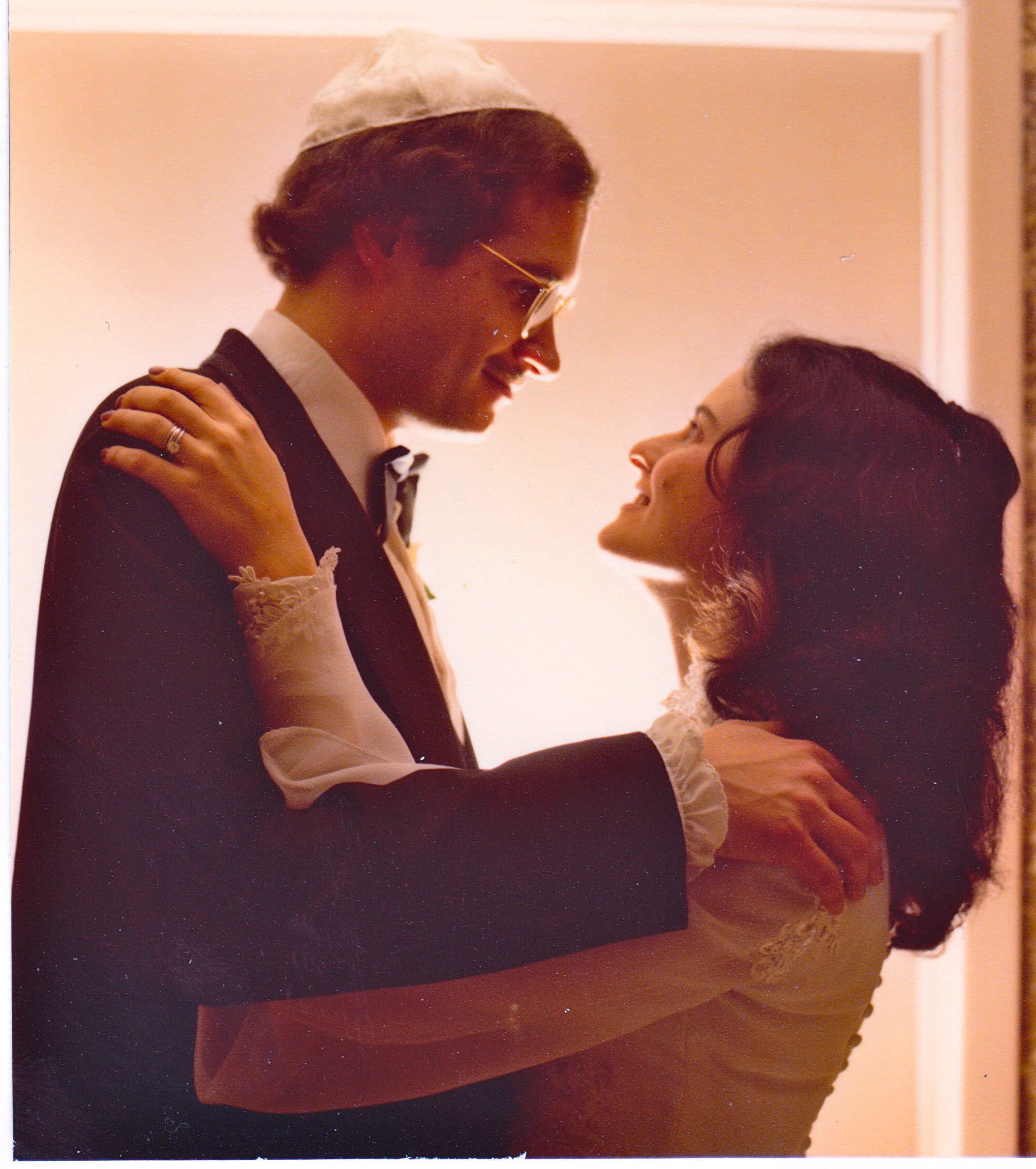
Notice the two gold rings by my engagement ring, several hours after my husband and I were married. Notice the two gold rings by my engagement ring, several hours after my husband and I were married.

When I married in 1980, I also was married in this special ring. My husband paid my mother one dollar for it. And even though I had another plain gold ring to wear, during the service it was my grandmother’s and mother’s ring that was placed on my right forefinger, and later moved to my ring finger.

My husband recited the same words to me, “With this ring, you are consecrated to me according to the law of Moses and Israel.” And I, being a more modern bride, wanted to say something as I placed a ring on my husband’s finger. So I said, “My beloved is mine and I am my beloved. Ani le’dodi v’dodi li.” I wore the family ring, along with my gold ring, for several years until my sister was to be married. 

Selling the ring to my brother in law just before he married my sister.

And then, as my mother wished, my sister’s groom purchased the ring for one dollar from my husband and me. Once again the ring was placed on the forefinger of a family bride.

As grandchildren were born into the family, my mother asked that the ring be used for each granddaughter’s wedding. And of course we agreed. My sister and I also feel that the ring should be used for the grandsons’ weddings as well, if they want to use it.

Ring/Dollars

My grandmother’s ring and the dollar bills each groom paid for the ring: my Dad, my husband, my brother-in-law.

The ring is now in my sister’s safety deposit box waiting for the next family wedding. With the ring are the dollar bills that my Dad, my husband and my brother-in-law all used to pay for the ring. Each dollar bill has the name of the bride and groom and the date of the wedding written on it. They are part of the tradition of the ring.

Soon the ring will come out of its resting place. It will be time to adorn the finger of another bride. I am happy that it will be my daughter’s wedding. The oldest grandchild, my daughter and her boyfriend recently announced their engagement. They plan to wed next summer, in 2016.   I hope that her groom will want to buy this ring to use for their marriage ceremony.  So that for the fourth generation, 91 years after my grandparent’s wedding, this magical ring will be used again.

I cannot wait to see my daughter and her groom stand under the huppah together.  I hope that they will use my father’s tallit for this special day. I cannot wait to see my grandmother’s white gold wedding ring slide onto the forefinger of my daughter. I cannot wait to hear the traditional words spoken by the groom. I wonder if my daughter will respond as I did, or in the way more modern brides do repeating the same words that the groom says to his bride.

I only hope that the magic of the ring continues and that my daughter and her groom celebrate throughout their married life with the joy of marriage that went through the lives of all the brides who have worn it.

Frogs Jumping At the Passover Seder

2 Apr

Over the years my desire to have an educational and entertaining Passover seder merged with my love of creating paper creatures using origami.

Origami is the Japanese art of paper folding to make figures. Many have seen the origami crane. But it can also be used to make flowers, boxes, insects, and animals. An unlimited number creatures and objects can be created by the intricate folds used in origami.

I have loved origami for over fifty years. When I was in fourth grade I went to a birthday party for a school friend who was from Japan. As part of the party fun, her mother taught us how to make several origami figures including a crane and a box. I was hooked.   I have been dabbling in origami ever since.

My collection of origami books and special papers grew when I was in graduate school. My roommate, Pekoe, was Japanese. When she found out about my love of origami, she was intrigued that I was capable of making the more advanced figures. Upon her return to Missouri, after winter break, she presented me with the most beautiful handmade origami paper and several figurines. I still have them all.

I used origami when I taught. I used origami when I was a hospital candy striper while in high school. I used origami as a mother. Many times I was able to cheer up rainy days and airplane trips by the aspect of making origami figurines. I always carried the special brightly colored, square paper with me when I traveled. It entertained not only my children, but others as well.

Making origami frogs before the seder. Making origami frogs before the seder.

At Passover, Pesach, origami frogs became an important part of our holiday tradition. I was always looking for ways to make the seder more enjoyable, especially for the children who were with us. So I started giving my son and daughter enough sheets of paper to make a frog for each person at our Seder.

We always made frogs that could ‘jump.’   Did I tell you that the frog plague was always our favorite? My son loves reptiles, lizards and amphibians. So of course he loved frogs. And green was his favorite color. So we made many frogs of different shades of green. Whenever we made our frogs and hopped them during the seder, we sang the Passover frog song that ends with “Frogs here, frogs there. Frogs were jumping everywhere.” And then our paper frogs would start hopping.

Jumping frogs

Last year at Passover my children went bonkers. They made multiple origami frogs of many colors. They also decided to make paper locust. We used all these origami figurines to decorate our seder table.

When we read about the plagues, everyone tried to hop these frogs. Some jumped directly into the wine, the charosets and the seder plate. Frogs were really jumping everywhere. Everyone had a great time.

The frogs remained on the table throughout the meal. When we sang the end of seder songs, frog jumping took over. The aim was to get the frog onto a tissue box. Several of the young adults at the table were quite good at this. So while we sang songs like ‘Had Gad Ya’, we also had a group still making the frogs jump.

Perhaps it is not taking the plague seriously. But I know that everyone who attends my seder will always remember the plague of frogs. They will always have fond memories of the Passover seder.


http://www.origami-instructions.com/easy-origami-jumping-frog.html


Click to access The%20Frog%20Song%20lyrics.pdf

The Sunday Crossword Puzzle Is a Family Tradition For Some

29 Mar

Puzzle

I never do the Sunday Crossword Puzzle when I am home alone. I do get the Sunday New York Times delivered to my house each week, because I cannot see a life without the large Sunday paper on my driveway. I grew up in a home where the Sunday paper was important. We each would take our sections and sit and read quietly, while my Dad did the puzzle.

Daddy loved to do crossword puzzles. When he was retired, he would start each day with a cup of coffee and the newest puzzle in the newspaper. He usually would use a pencil, but at times Dad used a pen. His ability to solve the puzzle was amazing. In fact I knew after his heart surgery when he was back to himself because he was once more able to complete the puzzle in under hour. For a while, after his open-heart surgery, he struggled.

My Dad had one major competitor for the puzzles, my sister. As she grew up, she wanted to do to the puzzles as well. I think they even bought two Sunday newspapers when my sister was living at home while she attended law school. It alleviated fights as they both could complete these impossible weekly puzzles on their own.

They were not good at sharing the puzzle. This made life more bearable for my Mom.   I am not sure if they competed to see who would complete it first, but it would not surprise me if they did.

I just did not want to get involved in the puzzle battles. I would answer a question about a word, if asked. But usually I stayed out of the way. It could be very intense. And although I was an English major and knew many of the references, I was afraid to get involved. What if I made a mistake? So I just bought my own puzzle books and stayed out of the fray.

When my sister married, she married another crossword puzzle addict. They and their children would sit around on Sunday and read the clues out loud so everyone had a chance to answer. They would also take turns being the one to write down the answers. A new family tradition was born. It was a world of word puzzle cooperation!

My husband was not interested in puzzles. So we never developed the tradition of doing the crossword puzzles together. Whenever my parents came to visit me in Kansas, I would read the section of the newspaper with the puzzle in it first so that when my Dad was ready he could do the puzzle. Sometimes one of my children would sit with him when he worked the puzzle, but it was more of watching than participating. Occasionally, my Dad would ask for help with a word.

I would buy my Dad crossword puzzle books so that he would have something to do when we were having down time. I even purchased him a crossword puzzle mug to use when he visited my family. I still have the mug. Whenever I use it I think of my Dad.

In the Catskills a different crossword puzzle tradition developed. My cousin also loves the Sunday puzzle. Every Sunday friends and cousins gather on his lake front property with the latest puzzle. It is passed around to those interested in working on it. Completing the Sunday Times puzzle is a process of teamwork. Clues are read out loud. Comments are made. The group effort often works.

I enjoy joining in because I like the concept of the crossword puzzle. I took my husband to see the movie, “Wordplay,” about the New York Times crossword editor Will Shortz and a crossword competition. I loved the movie. I enjoyed seeing the joy of the competitors as they did well.

So I had to think, “Why did I never get into crossword puzzles when I love word games so much?” I think it was because doing these puzzles was my Dad’s thing to do. And I would not compete. My sister moved back home after college after developing the love of crosswords while at school. So when she lived at home while attending law school, she and my Dad had to work out a compromise; it was purchasing two papers.

Except for a summer or two, I never lived at home again after college. I went to grad school and married. And the crossword puzzle tradition ended in my home, except when my parents visited. I also think that if online crossword puzzles had existed sooner, I might have been more interested.   With online puzzles, each person can work on their own without interfering with others. But even my sister, who does weekday puzzles online, admits that on Sunday she wants to work on a the paper puzzle.

When I get my Sunday Times. I read it over a two-day period. I save the Book Review and the Sunday Magazine for last. Often reading them on Tuesday. But I have never touched the puzzle. When I am with others, I love working on it. So, perhaps it is time for me to take on this tradition and attempt to complete the Sunday New York Times Crossword puzzle. Perhaps I need to develop a new Sunday tradition.

For Me the Fourth of July Echoes With Memories of My Dad and John Philip Sousa Marches

2 Jul

“Get up, get going, you are wasting the best part of the day,” my father would say early on a Saturday or Sunday morning. As teenagers all we wanted to do was sleep in on the weekends. But my Dad often had other ideas. He had chores he wanted us to do. If the talking did not work, he would play his favorite John Philip Sousa marches to wake us up. Heck, he would play marches all the time. He loved his Sousa marches.

I think we were the only children in North Bergen and the world who did their chores to John Philip Sousa marches. I can still see us lining up as a joke with mops and brooms marching around our house while the music blared. We would try to clean in time to the music. Well I would: vacuuming in time, dusting in time, ironing in time.

Dad loved his Sousa. Whenever I hear a march, I get the urge to clean. But I am able to resist. However, I do think of my Dad and his Arthur Fiedler and the Boston Pops collection (RCA Victor Label) of John Phillip Sousa marches. I can still hear “Stars and Stripes Forever” on an endless loop in my mind. But Dad had an entire collection of the Sousa marches. And we learned them all!

Needless to say, the Fourth of July was Dad’s favorite holiday. Those Sousa records would come out days before the Fourth as Dad prepared. You know my Dad could not sing at all. He tried, but he had no sense of pitch when he sang. But he would conduct along with the music, swinging his arms as if he was really in charge. I can remember seeing such joy on his face while he listened to the music.

His second favorite march was “Hail to the Chief.” Played whenever the President of the United States enters a room, with first the “Ruffles and Flourishes” introduction, “Hail to the Chief” made my Dad happy. In our house, he was the chief. And when he played that song he was letting us know who was boss. He would talk about his dream of one day having the song played for him.

And it happened. Dad served as president of his synagogue for 11 years. At a dinner honoring him, I mentioned his love of this song and his love of Sousa,   and his dream of hearing it played for him one day. When he came up to do his speech, the dance band spontaneously played “Hail to the Chief” in his honor. My Dad welled up with tears. He really was the President and he felt so honored.   I think my Mom, my siblings, our spouses and the two grandchildren there also cried out of pride and joy for Dad.

Dad did not only play his music on cleaning days. He brought his Sousa collection up to the Catskills. Since we had a very private four acres of land, he was able to play his Sousa as loud as he liked. And he liked to blast it out. I still have the sound of those brass instruments echoing in my mind.

And the times he got to see  any orchestra that played the marches live…Oh my!  That was the best for my Dad. Hearing the music live was even better than records or CDs. But I will say, his Arthur Fiedler records were his favorites.

When I think of his love of Sousa marches, I must also say that he loved the sight of a bald eagle.   Imagine my Dad, a proud veteran wearing an eagle or an American flag t-shirt, listening to John Philip Sousa marches on a relaxing weekend in the Catskills. Well he was relaxed, we were all wound up with the resounding booming music of Sousa.

Sousa wrote music for over 50 years! So there are quite a few marches to listen to over a weekend. He actually wrote almost 140 marches. And my siblings and I probably heard all of them at one time or another.

Among my favorites are the “Semper Fidelis March” written for the U.S. Marine Corps; “The Thunderer,” and the “U.S. Field Artillery,” which is the march for the US Army. (Sousa actually revised this melody, which was written by someone else.) Dad would ‘sing’ along with this last one, because it is the music to “The Caissons Go Rolling Along.” As a proud army veteran, he loved to sing this song.

For me the joys of the Fourth of July are not just the picnics, bar-b-ques,  the fireworks and the celebration of our country. For me  it is also time to listen to John Philip Sousa marches and remember my Dad.


Arthur Fiedler and Boston Pops “Stars and Stripes Forever’: http://www.youtube.com/watch?v=cmdyobr77IA

Marine Band plays “Hail to the Chief.” : http://www.whitehousehistory.org/whha_exhibits/marine_band/audio_marine-band-03.html

John Philip Sousa’s Marine Band playing “Semper Fidelis March”: http://en.wikipedia.org/wiki/File:John_Philip_Sousa_-_U.S._Marine_Band_-_Semper_Fidelis_March.ogg

US Army Band plays, “The Caissons Go Rolling Along”: http://en.wikipedia.org/wiki/The_Army_Goes_Rolling_Along


We are going to the LAKE!!!

1 Mar

I did not swim in a pool until I was 17.  Up until then I had only ever swam in a lake…one lake in particular: Kauneonga Lake in Sullivan County, NY.  My grandparents owned a small bungalow colony right across the street from the lake on West Shore Road. 

Kauneonga Lake is the northern side of White Lake.  White Lake and Kauneonga Lake once had just a small channel connecting them, but it was widened many years ago.  Amber Lake was off to the side, and could only be accessed on foot or by canoe because the channel was so shallow.

Each spring we would begin to prepare for the first visit to the lake.  Memorial Day weekend the bungalows would open. But the season would really not begin until the end of June, when school ended.  We would go up earlier so my Mom and Dad could help my grandparents prepare for the season.  My siblings and I would be put to work. . My brother and I would be scrapping paint off the bungalows to get ready for a new coat!  My sister was too young for those jobs, so was given a simpler job to do. 

Oh the excitement of knowing that summer was coming!  Once school was out, we would be there for two months of joy.  We would pack up the car, put on our pajamas, and head out for what was then a four-hour ride.  When we woke, we were there in our bungalow at Kauneonga Lake.

There, in the mornings we could watch the mist rise above the lake. In those days it was so cold in the mornings, we slept with our clothes under our pillows to keep them warm.  We would dress in layers under the covers and then get up.  Going to the bathroom in an unheated bungalow, first thing in the morning, was a COLD experience.  But even though the lakes were fed by spring water, in the mornings the water was warmer than the air, and mist would rise so ghostly above the water.

Watching the mist rise over the lake was a normal experience and also a beautiful one.  It was so peaceful.  There were very few motor boats on the lake then, just canoes and rowboats. 

My grandmother, who grew up in Poland, believed that washing your hair in the lake was the best.  So some mornings I would join her to walk over to the dock.  She wore her hair in braids on top of her head. But at the lake, she let it down and then would wash it with Ivory soap. She would wash my hair as well.  Then we would dunk in to the warmth of the lake and quickly wrap ourselves in towels when we came out.

Image

Swimming in Kauneonga Lake 1961.

Every afternoon, when it wasn’t raining or too cold, we would all go to the dock to swim.  Along side the dock were rocks were we could hunt for crayfish.  Some mornings we would fish.  I was an expert in filleting fish, which I did for my brother and I.  Later these skills were important when I worked in a deli and would filet white fish for the customers.  But then it was the joy of fishing and being at the lake.

When we swam, we tried to stay out of the gush. This was the seaweed and the bottom of the lake. The area we swam in was sandy because of all the activity. But on either side it was gushy. The older boys tried to make us have to step there. And in the gush were turtles and fish that would nibble at our feet.

We knew that a warm spot was a bad sign…and we would scream and yell when we walked or swam through one.  Who had peed in the lake?  No one would ever tell.

When I reached my teens, the lake atmosphere had changed. But I still loved it!  Now there were many motor boats and water skiing.  My friends and I would go out on the lake for hours, boating over to the cove where we could swim without our parents watching.

In the early fall, we would come back for weekends.  Even though the colony was closed, we came out to help do the closing of the buildings.  A friend of mine, who had a boat, came up sometimes as well, especially during Rosh Hashannah.  We would ride in his boat over to the beach at Camp Hi Li and sit on its floating dock working on our homework.

My parents had a pontoon boat in their later years.  It was perfect for my Dad to go gently around the lake. My cousins would keep watch over my parents when they went boating. Just as my parents kept an eye on my cousins when they were young.  Generation reversal!

Image

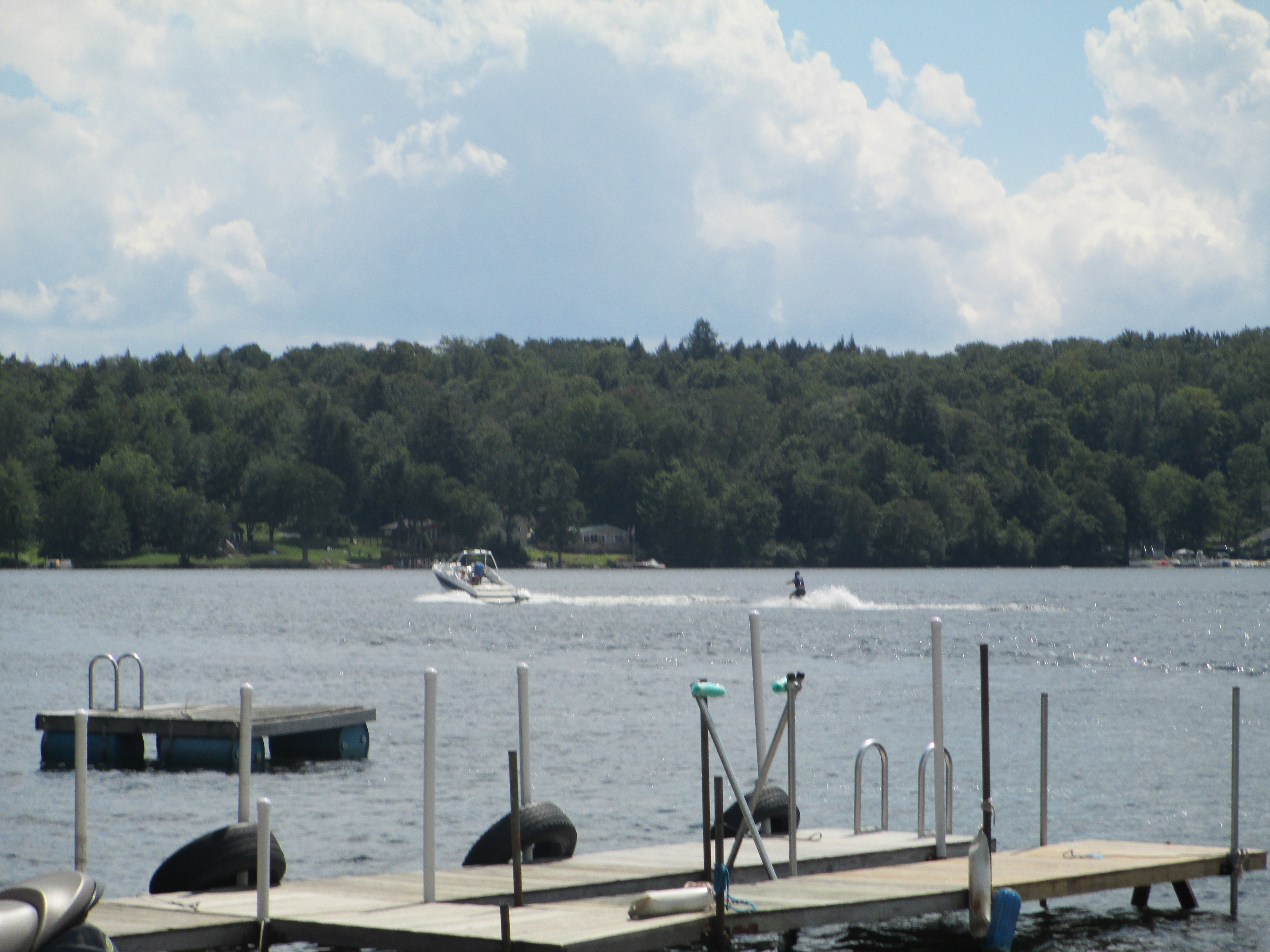
Kauneonga Lake summer 2013.

I still go up to the Lake.  There are so many more boats on it.  I don’t see as many people swimming. Most are boating.  My cousins have a large beach area where we hang out.  The ‘youngsters’ swim and boat and ski and go tubing and other water sports.  We, now the older generation, go out on the boat once in a while for a spin around the lake.  My cousins tell me about all the changes in the past year.

For all of us, there is joy just being by the lake.  Visiting with each other. Continuing the fun we had in the many years we spent growing up together across the street from Kauneonga Lake.

To this day, the words,  “We are going to the Lake,” still bring joy to my soul.