Tag Archives: travel

Always Searching For a Touch of Jewish History

7 Jul

Whenever I travel, I try to incorporate a touch of Jewish history into all my trips. It started when I had little children, and an older friend recommended that I include something of our heritage whenever we traveled. It seemed like a good idea, so I started this tradition.

Our first attempt to fulfill this commitment was seeing a production of a new opera about the Golem in the Aspen Opera House. It was a wild opera. Many people walked out. But my children LOVED it. A great success.
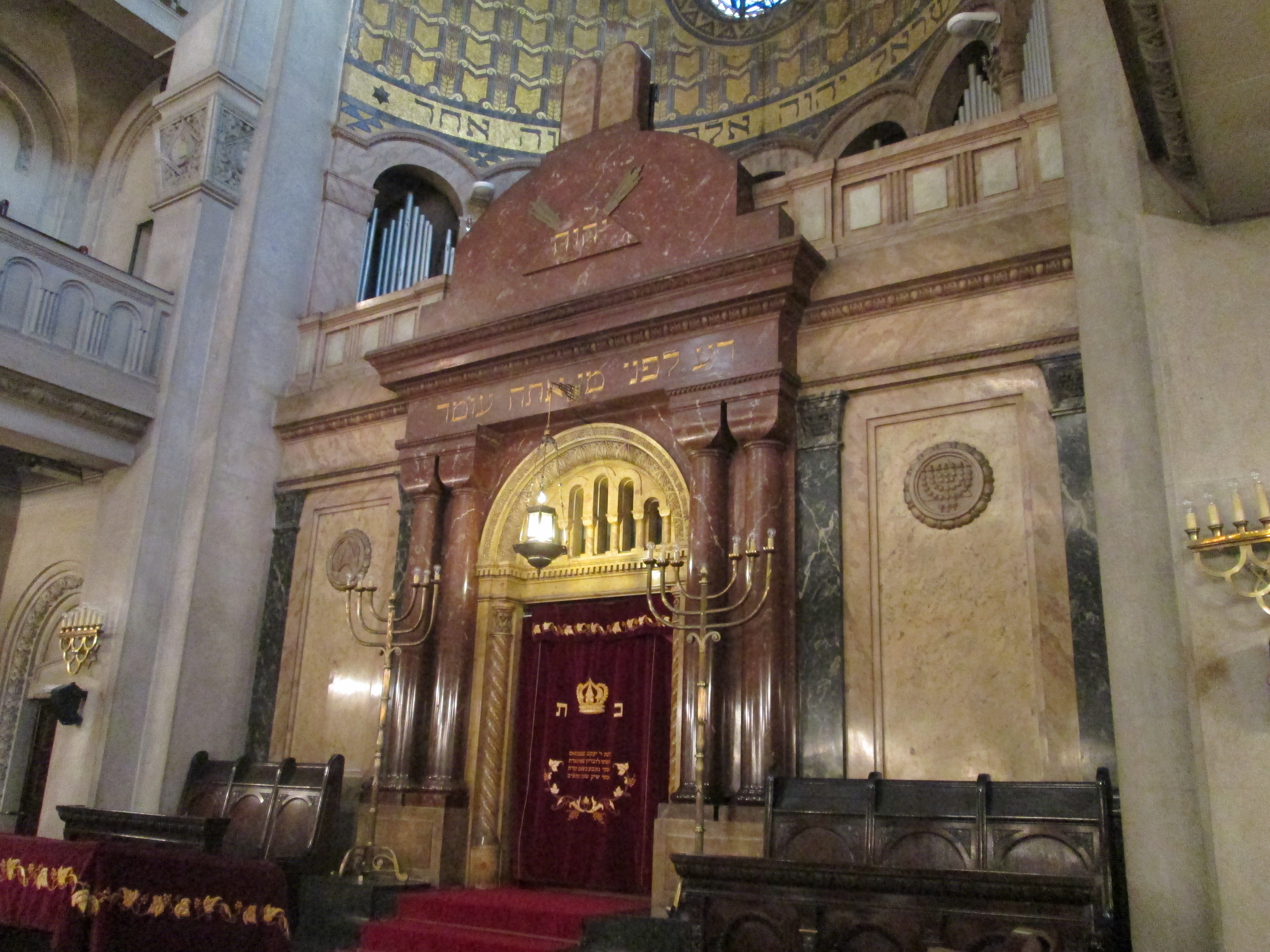
Great Synagogue in Buenos Aires.

Great Synagogue in Buenos Aires.

Since then we have visited Jewish sites throughout the world: Jewish museums thorugh out the United States,as well as the Jewish Museum in Vienna and my husband visited the Jewish Museum in Athens. We have seen the synagogue on St. Thomas, the Great Synagogue in Buenes Aires, the holocaust memorial and several synagogues in Montivideo, Uraguay. We have visited Jewish sites in Canada.

Holocaust memorial in Montevideo, Uruguay.

Holocaust memorial in Montevideo, Uruguay.

So my trip to Europe this summer was no different. We had to incorporate a bit of Judaism into our trip, especially with all the rise of anti-Semitism in Europe. I needed to do this!

While in Rome, we used the tour company, Jewish Roma, to book tours of the Jewish Quarter and the Vatican (to get a slightly Jewish slant on this very Catholic compound. ) The tour of the Jewish Quarter, or what used to b the Ghetto, was wonderful. Walking down the streets and seeing where so many Jews had been forced to live during the Middle Ages, in fact up until the 19th century, touched me.

I loved seeing the Great Synagogue and the museum with all its religious objects. I listened to the tales of the Shoah and the life of Jews in Rome for centuries. I was shocked to see the plaque on a church that once stood just outside the gate of the ghetto that was written in Hebrew but encouraged Jews to convert. I had heard of this practice, but to actually see it, was painful. I am glad they kept it there.

The Great Synagogue in Rome, Italy

The Great Synagogue in Rome, Italy

The small community of 12,500 Jewish people in Rome support synagogues, a day school and a hospital. They are well aware of their standing in the community.  Near the synagogue is a square where over 1,000 Jews were rounded up by the Nazi’s.  This October date is memorialized.  Of the 1,000 taken, only 18 returned.

I learned that in Rome the Jews are neither Sephardic nor Ashkenazi in their religious practice. Their service comes from a time before the divide. It is a Roman service. How interesting!?  We also ate fried artichokes, a Jewish Roman delicacy.  I enjoyed walking through the Jewish Quarter, seeing the Jewish Day School, eating lunch in a kosher bristol.

Our tour guide, Sara, told us how her family was actually from Sicily but was forced to move to Rome centuries ago. So I was excited when we were in Sicily to have to tour guide point out the original synagogue, now a church of course, and the road where the Jews once lived. There is a plaque on the wall of the street indicating that it was once the home to the Jewish population of Sicily.

What was once the synagogue in Sicily, now a church.

What was once the synagogue in Sicily, now a church.

Although there were small Jewish communities in some of the other places we visited, like Corsica, it was not until Barcelona that we had our next Jewish encounter. Near the harbor is a hill that is still called Montjuic, Mountain of the Jews. It was where the Jewish cemetery once was located. But as our tour guide told us, when the Jews were expelled the cemetery was destroyed. In fact the Jews of Barcelona were cast out in the 1390s, a hundred years before they were expelled from the rest of Spain. Now this is part of the site of the Barcelona Olympics from the 1990s. So although there are no Jews there anymore, the name remains.

We walked in the Gothic area of the city where the Jewish population once lived and where the old synagogue still remains, although we did not see it.

Our other touch of Judaism was going to a Flamenco performance. I had read that many people believe the Flamenco dance was an outgrowth of the closeness of the Roma community with the Sephardic Jewish community. Our tour guide, Bettina, commented on this connection as well. She told us about how the Jews were expelled and forced to leave.  When our tour was over, I commented privately to her about my family’s distant roots in Spain.  And how our family, then known as Faya was forced to leave.  I guess, that   even though the Jews left Spain so many centuries ago, little pieces remain behind. And that brings me some peace.

I do wish I had booked a private Jewish tour of Barcelona before we went instead of relying on public tours and asking my questions. But I am glad that I have continued in my search to find a bit of Jewish heritage with every trip I take.
My Architectural Love Affair With Hundertwasser and Gaudi

6 Jul

In the summer of 1999, my husband and I took our children on a tour of Austria and Hungary, primarily to see these countries and to view the total eclipse of the sun that would be visible that summer. We were heading to Hervis, Hungary, for the best viewing.

Before the trip up to the mountains, we stayed for several days in Vienna. It was an informative trip as we went to the Jewish Museum, Judenplatz, other museums and visited the home of the white stallions. (See below for links to another blog about this trip.)

But along the way I was introduced to the work of Friedensreich Hundertwasser, the Austrian architect who was born in 1928, the same year as my father, and who had survived the Shoah with his Jewish mother by passing as Catholic, the religion of his father. In Vienna we saw the most unusual apartment building designed by him, The Hundretwasserhaus. This crazy looking building was multicolored, unusually shaped and had trees growing everywhere.

IMG_6071

But the most wonderful part of our visit that year, was our accommodations at what my then 8-year-old son called the ‘Wacky Hotel.’ But whom others call Hundretwasser’s Rogner Bad Blumau, a hotel that includes thermal baths and pools. The hotel has no rhyme or reason that an adult can see. But it has sparks of imagination that enchant a child. I was enthralled.   I became a Hundertwasser lover. Even though I have no background in architecture.

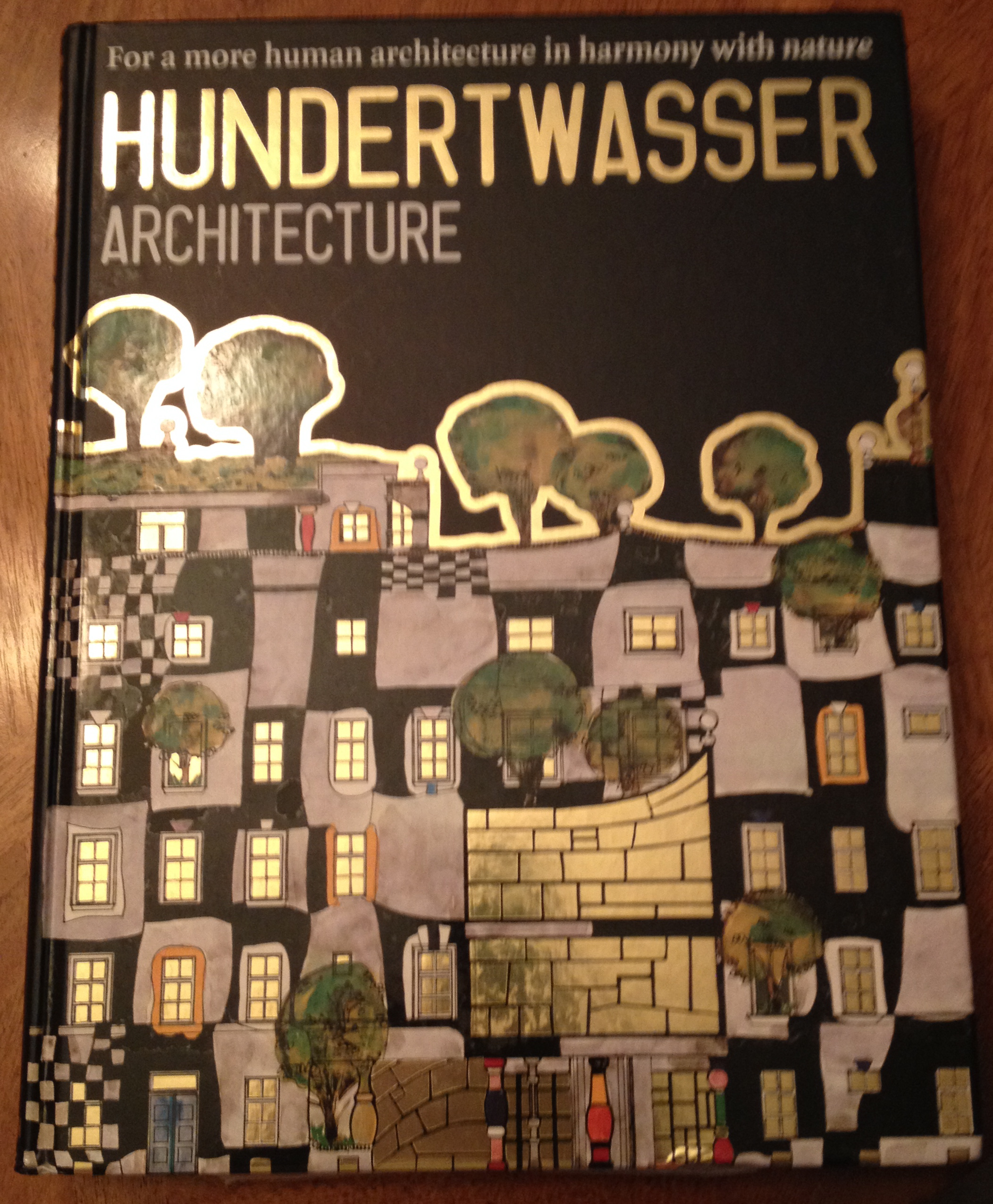
Our stay there was delightful, from the curving paths to the unusual windows to the wonderful pools and colorful design. I bought books about Hundretwasser. I was intrigued by his desire to help nature and bring all things natural to his architecture. Yes, I think he went a little far at times, but I so enjoyed his work.

I was also intrigued by his personal history and his survival. Born Friedrick Stowasser, he changed his name after the war to focus on his desire for peace and harmony with nature. I think I was also aware of another connection, my maternal grandfather was also from a part of Austria. He had moved to the USA in the 1920s, but like Hundretwasser, my grandfather lost almost 100 members of his family during the Shoah. Hundretwasser’s mother lost many of her family members as well. Our connection was that both of our families had been decimated by the Shoah.

I would love to see all the buildings Hundretwasser designed, but I realize this would be impossible. However, there is a winery in California, The Quixote Winery that I have to see! I love how he uses the natural contours of the ground and a need to protect the environment in his designs. I would love to see this winery in person.

My profound interest in Hundertwasser’s works lead to my interest in another European architect, Antoni Gaudi, from Spain.   Although he died three years before Hundretwasser was born, I see his influence in the work of my Austrian artist. For Gaudi, his Catholic religion was an important part of his designs. Not so for Hundretwasser, even though he was baptized to survive. But the form of their buildings and their interest in natural design fit so well together.

The towers on their buildings, the use of stone and color, the curves and contours reflect each other. Although Gaudi used religion to influence his art, and Hundretwasser used nature.

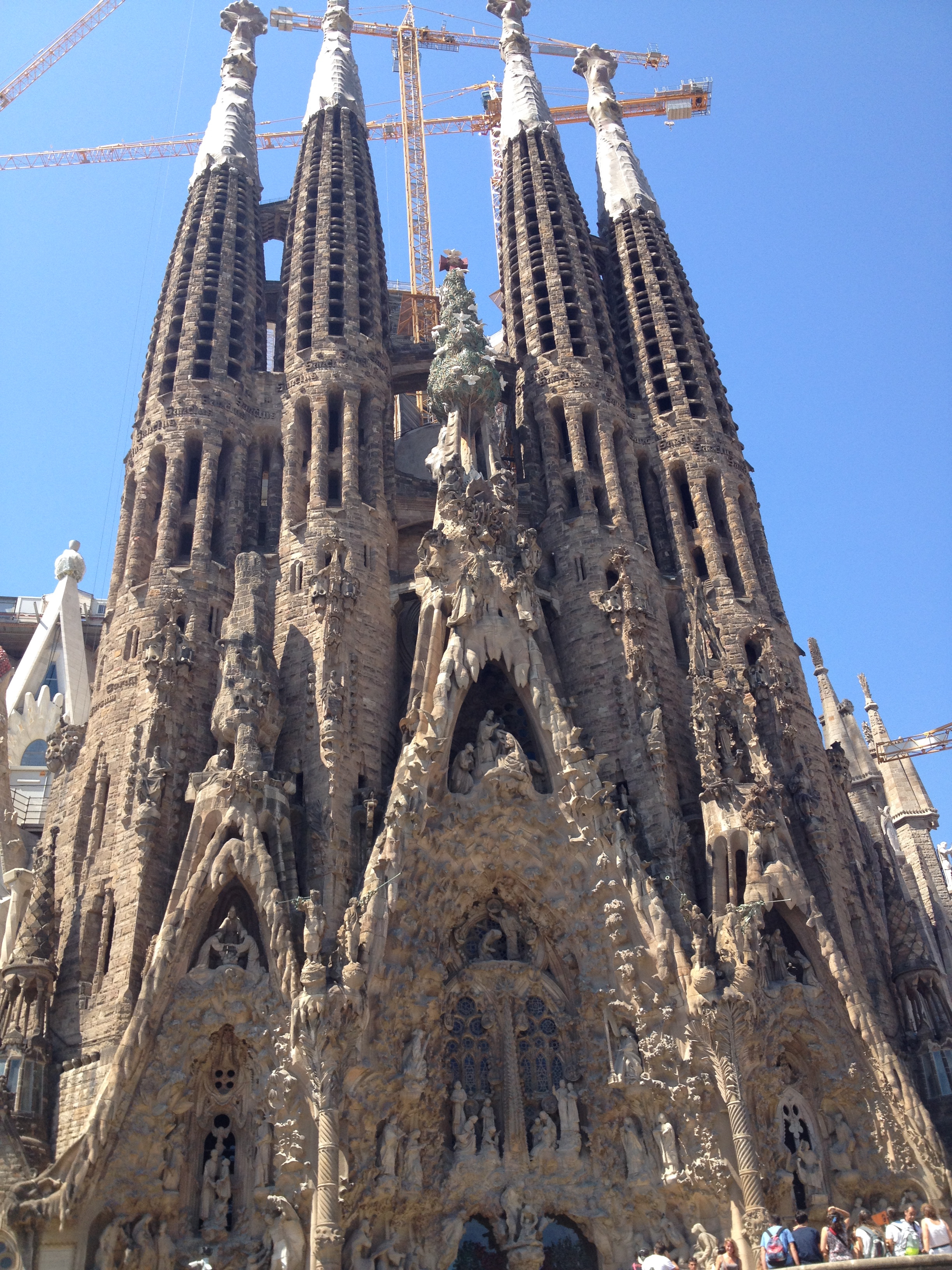
Church of Sagrada Familia

So, of course, on our recent trip to Europe and Barcelona, I had to go to see some of Guadi’s designs. The amazing church, the Sagrada Familia, which has been in progress for over 120 years! Wow! What a creation! My husband envisioned termite hills reflected in the towers. Our tour guide was not too happy with that comparison. But it is true. The towers do look like termite hills to us!

Casa Batllo Casa Batllo

We toured the Casa Batllo. I loved it! The mushroom fireplace, the lovely curved doors and windows, the delightful stone and tile-encrusted façade all brought me some joy! The private garden in the back on part of the roof was enchanting.

Unfortunately we could not get tickets to Park Guell, so I guess I will have to go back to Barcelona one day to view this park and see how it compares to the Rogner Bad Blumau.

I find it so unusual that one man, born in the mid 1850s and dying in 1926, who based his architecture on his religious beliefs; and another man born in 1928, who died in 2000, and had to escape from religious persecution, both designed buildings with such unique and imaginative styles.

Although some believe the word gaudy comes from Antoine Gaudi’s name, it does not. My search of several dictionaries revealed that the word, gaudy, was first used in the 1500s to mean garish or flashy. Yes, it is somewhat like Gaudi’s buildings, but in this case his name was not the reason for the word, just a serendipitous event.

And although some might call Gaudi’s works gaudy, to me they are inspiration! To me, to be honest, neither the work of Gaudi nor the work of Hundretwasser should ever be considered gaudy, rather they should be seen as works of imagination! Just as the song about Figment in the Disney ride “Imagination” used to say, “One little spark of inspiration is at the heart of all creation!”

I believe their designs will be joy to many others for generations because they hold the spark of imagination. And so I will continue my architectural love affair with their buildings.

Update with a newest Gaudi visit: https://zicharonot.com/2018/10/08/i-do-love-gaudi-my-second-barcelona-gaudi-adventure/

https://zicharonot.wordpress.com/2015/04/19/behind-the-beauty-and-facades-of-vienna/

tour the rogner bad blumau spa, designed by friedensreich hundertwasser

My second Gaudí adventure: https://zicharonot.com/2018/10/08/i-do-love-gaudi-my-second-barcelona-gaudi-adventure/

Behind the Beauty and Facades of Vienna

19 Apr

My husband and I took our children to Vienna in 1999. We went to Austria and Hungary primarily to see the total eclipse of the sun. But our tour started in Vienna. I was not sure I wanted to go there. My grandfather was from Galecia, when it was part of Austria. His entire family was murdered in the Shoah. So should I go to a place that hated my family, my people and my traditions so much?

But on the other hand, my grandfather also told me that he bought his property and built his bungalow colony in the Catskills because the hills reminded him of his home. I wanted to see that part of Austria. And I did, when we left Vienna to go into the Vienna Woods, into the rolling hills above the city, I saw what he meant.

It did remind me of the Catskills. And I understood that even though he would never, ever leave the USA. That he would never go back to Galecia, he still had that piece of home in his heart when he was in the Catskills.

In Vienna we also saw the Hundertwasser haus designed by Friedensreich Hundertwasser. Born, Friedrich Stowasser, the son of a Jewish mother, as a child, he and his mother posed as Catholics during the war. His mother lost almost 70 members of her family. When we went up into the mountains, we stayed at the Bad Blumau Spa, which he designed. My son called this place the wacky hotel. It was an amazing spot. It is a place of beauty and peace designed by a Jewish man who was able to survive and provide beauty to the world.

While in Vienna, I made sure that my children went to the Jewish Museum and to the Judenplatz, the area of Vienna where most of the Jews had lived. At the time there was no memorial to the Shoah or an additional museum to memorialize what happened there. When we went, the central grounds in the Judenplatz was in the midst of construction. There were signs about what would be built there. And there was a plaque on one of the buildings describing, in German, what had happened during the war, after the Anschluss with Germany in March 1938.

We stayed for three nights in Vienna. Because we were traveling as a family of four within a tour group, the hotel reservations clerk upgraded our hotel rooms from two small rooms next to each other to an actual apartment suite that was on two floors. It was a lovely suite. We had a view of the city. Our children loved this elegant accommodation. But the entire first day, I felt unsettled.

On Saturday morning, as we were eating breakfast in the hotel dining room, I heard chanting and prayers. I followed the sounds and found several women sitting in a hallway outside a room where a traditional Shabbat service was being held. I was amazed. There was still a Jewish presence in Vienna? People were celebrating Shabbat here? We were not the only Jews in the city? I felt a bit comforted that the hotel we were staying in allowed Jewish services and provided a spot for those who wanted to celebrate the Shabbat and keep kosher. A bit of my angst left me.

We did all the tourist stops in Vienna. We went to the Schonbrunn Castle; The Belvedere; and the Spanish Riding School, home of the Lipizzaner horses. I had to see the Spanish Riding School, because I remember seeing the Disney movie, “The Miracle of the White Stallions,” as a child and have always been intrigued by these horses. At the Schonbrunn Palace we learned about Sisi, Empress Elizabeth of Austria and her very long hair!

I bought souvenirs, some lace, white ceramics, gifts for the children, and of course post cards of art work from the museums, including the beautiful Klimt paintings. They were magnificent.

The Klimt paintings, especially the one of the woman painted and then covered in gold, was amazing.   But there was much going on in the background of that painting that we did not know. There was no mention that the woman in gold was stolen from a Jewish home during the Shoah, along with other artwork.

My views of Vienna changed again when I went to see the movie, “The Woman in Gold” and found out the true story of this painting and others like it. I had a totally different reaction than when I saw the “Miracle of the White Stallions” so many years ago.

Although “The Woman in Gold” has not received wonderful reviews, I found it fascinating.   Perhaps with my somewhat Austrian roots and my previous time spent in Austria and Vienna, I related on to the film a different level. Perhaps because my family was destroyed after the Anschluss, so I felt the story on that level as well.

Of course my family was not multi-millionaires. But they did own a farm and property that was all stolen. And they did suffer through the murders and destruction.

I wish the movie shown that Maria Altman had children, grandchildren and great grandchildren. The Maria in the movie seems to be alone. And that was not the case. I wish the movie shown her triumphant in her life as well as in her fight against Austria to win the return of what belonged to her family.

For me the continuation of her family, as well as the return of the stolen property would have made the story even stronger. Not only did she get the beautiful Klimt, but she also made a lovely life.

I do not know if I will ever go back to Vienna. But I know that with the rise of anti-Semitism in Europe and around the world, we cannot stand back and say nothing.   So I am glad that movies such as “The Woman in Gold” have been made and are shown throughout the world.

Vienna in 1999 was a different Vienna than in 1938, but now I know that they were still not facing the truth of what had happened.   Vienna is a beautiful city. This is a fact. The pastry shops, the museums, the buildings, the parts are all stunning. But behind the facades, for me, will always be the homes, art, jewelry and lives taken.

http://www.nytimes.com/2011/02/09/arts/design/09altmann.html?_r=0

http://www.designboom.com/architecture/rogner-bad-blumau-spa-hotel-friedensreich-hundertwasser-austria-01-19-2015/

http://jewishonlinemuseum.org/friedensreich-hundertwasser

http://en.wikipedia.org/wiki/Miracle_of_the_White_Stallions

Remembering those who passed: Yom Hazikaron

5 May
My son thinking in the map of the communities destroyed at Yad V Shem.

My son thinking in the map of the communities destroyed at Yad V Shem.

In 2005, I took my children and parents to Israel for a family wedding and a three-generational trip. We hired a private guide, as my Dad had a heart condition, and I wanted the trip to be as easy as possible for him.   It was wonderful in that sense. Our tour guide knew all the downhill paths for my Dad to walk.

Although my daughter was in college at the time, my son was just in eighth grade. I was a little concerned about taking him to Yad V Shem and Mt. Herzl. But we went because it was important.

At Yad V Shem, the Holocaust Memorial, my son was uncomfortable, especially when we went through the memorial for the children who perished. But the map of Europe and the destroyed communities felt more comfortable. He walked through that section with my Dad. They stopped at Bialystok, where my Dad’s family had lived before coming to the US. And my Dad told him some stories.  My son sat and thought about what he had seen.

After that it was to Mount Herzl. To see all the grave of Theodor Herzl, who helped to establish a Jewish homeland, and  of young men and women who died fighting for Israel was difficult. My son asked a question, “Why are there some stones with no names, or no dates on them?”

These are the graves of people who came over from Europe, who survived the camps. The first thing they did upon arriving in Israel was to fight for survival again for the independence of the state of Israel. Unfortunately, many of them no one knew their name or their date of birth. Just the day they died.   This is what the guide told my son.

We continued walking through the cemetery to the graves of famous people, when I realized my son was missing.   I did not want to go yelling through a cemetery, but I was concerned. So we all split up looking for him.

Then I saw him putting stones on a grave. This is a Jewish tradition. We do not leave flowers, we leave stones as remembrances.. This is an old tradition, and I am not sure why. But I think perhaps as we return to dust, we become part of the ground. I could be wrong.

In any case, there he was putting stones on the graves of soldiers.

“What are you doing? Why did you leave us?” I demanded.

“Mom,” he said. “I am putting stones on all the graves of people with no names. I wanted to make sure someone remembered them. I wanted them to know someone loved them.”

My heart; my son. I still cry for these unnamed soldiers. And I still cry remembering the love in my son.

Yom HaZikaron. We will always remember.