Tag Archives: family

Forks in the Flower Pots; Or Why I Keep Plants By My Kitchen Sink

10 Aug
image

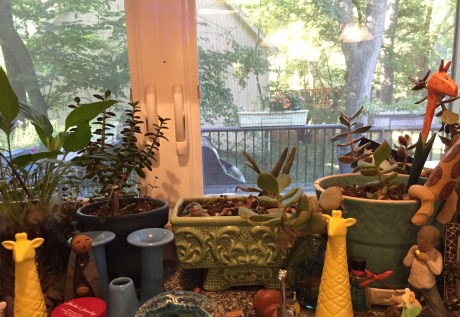
My kitchen window with my grandmother’s planter is the green one in the middle.

Above my grandparents’ kitchen sink in West New York, New Jersey were a variety of flower pots filled with plants.  But often interspersed among the plants were utensils.  Usually forks, but sometimes knives and spoons.
image

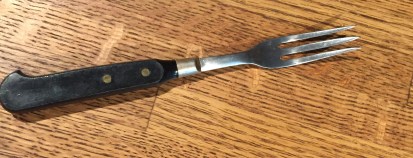
I own one of my Grandparents’ goupls.

When I was very young I remember thinking that my Grandma was special as she could grow metal in her pots. I especially wanted her to grow more of the special forks we called goupls, that we used in her home.  They had really thick and interesting handles. I thought goupl was a special name for this fork. We did not call the other forks, goupls, just these forks.  I found out when I was older that goupl is Yiddish for fork.

Usually standing upright, prongs in the dirt, were two or three forks each day. Amidst the plants the glow of silver.  Why?  My grandparents kept kosher. Meat and dairy is kept separate. My grandparents had utensils for milk meals and another set for meat meals. If they touched when they were wet, they had to be rekashered….made clean to use again.  One way, according to my Grandma,  is to bury it for 24 hours.  Grandma buried it by sticking the unclean item in a flower pot.

In reality, I think this was my grandmother’s interpretation of ne’itzah, a type of koshering for knives when you push them in dirt several times. Grandma just kept any utensil buried and unused.

My mother also kept plants in her kitchen at our hoe in North Bergen. But she did not keep kosher so there were never forks in the flowerpots. However having the plants was important to both my parents.  My Dad was always potting and repotting plants.  Plants freshen the air of your house according to my Dad. So besides helping to keep kosher, plants keep you healthy!

When I married, my husband and I decided to keep a kosher home. When we purchased our house a big draw for me was the window ledge above the sink.  A wonderful place for plants. But to be honest, I very rarely have put a fork or spoon or knife in a flower pot. However, they are there in case I need them.

image

My mother-in-law’s aloe plant.

Besides my kitchen sink plants, I have other plants including an aloe plant that is over 50 years old.  I have had it for 31 years. But before that it was my mother-in-law’s kitchen aloe plant.  I inherited when she passed away at only 59.  Aloe plants are important in the kitchen. My parents also had one.  If you burn yourself, you can quickly go to you aloe plant and break off a piece of a leaf. The thick goo is a healing source for burns.

Plants in my kitchen remind me of my grandparents, parents and in-laws.  Although I might not have forks in my flowerpots, I do have one of my grandmother’s flowerpots on my sink window.  My daughter is getting married in a month.  She has a window above her kitchen sink.  I plan to buy her a plant as a housewarming gift so she too can have flower pots in her kitchen.

The Mysterious Kalsbad Photos: Who Are They?

6 Jun

June 26, 1931. My Grandmother was in Europe with my Mother and my Uncle. She left them at the farm owned by my great grandparents in Poland while she went to Karlsbad (Karlovy Vary), Czechoslovia to take the waters and revive her health.

The doctors in the United States told her that she was going to die. She had been pregnant again in the USA. But doctors terminated the pregnancy through a very illegal abortion in an effort to save her life. But still she was sick. So she decided she would not burden my Grandfather with two young children, 5 and 2. She would take them to Europe to live with his parents and she would die there. He, then, would be free to continue his life.

I once asked my Grandfather, why he let her go. “She was a sick woman,” he told me. “I had to let her do what she thought was best.”

“Would you have left Mom and Uncle Stanley in Europe?” I asked. This was a very important question. His entire family perished. If he had left them, I would not be here.

He looked me in the eye, and said, “As soon as she died I was going to get on a boat and return with my children. I would never leave them there. “

His words made me feel a bit better. But if Grandma had died the world my Mom and Uncle lived in would have been very different. But at least I know my grandfather would not have abandoned them in Poland.

Luckily Grandma did get well. She stayed in Europe for six to eight months and then returned to the USA with my Mom and Uncle. She saw the rise of Hitler coming and now had a new purpose: get the family out. She could not save as many as she wanted. But she tried.

Grandma Thelam, Carlsbad

Grandma is sitting in the front. The date and place were added by my Mom. I think the two women are related. This is the photo we knew about.

We have several items from that trip to Europe. We have a ceramic vase that stays in her breakfront/curio cabinet in our Catskills’ home. We have stories about the trip.  We have a few photos. We knew of one. Grandma is with two other women. We have no ideal who they are. But I think they are related to her, one women sort of looks like her sister-in-law. We are not sure. There is no identifications on the back.

But I recently found another.

FullSizeRender (10)

Grandma is in back row on the left wearing a white hat.

It is a group photo. In the very back row, near the center is a woman in a white hat, that is my grandmother. She is 26 years old.

I do not know the other people. Are they family members who perished? Or are they just other people who are in Karlsbad? Sometimes I imagine that they are just other people at the resort who were pulled together for a group photo that the photographer would then sell to tourists.   Other times I imagine that people in the photo look like family, especially the man in the front on the left. But I honestly do not know.

This photo is different from the others we have from that trip. There is writing in Yiddish and English. The English is easy, her name and the address where she stayed in Karlsbad. Or is it a place she visited?

The Yiddish is more exciting to me. It is the only letter I have seen that she wrote to my Grandfather. (Thank you members of the Tracing the Tribe Facebook Group for translations!)

It says: “As a souvenir from your faithful wife, who hopes, to meet you again in good health.” Another translated it as “A souvenir from your devoted wife, who hopes to return to you in good health.”

Either makes sense. She was sick. She was away from my grandfather. She wanted to be reunited with her family and be healthy.

And that all happened. She returned to the US and lived an additional 50 years. And 80 years later, I keep finding treasures in her photo album!


https://zicharonot.wordpress.com/2014/04/28/speaking-yiddish-always-brings-me-holocaust-memories/

Drinking An Ooglie Mooglie/Gogli Mogli Always Made A Sore Throat Feel Better

11 May

Recently while at lunch with my Kansas Yiddish buddy, we were talking about how some children did not like eggs and the ways their mothers snuck eggs into their diet.

I told how my husband hated eggs so much, his mother would make him chocolate chip pancakes so that he would have eggs without knowing. Not such a harsh way to eat eggs! In fact, I laughed about it. But it was a tradition my husband continued with our children.  Scrambled eggs were not the right Sunday morning breakfast in his mind,  you gave your children pancakes and biscuits to have them eat eggs.

My friend’s mother had a sneakier way to get her to eat eggs. My friend would drink a malted after school each day. Her mother would mix a raw egg into my friend’s malted. She was surprised that her mother would do such a thing. When she found out what her mother was doing from her young uncle, she never trusted those special drinks again.

“It was a good thing I never got salmonella,” my friend said.

But then they did not think about salmonella over 50 years ago….okay I am giving away our ages.  In fact, serving raw eggs was considered a delicacy. Personally, I was not surprised about putting raw eggs in a drink. I asked her, “Well didn’t you ever have an ooglie mooglie?”

“What are you talking about?” She said as she looked at me as if I was crazy.

I could not believe she never had one of this special ‘treats’ when she had a sore throat or cold. Raw egg mixed with sugar and beaten till it was smooth and frothy, an Oogle Moogle or Ooglie Moogli was a treat that I had on occasion from my grandmother.  But never from my own mother.

However, when I lived in Israel during my sophomore year of college, I had many occasions to have an Oogle Moogle from my great aunt and uncle.   Holocaust survivors, they often made this treat for their daughter, who loved them. She would have them all the time if she could.   I remember the first time they made one for me,  I was so sick.  She wanted one as well!   But they only made one for me!  It was delicious.

I told all this to my friend, and to prove I was not crazy, I googled (LOL) oogle moogle. And there on Wikipedia was an entire page devoted to this treat, I show the first paragraph here:

“Kogel mogelGogl-MoglGogel-MogelGogol-Mogol (Russian: Гоголь-моголь), Gogli-Mogli, or Gogle-mogle (Yiddish: גאָגל-מאָגל‎) is an egg-based homemade dessert popular in Central Europe and Caucasus. It is made from egg yolkssugar, and flavorings such as honeyvanillacocoa or rum, similar to eggnog. In its classic form it is served slightly chilled or at room temperature. Served warm or hot, it is considered a home remedy for sore throats. As a home remedy it could be of Russian or Yiddish origin. Variations include milk, honey and soda.[1][2] https://en.wikipedia.org/wiki/Kogel_mogel

There was my proof, except the name was slightly different: Gogli Mogli. Perhaps I had misunderstood what it was called, but probably over time, I just forgot and changed the pronunciation. It did not matter, my friend still had never heard of it.

But since she never liked eggs, I cannot imagine that her mother or any relative would ever offer her a drink made primarily of eggs and sugar. Whereas I can still see my great uncle mixing the drink and stirring it so quickly till it turned to forth. To me the memory of an Ooglie Mooglie or a Gogli Mogli is a wonderful memory, especially when I am suffering with a sore throat. It would make it feel so much better.

Memories of My Grandparents Or Why I Always Read Street Signs

8 May

I can be annoying when driving or sitting in the passenger seat of a car. Why? Because I read all the road signs…out loud…always: street signs, billboards, ads. If it is on the street or the highway, I read it.   And I read quickly. When you learn to read by reading street signs, you learn to recognize letters and words and read before the car passes the sign.

I did, in fact, learn to read, or at least enhance my reading through verbalizing what was written on signs.  Although we had plenty of books in our house, it was street signs that were important. My maternal grandmother started this habit. She read every street sign as my grandfather drove. When I was a child I did not know why, I just knew we had to read all the signs. As a teen, I realized the importance of reading signs when Grandpa was driving.

My maternal grandparents came to the US from Europe in the early 1920s. Although my grandmother went to night school and learned to read and write English, my grandfather never did. He was great in Yiddish, Hebrew and Polish. But English, he never really learned. So it was Grandma who read the papers, kept the books and read the street signs for him.

Grandpa did drive the car. I guess driver’s licenses were easier to get back then. No written tests I assume, because Grandpa could not read or write English well. He could read slowly and write his name. But overall not well enough to read the street signs. To make finding their destination easier, in the times of no GPS telling you what to do, my grandmother would always read the street signs to let him know exactly where we were: Stop, Yield, Merge were easy. I know he learned to recognize those signs over time.

But my Grandma did not stop there, she read all those street signs as to where you were and special billboards as we drove along. If there was a sign, she read it. Eventually, we just read along starting at a unusually early age. I think at times there was a race to see who could read the signs first, as my sister and my brother and my Mother also read the street signs.

My Grandpa needed it. My Dad never said anything about it. Perhaps he thought it was cute when we were children. In reality, it is a habit I cannot stop. I still do it. I read when I am driving, or when someone else is driving.   Lately the ones that really get my reading mind in gear are in Missouri. They have all these electronic billboards that say things like, “Buckle up, MODOT cares.” I read all of them out loud. I cannot read them silently. Part of reading a street sign is to read for everyone to hear. At one point while we were driving to St. Louis, my husband piped up and said, “Don’t get into an accident reading all those MODOT signs.”

My husband probably had no idea why I always read the signs. But he puts up with it and has not said anything about it in years. At one point early in our relationship, he did say something about being able to read for himself. But that stopped when our children were little. I think he thought I was reading for them. But I was not.   I was just continuing a childhood habit.

To be honest, I usually do not read the signs around our home and neighborhood. Those are not necessary to read. However, as soon as I get on a highway and, especially, if I am in a new place, I start reading those signs.  Last year we had a road trip to Minneapolis. It was a road sign Bonanza, especially after my GPS stopped working. (We accidentally popped out the little disk.)

I have a few friends who I know find it annoying when they are driving with me. I think they think I do it when I have nothing else to say, just to hear my own voice. But that is not the reason. Reading signs is second nature. I remember long car rides to the Catskills with my grandparents. I hear my Grandma’s voice as we drive along. And I know we will be safe. We know where we are going.

The Necklace I Never Wear

2 Apr

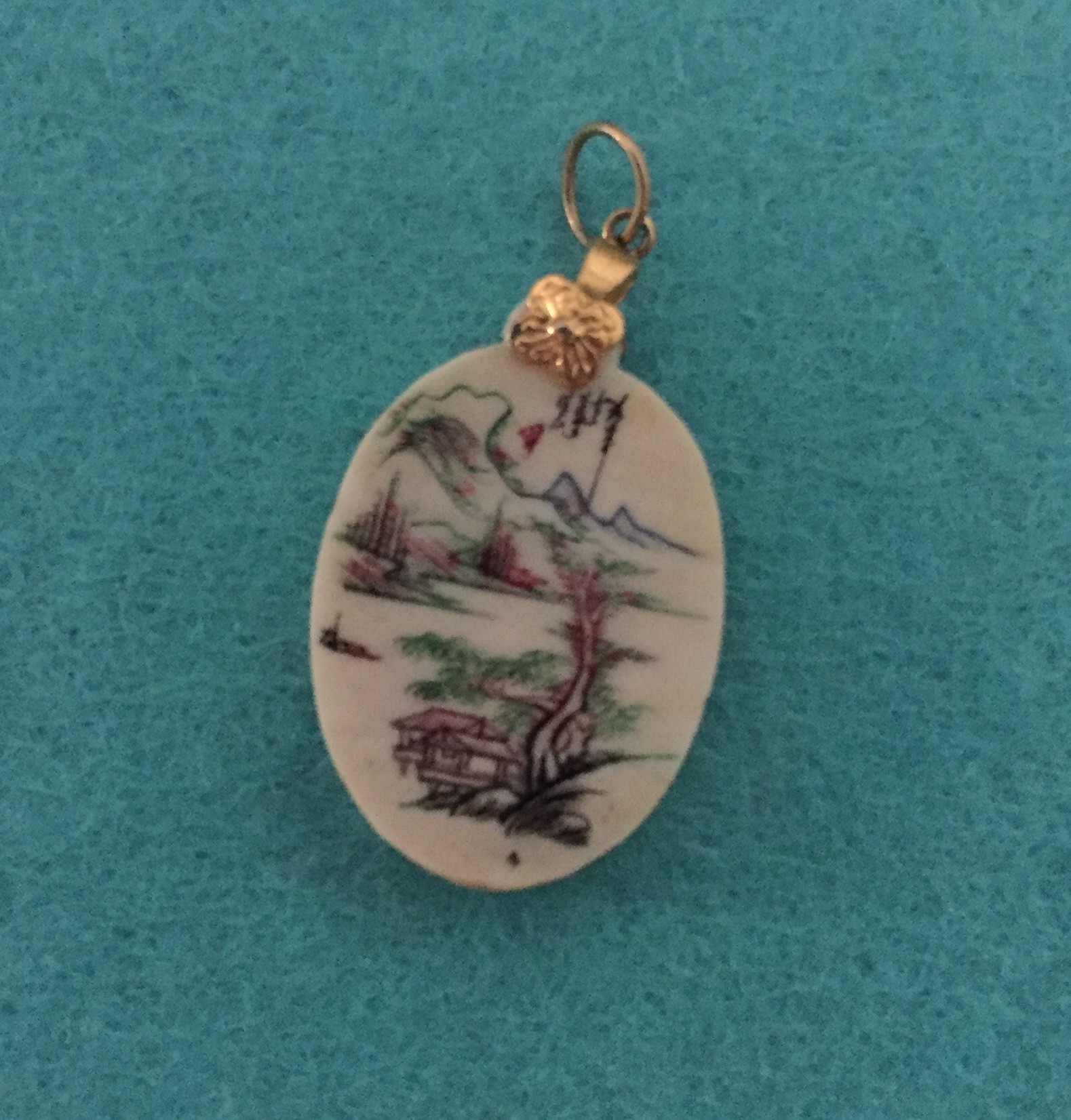
In a box in my closet is a small scrimshaw necklace that I never wear. I will never give it away. I will never sell it. I hope one day one of my children will take it.

The necklace I purchased with the money from Zeisel.

The necklace I purchased with the money from Zeisel.

It is not that old. I bought it when I was 20, when I spent my sophomore year of college in Israel, 1974 to 1975.

Many holocaust survivors were still alive. Some of them related to me through my maternal grandparents who were both from Europe. My grandparents came to the USA in the 1920s. But most of their family remained behind. Many perished, others survived and moved to Israel.

My grandmother went to Europe in 1931 with my Mom and uncle. I have written about this before. She stayed on the farm owned by her in-laws. While she was there her mother-in-law, my great grandmother Chava, gave her some family items. Two pieces of jewelry, a pearl necklace and an opal ring; and several embroidered and handmade pieces that Chava had made.   I own all but the pearl necklace. They were all given to me as the one named for Chava.

The pearl necklace disappeared in 1931. My grandmother went to use the shower at her inlaws. She took off the necklace to bathe and forgot to put it back on. When she realized it was gone, she went back to the bathroom. It was missing.

But she knew who took it. Zeisel. He was the only one who had been in the bathroom. But he denied taking it. And that was the end of the matter for 43 years, until I went to Israel for a year of college.

A month after I arrived in Israel, I received a letter from my grandmother telling me the story of the pearls. I had never heard it before. In the letter she wrote that the ‘goniff,’ Zeisel Feuer, my grandfather’s cousin, was going to give me some money to pay her back for the necklace he stole in 1931. I was to take the money and give my great uncle, her brother, half the money. The other half was to buy myself a necklace because I should have the pearls.

What? Was my grandmother insane?   I did not really want to do this.

I wrote her back saying that I thought 43 years meant the statute of limitations on a theft were over. And that she needed to let it go. And I did not need to have the necklace. But a few weeks later I received another letter instructing me how to find Zeisel in Tel Aviv. He worked at bakery on a specific street and I was to go there and speak to him. She said I had no choice. I had to do this. It was important to both of them to end this. And I would be the one to fix it. What?

Grandma ordered, so I obeyed. The next time I was in Tel Aviv, I went to the bakery. There was a man who looked so much like my grandfather, except smaller and bent. I knew it had to Zeisel. I introduced my self. He held for minute and had me sit at a table. He brought tea and a pastry. I waited while he finished working. Then we walked back to his apartment.

There he gave me Israeli lire, which in US would be worth about $100. And he told this story.

He was married with two children. He had a wonderful life. But he wanted more for his family. So when my grandmother left the pearls in the bathroom, he thought, “She lives in America. She is rich and has money. She does not need this necklace.” And he took it. And he lied.

In return the Nazis came. They killed his wife. They killed his children. They tortured him. He could no longer have any children.

And he knew that taking the necklace had brought all this pain to him and his family. And before he died he had to make amends. So he gave me the money. I was to do with the money whatever my grandmother said.  He had made peace.

I was stunned. I was 19. I did not know what to say but to cry.   When I left him, I took the money back to my dorm in Jerusalem at Hebrew University. A few weeks later I took half the money to my Uncle Isaac. The other money I kept in my room.

Each time I went to Tel Aviv after that, I always went to the bakery to see Zeisel. He always gave me tea and a pastry.   There were not many phones in Israel at the time. So I could not call in advance. I would just show up, or send him a letter telling him when I thought I would come. When my parents came to Israel that December of 1974, I took them to meet Zeisel and speak to him. It was a meeting my parents never forget as well.

In January I turned 20. I finally spent the $50 on a necklace for me. A necklace that carried so much pain. I could not wear it even though I knew my grandmother wanted me to have this jewelry from my great grandmother. So I keep it in a box in my closet. I know it is there. I know it is safe. It will not be lost. But I cannot wear it. When I see it, I always think of Zeisel and how much he lost.

It was not the pearl necklace that doomed his family. It was the rise of hatred. But he did steal it.  So for him giving me the money was closure. He had repented; he had done his “tashuvah.”  But for me it was the beginning of truly understanding the past.

I have written about the Zeisel and the pearl necklace before. It is a story that stays in my heart and my soul. But I have never talk about what I bought with the money. In my mind it is just not enough. It does not make up for the suffering surrounding one pearl necklace.  Zeisel was also the person who let my grandfather know that his entire family had perished in the Shoah.  He is forever bound in our family history.

Zeisel, my grandparents and my parents have all passed away. I am the only one who can remember this story. And so I tell it again.


https://zicharonot.wordpress.com/2014/08/22/i-believe-mystically-and-magically-great-grandma-chava-watches-over-me/


Joyous Occasions in Discovered In Yiddish

14 Mar
IMG_6556

My Uncle Bernie and part of the article about his bar mitzvah.


Besides articles about my Great Grandfather Louis Goldman/Baruch Lev Litwack, there were also announcements of family events in the Bialystoker Stimme magazines under the title “Simcha by Landslight,”   or “Joyous Events by our community members.”   I found three events in Yiddish about my extended family members, which my friend, Blumah, translated for me as well.

The first was about my Uncle Bernie, or Bernard, about his bar mitzvah:

“A nice bar mitzvah party took place on Shabbat. The 11 of June by Mr. Bernard.  A nice, accomplished young man, the son Mr. and Mrs. H Rosenberg and the grandson of our dear friends and active community members Louis and Ray Goldman from the Bronx.

A nice private group of close family celebrated by the simcha. They wished much nachas to the parents from this bar mitzvah boy.

As is well known, Mr. and Mrs. Louis Goldman, the grandfather and grandmother, are actively in the Bialystoker Center and the Ladies Auxiliary.

Mr. Goldman is now the president of the Bialystoke charity organization that was the Bialystoke Free loan society: Bialystoke Somech Noflim, (It was started in 1886 in the USA.) This is he oldest charity association that the Bialystoke started.

We wish the zayde and bubie, and the parents to live to have much nachas and much joy from Bernard and the other children.”

I loved that even in an announcement of my uncle’s bar mitzvah, it was important to the writer to list my great grandfather and great grandmother’s accomplishments in the Bialystoke societies.   I am thinking it is to give them even more ‘kovod,’ honor. Or perhaps it is to encourage others to volunteer?

In later years, when the Bialystoker Stimme had more English, there is another Bar Mitzvah announcement for my father. But it is much shorter and written in English.

One of my father’s cousin’s is also mentioned in “Joyous Occasions.” My Dad’s first cousin David M. made the Yiddish paper, in a shorter and less flowery article.

“The Goldman’s talented grandson, David M., graduates with honors. The 16 year old grandson of our active members, Mr. and Mrs. Louis Goldman, of the Bronx. He just graduated from Townsend Harris High School. He was immediately accepted in City College. We wish the parents Mr. and Mrs. Eli Marks and the grandparents of David much nachas from their very capable David.”

The final “Joyous Occasion” in Yiddish was my great Uncle Sam’s wedding announcement, for his first marriage. I never knew the woman mentioned in this announcement. But I do know that they had one daughter. I honestly only remember meeting her when I was a young child. I think the family lost touch with her.

“Sunday Dec. 11, our friends, Mr. and Mrs. Louis Goldman brought their youngest child to the Huppah: Samuel with the beautiful, intelligent Miss Otta Schmuckler. The wedding was private, and the supper was afterwards celebrated in Central Plaza, where many friends from both sides were part of the joyous occasion.

We wish Mr. and Mrs. Louis Goldman and the young couple much nachas.”

The only thing I can say about this announcement is that I always thought his first wife’s name was Yetta. And that might have been the name she used in English.

Every one of these little Yiddish articles is like a jewel for me. I find out tiny bits about my family’s life in the 1920 – 1940s. I see pieces of my Dad’s childhood. He probably was at all these simchas: his brother’s bar mitzvah, his cousin’s graduation party, his uncle’s wedding. We do have a few photos from this time. But I have never seen the photos of my uncle and my Dad’s cousin that shown in these articles.

The Bialystoker Stimme continues to be a treasure for me and I hope for my family.


https://zicharonot.wordpress.com/2016/03/08/louis-of-the-blessed-heart/


Temple Beth El Has Closed, But It is Not Gone

15 Jan

I was sad when I learned through a North Bergen Facebook group that after 91 years, Temple Beth El on 75th Street in North Bergen was closing. This synagogue was where I spent most of my childhood, from third grade until I married. Right across the street from Robert Fulton Elementary School, Temple Beth El is where I spent four days each week in Hebrew School after I finished my secular classes.

I remember going to synagogue for holidays and Shabbat. I loved going when I was young because my great Uncle Leo and Tanta Esther belonged to Beth El. And Uncle Leo always had candy in his pocket. When we came to services he would slip us some candy. Uncle Leo was a very quiet man with a German accent. But when he put his hand in his suit jacket and brought out a sweet, a gentle smile would come over his face as he said, “here.” And handed over the candy.

When my brother and I would go by ourselves as we prepared for our confirmation classes, Uncle Leo was still there. And even though we were in our early teens, we made sure to sit next to him to get our candy!

I remember Cantor Ovstbaum and Rabbi Sidney Nissenbaum. The Cantor  wrote a Purim Spiel play using the melodies from the opera, “Carmen.” I can still sing some of the lyrics to these songs: “My name it is Vashti,” “Ahasverus, I the Glorious,” “Haman’s Seven Sons are We,” and more. I remember Ella P. who was Queen Esther. And my friends who all got singing parts like Shashi. I was not allowed to sing. But I still loved and remember those songs!

Walking to services with my Dad was fun. I especially enjoyed going to services for Succot, when they built the Succah in the small parking lot across the street from the synagogue.   I have so many good memories of the shul, the people, and my many friends who went there with me.

So when I read it was closing, I felt the pangs and sadness of the end to an era. It was a closure that completed with the deaths of my parents, another part of my childhood forever gone.

But then I had a revelation! I got a letter in the mail, which changed my feelings.

When my parents moved from North Bergen to Cliffside Park, they joined Temple Israel on Edgewater Road. My parents became extremely active in this congregation. My Dad served as president for 11 years! It was Rabbi Engelmeyer and the Cantor Peter and the congregants who were so kind to my parents as they aged and helped my Dad so much after my Mom died.   I loved the people of Temple Israel.

At Temple Israel in 2006. My Dad is with a scribe as they work on repairing older Torah scrolls.

At Temple Israel in 2006. My Dad is with a scribe as they work on repairing older Torah scrolls.

Although I never belonged there, I went to many services there with my parents and always heard so much about it whenever I spoke to my parents. It was at Temple Israel where we had a memorial service for my Mom. It was at Temple Israel that we endowed a library for my parents. It was at Temple Israel that we put up memorial plaques for my parents.

These two congregations were important to me even though I now live in Kansas. I still send donations several times a year in honor of my parents’ and other relatives’ yahrzeits.

So my revelation?   Temple Beth El was not closing. NO! It was merging with Temple Israel.   The new name is Congregation Beth Israel of the Palisades!

My Dad would be so happy. Throughout his years as president and board member, he was always searching for ways to keep the congregation alive and financially sound. With the combining of these congregations, perhaps they both will survive.

And in my mind, my Dad had a celestial part in the merging of these congregations. With Congregation Beth Israel of the Palisades the memory of my parents and my childhood continues.   Perhaps Uncle Leo never went to services in this sanctuary. But my parents and my siblings and my cousins and my parents friends all have sat there. I can close my eyes and see so many loved ones who are no longer with us.

Temple Beth El is not gone, even though many of the Jewish population have left North Bergen. It is still close by in another form. It has changed with time, as we all do. But it lives in my mind.

Finding The Nina’s Starts A Perfect New York City Day

3 Jan
image

My Al Hirschfeld Collection, including the article that appeared in the NY Times a few days after his death.

Like many who grew up in the New Jersey/New York City area in the 50s, 60s and 70s, my Sunday morning routine included one important item, I had to open the New York Times and find the Nina’s in the newest Al Hirschfeld drawing!

My Dad started me on the search for Nina’s one morning in North Bergen.  I am sure he just wanted me to let hime read the paper.  Little did he know what would happen to me. I became obsessed.   I loved looking at the newest entertainment stars Hirschfeld had rendered in ink. They often were stars of Broadway musicals, another passion I developed. I especially loved when he did a complicated drawing that had more than one Nina! Heaven!

Thus it is not surprising that over the years, I purchased books of Hirschfeld’s drawings so that I could look for Nina’s even when I was not getting the “New York Times.” Especially when he passed away at age 99 and his long run of drawings for the paper and the world ended. I was saddened when he passed away close to my birthday in January of 2003.

I even saved the article that appeared in the New York Times on January 26, 2003, six days after his death. He was that important to me.

When I was older and moved to the Midwest, I was glad he was born in St. Louis, the same city where my husband was born.  Another connection!

There is something about his drawings that are so free and moving. He captured the essence of each person with such simple lines; it is deceiving. And so many of his drawings are just joyful.

I have been to the Al Hirschfeld Theater in NYC, (last time to see Kinky Boots) where a permanent display of replicas his works adorn the second floor walls. I made my daughter look at each drawing with me to find the Nina’s. A tradition she had to share!

This past summer, in July 2015, when I visited my family, I enticed my sister to go with me to the New York Historical Society to see the exhibition: “The Hirschfeld Century: The Art of Al Hirschfeld.”

To be honest, it did not take too much enticing the get my sister to leave New Jersey with me to see the exhibition. She knew how much I loved his drawings. In fact she and her husband purchased the book, Hirschfeld on Hirschfeld for me as a gift many years ago!

And, of course, she also grew up looking for the Nina’s. We might have had one or two arguments over his drawings through the years. Who would find the Nina’s first was a big deal!

The exhibit was wonderful. My sister and I went from drawing to drawing, checking the number by his name to see how many Nina’s we needed to find. And then the search was on.   We looked at every sketch, drawing and film.  It was delightful.

I wanted to take a photo at the art table that was set up. But the guard would not let me. Sigh.   I could almost imagine myself as Hirschfeld, but no such luck. I am not a good artist. But I was disappointed not to have the photo at the replica of his desk.

The gift shop lured us in. Luckily they would ship my purchases home! A book, a mug, a t-shirt and some gift cards went to the Midwest. My sister’s purchases spent the rest of the day in Manhattan with us, even attending a show with our Aunt and cousin.

It was a glorious New York City type of day: subway ride, taxi, show, lunch, ice tea at Bryant Park, dinner at the Bryant Park Grill in the City, hanging out with family, and Finding the Nina’s!

Kauneonga Lake Was A Peaceful Winter Wonderland

13 Dec

Unlike many bungalow colony owners, my grandparents eventually moved up to the Catskills to live full time in the 1960s. For a while they kept a small apartment in the building they owned in West New York, NJ, which was above their original bakery. But eventually they sold that building and no longer traveled back to the “city” in the winters.

Their home in Kauneonga Lake was a ‘winter’ home, and not a small bungalow. It was warm and cozy. They would close off the parts of the house they did not use in the winter. It was a bit scary at first when the furnace turned on as we could actually see the flames through an open grill in the floor. After a few years they replaced this antique system and the house was warmer. There was also a beautiful stone fireplace that helped to keep the house warm.

With my mother’s parents in the Catskills, for my family that meant we would have to travel up to the Catskills in the winter time and visit my grandparents. Usually we went when there was a long weekend, or a holiday. We knew that there would be snow and cold. The snow was sometimes several feet deep. We would be spending most of our time indoors playing cards, board games, watching television and talking.

When we did go outside we would bundle up with every scarf and hat we could find. I would double glove my hands for warmth! BRRRR! We often would sled down the hill in the front lawn and sometimes we would walk into town.

The walks to town were special in the winter. We would walk to the lake and then ACROSS the lake into town. The lake was so frozen that people would actually drive their cars across it in the winter months.

I loved walking on the lake.   It was exciting to step out on to what was usually water and sort of skim my feet across the top. Others would ice skate. Some people fished in the lake and cut holes into the ice to reach the moving water where the fish survived the harsh winters.

In later years, my parents kept cross-country skis up at the house for those days when traveling by car was impossible. They would just stay home and ski in the yard and around the area just for the fun and exercise. My memories do not include skiing, although I think my younger sister did some cross country skiing when she visited. ( My sister reminded me that they also had snow shoes, and our mother enjoyed using them in the winter.)

During my freshman year of college, my parents drove up during winter break for an overnight with my grandparents, and left me up there with them. My grandmother was lonely and needed company. That was my job. Keep Grandma entertained for a week or so.

It snowed and snowed and snowed. And even though my grandfather had someone who usually plowed the long driveway, we still had to dig out. I remember that we could not get plowed for several days. So Grandpa decided we would make a one-car lane through the snow.  Did I tell you it was a very long driveway!

We would go out and shovel for 30 or 40 minutes and then go in for something warm to drink or a cup of soup. My grandma was not a great cook, but she made excellent soup. And on a cold day it was beyond delicious.

That year, for the first time in my life, my face broke out in acne. I think it was the stress of being a college student and living away from home for the first time. My grandmother had a solution. In Poland, where she spent her childhood, there were no fancy medicines, there was just natural solutions to acne. And she wanted to try them all on me.

Every time I went outside she would yell out, “Put some snow on your face. It will help.” And every time I walked back in, she would ask if I had put some snow on my face, which I did. But she was making me a bit upset.

My grandfather finally told her to leave me alone. When that did not work, he took action. When we came in after shoveling for a while, he walked in after me. And when Grandma said, “Did you put snow on your face?” He walked right up to her, and rubbed snow all over her face. She laughed hysterically. And he said, “How do you like to have snow on your face! Enough with the snow!“ That was it. She did not bug about snow again.  (I will be honest, the snow did dry out the acne, and helped to clear it up.  But it was so COLD.)

When the weather was nice, we would visit with the few others who braved the winters. My grandparents had several good friends up there, although most went to Florida for the winters. The people who stayed up throughout the year watched out for each other. There was always someone calling to make sure they were okay or if they needed food.

Winters in Kauneonga Lake were so peaceful. I loved the quiet time to read. I loved visiting with my grandparents and hearing their stories. I even loved when my parents and siblings were there as well and we had major snow ball fights outside. Those were not so peaceful. But to see the giant pine trees covered in snow; to see the lake frozen; and to see people helping each other gave me wonderful memories.

My Grandma’s Ledger Books Remind Me of Her Financial Lessons

7 Dec

image

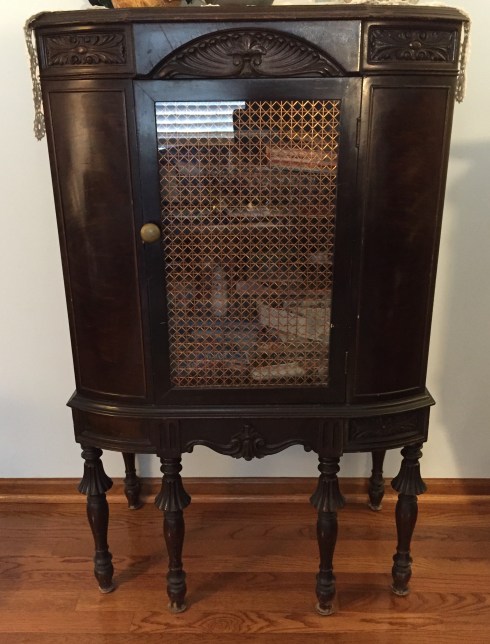
In 1985, when I moved into my house, my mother sent me some of my grandparents’ furniture that had been promised to me. Included in the furniture was an old radio cabinet that had been turned in to a shelved cabinet with the radio removed. Inside the cabinet were some of my grandmother’s ledger books and other items. My Mom had not cleaned it out. She sent it to me filled with the stuff she did not want to deal with by herself.

Thirty years later, I still have the radio cabinet and the ledger books. And at times I look into the books to realize how far my grandparents came in their journey as immigrants. How their strength became part of our lives.

My grandmother came to America by herself from Poland when she was 16 years old. She met my grandfather and married him when she was 19, about 1925.  She went to night school and learned English. They opened a bakery and became successful in business. They also owned a small bungalow colony in the Catskills. They were able to bring some family members over before the Holocaust and they donated to many charities. During the Depression they allowed families to buy food on credit, knowing that they would not be getting anything from many of these families.

My grandfather left Europe when he was 18. His journey to America took two years. He married my grandmother when he was 25. And he had a bakery and owned property.

My grandparents are the American success story. As immigrants who came to the United States with nothing in the early 1920s, they built a good life. The ledgers I found in the old radio cabinet show their desire to save and make their lives and the lives of their children and grandchildren better. The ledgers go from 1959 to 1968 and show every purchase of stock and every bank deposit and interest. It shows how their portfolio grew during these years.

I still remember spending time with my grandmother on what I called her ‘bank tour.’ Grandma Thelma did not totally trust banks. She had lived through the Great Depression. So she kept her money in a variety of banks. And at the end of each month she would take her bank deposit books to each bank to get the interest amount stamped into the book. It was an all day event, with a break for lunch. I remember her showing me my book and letting me see how much I had. She would tell me that you start with a little bit, and it keeps on growing.

Grandma was a true believer in saving your pennies. In fact she saved every silver coin that came into their bakery. When she passed away, we found silver dollars, silver half dollars, silver quarters and silver dimes hidden in every purse and pocketbook and coat pocket in her home. Those were worth more as they aged. More than they would have been worth in a bank. She also had several ‘pushka,’ little hoards of cash hidden around the house.  You never knew when you needed a bit of cash.

image

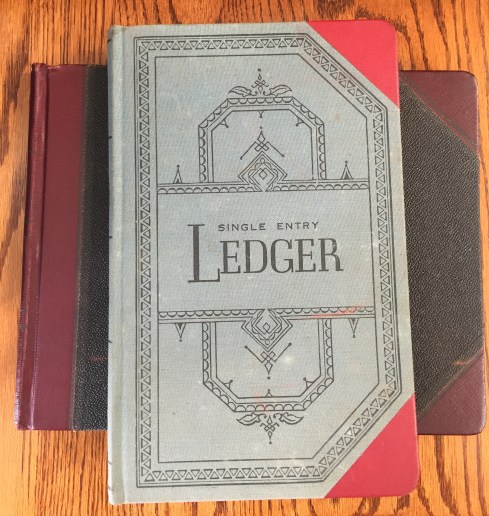
The ledger books were her way to keep track of every cent they had. She often bought 20, 25 or 50 shares of a stock. She kept records as she bought more or sold a stock that she no longer liked. She wrote down how much each stock was worth when a statement came. There were no computers then, so she kept all her information written in a ledger book.

My grandmother loved to play the stock market. And these ledger books show exactly what she bought, when she bought it and when she sold it for how much. Even the serial numbers of the stock certificates are written in the books.

I love looking at her handwriting. It was excellent when she was young. Every page was organized. And when she sold a stock she would cross it out and write sold across the entry. I can see her analyzing every purchase and sale. Grandma was a force to be reckoned with. I would have hated to be her stock broker!

For example in 1957 she had 25 shares of Con Edison that she purchased for $1123.23.   She sold two shares in 1960 for $156.27 and two shares in 1961 for $100. I am assuming she needed to buy something then, and needed the cash. I cannot understand any other reason to sell just a few shares. But then she sold the rest of her 21 shares in December 1964 for $2019.95. She made money. Altogether she doubled her money! On November 30, 1966, she bought 25 shares again for $857.19. I wonder if she made more. I don’t know if she sold this, or it stayed in my grandparents’ estate. The entries end in 1968. I wonder if she had a new way of keeping track?

I love that she owned 50 shares of the Atchison, Topeka and Santa Fe Railroad, as I live in Kansas. She bought it in January of 1968 for $1469.50. Who knew? She bought many different stocks and bonds. Grandma believed in a diversified portfolio. That is apparent.

Grandma ran the business. And she was smart. Grandpa ran the bakery. He never really learned to read English. So he relied on Grandma to take care of the finances. And she did. She loved to discuss the stock market with certain select people. I think they liked speaking with her as well because she was so knowledgeable.

From my grandmother I learned to be aware of my financial situation. I learned how important it was to save money and invest wisely! I learned that it was correct and smart for any woman to know exactly what the family financial situation was and where all the investments are located. In fact, I learned it was a woman’s right to know.

This has been a guiding force in my life to be honest. As I see other women in situations that are so stressful. Some times due to divorce, sometimes due to the death of a spouse, I have seen women who have no idea where their investments are and how much they really have to support them. My grandmother would have been horrified.

The ledger books filled with my grandmother’s writing and investments are a reminder of my grandparents’ success and their investment in all of our futures.   They were able to leave a financial inheritance to both of their children and a little something to each grandchild. But most of all I am thankful for the lessons on savings, investing and knowledge that my grandmother taught to me.