An Unexpected Email Reveals Family Shoah History

30 Oct

In the last week I have been in contact with Izabela S., who lives in Tarnow, Poland, which is close to both Mielec and Trzciana, where my family lived and where they were murdered in the Shoah.   Izabela has been working for the past three years to clean up the Jewish Cemetery and get information about the places where the Jewish residents were murdered and put up plaques to commemorate them in the Mielic area.  She also writes a blog and has a Facebook page to write and remember the Jewish residents who were murdered in the Shoah.  Before the war, of the 10,000 residents in Mielec, 5,000 were Jewish.  After the war, maybe 200 survived!

(See video about Izabela below.)

My quest to find my grandfather’s family started in the late 1970s after I spent time in Israel and met those who survived.  My grandpa lost his entire family in the Shoah, except for a few cousins, and except for his mother, he never knew how his father and siblings died.  I told him that I would find out. It has taken almost 50 years, but I never gave up! Over the years I have written many blogs about them. (Some are linked below.). But I could not find out about three of his siblings.  Now I know more.

But then there is the question?  When you find these things out, do you really want to know?  And are some ways of dying better than other ways.  In the towns my family came from people were burned alive in the synagogue and mikve, starved to death or died of disease in the Lodz Ghetto, gassed at Belzec, shot at a mass grave.  Which is worse? 

I guess I decided that being shot is the kindest way to die among those options.  A distant cousin of mine (Her great grandfather and my grandfather were second cousins, l believe), thought her great great grandparents were burned alive in the synagogue.  She now knows, thanks to Izabela, that they were shot. And in a weird way it is better.  I think.

My family came from the small town of Trzciana. Before the war there were about 1000 people.  The town was known for its windmills.  I can imagine that it was lovely.   Izabela wrote about it this way:

“Jewish families lived in Trzciana: the Amsterdams, the Hollanders, the Brenners, and the Feuers. They were closely related to each other. In  Next is the night: The fate of Jews in selected counties of occupied Poland, vol. II Tomasz Frydel writes that every Sabbath, members of the Amsterdam family from the village of Trzciana went to the synagogue in Czermin, where more Jews lived among the German colonists. This family was widely respected, its members gave grants to the Roman Catholic parish and distributed potatoes and beets to local peasants.”  This was my family.

I knew already how my great grandmother, Chava, died. (See blog below.)  But I now know my grandfather was not killed in Belzec with his son, Shimon.  Instead he was murdered on March 9, 1942 with many others of his family during a round up/deportation and slaughter of Jews.  He was shot in Cieszanow.    I now know that their daughter, Tova, was also in that roundup. But was not killed then. So probably died in one of the camps. I know Jews from Meilec went to four camps, Belzec, Sobibor, Treblinka and Majdanek. 

I now know that outside of the town there is a mass grave of 800 Jews.  Many of them my relatives. I know about one for a fact.  Natan Feuer ran.  He was able to get about 50 yards when the Nazis shot him and dragged him back to the pit where they threw him in still alive. And he perished. But Natan story really hits home as my grandfather’s brother was named Nueter/Natan. So is this him? I will never know.

I believe that my grandfather’s cousin, Morris Brenner, who owned a candy store in Linden, NJ, and whom I wrote about before, (See blog below.), had two sisters and a nephew who are buried in the Jewish cemetery on Traugutta Street: Cerla Kleinman nee Brenner, her son David, and sister, Sara Brenner.  His mother, Gital, died in 1941, before the mass murder of the Jews.  I have to admit that gives me a bit of joy. It is nice that someone died a natural death and wasn’t murdered because she was Jewish.

I had heard of the brothers Tuvia, Zus, and Asael Bielski, from the book and the movie Defiance.   I now know that there was also the Amsterdam Brothers, Johanan and Abraham,  who led a group in the forest near Bulcza Mielka called The Amsterdam Group.  According to Izabela, it was a large group of Jews who hid and the core of this group were families from Trzciana.   There were 84 Jews in Trzciana before the war, all related to me.  The two brothers, who had been in the Polish Army before the war, commanded the group.   They built a series shelters and hideouts where they survived the winter of 1943.  They hid in  bunkers and acquired weapons from the peasants as well as gaining them in battles with the police and Germans.  They divided into small groups to keep more people safe.

A survivor named Ryvka Schenker wrote about the conditions in the hidden camp:

“It was very cold back then, the snow fell, You had to be very careful – every step was known. How they went out to the country Shopping, they made their feet like the birds they have. It was made of wood, They made the same traces as birds walked. No one could have Imagine there are people in the middle of the forest. We sat all day very long calmly, one read a lot, others wrote diaries, some embolden images, Everyone made it through that day. We always lived the hope that It will be after the war soon, but it was just a dream.   There were severe frosts, nobody had The right clothes, let’s get out of the field little. The men were more Resilient. We had a lot of water because it froze.”

I am Amazed!  And feel proud that my family tried to survive in every way that they could.

There is so much information it will take me a while to unravel all of the connections and organize in my mind so that I can write about this family that was almost wiped out. My family.  But I felt it was important to write this down when the emotion of discovery was still strong. Baruch Dayan HaEmet.  May their memories live through these remembrance and that we never forget those who have been murdered by hate and evil.

Video of Izabela S.and her work.

About Morris Brenner

https://www.facebook.com/groups/1318997264939643/

Charleston, A Lovely City, But the History of Slavery Cannot Be Ignored

14 Oct

Every Year on the Fourth of July, we watch the movie version of the play 1776.  We love the music; we love the acting; we love the retelling of the founding of our country.  But for me the scene that always hurts my soul is when Edward Rutledge sings “Molasses to Rum to Slaves.’  That moment in the movie is so strong and so emotional.  When John Adams says, “For God’s Sake Mr. Rutledge,” I can feel the pain.

When we were in Charleston, South Carolina, we knew that part of our visit there was to learn more about the slave trade: to see where it happened.  We visited St. Philip’s Church and walked through the historic cemetery where some of those involved in the American Revolution are buried, including the infamous Edward Rutledge.  We saw the area where the slave market was held and walked down the cobblestone streets.  The historic district of Charleston is unique and extremely interesting.

I learned interesting information about the history of slavery while in Charleston.  This new- found information started with our visit to the Magnolia Plantation, which is just outside Charleston.  I never knew that Carolina Gold referred to golden rice.  Actually, I never knew that rice was grown in the south.  I always just think of tobacco and cotton.  My eyes have been opened.  What I learned created a burn in my heart.

While at the Magnolia Plantation where saw the area where the slaves lived. Four families to a building. There are only a few rebuilt slave buildings now.  Most were destroyed in previous hurricanes. At one time there were 11 or more ‘homes’.  Almost 250 slaves lived on the Magnolia Plantation.  Their main job was growing and harvesting rice.

We saw where the rice paddies once were located. Some of them still have water. It is from the tides that wash over the banks of the Ashley River and fill up areas that have been dug out down three feet and contained by low levees, so the water doesn’t all recede. A perfect spot for growing rice and also good homes for alligators and water moccasins. Two creatures that are adept at killing humans.

We found out that once a child was tall enough, he or she went into the rice paddies to work.  The average length of time that someone survived the rice paddies was six to eight years!!!  Someone who was 20 years old and still alive after being exposed to deadly snakes, alligators and disease, was considered old.  That was something I did not know. And that makes me a bit sick to my stomach.  How could they use children this way? Really disgusting!  No one there are people who are adamant to keeping the real story out of our schools.

Going the next day to the International African American Museum cleared up a puzzle for me.  How did these slaves know how to grow rice?  It seems when the white men came to Africa to purchase captured slaves, they were going with a list of who they wanted. And what they wanted were farmers who knew how to grow rice and indigo.  They were enslaving people who had the knowledge that would make the plantation owners rich, while the slaves would not only be enslaved but most likely die young.  It seems so unreal.  But it is true. I always knew the slave owners became rich due to slavery, but I never knew the stave traders went to Africa with a shopping list of which Africans they wanted to enslave.  A definite eye-opening experience.

We enjoyed learning at the museum.  The first section discusses the African American community in South Carolina and how the Middle Passage from African often ended up in Charleston, which was the most active port in the slave trade. Many people died on the way over and those who survived that horrible journey had more horrors ahead.

I also learned more about the Low Country Gullah Geechee population and their unique culture, which is so interesting.   The descendants of slaves, the Gullah Geechee people were able to hold on to their African heritage because they were isolated on island and costal plantations.

The second section of the museum was filled with facts and information decade by decade of the African American experience.  To be honest, this is not a museum to take young children, there is just too much reading and too much standing.  I wish they had some benches along the winding hallways to take a break both physically and mentally. There is so much to absorb.  It was difficult for me.  And after a bit I was exhausted from the stories, the reading and the standing.

A few years ago, we visited the Charles H. Wright Museum of African American History in Detroit, Michigan. The permanent exhibit, “And Still We Rise,” was so immersive and left a permanent mark in my memory about how horrible the Middle Passage was for the enslaved and captured Africans.  It does a much better job, visually, explaining the slave trade and having the visitors feel the impact, while its special exhibits focus on more cultural experiences. 

The museum in South Carolina, however, does a much better job about explaining and detailing the history of the African American community over the centuries by highlighting important events, dates and people.  But trying to see it all in one day is too much. 

There were two little exhibits that stuck out to me as I walked through this museum.  They had a display of the Green Book that told African Americans where they could stay as they traveled around the USA.  I turned to pages to Kansas, where I currently live, to see where people could spend the night.  There are not many places, which is disturbing. But in a way, being Jewish, I understand this pain, as Jewish people were also discriminated against and not allowed to stay in many places.

I did enjoyed seeing two of David Drake’s pottery pieces.  I had seen his work several times on the Antique Roadshow, so was excited to see them in person.  We saw another one at the Gibbes Museum in downtown Charleston.  It was interesting to note the fact that he could write and sign his name was a quiet protest against slavery since slaves were not allowed to learn to read or write. This knowledge could have cost him his life.

Charleston was a lovely city to visit.  There is so many places to immerse yourself into the history of our country.  But while learning about things we can be proud of, we cannot forget the darkest, bitter moments of our country’s past due to its support of slavery.

https://en.wikipedia.org/wiki/St._Philip%27s_Church_(Charleston,_South_Carolina)

https://www.thewright.org/

https://en.wikipedia.org/wiki/David_Drake_(potter)

https://www.magnoliaplantation.com/

https://www.gibbesmuseum.org/

Remembering and Looking Forward 

7 Oct

The Anne Frank Center and Kahal Kadosh Beth Elohim

When we drove from Asheville to Charleston, before the hurricane, friends of ours who live in Charleston suggested we stop at the Anne Frank Center located on the campus of the University of South Carolina. 

I never expected South Carolina would be the home of one of four Anne Frank Centers in the world, and the only one in the United States, in partnership with the Anne Frank House in Amsterdam.  I contacted the Center before our trip and was able to make an appointment to tour the exhibits.

So today, on October 7, 2024, I feel that I must remember the distant past of Jew hatred as we mourn the one year anniversary of the vicious attack on Israel.

The Anne Frank House does an excellent job recreating the feeling of the hidden annex.  While touring the exhibit, visitors will enter a display of Anne Frank’s diary written in many languages on a wall of bookcases.  Not surprisingly one bookcase opens allowing visitors to enter a darkened room that helps tell the story of the Annex.  Having visited the Anne Frank House in Amsterdam, I was amazed about how this small display harkens to the feelings I had in Amsterdam.

Besides the onsite programs, the Anne Frank House also offers traveling exhibits that can be sent across the USA.  They teach local high school or college students to serve as the guides to the 32-panel exhibit. I would love to see this exhibit in my home community!  Our tour at the Anne Frank Center was led by a college sophomore who was doing her first tour for us and her dad!  Emma did a great job. I could see that she related to the world of Anne.

Going to the Anne Frank Center and remembering her words of hope help me see hope in the situation that we have in the Middle East today.  There are good people who want this violence to stop.  Who want terrorists to end their campaign of hatred.  No one wants innocents, like Anne Frank, to suffer or die.  So I have to believe there will be peace.

My feelings of hope continued in Charleston where we visited the 275-year-old Kahal Kadosh Beth Elohim synagogue, founded in 1749. It is the oldest synagogue in continuous use in the United States. The current building dates from 1841, after a fire in 1838 destroyed the second building.

 Originally a Sephardic synagogue with the bima in the center and balconies above for the women, it changed in 1879, when the bima moved to the front and women joined men in siting for services. Later, after the earthquake of 1886, the balconies were destroyed and were not replaced.

Standing in a building that has housed a congregation since 1840, almost 190 years, and knowing that the congregation itself is 275 years old gives me hope. This congregation has survived the Revolutionary War, Civil War, WW1, WW2, antisemitism, the creation of the State of Israel, the rise of the alt right in the south, and more.  The fact that it continuous to be an active congregation gives me hope.

Today, I remember my feelings on October 7, 2023, when my daughter called me from Israel to say she and her husband were okay, but that the situation was very bad. The entire country was in shock.  Everyone knows someone who died.  For me, although I knew no one, I do know people who lost family members and friends.  The past cannot be forgotten. However with education, like that of the Anne Frank Center, and endurance like that of Kahal Kadosh Beth Elohim, I believe we can look forward with hope to the future.

https://sc.edu/study/colleges_schools/education/partnerships_outreach/anne_frank/index.php

https://www.kkbe.org

Asheville, NC.  Not the Blog I Planned to Write

2 Oct

My husband and I were in Ashville, North Carolina from September 19-21.  We then rented a car and drove first to Columbia, South Carolina, where we went to the University of South Carolina and lunch, and then on to Charleston.

I planned to write a glowing blog about how much I loved the hotel we stayed at in Asheville: The Omni Grove Park Inn.  A lovely 1912 hotel built out of Granite and overlooking the Blue Ridge Mountains.

I will not write about the hotel.   I know it is still standing, even though it is now closed.  I will not describe the places I saw on the Hop on/ Hop off tour I took, because the downtown and the arts center of Asheville are currently underwater or covered in mud.   I won’t tell you the joke our tour guide made about the French Broad River, because it crested high above flood stage and destroyed most of the town.  

What I will tell you is that Ashville was a beautiful quaint city with a lovely downtown.  The Arts area was covered in murals created by local artists.  And all the buildings were brimming with pieces created by local artists.  Now probably washed away, destroyed or at the least covered in muck and mud.

I will tell you about the black bears that calmly walked down the street and were shooed away by people standing on their porches.  I wonder how many survived.

While I was on my tour, the tour guide stopped to show us the white painted line on the side of a building to show us how high the flood of 1916 covered the town. I think the flood of 2024 was higher.

I do not know if any of the many people I met there who worked in the hotel or in town were hurt or injured or lost loved ones.  Lost their homes, their jobs and their sense of security.

I will say, Asheville and western North Carolina needs our help.  The highway we used to leave town, Highway 26, was closed for a while.  It is now open. But many roads are still closed, power is out, phone coverage is out, internet is out. There is a lack of water and food.

I will post here some of my photos from Asheville.  I hope that everyone can do what they can to help.  I know the Red Cross is collecting money to help.

I wish I was writing the blog I wanted to write about Asheville. We had a wonderful visit and met many lovely people.  We enjoyed our stay at the hotel imagining life there in the early 1920s.  I loved the little museum with information about their annual gingerbread house competition. How F. Scott Fitzgerald lived and wrote there. And the many famous people and presidents who visited the hotel.

I hope it does not take decades to recover.  But I know the entire western edge of North Carolina needs our help. The Red Cross is asking for volunteers to help with Hurricane Helene disaster relief, specifically people from Arkansas and Missouri who can go for two weeks. They also need financial donations. Here is the link to the Red Cross donation page.

Or you can go to the American Red Cross on your own to donate:  https://www.redcross.org/donate/donation.html/.

Viroshov/Wieruszow: A Jewish Community Destroyed

28 Aug

With the days quickly leading up to Tisha B’Av, I cannot get the destruction of my grandparent’s families out of my mind. After writing about Boleslawiec and its small Jewish community, I feel it is important to write about a town that lies six miles away.  The town where my great grandmother Sarah Manes grew up: Viroshov/Wieruszow.

When I realized there were so few Jewish citizens of Boleslawiec, I had to reconsider some of the stories my Grandma told me about growing up.  She always talked about all her cousins and spending time with them.  Then I remembered, she told me about spending time with her grandmother Klindell Manes, and that is where she saw her cousins, in the town of Viroshov.   It took me a while to figure out that Viroshov, was Yiddish for Wieruszow.

All those stories she told me were about her Manes cousins. Those were the cousins I had met in Israel so long ago.  (See blogs below.)

I was right.  And once again I am forced to forgive my 20-year-old self for not paying enough attention.  For not wanting to hear the horrible stories.  For tuning out, while trying to escape from the seemingly endless number of survivors who insisted on seeing Grandma during our month-long stay in Israel in 1976.

I have written about several of these survivors and what I discovered. (See blog below.). And I even wrote about my Grandma’s cousin Dora before.  But now I need to revisit Dora and tell more of her story.

I now understand why her daughter was so protective of her when she called to set up a meeting with my Grandma.  I now have rachmanes, in my mature years, that I did not have as much in my youth.  I tried to be as courteous as possible, but I truly did not understand the undercurrents of everything that occurred.

Grandma had survived the war by being in the USA. She had saved her father and her sister by bringing them out of Europe in 1936.  In fact, their family did not know that my great aunt had escaped, and had even added her to the Yitzkor book of the town!

My grandmother and her children were safe.  She did not need to remake her life.  But Dora and so many others had had a different reality.   I now know Dora’s reality.  And I feel, once again, the burden of knowing someone, but not really understanding and knowing what happened.

Dora was married before the war, in 1924, a few months before my grandparents.  She and her husband survived.  But her mother, who was my great grandmother’s sister, Mascha, did not survive.  Her father, Eliazer, did not survive.  Her brother, Wolf, and her sister Yocheved, did not survive.  In all 13 people with the last name Manes, and more related to the family,  from Wieruszow were murdered.

Before the war, in 1921, there were 2300 Jews in the community of Wieruszow, making up 36 percent of the population.  In 1939, before the Nazis invaded there were 2400.  That all changed.  The Jewish community was slowly decimated. By 1940 there were 1740 Jews.  In September 1941 a ghetto was opened where 1200 Jews were imprisoned.  Then between August 11 and 23 the ghetto was ‘liquidated.’ I hate that word.  Just say the Jews were killed and moved to Concentration Camps.  This time, Chelmo.   But before they were taken, the old and sick were shot.

In April 21, 1942, there was a mass murder of Jews and a mass grave for 86 people was dug in the Jewish cemetery.   But, of course, that did not survive because the Nazis also had to wipe out cemeteries to destroy the memories.  The tombstones were used for pavers. The cemetery was dismantled.  But 100 tombstones still remain.   I doubt I would find my great great grandparents and great grandparents gravesites.

However, that mass grave gave me another clue to my family.  A stone was laid on the mass grave by a man with the last name Majerowicz.   That sent a shock through me as well.  Because in Israel, I also knew a man with the last name Majerowicz.   He was also my Grandma’s first cousin.  But he was a bit different.  I wrote about him because his sister was Grandma’s first cousin and best friend. His mother and my grandmother’s mother were sisters.

In all there were 135 names in the Yad VaShem database with the last name Majerowicz, or some similar spelling that perished in Viroshov/Wieruszow.  I noticed that many were duplicates, so perhaps only 80 people were listed.  And although not all were related to me, once again I will claim them as being related. Because I feel I must.

Now there are over 8600 people live in Wieruszow.  In a town that was once 36 percent Jewish, there are no Jews.  The cemetery is destroyed.  The original mikveh, where many Jews were murdered by the Nazis is gone.  There is just a list, a yitzkor book and some memories.

Once again thank you to Virtual Shetl, the Yad Vashem Database, Jewish Gen, and the Viroshov Yitzkor book.

https://zicharonot.com/2014/04/28/speaking-yiddish-always-brings-me-holocaust-memories/

https://zicharonot.com/2015/11/03/who-are-you-these-photos-call-out-to-me/

https://zicharonot.com/2016/10/01/the-rosh-hashannah-card-has-a-story/

https://zicharonot.com/2018/06/07/the-sorrow-of-shalom-hollander/

What the Karlsbad/Karlovy Vary Postcards Revealed

27 Aug

The Cigar Box discovered in our Catskill house is beginning to reveal its secrets and memories.

There are seven postcards written from my grandmother in Karlsbad  (Karlovy Vary) to my grandfather in Linden, New Jersey.  

The first discovery is the address of my grandfather’s bakery, where he lived above the store.  We now know exactly where it was located.  The building still exists, and I even have a photo of the building that I found online.

We knew that when my grandmother went to Europe my grandparents were in the process of opening their own bakery.  My grandfather had been in business with his uncle since he moved to the USA. The bakery in Linden mainly served restaurants and grocery stores and had a small retail presence.  This store closed a few years after my grandmother returned to the USA when they purchase a building and opened a bakery in West New York, New Jersey.

We often wondered if or how they communicated when grandma was in Europe, now we know.  Postcards.  My grandparents saved these seven. These all are from the month that she spent at the spa trying to heal from her illness, kidney disease brought on by eclampsia and the termination of her pregnancy in early 1931. Luckily, she had a great doctor who saved her life.  (See blogs below.) The postcards date from June 30 to July 22, 1931.

Now we know what she was thinking while she was there.  She was 25 years old, the mother of two children who were staying with her in-laws in a small shtetl outside of Mielic, and she was horribly ill.

I must thank Leslie T., who was gracious to translate these postcards for me.  Leslie is someone who also belongs to the Jewish Genealogy Portal Facebook Group.

The first postcard dated June 30, 1931, asks for $100. And informs my grandfather that the first treatment did not help, but the second treatment is helping.  She also told my grandfather that there was someone at the mineral waters who was 58 years old.  I think that gave her hope that she could and would survive.

There is another postcard written on the same day in English.  Thanking my grandfather for the money he has sent.  And asking him to please write, as she is worried about him. 

Grandpa was 31. I know exactly what he was thinking because I asked him.  Why did you let grandma take the children to Europe.  “She was a sick woman.  I had to let her do what she thought was best..”  But what would have done if she died? The children would have been left in Austria.  “As soon as she died I was going to get on a boat and return with my children. I would never leave them there.”    End of discussion. 

The postcard correspondence continues.

July 6, 1931:

Most beloved husband:

I’m very surprised that I’m not getting any letters from you. I write to you so often and yet no answer. Anyway, how are things by you? Hopefully, still good. No news forthcoming from my part. Everything is the same as always. Well then, I send you greetings and kisses; also, the very best greetings and kisses from the dear children.

I remain your faithful wife who hopes to see you as soon as possible

July 14, 1931:

Dearest husband Nisan,

I’m letting you know that I got your card from Sharon Springs

 I’m very happy that you went to ‘take the waters’ but dear Nisan, see to it that you get some rest after the mineral baths else you could become very weak. I’ve experienced something like it. I’m still staying at Carlsbad this week – see that you send me some money. And don’t worry about the house because I get very frequent letters [from there]. Everyone is OK and the children really yearn for you – as do I. I send you heartfelt greetings and kisses from your faithful wife who hopes to see you as soon as possible. Thelma Amsterdam

July 21: 1931

Dearest husband: In this picture you can see the guest house where I live in Joachimsthal [now called Jachymov Czechia]. Just looking at it is enough to make you cry, but it is the stuff of memories. Well, Nisan, I’m begging you to send me some amount of money by telegraph to Carlsbad to the same bank – and immediately, as soon as you get this card, because I am left without a cent. Other than that, there is no news, at least, nothing good to report. Just know that I send hearty greetings, and you should get much pleasure from your dear children as well.

I feel worse now than at home.

Write an answer to your children.

July 22, 1931

Dearest husband:

I have taken 3 bath treatments already and feel like all my bones are breaking. There are people here from all over the world and everyone says that the treatments work but that you have to come at least several times. I believe that I’ll go from here to Vienna to see a heart specialist. Please send money to the same bank as before. No other news. Your faithful wife sends her regards – and the best greetings are from your children. Thelma Amsterdam

July 24, 1931

Dearest husband,

I received your letters from Sharon Springs. I’m writing you another postcard because yesterday I sent you a telegram asking for money. I want to go to Vienna to see a professor about my heart. The children are fine, but they miss us very much. I hope to be seeing them soon. Dear husband, here in Joachimsthal things are going well for me. There is a heat wave here and the baths aren’t sapping my strength, but everyone says that one course of treatments won’t do it; one has to come here at least 3 times to get cured. Other than that, there is no news to write. I’ll write you a letter soon – your faithful wife Taube

And then one from my grandfather from Sharon Springs.  I am assuming this one is from mid-July because on July 14 grandma says she got a postcard and found out that he was taking spa treatments.  But I do not know the definite date. Later, July 24, she also mentions getting letters from him.

Much beloved wife: I’m writing to let you know that I’ve had two spa treatments already. Dear Taube, write and let me know how you’re feeling and what they’re writing to you from Auntie.

How are the children doing? Otherwise, I have nothing else to write to you. I send you my regards and kiss you and the dear children. Your faithful husband Nisan

Honestly, I was al ittle disappointed by these postcards. I wish these postcards had more information. But then they were postcards.  You really cannot be intimate or give out real information that anyone could read.

But I have questions:  How did he get the money to afford all of these?  I know his bakery was doing well. But really, 1931, was during the Depression.  He was supporting himself and my grandma in Europe.  Plus paying for all the Spa fees!  I know they did well, but that really surprised me.

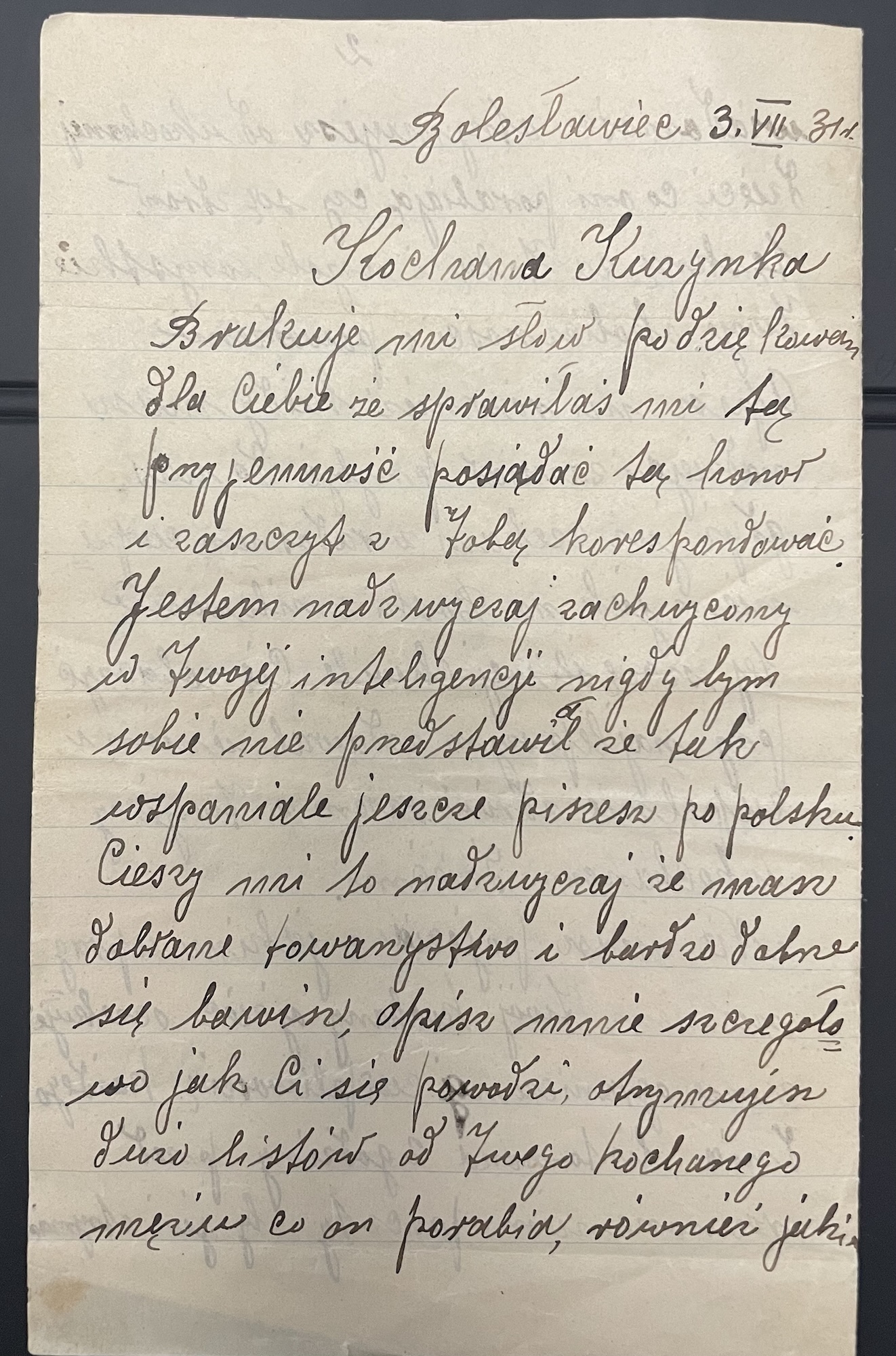
I also wonder what was going on with the children (my mother and uncle.)? They were just 2 and 5 years old.  I do have letters in Polish to both my grandmother and grandfather written by the same person, as the handwriting is the same.  I do not yet know who wrote them or what they say.  Perhaps they tell the story of the children.  I hope so.

The Cigar Box: A New Family History Adventure Begins

14 Aug

This might be the last treasure box found in our Catskill home.  After being in our family for 63 years and after a 90-year presence in Kauneonga Lake, we are selling our home.  None of our children, who are widely dispersed, can care for it.  Our fortune is that we have cousins who still have homes near the lake, so we can visit.

But in cleaning out the house and the drawers and the closets, my niece came upon this last treasure buried in a drawer under linens: a beautiful cedar box from Montauks Cigars.  In it were postcards written from my grandmother when she was in Europe with my mother and her brother in 1931-32. Postcards written to my grandfather in Yiddish and English, The Yiddish will have to be translated. I am hoping the generous members of Tracing the Tribe will translate these, as they are just short paragraphs.

 I had to laugh because all the stamps had either been peeled off or torn.  They were given to one of the grandchildren who were collecting stamps. It might have been me.  I collected postcards as well. But these were probably too important to my grandparents to give to a child who might lose them.

There are letters written in German and Polish to my grandmother during the time she was in Europe. I know one is from her cousin Dora, who survived the Shoah and moved to Israel. Others I think were written by my great aunt Esther to my grandmother, her sister.  The German I can understand a bit. But the Polish is impossible for me.  I will need to find a translator for these letters.

There are photographs in the box.  Almost every one of them is identified in English, Yiddish or German.  The ones that are not identified, I actually recognize the people in the pictures.

I have already sent scans of two of the photos to my third cousin.  One shows her grandmother at her elementary school graduation. Her grandmother and my grandmother were first cousins.  When my grandma came to the USA she stayed with her aunt’s family.  The two girls became best friends.  The other photo shows five brothers who lived in the same building. My grandmother’s cousin married two of them. One when she was young with whom she had her children.  And later when her husband died, she married one of his brothers who also lost his wife.  My cousin was glad to see the photos.  I am going to send her the original of one.  The other my niece wants because she shares the same first name.

I have written about these people in other blogs. So below are links to their stories. 

I think this box will be giving me much more to write about.  Every time I think I have finished the story of my European family, another piece of information turns up.  I hope to start with the notes my grandmother wrote to my grandfather from Europe. I always wondered if they were able to communicate.  As well as what she was thinking when she was there, as we know she went to Europe so sick, she thought she would die.  Her plan was to leave my mother and uncle in Europe. Thank goodness she got well!

Niki de Saint Phalle’s Art Is a Joy!

15 Jul

In March when we stayed in San Diego, I noticed the most unusual sculpture from our hotel window.  We overlooked a bridge, the convention center and this giant piece of art.  I told my husband that we had to walk over to it and see about this giant face! The walk was a little longer than I anticipated.  And the sculpture was much bigger than I thought!  In fact, when we got close to it, I could not even take a photo.  I should have done that from a block away.  However, I did see that it was a piece of art called, “Coming Together” by Niki de Saint Phalle.

The sculpture is in the lower right corner. The view from our hotel.

When we got back to the hotel, I looked her up and found out that a retrospective exhibit of her art was going to open at the Nelson Atkins Museum of Art in late April.  Wow, close to where I live.  I needed to go when I went back, because now I was intrigued.  It was as if the sculpture had called my name and now I could find out even more about this woman.

We then went off on a cruise, then home, then another trip, and I sort of forgot about the art exhibit.  However, every so often I would get something from the museum about this exhibit and say to my husband, “We have to go to see that.” But I did not know why.

Finally, last week, just nine days before the exhibit ended, we went to the museum.  I renewed our yearly membership that had just expired, and we just visited the one exhibit. My husband said, “Why do we have to go to this?”  And I said, ”I honestly don’t know, but I have had it in my mind for months.”

When entered the exhibit, “Niki de Saint Phalle Rebellion and Joy” and saw her first works of art.  I honestly did not like them.  She was an angry young woman who made white paper mâché creations to which she hung balls of paint.  She then took a gun and shot the paint balls so they splattered all over the art. I watched a video of her doing this.  It was not for me. And I really thought I was crazed for wanting to go to this exhibit.

But then we turned a corner.  We saw her ‘nanas’, we saw her ‘skinnies’, we saw large sculptures, we saw maquettes of larger artwork, we saw her paintings, we saw a video of her installations in Tuscany called Tarot Park.  This is a large art installation that made me think about and compare it in a way to Gaudi’s Parc Guell in Barcelona, a place I adore. (See blog below.)

I said, “Ok, Now I know why I wanted to come. This is like the inside of my mind.  It makes me think of Gaudi and Hundertwasser, two of my all time favorite architects and artists. Yes, we had to come here.” (See blog below.)

But I still did not remember the sculpture in San Diego, until I saw her skinnies and read a bit about her life. She lived her last eight years in San Diego and had art installations there. YES. Now it all came back to me. The giant sculpture in San Diego.  It all came together.  I could tell my husband what was going on in my mind.  But by that time he did not mind, he was also enjoying the exhibit.

Niki De Saint Phalle, should never be forgotten.  She believed in Social Justice, Civil rights and support of AIDS patients. In the exhibit it said that she “Strove to create art and environments that inspired hope, freedom, empowerment and imagination.”

Her artworks are fanciful and fun, once she got passed her anger stage.  They brought me much joy to see and explore.  I was so impressed I had to buy “What is Now Known Was Once Only Imagined, An (Auto)biography of Niki de Saint Phalle” By Nicole Rudick.

Queen Califia’s Magical Circle marquette.

The exhibit is soon to close. But my interest in her remains.  I am sure that next time I am in the San Diego area, my husband and I will be looking for all of her art installations in the city, and taking side trips to La Jolla and Encino to see more of her works, especially the Queen Califia’s Magical Circle,” of which we saw the marquette at the Nelsom. I also hope I can get to Tuscany one day and see the Tarot Garden!

I thank the Museum of Modern and Contemporary Art in Nice, France, for loaning these works to the Nelson-Atkins! Also thanks to the Niki Charitable Art Foundation in California for sending along some additional pieces. 

https://www.sandiego.org/articles/arts-culture/the-magic-of-niki-de-saint-phalle.aspx

https://en.wikipedia.org/wiki/Tarot_Garden

https://en.wikipedia.org/wiki/Park_G%C3%BCell

Peace Please For Israel , The Middle East, The World

10 Jul

Recently  my synagogue’s Men’s Club sponsored a showing of the movie, “To Cast A Giant Shadow,” all about the 1948 formation of the modern State of Israel, the siege of Jerusalem,  and the attacks by five Arab countries to destroy Israel before it was even a day old.

The movie starred Kirk Douglas as Colonel David “Mickey” Marcus, a true hero of the Second World War, who became the first general of Israel and died in a tragic incident concerning friendly fire.

Other stars included Frank Sinatra, John Wayne, Yul Brenner, Angie Dickerson, Topol, and Senta Berger, who played the characters of real people involved in the creation and salvation of Israel against the multitude of Arab nations who vowed to destroy them.    It is a fictionalized version.  But it gives a view of Israel from the 1960s when the movie was made and the terror that people were living through then.

Sounds familiar?  It does to me, as once again terrorist forces from the East, the South and the North try to destroy Israel, and anti-Semitism and Jew hatred takes over social media, and the traditional media also seems to favor the terrorists of Hamas over Israel as it defends itself. In fact, the word Zionism has replaced the word Jewish on social media to create Jew hatred around the world.

We were basically defenseless then.  No one would give us weapons. The British were turning everything over to the Arab nations.  The Jews had just suffered through a massive attempt to annihilate them—the largest genocide in human history. Many of the ‘soldiers’ had recently arrived from the concentration camps.  Who would have thought Israel would survive?  It was really a miracle, perhaps the divine intervention included the help of Mickey Marcus.

Now we are not defenseless.  But once again there are fractions in the world that would like to see the destruction of the State of Israel.  The UN made it obvious who they wanted to believe when they would not even admit for months that the Hamas terrorists raped and brutalized Israel victims, both women and men and the horrible murders of children.  The UNWRA seems complicit in the work of Hamas.

On college campuses and in cities around the world people are supporting Hamas, a terrorist group that ended a cease fire and has caused the deaths of thousands of people. It seems to be a world gone insane. But not only in Israel.  Yesterday Russia once again bombed the Ukraine. This time destroying a children’s hospital in Kiev. 

How bad can it get before the world realizes that Israel is a sovereign country?  Ukraine is a sovereign country.  When Iran says it will obliterate Israel, what does that really mean? Nuclear War?  When Russia threatens to use nuclear weapons, what does it mean?  Nuclear War?

In the Middle East the wars between Israel and its neighbors did not stop then with this war for survival.  For the entirety of Israel’s existence, the Arab nations surrounding it have worked for its destruction.  For the past decade, Russia has been trying to chip away at Ukraine’s borders.

Isn’t it time for these continuous battles to end? Isn’t time for children everywhere to be able to sleep a peaceful night without the need for bomb shelters? 

Isn’t it time for Iran, Hamas and Hezbollah to start working to make life better for the people they are entrusted with and use the money they have to rebuild and create a strong economy and society instead of using more and more money to precure arms and build the tunnels and machinery for destruction?

Isn’t it time for Russia to pull back?  So the children and people of Ukraine can have peace again? Before this blows up and more people die on both sides. 

Does anyone think nuclear war will end the battles?  It might –  with the destruction of the world as we know it.  Releasing atomic bombs will not solve the problems.  Ukraine and Russia border each other. Any nuclear bomb will harm both. Israel borders many Arab nations, if Iran obliterate Israel other nations will also be destroyed. It makes me think of another of my favorite movies, “War Games,” in which we find out that thermonuclear war is a non-winner for everyone.

Please Peace.  No more battles, deaths, sleepless nights, and destruction.  It is time for Iran and its terrorist proxies to look at their own plates and solve the problems of their people and stop trying to kill all the Jews in the world.  The same in Ukraine.  I know that the ‘normal’ people of the world who are suffering do not want any more battles.

Please Peace. For Israel. For Ukraine. For the world.

https://en.wikipedia.org/wiki/Cast_a_Giant_Shadow

https://en.wikipedia.org/wiki/WarGames

The Vaile Mansion, A Gem in Independence, MO

2 Jul

I love old homes that have been turned into museums.  So when I read about the Harvey M. Vaile Mansion in Independence, I knew it had to be part of one of our local excursions.  When I discovered it, the mansion was not open to the public.  It is only open from April 1 through October 31 on Thursdays through Sunday for regular tours, although it does have a holiday season in December. 

We planned our visit to the Vaile Mansion for May and took a short trip over to Independence to check it out. It was worth the trip!  The mansion is lovely.  It was built in 1881, the mansion has 31 rooms.  But what surprised me is that only two of the rooms were bedrooms!  There were not many people who lived there, but they had plenty of places to use to stay away from each other!! The brick hoe also has nine lovely marble fireplaces of different colors.  Important to keep warm with in the 1880s.

The house was designed by a local Kansas City architect, Asa Beebe Cross. It was the height of modern technology for its time.  It has flushing toilets, fueled by a 6000-gallon water tank.  Copper bathtubs were installed in the bathrooms.  The room where the tank was later used as an informal dining area. The kitchen had hot and cold water!!!

Unfortunately, Harvey Vaile and his wife, Sophia, did not enjoy the mansion for long.  Sophia, who had stomach cancer, died in 1883.  Vaile continued to live there, but he died in 1894.  They did not have any children.  But Harvey Vaile did have nieces and nephews that contested his will which led to a legal battle and their being unable to pay the attorney, who then acquired the mansion!

Over the years it was used as a sanatorium and a nursing home and owned by the attorney Carey May Carroll.  After she died and it was to be demolished a local couple, Roger and Mary Mildred DeWitt, purchased the mansion and began making repairs and restoring it. Mrs. DeWitt donated it to the City of Independence in 1983.

I loved it. The building looks like a mansion should look.  It has a gothic air of mystery!  In fact, my husband commented that it looked a lot like the house in a lithograph I have made by a local artist (Randal Spangler, see link below.)  about a spooky Halloween house!  We are sure it is the inspiration! In fact, in October they do hold Spooky Tours, and supposedly the house has a resident ghost!

I loved the massive wooden entrance door, and the beautiful leaded glass throughout the house.  The staircase that goes up three stories and ends in a skylight at the top is wonderful.  All the carved wood bookcases and cabinets, along with the painted ceilings, which were part of the original house, makes it truly a gem. The bathrooms, with the cooper tubs and toilets are so unusual for the time! Colonel Vaile was forward thinking!

The furniture is all from the period, but none of it was original to the house. But there are many lovely pieces included an organ, piano and music box.  Throughout the house there are little pieces of history to experience. The best part is that a docent takes you on a tour of the house to point out special objects and to answer questions.

The grounds of the house are also lovely.  In early spring a Strawberry Festival is held there. Local couples can rent the house and its grounds for weddings.  It would be a great place to be married.

In all you just need about an hour or so to go through the house.  The day we went we were the only people at that time. As we were leaving more guests were arriving.  It is very close to the Independence Square, so we headed over to complete our day by eating lunch at the Court House Exchange.

https://www.vailemansion.org/

https://en.wikipedia.org/wiki/Vaile_Mansion

https://en.wikipedia.org/wiki/Asa_Beebe_Cross

Trick or Treat House: https://www.randalspangler.com/store-2-1/p/sanctuary-of-knowledge-tplyf-j8pyx-mmn56-8et9k-k4tkm-cshzd-b6res-r9t4e-3fes4-23a3n-59ghm