Archive | Yiddish RSS feed for this section

The Six Letters From Cousin Abram

15 Dec

I have six letters written from March 1931 to !932 to my grandmother from her cousin, Abram.  I don’t have her letters, only what he wrote to her.  We found them in a cedar cigar box with some other items that she obviously thought were important treasures.

I have had the first three letters translated by members of Tracing the Tribe and the Jewish Genealogy Portal pages on Facebook.  Now I am trying to decide if I should continue in my quest to see what the letters say, because I am realizing that my grandmother had another ‘love’ besides my grandfather.

The letters were written just before and during the six months that my grandmother was in Europe with my mother and uncle while she underwent treatments at the spa/spring waters of Kalsbad.  They were written in the town of Boleslawiec, where my grandmother grew up. 
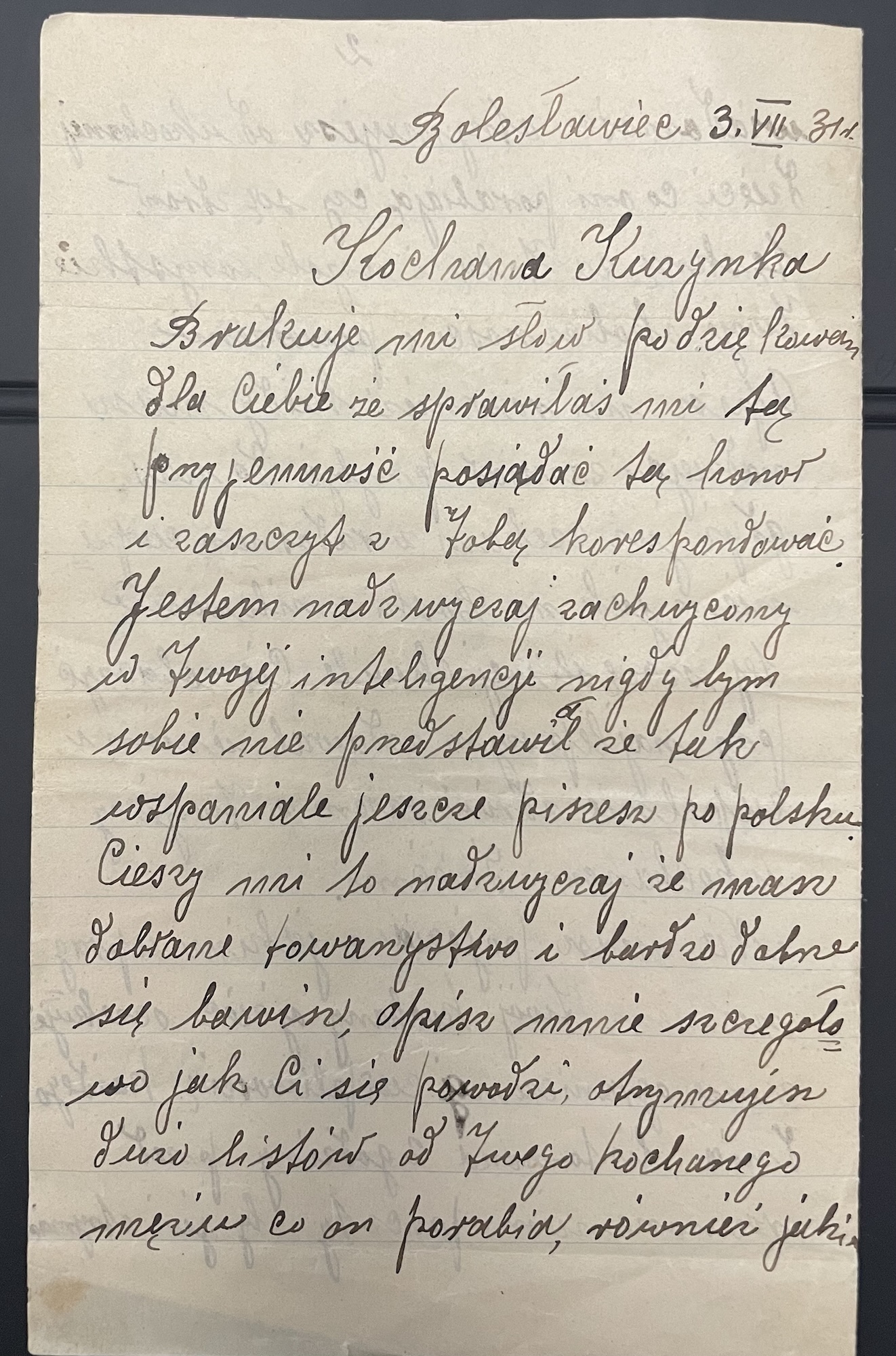
In my mind the first letter is a bit obnoxious.  Her male cousin, Abram, is amazed that my grandmother can still write so well in Polish.  He writes, “I am completely fascinated by your intelligence, I would never have thought you would still be writing in Polish so proficiently.” 

My first thought was UGH.  But then I remember that my grandmother left Poland when she was 16 in 1922. So perhaps it could happen that nine years later her language skills would fade. But still!

He asks how her husband and children are doing. Whether she is getting letters from them.  Hoping she was doing well.  Also telling her how happy they are that she is going to visit.

“I miss you.  Please tell me everything that is happening with you and let me know when you’re planning to visit because I am waiting impatiently for this happy moment to see you well and with your dear children.

You have no idea how your beloved father waits for the mailman with unlimited patience every day two hours before his shift starts. And when he receives a letter from you he is so overwhelmed with joy he occasionally loses his ability to read!”

Can you imagine not seeing your daughter for nine years, perhaps thinking when she left that he would never see her again.   To a degree, I understand.  For over two and a half years, during Covid, I did not see my daughter who lives in Israel. At least we could Facetime.  When she finally did come to the USA, she and I hugged and cried for a long time at the airport.

He ends this first letter:

“I am finishing this letter by wishing you all the best, whatever you may desire!

Best regards from your kind-hearted cousin, Abram and the entire family.”

The second letter was written from Boleslawiec pm June 23, 1931. This letter was written after she arrived in Europe, perhaps at the spa.  She had had a difficult journey from the USA and in fact almost died.  She was ill with kidney disease as a result of eclampsia.

He writes: “That you did not have a pleasant journey did not bring me joy.  However, the following bright days should give you the opportunity to enjoy the good and clear air as well as admission for immediate treatment.  I wish you a speedy recovery so that you can return to us completely healthy.”

Once again, he mentions how eagerly they are all awaiting her arrival in Boleslawiec. He tells her that he visited with his beloved fiancée and told her how impressed he was with my grandmother because she was so intelligent.  That she also wished my grandmother a speedy recovery. (I just have to say that my grandmother was brilliant. Her brain was like a trap.). He ends this letter wishing her warm regards and good luck.  Abram.

It is in the third letter, dated July 28, 1931, from Boleslawiec, that the tone begins to change.  And I began to wonder if I should have the other letters translated.

He starts by thanking her for this letter, but admonishes her because the last correspondence was just a note card without too much information.

“I expected a more detailed description of your events, and I felt quite offended by your silence and short note.  I still admire your intelligence and wisdom, humor and quick

wit which always digs me out of the hole that I entered by writing such a letter to you… Otherwise, I expect a terrible end for myself, but I trust that in the future you will grant me with your words, so precious to me, more generously.”

He is a bit pompous and impressed with himself.  But I guess I have to think about the times, 1930s, and the male dominance of the time period, especially among the orthodox. But my grandmother was a bit different. Her Dad was a scholar/cheder teacher.  And he had all his children learn to read and write in Hebrew, Yiddish and Polish.  My grandmother also knew how to read and write in German before she came to the USA where she learned English.    Amazing for someone whose formal education ended when she was still a teen.

He then writes: “I received your funny and humorous letter, and I thank you so much for all the giggles and fun that it provided and for setting a clear timeline for sending a more serious letter to you… I will grant that having received your letter I should have changed the subject of my writing, but you must forgive me because my mom is unwell and under these circumstances I did not have the mood for jokes nor time to write a different letter and I do not want to stall and stop you from sending an answer to my writing.”

But now comes the part that really got my attention and changed the total impression about what might have really be going on. You see she had two cousins named Abram.  I am not sure which one this is. Buy I have written about one in earlier blogs.  (See below.)

“My dear cousin, I am letting you know that Abram visited us yesterday, we took a long walk in the evening, and he was telling us all about your visit to him and your previous relationship.  He was pouring his heart out which, as you know, is quite unlike him, because typically he is reserved and introverted. Still he was confessing to me like a broken record to put some ease to his own suffering. He also knew what was said about him… He really wanted me to share with him what your true opinion about him is. I deflected his questions about you immediately.”

“I am sending this letter with best regards, your sincere cousin, Abram.

Best regards from my parents and sister as well.”

WOW!.  I think the Abram who is in love with her is the cousin in Germany.  She probably got to see him when she went to take mineral water treatments.  I have other items with his name in them.  And I assume that they had an unrequited young love before she went to the United States.

This really touched my heart, but also made me think that perhaps future letters spoke more about the second Abram. And did I really want to know more? 

But it also made me think that perhaps one reason that she went to the USA when she was 16 was the end of the relationship with the second Abram.  Did he break off with her, did she break off with him.  Did the family decide that this was not a good match?  I know in those days first cousins did marry.  So many questions that I might never know the answers to.

I did put the fourth letter up on Tracing the Tribe to see if someone would translate it. But even though it has been up for a month, there has been no translation.  In my mind, I have thought pehaps it is for the best.  But another part of me wants to know what the other three letters reveal.  I am having an internal debate whether to repost the fourth letter.

In any case thank you to Aleksandra Leonczyk and Roman Matz, who did the translations.
What the Karlsbad/Karlovy Vary Postcards Revealed

27 Aug

The Cigar Box discovered in our Catskill house is beginning to reveal its secrets and memories.

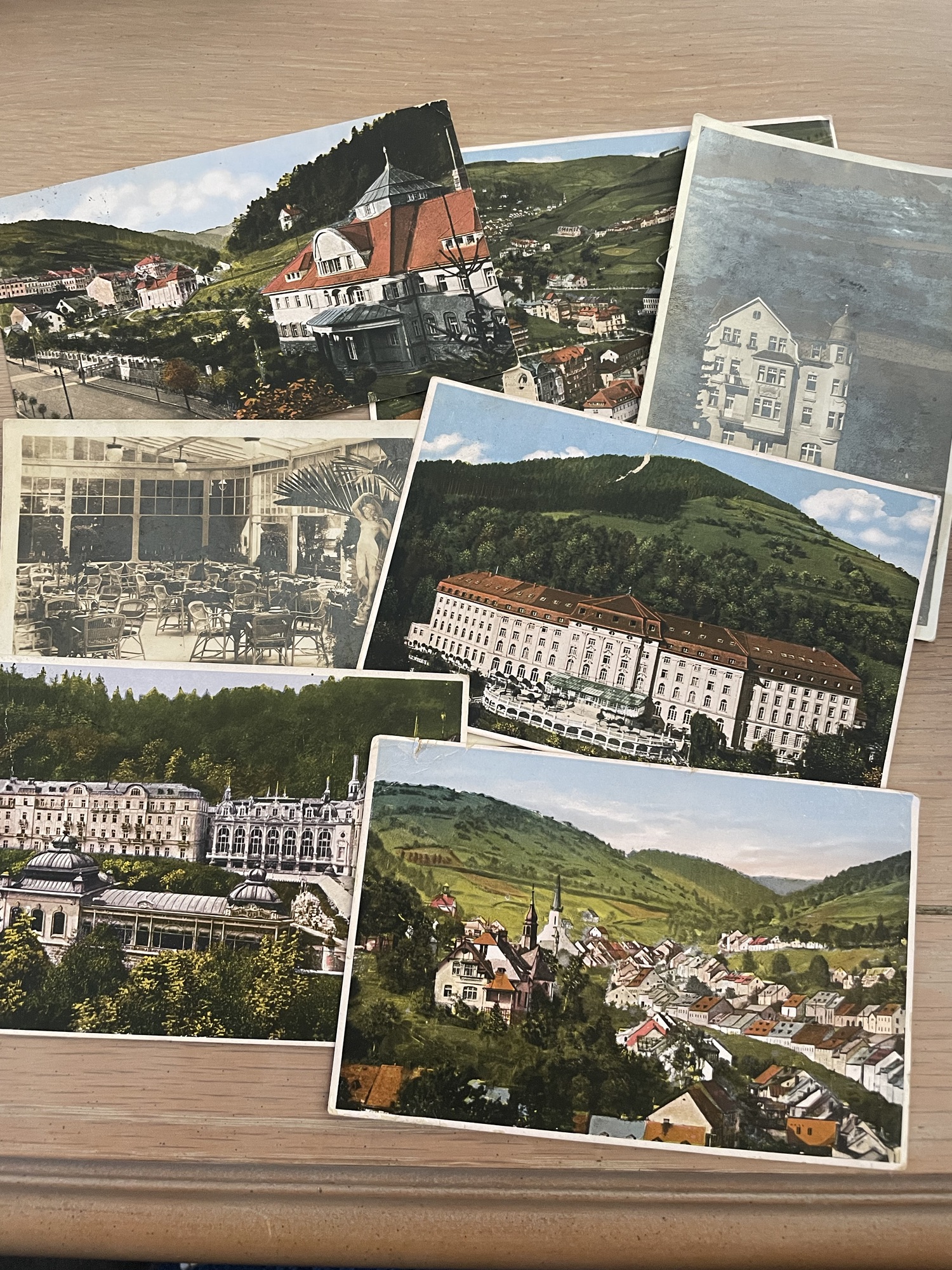
There are seven postcards written from my grandmother in Karlsbad  (Karlovy Vary) to my grandfather in Linden, New Jersey.  

The first discovery is the address of my grandfather’s bakery, where he lived above the store.  We now know exactly where it was located.  The building still exists, and I even have a photo of the building that I found online.

We knew that when my grandmother went to Europe my grandparents were in the process of opening their own bakery.  My grandfather had been in business with his uncle since he moved to the USA. The bakery in Linden mainly served restaurants and grocery stores and had a small retail presence.  This store closed a few years after my grandmother returned to the USA when they purchase a building and opened a bakery in West New York, New Jersey.

We often wondered if or how they communicated when grandma was in Europe, now we know.  Postcards.  My grandparents saved these seven. These all are from the month that she spent at the spa trying to heal from her illness, kidney disease brought on by eclampsia and the termination of her pregnancy in early 1931. Luckily, she had a great doctor who saved her life.  (See blogs below.) The postcards date from June 30 to July 22, 1931.

Now we know what she was thinking while she was there.  She was 25 years old, the mother of two children who were staying with her in-laws in a small shtetl outside of Mielic, and she was horribly ill.

I must thank Leslie T., who was gracious to translate these postcards for me.  Leslie is someone who also belongs to the Jewish Genealogy Portal Facebook Group.

The first postcard dated June 30, 1931, asks for $100. And informs my grandfather that the first treatment did not help, but the second treatment is helping.  She also told my grandfather that there was someone at the mineral waters who was 58 years old.  I think that gave her hope that she could and would survive.

There is another postcard written on the same day in English.  Thanking my grandfather for the money he has sent.  And asking him to please write, as she is worried about him. 

Grandpa was 31. I know exactly what he was thinking because I asked him.  Why did you let grandma take the children to Europe.  “She was a sick woman.  I had to let her do what she thought was best..”  But what would have done if she died? The children would have been left in Austria.  “As soon as she died I was going to get on a boat and return with my children. I would never leave them there.”    End of discussion. 

The postcard correspondence continues.

July 6, 1931:

Most beloved husband:

I’m very surprised that I’m not getting any letters from you. I write to you so often and yet no answer. Anyway, how are things by you? Hopefully, still good. No news forthcoming from my part. Everything is the same as always. Well then, I send you greetings and kisses; also, the very best greetings and kisses from the dear children.

I remain your faithful wife who hopes to see you as soon as possible

July 14, 1931:

Dearest husband Nisan,

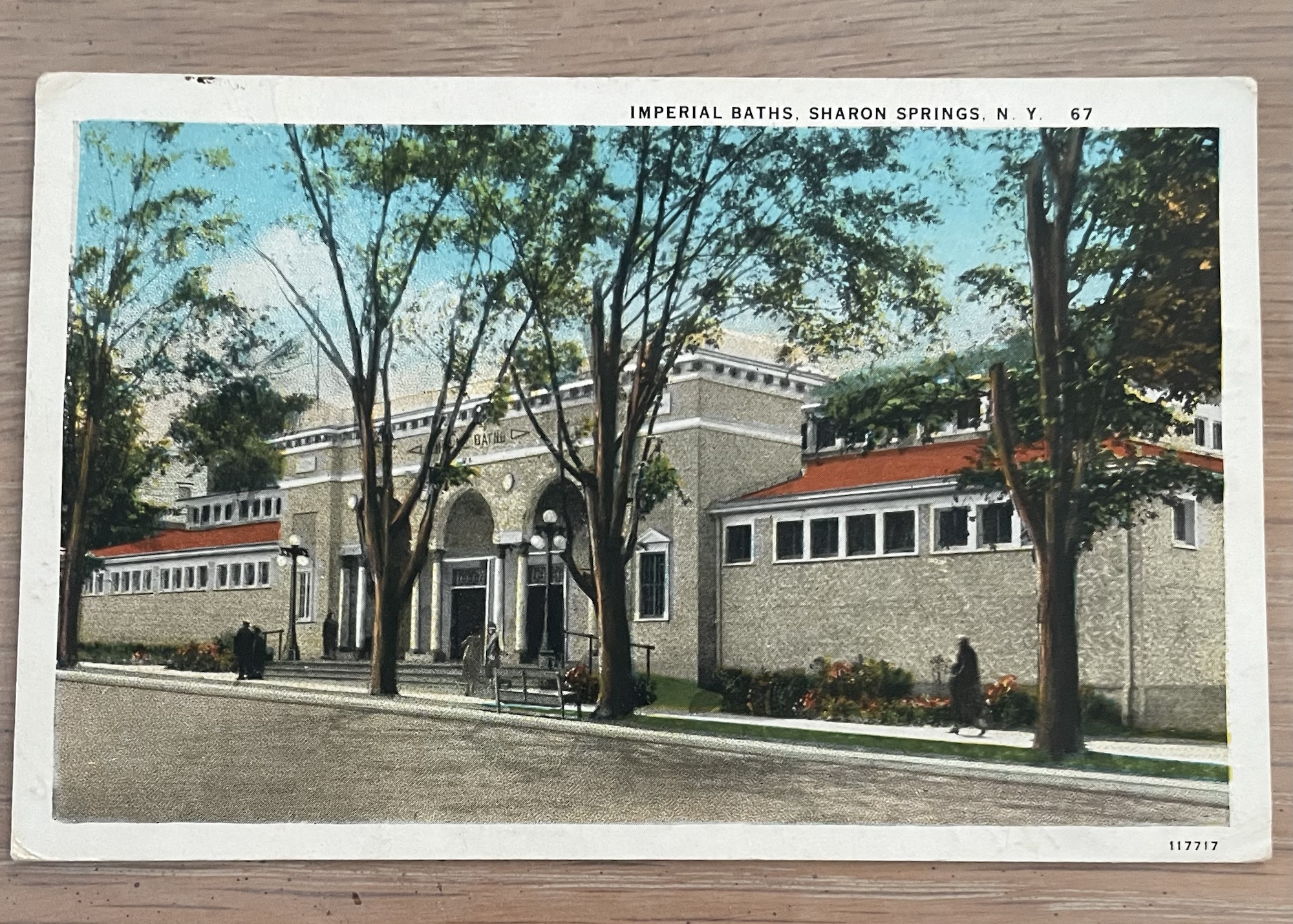
I’m letting you know that I got your card from Sharon Springs

 I’m very happy that you went to ‘take the waters’ but dear Nisan, see to it that you get some rest after the mineral baths else you could become very weak. I’ve experienced something like it. I’m still staying at Carlsbad this week – see that you send me some money. And don’t worry about the house because I get very frequent letters [from there]. Everyone is OK and the children really yearn for you – as do I. I send you heartfelt greetings and kisses from your faithful wife who hopes to see you as soon as possible. Thelma Amsterdam

July 21: 1931

Dearest husband: In this picture you can see the guest house where I live in Joachimsthal [now called Jachymov Czechia]. Just looking at it is enough to make you cry, but it is the stuff of memories. Well, Nisan, I’m begging you to send me some amount of money by telegraph to Carlsbad to the same bank – and immediately, as soon as you get this card, because I am left without a cent. Other than that, there is no news, at least, nothing good to report. Just know that I send hearty greetings, and you should get much pleasure from your dear children as well.

I feel worse now than at home.

Write an answer to your children.

July 22, 1931

Dearest husband:

I have taken 3 bath treatments already and feel like all my bones are breaking. There are people here from all over the world and everyone says that the treatments work but that you have to come at least several times. I believe that I’ll go from here to Vienna to see a heart specialist. Please send money to the same bank as before. No other news. Your faithful wife sends her regards – and the best greetings are from your children. Thelma Amsterdam

July 24, 1931

Dearest husband,

I received your letters from Sharon Springs. I’m writing you another postcard because yesterday I sent you a telegram asking for money. I want to go to Vienna to see a professor about my heart. The children are fine, but they miss us very much. I hope to be seeing them soon. Dear husband, here in Joachimsthal things are going well for me. There is a heat wave here and the baths aren’t sapping my strength, but everyone says that one course of treatments won’t do it; one has to come here at least 3 times to get cured. Other than that, there is no news to write. I’ll write you a letter soon – your faithful wife Taube

And then one from my grandfather from Sharon Springs.  I am assuming this one is from mid-July because on July 14 grandma says she got a postcard and found out that he was taking spa treatments.  But I do not know the definite date. Later, July 24, she also mentions getting letters from him.

Much beloved wife: I’m writing to let you know that I’ve had two spa treatments already. Dear Taube, write and let me know how you’re feeling and what they’re writing to you from Auntie.

How are the children doing? Otherwise, I have nothing else to write to you. I send you my regards and kiss you and the dear children. Your faithful husband Nisan

Honestly, I was al ittle disappointed by these postcards. I wish these postcards had more information. But then they were postcards.  You really cannot be intimate or give out real information that anyone could read.

But I have questions:  How did he get the money to afford all of these?  I know his bakery was doing well. But really, 1931, was during the Depression.  He was supporting himself and my grandma in Europe.  Plus paying for all the Spa fees!  I know they did well, but that really surprised me.

I also wonder what was going on with the children (my mother and uncle.)? They were just 2 and 5 years old.  I do have letters in Polish to both my grandmother and grandfather written by the same person, as the handwriting is the same.  I do not yet know who wrote them or what they say.  Perhaps they tell the story of the children.  I hope so.

Rediscovering My Master’s Thesis On The Jewish Press

22 Jun

As journalists and media outlets are facing some of their most difficult times with the loss of large newspapers and 24 hour entertainment/news, and the attack on the journalists in the USA, I found my latest move-related discovery: a box filled with papers included a red folder containing the survey responses from a 78 Jewish publications in the late 1970s, who responded to my master’s thesis request.

I worked on and wrote, “The Jewish Press: Journalism Versus Religion,” in 1979. Starting in the fall semester of 1978, I f finished with my defense and publication in December 1979.   I remember my advisor being happily surprised that so many responded to my survey.  I took the information and diligently typed this information on to computer punch cards.  Then reserved my time on the University of Missouri’s mainframe computer where, my cards zapped through the machine and presented me with the results. 

I have to laugh.  It took three tries. The first I dropped the cards, and I did not have them all numbered. This was a disaster in those days, because certain cards told the computer what to do.  You do that once, and never again!  The second time, a one card had a typo.  Finally, on the third try, it went perfectly.  Of course, four responses came after the computer work, so I had to mentally add them to the statistics.  The computer took up an entire room. You do have to laugh when you think about computers today and then 41 years ago. Sigh.

Back to my surveys. I sent my survey to magazines, newspapers, English and Yiddish publications. Any publications that identified as part of the Jewish press. Some of the editors/publishers just answered the questions with as few words as possible, others sent me paragraph upon paragraph of information about their publications and their thoughts. 

One person’s help stood out.  He wrote me a letter along with returning the survey.  In his letter, Bernard Postal offered as much help as possible in my project. My most vivid memory of working on my thesis was his wonderful help and advice! 

Mr. Postal had been an associate editor of The Jewish Week from 1971 until his death in 1981.  In the 1920s and 30s he worked at many publications including the New York Globe, the New York Times, the Jewish Telegraphic Agency and the Jersey City Jewish Standard.  He was the editor of the monthly magazine, The Jewish Digest from 1955 till he passed away. He wrote books and he was honored by the JWB’s Jewish Book Council for his contributions to American Jewish History.

For me he was a godsend.  He had written an unpublished article in 1976 entitled, The American Jewish Press after 150 Years. He was interested in my master’s thesis and wanted to help. He wrote to me about my research. He spoke to me on the phone.  Finally, when I was in New Jersey during a break, I took the train to Long Island, where he met me at the train station and took me back to his home. We spent hours going through his personal archives.  He sent me away with a load of articles, information and a wonderful interview which took place on March 29, 1979. This interview is footnoted in my thesis.

We kept in touch.  I even invited him to my wedding, which took place a year after our day together.  He did not come.  And then, less than two years after my thesis was published by the university, he died.  I was devastated.   He was my mentor.  I was 26 and he was 75. I felt terrible that I had not gone to see him with the bound copy of my thesis.  However, his name and  memory has stayed with me throughout the years. 

Finding these papers, brought me back to the memory of my day in his home. Because of my thesis and my time with Bernard Postal, I always had a positive imagine of the Jewish press. I have had articles published in three different national Jewish publications, of which only one is still published today.

For many years, I have freelanced for the local Kansas City Jewish newspaper.  I will admit, that one of the people who responded to my thesis survey was the then editor of the Kansas City Jewish Chronicle, Milton Firestone.   He was one that answered with just a few words. I never worked for Milton.   I started freelancing for the Chronicle in 1985, when I was pregnant with my daughter, 35 years ago.  He had died suddenly two years before, when he was quite young, 55.  I never had the chance to discuss my thesis with him.  However, I still write an occasional article or commentary for the paper. 

When Milton Firestoen responded to my survey, he mentioned concern to the question about “the possible demise of your publication.”  His answer: there is “little new talent interested in producing a publication. Also, young people may not want to read it.”  I think he would be happy to know that it just celebrated its 100th anniversary.  Although, I am sure there is still concern about the future of the publication, just as there is for all newspapers throughout the world.

Rereading some of the survey questionnaires has brought me back to a different time. So many of these publications are no longer published, or if they are, in a much smaller format.  I think everyone who responded is no longer alive.  I am actually feeling so glad that I held on to this tiny bit of Jewish history.

I am still looking to see if I saved the letters and the notes from my interview with Mr. Postal.  So far, I have not found them.  But what I did find has given me a bit of joy.

For My Grandpa, Being a Kohan Was His Joy and Duty

27 Jun

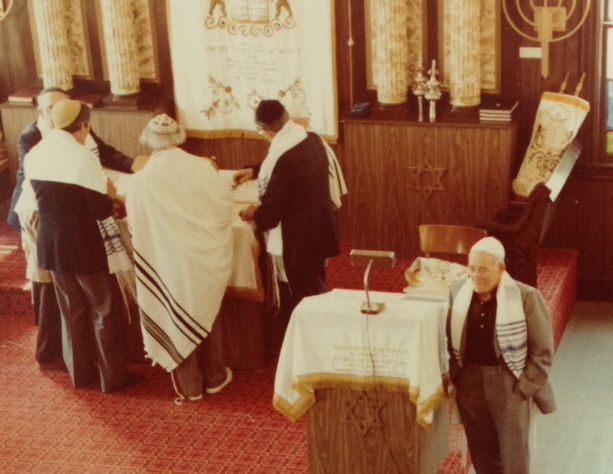
Inside Shul in Kauneonga Lake

My Cousin took this photo from the women’s balcony, at least 30 years ago. My Grandfather is standing on the right, walking away from the bima.

My maternal Grandpa was a Kohan, a descendant of the Priests of Israel.  Even today, Kohanim have roles and duties that are part of their lives.  Grandpa was born in Galicia, an area of Austria/Poland that often changed borders.  He came to the USA in 1920.  And eventually owned his own kosher bakery in New Jersey, as well as a small bungalow colony in the Catskills.  But he always kept the rules of the Kohanim.

Grandpa often served as the Kohan during the Pidyon ha Ben ceremony.  This ceremony is also called the redemption of the first born.  In biblical times the first-born child, if it is a son, of an Israelite family had to be given to the Kohanim.   The family needs to present five silver coins to a representative of the Kohanim.  My grandfather was often asked to serve as this representative.   He would lead the ceremony and take the silver coins, which he kept until the boy was bar mitzvah, when he would return the coins as part of the child’s bar mitzvah gift.

I remember as a child being at a Pidyon ha Ben service.  I was so intrigued by the ceremony.  But I think more by the money.  I asked what Grandpa did with all the silver coins.  My Grandma told me that Grandpa did not use that money.  He saved it in a special place to return to the boy when he was older.

I wonder how they could keep track of that money.  But then my grandparents owned a kosher bakery, and my grandmother saved every silver coin that came into the store.  When she died, we found 900 silver coins, from dimes to silver dollars.  They were divided up so that everyone one of their descendants had some.  I still have mine.

Grandpa rarely went to a cemetery.   In fact, I don’t remember him ever going to a cemetery. He always paid shiva calls, but not the funeral.  Kohanim do not go near the dead. He did not go into a service until my grandmother died.   Kohanim do not go near the dead.  In fact, some Jewish funeral homes are built with two foundations, so that Kohanim can stay in the outer area during a funeral. There but not in the same structure.  I can still see my Grandpa during my Grandma’s funeral, even though it was almost 40 years ago.

Grandpa went to services on Shabbat.  He made so many Kohan aliyot at Shabbat services.  When they moved to the Catskills full time.  He was often the only Kohan at shul.  It became his responsibility to go every week and be the Kohan.  He took this honor seriously.

When he was in his later years, over 80, he would drive partway to shul and then walk the distance that he could walk.  Although he was brought up not driving on Shabbat or working, in the 1980s at his shul in Kauneonga Lake, people drove to services, even parking on the grounds of the shul, Congregation Temple Beth El. But not Grandpa.  He would park by Sylvia’s clothing store, up the hill from the main part of Kauneonga Lake and easier for him to walk.  I once asked him why he didn’t just park at the shul.   His response, “I walk as far as I can, because I can do that for Shabbat.”

On the high holidays he was often the only Kohan at the Kauneonga Lake shul.  On the high holidays he would sit in the men’s section with his tallit wrapped over his head covering his eyes.  When I was little my favorite time was sitting with him in shul with his tallit covering me as well.  He kept his hands over his eyes under the tallit as he davened.  His emotions during the high holidays was overwhelming.  My sister said it was her strongest memory, how upset and emotional he would get them, as Grandpa usually had a great sense of joy.  But then as an adult she realized that the pain of the Shoah came to him then.  He was the only one left of his family.  All perished in Europe, while he was already in the USA.

Sometimes he was the only Kohan at shul to perform the Birkat Kohanim, the Priestly Blessings.  Grandpa had a beautiful singing voice.  He often sang to us in Yiddish. During the Priestly Blessings, he sang for everyone and blessing the entire congregation.  At times there were other Kohanim present, especially if the holidays were early in September.  Then Grandpa would be joined by others on the bima.

At some point, another Kohan moved to the Kauneonga Lake area and also went to services.  Grandpa was thrilled.  Sometimes he would not go to services on Shabbat.  He would say, “Let the other guy have a chance.”

It was this statement that brought this story to my mind last weekend..  My husband is a Levi.  He goes to minyan every Wednesday, but to Shabat services about once a month. He almost always gets Levi.  Our congregation only has three Levis who come weekly.  They, like my grandfather, are happy when another guy comes. This week the Gabbi came and said, “Do you want Levi?” “Sure,” was my husband’s response.  “Good because the others say they don’t want it today, you should take it.”  During this short conversation, in my mind’s eye, I could see my Grandpa’s smiling and laughing.

Grandpa took his role as a Kohan with joy and fulfilled his duty.  I know he would be happy seeing my husband fulfilling his duty as well.


https://www.chabad.org/library/article_cdo/aid/1008437/jewish/Birkat-Kohanim-Melody.htm


My Great Uncle Discovered In A Wonderful Photo

14 Jun

Once again, I browsed through my grandmother’s mystery photo album trying to identify more of the many photos from Europe.  This time I had success.

img_3908

I noticed a familiar face among a photo of six men playing cards and smoking.  All were young, well dressed, and looked posed to me.  But seated on the left side, I noticed someone who looked like my great uncle Isaac.  When I studied in Israel during 1974-75, I spent much time at my great uncle and great aunts’ home in Kiryat Haim, near Haifa.  I also brought my grandmother to Israel in 1976, when she saw her brother in the first time in over 40 years.  (See blog below.)

img_3909

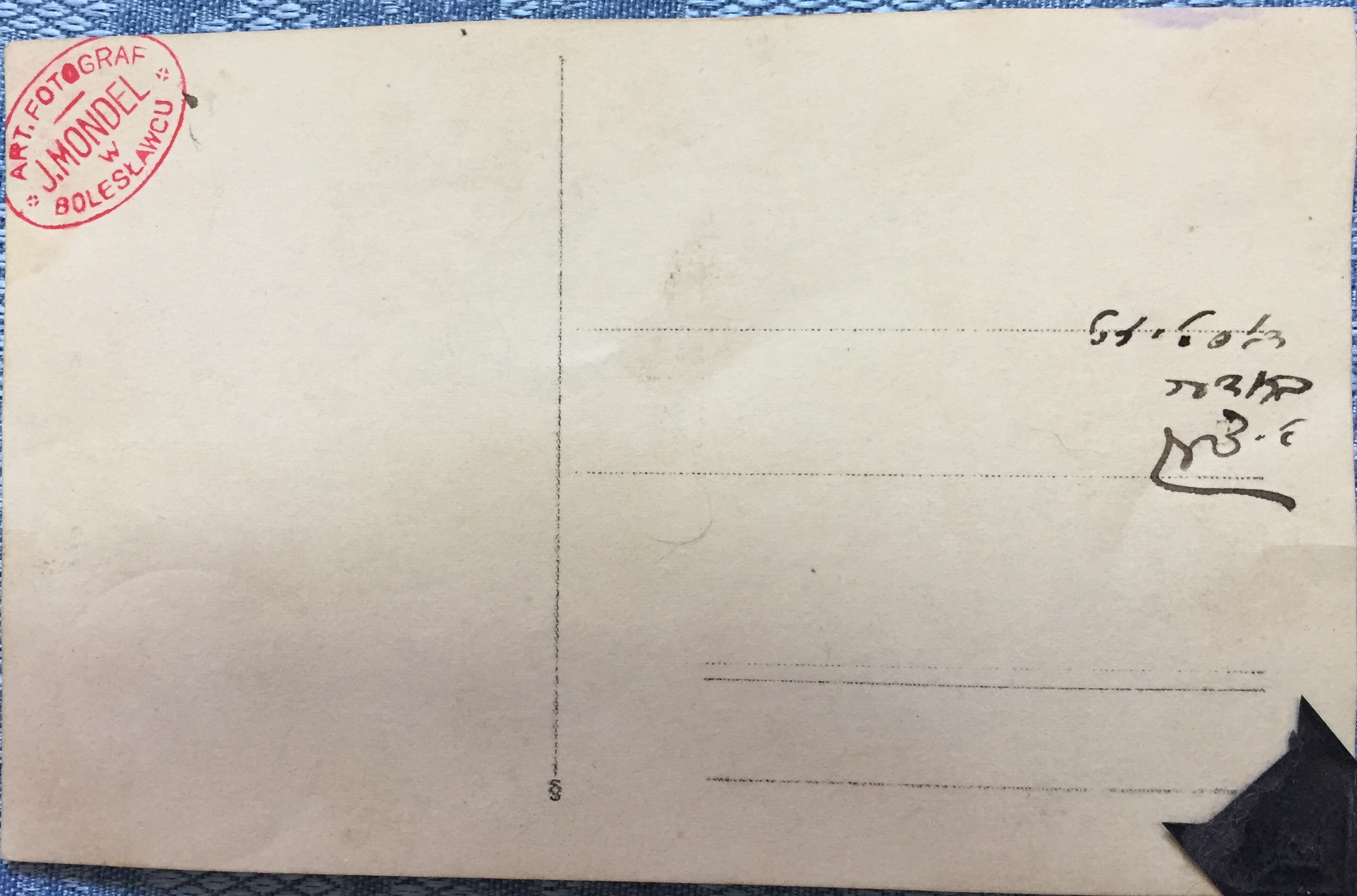
The back of the photo had a stamp from Boleslawiec, and I knew that was my grandmother’s home town.  So it would make sense that Uncle Isaac would be in a photo taken there.  And also, a short message was written in Yiddish, right over the spot where Uncle Issac was sitting on the front side of the photo.  I thought I could make out the name Izhak.

Thank you to Esther, another member of The Tracing the Tribe Facebook group.   She translated the back for me. “This is brother, Itzek.”  Itzek was what my grandmother called her brother.  I was right.  I correctly identified another photo.   Or at least one person in the photo!

I wish I knew the identities of the other young men. I am thinking they were friends, or perhaps cousins.  He had a brother, but I would assume, David would have been identified in the photo also.

By the time this photo was taken, my grandmother was living in the United States.  She left Poland in 1922, when she was 16, the oldest of the children.  I would assume this photo was taken sometime in late 1920s early 1930s, before the world changed.

Each time I identify another of these photos, I feel a moment of pure joy.  I have written a number of blogs about these photos.  Several of them are listed below.


PS. Uncle Issac is the one who made a jacket for my Mom,  which I wrote about here: https://zicharonot.com/2019/05/20/this-jacket-is-a-survivor/


Speaking Yiddish Always Brings Me Holocaust Memories

https://zicharonot.com/2018/12/06/identifying-a-photo-is-hanukkah-miracle/

https://zicharonot.com/2018/07/15/boleslawiec-pottery-pieces-create-a-feeling-of-despondency/

https://zicharonot.com/2016/10/01/the-rosh-hashannah-card-has-a-story/


My Grandmother’s Mysterious Black Notebook

13 May

img_3335-1

The black notebook.

I have a book.  It is small.  About eight inches by nine inches.  It has a black cover.  Inside are 33 lined pages, so total of 66 pages that can be written on.

It seems to be a diary.  Most of the pages, about 40, have entries that are dated in 1921.  So my book is almost 100 years old.  Two of the names I recognize.  My grandmother and her first cousin, Abraham, who perished in the Shoah.  The other names I am not sure about.  But these entries, even though they have different names, seem to be written by the same person.  My grandmother perhaps?  Or are they really two separate handwriting.  Now that I look at this page below, it seems as if two different people wrote. But many of the pages have the same writing and not changes like this one.

img_3332

Entries from March 1921 with my grandmother Tala Szenk and her cousin Abram Prentki’s names.

Some of the entries look like they could be poems.   Did they write these poems, or did they just copy them from some book?  It does show how my grandmother was educated in Poland.  Her father was a teacher. Grandma could read, write and speak in Polish, Hebrew and Yiddish.  After she came to America, she went to night school to learn English.

img_3337

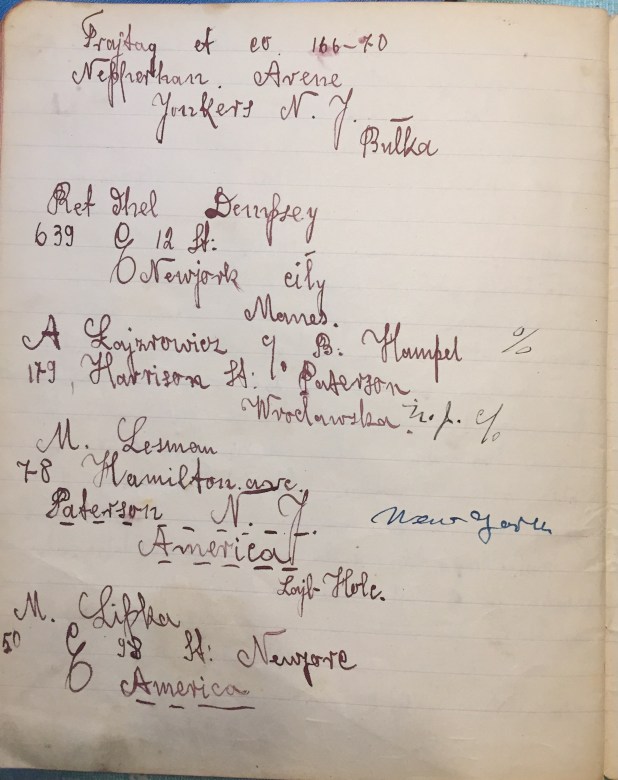
See Lipka, her relatives she stayed with when she arrived in America.

In the middle of the book are names and addresses in English.  Names of people living in New York and New Jersey.  Hidden, I think, in the middle of the book.  Her escape plan?   My grandmother came to the United States when she was 16 in 1922.  I see the last name of the aunt and uncle who allowed her to live with them in the United States.  They must have sponsored her as well.  The name is Lipka.

It is all written in Polish.  But I can understand the names, because I recognize them.  And the name of my grandmother and her cousin jump out at me.  Especially since I have written about this cousin and not knowing who he was at first.  And then here he is embedded with her in this book.

img_3338

Who wrote these pages?

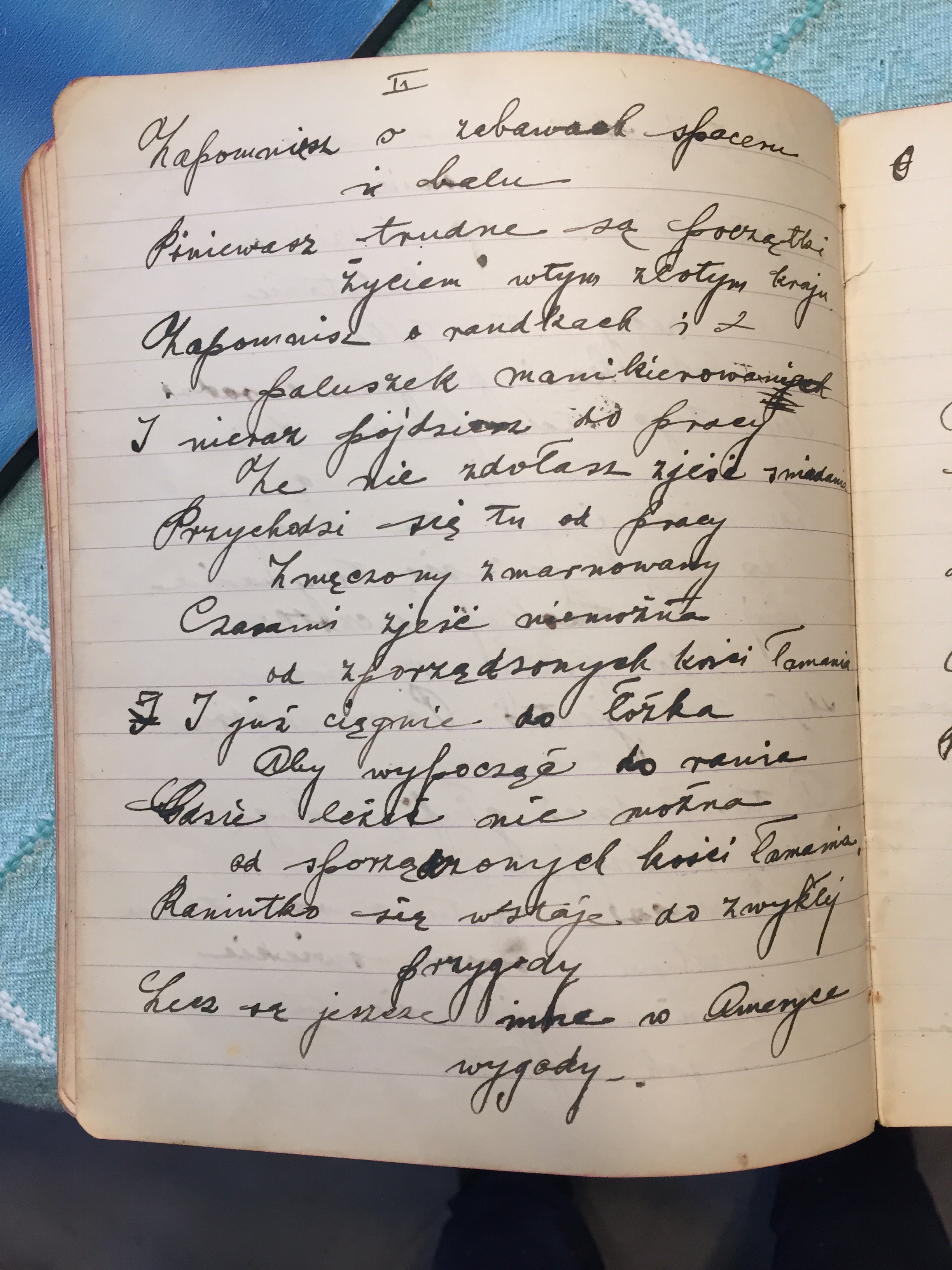
After the journal entries, if that is what they are, comes some blank pages, and then six pages written in a different handwriting.  It looks like a poem.  But I am not sure.  I am not sure what any of it is.

The last four pages are in Yiddish. Those I have had translated.  We think it is a story, perhaps not true, perhaps yes.   About a girl who meets non-Jewish man and how it ends in sadness.  The beginning reminds of the story of Tveye and his daughter Chava.  But this story does not end happily.  Did she read a book and decided to write that story?  I don’t know. I don’t know if she is writing about someone she knew or making up a story.   Perhaps the other entries would give me information. Perhaps.

img_3336

Why did she save this receipt as well?

Inside the book is a receipt for registered mail sent on November 16, 1922.  Did she send something back to her father and her siblings after she arrived in America?  I wish I knew.

My grandmother passed away 38 years ago.  I wish I had seen this book when she was alive so I could ask her what all this is!  We found it long after she died and my parents died.  It was hidden in the bottom of a box in the attic of their Catskills home.  Not thrown away, but saved for me to one day find.

This book is a mystery to me.  I need someone who reads Polish and can translate this book for me.  I love a mystery, but even more, I love the solution to a mystery!


Two blogs about Abraham Prentki:

https://zicharonot.com/2018/06/04/the-mystery-of-abraham-prantki/


https://zicharonot.com/2018/06/26/amazing-what-information-two-photos-can-provide/

My ‘Feh’ Mood Seems Overwhelming

24 Jan

There are certain Yiddish words that just fit.  When you say them, you know that everyone understands exactly what you feel and why you feel that way.  And lately one words keeps coming to my mind all the time: Feh!

Feh:  I am so disgusted.  I have reached the age where I look at life in a different way.  I get so disgusted with unreasonable behavior.  With those more concerned about their own glory than the people they are supposed to serve. People so caught up in their political side that they are forgetting that people are now suffering without pay.  That our economy is hurting, our people are hurting.  Feh on them all. Actually, our political world is beyond feh!  I would say it was all “verkakte,” screwed up!   I have been calling my two senators several times a week.  Does it help? Who knows! But I feel better for trying.

I am disgusted with baseless hatred.  And with people who spew hatred. I am disgusted with the increased acts of ‘anti’ behavior: anti-Semitic, anti-LGBTQ, anti- immigrant, anti-anyone who is different than you. Feh on all the haters out there. I honestly never thought I would see an America so filled with hatred. But here we are! FEH!  I could just ‘schrai,’ scream,  in aggravation. And I do.

But my feh mood is more than just on the atmosphere of the political structure, it is also on the atmosphere of the world!  Reading or watching or listening to the news has brought about many feh moments the last few months.  I am at the point where I do not want to hear any more. But then I realize I have to listen. Despite my disgust and my temptation to yell, “Feh,” at my television, I keep on watching. But to be honest, this mishegoss is making me meshugah!

Then there is the atmosphere of the weather. Feh on the weather!  Climate change is killing me.  The summers are too darn hot!  And this winter has been a polar bear of ice, snow, sleet, graupel, freezing rain and more.  I am done. FEH! I do not want to kvetch, but who needs this weather? Not me.

Feh on the dirty snow piled on the roads and my driveway. Feh on the mud and muck coming into my home. Feh on the downed trees and limbs felled by 10 inches of wet nasty snow.  Just FEH.

I am so tired of schlepping!  I am tired of putting on layers of clothing and my boots.  I am tired of schlepping a scarf and gloves and hat with me wherever I go, and then running back when I forget something or if fell as I was walking into a building.  I am tired of schlepping my coat around when I go shopping at the grocery store.  If I take it off it takes up too much of my cart; if I leave it on, I get too hot.  Feh on my schlepping and my winter clothes!

I remember my grandmother saying feh on little things, like a mud-covered child, a dirty diaper, a messy face.  My fehs have reached epic proportions this year.  I am in super feh mode.  There has to be a word to express my extreme disgust.

I honestly do not want to become verbissen, totally bitter, by all that is happening in the world at this time.  But my feh mood seems to be over whelming some days!


Oy, An Egg Kichel! Delicious!

9 Jan

Amazing how the taste of a freshly baked egg kichel can bring back so many joyful memories!

It started with a Facebook post by a friend.  She posted something from My JewishLearning.com, entitled “Kichels Recipe: Jewish Bow Tie Cookies.    (See link below, it includes the recipe.)

A few of my friends started commenting on the post about how much they loved these cookies, including me.  I commented: “My grandpa made these in his bakery and continued making them for us.  I loved them.  I would glad to be a tester for you!”

Next thing I knew I had committed to meeting a different friend and making them.  What a delight! She had posted that her Bubbie made these treats.  And she wanted to make them again.  I was all in!  (I do feel a bit of guilt that we did not have the person who posted the article with us!)

You do not bake egg kichel, you fry them.  You do not need much, just flour, salt, vinegar, eggs, oil and powdered sugar.    Mixing bowls, a mixer and a frying pan, along with lots of paper towels are required.  I promise you an hour or so of fun, and then a delicious reward.

img_1609

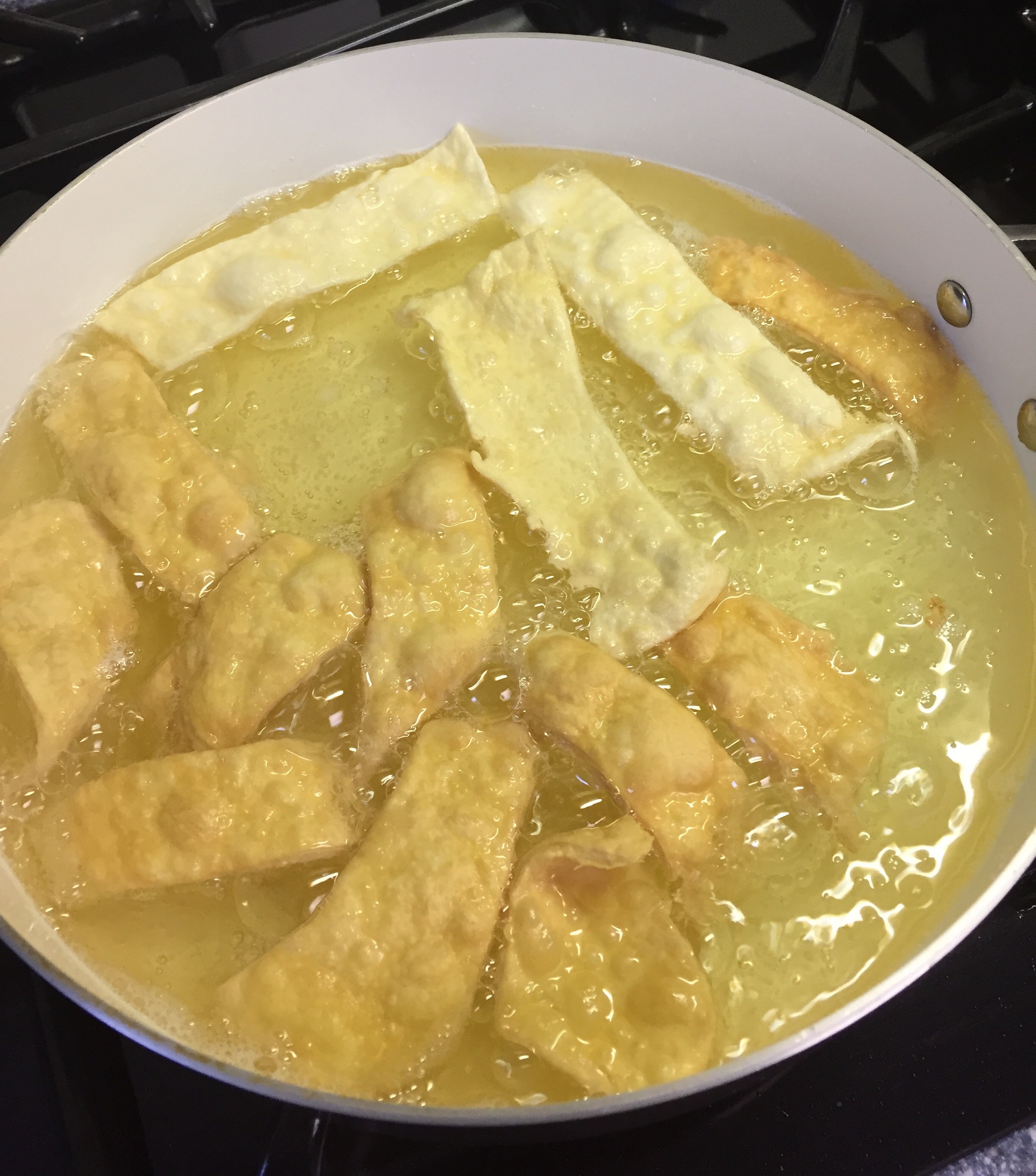
One of our early batches.  A bit too thick!

We learned something from our foray into making them.  The dough does have to be paper thin!  It is best to have all the dough rolled out and cut into strips before heating up the oil.  And really, you must make sure the oil is hot, hot, hot before you start putting the dough strips into the frying pan.

My friend was in charge of mixing, then rolling out the dough, and making the paper-thin morsels for us to fry.  The learning experience commence with our first frying. The strips were too thick.  So for the next batch, she started cutting the strips and rolling them out again. SUCCESS!

The excitement once we did it correctly was encompassing.  Each rectangle of dough would almost instantly turn white, bubble up and float to the top of the oil.  In a few moments one side would be golden brown, and I would flip them over.  Watch them a few moments more and then out into the towel to soak up extra oil.  Then I sifted the powdered sugar over them.

img_1611

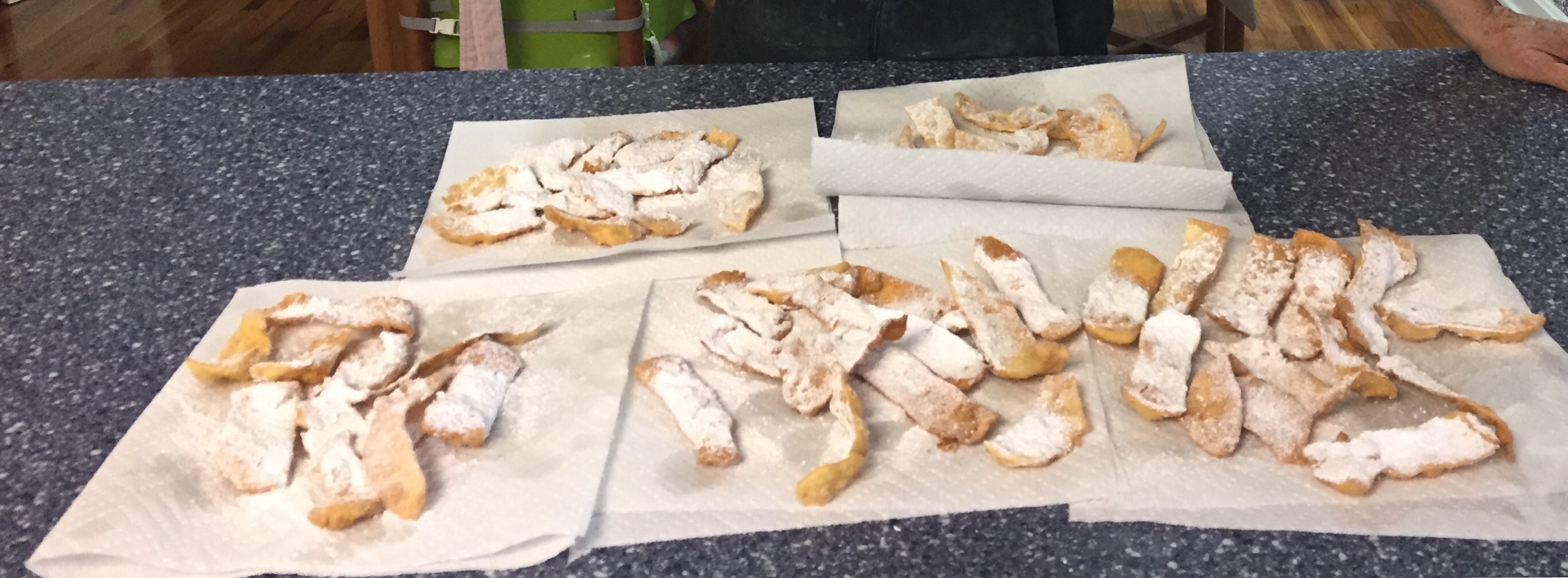
I combined some batches.  But here they are letting the oil soak out!

We had to try one from each batch to taste the difference.  The thinner the dough, the hotter the oil, the crispier the fried kichel, the better it tasted.  We had six batches, so we had to try six. YES!  We really did!

I am so happy my friend not only said that we need to make them one afternoon, she set a date! It was not only the fun of tasting and frying, it brought back the memories of cooking with our grandparents.  We cannot bring them back, but we can in our minds relive happy moments like this!

img_1613

 Mine are on the right!

Even after tasting, we had so much left over.  We divided them up relatively evenly.  I suggested she keep extra as she has a grandson living close by to help in the eating.  But I was happy to bring a plate home for my husband and me.

My husband doesn’t have the same memories.  He never tasted egg kichel.  A Shanda!  Can you imagine never eating them?  I cannot.  But then he did not have anyone to bake traditional cookies and treats when he was growing up.  Both of his grandmother’s died very young.

For me, however, each snap of a kichel in my mouth along with the melting of the powder sugar gives me joy.  Oy!  Egg Kichel!  It is so delicious


https://www.myjewishlearning.com/the-nosher/kichels-recipe-jewish-bow-tie-cookies/?utm_content=buffer717d6&utm_medium=social&utm_source=thenosher&utm_campaign=buffer


Discovering Karola’s Kielce Pogrom Testimony

12 Aug

In February 2017 I published a blog about discovering my grandmother’s cousin was in Kielce, Poland, during the Pogrom in July 1946. (See blog link below.) Since then I have been continuing my research on the lost remnants of my grandparent’s families.  Along the way, I have discovered more about Karola.

First off, I now know her entire name, which brings me more understanding. Korala’s mother and my great grandmother were sisters.  My grandmother was her first cousin.

Our families did keep in touch.  My father often went to Paris on business, occasionally my Mom would accompanied him and would visit a cousin who lived there.  That cousin was Karola.  She had changed her name from the Polish sounding to a more French name, and of course I recognized the last name.

In any case, it was when I found the village where my great grandmother was born, that I found also the Viroshov Yitzkor Book published in 1970.   In it, written in Yiddish, was Karola’s testimony about the Kielce Pogrom.   I must thank my friend, Blumah W., the local Chabbad rebbetzin, who spent several hours with me as she translated this moving memory.

I think with what is going on in Poland today, with the country’s wanting to deny their people’s involvement in the Nazi’s intent to destroy and annihilate the Jewish population.  Karola’s story and memory is even more important because it tells the truth of what really happened in the years pre, during and after the war.

The Kielce Pogrom By Karola Manes F. as translated by Blumah W.

 “A lot has already been told about the ferocious anti-Semitism of how the majority of Polish treated their Jewish neighbors during all the years of the Polish existence. It is still fresh in memory.  The anti- Jewish politics in pre-war Poland using power against the Jewish workers and merchants, and the hooligans acting against the Jewish young students. 

        Also, during the time of the War, being under the German occupation, the Poles did not forget their anti-Semitic tradition.  They were very much supportive of the Nazi program and worked with the Nazis for the annihilation of the Jewish nation.  (“G-d forbid,” added by Blumah.)

          When the war finished, the Jewish remnants were hidden in different places. A few Jewish people who were saved began to look in their birth places for their relatives; their flesh and blood.   Also, then there came upon these survivors, unruly/wild Polish bandits, bands of Poles, who murdered these few left over Jews.

           The culmination point of this ferocious Polish behavior was the tragic well-known Kielce Pogrom, which was accomplish over these few ‘leftovers’ in the summer of the year 1946.

            Being be that I was in that time in Kielce where I lived through this tragic chapter, then I will tell what happened during this incident.

            After the war, in Kielce there was the concentration of a larger group of Jews.  The portion of them came from hidden places and from the forests, where they were involved with the armed partisans combat.  Larger groups from back from Russia, where they found themselves during the time of the war.  In order to deal with stream of survivors, a Jewish committee was formed that found themselves on Planty Street. 

           The Polish people right away, in the first days, immediately began to agitate and incite against the Jews.  “TOO many of you remained!”  They said with extreme hate.

           The first provocation was when someone threw the dead body of a Christian woman into the Jewish compound.  It was accompanied with an incitement that they said the Jews murdered this woman.

           Only at night, Russian soldiers came dressed in Polish uniforms and made order. They arrested a number of Polish hooligans.   The next morning, on the way to the funeral, the Jewish people accompanying the dead, were guarded by the Russian soldiers in order to avoid any further incidents by the wild and unruly Polish population

            May these words act as a monument for the holy martyrs of the Kielce Pogrom; May G-d avenge their blood. “

In the last paragraphs, Karola does not talk about how people were murdered or what truly happened on the day of the pogrom.  Instead she talks about the fact that it was Russian soldiers who stopped the pogrom by dispersing the Polish hooligans.

To be honest, I was a bit disappointed.  I wanted to know from her mouth/her pen what truly happened. What she as a survivor saw.  But then, I realized, it was too much.  She had survived a ghetto, a concentration camp and now a pogrom, who am I to want more from her?

What Happened To Karola?


The Sorrow of Shalom Hollanders

7 Jun

In my blog “Murdered in Belzec” I wrote about Shalom Hollander, the relative who put in the information about my great grandparents and great uncle on the Yad VeShem datebase.  I had met him in 1976. when I was 20 years old in Israel, when took my Grandmother to Israel to see her brother (See blog link below).

After I found those three names, I decided I needed to see if Shalom entered other names on the Yad VeShem website, since I could only find one of my grandfather’s siblings.  I did an advance search using only Shalom’s name as the one who put in the testimonies.  About 45 names showed up.  After going through all of them, I realized that he had duplicated some names.  Mainly his own children.  So in reality there were probably 40 names of people that were somehow related to me, of these 18 were children.

And although I was looking for my grandfather’s siblings and their children, finding these three families and their children touched my heart.  They were also my family.

Among the many names were his wife and his five children.  With this information I found out how he was closely related to me.  His wife, Cerla or Tzira Feuer, was my great grandfather’s niece and so my grandfather’s first cousin.  She was 38 when she was murdered.  (I knew two of her brothers who survived the Shoah, one settled in Montana of all places and one in England. Another brother also survived.)

Shalom’s children were:  Elish (Ptakhia), 11 years old when murdered in Auschwitz; Etla, seven years old when murdered at Auschwitz; Mordechai, five years old when murdered at Auschwitz; Gital Tila, four years old when murdered at Auschwitz; Ita, two years old when murdered in Auschwitz.  They all were murdered in August 1942 on the day that the Jews of Mielec were deported .

Before they were murdered at the camp, they lived in the Tarnow Ghetto.  What a horrible short life they lived.

In the earlier blog I wrote that I thought he had no family in Israel.  I now know why.  All of these deaths.

But it doesn’t stop there.

His sister also perished: Chaja/Serka/Khala Holander Viner/Wiener also died.  I like how he gave all the names she used.  She died in Belzec.  Also dying was her husband: Pinchas Viner/Wiener. He died in a different camp, Plaszow Camp, which was first a slave labor camp. Then a death camp.

It doesn’t stop there because his parents Mordechai and Tova also perished in the Shoah.  They died on March 9, 1943, in Beredechow, Ropczyce, Krakow.  I wonder what happened that day?  Why were they both murdered then?  I tried seeing if such a date was important in some way, but could not find anything.  But I guess it was important because Mordechai and Tova were murdered that day.

His father was related to my great grandmother, an Amsterdam. But Shalom chose to use his mother’s maiden name. Or perhaps his parents never had a civil marriage as what happened to many Jewish couples in Galicia, so he had his mother’s name.

I am looking back at my 20 year old self in horror.  I remember spending several hours with Shalom and my grandmother.  We had a meal or drink together in a restaurant.  We walked around for a while as my Grandma talked to him.  I remember being a bit annoyed because I had to take Grandma by bus to a place I really did not know so well to meet him. I think it was in Haifa.  I knew Tel Aviv much better.
I still remember what he looked like.  He was relatively tall for an ‘old man.’ Probably in his mid-70s.  He had the look of my grandfather, but not as much as another relative I had met.

They spoke in Yiddish.  I tuned it out.  I was so exhausted from all the Holocaust memories I had been listening to during that four-week trip.   Can a person have delayed Jewish guilt?  Can those memories really cause so much sorrow to me now?

They do.   I went back to Israel a year later and spent over three months. But I did not go to see him again.  Other survivors who I knew, I did see. But not Shalom.

I cannot imagine what losing all those people he loved did to him.  I cannot imagine what sorrow he carried with him.   I knew another of my grandfather’s relatives who survived. I wondered if they knew each other.  Now I know that they did.  Although Ziesel and Shalom were both related to my grandfather from different sides of his family, they married into his close family by married sisters, his two first cousins.

I do remember a bit of that visit with Shalom.  I remember Grandma telling me that this visit would be different, that I would be meeting one of Grandpa’s relatives, not one of hers. And that she did not know him very well.  I remember the overwhelming sense of pain that came from him while they spoke.  My grandmother spoke to him in a way I had never heard before.  With him she was so gentle.  Almost whispering to him as they conversed.  Easing the words out of him.

I remember Grandma and me being exhausted after this visit.  I remember Grandma went to bed as soon as we returned to the hotel.  It really was too much to comprehend.  Too much sorrow.  So maybe I just let myself forget.

Now, as an adult,  I realize that I must remember Shalom and his wife Tzira; his children Elish, Etla, Mordechai, Gital and Ita; his sister Chaja and her husband, Pinchas; his parents Mordechai and Tova.  May their names be a blessing, may I use this blog to keep their memories alive.  Baruch Dayan haEmet.

https://zicharonot.com/2018/06/05/murdered-in-belzec/

https://zicharonot.com/2018/05/01/zysel-ziesel-feuer-survivor/

https://zicharonot.com/2014/04/28/speaking-yiddish-always-brings-me-holocaust-memories/

https://www.encyclopedia.com/religion/encyclopedias-almanacs-transcripts-and-maps/mielec