Archive | Uncategorized RSS feed for this section

Braille City Maps of Germany Delight Me

22 Sep

Our first stop in Germany was in an area that once was East Germany and part of the Soviet Union.  While many people from our cruise ship chose to take a train to Berlin, we decided to visit another Baltic City and UNESCO World Heritage Site, Wismar.

The first place we went to in Wismar was the center town square, or Market Place.  Our tour guide, a college student, first told us about the square and its important architectural structures, then walked us to a wonderful metal 3-dimensional, braille map of the city. When we arrived, a blind man and his care giver were at the map.  The man was examining the map with his fingers, as the woman explained what each place was, naming streets and buildings.

img_4873

Map of Wismar

Our guide waited a bit, then asked politely if he could talk to us about the map. (I was glad to know I still understand German, even though I have not used it in 20 years.)  Most important, I was impressed with the map.   I asked the guide if Wismar had a school for the blind, and so the map was there for this purpose.  He asked the care giver, who replied that was not the case. The map was just there for anyone to use.

That was that, or so I thought.

img_4878

St. Mary’s Church tower.

As we walked our guide told us about Wismar and the bombing damage during World War 2.  Two churches close to the town center, St. Mary’s Church and St. George’s Church, were heavily damaged.  Although St. George’s Church was rebuilt, St. Mary’s has only its main tower remaining and the start of a park that will be in the shape of the outline of the original church.

img_4886

When we got to St. Mary’s Church. I was surprised to see another braille map this one detailing the destroyed church and its environs.  It was being examined by the blind gentleman we had seen earlier.  We waited until he was finished, then we walked over to examine the map ourselves.  It was interesting to see the details of the church from before the war.

After viewing this map, we visited both churches.  The St. George’s Church has been rebuilt, but nothing remains inside. It is now used for concerts because the acoustics are excellent.  Inside the remaining tower of St. Mary’s Church are some displays about the churches in the city.

We signed up for this tour for another important visit, to the one brewery in Wismar.  Centuries ago, there were almost 200 breweries in the town.  During the Soviet occupation, all breweries were closed and the beer came from other cities.  In 1995 Herbert Wenzel purchased a building that had been a brewery in the 15th century.  It is now the only brewery in Wismar.  We visited the now named, Brauhaus am Lohberg zu Wismar, and tasted three of its beers.

Although the brewery, the port and the town center were all delightful and gave good reason for this to be a UNESCO heritage site, it was the braille maps that gave me the most joy.  What a great idea!  And to see someone actually using it made it so much more meaningful.  I loved these two maps.

I thought when leaving Wismar, I would not see them again.  But I was wrong.  The UNESCO World Heritage Site of Lubeck also had a braille map that was used by our tour guide to explain the old city to us.  I really enjoy seeing the city from an overview.
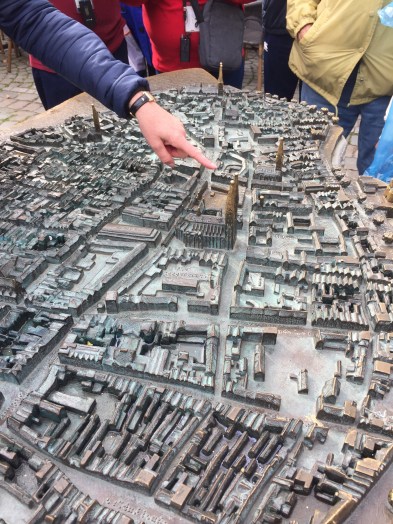
img_5763

Map of Lubeck

I was very curious about these maps.  Were they a German government idea? I thought maybe a UNESCO plan? I did not see these maps at any other UNESCO World Heritage Site.  When I looked back at my photos, I realized he map in Lubeck had a big clue.  On the map was a note in German that mentioned that the map was a gift from the Rotary Club Lubeck-Holstentor and said the maps were for the blind and sighted people.
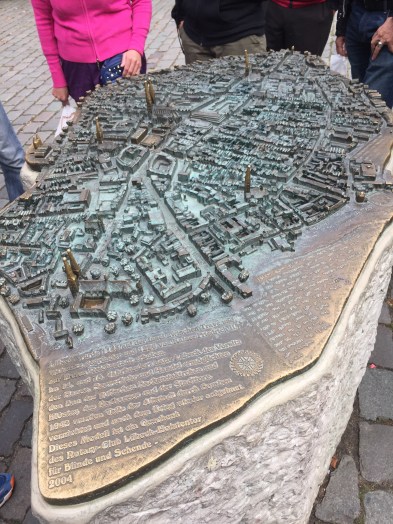
img_5761

Map of Lubeck with information about donors

That helped.  I knew that Rotary Clubs do community service and specifically have activities for the blind.  In 2017 Rotary International joined with the International Agency for the Prevention of Blindness (IAPB) to combat blindness.  I am assumed the map in Wismar was also donated by a Rotary Club, but I was wrong. When I looked back at my Wismar photos more closely, I saw that this map was donated by a large number of organizations, starting with the Lions Club of Wismar.  I am aware of what Lions Clubs do as well.  I often donate my old eyeglasses to the Lions Club!

I personally would like to thank the Rotary Club of Lubeck-Holstentor and the Lions Club of Wismar along with all the other organizations for these great maps!! I have an affinity for anything that helps the blind and vision impaired.  My mother was blind in one eye due to childhood accident.  Throughout my life, she constantly dealt with issues concerning her eye and was vigilant in making sure we had good eye health.  These maps delighted me and touched my heart.


https://www.rotary.org/en/rotary-partners-international-agency-prevention-blindness


A Fairy Tale Country, Estonia

21 Sep

img_5012

Spending a day in Tallinn, Estonia, was like being inside a fairy tale country.  I loved the old city with its quaint streets, towers and churches.  Tallinn is a UNESCO World Heritage site, and it deserves that status.  But more than then the look of the country was the feel of the country.

img_4983

The tower is called Tall Hermann

I love that they name their towers and weather vanes.  I love the magical feel of the old city and its cobblestone walkways.

Behind the beauty, Estonia has had its hardships.  Torn between two powers who wanted their ports on the Baltic Sea and its resources, both Germany and Russia/Soviet Union invaded Estonia many times over the years.  But in 1939 the worst happened when Hitler and Stalin signed a treaty dividing Estonia between the two and the two powers invaded Estonia from different sides of the country.

Our tour guide in Tallinn, a lovely young woman, told us that this was the worst.  People were torn between choosing between two evils.  And the Soviet Union proved to be a great evil, taking over the country and killing or deporting all the political and business leaders.

The only positive I see from this however, is this occupation saved the majority of Estonia’s Jewish population, which was about 4000 before the start of World War Two. By then end of the war, about 1000 of Estonia’s Jewish residents were murdered in the Shoah. The others had escaped into the Soviet Union and so survived. After the war, 1500 Jewish residents returned.

After World War 2, Estonia entered a 50-year occupation by the Soviet Union. Estonia was terrorized.  Our guide explained how all access to the Baltic Sea were closed by the Soviets, who put military bases there. People could not get out.  Help could not get in. She explained life as lived by her parents and grandparents.  It was not a happy time.

img_4966

A statue of Ernesaks overlooks the Song Festival Grounds.


But in Estonia, they came up with their own way of revolution that did not included guns or violence. The Singing Revolution started with the singing of the national song, “Land of My Fathers, Land That I Love.”  For years they sang this song in rebellion against Soviet rule.  Gustav Ernesaks, the “Father of Song” for the country who helped start the song festival movement, helped in this non-violent rebellion. The singing events were held on the Tallinn Song Festival Grounds.

The Singing Revolution lasted four years. Multiple songs and citizens singing saved Estonia!  Tallinn is also known for the large chain of people, over two million, that spanned from Tallinn to Vilinius in August 1989.  Singing songs and then slowly moving forward with small steps of rebellion and independence worked. By 1991, Estonia gained its independence.

Along with the freedom for all Estonians, came renewed freedom for its Jewish residents after 1991.  In 2007 a synagogue opened.  Today about 2000 Jewish residents live in Estonia. It is a small but secure population.  According to our tour guide and to what I have read, the Jewish population lives in comfort and without any issues thanks to a law that protects all minorities in Estonia.  There is a synagogue, a Jewish Day School, a Jewish Museum and a Jewish Community Center. I wish I could say that I visited all these Jewish sites, but I did not.  I wish I had researched Tallinn before I went. So I put links below to the Jewish sites of Tallinn.

img_5030

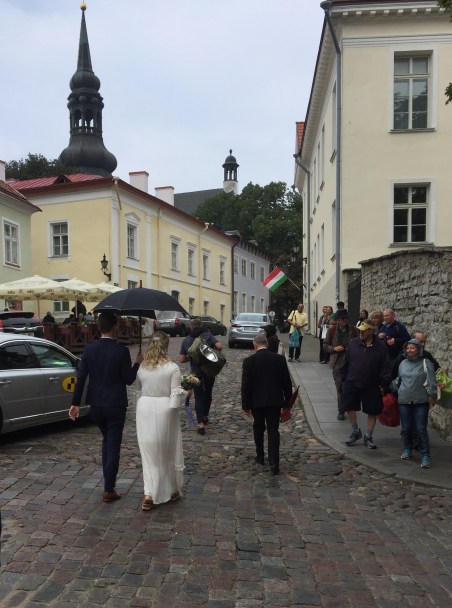
I loved my day in Tallinn.  Visiting this UNESCO World Heritage Site was a lovely experience.  Somehow, it seemed appropriate and joyful, to see a bride.


https://www.ejc.ee/templates/articlecco_cdo/aid/304672/jewish/History.htm

https://muuseum.jewish.ee/

Lessons I Learned While Traveling Through Countries Along Baltic Sea

16 Sep

During our two-week cruise of the Baltics, we visited Holland, Denmark, Germany, Russia, Finland and Sweden.   I never realized how close these countries are to each other, just hours away across the Baltic.  And I never realized how intertwined their histories made their peoples and languages and flags!  The architecture repeats itself in every city as influences of Sweden, Denmark, Holland, German and Finland structures can be found in all the cities, and a combination of these styles.

I met many tour guides.  Some were better than others.  But several gave sound advice that I want to remember forever.  In fact, I need to share them.

img_5660

Typical steps of unexpected heights!

We spent two days in St. Petersburg and had an excellent guide on our first day.  A retired engineer, she was now guiding tourists through the maze of royal palaces.  Her excellent advice: “Be aware of steps/stairs of unexpected height.”   I think it was her engineering background speaking. But it was so true.  With the cobblestone streets and the old buildings, many times we faced stairs and steps of unexpected height.

Often as we crossed the street or entered a building she would intone, “Be aware of steps of unexpected heights!” Her words resonated through my mind many times during the nine-hour day of touring.  I think, thanks to this lesson, we never fell, we were always aware, no matter what country we were in.

Another day in St. Petersburg, another tour guide with a different message. (She was a retired college professor.) “Don’t demonstrate your water bottle.”   I think what she was really saying is don’t make a big deal out of things.  It was very hot when we were there. Unexpectedly warm.  And many people had water bottles with them.  I kept mine on the bus. But others, especially older adults, needed their water.

However, at certain places, you are not supposed bring a water bottle in.  However, with the heat, they were making exceptions.  So, our guide said.  “Water bottles are not allowed, but don’t demonstrate your bottle. Put it in your back pocket and go through security.”  I guess if the guards wanted to take it away, they could. But not hiding, while at the same time, not making an issue of it, was the best policy. Thus several of our comrades on the tour kept their water bottles with them throughout.

In Denmark, I learned two important lessons.  The guide we had on a day when it was pouring rain, told us that in Denmark the saying is, “There is no bad weather, only bad clothes.”  I concur.  I had packed our Land’s End raincoats and good walking shoes.  We stood in the rain, without getting really wet, as the water skimmed over our coats, while others were drenched.  Meanwhile,  all around us, the Danes walked freely without umbrellas, ignoring the weather and  just strolling through town in the rain.

img_6038

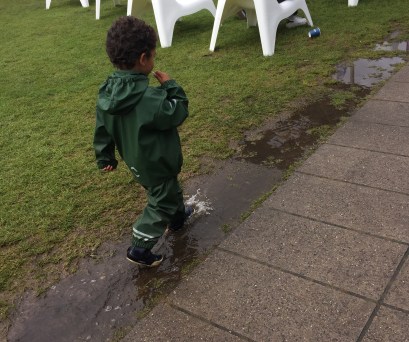
He was wearing good clothes as he splashed in the puddles.

I especially enjoyed seeing a young boy dressed in his very good rain clothes and boots splashing through all the puddles in a park as his Mom pushed his stroller as she ambled along next to him.  Good clothes do make a difference!

I will admit, the first tour guides words resonated with me during the rain in Denmark. As we walked the cobblestones and the steps of unexpected heights, I looked down and carefully placed my feet on the wet and slippery walkways.

The Danish tour guide’s other lesson was that umbrellas are not needed because they don’t work. Also true.  I had an umbrella at the beginning of the day. While we walked the streets of the city, it seemed fine.  But by the time I returned to the ship, the only place for that twisted and ragged umbrella was the trash.  You do not need an umbrella in Copenhagen or Arhus.  You just need good clothes!

I loved our tour guide in Stockholm.  She had an attitude that I appreciated.  The problem with most tours is that some people are always late, taking up time from everyone else.   She kept a steady pace wherever we went, shouting back to the slower walkers, “You can’t get lost, there is only one way to go …straight.”

She told us outright, when we left for a short period of time on our own, after she showed us the main square, that if we did not make it back to our bus at the assigned time, she would assume that we were staying in town.   We were adults and we could find our own way back.

And I appreciated that she said that, but then her soft side showed.  We had one woman on our tour who walked slowly using a cane.   When she and her husband were not back at the bus on time, our guide said, “I am just going to check the corner to see if they are coming.”  We all agreed that was a great idea.  And it was, as the couple were slowly moving up the hill and being careful on the steps of unexpected heights.


Seeing A Surviving Synagogue in Lubeck, Germany, Made My Day!

11 Sep
img_5728

The Holestentor, gate to the old city of Lubeck.

When we toured the UNESCO Heritage site of Lubeck, Germany, I loved the oval-shaped, island city which is surrounded by the river Trave.  I never thought I would enjoy being in Germany.  I carried my grandparents’ and parents’ distress about the destruction of our family in Europe during the war. But I hoped that Germany of today is not the Germany of the 1930s and 40s. So I went with an open mind.

Of course. I had to ask our tour guide about Jewish Lubeck.  She was open and sincere and had knowledge.  I am sure I am not the first person to ask her. She informed me that before the 1800s Jews were not allowed to live in the old city.  But afterwards, when the French took it over, Jewish residents moved in. But they had to leave again after the French and Napoleon were defeated. Jewish residents did not move back until 1848.

She told me that the synagogue in Lubeck survived because the Germans did not want to damage the museum that was next to it. It was built in the middle 1800s.  She gave me directions to find it during our free time.  The synagogue was closed for renovations, but I had to see this German synagogue that survived the war.

My husband and I took a ten-minute walk in the rain to the building. For me it was well worth it.  It seemed, from the outside, to be in good shape. A red brick building set far back from the street, the area in front was gated off and a sign explaining what was happening was in front.  When we were there a group of elementary school children were walking by.  Their laughter and joy in the rain, lightened my spirit.  Although I could not go inside, below I have put a link to what the shul looked like inside in the 1920s.

Our guide also told me an interesting story. She said that Jewish resident of Lubeck who escape Germany and settled in England helped to save the city. She said that the city was bombed by the Royal Air Force of Britain in March 1942 in retaliation for Germany bombing Coventry.  During that bombing 20 percent of the historic area was destroyed.  That was the only major bombing of the city, but it caused much damage.

From what I had read, the reason it was bombed was to test the firebombs to see how much destruction they would cause on the narrow streets of the old city. About 300 people were killed during the raid, so I think the RAF succeeded in destruction.   Her story is not totally correct from what I can tell. But that bombing was the only major attack on Lubeck.

She also said, that the Jewish resident who fled Germany to London wanted to save Lubeck. That made me wonder, could it be true?  Would a Jewish resident want to save a city in Germany?  It is a lovely historic area, but really after fleeing to survive, would I want to save my home town? I am not sure. However, that was her comment.

She continued that this man was a relative of the head of the Red Cross. So, I did research.  I think it all goes back to a man named Eric M. Warburg, who was born in Hamburg, Germany, not far from Lubeck in 1910.  He fled to the United States in 1938 and he became an intelligence officer for the US army and helped get German scientists and their families to the United States and out of Germany. He served as a liasion officer between the RAF and the US Army Air Force.

He along with Carl Jacob Burchhardt, who was president of the International Committee of the Red Cross, made Lubeck port a Red Cross port to supply prisoners of war with aid. Since Burchhardt was not Jewish, I assume she was referring to Warburg, even though he was not the head of the Red Cross, he had contacts. Also it made sense for Lubeck to be the Red Cross port as near Lubeck, the Nazis had a prisoner of war camp for officers, Oflag X-C, from 1940 to 1945.

Mr. Warburg was a member of a large Jewish-German banking family.   Could he have had a relative who lived in Lubeck and wanted to save it?  Maybe? Or could it be Mr. Warburg himself, a Hamburg native, who supposedly tried to save Lubeck?

I just have no proof of this. But I do have proof that members of the Jewish community in Lubeck were murdered by the Nazis.  I found five Stumbling Stones (Stolpersteine) for Jewish residents who were murdered in Riga. In fact, the last 85 Jewish residents in Lubeck were deported to Riga Ghetto in 1941-42, including Rabbi Joseph Carlebach (1883-1942), who was murdered in the Shoah.

You might notice that two of the Stolpersteine are for victims with the last name Alexander.  I have in my family members with this surname.  I will admit that I felt an extra pang in my heart when I read these two stones.  (See blog below about my Alexander family.)

I am not sure if there are any Jewish residents in Lubeck now.  There are about 3000 who currently live nearby in Hamburg.  At one point, before WW2, Hamburg had almost 20,000 Jewish residents.

img_5744

Salzspeicher houses along the Trave River.

Lubeck has many lovely medieval buildings.  I saw the unique entrance gate, the Holestentor,  that leads to the old town.  I ate marzipan at the famous Cafe Niederegger, which was founded over 200 years ago.  I saw the Salzspeicher houses that stand along the Trave River close to the gate. We walked past the home of Thomas Mann’s family. But for me, seeing a synagogue that survived World War 2 in Germany, was the highlight of the day in Lubeck.

 (Thank you to a resident of the area who was kind enough to contact me and tell me that there are about 800 Jewish residents of Lubeck and 5000 in Hamburg.)


https://en.wikipedia.org/wiki/Bombing_of_L%C3%BCbeck_in_World_War_II

https://en.wikipedia.org/wiki/Eric_M._Warburg

http://www.jewishencyclopedia.com/articles/10165-lubeck

https://dbs.bh.org.il/place/hamburg?gclid=EAIaIQobChMI2PabjJTH5AIVBr7ACh3P1gVmEAAYASAAEgJd4vD_BwE


https://dbs.bh.org.il/image/interior-of-the-synagogue-of-lubeck-germany-1920-c

https://zicharonot.com/2015/06/13/finding-katie/


The Floors of St Petersburg

10 Sep

It is a bit overwhelming to try to see as much as possible in two days in St. Petersburg. We went to Czarina Catherine’s summer palace in Pushkin. To two cathedrals: Isaac and Church of the Spilled Blood and the Hermitage, also known as the Winter Palace.

They were opulent, they were amazing, they were beyond belief, and so they made you realize why the ordinary Russian peasants and people rebelled against the aristocracy! The dichotomy between the rich and the poor was extraordinarily!

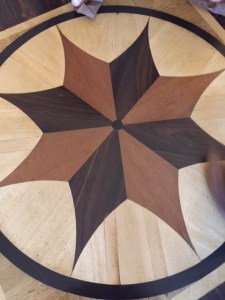
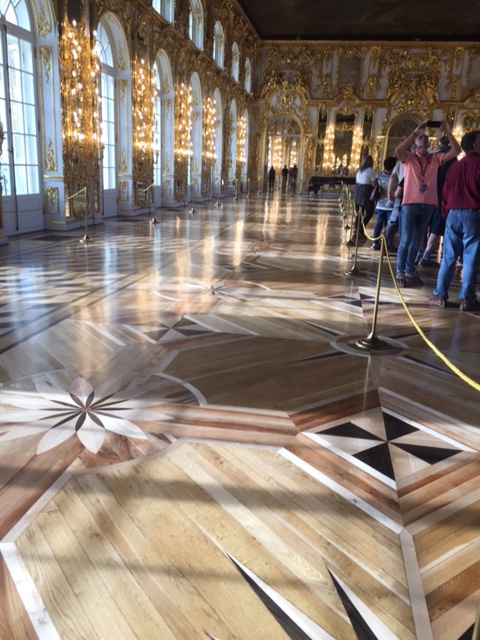
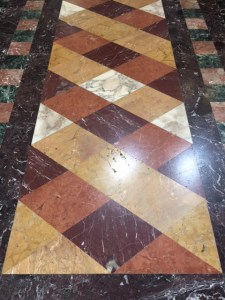
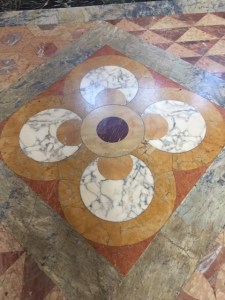
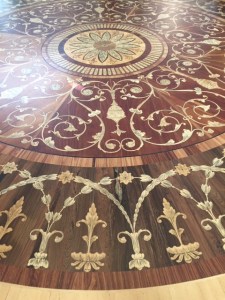
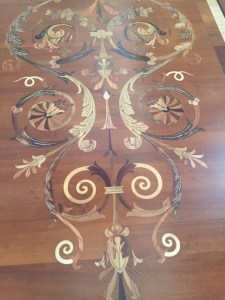
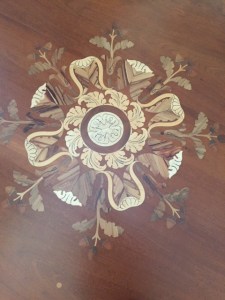
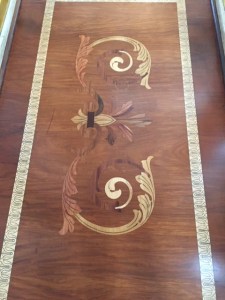
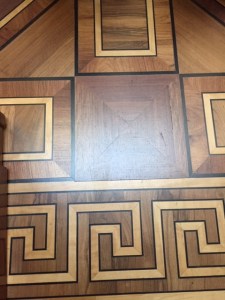
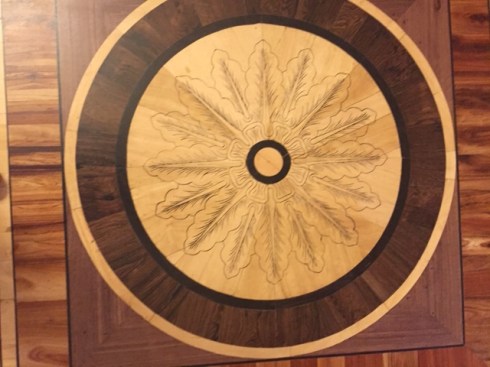
While in these churches and palaces, I began to notice the marble floors and the wood floors. They were also astounding. And I became obsessed, especially in the Hermitage where the floors were stunning examples of inlaid word and marble.

So here are some of my many floor photos.

First the floors of Catherine’s Summer Palace in Pushkin.

The marble floors of The Church of the Spilled Blood in St. Petersburg:

Finally the most magnificent inlaid wood floors of the Hermitage. I need to say that while we had to put on special booties to protect the floors in Catherine’s Palace, we did not have to wear them at the Hermitage. Some of these stunning floors are beginning to show damage. Here they are:

These buildings were so astonishing, it was often impossible to decide where to look. I think i focused on the floors, which are usually simple, as a way to relax my brain from the overwhelming lushness of what I was seeing. If you have ever been through the Vatican collection, then you know that exhaustion of seeing so much at one time. That is the feeling I had throughout my visit in St. Petersburg.

Discovering My Amsterdam Heritage in Amsterdam

26 Aug

Amsterdam has been the destination my heart has yearned to visit. My Grandfather’s last name was Amsterdam. We know his family moved from Spain to Portugal to Amsterdam to Poland where his family got the last name Amsterdam while others became Hollanders. So I always wanted to see where my family found safety. (I have written about this in the blog below.)

My first connection came unexpectedly. We first toured the Anne Frank House, which was of course heartbreaking to know how close they came to survival. But while there I noticed something I never realized. Anne’s mother’s maiden name was Hollander. I had an Oy vey moment. I knew that Anne Frank and my mom were both born in 1929. But now there was the connection in name. Could we possibly have been distantly related? My horror was multiplied. I have already found so many of my family murdered in the Shoah. (See blog below.)

Then while taking a canal tour we rode past the new town hall and ballet. We were told that the old Jewish Section of town was razed to build this and there was a community outcry. But it still happened. As we rode past I saw a black monolith with Hebrew inscribed in gold. I knew I would be back.

The next morning my husband and I took the 14 tram to the Portuguese Synagogue. We walked around the area. It was not open yet, so we could not go inside. But I assume this is where my family worshipped after their arrival in Holland. I saw the outside of the Jewish Museum. I need to go back to visit these sites in he future.

In front of the Synagogue was a statute with the date February 25, 1941. On this date was major strike started against the Nazis because of the roundup of Jewish citizens. The Germans were harsh in stopping the strike. Many would died and be deported. It was my first reminder of the Shoah.

But my focus was on finding the monolith. My husband and I started walking the almost mile to the Town Hall. Along the way I saw my first stolperstein, golden stones, in front of a home listing the Holocaust victims. I knew they existed but had never seen them before outside of photos. It was another ache to the heart.

We continued our walk until we found the monolith on the edge of the land overlooking the canal. The black monolith commemorating those who died. Again I thought of all who found safety there in the 1600s but could not find it in the 1900s. I have to be honest, it reminded me of the giant black monolith of “2001 A Space Odyssey ” indicating great change. The change here was the decimation of the Jewish community.

A short walk away from the monolith was a statute in honor of Spinoza, who was born in Amsterdam at this location. I was surprised to find it here, although I know his history. There was a plaque nearby that discussed Spinoza’s impact on ethics and philosophy.

My desire to discover my Amsterdam heritage in Amsterdam was not totally quenched. I will need to go back to the Synagogue and museum another time. But I still feel closer to my family history.

https://zicharonot.com/2014/06/09/as-spain-welcomes-back-jews-expelled-in-the-1400s-i-share-my-spanish-roots/

https://zicharonot.com/2018/06/07/the-sorrow-of-shalom-hollander/

Remembering the Summer of 1969

11 Aug

The most amazing summer of my life was the summer of 1969. In July we watched a man walk on the moon. We stayed up late staring at our black and white televisions as the first photos from the moon came through and we saw Neil Armstrong step onto the moon.

img_4358

Photo of a poster put up in 1969 to announce the new spot for Woodstock.  Insure is the incorrect word, it should have been ensure!

Later that summer we had a more impressive event close to our summer home. We first heard of it when signs started appearing about a concert being moved from Walkill to White Lake, New York, in the township of Bethel.

Although we were not in the town of White Lake, we were in its sister town, Kauneonga Lake, which was on the other side of the lake. White Lake and Kauneonga Lake were once basically two separate lakes with a narrow channel connecting the two, but at some time the channel was blasted open and the lakes were combined.

Wikipedia gives more information about the names. It states that Kauneonga is a native American word that means lake with two wings. Originally the lakes were called White Lake and North White Lake, but the northern side, where I stayed, was eventually named Kauneonga Lake.

On the corner of 17 B and 55 where you turn off to go to Kauneonga Lake was an old motel, the El Monaco, we loved going there for pasta and pizza. It was basically the only restaurant in town for the longest time. The El Monaco played an important part on what would become a world known event, Woodstock. The hotel was knocked down years ago. Now there is an empty field and a clock tower on the corner. Honestly, I never thought it would be demolished because of its history.

But then, in Kauneonga Lake and White Lake, the word, Woodstock, did not have positive connotations for a very long time. Max Yasgur became a pariah in town. He sold his farm a short time later and moved to Florida, where he died just a few years after Woodstock at the age of 53.

img_4339

By the Dancing Cat.

Times change. Now, thanks to Woodstock, Bethel Township and these two small towns have a better economy that most Sullivan County towns.

The hotels that used to cater to the many are now closed. Most of the bungalow colonies are closed or taken over by Hasidic groups that create synagogues on the property taking it out of the tax base. For many small communities this meant disaster. But the area of White Lake and Kauneonga Lake has had a revival. All thanks to Woodstock and Alan Gerry.

img_4399

Kauneonga Lake

This summer, while in Kauneonga Lake, my sister and I took a pilgrimage to the Woodstock site, where Max Yasgur had a hay field for his dairy farm 50 years ago. We have been there many times. But this time we went into the museum and took a tour. Since we actually remember the concert, we were glad to answer the questions of our guide, who was not there.


Bethel Woods Center for the Arts and the Bethel Woods Museum are all thanks to Alan Gerry. A native of Liberty, Gerry started the cable television business in the Catskills. It was thanks to him that we were able to watch television the night that Neil Armstrong walked on the moon. Before that we had horrible reception.

He became extremely wealthy, and used some of his wealth to form the Gerry Foundation and to help the economy of Sullivan County, and that included buying the Woodstock site and over 1000 acres surrounding it, then developing the area into a music festival site and a museum. Because of Bethel Woods, other businesses including restaurants and a distillery have opened.

img_4362

The pavers by the Bethel Woods Museum.

Now each summer weekend night close to 17,000 concert goers drive to Bethel Woods to see a concert. My parents loved going to concerts there. They had a membership and would go early to eat dinner on the grounds. Recently, when the Bethel Woods sold pavers in honor of the 50th anniversary, we purchased one in memory of our parents. My Dad would have loved where it is located, near to the entrance of the museum.

The weekend of the Woodstock anniversary Ringo Starr, Santana and John Fogerty will be putting on concerts at Bethel Woods. I know that the planned celebration that was going to be held elsewhere was cancelled. But at the site itself, celebrations will continue. Meanwhile at Yasgur’s Farm, the actual farmhouse, there will be a Woodstock celebration as well.

I have written about Woodstock several times. Below are the other blogs concerning Woodstock. I hope you all have a peaceful, wonderful weekend remembering a time of peace and music.

Woodstock Memories: A Walk On West Shore Road

Taking a Walk Up To Hurd Road to the Woodstock Site

The Legacy of Woodstock

Woodstock Revisited in August 1998

http://www.bethelwoodscenter.org
https://en.wikipedia.org/wiki/Max_Yasgur
https://en.wikipedia.org/wiki/Alan_Gerry

Breaking Hearts: Children in Distress

8 Aug

I know someone who is a survivor.  Although 95 years old, she still remembers the day she was put on a Kindertransport and saw her mother for the last time.  Although she knows what her mother did made sense, and allowed her and her siblings to survive, she still yearns for the mother who perished in the Shoah.

I have family members who survived the Shoah, but their spouses and children were murdered.  Their families destroyed.  They carried that sadness for their entire lives.  Two of them never remarried and never had other families.  The Shoah, the loss of their children was never forgotten.  How could you forget this?
So, when I see the photos of the children left behind when ICE agents raided the places where their parents worked, I think of these families.   I have to say, how is our government better than those who were in cahoots with the Nazis?   How can the ICE agents say they were just doing their jobs, just as the German soldiers did after the war was over, when they know that there are children being left behind with no one to care for them?   How can that be right?

I am sorry, but what I see terrifies and disgusts me.  For a government to do such acts and for the people to do these acts without thinking about the ramifications to the children, makes me sad for them.   I think they will eventually be punished for crimes against humanity.

When people look at the ICE agents, they see terror.  Is that what the ICE agents want to be known for?  For scaring children and destroying their fragile sense of security?

There are much better ways to deal with immigrants.   And those ways do not include cancelling all USA aid to other countries.  It does not include terrorizing people at the borders.  It does not include ripping children from their families and housing them in mass detention camps. It does not include leaving children unattended.  It does not include calling people coming to our borders for help ‘an invasion.’ It does not include dehumanizing families, children, parents.

What it should include is finding a way for those who have been good citizens of this country, paying their taxes and doing their jobs, a way for them to become citizens.  It allows those in refuge situations a way to find a safe haven.

It should not allow hateful speech and actions spewed at them by people in authority.  It should not include secret cabals spreading hateful language on secret Facebook pages.

Shouldn’t we have learned from the 1930s and 40s when we denied safe haven to those fleeing Europe?  My own family perish in the fires of the Shoah because they could not get visas.

It should include finding safe havens for the children, whose lives have been uprooted in so many ways.   The United States is a country of the people, by the people and for the people, which includes liberty and justice for all.  This administration seems to have forgotten our unique message to help the huddle masses and to be a safe haven.

Everyone should be horrified by what is happening.  And if you are not, then I pity you, because you have lost your humanity.

Some of My Paternal Family Mysteries Solved, But Not All

18 Jul

For more years than I care to share, I have been searching for answers to my paternal grandfather’s many family mysteries.  My grandfather did not want to talk about his family.  My grandmother, his wife, was the one who told me the little bit she knew, with a caveat,
“when you marry, check out the family, because you marry them as well.”   ( See links to blogs below.)

Before I go into details, I have to thank Evan Wolfson, my, I think, fourth cousin on my father’s side, for his help!! He had sent me a copy of my great grandparent’s marriage license and said he was doing research at the Family History Center run by the Mormon Church.  On a serious whim, I asked if he could help with my mystery. Over two days he sent me record after record.  I am forever grateful for his help in working on my mystery!!!

What we all thought we knew and what I know now:

Grandpa Harry was born in 1888 or 1889.  No he was not.  He was actually born in April 20, 1890, in New York.   I know this from his registration papers for the military in 1914, where he claimed he was, (and I wrote from what he wrote) “the mostly supporter of my father and mother.”  He was an operator and cutter in his own business, as a pants maker, at 90 Attorney Street in New York.

By the way, his brother Jacob also filled out his registration card for military service then.  But since he was employed as a stenographer at the Brooklyn Navy Yard, he did not go, as he was working in ‘home support.’

Grandpa was the oldest of six children.   No he was not.  He had an older brother, Samuel, who was born in Russia and came to the USA as an toddler.   He also had an older sister, Celia, who was born in the USA, but died when she was about 24 years old of pneumonia and pulmonary edema.  She worked making shirt waists and was single when she died.  She is buried in Montiefiore Cemetery in New York.  We will have to find her one day.

404868_10150550937698566_1584121025_n

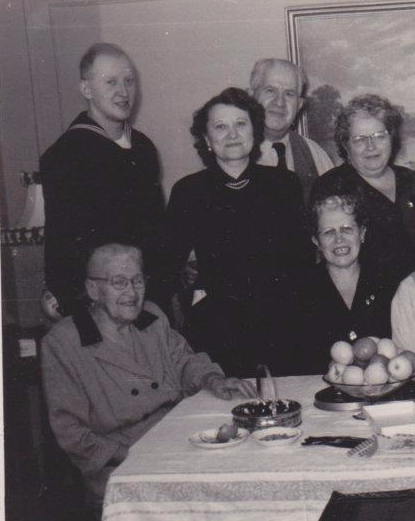
Standing: Great Uncle Lenny, Great Aunt Hady, Grandpa Harry, Grandma Esther. Seating are my great grandmother and great aunt from my Grandma’s side.

He was the oldest of the other children.  Grandpa Harry, born 1890; Jacob, born about two years later; Bertha, five years younger, and never married; Edith (Yetta), born 1898 and also never married; Hatti/Hady who was born in 1901 and married to Lenny Greenberg; and finally, Minnie/Miriam/Muriel, who married and had two children.

The other item I now know is that his mother gave birth to 12 children, of which 8 survived.  There is a child who was born in 1904 named Rosie.  But no other listings of her.

The story we all heard was that when Grandpa was in his early teens, his father abandoned the family and went to Seattle. And Grandpa then became the provider for the family, and also traveled to Seattle to find his father.   Probably, maybe for a while, then went back?  Not quite sure.  Here’s what I know.  Grandpa did go to Seattle, we have the photos and the story.  But it was not that early.   Did he find his father?  I am not sure.  Did his father come back for a bit?  Well he was in New York at least till 1915, so who knows what was happening. Perhaps he became ill as he was no longer working then.

I did go to Seattle and did research at the library.  I did find a Abraham Rosenberg there in 1906 who was a tailor, but I could not find the same man again.   I also now know that my great grandparents were still having children in 1901 and 1903.  Hattie was born in 1901 and Minnie/Muriel was born about 1903. And the child born in 1904.

I also know that when my grandfather registered for the military in 1914, he listed the sole support of his mother and father and siblings as the reason he could not serve.  I had heard for years that my grandfather supported all his siblings, many of whom went to college on his dime, while he was just a tailor.

I know they were living together at least until 1915 because they are on a census together.  But by 1920 Sarah is the head of her household, and Abraham is gone.   I wonder if he had gone to Seattle in 1905 after his last child was born, but then came back after my grandfather found him.  Grandpa would have been 16 in 1906. So that is possible.  Then after they got divorced, he left again?  I am only thinking this, I have no proof.  The only fact I know for sure, is that my father always said the only time he met his grandfather we when he showed up the day of his bar mitzvah in September 1941.   He had vague memories of his grandmother. But then she died when he was 8.

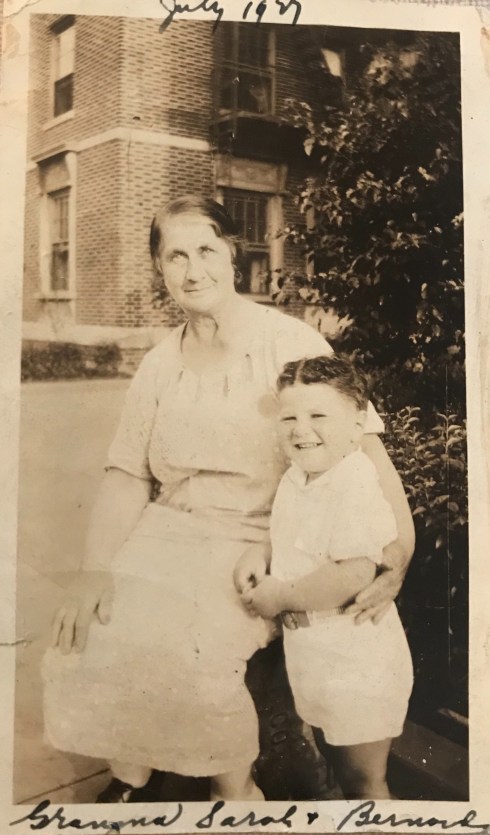
The only photo I have of my great grandma. Thanks to my cousin.

My other mystery was knowing nothing about my great grandmother Sarah.  Well I now know her maiden name was Ritt/Writt.  I first saw this last name on my grandparents’ marriage license.  They married on February 25, 1922. Grandpa was 30 and Grandma was 23.

But her certificate of death gave much more.  Her parents were Hirsh Ritt, who was born in Poland and Flora, also from Poland.  Hirsh makes sense as that is my grandfather’s Yiddish name.   Flora is unusual. It also states that Sarah was born in France, which was the first time for that announcement.  In other places she is listed as was born in Russia or Germany.  Still the woman of mystery.

When she died at age 68, on January 28, 1936, she was divorced and suffered from carcinoma of the pancreas.  She was only sick for one month and seven days and died at the Jewish Hospital of Brooklyn on 555 Prospect Place.

My Grandfather was the one who provided the information about his mother.

Thus some mysteries are solved.  And others now stand out.  What do the divorce papers say?  I still cannot find those.  What happened to Samuel?  And Muriel?    And where and when did Abraham go to Seattle or did him?  And where did he live after he and Sarah got divorced?  I had heard he was with another woman?

I knew Hady/Hattie and her husband, Lenny (see blog below.). Edith and Bertha, I never met, but I knew of them as the two maiden sisters. They went to college, but never married. However they gave my uncle the middle name, Prim; and my aunt the middle name, Gwendolyn.

As for Jacob. That will be another blog. Previously, I had found some information about him, and my cousin Evan was able to find a bit more during his research.

Once again, thank you Evan for helping me with my mystery! And a thanksto Tracing the Tribe Group, where I first encountered my cousin.


https://zicharonot.com/2015/06/14/the-sad-scandal-that-forever-scarred-my-grandpa-harry/


https://zicharonot.com/2017/10/25/the-missing-link-in-my-family-history-or-my-biggest-genealogy-block/


https://zicharonot.com/2018/11/16/epiphany-excitement-discovery-disappointment-hope/


https://zicharonot.com/2015/02/18/the-littlest-gambler-learning-about-horse-races-in-the-catskills/


Bells Chiming Make Me Feel Better

15 Jul

When I was a child, and home sick, my mother would give me a little bell to ring if I needed her.   My brother and sister also had the use of the bell when they were sick.  I loved that bell.  I knew as long as I had that bell, my Mom or my Dad would come into the room and make me feel better just by being there. Its sound brought me comfort.

img_4176

Space shuttle bell on the left; Tinkerbell bells in the back.  Chilean bells in the front.

So, of course, when I had children, I also wanted them to have a special bell to ring for me.  I tried many.  For my daughter, I tried a little plain bell first.  But the sound was really dull.  With her bedroom upstairs, I needed something that would sound better and stronger.  We found one in Disney World.  A little Tinkerbell bell that was perfect, as my daughter loved Tinkerbell.   In fact, my Dad would call her ‘Tink’ all the time.  Although in reality, she thought she was Tigerlily.  That is a story for another day!

When that Tinkerbell bell eventually broke from use, we purchase a new one. It was not the same for her.  Too bright, not darkened with use.  But luckily, we were able to rehang the original bell, fixing it and reclaiming its tinker.

For my son, I purchased a bell from the Kennedy Space Center.  I am not sure why the space center sold bells, but the sound was good.  Since my son liked space ships and rockets, this bell was perfect for him, with its dangling space shuttle.

Whenever they were sick, I would give each of them their special bell to call me when needed.  Did it always work?  No, not often.  Usually they would just call me, and I would come. But for me it was a comfort to know they had a bell.  In my mind, having a bell was about continuity and love. By giving them a bell, I was giving them the power to bring me to them, like a magical wish.

I always have been attracted to the sound of bells. I love listening to handbell choirs. There was even a Hershey’s television commercial that used chocolate kisses as bells.  I loved it.  So when I travel, if I see an interesting bell, I am attracted to it.    I did fine some lovely bells in Chile a few years ago. To be honest, although they are lovely to look at, they do not sound good at all.   In fact, no bell quite sounds as good as my mother’s bell.

Actually, I have my mother’s bell, so I really need no other.   I believe my Mom brought to me when she came to visit one time because she knew my attachment to it.   I keep it in my family room.

It is a small brass bell, with a bit of red trim, set in a holder.  On the bottom it says “Made In India.”  But 60 years ago, when my mother first had this bell, I do not think there were many things from India for sale in the USA.  I now know that it is called an elephant claw bell, because of the shape of the bottom.   I have seen several similar bells with base for sale on line.  Sometimes they are called “antique ceremonial meditation bells.”

I can see it being a meditation bell, as It has the loveliest of tones. My bell has the same tones as those used by my yoga instructor to indicate the end of class.  But for my bell, when I ring it, my soul and heart returns to those happy memories. And I see my Mom in my mind — my young mom, the mother of three small children.

Another bell was important to my family. We used it only in the Catskills, my Mom and my Grandma used a large metal dinner or cow bell to call us to come in.  The bell hung outside the door of my grandparents’ house, facing the back towards our bungalow.  We had four acres of land including woods, so they often did not know where we, the children, were playing. Sometimes we were at our neighbors’ yards playing. It did not matter, when heard that large bell ringing, we knew to come.

Grandma would also ring that bell when she wanted one of us to come down to her house to get something or do something for her.  My mother would ring to bring us in, yelling our names along with sounding the bell.  It was used daily.  When she had grandchildren, my Mom used the bell to call them in as well.

Th bell is still at our Catskills’ home waiting for another generation to be called. Its loud clanging, not so beautiful in tone, but beautiful in memories.

The sound of bells chiming almost always puts me in a good mood and make me feel better.


https://www.thetabernaclechoir.org/videos/carol-of-the-bells-mormon-tabernacle-choir.html


https://www.youtube.com/watch?v=Pe4IZ7aGikw