Archive | Uncategorized RSS feed for this section

Thinking of My Dad on Memorial Day

29 May

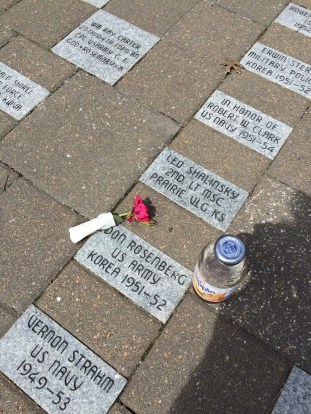
A rose and a Snapple for my Dad. 2016.

My  Dad was the recipient of two Purple Hearts and a Bronze Star. During the Korean War, he was a forward observer, which meant he had the job of going in front of the front lines, laying the radio cable with which they communicated, and observed what the enemy was doing.   Sometimes he disappeared for a while, with no communications home to my Mom or to his Mother.

Before he left f or Korea, my Dad got engaged to my Mom, married her on his last leave, June 17, 1951, and spent time in California training. At first, I think because of his advanced age, he was almost 23, he taught map reading to new recruits. Dad loved to read maps. Honestly, I think GPS systems would have driven him crazy, as paper maps have almost vanished. For Dad a map was important.

His time as a instructor was limited. One day during exercises, an officer insulted my Dad, making anti-Semitic comments and making fun of the mezuzah he wore around his neck.   Dad was not a tall man, but he was a big man. He tackled the officer and broke his jaw.

Not a good thing to do at all. But Dad was from the Bronx. He learned at a young to defend himself. And perhaps going to an all boy high school, DeWitt Clinton, in NYC, made his sure of himself.  And he was not stupid.  He knew exactly what he was doing. But NO one was  going to make fun of him for being a Jew. (Okay, I will admit he dropped out of college, CCNY,  his biggest mistake,  he ended up in Korea instead of in a classroom.)

He was lucky, his commanding officer, a Captain, saw the incident. He and several others hustled Dad back to camp.   As far as anyone was concerned, Dad was not there when the Lieutenant had his jaw broken.   But Dad was demoted a grade and sent to Korea. He always said that the USA paid for his first cruise…to Japan and then to Korea.

Dad’s first Purple Heart came when they were going up a hill. His group was being bombarded.   The noise was horrendous. Years later when Dad saw “Saving Private Ryan,” he discussed that noise. The movie brought back his memories, as he was part of the amphibious landing in Lochi.  My Mom said he cried during the opening sequences.

He told us, They got everything right, even the sounds of the bullets hitting the sand, but they could not get the horrendous smell.”

Dad was injured on the hill. Shrapnel entered his legs. He was bleeding. His friends cried out, “Rosie! Get Down! You are wounded! Medic Medic!. “ He said he did not even feel the pain in the rush to get up the hill.   It was Dad’s first visit to a MASH unit.   Needless to say, Dad loved the television comedy M.A.S.H. The MASH doctors fixed Dad up and he went back to war.   Years later the shrapnel began to exit his legs, causing him much pain.

Besides being a forward observer, Dad was a radio man. He laid wires and fixed faulty wiring. He received a citation for bravery for fixing wiring at the base during a bombardment. He was up on a pole fixing it, while bombs fell around him.

His Bronze Star was a unit award. Quotes from my sister: “His unit got in during the Inchon incursion when the South Korean army units on the flanks bugged out and left his division holding the line against North Korean army until relief units arrived.”

My brother disagrees. He says yes it was a unit award, but was not for Inchon. They were actually in the mountains and were abandoned by the South Koreans. The unit got the Bronze  Star for this mission, for fighting their way back to their encampment and surviving.

His second Purple Heart got him the trip home. This time by plane to Hawaii and the big pink military hospital on the hill.   (I waved to it when I went to Hawaii 17 years ago.   Dad asked me to do that for him.) Then to California and one to Massachusetts, where Mom was able to meet up with him.

She always said that Dad was not the same person when he came home. She would say that he was not a human being. That it took a full year for the real Donald to come back.

Dad was the kindest, gentlest man. He loved people. He loved his family. But his time in the army changed him.   Certain noises would impact him.   Military movies made him cry.   He went to pay respects at the Korean War Memorial in Washington, DC, as well as the one here in Kansas. At both he cried for those who did not come home.

2017 Remembering my Dad and Mom. Two roses.

On Memorial Day, I always think of my Dad, and all the others who served our country.  I go to the Korean War Memorial near my home and put roses on the stone I put in for my Dad.   Roses for Rosie….and I drink a diet peach Snapple, his  and my favorite drink.

Another Blog about my Dad:  https://wordpress.com/posts/zicharonot.wordpress.com?s=My+Dad+was+a+Proud+Veteran

https://zicharonot.wordpress.com/2015/11/10/museums-help-me-honor-our-relatives-who-served-on-veterans-day/

Setting My Seder Table is An Act of Love

22 May

Each year, on the morning of hosting a seder, I remove my Pesach dishes from the high cabinets where they sit away from life during the year. Many of these amber glass dishes have been in my family since the 1930s.

Once they were my grandmother’s dishes. She collected them during the Depression, as they were given away for free or a low cost. Sometimes they came in boxes of food or were prizes presented for going to the movies. I sometimes wonder if the fact they owned a bakery gave her more access to these dishes, as she had quite a collection of one pattern.

Grandma’s depression glass was produced by the Federal Glass Company.   Our pattern is called Patrician or Spoke. Many just call it Patrician spoke because of its center design. The color is amber, although this pattern came in several colors: pink, green, clear and amber.

When I first got these glass dishes, there was not a complete set at all. Many had chips along the edges. The collection included luncheon plates, a few dinner plates, a creamer, a sugar bowl without its lid, several coffee cups, more saucers, and two serving oval serving bowl and an oval dish.

Over the years, I have filled in the set. I now have dishes to serve 18 people at Pesach: dinner plates, soup bowls, bread/butter plates, dessert bowls, and multiple serving pieces. Many of the pieces I have repurposed, like the bread and butter dishes, now used for gefilte fish. The creamers and sugar bowls are used for charoset. Small bowls sometimes are filled with salt water or eggs. I have both cereal bowls and soup bowls…all are used for matzah ball soup to start the meal.

When I first used these dishes, I would change everything for the holiday. Pots, pans, two sets of utensils, everything in the house would change. But for Pesach I just used this one set of dishes, since glass dishes could be used for milk or meat. They just needed to be cleaned in between uses. This made Pesach a bit easier.

I have to admit, over the years, I have stopped changing everything for Pesach. I still clean out the cabinets and pantry. I still stop buying bread or any product with yeast. I still buy my Kosher for Pesach food. But I no longer switch all my pots, pans, utensils and more.

IMG_3209

My Patrician Spoke dishes, with my Rueben wine glasses and Lenox seder plate at seder.

But what I still do, and will always do, is take out my Depression glass dishes to be used for the seder. It is a minor ordeal. Someone, usually me, stands on a step stool to reach into these cabinets. Someone else, usually my son or daughter or husband stands below me as I count out the number of dishes I will need for the current seder.

They place the dishes on the clean counter.   There are many that have to be transferred. As I take out each dish, I run through the seder in my mind. What each dish will be used for; what time in the seder will it be used; what I need to still prepare for the meal.

Preparing for seder is a several day event. The foods, the dishes, the haggadah; each are planned according to the rituals and the group that is attending the seder. I have three sets of haggadahs. I switch depending on the mood and the attendees. But the one constant is my dishes.

Besides the dishes, we now bring out the seder plate.   My Lenox plate was my parents. When they stopped leading a seder, they gave me their original plate, and purchased another one for my sister. The special glasses from Murano, Italy, come out of the breakfront: one used for Elijah’s cup filled with wine; and now one for Miriam’s cup filled with water. These my husband and I took from my in-law’s home after his mother passed away when she was only 59. Each of these items bring memories as well as set our families who are gone at the table.

For many year’s I used a matzah cover created by my great grandmother in Europe in 1901.   Two years ago I donated it to a museum (see link to blog below). I now used a matzah cover I made as a teen.   But sometimes, I use one that my husband purchased for me in Cochin, India.

The small wine cups we use are Rueben glass from Israel.  One set was my parents,  I actually took all the Rueben glass when we cleaned their home for the first time.  The others were part of a wedding gift my husband and I received many years ago. We truly have a multinational seder with the items from throughout the world.

Even setting out kippot has a meaning. As we place the colorful kippot at the table, we read the names inside. Someone’s bar or bat mitzvah is remembered as well as weddings we attended. I always provide my husband the white kippah he wore at our wedding.

The napkins I use for seder are also special.  A friend made them years ago.  Twenty napkins, two sets of plagues.  Each napkin has a number, a design and a plague.

Setting the seder table is an act of love. Each dish, each ritual object carries memories.

When I put them away each year, the process reverses. I stand back on my stepstool and someone else hands me the dishes as I request.   We are done for another year. Except for one addition: I add one thing, a piece of the afikomen to keep us secure for the year until the next seder. This piece replaces the piece that I put away a year ago.


https://zicharonot.wordpress.com/2014/06/12/watching-antiques-roadshow-inspired-me-to-donate-my-great-grandmothers-matzah-cover/

https://en.wikipedia.org/wiki/Depression_glass

Costume Characters Just Made My Children Crazed

20 Apr

I know that people have the best times taking photos of their children with big costumed characters.   Not just the Easter bunny or Santa Claus, but also characters like clowns or at Disneyland and Universal Studios. This did not go over well in my family for several reasons.

First, since we are Jewish, I never took my children to have a photo with Santa or the Easter bunny. But that does not mean that we did not have encounters that shook us to the foundation. Second my daughter, and then my son, were petrified of costumed characters. Just seeing their oversized heads could start a squall! Finally, both of my children were shy.

When my daughter was three, we were walking though a mall’s lower level, a few days before Easter. Along came the Easter bunny and his helper. My daughter was the only child around, so the Easter bunny decided to walked over to say hello. Ad my daughter looked up, I noticed you could see a man’s face through the mouth in the costume.  I had a bad feeling.

My daughter started screaming, “The Easter Bunny ate someone!” Full out screaming. Needless to say the Easter bunny ran away as quick as he could, while I was left with a screaming traumatized child. True story. 28 years later. I still can hear her screams in my memory.

When she was young my daughter had panic attacks whenever she saw a clown. This was unfortunate, as her great-great Uncle Mike worked hard to make her a beautiful ceramic clown. It was lovely and colorful. However, she would not sleep at night with the clown in the room. I had to put it away, in another room. Eventually, the fear abated. But when she was small, clowns were an emphatic NO.

Our Santa experience was less stressful in some ways, but more in others. We have all seen and spoken to the many Santa’s who collect money for the Salvation Army.   We always put money into their collection pails whenever we could. And at first this created no problems. As long as they did not speak to her we were fine.  She would shyly walk up and drop the donation in the slot.

But when she was about six, she had an epiphany. “Mom,” she asked as we drove away from the mall, “How can there be so many Santas in one place?”

I was not thinking. I just told the truth. “Honey, there really is no such thing as Santa. He is a made up character. “ I immediately knew I had made a mistake. Her best friend was Greek Orthodox. Her quick response was, “I have to tell my friend.” That would not be good! OY! Dilemma of high magnitude!

Quickly I came up with an answer. “Wait. Not all Santa Claus’ are fakes. These are really Santa’s helpers. The real Santa Claus cannot do everything. So he has helpers.” Whew….that seemed to help. And I hope she never said anything.

With my son, I was no longer surprised by any fears.  I just avoided the malls during the heavy holiday season. Or at least I did not take my son there. But then came an experience I did not expect. When my daughter was 5 and my son was one, we went to Disney World. My parents came along. I expected a fun-filled adventure. But no!

I had booked a special Goofy breakfast with some of the Disney characters. But it did not go as planned. My son was petrified of all the big characters: No Mickey, Minnie, Goofy, Pluto, or Donald for him. They could not come near him without screaming emanating from his little body.

fullsizeoutput_85bd

A breakthrough! My son allows the Dream Finder a high five as my daughter looks on.

We had a minor miracle in Epcot with Figment and the Dream Finder, when my son was three. Thank goodness the Dream Finder looked like a real person, without a big head. Figment, of course, was cute and adorable. My son and daughter came home with their own Figment plush toys.

But the fear does eventually end. Years later we went to Disney World again. My children were older and ready to meet all the characters. My son even got an autograph book for all the characters to sign. We still have it. He ran up to the characters and led the way to the autograph areas. I am glad the childhood fears are gone.

I Kept Waiting For A Connection 

13 Apr

Through Tracing The Tribe, I became friendly with another member, Amy Cohen. We would read each other’s blogs and comment. We became Facebook friends. Another friend of mine did research that overlapped her research. There were just many connections. 

As she continued on her path, I kept waiting for our lives to intersect.  I just knew we had to be related somewhere.  Finally her research brought her to the Midwest.  Then I knew for certain our genealogies would intersect.  In the plain states, the Jewish population is intermingled.  And my husband’s family has tentacles that cover several states. 

Finally just before Passover the first tentacle reached out. Her distant relative was married to one of my best friend’s sister. But that was not enough.  I kept waiting and reading, and on Seder day it happened.  Another of her distant cousins was my husband’s uncle (by marraige).  More than that, the cousin who married my friend’s sister was related to our uncle. 

Now all sorts of connections are occurring as different Midwest family and friends read the blogs.  Click click click, the pieces fall into place. 

But to be honest, I still think there must be another connection that is more direct.  I keep waiting. 

We are one people. 

Cruise Conversations That Linger In My Heart

6 Apr

When I travel I have learned to expect the unexpected.  You never know who you will meet or what will occur.  The best is to be flexible.  But occasionally you meet someone who makes an impression.

The first time this happened was on a cruise over 25 years ago.    At lunch time, on a cruise, you get to sit with many different people.  You never know who you will meet or what you will talk about.  On the second day of this Caribbean cruise, we ate lunch with an older man, who when he reached across the table,  I saw numbers tattooed on his arm, numbers obviously from Nazi days.

I said nothing.  I remember as a child, in the early 1960s, I saw numbers on the arm of my parent’s friend.   I asked the question, “Why do you have numbers?”  The room grew silent, and I was taken from the room and told never to ask that question again.  It wasn’t until I was much older I understood that  in the early 60s people did not talk about the numbers.

But this was the early 1990s and I was no longer a child.  Since we were seated next to each other, I waited.   When most of the people left, I asked.  I had the most interesting conversation.  The man next to me was a retired priest.  He was on board to hold services.   He had been in the camps as a young man because he and his parents resisted the Nazis and were part of the intelligentsia and were ardent Catholics.  He and I had several conversations over the week-long cruise. We spoke about his experiences and the death of my grandfather’s family in the Shoah. Although I have forgotten his name,  I have never forgotten him.

But when we went on a cruise this past March, I did not think I would meet another survivor. So many years have passed, and among those survivors who are still alive, few still travel.   At lunch one day, I found my husband speaking to a much older couple.  The man was obviously elderly and perhaps recovering from an illness.  But he spoke strongly with a distinct British accent and he had a much different life experience.

His story touched my heart.  He and his brother were sent away from his home in Germany on a Kindertransport to England when he was 14.  He was one of the lucky ones.  His parents survived as well!   “We had a wonderful life in Germany,” he told us.  “We were more German than Jewish.”

But of course that did not help.  His parents were quite wealthy and aware enough to start the search for visas and relief early on.

When he turned 18, he enlisted in the US army and was sent to the United States.  His service helped him become an American citizen, because until then he was a man without a state.  While in the USA, just before he left for Germany, he became a US citizen.  His commanding officer advised him to change his name from Adolf and the very Jewish last name to something less Jewish sounding.

“If they capture you in Germany with that name, they will not keep you as a prisoner, they will kill you,” his commander told him.  Since he was getting citizenship he should change his name now.  So while he traveled to court he kept thinking of a good name.  He decided on Ralph for his first name.  For his  privacy I will not relate his last name.  He did go to Germany and was a translator for the Army during the closing days of the war and afterwards.

I have read about the Kindertransports and heard speakers discuss these train rides to freedom,, but I never actually met someone and had an informal conversation with someone who survived through this path.

Although I have read many books about the Shoah and spoken to many survivors, these two men will remain in my memory. My conversations with them linger in my heart.

Missing the Frank Gehry Museum, My Only Regret

2 Apr

Now that my trip is over, I must admit my one disappointment: not seeing Frank Gehry museum building in Panama City. 

Although I have never studied architecture, there are certain architects whose works intrigue me. I have written about Gaudi and Hundertwasser in a previous post (see below). 

But I also love the work of Canadian-born architect Frank Gehry. I just love his whimsical style just as I love the unusual designs of  Gaudi and Hundretwasser, who built structures before him. And although they worked in more natural materials, for me Geary’s modern  metal structures seem to meld into my love of slightly weird edifices. 

I think I also have an affinity to him as he was born one day after my mother’s birthday in February 1929 to an  immigrant Polish- Jewish mother, as was my mom.  

I love the Stata Center, the University building he designed for MIT in Boston. Walking around and inside and outside of this building just gave me joy. I loved the unusual angles.  

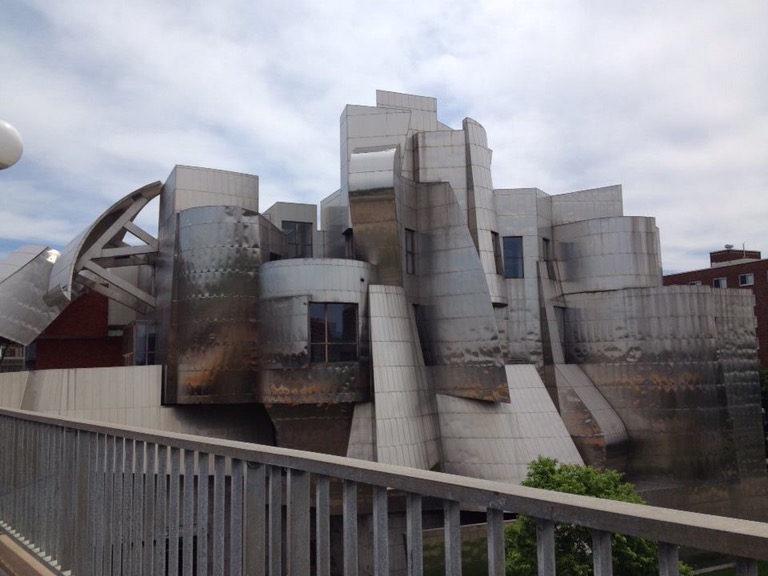
In Minneapolis viewing the museum from a bridge.


In Minneapolis we enjoyed time meandering through the Weisman Art Museum he designed near the University of Minnesota campus. When we walked away, I noticed a bridge which I immediately said had to be designed by Gehry as well.  I was right. My confirmation was a quick text to a young women I know who studied architecture at the university. 

Concert time


In Chicago I have enjoyed concerts at Millennium Park in the outdoor Jay Pritzker Pavillion theater that Gehry designed. The massive metal structure that surrounds the stage provides great acoustics and, for me, a welcoming embrace. It seems to reach out and say, “Pay attention!” I have meandered along the Millennium Bridge in the park. And I have yelled at teens trying to skate board along its lovely metal sides.

I have seen Geary’s famous fish sculpture in Barcelona, the city of Gaudi. This gives me joy I love that there are structures built by both done a century apart.  Although Gaudi’s famous church is still under construction. 

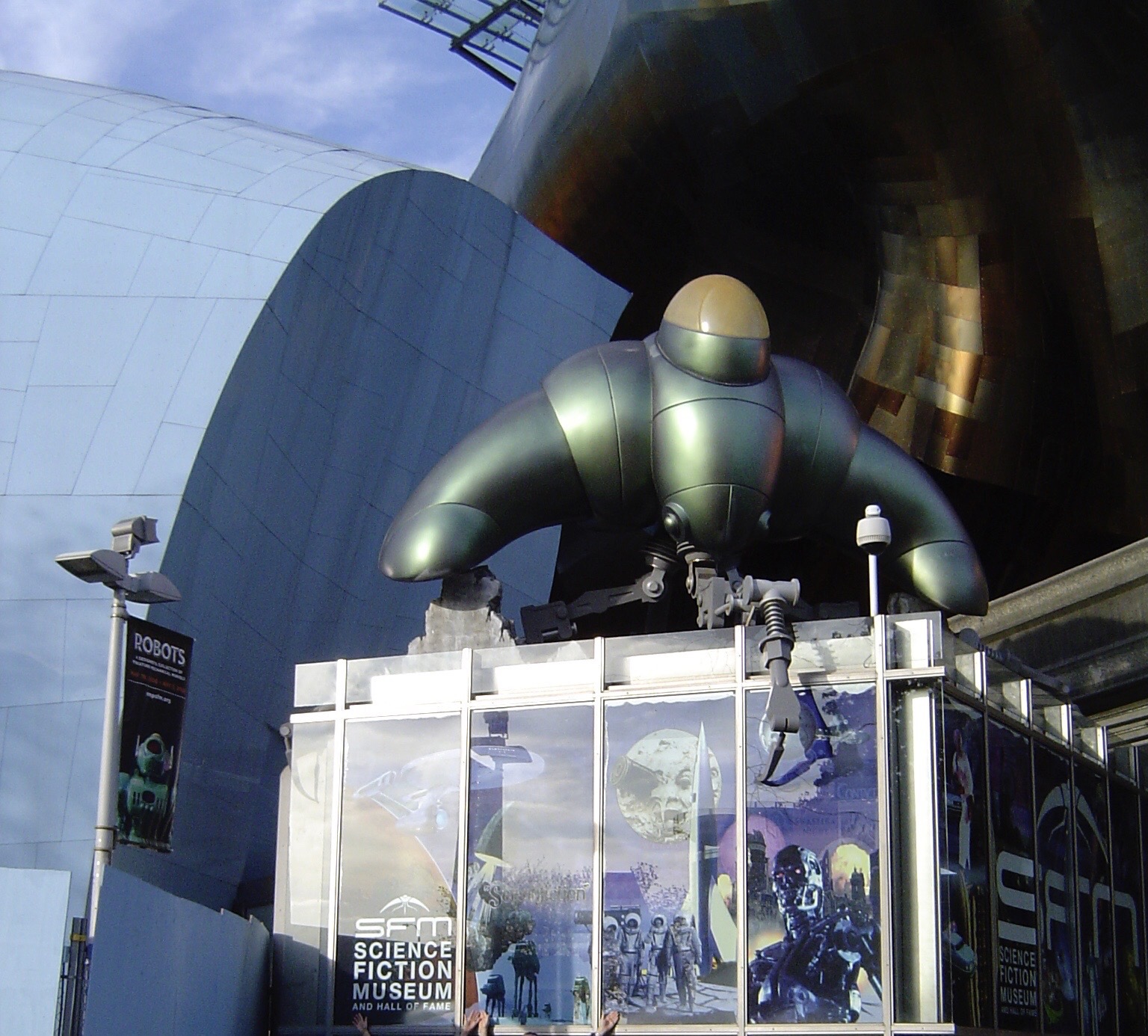
At the Museum of Pop Culture, the Gehry alien.


I visited the Museum of Pop Culture in Seattle and loved the Science Fiction Museum inside. I, of course, love the alien inspired figure over the entrance to the science fiction section. I enjoyed walking along the outside of this unique structure, loving the different forms and bright reddish color center.  

So it is not a surprise that I had signed up for a tour of the Biomuseo in Panama City that Gehry designed. Unfortunately, this tour was cancelled due to lack of registrations. How frustrating!  People signed up to go shopping in Panama City, but not tour the museum. 

And no we could not go on our own. We had docked in Colon for a short stay. The only way to get there was by a ship offered tour. I would have loved to really see the building, not just photos. Also the topic focusing on the changes in Panama due to the Canal would have been fascinating. 

So I must admit,  my only regret of our South American/Panama Canal vacation was missing a trip to this museum. I guess I will have to go back. 
https://zicharonot.wordpress.com/2015/07/06/my-architectural-love-affair-with-hundertwasser-and-gaudi/

Panama and The Canal 

31 Mar

Finally, we reached the Panama Canal.  The entire focus of this trip was to pass through the Canal locks and to see the workings of this major engineering endeavor. Of course the ports of call were interesting. But this was the impetus of our trip. 

We reached the entrance of the Canal early in the morning and entered the first lock of Mariflores at about 9 am. It was a Party atmosphere as everyone was on deck to view the lock process.

The electric mule at work


It is intriguing. First lines have to be attached to the electric, ‘mules,’ a small train engine, which helps guide the boats through the Canal. 

Entering the first lock.


The water used in the Canal is all fresh water from Gatun Lake and the locks are filled by gravity. There are no pumps that are needed. It helps that Panama has nine months of Rain each year with well over 200 inches of precipitation.  

Since we started by going up, 85 feet over three locks, it was fun to watch the water bubble up and slowly lift our cruise ship! We went through the first two licks, then traveled a short distance to the Pedro Miguel lock, then into the pass where we passed the mountains that has to be cut away to form the Canal. 

Gatun Lack was larger than I anticipated and filled with lovely islands and birds. A beautiful, peaceful sanctuary. 

Finally to the Gatun Locks, where the process repeated, but which slowly lowered us through the three locks to the Atlantic Ocean. 

Two boats in the locks going in opposite directions. The big beige walk is actually a giant freighter

Then on to Colon, Panama. The next morning we returned to the Gatun Locks by land and were able to see the lock process from a different view. Still intriguing and amazing to watch the boats side by side, one going up and the other going down in the two separate lanes of the Gatun Locks. 

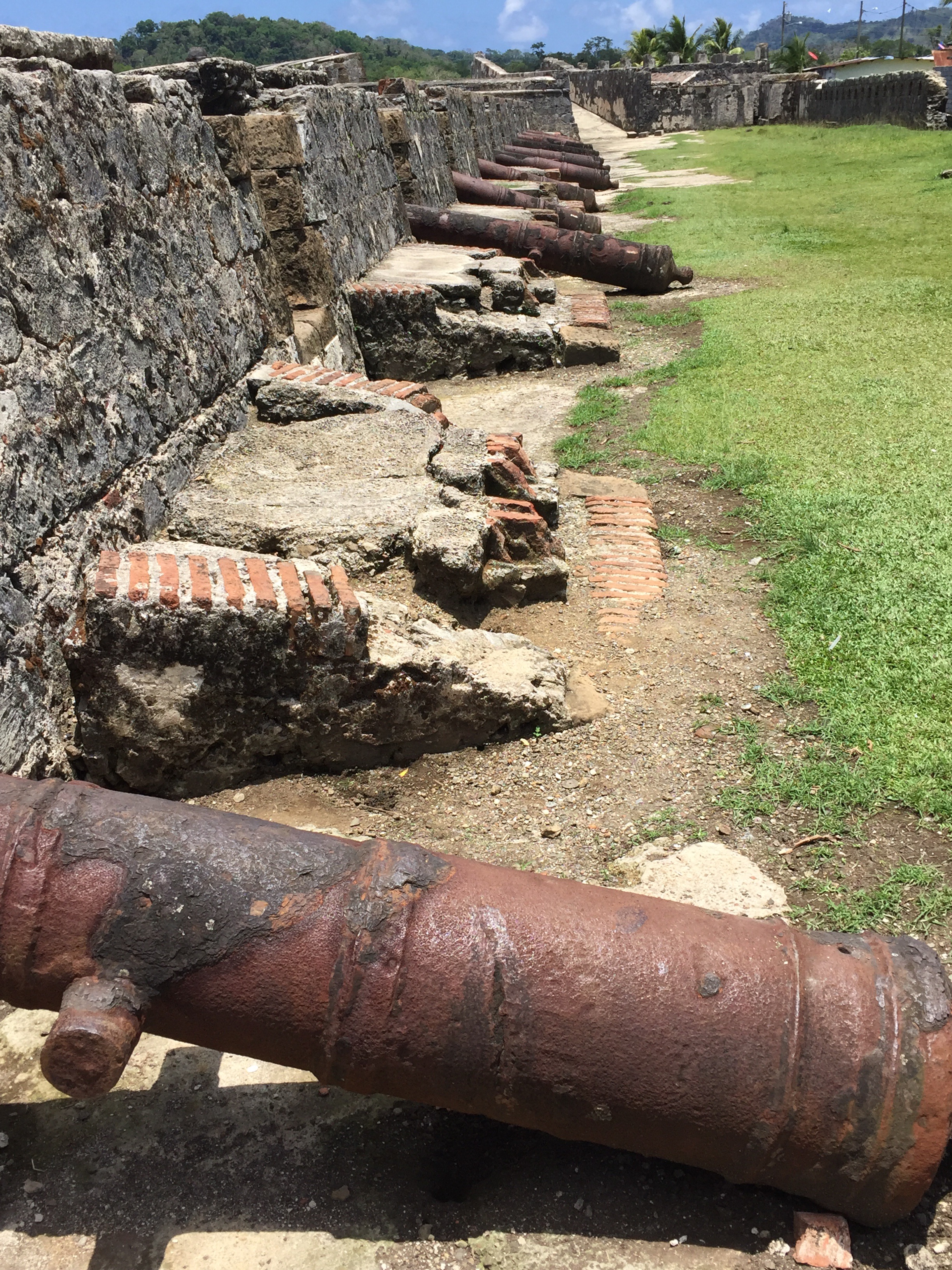
One of the two Spanish fortifications in Portobello


But our trip to Panama was not complete till we traveled to the small town of Portobello.  It is here that the Spanish originally brought the gold that they stole from Peru and other South American countries and took overland for the trip back to Spain. 

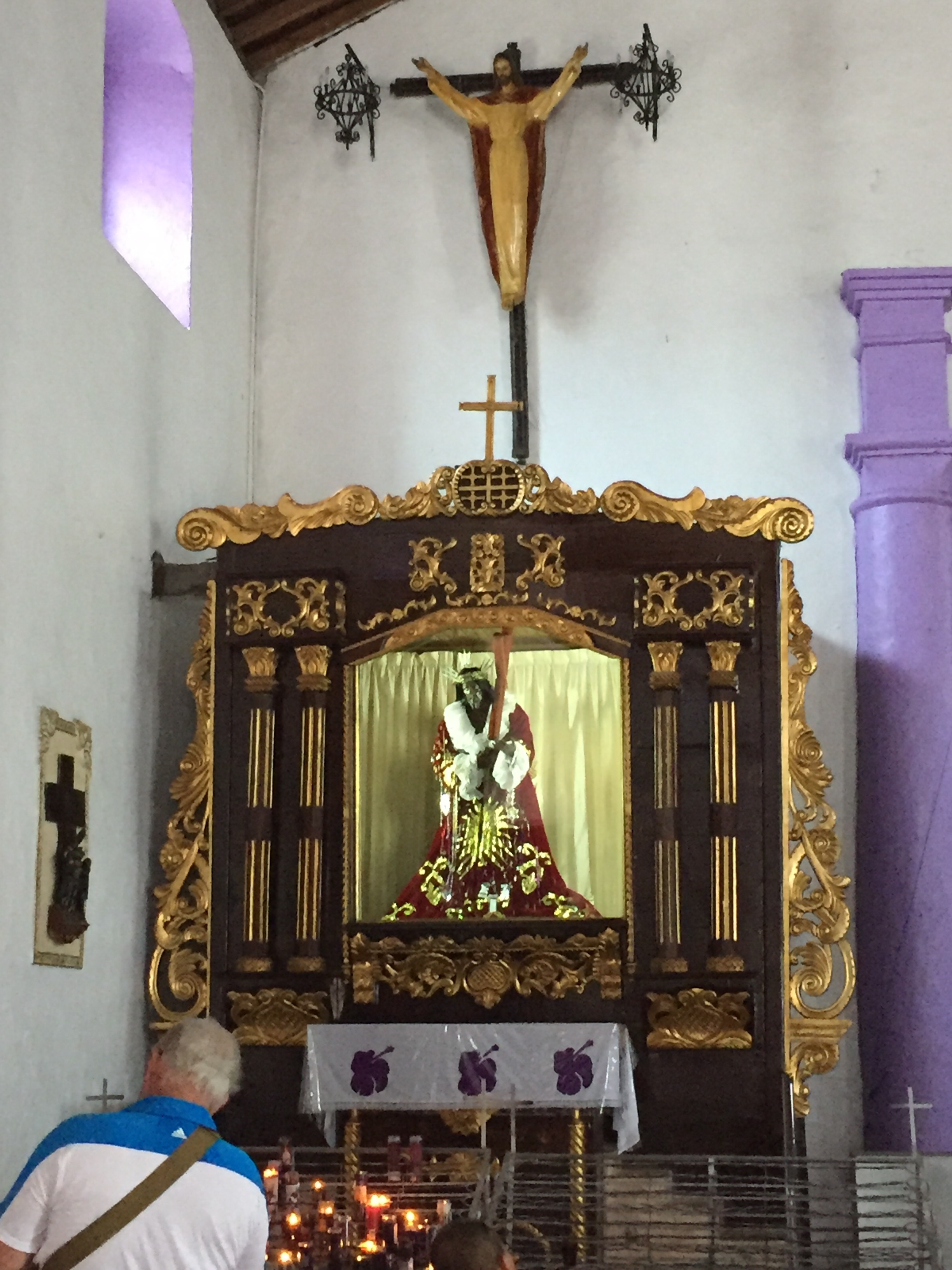
The black Jesus is in the cabinet adorned with his golden embroidered robe.


It is also here that the Pirates, among them Sir Francis Drake (who died there) and Henry Morgan, attacked the Spanish empire and stole the gold. We visited the Custons House, the destroyed fortifications and the Church that houses the famous Black Jesus that accidentally was delivered to Portobella. Once there it was destined to stay as each time the town attempted to send it back a big storm occurred. 

It was wonderful to see the technology of the Canal used to connect the Pacific with the Atlantic. But also wonderful to see a bit of the history of this region of Panama.  

A Little Visit to Lima, Peru

25 Mar

Our cruise only stopped for a short time in Lima, so we had an abbreviated, but informative tour of Colonial Lima. 

First I must say that due to the flooding and extensive rain in the Andes, Lima has no portable water. The Rimac River is filled with the mud and filth a flood brings, and so the city is working to get the water treatment plants back on line.

The Rimac River March 24, 2017

When you arrive by cruise ship, you actually arrive in the port area of Callao. Very industrial and looking a bit derelict. Our guide told us that people do not finish their homes all the way, as long as it is not finished they do not have to pay full taxes. Hence many homes have no stucco or an uncompleted top floor. 

Not quite completed buildings in Callao


Then there is the traffic of this large South American city. It does not matter, seeing the Colonia area was worth the ride. 

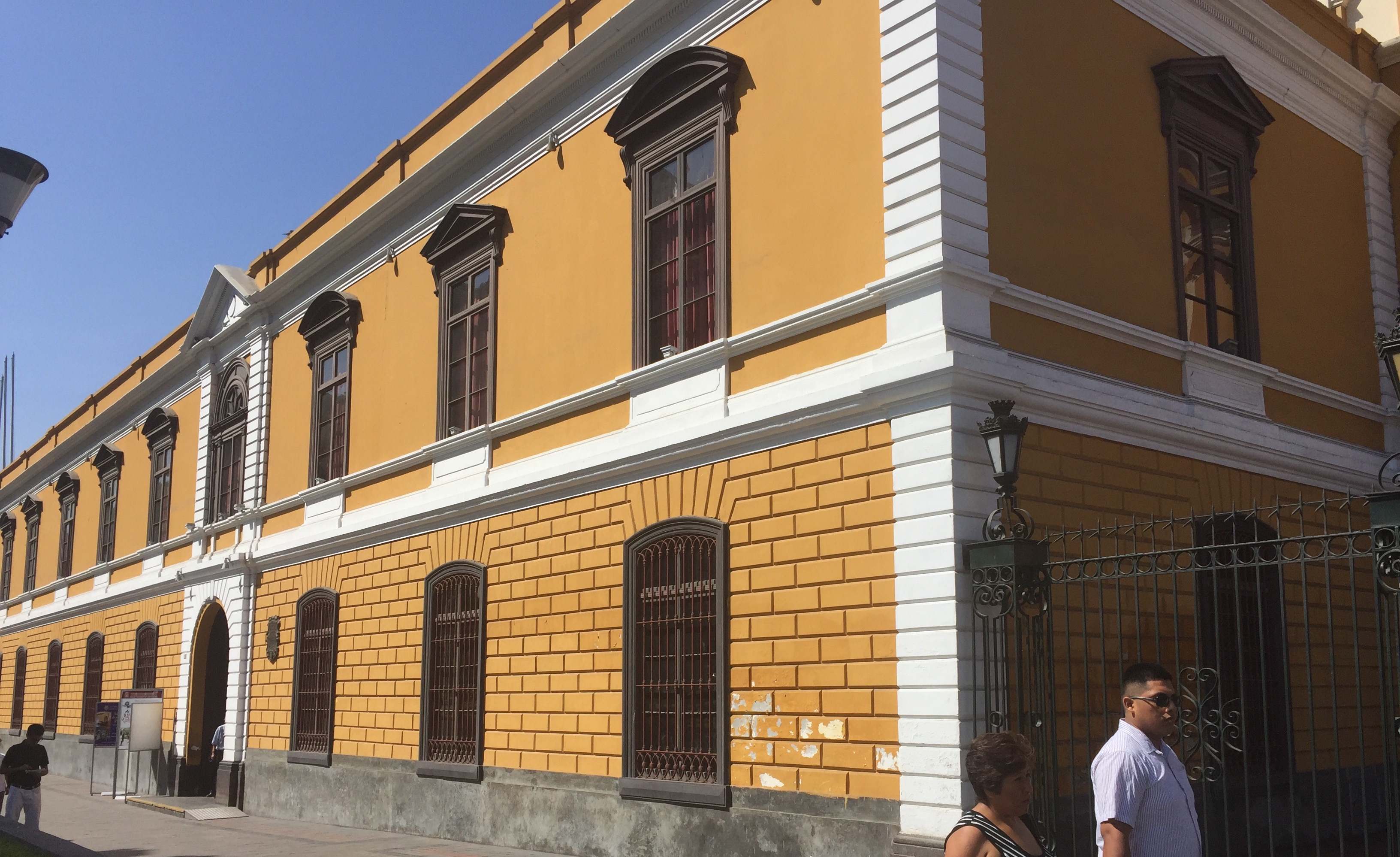
Our first stop was the original campus of the University of San Marcos. The first university in the Americas, this school was ‘public,’ a student only had to be from a royal family, a good Catholic, be the result of a legal, church approved marriage, and past a grammar test in Spanish and Latin. Oh one student ever got in who was illegitimate, and he was very important to the history of Peru. 

The University was first the school for Jesuit priests. When they were banished from the country, the government took it over. Although the outside is unimpressive, the beautiful courtyards and rooms inside are lovely! 

The exterior of the San Marcos University

The Law School courtyard

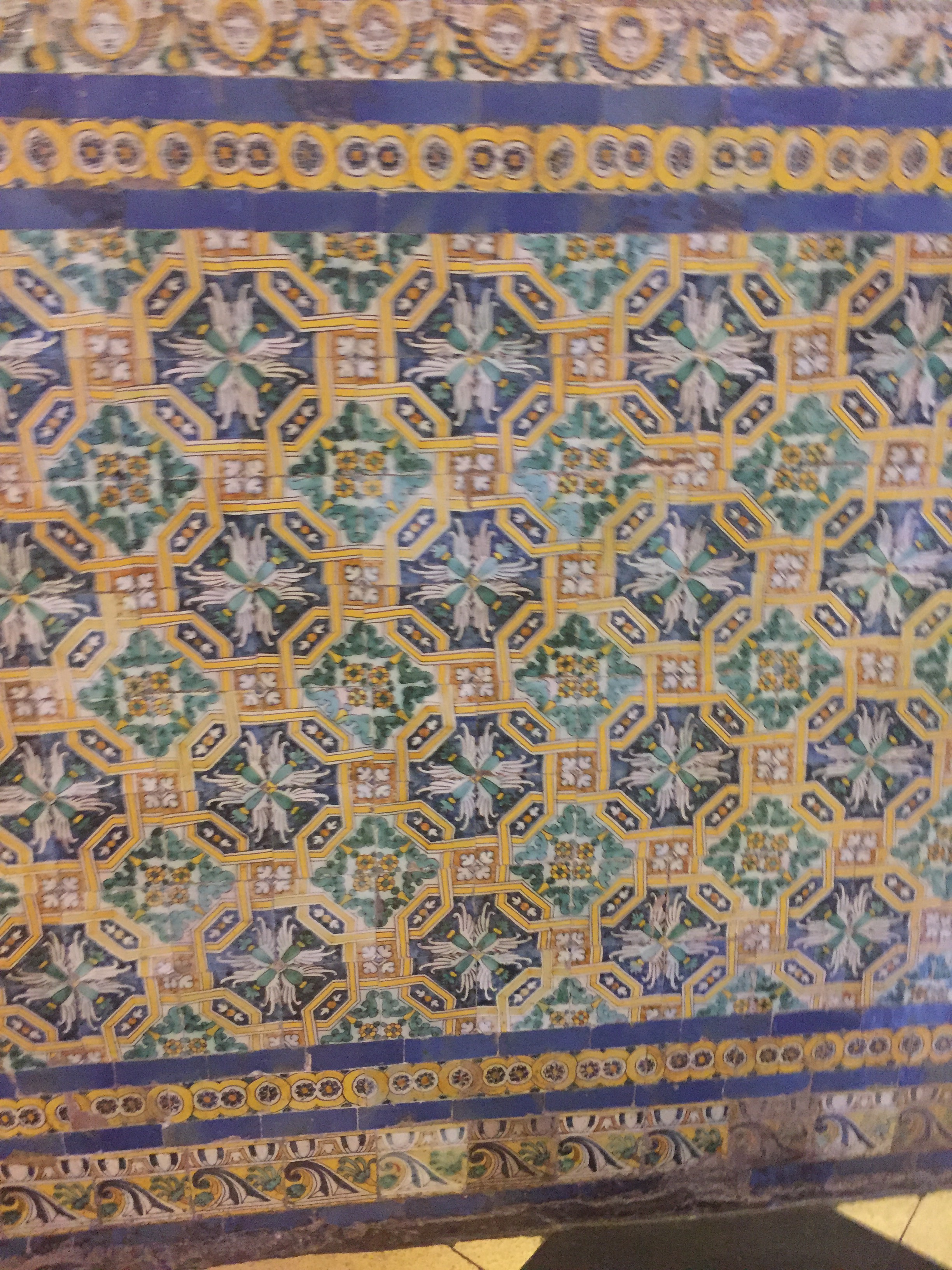
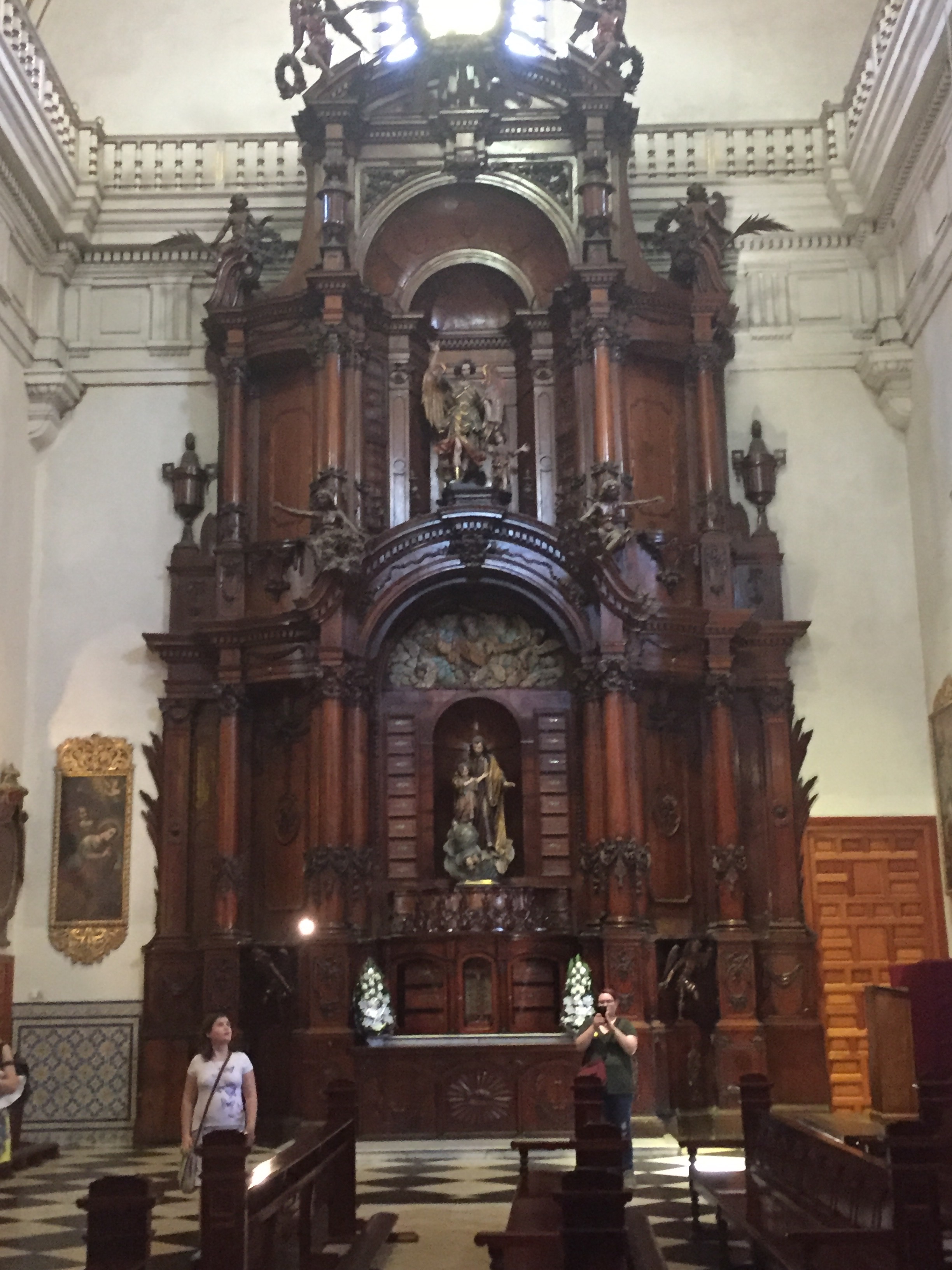
Next stop, San Pedro Church, which is not a museum, rather an active congregation. We saw people giving confession and praying. So a quiet exploration is important. We learned that this is the church the upper crust of Lima still uses for its weddings and baptisms.  Inside is lovely with its gold painted arches, ceramic tiled walls and majestic wooden alters. 

A ceramic wall in the church.

My favorite niche altar.


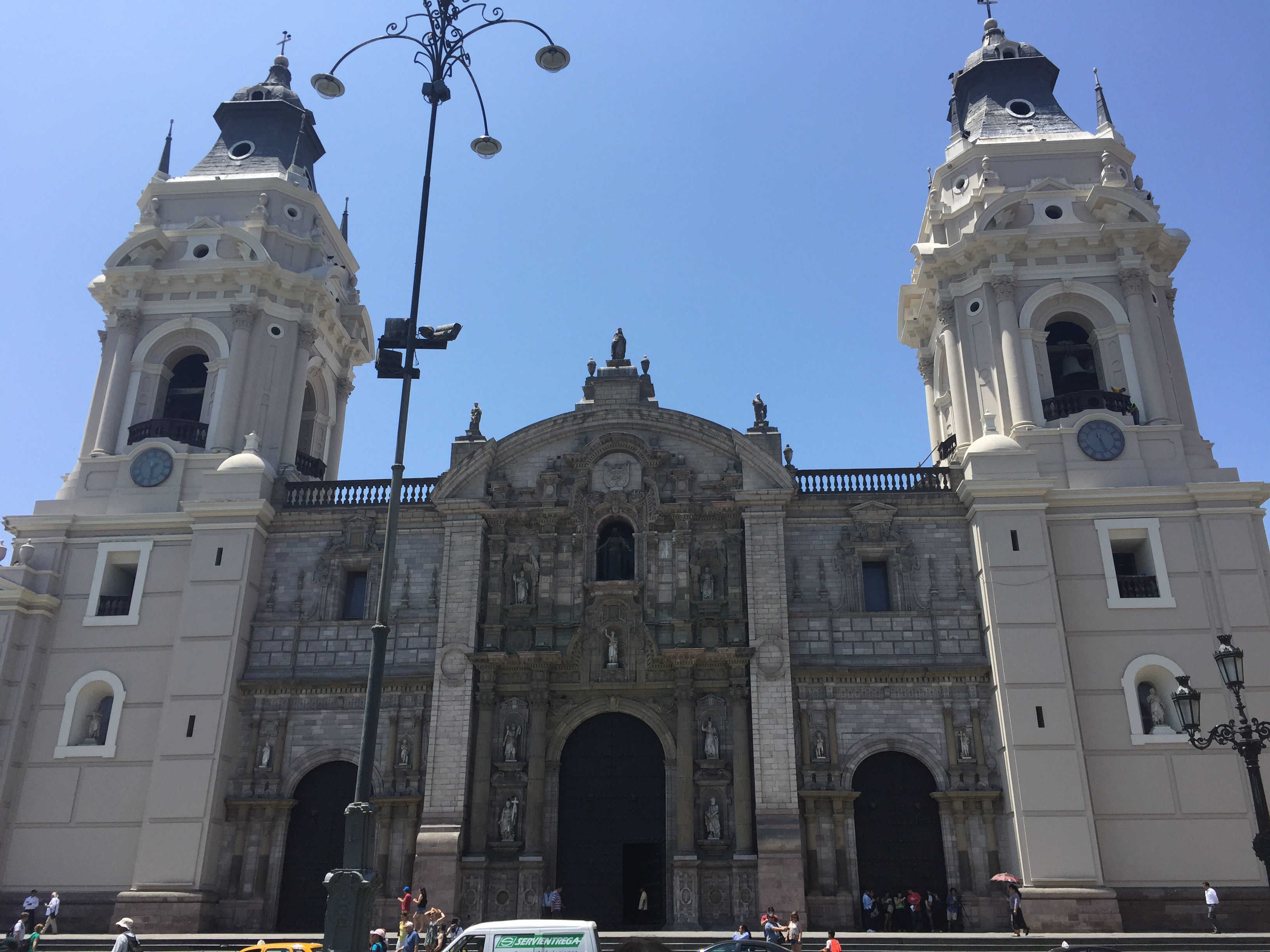
From the church we walked to the main plaza, Plaza Mayor.  We learned that this was the original site of the native Inca outpost.  Where the temple had been, the Spanish destroyed it and built a church. When the leader lived, his home was destroyed and the conquering Spanish built the home of Pissarro. 

Due to earthquakes the two towers were replaced on this church in the Plaza Mayor.


We also saw a home with the lovely wooden balconies. And another building that served as the listening post for agents of the inquisition. They would stand inside screened, wooden balconies, unseen, and listen. If they disliked someone they would haul them off to another building where they would torture them into confessing. I do not like the inquisition. A distant ancestor of mine was burned in Portugal as a heretic in 1618. And it is a shame that the Spanish brought the Inquisition with them to the Americas. 

The final item I found unusual or exceptional was how the local people are just building on the foothills of the Andes with no concern of earthquakes. A hill called St Christopher’s hill truly was intriguing.  

Houses just built into the hill helter skelter

There is much more to see, I just showed our highlights. But definitely was a wonderful experience. 

Why I like Chile 

19 Mar

The flower clock in Vina Del Mar


We have just begun our fourth trip to South America, with our first stop of Chile. I must say I love going to Chile. There are several reasons. 

First Chile is a lovely country. Although long and narrow, with both coastal mountains on one side and the Andes forming the border with Argentina, the long lovely coastline is amazing. 

The first time we came to Chile we spent several days in Santiago then cruised south along the coast stopping at several ports along the way. Journeying through the Straits of Megellan and the north to Argentina and Uruguay. We loved it. 

This time when we came, we traveled directly from the airport to the lovely resort city of Vina Del Mar, staying in The Enjoy hotel that connects to the original Casino. Walking around has be a delight. Soon we will travel to our cruise ship and sail north to Arica, Chile, and on to Peru, Ecuador, Panama, the Canal, and Columbia. I cannot wait for these new experiences. 

Second reason why I love Chile:  although it is a 9.5 hour flight from Atlanta, we only change two time zones from our home. So NO jet lag. I love that. I admit that I do hate being on an airplane for that long. But for this trip we end in Miami, so a much shorter flight home. 

The final and best reason for me, my best Chilean buddy. It is really wonderful to travel a country with a friend who is a native. First having friends to experience the adventure makes it more enjoyable. Then there are no issues with translating. She makes wonderful food selections. We want to eat foods we do not find at home and eat traditional South American fare. 

We are off on another adventure. 

Missing Mom’s Passover Recipes

13 Mar

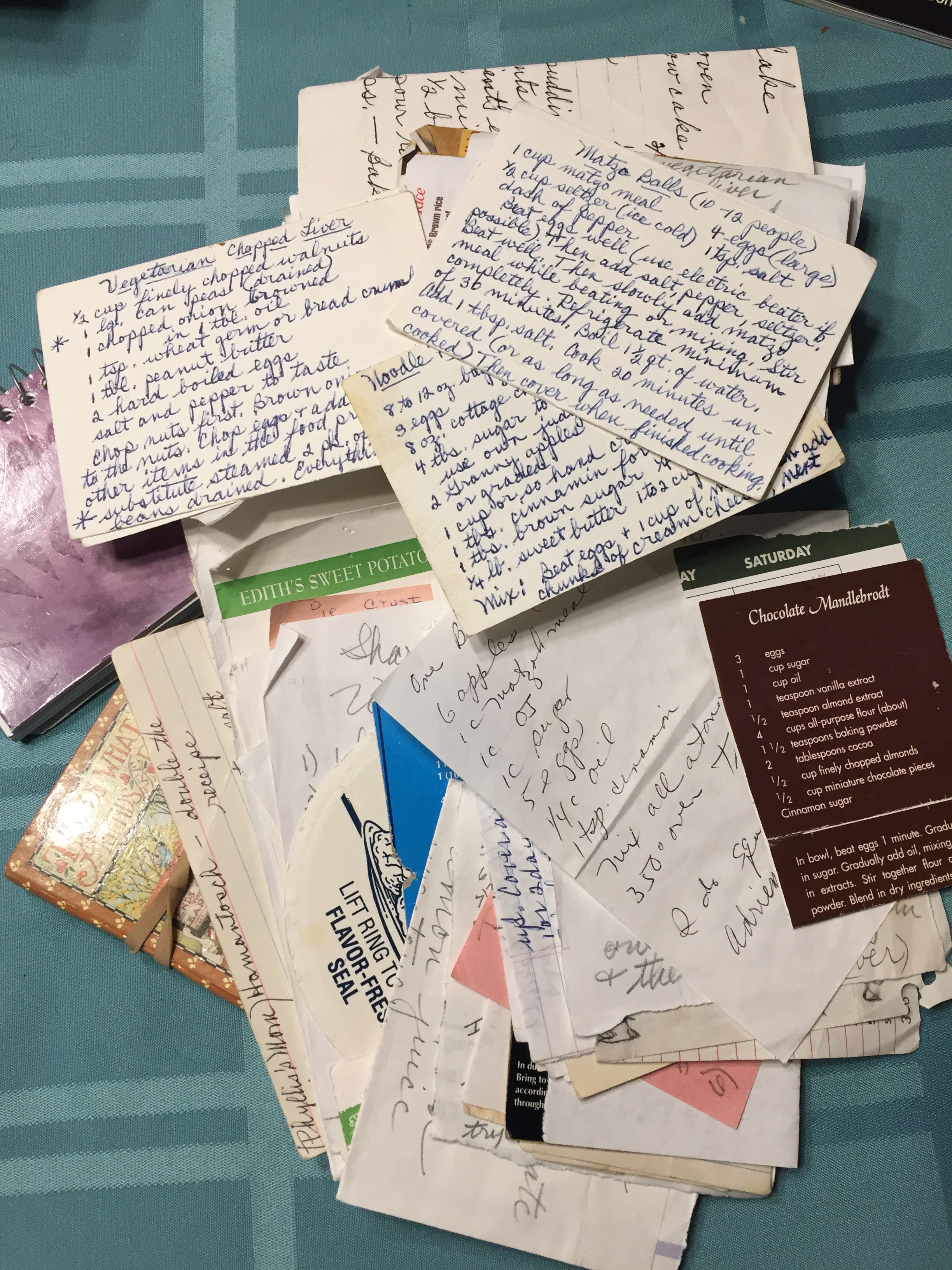
The recipes filled a bag.

There were many little issues that appeared during the year that my parents died. Little things that you do not realize will cause distress. But for my sister and me, one of these issues was my Mom’s recipes. They were gone. We searched the house and could not find them. Most recipes we knew because we continued to make them.

But a few seemed lost forever, these included her Passover recipes. Since we used them only once a year, they were not etched into our memories. And so we had to use recipes from books or from others, or just not make that item. Without her recipes, we felt a bit lost.

My parents would come to me each year for the second night of Pesach.   They did the first Seder in New Jersey with my siblings and their families. Mom would cook her share of the meal, and leave all the leftovers for my brother and sister’s families. Because the next morning, bright and early, my parents would fly out to stay with me for second Seder and the rest of the holiday.

My children went to the Jewish Day School, so they were off that week. It was a perfect time for my parents to have grandparent adventures with the children.

Mom would arrive and join me in cooking. We always spent the first seder with other families at friends. But I alternated second night seder with another friend, and so often it would be at my house. Eventually, second night became my domain.

Whatever the case, there were certain foods I did not make until Mom got here. She knew exactly what to do, even though she might have had the recipes written down. After making seders for so many years, she knew her recipes. Whereas, my sister and I depended on her memory to help us.

So I should have known what happened to the recipes. But it never occurred to me.

About a year or so after both my parents passed away, they did so quickly and within nine months of each other, I finally cleaned out the bedroom in my house where they always stayed. We had already cleaned out their condo apartment in New Jersey; had told the managers of the apartment they rented in Florida to take what they wanted and donate the rest, and we had mostly cleaned out the house in the Catskill. So now it was time for me to do the final cleaning and pack up and donate what they had left behind in my house.

They had their own space, and I had avoided going into it, but my son wanted to move into this larger room, with its own separated entrance.

I finally opened the closet and packed my dad’s jeans and shirts and jackets. I started cleaning out the drawers. Putting tops and items into bags to donate.

There in the bottom drawer, covered by tops, was a small, stuffed plastic bag filled with papers. Recipes. Lots and lots of recipes. She was in the process of rewriting in her beautiful teacher’s handwriting. Passover was back: Vegetarian Chopped Liver, Matzah balls for 10-12 people, Farfel pudding from Sylvia, Baked Gifilte Fish from Lola, Potato Kugel, Stuffed cabbage.

Mixed in were many other recipes, including Hamantasch from Phyllis and my Uncle Stanley’s cookie recipe, which she called Cookies by Stanley. (He was baker and passed away in January 2017, a week before his 90th birthday, on my Mother’s sixth Yahrzeit.)

I would like to say I used these recipes. But I did not.  I put them in my room, in a box, waiting to be used.  I did not share them.  I did not look at them.  I just could not.  Now, I know I need to scan the recipes and send them to my brother and sister. I know that. But for four years they have sat in their bag while I have looked at it as a locked time chest, unable to really sort through the notes left by my Mom.

I decided this year was the time. I was ready.   We are done missing my Mom’s recipes.