Archive | Uncategorized RSS feed for this section

Working on An Ancestor Mystery

20 Jun

You would think that with my niece’s wedding in two days my sister (the mother of the bride) and I would focus on the wedding. But not us. After a day of running wedding related errands, my sister and niece were putting together a display about our family weddings, when my sister and I got into a mini dispute over a wedding date.

This lead to my sister logging into her ancestory account to check the date, which of course led us into a lengthy look into our family mystery: our paternal grandfather’s family.

Once again we started searching for his family on the census documents and in other areas. We know his birthdate and the names of some of his siblings. And we think we found his family. We knew of six siblings in his family. We are now up to eight in the 1905 census. But there is one brother not yet listed. And we cannot find another census with the family listed. So we honestly do not think this is our family. We need to investigate more.

But that is not our only mystery. Sometimes the documents have all but one child born in the USA. Others show all but one born in a Russia. Some say the father, our great grandfather came in 1880 or earlier. Others say 1890. We know he was born in 1859 and his wife in 1865 we know they married in 1883 and started having children in 1885. The biggest problem is their very common names. If only we could find documents with the original last name of Grau instead of looking for Rosenberg.

We know our great grandfather abandoned the family when our grandpa was about 13. It is now looking as if grandpa might have been a bit older.

The names are so common that we have to be careful we are staying with the right family when we search. And it is difficult and confusing.

In the midst of this research, while I was looking for a post relating to my paternal grandfather’s family, I found a post I put up a while ago of two young girls which was never translated. This lead us down another path and, thanks to a Tracing The Tribe member, connected us to a relative on my maternal grandmother’s family. I need to do a bit more research before I can write about this photo.

But we have found a photo of my grandmother and what looks to be this woman. We know my grandmother visited family in Breslau in 1931, where this woman lived. And we know her mother has the same name of our great grandfather’s sister. So we are pretty sure she, this women murdered in The Shoah, is grandma’s first cousin.

My sister and I love mysteries and searching for our family in Europe. Identifying our family who perished in the Shoah is important to us. We want their names to stay in our memories.

So at my niece’s wedding, I sat with my mother’s first cousin and showed her some of the information. Sometimes she remembers a name or knew someone that my siblings and I never met.

My grandmother left Poland when she was 16 in 1922, while my great aunt stayed until 1936, when she was 22. So she had stronger connections with the extended family in Poland right before the war.

However, with this family member, my cousin had no memory to share. In fact she did not seem to know about the cousins my grandmother visited in Breslau in 1931. However she reminded me that my grandma was 8 years older than her mother.

We have one last link. The Yad Vshem testimony was submitted in 1999. I have a contact name and address. I know the person who submitted it would probably be in her 80s now. But I plan to send her a letter with our information and copies of the three photos I have. Perhaps we can make a connection.

Dragons Must Exist…Well for me

11 Jun

img_7721

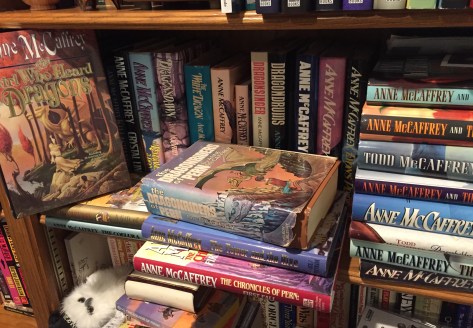
When I was a teen I became entranced with the series of books by Anne McCaffrey, the Dragonriders of Pern.  I have every single Dragonrider book she wrote, and I have read them more than once.  They delighted me. They made me want to believe that dragons existed in this universe; that they were good; that we could fly on them; and with dragons we could save the world!

My dreams of dragons take me away from the everyday stress and evils.  When politics make me crazy, I think of flying away on a dragon from Pern, saving the world from the threads falling from the red planet.  Communicating solely with my dragon.  Wouldn’t that be fun?

My favorite of her books is “The Girl Who Heard Dragons.”  I so wished that was me!  She could speak and hear all the dragons.  Everyone else could only speak to their specific bonded dragon! The girl who heard dragons was special!  (When Anne McCaffrey passed away in November 2011, I was so sad that the world lost her imagination.)

img_7625

Computer Catsastrophies by R. Spangler

Because I love the idea of dragons, I am attracted to art with friendly dragons.  Two local Missouri artists’ works exemplify friendly dragon art.  And their works adorn my home.  Perhaps too much, but their art makes me happy.   The two-dimensional, lithograph works by Randal Spangler can be found on walls in almost every room of my home.  For years, I would buy my husband a Randal Spangler print for his birthday. I know I buy them for my husband, but I love them.  Kind of self-serving!  But he does not mind.

At first, I focused on the series with the astronomer and the libraries.  But over time, I just went for the dragons.  And if there were dragons and cats, even more delectable to me.

His art is fun, delightful and never upsetting.  I always find something new to see in his more intricate and larger works.   Some of my favorites have dragons and fireflies!  So joyful.

When I want to ‘feel’ a dragon, I switch to the clay three-dimensional work by Clay Images artists Melissa and Jim Hogenson.  They call their works, “whimisical designs in stoneware.” Which they are.  I purchased my first one in 1984 at the Kansas City Renaissance Festival.  And I have been buying at least one piece almost every year since then.  Even when I do not go to the festival, my children will take photos of pieces they think I would like. And then they buy them!  They know that we have to make a stop at their booth so that I can look at dragons!

I have also found it possible to contact Clay Images on line and order exactly what I want.  (Yes, I did Like their Facebook page.) It works for me.   In fact, I recently saw two pieces that I must have!

My sculptured dragons stay in the family room, kitchen and front hall of my home.  They stand guard against invaders.  And they cheer me up.  I loved the one I got last summer.  My children went to the Renaissance festival and brought home: Eclipse, a dragon wearing special eclipse sunglasses.  I saw the eclipse in Wyoming.  It would have been fantastic to have a dragon with me! Can you imagine flying over the tops of the Grand Tetons as the eclipse began to cover the world in darkness.  It would be like a scene out of a Dragonrider of Pern novel!  WOW!

Among my favorite pieces are a dragon cookie jar, two lamps and my wizards. Because I crochet and knit, my children also made sure I had dragon yarn holders.  I have two different ones that I keep together when I am not using them.  I have useful pieces like mugs and the cookie jar, but I also have ones that are just fun to look at!

Over the years I have watched a few dragon related movies and read other dragon books.  Disney’s Pete’s Dragon is fun.  While Smaug, the dragon, in the Lord of the Rings is quite scary and mean.  I loved the somewhat helpful dragon, Mushu, in Mulan.  Of course, the lovesick Dragon in Shrek saved the day, as do my imaginary dragons. And I sort of smiled through the How to Train Your Dragon books. I was scared by the dragons in the Harry Potter series and petrified of the two-headed dragon in Willow (one of my favorite movies!).  I know I need to see the animated movie Spirited Away, to see Haku, the river spirit. My son is a great fan of the animation artist, Hayao Miyazaki.

In my work space, above my computer, is a Spangler print called “Computer Catastrophies.”  Although my desk does not look exactly like that, the print gives me inspiration and joy. As do all my dragons.  On the wall to the right of my desk is Spangler’s “Science Fiction Shelf,” which depicts dragons and science fiction books.  Some of my favorite books are listed, but unfortunately, he did not put any Dragonrider books on this imaginary shelf.  That would have made it perfect.

I believe you are only as old as you feel. And with my dragon art and books in my home, I still feel quite young!  Because with them here, I can believe that dragons must exist!

Clay Images

Randal Spangler

The Sorrow of Shalom Hollanders

7 Jun

In my blog “Murdered in Belzec” I wrote about Shalom Hollander, the relative who put in the information about my great grandparents and great uncle on the Yad VeShem datebase.  I had met him in 1976. when I was 20 years old in Israel, when took my Grandmother to Israel to see her brother (See blog link below).

After I found those three names, I decided I needed to see if Shalom entered other names on the Yad VeShem website, since I could only find one of my grandfather’s siblings.  I did an advance search using only Shalom’s name as the one who put in the testimonies.  About 45 names showed up.  After going through all of them, I realized that he had duplicated some names.  Mainly his own children.  So in reality there were probably 40 names of people that were somehow related to me, of these 18 were children.

And although I was looking for my grandfather’s siblings and their children, finding these three families and their children touched my heart.  They were also my family.

Among the many names were his wife and his five children.  With this information I found out how he was closely related to me.  His wife, Cerla or Tzira Feuer, was my great grandfather’s niece and so my grandfather’s first cousin.  She was 38 when she was murdered.  (I knew two of her brothers who survived the Shoah, one settled in Montana of all places and one in England. Another brother also survived.)

Shalom’s children were:  Elish (Ptakhia), 11 years old when murdered in Auschwitz; Etla, seven years old when murdered at Auschwitz; Mordechai, five years old when murdered at Auschwitz; Gital Tila, four years old when murdered at Auschwitz; Ita, two years old when murdered in Auschwitz.  They all were murdered in August 1942 on the day that the Jews of Mielec were deported .

Before they were murdered at the camp, they lived in the Tarnow Ghetto.  What a horrible short life they lived.

In the earlier blog I wrote that I thought he had no family in Israel.  I now know why.  All of these deaths.

But it doesn’t stop there.

His sister also perished: Chaja/Serka/Khala Holander Viner/Wiener also died.  I like how he gave all the names she used.  She died in Belzec.  Also dying was her husband: Pinchas Viner/Wiener. He died in a different camp, Plaszow Camp, which was first a slave labor camp. Then a death camp.

It doesn’t stop there because his parents Mordechai and Tova also perished in the Shoah.  They died on March 9, 1943, in Beredechow, Ropczyce, Krakow.  I wonder what happened that day?  Why were they both murdered then?  I tried seeing if such a date was important in some way, but could not find anything.  But I guess it was important because Mordechai and Tova were murdered that day.

His father was related to my great grandmother, an Amsterdam. But Shalom chose to use his mother’s maiden name. Or perhaps his parents never had a civil marriage as what happened to many Jewish couples in Galicia, so he had his mother’s name.

I am looking back at my 20 year old self in horror.  I remember spending several hours with Shalom and my grandmother.  We had a meal or drink together in a restaurant.  We walked around for a while as my Grandma talked to him.  I remember being a bit annoyed because I had to take Grandma by bus to a place I really did not know so well to meet him. I think it was in Haifa.  I knew Tel Aviv much better.
I still remember what he looked like.  He was relatively tall for an ‘old man.’ Probably in his mid-70s.  He had the look of my grandfather, but not as much as another relative I had met.

They spoke in Yiddish.  I tuned it out.  I was so exhausted from all the Holocaust memories I had been listening to during that four-week trip.   Can a person have delayed Jewish guilt?  Can those memories really cause so much sorrow to me now?

They do.   I went back to Israel a year later and spent over three months. But I did not go to see him again.  Other survivors who I knew, I did see. But not Shalom.

I cannot imagine what losing all those people he loved did to him.  I cannot imagine what sorrow he carried with him.   I knew another of my grandfather’s relatives who survived. I wondered if they knew each other.  Now I know that they did.  Although Ziesel and Shalom were both related to my grandfather from different sides of his family, they married into his close family by married sisters, his two first cousins.

I do remember a bit of that visit with Shalom.  I remember Grandma telling me that this visit would be different, that I would be meeting one of Grandpa’s relatives, not one of hers. And that she did not know him very well.  I remember the overwhelming sense of pain that came from him while they spoke.  My grandmother spoke to him in a way I had never heard before.  With him she was so gentle.  Almost whispering to him as they conversed.  Easing the words out of him.

I remember Grandma and me being exhausted after this visit.  I remember Grandma went to bed as soon as we returned to the hotel.  It really was too much to comprehend.  Too much sorrow.  So maybe I just let myself forget.

Now, as an adult,  I realize that I must remember Shalom and his wife Tzira; his children Elish, Etla, Mordechai, Gital and Ita; his sister Chaja and her husband, Pinchas; his parents Mordechai and Tova.  May their names be a blessing, may I use this blog to keep their memories alive.  Baruch Dayan haEmet.

https://zicharonot.com/2018/06/05/murdered-in-belzec/

https://zicharonot.com/2018/05/01/zysel-ziesel-feuer-survivor/

https://zicharonot.com/2014/04/28/speaking-yiddish-always-brings-me-holocaust-memories/

https://www.encyclopedia.com/religion/encyclopedias-almanacs-transcripts-and-maps/mielec

Murdered In Belzec

5 Jun

I have not gone to the Yad Veshem website in years.  I already had all the information about my great grandparents.  But in writing about a mystery cousin, several people suggested I go see if he was listed at Yad VeShem.  He is not.  So I will assume he survived, (optimistic I know) and look elsewhere. (See blog below.)

However, the website looked so different, I decided to look at my great grandparents again. I knew that there was an entry for both of them. But when I first saw it, I could not read much of it.  Now it is all translated into English. More important, it was put up by a survivor, a cousin, someone I met in Israel in 1976 with my grandmother: Shalom Hollander.

I had not seen his name in 42 years.  When we met, in Haifa or Tel Aviv, Grandma and Shalom only spoke in Yiddish.  And at the time, although I did understand some of what they said, I did not really pay attention.  I heard so many holocaust stories when I was with grandma that month, and I was just 20.  (See link blog below.)

It has been many years since I last looked at the listing in Yad VeShem.   Besides their updated website, I have been on a mission to record what has happened to my family.

Recently I listened to an audio tape made by my grandfather in 1981.  I had it made into a cd earlier this year. (See link below.) In it he talks about the village where he grew up.  We always thought it was in Mielec.  Which it was to a degree, but it was actually in a small village near Mielec called Trzciana.

We knew that my great grandmother, Chava, was killed near her home. That she had been hidden and did not go to the concentration camps.  The Yad VeShem records confirm that she was murdered in Mielec/Trzciana.

I did not know which concentration camp my family had perished. I only knew that they had all died.   However the testimony provided by Shalom Hollander is clear.  They were murdered in Belzec.  I am not so sure I am happy about that. But I now know that is where Gimple Feuer, my great grandfather died.

In Belzec approximately 500,000 Jews were murdered. Nazis were killing people at Belzec for nine and a half months.  Thus, I now also know that my family was murdered between March 17 to December 1942.  But at Belzec the Nazis not only murdered and buried my family, when the war was near the end, the Nazis secretly dug up their bodies and burned them.   Most depressing is that of all the Jews who were sent to Belzec only seven survived according to Wikipedia.

In the past I have also tried to find any reference to my grandfather’s siblings.  My biggest problem is that I do not know his sisters’ married names.  However, the most amazing aspect of going to the Yad Veshem datebase this time is that I found one of my Grandpa’s siblings: Shimon. Born in 1910.  Single.  A merchant.  Murdered in Belzec.  I knew all my grandfather’s siblings died. But I never saw it in writing before: Murdered in Belzec.

Shalom also did the records for his own parents.  Mordechai Amsterdam, a cousin of my great grandma; and Tova (Tauba) Holander Amsterdam.  His parents were probably cousins as well, as we were all related: Amsterdam, Feuer, Hollander, Brenner.

But there it is.  Murdered in Belzec.  No one is named for Shimon.   I do not think Shalom Hollander had a family.  Or at least I did not meet them in Israel.  I guess my next job is to search for any of Shalom’s descendants.

I am still stuck on those three words.  Murdered in Belzec.

Thanks to Tracing the Tribe members for their suggestions, especially Amy.

https://en.wikipedia.org/wiki/Be%C5%82%C5%BCec_extermination_camp

https://zicharonot.com/2018/06/04/the-mystery-of-abraham-prantki/

https://zicharonot.com/2018/05/15/my-grandpas-voice-can-still-be-heard/

https://zicharonot.com/2018/05/01/zysel-ziesel-feuer-survivor/

https://zicharonot.com/2014/04/28/speaking-yiddish-always-brings-me-holocaust-memories/

The Mystery of Abraham Prantki

4 Jun

As I search through the photo album we found hidden in my grandparent’s attic, I am still finding mysteries and photos of people who were never identified.  But this time, I found one, or should I say two, that were different.

I found two copies of the same photo postcard sent in 1923.  The young man identifies himself as Abraham Prantki.  The cards are made out to my grandmother and to her Aunt Gussie. They say the same thing, “For friendly memories I send my picture to… “

So now the questions.  He sends the one to Tante Gussie, I think.  It might say Tante Sunia?  But the last name is the name of my great-great aunt.  I am assuming that is who he meant? Maybe?

Is he really her nephew, and my grandma’s cousin?  If so then he would be from my great grandfather’s side.  He had five sisters.  I know the descendants of two of them.  However, they were from Poland. So why is this postcard written in German?  But then, they must have read German if that is the language he wrote to them in.  Actually,  my grandmother was well educated. She spoke and read several languages.

The other odd thing… on the top right of the photo addressed to the Tante, there is writing in another handwriting. I have no idea what that says.

I would love to claim him and put him somewhere on my family tree.  He looks a bit like my grandmother’s family. Like he could be related.  But it is just too nebulous.  What do you think?  A first cousin?  A border?  A relative?  Or just a friend?

And then the date, 1923.  My grandmother had been in the USA just a year.  She was 17 and living with her Aunt Gussie.  She married my grandfather in 1925.  So I have to ask, did Abraham Prantki survive?

So many questions.  I might know his name, but I still do not know who he is and what happened to him.

(Thank you to a member of Tracing the Tribe who translated the German on the postcards for me.  Update with more translations:  It seems he did address the one postcard to his cousin and the other to his aunt.  So I say YES a cousin.  I now know that his mother was one of three women, maiden name either Sura Szenk, Esther Szenk or Leba Szenk.  I will check Yad VShem.  Thank you all!)

These two previous posts discuss my grandmother’s family.

Grandma Thelma Knows What She Knows

Speaking Yiddish Always Brings Me Holocaust Memories

Seeing Isaac Stern in Concert Touched My Heart

26 May

When I was 23 years old I was fortunate to see the violinist Isaac Stern in concert.  My husband, then my boyfriend, got us the tickets that were excellent, about six rows back from the stage.  I remember watching as he created the most beautiful music. But the moment that touched my heart was when he meandered over the stage to our side of the theater, all the while making music, and as he reached a crescendo he lifted on to his toes…. I was sure he would lift into the sky with his music, upward into heaven.  I thought, “this is what Marc Chagall was painting when he drew his musicians flying in the sky. This moment is a Chagall painting.”

I thought of Isaac Stern yesterday throughout a concert at the Kansas City Symphony conducted by Michael Stern, Isaac’s son.  Although we have season tickets to the Pops Series of the Symphony, and we go to other concerts as well, we have never actually been to a concert that Michael Stern conducted.  As I watched him conducting, putting his entire body into the music, I flashed back to that moment about 40 years ago when I saw his father.

Since that time when I was in graduate school, I have been to many concerts.  I have attended concerts throughout the USA including the Aspen Music Festival, Boston Pops, Kansas City Symphony.  I have been to La Scala, in Milan, where our hosts arranged for my son, my husband, and I to go behind the scenes at the music school [Accademia d’Arti e Mestieri dello Spettacolo (Academy for the Performing Arts]and see the incredible instruments and tour the school.  I still cannot believe we got to do that!

Although I took piano lessons for many years, I was never the most talented musician.  (See link below.) Those years of lessons, however, taught me to love music.  I love to listen to the sounds of a symphony. I have sat in other venues and listened with my ears and my heart to other wonderful concerts and extremely talented musicians: including violinists Itzhak Perlman, Midori, and Pinchas Zukerman; and cellist Yo Yo Ma.  I have seen Zubin Mehta conduct.

Not one of them have ever compared to Isaac Stern for me.  Perhaps it was because it was my first time to see such an extraordinary musician.  However, I think it was because of the way he lived and breathed his music.  I will never forget him on his tiptoes, playing his violin and reaching to heaven with his music.

For me it is true, as this quote attributed to Plato says,  “Music gives a soul to the universe, wings to the mind, flight to the imagination and life to everything.”  For me, it was Isaac Stern who first truly gave me this gift.  Seeing Isaac Stern in concert touched my heart.

A Chair, A Baby Grand Piano and Yiddish Songs

Welch’s Jar Glasses were a Catskills Classic

22 May

Our Catskills home was the depository for mismatched dishes.  Any set that had lost pieces to breakage over the years soon made its way to the summer kitchen.  Same with glasses and mugs.  If a set was no longer complete, then there was a home for it in the Catskills. I think we were all used to using whatever came out of the cabinet. No worries about everyone having matching plates!

Among the glasses that made their way upstate were all those Welch jelly jar glasses. They were our favorite juice glasses; the perfect size for orange juice or a quick drink of water. I especially loved the Looney Tunes and Flintstones ones when I was a child.  I know there were bigger glasses as well, from sour cream jars.

I was born in the height of jelly jar glasses.  Welch’s started making them in 1953, just a few years before I was born.  I remember going to the store and looking for Welch’s jars we did not already have at home. We wanted as many different ones as possible.

I know they stopped making them for a while because the new way of manufacturing glass made the glass thinner, and the glasses would break when the lids came off.  Thus, for years Welch stopped making these glasses.

I do not know what happened to the ones that were in the Catskills.  I believe they all broke.  Or perhaps my Mom in one of her cleaning sprees decided to give them away. They are no longer in the cabinets in our Catskills home.

img_7508

I found out that in 1989, Welch started making these glasses again.  Actually, I did not find out until about the year 2000.  My son is not a lover of Welch jelly, he is a JIF fan. But one day in the grocery store he saw a Pokemon jar of Welch jelly and had to have it.  So I purchased for him.  We still have that glass.  He did not eat the jelly, so I did not buy the other Pokemon glasses that were made.

However, buying that glass reminded me of the glasses we used when I was small.  About ten years ago, I was in an antique mall with a friend.  I was looking for Depression Glass in my pattern when I came upon five Welch’s juice glasses: two Flintstone, two Looney Tunes and one generic one.

I had to have them.  Memories from the Catskills and my childhood are so strong, that sometimes I need a physical touch.  Having the Welch glasses gave me that touch.  The five glasses were purchased; they are not that expensive, just a few dollars each.

I use them for juice and for a quick drink of water.  For a moment I am back in the Catskills during the summer; and all is good in the world.

My Father’s Tallit Comes to Family Weddings

20 May
clip_image001

Dad ready for his bar mitzvah.

My father was bar mitzvah in September 1941 in the Bronx.  A few months later, the world would change for the USA.  But on this day, my Dad celebrated with his family.  He stands here on the roof of his building, posing so that they had this photo of him.

He used to tell us stories about  studying for his bar mitzvah.  He and his best friend would meet with the Rabbi together.  Their bar mitzvahs were held just weeks apart.  They were not the best students and often got in trouble.  His favorite story was telling us about the time they were wrestling while they waited for the Rabbi.  They accidentally broke the leg of the table where they studied.  Quickly they fixed it as best they could. But the leg was just loosely holding up the table.

Their Rabbi had a habit of banging his hand hard on the table whenever my Dad or his buddy, Willie, would make a mistake. This day things went wrong.  While they were chanting the service, the Rabbi slammed his fist on the table in anger. On this day the table and all the books fell to the floor. The table was broken.  The Rabbi thought his angry slam caused the table to break. He apologized and sent them home.

Dad loved to tell this story.

The tallit he is wearing in this photo was in his night table drawer.  I found it after he died.  There was a second, larger tallit made of the same material in the drawer as well.  My siblings and I think he got the second one when he and Mom got married.  It is traditional to get a tallit at your wedding.  In fact, some men do not wear a tallit to synagogue, even after their bar mitzvah, unless they are married…or going up for an Aliyah.

Dad had a third tallit; the one my Mom purchased for him when he became president of his synagogue.  Dad had been using a shul tallit for years, as his two were worn and really not useable.  The new tallit was lovely. My Mom selected not only the tallit, but also a velvet bag and a lovely silver tallit clip with in the form of the word, Shaddai, on either side.  Dad wore this tallit every time he went to services.

When we planned his funeral, we brought all three tallisim to the funeral home for them to bury with him.  The consultant who was with us throughout this difficult time advised us to keep the newest tallit.  “Bury the older ones with him,” he said.  “But keep this one. It is so beautiful. Isn’t there someone who needs a tallit?  Or use it for his grandchildren’s weddings.”

We listened.  I do not think any of us really wanted to bury it, so we kept that tallit.  My siblings agreed that my son could have this tallit.  We also agreed that it would be used for all the grandchildren’s weddings.

The first wedding was my daughter’s two years ago.  During the ceremony the tallit sat under the huppah with them. That evening for the first night of Sheva Brachot, seven blessings, they wrapped the tallit around them while the rabbi chanted the blessings.

My father’s tallit is the huppah at my niece’s wedding.

It will be used again in June, when my niece marries.  She chose the date of my parent’s wedding anniversary for her wedding date. My parents got married on Father’s Day in 1951.  My niece will marry on Father’s Day 2018.  And my Dad’s tallit, purchase with love by Mom, will serve as their huppah.

My Grandpa’s Voice Can Still Be Heard

15 May

On November 7, 1981, my cousin made a cassette tape of my grandfather singing his favorite songs in Yiddish.   It sat in my house for all these years. I could never listen to it after he passed away.  Grandpa had a wonderful singing voice and used to sing to us all the time in Yiddish.

Two months ago, I took the cassette tape to a company that turned it into a CD.  I got it back on Friday.  On Mothers’ Day, I listened to my Grandpa sing in Yiddish and listened to him speak about his life in Europe and coming to the United States in 1920.

He passed away in 1989, so it has been a long time since I heard his voice.  It was just as I remembered it.

Listening to this tape was interesting in many ways.  Most of the stories he told, I have heard before.  I had spoken to my Grandpa about his life in Europe many times.  I just never recorded him.  I am extremely grateful that my cousin made this tape.

He sang six songs.  Tumbaliaka, Hativah in Yiddish, Ofin Primpinchick,  Yiddisha Mama and two others I had not heard before.  He left out some I remember him singing. But it doesn’t matter. Hearing him sing these favorites is a gift.

Grandpa left his home in 1918.  He was the oldest of five children who lived on a 16-acre farm, that they owned, in Austria.  He said if he had stayed in Austria, he would have eventually had two acres for him and a place to build a house.  (I wrote about Grandpa leaving Europe in an earlier blog, see link below.)

When he first arrived in the USA, he lived with his uncle Morris and went to work as a butcher.  A farm boy, he knew about animals.  He worked for $4 a week.  He did not know English.  It was a job he did not like.  A month later, he switched to being a baker for $20 a week on Flushing Avenue in Brooklyn.  (I never knew the address in Brooklyn. ) He was lucky. He had relatives who were both a butcher and a baker.  And they provided him with jobs.

Grandpa was brought up to follow the rules of Shabbat, although they were not extremely religious. He had no beard or payos.  But when he first started working at the bakery, he had to light a fire on Shabbat.  “I sat there and cried,” he said, “because my Mother always told me that if I light a fire on Shabbat I would die.”   He did not die, so the following week he lit the fire without crying.

Grandpa excelled at baking.  But he said he was very bashful.  People would say to him, “Do you want to meet a girl,” and he would say yes.  But they did not work out.  Then, by accident, he met our Grandma in Brooklyn.  He went to deliver a gift to someone, and there she was.

“Before Thelma, I did not look for someone. But when Thelma came it was different.  Something drew me to her,” he said.  “I was 25, she was 18 or 19.  To look at, she was nothing.  But it is the person she was. Someone made for you.”  (I disagree. I think my young Grandma was lovely.)

They got married in September 1925 and lived in Brooklyn, till my uncle was born. Then Grandpa opened his own business in the Bronx, where they lived for five years. And my Mom was born. In 1929, they moved to Linden, New Jersey.  My grandparents opened a new bakery.

But they had it for only about 18 months.

My grandmother was ill.  Grandpa said she had to go back to Europe to see a Dr. Lapenski in Krakow.  He could help her.  She was sick from the fumes from the gas in WW1.  I honestly had never heard that story before.  (I wrote about her time in Europe in earlier blogs, see links below.)

When Grandma came back, they moved to West New York, New Jersey, and opened the bakery they would have for almost 30 years.

“I wanted my children to have a better life,” Grandpa said.  “My Mom did not know that I had to learn to read.  I worked on a farm.  I had no education.  My parents said, you know how to work in the field that is enough.  My Mom thought I would stay in Europe.  She did not know that I would leave.”

My cousin asked if he was afraid to come to the USA by himself.  He started to laugh.  He was not afraid.  “It could not be worse than where I was,” he said.  “It had to be better.”

He told us a bit about his younger siblings and his parents. But the main discussion was the fact that none of them survived.  “I could not convince them to come,” he said.

As for his wife’s parents, my other great grandparents, Grandpa said, “From the day I got married I had to support her family.”  Which is true. Her mother had died during WW1.  And her father, was an educated man.  He studied.  “His wife made a living for him,” my Grandpa said.  When she died, there was not much income.

The tape was made just over three months after my grandmother died.   It was strange to hear Grandpa say her name.  He never said it when she was alive, to keep the evil eye from getting her.  He was still in deep mourning.  They had always thought he would die first as he was six years older.  But instead she died.

“You struggle and you pay for those things you did,” Grandpa said.  “Maybe I did something wrong.”  This was his explanation on why she died before him.  It made me so sad to hear him say this.  I remember how desolate he was without her.  (See Autumn Leaves blog link below.)

My cousin asks questions. Some Grandpa answers.  But he made his point.  He loves his family.  “I accomplished my mission.  I would have my own home.  And I did more than that,” he said.  He got to see four of his five grandchildren marry.  He saw the arrival of six of his eight great grandchildren.

Before he ended the tape, he sang one last song.  He sang of traveling the world, always  wishing he could go home and kiss the stones where he was born.  My cousin asked if he would want to go back to Austria.

His answer, Yes and No. (Grandpa told me that he never wanted to go back there.)

Hearing my Grandpa talk about his family; his children, and his grandchildren was bittersweet.  I made CDs for my siblings and cousins.  I think they need to have this experience as well.

https://zicharonot.com/2016/06/06/the-mysterious-kalsbad-photos-who-are-they/
https://zicharonot.com/2014/06/25/how-world-war-i-saved-my-family-or-my-grandpa-was-a-draft-dodger/

https://zicharonot.com/2015/02/23/the-melody-of-autumn-leaves-haunts-me/

The US Passport: A Matter of Life

A Chair, A Baby Grand Piano and Yiddish Songs

End of the School Year Has Me Bringing Out My Old Yearbooks

11 May

img_7382

With the end of the school year coming, I have an urge to look at old yearbooks.  I have every yearbook from high school through college, as well as ones I mentored as a teacher, and now ones from the school where I work in a non-teaching role.

It is strange to see me as I age from 14 to now.  But one thing stays consistent, I was on the newspaper and yearbook staffs of high school, college and my year studying overseas.

It is strange when I look back and see where I began my interest in journalism and writing, to where I am now.   When I first started working on my high school newspaper, “Paw Prints,” and yearbook, Prelude,” at North Bergen High School, I never intended to go into journalism.  I wanted to be a psychologist.   I just enjoyed being on the school newspaper and yearbook, moving up to become one of the editors, but never vying to be editor in chief.  Just happy in the role I had.  It was fun, but not my main interest.

In college, at Drew University, I had the same view.   College was a bit disjointed and strange for me.   I spent my sophomore year in Israel doing a year abroad.  Most people go during their junior year, after they have made an impression on their friends and professors.

I went a year early, because a friend of my parents was on the board of the Hebrew University’s Overseas Program.  As a college professor, he thought being gone junior year was a mistake, and pressed my parents to send me a year earlier.  In 1974, it was unusual for students to go overseas to study at all.  For my parents to even let me go, and to go a year earlier, I think they were brave.

In any case, I lost a year of making a name for myself at the school and connecting with friends.  When I got back, it was a bit awkward, as I had to reacquaint myself with everyone and sort of start again in the school atmosphere.  Also, I was changed by my year in Israel, arriving there less than a year after the Yom Kippur War.  The me who left Drew in 1974 was extremely different than the me who returned in 1975.  I was resolute, braver and knew myself!

While I was in Israel, I actually worked on the Hebrew University’s Overseas Program yearbook. I am listed as one of the eight students on the editorial board. I have vague memories of working on it.  Being in Israel at that time was so amazing, I honestly feel as if a different person was there, each memory more of a dream then a reality.

When I came back, I had to decide what to do next.  I had to declare a major.   I now knew that psychology was not for me.  I had taken a neuropsychology class at Hebrew University where we went to look at brains and studied brain damage and its impact on a person’s personality.  The professor and I clashed. He believed left handed people were left handed because of underlying brain damage.  I am left handed.  I still remember him stating: “Ten percent of the population has brain damage, ten percent are left handed.”  I told him his logic was totally off!  No matter, it left a bad taste in my mind for psychologists.

I came back to Drew and decided to become an English major, with a minor in political science.  Now I was really busy.  I had to take many of the sophomore English classes, as well as upper level courses, so I could graduate in time.  I was taking 18 credits a semester.  I guess I should say, in time, for me meant early.  I wanted out of college.  I set a plan of action to graduate in 3.5 years.  I had spent three semesters learning in Israel.  The entire summer I had studied at the Ulpan learning Hebrew. That provided me with 12 credits.  I decided that by graduating early, I could save my parents some money…which I did.

Upon my return, I joined the newspaper staff, “The Acorn,” and the yearbook staff, “Oak Leaves.”  I wrote stories, worked on layout, and made new friends.  I was busy with all my course work…lots of reading and writing… and I also became a research assistant for Professor Chapman. (See link to earlier blog below.)

I was on a roll.  Although I still did not have journalism on my mind.

In my senior year I became one of the layout editors for the yearbook.  I let them know in advance that I would be gone second semester. But all went well…for a while.  I still remember my first indignant protest as a woman.   I was out of town for the weekend when the editor in chief wanted my layout pages.  Why he needed them, I don’t know. But he got my RA to let him into my dorm room and search it till he found them.

I was incensed.  The invasion of privacy was outrageous.  I when to the Dean of Student Life, Elynor Erickson.  I had an earlier issue with her my junior year, so we knew each other.  I told her what had happened and how furious I was about someone going through my things when I was not there.  She agreed. The RA got in trouble.  As did the editor in chief at the time. It was so wrong!  It still bothers me. But I had to stand up for my rights!

In any case, I do not have an official photo in the yearbook. I think he got his revenge.  Although I am in a photo of the yearbook staff and I am still listed among the editors.  Of course, it could be that I just was not there during the time the official photos were taken.  I have to be honest.

During that fall semester I was trying to decide what to do next.  My Dad would joke that he had paid for an expensive finishing school with my degree in English literature.  Also,  I really did not have a career in mind.  But I thought about journalism, and when I applied to graduate school, I included a master’s in journalism on my list.  I still was not officially going into journalism as a career.

However, at Drew, there was a January-term program.  You could take a one-month class over winter break. That year there was a class in journalism, and I decided to take it. I loved it. I excelled at it.  This class marked the start of my career path.

I had applied to three graduate schools: Columbia University and University of Missouri-Columbia for journalism, and Hebrew University for a degree in Jewish American Literature.  I got accepted to all three. So now I had a great decision to make.

Professor Joan Steiner, my advisor, as well as Professor Jacqueline Berke, who was my independent study advisor, seemed to think journalism was the best for me.   It also kept me in the country. They were routing for Columbia University. (Especially Professor Berke, as she was a Columbia graduate.) On another aside, I still have my independent study paper I wrote for my personal class with Professor Berke, “Alienation In th Novels of Saul Bellow.”  Originally I wanted to do Bernard Malamud as well, but that would have been a master’s thesis.

But I had another source of advice, Cecelia Whitehouse, my high school English and journalism teacher. (see link below.) She and I had kept in touch all through college. She was the one who had told me about the University of Missouri in the first place.  She thought getting out of the NYC area would be an eye-opening experience for me.  She was right!

The University of Missouri won out. I accepted their acceptance.

Eventually I taught high school journalism for a few years.  During those years, it was me who was the newspaper and yearbook teacher.  I often thought of Cecelia Whitehouse during those years.  I would think about how she handled issues with students. And I modeled my teaching on her.

I kept in touch with her and my college professor, Joan Steiner, for many years.  They both were positive and important role models!

My life was forever changed.  It started with school yearbooks and newspapers.


https://zicharonot.com/2014/01/19/my-days-in-the-english-department-office-at-nbhs/


https://zicharonot.com/2014/05/12/remembering-my-college-during-graduation-season/