Archive | Uncategorized RSS feed for this section

Updated Esthers

8 May

A while ago I wrote two blogs:  “Too Many Esthers” and “Your Heart Just Gets Larger” (links below).  I realized that they  needed to be a bit condensed and combined.  The following is a new blog combining these two.  I read it last week at the Cloud Burst program at Congregation Beth Torah in Kansas, and felt I had to share this new version here.

My Grandma Esther had a problem with her name.  She did not mind that she was named after her grandmother, Esther (Etka) Lew Wolf(f).  She enjoyed being named after the heroine of the Purim story.  She just hated that she had four first cousins all named Esther and all named for the same grandmother.

This caused her years of anguish….really.  She even told me about it when I sat down with her in the 1970s to get her family history.   She was already 80 when we spoke.  But it still bothered her that there were so many Esthers.

Why?  Because each of the Esthers, except for the oldest, was given a family nick name to designate which Esther people were talking about.  There was Pepi Esther; Meshuganah Esther, Curly Esther, Little Esther, and of course, Esther (the oldest who could just be that).

When you look at the family tree, it is confusing, so many Esthers and some with the exact same first and last names! Part of the genealogist nightmare. They were all born in the late 1890s, when census taking was not as organized as now. But my Grandmother’s memory was fantastic.  So I have an accurate listing of all her aunts and uncles and cousins, including the many Esthers.

My Grandma was Curly Esther, because she had very curly hair.  Thank goodness she was not called Meshuganah Esther, she told me, that would have made her so mad. But then she said,  Meshuganah Esther was really crazy.  So there you go.  But I think, did the name depict her, or did she conform to the nick name she was given?  We will never know.

Grandma told me NEVER EVER to give my child the same name as another first cousin.   It is too confusing.  That is why, when my Dad was born, although he was given the Hebrew name David, his English name just started with a D.   He already had a first cousin named, David, and Grandma was not taking any chances!!. Her children would not have nicknames!

The Esther story followed me to Ann Arbor, Michigan.  My husband and I spent two years there when he was studying.  Grandma said, you have cousins there.  You should go for Passover.  He is the son of Pepi Esther, Joel.  So of course, my husband and I had seder with my second cousin once removed and his family.

When we were ready to leave, I told him to say hi to his Mom, Pepi Esther.  He had NO idea what I was talking about.  Pepi Esther did not suffer the same trauma as my grandmother.   My cousin called me later that week to tell me he spoke to his Mom and found out about the Esthers.  He was laughing as he told me about his conversation with her:  “All my cousins call me Pepi,” she said.  “We just never used it at home.”

Later, when I had my first child, I received a sweater in the mail.  Knitted and sent with love, from ‘Pepi’ Esther.

Needless to say, I was careful about how I named my children.  Since my daughter was the first grandchild on one side, and only the second girl on the other side, I was safe.  She was the only one named after her grandmother who had passed away a year before she was born.  And, although I used her Hebrew name, my daughter’s English name was different.

My son also was the only one named for my grandfather and my husband’s uncle. So no duplicate names there either.  However, the fact that we adopted our son, made it possible for me to learn more about the story of Meshuganna Esther.

My dad was nervous about how his mother, my Grandma Esther, would react to our adopting a child. As far as he knew, there had never been an adoption in the family. How little he knew.

Grandma was now 92 and living in New York.  She called because was so happy about my son and told me more about the story of her cousin, Meshuganah Esther.  She told me in the old days, late 1890s/early 1900s, people, who had no children, often adopted orphan children. Most of the time they were related. But sometimes, they were the children of friends. I must say that orphan sometimes just meant one parent had died, usually the father.

In any case, my Great Grandmother Ray, had a sister, Chamka.  When Chamka finally made it out of the Bialystok region to join her siblings in the USA, she was a widow with three young children. And she was pregnant.  What was she to do?  Her sister Sarah had no children. and Sarah had a good job and could support a child.  When Chamka gave birth, the daughter Esther, was given to Sarah to raise. Because so many girls were named Esther, she received the nickname, Meshuganna Esther.

One of my cousins recently discover a photo of a grandmother and her granddaughter.  The photo is touching. It actually shows Chamka holding Meshuganna Esther’s daughter, Lenore.  And it tells part of the story on the back.

Tante Chamky and Lenore.  Lenore was Meshuganna Esther’s daughter. Esther was raised by Tante Sarah but was really Champka’s daughter.

My cousin wanted to know if I knew the story.  Of course I did.  And I told her.

In my mind, I wondered, is this why they called her Meshuganna Esther?  Because she was raised by her aunt as her mother and it confused her siblings and her cousins?  I am not sure.

But I do know that Meshuganna Esther named her daughter after someone named, Leah and named her daughter Lenore.  My Grandma Esther names her daughter after the same person and named her Leona.  The two of them had learned their naming lesson.

And I also know, I would never call anyone Curly or Meshuganna. I know my Grandma would disapprove.

Too Many Esthers!

Your Heart Just Gets Larger

Zysel/Ziesel Feuer, Survivor

1 May
img_7280

The document that Scott G. shared with me.  Zysel is line 79.  I know that Lejzor Feuer, line 77,  was also a cousin.

I am thinking a lot about Zysel/Ziesel Feuer this week, a cousin of my grandfather’s who survived the Shoah.  This weekend another Tracing the Tribe member, Scott G. shared a document with me that lists the names of the survivors from Mielic, Galicia, Austria/Poland. And on that list is my relative: Zysel Feuer.  Even though I knew he was a survivor, seeing his name on that list just broke my heart.  I see him again in my mind, and I am sad.

Scott is working on a project to get all the names of survivors and victims of the Shoah from Mielic, Austria/Poland. I contacted him with the names I could share.  My grandfather’s entire family except for a few cousins died. The last names Amsterdam, Feuer, Brenner and Hollander were all in some way related to me.  And many perished.

I have written about Ziesel before.  He went to Israel after the war.  And lived there until his death.  I met him when I went to Israel for my sophomore year of college in 1974.  I would visit him in Tel Aviv, whenever I went there from Jerusalem where I was studying.  I first met him because my grandmother sent me on a mission.  I wrote about that in an earlier blog (see link below).

When my parents came to visit, during my winter break, I took them to see Ziesel as well.  His roommate, also a Holocaust survivor, was home when we arrived.  With no phones it was difficult to make definite appointments.  His roommate told us that Ziesel was at shul davening and we should go and call for him.  My Dad was embarrassed.  So, the man went with us.
“Ziesel, Ziesel Feuer,” he called through the doorway.  “Come here, your family is here.”  Of course, he called for him in a loud Yiddish/Hebrew whisper.  “Ziesel, Ziesel, comen ous, eir mishpacha du.”

My Dad told that story for years.  Standing outside a small shul in Tel Aviv, watching the elderly men daven. And having this embarrassing moment.  I however, was not embarrassed.  Not me, six months in to living in Israel in 1974-75 and nothing surprised me anymore.  Having to call someone out of services was no big deal.  I knew he wanted to see my parents. We had discussed their visit when I last saw him, and I promised to bring them to his apartment. He was especially looking forward to seeing my mother.

Ziesel left services as soon as he saw us.   We all walked back to the apartment.  Dad and Ziesel speaking Yiddish. Mom adding a comment or two.  They spoke about the Shoah and what had happened to him. And my mother cried. I do remember how happy he was that we came to visit him.  We had cake and tea, and then we left. For my mother it was especially difficult.

Ziesel lost his family in the Shoah.  His wife and children were murdered.  He could no longer have any other children. He told me that the Nazis did terrible things to him.  He did not remarry.  When I met him, he was working in a bakery across from the shuk in Tel Aviv. I now know his wife was Dvorah, my grandfather’s first cousin. The daughter of Zachariah. Ziesel entered her in the Yad VShem data base. But not his children.

Now I wish I could go back in time to my 19-year-old self, and say, “Ask more questions!  What did he do when he got to Israel.   How did he get there?  Ask more, be more interested.” But I was just 19. Whenever I saw him, he would mainly ask me how I was doing.  He was more interested in me, than I realized at the time.  I gave him family for a year.

I do know that it was  Zysel/Ziesel  who contacted my grandfather after the war.  It was Ziesel who told him that everyone had died.  My grandfather only had four cousins who survived.  Ziesel and one other are on this list.  The other I did not know well. But Ziesel was part of my life.  Although I have no photos of him, I really do not need one. He looked so much like my grandfather. They could have been brothers, not cousins.

In 1976 I took my grandma to Israel to see her brother and her family. (See link below.) She also went to see Ziesel.  That was a different type of meeting.  Ziesel had stolen something from her in 1931.  My original contact with Ziesel had to do with him paying off that debt. Their meeting was more an acknowledgement of the debt being paid and the past released. I think he felt relief after speaking to my grandma.

I was not a part of their conversation. That was the last time I saw Ziesel.

https://zicharonot.com/2014/07/06/a-strand-of-pearls-is-not-just-jewelry-it-is-a-circle-of-love/

https://zicharonot.com/2014/04/28/speaking-yiddish-always-brings-me-holocaust-memories/

Back in Time: Escape to Tybee Island

30 Apr

“When you go to Savannah, you must go to one of the barrier islands,” we were told by friends who had been there.  We chose Tybee Island for its historic sites, its lovely beaches and its historic lighthouse.  I love lighthouses.  (See link to post below.)

The drive from Savannah to Tybee Island is easy.  You cross over a few little islands along the one road that goes to the sea.  Along the way we saw the cut off to Fort Pulaski, where we stopped on our way back.

Let me tell you in advance, parking is a nightmare in Tybee Island. It was horrible in March.  I cannot imagine what it would be like in the height of summer tourism.  You have to pay for parking everywhere.  In fact, we chose our lunch spot because it had a parking lot, where you could park for free and there were spaces.   But beyond that, it is fun.

We did find a spot in town to park with a meter.  And we actually had some quarters.  DO NOT GO to Tybee Island without quarters!

img_6786

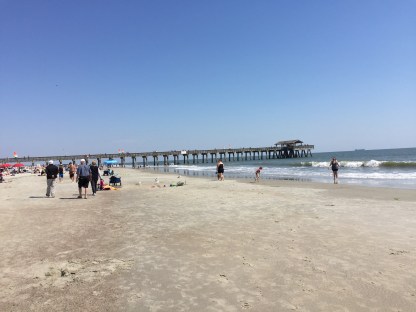
The pier at Tybee Island.

Having found a spot on a side street, we were able to walk to the beach and over to the pier. When we were there, they were having a mermaid event. I had a great time just looking at the Atlantic Ocean.  We saw some ships in the distance and watched the waves. At the end of the pier, people were fishing, mainly catching stingrays and then throwing them back into the ocean.

img_6792

People were catching stingrays.

I felt really badly for those stingrays!  On the way up, they were pulled by the fishing rod and put into a net.  Then they were subjected to photos with the person who caught them. However, the way down was way too scary, the stingrays were just thrown over the pier, where they tumbled back to the ocean.  UGH!

We did walk up the street filled with shops.  I was amazed at the number of people there!  It was only about 65 degrees, but people were on the beach sunbathing and some had even ventured into the ocean.

img_6815

The light house and the support buildings.

Next stop the Tybee Island Light Station and Museum…the Lighthouse.  We were in for a surprise.  It is not just the lighthouse that remains on the island, but all the houses used by the head keeper and his assistant.  You can even climb to the top of the light house!  All 178 steps!

The first lighthouse was built on Tybee Island in 1733!  It was too close to the ocean, so a second one was built.  During the Civil War, the confederates burned it.  After the war, in 1867 it was rebuilt and made taller!  Now it is a hybrid.  The bottom 60 feet are original, the top 85 feet were added in 1867!

It was a beautiful day to walk around and visit the historic buildings,  and watch a short movie about the lighthouse.

Across from the lighthouse compound are the remains of Fort Screvens.  One of the remaining batteries, Battery Garland, is now a museum as well.  Built in 1899, the battery was part of the US Coastal Defense System until 1945.  There are great views from the top.

img_6826

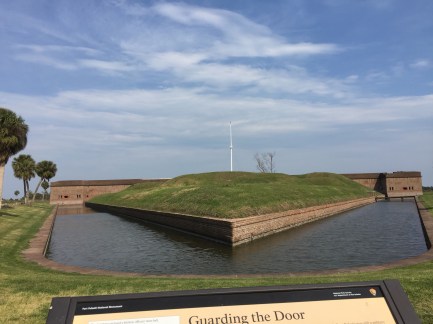
Unfortunately we could not enter the fort.

Our next stop was Fort Pulaski.  We had to cross over to McQueens Island and then across the South Channel of the Savannah River to Cockspur Island.  Unfortunately, last year’s hurricane season had not been kind to this area, and the fort itself was closed for repairs.  Also, we had to leave much earlier than normal because the road also was under construction and closed at a certain time.  We really only got to visit the Visitor’s Center and did not have time to walk the Lighthouse Overlook trail to see the Cockspur Island Lighthouse.  I was disappointed, but gives me a reason to go back!

History buffs, go!  I think you will enjoy these two sites.   And beach lovers, Tybee Island has lovely beaches for all to enjoy!


The Lighthouses That Made Me Feel Safe


UpDate: I Could Not Decide What To Do…But I Made The Right Choice!

26 Apr

On January 11, 2016, I published a post about finding the family of one of my mother’s best friends, “The I Cannot Decide What to Do. Really.”

Mom’s friend had passed away in her 50s to cancer, and my Mom, who lived until her early 80s, always wondered what happened to the family.  Her friend had moved to Texas and Mom lived in New Jersey.

Thanks to Tracing the Tribe members, I found out that the husband had also passed away, and an address.  So I sent a copy of a photo I had to that address with a note.  I also published the blog with the names in it hoping that would help as well.  And I waited.

In August 2016, I received an email from her youngest daughter.  I was so excited.  But it was just a few weeks to my daughter’s wedding.  And I had a lot on my mind.  We emailed back and forth a bit, and she told me more about her family.

She told me that I had spelled her Mom’s maiden name wrong. Once she told me , I had a revelation. There are my parent’s wedding list, were not only family members from her Dad’s side, but also her mother’s family.

I found out that her father’s family owned the poultry market in West New York… I went there often with my grandma! And her Mom’s family owned the meat market!  I had been there as well as a child.  My grandparents owned the bakery.  It made sense that they were such good friends.

I promised to send her the original photo of her Mom from December 1945.

But the wedding came and went.  And life got busy.  Most important, I had forgotten to write down her email address.  To be honest, I could not remember her name.  I knew it began with a J.  And that was it.  Every once in a while I would try to find it.

Last week I saw the photo again.  My guilt overwhelmed me.  I began a massive searched through my email using different search terms.  Finally I figured out the right one.  She appeared!  I emailed her immediately and apologized.

She does want the photo. And sent me her address.

Mom and Evelyn

Evelyn on left, and Fran, my Mom.

To make up for my long delay,  I also mailed her the original photo of our mothers together from that same day in 1945.  Yesterday they went in the mail.   I hope it brings her joy!  I also hope that if they travel from Texas to Kansas City, I have a chance to meet her.


https://wordpress.com/posts/zicharonot.com?s=What+to+do

The Shoah Impacts My DNA Relatives

24 Apr

Today I went on my 23 and Me account to access some information.  I manage both my account and that of my now deceased father, since I am the one who had him provide a sample about six months before he passed away.  I am so glad I did that.  It has provided me with my father’s Y chromosome information, which I otherwise would not have had.

I have over 1100 relatives on 23 and Me.  Most are third or distant cousins.  But today I had a revelation.  An unhappy one I must say.  There are 49 pages of relatives.  I just started scanning them.  And page after page after page, I kept seeing the same words, “on your father’s side,” after every entry.  Over and over again, not a single relative from my mother’s side. NO close relatives.  No distant relatives.

I started to cry.

Then I finally found ONE.  One distant relative. One.  I know that there were cousins who survived the Shoah. Not many.  And there were a few relatives already here in the USA. But I guess they are not on 23 and Me.  But in reality, most of my mother’s relatives perished.  She had one aunt and two uncles who survived. But among them, they only had two living children.  I know them well.   They also had descendants, I am happy to report.  Some live here in the USA, others in Israel.

But all those distant relatives are GONE.  Those distant relatives who share bits of my Dad’s and my DNA are welcome. But the missing ones from my mother’s side are so obviously a result of the Shoah that it reminds me of the horror of the loss.  I should have an equal number of distant relatives from my mother.  Instead of 1100 people, there should be 2200 people who share a bit of my DNA.

I am feeling a sense of loss I have not felt before.  Maybe because I am working on an article about my grandparents’ survival story.  So I am already feeling the dread of reliving their sorrow over their family’s loss.  But this was a blatant reminder that my family really is not like every other.

Reading Obsession Comes From My Mom

21 Apr

Reading Is my passion.  I cannot imagine life without a book by my bedside, magazines by my chair and my IPad with its digital books with me when I travel. If I love to read, then my Mom needs all the compliments.  She was an elementary school teacher, who believed books and reading were the best gift to give to a child.

Mom taught fourth grade for most of her over 30 years teaching career.  She taught as a young woman after college, while my Dad was in Korea.  Then stayed home with three young children.  She started back to full-time teaching when my sister was in first grade.  From then on, Mom’s life was split between us and her students.

Each summer when she went shopping for our school supplies and clothes, she also went shopping for her classroom. It is true that teachers spend their own money for their classrooms.  But this is not a new phenomenon: Mom was buying things for her classroom in the 1960s, 1970s, 1980s and 1990s.

Throughout the year, whenever her students had a Scholastic Book order, Mom would order books for her classroom.  Some were free, some she purchased.  But the good part, for us, was that we got to read these books as well.

img_7231

My Mom’s library system.

Mom built up quite a library in her classroom.  Bringing in bookshelves from home to stash her class’ reading choices.  Mom would make them as NF, non-fiction, or F, fiction.  She numbered each book and wrote her name inside.  Whenever the school purged old readers, my Mom would take some for her classroom as extra reading for her students.

She also would bring one of each home for me. Personally, I love old readers.  Whenever  Mom brought some home, I was delighted. Even when I was in college, I would curl with a reader just for fun.

When my Mom retired, I took at least one of each of the readers she still had.  I even have original Dick and Jane books from 1946-47.  Three to be exact.  One is quite decrepit, but I do not have the heart to get rid of it.  Those were actually being thrown out by the school. She asked if she could take a few for me.  And the principal said yes.  I still thank him, Mario, in my mind.

I know exactly which books were in my Mom’s classroom, as I still keep the numbers taped to the front of those books.  Inside I see my Mom’s handwriting and I have a bit of her with me.

img_7223

Some of my readers.

But my love for readers created a bit of an obsession for me as my children were growing up.  I often went to garage sales to find books and toys for them to play with.  Among the books, I often found readers.  They were sold for anywhere from a quarter to a dollar.  I then went big time: I started going to library books sales and I would pick up a few readers there.  These were a bit more expensive.  Then came the big book sales in the local convention center.  Yes, they had readers as well. This were even more expensive … three or four dollars!

I now have over 50 early readers and other school books.  My oldest school book is from 1914.  Many are from the 1940s and 1950s.  A few from 1960s.  But I did not stop at readers, not me.  I have science books, math books, language art books. I have readers that were published by the state of Kansas (where I live.)! I even have some very old story books. They are quite fun to read.

In my collection of books, I have an early Disney true life book; an early Nancy Drew; and much more.  My children learned to read with these readers.  Why not!  My daughter was reading the early Dick and Jane books when she was not quite four.  My son a bit later.  Those pictures draw the children in!

I happily passed my love of reading onto my children.  Each summer I would enroll them in the local library’s reading program.  For every five books they read, they got a prize. If they reached a predetermined number of books, they got a really special prize.  I did not have to do that for long for my daughter. She is an avid reader. She learned to read before she even went to kindergarten.  It caused a few problems because her ability to read was a much higher than her maturity.

I have some favorite reading memories.  She loved this scary series, Goosebumps.  One night she was reading a book in bed, way past her bed time.  I guess a thunderstorm was going on in the book, when a thunderstorm started in real life.  She threw the book across the room as she screamed in fright.  We loved that. Her favorite book for the longest time was Pippi Longstocking.  My husband actually hid it.  Many years later, when she was in college, we were cleaning bookshelves, my daughter found the book.  She knew instantly that he had hid it, as it was very high on a shelf.

In fact, in seventh grade, when the English teacher started a reading contest, my daughter blew everyone away.   I don’t remember how many books she read, but her list was extensive.  The teacher even called me into the room to make sure my daughter was really reading that much.   I realized she was not even telling the teacher about all the books she read!

My son was not as avid a reader as my daughter.  He has some dyslexia.  However, he also loved reading from my collection.  He loved the stories about the Spot and Puff.  He moved on slowly to riddle and joke books, then to the Bailey School Kids books. He loved these. His memorable moment was actually meeting the co-author Debbie Dadey and having books signed by her.

He moved on to more ‘boy’ books with time.  Animorphs were a favorite. But then he focused on graphic novels: manga.  The middle school librarian told me of his love, because, of course I volunteered in the school library.  As I re-stacked the books, I also read.  One day she informed me that I had to buy him some manga, as the school library was not carrying that many then.  I am sure there are many more now than in the early 2000s.

I am so glad that my Mom was a teacher.  Her love of books and learning, led to my love of books and learning.  I am glad I was able to pass this joy on to my children.  And whenever I want a little time reminiscing about my Mom, I just pull out a reader, settle into a chair and read.

Savannah Sojourn Is for History Lovers

19 Apr

For our 38th anniversary we went to Savannah, Georgia.  I have been wanting to visit Savannah for our entire married life because my first job out of graduate school was for a local Girl Scout Council.  And all Girl Scouts know that the founder, Juliette Gordon Low, was from Savannah.

It exceeded my expectations.  I want to go back!

img_6606

Juliette Gordon Low house.

On our first day,  I did go to the Juliette Low Gordon house.  I saw the rooms she walked in.  I saw ceramics and paintings she had created.  I walked in the garden with my husband.  Yes, I did buy something at the gift shop.  I had to.   Later we went to the Andrew Low house, where she spent her adulthood and passed away.  Unfortunately, we were too late to get on a tour.  But we did walk over the first Girl Scout headquarters, which is just beyond the gardens.  While there, a purchase of Girl Scout cookies was made.

But Savannah is not only for Girl Scout fans.  There was so much else to see.  So many lovely old homes from the early 1800s. Due to a group of women who started saving these homes in the 1960s, Savannah was saved from being a faceless and bland city to one that kept its local charm and ambiance.

I loved those restored homes.  We went on an architecture walking tour of the historic area, seeing many houses from the outside.  The next day, we visited three homes that were designed by William Jay in the 1820s: Owens-Thomas House, a home museum;  the Telfair Academy Art Museum which was once the home of Mary Telfair; and Scarborough House, built for the owner of the Savannah steamship.  This home is now the setting for the Ships of the Sea Maritime Museum. This museum is packed with wonderful models of sailing ships.  But the history of the building is also unique, it was once a school during segregation.

img_6856

Inside the Owens-Thomas house.  There is actually a bridge on the second floor connecting the two sides.

At each home I learned a bit more about William Jay, the architect, and even more about the economic slump of the 1820s that led to most of the original homeowners losing all their money and their homes, soon after they moved in.  These homes passed to other families and some fell into disrepair. Thank goodness for the Historical Society and the ladies that saved them!

img_6664

We walked the paths in Colonial Park Cemetery, reading the markers that told of the famous and infamous people who were buried there.  The saddest were the number of children who perished.  So many died in the epidemics of Yellow Fever that swept through Savannah several times.

I loved walking through the historic district and visiting every one of the 22 squares that still exists.  Yes, we went to every single one.  Each square has its own personality, some with a statue and a historic marker telling about that area.  I loved it.  I took photos of almost every marker.

We also meandered along the river and walked in and out of candy stores and gift shops.   The many diverse restaurants served the most delicious foods. My favorite was Elizabeth’s on 37th Street.  We ate in two different restaurants each day, some fancy, others just fun. Some we enjoyed were: the Funky Brunch Café;  Boar’s Head Grill and Tavern, near the river; The Lady and Sons Restaurant, surprising delicious; and Lulu’s Chocolate Bar.  I was surprised that I did not gain an ounce. But then we did walk 4 to 6 miles most days.

We also learned how Prohibition impacted Savannah!  It seems that lots of booze smuggling and speakeasy joints were part of the riverfront during the 1920s. A visit to the American Prohibition Museum is a must.  And yes get a drink at the end in the speakeasy.  You do not have to have an alcoholic drink…but my husband loved his.  I went for an original lemon soda mixed from scratch!


I found the history of the city is intriguing.  But for me, the Jewish history was amazing. Who knew that just a few months after the first settlers arrived, a group of 42 Jewish settlers arrived in 1733 bringing a Torah and starting a Jewish community in Savannah that survives today! This group of Sephardic Jews had been forced to leave Spain and settled in England just a decade or so earlier.  They then traveled to the unknown on their search for religious freedom.  WOW!

img_6638

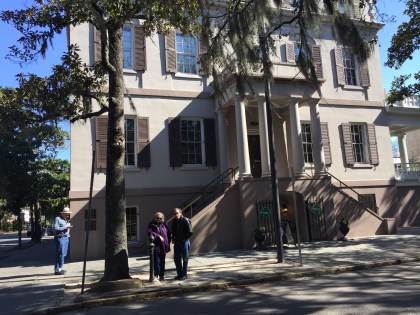
Built in the late 1870s, this building has always been a synagogue: Mikve Israel.

We went to visit the current synagogue building in the historic district:  Temple Mikve Israel.  Built in the late 1870s, the building is still used as by a congregation.  It contains a small museum and you can visit the chapel area.  But when we were there it was undergoing renovations, so we could not enter.

img_6629

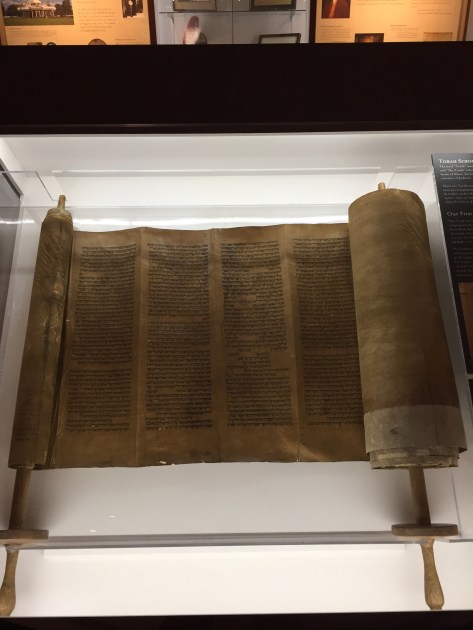
The Torah brought to Savannah in 1733, written on parchment made from deer hide.

We got to see one of the oldest Torah’s in the USA. The one that was brought here from England in the 1700s.  It is written on deer skin.  For me this was a thrill to see that a strong Jewish community still exists and has been a part of the Savannah community for 285 years.

I did not see all that I wanted to see in Savannah.   I loved staying in the Marshall House, with its evening wine and cheese, speakers and musicians, and wonderful staff.  But next time I want to stay in a bed and breakfast.  I have the spot picked out.   I could spend another five days in Savannah eating, walking and visiting museums.  I love learning about history and walking through Savannah is a living history lesson!


Grandma’s Depression Glass Dishes Brighten My Seder

2 Apr
img_6934

Depression Glass Dishes

Each year as I set my seder table, I cannot help but think about my Grandma Thelma, who died in 1981. Grandma had a collection of amber depression glass in the Patrician Spoke pattern.  It was not a complete set, but there were about 30 pieces: luncheon plates, serving dishes, a few cups and saucers and a creamer and bottom of a sugar bowl.The dishes were in our bungalow in the Catskills. After I married, in 1980, I claimed them.   I knew that they would be perfect for Passover.  Over the years I have purchased many pieces.  I now have a complete service for 18: dinner plates, soup bowls, small bowls, small dishes (bread and butter I think), luncheon plates, five serving pieces; two sets of creamer and sugar bowls; and the original cups and saucers from Grandma.

Depression glass was manufactured in the 1920s and 1930s.  It was often given away for free as part of a food promotion or to bring customers into a store.  I wonder if my Grandma had so much of it because my grandparents owned a bakery in West New York, New Jersey, that also sold some groceries.  This might have made it easy for her to collect the pieces she liked.

In fact, a cousin of my husband’s also has a collection of depression glass from her grandmother (my husband’s aunt).  Aunt Jean and Uncle Dave owned a grocery store in St. Joseph, Missouri. In my mind, I believe this clear glass set also came as giveaways that Aunt Jean was able to select and keep. Now her granddaughter is enjoying her dishes, as I enjoy my grandmother’s set.

Their patterns are very different. But that makes sense.  Over 100 different patterns were made in many colors, mainly clear, green, pale blue, amber and pink.  Although other colors like red and white were also manufactured.  Wikipedia states that most manufacturers were located in the Ohio River Valley. The website lists all of them and which patterns they produced.  My dishes were made by the Federal Glass Company

I have a few other pieces of depression glass.  In my years of searching for my patterns, I sometimes found a piece that just delighted me.  I have a cake plate in Madrid, pink, as well as a creamer.  It’s matching sugar bowl was destroyed years ago in a conflict with one of my cats.  That is the biggest problem with depression glass, it does break.  I do use them for my seder as well.

For my seder I use the dishes in my way.  The creamer and sugar bowls are filled with charoset.  The cereal bowls have become my soup bowls.  The bread and butter plates become small seder plates for each guest.  I use the small dessert bowls for an egg dish that starts my seder.

img_6946

My Rueven Glass pitcher, glasses and my parent’s seder plate.

But it is not only Depression glass that I place on my seder table.  I also have several pieces in the style of Rueven glass that were my parents. Some are originals, as he works in New Jersey, where my parents lived.   My art glass wine glasses, matzah plate and  water pitcher brighten my table.

img_6948

Miriam glass and Elijah’s glass

From my husband’s parents we have Murano glass kiddish cups that we use for Elijah’s glass and Miriam’s glass.  My in-laws purchased these when they were in Italy over 40 years ago.  I ended up with three in different sizes.

My Lenox seder plate was my parents.  They presented it to me over 30 years ago, as they came to me for Pesach, always arriving in time for the second seder.  They purchased an identical one for my sister, because they spent first seder with her.

Seeing these glass items on my table reminds me of our parents, my grandparents and the many wonderful seder memories from years ago.

Adorning my table with items from my grandparents, parents and in-laws brings me joy.  It promises me that traditions can continue.

The Art of Kintsugi is Changing How I View The River of My Life

12 Mar

I recently learned about the Japanese way of repairing broken ceramics through a process called kintsugi.  When a beloved pot or plate or mug or bowl or vase breaks, we usually throw it away.  There is not good repair for these items. But the Japanese developed a way to bond them together and make them more beautiful.   After a resin used to bond the broken pieces together and the edges are smoothed, the repair is completed with gold (kintsugi) or silver (gintsugi) painted into the mended areas.  They form golden veins.  This ‘Golden repair” makes the object more beautiful than before.

When I first read about kintsugi, I had one of those moments of epiphany that occurs when two totally different areas of my life combine.   I was going to be facilitating an evening class with my friend.  We had 19 women signed up to do a project called “the River of Life,’ which is part of the Wise Aging program designed by the Institute for Jewish Spirituality.

My friend and I participated in a two-day workshop to become instructors several years ago.  We had taught a full class on the topic of Wise Aging, but this was our first class in a while.  We were only going to touch on this one area where participants look back through their life, remembering the stories that were important to them, while seeing the threads and trends that impacted how they journeyed through life.

Sometimes people have a difficult time looking back on their lives. Events occurred that bring them distress because they have been unable to overcome the emotions that those memories bring to them.  They cannot get past and cannot move forward.  They see this as a broken thread; an unresolved flaw in their river.

img_6566

Although not Kintsugi, the turquoise embedded in the bowl’s cracks and flaws makes it more beautiful

It was while I was preparing for this class that I was reading a book for my job called, “The Growth Mindset Playbook, A Teacher’s Guide to Promoting Student Success.”  In Chapter 5, subtitled as “Failure As A path to Success,” the authors ended the chapter with information about kintsugi. In the book the authors wrote, “These restorations are not seen as a flaw in the piece, but as part of its history and something that makes it uniquely beautiful, and more interesting and valuable than before.”

YES!  The journeys we take in our lives are like the rivers with bends and falls and excitement, thrilling moments followed by peaceful floats.  Events occur that we cannot control.  We can only control our reactions to these events.  We have some control of the boat and the steering, but oftentimes events shatter our world.  We feel broken.  But we, like items repaired through kintsugi, are actually more beautiful and interesting because of our experiences.  We learn through each event we see and experience.  We become wiser and we can provide so much guidance.

Through failure we learn.   But is it really failure?  I think not.  Each episode or event in our life enriches our understanding of ourselves and of others. Empathy and compassion for others is increased when we can see the world in their place.

I am feel emotional attachment to those who suffer from infertility, because I too suffered though this.  I also underwent procedures and surgeries in an effort to have a family.  I feel what they feel.  But the golden veins of repair have helped me be a compassionate friend.

I saw kintsugi as the perfect way to explain this philosophy to the class.

The important aim, for me, is to always keep positive.  I want to see my life’s journey completed by golden and silver streams of repairs. Each one making me stronger and more lovely.  My outlook on the world might be different then before I needed the repair. When I look back at my life I want no regrets.  I want to believe that all that happened made me stronger, just as the repairs increase the strength of the broken ceramics

I believe, like kintsugi, each of our journeys through the river of our lives is uniquely beautiful.  It just takes us opening our eyes and seeing the best and not focusing on the hardships that will get us through.

In Honor of Our Children: Working For Safer Gun Laws Is My Personal Plan For Respecting Life

24 Feb

February 27 would have been my Mom’s birthday.  I have thinking about her so much since the latest school shooting. My Mom taught school for 30 years. Most of the time she taught fourth grade. There are some families for whom she taught multiple generations of children.

I also work in a school. It focuses on helping students who do not learn well in a traditional school setting. We have children who have anxiety disorders, ADD/ADHD, extremely brilliant children, bullied children, those on the autism spectrum, gay children, transgender children, depressed children, all special, all worthy and all needing an extra boost.  And I wonder how we will continue to keep all children safe from the outrageous behavior coming from the adults in our country.

I have been wondering what my Mom would think of all this gun violence and what she would do if she was still alive. Our family nickname for my Mom was ‘Norma Rae.’ This was based on the Sally Field character in the movie of the same name. Norma Rae had enough at her job and becomes a labor activist. She makes a difference.

My Mom might not have been a labor activist, but she never stayed quiet if she saw a wrong. She also made a difference. She taught me to speak up and speak out!  Maybe it is because she knew the tragedy of mass murder, since two of her grandparents and many family members were murdered in the Shoah. Or maybe it was because she learned from example. Her parents were strong willed people who came to the USA on their own in the 1920s with nothing, and built a business, a life and a family.

I believe my Mom would not have remained silent right now. So to those who have asked me who I am working for politically. I am not working for anyone. Rather I am working for every child who goes to school. I will keep calling my legislators. I will keep supporting organizations that combat gun violence. I will keep posting about topics that upset me, that I think are wrong. And I will not remain silent.

Dante wrote in his famous poem, “The Infernal,” that the hottest place in hell is for those who remain silent in times of moral crisis.  I will not remain silent. I feel my Mom with me and I feel her fire and passion for her students.

We really need to keep our children safe and let them know they are loved, special, unique and worthy.  How do we do that?

First there are about 5,000,000 members of the NRA. But there are over 325,000,000 citizens of the USA! Easy to see that 320,000,000 Do Not belong to the NRA. The NRA uses its money to buy our legislators by lobbying and giving them so much money for their campaigns.

We, the people, need to STOP this NOW!

1. Do not buy from companies that support the NRA. A boycott has started, and I will support it.

2. Give money to legislators who promise to fight for safe gun laws and the banning of assault weapons and items that boost these weapons to more dangerous levels.  I plan to continue to do this.

3. Let us work to get a ban on ammunition used in these killing guns.

4. Do Not vote for elected officials on any level of government who is financially indebted to the NRA.

5. Reject the NRA’s messages of hatred and divisiveness. I do not dislike people who own guns. I just dislike certain types of guns.

6. We have to put our money where our heart is and use it effectively. I am for a buy back of all assault weapons. I understand they cost about $600. I will give $1800 to buy back three. This amount calls out to me because 18 is the numerical value of the Hebrew word chai, life. I would give a hundred times life to save one life.

7. Let us insist they tighten the laws surrounding gun sales and the raffling off of guns as fundraisers. People should not be allowed to buy guns at gun shows and privately without background checks.

8. Tighten the laws surrounding background checks. We see they are failing us right now.

9. Increase funding for mental health care. Our government is supporting a cut to health care for all. The only industrialized nation that dies not provide health care for its citizens!  Let us work to change this.

10.  Keep calling and writing my elected officials to express my views on gun control laws and health care laws.

11. Support an organization that works to counter gun violence, like Grandparents Against Gun Violence, https://moksgagv.org, Gabby Giffords group Americans For Responsible Solutions https://giffords.org, Brady Campaign to Stop Gun Violence http://www.bradycampaign.org.

12. Be KIND!  There is too much divisiveness and hateful speech right now.  Use your words for good.

I will be wearing this pin that says Chai to remind myself to work for life.

Working for safer gun laws is my personal plan to respect life.