Archive | Szenk Feuer Blogs RSS feed for this section

This Jacket is a Survivor!

20 May

img_3411

I am cleaning out my cedar chest.  I had no idea what was piled up inside.  But surprises keep coming! My biggest surprise find was a jacket belonging to my mother.  I honestly forgot it was there.  I thought I had lost it in my many moves years ago.  But here it is:  A grayish brown wool jacket.  It is definitely from the late 1940s/early 1950s in both style and by history.

This is not just any jacket.  It was made by my mother’s uncles.  I am not sure which one, either David or Isaac.  They survived the Shoah because they were tailors.  When they escaped Poland they headed into Russia, where I am told they worked making soldiers’ uniforms.  I have no proof of this. But that is the story I was told.

After the war, they ended up in Italy first, where they waited for papers.  My uncles had my grandmother and another sister in the United States.  My aunts had relatives, sisters I think, in Australia.  They decided they would go to live in whatever country and near whoever sent visas first.  They just wanted out of Europe and away from fear.

The visas came from Australia.  So they went to Melbourne.  This jacket was made by my uncles in Melbourne after they settled there and sent to my mother in the United States.  Can you image? I can’t.

I know they were in contact throughout their journey of survival.   I know that my grandmother and aunt tried to get them visas to the USA and sent them money to survive after the war.

I know that they helped to support them throughout their lives.  My Uncle David died when he was in his late 30s in Australia.  He is buried in a Jewish cemetery in Melbourne.  Eventually the survivors, my Uncle Isaac, his wife Bronia and, David’s widow, Rosa moved to Israel with my cousin, where she still lives with her family.

When they moved to Israel, we sent care packages to them.  It was 1965 or 1966.  I still remember when I was 11 learning about my cousin. We became pen pals, writing back and forth for many years.  We still keep in contact, but now through What’s Ap and Facebook.

The year (1974-75) I studied at Hebrew University in Israel, I would spend time with my family, my uncle, aunts and cousin in Kiriat Haim, which is just north of Haifa.   During one visit, Uncle Isaac surprised me with a bag to carry my school supplies when I traveled from Jerusalem to visit family.  He also made me a pillow to decorate my room.  I was a great bag for that as it was the perfect size with a zipper.  And no one else had anything like.  I actually used it to go to class.  I still have both of these items.

After my return from Israel, my mother gave the jacket to me.  It longer fit her and she thought I would wear it.   Since I spent so much time with my family in Israel, the jacket carried so many emotions with it.  When I was younger, I would wear the jacket and think of all my great uncles and aunts went through during the war.  How they survived the war and got out of Europe.  It is a jacket of survival and strength in my mind.

So I guess I will continue to keep this jacket.  It has a few moth-eaten areas.  The color has faded.  But to me, its symbol of survival and new lives makes it so valuable.  It tells me to never give up.  To survive and be a survivor.


The Rosh Hashannah Card Has A Story


Speaking Yiddish Always Brings Me Holocaust Memories


My Grandmother’s Mysterious Black Notebook

13 May
img_3335-1

The black notebook.

I have a book.  It is small.  About eight inches by nine inches.  It has a black cover.  Inside are 33 lined pages, so total of 66 pages that can be written on.

It seems to be a diary.  Most of the pages, about 40, have entries that are dated in 1921.  So my book is almost 100 years old.  Two of the names I recognize.  My grandmother and her first cousin, Abraham, who perished in the Shoah.  The other names I am not sure about.  But these entries, even though they have different names, seem to be written by the same person.  My grandmother perhaps?  Or are they really two separate handwriting.  Now that I look at this page below, it seems as if two different people wrote. But many of the pages have the same writing and not changes like this one.

img_3332

Entries from March 1921 with my grandmother Tala Szenk and her cousin Abram Prentki’s names.

Some of the entries look like they could be poems.   Did they write these poems, or did they just copy them from some book?  It does show how my grandmother was educated in Poland.  Her father was a teacher. Grandma could read, write and speak in Polish, Hebrew and Yiddish.  After she came to America, she went to night school to learn English.

img_3337

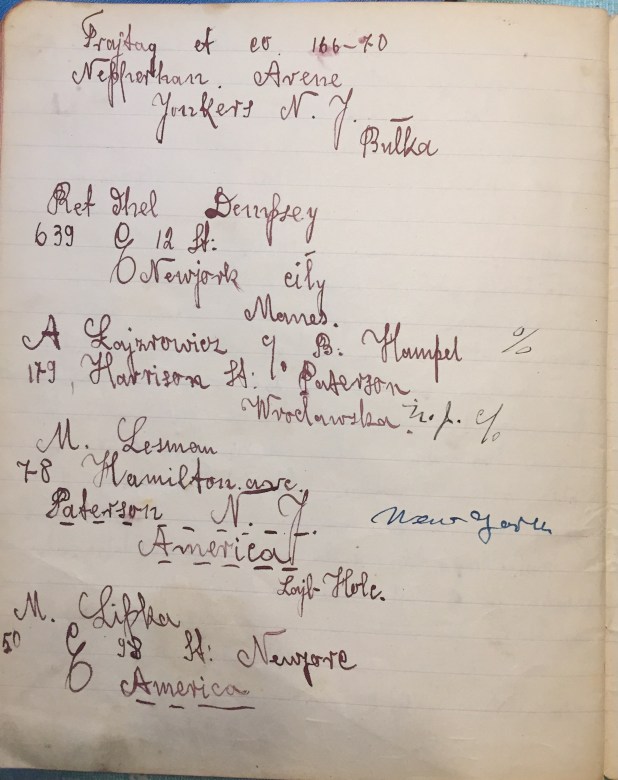
See Lipka, her relatives she stayed with when she arrived in America.

In the middle of the book are names and addresses in English.  Names of people living in New York and New Jersey.  Hidden, I think, in the middle of the book.  Her escape plan?   My grandmother came to the United States when she was 16 in 1922.  I see the last name of the aunt and uncle who allowed her to live with them in the United States.  They must have sponsored her as well.  The name is Lipka.

It is all written in Polish.  But I can understand the names, because I recognize them.  And the name of my grandmother and her cousin jump out at me.  Especially since I have written about this cousin and not knowing who he was at first.  And then here he is embedded with her in this book.

img_3338

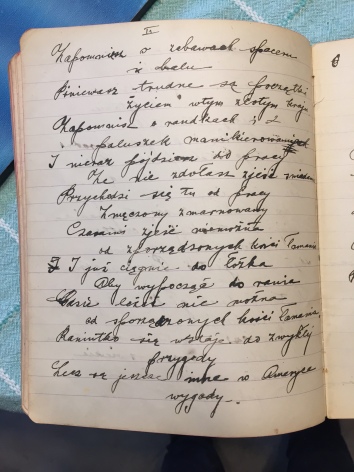
Who wrote these pages?

After the journal entries, if that is what they are, comes some blank pages, and then six pages written in a different handwriting.  It looks like a poem.  But I am not sure.  I am not sure what any of it is.

The last four pages are in Yiddish. Those I have had translated.  We think it is a story, perhaps not true, perhaps yes.   About a girl who meets non-Jewish man and how it ends in sadness.  The beginning reminds of the story of Tveye and his daughter Chava.  But this story does not end happily.  Did she read a book and decided to write that story?  I don’t know. I don’t know if she is writing about someone she knew or making up a story.   Perhaps the other entries would give me information. Perhaps.

img_3336

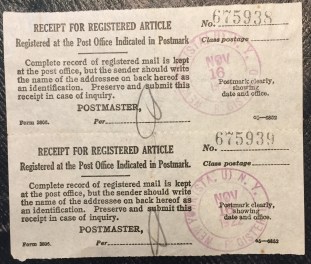
Why did she save this receipt as well?

Inside the book is a receipt for registered mail sent on November 16, 1922.  Did she send something back to her father and her siblings after she arrived in America?  I wish I knew.

My grandmother passed away 38 years ago.  I wish I had seen this book when she was alive so I could ask her what all this is!  We found it long after she died and my parents died.  It was hidden in the bottom of a box in the attic of their Catskills home.  Not thrown away, but saved for me to one day find.

This book is a mystery to me.  I need someone who reads Polish and can translate this book for me.  I love a mystery, but even more, I love the solution to a mystery!


Two blogs about Abraham Prentki:

https://zicharonot.com/2018/06/04/the-mystery-of-abraham-prantki/


https://zicharonot.com/2018/06/26/amazing-what-information-two-photos-can-provide/

The Keeper of the Records

6 May

In my family, I have become the keeper of the records.  I believe it is because I actually do something with them.  I scan them in to the computer; I research these records; I write about them; and then I share the information with my family through my blogs.  I hope that my doing this will keep these memories alive for future generations.

So recently, when I was in New Jersey, I asked my sister where she had put our parents’ wedding album, as my sister wanted it when we cleaned out our parents’ home.  It was easily accessible, so I looked through it, searching for a particular photo.  I had seen it the album many times, so knew it was included.

The biggest problem with this album is that the photos are encased in plastic. That must have been the style as I have seen other albums from this era also with plastic.  So those photos are difficult to photograph or scan, as you see here.

img_3065

My parents listening to the reading of their ketubah.

I found what I was looking for: a photo with my parents’ ketubah, Jewish marriage license.  It was important for me because I have both their marriage license and the engagement agreement that was signed at the same time.

The engagement contract is in disrepair.  I hate even taking it out of its’ envelop, but I did for a photo.  It is signed by both of my grandfathers. It was kept in an envelop addressed to my Dad at my grandparents’ bakery.

img_3219

The ketubah is in much better shape.  Written in both English and Hebrew, it is pretty simple.  Not an artist drawing, but rather a form Ketubah filled in by the Rabbi.  The most important part for me is that it lists my mother’s Hebrew/Yiddish name.  We sometimes had a debate on that as my grandparents, and sometimes my dad, would call her ‘Fegilah,” little bird.  But we were pretty sure her name in Yiddish was Freida, which is confirmed with the ketubah.

The photo with the ketubah almost makes me laugh.  Their wedding was arranged quickly.  Dad was in the army and going to Korea.  Yet there he is in tails and a top hat!  My Mom is standing by the huppah in a veil that almost hides her face. It is much denser than the veil my sister, sister-in-law, and I wore, and our daughters.

They both look so serious.  It is difficult to believe that they were just 22 years old. My uncle, my Mother’s brother, is there as well.  Thanks to him we actually have a movie of my parents’ wedding!  No voices, but all the action is shown.

To me having this photo together with the ketubah is important.  It is a link that ties the document to the people in it.  Now forever together in this blog.

I think that is why I am the designated keeper of the records.

Identifying A Photo is Hanukkah Miracle

6 Dec

My grandmother’s photo album continues to amaze me.  As I revisit it every few months,  I always find photos that call out to me.  This time, the portrait of a middle age man caught my attention.

img_1010

I believe this is my great grandfather.

He looked so familiar, but at the same time, not so much.  Then I looked more closely at his ears.  Do not laugh!  But his ears were very telling.  And I thought, “Wait, I think that is my great grandfather.”  I pulled out my great grandfather’s passport. And compared the photos.  And yes, in my mind the ears are the same.  As are the eyes.  He is much older in the passport photo.  And much had happened in his life.  But it is definitely Avraham Shlomo.

Front Great grandpa USA Visa

My Great Grandfather’s Green card that save him.

My grandmother’s album is filled with photos from the 1920s and 1930s.  I imagine that this is the photo she brought with her to the United States when she left Poland in the early 1920s.  Her mother had already died.  Her younger siblings, she left behind.

But she kept a photo album of the people she met in the USA And with the many photos sent to her from Europe.  Some I have identified.  But many more remain a mystery, because they have no identification,  that I still try to discover.  The hardest ones to see are the children.  Grandma put in several photos of large groups of children, I would assume from a school photo.  I wonder how many survived?

Each time, I figure out who someone is, I feel as if a great miracle has occurred.  So today I had  my Hanukkah miracle for the year, discovering this photo of my great grandfather in his middle age.  A younger vision of him before so much sorrow occurred in Poland and Europe.

Here is the blog I wrote when I first discovered this album.  But I have written many others since then.  Each discovering just an amazing find.  You can see more of the photos in the Category: Grandma’s Photo Album.

https://zicharonot.com/2014/08/19/old-photographs-bring-memories-to-life/

How The KinderTransport Touched My Family

5 Nov

I have always been intrigued by the KinderTransport that saved 10,000 Jewish children during the Shoah as they were transported out of Nazi territory and on to England by train and then across the English Channel.  In my mind I imagined the heaviness of heart of the parents as they put their children’s safety first and sent them to live in a foreign country with people they did not know.  What brave parents they were to know they might not survive, but to give their children a chance no matter the peril!

img_0400

My interest sparked me to read books about these trains.  And even brought my attention to the orphan trains that brought children from the east coast out to the middle of the country on Orphan Trains. In my mind the two were linked together.  The KinderTransport children were not yet orphans, but many would be by the end of the war.  The Orphan Train children were often in orphanages or living on the streets when they were sent away.

But I did not know of anyone who actually rode the trains to a new life brining the children to safety away from the horrors of Europe, except for a man I met on a cruise several years ago.  (See blog below.)

img_7760

The sisters,  Martha and Rosa, who I now know survived thanks to the KinderTransport.

However, recently that all changed.  I now know that two of my relatives survived the Shoah when their parents put them on a train to England from Breslau, Germany.  Their mother was my grandmother’s first cousin.  These two girls were around the age of my mother, their second cousin. Except for a photo I found and wrote about, we would not have known about the sisters.

Their mother, Celia, perished in the Shoah.  I thought they had as well.  All I had was a photo of two girls and a brief inscription on the back.  But from that inscription, I was able to find out that at least one of the girls survived.  I did not know how she survived, but I knew she lived and wrote a Yad V’Shem testimony for her mother.  From little information I had,  I wrote a blog (see below) about a year ago, wanting to know more.

Recently that blog was read by someone in England, who gave me the news that both girls had survived and had come to England on the KinderTransport.  That one girl, Martha, had lived with this person’s in-laws during the war. The families had been in touch until Martha’s death.

Now I have new wonders.  Did my grandmother know that her cousin’s children had survived?  Did anyone know?  The testimony was not written until 1999 from Australia.  So perhaps not.  Perhaps the sisters had been lost to the family forever because of the Shoah. I think this is a question that will never have an answer as anyone who might have known is long gone.

I wish I knew more.  I have reached out to the person who contacted me to see if she has more information.  I have not heard back.  But I thank her for contacting me at all and helping to solve another Shoah mystery for my family.

My searches continue.  I must admit, that this one at least gave me some hope and some joy. The KinderTransport touched my family; saved two lives.  That is the best knowledge of all.


https://zicharonot.com/2017/04/06/cruise-conversations-that-linger-in-my-heart/

https://zicharonot.com/2018/06/26/amazing-what-information-two-photos-can-provide/


Finding My Heritage In Spain

28 Oct

Our trip to Spain and Portugal had a special purpose for besides wanting to see places I had not seen. I also wanted to see the bits and pieces left of the Sephardic Jewish imprint on Spain. I have written about my maternal grandfather and his family’s Spanish roots in an earlier blog (see below). Now I wanted to see what I could see.

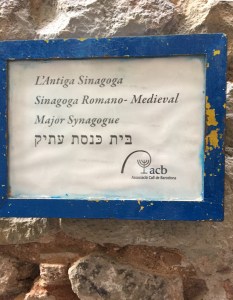
I was on a mission that started in Barcelona. I had been to this lovely city before and heard the story about the Jewish cemetery destroyed and replaced with a Christian cemetery. Now the only Jewish aspect was the name of the hill: Montjuic. However, in Barcelona you can visit the site of the Major Synagogue. A small space that you must walk down to see, this tiny space reflects the rule that no religious site would be bigger than the smallest church. So it is small. But I was glad to see that it has been found and reclaimed. There is a guide on site who gives a 10 minute presentation about it. So I am glad we went. Most places do not even have that!

Our next stop with a bit of Jewish history was surprising to me. We went to the small city of Sagunt or Sagunto near Valencia. I was not expecting what I found. First they were having a festival to celebrate their Middle Ages history, and as we entered I saw a menorah symbol on banners. The town had its Jewish quarter still designated including one of the original arches, called the Blood Arch. The tour guide did not know why. I have my own ideas. You actually walked through the Jewish Quarter in order to get up to the Roman teacher.

The narrow, hilly streets are picturesque, and walking through the quarter you come to the top where a private house stands on the site of the original synagogue, with an iron Menorah window. We were also able to see the archeology site of where they think the mikveh was located.

I have since researched and learned that in ancient days this town was called Morviedro. Here the Jews were protected from massacres in 1391 and Jews from other areas took refuge there. When the 1492 decree was made, the Jewish residents arranged safe passage out about 500 people.

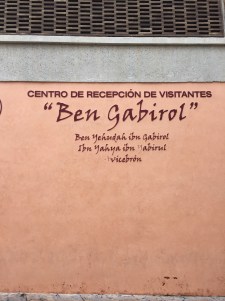
In fact almost every city we went to had some remains of its Jewish inhabitants. In Malaga, the birthplace of Picasso, we found it was also the birthplace of Yehudah Ben Gabriel, who revitalized Jewish literature. And we found the Jewish Quarter nit far from the Picasso Museum.

Gibraltar had a thriving Jewish community and still does. We saw people walking the streets wearing kippot. We walked to the old Flemish Synagogue and took a photo of the door to the walled area. Unfortunately we could not go in.

Only in Cadiz was all remnants of the Jewish community destroyed. Probably because of the 1755 earthquake and tsunami. But at one time there was a thriving community that had to escape due to the forced expulsion of the Jewish people. In fact 8000 Jews left Cadiz and traveled to North Africa.

A sign in Sintra

In Portugal we went to Sintra to see the Pena Palace. But while walking through the narrow streets of the city, I found a cork store where I purchased a purse. Then I noticed its address: Beco Judaea. The street of the Jews.

Church of Sao Domingos where Jewish citizens murdered in 1500s

The Jewish Quarter.

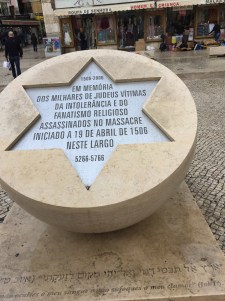
But it was in Lisbon that we had the most in-depth experience. Besides visiting some of the important sites like the palace of the inquisition and Rossi’s Plaza where the Crypto Jews were tortured, we visited the church, Sao Domingos, where the massacre of Jews began in the 1506, walked the Jewish Quarter, and learned how King Manuel I tricked the Jewish population and baptized them all without their permission. He wanted to marry the daughter of the king of Spain, but he also wanted to keep his Jewish citizens. This was his solution.

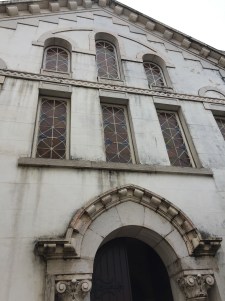
Finally we visited the Lisbon synagogue built in the early 1900s that still has services today. Portugal was a neutral country during the war, a Lisbon was a place of refuge. Today 2000 Jews live in Portugal.

Https://dis.bh.org.il murviedro-sagunto

One More Family Destroyed

6 Sep

It has been over a month since I last wrote about the testimonies of Shalom Hollander, my grandfather’s cousin who wrote the Yad VaShem testimonies for about 40 members of my family including my great grandparents and a great uncle.  I needed time away from the visions of horrors that his testimonies put into my mind as I thought of all these relatives who were lost. (See links to blogs below.)

But there was one last family that I was determined to write about because they all perished.

A family of five died in 1941-42.  They were Hirsh Tzvi Feuer, the son of Eliezer and Leah Feuer, and his wife, Dvora Amsterdam, the daughter of Tzvi and Chava Amsterdam.  As I have written in earlier blogs, the names Amsterdam and Feuer are common in my grandfather’s family.  My great grandmother was an Amsterdam, also named Chava, and my great grandfather was a Feuer. They, my great grandparents were first cousins.  There was so much intermarriage between these two families!

I have the names of all my great great grandparents and their siblings.  And, although I have the names of my three times great grandparents, I do not know the names of their siblings.  I am sure, however, that Hirsh Tzvi Feuer and Dvora Amsterdam’s parents are among those names.  Shalom identifies himself as a relative in these testimonies. Also he indicates that Hirsh was a farmer, and my great grandparents and their families were farmers in Trzciana.

Tzvi was born in 1895 and his wife, Dvora, in 1908, which make them contemporaries of my grandparents who were born in 1900 and 1906.  I would assume that my grandfather knew them when he was a child.  They lived before the war in Wola Mielecka, Poland, but they lived during the war in Trzciana, Poland, my grandfather’s home town. Wola Mielecka was close by, all the surrounding areas to the town of Mielec, Poland.

Tzvi and Hava had three children who perished.  Lea Feuer who was 4. Obviously named for her grandmother.  Chava Feuer, age 6, named for the other grandmother.  Then the third child, Eliezer, an infant, named for his grandfather.

I hope there are other children who survived. Who were older.  Hirsh Tzvi was 47 when he was murdered.  Dvora was 34.  I hope there could have been several children in their early teens?  Perhaps I am doing wishful thinking.  But in my heart, I want them to have been survived by someone besides Shalom Hollander. I do not want this entire family to have perished.

But like the family of Shalom Hollander, there is a possibility that they were all murdered along with thousands of others when the Nazi’s made the Mielec area Judenfrie.  Of the almost 4000 Jewish residents of the Mielec area, only a few hundred survived.

Baruch Dayan HaEmet.

https://zicharonot.com/2018/06/07/the-sorrow-of-shalom-hollander/

https://zicharonot.com/2018/06/05/murdered-in-belzec/

https://zicharonot.com/2018/07/11/the-yad-vashem-shoah-database-each-name-becomes-a-memory/

Discovering Karola’s Kielce Pogrom Testimony

12 Aug

In February 2017 I published a blog about discovering my grandmother’s cousin was in Kielce, Poland, during the Pogrom in July 1946. (See blog link below.) Since then I have been continuing my research on the lost remnants of my grandparent’s families.  Along the way, I have discovered more about Karola.

First off, I now know her entire name, which brings me more understanding. Korala’s mother and my great grandmother were sisters.  My grandmother was her first cousin.

Our families did keep in touch.  My father often went to Paris on business, occasionally my Mom would accompanied him and would visit a cousin who lived there.  That cousin was Karola.  She had changed her name from the Polish sounding to a more French name, and of course I recognized the last name.

In any case, it was when I found the village where my great grandmother was born, that I found also the Viroshov Yitzkor Book published in 1970.   In it, written in Yiddish, was Karola’s testimony about the Kielce Pogrom.   I must thank my friend, Blumah W., the local Chabbad rebbetzin, who spent several hours with me as she translated this moving memory.

I think with what is going on in Poland today, with the country’s wanting to deny their people’s involvement in the Nazi’s intent to destroy and annihilate the Jewish population.  Karola’s story and memory is even more important because it tells the truth of what really happened in the years pre, during and after the war.

The Kielce Pogrom By Karola Manes F. as translated by Blumah W.

 “A lot has already been told about the ferocious anti-Semitism of how the majority of Polish treated their Jewish neighbors during all the years of the Polish existence. It is still fresh in memory.  The anti- Jewish politics in pre-war Poland using power against the Jewish workers and merchants, and the hooligans acting against the Jewish young students. 

        Also, during the time of the War, being under the German occupation, the Poles did not forget their anti-Semitic tradition.  They were very much supportive of the Nazi program and worked with the Nazis for the annihilation of the Jewish nation.  (“G-d forbid,” added by Blumah.)

          When the war finished, the Jewish remnants were hidden in different places. A few Jewish people who were saved began to look in their birth places for their relatives; their flesh and blood.   Also, then there came upon these survivors, unruly/wild Polish bandits, bands of Poles, who murdered these few left over Jews.

           The culmination point of this ferocious Polish behavior was the tragic well-known Kielce Pogrom, which was accomplish over these few ‘leftovers’ in the summer of the year 1946.

            Being be that I was in that time in Kielce where I lived through this tragic chapter, then I will tell what happened during this incident.

            After the war, in Kielce there was the concentration of a larger group of Jews.  The portion of them came from hidden places and from the forests, where they were involved with the armed partisans combat.  Larger groups from back from Russia, where they found themselves during the time of the war.  In order to deal with stream of survivors, a Jewish committee was formed that found themselves on Planty Street. 

           The Polish people right away, in the first days, immediately began to agitate and incite against the Jews.  “TOO many of you remained!”  They said with extreme hate.

           The first provocation was when someone threw the dead body of a Christian woman into the Jewish compound.  It was accompanied with an incitement that they said the Jews murdered this woman.

           Only at night, Russian soldiers came dressed in Polish uniforms and made order. They arrested a number of Polish hooligans.   The next morning, on the way to the funeral, the Jewish people accompanying the dead, were guarded by the Russian soldiers in order to avoid any further incidents by the wild and unruly Polish population

            May these words act as a monument for the holy martyrs of the Kielce Pogrom; May G-d avenge their blood. “

In the last paragraphs, Karola does not talk about how people were murdered or what truly happened on the day of the pogrom.  Instead she talks about the fact that it was Russian soldiers who stopped the pogrom by dispersing the Polish hooligans.

To be honest, I was a bit disappointed.  I wanted to know from her mouth/her pen what truly happened. What she as a survivor saw.  But then, I realized, it was too much.  She had survived a ghetto, a concentration camp and now a pogrom, who am I to want more from her?

What Happened To Karola?


Boleslawiec Pottery Pieces Create a Feeling of Despondency

15 Jul

(I found out on September 24, 2018, that there are actually two Boleslawiec.  The village my grandmother came from is different from the one the pottery comes from in Poland. But since they are intertwined in my mind, the blog still is accurate.)

Lately I have been seeing the name of the city, Boleslawiec, quite a bit because of the beautiful Polish ceramic pottery that is created there and sold throughout the world.   As I walked through the historic section of St. Charles, Missouri, I saw a store dedicated to this pottery.  My sister-in-law and I walked through and admired all the lovely blue-toned, designed pottery.

Later that month, I was in Tuesday Morning, a discount store, that had a selection of this pottery as well.  Here, I actually purchased a piece of the pottery in the shape of a heart as a memory of my grandmother who grew up in Boleslawiec.  But my remembrance of my Grandmother is not her love of her home town, but rather to remember how much my grandmother hated Boleslawiec.  How excited she was when she was 16 to get her exit visa to the USA.  Leaving Boleslawiec was the best thing that happened to my Grandma.  It really was not a friendly spot for Jewish inhabitants.

In 1925 there were 103 Jewish people in Boleslaweic.  In 1933 the town of Boleslawiec had over 19,500 people, but only just over 100 Jewish residents.  By 1938 there were just 64 remained. My family was among those who lived there.  And after World War 2, there were no Jews left in the city.
img_5528

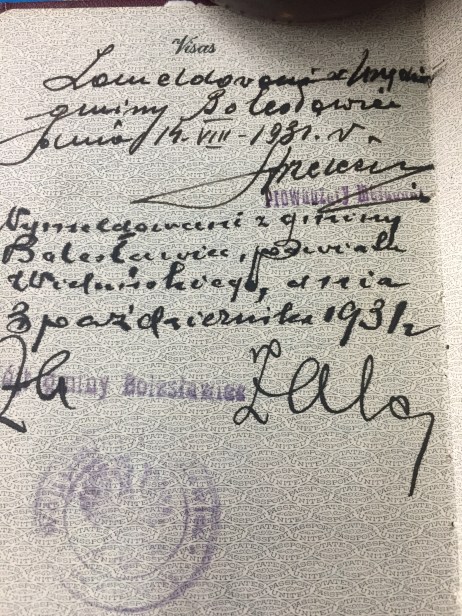
The special visa for 1931 visit to Boleslawiec.

My Grandma left Boleslawiec in 1922 to escape to the United States.  In 1931 she returned to Boleslawiec with my mother and uncle.  They stayed for several months.  We even have a special visa in the passport used by my Mom and Uncle that gives them permission to be in Boleslawiec.

It was during this visit that Grandma became aware of how bad it was for Jews in Europe.  Upon her return to the USA, she immediately began to work to get family members out.  She was able to rescue her father and her sister, who she brought to the United States. She could not rescue her two brothers and their spouses, but they did survive. Her mother, my great grandmother, Sara Manes Szenk,  died in 1919 as did a younger sister. (See blogs below.)

She was right to worry.  On Krystalnacht, November 9-10, 1938, Jewish business and the synagogue were set on fire.  They were destroyed.  Now just an empty lot is left.  The cemetery was also destroyed.  The few tombstones or matzevot left are at The Museum of Ceramics.   So my Great Grandma Sara’s grave — Sara, who I am also named for — is now unmarked, as are the other relatives who died before the Shoah.  An empty field marks the spot of the Jewish cemetery.  Luckily my great grandfather and aunt were already in the USA by then.   And my great uncles had fled.

Members  of Grandma’s family were murdered in the war. (See Blog about Speaking Yiddish below.).  I have not been able to find everyone.  But since the names Manes and Szenk were the surnames of her parents, I will claim all the Jewish people who lived in Boleslawiec who perished and had those surnames or maiden names.  I cannot claim for sure that they are related to me.  But in a town with just 100 Jewish members, I feel a strong level of confidence that they are my family.

Moshe Schenk(Szenk) and his wife, Yenta Fridel Schenk(Szenk), from Boleslawiec died in the Chelmo Death Camp in Poland in 1942.  Moshe’ siblings died as well:  Hana Leah and Bluma, also Bluma’s daughter Sara.  Two people wrote testimony for Moshe Schenk/Mosze Szenk: an uncle and a cousin.  That cousin also left testimony for Hana Leah, while the daughter/sister of Bluma and Sara, left testimony of their murders.

Many people who died in Chelmo were transferred there from the Lodz Ghetto in 1942.  So I will assume that these relatives were taken from Boleslawiec, to the Lodz Ghetto before their murders at Chelmo.  The Lodz Ghetto was the second largest ghetto in Poland.  Later, when the ghetto was destroyed in August 1944, many were taken to Auschwitz as well. Of the 68,000 Jews who were imprisoned there, 877 Jews remained hidden and were liberated by the Russians. When the war was over, only 10,000 Jews of Lodz Province remained alive. (Wikipedia).

Besides my Szenk/Schenk family who were murdered, there were at least four members of the Manes family killed: Franka Manes and three of her adult children: Sara, Eli and Reize.  Their sister entered the testimony in Yad VaShem.

I know that others perished as well because I met some of the survivors of Boleslawiec. I still cannot find their names, and that truly disturbs me. But the Manes family was from another small town nearby.  I have not yet completed my research about what happened in that village, but it was also in Lodz.  So I would assume the same route, Lodz Ghetto then Chelmo or Auschwitz.

When people think of the Polish city of Boleslawiec, they think of the beautiful pottery.   And only that.  I wish I could think that way as well.  Blue is my favorite color, and the pottery truly is lovey.  I know people who collect it.

I look at the lovely ceramic heart on my kitchen counter, and I think that it is amazing how a piece of lovely pottery that brings joy to so many people, brings me a feeling of despondency.   It is a symbol to me that people can create beautiful objects,  but carry biased hatred in their hearts. Even allowing that hatred to contribute to the deaths of others.  Unfortunately, I see that hatred rising again and happening today. So I look at the heart and I hope that kindness overcomes hatred.

Three websites, besides Wikipedia,  have helped me in the search about my Grandmother’s family who lived in Boleslawiec, Poland, located in the Province of Lodz.   Thank you to Jewish Gen; Vtrual Shtel; and my obsession, the Yad VaShem Database.

Update, There are actually two Boleslawiec cities in Poland.  The larger one is where the pottery is made; my grandmother probably lived in the smaller one.  But the pottery still brings the same response in my heart.

https://zicharonot.com/2014/04/28/speaking-yiddish-always-brings-me-holocaust-memories/

https://zicharonot.com/2017/12/04/the-us-passport-a-matter-of-life/

https://zicharonot.com/2016/10/01/the-rosh-hashannah-card-has-a-story/

The Yad VaShem Shoah Database: Each Name Becomes A Memory

11 Jul

The Yad VaShem Shoah database is killing me, while at the same time becoming addictive.  I have learned the secret of advance search where you can enter the name of a person who has given testimony and find all the other people that person has remembered.

For me it has been a personal trial as I try to find all the family names, while at the same time finding so many names, knowing that hundreds of family members perished in the Shoah.  My grandfather’s family all lived in a small area of Galicia surrounding the village of Mielec.

I enter names that are common to my family and I search.  Today I found a Tova Gital Feuer (her maiden name).  Those are two names that are used over and over again in my grandfather’s family.   Gital was the name of my great-great grandmother.  This Gital Tova/Tova Gital was born in 1889 in Mielec and died when she was 54 in Belzec 1942. That is where my great grandfather and great uncle also perished:  in Belzec.  They are sure to have been cousins of some sort, since they had the same last name in such a small town.

The person who gave testimony was Gital Tova’s daughter Ruth, who survived and made a new live in Israel.  But her immediate family did not survive.  Her father, Abraham, died in Treblinka.   Two of her brothers,  Lieb Arie and Anczel/Anshel died in the Debica/Dembitz Murder Site.  Anshel was a Polish soldier, I find that amazing.  He was 21 when he perished.

Debica/Dembitz was so close to where my grandfather and his family lived. It was actually part of the same area, and one set of his grandparents lived in Debica/Dembitz.

According to Wikipedia, the Nazi’s built a military base in 1941 in Debica.  They had 15,000 slave laborers who perished, including 7,500 Jews, 5000 Soviet POWs and 2500 Poles.  Their remains were buried in a nearby cemetery.  In Debica, the Nazis forced all of the Jews in to a ghetto and then murdered most of them there and in Auschwitz.
I had not heard of the Debica/Dembitz Murder Site. So I searched some more.   I found that in a Jewish Gen document. “The Murder of the Jews of Dembitz” by Reuven Siedlisker-Sarid, translated by Jerrold Landau.

This testimony tells about the formation of the ghetto, and that until 1943 the Jews were murdered in Belzec.  I believe this description is the Debica Murder Site that Ruth meant, as reported in the testimony:

“The Gestapo men approached the rows of kneeling people,and removed about 180 or 200 men. Those were placed on transport trucks and driven by the S. S. men to the edge of the Wilicka Forest at Lisa Gora. They were brought into the forest and shot into a communal grave that had previously been prepared by the Polish Junaks. The Junaks were then called to cover over the grave at the conclusion of the dreadful murder. This took place on the 7th of Av, 5702 (1942).”https://www.jewishgen.org/yizkor/debica/Dem141.html

Now I know about the murder site. All I can think is how horrible is that!   I have no idea how many members of my family died there. I have found so many horrible ways that my family members were killed by hatred.

Ruth’s parents and two brothers were not the only ones to be murdered:  In all seven of her siblings were killed: Lieb Arie and Anczel/Anshel in Debica; Shumel, 19; Simcha, 6 or 8, in Asuchwitz; Eliezar, 13; Mala/Malka, 23; Hanna, 14, Belzec.

I wish the list ended there, but Ruth also testified about the deaths of her aunts and Uncle Zlata, Sima and Hershel.   Another Aunt and Uncle: Hava and Zalman, and their 17-year- old son, Nissan.  These names got to me in a personal way.  My name is Hava, named for my great grandmother who perish in the Shoah.  And my grandfather was also Nissan Feuer.  It could have been us.

All were from Mielec.  And although Zlata and her husband Hershel and Sima were from Ruth’s father’s side, and might not be directly related to me, I claim them.  My great great grandfather on my grandfather’s maternal side was named Hershel.  He was both my great grandmother and great grandfather’s grandfather.  They were first cousins.  So many cousins married each other in Europe!

Ruth also gave testimony on several friends and acquaintances who also perished.   Ten more people.  I assume she saw them die either in the ghetto, or the death camps.  I do not believe I am related to any of them, as she did not mention a family relationship.

Of the 4,000 Jewish people who lived in the Mielec/Dembitz area only about 200 survived the war and the death camps.

I wish that I would not keep finding these horrific bits of information.  I wish I could stop searching the Yad VShem website.  Years ago, when I first tried researched my family, I tried the website database, but it was not as good as it is now.   Something makes me continue to search.   I continue to find more names to keep in my memory and in my heart.  Each name adds to my understanding of my grandfather and how important was for him to have our family.  Each name helps understand my Grandmother and her reactions when we traveled to Israel in 1976.  They lost so much in the Shoah.

For Ruth’s family, I feel a teeny, tiny less sad because Ruth survived.  She married.  I hope she had children, who had children, who had children to keep the memory and names of her parents, siblings, aunts and uncles, and cousins alive.  I hope she was able to live a happy life.  She entered these names in 1999.

For me each name I find is a blessing and a remembrance that I hope will keep in the hearts of my family.

Baruch Dayan HaEmet.


Here is one other blog about my Yad VaShem searches:  https://zicharonot.com/2018/06/07/the-sorrow-of-shalom-hollander/