Tag Archives: Tracing the Tribe

The Six Letters From Cousin Abram

15 Dec

I have six letters written from March 1931 to !932 to my grandmother from her cousin, Abram.  I don’t have her letters, only what he wrote to her.  We found them in a cedar cigar box with some other items that she obviously thought were important treasures.

I have had the first three letters translated by members of Tracing the Tribe and the Jewish Genealogy Portal pages on Facebook.  Now I am trying to decide if I should continue in my quest to see what the letters say, because I am realizing that my grandmother had another ‘love’ besides my grandfather.

The letters were written just before and during the six months that my grandmother was in Europe with my mother and uncle while she underwent treatments at the spa/spring waters of Kalsbad.  They were written in the town of Boleslawiec, where my grandmother grew up. 
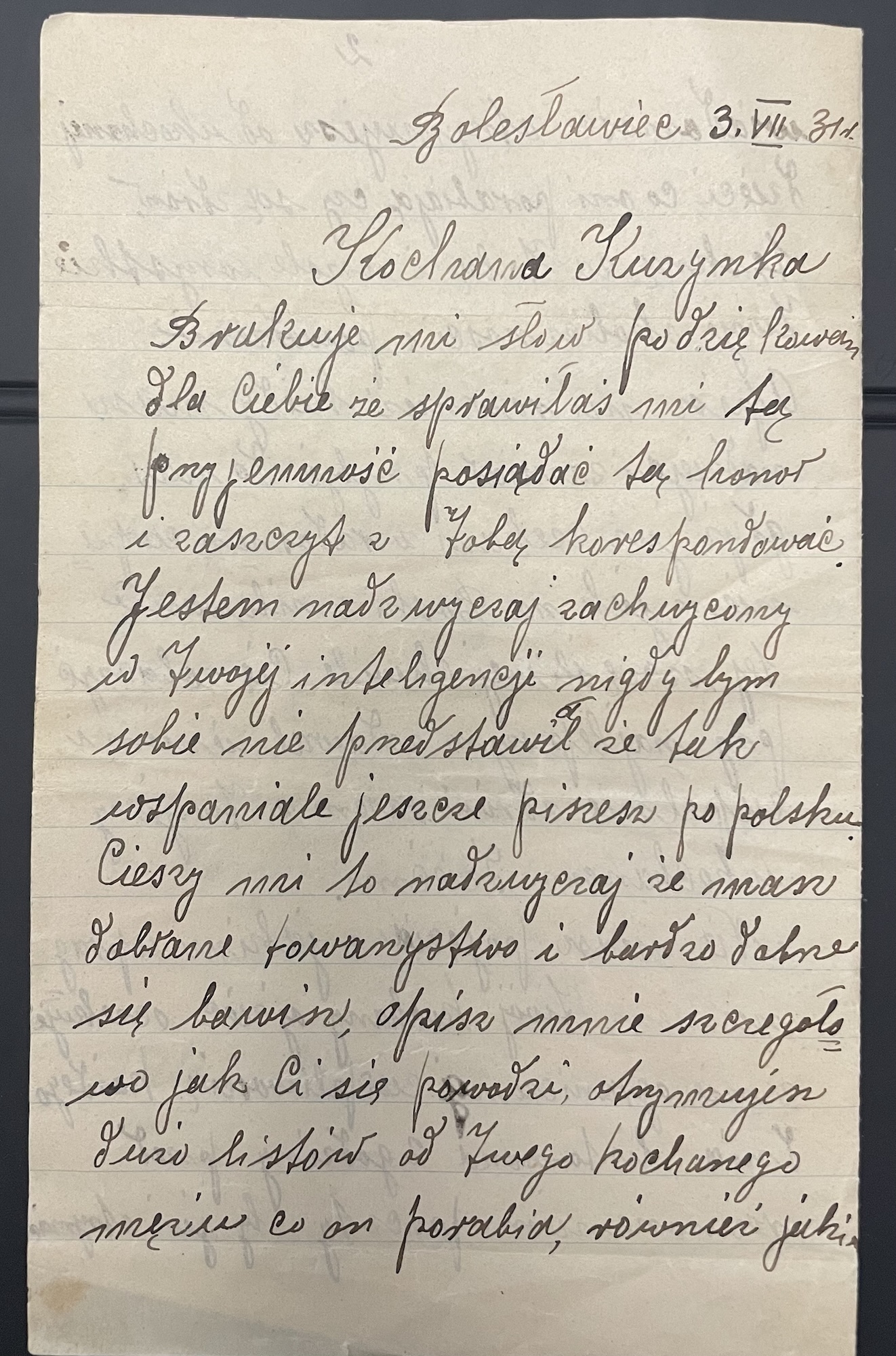
In my mind the first letter is a bit obnoxious.  Her male cousin, Abram, is amazed that my grandmother can still write so well in Polish.  He writes, “I am completely fascinated by your intelligence, I would never have thought you would still be writing in Polish so proficiently.” 

My first thought was UGH.  But then I remember that my grandmother left Poland when she was 16 in 1922. So perhaps it could happen that nine years later her language skills would fade. But still!

He asks how her husband and children are doing. Whether she is getting letters from them.  Hoping she was doing well.  Also telling her how happy they are that she is going to visit.

“I miss you.  Please tell me everything that is happening with you and let me know when you’re planning to visit because I am waiting impatiently for this happy moment to see you well and with your dear children.

You have no idea how your beloved father waits for the mailman with unlimited patience every day two hours before his shift starts. And when he receives a letter from you he is so overwhelmed with joy he occasionally loses his ability to read!”

Can you imagine not seeing your daughter for nine years, perhaps thinking when she left that he would never see her again.   To a degree, I understand.  For over two and a half years, during Covid, I did not see my daughter who lives in Israel. At least we could Facetime.  When she finally did come to the USA, she and I hugged and cried for a long time at the airport.

He ends this first letter:

“I am finishing this letter by wishing you all the best, whatever you may desire!

Best regards from your kind-hearted cousin, Abram and the entire family.”

The second letter was written from Boleslawiec pm June 23, 1931. This letter was written after she arrived in Europe, perhaps at the spa.  She had had a difficult journey from the USA and in fact almost died.  She was ill with kidney disease as a result of eclampsia.

He writes: “That you did not have a pleasant journey did not bring me joy.  However, the following bright days should give you the opportunity to enjoy the good and clear air as well as admission for immediate treatment.  I wish you a speedy recovery so that you can return to us completely healthy.”

Once again, he mentions how eagerly they are all awaiting her arrival in Boleslawiec. He tells her that he visited with his beloved fiancée and told her how impressed he was with my grandmother because she was so intelligent.  That she also wished my grandmother a speedy recovery. (I just have to say that my grandmother was brilliant. Her brain was like a trap.). He ends this letter wishing her warm regards and good luck.  Abram.

It is in the third letter, dated July 28, 1931, from Boleslawiec, that the tone begins to change.  And I began to wonder if I should have the other letters translated.

He starts by thanking her for this letter, but admonishes her because the last correspondence was just a note card without too much information.

“I expected a more detailed description of your events, and I felt quite offended by your silence and short note.  I still admire your intelligence and wisdom, humor and quick

wit which always digs me out of the hole that I entered by writing such a letter to you… Otherwise, I expect a terrible end for myself, but I trust that in the future you will grant me with your words, so precious to me, more generously.”

He is a bit pompous and impressed with himself.  But I guess I have to think about the times, 1930s, and the male dominance of the time period, especially among the orthodox. But my grandmother was a bit different. Her Dad was a scholar/cheder teacher.  And he had all his children learn to read and write in Hebrew, Yiddish and Polish.  My grandmother also knew how to read and write in German before she came to the USA where she learned English.    Amazing for someone whose formal education ended when she was still a teen.

He then writes: “I received your funny and humorous letter, and I thank you so much for all the giggles and fun that it provided and for setting a clear timeline for sending a more serious letter to you… I will grant that having received your letter I should have changed the subject of my writing, but you must forgive me because my mom is unwell and under these circumstances I did not have the mood for jokes nor time to write a different letter and I do not want to stall and stop you from sending an answer to my writing.”

But now comes the part that really got my attention and changed the total impression about what might have really be going on. You see she had two cousins named Abram.  I am not sure which one this is. Buy I have written about one in earlier blogs.  (See below.)

“My dear cousin, I am letting you know that Abram visited us yesterday, we took a long walk in the evening, and he was telling us all about your visit to him and your previous relationship.  He was pouring his heart out which, as you know, is quite unlike him, because typically he is reserved and introverted. Still he was confessing to me like a broken record to put some ease to his own suffering. He also knew what was said about him… He really wanted me to share with him what your true opinion about him is. I deflected his questions about you immediately.”

“I am sending this letter with best regards, your sincere cousin, Abram.

Best regards from my parents and sister as well.”

WOW!.  I think the Abram who is in love with her is the cousin in Germany.  She probably got to see him when she went to take mineral water treatments.  I have other items with his name in them.  And I assume that they had an unrequited young love before she went to the United States.

This really touched my heart, but also made me think that perhaps future letters spoke more about the second Abram. And did I really want to know more? 

But it also made me think that perhaps one reason that she went to the USA when she was 16 was the end of the relationship with the second Abram.  Did he break off with her, did she break off with him.  Did the family decide that this was not a good match?  I know in those days first cousins did marry.  So many questions that I might never know the answers to.

I did put the fourth letter up on Tracing the Tribe to see if someone would translate it. But even though it has been up for a month, there has been no translation.  In my mind, I have thought pehaps it is for the best.  But another part of me wants to know what the other three letters reveal.  I am having an internal debate whether to repost the fourth letter.

In any case thank you to Aleksandra Leonczyk and Roman Matz, who did the translations.

Learning about the Crypto-Jews/Conversos in Santa Fe

28 May

As the descendent of a Jewish family that was forced to leave Spain in 1492 or convert, I have always been interested in learning more about the Crypto-Jews/ Conversos of New Mexico.  It was in the 1980’s when the information about this still hidden group first started to be revealed. It started when a Jewish man named Stanley Hordes because New Mexico’s State Historians, and people started coming to him to tell him their stories.  To me it was absolutely amazing that 500 years after the Inquisition in Spain, that descendants were still hiding and still keeping this secret!

I had wanted to attend the Roads Scholar program: “New Mexico’s Conversos and Crypto-Jews in Santa Fe” since 2019.  Covid interrupted my plans. But finally we were able to attend. My family were also once impacted by the Inquisition and Spain’s quest to either convert or eliminate all Jews.  My family chose to move to Portugal and then to Holland.  Our story is written in an earlier blog. (See below.)

We had lectures from the authors of the top two books.

Our first speaker was Professor Ron Duncan Hart, who gave us an overview of the history of the Jews journey to New Mexico. He wrote, “Crypto-Jews, The Long Journey.” Jews were in Spain were given a choice, convert or leave.  Many stayed, they could not afford to go or they thought it would not last long and they would just hide their Jewishness, some decided they really would become Catholic.  But all were doubted because they were not “pure of blood, “meaning they were not just Spanish, they were tainted by either having Jewish or Moslem descent. Those converted in name only and still practiced their religion in secret, known as Crypto-Jews…hidden Jews. Those who were forcibly converted and known as anusim also secretly practiced Judaism.

In fact, so many of the Portuguese who came over to Mexico in the 1600s were of Crypto-Jewish ancestry, that calling someone Portuguese was just another way to say he/she was Jewish. Since my family went from Spain to Portugal, I began to wonder if some of my family made this arduous journey to escape the Inquisition. To be allowed to go to the New World, you had to show that you were purely Spanish, not tainted with Jewish or Muslim blood.  Horrifying!  People actually had their genealogy redone to eliminate their Jewish past to fit the needed requirement.

The Crypto-Jews of today still live in the mountains in northern New Mexico.  They still keep their secret.  In fact, one of our speakers, when asked how many crypto Jews there actually was, basically said, “We do not know. They keep hidden.  They do not talk about it.  They know who the other families in their community are like them. But it is not discussed”

We heard from two women who have reclaimed their Jewish identity.  They were each the child in the home who a parent said “Somos Jodios,” “We are Jews.”  Maria Apodaca told us how difficult it was to come out of hiding and join a congregation and have a ceremony of return.  How family members were not always happy about what they had done.  Many feel, with the way the world is now, it is better to stay hidden!

Isabelle Medina Sandoval wrote a novel based on her family’s history: “Guardians of Hidden Traditions.”  She can trace her ancestry back to Portugal and was able to claim Portuguese citizenship based on her family history.  But she also said that coming out of hiding is a difficult process.  A poet, she has written poems about the Crypt-Jewish experience.

From these two women we learned some of the cultural/religious/cuisine that continues from their Jewish ancestry, like lighting candles on Friday night, covering mirrors when someone dies, making a fried treat at the winter holidays, cleaning the house on Friday.  It is amazing to me that these traditions continue.

Schelly Talalay Dardashti, spoke about: “The New World: Jewish Ehtnicity, DNA& Genetics.“ Schelly is the founder of Tracing the Tribe – Jewish Genealogy on FB. She explained the difference in the different DNA tests and how some do not look for Sephardic DNA, only Ashkanazi.  We were told that between 20-40 percent of people in New Mexico had some Jewish ancestors.  That there are genetic links between those living in northern New Mexico and isolated areas in Central/South America.  People who were also trying to hide away from the Inquisition.  And the final link, a rather sad one, the fact that the BRCA1 mutation that causes brest cancer in Jewish women, is also found in the Hispanic population in Mexico and New Mexico and came from those original converso/crypto Jewish arrivals from Spain in the early 1500s.   Wow.

We attended a performance of “Parted Waters,” a play written by Robert F. Benjamin about the Crypto Jewish community. It tells the story of three generations of a crypto Jewish family.  The grandfather, a crypto Jew; his son, who knows the background, but identifies with his life as a Catholic and does not want to talk about it; and his son, who has never been told about his ancestry.  When the grandson makes a racist comment to a Jewish woman, the truth comes out along with the ramifications.  It pulled together all that we had learned over the week.

Our last lecturer, Chris Herbst spoke about Outliers/Ousiders and Religion.”  He provided us some history about the area of northern New Mexico and more explanations about the genetic composition of the populations today in Spain and in New Mexico.  He said about 1/3 of the population of Spain today has either Jewish or Moorish ancestry.

Throughout all of our talks we were referred back to the book written by Stanley Hordes, who wrote an indepth book about the Crypto Jews called, “To the End of the Earth.”  The Spanish/Portuguese Crypto-Jews traveled to the End of the Earth, the mountains of New Mexico above Santa Fe, to escape the Inquisition.  It is like reading a college dissertation, but it was fantastic in the depth of the research.

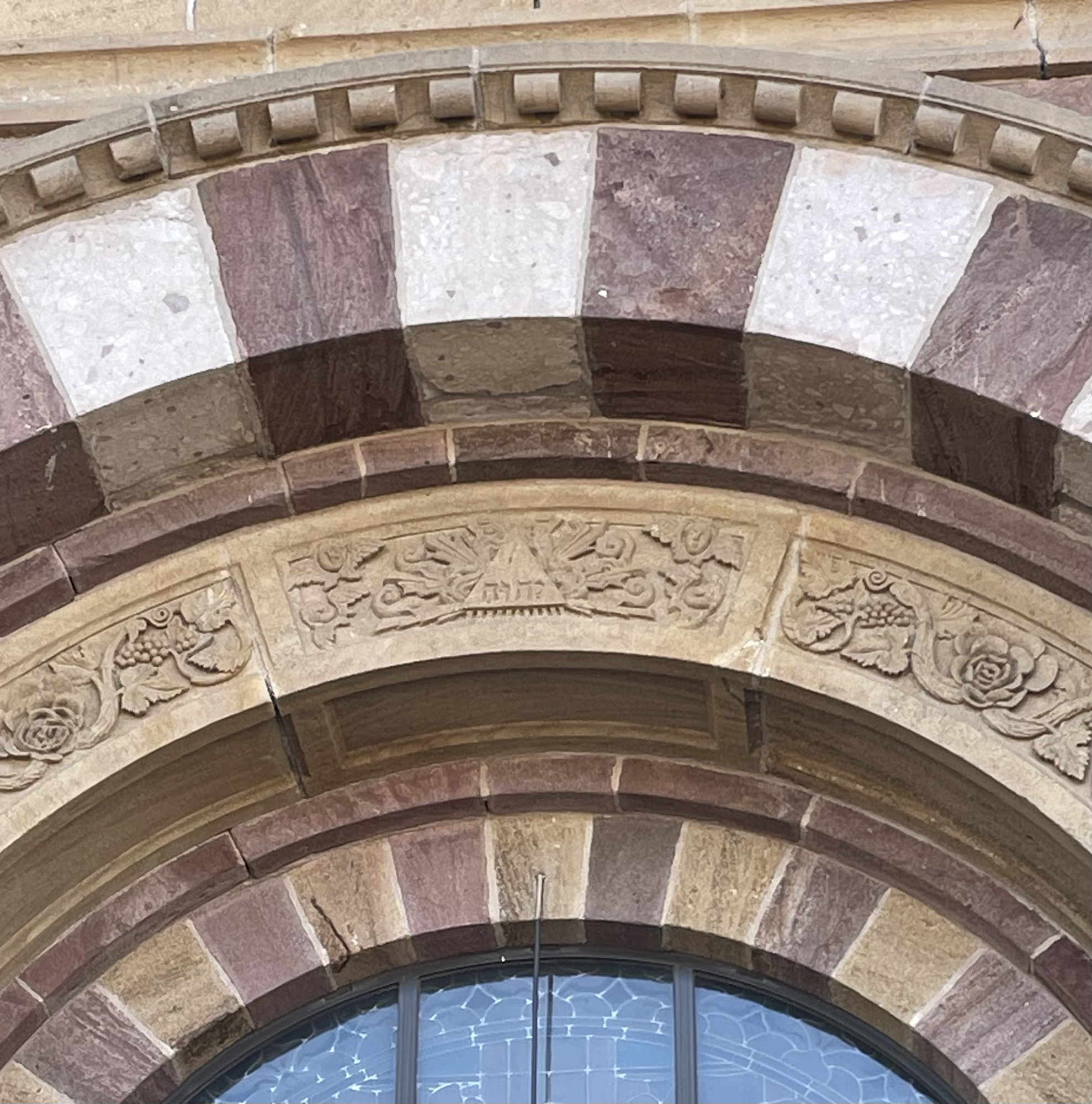
The Hebrew is in the triangle.

We did not spend all of our time learning, we also had time on our own to visit museums and explore Santa Fe.  We went to the  main cathedral of Santa Fe, where over the mantal of the front door, is an inscription in Hebrew and a Jewish Star on an internal wall. 

As part of our Roads Scholar program we also ate at many different restaurants with the most delicious food, toured historic Santa Fe, with our wonderful leader, Vennetta, and went to Taos and the World Heritage Site of the Taos Pueblo.

This was just a wonderful learning experience, where we were able to learn, experience, make new friends and enjoy the true wonders of Santa Fe, New Mexico. If you have any interest in learning more about the Crypto-Jewsof New Mexico, Mexico and Spain, I highly recommend this Roads Scholar program.

I will write about the other places we visited in future blogs.

My Genealogy Research Makes a Difference To A Distant Cousin

23 Apr

When I started my genealogy research, I did my research and wrote my blogs just for my siblings and immediate family.  Over time, I included my cousins on my blog posts.  And then it just snowballed.  I realized that by posting them on Facebook, specifically on Tracing the Tribe group, I might connect with other more distant relatives.  And it happened.  I have had people help me with my research who are not related. I am in touch with distant cousins including Evan, who has been an immense help in making connections.  I have met some of these cousins in person.  And my understanding of my family increases with each new contact.

This blog is different.  In this instance, I discovered that the information I had from speaking with my grandmother years ago helped solve the family mystery of a women who is actually my third cousin, our grandmother’s were first cousins.

It started with an email from Evan. (He really does a great job keeping in touch with all the cousins) He connected me with a distant cousin named Sherry, the granddaughter of a woman named Esther who was born about 1897/1898.  He said she was part of my branch of the family and thought I could help.  I could.

A number of years ago, I wrote a blog about my grandmother entitled “Too Many Esthers” (see blog below) and “Updated Esther “(see blog below).  My Grandma Esther was one of 5 or 6 first cousins all named for their maternal grandmother, all named Esther, all born around the same time. All were given nicknames.  My grandmother was known as Curly Esther.

Sherry wrote back to Evan and me: (She has given me permission to write this blog, I have edited her emails for privacy and brevity.).  “Thank you for contacting me!  I had trouble with my grandmother, and who her parents truly were.  There were so many unanswered questions and there are no living family members in my close family that know anything more than I do.  I got pretty frustrated and sort of put it on the back burner.  I would be really interested in what you found out!”

I immediately responded: “It’s nice to be reconnected. I am the granddaughter of another Esther born in 1898.  I have been researching the family for years. In late 1970s I sat down with my Grandma and got the names of all of her mother’s siblings. The children of Elka/Esther Lew and Victor/Avigdor Wolf. Here are two of my blogs that will lead back to some of my research and introduce you to the family. The attached photo is our great great grandparents Esther and Victor Wolf(f).

Actually, I knew immediately who her grandmother had to be, which is why I sent her the blogs about the Esthers.  There was one cousin known as Meshugannah Esther.  Her mother Chamka came to the USA pregnant with three children.  Her husband had passed away before she came.  After their daughter, Esther, was born and weaned, she was given to a different sister, Sarah, who could not have children, to raise as her own.  To make things more confusing, Chamka was known as Anna in the USA, but her Hebrew name was Nechama.  Her family called her only Chamka/Chamky.

I must say I was truly happy to receive a reply from Sherry.  Her response filled me with joy to know that my research and pictures helped her.  Here is an edited version of her response.

“Wow!  I am so overwhelmed and thrilled with this connection.  I was getting so frustrated with trying to figure out my grandmother’s story and had no one to ask.  

I did hear that “grandma didn’t find out until the day she was engaged that her aunt was her mother and her mother was her aunt”.  So I knew that there was information that I was missing in order to fill in the blanks.  

“Meshuganah Esther moved in with my family when I was 10 years old. We lived next door to Aunt Lenore and her family.  Grandma was married 5 times!  She felt she needed to do that in order for her to care for her children. My grandmother passed in June of 1993.

“Ellen, you spoke of the cousins’ club meetings.  I remember them although I think I spent most of the time hiding behind my mother’s skirt…

“I actually gasped out loud when I opened the picture of Esther and Victor Wolf.  I have that picture and I had no idea who they were.

Thank you, dear cousins.  This is a gift.”

My initial response to this was just as excited. I was elated that I could help.

“I am so glad that you were able to make connections about the family through my blogs. I am so glad that you have that photo as well, and now know who it is.  It is amazing to have photos of great grandparents, but great great grandparents is really special. 

“Did you see the picture of Chamka and Lenore?  I am not sure which blog it is in.

I can understand a bit why she wasn’t told which sister was her mother.  But I am sure it was a big shock at the time. It was one of those open secrets that everyone knows but does not discuss.”

Since she did not have nor seen the photo of her great grandmother Chamka with her granddaughter Lenore, I sent her the photo and the information that was written on the back. “Tante Chamky and Lenore. Lenore was Meshuggana Esther’s daughter. Esther was raised by Tante Sarah, but was really Chamky’s daughter.”

I am currently looking for the photo so I can send her it for her family records.

Thanks to Tracing the Tribe, over the years, I have connected with a number of cousins.  But this connection honestly made me immensely happy.  

An Unexpected ‘Grave’ Mystery

3 Mar

With the uptick in anti-Semitic events, with masked college students attacking Jewish students at colleges, with a Hamas murderous pogrom in Israel, I am still amazed when events from the Shoah are revealed in present day. I feel like I am in a time warp.  Reading about the events at the UC Berkley campus and at the same time reading an email from a distant cousin telling me about a mass grave found in Poland that contains members of my extended family.  Don’t college students learn anything about history? 

My newest journey started with a email from a distant cousin concerning the Holocaust and my family. I get unusual requests now and then because I have been the family historian, trying to document all the family who were murdered during the Shoah.  A task I realize is virtually impossible with all large number of people in my family who were murdered. 

My distant cousin received a letter through JewishGen’s Family Finder.  Her great aunt, who I keep in contact with, suggested she send the email to me.

Her email contained a series of emails between two people in Europe that forced my brain back in time to all that my maternal family had suffered so many decades ago during the horrors of the Shoah.

The first was from a retired baker in London who had been contacted by a researcher who wanted information about a family named Brenner who were murdered by the Nazis and whose bones were recently found in a mass grave and in accordance with state law were re-interred in a Catholic cemetery.

His mother was born Kornbluth and her father was born in Mielec, Poland, where many Kornbluth’s were living when the Nazis invaded. They believed the bones were those of a woman whose maiden name was Kornbluth; her married name was Brenner.

My family was from Mielec and its surrounding small towns.  I have written about the destruction of the Jewish population in this city and its surrounding in other blogs.  Brenner is one of the names in my family. Which made me think that I could have a connection with this grave.  Although the last name Kornbluth is familiar, I wasn’t entirely sure of the connection to us.  But I kept reading.

The baker then include emails from a representative of the Zapomniane Foundation that deals with locating and commemorating the graves of the Holocaust victims. He found the baker through JewishGen Family Finder.


“I represent the Zapomniane Foundation that deals with locating and commemorating the graves of the Holocaust victims (zapomniane.org or our profile on FB). I’m currently researching the case of the Brenner family murdered in 1942 and buried in a mass grave near Mielec. According to what I have learned so far among the victims probably were Lazar and Sara Brenner. Her maiden name was Kornbluth. Before the war they lived in a village called Hyki (today it is called Sarnow). They were killed together with their children and Sara’s brother. Would you happen to know this story and/or have any information about Sara Brenner nee Kornbluth?

Sincerely
A N”

Then came more information from the Zapomniane Foundation:
“ Here is the story of how I have learned about the Brenner family:

Two years ago I went to Czajkowa (a village near Mielec) to see the location of a place where the Brenner family (seven people) was killed and buried in August 1942.My guide was Robert P. who told me the story of his aunt Anna P. Anna’s real name was Ryfka Amsterdam she was Jewish, converted to catholicism before the war and married Andrzej P, Robert’s relative and became Anna P. The Brenner family were the relatives of Anna/Ryfka: perhaps Ryfka’s sister with husband and children and possibly Ryfka’s (and Sara’s?)brother. There are no names, only the last name of the father of the family i.e Brenner.”

Well now we are getting closer to my family, since Amsterdam is my grandfather’s last name. I know that any one named Amsterdam is definitely somehow related to me. This is the first time ever that I have heard about a family member who converted to Catholicism before the war.  But to be honest, if someone left the family to marry outside of the faith, it was probably not discussed. 

What the email says next really touched my soul! I could not image how this young man would have felt when he dug up the grave.


“The gravesite of the Brenner family was partially destroyed in 2003 by an excavator. Obviously the grave itself has never been marked, it was just a hole in the ground.  As a result the bones from this grave were taken by the police and buried in an anonymous grave in Tuszów Narodowy catholic cemetery. Ironically the guy who worked with the excavator and dug out the bones was the grandson of Ryfka Amsterdam/Anna P. He was interrogated by the police in 2003. Anna/Ryfka had three children, her son born in 1950 is still living in Mielec.”

Next shock!  A non-Jewish descendant of Rikva/Anna born just a few years before me, still lives in Mielec.  They stayed there even after all her Jewish relatives were murdered. I cannot understand that reality. Could you comfortably walk the streets of a city, see the houses of your relatives, know that they were murdered and that others were living in their homes?  Would you ever feel safe?

Not only that, it was Anna’s grandson who accidentally dug up the grave of people who might be his great aunt and uncle and their children, his cousins.  I could almost see this as a movie.  Could this truly be happening?  But yes, it was and it is.  So now he has not only dug up a grave 80 years after they were buried, but it is his family buried there.  I really have no words.

The researcher  continued:

“I found the information about Chaim Brenner via the Holocaust Survivor Program. Thus I knew the names of his parents and their fate that fits the story I know from the Polish archives:

Czajkowa
Aug. 15, 1942
Captured and shot by German police, beginning w/ oldest family member; gendarme Franiszek Wojtas identified as likely shooter; family did not report to ghetto and remained in hiding for approx. 3 mos.; hid in forest and empty home of Kamuda; group consisted of two families; relatives of prewar converts to Christianity, Amsterdams, who survived war in same village

So my big questions are who was buried in the grave destroyed by the excavator 20 years ago and how can we commemorate them.”


The retired baker then tells my cousin that he contacted her because she has a Nathan Amsterdam in her family tree who told Yad VaShem about the death of a niece with the maiden name of Kornbluth. Could she help? Which is how I became part of this Nazi murder/grave mystery.

I knew I really could not help, but I felt like I had to say something I emailed both the baker and the Zapomniane Foundation.  Here is a shortened version of the email I sent.

Your question about the grave and the Brenner/Amsterdam/Kornbluth murders, was sent to me as I have become an Amsterdam family researcher for a while now.

She knew I would be interested in this question.

Unfortunately, I do not know who was buried in the unmarked grave.  Not much help I know. But I can tell you that there are many named Nathan Amsterdam in our family.  My cousin’s great grandfather and my grandfather were both were named Nathan Amsterdam and they were cousins who were born in Austria/Poland in the Mielec area.

The family in Meilec and the surrounding area had four main family names: Amsterdam, Feuer, Brenner and Hollander. The family is Cohanim. Hence the names Feuer/ FIre and Brenner/ Burner. The other names came because the family did go from Spain to Portugal to Amsterdam and then a group moved to Austria/Poland. There was much intermarriage between people with these four surnames.

Almost the entire family who remained in Europe died during the Shoah. Mielec was one of the first areas that the Nazis made judenfrei. Only a few cousins survived. They are all gone now.  One moved to the USA, two went to England and two moved to Israel.

Here is the info on the family that survived and moved to England. Perhaps you might find a descendant. I met them in the early 1960s when they came to the USA to visit the family here.

Zacheriah and Elka had seven children.  Only three survived the Shoah.  Gimple Feuer married and moved to England.  They had four children.  (I then named the four children who they might be able to reach. I am not publishing their names here as they might still be alive.)

Lazar Feuer also lived in England after the war, I never met him.  He had three children: (I named these three as well.)

I am sorry I cannot tell you or the researcher there who exactly is buried in that grave.  But I can tell you that several hundred members of the family were murdered in the Shoah in many different places and methods.  But as the names were Brenner and Amsterdam, I can tell you that they are my distant relatives and that the men were probably Cohanim.”

Because I think finding a way to commemoriate these people is important, I am posting this on Tracing the Tribe Facebook page to see if anyone else has a connection that could help.

Baby Jacob is Found

12 Jan

I recently expanded my spiritual care volunteering to include women who have lost a pregnancy or an infant.  (See blog below.). While I was taking seminars and webinars to learn about my new role, I was reminded that my grandmother always mentioned her brother Jacob, who died when he was a child, whenever she listed off her siblings.  She always told me that she was one of five; four living and one who died.

I always assumed that Jacob, who had been named for his paternal grandfather, Yankel, my great great grandfather, had died as a young boy.  Old enough for my grandmother to remember him.   I did not know how Jacob died or how old he was when he died.  My grandmother spoke about him as if she knew him.  So I figure he was a child of 5 or 6 when he passed. 

Now I know she did not know him at all. That the memory she had of him came from her mother, my great grandmother. I can imagine that whenever someone asked her how many children she had, she always remembered and counted Jacob. How could a mother forget her own child? I know now that you never forget the pain of losing a loved one, especially a child. What you can do is to learn to live with it and move forward while remembering.

Jacob has been on my mind lately.  So recently, when my distant cousin, Evan W., who is the best genealogy researcher I know started texting documents one day, I realized I could find out what happened.  Or rather Evan could.  I asked if he was again at the Mormon Center doing research.  He was.  That was fortuitous for me.  I told him about Jacob.  Honestly, within minutes I had my answer. I was stunned.  And when I looked at the dates on the death certificate, I realized I was looking at documents registered almost exactly 126 years ago.

(Once again thank you to Evan and to Tracing The Tribe group that has helped me so much over the years with my mysteries.)

Evan found first that In the 1900 census the family can be found living in the same apartment building as one of my great grandmother’s sister and her family.  Louis and Ray have two living children, two girls one born in 1895 and one in 1898 (my grandmother.). But it also indicated that she had three children, only two living. 

Jacob died when he was just over one year old on January 2, 1898, at 4 pm in the afternoon, with the document registered on January 3 (or 8). He was acutely ill for four days, with the doctor making house calls from December 30 until Jacob died on the second.

I cannot imagine starting a new year with the death of a son.   She must have been devasted.  I can imagine that her sister, who lived in the same building, was there for her.  Jacob’s older sister, my great aunt, was only about 18 months old. My grandmother was not even born when he died.  In fact, she was born 11 months later in November 0f 1898.  So I know for sure she was not remembering him at all.  She was repeating what her mother always said. “I have five children, four living and one, Jacob, who passed away.”

The death certificate states that the cause of death was Simple Meningitis, but there was a contributing factor. Poor Jacob had hydrocephalus.  This is a condition of extra cerebrospinal fluid on the brain.  Now a baby who has this gets a shunt put in that releases the fluid, so that the child survives.

In fact on KidsHealth website it says: “Children often have a full life span if hydrocephalus is caught early and treated. Infants who undergo surgical treatment to reduce the excess fluid in the brain and survive to age 1 will not have a shortened life expectancy due to hydrocephalus.”

But for Jacob this was not an option.  His short life was probably difficult for all as the fluids put pressure on his skull and brain.  My husband, who is a pediatrician, said that meningitis is common with those who have hydrocephalus.  I can imagine the toll his condition had on the family.  I assume that his parents knew that he would not live a long life.  Jacob was unfortunately doomed to die. 

My great grandmother had three children after Jacob died, my grandmother and two more sons.  These four children really grew up not knowing Jacob at all.  But their mother kept his memory alive.   Jacob is buried at Washington Cemetery in New York, where my great grandparents are buried.  I am hoping to find his grave. Although Evan told me that often babies had no stones.

My great grandparents married on January 28, 1894.  I am writing this blog in memory of their 130th wedding anniversary, and the loss they had right before their fourth anniversary in 1898, when Jacob died. By writing this memory I hope that I am continuing my great grandmother’s wish to keep his memory alive.

https://kidshealth.org/

Finally Finding The Three Rosenberg Sisters

12 Sep

I have had such a mystery. I have found out much about my great grandparents Abraham and Sarah Rosenberg. I know that they got divorced. I know that they lost one daughter, Celia, to the Spanish Flu and a son, Samuel, to a mental institution. (See blogs below.) They were their two oldest children. Other children in this family disappeared from our family connections.  I have been trying to find them all for over 20 years.

In order, the children were Samuel, Celia, my grandfather Harry/Hersh, Jacob/Jack, Bertha, Edith/Esther, Hady/Hatti/Hanna, Minnie/Muriel.  I have found Jacob in England, where he moved.  I have found out some about Muriel.  I did know my Aunt Hady when I was a small child.  (See blogs below.) But Bertha and Edith/Ethel were still a mystery.

At several times in their marriage, in which my great grandmother had 12 pregnancies and eight live births, my great grandparents had major issues, they eventually divorced, which in the 1920s was uncommon.  There was a period of time when their three middle daughters did not live with them: Bertha, Ethel/Edith and Hattie/Hady/Hannah. At first, I could not even find them anywhere in the census reports.  But then I posted a request for help on the Tracing the Tribe group

The mystery starts in 1900.  I found the family in Kings County, New York census. There were two girls are named Rose and Esther.  Rose is a name that was often given to a daughter in this family and then changed!  (See blog below).  And I believe Esther became Ethel/Edith.

In the 1905 New York census, none of these three girls were living with their parents.  But another Tracing the Tribe member (Sherri V) found Bertha living with a family headed by Lous and Rose Salomon/Solomon. She is listed as their niece. The list of family includes Benny, 22; Rebeka, 20; Moses, 19; William, 18; David, 16; Sadie, 24; Esther 13; and. Bertha 11.  Esther is not listed as a Rosenberg, but I have to wonder if she is Ethel.

I found the family again in both the 1910 and 1920 census.  This time all three girls were living with Louis and Rose Solomon and their sons Bernard, Morris, William and David. The three girls are listed as Bertha Rosenberg, 17, Ethel Solomon 15, and Hanna Solomon, 13. in 1910.  Later in 1920, Louis is living with William, and David, along with Bertha Rosenberg 24 and Ethel Solomon 23.

Although Ethel and Hanna are listed as Solomon, it is possible that they actually used these names when living with their aunt and uncle. These three girls seemed to go back and forth between their parentsmother and the Solomon family.

I posted the above information along with these questions to the Tracing the Tribe group: How is the Solomon family related to my great grandfather, Abraham Rosenberg, or to his wife, Sarah Ritt/Writ/Rith/Rosenberg. They lived in Kings County New York.

Kaye H. was kind enough to do some research for me.  She posted:  According to their marriage record, Rose’s maiden name was Rosenberg. Her parents were Jacob Rosenberg and Rhoda Anna Cohen (I think, it’s a bit hard to read). Does that line up with Abraham’s parents? https://a860-historicalvitalrecords.nyc.gov/view/7950837

Well that was a very good question.  I did not know the names of my grandfather’s parents.  He was born in Russia, and he was married in Europe.  I have been unable to find his parent’s names.  I have my great grandmother’s death certificate, so I know her parent’s names, but have been unable to find anything about my great grandfather.

My family lived entirely in Kings County once they came to the USA. But there is a rumor that my grandfather left the family and moved to Seattle.  A few years ago, when I was in Seattle, I went to the public library to see if I could find any records of him.  With the help of tw o lovely librarians, I found a few Abraham Rosenbergs, but no one that really matched my great grandfather.  I am thinking that I was looking too early.  I assumed in went around 1900. But now I think if he went it was closer to 1905.

My great grandfather was born about 1861.  Rose/Rosa, who is perhaps his sister, married Louis on January 4, 1882 in New York City. She was 17 or 18 when she got married.  Making her birth about 1865 and she was born in Russia. Rosa/Rose signed her marriage license with an X. Louis, her hsuband , was educated enough to sign his full name in Hebrew.

Because Bertha is listed as a niece, I have to believe that Rose is Abraham’s sister.  In fact, Abraham and Sarah did name their fourth children, Jacob, and the custom is to name after a relative that died.  It would make sense for Abraham to name a child after his father.  With this mystery uncovered, I now know the names of my great great grandparents, which was the only set of great great grandparents I did not know.

I want to thank Kaye, Sherri V., and others from the Tracing the Tribe Facebook group who are always willing to help solve a genealogy mystery.

Mysteries, Mysteries, Mysteries: The Continuing Saga of My Grandfather’s Family

17 Jan

It has been a crazy investigation that started when I found a birth notice for a daughter named Rossie Rosenberg for my great grandparents.  I could not find any other information about her.  Just that one document.  So, I posted on my favorite Facebook group for help.  Once again, another Tracing the Tribe member came through…in a GIGANTIC way. 

First of all, a MAJOR thank you to Sherrie V. who connected the dots and solved the mystery of Rossie Rosenberg.  She was born on May 3, 1904.  But her name did not show up in other records.  However, another child, Minnie/Marion/Muriel does appear.  She was born on May 5, 1904.   Close enough.  I have to assume they could not think of a name when their last of eight living children was born, so just called her Rossie.  Once she got home, a final name, Minnie, was selected.  The mystery of Rossie/Minnie is now solved.

I do know that Muriel got married in 1934 to a man named Harry Moskowitz and they had four children.  But what makes it very evident that this is the right Muriel Rosenberg Moskowitz, is that she named her first son Stanley RITT Moskowitz (He has passed away so I mention his name.).  Ritt was my great-grandmother, and Muriel’s mother’s maiden name, which really helped in following the trail.

But Sherri did not stop with Muriel. Something caught her eye about my grandfather’s oldest brother, Samuel.

First some back story.  My grandfather’s oldest brother disappeared.  I could not find him anywhere except on census documents up until 1915.  However, now I know that I did find him, I just did not realize what I was finding.

My grandfather never mentioned his family.  When I spoke to my grandmother about her family, she filled me in a bit about his family, but she was not very forthcoming.  She told me that they were all crazy.  Her information was basic and not totally correct.  In her rendition, he was the oldest of six children.  He supported them because his father ran off and abandoned the family.  He helped put his younger brother through law school, he helped his sisters go to school.  And then they left him.  (See blogs below for information on them.)

Her most important message to my sister and me, was “Be careful who you marry.  Check out the family.  You have to be sure that they are not crazy.  Look what happened to me.”  My sister remembers this being told to us over a long weekend when my grandmother stayed with us.   But that is not the only time she told this story.  She repeated over and over again to me when I was dating my husband and finally engaged. 

My grandfather, just so you understand, was not the oldest of six children.  He was really the third of eight children who survived childhood.  My great-grandmother Sarah, had 12 births and 8 living children.  I found Grandpa’s older sister, Celia, who died at age 24.  (See blog below.)

But I never could find Samuel…till now.

Sherri sent me New York and Federal census lists starting in 1900 through 1925. Many of them I had seen before and had acknowledged as my family. Others I had looked at and thought no, it can’t be them. But with Sherri, I could see how my great grandfather could be listed as Aaron and not Abraham, especially when all the other names and dates matched up. But she had a bit of knowledge that I did not know about the Kings Park State Hospital. A place which I never heard of before, but I have learned much more. Now my grandmother’s rants and stories all make sense.

In the 1915 New York census, it showed Samuel living at home, but listed his occupation as a farmer.  Before that, in 1910 he was the foreman at a tailor shop. When I saw this, I thought, hmmm this is why he disappeared. He left the tailor business and tried his hand at farming. Perhaps he farmed in New Jersey or Long Island and came home to sleep at night.  Okay, I was naïve.  But I honestly could not understand why he was a farmer.

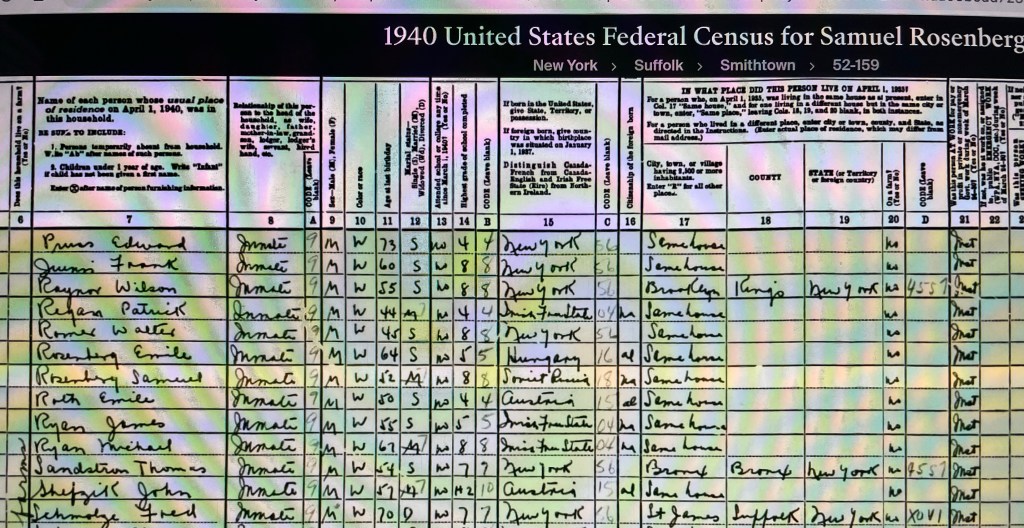
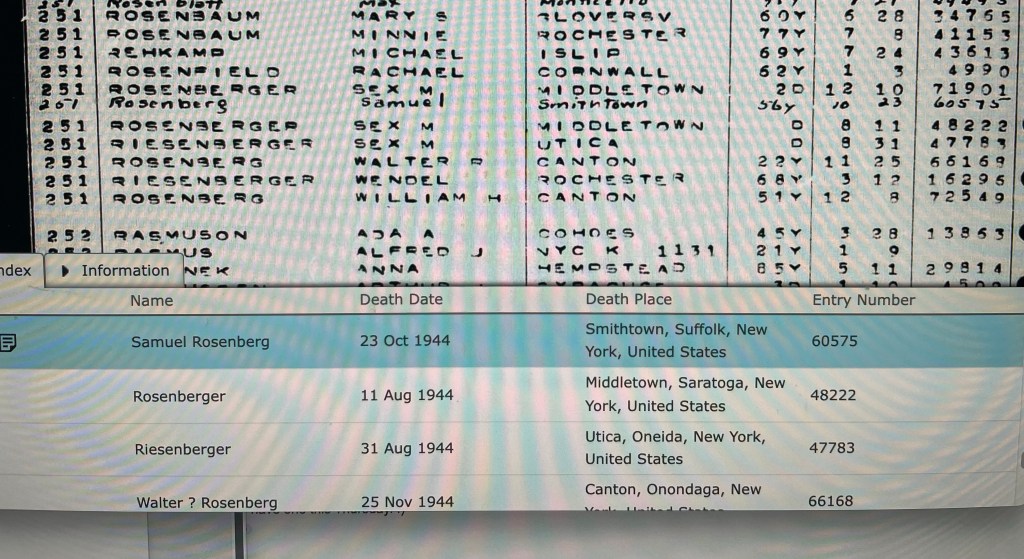
Sherri posted the following note: Is there any anecdote about one of the ‘kids’ being hospitalized? The occupation of “farmer” in the 1915 census makes me wonder whether Samuel was institutionalized at the Kings Park State Hospital which used farming as therapy for mental illness. There is a WW1draft registration and census records there through 1940 for a patient named Samuel Rosenberg, b. 1888. It appears he died in 1944 but I don’t see a burial online.”

Wow! That put a shock through my system. I had seen the WW1 draft form, which I found when I found my grandfather’s and other great uncle’s registration. But I assumed it was not him. And since my grandparents never spoke about him, and I think my Dad never knew about him either. But then my brain started working and connecting and thinking: Grandma! She probably knew all about the crazy brother, hence her tirade on checking out families before you got married. If he died in 1944, I wonder if my grandfather was contacted. Since his mother had died in the 1930s. Perhaps that is when grandma found out about the crazy brother who she knew nothing about.

I had found the military registration for a Samuel Rosenberg in Kings Park, but I just blew it off. I had no idea that a farmer could mean a patient/inmate in the hospital. But now I had to know more. And Wikipedia had the information. Kings Park Psychiatric Center opened in 1885. It was unique in its efforts to actually help people. The idea was to be a farm community where patients worked or helped on the farm as part of their treatments. My great uncle being listed as a farmer was the information Sherri needed to understand what happened. Why was he still listed on their census form? I am not sure. But perhaps because they did not want to say he was mentally ill.

In 1895 the hospital was over-crowded and the state of New York took it over, renaming it Kings Park State Hospital. The residential area around the hospital was also called Kings Park.  The hospital became self-sufficient and grew its own food.  It finally closed 100 years later in 1996.

Over the years there are a few records of Samuel.  And I will say it is a bit difficult to see the words inmate after his name, as well as the words insanity!  What would he be today, bi-polar, psychotic, schizophrenia?  I have no idea, but I cannot help but wonder!

It also made me think about my great grandparents getting divorced by the 1920 census. In those days people did not divorce that easily.  It was considered a Shanda, a shameful event.  But Sarah is divorced and head of the household in 1920.  Celia is dead by the time of the census and Samuel is no longer listed as part of the family, while the six other children are living with her. Abraham is gone.

I think about being a parent.  With one child, who is  in hospital for mental illness by 1915, the age of 27, and another child that dies in February of 1920 at the age of 24, perhaps the stress was just too much.  Or perhaps one of them was also a bit crazy! We will never know why they divorced.

In any case, I am not quite done with my research.  I am trying to get a copy of Samuel’s death certificate, information on his burial and finally perhaps his records from the hospital.  Actually, when I say I am trying, I am hoping my sister takes care of the paper work for the family.  She has a talent for details!

I will admit, while it is nice finally knowing what happened in my grandfather’s brother, I would liked to have found out that he had a family and did something special. Finding him as the inmate in a mental health institution is just sad.

I am left with just one mystery. I just need to find out what happened to my great grandfather!  Where did Abraham go!

(I want to thank Evan W. for all his help in the past in originally finding some of the documentation.)

https://en.wikipedia.org/wiki/Kings_Park_Psychiatric_Center

https://www.cdc.gov/flu/pandemic-resources/1918-commemoration/1918-pandemic-history.htm

What Happened to Grandpa’s Twin Sisters?

16 Apr
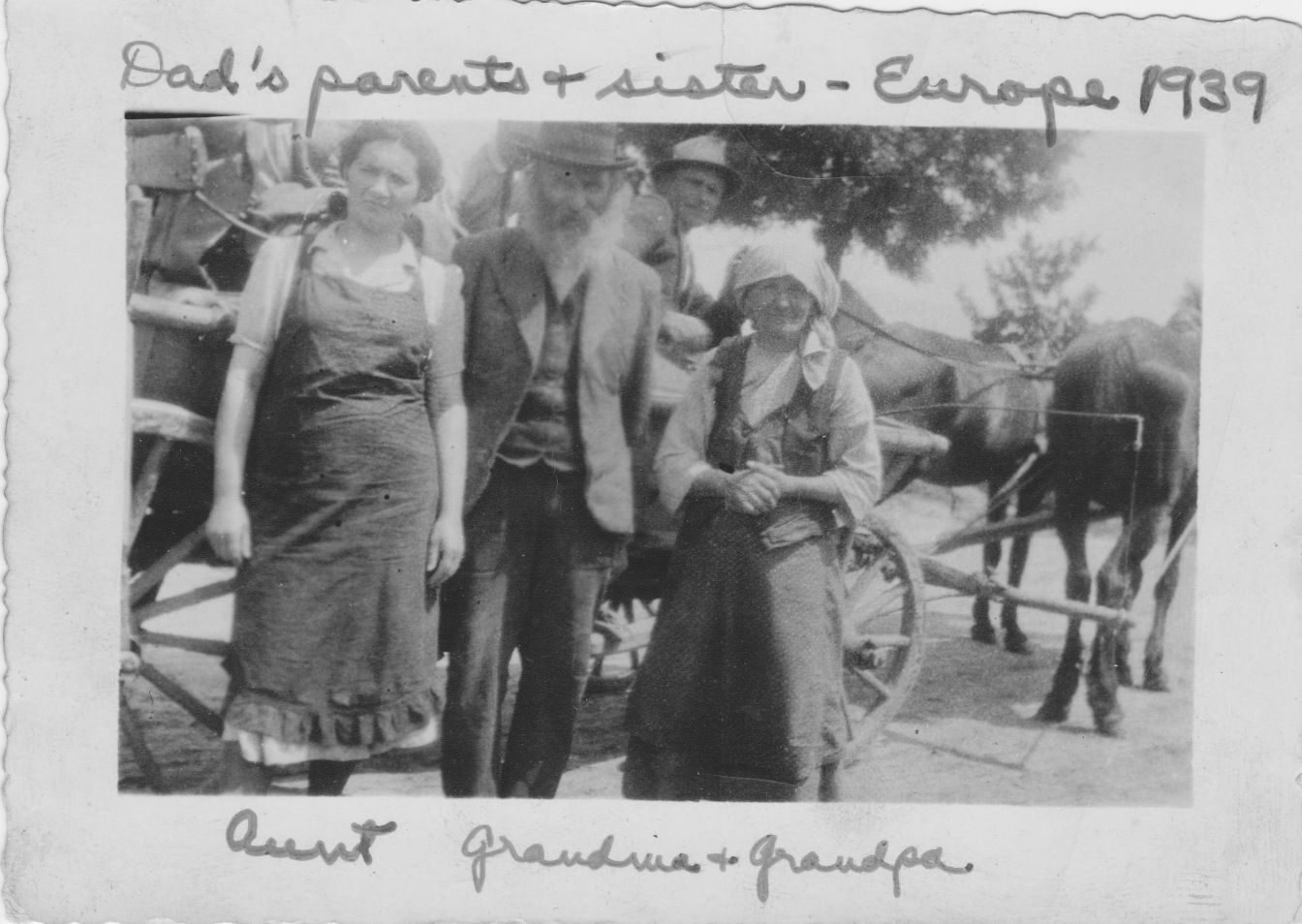
My great aunt Tova, my great Grandparents Gimple and Chava. The man driving is an Uncle. And the horses and cart they bought with the money my grandparents sent. They all perished.

Would it be horrible to say that I am disappointed to find that my grandfather’s two sisters were not the victims of Josef Mengele?  It sounds horrible even to me.  But I have been searching to find out what happened to them for over a decade.  And I thought I finally found a glimmer of hope.  I remembered that they were twins.  Perhaps they made it to the right concentration camp and were separated out. I could at least have some closure.

But no.  Another dead end, I write without a pun.  I had already searched through Yad V Shem, where I found my grandfather’s parents and one brother.  I have found my great grandparents, Gimple/Mordechai who died in Auschwitz and Chava who died in the town.  My great uncle, Shimon died in Belzec.   All three testimonies were put in Yad VShem by a cousin, Shalom Hollander.  Although he entered many other testimonies, there are none for the other three siblings.

I have searched through the Jewish Gen files.  I have found many, many, well hundreds of family members who perished in the Shoah.  But I cannot find my grandfather’s two sisters and their families and his other brother.  It is what I have been searching for since I started my genealogy searches. 

I tried the place that usually helps, Tracing the Tribe Facebook Group.  From one member, I found out about the the Arolsen Archives, International Center on Nazi Persecution, in Bad Arolsen in Germany.  And I had great hope.  I filled out three forms with all the information I had on my great aunts, Tova and Tzelia, and great uncle Nachum.  I admit it was not much.  Just their names and town of birth, parents and approximate date of birth. 

I was sure to add that Tova and Tzelia were twins.  I have a photo of Tova.  I knew she was married.  She probably had children. But by the time I spoke to my grandfather about her and his other siblings in the 1970s, he had forgotten the names of her husband and children.  So my search was based on somewhat limited information.

Unfortunately, the Arolsen Archives could not help.  For each of my requests, I received the same message. “We can inform you today that we – based on the data you provided – have made an extensive check of the documentation available to us.
To our regret, it has not proved possible for us to ascertain any information.”

Another dead end.  But I was not totally surprised.  I know that Mielec and Grandpa’s home town of Trzciana, were among the first cities that the Nazis chose to kill all the Jews.  Only 100 Jewish residents from the area survived the war.  Some were killed at the Denbica/Dembitz Murder site.  Others went to the Lodz Ghetto and then Belzec  Some died in Auschwitz.  But some died in their community, like my great grandmother.  Some were burned in the synagogue.  Some were burned in the mikve.  Some were shot. 

I have discovered many people with similar names, but not these three.

I assume they died nameless, not a number in the Nazi machine.

So perhaps not finding them is a good thing.  Perhaps they died quickly.  They did not have to suffer the indignity of being a victim of Mengele.  They did not make it to the Concentration Camps.  But what is so sad is that no family member was able to write their testimonies.  No one could enter their names in to Yad VShem data base.  And I cannot either, because I do not know what happened.

Perhaps my quest to find out the names of their children will never be achieved.  I will never find out what happened.   Each time I have found out what happened to a family member. I have had another little stab in my heart.  Perhaps it is time to let this search end.

A Ketubah Mystery

7 Dec

My maternal grandparent’s ketubah has presented a mystery!

I know for a fact that my great grandfather’s name was Gimple.  That name is what was used in the Yad V’shem testimony that describes his death in the Shoah.  That is the name my grandfather always used when discussing his father.  That is the Hebrew name that was given to my cousin when he was born in 1949 in memory of him.

So why does it say my grandfather’s Hebrew name is Nisan ben Mordechai haCohen, Nisan the son of Mordechai the Cohan?

I was stunned.  I immediately put the Ketubah up on Tracing the Tribe Facebook page for help.  And yes, the name is Mordechai.  Was my grandfather hiding something from us all these years?  I don’t think so. His parents were his parents. But this seemed odd!

Then I thought could this possible be one of the many paired names, but one I had not heard of before?  For example, my paternal grandfather’s Hebrew name was Hirsch Zvi. This is a common paired name as one is Yiddish and other Hebrew for deer. But I had never heard that Gimple was a pairing for Mordechai. 

Thanks to the Tracing the Tribe group, I have since learned that it is. But a bit different.  It does not mean the same thing, but rather they were paired together. It seems Gimple started first as a surname and then eventually became a first name.  I started searching.  And I found response to someone else asking the same question.  It seems in Poland, where my grandfather was from (when it was Poland, sometimes it was Austria), there was a double name for Mordechai Gumpel, Mordechai Gumplein, Mordechai Gumplin and Mordechai Gumprecht, accorded to a Professor G. L. Esterson in Israel.  He supposes that since Gimple is so close to Gumple, that Gimple is also a double name with Mordechai!!!

Then another member of Tracing the Tribe sent me the link below to the Jewish People’s Museum in Israel.  It had an entire page dedicated to the name Gimple and its relationship to Mordechai! The names were paired together, as stated by above by Esterson! Confirmation!

To be honest, this makes so much sense, in my family because my great grandfather was the only man I have found named Gimple.  However, there are many men named Mordechai over the generations before the Shoah.  I wonder if his mother was trying to help end confusion by calling him Gimple, but giving him the Hebrew name Mordechai?  I will never know!

However, I now have to come to my son’s generation.  My son is named for my grandfather, Nisan.   He is also named for my husband’s uncle, Mordechai.   Thus, by happenstance, my son is also named for two generations at the same time, both his great and great, great grandfathers!  Is that not a weird coincidence!!

Sometimes looking back at old documents can improve our knowledge of our family.  I knew I had the ketubah. I had looked at it before. But because it was in such a bad shape, I just kept it put away and did not really examine it.  Today I decided to take a photo to keep its information safe as it continues to deteriorate.  Then I enlarged it on my phone, and there was the information that I had not noticed! 

Another Mystery solved thanks to Tracing the Tribe.

(In an addendum, I asked for help from Tracing the Tribe in deciphering the names of the witnesses, even though I knew they were not relatives. So just so my family knows. Their names were Benjamin son of either Yehoshua or Yehuda, the Levi. And Shlomo the son of Mendel.)

https://dbs.anumuseum.org.il/skn/en/c6/e241754/Family_Name/GOMPERTZ?fbclid=IwAR2UmU_uU4aKv-jbqxoVD6K16LRsd-dnbTHfZlkn4CegeS5xCbv8LPt5iDE

Survival of Shalom (Szulim) Hollander

25 Nov

Over my years of researching my family, especially my family who remained behind in Europe, I have found relatives who perished in both Belzec and Auschwitz Death Camps.  Those who died in the Lodz Ghetto.  Those who were probably burned to death in their community synagogue or mikveh. Those who were murdered after the war ended. They died in so many places, that I no longer am shocked, even though after each discovery, I feel a pain in my soul.  A pain that makes me stop searching for a month or so as I recover from the finality of my search.

I have a great grandmother who survived the war years hidden by a righteous Christian friend, but who could not save her from the final indignity:  murdered when she returned to her family property by the people who had squatted on their land.  I am named for her.  I keep her photo near my computer so she is watching my search.

There is at times a happier outcome.  I have also found those who survived.  My grandmother’s first cousin who survived the Shoah and the Kielce Pogram, and even wrote a testimony about her experience.   I have two distant cousins, the children of another of my grandmother’s first cousin, who survived the war after being put on the KinderTransport. Their parents did not survive. I have relatives who made their way to France, the United States, Australia, England and Israel.  Where once my families were in a small area of Poland, Austria and Russia before the war, now they are on four continents.

Now I add another story of survival through an extraordinary circumstance.  A relative, perhaps two, who survived the Shoah thanks to being one of almost 1100 names who were on Schindler’s List.

To be honest, I am a bit stunned.   I wrote about Shalom Hollander several times, in most detail in a blog that I published in June 2018.  This week Shalom’s story changed.

I was contacted by a distant cousin who read my blog.   She just recently has been researching her family and by goggling family names found my blog, “The Sorrow of Shalom Hollanders” (see below.). She sent me a message: “I must be an extended family member of yours. I am related to Tova Hollander, Mordechai/Marcus Amsterdam, Szulim (Shalom) Hollander, and all the people on this story. I found this while googling names and have been looking into ancestry.com. I would love to connect if you are willing.”

Of course, I was willing to connect.  I emailed her immediately.  I was delighted to find out that her great grandfather was Shalom’s brother.  He had come to the United States before the war, and so survived much like my grandparents.

The words that caught at my heart were these: My great grandpa’s brother was Shalom Hollander who you wrote about in your blog (not sure if you are aware but he is listed on Schindler’s List under the name Szulim Hollander). 

I had to look, and there he was:

Holocaust Survivors and Victims Database:   Schindler’s Lists: Electronic data regarding Oscar Schindler’s inmates, complied from two separate lists.

Szulim Hollander : Date of birth: 8 Feb 1906                                                             Persecution Category: Ju. [Jew] ;   Occupation:  ang. Tischler  (carpenter)         Nationality:  Po. [Polish] ; Prisoner Number:  69073

He survived because he was on Schindler’s List, but was it a good survival?  This knowledge hurt my heart.  While he was surviving, he lost his wife, his children, his parents, his sister.  So many relatives murdered.  I wish when I met him in 1976, I would have listened and learned more. But then, no one knew about Schindler or his list.  I am not even sure he spoke to my grandmother about how he survived.  Wait, I take that back.  Everyone we met with that trip told my grandmother their Holocaust story.   (see blog below.)

In the same email, she mentioned her Aunt Susan also told her about me.  I remember Susan, I connected with her through Tracing the Tribe.  We met about five years ago and exchanged information.  We knew that her husband must be related to my family.  But I did not know of the connection with Shalom.

Now that I know Shalom had a brother in New Jersey, where my grandparents had a kosher bakery, many little pieces came into place. I had an ‘aha’ moment.  My grandparents definitely knew this family.   We knew many Amsterdam families in New Jersey.  I never connected them because Shalom’s brother in New Jersey used the last name Amsterdam, which is their father’s last name, while Shalom used Hollander, which was their mother’s last name.

My grandparents and parents could not have known Shalom and not his brother in New Jersey. They were probably some of the many relatives I met as a child, who just blurred together in my grandparent’s European connections.

One other bit of good news about Shalom.  He did remarry after the war and started another family.  What strength!  He truly was a survivor.  My grandmother and I only met with him that day in Israel.  I rejoice in knowing this news.  I wish I could meet his family.

I must add that there is another Hollander on Schindler’s List: Rachela Hollander was born on March 23, 1917.  She was just a young woman when the war began. She is listed as a metal worker.  I will assume that some way she is related to us as well.

KinderTransport, Schindler’s List, Kielce, Belzec, Auschwitz, Lodz Ghetto: My family went through the worst of the Shoah.  But it comforting to know that some connected with people who had a bit of goodness left in their souls and somehow they survived.


https://zicharonot.com/2018/08/12/discovering-karolas-kielce-pogrom-testimony/

https://zicharonot.com/2018/11/05/how-the-kindertransport-touched-my-family/

https://zicharonot.com/2018/06/07/the-sorrow-of-shalom-hollander/

https://zicharonot.com/2018/06/05/murdered-in-belzec/

https://zicharonot.com/2018/09/06/one-more-family-destroyed/

https://zicharonot.com/2014/09/13/my-familys-holocaust-history-impacts-my-observance-of-rosh-hashannah/

https://zicharonot.com/2014/04/28/speaking-yiddish-always-brings-me-holocaust-memories/