Tag Archives: Shoah

The Tavern in Trzciana Comes To Life

29 Jul

I vividly remember when the movie version of “Fiddler on The Roof” was released.  It was the first Broadway show I had seen in person as a child.  So seeing it again in the movie theater reminded me of the special trip into New York City with my parents and the delight I felt while listening to the songs and learning about Anatevka.  One of my favorite scenes occurs in a tavern where the Polish and the Jewish citizens end up in riotous dance!

The tavern scene has so much more meaning to me now.  I was with my maternal grandfather the first time he saw the movie.  Grandpa was from a small town in Austria/Poland called Trzciana.  When he watched the tavern scene, he turned to me and said, “My family had a tavern just like that.  It looked just like that.”  Anatevka/Tzrciana taverns were interchangeable in my grandfather’s eyes. He said the movie brought back memories of his childhood.

Grandpa did not often speak freely about his family.  Stories came in bits and pieces of memories.  But it was not something you asked about.  It was something that he had to offer because Grandpa’s family all perished in the Shoah.  His parents, his siblings, his aunts and uncles, his cousins, everyone who was in Europe died, except for three.  (See blogs below.)

But that tavern memory has so much more meaning because now I know more about it thanks to the research of Izabela Sekulska who started the Mayn Shtetele Mielec Facebook group.   Izabela has been helping me find out information about my family for about a year now. The documents she finds make the stories I was told by Grandpa come to life.

Izabela recently found a document from the Chamber of Commerce and Industry that  brings the family tavern to life.
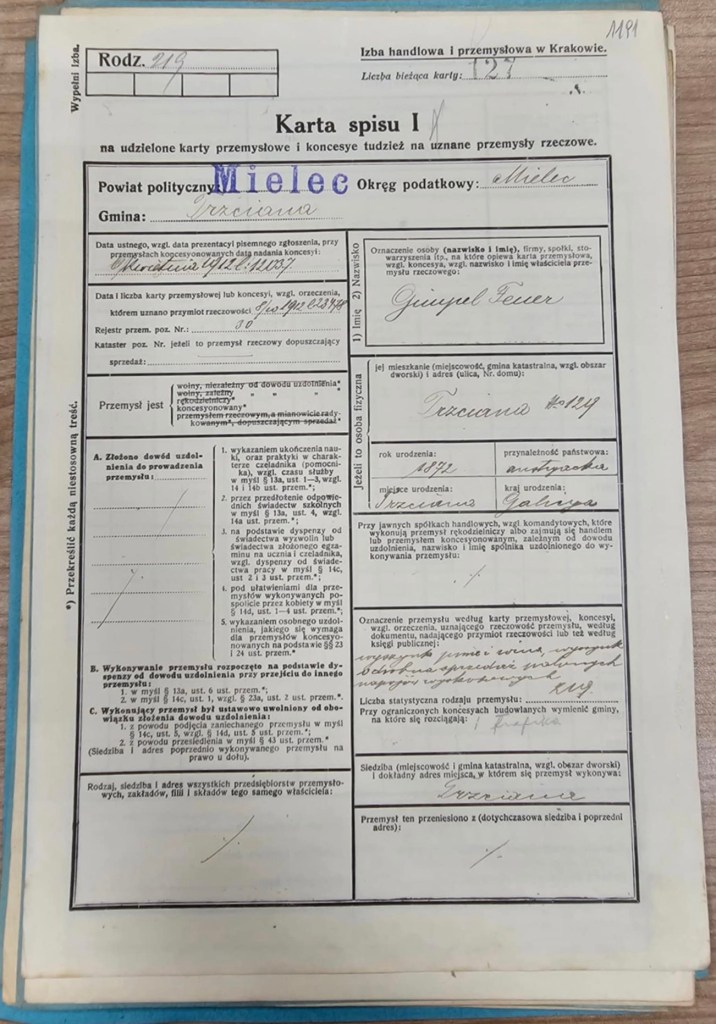
My great grandfather Gimple Feuer applied to open a tavern on April 10, 1912, when my grandfather was just over 12 years old.  My Grandpa did grow up with a tavern in his life.  This document from the Chamber of Commerce and Industry states that the location was in Trzciana, Galicia, which was then part of Austria as Poland.  Throughout his life Grandpa said he was Austrian as that part of Galicia became part of Poland after the war. 

At my family’s tavern they sold beer, wine, other alcoholic beverages and tobacco according to this document.  I knew my great grandfather had a farm that included a crop of  grains and grain silos to store the grain.  So having a tavern makes sense, he had the grain to brew the beer.

Grandpa told us stories about cleaning out grain silos and how one time he and his cousin became intoxicated on the fumes from the silo.  They actually became sick and ran to a nearby stream/creek to drink the water and wash the fumes away. He said they almost drowned, they were so drunk.  
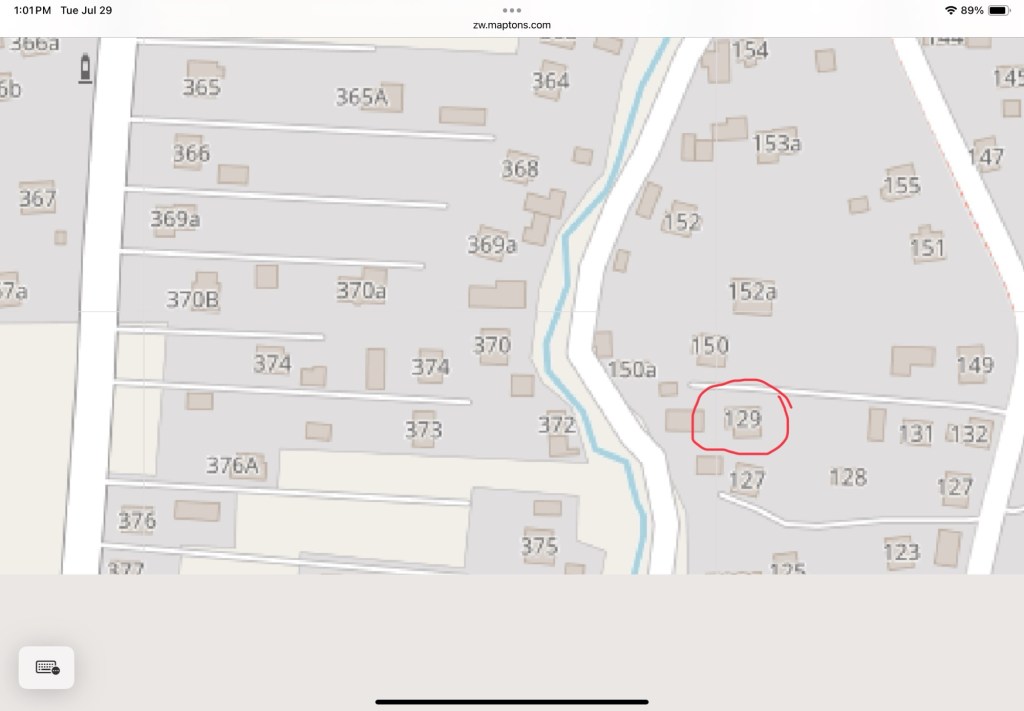
As I remembered this story, I  looked for  a map of current day Trzciana online and saw where the Cichawka stream goes through the town.

Thanks to Izabela, I know that there were no street names in Tzrciana, the homes and buildings  were just numbered during the time my grandfather lived there..  And the number of the tavern was 129.   

On the map that  I found online all the buildings are numbered.  There is one numbered 129 close to the creek. Could this be when my great grandfather had his tavern?  I am not sure, but it perhaps the numbers remain the same. 

Now there are addresses and streets. So perhaps with this information we can one day find out exactly where the tavern was located in the town. Perhaps this address is where the family lived, and the tavern was located on their farmland?   

Izabela has asked for help in finding out where this location is now in Trzciana in the Facebook group.  That would make this amazing find so much more amazing.  And it might be that the number 129 is in the same place. And the numbers around it are the places where the other members of my family lived before the war.

Knowing my great grandparents had a tavern, perhaps explains to me why there was actually a trial after the war concerning the murder of my great grandmother during the Shoah.  Perhaps their standing in the community created lasting friendships that existed after the war and lead to people actually testifying about her death. (See blog below.)

No matter what I find about where the tavern actually stood in Trzciana, I do know that from now on whenever I see the story of Anatevka and see the tavern scene, I will think of my grandfather and his family that perished, but I will also remember how they lived.

 

Renewing A Family Connection: My Mother’s Day Gift

Renewing A Family Connection: My Mother’s Day Gift

21 May

While in Isarel, I finally renewed a family connection which started 50 years ago. When I was 20, I met two survivors of the Shoah. They were married to sisters before the war. The sisters perished in the Shoah, but the two men remained connected for the rest of their lives.

I have written about both of these men before, (Lieb) Zissel Feuer and Shalom Hollander.  Both were distant cousins of my grandfather. But their wives were his first cousins.   I wrote about meeting Zissel and Shalom and what happened to them during and after the war, and a bit about my contact with them in Israel between 1974-76. (See blogs below.). Over the years my perception of the two changed, as I learned more about their lives.

Now I have a different story to share, because I have met Shalom’s oldest son Chaim, as well as the great nephew of his first wife, who is also my third cousin, Jeff, and his daughter.

For me it was a meeting that completed a story.  For them, I hope I was able to fill in stories about the family and answer question about the family before the war.  As we shared our stories, I could see where my knowledge and theirs combined and differed.  I spoke about meeting Zissel at the bakery in Tel Aviv across from the Shuk HaCarmel.   Chaim smiled while I told my stories about meeting Zissel there each time I came to Tel Aviv.  Chaim, of course, knew the bakery and even Zissel’s address.  Although I had been at his apartment several times, I did not remember the address.  But we had other shared memories. 

I think when I talked about the bakery, Chaim knew then that I was really a relative.  I really had met Zissel. I don’t think he thought I was lying , but he had never heard of me, yet there I was a family member from the USA, unknown to him. Also when I told him about meeting his father, how elegant he seemed.  And Chaim agreed, his dad had that old world charm.

Chaim actually made me feel better about Zissel. I knew he did not have a family.  Shalom was not related to him at all, once their wives died.  Shalom. remarried.  Zissel never did.  But Chaim told me that Zissel was always part of Shalom’s family. He came to be with them for all the haggim, the holidays.  That eased my heart.  Really, I am tearing up even now.  For me Zissel was such a sad soul. So to know he was not alone, helped.

We talked about the importance of what Ziseel and Shalom did after the war to help others from Mielec who survived and to keep the memory of those who were murdered. Shalom purchased the land where a mass burial of 800 Jews were buried and put up a fence and a marker.  Both men also testified against those who were the murderers, as Zissel had done for the murderer of my great grandmother, his aunt by marriage.  Our discussion filled in so many blanks for me.

Chaim and his wife gave me memoirs written by both Shaom and his second wife, Ita, about what happened during the war.

I in turn could tell them about those who made it to the United States before the war.

How Julius/Judah/Yidel Amsterdam, my grandfather’s uncle, came first.  As other relatives came to the New York/New Jersey area, he gave them a choice. You can be a butcher or a baker.  There was a cousin who was a butcher, and Uncle Yidel was a baker.  My grandfather chose to be a baker.  Chiam laughed as I told the story, because his uncle who went to the states became a butcher.  I said he was probably helped by my great uncle Yidel as well.

With Jeff, I could talk about his great uncle Morris, who lived in Helena, Montana.  My grandfather always stayed in touch with his first cousin.  I knew one of this sons because when I moved to Kansas, they gave me Jack’s phone number. He lived in Denver.  To my grandfather and his cousin Morris, this was close enough. We never actually met, but we spoke several times.

For me I have a feeling of completion.  When I found out about these relatives, through the research of Izabela S.  I knew I had to see them when I was in Israel visiting my daughter.  They lived quite a distance.  But my daughter said that this was my Mother’s Day gift.  It was the one thing I really wanted to do.  So we took the long drive from Holon to a small Kfar near Netanya.

Over the years of my research I have found out how the members of my family were murdered during the Shoah.  I know how a small numbered survived.  I know that they are not forgotten.  I am not the only who keeps their memory alive within the family.  And there are people like Izabela in Poland, who also work to keep the memory of the  Jewish population alive.

I never thought I would ever want to go to Trzciana or Mielec.  My grandfather never wanted to go back there after his family was murdered.  But now I do want to go. I what to see where they lived. Where Shalom and Zissel created a Jewish community after the war. Where the Amsterdam group hid in the nearby forest. The town where my great grandmother was murdered. The mass grave where my great aunts are probably buried.

But most of all I am so glad that I found out what that Zissel and Shalom did after the war.  I, as a young woman, saw both Zissel and Shalom as such sad people talking about Death.  I did not hear the stories about what they did to give people a reason to LIVE after the war. And to create a place of memory for those murdered.

I now know that Shalom and his wife, who was also a survivor from Mielec, had four children, a girl who survived whom they adopted and three sons.  Chaim and his wife have seven children, 40 grandchildren and 19 great grandchildren so far. 

I know that Zissel was not alone.  That Zissel and Shalom stayed connected throughout their lives.  I also know that Zissel died in Holon.  I think he might be buried there. So next time I am in Israel, I hope to find his grave and put place a rock of remembrance on his matzevot.

An Unexpected Email Reveals Family Shoah History

30 Oct

In the last week I have been in contact with Izabela S., who lives in Tarnow, Poland, which is close to both Mielec and Trzciana, where my family lived and where they were murdered in the Shoah.   Izabela has been working for the past three years to clean up the Jewish Cemetery and get information about the places where the Jewish residents were murdered and put up plaques to commemorate them in the Mielic area.  She also writes a blog and has a Facebook page to write and remember the Jewish residents who were murdered in the Shoah.  Before the war, of the 10,000 residents in Mielec, 5,000 were Jewish.  After the war, maybe 200 survived!

(See video about Izabela below.)

My quest to find my grandfather’s family started in the late 1970s after I spent time in Israel and met those who survived.  My grandpa lost his entire family in the Shoah, except for a few cousins, and except for his mother, he never knew how his father and siblings died.  I told him that I would find out. It has taken almost 50 years, but I never gave up! Over the years I have written many blogs about them. (Some are linked below.). But I could not find out about three of his siblings.  Now I know more.

But then there is the question?  When you find these things out, do you really want to know?  And are some ways of dying better than other ways.  In the towns my family came from people were burned alive in the synagogue and mikve, starved to death or died of disease in the Lodz Ghetto, gassed at Belzec, shot at a mass grave.  Which is worse? 

I guess I decided that being shot is the kindest way to die among those options.  A distant cousin of mine (Her great grandfather and my grandfather were second cousins, l believe), thought her great great grandparents were burned alive in the synagogue.  She now knows, thanks to Izabela, that they were shot. And in a weird way it is better.  I think.

My family came from the small town of Trzciana. Before the war there were about 1000 people.  The town was known for its windmills.  I can imagine that it was lovely.   Izabela wrote about it this way:

“Jewish families lived in Trzciana: the Amsterdams, the Hollanders, the Brenners, and the Feuers. They were closely related to each other. In  Next is the night: The fate of Jews in selected counties of occupied Poland, vol. II Tomasz Frydel writes that every Sabbath, members of the Amsterdam family from the village of Trzciana went to the synagogue in Czermin, where more Jews lived among the German colonists. This family was widely respected, its members gave grants to the Roman Catholic parish and distributed potatoes and beets to local peasants.”  This was my family.

I knew already how my great grandmother, Chava, died. (See blog below.)  But I now know my grandfather was not killed in Belzec with his son, Shimon.  Instead he was murdered on March 9, 1942 with many others of his family during a round up/deportation and slaughter of Jews.  He was shot in Cieszanow.    I now know that their daughter, Tova, was also in that roundup. But was not killed then. So probably died in one of the camps. I know Jews from Meilec went to four camps, Belzec, Sobibor, Treblinka and Majdanek. 

I now know that outside of the town there is a mass grave of 800 Jews.  Many of them my relatives. I know about one for a fact.  Natan Feuer ran.  He was able to get about 50 yards when the Nazis shot him and dragged him back to the pit where they threw him in still alive. And he perished. But Natan story really hits home as my grandfather’s brother was named Nueter/Natan. So is this him? I will never know.

I believe that my grandfather’s cousin, Morris Brenner, who owned a candy store in Linden, NJ, and whom I wrote about before, (See blog below.), had two sisters and a nephew who are buried in the Jewish cemetery on Traugutta Street: Cerla Kleinman nee Brenner, her son David, and sister, Sara Brenner.  His mother, Gital, died in 1941, before the mass murder of the Jews.  I have to admit that gives me a bit of joy. It is nice that someone died a natural death and wasn’t murdered because she was Jewish.

I had heard of the brothers Tuvia, Zus, and Asael Bielski, from the book and the movie Defiance.   I now know that there was also the Amsterdam Brothers, Johanan and Abraham,  who led a group in the forest near Bulcza Mielka called The Amsterdam Group.  According to Izabela, it was a large group of Jews who hid and the core of this group were families from Trzciana.   There were 84 Jews in Trzciana before the war, all related to me.  The two brothers, who had been in the Polish Army before the war, commanded the group.   They built a series shelters and hideouts where they survived the winter of 1943.  They hid in  bunkers and acquired weapons from the peasants as well as gaining them in battles with the police and Germans.  They divided into small groups to keep more people safe.

A survivor named Ryvka Schenker wrote about the conditions in the hidden camp:

“It was very cold back then, the snow fell, You had to be very careful – every step was known. How they went out to the country Shopping, they made their feet like the birds they have. It was made of wood, They made the same traces as birds walked. No one could have Imagine there are people in the middle of the forest. We sat all day very long calmly, one read a lot, others wrote diaries, some embolden images, Everyone made it through that day. We always lived the hope that It will be after the war soon, but it was just a dream.   There were severe frosts, nobody had The right clothes, let’s get out of the field little. The men were more Resilient. We had a lot of water because it froze.”

I am Amazed!  And feel proud that my family tried to survive in every way that they could.

There is so much information it will take me a while to unravel all of the connections and organize in my mind so that I can write about this family that was almost wiped out. My family.  But I felt it was important to write this down when the emotion of discovery was still strong. Baruch Dayan HaEmet.  May their memories live through these remembrance and that we never forget those who have been murdered by hate and evil.

Video of Izabela S.and her work.

About Morris Brenner

https://www.facebook.com/groups/1318997264939643/

Viroshov/Wieruszow: A Jewish Community Destroyed

28 Aug

With the days quickly leading up to Tisha B’Av, I cannot get the destruction of my grandparent’s families out of my mind. After writing about Boleslawiec and its small Jewish community, I feel it is important to write about a town that lies six miles away.  The town where my great grandmother Sarah Manes grew up: Viroshov/Wieruszow.

When I realized there were so few Jewish citizens of Boleslawiec, I had to reconsider some of the stories my Grandma told me about growing up.  She always talked about all her cousins and spending time with them.  Then I remembered, she told me about spending time with her grandmother Klindell Manes, and that is where she saw her cousins, in the town of Viroshov.   It took me a while to figure out that Viroshov, was Yiddish for Wieruszow.

All those stories she told me were about her Manes cousins. Those were the cousins I had met in Israel so long ago.  (See blogs below.)

I was right.  And once again I am forced to forgive my 20-year-old self for not paying enough attention.  For not wanting to hear the horrible stories.  For tuning out, while trying to escape from the seemingly endless number of survivors who insisted on seeing Grandma during our month-long stay in Israel in 1976.

I have written about several of these survivors and what I discovered. (See blog below.). And I even wrote about my Grandma’s cousin Dora before.  But now I need to revisit Dora and tell more of her story.

I now understand why her daughter was so protective of her when she called to set up a meeting with my Grandma.  I now have rachmanes, in my mature years, that I did not have as much in my youth.  I tried to be as courteous as possible, but I truly did not understand the undercurrents of everything that occurred.

Grandma had survived the war by being in the USA. She had saved her father and her sister by bringing them out of Europe in 1936.  In fact, their family did not know that my great aunt had escaped, and had even added her to the Yitzkor book of the town!

My grandmother and her children were safe.  She did not need to remake her life.  But Dora and so many others had had a different reality.   I now know Dora’s reality.  And I feel, once again, the burden of knowing someone, but not really understanding and knowing what happened.

Dora was married before the war, in 1924, a few months before my grandparents.  She and her husband survived.  But her mother, who was my great grandmother’s sister, Mascha, did not survive.  Her father, Eliazer, did not survive.  Her brother, Wolf, and her sister Yocheved, did not survive.  In all 13 people with the last name Manes, and more related to the family,  from Wieruszow were murdered.

Before the war, in 1921, there were 2300 Jews in the community of Wieruszow, making up 36 percent of the population.  In 1939, before the Nazis invaded there were 2400.  That all changed.  The Jewish community was slowly decimated. By 1940 there were 1740 Jews.  In September 1941 a ghetto was opened where 1200 Jews were imprisoned.  Then between August 11 and 23 the ghetto was ‘liquidated.’ I hate that word.  Just say the Jews were killed and moved to Concentration Camps.  This time, Chelmo.   But before they were taken, the old and sick were shot.

In April 21, 1942, there was a mass murder of Jews and a mass grave for 86 people was dug in the Jewish cemetery.   But, of course, that did not survive because the Nazis also had to wipe out cemeteries to destroy the memories.  The tombstones were used for pavers. The cemetery was dismantled.  But 100 tombstones still remain.   I doubt I would find my great great grandparents and great grandparents gravesites.

However, that mass grave gave me another clue to my family.  A stone was laid on the mass grave by a man with the last name Majerowicz.   That sent a shock through me as well.  Because in Israel, I also knew a man with the last name Majerowicz.   He was also my Grandma’s first cousin.  But he was a bit different.  I wrote about him because his sister was Grandma’s first cousin and best friend. His mother and my grandmother’s mother were sisters.

In all there were 135 names in the Yad VaShem database with the last name Majerowicz, or some similar spelling that perished in Viroshov/Wieruszow.  I noticed that many were duplicates, so perhaps only 80 people were listed.  And although not all were related to me, once again I will claim them as being related. Because I feel I must.

Now there are over 8600 people live in Wieruszow.  In a town that was once 36 percent Jewish, there are no Jews.  The cemetery is destroyed.  The original mikveh, where many Jews were murdered by the Nazis is gone.  There is just a list, a yitzkor book and some memories.

Once again thank you to Virtual Shetl, the Yad Vashem Database, Jewish Gen, and the Viroshov Yitzkor book.

https://zicharonot.com/2014/04/28/speaking-yiddish-always-brings-me-holocaust-memories/

https://zicharonot.com/2015/11/03/who-are-you-these-photos-call-out-to-me/

https://zicharonot.com/2016/10/01/the-rosh-hashannah-card-has-a-story/

https://zicharonot.com/2018/06/07/the-sorrow-of-shalom-hollander/

The Importance of My Grandma’s Illegal 1931 Abortion

16 Jun

In 1931 a 25-year-old mother of two young children was pregnant with her third pregnancy.  It was twins.  But whereas her other pregnancies went fine this one was not going well at all. In fact, her kidneys were failing, probably due to eclampsia. If nothing was done, she and the fetuses she carried would all die.  Abortion was not legal in 1931.  But someone saved her.  Someone, I am told a doctor, provided her an illegal abortion. 

That woman was my grandmother.  She lived.  

“Preeclampsia may lead to kidney disease by causing acute kidney injury, endothelial damage, and podocyte loss. Preeclampsia may be an important sex-specific risk factor for chronic kidney disease,” according to an NIH website.  Although my grandmother did not die in 1931, she was left with failing kidneys.  In fact, she had kidney disease for the next 52 years of her life. 

Grandma decided to go back to Europe with her two children, my Mom and my Uncle, so that when she died they would be raised by their grandmother, as she was sure that she was still going to die. Someone traveled with my grandmother for this trip. In fact, one night she was so sick, they took her up on the deck because she wanted to see the stars one more time before she died.

The doctor who saved her life actually impacted the lives of many people. Because my grandmother lived, my mother and uncle were not left without a mother. Also, as the story continues, because my grandmother lived, others lived as well.

When my Grandmother got to Europe she traveled through Germany to Carlsbad, to take the waters, and then around Poland visiting family for over six months. During these travels her opinion about life in Europe changed drastically. By the end she was much healthier and concerned about taking her children back to the United States to safety.

Why do I say saving her life saved others? She had been traveling through Germany in 1931. She had seen the evil that was taking over Europe with the rise of Hitler.

This is where her surviving preeclampsia and a life saving abortion takes on even more meaning. First, everywhere she went in Poland, she told family and friends to “Get Out! Bad times are coming.” We do not know how many heeded her warning! But we know her story and what she tried to do.

When Grandma came home she had one goal, to get her family and the family of my Grandfather out of Europe! My grandparents worked to bring family members over from Poland and Austria. In the end, they only were able to bring my Grandmother’s father and sister. My Tante was very small for her age, so they changed her age and made her under 21 so she could travel to America on my great grandfather’s papers and visa.

My Tante lived.  She married and had one daughter.  Her daughter married and had three children.  Her children married and among them had 11 children.  

All because my grandmother had an abortion, all because she lived, two people survived and avoided the horrors of the Shoah and 15 descendants were born.  Who knows how many more will be born in the future.

Abortions save lives! The mother’s lives. To me these lives are extremely important. Currently, in this time of legal abortions another relative of mine had eclampsia putting her life and the life of her much wanted fetus at risk. They were both dying in the hospital. The only choice to save one life was an abortion. My cousin lived. Amazingly a year later she was again pregnant and gave birth to a healthy child.

I do not believe anyone, a legislator or a member of the voting public, has the right to tell a woman how to handle her private medical issues. We have HIPAA laws that are supposed to keep our medical history private. What a woman decides, with input from her medical professional, for her own health is her personal business. HIPAA laws are not just for men. They are for everyone.

In the meantime, I support women’s health rights. I support women who make the difficult decision to end a pregnancy. I support their choice and decisions concerning their personal medical health. I know that the right to chose an abortion must remain legal, because I know that saving a mother’s life is vital.

The Murder of Chava Feuer 1942

22 Apr

It is not every day that you find out exactly how your great grandmother was murdered in the Shoah.  But it just happened to me, and I am in shock.

I was taking a webinar called “The Case of The Missing Ancestors: Genealogy Tips from Nancy Drew,” that I signed up for from the Erie Community Library.  The speaker was Ellen Shindelman Kowitt. I am still searching for my grandfather’s three siblings.  After hitting dead end after dead end, I thought maybe this workshop would help. 

The speaker mentioned looking up the name of the town instead of the name of the person.  So while I was listening on one device, I entered the name of my grandfather’s birthplace, Trzciana, Poland, on another device.

At first I just found a short Wikipedia entry telling me that Trzciana was a small village in Buchnia County, the seat of the administration office, and so was called Gmina Trzciana.  It was just outside Mielec, which I knew.  It currently has a population of 1462.  No mention of the Shoah.

Then I entered “Trzciana and the Holocaust.”  A book popped up:
The Holocaust and European Societies: Social Processes and Social Dynamics edited by Frank Bajohr and Andrea Low.  There were also some sample pages that I could read, including a section on an event that happened in Trzciana.

I knew my great grandmother, Chava, was murdered in her town.  I knew she had been hidden. And that saved her when the rest of her family was taken. I thought she was murdered at the end, after the war was over. But that is not the case.  She was murdered in 1942. There is an entire paragraph about the murder of my great grandmother Chava, the wife of Gimple.  MY Great Grandmother.

I can imagine the fear she had when she knew the Nazis were searching for all the Jewish people in the area. When she knew that the Polish people were afraid and turning the Jews in.  How in fear she must have been when she went to a family that had hid her before. But I am sure she knew there was no hope.  No hope, no help. Just death. And did it really matter when everyone else was already gone? Her husband, her four children. Her extended family.

Yes, I am crying.  Yes, I think I am in shock.  This I never expected.  I did not find my great aunts and great uncle.  But I found this. 

I have ordered the book.  I need to see it and touch it.  To really believe it.

But read for yourself the murder of Chava Feuer, my great grandmother, for whom I carry her name.  May her name and memory always be a blessing. (Yes, I know it says Chana, but believe me it is Chava.)

She says “Do with me as you please.” This touches my heart. I was an obstinate child. I would often say to my parents and grandparents, “Do what you want, I am not moving.” My grandfather would shake his head and laugh, while my grandmother would say, “You are just like her.” The “her” being Chava, whose name I carry.

What Happened to Grandpa’s Twin Sisters?

16 Apr
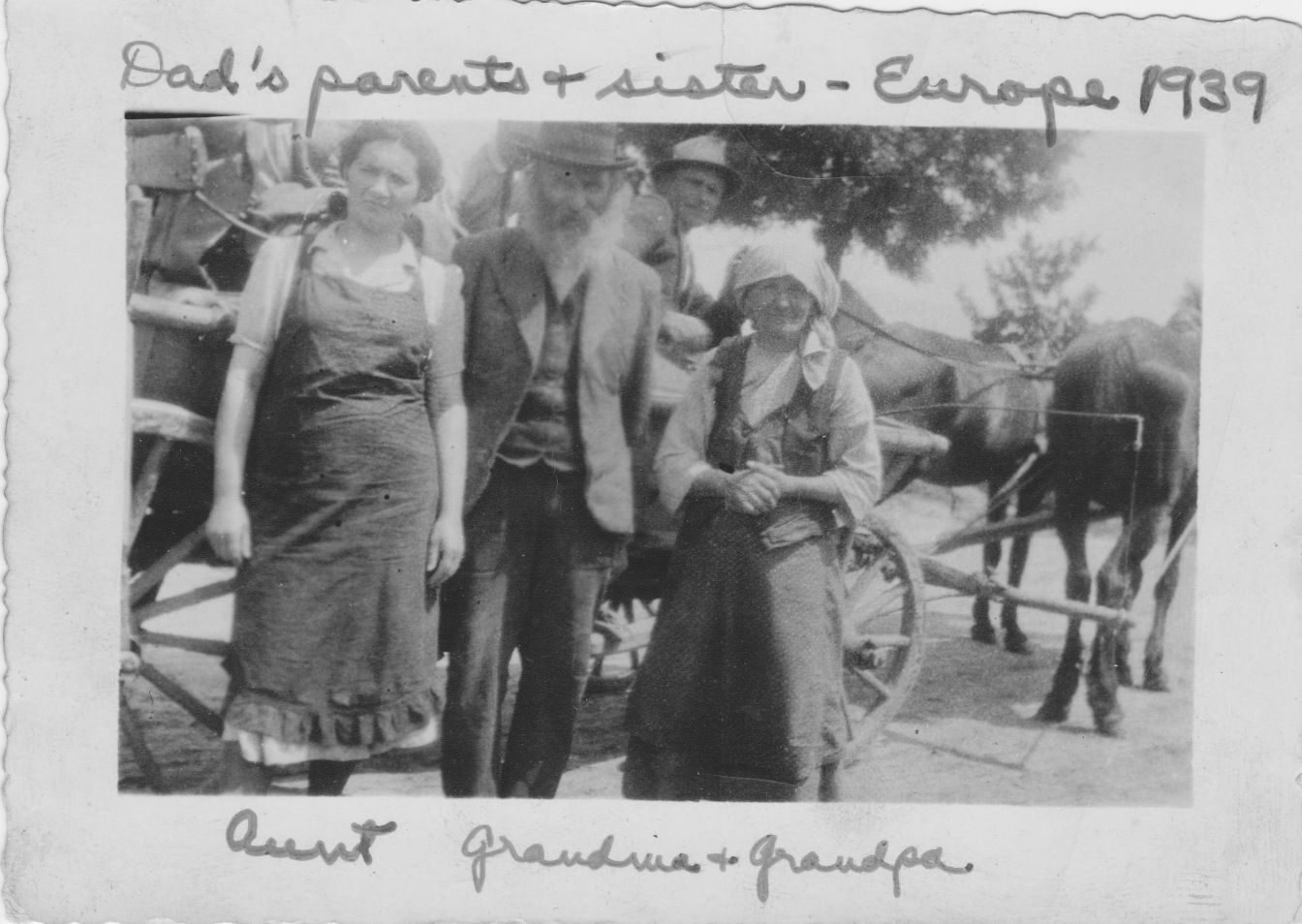
My great aunt Tova, my great Grandparents Gimple and Chava. The man driving is an Uncle. And the horses and cart they bought with the money my grandparents sent. They all perished.

Would it be horrible to say that I am disappointed to find that my grandfather’s two sisters were not the victims of Josef Mengele?  It sounds horrible even to me.  But I have been searching to find out what happened to them for over a decade.  And I thought I finally found a glimmer of hope.  I remembered that they were twins.  Perhaps they made it to the right concentration camp and were separated out. I could at least have some closure.

But no.  Another dead end, I write without a pun.  I had already searched through Yad V Shem, where I found my grandfather’s parents and one brother.  I have found my great grandparents, Gimple/Mordechai who died in Auschwitz and Chava who died in the town.  My great uncle, Shimon died in Belzec.   All three testimonies were put in Yad VShem by a cousin, Shalom Hollander.  Although he entered many other testimonies, there are none for the other three siblings.

I have searched through the Jewish Gen files.  I have found many, many, well hundreds of family members who perished in the Shoah.  But I cannot find my grandfather’s two sisters and their families and his other brother.  It is what I have been searching for since I started my genealogy searches. 

I tried the place that usually helps, Tracing the Tribe Facebook Group.  From one member, I found out about the the Arolsen Archives, International Center on Nazi Persecution, in Bad Arolsen in Germany.  And I had great hope.  I filled out three forms with all the information I had on my great aunts, Tova and Tzelia, and great uncle Nachum.  I admit it was not much.  Just their names and town of birth, parents and approximate date of birth. 

I was sure to add that Tova and Tzelia were twins.  I have a photo of Tova.  I knew she was married.  She probably had children. But by the time I spoke to my grandfather about her and his other siblings in the 1970s, he had forgotten the names of her husband and children.  So my search was based on somewhat limited information.

Unfortunately, the Arolsen Archives could not help.  For each of my requests, I received the same message. “We can inform you today that we – based on the data you provided – have made an extensive check of the documentation available to us.
To our regret, it has not proved possible for us to ascertain any information.”

Another dead end.  But I was not totally surprised.  I know that Mielec and Grandpa’s home town of Trzciana, were among the first cities that the Nazis chose to kill all the Jews.  Only 100 Jewish residents from the area survived the war.  Some were killed at the Denbica/Dembitz Murder site.  Others went to the Lodz Ghetto and then Belzec  Some died in Auschwitz.  But some died in their community, like my great grandmother.  Some were burned in the synagogue.  Some were burned in the mikve.  Some were shot. 

I have discovered many people with similar names, but not these three.

I assume they died nameless, not a number in the Nazi machine.

So perhaps not finding them is a good thing.  Perhaps they died quickly.  They did not have to suffer the indignity of being a victim of Mengele.  They did not make it to the Concentration Camps.  But what is so sad is that no family member was able to write their testimonies.  No one could enter their names in to Yad VShem data base.  And I cannot either, because I do not know what happened.

Perhaps my quest to find out the names of their children will never be achieved.  I will never find out what happened.   Each time I have found out what happened to a family member. I have had another little stab in my heart.  Perhaps it is time to let this search end.

Survival of Shalom (Szulim) Hollander

25 Nov

Over my years of researching my family, especially my family who remained behind in Europe, I have found relatives who perished in both Belzec and Auschwitz Death Camps.  Those who died in the Lodz Ghetto.  Those who were probably burned to death in their community synagogue or mikveh. Those who were murdered after the war ended. They died in so many places, that I no longer am shocked, even though after each discovery, I feel a pain in my soul.  A pain that makes me stop searching for a month or so as I recover from the finality of my search.

I have a great grandmother who survived the war years hidden by a righteous Christian friend, but who could not save her from the final indignity:  murdered when she returned to her family property by the people who had squatted on their land.  I am named for her.  I keep her photo near my computer so she is watching my search.

There is at times a happier outcome.  I have also found those who survived.  My grandmother’s first cousin who survived the Shoah and the Kielce Pogram, and even wrote a testimony about her experience.   I have two distant cousins, the children of another of my grandmother’s first cousin, who survived the war after being put on the KinderTransport. Their parents did not survive. I have relatives who made their way to France, the United States, Australia, England and Israel.  Where once my families were in a small area of Poland, Austria and Russia before the war, now they are on four continents.

Now I add another story of survival through an extraordinary circumstance.  A relative, perhaps two, who survived the Shoah thanks to being one of almost 1100 names who were on Schindler’s List.

To be honest, I am a bit stunned.   I wrote about Shalom Hollander several times, in most detail in a blog that I published in June 2018.  This week Shalom’s story changed.

I was contacted by a distant cousin who read my blog.   She just recently has been researching her family and by goggling family names found my blog, “The Sorrow of Shalom Hollanders” (see below.). She sent me a message: “I must be an extended family member of yours. I am related to Tova Hollander, Mordechai/Marcus Amsterdam, Szulim (Shalom) Hollander, and all the people on this story. I found this while googling names and have been looking into ancestry.com. I would love to connect if you are willing.”

Of course, I was willing to connect.  I emailed her immediately.  I was delighted to find out that her great grandfather was Shalom’s brother.  He had come to the United States before the war, and so survived much like my grandparents.

The words that caught at my heart were these: My great grandpa’s brother was Shalom Hollander who you wrote about in your blog (not sure if you are aware but he is listed on Schindler’s List under the name Szulim Hollander). 

I had to look, and there he was:

Holocaust Survivors and Victims Database:   Schindler’s Lists: Electronic data regarding Oscar Schindler’s inmates, complied from two separate lists.

Szulim Hollander : Date of birth: 8 Feb 1906                                                             Persecution Category: Ju. [Jew] ;   Occupation:  ang. Tischler  (carpenter)         Nationality:  Po. [Polish] ; Prisoner Number:  69073

He survived because he was on Schindler’s List, but was it a good survival?  This knowledge hurt my heart.  While he was surviving, he lost his wife, his children, his parents, his sister.  So many relatives murdered.  I wish when I met him in 1976, I would have listened and learned more. But then, no one knew about Schindler or his list.  I am not even sure he spoke to my grandmother about how he survived.  Wait, I take that back.  Everyone we met with that trip told my grandmother their Holocaust story.   (see blog below.)

In the same email, she mentioned her Aunt Susan also told her about me.  I remember Susan, I connected with her through Tracing the Tribe.  We met about five years ago and exchanged information.  We knew that her husband must be related to my family.  But I did not know of the connection with Shalom.

Now that I know Shalom had a brother in New Jersey, where my grandparents had a kosher bakery, many little pieces came into place. I had an ‘aha’ moment.  My grandparents definitely knew this family.   We knew many Amsterdam families in New Jersey.  I never connected them because Shalom’s brother in New Jersey used the last name Amsterdam, which is their father’s last name, while Shalom used Hollander, which was their mother’s last name.

My grandparents and parents could not have known Shalom and not his brother in New Jersey. They were probably some of the many relatives I met as a child, who just blurred together in my grandparent’s European connections.

One other bit of good news about Shalom.  He did remarry after the war and started another family.  What strength!  He truly was a survivor.  My grandmother and I only met with him that day in Israel.  I rejoice in knowing this news.  I wish I could meet his family.

I must add that there is another Hollander on Schindler’s List: Rachela Hollander was born on March 23, 1917.  She was just a young woman when the war began. She is listed as a metal worker.  I will assume that some way she is related to us as well.

KinderTransport, Schindler’s List, Kielce, Belzec, Auschwitz, Lodz Ghetto: My family went through the worst of the Shoah.  But it comforting to know that some connected with people who had a bit of goodness left in their souls and somehow they survived.


https://zicharonot.com/2018/08/12/discovering-karolas-kielce-pogrom-testimony/

https://zicharonot.com/2018/11/05/how-the-kindertransport-touched-my-family/

https://zicharonot.com/2018/06/07/the-sorrow-of-shalom-hollander/

https://zicharonot.com/2018/06/05/murdered-in-belzec/

https://zicharonot.com/2018/09/06/one-more-family-destroyed/

https://zicharonot.com/2014/09/13/my-familys-holocaust-history-impacts-my-observance-of-rosh-hashannah/

https://zicharonot.com/2014/04/28/speaking-yiddish-always-brings-me-holocaust-memories/


Another Photo, Another Trip to the Yad V’Shem Database

26 Sep

Since I recently returned from a trip to the Baltics, and actually used my school-girl German,  I decided I needed to open my Grandma’s album and continue my search.  I chose a photo with German writing, since I could translate that.

The note was written to my grandma, from her cousin.  “For my cousin, Tauba.  I send my ‘Bilck” (I think that means image).    Dated August 22, 1931, from Wieruszow, a city I have written about before, you can read about it in the blog below.

I had a difficult time figuring out his name.  I knew the Anshel/Anssel.   But the last name stymied me.  So once again thank you to the Tracing The Tribe group, who gave me the last name Eisner.   It opened the door on the Yad VShem Database.

Anshel Eisner, who was born in 1906, was murdered in the Shoah.  The year 1906 hurt my heart, as that is the same year that my grandmother was born. 

His parents, Moses Aron Eisner and Rivka Manes, were married in 1898. His mother and my great grandmother were sisters. I image they were happy to be pregnant at the same time. (Thank you Elzbieta from Tracing the Tribe).

He is probably one of the many cousins that she told me about…that she played with at her grandmother’s house.

img_3908

He looks a bit like her own brothers.  So much so that I will now look at group photos to see if I can find him.  And I think I found him standing on the far right of this photo that includes my great uncle, who is seated on the left. (See blog below.)

Anshel was married to Liba/Libka.  I could not find her on the data base.   But it said that Anshel was a merchant and died when he was 32 years old.  1942. That was a big year for murdering my family.

His testimony was prepared by his uncle Yitzchak/Isaac Ajzner/Eisner.  I did an advanced search and found that Yizchak prepared testimonies for 54 people who were murdered in the Shoah, including his parents, his siblings, his nieces and nephews and cousins.  He also included friends who perished. These people came from Wieruszow, Lodz, other cities in Poland and Czechoslovakia.

I assume that not all 54 are related to me.  But I take them to my heart.  I add them to the hundreds I already mourn for who perished.  I think of the many cousins I should have in my family who are gone and forgotten and who names have disappeared into the whispers of the past.

Each photo I find that leads to the database breaks my heart a bit. But then, in my heart, I thank my Grandma for saving all these photos.  For keeping their memories alive in a book hidden in the attic for me to find and rediscover and remember.

Baruck Dayan HaEmet.  May their memories be a blessing.  I hope I help them live though my blog.


https://zicharonot.com/2018/07/20/viroshov-wieruszow-a-jewish-community-destroyed/


https://zicharonot.com/2019/06/17/my-obsession-with-grandmas-album-leads-to-the-shoah/


https://zicharonot.com/2014/08/19/old-photographs-bring-memories-to-life/


Seeing A Surviving Synagogue in Lubeck, Germany, Made My Day!

11 Sep

img_5728

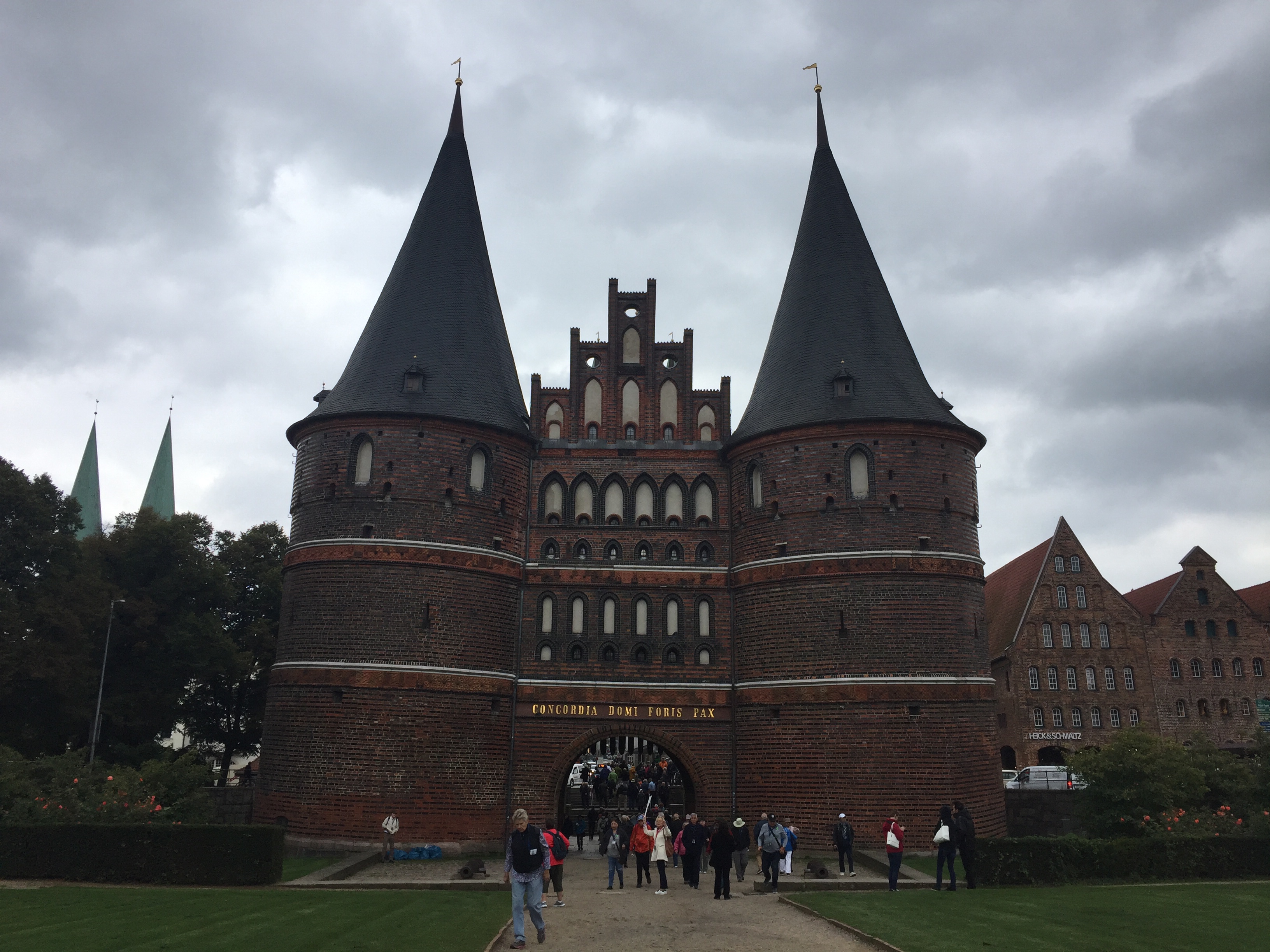
The Holestentor, gate to the old city of Lubeck.

When we toured the UNESCO Heritage site of Lubeck, Germany, I loved the oval-shaped, island city which is surrounded by the river Trave.  I never thought I would enjoy being in Germany.  I carried my grandparents’ and parents’ distress about the destruction of our family in Europe during the war. But I hoped that Germany of today is not the Germany of the 1930s and 40s. So I went with an open mind.

Of course. I had to ask our tour guide about Jewish Lubeck.  She was open and sincere and had knowledge.  I am sure I am not the first person to ask her. She informed me that before the 1800s Jews were not allowed to live in the old city.  But afterwards, when the French took it over, Jewish residents moved in. But they had to leave again after the French and Napoleon were defeated. Jewish residents did not move back until 1848.

She told me that the synagogue in Lubeck survived because the Germans did not want to damage the museum that was next to it. It was built in the middle 1800s.  She gave me directions to find it during our free time.  The synagogue was closed for renovations, but I had to see this German synagogue that survived the war.

My husband and I took a ten-minute walk in the rain to the building. For me it was well worth it.  It seemed, from the outside, to be in good shape. A red brick building set far back from the street, the area in front was gated off and a sign explaining what was happening was in front.  When we were there a group of elementary school children were walking by.  Their laughter and joy in the rain, lightened my spirit.  Although I could not go inside, below I have put a link to what the shul looked like inside in the 1920s.

Our guide also told me an interesting story. She said that Jewish resident of Lubeck who escape Germany and settled in England helped to save the city. She said that the city was bombed by the Royal Air Force of Britain in March 1942 in retaliation for Germany bombing Coventry.  During that bombing 20 percent of the historic area was destroyed.  That was the only major bombing of the city, but it caused much damage.

From what I had read, the reason it was bombed was to test the firebombs to see how much destruction they would cause on the narrow streets of the old city. About 300 people were killed during the raid, so I think the RAF succeeded in destruction.   Her story is not totally correct from what I can tell. But that bombing was the only major attack on Lubeck.

She also said, that the Jewish resident who fled Germany to London wanted to save Lubeck. That made me wonder, could it be true?  Would a Jewish resident want to save a city in Germany?  It is a lovely historic area, but really after fleeing to survive, would I want to save my home town? I am not sure. However, that was her comment.

She continued that this man was a relative of the head of the Red Cross. So, I did research.  I think it all goes back to a man named Eric M. Warburg, who was born in Hamburg, Germany, not far from Lubeck in 1910.  He fled to the United States in 1938 and he became an intelligence officer for the US army and helped get German scientists and their families to the United States and out of Germany. He served as a liasion officer between the RAF and the US Army Air Force.

He along with Carl Jacob Burchhardt, who was president of the International Committee of the Red Cross, made Lubeck port a Red Cross port to supply prisoners of war with aid. Since Burchhardt was not Jewish, I assume she was referring to Warburg, even though he was not the head of the Red Cross, he had contacts. Also it made sense for Lubeck to be the Red Cross port as near Lubeck, the Nazis had a prisoner of war camp for officers, Oflag X-C, from 1940 to 1945.

Mr. Warburg was a member of a large Jewish-German banking family.   Could he have had a relative who lived in Lubeck and wanted to save it?  Maybe? Or could it be Mr. Warburg himself, a Hamburg native, who supposedly tried to save Lubeck?

I just have no proof of this. But I do have proof that members of the Jewish community in Lubeck were murdered by the Nazis.  I found five Stumbling Stones (Stolpersteine) for Jewish residents who were murdered in Riga. In fact, the last 85 Jewish residents in Lubeck were deported to Riga Ghetto in 1941-42, including Rabbi Joseph Carlebach (1883-1942), who was murdered in the Shoah.

You might notice that two of the Stolpersteine are for victims with the last name Alexander.  I have in my family members with this surname.  I will admit that I felt an extra pang in my heart when I read these two stones.  (See blog below about my Alexander family.)

I am not sure if there are any Jewish residents in Lubeck now.  There are about 3000 who currently live nearby in Hamburg.  At one point, before WW2, Hamburg had almost 20,000 Jewish residents.

img_5744

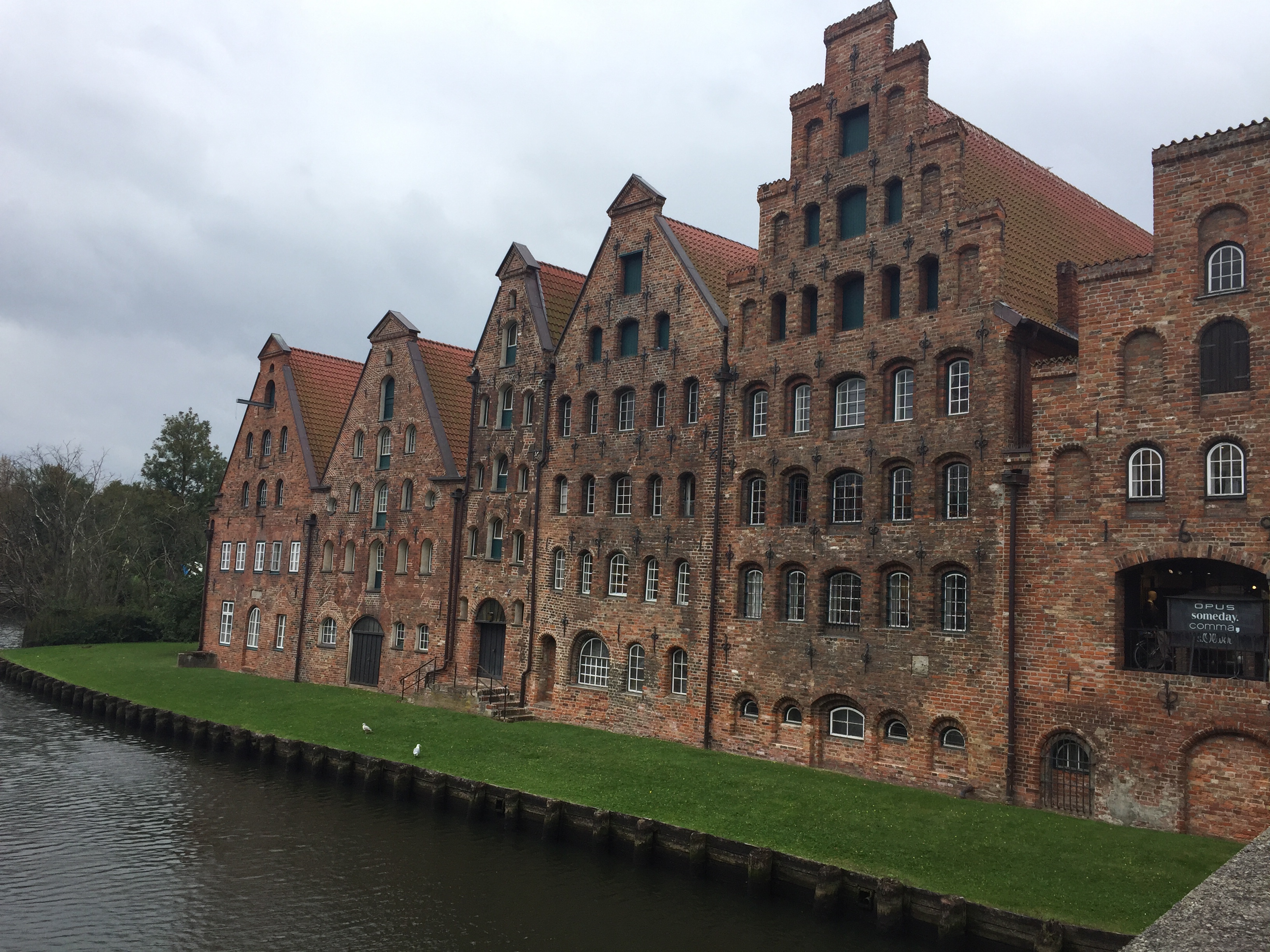
Salzspeicher houses along the Trave River.

Lubeck has many lovely medieval buildings.  I saw the unique entrance gate, the Holestentor,  that leads to the old town.  I ate marzipan at the famous Cafe Niederegger, which was founded over 200 years ago.  I saw the Salzspeicher houses that stand along the Trave River close to the gate. We walked past the home of Thomas Mann’s family. But for me, seeing a synagogue that survived World War 2 in Germany, was the highlight of the day in Lubeck.

 (Thank you to a resident of the area who was kind enough to contact me and tell me that there are about 800 Jewish residents of Lubeck and 5000 in Hamburg.)


https://en.wikipedia.org/wiki/Bombing_of_L%C3%BCbeck_in_World_War_II

https://en.wikipedia.org/wiki/Eric_M._Warburg

http://www.jewishencyclopedia.com/articles/10165-lubeck

https://dbs.bh.org.il/place/hamburg?gclid=EAIaIQobChMI2PabjJTH5AIVBr7ACh3P1gVmEAAYASAAEgJd4vD_BwE


https://dbs.bh.org.il/image/interior-of-the-synagogue-of-lubeck-germany-1920-c

https://zicharonot.com/2015/06/13/finding-katie/