Recently when visiting my daughter in Israel, we went to the cemetery in Holon to search for my grandfather’s cousin’s grave. I have written about (Lieb) Zissel Feuer many times. Because, although I met him when I was 19, I really did not know his story. I saw his several times over a two-year period when I was in college. But it wasn’t until I really began researching my family that I found out exactly the role he played in both the family and for the Jewish survivors who had lived in Mielec. (You can read about him in some of my other blogs.)
For me, he was an elderly relative that my grandmother asked me to visit. (He was about the age I am now.) I went to see him whenever I was in Tel Aviv. I always went to the bakery across from the Shuk HaCarmel, and he was always there when I went. He would walk me back to his apartment where we would visit for a bit. I took my parents to meet with him. And I brought my grandmother to see him as well. He was the connection to those who perished.
The last time I was in Israel then, I was 22. Keeping in touch with an older relative was not high on my list at time in my life. And, although I kept in touch with others. Zissel, I did not. But I always remembered him. And I had stories about my visits with him.
I did not go back to Israel for 25 years. Raising a family, working, living my life. I did not have time for that. But in 2005 I returned. And since then, I have been back multiple times to visit cousins and friends, and my daughter and her family. Because that trip to Israel in 2005 awakened a yearning for her to live in Israel.
Last year, I reconnected with other family members who live in Israel and were related to Zissel as well. They told me that although Zissel had no immediate family of his own, he was their family and he was always with them for the holidays. That made me happy. I always wondered if he had a place to go.
I felt like I needed to say goodbye to Zissel. And tell him how much I appreciated my times meeting with him and for what he had done for the survivors of the Jewish community of Mielec. So I asked my relatives where he was buried.
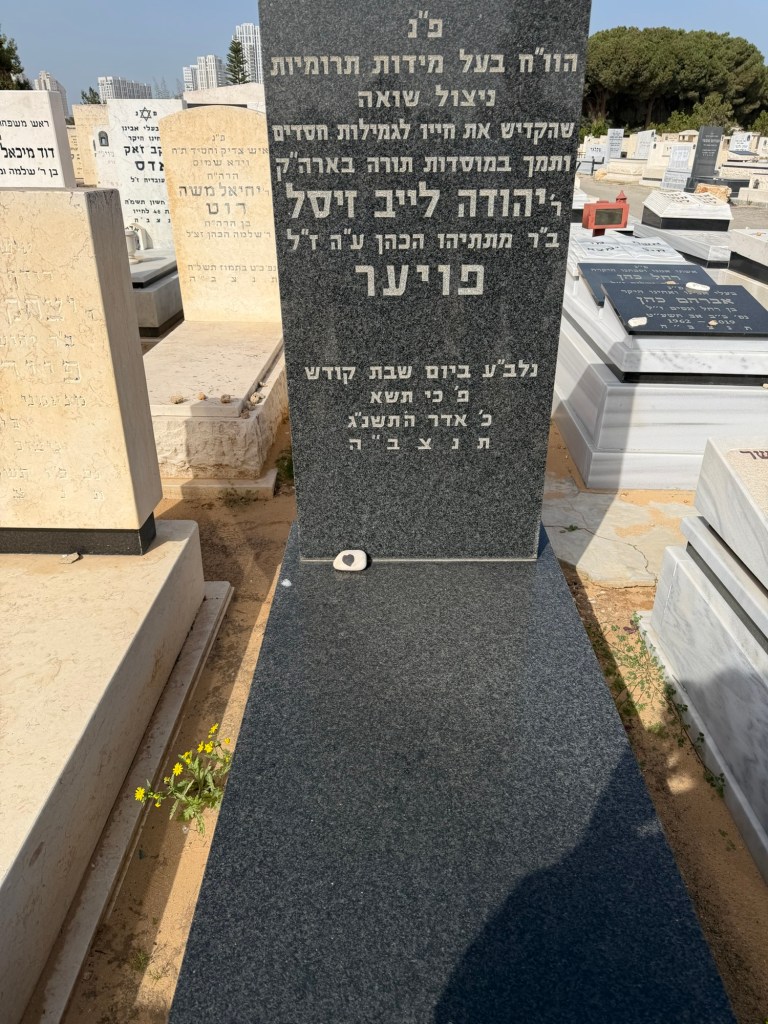
In February, my daughter and I went to see his grave. I was surprised to see that his name in Hebrew on the tombstone said Judah Lieb Zissel. While he was listed in the directory as Lieb Zissel. I don’t know why. I just wondered if it had to do with the Shoah. His grave says:
Here is a charitable man, a survivor of the Shoah. Who dedicated his life to good deeds and supported Torah institutions in the USA. Lieb Zissel, the son of Matityahu HaCohen Feuer. He died on Shabbat, the 20th day of Adar.
Only the holiest die on Shabbat. To Jewish people it is a sign of righteousness. Supposedly the souls go straight to their rest.
I left him a stone. Yes, I did put a heart on it. There were other stones there as well. I am glad I went. I felt like I was completing the circle, finishing something that needed to be done. My daughter told me we could come to visit him whenever I came to visit her. I might do that. Zissel was an important part of my history.
Today is his yahrzeit. I am writing it on the 29th anniversary of his death. May his name and memory always be a blessing.
While in Isarel, I finally renewed a family connection which started 50 years ago. When I was 20, I met two survivors of the Shoah. They were married to sisters before the war. The sisters perished in the Shoah, but the two men remained connected for the rest of their lives.
I have written about both of these men before, (Lieb) Zissel Feuer and Shalom Hollander. Both were distant cousins of my grandfather. But their wives were his first cousins. I wrote about meeting Zissel and Shalom and what happened to them during and after the war, and a bit about my contact with them in Israel between 1974-76. (See blogs below.). Over the years my perception of the two changed, as I learned more about their lives.
Now I have a different story to share, because I have met Shalom’s oldest son Chaim, as well as the great nephew of his first wife, who is also my third cousin, Jeff, and his daughter.
For me it was a meeting that completed a story. For them, I hope I was able to fill in stories about the family and answer question about the family before the war. As we shared our stories, I could see where my knowledge and theirs combined and differed. I spoke about meeting Zissel at the bakery in Tel Aviv across from the Shuk HaCarmel. Chaim smiled while I told my stories about meeting Zissel there each time I came to Tel Aviv. Chaim, of course, knew the bakery and even Zissel’s address. Although I had been at his apartment several times, I did not remember the address. But we had other shared memories.
I think when I talked about the bakery, Chaim knew then that I was really a relative. I really had met Zissel. I don’t think he thought I was lying , but he had never heard of me, yet there I was a family member from the USA, unknown to him. Also when I told him about meeting his father, how elegant he seemed. And Chaim agreed, his dad had that old world charm.
Chaim actually made me feel better about Zissel. I knew he did not have a family. Shalom was not related to him at all, once their wives died. Shalom. remarried. Zissel never did. But Chaim told me that Zissel was always part of Shalom’s family. He came to be with them for all the haggim, the holidays. That eased my heart. Really, I am tearing up even now. For me Zissel was such a sad soul. So to know he was not alone, helped.
We talked about the importance of what Ziseel and Shalom did after the war to help others from Mielec who survived and to keep the memory of those who were murdered. Shalom purchased the land where a mass burial of 800 Jews were buried and put up a fence and a marker. Both men also testified against those who were the murderers, as Zissel had done for the murderer of my great grandmother, his aunt by marriage. Our discussion filled in so many blanks for me.
Chaim and his wife gave me memoirs written by both Shaom and his second wife, Ita, about what happened during the war.
I in turn could tell them about those who made it to the United States before the war.
How Julius/Judah/Yidel Amsterdam, my grandfather’s uncle, came first. As other relatives came to the New York/New Jersey area, he gave them a choice. You can be a butcher or a baker. There was a cousin who was a butcher, and Uncle Yidel was a baker. My grandfather chose to be a baker. Chiam laughed as I told the story, because his uncle who went to the states became a butcher. I said he was probably helped by my great uncle Yidel as well.
With Jeff, I could talk about his great uncle Morris, who lived in Helena, Montana. My grandfather always stayed in touch with his first cousin. I knew one of this sons because when I moved to Kansas, they gave me Jack’s phone number. He lived in Denver. To my grandfather and his cousin Morris, this was close enough. We never actually met, but we spoke several times.
For me I have a feeling of completion. When I found out about these relatives, through the research of Izabela S. I knew I had to see them when I was in Israel visiting my daughter. They lived quite a distance. But my daughter said that this was my Mother’s Day gift. It was the one thing I really wanted to do. So we took the long drive from Holon to a small Kfar near Netanya.
Over the years of my research I have found out how the members of my family were murdered during the Shoah. I know how a small numbered survived. I know that they are not forgotten. I am not the only who keeps their memory alive within the family. And there are people like Izabela in Poland, who also work to keep the memory of the Jewish population alive.
I never thought I would ever want to go to Trzciana or Mielec. My grandfather never wanted to go back there after his family was murdered. But now I do want to go. I what to see where they lived. Where Shalom and Zissel created a Jewish community after the war. Where the Amsterdam group hid in the nearby forest. The town where my great grandmother was murdered. The mass grave where my great aunts are probably buried.
But most of all I am so glad that I found out what that Zissel and Shalom did after the war. I, as a young woman, saw both Zissel and Shalom as such sad people talking about Death. I did not hear the stories about what they did to give people a reason to LIVE after the war. And to create a place of memory for those murdered.
I now know that Shalom and his wife, who was also a survivor from Mielec, had four children, a girl who survived whom they adopted and three sons. Chaim and his wife have seven children, 40 grandchildren and 19 great grandchildren so far.
I know that Zissel was not alone. That Zissel and Shalom stayed connected throughout their lives. I also know that Zissel died in Holon. I think he might be buried there. So next time I am in Israel, I hope to find his grave and put place a rock of remembrance on his matzevot.
I have found out so much about what happened to my family in Trzciana and Mielec. The revelations are sometimes difficult to understand. But at least we now know.
But within all that we do know, there is a mystery of a grave containing two women, sisters and the son of one of them. (See blog below, An Unexpected Grave Mystery.). In my talks with Izabela, a Polish woman who has helped in my search, I found out that she is also aware of this grave and the unsolved mystery of exactly who are related to these two women and boy. We have discussed it several times. We think that I have the answer to the mystery. But I want to be sure.
Morris’ rocking chair. Now owned by my brother.
When I was a child, I knew my grandfather’s cousin Morris Brenner. He and his wife owned a newsstand/candy store in Jersey City. He was a diabetic and had both of his legs amputated. So he always sat in a rocking chair and was the cashier, while his wife, (we think her name was Anna), would walk around the store and help people.
My brother and I remember going to visit several times with our parents, or with our Mom and grandparents, or perhaps with just our grandparents. My sister doesn’t remember because she is so much younger. I am the last one alive to have seen him in my family. My Mom and I visited him in a nursing home near Bayonne, New Jersey. I detail that visit in a blog. (Childhood Events Definitely Influence My Adult Choices.)
His wife died before him, and since he had no legs, he had to move to skilled nursing. He and his wife did not have children. I believe I remember that they were first cousins so decided not to have children.
Why is this important? Because there is belief that the women buried in the grave had a brother who moved to the United States before the war, named Morris Brenner. Is this the right Morris Brenner? I wish I knew because it would bring closure to this mystery.
I have been searching the Ancestry files for days. I have found a number of Morris Brenners. But not a single one is listed as running a candy store. I have searched in Jersey City and Linden, New Jersey. My grandfather owned a bakery in Linden for a while, so I thought maybe there. And there is a Morris Feuer there, but he was married with children and did not own a candy store.
My frustration is strong. I thought it was an easy find compared to finding what happened in Europe. I thought how many men with the name Morris Feuer could there be? I thought the amputation and the knowledge of the nursing home would help. I also figured he died in the late 1960s. But I am not skilled enough with Ancestry to find him.
My Morris Brenner was probably born in the late 1890s in the Mielec/Trzciana area of what was then Austria, now Poland. He was married. His wife’s name might have been Anna. They had a candy store/news stand in New Jersey. They might have lived in the same building as the store, because I remember going into the back of the store through a door to a kitchen. Perhaps Jersey City, perhaps Linden, Perhaps Newark? At the end of his life, he lived in a skilled nursing facility/nursing home near Bayonne. Perhaps it was one for Jewish people? He did have nieces and nephews. I do not know if they were from his family or his wife’s. I know my grandparents began to visit him after my one visit. I know that my family inherited the rocking chair, my brother owns it. I know he died in the late 1960s perhaps early 1970s.
I even looked for people named Nissan Brenner, because by grandfather had a cousin in the USA by that name as well.
I do admit that my brother and I could have distorted memories. We were young when we knew him. I think I was about 10-12 years old the last time I saw him. That would be 1965-67. I believe he died within a year or so of that visit. But I do not know for sure. I remember when he died, but I don’t remember exact dates that far back.
I am asking for help from those of you who are excellent at research. Members of Tracing the Tribe have helped me in the past. Could you please help me find my Morris Brenner! Thank you!
So much information has come my way since Izabela S. contacted me. But the first in-depth story I must tell is about Zissel Feuer, my grandfather’s second cousin, who married my grandfather’s first cousin. I have learned so many details about how he survived and what he did immediately after the war, before he made aliyah to Israel.
Before the war Zissel was married to my grandfather’s first cousin, Dvorah/Deborah. Zissel then used the name Sussel or Zygmunt, the Polish version of his name. His life was intertwined with Schulim/Shalom Hollander because they were married to sisters. Shalom’s wife, Cerla, and Devorah were the daughters of Zacharias, my great grandfather, Gimple’s brother. My grandfather told me that Shalom and Zissel were his second cousins from opposite sides of his family. But since his grandparents/or great grandparents were first cousins, there was much intermingling.
Both Zissel and Shalom and their wives lived on a farms in Trzciana close to where my great grandfather had his farm and both Zacharias, the father of their wives and Shalom’s parents had their farms.
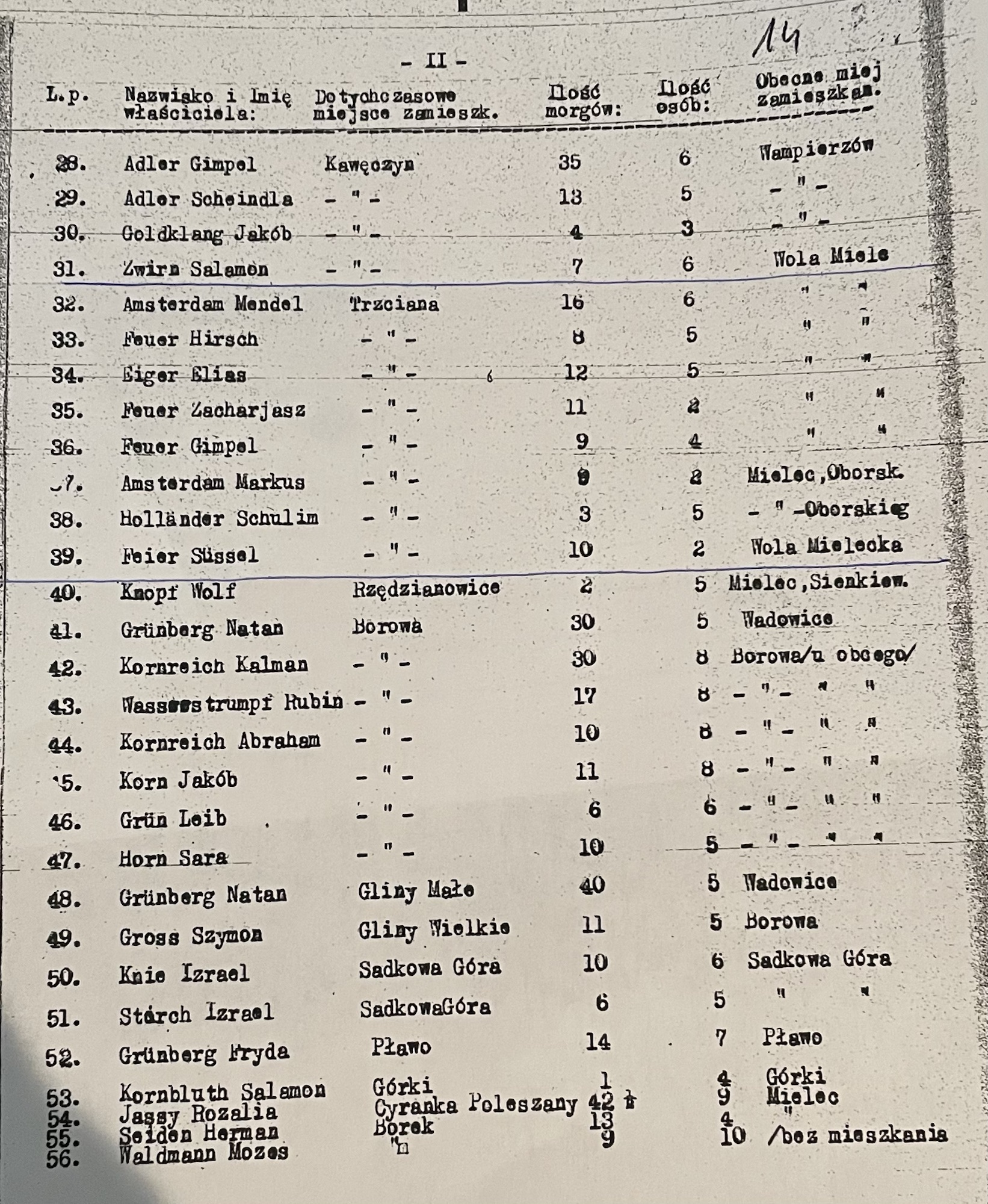
In fact in the document I have, is a list of farms taken from Jewish citizens. The Germans documented everything. Her you can see that seven of my relatives in listed from 32 to 39: Mendel Amsterdam, Hirsch Feuer, Zacharias Feuer (Dvorah and Cerla’s father), Gimple Feuer (my great grandfather), Markus Amsterdam (Shalom’s father), Schulim (Shalom) Hollander, Sussel Feuer. They were all inter-related. My grandfather once told me that this entire plot of land was once owned by his great great grandfather, or even further back. But with each generation the land was split among the sons. There was so much intermarriage as they kept the land within the family.
Zissel was a farmer and a corn merchant. I know that they also had potatoes and other crops on their farms. But it doesn’t matter, they were all forced to turn over their lands to the Germans in 1941.
After they were all forced off their land, Zissel and his wife; Gimple and Chava, my great grandparents; Zacharais, along with other Jewish farmers, were resettled in Wola Mielecka, a nearby village. Shalom and Cerla and his parents were sent to Mielec where they had a home. And then began their efforts to survive. I will let you know in advance, only Shalom, Zissel and one other cousins, the son of Zacharias lived. The rest did not survive.
Much of this information about Zissel comes from the book “Sztetl Mielec. Z Historii mieleckich Zydow” written by Andrzej Krempa that Izabela S. translated for me. (In English, Shtetl Mielec. From The History of the Jews of Mielec.”) Other information came from documents that Izabela has uncovered and translated for me. Part is what Izabela and I have determined through our many email conversations and the research I did and memories I took from my grandfather. I will mix her information with the information I know from my family.
So where was Zissel/Sussel and Dvorah during the war after he was removed from his farm? At first they hid with a man named Stanislaw Wojtusiak in Gliny Male and then with Jozef Padykula in Platkowiec. At some point Zissel’s wife was exposed by a resident of Trzciana, then murdered by the Germans. At this point Zissel had to run. He hid in the Piatkowiec forest near Mielec, near the village of Piatkowiec.
In the meantime, On March 9, 1942 Shalom was sent to a Labor Camp in Mielec. He was then sent to Wieliczka, then to Płaszów. He then became one of the people on Schindler’s List and ended up in Brunnlitz.
My one issue about this, is that Zissel told me he had two children. I do not know where they were or their names. But Izabela told me there is a mass grave near Tarnow where 800 children were murdered and buried. These children came from the Tarnow orphanage and ghetto. Shalom and Cerla’s children, as well as any child Zissel and Dvorah might have had, if they were not taken to a camp with their parents, may be buried here. Or they could have been shot at the Tranow Jewish Cemetery. Or deported. In any case we do not know exactly where the children are buried.
Zissel spent the time from March 9, 1942, the date that the Jews were rounded up for deportation and many murdered, until April 19, 1944, wandering and hiding around the villages near Mielec. For part of this time, he hid in Polaniec (July 25 until October 25, 1942). He left that area after the Jews of Polaniec were deported and returned back to Mielec.
He was able to stay hidden for a while. But starting in April 1943, the Gestapo was looking for him. They knew there was Jewish man hiding in the woods. Honestly, I cannot imagine how he survived for so long, having watched so many of his family die and disappear. But he survived! I know he had to have help, because his freedom was always in doubt. Finally in 1944 he was caught by the Polish Forest Administration and turned over to the Germans. But the slippery and I think smart Zissel, escaped. On his way back from Polaniec he was attacked in the village of Otalezh, which he was stripped and robbed. But he survived.
We know this because he filled out a questionnaire at the Central Committee of Polish Jews after the war. (Izabela says this document is now in the Jewish Historical Institute.)
Some of the Jews who survived. Zissel and Shalom are on this list.
After the war, he returned to Mielec, where he became the President of the Jewish Religions Congregation in Mielec. He was among the 55-70 Jews who survived. Zissel, Shalom and a woman named Chava Amsterdam are listed. Zissel was now using the name Lieb Sussel Feuer. His post war address was Maly Rynek 1. Shalom also lived at this address for a while after the war.
I think they still had battles for survival after the war. Padykula, who helped Sussel was accused after the war for helping in the capture of Zissel. But Shalom Hollander wrote a letter saying this was not true. That he actually helped not only Zissel, but also Shalom’s son Nissan. (This is interesting because in his Yad V’Shem list, he details the names of his five children who died. There was no Nissan. There is also no Nissan mentioned on the list of survivors who returned to Mielec. So perhaps it was someone he took care of during the war.)
Zissel did leave Mielec for six months. He visited his brother, Arthur, in the United States. I never him. But I did know that Zissel visited my grandparents. He is the one who told my grandfather that everyone died during this visit. I know from Izabela, that Zissel is one of the witnesses for my great grandfather, Gimple’s death. I know how difficult this was for my grandfather. My mother once told me that after baking all night my grandfather would come upstairs to their apartment and sit and cry with his head on his arms on the table. Can you imagine, not only finding out that his parents died, but his siblings, his entire family. Of those that stayed in Austria/Poland, I only know of four close cousins who survived. Shalom, Zissel and one of Zacharias’ sons. ( will write about one of the son’s in my next blog.) Shalom moved to Israel and remarried.
Zissel also went to see another brother in Berlin and then on to Israel. He did not stay in Israel, instead he returned to Poland. I really cannot understand why he would return, unless he had unfinished business. Which, from what Izabela told me next, I think I know what he needed to accomplish.
In 1947 he owned an apartment building at 41 Sandomierska Street, where he lived. As President of the Jewish Congregation, he began the work of fencing in the Jewish Cemetery on Jadernych Street. But the Provincial Office stopped the work. This is the Cemetery that Izabela now cares for with a group of volunteers. A few kilometers from the cemetery, at Swierkowa Street, there is another mass grave, where the Holocaust victims from Mielec are burried. In the area of this mass grave, Shalom put a tombstone in memory of his parents Tovah and Marcus/Markus Amsterdam. (Tovah’s maiden name was Hollander). It is possible that my great grandparents are also buried in this mass grave.
Zissel also gave testimony for the Polish people who helped him, by writing letters to document what they had done. I have photos of two of these letters, where he mentions Polish people who defended and saved other Jewish people. Two of them are Loen Wanatowicz and Stanislaw Rebis.
Zissel also testified against those who did evil, included a war criminal named Jek. He testified that Jek beat Jews and humiliated Jewish women by ordering them to strip naked. In the Tarnow ghetto he also killed at least three Jewish men.
Besides these testimonies, Izabela told me that there are still rumors about Zissel stating that he cheated some of the people of Mielec. How so? There were many homes that were now vacant because almost all of the 5000 Jews of Mielec and the surrounding area were murdered in the Shoah. They basically were available for people to move in to without having to pay anyone. Zissel, as the President of the Jewish Congregation, said that those who survived and returned were descendants of people who owned some of the property. Therefore, the Polish people now living on the property and in the homes had to pay the survivors for the homes and or property.
I told Izabela, since the families were so interrelated it could very well be that they were distant relatives. But even more important. They had NOTHING left. Everyone was dead. Their homes were gone. They had suffered. In my mind Zissel had done honorable work. He found a way for these people to get some money to begin their lives anew. Perhaps some of them were not really related to the property owners. But they did not belong to the people now living in them either.
(On a side note, I once asked my grandfather if he had tried to get compensation from Germany after the war for the death of his parents or his property. He became very angry and asked the following questions. “Would getting the money bring my parents back? Would getting the money bring my brothers back, my sisters? Would it bring any of my family back? I don’t want their blood money?” We never discussed it again.)
When Zissel was done with this work, he left Poland for Israel. He started using the name that I knew for him, Zissel: no longer Lieb or Sussul or Zygmunt. I met him in 1974. He was living in an apartment near the center of Tel Aviv with another Holocaust survivor. He worked in a bakery not far from the Shuk HaCarmel, the Carmel Market.
The last time I saw him was in 1976 with my grandmother. Zissel was not a perfect man. He stole from my grandmother. He was a bit of a goniff. But perhaps that is what kept him alive and allowed him to help others after the war.
May his name be for a blessing. May his memory live on from the blogs I have written.
In the last week I have been in contact with Izabela S., who lives in Tarnow, Poland, which is close to both Mielec and Trzciana, where my family lived and where they were murdered in the Shoah. Izabela has been working for the past three years to clean up the Jewish Cemetery and get information about the places where the Jewish residents were murdered and put up plaques to commemorate them in the Mielic area. She also writes a blog and has a Facebook page to write and remember the Jewish residents who were murdered in the Shoah. Before the war, of the 10,000 residents in Mielec, 5,000 were Jewish. After the war, maybe 200 survived!
(See video about Izabela below.)
My quest to find my grandfather’s family started in the late 1970s after I spent time in Israel and met those who survived. My grandpa lost his entire family in the Shoah, except for a few cousins, and except for his mother, he never knew how his father and siblings died. I told him that I would find out. It has taken almost 50 years, but I never gave up! Over the years I have written many blogs about them. (Some are linked below.). But I could not find out about three of his siblings. Now I know more.
But then there is the question? When you find these things out, do you really want to know? And are some ways of dying better than other ways. In the towns my family came from people were burned alive in the synagogue and mikve, starved to death or died of disease in the Lodz Ghetto, gassed at Belzec, shot at a mass grave. Which is worse?
I guess I decided that being shot is the kindest way to die among those options. A distant cousin of mine (Her great grandfather and my grandfather were second cousins, l believe), thought her great great grandparents were burned alive in the synagogue. She now knows, thanks to Izabela, that they were shot. And in a weird way it is better. I think.
My family came from the small town of Trzciana. Before the war there were about 1000 people. The town was known for its windmills. I can imagine that it was lovely. Izabela wrote about it this way:
“Jewish families lived in Trzciana: the Amsterdams, the Hollanders, the Brenners, and the Feuers. They were closely related to each other. In Next is the night: The fate of Jews in selected counties of occupied Poland, vol. II Tomasz Frydel writes that every Sabbath, members of the Amsterdam family from the village of Trzciana went to the synagogue in Czermin, where more Jews lived among the German colonists. This family was widely respected, its members gave grants to the Roman Catholic parish and distributed potatoes and beets to local peasants.” This was my family.
I knew already how my great grandmother, Chava, died. (See blog below.) But I now know my grandfather was not killed in Belzec with his son, Shimon. Instead he was murdered on March 9, 1942 with many others of his family during a round up/deportation and slaughter of Jews. He was shot in Cieszanow. I now know that their daughter, Tova, was also in that roundup. But was not killed then. So probably died in one of the camps. I know Jews from Meilec went to four camps, Belzec, Sobibor, Treblinka and Majdanek.
I now know that outside of the town there is a mass grave of 800 Jews. Many of them my relatives. I know about one for a fact. Natan Feuer ran. He was able to get about 50 yards when the Nazis shot him and dragged him back to the pit where they threw him in still alive. And he perished. But Natan story really hits home as my grandfather’s brother was named Nueter/Natan. So is this him? I will never know.
I believe that my grandfather’s cousin, Morris Brenner, who owned a candy store in Linden, NJ, and whom I wrote about before, (See blog below.), had two sisters and a nephew who are buried in the Jewish cemetery on Traugutta Street: Cerla Kleinman nee Brenner, her son David, and sister, Sara Brenner. His mother, Gital, died in 1941, before the mass murder of the Jews. I have to admit that gives me a bit of joy. It is nice that someone died a natural death and wasn’t murdered because she was Jewish.
I had heard of the brothers Tuvia, Zus, and Asael Bielski, from the book and the movie Defiance. I now know that there was also the Amsterdam Brothers, Johanan and Abraham, who led a group in the forest near Bulcza Mielka called The Amsterdam Group. According to Izabela, it was a large group of Jews who hid and the core of this group were families from Trzciana. There were 84 Jews in Trzciana before the war, all related to me. The two brothers, who had been in the Polish Army before the war, commanded the group. They built a series shelters and hideouts where they survived the winter of 1943. They hid in bunkers and acquired weapons from the peasants as well as gaining them in battles with the police and Germans. They divided into small groups to keep more people safe.
A survivor named Ryvka Schenker wrote about the conditions in the hidden camp:
“It was very cold back then, the snow fell, You had to be very careful – every step was known. How they went out to the country Shopping, they made their feet like the birds they have. It was made of wood, They made the same traces as birds walked. No one could have Imagine there are people in the middle of the forest. We sat all day very long calmly, one read a lot, others wrote diaries, some embolden images, Everyone made it through that day. We always lived the hope that It will be after the war soon, but it was just a dream. There were severe frosts, nobody had The right clothes, let’s get out of the field little. The men were more Resilient. We had a lot of water because it froze.”
I am Amazed! And feel proud that my family tried to survive in every way that they could.
There is so much information it will take me a while to unravel all of the connections and organize in my mind so that I can write about this family that was almost wiped out. My family. But I felt it was important to write this down when the emotion of discovery was still strong. Baruch Dayan HaEmet. May their memories live through these remembrance and that we never forget those who have been murdered by hate and evil.
With the uptick in anti-Semitic events, with masked college students attacking Jewish students at colleges, with a Hamas murderous pogrom in Israel, I am still amazed when events from the Shoah are revealed in present day. I feel like I am in a time warp. Reading about the events at the UC Berkley campus and at the same time reading an email from a distant cousin telling me about a mass grave found in Poland that contains members of my extended family. Don’t college students learn anything about history?
My newest journey started with a email from a distant cousin concerning the Holocaust and my family. I get unusual requests now and then because I have been the family historian, trying to document all the family who were murdered during the Shoah. A task I realize is virtually impossible with all large number of people in my family who were murdered.
My distant cousin received a letter through JewishGen’s Family Finder. Her great aunt, who I keep in contact with, suggested she send the email to me.
Her email contained a series of emails between two people in Europe that forced my brain back in time to all that my maternal family had suffered so many decades ago during the horrors of the Shoah.
The first was from a retired baker in London who had been contacted by a researcher who wanted information about a family named Brenner who were murdered by the Nazis and whose bones were recently found in a mass grave and in accordance with state law were re-interred in a Catholic cemetery.
His mother was born Kornbluth and her father was born in Mielec, Poland, where many Kornbluth’s were living when the Nazis invaded. They believed the bones were those of a woman whose maiden name was Kornbluth; her married name was Brenner.
My family was from Mielec and its surrounding small towns. I have written about the destruction of the Jewish population in this city and its surrounding in other blogs. Brenner is one of the names in my family. Which made me think that I could have a connection with this grave. Although the last name Kornbluth is familiar, I wasn’t entirely sure of the connection to us. But I kept reading.
The baker then include emails from a representative of the Zapomniane Foundation that deals with locating and commemorating the graves of the Holocaust victims. He found the baker through JewishGen Family Finder.
“I represent the Zapomniane Foundation that deals with locating and commemorating the graves of the Holocaust victims (zapomniane.org or our profile on FB). I’m currently researching the case of the Brenner family murdered in 1942 and buried in a mass grave near Mielec. According to what I have learned so far among the victims probably were Lazar and Sara Brenner. Her maiden name was Kornbluth. Before the war they lived in a village called Hyki (today it is called Sarnow). They were killed together with their children and Sara’s brother. Would you happen to know this story and/or have any information about Sara Brenner nee Kornbluth?
Sincerely A N”
Then came more information from the Zapomniane Foundation: “ Here is the story of how I have learned about the Brenner family:
Two years ago I went to Czajkowa (a village near Mielec) to see the location of a place where the Brenner family (seven people) was killed and buried in August 1942.My guide was Robert P. who told me the story of his aunt Anna P. Anna’s real name was Ryfka Amsterdam she was Jewish, converted to catholicism before the war and married Andrzej P, Robert’s relative and became Anna P. The Brenner family were the relatives of Anna/Ryfka: perhaps Ryfka’s sister with husband and children and possibly Ryfka’s (and Sara’s?)brother. There are no names, only the last name of the father of the family i.e Brenner.”
Well now we are getting closer to my family, since Amsterdam is my grandfather’s last name. I know that any one named Amsterdam is definitely somehow related to me. This is the first time ever that I have heard about a family member who converted to Catholicism before the war. But to be honest, if someone left the family to marry outside of the faith, it was probably not discussed.
What the email says next really touched my soul! I could not image how this young man would have felt when he dug up the grave.
“The gravesite of the Brenner family was partially destroyed in 2003 by an excavator. Obviously the grave itself has never been marked, it was just a hole in the ground. As a result the bones from this grave were taken by the police and buried in an anonymous grave in Tuszów Narodowy catholic cemetery. Ironically the guy who worked with the excavator and dug out the bones was the grandson of Ryfka Amsterdam/Anna P. He was interrogated by the police in 2003. Anna/Ryfka had three children, her son born in 1950 is still living in Mielec.”
Next shock! A non-Jewish descendant of Rikva/Anna born just a few years before me, still lives in Mielec. They stayed there even after all her Jewish relatives were murdered. I cannot understand that reality. Could you comfortably walk the streets of a city, see the houses of your relatives, know that they were murdered and that others were living in their homes? Would you ever feel safe?
Not only that, it was Anna’s grandson who accidentally dug up the grave of people who might be his great aunt and uncle and their children, his cousins. I could almost see this as a movie. Could this truly be happening? But yes, it was and it is. So now he has not only dug up a grave 80 years after they were buried, but it is his family buried there. I really have no words.
The researcher continued:
“I found the information about Chaim Brenner via the Holocaust Survivor Program. Thus I knew the names of his parents and their fate that fits the story I know from the Polish archives:
Czajkowa Aug. 15, 1942 Captured and shot by German police, beginning w/ oldest family member; gendarme Franiszek Wojtas identified as likely shooter; family did not report to ghetto and remained in hiding for approx. 3 mos.; hid in forest and empty home of Kamuda; group consisted of two families; relatives of prewar converts to Christianity, Amsterdams, who survived war in same village
So my big questions are who was buried in the grave destroyed by the excavator 20 years ago and how can we commemorate them.”
The retired baker then tells my cousin that he contacted her because she has a Nathan Amsterdam in her family tree who told Yad VaShem about the death of a niece with the maiden name of Kornbluth. Could she help? Which is how I became part of this Nazi murder/grave mystery.
I knew I really could not help, but I felt like I had to say something I emailed both the baker and the Zapomniane Foundation. Here is a shortened version of the email I sent.
Your question about the grave and the Brenner/Amsterdam/Kornbluth murders, was sent to me as I have become an Amsterdam family researcher for a while now.
She knew I would be interested in this question.
Unfortunately, I do not know who was buried in the unmarked grave. Not much help I know. But I can tell you that there are many named Nathan Amsterdam in our family. My cousin’s great grandfather and my grandfather were both were named Nathan Amsterdam and they were cousins who were born in Austria/Poland in the Mielec area.
The family in Meilec and the surrounding area had four main family names: Amsterdam, Feuer, Brenner and Hollander. The family is Cohanim. Hence the names Feuer/ FIre and Brenner/ Burner. The other names came because the family did go from Spain to Portugal to Amsterdam and then a group moved to Austria/Poland. There was much intermarriage between people with these four surnames.
Almost the entire family who remained in Europe died during the Shoah. Mielec was one of the first areas that the Nazis made judenfrei. Only a few cousins survived. They are all gone now. One moved to the USA, two went to England and two moved to Israel.
Here is the info on the family that survived and moved to England. Perhaps you might find a descendant. I met them in the early 1960s when they came to the USA to visit the family here.
Zacheriah and Elka had seven children. Only three survived the Shoah. Gimple Feuer married and moved to England. They had four children. (I then named the four children who they might be able to reach. I am not publishing their names here as they might still be alive.)
Lazar Feuer also lived in England after the war, I never met him. He had three children: (I named these three as well.)
I am sorry I cannot tell you or the researcher there who exactly is buried in that grave. But I can tell you that several hundred members of the family were murdered in the Shoah in many different places and methods. But as the names were Brenner and Amsterdam, I can tell you that they are my distant relatives and that the men were probably Cohanim.”
Because I think finding a way to commemoriate these people is important, I am posting this on Tracing the Tribe Facebook page to see if anyone else has a connection that could help.
When I was a child, I remember going to my grandparents’ cousin’s candy store on Bergen Boulevard near Journal Square in Jersey City. My brother and I have discussed their names, as it is a memory from long ago, over 50 years. He remembers the wife as Anna, and I remember the husband, as Morris Brenner. We will go with these two names.
Like my grandparents, they were from Europe. I believe that Morris was my grandfather’s second cousin. That is a connection I have yet to finalize. But I am pretty sure he was not a first cousin. However, in the area they came from in Galicia, Mielec, my grandfather’s family was large and very intermingled.
The best part of going to the candy store, of course, was the candy. We could eat whatever we wanted, within the reasonable constraints of my mother. The other part was seeing Morris and Anna, who were always excited to see us. They never had children of their own, but they loved us.
Sometimes, my Mom would drive my grandmother, my brother and I to visit them in the candy store. I have good memories of being there. My grandmother and Anna always had a good time visiting. So even though it was my grandfather’s cousin, my grandmother often went to visit without him. And since she never learned to drive, my Mom had that job and we got to tag along.
Morris always sat behind the counter and ran the cash register. He sat there because he no longer had legs, he lost them to diabetes. Anna ran the store. She was tiny and very energetic. That is why what happened is so sad.
Morris’ rocking chair. Now owned by my brother.
Anna died first. I don’t think she was that old. But when she died, Morris could no longer stay alone. The store was closed; their belongings were sold or given away, and Morris went into a nursing home. I remember my parents speaking about it, because we were gifted his rocking chair. It did not go to the nursing home with him. My brother still has the rocking chair in his home. The tangible evidence that Morris and Ann were part of our world.
The nursing home Morris lived in for the rest of his life was in Bayonne, New Jersey, close to where our family dentist had his office. Usually we all went to get our teeth done at one time.
But on this day, it was just my Mom and me. As we drove away from the dentist office, she turned to me and said, “I want to go visit Morris. I know he lives near here.”I don’t remember how old I was, somewhere between 10 and 12. To be honest, I thought we were going to the candy store. But I was in for an unpleasant and emotional surprise.
When we arrived at a large one-story building, my mother and I entered and went to the desk, where Mom announced that she wanted to see Morris. The woman stopped what she was doing and called to someone, a nurse/supervisor/care giver came out. Both were so surprised that we were there to see him. The supervisor said, ‘Oh my, who are you? You are the first people who have ever come to visit him.”
My Mom was stunned. “Are you kidding me. He has nieces and nephews.” But she was not joking. No one had visited Morris in the year or so he had been living there.
The nurse walked us to his room. In fact, by the time we got there, I think three or four nurses or caregivers were following us. Mom walked in first and knelt down beside Morris. “Morris, It’s me Frances, Nat and Thelma’s daughter.” She said in Yiddish as she reached out to him.
Morris started cry. He put his hands on either side of Mom’s face and sobbed, “Frances Frances.” Her name was like a chant. While Mom hugged him with one arm, she put out her other arm, I knew that meant I needed to come over.
“Here is Ellen,” she said. My face was now embraced by his hands as he cried into my hair and stroked my face. I was crying by then as well, as were Mom and the nurses/caretakers. We stayed and talked to him for about an hour. It felt longer. He spent most of the time crying and hugging us. And asking about all the family. I have never forgotten.
As we went to leave, the supervisor asked Mom for her address and phone number in case they needed to reach someone. They had no contacts for him.
We went and sat in the car. My Mom cried for an additional half hour or so. Just sobbing, with her arms crossed on the steering wheel and her face down in her arms. I cried with her. It was one of my saddest moments as a child. When we got home, my Mom called her parents.
I never went back to the nursing home. I think because every time I thought of him, I started to cry. But I know my Mom and my grandparents went. To be honest he did not live long after our visit. My sister, who is four years younger than me, does not remember Morris or Anna. But what she does remember is my grandparents and my mom talking about him. And my mother always talking about what happens to someone when they are all alone in the world.
For the past ten months I have been a Spiritual Care Volunteer at an elder care facility. Over and over again people have asked me: How can you do that? Doesn’t it bother you? Isn’t too difficult when someone dies?
The answer to all these questions is an emphatic NO. Each week when I go, I am greeted by smiles and joy. I speak to each one of them. Some days I give them hugs. Sometimes someone cries, especially if they have recently lost a loved one. Most of them have family members who often come to see them. Most important to me is that I know that I am going every week. I am giving them the attention that Morris so deserved and did not receive.
This childhood event definitely impacted my adult choices. Each time I go, I feel a little lift to my heart, knowing that I have helped to brighten someone’s day. It is the best feeling, because each time I go, a little of the sadness that has followed me for over 50 years, whenever I think about Morris, dissipates.
It has been over a month since I last wrote about the testimonies of Shalom Hollander, my grandfather’s cousin who wrote the Yad VaShem testimonies for about 40 members of my family including my great grandparents and a great uncle. I needed time away from the visions of horrors that his testimonies put into my mind as I thought of all these relatives who were lost. (See links to blogs below.)
But there was one last family that I was determined to write about because they all perished.
A family of five died in 1941-42. They were Hirsh Tzvi Feuer, the son of Eliezer and Leah Feuer, and his wife, Dvora Amsterdam, the daughter of Tzvi and Chava Amsterdam. As I have written in earlier blogs, the names Amsterdam and Feuer are common in my grandfather’s family. My great grandmother was an Amsterdam, also named Chava, and my great grandfather was a Feuer. They, my great grandparents were first cousins. There was so much intermarriage between these two families!
I have the names of all my great great grandparents and their siblings. And, although I have the names of my three times great grandparents, I do not know the names of their siblings. I am sure, however, that Hirsh Tzvi Feuer and Dvora Amsterdam’s parents are among those names. Shalom identifies himself as a relative in these testimonies. Also he indicates that Hirsh was a farmer, and my great grandparents and their families were farmers in Trzciana.
Tzvi was born in 1895 and his wife, Dvora, in 1908, which make them contemporaries of my grandparents who were born in 1900 and 1906. I would assume that my grandfather knew them when he was a child. They lived before the war in Wola Mielecka, Poland, but they lived during the war in Trzciana, Poland, my grandfather’s home town. Wola Mielecka was close by, all the surrounding areas to the town of Mielec, Poland.
Tzvi and Hava had three children who perished. Lea Feuer who was 4. Obviously named for her grandmother. Chava Feuer, age 6, named for the other grandmother. Then the third child, Eliezer, an infant, named for his grandfather.
I hope there are other children who survived. Who were older. Hirsh Tzvi was 47 when he was murdered. Dvora was 34. I hope there could have been several children in their early teens? Perhaps I am doing wishful thinking. But in my heart, I want them to have been survived by someone besides Shalom Hollander. I do not want this entire family to have perished.
But like the family of Shalom Hollander, there is a possibility that they were all murdered along with thousands of others when the Nazi’s made the Mielec area Judenfrie. Of the almost 4000 Jewish residents of the Mielec area, only a few hundred survived.
The Yad VaShem Shoah database is killing me, while at the same time becoming addictive. I have learned the secret of advance search where you can enter the name of a person who has given testimony and find all the other people that person has remembered.
For me it has been a personal trial as I try to find all the family names, while at the same time finding so many names, knowing that hundreds of family members perished in the Shoah. My grandfather’s family all lived in a small area of Galicia surrounding the village of Mielec.
I enter names that are common to my family and I search. Today I found a Tova Gital Feuer (her maiden name). Those are two names that are used over and over again in my grandfather’s family. Gital was the name of my great-great grandmother. This Gital Tova/Tova Gital was born in 1889 in Mielec and died when she was 54 in Belzec 1942. That is where my great grandfather and great uncle also perished: in Belzec. They are sure to have been cousins of some sort, since they had the same last name in such a small town.
The person who gave testimony was Gital Tova’s daughter Ruth, who survived and made a new live in Israel. But her immediate family did not survive. Her father, Abraham, died in Treblinka. Two of her brothers, Lieb Arie and Anczel/Anshel died in the Debica/Dembitz Murder Site. Anshel was a Polish soldier, I find that amazing. He was 21 when he perished.
Debica/Dembitz was so close to where my grandfather and his family lived. It was actually part of the same area, and one set of his grandparents lived in Debica/Dembitz.
According to Wikipedia, the Nazi’s built a military base in 1941 in Debica. They had 15,000 slave laborers who perished, including 7,500 Jews, 5000 Soviet POWs and 2500 Poles. Their remains were buried in a nearby cemetery. In Debica, the Nazis forced all of the Jews in to a ghetto and then murdered most of them there and in Auschwitz.
I had not heard of the Debica/Dembitz Murder Site. So I searched some more. I found that in a Jewish Gen document. “The Murder of the Jews of Dembitz” by Reuven Siedlisker-Sarid, translated by Jerrold Landau.
This testimony tells about the formation of the ghetto, and that until 1943 the Jews were murdered in Belzec. I believe this description is the Debica Murder Site that Ruth meant, as reported in the testimony:
“The Gestapo men approached the rows of kneeling people,and removed about 180 or 200 men. Those were placed on transport trucks and driven by the S. S. men to the edge of the Wilicka Forest at Lisa Gora. They were brought into the forest and shot into a communal grave that had previously been prepared by the Polish Junaks. The Junaks were then called to cover over the grave at the conclusion of the dreadful murder. This took place on the 7th of Av, 5702 (1942).”https://www.jewishgen.org/yizkor/debica/Dem141.html
Now I know about the murder site. All I can think is how horrible is that! I have no idea how many members of my family died there. I have found so many horrible ways that my family members were killed by hatred.
Ruth’s parents and two brothers were not the only ones to be murdered: In all seven of her siblings were killed: Lieb Arie and Anczel/Anshel in Debica; Shumel, 19; Simcha, 6 or 8, in Asuchwitz; Eliezar, 13; Mala/Malka, 23; Hanna, 14, Belzec.
I wish the list ended there, but Ruth also testified about the deaths of her aunts and Uncle Zlata, Sima and Hershel. Another Aunt and Uncle: Hava and Zalman, and their 17-year- old son, Nissan. These names got to me in a personal way. My name is Hava, named for my great grandmother who perish in the Shoah. And my grandfather was also Nissan Feuer. It could have been us.
All were from Mielec. And although Zlata and her husband Hershel and Sima were from Ruth’s father’s side, and might not be directly related to me, I claim them. My great great grandfather on my grandfather’s maternal side was named Hershel. He was both my great grandmother and great grandfather’s grandfather. They were first cousins. So many cousins married each other in Europe!
Ruth also gave testimony on several friends and acquaintances who also perished. Ten more people. I assume she saw them die either in the ghetto, or the death camps. I do not believe I am related to any of them, as she did not mention a family relationship.
Of the 4,000 Jewish people who lived in the Mielec/Dembitz area only about 200 survived the war and the death camps.
I wish that I would not keep finding these horrific bits of information. I wish I could stop searching the Yad VShem website. Years ago, when I first tried researched my family, I tried the website database, but it was not as good as it is now. Something makes me continue to search. I continue to find more names to keep in my memory and in my heart. Each name adds to my understanding of my grandfather and how important was for him to have our family. Each name helps understand my Grandmother and her reactions when we traveled to Israel in 1976. They lost so much in the Shoah.
For Ruth’s family, I feel a teeny, tiny less sad because Ruth survived. She married. I hope she had children, who had children, who had children to keep the memory and names of her parents, siblings, aunts and uncles, and cousins alive. I hope she was able to live a happy life. She entered these names in 1999.
For me each name I find is a blessing and a remembrance that I hope will keep in the hearts of my family.
As Rosh Hashannah approaches, I have a new view of my family’s heritage, a new reality that will impact my observance and prayers this year and in all future years.
It started with a Facebook Group called, “Tracing the Tribe.” I actually was able to find a family member due to a blog I posted about my grandfather’s family history and his town in Austia/Galecia called Mielec. I met Susan when I was in New Jersey this summer. It is actually her husband who was related to me.
We spoke about the family and how we might be related. I actually found the connection. My great grandfather and her husband’s great grandmother are probably brother and sister.
She emailed me a testimonial written by her husband’s first cousin, “E”, about her Holocaust experience. “E” survived the Holocaust and settled in the USA. In this memoir, “E” recounts a story about the Jews of Mielec and how they died. She wrote that 600 were rounded up and burned alive in their synagogue. She received this information from relatives in Mielec.
What! I was somewhat stunned. No one had ever mentioned this to me before. Whenever there was discussion about our family who died, we were told that they were burned alive in the fires of the Holocaust; or that some had died in Auschwitz; or that my great grandmother had been hidden and then murdered by the people who had stolen the family farm. But this story was never mentioned. Never.
But I remember thinking, when my Mom would tell me that our family was burned alive, that in the crematorium, the people were dead before they were burned. Weren’t they? So why would I be told that they were burned alive? Could this be what happened?
My Grandfather never talked about his family. He lost almost everyone who still lived in Europe: his parents, siblings, nieces and nephews, aunts and uncles, cousins. Everyone! Only a few cousins survived. When I finally got him to talk to me and tell me about his family, he was vague when talking about the Holocaust. He would tell me a little about life when he was a boy. But he did not like to mention the names of the dead.
When I found out that Germany was giving money to those who could prove they had owned property, I suggested that he apply to get money for the family’s farm.
He was furious. “Will this money bring back my mother and my father?” He yelled at me. “Will this money bring back my brothers and my sisters and their families? NO! NO! I don’t want their blood money! Let them keep their blood money!”
I can still hear him yelling at me. So I stopped. I never asked again.
My mother told me that a relative, Zissle Feuer, came from Europe and told my grandfather what had happened. And then my Grandfather contacted the Red Cross. Everyone was confirmed dead. My mother was about 16 when they found out that everyone died. She said that every morning when my Grandpa came upstairs from the bakery she would hear him cry while sitting at the kitchen table; sobbing over the loss of his family.
Now I read this testimonial. What is the truth? How did they die? “E” was not there. She only heard about it. So I looked through all the papers I had gathered through the years. And I found one document that I guess I never read entirely. I just read the part about the city of Mielec before the war. I never read the section that was call Holocaust Years. Because there it states, halfway down the page, that on September 13, 1939, on the eve of Rosh Hashannah, 20 Jewish were pushed into a burning synagogue. If they tried to escape they were shot. Then the German soldiers put Jews into a slaughterhouse and set it on fire. Then they went to the Mikveh and killed Jews there. On the second day of Rosh Hashannah a second synagogue was set on fire.
So many burned alive on Rosh Hashannah. I do not know if it was 600, but even one is too many. What a horrible death!
How can I ever see Rosh Hashannah in the same way again? How can I understand that on this holiday my family might have been murdered, burned alive. Up until September of 1939 there were 4,000 Jews living in Mielec. When they were deported in March 1942 only 2,000 were still alive.
Did 600 get burned alive in the four buildings set ablaze during Rosh Hashannah of 1939? Did my great aunts, great uncles and cousins suffer in those flames? Did my great grandfather die there? Is this why my Grandfather could never talk about it? Did he know that is how most of his family perished? When my mother said they were burned alive, did she know as well?
Was it just too horrible to tell us?
Mielec, the home of my family, was one of the first to be totally depleted of its Jews. This report said only 200 Jewish people survived the war: 200 out of 4000. I know that four of them were cousins of my grandfather. I met them all: one settled in Montana; one in England; two in Israel. They have all since passed away.
On Rosh Hashannah we chant the Unetanah Tokef. It is a prayer that has always made an impact on me. But this time when I read “who by water and who by fire,” I will be wondering: “Who died this way? Who?”


 zicharonot