Tag Archives: grandparents

Watching Antiques Roadshow Inspired Me to Donate My Great-Grandmother’s Matzah Cover

12 Jun


Matzah cover made by my Great Grandmother Chava.

Matzah cover made by my Great Grandmother Chava.

Watching the Antiques Roadshow, a PBS show, is one of my favorite television experiences.   I started watching it with my parents years ago. Whenever they came to visit, this was one of their favorite shows. They got me hooked on it!

I love learning about different items of furniture, jewelry and knick knacks. It is a history lesson along with seeing the beautiful items. But every once in a while, someone brings in a special ephemeral item: photos, letters, a diary. In my opinion, these items should really be in a museum, some place where researchers and students and others can see the items and learn from them.

It drives me crazy. I even say it out loud. Occasionally we find out that the family did donate the item. Like when a family had the musical notations of the “Star Spangled Banner.” They donated it to a museum, and that made me feel good!

I often wondered: would I be able to do that. Would I be able to donate a family treasure to a museum? The answer is yes.

When my siblings and I were cleaning out our parents’ apartment we found two items that my brother, sister and I all wanted, but knew something special had to be done with them. One was a program from the 1930s for a benefit to help the Jews of Europe, the other was a cookbook in English and Yiddish to help immigrants learn to cook American meals.

My sister contacted the Museum of Jewish Heritage in Battery Park and asked if they would want these documents. The answer was a resounding yes. So we donated them. This way they will survive, and others who might be doing research or want to know about life for immigrant women would have these items. They will be protected. The curator told us that they had only seen one other program like ours, but it was from a Chicago event. Ours was from a New York City event.

The three of us were glad that we made this decision.

I recently made another decision to donate.

I am donating the matzah cover my great-grandmother Chava made in 1901 to the same museum. I have thought about this for several years, and decided it was the best choice for this family heirloom.

The matzah cover is made of beige linen and a teal silk. I think the silk was originally blue. On the matzah cover my great grandmother embroidered the date she made it in Hebrew letters and the words: “Seder shel Pesach” (Seder of Passover) in Hebrew. It has beautiful cut work embroidery made into a Jewish star (Mogan Dovid) with embroidered roses along the edge.

My mother gave it to me about 25 years ago for several reasons: first because I was named for my great grandmother; second, because I also do embroidery; third because my parents would come and spend the second night of Pesach with me; fourth because my daughter is the oldest grandchild. I think they thought I would pass it on to her.

But I will not.

The matzah cover was made in Galicia before the First World War. I think it was made for my grandfather’s first birthday, as he was born in 1900 on the first of Nissan. It came to the USA in 1932. My Grandmother took my mother, then age 2, and her brother, age 5, to Europe for six months. They stayed with my great grandparents. And my great grandmother gave the matzah cover and some other family items to my grandmother to bring back to the United States with her family.

At some point my grandmother gave the matzah cover to my mother. And then it became mine.

I used it every year for Passover. I would cover the matzah on the table before the meal. But as soon as the food and wine came out, I would switch to a matzah cover that I made. I did not want anything to happen to this cover because I was not sure how I could ever clean it without destroying it.

As the years have passed, it has become more and more fragile. I want it to survive. My great grandmother did not survive. She and most of my grandfather’s family perished in the Shoah. This is the only religious item she made that remains.

I also thought about donating my matzah cover because I had a mild infestation of fabric eating bugs. Ugh. They are gone now. And the matzah cover is safe. But part of me was worried. What if they had reached the cover? Perhaps there is something better I can do with this item?

First I asked my daughter how she felt about my donating this item. She thought it was a great idea.

So I contacted the museum and the woman who helped us with the other donations. She asked for photos.

And then she said yes, they would like the matzah cover for their collection. She told me that the matzah covers they had that were that old were all stained and in disrepair, while mine was in wonderful shape. Which is true.

I told her I wanted to use it for one more Passover before I donated it.
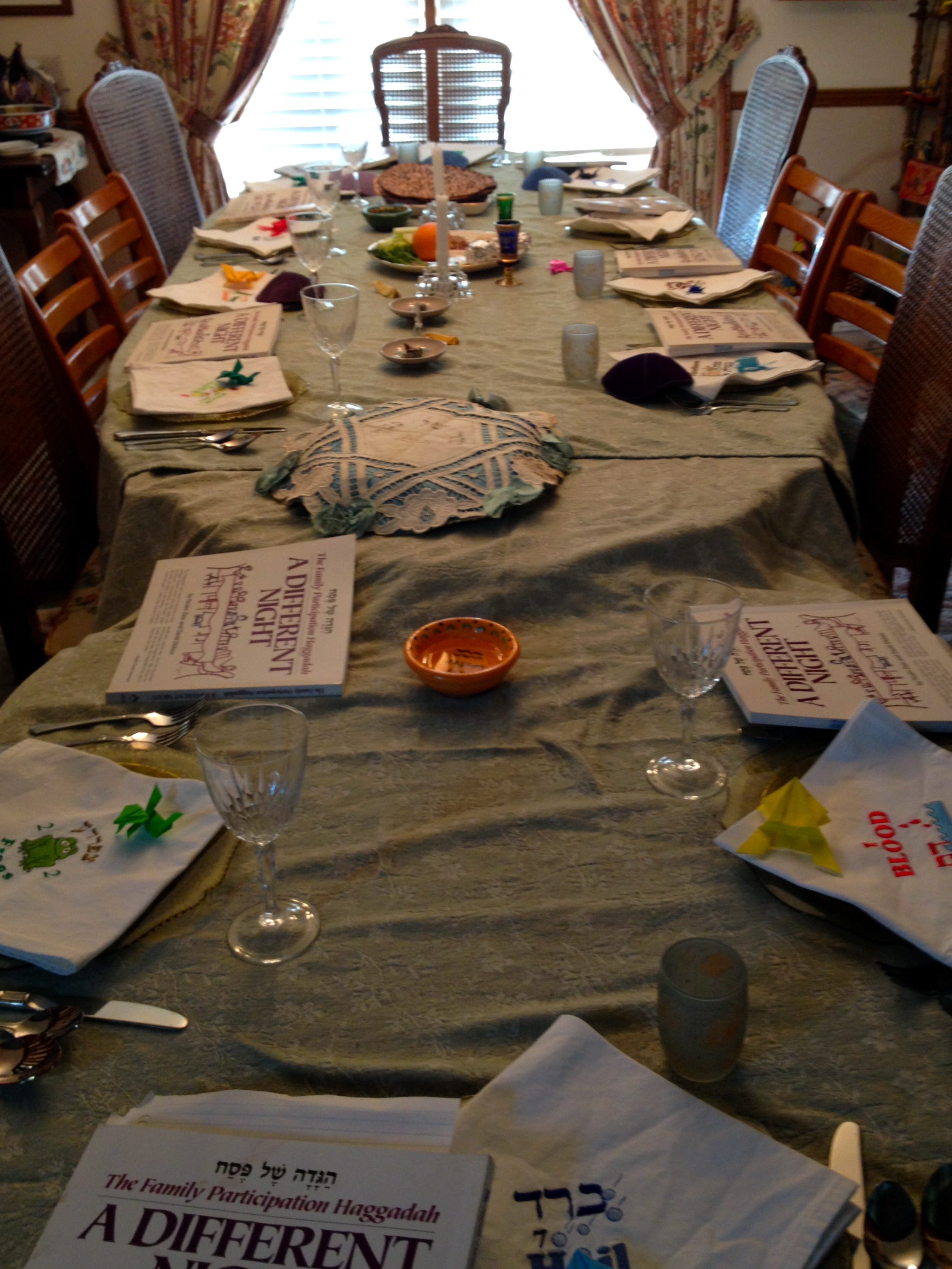
2014 Passover Seder.  Matzah cover in the middle of the table.

2014 Passover Seder. Matzah cover in the middle of the table.

She asked that I take photos of it in use. Which I did and you can see here.

She promised me that anyone in my family would always have the right to come and see it privately when it was not on display, although we would never be able to touch it again. (Probably a good thing as fabric decays.)

In August I will take my matzah cover from Kansas back to New Jersey, and then to its new home at the museum. I hope by sharing it with so many people, it will have continued life, and perhaps help people understand how extraordinary Jewish life was in Europe before the Shoah.

I donated the matzah cover on August 12, 2014.

As Spain Welcomes Back Jews Expelled in the 1400’s, I Share my Spanish Roots

9 Jun

“Grandpa’s family was originally from Spain,” my Grandma Thelma would begin her story with these words. “They left Spain because they did not want to convert. They were court Jews and could have stayed. But their Judaism was more important.”

I thought this was a ‘bubba meiser,’ just a myth and a bedtime story. And for many years, I did not believe the Spanish expulsion of Jews had anything to do with me. I thought it was enough that our family had been decimated by the Shoah. But it seems my grandmother was telling me the truth, and my family is both a survivor of the Spanish and German attempts to destroy the Jewish people.
Grandpa Nat portrait

My Grandpa Nat’s last name was Amsterdam. This is a somewhat unusual Jewish name. And, it seems, actually anyone named Amsterdam is related to me. The family started in Spain as wealthy Jewish merchants and financiers. Supposedly three brothers moved to Amsterdam in the early 1500s. And then a group of them moved to Denbitz and Mielec in Galicia, where they were given the last name Amsterdam.

I started to investigate the Spanish connection when I was in college. And then I got help from an unexpected source. The other story my grandmother told me had to do with the comedian Morey Amsterdam. I was told he was my grandfather’s cousin. He had to be, his name was Amsterdam. I was not sure how to contact him. But he actually contacted me. Morey’s son-in-law met my cousin, Gary, who was an Amsterdam. Since I had the family history, I was then put in touch with Morey Amsterdam. He was on a mission to find all the Amsterdams. He wanted learn all he could about our family. I am not sure he met all of us before his death. But he was relentless. He would send me information about other Amsterdams when he met them. He would give them my contact information as well. People called and contacted me from up and down the East coast telling me that Morey Amsterdam told them to call me. May his name be for a blessing.

In any case, he confirmed the story about our Spanish roots, and then told me more. But it was not Morey who really filled in the missing information. It was another cousin named Bob. His parents and my grandparents were first cousins who all came to the USA in the early 1900s. They stayed in touch in the USA. We have photos of them at family events. My grandparents attended Bob’s wedding.

Bob was a generation older than I, and as an engineer was meticulous about his research. He also got in touch with me through my cousin. That Amsterdam last name stands out. Bob was kind enough to send me his information. And I sent him mine. Since his last name is not Amsterdam, he did not have some of the contacts and information I had received. We filled in each others missing pieces.

The following is what we know and what we think. I have to thank him for all the help he gave me in investigating the family.

Our family has taken on other last names as well. Faya was the original name used in Spain. There are family members who have this name as part of their Hebrew name. This spelling was used up until about 1800. After 1800 the spelling became more Eastern European: Feuer. Other names in the family include Brenner and Asher. All have to do with fire, because they were Cohanim.   The families often intermarried. My grandfather had both a Feuer and an Amsterdam parent. They were first cousins. I have met others, including Bob, who also have parents from both lines. This is a tradition from the days that they were crypto Jews in Spain.

I actually can trace my grandfather’s family back to about 1795 with direct names. My Grandpa Nat’s parents were first cousins, Chava and Gimple. Chava’s parents were Hershel and Frieda; Gimple’s parents were Tzipporah (?) (Hershel’s sister) and Nissin (also a cousin of some sort). Siblings Hershel and Tziporrah parents were Tova and Nissin Amsterdam, and Nissan’s parents were Chava and Morris Amsterdam (My fourth great grandparents!) These names show up constantly in the family and continue today. I am a Chava, named for my great grandmother; my son is Nissan named for my grandfather, so the names continue.

There are many, many men named Nathan (Nissan) in the family. My Grandpa was given this name because he was born between Purim and Passover on the first day of Nissan, but also because it was an important family name.

After the expulsion, some of the family stayed in Spain and converted and became Catholic on the outside. However in their home they were still following the traditions of Judaism.  Through research by a cousin, we believe the family lived in Segovia, a city with a large Jewish population.

However a branch of the family left, we think they all moved to Portugal. We believed they lived in a port city called Oporto before they went to Amsterdam. But some stayed after the Portugal expulsion. The Spanish Inquisition impacted my family in other ways. One family member, Aaron Cohen Faya, was burned at the stake in Lisbon in May 1618. A poet, his secular name was Antonio d’Aguiar. We think d’Aguiar or Aguiar was the name of the entire crypto-Jewish branch of our family.

I have much more information about my Spanish roots. I could tell you about our coat of arms.   I could tell you about meanings of names and how names concerning birds, hawks and eagles are important in our family history.

But I think that as Spain welcomes back the Jewish families they sent forth during the great expulsion, it causes me to think of how it impacted my family. How my family had its own additional diaspora that caused them to travel from Spain to Portugal, to Amsterdam, then to Galicia.   I think about how some survived these moves, left Europe and moved to the United States or to Israel. But others stayed behind and perished in the Shoah. (See my blog, “Speaking Yiddish Always Brings Me Holocaust Memories.”)

My Spanish roots are noted. But more important, I look at what I can do because of my desire to learn about my Spanish ancestry. I found out so much about my family. Most Jewish families cannot tell you the names of ancestors back to the late 1700s. I can. Most cannot tell you that they are related to everyone with a similar last name. I can.

My daughter was at a party. I saw on Facebook that one young man had the last name Amsterdamer. I said, “He is your cousin.” She laughed. “Ask him,” I said. “Mom, I can’t do that. I hardly know him.”

But the next time she saw him she said, “My grandmother’s last name was Amsterdam.” He replied, “Then we are cousins.”

I am proud to have the Amsterdam/Faya/Feuer ancestry.

Why I love my pillow!

8 Jun

I love my pillow. It is a big, fluffy feather pillow covered in a rose color bunting. When I rest my head I have the happiest dreams and most pleasant thoughts. I miss my pillow when I am not home, and have a difficult time sleeping.

I did not realize my sleep depended so much on this pillow till about a year ago. Over the first 33 years of my marriage, I had many pillows. But I never slept as well as I did when I went to visit my parents in New Jersey and slept with my pillow. I just thought that when I was home with my parents, I was not worrying about them. But I realized that was not the truth.

My pillow started out as part of my grandparents’ feather bed. I am like the little child in John Denver’s song, “Grandma’s Feather Bed.” This song always puts me in a great mood. I hear that song and I am immediately smiling and singing along. And I think back to my Grandma Thelma and Grandpa Nat.

When I was a little girl, I loved sleeping at my grandparents in the winter. First of all, Grandma always put a lightweight flannel sheet over the cold sheets. Second…was the feather bed (or duvet). I loved when she threw it over me and it cuddled around me. It was so soft and comfy. Filled with feathers and love. Grandma always slept with me when I was little and staying at her house. She would whisper to me and sing me Yiddish songs under the quilt.

I loved that feather bed. In the mornings, I would wake up and snuggle in the warmth of the blanket. My grandparents would be downstairs in their bakery in West New York, New Jersey. Once I was ready, I would get dressed and run down the stairs to be with them, have my breakfast and start my day in the bakery.

They took the feather bed with them when they moved up to Kauneonga Lake, in the Catskills for the full year. I loved our visits over winter break, because Grandma always let me sleep with the feather bed.

But it did not last for long. Eventually Grandma decided it was time for the featherbed to be washed and the feathers sorted. There were not enough good feathers to make a duvet again. So Grandma had it turned into several pillows.   All I know is that I got one: my beautiful rose-colored feather pillow.

It is true that many people cannot sleep with a feather pillow. They have allergies; they do not like how they sink in; they have issues. But for me…a feather pillow is heaven. My feather pillow is especially wonderful!

My pillow came to college with me and was home whenever I needed it.

But when I got married, my Mom kept my pillow. She had it in a plastic bag on a high shelf. No one used it but me. Whenever I came home for visit, the rose- colored pillow came out for my bed.

My children did not like it or want to sleep with it, better for me. They are the only ones I would have allowed to use my pillow.

However, at home in Kansas, with my husband, I searched for the perfect pillow for me. I cannot tell you how many pillows I bought over the first 33 years of our marriage. I never found a good pillow. I never got really comfortable. I used two pillows. I switch pillows. I tried everything. But I never really slept well. I could not understand why. It never occurred to me that I needed that one pillow.

When my Mom had her stroke, I flew out quickly to New Jersey. My pillow was there at my parent’s apartment. Once again it was the comforter of my tears. Even though I could barely sleep, I still felt better with my pillow. I knew my Mom had kept this pillow for all these years just for me.

My Mom died a week later in the middle of the December 2010 blizzard. I was with my Dad, trying to make all the arrangements. While I juggled three phones and a computer, I held my pillow on my lap and at times had it behind my back supporting me. It helped comfort me.

I left the pillow at my Dad’s apartment. I used it whenever I went to visit him. But nine months later my Dad passed away. I spent that first night alone in my parents’ apartment with just my pillow for comfort. Later people asked how I could stay there by myself. It really was not difficult. I had so many loving memories. I had my pillow filled with feathers and love. I was fine.

I still left my pillow there, after that visit.

But 18 months later, when we finally cleaned out my parent’s apartment, the time had come. I told my siblings, I am taking my pillow. I found a box and stuffed it in along with a few other things. And shipped my pillow home.

And for the past year, I have slept the most wonderful sleeps. I have had the most wonderful dreams. My family still does not understand.

My daughter says, “Mom that pillow probably needs to be cleaned.”

HA!

It was cleaned 45 years ago. The feathers are probably 90 years old.   Why would I clean it? When I put my head on that pillow I am a little girl whispering with my Grandma. When I put my head on that pillow I am a teenager in high school. When I put my head on that pillow I am a young woman in love waiting for my wedding the next day. When I put my head on that pillow, I am visiting my parents with my two children. When I put my head on that pillow I see my Mom and Dad getting it down off the shelf just for me.

My pillow that I love is filled with memories that I love.


http://www.azlyrics.com/lyrics/johndenver/grandmasfeatherbed.html

Grandma Thelma Knows What She Knows

29 May

We always wondered how old my Grandma Thelma was when she celebrated her birthday. She insisted that she was born in 1906 and arrived in the United States when she was 16. This is a debate that went on for years, as her passport had her as two years older.

Her explanation was that she was so desperate to get out of Poland, she made herself two years older to get out. In fact when she finally got her passport and papers in Poland, the official said to her, something like, “I hope you have a safe trip and return safely.” When she got to the door, she turned around and said, “I will never come back here, never.” And then ran for home. Her happiest day was the day she arrived into the New York City harbor.

I have her passenger records from Ellis Island. She arrived as Tauba (Tova), from Boleslawiec, Poland, on November 7, 1922. An 18 year-old, single female, she traveled by herself on the Gothland from Antwerp, Belgium.

Grandma reinvented herself to Thelma. She stopped using the name Tova except in synagogue.

She lived with relatives, her Aunt Gussie, her father’s sister, had agreed to sponsor Grandma. Aunt Gussie had four children, three boys and a girl. But the stories Grandma told always revolved around the cousin who was her age, Katie, who was treated as a queen. While my Grandma said she was treated as the “deinst,” the maid. She had to work all day, go to the school at night, and then when she was in the apartment clean and work for her board.

When Katie would have her friends over, they would tease my grandmother because she was a “greener.” My grandmother also had to ‘serve’ them, and was not allowed to really just sit and visit. It made my Grandma mad, as many of Katie’s friends were also once “greeners.” It also made her mad to be treated like that when she was family. However, she and Katie did become friends, because despite everything, they liked each other.

It was a difficult life made more difficult because her Aunt Gussie wanted her to marry an old widowed man with children. And Grandma did not want to marry him. She had met my grandfather, Nathan (Nissin) who was a baker and either four or six years older than her (depending on the birth year accepted). My sister and I think one reason Grandma and Katie became firm friends is that she helped my Grandma in her romance with Grandpa.

This became a battle with Aunt Gussie. My grandmother took matters into her own hands by writing her father, Avraham Shlomo, in Poland.   She told him about her love for Nathan and the pressure from Aunt Gussie to marry the other man. My great grandfather did what any good Jewish father would do for his daughter, he investigated Grandpa’s family; found out they were a good family of Cohen descent, and approved the marriage. When the letter arrived from Poland, my grandmother got her way, and married my grandfather.


Grandma Thelma and Grandpa Nat in their wedding finery. Grandma Thelma and Grandpa Nat in their wedding finery.

Grandma always kept in touch with Katie. Throughout their lives, they did not see each other, but they wrote many letters. We remember whenever a Katie letter arrived in the Catskills, Grandma sat down and read it. They were always in Yiddish. And then Grandma wrote her a many-paged response. Although Grandma loved her cousin, Katie, she never forgave Aunt Gussie for the harsh treatment. It was difficult because she was also always grateful that her aunt had sponsored her to come to the United States and gave her a place to live, however begrudgingly.

In the meantime, my Grandpa and his Uncle Yidel (Julius) had a bakery. Their business grew. At some point they decided to separate. Uncle Yidel stayed in New York, while Grandma and Grandpa moved to New Jersey and opened their own bakery.

My Grandma was a shrewd businesswoman. She enabled the business to survive through the 1929 stock market crash. She had two children to support, but during the Great Depression she gave out food on credit to those who needed it.   She invested in the Stock Market, but at the same time she had money spread out in lots of different banks. I remember going bank hopping with her in both New Jersey and New York City. She would bring all her bank passbooks at the end of each month, to have the interest entered.

My Grandma is 36 or 38 in this photo. My Grandma is 36 or 38 in this photo.

Over the years, my grandparents became financially and personally successful. They had the bakery and the building it was in; they owned a small bungalow colony in the Catskills, as well as a winter home about half mile from the bungalows. They had investments. They had two children and five grandchildren. All was happy and well.

The memories of Katie A and her parents, as well as their treatment of Grandma, had stayed within my Grandma’s memories and were not really discussed until one day in the Catskills. A day I will always remember, because it shows you how small the world can be, and how connections make changes.

Both my Dad’s parents and their siblings were born in the United States. His mom, my Grandma Esther, was one of five siblings, including her brother Sam. Uncle Sam was a little different from everyone else. He worked for the New York City Port Authority, and he was divorced and remarried. I loved my great Uncle Sam. He had a great sense of humor and was wonderful with us children. His second wife, Sylvia, had a little yappy dog, who scared us all. She carried that dog everywhere. Aunt Sylvia was always perfectly dressed, blonde hair in a French twist. She expected elegance wherever she went, thus she did not like to come to the Catskills because she felt it was too middle class.

Her feelings might have changed the day they decided to finally take a ride up to the Catskills and see everyone. My father’s parents and sister and her family stayed at the bungalow colony owned by my maternal grandparents. So first Uncle Sam went there to see his sister and visit. Later in the day, he and Aunt Sylvia drove up to the ‘big’ house where my maternal grandparents lived, and where we had our bungalow.

Of course there were introductions all around so that Grandma Thelma and Grandpa Nat could meet Uncle Sam’s wife Aunt Sylvia.

When my Grandma met Aunt Sylvia, she said, “I know you.”

“No,” Sylvia replied. “I never met you before.”

I started walking with Grandma back to the house. “I know her,” she said again. My Mom heard. “Mom,” she said. “She probably just reminds you of someone.”

I thought it was over. No big deal. But a short time later, Grandma came back to our bungalow, where we were sitting outside. She walked up to Aunt Sylvia and said, “Sadie, you are Sadie. You were a friend of my cousin, Katie. I remember you.”

Aunt Sylvia…now Sadie, looked at my Grandma and said, “Tova, is that you!?”

And it was. They hugged. They kissed. They spoke in Yiddish for hours.

When Uncle Sam and Aunt Sylvia left, my Grandma Thelma had a new ‘best’ friend. They had so many memories to share.

And then my Grandma turned to my Mom and said, “I told you I knew her.” We should have known that Grandma Thelma knows what she knows.

This incident impacted my Grandma Esther as well, once she heard what had happened. From then on, whenever her sister-in-law made her crazy, she would say, “Sylvia…she is so hoity toity, but she is really just Sadie from Brooklyn.”

Thanks to my sister for remembering with me.

How My Grandparents Impacted My Life

15 May


Summer of 1979 in the Catskills.  Eight months before my wedding.

Summer of 1979 in the Catskills. Eight months before my wedding.

I am so fortunate to have had all four of my grandparents walk down the aisle at my wedding! Two of them were alive when my daughter was born, and knew her. And one of my grandparents survived and knew my son as well. They had a major impact on my life, especially since I spent every summer in the Catskills with all four of my grandparents near by.

My Grandpa Harry, born in 1888 or 1889, was my oldest grandparent. He did not have the easiest childhood. The oldest of five children, he spent two years as a teen searching for his father who abandoned the family. He found him in Seattle, Washington, quite far from his family in New York City. Grandpa returned home, became a tailor and supported his family. All of his siblings graduated college, a feat for women of the time. And Grandpa supported them. The saddest part is that after they were college educated, they treated Grandpa as if he was not quite good enough for them.

I took sewing classes beginning when I was 14, and Grandpa and I started to really talk! He was proud of the things I made and would check the seams and my work. Grandpa taught me how to match plaids, not an easy thing to do. But from him I learned that to make something well, you need to take the time and effort to make it nice. To this day, I cannot buy clothing where the plaids or lines do not match up.

My favorite memory of Grandpa Harry was his guarding the sweet table every holiday. My Grandma Esther was a great cook and baker. Each holiday had amazing treats set aside on special table. Grandpa would sit at the end. I think he counted how much each of the nine grandchildren ate. If we came back too often, he would intone: “The Trolley car stops, too!” From this I learned moderation. You need to take a break.

(From my cousins I learned that there were extra treats hidden in the back bedroom.)

Grandma Esther was also born in the New York City area, but in 1898. She was also one of five children, and was surrounded by cousins. I have written about her teaching me to crochet and knit (See “Grandma Esther’s Afghans Wrap Me in Love” and “Knitting and Crocheting Brings Love and Memories.”) But she taught me many other important concepts as well.

When I was old enough to date, Grandma Esther sat me down to discuss choosing the perfect spouse. She had already dealt with my Grandpa Harry’s family for years, so it was not surprising when she said, “When you get married, you marry the family as well. So be careful. Check out his family before you say yes. Find someone whose family is like your family.” And I did. Almost 35 years later, I can say, Thank you!

The most important help my Grandma gave me was teaching me how to nurse my daughter. Grandma flew out to Kansas when she was 88 years old to meet my daughter. (My sister and her husband flew with her.) When she saw my feeble attempts at nursing, 28 years ago, she was shocked.

First she said, “Only poor people nurse. Your cousins’ wives did not do this.” My response was, “Grandma, they say this is much better for the baby. I want to do it.” Her second response, “Well if you are going to do it, do it right.”

And she showed me how to do it the right way. It made such a big difference. I then taught all my friends the tricks my Grandma showed me. Our mothers had not nursed. So we needed someone who actually had done it to point out the way.

The last advice she gave me was in naming babies. She was one of five cousins named Esther. And she hated that each of them had nicknames. She was Curly Esther because of her hair. But there also was Topsy Esther and Meshuganah Esther as well. I never heard the other nicknames. So she made sure her children’s English names were different from their cousins, even though their Hebrew names were the same.

My Grandpa Nat (Nissan) was born in Europe in 1900. He spent two years traveling to get to the Golden Medina, the USA. He arrived in 1920. Grandpa was a baker (See “Bakery Aromas Bring Back Delicious Memories.”) But most important is that he had a great work ethic, as well as a great sense of humor.

Every spring we had to help get his bungalow colony ready for another season. He would say to my siblings and I, as he handed us paint scrappers, “If you don’t work, you don’t eat.” Which is true. As an adult you have to have a job to get food. He was proud of our college educations. Having grown up in Europe and seen the treatment of Jews there, he said, “They can take everything away from you, but they can never take away your education.”

One of his fun, and my favorite saying of his, “It is as easy to follow a heavy cart, as it is to follow a empty one.” I am sure it is a translation from Yiddish. But it was his marriage advise meaning, try to find someone who has a little more assets. It will help in the long run. But all time favorite saying was “Every Pot has a Lid.” This might have been my Grandma Thelma who said this. But the main point is that everyone has someone.

Grandpa Nat loved us. His entire family, parents, siblings, nieces and nephews, many aunts, uncles and cousins had perished in the Shoah. (“Speaking Yiddish Always Brings Me Holocaust Memories.”) But he never lost a sense of humor, and he always showed us love.

But the most important person to him was my Grandma Thelma (Tova). She was born in Poland in 1906. Grandma was strong willed and determined; she came to the USA when she was 16, worked all day and then went to night school to learn English. She read, wrote and spoke three languages. And she was afraid of Nothing.

Grandma Thelma sang Yiddish songs to me to put me to sleep. “Ofyn Pripetchik “ was my favorite. Grandpa sang to us as well. Their singing of the Yiddish songs was so heartfelt. Grandpa’s version of “Rozhinkies mit Mandlen,” “Was itz Geven Ist Geven,” “Tum Balalayke,” “Eli Eli” and “Schtela Beltz “ still echo in my mind. He had a beautiful voice. My siblings and I often sang along with him.

Advice from Grandma Thelma was never ending. She and I battled for power constantly. She called me the Machshefah, the witch.   But from her I learned to be strong. I learned never to give up. I learned to trust myself.

When I was at college, she would send me letters with a bit of ‘gelt’ (money) so I could buy stamps and write back. Wherever I lived, not matter what I did or where I wanted to go, she was my ally. We could fight, but she backed me up always. When I needed to stand up to my parents, to be who I wanted to be, Grandma was standing behind me.

Her shopping advise was intense,  “When you buy jewelry, always buy real. When you buy gold, always buy solid, never buy hollow.” Grandma taught me how to sew jewelry into clothing, because you never know. She kept silver coins in every purse. And money buried in the basement. Her experiences growing up in Europe scarred her, but she was defiant and not scared. Luckily I never had to use this final advice.

I am who I am because of my grandparents. I think of them often with love.

Remembering those who passed: Yom Hazikaron

5 May
My son thinking in the map of the communities destroyed at Yad V Shem.

My son thinking in the map of the communities destroyed at Yad V Shem.

In 2005, I took my children and parents to Israel for a family wedding and a three-generational trip. We hired a private guide, as my Dad had a heart condition, and I wanted the trip to be as easy as possible for him.   It was wonderful in that sense. Our tour guide knew all the downhill paths for my Dad to walk.

Although my daughter was in college at the time, my son was just in eighth grade. I was a little concerned about taking him to Yad V Shem and Mt. Herzl. But we went because it was important.

At Yad V Shem, the Holocaust Memorial, my son was uncomfortable, especially when we went through the memorial for the children who perished. But the map of Europe and the destroyed communities felt more comfortable. He walked through that section with my Dad. They stopped at Bialystok, where my Dad’s family had lived before coming to the US. And my Dad told him some stories.  My son sat and thought about what he had seen.

After that it was to Mount Herzl. To see all the grave of Theodor Herzl, who helped to establish a Jewish homeland, and  of young men and women who died fighting for Israel was difficult. My son asked a question, “Why are there some stones with no names, or no dates on them?”

These are the graves of people who came over from Europe, who survived the camps. The first thing they did upon arriving in Israel was to fight for survival again for the independence of the state of Israel. Unfortunately, many of them no one knew their name or their date of birth. Just the day they died.   This is what the guide told my son.

We continued walking through the cemetery to the graves of famous people, when I realized my son was missing.   I did not want to go yelling through a cemetery, but I was concerned. So we all split up looking for him.

Then I saw him putting stones on a grave. This is a Jewish tradition. We do not leave flowers, we leave stones as remembrances.. This is an old tradition, and I am not sure why. But I think perhaps as we return to dust, we become part of the ground. I could be wrong.

In any case, there he was putting stones on the graves of soldiers.

“What are you doing? Why did you leave us?” I demanded.

“Mom,” he said. “I am putting stones on all the graves of people with no names. I wanted to make sure someone remembered them. I wanted them to know someone loved them.”

My heart; my son. I still cry for these unnamed soldiers. And I still cry remembering the love in my son.

Yom HaZikaron. We will always remember.

Building Projects Are Family Friendly

30 Apr

Whenever my parents came to visit, I always had a list of jobs around my house and yard that needed to be done. My Dad was not the type of person to sit around and do nothing. If he did not have a goal, he would just get too antsy.

Over the years he helped my husband put together bookcases, desks, closet organizers and more. They planned and dug flower and vegetable gardens. And spent hours together walking through home improvement stores and buying much needed equipment!  My Dad and husband loved going to home improvement stores together.  If they spent less than $100, I thought it was wonderful.  Most times they spent much more.

One year they built a giant closet organizer for my walk-in closet. They went to the home improvement store and brought home information on how to do it.  We designed it. Then my husband and Dad bought all the shelving and hanging poles, and spent a few days putting it together. I have had the best use out of that one project.

My son enjoyed helping as well. The first time he really got into putting something together, besides Lego sets (which he was quite good at completing), was when he was in seventh grade. I think it was because he was taking ‘shop’ in middle school. He got the urge to really build and use tools in that class.

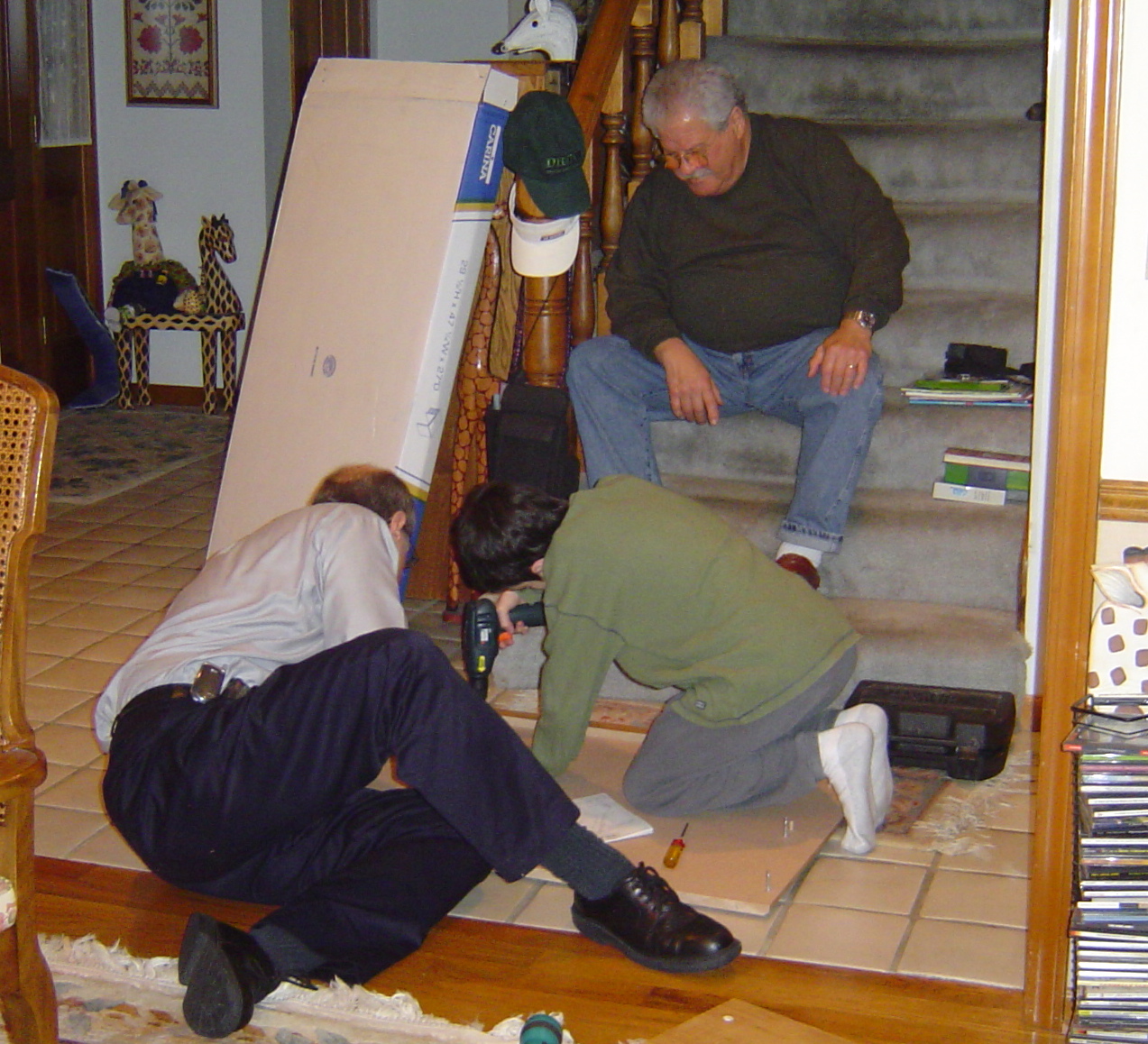
My son builds his first project with my husband and Dad.

My son builds his first project with my husband and Dad.

The first project they all worked on was a desk that needed to be put together for my computer. My Dad, husband and son set up a command center on my dining room floor near the stairs. Why there? I am not sure. I think it was because my dad could sit on the stairs and direct.

They pulled out the instructions, got some tools and spent the next hour happily bonding through building. It was fun for the three of them. And, eventually, they actually finished putting the desk together.

These type of projects were easy. All the pieces came in a box. They only had to assemble it. My husband and son put together three bookcases for our basement family room with these box projects. There were drawers and closet doors, which was a bit more of a challenge. But they were able to complete their mission.

Building his first independent project for the cats.

Building his first independent project for the cats.

My son wanted a bigger challenge. He wanted to build a place for our cats to hang out. We had seen some of the cat platforms in the pet store. But the one he wanted was expensive. At the same time, I was reading a magazine for cat owners, in it was the instructions on how to make one at home.

That was all information my son needed. He begged my husband to help him build it. So they took the magazine to the hardware store and bought all the needed supplies. It took several weekends, and several trips to the store. But the time they spent together building the cat hideaway and platform was worth much more than the money spent to make it.   An added benefit is that the cats love it.

The cats loved the finish project.

The cats loved the finish project.

But my son is not the only one to get the building bug. My daughter was often right there with them putting things together. She had the patience to actually read the instructions. Her Dad and brother were more likely to go by instinct. Her help was always appreciated, as she used her calm to keep them on target when the building was not going exactly as planned.

When my Dad had a more difficult time putting things together, my daughter, who went to college near by, was the helper. But she was more than just a builder, she was often a tech support. Spending a weekend with her grandparents meant also fixing the computer, the internet connection or a television’s reception.

She was not the only one to help, but since she actually stayed with them, they often saved up chores for her to accomplish when she visited. My brother-in-law and nephew were the usual tech support because they lived close by. But I think they enjoyed the ‘vacation’, when my daughter could take over for a bit.

Cousins putting together a coffee table.

Cousins putting together a coffee table.

Years later, my nephew moved to Kansas for his master’s degree.   My children and I took him shopping for a coffee table. It came, of course, in a box. The three of them had a great time putting it together. Their Grandfather would have been so happy to see them on the floor with the pieces and the screws and the directions. I sat on a chair and directed…taking my Dad’s role.

Building is fun. But more important, in our family, it brings us together for a glorious time as we reach a common goal.  Dad would be smiling.

Speaking Yiddish Always Brings Me Holocaust Memories

28 Apr

My maternal grandparents were from Poland and Galicia. They came to the United States in the 1920s. Met and married when Grandma was 19, Grandpa was 29. At home they spoke to each other only in Yiddish, although both learned to speak excellent English. And Grandma was a ferocious reader in several languages.

When I stayed with them, they spoke Yiddish to me as well. As a young child I could respond and easily speak to them. But that ended when my parents realized that my siblings and I spoke and understood Yiddish. They had been using it as a secret language to discuss finances and personal matters. So the order went out…stop speaking Yiddish to the children. My Mother, in later years, would tell me that she regretted making that demand.

But Yiddish connected me to my grandparents. And I studied German in high school and Hebrew in college. Then I spent a year in Israel at Hebrew University. While there I spent so much time with my great uncle and great aunts, who spoke Yiddish at home. So my Yiddish slowly improved, and I became more fluent.

The kneeling sailor is speaking to my Mom;behind her my Uncle; behind him my Grandma.

The kneeling sailor is speaking to my Mom;behind her my Uncle; behind him my Grandma.

My Grandma’s family was lucky. She went to Europe in 1931 with my Mom and Uncle and stayed for six months. When she returned to the US in 1932, she told my grandfather that they had to get everyone out. And she started the process. She was able to get visas for her father and sister. They made my great aunt younger than her real age, so she could come in on her father’s passport. Her brothers and their wives were not as fortunate. But they did survive the war.

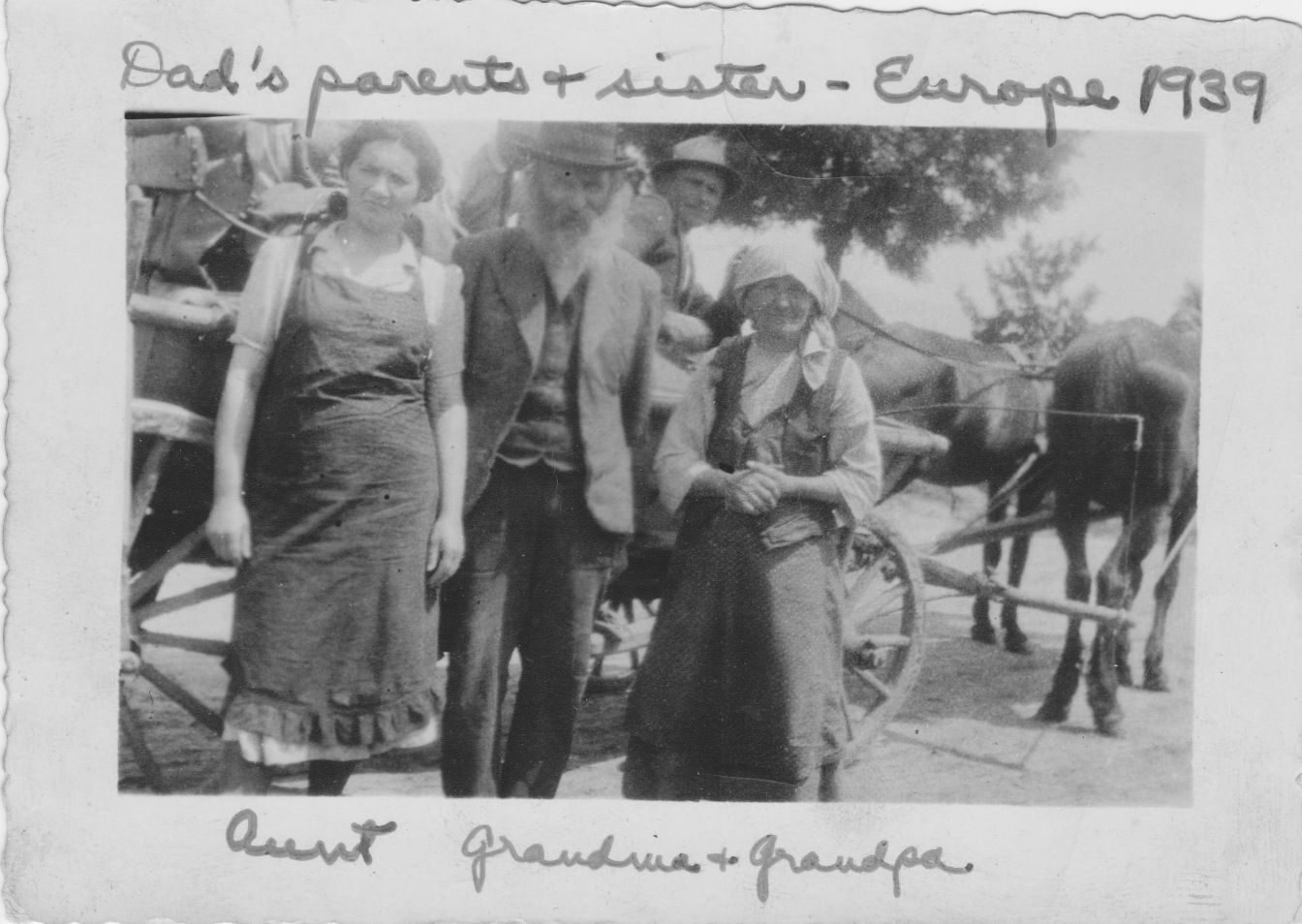
My great aunt Tova, my great Grandparents Gimple and Chava. The man driving is an Uncle. And the horses and cart they bought with the money my grandparents sent. They all perished.

My great aunt Tova, my great Grandparents Gimple and Chava. The man driving is an Uncle. And the horses and cart they bought with the money my grandparents sent. They all perished.

My Grandpa’s family was not fortunate at all. They all perished. My grandparents did send his parents money and visa to come to the US. But they could not believe what would happen. They took the money and bought a horse and cart. They did not want to leave their other children and grandchildren. And my grandparents could not get everyone visas.

My mother used to tell me that every morning after work, when he found out that his entire family was murdered, my grandfather would sit in the kitchen and cry. He was a baker…up all night. But before he went to sleep for the day, he cried for all he lost.

In the meantime, my grandparents thrived in the US. They had two children, five grandchildren; two businesses, both a bakery in New Jersey and a bungalow colony in the Catskills.

Grandma wrote to her brother in Israel often. When I went as a college sophomore, I spent a year of college at Hebrew University. I had a cousin who was my age, and my great uncle and aunts (one uncle had died in the 1950s.) I met a few other relatives who had survived the Shoah. But no one ever spoke to me about it. I was young. But my Hebrew and Yiddish were improving rapidly.

Then when I was a junior in college, I took my Grandma to Israel with me during winter break. She had not seen her brother in 42 years. We spent a month together. A month I will never, ever forget.

The phone calls at the hotel would be in Hebrew. Someone would call and speak to me. “I understand the Tova S. is here,” they would say. “Yes,” I would respond. They would then ask genealogy. Who were her parents? Where did she live? When all the right answers were given, I would hear. Yes. She is my mother’s or father’s or someone’s cousin. And they would set up an appointment to meet with us: to see my Grandma.

And the holocaust became real to me. Each person in Yiddish told my Grandma their story of how they survived the Shoah. And who had died during that horrible time. If I did not understand a word, Grandma would translate. Sometimes they would tell me the word in Hebrew. Day after day, week after week, I heard so many stories.

But then came the worst of all. Rafael came. I knew him and his wife and daughter. His mother and my great grandfather were siblings. Rafael and his wife had never spoken to me about their experiences. But when Rafael saw my Grandma, it was an outburst of pain and crying from both of them. Rafael was my Grandma’s first cousin. His sister, Tova Malcha, had been my Grandma’s best friend. And Tova Malcha had not survived. When Rafael and Grandma met their memories overflowed. Not only on death, but on the lives they had left behind.

At that moment, at that time, my Yiddish was at its best. I understood all.

After Rafael left, I asked Grandma why no one had ever told me these stories? Why I had not met all these people who kept showing up? Why Uncle had only introduced me to a few of the relatives when I spent my year there?

There was no answer.

When we returned to the US, my Grandpa was so happy to see Grandma. “Never leave me again,” he said. He did not come with us, because he refused to ever leave the United States.

She never left him again, till she died.

And I never speak Yiddish or hear Yiddish without the images and sounds of that month in Israel and the Shoah ever present in my mind.

Knitting and Crocheting Brings Love and Memories

13 Feb

I am told that what I do is a dying talent.  When I sit in an airplane or in a waiting room, people walk over to me to see what I am doing.  What am I making?  How did I learn to do that?

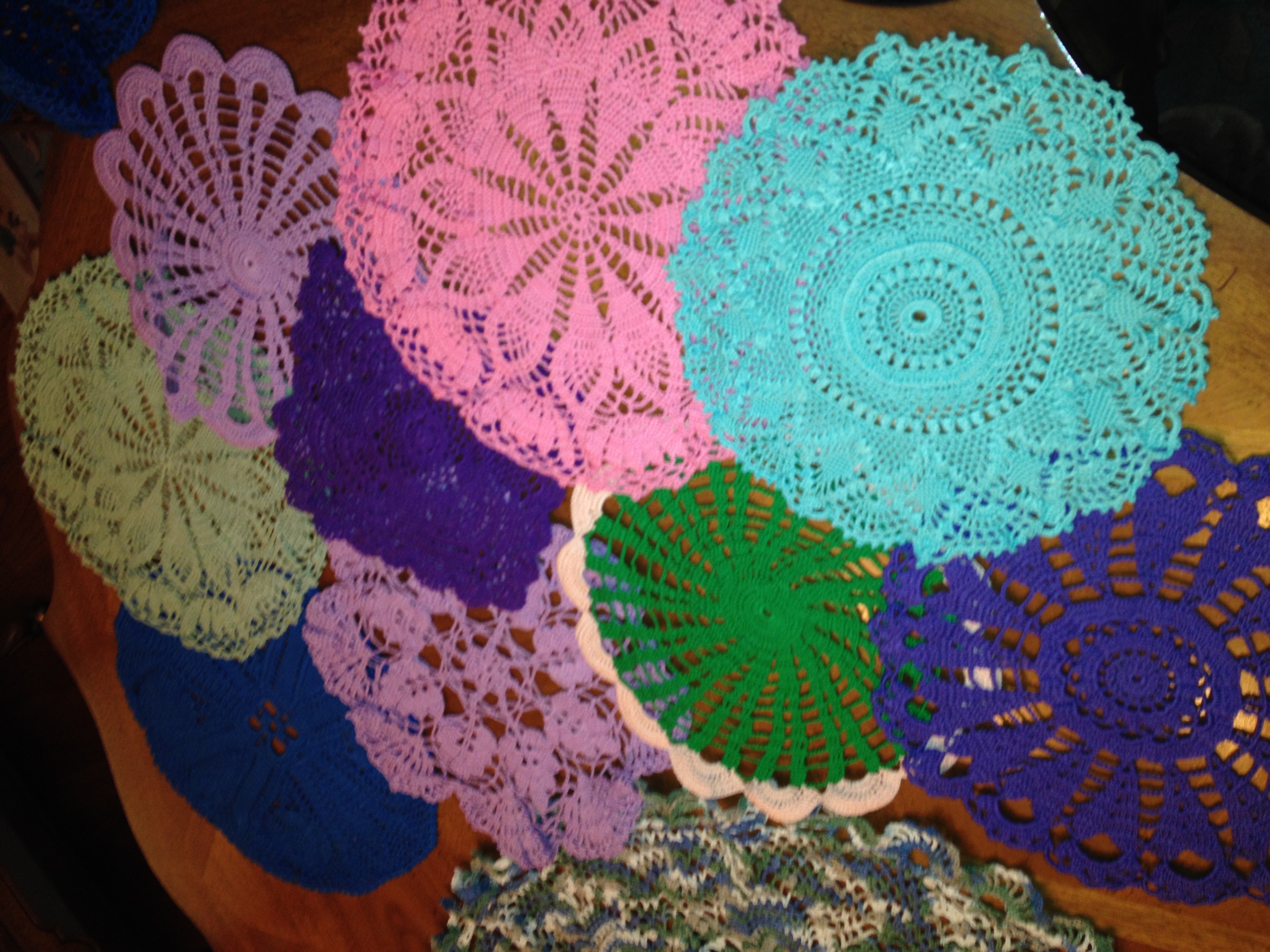
I am crocheting with thread.  I use a tiny hook, with thin brightly colored yarns.  Sometimes I make up my own designs, sometimes I navigate the instructions in a book or magazine.  My favorite is to make doilies, bookmarks and small table clothes.

Image

I started when I was nine year old.  One summer my Grandma Esther decided it was time I learned to knit and crochet.  It became our summer project.  Whenever I was not running with the ‘pack’ of children,  I was sitting with my Grandma and learning a new skill.

My Grandma was always knitting…when she wasn’t playing canasta.  She made sweaters for all of us.  Afghans were important. She made one for each grandchild and great grandchild, when they arrived.  There was a yarn store in Kauneonga Lake where you could buy yarn in bulk.  I think my Grandma, aunt and mother supported that store.

But teaching me was much, much harder than she imagined, because I was left handed, and my Grandma did everything right handed.   Which is why, in the end, I crochet right handed.

I remember sitting on her lap on a wooden chair under a tree at the bungalow colony in Kauneonga Lake.  We started with large needles and thick yarn.  I first learned to make a scarf and a hat.  Knitting and purling; straight needles for the scarf, then a needle in the round for the hat.  I learned increase and decrease, casting on and casting off.

She taught me by holding her hands over my hands.  And soon the knitting was no problem.  I just sat next to her and knitted while we talked.  If I had a problem like dropping a stitch, she was right there to help me. She showed me how to fix it and to keep on going.  The idea was not for her to fix it for me, but for me to learn how to do it for the next time.

Once I finished the hat and scarf, it was time to learn to crochet.  This was oh so much more difficult.  At least when you knit, you use two needles.  So even though I was not right handed, I could still learn to knit the way she did.

But crocheting was different. Grandma tried.  We spent hours and days as she tried to crochet left handed to teach me the techniques of single, double and triple crochets.  She eventually gave up.

“We are going to try something different,” she said, as she put the crochet hook in my right hand.  It was not a problem.  I think as a left-handed person, you learn early on to do things with your right hand.  I had to cut with scissors with my right hand, I threw a ball with my right hand…we only had left handed gloves, so it made sense that I could crochet with my right hand.

The knowledge of knitting and crocheting that I learned that summer has stayed with me my entire life.

When my children were little, I made lots of sweaters, blankets, scarves and hats.  I made gifts for my friends’ children.   A close friend of mine and I knitted all the time, sharing patterns for sweaters we made for our children.  I enjoyed knitting more than crocheting.  It went quicker.

But when my son was four, I broke my right elbow and wrist.  And all knitting had to stop.  I was in the middle of a sweater when it happened.  I tried to go back to knitting after my arm healed, but I could not hold the weight of the sweater with my arm as I knitted.

I stopped all knitting and crocheting for years.  And I missed it.

Then one day while watching my son in his gymnastic class, I noticed a woman using thread yarn to make a bookmark.   I thought. “I think I could do that. “ It did not look heavy at all.  She was nice enough to share her pattern. I went out and bought a fine needle and some yarn.

Image Crocheting at our home in Kauneonga Lake.

I was addicted!!!  I made hundreds of bookmarks.  I used patterns from books. I made my own designs.  I made about five each day.  I crocheted at music lessons, gymnastics, basketball, bar/bat mitzvah lessons, watching television.  Whenever I had down time, I crocheted.

The bookmarks were everywhere.  My children’s school friends each got some. Relatives got them for every birthday and holiday.  I donated them to the school library. I gave them away.  Finally my daughter said in exasperation,  “MOM, CAN’T YOU CROCHET SOMETHING OTHER THAN BOOKMARKS?”

And I said, “Yes, I think I can.”

I started on doilies.  I have made hundreds of doilies of every color, except white….too boring.  For my son’s bar mitzvah I made 65 thread crocheted ‘doilies’ head coverings  for the married women to wear.  It was a great idea.  The men always get something, why don’t the women?  I was going to make them all green, my son’s favorite color. But my Mom insisted I made some quieter colors.   So I made blue and beige as well.  I still see women in my congregation wearing a head covering from the bar mitzvah.

I give them to people who frame them for their daughter’s room.  I give them to friends.  I give them to strangers.  If I have some in my bag and someone admires one, I will give them the finished ones.  It’s not like I do not have at least 30 at home at any time.

I became obsessed with the yarn.  When my daughter lived at home, I would sneak more yarn into my own home, because she could not understand my need for more.   “MOM, I can’t believe you bought more yarn. You haven’t finished the yarn you have,” she would say.  She wanted to do a yarn intervention.

But these were colors I did not have.  I had to buy them.  I have way more yarn then I have time to finish. And the crochet books! They fill a cabinet.  I admit it.

However, when I crochet, I enjoy the feeling of making something.  I love giving them as gifts. I remember the times with my Grandma knitting or crocheting, I have joy from giving them away.

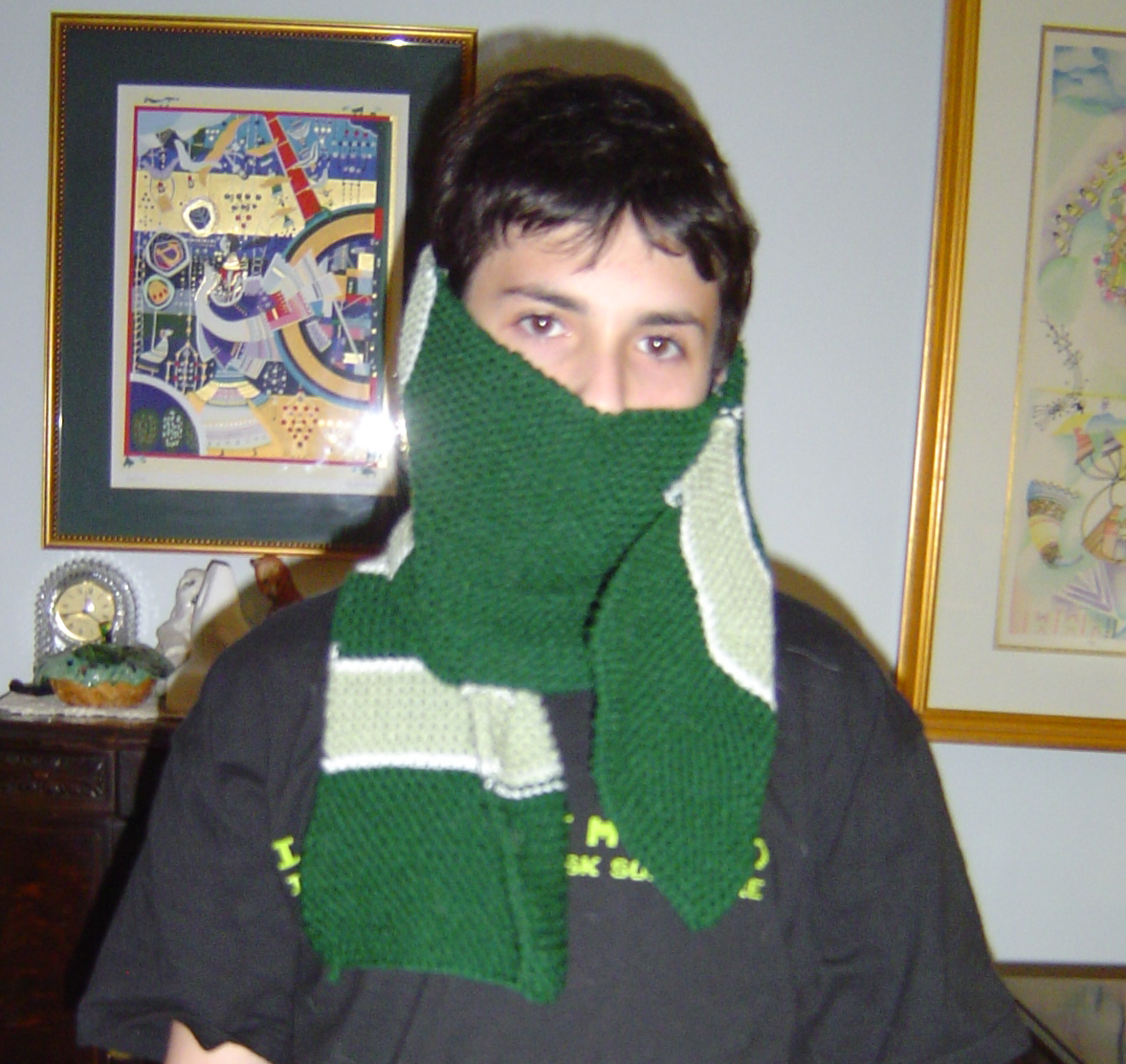
Image My son wearing a scarf that my daughter knit for him.

So, finally, I taught my daughter to knit scarves and hats.  She made some for her grandparents and brother and friends.  And now she loves yarn as well.

From generation to generation, my daughter learned in Kansas,  because my Grandma taught me in the quiet of the Catskills.  And a tiny bit of me is up in the Catskills, sitting on my Grandma’s lap, learning a new skill, while part of me is enjoying watching my daughter follow in a family tradition.

Bakery Aromas Bring Back Delicious Memories

1 Feb

There are bakery aromas that help me time travel in my mind.  Until I was 3 ½ years old I lived with my parents and brother in an apartment above my grandparents’ bakery, Amsterdam’s Bakery,  on Palisade Avenue in West New York, New Jersey.  I do not remember much of those days. But I remember the smells.

ImageEven though we moved to North Bergen, my brother and I alternated weekends at my grandparents.  They were wonderful adventures.  My younger sister’s birth was the reason we moved, as well as the reason we were sent off to my grandparents.  It gave my mom a needed break.

Staying with my grandparents was the best.  They lived in the top floor of a three-story building.  The bottom, ground level was the bakery. Above it was two smaller apartments. And the top floor was my grandparent’s home.

I loved going to sleep at night, knowing in the morning I was expected to get up on my own…get dressed and make my way to the bakery, with those glorious aromas.

I loved walking into the store area.  Grandma would be behind the counter.  The moment she saw me, her eyes would light up.  Breakfast would soon be coming.

Between the bakery shop and the store was a narrow room with a small kitchen, bathroom and the candle-ing room for the eggs. (My grandfather had a kosher bakery, so all the eggs had to be checked before use.)  Here I would get my warm breakfast of eggs and toast.    Grandpa would often bake me a little loaf of rye bread.  I loved the crust. I did not like the inside.  I would scoop out the inner part and give it to grandma, then eat all the crust with butter. YUM

When done, I would enter the bakery!  Grandpa and Uncle Leo would be busy.  But never too busy to forget to give me my dough, raisins and some chocolate chips to make cookies.  I would knead my dough and make round cookies.  These would be baked and given to me to take home for my parents.

After I finished my baking, I always returned to the storefront.  Now was snack time.  All that work in the bakery made me hungry.  It was time to forage along the case and decide which of my favorite treats I should eat.  A crumb bun, a chocolate chip cookie, a linden tart, a black and white cookie?  Oh there were so many choices.  But these were my favorites.   Usually after breakfast, I would have a crumb bun.

There is a special way to eat it.  You put it on a napkin upside down.  Eat the cake first and save the crumbs for the last.  Delicious!  Great with a cup of tea!

My chores were not over of course.  After that snack, I always worked behind the counter.  There was a wooden milk carton to stand on to help the customers.  Grandma and I would work together.  But I got to put the money in the old cash register and give the change.

Our lives changed in 1969 when my grandfather sold the bakery.  No more early morning deliveries of bread and cake to our front door.  No more weekend baking expeditions.  My mother went for months looking for a bakery that met her expectations.  She finally settled on Hill Top, although it was not the same as my Grandpa’s baking, it was a wonderful second best.

But my grandfather did not totally stop baking. He moved some of his equipment:  giant mixer, baking trays, cooling racks, bowls, whisks and more, to his home in Kauneonga Lake, New York.

This began another adventure in baking.

Grandpa had all this equipment moved to his basement where he set up a little bakery.   He would make cookies, challah, cakes and pies. And we would help!  I learned many ways to braid a challah, among other skills.

I remember one time he made so many plum cakes.  Someone gave him a bushel of plums. We baked for an entire day. He made it into trays upon trays of cakes that he gave to Beth El Synagogue in Kauneonga Lake, for a Shabbat oneg.

Every year for Rosh Hashannah and Yom Kippur , he made dozens of round challah. We did not eat them all, so he must have given them to his friends.

Even though he was retired, he still would bake for Katz Bakery on the weekends. When my brother was old enough, he started baking as well and working for Katz, with my grandfather as his teacher.  My grandfather’s attitude was that learning a skill was important.  My brother became a chemist….perhaps all those recipes helped him learn formulas later on.

My grandmother and I worked at a Katz outlet in Kauneonga Lake. We were only opened on the weekends. But it was my first real summer job. I was only 14. There was no baking there, just a storefront to sell the cakes, cookies and breads.  I worked there for two summers.  It was very close to the post office; and friends would come and visit me when they got their mail.

I loved working there because it brought back memories of my grandparents’ bakery, but it was not quite the same. My Grandpa’s chocolate chip cookies were still the best.  His basement bakery was the source of many care packages sent to my brother and me in college.  Whenever the box of chocolate chip cookies arrived, my roommates and friends would line up for a sample.

To this day, when I enter a bakery, the aromas take me back in time.  I see my grandparents, I smell the bakery, I remember working with them and sharing precious time.  I am once again a child waiting for a favorite treat.