Tag Archives: grandparents

Memories of the Multi-Colored, Rainbow Fence

19 Jan

My son and I recently completed a project in my home. We stripped wallpaper off the walls of a bathroom and covered the vacant walls with a lovely sea foam-colored paint. I loved working on this project with my son over his winter break!

While we were painting, I kept flashing back to my Grandpa Nat, for whom my son is named. Grandpa would have loved that my son was taking on a painting project and successfully meeting my expectations.   It was my grandfather who taught me the skill of scrapping and painting and keeping a home in shape.

As the owner of a small Catskill’s bungalow colony in Kauneonga Lake, Grandpa did much of the maintenance on his own, with help from my Dad and us, his grandchildren.   The difficult plumbing and electrical work was done by professionals, the painting was a chore we could all do. And we did.

“IF you don’t Work, you don’t Eat,” Grandpa would intone. Of course we always ate, but he wanted us to know that it was important to have a good work ethic. In the real world, not working meant no money.

In the spring, that work ethic was obvious. We would go up to the Catskills before the season began for my Dad to help Grandpa get the bungalows ready. My brother and I were scrappers and painters. They would put us along the bottom of the bungalows that needed to be painted, where we scrapped off the peeling paint.

When that chore was completed to Grandpa’s satisfaction, my brother and I would be allowed to paint the bottom.   I actually loved it! It was my favorite chore, even though all the buildings were painted white. (I think my sister was too young to be part of the paint squad!)

img_4330

We still have the furniture.  It is well over 65 years old, and needs painting!

When the bungalows were done, we had to paint the wooden lawn furniture.  Grandpa went for the greens, blues and gray tones.  Scrapping those chairs and painting the wooden slats and metal legs was backbreaking work.  We got to do it because we were lower to the ground!  But I still remember how tired I would be when we completed this chore.

Now I have to tell you that my Grandpa was colorblind. ALL colors looked the same for him. Whereas, my Grandma loved colors. So in a way what happened one spring is partly my grandmother’s fault.

Every other spring, my grandfather would paint the wooden fence that surrounded the colony. Our colony was located across from the lake along the side of West Shore Road.   During the week, the road was quiet with virtually no cars. But on the weekend, the road was zipping with cars.   The fence kept all the children safe.

I do not know why, but one spring Grandpa painted the fence when we were not there.   And instead of getting new paint cans, he decided to use all the old paint that was in storage: exterior and interior paint. Why waste it? He did not mix the cans together. That might have been better, as everything would have been grey.   However, that is not what he did!

Instead as he finished one can of paint, he opened another and continued painting where he left off, over and over again. It was rainbow like in its many colors, but not in any rainbow order. When we drove up to the Catskills and arrived at the colony, we were amazed to see, what I thought was lovely, a multi-colored fence surrounding the property. I cannot remember all the colors that covered the wood. But it was noticeable. My parents were stunned. And then they laughed.

My grandfather had no idea what the fuss was about. When they told him, he just roared in laughter.

I think it stayed that way for two years, even though some of the tenants complained. Although my mother and grandmother were not fans of the multicolored fence, I was. It made me happy. We were the only bungalow colony with such a joyful fence. When he repainted it, he used just one color, grey.   After that he often mixed all the paints together when we worked in the spring creating different tones of grey!

So as my son painted the walls in my bathroom, a joyful sea foam blue, I continually flashed back to the joyful multicolored, rainbow fence that surrounded our bungalows.

It is a GRAVE Matter…Really

6 Jan

photo-1

My parents and grandparents are all together.

Over the years I have avoided one important part of my estate planning.  Buying a gravesite for my husband and for me.

I know this is important. But the thought of buying a grave made me sad.  I do not know why. My parents planned ahead. They purchased their graves as part of a family plot in New Jersey. In this same shared area rest all four of my grandparents, my parents and my aunts and uncles on my dad’s side.  When I was a child, no one was buried there. Unfortunately, now all but one of the assigned graves are now filled. 

At the time the graves were purchased, only my two uncles’ names were placed on the contract, as the cemetery would not allow  three names to be on it.  This left my father out. It was not a big deal until my mom died, and we found out that we had no authority to open her grave.  Same thing with my dad.  Luckily we are a close family and my cousins immediately did all that needed to be done. In fact my one cousin went out of his way to help all the cousins as he not only arranged for us to purchase perpetual care for the graves, he has also kept close watch on the care.  When we suffered the loss of our parents and his mother within a year, it was this cousin who made sure the that all three stones were placed properly. We are so thankful for his concern. As we suffered multiple losses that year.

Every year when I go back east, my sister and I make a pilgrimage to the cemetery.  Besides visiting all of our relatives, we take a short stroll to the resting place of my cousin’s other grandparents and relatives.  They are all so close together.  Remembering to bring the correct number of stones, is the hardest part.

Across from our parents, my sister and brother have a resting spot that includes their spouses. Unfortunately one grave is already occupied.   In fact it was this death about five years ago that started my quest and my inquiries about cemeteries.  But it has not been easy for me.

It was convenient for my siblings to buy for all of them as they  live in New Jersey.  But for me it is different.  My husband is from Missouri, and we live in Kansas. We have no family here.  Our daughter lives out of the country. And though our son lives near us now, who knows where he will end up.  So we have been indecisive about what to do.

Where should we eventually be buried?  OY! The best was to ignore this nagging and difficult choice.

This fall one of my close friends, a walking buddy, spent an entire walk telling me about the arrangements she and her husband recently made for their final home.  She also wanted to be sure her children would have no worries. The decision is made and paid for in advance.  It made me start thinking about our grave matter once again.

To be honest my husband does not care where we end up.  “When we are dead we are dead,” he says. “It won’t matter to us at all.”   But I think it will matter to our children if they do not have to worry about this decision in the midst of emotional turmoil.  It is hard enough when a parent dies without having to make this decision as well.  I knew my obsession had to be dealt with when I found myself reading the cemetery plot ads in the Jewish Forward.  That was a bit too much even for me.

As I am interested in genealogy, it was important to me that  our descendants  to be able to find us. I have seen the joy of discovery as people find the graves of their grandparents, great grandparents and even further back. It is so wonderful to have these in one place. So even though we belong to two synagogues, and we could buy plots in their cemeteries,  I do not want to be alone, away from everyone. It might be crazy, but that is how I feel.

The issue came to a head this past November, when my husband’s stepmother died.  She always planned to be buried on one side of my husband’s dad.  He and his first wife, my husband’s mother, are already buried there, as well as my husband’s grandparents. But things did not go as plannned.  Even though there are four empty graves in the plot, my father in law had never designated her to be buried there.  And with my father in law and his brother both deceased, the four plots are owned by the five adults in the next generation.  Since we are out of contact with my husband’s cousins, we were not allowed to bury her in this grave. It made for a tense few days. But the cemetery’s executive director would not  allow it.  (We assume the cemetery must have had lawsuits in the past over similar issues! )

No matter,  she had to be buried in a different cemertary.   But at least it was with her family. A cousin of hers who had purchased multiple plots donated one to her.   I was glad she was not alone.

This situation, the days of trying to figure out what would happen, increased my determination that our children should not have to deal with the issue of a grave site.  I was so upset. I do not want my children worrying about where to bury me. I want it settled.

But now I had a plan.  It is stupid for us to go to New Jersey especially since there are four perfectly good plots in St. Louis.   I am on a mission.  I am working with the cemetery to track down my husband’s first cousins.  It seems we are all joint owners of these four graves. I want two of these plots. It is stupid for them to stay empty when they can be used.

Even the woman I am working with at the cemetery agrees it is foolish to leave them unused.  But she says it happens often. Families drift apart and move away.  The original owner is long dead.  And the ownership continues to pass on to the next generation involving more and more descendants. And the cemetery is stuck, unable to let anyone use the graves.

Well one thing I have learned through my interest in genealogy, and my great contacts on the “Tracing the Tribe Facebook” group, research.  The person at the cemetery told me she could not find my husband’s cousins.  I took that as a challenge.  Within 90 minutes I had their names, their spouses’ names and the names of their children.  I have sent that information on to the cemetery’s office for them to be contacted.  (My research did remind me that my father in law and his brother died just over a month apart.  Even though they had not spoken to each other in perhaps 25 years, they had this connection: One died two weeks before 9/11 and one three weeks after. )

I have another back up plan as well.  My sister in law in St. Louis also has a group plot with her brothers and parents. When I unloaded my stress over finding a grave, she told me that they had some extra plots.  “You probably could buy two plots from us, if that would make me feel better and calm you down,” she laughed as she made this suggestion.  But my loving niece understands.  She promised me that she would come to visit ” her crazy aunt” in St. Louis.

My new year’s resolution for 2017:  I am focusing on resolving this grave matter.   I hope to find my husband’s cousins and come to an agreement about the graves.  Or purchase two plots from my sister in law’s family.  It is my resolution to buy two graves…   NOT that I want to use them anytime soon.
Update: we have two graves with my sister in law and her family in the St Louis area. I am at peace. My children will have an easier time with this knowledge. 

The Antique European Hannukiah

5 Jan

When my husband’s mother died in 1984,  we were given the opportunity to chose some of her personal items.  My husband and I were her only children who were dedicated to having a Jewish family, so we took most of the Jewish religious items, including this Hannukiah that belonged to his grandparents.

My mother-in-law told me that  was her father’s and had come with her parents from Europe in the early 1900s.  This was the Hannukiah the family used when she grew up. It was the item she chose to keep after her father died, when she was 16.

I know it is bronze.   I know that once it burned oil, as the dark burn stains still are visible.  But we have never used it.

Years ago, when I went to the Jewish Museum on 92nd Street, in New York City, I purchased a book entitled, Treasures of The Jewish Museum, published in 1986.  While looking through the book, I discovered on page 66, a hanukkiah much like ours.  It said it came from Spain or France and was first used in the end of the 13th or beginning of the 14th century.  The book says, “The gabled end of a Gothic catherdral, rose window and all, was the model for the backplates of the first pendant lamps.”

I remember thinking, impossible.  But it is so similar.  The only difference was that on the museum hannukah lamp, the shamash area was elevated, instead of off to the side, as in our design.

And so the hanukkiah stayed on my book shelf as a decoration along with  other, more modern ones,  that joined the collection over the years.  But that was it.   I never did any follow up.  As long as it was part of the family’s lore and history, that was more than enough for me.

Until this past December, when I went to Israel for a visit.  While there, I spent the day at the Israel Museum with my daughter’s mother-in-law.  As a resident of the Jerusalem area,  she has visited the museum many times.  She suggested we take an English tour of the permanent exhibit.  So we did.  We were the only two who signed up for it.  Lucky for us, we had a private 90-minute tour of the museum.

Since it was close to Hanukkah, the guide took us to see the collection of Hannukiot/hanukkah lamps that the museum owns:  covering many centuries and many countries.  There, on the wall, the very first one, was an exact duplicate of my husband’s grandfather’s Hannukiah!  The one that came from Europe and that he had used when studying medicine in France during the late 1800s.  Wow.

I asked our guide about that Hannukiah, as the touch screen was not working.  She said it was the oldest Hanukkah lamp that the Israel Museum owned.  She thought it came from the 17th century.

So to my husband’s Matassarin/Matassaru family in the USA and Israel: the family Hanukkiah survived.  It did not get destroyed in the Shoah.  No Leon brought it to the USA with him and his family, and used it with his children.

It has been an amazing journey for this centuries old work of Jewish religious ritual item. It traveled with my husband’s grandfather from his home in Europe with him to medical school in France.  From there, he took it to England, where he met his wife and they had their first three children.  Onward to Canada and to the United States, where he settled in Kansas!   He served as a colonel in the US military in World War 1, then settled in Leavenworth, Kansas.  After he died, his daughter (child 8 of 10) had it in her home in St. Louis.  And finally it resides with us back in Kansas.

I am honored that this Antique European Hanukkiah lives with us.

The Rosh Hashannah Card Has A Story

1 Oct

szenk-1936-shana-tova

In 1936 my Grandma Thelma’s siblings sent her a Rosh Hashannah card from Poland. On the front is a photo of her siblings. Seated are her brother Isaac and his wife, Bronia. Standing are her youngest siblings David and Esther. Soon after this photo was taken the world really began to change.

This photo looks so peaceful and calm. But so much was going on behind the scenes. Plans were already being made. Getting out of Poland was their main goal.

My Grandmother worked diligently to get her family out of Europe. She and my grandfather owned a bakery and had two young children. Grandma had taken her children to Europe in 1931 and since her return had been searching for ways to rescue her family and my grandfather’s family. It was very difficult.

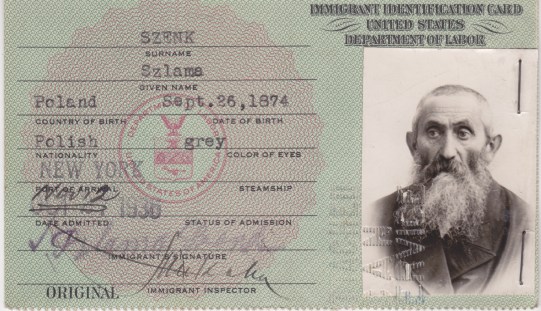
Eventually, she got documentation to bring my great grandfather Abraham (her mother had died young) and her younger sister, Esther, to the United States. Esther was older than 21, but she was very tiny. So they made her younger. And thus she was able to come with her father.

The age difference was a bone of contention for years. My Tante always stating her ‘fake’ age, my grandmother always correcting her. It was made worse by the fact that my Grandmother had traveled by herself to the USA in 1922, when she was only 16. To get the papers she needed, she made herself two years older! The war over their ages went on for years.

It was great until Tante wanted to retire. Truly she was 65, but legally she was 62. I remember this as my Grandmother and Tante would argue about this as well.   Like sisters, with love, they found many things to argue about.

Front Great grandpa USA Visa

In any case two were saved. I have my Great Grandfather’s passport and visa. In the passport it states that he has to leave Poland within a certain time or the visa is invalid. Luckily my grandparents also sent money. Saving family was utmost in my grandparents’ mind.

But my Grandmother was unable to rescue her brothers and bring them to the USA.   They decided that they had to leave Poland: Uncle Isaac and his wife, Bronia, along with David and Bronia’s sister, Rosa. The Rabbi said that David and Rosa must marry before they left Poland. So a quick wedding was held.

They escaped Poland to Russia. Not as great, but they were tailors…or they became tailors. And so, my grandmother would say, they were employed to make army uniforms for the Russian army.

Their lives were not easy. They suffered. But they survived. Many were not as fortunate.

After the war they wanted to leave Europe. They were in Italy and the Facists were on the rise. They were afraid. They wrote to their sisters in the United States, and to Bronia and Rosa’s sisters in Australia. They decided whoever sent documents first , they would go to that country. They just wanted out of Europe as quickly as possible.

Once again they were among the fortunate ones with sisters on two continents working to save their siblings. The sisters in Australia got documents first. My great aunts and uncles moved to Australia. There my cousin was born. There my Uncle David passed away when in was in his 30s. He is buried in Melbourne.

When my cousin was a child, they decided to move to Israel. My Great Uncle and his wife; his sister in-law, and niece. My cousin and her family still live in Israel. My grandparents, great aunts and uncles have all passed away. But when I look at this Rosh Hashannah card, I see hope. I wish everyone a blessed, happy, healthy and sweet new year.


To read more about the family:

https://zicharonot.wordpress.com/2014/04/28/speaking-yiddish-always-brings-me-holocaust-memories/

https://zicharonot.wordpress.com/2015/11/03/who-are-you-these-photos-call-out-to-me/


https://zicharonot.wordpress.com/2014/05/29/grandma-thelma-knows-what-she-knows/

The Kauneonga Lake Temple BethEl Recipe Book

12 Aug

I found a treat today. I decided to clean out my cookbooks. My daughter is getting married in a few weeks, and I am in a nesting mode. Sort like when I was pregnant. Now I am cleaning out my house and getting ready for hordes of guests.

I decided to clean out my cookbooks. There are many I have not used in years. I offered some to my daughter, but she informed me that she gets her recipes off the Internet. Fine. She does not want my cookbooks! I will give them to someone who wants them. And will appreciate them. But there are a few I will keep!

I like cookbooks, especially because some have much meaning and memories. I have my mother’s Settlement Cookbook. Probably the best cookbook ever made.   I have kosher cookbooks, healthy cookbooks, vegetarian cookbooks, light meal cookbooks, as well as a variety of cookbooks put together as fundraisers by various charitable organizations.

image

It was in the midst of these spiral notebook style cookbooks that I discovered a tiny treasure, “Cooking Favorites of Bethel,” put together by the Sisterhood of Temple Bethel, Bethel, New York. This is the congregation I belonged to throughout my childhood when we spent our summers and High Holidays in the Catskills. My grandparents lived in Kauneonga Lake throughout the year and davened at this small shul. I rejoined many years later as an adult to help support it.

I know this book is at least 35 years old, because my grandmother died in 1981. But it has to be older, based on the names of some of the women who contributed recipes. They passed away before my Grandma Thelma, like Clara Wagner. I close my eyes and I see Clara. She was Grandma’s best friend.   They spent many hours sitting and visiting. My Grandma was heartbroken when she passed away.

Then there is Nan Dasher, besides cooking, she would embroider tablecloths. Which she did constantly. I have two tablecloths she made. One specifically for me when I married, and one I took from my mother’s stash after Mom passed away. Nan lived in the White Lake Estates, not far from my grandparents.

So many other names of women I knew when I was a child submitted recipes: Lenore Liff, Yetta Gruber, Mrs. Elfenbaum, Goldie Lerner, Rebecca Rosenberg and more.

But the most exciting and enjoyable for me was finding my grandmother’s name in the book. Thelma Amsterdam contributed four recipes. HA! These recipes are a sort of lie! Grandma did not cook. Okay she cooked but not very well.

I still remember the trauma over this cookbook. Grandma had to submit recipes. She was an important member of the Sisterhood and needed to show she cared. I remember her coming to my Mom to get recipes. There they were sitting in the kitchen and writing down recipes that Mom gave her. The recipes that have my Grandma’s name, every one of them is from my mother. There is my Mom’s simple baked macaroni recipe. I still make it!!!! Even though I cannot eat dairy I have made it for Yom Kippur break the fast, and for shivas. It was so easy! However, Grandma NEVER made this meal.


recipe

So when I saw the four recipes she submitted I was filled with the laughter of remembering Mom giving her the recipes. I was filled with memories of my Grandma’s horrible cooking, although she could make the best mushroom barley soup and Pesach noodles. And I remember this book being put together and then published.

I should also tell you that this book is in perfect condition. I don’t think my Grandma ever opened it after she purchase in the effort to support the congregation and its sisterhood.

I honestly do not know when I got it. But I have a vague memory of Grandma giving it to me when I got married. Okay, I never used it either. It is so small it got hidden among my other cookbooks.

I am glad in a way, because now I have this tiny memory in such pristine condition. With it are many memories of Kauneonga Lake and going to shul!

Forks in the Flower Pots; Or Why I Keep Plants By My Kitchen Sink

10 Aug
image

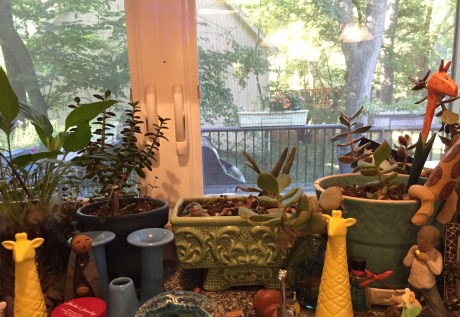
My kitchen window with my grandmother’s planter is the green one in the middle.

Above my grandparents’ kitchen sink in West New York, New Jersey were a variety of flower pots filled with plants.  But often interspersed among the plants were utensils.  Usually forks, but sometimes knives and spoons.

image

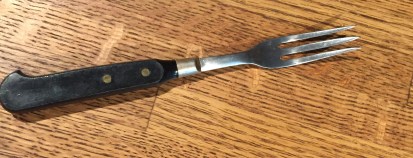
I own one of my Grandparents’ goupls.

When I was very young I remember thinking that my Grandma was special as she could grow metal in her pots. I especially wanted her to grow more of the special forks we called goupls, that we used in her home.  They had really thick and interesting handles. I thought goupl was a special name for this fork. We did not call the other forks, goupls, just these forks.  I found out when I was older that goupl is Yiddish for fork.

Usually standing upright, prongs in the dirt, were two or three forks each day. Amidst the plants the glow of silver.  Why?  My grandparents kept kosher. Meat and dairy is kept separate. My grandparents had utensils for milk meals and another set for meat meals. If they touched when they were wet, they had to be rekashered….made clean to use again.  One way, according to my Grandma,  is to bury it for 24 hours.  Grandma buried it by sticking the unclean item in a flower pot.

In reality, I think this was my grandmother’s interpretation of ne’itzah, a type of koshering for knives when you push them in dirt several times. Grandma just kept any utensil buried and unused.

My mother also kept plants in her kitchen at our hoe in North Bergen. But she did not keep kosher so there were never forks in the flowerpots. However having the plants was important to both my parents.  My Dad was always potting and repotting plants.  Plants freshen the air of your house according to my Dad. So besides helping to keep kosher, plants keep you healthy!

When I married, my husband and I decided to keep a kosher home. When we purchased our house a big draw for me was the window ledge above the sink.  A wonderful place for plants. But to be honest, I very rarely have put a fork or spoon or knife in a flower pot. However, they are there in case I need them.

image

My mother-in-law’s aloe plant.

Besides my kitchen sink plants, I have other plants including an aloe plant that is over 50 years old.  I have had it for 31 years. But before that it was my mother-in-law’s kitchen aloe plant.  I inherited when she passed away at only 59.  Aloe plants are important in the kitchen. My parents also had one.  If you burn yourself, you can quickly go to you aloe plant and break off a piece of a leaf. The thick goo is a healing source for burns.

Plants in my kitchen remind me of my grandparents, parents and in-laws.  Although I might not have forks in my flowerpots, I do have one of my grandmother’s flowerpots on my sink window.  My daughter is getting married in a month.  She has a window above her kitchen sink.  I plan to buy her a plant as a housewarming gift so she too can have flower pots in her kitchen.

A Chair, A Baby Grand Piano and Yiddish Songs

2 Aug

image

As the oldest granddaughter, my grandmother made it clear that I would inherit my grandparents’ cherry mahogany bedroom set. The most important pieces of furniture that came with it were my grandmother’s vanity and the small chair that goes with it.

The swivel chair is covered in a gold silk fabric. It is now a bit tattered, but I will not change it. In this chair my grandmother held me at night and sang Yiddish songs to me before I went to sleep.

She usually sang “Oif’n Pripetshik,” a song about children learning in their alef beiss, the alphabet. Even now, over 50 years later, listening to this song calms me. I feel my grandma’s arms around me; I smelled her scent; I feel the softness of her hair and her breath in my ear as she sings and slowly spins in the chair.

If one song did not get me ready to sleep, she would start singing, “Rozhinke Mit Mandlen.” I tried to stay awake so she would have to sing me both songs before I got into bed. When I was very young I slept with my grandmother.   I loved being with her in the winter under the big feather bed! I still have the one pillow left that was made from that giant duvet over 50 years ago. (See link to blog below.)

My grandparents kept the traditions they grew up with in Europe: Two twin beds, always. Grandpa would get up very early in the morning to go to their bakery and make the fresh bread and pastries.  Their apartment was on the top floor of the building that housed their bakery in West New York, New Jersey, right on Palisades Avenue.

Grandma would stay in bed with me a bit longer. Before she left she always whispered, “Remember, when you get up, get dressed and come down to the bakery.” Then a soft “Geh shluffen.” And she would be gone as well.

My grandfather also sang to us in Yiddish. He had a beautiful voice. Among his favorites to sing were “Tumbalalaika,” “Eli, Eli,” “Die Greene Koseene,” “Belz, Mine Shetele,” and “Wus Geven is Geven Un Nitu.”

Sometimes we would sit with him and sing together. Other times we would just listen. Occasionally, at a synagogue dinner in the Catskills, he would sing his Yiddish songs for the congregation. I remember once for my parent’s anniversary he sang several songs. But my Mom got very upset when he say, “Wus Geven is Geven un Nitu.”  I honestly do not think he meant to hurt her feelings.  He just loved to sing that song.

My grandparents had a beautiful carved walnut baby grand piano. The keys made of ebony and ivory. It was my Mom’s piano. She studied as a special student at Julliard when she was in high school. And even though she loved to play the piano, she went to college to learn to be a teacher instead of continuing at Julliard.   My grandparents felt teaching was a much better professional for a young woman in 1947.

I also learned music on this piano: years of lessons. I was never as good as my mother. But I did learn to love it. My teacher was kind. He let me chose the songs I wanted to learn. It was obvious that I would never be a concert pianist.

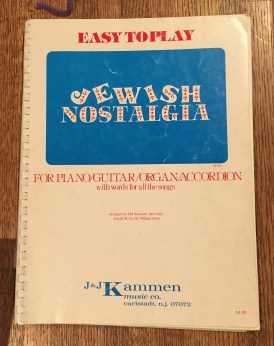
When I married, the piano and the bedroom set moved to my home. When I was pregnant with my daughter I would play the piano every day. I often played from a book of Yiddish music: “Jewish Nostalgia For Piano/Guitar/Organ/Accordian” published by the J & J Kammen Music Co. Sometimes I could feel my daughter kick within me as I played her favorite songs.

I know that she heard the music! After she was born, when she was fussy, I would bring her into the music room and play “Oif’n Pripetshik” for her. Within minutes she would be calm listening to the music.

My grandfather, Papa, lived until she was 3 ½.   He would sing to her in Yiddish as well. She does not remember much about him. But he would hold her close to his face while he sang.   What she remembers is that “Papa had a scratchy face.” He did not shave as often when he was in his late 80s.

When she was old enough, my daughter also took her first piano lessons on our family’s baby grand piano. Like me, she was not meant to be a concert pianist. But we both learned to love and read music while learning to play piano. I would often play music for my children when they were little. I often would play the Yiddish music of my childhood.

Over the years, many people have come to visit and would play the piano.   One childhood friend came to visit several years ago.   She asked what happened to my Mom’s piano.   I took her into my living room to see it.  She cried as she stood in front of it.  There was so much love invested in my piano.

I am so fortunate.  I have a chair to sit in to remember when my grandmother sang to me; a piano to play the music that my grandparents taught me.  I have the  Yiddish songs that I continue to hear in my mind and sometimes still play on my piano. Amazing memories and sounds of Yiddish songs from just looking at a chair and a piano.


https://zicharonot.wordpress.com/2014/06/08/why-i-love-my-pillow/


We Always Have Our Minds, We Must Use Them

21 Jul

“They can never take your education or your mind,” my Grandfather told me. He escaped from Europe in 1918 in an effort to avoid service in the military. For a Jew in 1918, a military career was not a good option.

Although Grandpa’s formal education ended, he was a strong believer in education for his children and grandchildren. He came to a country, that although it had quotas for college at the time, there was still an opportunity to get an advanced education for everyone. In New York City, many children of immigrants went to CCNY, City College of New York, where education was basically free!

He would be proud to know that five of his great grandchildren have or are working on secondary degrees: four master’s degrees already completed, one in progress and a PhD on its way. No one can take this education away.

We are the people of the book, the Torah. We are a people who stress learning and education. My family is one that continues this tradition. In this country we have had the opportunity to learn at any college or university. We have had the freedom to study Torah as free and independent people.

My Grandfather never learned to read English well. We grew up reading street signs for him as he drove. In fact, I learned to read by listening to my Grandmother read to him.   My Grandmother also came from Europe and was fortunate enough to go to night school to learn English.

But do not think my Grandfather was uneducated. He was not. He was literate in Yiddish, Hebrew and Polish, as was my Grandmother. English was their fourth language.

My Grandfather was a Cohen, from the priestly group of Judaism.   He had a beautiful voice. When I was a small child, I loved to sit under his tallit with him as he chanted the prayers.

I also stress education.   I have taught high school. I work at a school now. And I made it clear to my children, from infancy, that education was the most important job they had.

No matter what you do in life. No matter where you live. Nothing can ever take your education away from you.

In Israel they know this. Recently Shimon Peres, the 93-year-old, past president, said: “In Israel, a land lacking natural resources, we learned to appreciate our greatest resource, our minds.”

This is a truth for everyone.   Education and your mind are always yours. No one can take these away.

The United States has been a country of immigrants; a country where people can get an education. Where people can read the books they want to read, study the topics they want to study; use their minds to be whatever they want to be. The USA is a country of free speech and freedom of religion.

I hope it continues. We always have our education and our minds. I hope people use their minds this November.  I hope they remember that we all came from elsewhere.  Use their minds and their education to do what is best to keep our country free, to keep the haven for immigrants alive, to avoid the pitfalls we see in Europe.  The world is a scary place right now.  But we need to use our minds to keep out fear and to reject those who would use fear and hatred to change American.

Donating My Holocaust Books to the Right Place

12 Jul

image

My husband and I are members of the Midwest Center for Holocaust Education (MCHE) in Kansas. There is an important reason for our support. I was named for my great grandmother who was hidden during the Shoah and then murdered by the people who stole her property. In her memory I feel it is important to keep contact with Holocaust organizations.

Since MCHE started, I have attended a few events and made financial donations. This year, we were among those honored for our 20 years of support. But two years ago, I became a bit more involved. I started serving as a preliminary judge for its White Rose Essay Contest. Open to students in eighth through twelfth grade, it is held each year in the Kansas City area. Preliminary judges help to weed the multitude of admissions down to ten in each category 8th and 9th grade/ 10th – 12th grade.

I enjoy reading the essays. It is amazing what some of these students do under the guidance of their teachers. The students have to research a specific topic, which changes each year, using both internet sources and books, many of which are held in the MCHE library.

I look forward to the essay contest each year and being a part of this process. I learn the stories of survivors as I read these essays, which has helped to encourage me on my path to discovering more about my family.

I have a collection of Holocaust books, both non-fiction and fiction. I have way too many books to be honest. Even with a Kindle, I still cannot let go of books very easily. But this weekend I had an urge to purge my bookshelf of books I no longer read.   And a thought occurred.   I had read all these Holocaust books, some several times. Perhaps the MCHE could use them for the White Rose contest, as well as for other researchers.

With that goal in mind, after two days of sorting through my books, I found 17 I was willing to part with and which I thought could be used for research. These 17 non-fiction books pertaining to the Shoah only touch the surface of my collection. But for me it is a positive start.

I contacted MCHE and offered my books.   There were six the historian definitely wanted for the library. The books were already in the car waiting to go. As soon as I got the email, I sorted the books into two groups and took all of the books over.

When I entered the Center, the director said, “Were you waiting in your car for my email?”

I smiled. “The books were in the car,” I admitted.

I did arrive within an hour of getting her email. To be honest, I really wanted a good home for these books where they would be used and appreciated. I think I found that home.

But on the other hand, I was worried that I would go through the books again and change my mind. It is difficult for me to relinquish a book. I even emailed my daughter with a list of the books and asked her opinion.

“I am planning to donate the following. If you have a feeling for any of these books speak now,” I wrote her.

She responded with one word: Donate.

The books they did not want for their library they will offer for sale to their members. That would be fine with me, as the income would still go to MCHE.

However, as I spoke to the Director I suggested they review my books. All were in excellent shape. Perhaps they should replace the books on their shelves with my almost pristine copies? She agreed this was a great idea. It made me feel even better. Perhaps even more of my books would remain on the shelves of the library.

Whatever MCHE and its historian do with my books, I am glad. I am letting go. When I get my letter acknowledging the donation, I will think about those who will continue to read and use my books and know that I donated my books to the right place.


http://mchekc.org/white-rose-student-essay-contest/


What I Think About on The 2016 Fourth of July

4 Jul

I am a fortunate person. My paternal great grandparents immigrated to the United States in the 1880s, and my maternal grandparents arrived in the early 1920s, before the Immigration Act of 1924 severely limited immigration and imposed a strict quota system. It was a bigoted act designed to limit immigration of Africans as well as Southern Europeans and Eastern Europeans.   It actually banned the immigration of Arabs and Asians.   It was due to this horrible act that so many Jewish people trying to escape Nazi Germany were banned from entering the United States and were murdered.

Finally, the Immigration and Nationality Act of 1965 was passed and enacted on June 30, 1968, just in time for a Fourth of July celebration. It ended the strict limits of the quota systems and allowed preference visa categories that took into account an immigrant who had family members who were citizens, as well as an immigrant’s special skills.

Think of what this act might have meant for tens of thousands of Jews stuck in Europe. In my own family, the 1924 act caused the death of my grandfather’s family. He was able to get Visa’s for his parents, but not for his siblings. His parents refused to leave. And so everyone perished in the Holocaust.   My grandmother was able to get a visa for her father and younger sister, but not her brothers. Fortunately they survived.

The Immigration Act of 1990 increased the total immigration allowed and the number of visas from the 1965 law. But also in the 1990s other laws were passed to make it more difficult for legal and illegal immigrants adding reasons for deportations, according to a Wikipedia article on “The Laws Concerning Immigration.”

But the world changed on September 11, 2001, and along with it views on immigration. People got scared. We began to allow fear to rule the country. And if we do that, we let the terrorist win through fear. That is what they want.

We seemed to have gone back to the ways of the 1920s, when the white men in power seemed so afraid of those that were different. Many restrictive laws were enacted before women had the right to vote. The 19th Amendment was only ratified on August 18, 1920. At first many women did not vote. It took time for women to stand up and have their voices heard.

I cannot prove that having women’s votes changed the direction of the United States, but I believe that women voters have influenced many aspects of life in the USA.

The fact that we now have three women on the Supreme Court has made a difference. The fact that we have women in office on all levels of government: local, state, national, has made a difference. The fact that we have had women running for the two highest offices in the USA: vice president and president, has made a difference.

I am so proud and glad to be a citizen of the United States of America. I am so glad that my ancestors made the journey to the USA in times that were so difficult and were allowed to settle here and become citizens.

I hope that we all remember what is written in the Declaration of Independence:

“We hold these truths to be self-evident, that all men are created equal, that they are endowed by their Creator with certain unalienable Rights, that among these are Life, Liberty and the pursuit of Happiness.–That to secure these rights, Governments are instituted among Men, deriving their just powers from the consent of the governed, –That whenever any Form of Government becomes destructive of these ends, it is the Right of the People to alter or to abolish it, and to institute new Government, laying its foundation on such principles and organizing its powers in such form, as to them shall seem most likely to effect their Safety and Happiness.”

We must not let fear of the other make us forget that the United States was founded by the ‘other.’ Everyone who signed the original Declaration of Independence was the descendant of an immigrant. We were not perfect. The treatment of the Native Americans and slave ownership was not right. But the founders did their best with the information they had. The Constitution helped them make changes to reflect the society. Slavery ended, women got the right to vote.

With the death of Elie Wiesel, we must remember his words as he reminded us of the Shoah and our responsibility to keep another one from happening: “We must always take sides. Neutrality helps the oppressor, never the victim. Silence encourages the tormentor, never the tormented.”

And we must side with the victim. We are a country founded by people searching for religious freedom, searching for a place to live with freedoms and the rights to be as equal as anyone else.

This Fourth of July, we must not give in to fear and hatred. We must protect those fleeing from war. We must not become a bigoted, hateful country. We must remain the defender of the victim. That is the heritage I want to rejoice on this July Fourth.