Tag Archives: family history

The Tavern in Trzciana Comes To Life

29 Jul

I vividly remember when the movie version of “Fiddler on The Roof” was released.  It was the first Broadway show I had seen in person as a child.  So seeing it again in the movie theater reminded me of the special trip into New York City with my parents and the delight I felt while listening to the songs and learning about Anatevka.  One of my favorite scenes occurs in a tavern where the Polish and the Jewish citizens end up in riotous dance!

The tavern scene has so much more meaning to me now.  I was with my maternal grandfather the first time he saw the movie.  Grandpa was from a small town in Austria/Poland called Trzciana.  When he watched the tavern scene, he turned to me and said, “My family had a tavern just like that.  It looked just like that.”  Anatevka/Tzrciana taverns were interchangeable in my grandfather’s eyes. He said the movie brought back memories of his childhood.

Grandpa did not often speak freely about his family.  Stories came in bits and pieces of memories.  But it was not something you asked about.  It was something that he had to offer because Grandpa’s family all perished in the Shoah.  His parents, his siblings, his aunts and uncles, his cousins, everyone who was in Europe died, except for three.  (See blogs below.)

But that tavern memory has so much more meaning because now I know more about it thanks to the research of Izabela Sekulska who started the Mayn Shtetele Mielec Facebook group.   Izabela has been helping me find out information about my family for about a year now. The documents she finds make the stories I was told by Grandpa come to life.

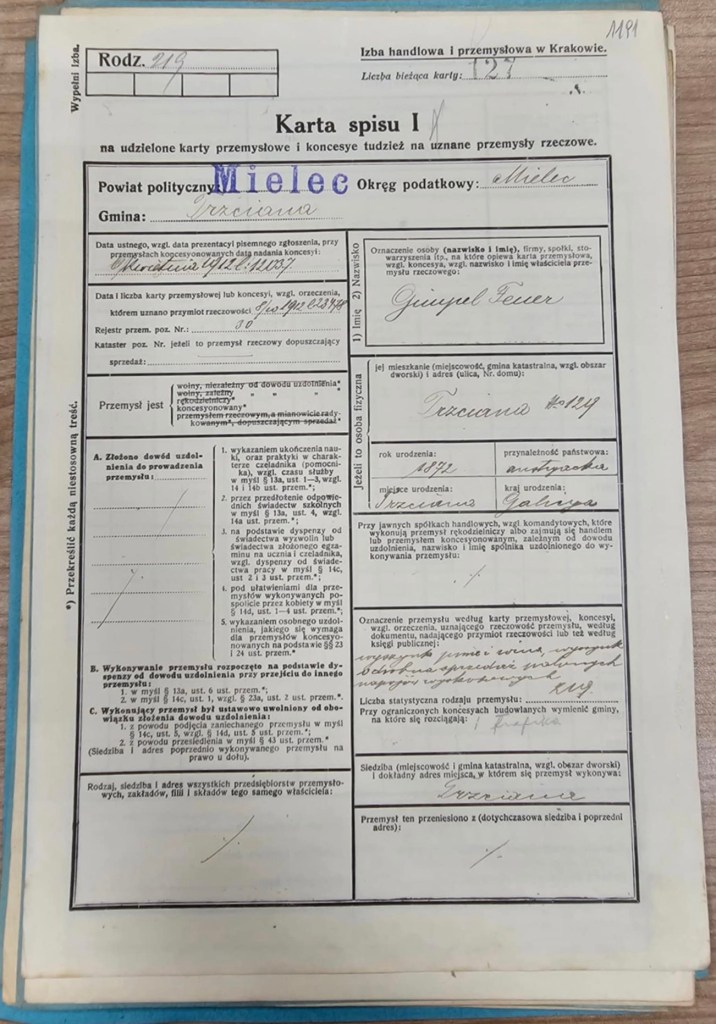
Izabela recently found a document from the Chamber of Commerce and Industry that  brings the family tavern to life.

My great grandfather Gimple Feuer applied to open a tavern on April 10, 1912, when my grandfather was just over 12 years old.  My Grandpa did grow up with a tavern in his life.  This document from the Chamber of Commerce and Industry states that the location was in Trzciana, Galicia, which was then part of Austria as Poland.  Throughout his life Grandpa said he was Austrian as that part of Galicia became part of Poland after the war. 

At my family’s tavern they sold beer, wine, other alcoholic beverages and tobacco according to this document.  I knew my great grandfather had a farm that included a crop of  grains and grain silos to store the grain.  So having a tavern makes sense, he had the grain to brew the beer.

Grandpa told us stories about cleaning out grain silos and how one time he and his cousin became intoxicated on the fumes from the silo.  They actually became sick and ran to a nearby stream/creek to drink the water and wash the fumes away. He said they almost drowned, they were so drunk.  

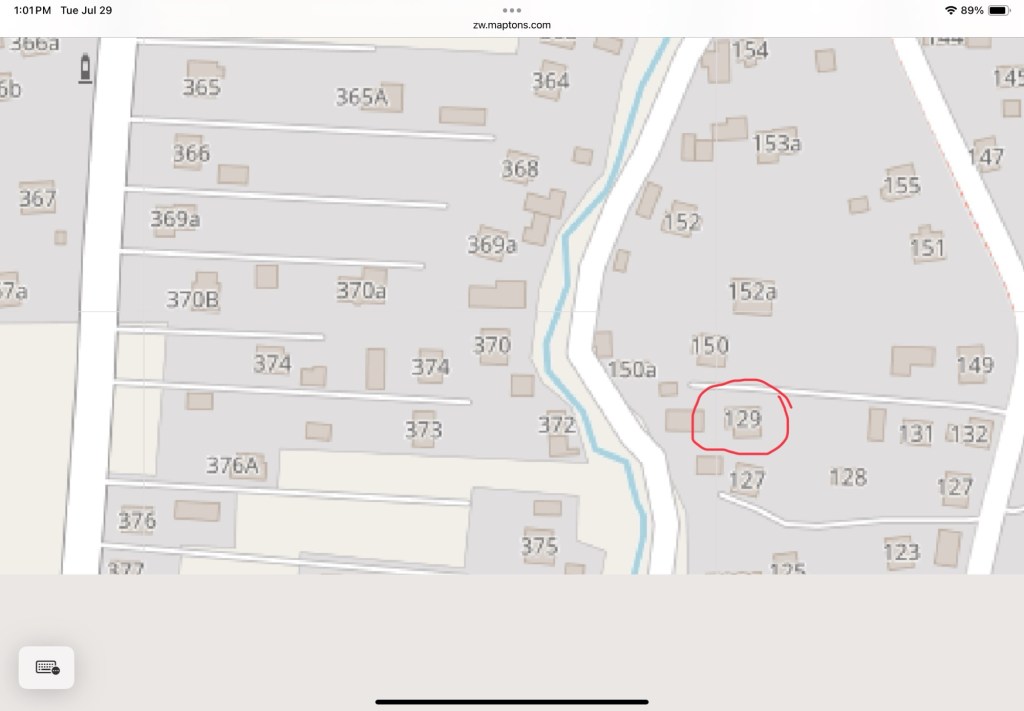
As I remembered this story, I  looked for  a map of current day Trzciana online and saw where the Cichawka stream goes through the town.

Thanks to Izabela, I know that there were no street names in Tzrciana, the homes and buildings  were just numbered during the time my grandfather lived there..  And the number of the tavern was 129.   

On the map that  I found online all the buildings are numbered.  There is one numbered 129 close to the creek. Could this be when my great grandfather had his tavern?  I am not sure, but it perhaps the numbers remain the same. 

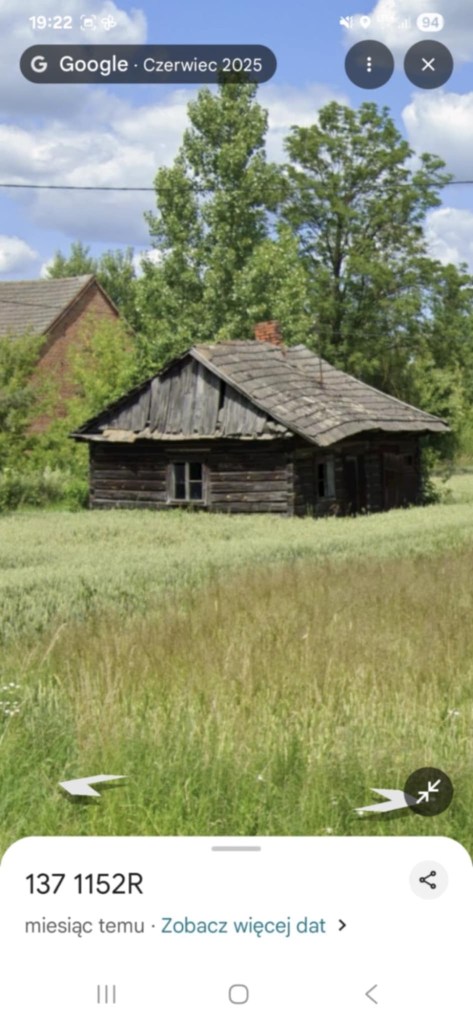
Now there are addresses and streets. So perhaps with this information we can one day find out exactly where the tavern was located in the town. Perhaps this address is where the family lived, and the tavern was located on their farmland?   

Izabela has asked for help in finding out where this location is now in Trzciana in the Facebook group.  That would make this amazing find so much more amazing.  And it might be that the number 129 is in the same place. And the numbers around it are the places where the other members of my family lived before the war.

Knowing my great grandparents had a tavern, perhaps explains to me why there was actually a trial after the war concerning the murder of my great grandmother during the Shoah.  Perhaps their standing in the community created lasting friendships that existed after the war and lead to people actually testifying about her death. (See blog below.)

No matter what I find about where the tavern actually stood in Trzciana, I do know that from now on whenever I see the story of Anatevka and see the tavern scene, I will think of my grandfather and his family that perished, but I will also remember how they lived.


Renewing A Family Connection: My Mother’s Day Gift

Renewing A Family Connection: My Mother’s Day Gift

21 May

While in Isarel, I finally renewed a family connection which started 50 years ago. When I was 20, I met two survivors of the Shoah. They were married to sisters before the war. The sisters perished in the Shoah, but the two men remained connected for the rest of their lives.

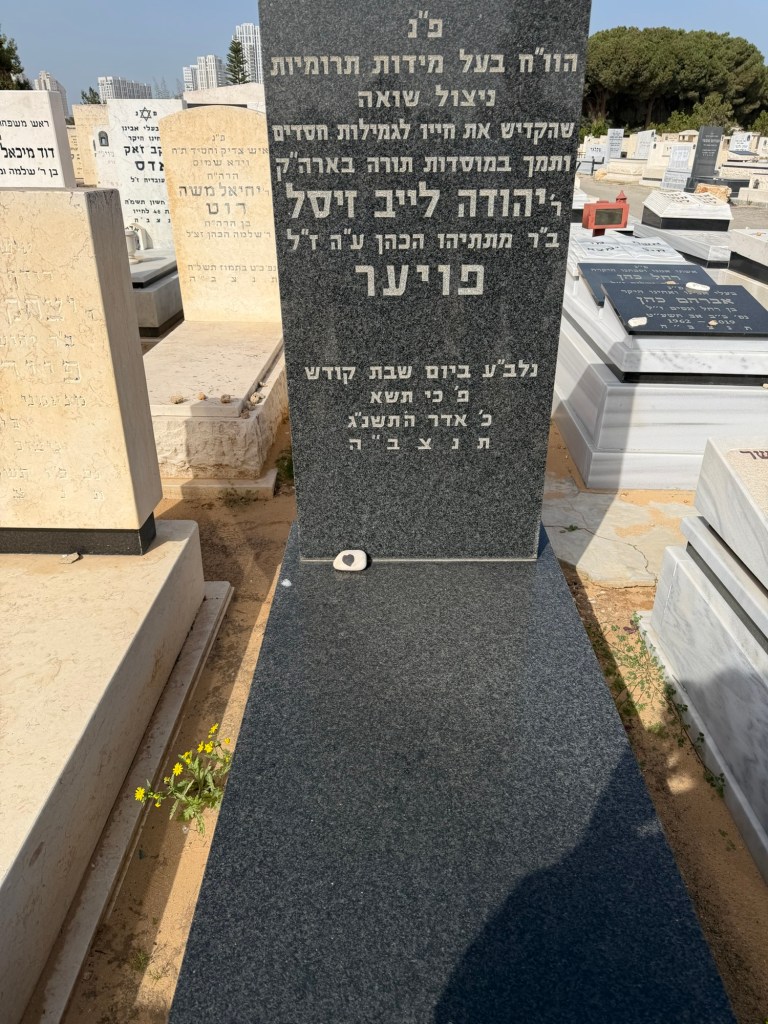
I have written about both of these men before, (Lieb) Zissel Feuer and Shalom Hollander.  Both were distant cousins of my grandfather. But their wives were his first cousins.   I wrote about meeting Zissel and Shalom and what happened to them during and after the war, and a bit about my contact with them in Israel between 1974-76. (See blogs below.). Over the years my perception of the two changed, as I learned more about their lives.

Now I have a different story to share, because I have met Shalom’s oldest son Chaim, as well as the great nephew of his first wife, who is also my third cousin, Jeff, and his daughter.

For me it was a meeting that completed a story.  For them, I hope I was able to fill in stories about the family and answer question about the family before the war.  As we shared our stories, I could see where my knowledge and theirs combined and differed.  I spoke about meeting Zissel at the bakery in Tel Aviv across from the Shuk HaCarmel.   Chaim smiled while I told my stories about meeting Zissel there each time I came to Tel Aviv.  Chaim, of course, knew the bakery and even Zissel’s address.  Although I had been at his apartment several times, I did not remember the address.  But we had other shared memories. 

I think when I talked about the bakery, Chaim knew then that I was really a relative.  I really had met Zissel. I don’t think he thought I was lying , but he had never heard of me, yet there I was a family member from the USA, unknown to him. Also when I told him about meeting his father, how elegant he seemed.  And Chaim agreed, his dad had that old world charm.

Chaim actually made me feel better about Zissel. I knew he did not have a family.  Shalom was not related to him at all, once their wives died.  Shalom. remarried.  Zissel never did.  But Chaim told me that Zissel was always part of Shalom’s family. He came to be with them for all the haggim, the holidays.  That eased my heart.  Really, I am tearing up even now.  For me Zissel was such a sad soul. So to know he was not alone, helped.

We talked about the importance of what Ziseel and Shalom did after the war to help others from Mielec who survived and to keep the memory of those who were murdered. Shalom purchased the land where a mass burial of 800 Jews were buried and put up a fence and a marker.  Both men also testified against those who were the murderers, as Zissel had done for the murderer of my great grandmother, his aunt by marriage.  Our discussion filled in so many blanks for me.

Chaim and his wife gave me memoirs written by both Shaom and his second wife, Ita, about what happened during the war.

I in turn could tell them about those who made it to the United States before the war.

How Julius/Judah/Yidel Amsterdam, my grandfather’s uncle, came first.  As other relatives came to the New York/New Jersey area, he gave them a choice. You can be a butcher or a baker.  There was a cousin who was a butcher, and Uncle Yidel was a baker.  My grandfather chose to be a baker.  Chiam laughed as I told the story, because his uncle who went to the states became a butcher.  I said he was probably helped by my great uncle Yidel as well.

With Jeff, I could talk about his great uncle Morris, who lived in Helena, Montana.  My grandfather always stayed in touch with his first cousin.  I knew one of this sons because when I moved to Kansas, they gave me Jack’s phone number. He lived in Denver.  To my grandfather and his cousin Morris, this was close enough. We never actually met, but we spoke several times.

For me I have a feeling of completion.  When I found out about these relatives, through the research of Izabela S.  I knew I had to see them when I was in Israel visiting my daughter.  They lived quite a distance.  But my daughter said that this was my Mother’s Day gift.  It was the one thing I really wanted to do.  So we took the long drive from Holon to a small Kfar near Netanya.

Over the years of my research I have found out how the members of my family were murdered during the Shoah.  I know how a small numbered survived.  I know that they are not forgotten.  I am not the only who keeps their memory alive within the family.  And there are people like Izabela in Poland, who also work to keep the memory of the  Jewish population alive.

I never thought I would ever want to go to Trzciana or Mielec.  My grandfather never wanted to go back there after his family was murdered.  But now I do want to go. I what to see where they lived. Where Shalom and Zissel created a Jewish community after the war. Where the Amsterdam group hid in the nearby forest. The town where my great grandmother was murdered. The mass grave where my great aunts are probably buried.

But most of all I am so glad that I found out what that Zissel and Shalom did after the war.  I, as a young woman, saw both Zissel and Shalom as such sad people talking about Death.  I did not hear the stories about what they did to give people a reason to LIVE after the war. And to create a place of memory for those murdered.

I now know that Shalom and his wife, who was also a survivor from Mielec, had four children, a girl who survived whom they adopted and three sons.  Chaim and his wife have seven children, 40 grandchildren and 19 great grandchildren so far. 

I know that Zissel was not alone.  That Zissel and Shalom stayed connected throughout their lives.  I also know that Zissel died in Holon.  I think he might be buried there. So next time I am in Israel, I hope to find his grave and put place a rock of remembrance on his matzevot.

Pre-Passover/Pesach Ponderings

8 Apr

At 70 years old, I envisioned that I would be sailing through my retirement years comfortable with my world.  Enjoying my family, watching my country continue to flourish, seeing the United States and its reputation be strong in the world, as my husband and I continued to travel and enjoy visiting new places.

This is a far distant vison than the one my great grandmother faced 82 years ago, when in April 1943, she was murdered by the Germans at age 70 in Poland.  It was the Thursday before Easter, and after her husband and four children had been murdered and her farm and property had been confiscated by the Germans.

My great grandmother is a bit different than the many unknown who were murdered during the Shoah, as there is a record of her last day taken during the trial held after the war for her murder.  I know what she did, what she said, and who killed her. (See blog below.)

For fifty years I had been on a quest to find out what happened to my grandfather’s family.  A quest that started after I spent my sophomore of college in Jerusalem.  A year when I met many members of my family who survived the Shoah and ended up living in Eretz Israel, the land of Israel.

When I returned home, I was the child who said, I need to know.  I sat with all of my grandparents to hear their stories.  I wrote everything down. In the 1970s there was no internet, no easy way to discovered what happened. But I kept my papers and over the years when I met other members of my family I wrote down what they said.  And slowly, slowly the stories came out.

In some instances, I found out history that perhaps I did not want to know.  I learned about my father’s family who came to the USA in the 1870s.  I learned of both tragedies and joys.    

I learned about a great uncle who ended up in a mental institution, a great aunt who died from the Spanish flu, multiple children who died in their infancies; family menbers who did not speak to each other and a child who was raised by an aunt and did not know till she got engaged.

For my mother’s family, both of her parents came to the USA in the early 1920s, I learned about the hundreds of cousins, siblings, parents, all many of relatives that were murdered in the Shoah, as well as ones who had been saved.

I learned about relatives who were on Schindler’s List.  Those who were saved by the Kinder Transport and ended up in England.  A cousin who survived the Kelce Pogrom. Others who hid in the forests near their home town and formed a group like the one in the movie, “Defiance,” but these were my family.

I learned about a relative who converted to Catholicism before the war, but during the war she tried to save her sibling and her children. She was not successful.  Their bodies were found buried in a field when construction was being done about three years ago. The driver of the vehicle was the grandson of the relative who converted, so Catholic himself.  He had dug up the bodies of his own dead Jewish great aunt and her family.  Can you imagine the irony of this? 

I learned that owning property or having money does not save you.  What might save you is luck, fortitude, or relatives who might have a chance to get your out.  But you also had to make your own luck.  You had to want to survive.

My great grandmother finally gave up. Everyone was dead, she had been hiding in the forest with others for a while.  But then she was done. It was too much sorrow. Too much loss.

In this world with the chaos and uncertainty surrounding the economy; the round up of immigrants, even those with legal residences; the job losses; the attacks on education; the attacks on the rights of LGBTQ communities; the rise in anti-Semitism and hatred toward Israels and Jews, I have had to re-evaluate.

Could our property be confiscated?  Could our savings be stolen?  Could people in the USA be forced to hide in the woods to stay safe?  Will people just give up?

Am I really so different from my great grandmother whom I am named after?  Should I consider my own exit strategy?  Believe me my mind often mulls over the options. 

But it is the Tuesday before Pesach and Easter.  It is two days before the 82nd anniversary of my great grandmother’s murder by the German mayor of Czermin, Jukub Hesler.

So I am pondering and considering and hoping that our Constitution is strong enough. That our courts are strong enough. That our elected politicians remember who they vow allegiance to:  The CONSTITUTION of the United States of America.  And who they serve, the people of their states and districts.

I wish everyone a Zissel Pesach, a happy Pesach.  And I wish all who celebrate Easter a happy Easter.  And I wish to everyone throughout the countries of the Earth a peaceful and joyful 2025.

My Genealogy Research Makes a Difference To A Distant Cousin

23 Apr

When I started my genealogy research, I did my research and wrote my blogs just for my siblings and immediate family.  Over time, I included my cousins on my blog posts.  And then it just snowballed.  I realized that by posting them on Facebook, specifically on Tracing the Tribe group, I might connect with other more distant relatives.  And it happened.  I have had people help me with my research who are not related. I am in touch with distant cousins including Evan, who has been an immense help in making connections.  I have met some of these cousins in person.  And my understanding of my family increases with each new contact.

This blog is different.  In this instance, I discovered that the information I had from speaking with my grandmother years ago helped solve the family mystery of a women who is actually my third cousin, our grandmother’s were first cousins.

It started with an email from Evan. (He really does a great job keeping in touch with all the cousins) He connected me with a distant cousin named Sherry, the granddaughter of a woman named Esther who was born about 1897/1898.  He said she was part of my branch of the family and thought I could help.  I could.

A number of years ago, I wrote a blog about my grandmother entitled “Too Many Esthers” (see blog below) and “Updated Esther “(see blog below).  My Grandma Esther was one of 5 or 6 first cousins all named for their maternal grandmother, all named Esther, all born around the same time. All were given nicknames.  My grandmother was known as Curly Esther.

Sherry wrote back to Evan and me: (She has given me permission to write this blog, I have edited her emails for privacy and brevity.).  “Thank you for contacting me!  I had trouble with my grandmother, and who her parents truly were.  There were so many unanswered questions and there are no living family members in my close family that know anything more than I do.  I got pretty frustrated and sort of put it on the back burner.  I would be really interested in what you found out!”

I immediately responded: “It’s nice to be reconnected. I am the granddaughter of another Esther born in 1898.  I have been researching the family for years. In late 1970s I sat down with my Grandma and got the names of all of her mother’s siblings. The children of Elka/Esther Lew and Victor/Avigdor Wolf. Here are two of my blogs that will lead back to some of my research and introduce you to the family. The attached photo is our great great grandparents Esther and Victor Wolf(f).

Actually, I knew immediately who her grandmother had to be, which is why I sent her the blogs about the Esthers.  There was one cousin known as Meshugannah Esther.  Her mother Chamka came to the USA pregnant with three children.  Her husband had passed away before she came.  After their daughter, Esther, was born and weaned, she was given to a different sister, Sarah, who could not have children, to raise as her own.  To make things more confusing, Chamka was known as Anna in the USA, but her Hebrew name was Nechama.  Her family called her only Chamka/Chamky.

I must say I was truly happy to receive a reply from Sherry.  Her response filled me with joy to know that my research and pictures helped her.  Here is an edited version of her response.

“Wow!  I am so overwhelmed and thrilled with this connection.  I was getting so frustrated with trying to figure out my grandmother’s story and had no one to ask.  

I did hear that “grandma didn’t find out until the day she was engaged that her aunt was her mother and her mother was her aunt”.  So I knew that there was information that I was missing in order to fill in the blanks.  

“Meshuganah Esther moved in with my family when I was 10 years old. We lived next door to Aunt Lenore and her family.  Grandma was married 5 times!  She felt she needed to do that in order for her to care for her children. My grandmother passed in June of 1993.

“Ellen, you spoke of the cousins’ club meetings.  I remember them although I think I spent most of the time hiding behind my mother’s skirt…

“I actually gasped out loud when I opened the picture of Esther and Victor Wolf.  I have that picture and I had no idea who they were.

Thank you, dear cousins.  This is a gift.”

My initial response to this was just as excited. I was elated that I could help.

“I am so glad that you were able to make connections about the family through my blogs. I am so glad that you have that photo as well, and now know who it is.  It is amazing to have photos of great grandparents, but great great grandparents is really special. 

“Did you see the picture of Chamka and Lenore?  I am not sure which blog it is in.

I can understand a bit why she wasn’t told which sister was her mother.  But I am sure it was a big shock at the time. It was one of those open secrets that everyone knows but does not discuss.”

Since she did not have nor seen the photo of her great grandmother Chamka with her granddaughter Lenore, I sent her the photo and the information that was written on the back. “Tante Chamky and Lenore. Lenore was Meshuggana Esther’s daughter. Esther was raised by Tante Sarah, but was really Chamky’s daughter.”

I am currently looking for the photo so I can send her it for her family records.

Thanks to Tracing the Tribe, over the years, I have connected with a number of cousins.  But this connection honestly made me immensely happy.  

 Finding Answers About My Paternal Great Grandmother

17 Apr

In Ashkenazi Jewish custom we name our children for those beloved family members who have passed away. I was always told that I was named after three of my great grandmothers:

Chava was for my maternal grandfather’s mother, Chava, who was murdered in the Shoah.

Sara was for my maternal grandmother’s mother Sara/Sura, who died in the 1920s in Poland, and for my paternal grandfather’s mother as her name was Sarah as well.

I knew about my two maternal great grandmothers, because there were family stories about them.  But I knew nothing about my paternal great grandmother even though she  lived in the United States and is buried in New York.  I have recently realized there is more to the story about her and my name. 

I have been searching for information about my paternal great grandmother  for years.  The first real clue was when we first saw a photo of her about five years ago.  We did not even know we had one!  But my first cousin was searching through her family’s old photos and discovered one of her with my uncle.  (See blog below.)

More information followed when my distant cousin, Evan, who is a great researcher, found my grandparent’s marriage license.  They were married in January of 1923.  It contained my great grandmother’s maiden name which we never knew: Ritt.

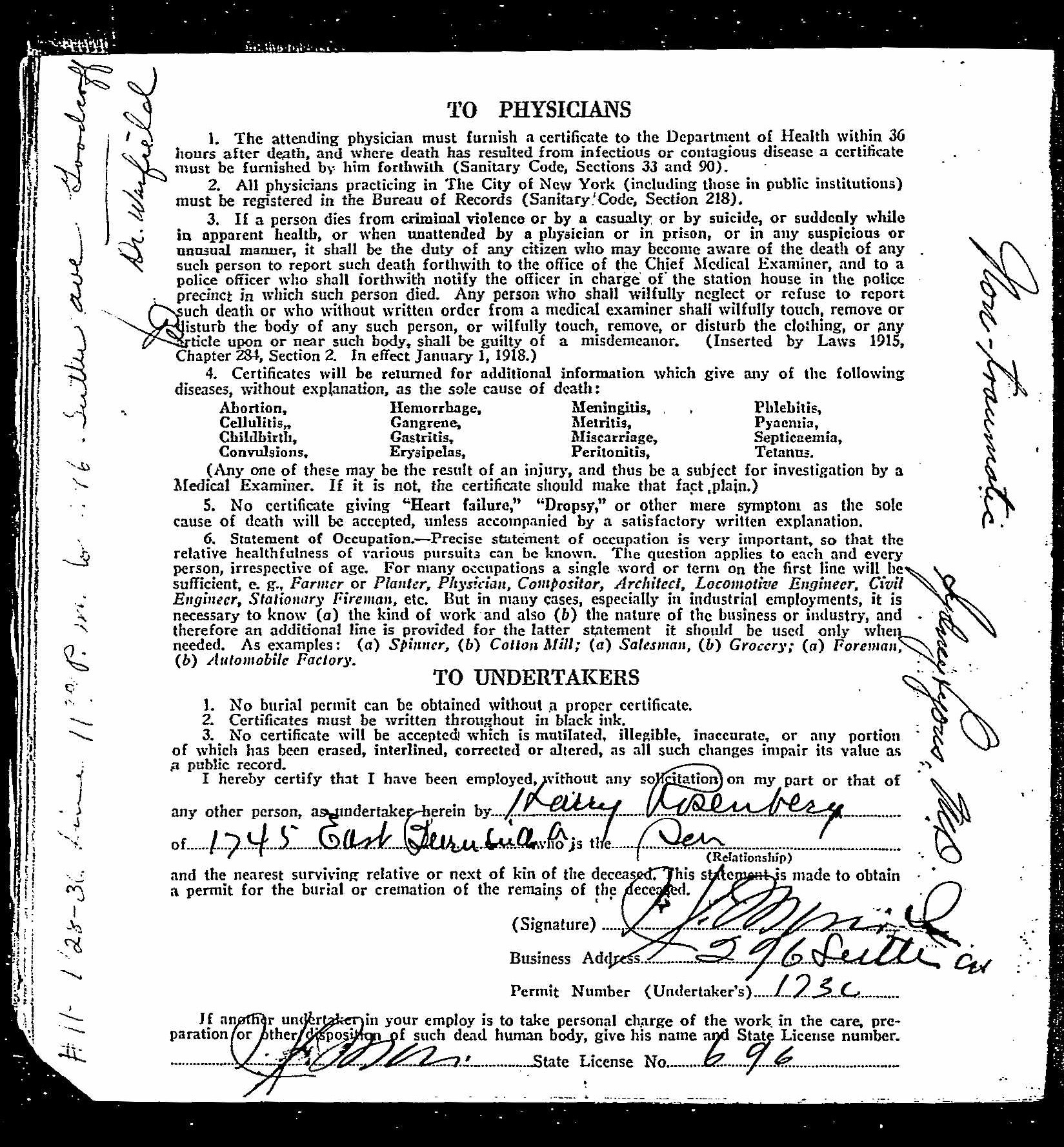
Evan also found a puzzle piece for me when he found her death certificate, which was packed with information. The final link was when Beth David Cemetery in Elmont, New York, where she was buried on January 29, 1938, sent me a photo of her matzevah (tombstone).

I now can tell my family more about my mysterious great grandmother, who I now know is named Chaya Sarah, so close to my own name of Chava Sara, that I think I was bound to have this name.

My great grandmother did not have an easy life.  She gave birth to 11 children. Eight survived to adulthood.  She lost her oldest daughter, Celia, to swine flu when she was in her 20s.  Her oldest son, Samuel, was mentally ill and spent most of his adult life institutionalized.  She and her husband, Abraham, were divorced in the 1930s.  A very unusual occurrence for a Jewish woman, well for any woman, in that time period.

My Great Grandma Sarah died on January 28, 1938, from cancer of the panaceas at Jewish Hospital of Brooklyn, when she was 68 years old.  My grandfather, then the oldest living child signed the death certificate and made the arrangements.

I have three thoughts about this information.  First, the line through my grandfather is cancer free.  But I have since learned that the line through his youngest sibling, Jacob, was not as kind. We all thought Jacob had disappeared after he moved to England when my dad was a child. But in fact he died when he was in his fifties from cancer, as did his son Rufus.  The cancer gene followed them. (See blog below.)

Second, I think I know why I was named for her.  She died in late January.  Years later, I was born in late January.  It made sense.  Finally, I am currently close to her age when she died.  And that touches me that I found out now.

I know that she was born about 1870, in France.  That she and her parents lived in France surprised me. But her father and mother, Hirsh and Flora Ritt, were from Poland.  So I think they were in transit from Poland to the USA when she was born.  I have no proof, but it seems right.  I also know that her father died before 1892 because my grandfather was named for him. Zvi Hirsh.  I now know that she was about 22 when she had her third child, and her other children were toddlers when my grandfather was born.

She died when my Dad was just 9 years old.  He really did not have many memories of her or information.  But now we know her name and also the names of my great great grandparents: Chaya Sarah Ritt, the daughter of Hirsh Zvi and Flora Ritt.  We now can add their memories to our family.

I want to thank the personnel of Beth David Cemetery. I now have photos of the graves of four of my great grandparents.

Oy Vey Rosie Rosenberg!

30 Dec

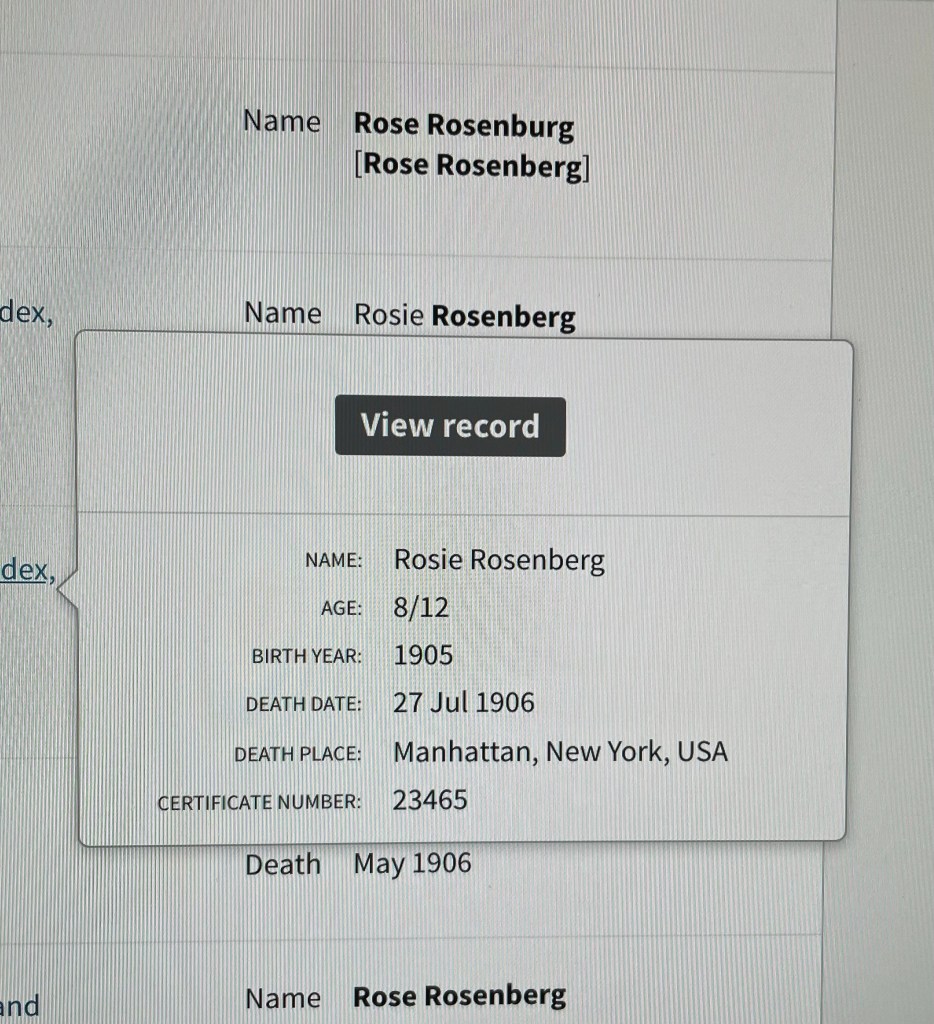
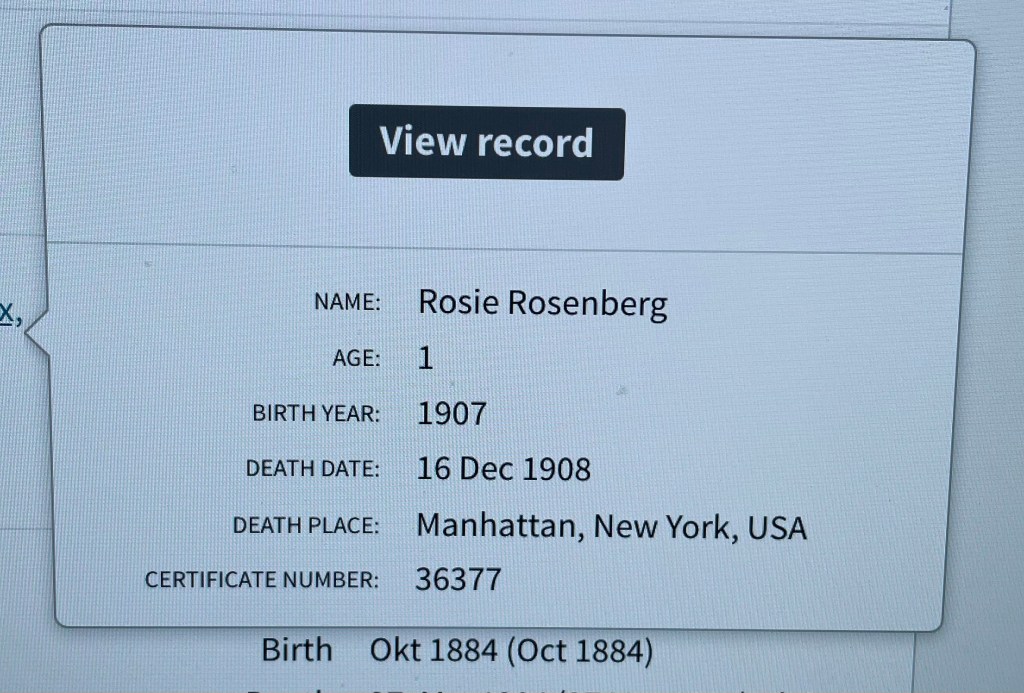
Somewhere out there is more information about my Grandfather’s supposed sister, Rose/Rosie/Rossie, who was born on May 3, 1904, and died before the 1910 US census. 

First, I have to start by saying, I have known for a while that though we were told my grandfather was the oldest of six siblings, I know that he was actually the third oldest of 8 siblings who lived to adulthood.

I also know that his mother gave birth to 12 children.  For three I have no records, so I assume they were still births.  However, for one, I have a name and a date of birth.  Rose/Rosie.  That name touches my heart.  My father’s nickname when he served in Korea was Rosie.  To this day when I visit a memorial stone I put in the local Korean War Memorial, I always bring a rose.

But he never knew he had aunts who died tragically young: one named Celia, who lived to 24, (see blog below) and Rosie, who probably only lived for a couple of years or less.

But I cannot find Rosie except for this one document which includes her birthdate and her parent’s names.  I know it is correct, because it has Sarah Ritt/Rith for the mother’s maiden name. Also the family did live in Brooklyn in Kings County. I am not sure about the street. I know at one point they lived on a Sackman Street. But that was later. And I have found that this family seemed to move a bit.

Also I know Rosie was born before the youngest daughter Minnie/Muriel.  I remember seeing her name in a list of the family members at some point after 2017.  At that time, I wrote a blog about searching for my grandfather’s family.  Someone sent me an email or a private message with information about all the children from research he/she had done.   At the time I did not believe it was correct because I was still under the assumption that grandpa was the oldest of six, not the third of eight, or even nine.  But somewhere along the way I have lost that document.  And now I need it.

That teaches you to have absolutely NO assumptions about your family’s history and to never disregard a document.

I have found several Rosie or Rose Rosenbergs who died between 1905 and 1909. I am not sure if any of them is my family’s Rosie. Since her sister, Celia, was buried in 1920 at Montefiore Cemetery in the Queens, I was hoping to find Rosie there as well. But the only Rose Rosenberg buried in Montefiore, Springfield Gardens, had no date of birth or death. Could it be her? The memorial ID number is 148979659. But there is no other information or photo.

I am hoping someone who researches better than I can find out more about Rosie! I used Ancestry and Family Search as the two sources for the information I do have. Thank you!

Some of My Paternal Family Mysteries Solved, But Not All

18 Jul

For more years than I care to share, I have been searching for answers to my paternal grandfather’s many family mysteries.  My grandfather did not want to talk about his family.  My grandmother, his wife, was the one who told me the little bit she knew, with a caveat,
“when you marry, check out the family, because you marry them as well.”   ( See links to blogs below.)

Before I go into details, I have to thank Evan Wolfson, my, I think, fourth cousin on my father’s side, for his help!! He had sent me a copy of my great grandparent’s marriage license and said he was doing research at the Family History Center run by the Mormon Church.  On a serious whim, I asked if he could help with my mystery. Over two days he sent me record after record.  I am forever grateful for his help in working on my mystery!!!

What we all thought we knew and what I know now:

Grandpa Harry was born in 1888 or 1889.  No he was not.  He was actually born in April 20, 1890, in New York.   I know this from his registration papers for the military in 1914, where he claimed he was, (and I wrote from what he wrote) “the mostly supporter of my father and mother.”  He was an operator and cutter in his own business, as a pants maker, at 90 Attorney Street in New York.

By the way, his brother Jacob also filled out his registration card for military service then.  But since he was employed as a stenographer at the Brooklyn Navy Yard, he did not go, as he was working in ‘home support.’

Grandpa was the oldest of six children.   No he was not.  He had an older brother, Samuel, who was born in Russia and came to the USA as an toddler.   He also had an older sister, Celia, who was born in the USA, but died when she was about 24 years old of pneumonia and pulmonary edema.  She worked making shirt waists and was single when she died.  She is buried in Montiefiore Cemetery in New York.  We will have to find her one day.

404868_10150550937698566_1584121025_n

Standing: Great Uncle Lenny, Great Aunt Hady, Grandpa Harry, Grandma Esther. Seating are my great grandmother and great aunt from my Grandma’s side.

He was the oldest of the other children.  Grandpa Harry, born 1890; Jacob, born about two years later; Bertha, five years younger, and never married; Edith (Yetta), born 1898 and also never married; Hatti/Hady who was born in 1901 and married to Lenny Greenberg; and finally, Minnie/Miriam/Muriel, who married and had two children.

The other item I now know is that his mother gave birth to 12 children, of which 8 survived.  There is a child who was born in 1904 named Rosie.  But no other listings of her.

The story we all heard was that when Grandpa was in his early teens, his father abandoned the family and went to Seattle. And Grandpa then became the provider for the family, and also traveled to Seattle to find his father.   Probably, maybe for a while, then went back?  Not quite sure.  Here’s what I know.  Grandpa did go to Seattle, we have the photos and the story.  But it was not that early.   Did he find his father?  I am not sure.  Did his father come back for a bit?  Well he was in New York at least till 1915, so who knows what was happening. Perhaps he became ill as he was no longer working then.

I did go to Seattle and did research at the library.  I did find a Abraham Rosenberg there in 1906 who was a tailor, but I could not find the same man again.   I also now know that my great grandparents were still having children in 1901 and 1903.  Hattie was born in 1901 and Minnie/Muriel was born about 1903. And the child born in 1904.

I also know that when my grandfather registered for the military in 1914, he listed the sole support of his mother and father and siblings as the reason he could not serve.  I had heard for years that my grandfather supported all his siblings, many of whom went to college on his dime, while he was just a tailor.

I know they were living together at least until 1915 because they are on a census together.  But by 1920 Sarah is the head of her household, and Abraham is gone.   I wonder if he had gone to Seattle in 1905 after his last child was born, but then came back after my grandfather found him.  Grandpa would have been 16 in 1906. So that is possible.  Then after they got divorced, he left again?  I am only thinking this, I have no proof.  The only fact I know for sure, is that my father always said the only time he met his grandfather we when he showed up the day of his bar mitzvah in September 1941.   He had vague memories of his grandmother. But then she died when he was 8.

The only photo I have of my great grandma. Thanks to my cousin.

My other mystery was knowing nothing about my great grandmother Sarah.  Well I now know her maiden name was Ritt/Writt.  I first saw this last name on my grandparents’ marriage license.  They married on February 25, 1922. Grandpa was 30 and Grandma was 23.

But her certificate of death gave much more.  Her parents were Hirsh Ritt, who was born in Poland and Flora, also from Poland.  Hirsh makes sense as that is my grandfather’s Yiddish name.   Flora is unusual. It also states that Sarah was born in France, which was the first time for that announcement.  In other places she is listed as was born in Russia or Germany.  Still the woman of mystery.

When she died at age 68, on January 28, 1936, she was divorced and suffered from carcinoma of the pancreas.  She was only sick for one month and seven days and died at the Jewish Hospital of Brooklyn on 555 Prospect Place.

My Grandfather was the one who provided the information about his mother.

Thus some mysteries are solved.  And others now stand out.  What do the divorce papers say?  I still cannot find those.  What happened to Samuel?  And Muriel?    And where and when did Abraham go to Seattle or did him?  And where did he live after he and Sarah got divorced?  I had heard he was with another woman?

I knew Hady/Hattie and her husband, Lenny (see blog below.). Edith and Bertha, I never met, but I knew of them as the two maiden sisters. They went to college, but never married. However they gave my uncle the middle name, Prim; and my aunt the middle name, Gwendolyn.

As for Jacob. That will be another blog. Previously, I had found some information about him, and my cousin Evan was able to find a bit more during his research.

Once again, thank you Evan for helping me with my mystery! And a thanksto Tracing the Tribe Group, where I first encountered my cousin.


https://zicharonot.com/2015/06/14/the-sad-scandal-that-forever-scarred-my-grandpa-harry/


https://zicharonot.com/2017/10/25/the-missing-link-in-my-family-history-or-my-biggest-genealogy-block/


https://zicharonot.com/2018/11/16/epiphany-excitement-discovery-disappointment-hope/


https://zicharonot.com/2015/02/18/the-littlest-gambler-learning-about-horse-races-in-the-catskills/