Archive | Yiddish RSS feed for this section

My Grandpa’s Voice Can Still Be Heard

15 May

On November 7, 1981, my cousin made a cassette tape of my grandfather singing his favorite songs in Yiddish.   It sat in my house for all these years. I could never listen to it after he passed away.  Grandpa had a wonderful singing voice and used to sing to us all the time in Yiddish.

Two months ago, I took the cassette tape to a company that turned it into a CD.  I got it back on Friday.  On Mothers’ Day, I listened to my Grandpa sing in Yiddish and listened to him speak about his life in Europe and coming to the United States in 1920.

He passed away in 1989, so it has been a long time since I heard his voice.  It was just as I remembered it.

Listening to this tape was interesting in many ways.  Most of the stories he told, I have heard before.  I had spoken to my Grandpa about his life in Europe many times.  I just never recorded him.  I am extremely grateful that my cousin made this tape.

He sang six songs.  Tumbaliaka, Hativah in Yiddish, Ofin Primpinchick,  Yiddisha Mama and two others I had not heard before.  He left out some I remember him singing. But it doesn’t matter. Hearing him sing these favorites is a gift.

Grandpa left his home in 1918.  He was the oldest of five children who lived on a 16-acre farm, that they owned, in Austria.  He said if he had stayed in Austria, he would have eventually had two acres for him and a place to build a house.  (I wrote about Grandpa leaving Europe in an earlier blog, see link below.)

When he first arrived in the USA, he lived with his uncle Morris and went to work as a butcher.  A farm boy, he knew about animals.  He worked for $4 a week.  He did not know English.  It was a job he did not like.  A month later, he switched to being a baker for $20 a week on Flushing Avenue in Brooklyn.  (I never knew the address in Brooklyn. ) He was lucky. He had relatives who were both a butcher and a baker.  And they provided him with jobs.

Grandpa was brought up to follow the rules of Shabbat, although they were not extremely religious. He had no beard or payos.  But when he first started working at the bakery, he had to light a fire on Shabbat.  “I sat there and cried,” he said, “because my Mother always told me that if I light a fire on Shabbat I would die.”   He did not die, so the following week he lit the fire without crying.

Grandpa excelled at baking.  But he said he was very bashful.  People would say to him, “Do you want to meet a girl,” and he would say yes.  But they did not work out.  Then, by accident, he met our Grandma in Brooklyn.  He went to deliver a gift to someone, and there she was.

“Before Thelma, I did not look for someone. But when Thelma came it was different.  Something drew me to her,” he said.  “I was 25, she was 18 or 19.  To look at, she was nothing.  But it is the person she was. Someone made for you.”  (I disagree. I think my young Grandma was lovely.)

They got married in September 1925 and lived in Brooklyn, till my uncle was born. Then Grandpa opened his own business in the Bronx, where they lived for five years. And my Mom was born. In 1929, they moved to Linden, New Jersey.  My grandparents opened a new bakery.

But they had it for only about 18 months.

My grandmother was ill.  Grandpa said she had to go back to Europe to see a Dr. Lapenski in Krakow.  He could help her.  She was sick from the fumes from the gas in WW1.  I honestly had never heard that story before.  (I wrote about her time in Europe in earlier blogs, see links below.)

When Grandma came back, they moved to West New York, New Jersey, and opened the bakery they would have for almost 30 years.

“I wanted my children to have a better life,” Grandpa said.  “My Mom did not know that I had to learn to read.  I worked on a farm.  I had no education.  My parents said, you know how to work in the field that is enough.  My Mom thought I would stay in Europe.  She did not know that I would leave.”

My cousin asked if he was afraid to come to the USA by himself.  He started to laugh.  He was not afraid.  “It could not be worse than where I was,” he said.  “It had to be better.”

He told us a bit about his younger siblings and his parents. But the main discussion was the fact that none of them survived.  “I could not convince them to come,” he said.

As for his wife’s parents, my other great grandparents, Grandpa said, “From the day I got married I had to support her family.”  Which is true. Her mother had died during WW1.  And her father, was an educated man.  He studied.  “His wife made a living for him,” my Grandpa said.  When she died, there was not much income.

The tape was made just over three months after my grandmother died.   It was strange to hear Grandpa say her name.  He never said it when she was alive, to keep the evil eye from getting her.  He was still in deep mourning.  They had always thought he would die first as he was six years older.  But instead she died.

“You struggle and you pay for those things you did,” Grandpa said.  “Maybe I did something wrong.”  This was his explanation on why she died before him.  It made me so sad to hear him say this.  I remember how desolate he was without her.  (See Autumn Leaves blog link below.)

My cousin asks questions. Some Grandpa answers.  But he made his point.  He loves his family.  “I accomplished my mission.  I would have my own home.  And I did more than that,” he said.  He got to see four of his five grandchildren marry.  He saw the arrival of six of his eight great grandchildren.

Before he ended the tape, he sang one last song.  He sang of traveling the world, always  wishing he could go home and kiss the stones where he was born.  My cousin asked if he would want to go back to Austria.

His answer, Yes and No. (Grandpa told me that he never wanted to go back there.)

Hearing my Grandpa talk about his family; his children, and his grandchildren was bittersweet.  I made CDs for my siblings and cousins.  I think they need to have this experience as well.

https://zicharonot.com/2016/06/06/the-mysterious-kalsbad-photos-who-are-they/

https://zicharonot.com/2014/06/25/how-world-war-i-saved-my-family-or-my-grandpa-was-a-draft-dodger/

https://zicharonot.com/2015/02/23/the-melody-of-autumn-leaves-haunts-me/

The US Passport: A Matter of Life

A Chair, A Baby Grand Piano and Yiddish Songs

Zysel/Ziesel Feuer, Survivor

1 May
img_7280

The document that Scott G. shared with me.  Zysel is line 79.  I know that Lejzor Feuer, line 77,  was also a cousin.

I am thinking a lot about Zysel/Ziesel Feuer this week, a cousin of my grandfather’s who survived the Shoah.  This weekend another Tracing the Tribe member, Scott G. shared a document with me that lists the names of the survivors from Mielic, Galicia, Austria/Poland. And on that list is my relative: Zysel Feuer.  Even though I knew he was a survivor, seeing his name on that list just broke my heart.  I see him again in my mind, and I am sad.

Scott is working on a project to get all the names of survivors and victims of the Shoah from Mielic, Austria/Poland. I contacted him with the names I could share.  My grandfather’s entire family except for a few cousins died. The last names Amsterdam, Feuer, Brenner and Hollander were all in some way related to me.  And many perished.

I have written about Ziesel before.  He went to Israel after the war.  And lived there until his death.  I met him when I went to Israel for my sophomore year of college in 1974.  I would visit him in Tel Aviv, whenever I went there from Jerusalem where I was studying.  I first met him because my grandmother sent me on a mission.  I wrote about that in an earlier blog (see link below).

When my parents came to visit, during my winter break, I took them to see Ziesel as well.  His roommate, also a Holocaust survivor, was home when we arrived.  With no phones it was difficult to make definite appointments.  His roommate told us that Ziesel was at shul davening and we should go and call for him.  My Dad was embarrassed.  So, the man went with us.
“Ziesel, Ziesel Feuer,” he called through the doorway.  “Come here, your family is here.”  Of course, he called for him in a loud Yiddish/Hebrew whisper.  “Ziesel, Ziesel, comen ous, eir mishpacha du.”

My Dad told that story for years.  Standing outside a small shul in Tel Aviv, watching the elderly men daven. And having this embarrassing moment.  I however, was not embarrassed.  Not me, six months in to living in Israel in 1974-75 and nothing surprised me anymore.  Having to call someone out of services was no big deal.  I knew he wanted to see my parents. We had discussed their visit when I last saw him, and I promised to bring them to his apartment. He was especially looking forward to seeing my mother.

Ziesel left services as soon as he saw us.   We all walked back to the apartment.  Dad and Ziesel speaking Yiddish. Mom adding a comment or two.  They spoke about the Shoah and what had happened to him. And my mother cried. I do remember how happy he was that we came to visit him.  We had cake and tea, and then we left. For my mother it was especially difficult.

Ziesel lost his family in the Shoah.  His wife and children were murdered.  He could no longer have any other children. He told me that the Nazis did terrible things to him.  He did not remarry.  When I met him, he was working in a bakery across from the shuk in Tel Aviv. I now know his wife was Dvorah, my grandfather’s first cousin. The daughter of Zachariah. Ziesel entered her in the Yad VShem data base. But not his children.

Now I wish I could go back in time to my 19-year-old self, and say, “Ask more questions!  What did he do when he got to Israel.   How did he get there?  Ask more, be more interested.” But I was just 19. Whenever I saw him, he would mainly ask me how I was doing.  He was more interested in me, than I realized at the time.  I gave him family for a year.

I do know that it was  Zysel/Ziesel  who contacted my grandfather after the war.  It was Ziesel who told him that everyone had died.  My grandfather only had four cousins who survived.  Ziesel and one other are on this list.  The other I did not know well. But Ziesel was part of my life.  Although I have no photos of him, I really do not need one. He looked so much like my grandfather. They could have been brothers, not cousins.

In 1976 I took my grandma to Israel to see her brother and her family. (See link below.) She also went to see Ziesel.  That was a different type of meeting.  Ziesel had stolen something from her in 1931.  My original contact with Ziesel had to do with him paying off that debt. Their meeting was more an acknowledgement of the debt being paid and the past released. I think he felt relief after speaking to my grandma.

I was not a part of their conversation. That was the last time I saw Ziesel.

https://zicharonot.com/2014/07/06/a-strand-of-pearls-is-not-just-jewelry-it-is-a-circle-of-love/

https://zicharonot.com/2014/04/28/speaking-yiddish-always-brings-me-holocaust-memories/

The US Passport: A Matter of Life

4 Dec

I recently saw the documentary, “Big Sonia,” about a local Kansas City area woman who survived the Holocaust and three concentration camps from ages 13 to 19; how she and her husband started their own tailor shop; how the tailor shop became an important part of her life; and how the Holocaust impacted her life, her family and those around her.  Although I do not know Sonia, I do know her sister-in-law, who belongs to my congregation.

Both Sonia and Ann are contemporaries of my Mom.  And when I hear of their Holocaust survival story, I cannot help but think, “there for the grace of G-d, could have been my Mom.” But she would have just been 10 when the horrors really began, and she might not have survived.  It stabs at my heart.  Here is why:

img_5529

When I look at the smiling children in the 1931 passport, I feel fear in my heart.  They are my Mom and my Uncle.  My grandmother is getting ready to take them to Poland.

In 1931, most Jews in Poland and Europe were not yet concerned about escaping. Although Hitler’s rise to power was advancing, he did not become chancellor of Germany until January 1933.  Thus, I guess in some ways, my Grandmother was not afraid to take her two small children, my Uncle, who was 4 ½, and my Mom, who was 2 1/2, to Europe to stay with family while she tried to regain her health.

Boat to Europe 1931

The kneeling sailor is speaking to my Mom;  behind her my Uncle; behind him my Grandma.

I always knew this had occurred. I have seen the photo taken of my Mom and Uncle on the ship to Europe. I knew that my grandmother almost died aboard the ship on the way to Europe. I have seen several photos of my grandmother in Kalsbadt and with family members during that trip.

Both their visa and Passport were issued on May 18, 1931.  I think their visa was good until May 18, 1932.  This part of the Visa is in German. Since my Grandfather’s family lived in the area of Galicia which was then Austria, it makes sense. They arrived in Europe on May 26, 1931.

I heard the stories of my Mom and Uncle coming back from Europe only speaking Yiddish. Their English left them while they spent six months with their paternal grandparents.  This would not happen again, as these grandparents perished in the Shoah.

img_5528

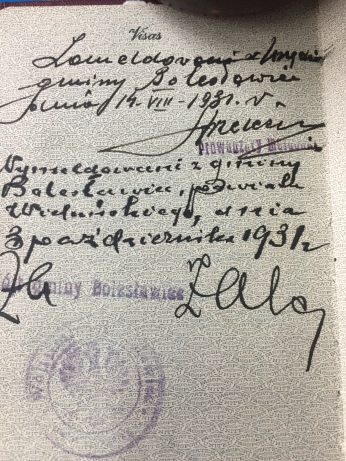
This registers my uncle and mom as living in Boleslawiec.

But now that I have the Passport, and have had part of it translated,  I know that this story is not totally true.  They spent at least two and half months in Boleslawiec, Poland,  from August 14 to October 3, 1931.  This is where my Grandmother was born.  They spent at least that time staying with their maternal grandfather and his children. That was a surprise.

So at some point, my Grandmother traveled across Europe with two small children, going from Mielic, Galicia, Austria, to Boleslawiec, Poland.  WOW.  I wonder how the trains were then.  I am sure she went with her American dollars and was able to travel easily.  But the idea of them on a train in Austria and Poland sends shivers through my body.  I can so easily image the other members of my family who traveled on much less kind trains a number of years later to their deaths in the concentration camps.

I also knew it was this trip and her visits to the mineral waters of Kalsbadt that saved and cured my grandmother.  Her experiences in Europe over these months also made her resolute to get as many family members out of Europe that she could.  Unfortunately, she was only successful in rescuing her father and sister.  Her in laws refused to leave, and they perished.

However, until I held the Passport that jointly named my Uncle and Mom as USA citizens and saw the visas, I somehow did not quite fathom the enormous consequences.   This passport was only valid for two years. What if they had been stuck in Europe? I had asked my grandfather when I was younger what he would have done if Grandma died in Europe.  He assured me that he was not going to leave his children in Europe.  He let her go because she was ill, but his children would return to the USA.

That always made me feel better, as the family they stayed with, my grandfather’s family, all perished.  I always believed that Grandma took the children to her in-laws and traveled by herself.  But that is not true.  She also took them to see her father and siblings as well. And miraculously my Grandmother’s two brothers and their wives survived even though Grandma could not get them out of Poland.

The Passport was originally made out only for my Uncle in May 1931.   I found that strange.  Was my Grandmother going to leave my 2-year-old mother with my grandfather in the States, while she traveled with my Uncle?  What changed her mind? I will never know that story. I found the Passport long after my grandmother had passed away.

I do know that they came home.  They arrived back in the USA on October 13, 1931. I can see the US Immigration stamp. The trip itself took a week or so crossing the Atlantic.  They grew up in New Jersey.  They married. They had children and grandchildren. Their memories of Europe faded quickly.  Perhaps my Uncle remembered more, but for my Mom it was just stories she heard.

My Mom did not go through the horrors and Hell that Big Sonia experienced.   Her American Passport and visa and ticket to return saved her and my uncle.  In 1936 Mom went with my Grandmother to Ellis Island to gather my great grandfather and Tante (great aunt).  My Grandmother was successful in saving them.

Not everyone had a life saving Passport. I often think of those who perished.   I still remember the day I found out about the Holocaust.  I cannot forget.

With the vitriol and anti-Semitic language and acts of bullying throughout the country, I think it is important that no one forgets.  Everyone should go and see “Big Sonia” and learn about real courage, and the horrible consequences of baseless hatred and bigotry.

Thank you to members of the Facebook Groups: Tracing the Tribe and Jewish Ancestry in Poland for the translations.

http://www.bigsonia.com

https://www.facebook.com/bigsoniamovie/?fref=mentions

https://zicharonot.wordpress.com/2016/06/06/the-mysterious-kalsbad-photos-who-are-they/

https://zicharonot.wordpress.com/2014/04/28/speaking-yiddish-always-brings-me-holocaust-memories/

Kuk Eyn:  Give a Look

26 Dec

“Kuk eyn!” My grandma would say when she wanted my Mom to look at something quickly, usually when we were out of the house in public place. Kuk eyn, two Yiddish words that mean look, eye.  But when Grandma said it, it meant, “Look now, give a look!”

“Kuk eyn!” my grandparents said as thousands of young people walked past our summer home on the way to Woodstock. “Look at them, what are they doing?” Is what they added to their two word exclamation. Everyone was looking at the mass of people walking by.

Kuk eyn, when we were shopping and someone was acting or dressed unusually. Kuk eyn in synagogue if someone dressed inappropriately. Kuk eyn whenever something out of the ordinary happen.

These two words were a signal, a notification. Sometimes they meant, “Watch out! Something is happening!” Whenever I heard Grandma or my Mom said these words, I always looked up with interest. I knew something was up. They were a secret code to pay attention.  “Kuk eyn” in a whisper, “be careful, watch out.”

Kuk eyn.  Give a look.  After grandma died, my Mom continued to use the expression with my sister and me. It was almost always said quietly. Not to draw attention, but to point something out. A whisper in my ear.

My mother has passed away, but I still say it to my sister and daughter. The first time I saw someone with brightly colored hair, when I took my daughter to college to begin her freshman year, I said it to my daughter. The girl with bright pink hair became one of her best friends. It is so common to see pink and purple and peach and blue hair now, I do not even react with a “Kuk eyn.”

Sometimes a “Kuk eyn” is coupled with a nod of the head in the direction to look. A sweep of the eyes to the side was another indication. It was our way to communicate without drawing attention.

Occasionally the words were said in an joyful voice to point out something we really liked. A sort of, “Wow! Look at that!”

Like most of the phrases I know in Yiddish, these two words, said with different inflections, have so many meanings.

There have been times I have been out with friends who do not know Yiddish, when I so wish I could say, “Kuk eyn.”

The Rosh Hashannah Card Has A Story

1 Oct

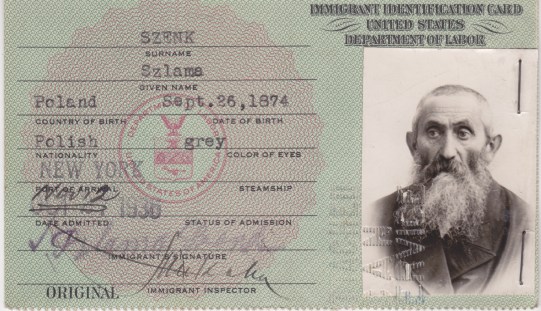
szenk-1936-shana-tova

In 1936 my Grandma Thelma’s siblings sent her a Rosh Hashannah card from Poland. On the front is a photo of her siblings. Seated are her brother Isaac and his wife, Bronia. Standing are her youngest siblings David and Esther. Soon after this photo was taken the world really began to change.

This photo looks so peaceful and calm. But so much was going on behind the scenes. Plans were already being made. Getting out of Poland was their main goal.

My Grandmother worked diligently to get her family out of Europe. She and my grandfather owned a bakery and had two young children. Grandma had taken her children to Europe in 1931 and since her return had been searching for ways to rescue her family and my grandfather’s family. It was very difficult.

Eventually, she got documentation to bring my great grandfather Abraham (her mother had died young) and her younger sister, Esther, to the United States. Esther was older than 21, but she was very tiny. So they made her younger. And thus she was able to come with her father.

The age difference was a bone of contention for years. My Tante always stating her ‘fake’ age, my grandmother always correcting her. It was made worse by the fact that my Grandmother had traveled by herself to the USA in 1922, when she was only 16. To get the papers she needed, she made herself two years older! The war over their ages went on for years.

It was great until Tante wanted to retire. Truly she was 65, but legally she was 62. I remember this as my Grandmother and Tante would argue about this as well.   Like sisters, with love, they found many things to argue about.

Front Great grandpa USA Visa

In any case two were saved. I have my Great Grandfather’s passport and visa. In the passport it states that he has to leave Poland within a certain time or the visa is invalid. Luckily my grandparents also sent money. Saving family was utmost in my grandparents’ mind.

But my Grandmother was unable to rescue her brothers and bring them to the USA.   They decided that they had to leave Poland: Uncle Isaac and his wife, Bronia, along with David and Bronia’s sister, Rosa. The Rabbi said that David and Rosa must marry before they left Poland. So a quick wedding was held.

They escaped Poland to Russia. Not as great, but they were tailors…or they became tailors. And so, my grandmother would say, they were employed to make army uniforms for the Russian army.

Their lives were not easy. They suffered. But they survived. Many were not as fortunate.

After the war they wanted to leave Europe. They were in Italy and the Facists were on the rise. They were afraid. They wrote to their sisters in the United States, and to Bronia and Rosa’s sisters in Australia. They decided whoever sent documents first , they would go to that country. They just wanted out of Europe as quickly as possible.

Once again they were among the fortunate ones with sisters on two continents working to save their siblings. The sisters in Australia got documents first. My great aunts and uncles moved to Australia. There my cousin was born. There my Uncle David passed away when in was in his 30s. He is buried in Melbourne.

When my cousin was a child, they decided to move to Israel. My Great Uncle and his wife; his sister in-law, and niece. My cousin and her family still live in Israel. My grandparents, great aunts and uncles have all passed away. But when I look at this Rosh Hashannah card, I see hope. I wish everyone a blessed, happy, healthy and sweet new year.


To read more about the family:

https://zicharonot.wordpress.com/2014/04/28/speaking-yiddish-always-brings-me-holocaust-memories/

https://zicharonot.wordpress.com/2015/11/03/who-are-you-these-photos-call-out-to-me/


https://zicharonot.wordpress.com/2014/05/29/grandma-thelma-knows-what-she-knows/

The Kauneonga Lake Temple BethEl Recipe Book

12 Aug

I found a treat today. I decided to clean out my cookbooks. My daughter is getting married in a few weeks, and I am in a nesting mode. Sort like when I was pregnant. Now I am cleaning out my house and getting ready for hordes of guests.

I decided to clean out my cookbooks. There are many I have not used in years. I offered some to my daughter, but she informed me that she gets her recipes off the Internet. Fine. She does not want my cookbooks! I will give them to someone who wants them. And will appreciate them. But there are a few I will keep!

I like cookbooks, especially because some have much meaning and memories. I have my mother’s Settlement Cookbook. Probably the best cookbook ever made.   I have kosher cookbooks, healthy cookbooks, vegetarian cookbooks, light meal cookbooks, as well as a variety of cookbooks put together as fundraisers by various charitable organizations.

image

It was in the midst of these spiral notebook style cookbooks that I discovered a tiny treasure, “Cooking Favorites of Bethel,” put together by the Sisterhood of Temple Bethel, Bethel, New York. This is the congregation I belonged to throughout my childhood when we spent our summers and High Holidays in the Catskills. My grandparents lived in Kauneonga Lake throughout the year and davened at this small shul. I rejoined many years later as an adult to help support it.

I know this book is at least 35 years old, because my grandmother died in 1981. But it has to be older, based on the names of some of the women who contributed recipes. They passed away before my Grandma Thelma, like Clara Wagner. I close my eyes and I see Clara. She was Grandma’s best friend.   They spent many hours sitting and visiting. My Grandma was heartbroken when she passed away.

Then there is Nan Dasher, besides cooking, she would embroider tablecloths. Which she did constantly. I have two tablecloths she made. One specifically for me when I married, and one I took from my mother’s stash after Mom passed away. Nan lived in the White Lake Estates, not far from my grandparents.

So many other names of women I knew when I was a child submitted recipes: Lenore Liff, Yetta Gruber, Mrs. Elfenbaum, Goldie Lerner, Rebecca Rosenberg and more.

But the most exciting and enjoyable for me was finding my grandmother’s name in the book. Thelma Amsterdam contributed four recipes. HA! These recipes are a sort of lie! Grandma did not cook. Okay she cooked but not very well.

I still remember the trauma over this cookbook. Grandma had to submit recipes. She was an important member of the Sisterhood and needed to show she cared. I remember her coming to my Mom to get recipes. There they were sitting in the kitchen and writing down recipes that Mom gave her. The recipes that have my Grandma’s name, every one of them is from my mother. There is my Mom’s simple baked macaroni recipe. I still make it!!!! Even though I cannot eat dairy I have made it for Yom Kippur break the fast, and for shivas. It was so easy! However, Grandma NEVER made this meal.


recipe

So when I saw the four recipes she submitted I was filled with the laughter of remembering Mom giving her the recipes. I was filled with memories of my Grandma’s horrible cooking, although she could make the best mushroom barley soup and Pesach noodles. And I remember this book being put together and then published.

I should also tell you that this book is in perfect condition. I don’t think my Grandma ever opened it after she purchase in the effort to support the congregation and its sisterhood.

I honestly do not know when I got it. But I have a vague memory of Grandma giving it to me when I got married. Okay, I never used it either. It is so small it got hidden among my other cookbooks.

I am glad in a way, because now I have this tiny memory in such pristine condition. With it are many memories of Kauneonga Lake and going to shul!

Forks in the Flower Pots; Or Why I Keep Plants By My Kitchen Sink

10 Aug
image

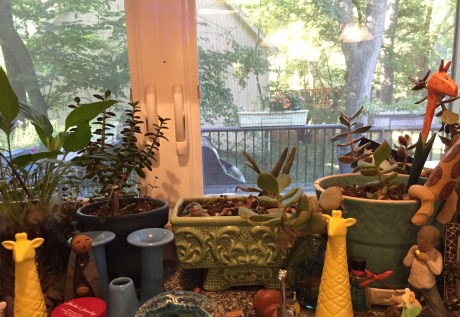
My kitchen window with my grandmother’s planter is the green one in the middle.

Above my grandparents’ kitchen sink in West New York, New Jersey were a variety of flower pots filled with plants.  But often interspersed among the plants were utensils.  Usually forks, but sometimes knives and spoons.

image

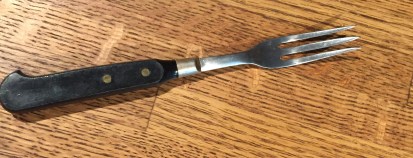
I own one of my Grandparents’ goupls.

When I was very young I remember thinking that my Grandma was special as she could grow metal in her pots. I especially wanted her to grow more of the special forks we called goupls, that we used in her home.  They had really thick and interesting handles. I thought goupl was a special name for this fork. We did not call the other forks, goupls, just these forks.  I found out when I was older that goupl is Yiddish for fork.

Usually standing upright, prongs in the dirt, were two or three forks each day. Amidst the plants the glow of silver.  Why?  My grandparents kept kosher. Meat and dairy is kept separate. My grandparents had utensils for milk meals and another set for meat meals. If they touched when they were wet, they had to be rekashered….made clean to use again.  One way, according to my Grandma,  is to bury it for 24 hours.  Grandma buried it by sticking the unclean item in a flower pot.

In reality, I think this was my grandmother’s interpretation of ne’itzah, a type of koshering for knives when you push them in dirt several times. Grandma just kept any utensil buried and unused.

My mother also kept plants in her kitchen at our hoe in North Bergen. But she did not keep kosher so there were never forks in the flowerpots. However having the plants was important to both my parents.  My Dad was always potting and repotting plants.  Plants freshen the air of your house according to my Dad. So besides helping to keep kosher, plants keep you healthy!

When I married, my husband and I decided to keep a kosher home. When we purchased our house a big draw for me was the window ledge above the sink.  A wonderful place for plants. But to be honest, I very rarely have put a fork or spoon or knife in a flower pot. However, they are there in case I need them.

image

My mother-in-law’s aloe plant.

Besides my kitchen sink plants, I have other plants including an aloe plant that is over 50 years old.  I have had it for 31 years. But before that it was my mother-in-law’s kitchen aloe plant.  I inherited when she passed away at only 59.  Aloe plants are important in the kitchen. My parents also had one.  If you burn yourself, you can quickly go to you aloe plant and break off a piece of a leaf. The thick goo is a healing source for burns.

Plants in my kitchen remind me of my grandparents, parents and in-laws.  Although I might not have forks in my flowerpots, I do have one of my grandmother’s flowerpots on my sink window.  My daughter is getting married in a month.  She has a window above her kitchen sink.  I plan to buy her a plant as a housewarming gift so she too can have flower pots in her kitchen.

A Chair, A Baby Grand Piano and Yiddish Songs

2 Aug

image

As the oldest granddaughter, my grandmother made it clear that I would inherit my grandparents’ cherry mahogany bedroom set. The most important pieces of furniture that came with it were my grandmother’s vanity and the small chair that goes with it.

The swivel chair is covered in a gold silk fabric. It is now a bit tattered, but I will not change it. In this chair my grandmother held me at night and sang Yiddish songs to me before I went to sleep.

She usually sang “Oif’n Pripetshik,” a song about children learning in their alef beiss, the alphabet. Even now, over 50 years later, listening to this song calms me. I feel my grandma’s arms around me; I smelled her scent; I feel the softness of her hair and her breath in my ear as she sings and slowly spins in the chair.

If one song did not get me ready to sleep, she would start singing, “Rozhinke Mit Mandlen.” I tried to stay awake so she would have to sing me both songs before I got into bed. When I was very young I slept with my grandmother.   I loved being with her in the winter under the big feather bed! I still have the one pillow left that was made from that giant duvet over 50 years ago. (See link to blog below.)

My grandparents kept the traditions they grew up with in Europe: Two twin beds, always. Grandpa would get up very early in the morning to go to their bakery and make the fresh bread and pastries.  Their apartment was on the top floor of the building that housed their bakery in West New York, New Jersey, right on Palisades Avenue.

Grandma would stay in bed with me a bit longer. Before she left she always whispered, “Remember, when you get up, get dressed and come down to the bakery.” Then a soft “Geh shluffen.” And she would be gone as well.

My grandfather also sang to us in Yiddish. He had a beautiful voice. Among his favorites to sing were “Tumbalalaika,” “Eli, Eli,” “Die Greene Koseene,” “Belz, Mine Shetele,” and “Wus Geven is Geven Un Nitu.”

Sometimes we would sit with him and sing together. Other times we would just listen. Occasionally, at a synagogue dinner in the Catskills, he would sing his Yiddish songs for the congregation. I remember once for my parent’s anniversary he sang several songs. But my Mom got very upset when he say, “Wus Geven is Geven un Nitu.”  I honestly do not think he meant to hurt her feelings.  He just loved to sing that song.

My grandparents had a beautiful carved walnut baby grand piano. The keys made of ebony and ivory. It was my Mom’s piano. She studied as a special student at Julliard when she was in high school. And even though she loved to play the piano, she went to college to learn to be a teacher instead of continuing at Julliard.   My grandparents felt teaching was a much better professional for a young woman in 1947.

I also learned music on this piano: years of lessons. I was never as good as my mother. But I did learn to love it. My teacher was kind. He let me chose the songs I wanted to learn. It was obvious that I would never be a concert pianist.

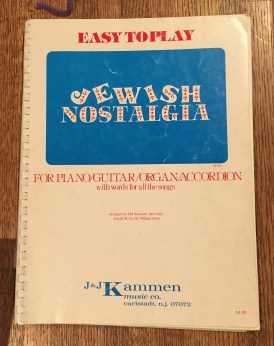
When I married, the piano and the bedroom set moved to my home. When I was pregnant with my daughter I would play the piano every day. I often played from a book of Yiddish music: “Jewish Nostalgia For Piano/Guitar/Organ/Accordian” published by the J & J Kammen Music Co. Sometimes I could feel my daughter kick within me as I played her favorite songs.

I know that she heard the music! After she was born, when she was fussy, I would bring her into the music room and play “Oif’n Pripetshik” for her. Within minutes she would be calm listening to the music.

My grandfather, Papa, lived until she was 3 ½.   He would sing to her in Yiddish as well. She does not remember much about him. But he would hold her close to his face while he sang.   What she remembers is that “Papa had a scratchy face.” He did not shave as often when he was in his late 80s.

When she was old enough, my daughter also took her first piano lessons on our family’s baby grand piano. Like me, she was not meant to be a concert pianist. But we both learned to love and read music while learning to play piano. I would often play music for my children when they were little. I often would play the Yiddish music of my childhood.

Over the years, many people have come to visit and would play the piano.   One childhood friend came to visit several years ago.   She asked what happened to my Mom’s piano.   I took her into my living room to see it.  She cried as she stood in front of it.  There was so much love invested in my piano.

I am so fortunate.  I have a chair to sit in to remember when my grandmother sang to me; a piano to play the music that my grandparents taught me.  I have the  Yiddish songs that I continue to hear in my mind and sometimes still play on my piano. Amazing memories and sounds of Yiddish songs from just looking at a chair and a piano.


https://zicharonot.wordpress.com/2014/06/08/why-i-love-my-pillow/


The Mysterious Kalsbad Photos: Who Are They?

6 Jun

June 26, 1931. My Grandmother was in Europe with my Mother and my Uncle. She left them at the farm owned by my great grandparents in Poland while she went to Karlsbad (Karlovy Vary), Czechoslovia to take the waters and revive her health.

The doctors in the United States told her that she was going to die. She had been pregnant again in the USA. But doctors terminated the pregnancy through a very illegal abortion in an effort to save her life. But still she was sick. So she decided she would not burden my Grandfather with two young children, 5 and 2. She would take them to Europe to live with his parents and she would die there. He, then, would be free to continue his life.

I once asked my Grandfather, why he let her go. “She was a sick woman,” he told me. “I had to let her do what she thought was best.”

“Would you have left Mom and Uncle Stanley in Europe?” I asked. This was a very important question. His entire family perished. If he had left them, I would not be here.

He looked me in the eye, and said, “As soon as she died I was going to get on a boat and return with my children. I would never leave them there. “

His words made me feel a bit better. But if Grandma had died the world my Mom and Uncle lived in would have been very different. But at least I know my grandfather would not have abandoned them in Poland.

Luckily Grandma did get well. She stayed in Europe for six to eight months and then returned to the USA with my Mom and Uncle. She saw the rise of Hitler coming and now had a new purpose: get the family out. She could not save as many as she wanted. But she tried.

Grandma Thelam, Carlsbad

Grandma is sitting in the front. The date and place were added by my Mom. I think the two women are related. This is the photo we knew about.

We have several items from that trip to Europe. We have a ceramic vase that stays in her breakfront/curio cabinet in our Catskills’ home. We have stories about the trip.  We have a few photos. We knew of one. Grandma is with two other women. We have no ideal who they are. But I think they are related to her, one women sort of looks like her sister-in-law. We are not sure. There is no identifications on the back.

But I recently found another.

FullSizeRender (10)

Grandma is in back row on the left wearing a white hat.

It is a group photo. In the very back row, near the center is a woman in a white hat, that is my grandmother. She is 26 years old.

I do not know the other people. Are they family members who perished? Or are they just other people who are in Karlsbad? Sometimes I imagine that they are just other people at the resort who were pulled together for a group photo that the photographer would then sell to tourists.   Other times I imagine that people in the photo look like family, especially the man in the front on the left. But I honestly do not know.

This photo is different from the others we have from that trip. There is writing in Yiddish and English. The English is easy, her name and the address where she stayed in Karlsbad. Or is it a place she visited?

The Yiddish is more exciting to me. It is the only letter I have seen that she wrote to my Grandfather. (Thank you members of the Tracing the Tribe Facebook Group for translations!)

It says: “As a souvenir from your faithful wife, who hopes, to meet you again in good health.” Another translated it as “A souvenir from your devoted wife, who hopes to return to you in good health.”

Either makes sense. She was sick. She was away from my grandfather. She wanted to be reunited with her family and be healthy.

And that all happened. She returned to the US and lived an additional 50 years. And 80 years later, I keep finding treasures in her photo album!


https://zicharonot.wordpress.com/2014/04/28/speaking-yiddish-always-brings-me-holocaust-memories/

Drinking An Ooglie Mooglie/Gogli Mogli Always Made A Sore Throat Feel Better

11 May

Recently while at lunch with my Kansas Yiddish buddy, we were talking about how some children did not like eggs and the ways their mothers snuck eggs into their diet.

I told how my husband hated eggs so much, his mother would make him chocolate chip pancakes so that he would have eggs without knowing. Not such a harsh way to eat eggs! In fact, I laughed about it. But it was a tradition my husband continued with our children.  Scrambled eggs were not the right Sunday morning breakfast in his mind,  you gave your children pancakes and biscuits to have them eat eggs.

My friend’s mother had a sneakier way to get her to eat eggs. My friend would drink a malted after school each day. Her mother would mix a raw egg into my friend’s malted. She was surprised that her mother would do such a thing. When she found out what her mother was doing from her young uncle, she never trusted those special drinks again.

“It was a good thing I never got salmonella,” my friend said.

But then they did not think about salmonella over 50 years ago….okay I am giving away our ages.  In fact, serving raw eggs was considered a delicacy. Personally, I was not surprised about putting raw eggs in a drink. I asked her, “Well didn’t you ever have an ooglie mooglie?”

“What are you talking about?” She said as she looked at me as if I was crazy.

I could not believe she never had one of this special ‘treats’ when she had a sore throat or cold. Raw egg mixed with sugar and beaten till it was smooth and frothy, an Oogle Moogle or Ooglie Moogli was a treat that I had on occasion from my grandmother.  But never from my own mother.

However, when I lived in Israel during my sophomore year of college, I had many occasions to have an Oogle Moogle from my great aunt and uncle.   Holocaust survivors, they often made this treat for their daughter, who loved them. She would have them all the time if she could.   I remember the first time they made one for me,  I was so sick.  She wanted one as well!   But they only made one for me!  It was delicious.

I told all this to my friend, and to prove I was not crazy, I googled (LOL) oogle moogle. And there on Wikipedia was an entire page devoted to this treat, I show the first paragraph here:

“Kogel mogelGogl-MoglGogel-MogelGogol-Mogol (Russian: Гоголь-моголь), Gogli-Mogli, or Gogle-mogle (Yiddish: גאָגל-מאָגל‎) is an egg-based homemade dessert popular in Central Europe and Caucasus. It is made from egg yolkssugar, and flavorings such as honeyvanillacocoa or rum, similar to eggnog. In its classic form it is served slightly chilled or at room temperature. Served warm or hot, it is considered a home remedy for sore throats. As a home remedy it could be of Russian or Yiddish origin. Variations include milk, honey and soda.[1][2] https://en.wikipedia.org/wiki/Kogel_mogel

There was my proof, except the name was slightly different: Gogli Mogli. Perhaps I had misunderstood what it was called, but probably over time, I just forgot and changed the pronunciation. It did not matter, my friend still had never heard of it.

But since she never liked eggs, I cannot imagine that her mother or any relative would ever offer her a drink made primarily of eggs and sugar. Whereas I can still see my great uncle mixing the drink and stirring it so quickly till it turned to forth. To me the memory of an Ooglie Mooglie or a Gogli Mogli is a wonderful memory, especially when I am suffering with a sore throat. It would make it feel so much better.