Archive | Uncategorized RSS feed for this section

After A Trip Was Cancelled, We Went to Tulsa

7 Nov

Since April, I have been telling my husband that I wanted to go to Tulsa, Oklahoma, and visit the Bob Dylan and Woody Guthrie museums.  I had the trip planned for the longest time.  Our first stop would be these two museums, then we would visit with friends of his and perhaps one of his cousins in Oklahoma.  On the way back I wanted to stop in Wichita, see more cousins, spend the night, then on the way home visit the Cosmosphere in Hutchinson, Kansas.

Though I kept talking about it, we never got around to do it this summer.  But this fall, our plans changed quickly and radically.  We were supposed to go to Israel where our daughter and her husband live.  The war changed our plans, but my husband still had two weeks of vacation.  I had to do something.  Just sitting home and moping and worrying was not an option. I am the type of person who can usually find the good in any situation.  And I was determined to find some small element of good.

Road Trip Number 1!

We reached out to our people; I made hotel reservations; and off we went.

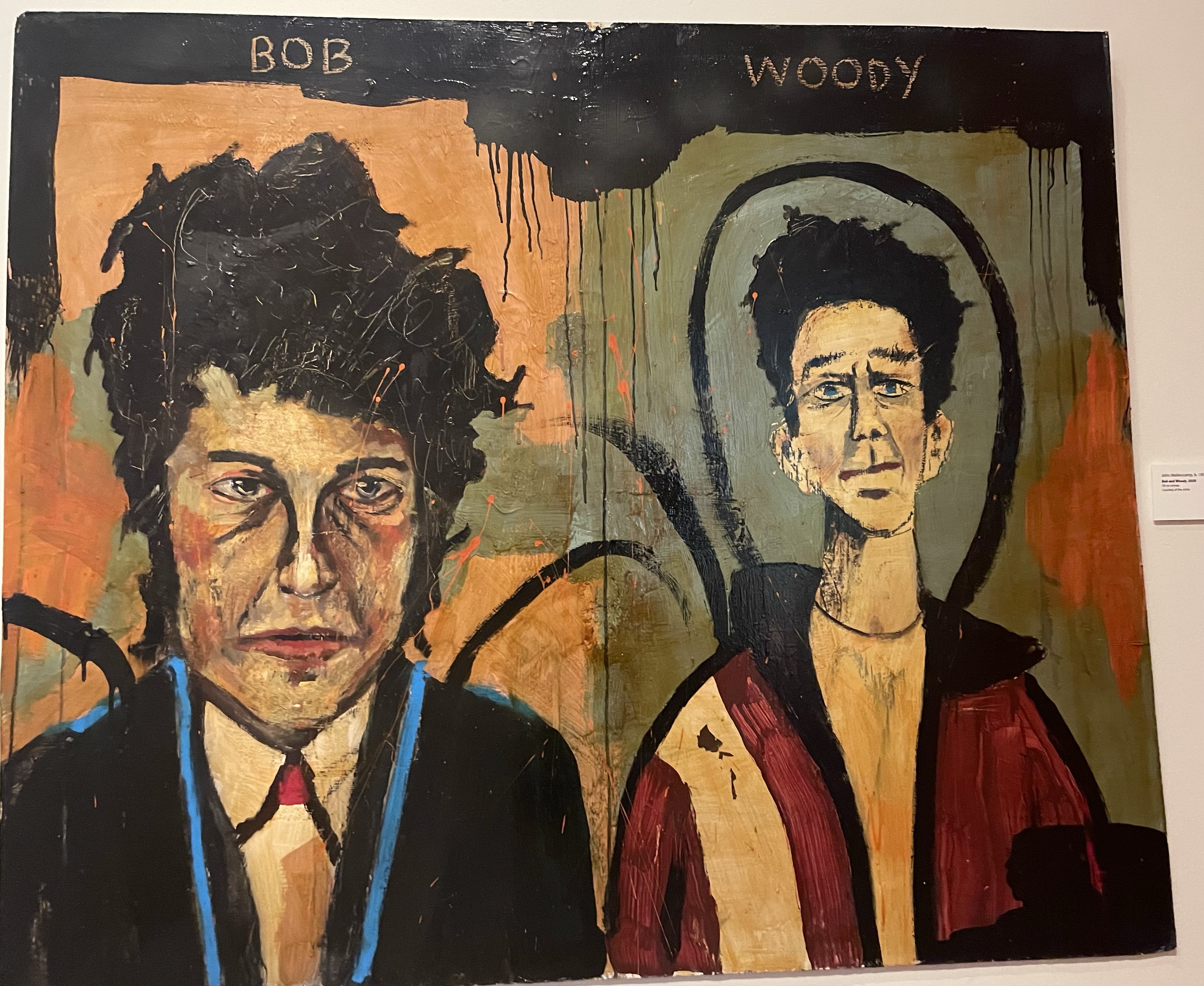
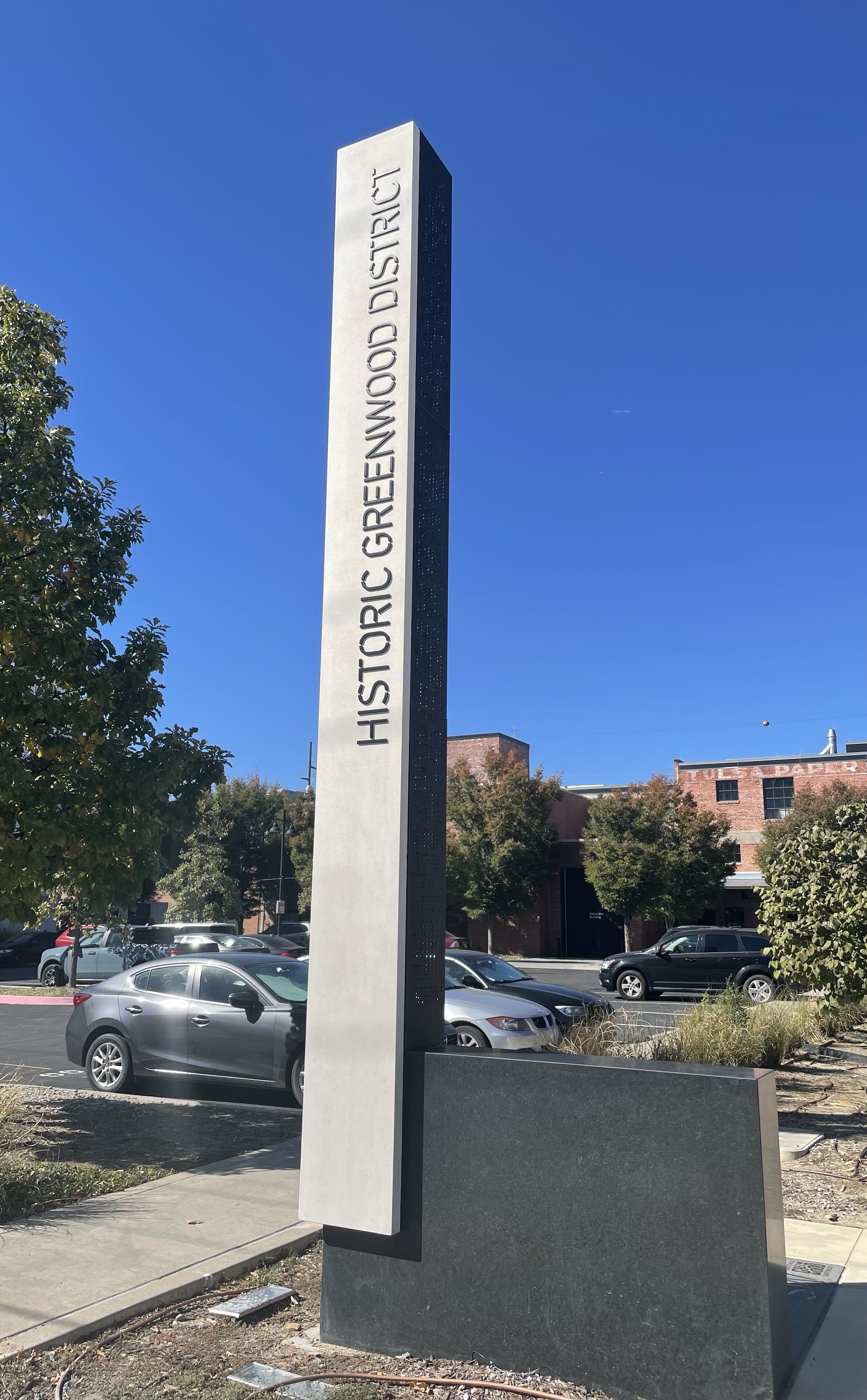
The hotel we stayed at in downtown Tulsa was in easy walking to the two archive/museums.  They are next door to each other.  On our walk towards the museums, we saw a large post indicating that we were entering the Historic Greenwood District. This is the area where once a thriving Black community settled before the 1921 Tulsa Race Massacre took place.  We thought it was extremely apropos that the museums dedicated to these two musical activists were in this area.  It just fit.
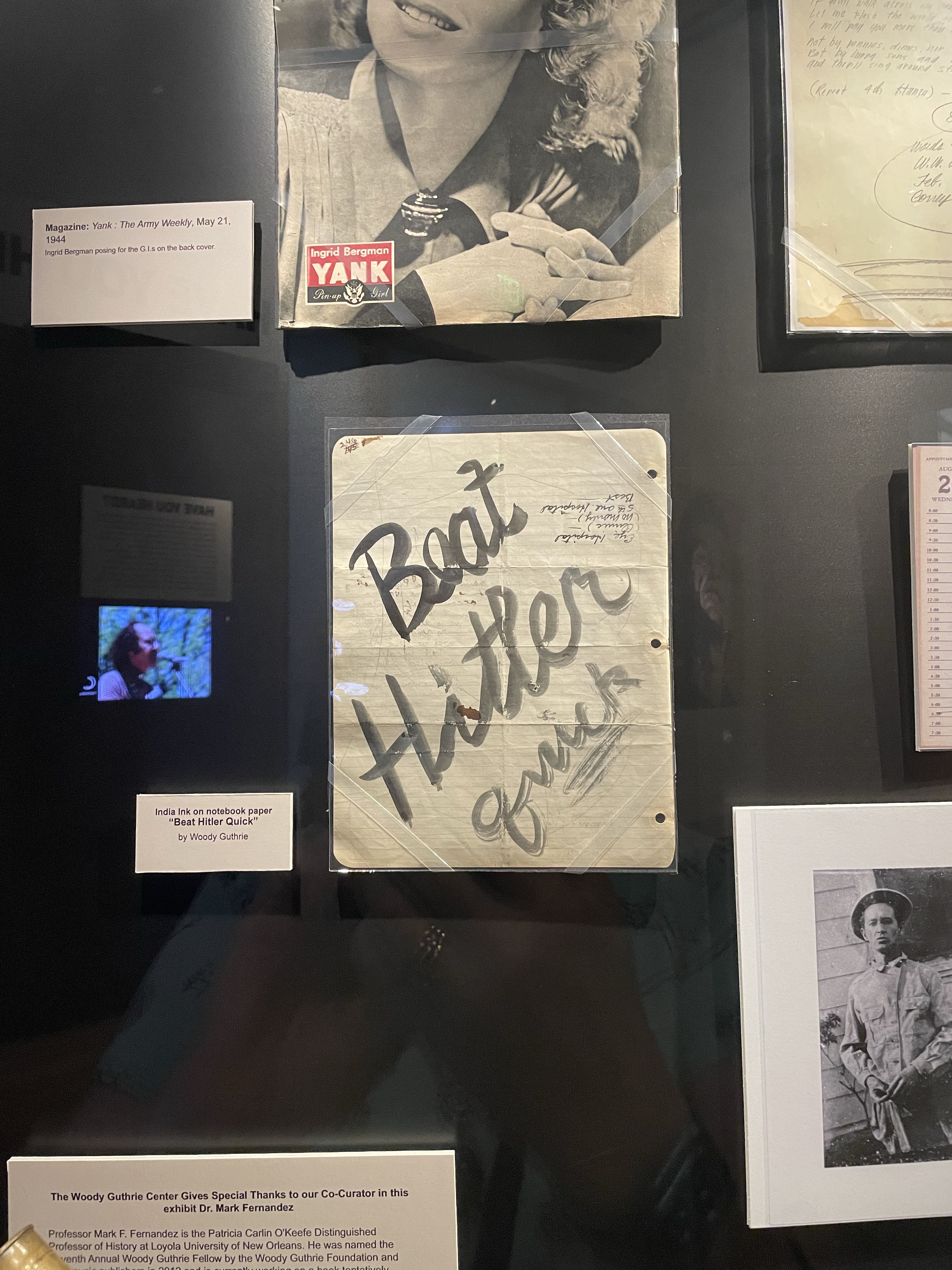
I loved both museums.  They each traced the lives of two of my musical heroes.  Even though their music was written decades apart, they actually knew each other.  One was born Jewish, the other was married to a Jewish woman and fought in WW2. Among Guthrie’s papers is one that reads, “Beat Hitler quick.” That resonated with me with all the Jew Hatred going on right now. The museums are both well worth the visit.  You can spend time watching the videos or just walk through.  I loved reading about them, listening to their music, and looking at their artifacts.  At the Guthrie Museum, you must try the virtual reality of the dust storms that devastated Oklahoma. WOW.

That evening we ate dinner with our friends. I asked about the two museums I wanted to see. The husband actually serves on the board of the Sherwin Miller Museum of Jewish Art.  At dinner he told us a bit about the museum, I realized it was much bigger than I anticipated.  For a community of about 1800 Jewish residents, it was really special. 
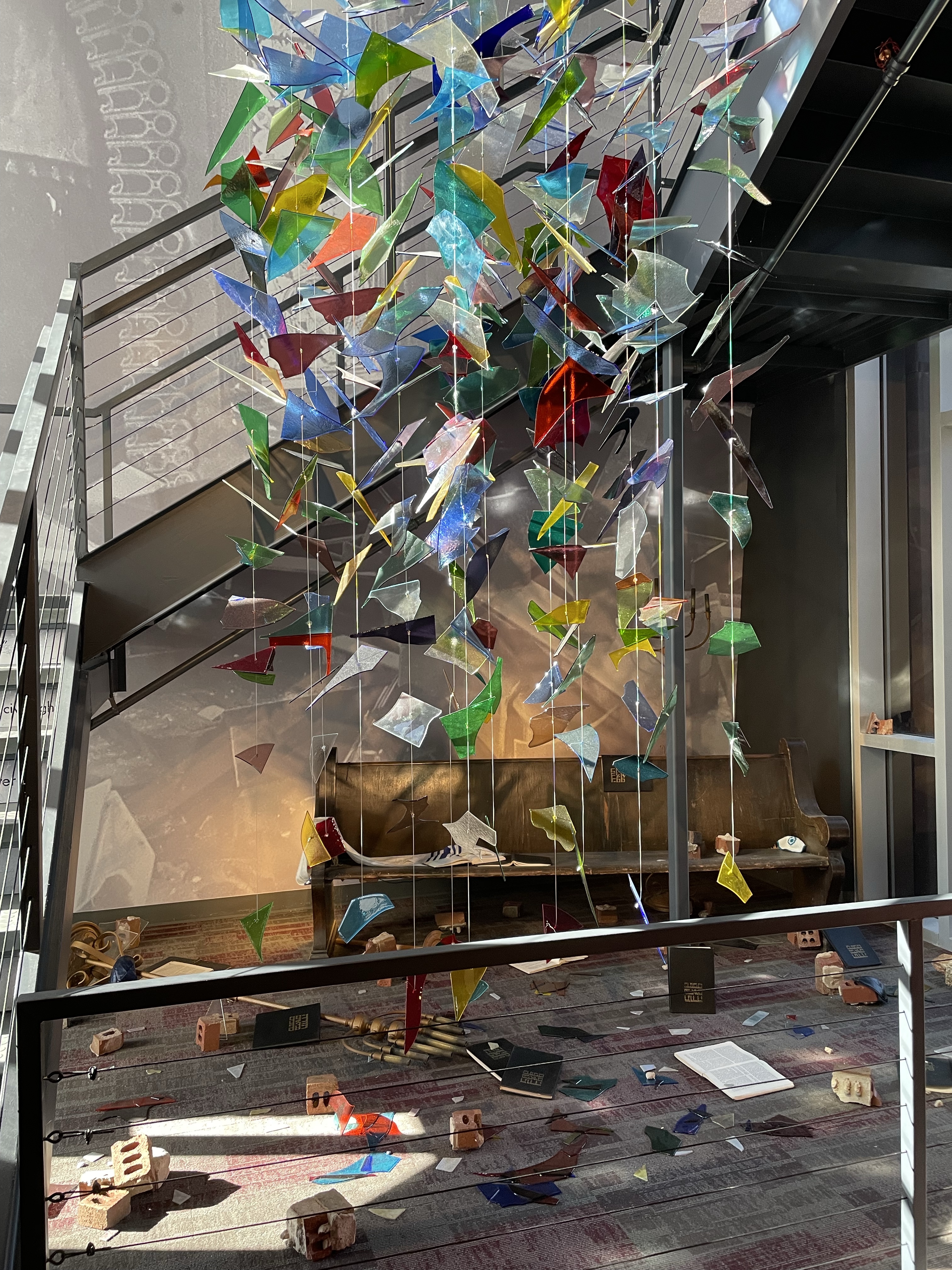
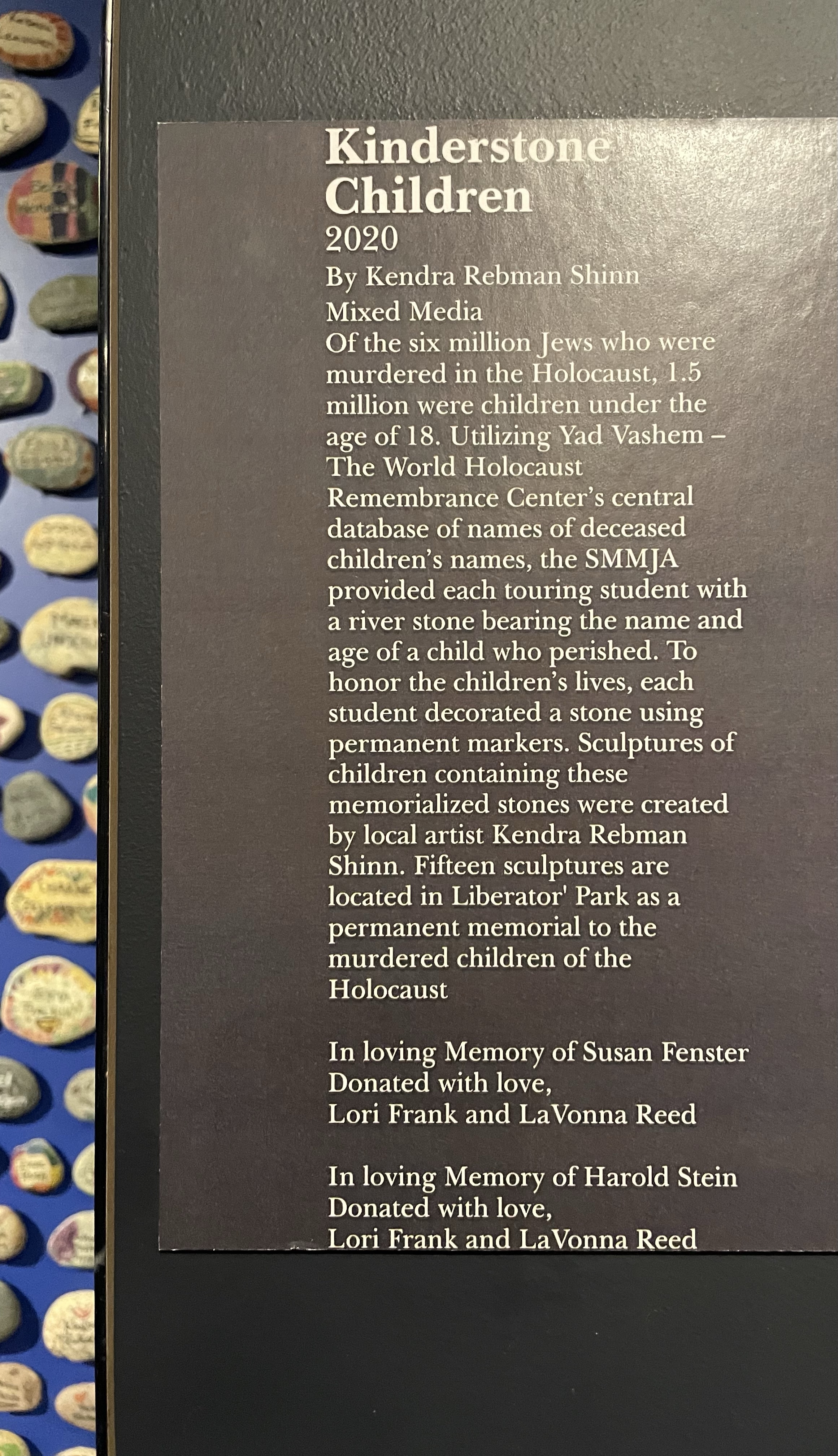
The section about the Holocaust was difficult as such museums always have to be.  But I loved how they imagined KrystalNacht.  I was so touched by the stone display that is a memorial to the 1.5 million Jewish children killed. I had tears in my eyes thinking about the children who were recently murdered by Hamas.  How could I not compare the two? The death of every child takes a toll on society.

Upstairs was dedicated to modern Jewish Life.  They had a sanctuary set up that must be wonderful to teach about Judaism to those who come to visit.  For me, personally, I loved the special exhibit of mezuzahs, the scrolls we put on our doorposts.

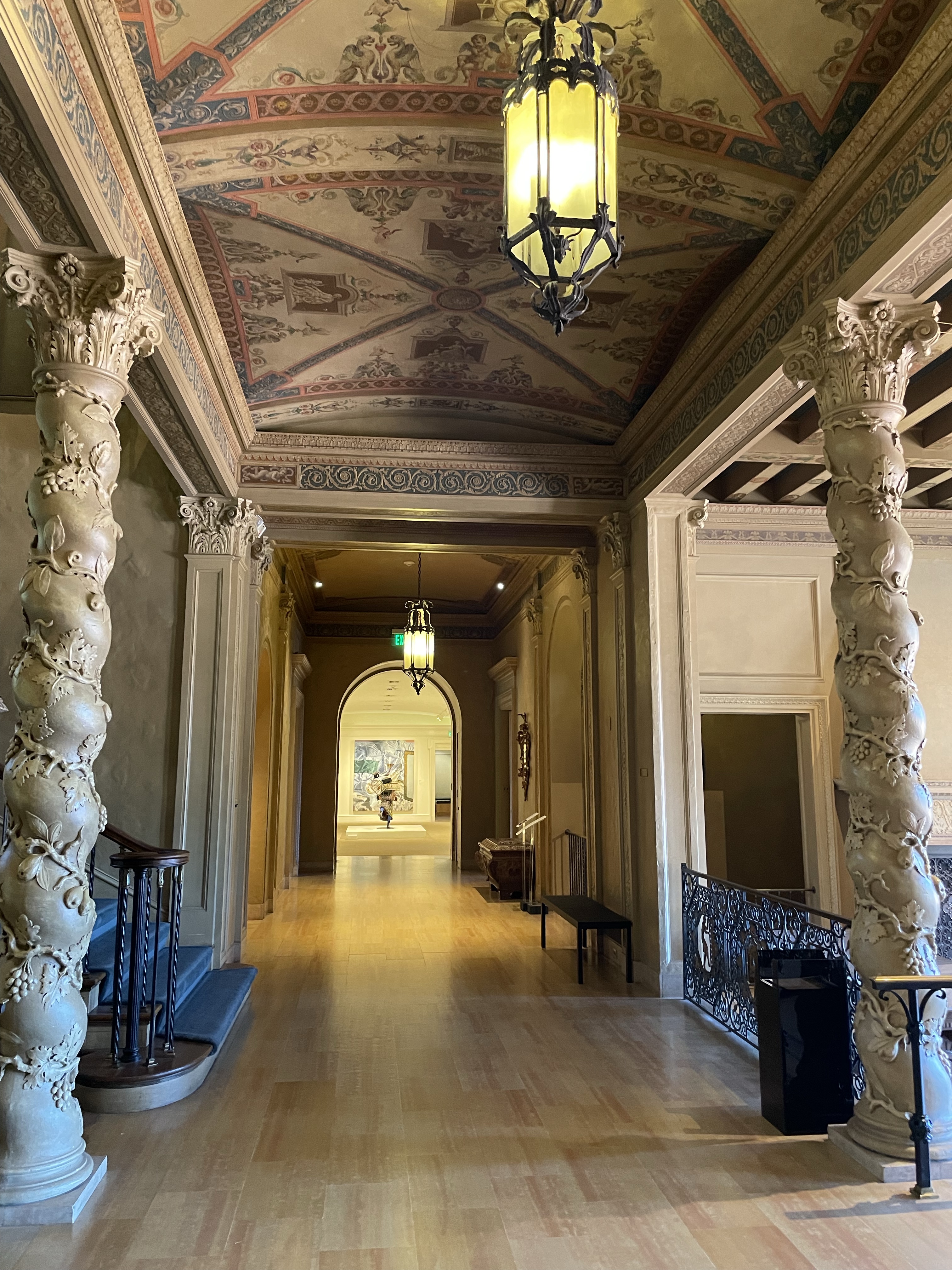
From there we went to the Philbrook Museum of Art. The house was built by Waite Phillips, who started a ‘little’ oil company. Phillips and his family lived there for only 11 years, and then they gifted the house and 23 acres of land to Tulsa for an art museum. Okay, I will be honest with you, the art in the house is great.  But the house itself is amazing.  I love old houses.  And this one does not disappoint.  The grounds are also stunning.  Well worth a couple of hours to walk through and visit.  It just cheered me up. I could see myself sitting outside for hours.  We especially loved all the wonderful milkweed and butterfly gardens. 

After we got back to our hotel, my husband’s cousin drove in from Oklahoma City to visit us.  She surprised me with a gift, her grandmother’s mah jong set.  She told me that no one in her family plays and she knew that I did, so she gave it to me.  Her grandmother and my husband’s mother were sisters.  I have to say having both of their mah jong sets gives me joy.  It was great catching up with her and seeing pictures of her family and sharing photos of our family.

The next morning it was on to Wichita.  One note about the drive from Texas to Kansas.  It is VERY flat and dusty.  There were no crops really, just fields and fields of red dirt.  However, and I am really sorry I could not get a photo of this, besides the oil well arms pumping away there were also giant windmills.  And at one spot there was a windmill farm circulating air and making e;ectricity above the same field where the oil well arms were pumping oil.  It would have been a great photo representing the changes coming to society as we switch to rely on renewable energy.

Of course I contacted our Wichita cousins as soon as we arrived and then spent the next seven hours with them.  It was great.  We had two meals with everyone. But also had time for us older adults to just visit.  We have not seen them for about six years, which is ridiculous.  Wichita is just three hours from home. I vowed that we would come back more often.  We need to see his first cousins and also visit some museums.  (My husband hates museums, but he loves me.)
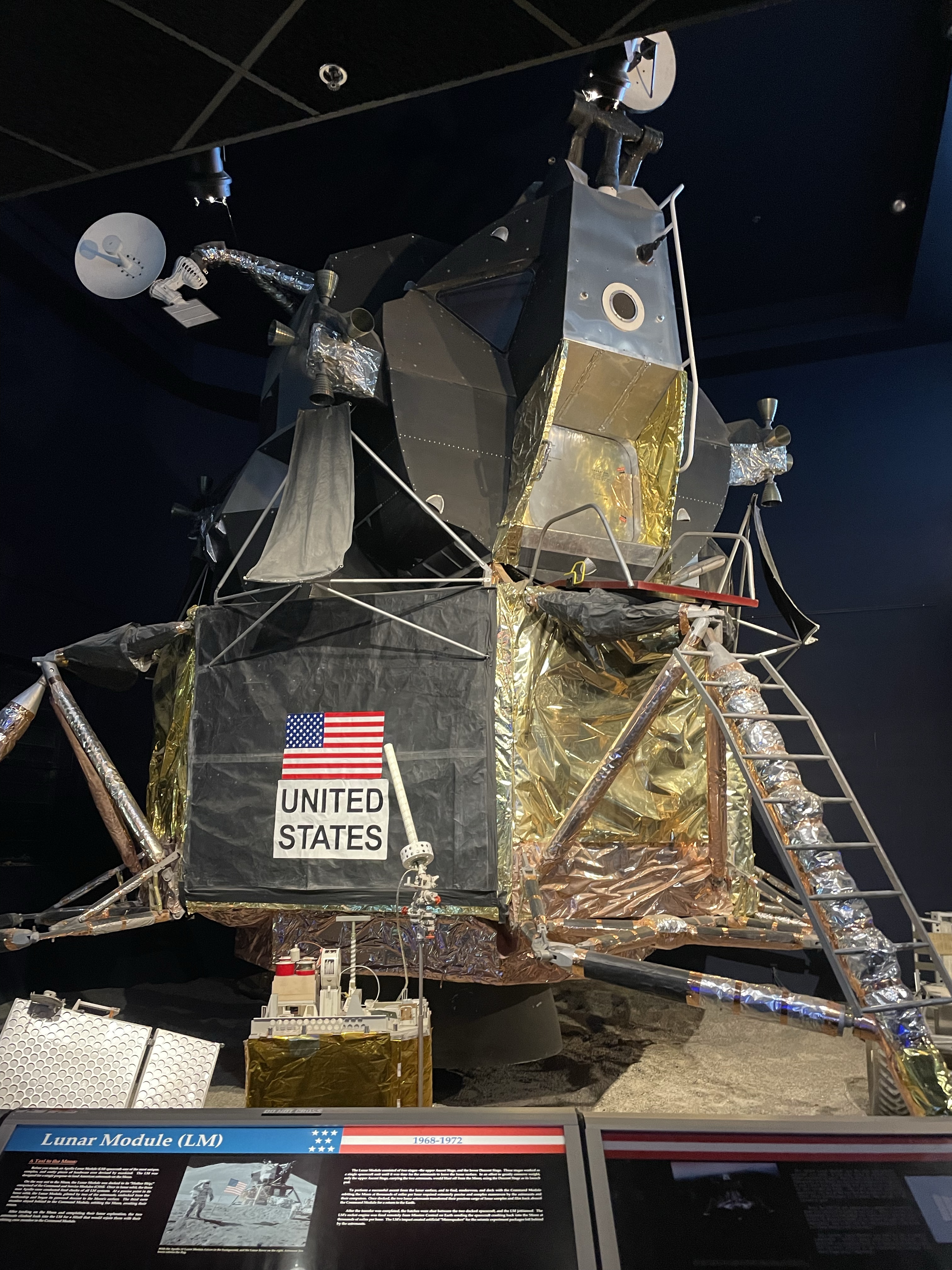
Next morning on to Hutchinson and the Cosmosphere, one of my favorite museums in Kansas.  Honestly, we went several times when our children were younger.  In fact, our daughter attended two summers of Space Camp there and loved them.  Even though we have been members for about 28 years, we have not been there for about 20 years.  It was definitely time to go back and see the changes!

The museum exhibits are wonderful.  If you love space and NASA, you will love this museum. The real Apollo 13 space craft is there. All the exhibits have been redesigned since our last trip. Definitely for the better.  We watched one of the two movies, about the Blue Whales.  That cheered us up. We were pretty sure that this documentary would end on a sad note, but NO, the Blue whales are coming back and increasing in numbers.  Honestly, I think Star Trek’s movie has something to do with that. It was a good start to the visit. 

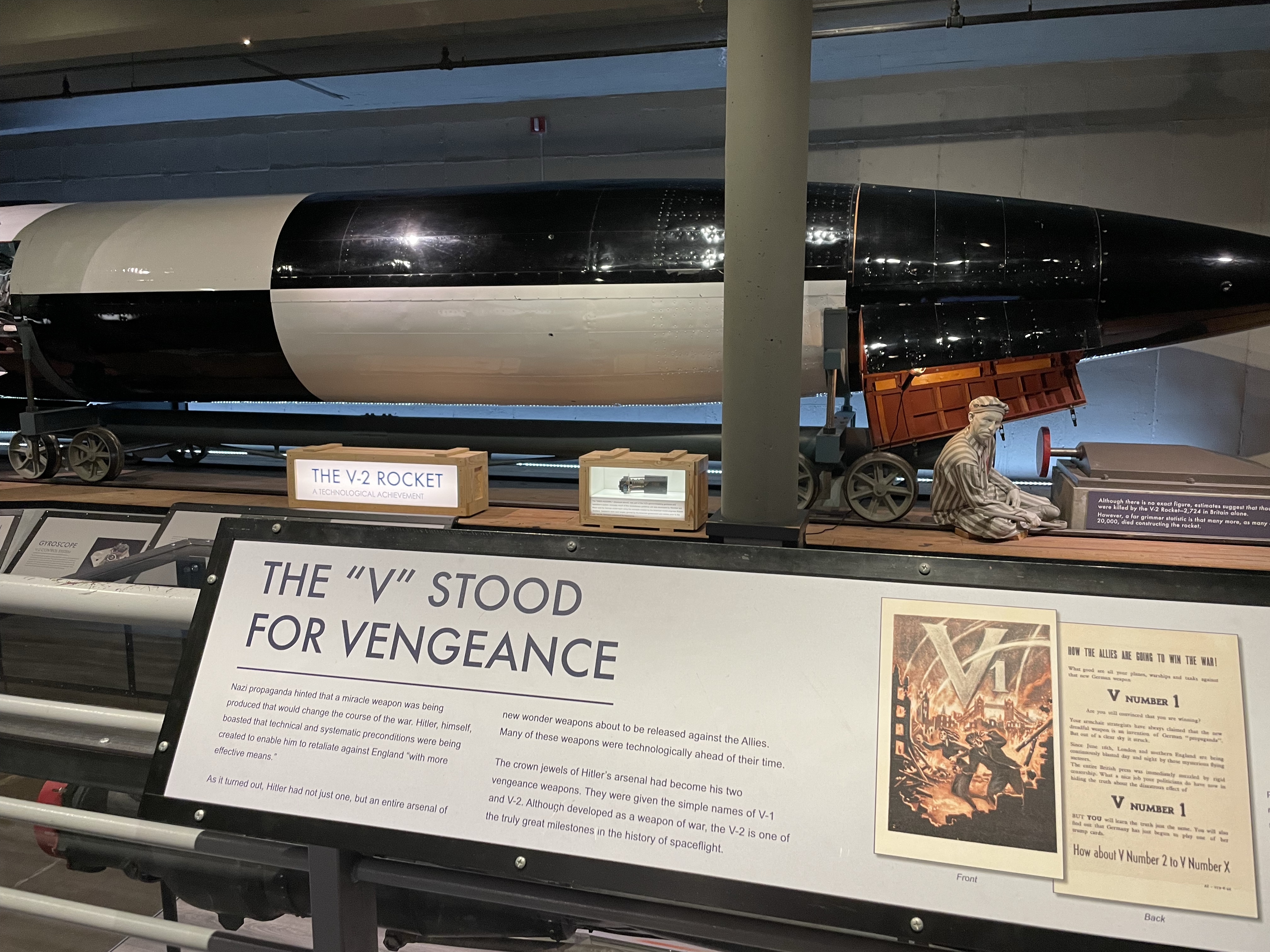
While we were walking around, I noticed a little exhibit off to the side, The V-2 Gallery, which was all about the V-1 and V-2 rockets that the Nazis used to bomb and terrorize London.  In the past the history of these rockets was sort of not mentioned.  Just as it was not always advertised that Wernher von Braun, who helped start the United States aerospace industry, was a member of the SS and helped Nazis build their death rockets.  This exhibit made it very clear.  It also made clear that the rockets were built by slave laborers in concentration camps.  And over 500 prisoners were killed when the Allies bombed the factory, as the prisoners were locked in and could not escape.  These rockets decimated London causing the deaths of over 20,000 people.  A sad start to the aerospace history. But one I think should not be forgotten.

Our first Fall Road Trip was a great adventure.  We loved seeing friends and family.  We loved visiting new museums and revisiting the Cosmosphere.  Personally, in this time of great stress for the Jewish community of the world and the horrors of war, I was glad to get away.  But at the same time, I am glad that we were able to visit places that show good in the world and how society can survive war and hatred. 

http://www.jewishmuseumtulsa.org

http://www.cosmo.org

http://www.Philbrook.org

http://www.bobdylancenter.com

http://www.woodyguthriecenter.org

Learning More About The Manhattan Project

20 Aug

We went to see Oppenheimer, a movie I knew I had to see, but at the same time I was dreading it. We all hear about Los Alamos and what happened secretly in New Mexico for years as the science was developed to create the Trinity device that effectively ended WW2, while also changing the world for eternity. 

I have been to the Truman Library in Independence, Missouri.  I saw the documentation about how President Truman found out about the Manhattan Project. The movies about the impact of the bombs were horrifying.  To see the ‘green plug’ from the Fat Man, plutonium bomb that fell on Nagasaki actually made me shiver.

I knew about the Manhattan Project and the work done in Los Alamos, but I was not aware of what happened in Oak Ridge, Tennessee.  And it was not until this summer that I learned about Hanford, Washington.

Oak Ridge, Tennessee, was the military headquarters for the Manhattan Project.  The town of Hanford, Washington, was where the plutonium was processed. I am not a physicist or an historian of WW2. I knew the little bit that I knew, and to be honest that was enough. Knowing what I know now is a bit frightening.

This summer we took a cruise on the Columbia and Snake rivers to learn about the Lewis and Clark Expedition.  Though I did learn so much about the history of that journey, docking near Hanford. opened my eyes to the immensity of the Manhattan Project and the multiple places where the secret experiments were carried out and the bombs were manufactured.

The Hanford Engineering Works was where the plutonium was processed.  This almost 600-square-mile site was another secret city where people worked on the development of the nuclear bomb.   To this day, two thirds of our country’s nuclear waste is contained somewhere on this site.  The water and air continue to be monitored. Barriers have been built to keep the waste contained.   Families with children live and work here.  I am not sure I would want to live there.  But many do.

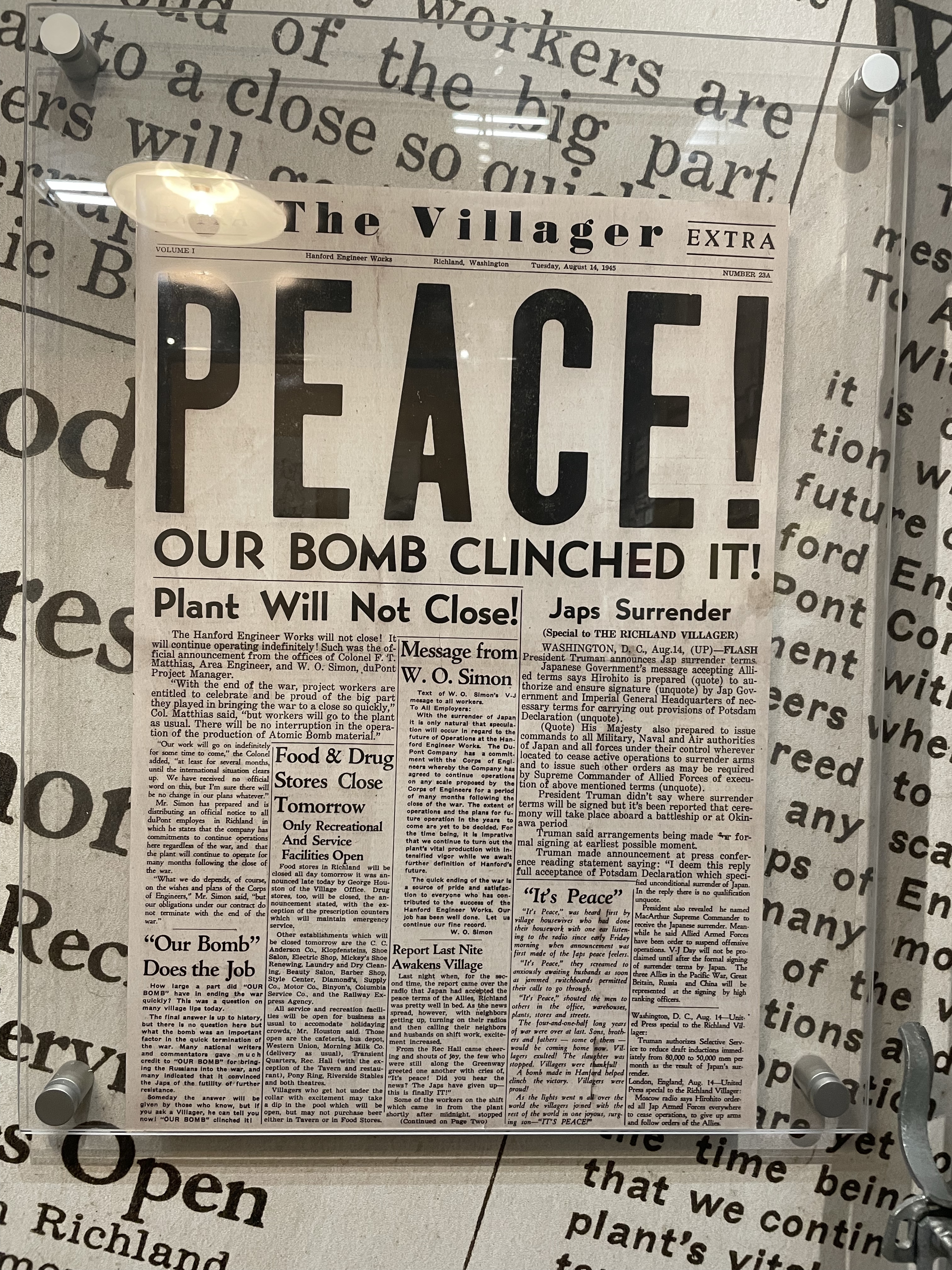
While in the Hanford area, in what is called the Tri-Cities, we visited the REACH Museum. The museum focus on this area and the time before Hanford became part of the Manhattan Project, but it also has an area devoted to the development of the atomic bomb.  For me this was a revelation.  I had absolutely no idea what happened here! Just like in Los Alamos, an entire town and community was developed in a secluded area basically uninhabited.

In 2015 the Manhattan Project National Historical Park was created.  This part preserves areas in the three sites where the atomic bomb and its secret development was worked on: Los Alamos, Oak Ridge and Hanford. Parts of these sites are open to the public.

Watching Oppenheimer was emotionally intense.  To see how these people came together to invent the unimaginable and how some were horrified by what they had developed.  To see Oppenheimergo from a man honored for his work as the director of the Manhattan Project to a pariah for his work afterwards to keep additional bombs from being developed. 

To see how he was attacked and verified was a bit frightening.  I knew about MaCarthyism and the attack on many Americans because they might have once been communists.  I learned in college how these attacks hurt many innocent people.  And how Joseph McCarthy was finally stopped.  I did not know that the fear about communism also impacted Robert Oppenheimer. 

In the movie they ask him when opinions on the bomb and what he did had changed.  To me this was a ridiculous question. Can you imagine being among those scientist who learned how to use the power of the atom and plutonium to kill hundreds of thousands of people?   I would imagine that many had second thoughts about what they had unleashed even though the bombs did end the war with Japan.

At the REACH Museum this display indicates increased bombs during the Cold War.

We all need to learn about how the bomb was developed and the efforts to stop the continued development of bombs in the 1950s.  Perhaps the world would be a different place if that had happened.  Because even today the fear of nuclear bombs continues to be a threat to our world.  So we have to ask, as Oppenheimer did, did he “become Death, the destroyer of worlds”? 

I hope not.

To learn about the Manhattan Project National Park   https://www.nps.gov/mapr/index.htm

The Reach Museum: https://visitthereach.us/

Technology Equals No Division

17 Jul

I had the most pleasant dinner with my husband and siblings in a restaurant in Montclair, NJ. The food, fish for all of us and ice cream and sorbet for dessert was delightful. We chatted and ate and visited and finally were ready to leave.

I have to admit that perhaps we asked for too much. We wanted to divide the check so that my husband and I paid half and my siblings each paid a quarter of the bill. The waitress said it was fine. And so we gave her three credit cards and waited. And waited. And waited. I should have known something was not working out.

Our bill for four people was $129.02. She came back with my credit card and a receipt for $86. She then was going to divide the $43.02 between my siblings. I was astounded that she did not even realize that this was not divided in HALF. It was two-thirds and a third, but definitely not half. $86 and $43 are NOT equal!

I went up with my receipts to speak to her while she was running the other cards. I politely said, “Wait. This is not right. $86 Is not half of $129.02.”

She was not convinced. “Are you sure? I have to get my manager,” she told me as she hustled away with a dazed look on her face.

A few minutes later the manager came. “How cam I help? ” He was pleasant.

“This is wrong. $86 is not half of $129.02. ” I told him. I was sure he would understand. But no such luck. “You asked for half on one card and the rest divided between those two!” He told me.

“Yes half. $86 is not half of $129.02. Half of $130 is $65. This is wrong.” I started doing the math, the division on a piece of paper. I showed him the math. But that was not what he needed. I offered to show him on my phone calculator. But no. He had a calculator that he pulled out.

He typed in 1292. No I said. You need a decimal. It is 129.02. He might have been anxious at this point. I noticed my siblings laughing and looking at me. I was getting exasperated. And I now was in teacher mode. I had taught at a high school. There is a definite teacher voice and look that can come over me.

In any case he correctly typed in 129.02 and divided by 2. 64.51 was the number it read. “You are right,” he admitted. “I am sorry. I will fix it. ”

I wanted to make it easy. I wanted him to credit my sister’s account and just put the rest on my card, the other $43.02. We would sort it out later. But that was too much as well. He ended up crediting my account and my sister’s. He ran a new receipt putting all the money on mine. I paid , added tip and we settled up.

My siblings laughed all the way to the car. They knew I was frustrated, they told me that the look of our mother came over me as I tried to explain the math to the manager. Mom taught fourth grade for 30 years.

“I just can’t understand how the waitress and the manager did not see that $86 was not half. $43 and $86 are not equal. Did they not understand half, divide by two,” I was still frustrated.

I was concerned that they did not believe my division that I did on paper. They would only believe a calculator. I felt like I was in a science fiction novel that I had read years ago where a boy who could do math in his head was considered a genius because everyone else HAD to use a calculator!

I am worried Technology is destroying the ability to calculate math in our brains.

My Last Ever Field Trip: Veteran’s Community Project

10 Jun

I retired.  I planned it since Thanksgiving weekend 2022.  I knew that at the end of the school year, I would be completing my almost 13 years as the fund development and public relations director for the the Accelerated Schools of Overland Park.  I loved my job.  I loved the people I worked with, the children we helped and the work I actually did.  When I turned in my keys and walked to my car, I had little tears and a feeling of melancholy.  I knew I was doing the right thing.  I was ready.  But a part of me was sad. I had so much joy in my job!  Including my final field trip in April. But first…

There were things I loved about my job.   I liked the part of the job that had to do with fundraising and PR.  That was what I was trained to do.  But what I had fun doing was all the extra stuff.  For years I planned the graduation and awards ceremonies.  I worked with the hotels or event sites and planned parties. Originally, I also planned all the staff parties and got the food and set them up.    During the past few years several teachers took that over.

For a long time, I scheduled speakers and kept schedules for the field trips.  The teachers planned these, but I would come up with some ideas and help out when needed.  Which was great for me, it gave me a reason to go to more museums.  And I love museums.   The speakers were really my main job.  We had parents sometimes, or just people I knew.  Veternarians, doctors, financial planners, artists, as well as speakers from different organizations like Metropolitan Organization to Combat Sexual Assault (MOCSA) and Midwest Center Holocaust Education (MCHE).  Once a  parent who was involved in Water.Org came.  That was great.

But what I really loved were the community service projects I got to arrange.  I arranged for recycling at the school.  I had someone from Johnson County government come to speak to the students and staff about recycling.  Then I was able to arrange for a non profit, L’Arche Heartland, that has a sheltered workshop.  They collect recycling from some offices as a job for their clients.  It was a perfect match, our school that caters to students who are different and thrive better in our school.  And the recycling collected by special needs adults. I loved that I was able to arrange that.

For several years before and after COVID we collected food for Harvesters.  In my early years we even had our older students go to Harvesters once a year and help at the warehouse.  Of course that stopped with COVID.

The last community service was one of my favorites.  I made contact with the Veteran’s Community Project (VCP) for our school to help them this year.  The wonderful Kristin Griffin, a VCP staff member,  came to speak to our students.  The student council had decided to up our collections and collected almost 250 pairs of socks before the talk in January 2023.  So when Kirsten came to talk, we gave her the socks.  Later in the year, during the month of February we collected hygiene products for the VCP. 

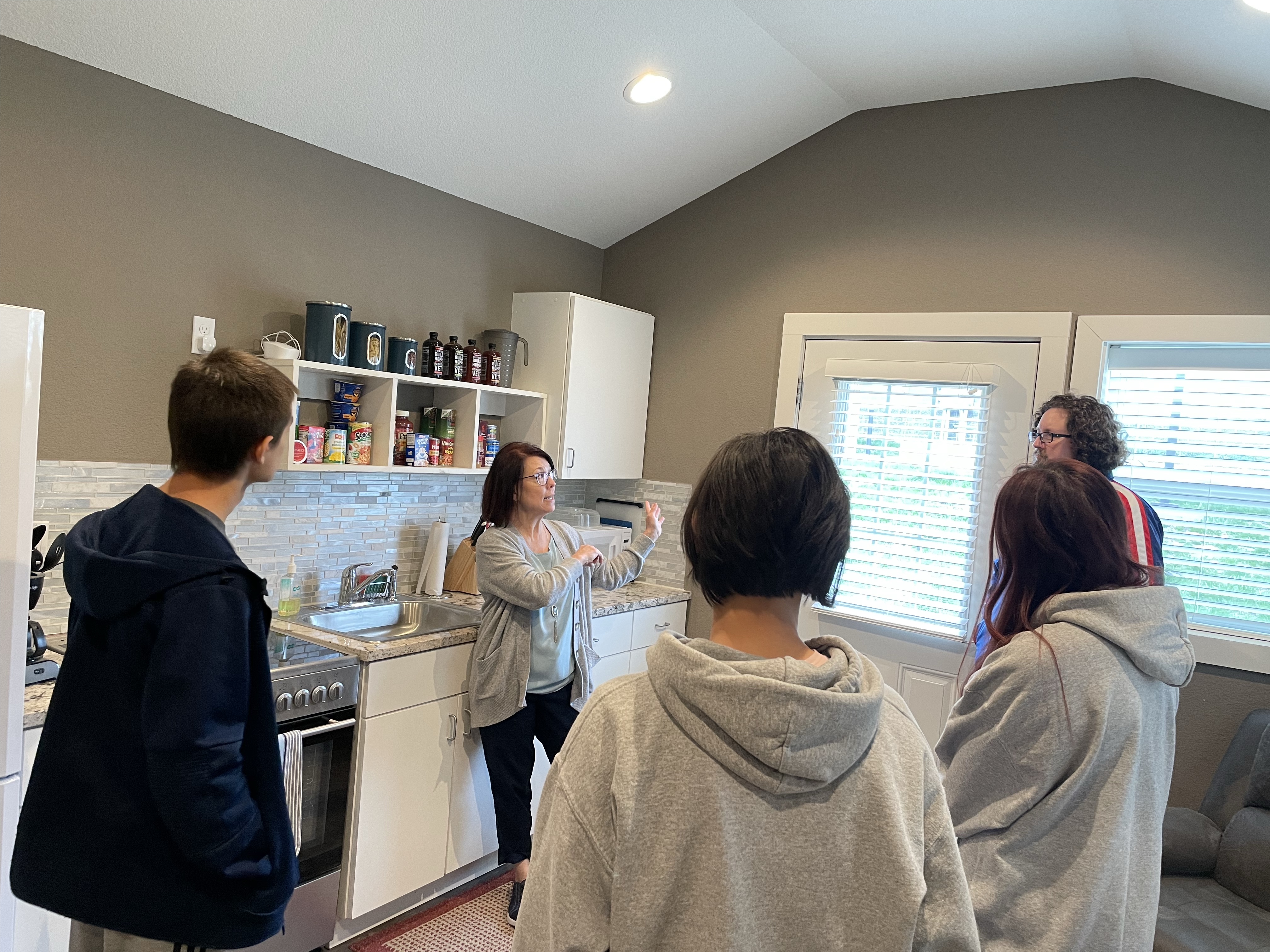
After Spring Break, the student council advisor, the three members of the student council and I went to the VCP campus to meet with Kristin and to tour it. I was so excited.  I had been watching the creation of this village since it started.  The idea of providing tiny homes for homeless veterans just touched my heart.  And to actually get to tour it and see it in person and to learn more about it was wonderful.  We got to go inside one of the tiny homes. We saw the ‘store’ area where any homeless veteran can come to get supplies. We learned about how they help all veterans.

I loved that in the Less Thompson Building there is a communal kitchen where residents learn to cook. Also offices for a doctor, dentist and veternerian to help with medical issues both human and companions. Social workers are on staff as well to help the veterans deal with other issues. The hope is that these veterans can transition to other homes and find jobs. There was so much more to see and learn about. What a wonderful idea that was conceived by veterans wanting to help other veterans. They were truly wonderful in their ambitions.

The Kansas City campus of VCP has started a nationwide trend. There are now VCP villages planned in six other cities with the national headquarters are here in KC. I read Jason Kander’s book, Invisible Storm, and was glad to know that someone who really understood the plight of veterans is now the CEO of VCP. We did not tour the national offices, but we could see the building across the street.

I was so impressed and so pleased to be able to go with the students on my last ever field trip to the Veteran’s Community Project.  It was a real moment of joy for my last year at the school.

https://www.veteranscommunityproject.org/

https://www.larcheks.org/

http://www.Acceleratedschoolsop.org

Expanding my Spiritual Care Volunteer Work

8 Apr

Over the last six months, I realized that I needed to expand the work I do as a spiritual care volunteer (SCV) for Jewish Family Services. For the past four years, I have been working with the senior population at one elder care facility. To be honest, it is one of the most rewarding volunteer positions I have ever held. I believe I am really helping people and making life a bit more pleasant. It gladdens my heart.

But six months ago, we had a family event that changed me. My daughter lost a pregnancy at five months as their much wanted fetus was not viable. Making a choice to end a pregnancy is not an easy decision. It hurts the heart. I traveled to be with my daughter and son in law. I realize during the time that I was with them, that my spiritual care training was helpful as we walked and talked and dealt with this unhappy time.

When I returned home, I saw that the Bikur Cholim, an organization that provided programming for chaplains and SCV, was offering a three-week summit entitled, “Perinatal Loss Summit” with a group called “I Was Supposed to Have A Baby.”  I thought that would help us as we dealt with our loss, so I signed up.

The Mission of “I Was Supposed to Have A Baby” is “is to utilize social platforms (Instagram, TikTok, LinkedIn, Facebook, etc.) to support all Jewish individuals and families struggling to have a child by providing a warm and nurturing space for those going through infertility, pregnancy loss, infant loss, surrogacy and adoption, and by making connections to resources in the Jewish community at large.”

I found this three-part programming informative, helpful, and thought provoking as I learned about Jewish rituals, or rather lack of, for women who suffered pregnancy loss, infertility and death of an infant. I was excited to learn that women were developing their own rituals. I read the book that was discussed, “Tears of Sorrow, Seeds of Hope,” by Rabbi Nina Beth Cardin. Its subtitle is “A Jewish Spiritual Companion for Infertility and Pregnancy Loss.” It provides ideas for both rituals and prayers. I found it extremely helpful.

The third meeting impacted my SCV/NCJW volunteer mind. It included representatives of a National Council of Jewish Women section in New York who provided individual peer support and group support for women going experiencing pregnancy issue: infertility and loss. They would pair a woman who had a similar problem 20 or more years ago with a women going through it now for peer counseling.

As someone who also suffered through infertility, ending with both biological and adopted children, and this more recent family loss, I thought this might be something I could do. I spoke to the JFS Rabbi who is my supervisor for SCV to see this was possible. He said that spiritual care volunteers could help wherever they were needed.

I also spoke to the woman who runs a program in our area called Priya, which is focused on helping couples who are having infertility, trying to adopt, and other birth related issues. I asked if they had a peer support program or anything like that. She said they had tried, but people felt uncomfortable talking to others and revealing their feelings afraid that the information would get into the public. But as I am HIPPA compliant as a spiritual care volunteer that is not an issue. I do not talk about who and what I learn.

They both agreed that this is something that might be useful in our community. With that encouragement. I am continuing on my quest to help. Recently Jewish Family Services paid for me to attend a one-day workshop on “The Mental Health of Women in the Reproductive Years.” Of the 30 participants, I was the only one not in the medical field…most were social workers who worked with or planned to work with pregnant women dealing with postpartum depression, as well as pregnancy loss. Centimano Counseling, which is focused on Perinatal Mental Health, held the workshop. I learned more than I expected and was glad I had the opportunity to attend.

My belief is that if I even help one person or one couple, then it is more than worth all these extra trainings. I remember the black hole of despair I had when I could not get pregnant and all around me my family and friends were having babies. I understand how difficult it is to speak to someone who has no idea what heartache was happening within me. I knew how it was easier to speak to someone who was going through the same problems as me than even my own mother, who had no idea what infertility was like.

So I am hoping that as a compassionate, HIIPA compliant, friendly sounding board, I can help those in need get a little bit of hope and joy back in their lives.

https://iwassupposedtohaveababy.org/

https://www.centimano.com/

https://zicharonot.com/2019/01/16/do-more-of-what-makes-you-feel-happy-or-why-i-want-to-be-a-spiritual-care-volunteer/

Island Adventures on Lake Huron

4 Aug

We did it.  We left the confines of our home and took our first cruise in almost three years.  I was a bit hesitant and anxious.  But we chose a cruise that stayed close to home, sailing the Great Lakes between the USA and Canada.  It was a cruise I had been thinking about for years.  This seemed like the perfect time to take it.

Two of my favorite stops on the cruise were islands that are adjacent or within Lake Huron.  Both were the home of the Ojibwe nation, but one is in the United States and one is in Canada.

Mackinac Island

Years ago my husband and I lived in Michigan.  We heard over and over again that we had to go to Mackinac Island.  We never made it there during our two-year time. But it has been on our list of places to see ever since.  We had a most delightful day!!!

I will start by telling you that the original native Ojibwe name was Michilimackinac.  When you say it, you realize that the name Michigan was also a native name. It means Big Turtle, because the island is somewhat shaped like a turtle. The entire island is just about eight miles around.  So it is easy to walk from one place to another.

In July we found out why people love it so much.

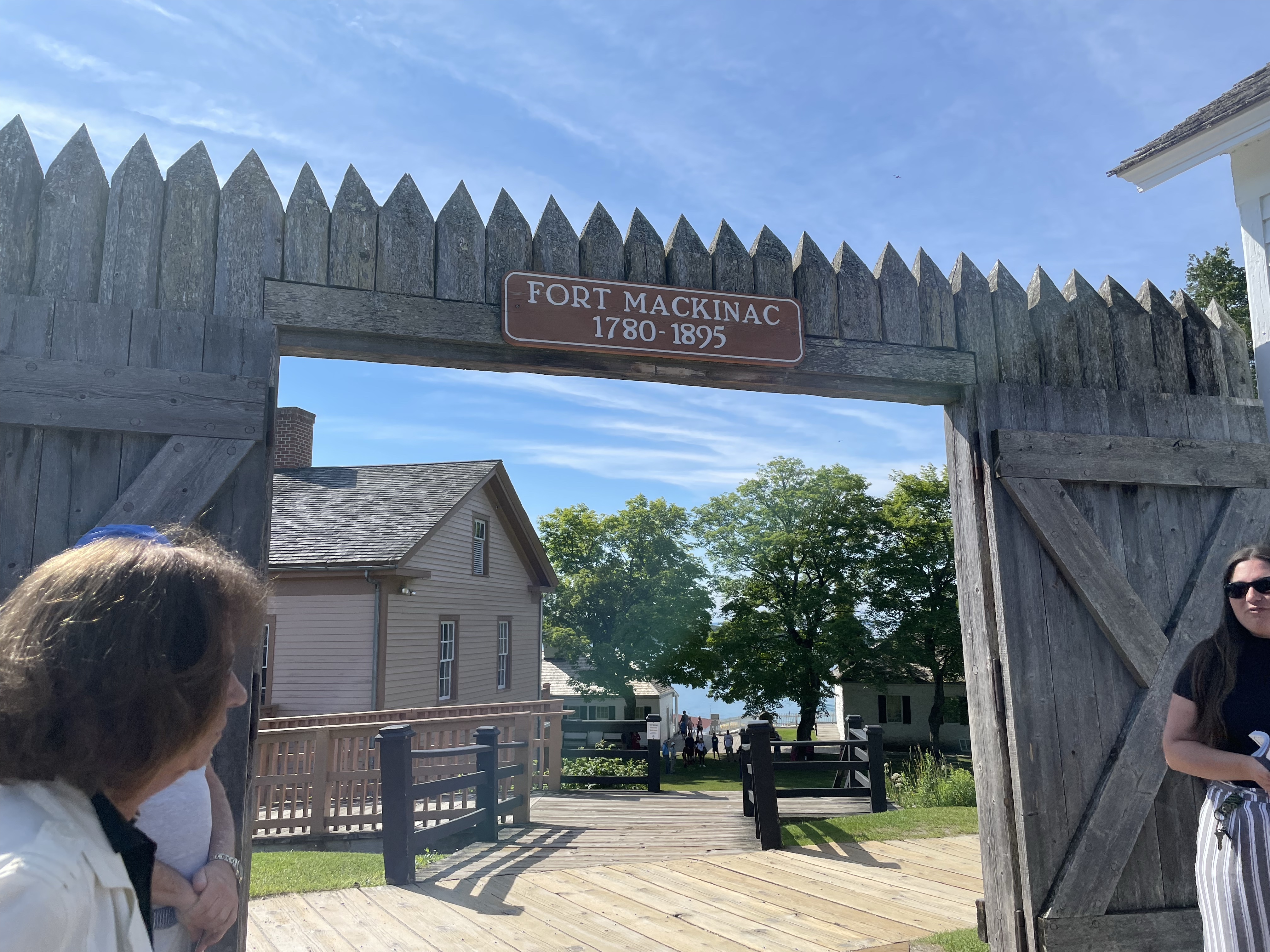
First, there are NO CARS on the island!  The only transportation is foot, bicycle or horse drawn carriage.   WOW.  (Fire engines and ambulances are an exception.) It is interesting to go around an island on an open carriage. When we got off the ship, very close to downtown, we were loaded up into a carriage that had about 20 people.  This took us on the first part of the ride, through the downtown, past the Grand Hotel, and to a place where we were transferred to a larger carriage drawn by three horses for our tour through the park to the historic Fort Mackinac.

Second, there is the GRAND Hotel.   It is pretty darn Grand.  With its stunning Victorian décor; the large veranda with excellent rocking chairs (yes I checked them out); ice cream parlor; excellent views; the Grand Hotel lived up to expectations.  I especially loved the sign that said after 6 pm all men must wear jackets and women must wear dresses.  To be honest, I would never stay there because my husband would not want to dress up each evening.

However, we did go the Gate House Restaurant that is part of the hotel and had a delicious lunch sitting outside and enjoying people watching and horse watching.  There is a little stone church across the street from the restaurant that we also visited.  It is actually called the Little STONE Church.

Third, there is lots of history surrounding the Revolutionary War, the War of 1812, and the lives of the Native Americans and how the changes from French to British to American impacted the First Nations Peoples, especially the Ojibwe nation, which is also based in Canada.  We spent an hour or so walking around the Fort and we even got to see a cannon fire.

After we at lunch at the Grand Hotel, we walked into town to visit some of the sites, including  the Biddle house which is now a small museum about the impact on the Native Americans.

We had an excellent time walking around the downtown, doing a bit of shopping, and finding an ice cream store for my husband.  Mackinac Island is known for its many fudge shops.  And we did enjoy the free samples. But we stayed strong and did not purchase any.  I could only that that with eight days left on the cruise, it would be too tempting.

Manitoulin Island

The other Island we visited was quite different. First, it is in Canada. Manitoulin Island is also known as Ontario’s Island Retreat. Its original Ojibwe name is Manidoowaaling, meaning the Spirit Cave, which we did get to see. It is a big island, over 100 miles long. In fact, it is the largest island in a fresh water lake, Lake Huron. In the island of Manitoulin is the largest lake in the largest island in a fresh water lake. That would be Lake Manitou in Manitoulin Island in Lake Huron. But there is also Treasure Island, which is the largest island in a lake in the largest island in a Great Lake. But it was not in Lake Manitou. I LOVE these descriptions. They should be part of a children’s song!!!

The island was also first inhabited by the Ojibwe people, who still inhabit much of the island.  But it was also the site of the first European settlement in Canada.

We docked in Little Current, which is the largest city on the Island. It has been a resort town for a while and has many bed and breakfast accommodations, much like Mackinac Island.

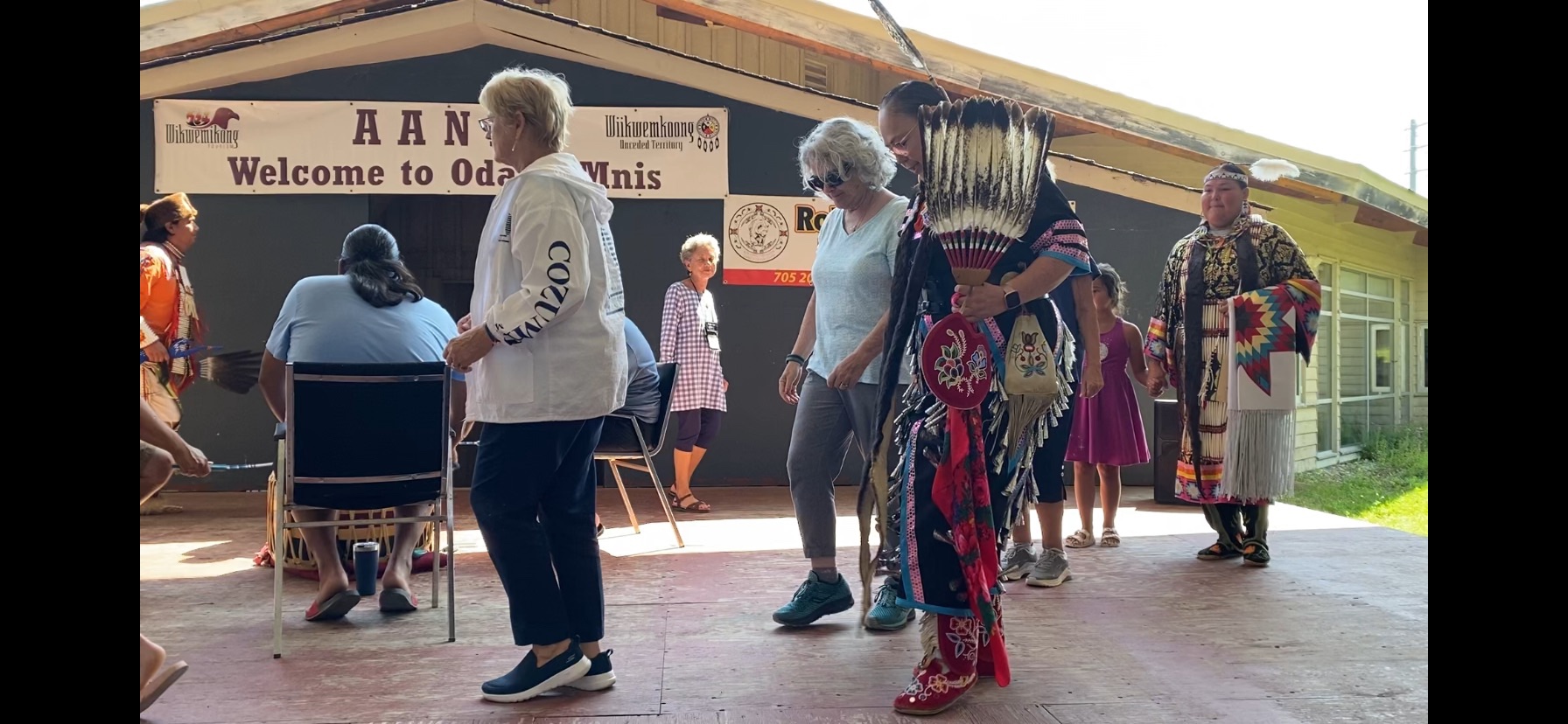
We visited the Ojibwe Cultural Foundation, which was a great experience.  My husband was concerned that it would be ‘hokey’.  But it definitely was not.  The young man who met us at the Center gave us a great presentation about the First Nations and the Island.  He explained what we were seeing in the museum section, which really was fascinating.  We then went to a work area where people can come to work on their crafts like beading and porcupine quill art.  We also met with a young woman who explained the sacred herbs such as sage and how they are used.

Finally we were welcomed to an outside theater where we got to see authentic First Nation dances and the drummers.  I so enjoyed this experience.  My favorite were the jiggle dress dancers.  Finally we were invited up to dance with them and learn a bit.  I had to get up there.  One of the dancers stepped with me and showed me how to do it correctly! 

We did notice along the way that the cities in the USA were much smaller than the cities in Canada.  But then I had an enlighten moment. For the Canadians, these cities were among their furthest southern border, while for the US these were at the northern border.  Makes a difference when you take in this factor.

We loved our island experiences in Lake Huron. 

The Importance of My Grandma’s Illegal 1931 Abortion

16 Jun

In 1931 a 25-year-old mother of two young children was pregnant with her third pregnancy.  It was twins.  But whereas her other pregnancies went fine this one was not going well at all. In fact, her kidneys were failing, probably due to eclampsia. If nothing was done, she and the fetuses she carried would all die.  Abortion was not legal in 1931.  But someone saved her.  Someone, I am told a doctor, provided her an illegal abortion. 

That woman was my grandmother.  She lived.  

“Preeclampsia may lead to kidney disease by causing acute kidney injury, endothelial damage, and podocyte loss. Preeclampsia may be an important sex-specific risk factor for chronic kidney disease,” according to an NIH website.  Although my grandmother did not die in 1931, she was left with failing kidneys.  In fact, she had kidney disease for the next 52 years of her life. 

Grandma decided to go back to Europe with her two children, my Mom and my Uncle, so that when she died they would be raised by their grandmother, as she was sure that she was still going to die. Someone traveled with my grandmother for this trip. In fact, one night she was so sick, they took her up on the deck because she wanted to see the stars one more time before she died.

The doctor who saved her life actually impacted the lives of many people. Because my grandmother lived, my mother and uncle were not left without a mother. Also, as the story continues, because my grandmother lived, others lived as well.

When my Grandmother got to Europe she traveled through Germany to Carlsbad, to take the waters, and then around Poland visiting family for over six months. During these travels her opinion about life in Europe changed drastically. By the end she was much healthier and concerned about taking her children back to the United States to safety.

Why do I say saving her life saved others? She had been traveling through Germany in 1931. She had seen the evil that was taking over Europe with the rise of Hitler.

This is where her surviving preeclampsia and a life saving abortion takes on even more meaning. First, everywhere she went in Poland, she told family and friends to “Get Out! Bad times are coming.” We do not know how many heeded her warning! But we know her story and what she tried to do.

When Grandma came home she had one goal, to get her family and the family of my Grandfather out of Europe! My grandparents worked to bring family members over from Poland and Austria. In the end, they only were able to bring my Grandmother’s father and sister. My Tante was very small for her age, so they changed her age and made her under 21 so she could travel to America on my great grandfather’s papers and visa.

My Tante lived.  She married and had one daughter.  Her daughter married and had three children.  Her children married and among them had 11 children.  

All because my grandmother had an abortion, all because she lived, two people survived and avoided the horrors of the Shoah and 15 descendants were born.  Who knows how many more will be born in the future.

Abortions save lives! The mother’s lives. To me these lives are extremely important. Currently, in this time of legal abortions another relative of mine had eclampsia putting her life and the life of her much wanted fetus at risk. They were both dying in the hospital. The only choice to save one life was an abortion. My cousin lived. Amazingly a year later she was again pregnant and gave birth to a healthy child.

I do not believe anyone, a legislator or a member of the voting public, has the right to tell a woman how to handle her private medical issues. We have HIPAA laws that are supposed to keep our medical history private. What a woman decides, with input from her medical professional, for her own health is her personal business. HIPAA laws are not just for men. They are for everyone.

In the meantime, I support women’s health rights. I support women who make the difficult decision to end a pregnancy. I support their choice and decisions concerning their personal medical health. I know that the right to chose an abortion must remain legal, because I know that saving a mother’s life is vital.

Another Quest Completed!

29 May

Great Grandpa Abraham Shlomo Grave

One of my genealogy goals is to find the graves of all my great grandparents who are buried in the United States.  Five are buried in the USA with four for sure in the New York, New Jersey metro area. Three of my great grandparents died in Europe, two during the Shoah, so finding their burial sites is impossible.

Since I live in the middle of the country it is difficult to search cemeteries on the east coast. But luckily for me I have willing helpers!  I truly appreciate my family who understand my quest.

Last year during Covid, one of my first cousins went to Washington Cemetery in New York and took photos of my Goldman great grandparents.   (See blog below.). In my mind he was the ideal person to search for the graves, since is named for our great grandfather, with the Hebrew name, Baruch Lev.  It was perfectly apropos that he went to find the graves.

Now it was my brother’s turn.  My brother’s Hebrew name is Avraham Sholmo for my Szenk/Shenk/Schenk great grandfather.   Our great grandfather was born with the name Shlomo/Solomon. But when he was a child he became very ill.  His parents gave him a second name, Avraham, to keep the Angel of Death from finding him.

Usually, the names given to fool the Angel of Death were names like Chaim and Chaya, which mean life. The idea was to confuse the Angel of Death because he would not be able to find a child with a different name.  This superstition said changing the child’s name would save him/her.

In any case my great grandfather’s Hebrew name was changed, but his legal name remained Solomon, or Szlama, as he was known in Poland.  His birthdate was September 1874 and he died in 1942. My great grandfather came to the USA in 1936 along with my great aunt. It was the work of my grandparents to get as many people out of Europe that they could. Unfortunately, it was only these two that they were able to actually bring over.

At first my great grandfather lived with my grandparents.  But, although they had a kosher bakery and kept kosher, my grandmother did not cover her hair, and they did not follow the rules as they did in Europe.  So my great grandfather moved into a Hebrew Home for the Aged

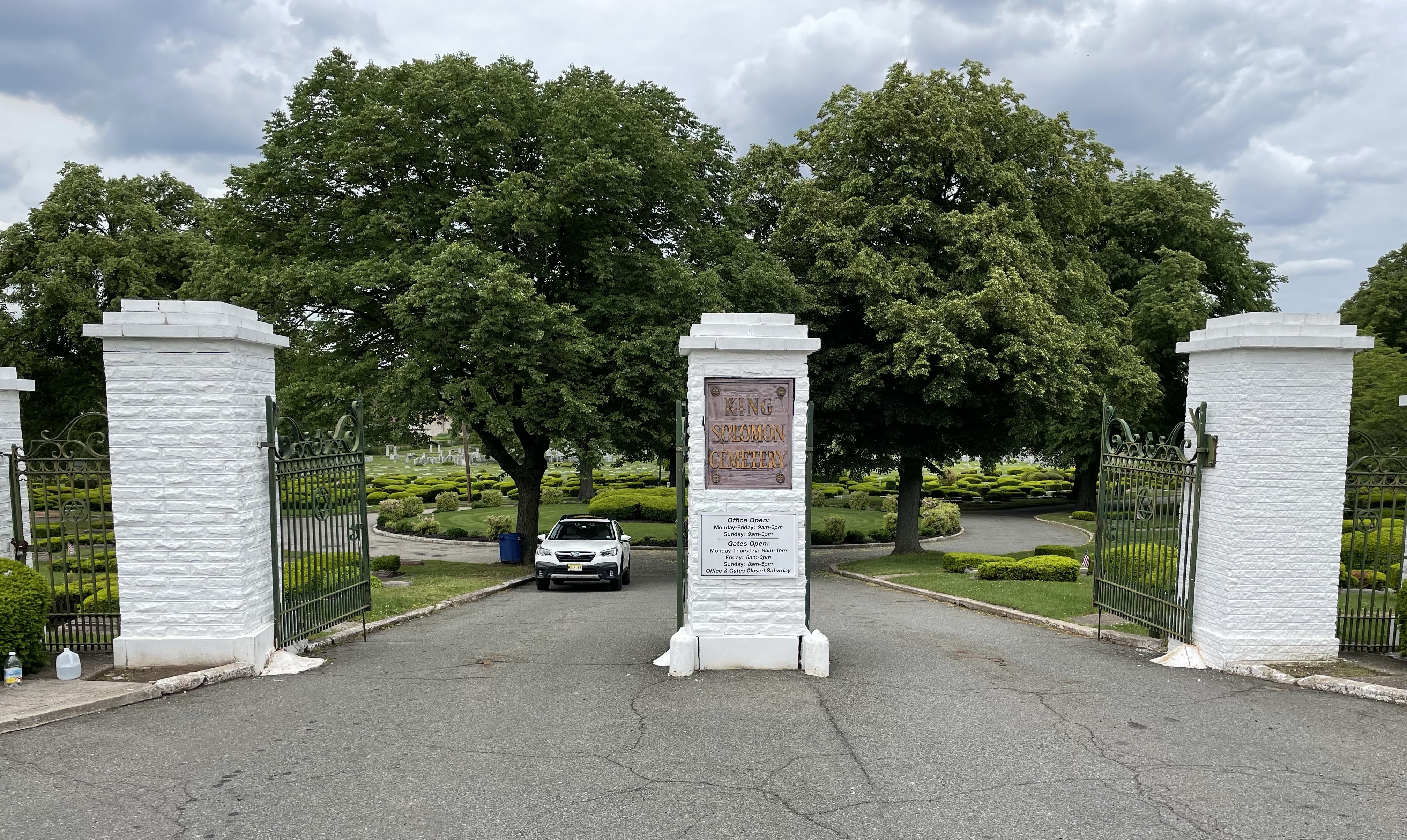
We did have the name of the cemetery where he was supposedly buried. I think my mother’s first cousin told us.  My brother took over the job of finding the grave.  He contacted the King Solomon Memorial Park in Passaic asking about our grandfather. (I do find it interesting and coincidental that Solomon was buried in the King Solomon Cemetery.)  The response was positive, our great grandfather was buried in the Tuber Section through a gate that says Welloner Benevolent Assn. 

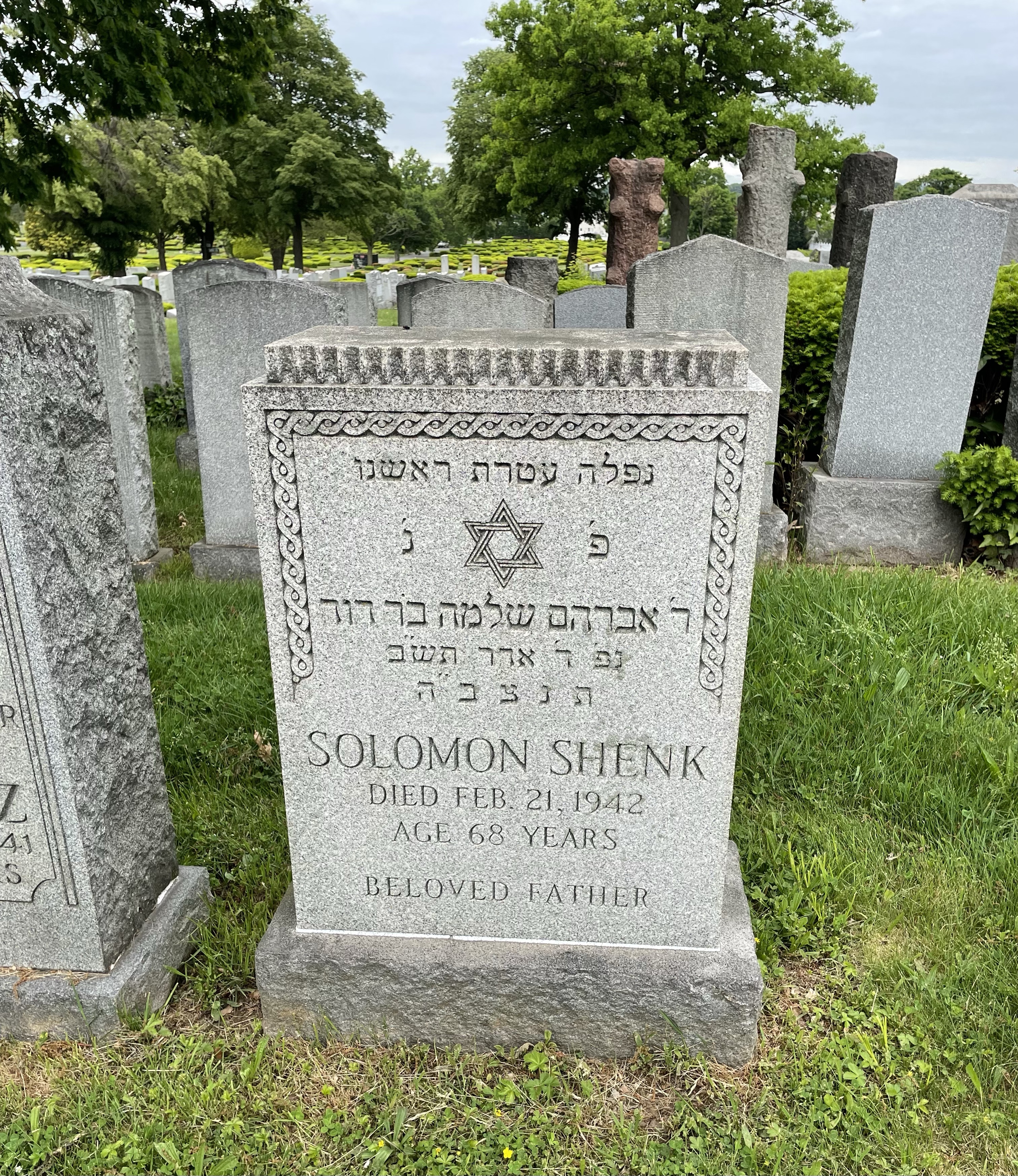
The grave had the correct date of death.  There is no date for his birth, probably because no one knew it.  We thought he was born in 1870, but his Visa paperwork said 1874.  However, the age on the stone matches what his age would have been when he died, 68 years old.

The staff at the cemetery even emailed my brother a map to the grave, which was exactly where my brother was told to look.  Not only that, the cemetery and the gravesite were in excellent condition.  So many old cemeteries are not kept up.  Thank you to the King Solomon Memorial Park for keeping these graves in excellent shape.

My brother took photos of the entrance to the cemetery, the gate to the section and the grave itself. He also looked for other family members, but did not find them. Then he left three stones on the grave. This is the way to show that we remember and honor his memory.

https://yivo.org/Folklore-of-Ashkenaz?gclid=EAIaIQobChMI0NL84bX59wIVfW1vBB1sGgIMEAMYASAAEgKhzfD_BwE

Where Were My Three Great Aunts in 1905?

18 Apr

I have all the census records for my grandfather and his family starting in 1900 through 1930.  I can see the birth of the children through the additions in each census, till finally there are eight living children.   I can see as children disappear, one died, one to an asylum, several to get married.  And two who stayed with their mother even after her divorce. (Abraham and Sarah Rosenberg, Kings, Bronx, New York; Sometimes Aaron, one time Rosenbery.)

I know there is the rumor that my great grandfather left the family and moved to Seattle sometime around the turn of the century.  In the 1900 Census, it seems that they are living together with their five children, aged 1 through 14.

In 1905, the family shows up, but some of the children are missing.  The four oldest children and the newest baby are all there, as are two borders.  But the three other daughters, Bertha, Edith and Hattie, are not listed.   Where are they?  One was found, Bertha is living with Louis and Rosa Salomon, also in Brooklyn, Kings.  She is listed as a niece, living with her aunt and uncle and their seven children.  Bertha is 11.  Her cousins range in age from 13 to 22.

But how are they related?  Is Rosa the sister of Bertha’s mother or her father?  Or is Bertha somehow related to the father of the family?  Is Bertha really their niece, or some other distant relative, so Rosa and Louis are doing a favor for Abraham and Sarah?    Where are the other two girls?  Are they with other family members or in an orphanage? What happened to Edith and Hattie?

The questions keep coming into my mind.  Is this when my great grandfather abandoned the family.  If so, did Sarah give her daughters to other people to care for during this time.  Perhaps, even though Abraham is listed on the Census, he is NOT really living there.  Perhaps Sarah was too embarrassed to tell.

I do know the story that my grandfather was sent to search for his father and bring him home.  That at age 13, which would have been in 1903, he crossed the USA with a friend from New York all the way to Seattle in an effort to bring his father home.  I remember being told that my grandfather’s friend was Italian, and during that trip is when Grandpa learned to speak Italian.

So we know this is a posed photo, but it is when Grandpa (on right) crossed the USA looking for his father.

Did his father come home with him?  I understand that it took almost two years for the journey there and back.  Perhaps this is when they returned, but they had not yet collected the girls from the places where they are staying.

I do know that they came back.  Because the 1910 Census lists all of them.  It is the last time that they would all be together in a census.  Here both parents and all eight children are listed in age order.  The sons always keep the same names, Samuel, Harry/Henry, and Jacob/Jack.  But I must say the girls have many names: Celia/Cecelia is the oldest, but I know she also had a Hebrew. Rose/Bertha is the oldest of the four younger children.  Esther/Edith is the third oldest. Hattie also had another name, but almost always was Hattie or Hady.  Minnie/Marion/Muriel is the youngest.

In 1915, they are all listed, but Samuel is listed as a farmer.  I know now that he was not really living at home, rather he was an inmate in an asylum. (See blog below.)

By 1920, the world of the Rosenberg family is disrupted forever. Sarah and Abraham are divorced.  Sarah is the head of the household, but two children are missing.  Samuel is at the asylum and Celia has died at the age of 24.

In 1925 my grandfather, the oldest of the remaining children, is gone from Sarah’s home, as he has married my grandmother. In 1930, Jacob is also gone.  It is Sarah and her four daughters.  But now Bertha is listed as the head of the household.  Perhaps by then Sarah is already sick.   She died in 1936 from cancer.   Before she died, she did get to see two of her daughters get married.  Muriel, who married in 1924, named her first child after her mother.  Sarah died on January 28, 1936.  And on November 13, 1936, Muriel had a son she named Stanley and used her mother’s maiden name as his middle name.  That made me happy.  I am also named for Sarah, but I was born almost 20 years after Stanley.

Standing: Great Uncle Lenny, Great Aunt Hady/Hattie, Grandpa Harry, Grandma Esther. Seating are my great grandmother and great aunt from my Grandma’s side.

Aunt Hattie married Lenny Greenberg. I knew them.  In fact, it was Aunt Hattie who introduced my Dad to my Mom.  Aunt Hattie and Uncle Lenny never had children.

Bertha and Edith never married and always lived together.

But my questions continue. Where were Bertha, Edith and Hattie living in 1905.  How was Rosa and Louis Salomon related to Bertha?

Once again thank you to Sherri V. who connected information for me when I posted on Tracing the Tribe Facebook Group!

Chihuly Double Dose

19 Mar

I do love Chihuly.  So when we were in Phoenix recently, I was delighted to learn that there was not one, but two, Chilhuly exhibits in town.  Luckily for me, my friends were willing and interested in an adventure,  seeing both exhibits in  one day! 

Friday, February 25, was Chilhuly Day for us in Phoenix. We purchased our tickets in advanced.  The morning was devoted to the “Chihuly In The Desert” at the Desert Botanical Gardens, where the art often imitated the nearby cacti.  The late afternoon was devoted to a tour of Frank Llyod Wright’s Taliesin West and the Chihuly pieces chosen to fit this unique architectural site.

I had been to the Desert Botanical Garden in Phoenix many years ago.  Even then, there were a few Chilhuly pieces at the entrance.  But I had only seen a small part of the gardens. Since I came with a group, we were kept close by on the paths near the front.  This time my friends and I walked the entire grounds!!!  We saw everything that was outside; the Apache household and native crops; the cactus and succulent galleries; the Agave yucca forest and more.  In each area, we looked for and admired the Chilhuly glass that was selected to highlight the natural art.

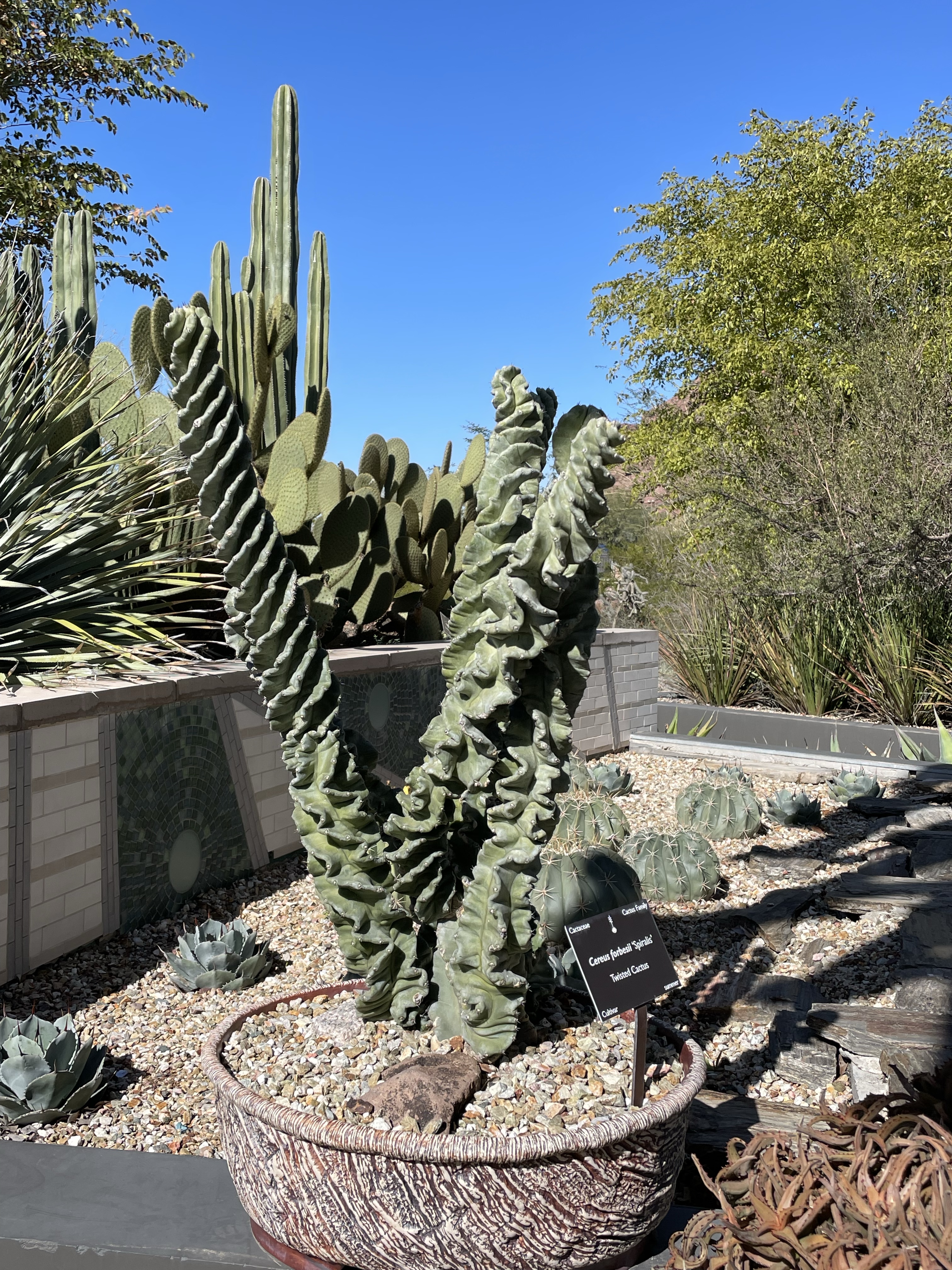
My favorite natural beauty was the crested cactus.  That was truly something amazing.  As well as the giant cactus that were highlighted by Chilhuly purple reeds.  I also loved this smaller twisted cactus!  Another amazing cactus insight was that birds make nests inside the cactus.  All those holes in a cactus are often a birds nest! A special protection coating is formed to protect the cactus and make a home for the bird.  It looks like a boot!!  We were also lucky as the cacti were beginning to bloom.  So pretty!

From my friend, who lives in Phoenix, I learned that pretty cactus are not NICE.  Some can almost leap onto you.  While another, that looks like it has a soft beard, in reality has a white soft looking collection of barbs.  DO NOT TOUCH. She continued to tell us to STAY BACK.  DON’T get so close. 

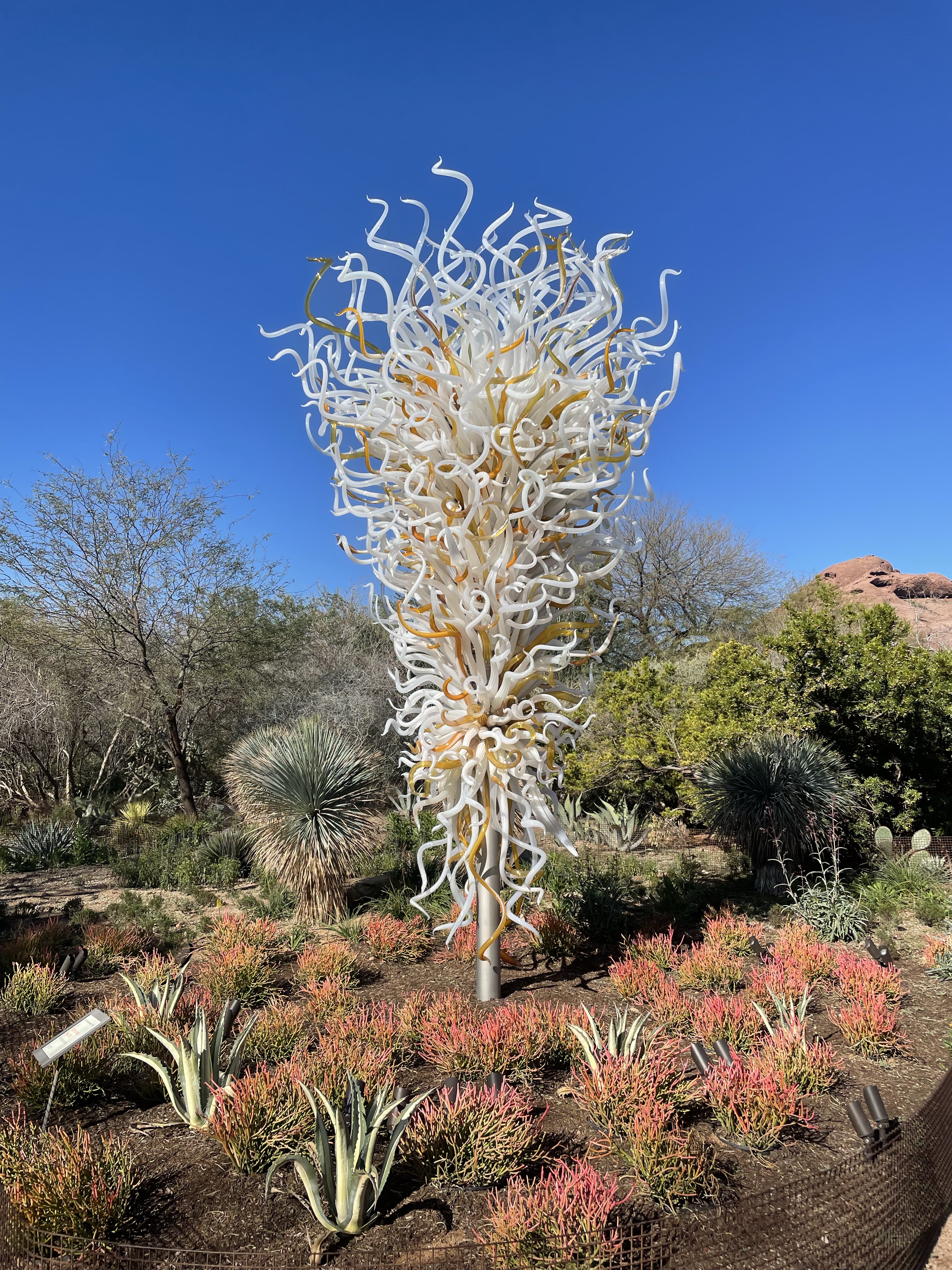
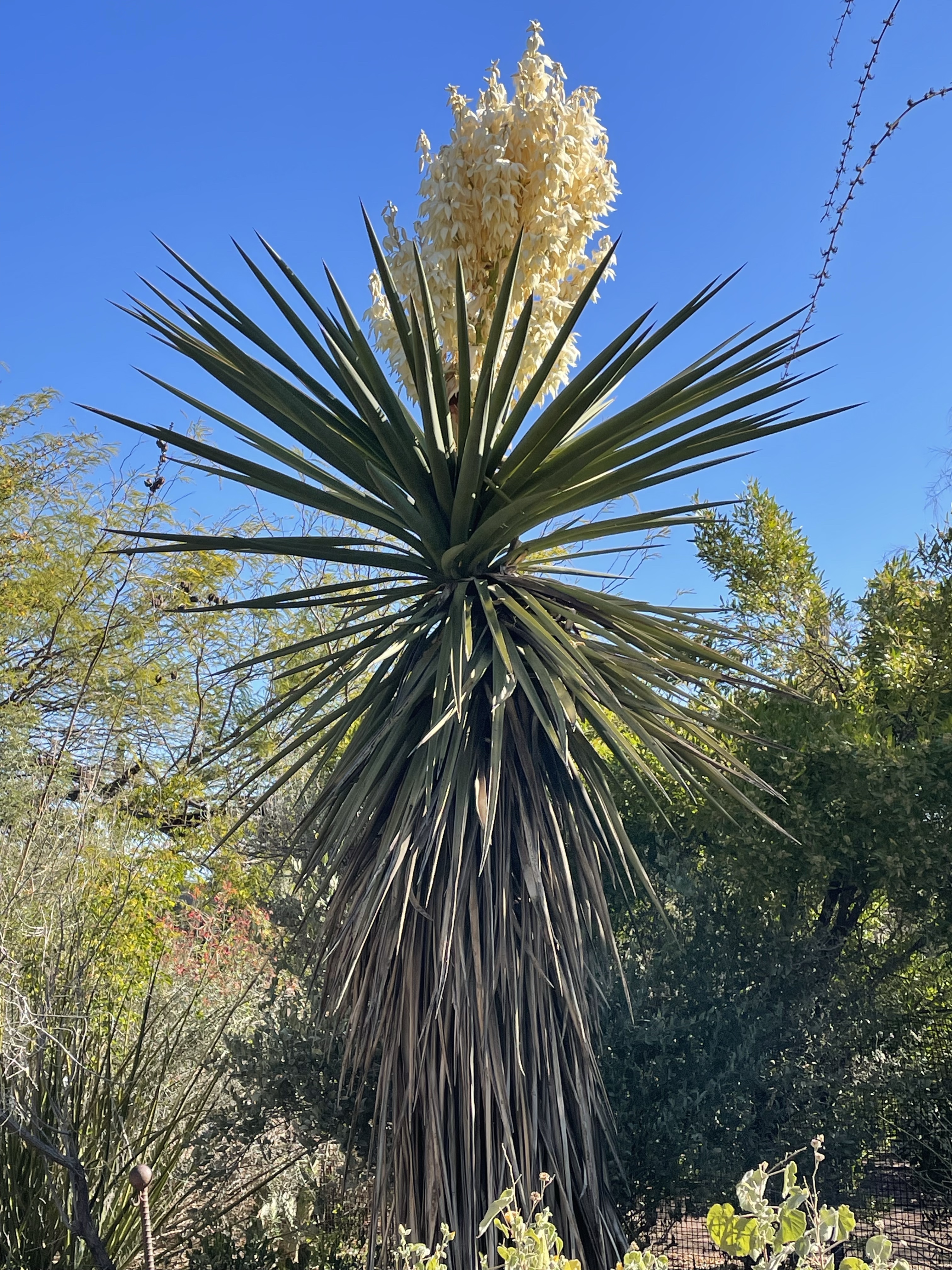
As for the Chilhuly, my favorite pieces included a giant gold, cream and white swirling tall collection of twisted tubes that reminded me of a yucca in bloom. My other favorite was a grouping of red, orange and purple reed like glass that made me think of flamingos. Of course, for anyone who knows me well, I loved the blue reeds!

I will admit, that it was not until we were leaving that we realized there was another exhibit of Chilhuly glass in a  gallery.  But we did not have time to admire it.  We had timed tickets for our second glass adventure.

 I really knew nothing about Taliesin West before this trip.  I have driven past Taliesin East in Wisconsin and been to a Frank Lloyd Wright house at Crystal Bridges in Bentonville. (See Blog Below about another Chilhuly adventure there.). But I really had not much information about Taliesin West until I learned about the Chilhuly exhibit.  Then I had to go and see the compound and the art glass.

Throughout the grounds, Chilhuly glass was displayed in ways to enhance the prairie style buildings.  My favorite, once again, mixed white gold and cream, with some sparkle right at the center of the complex, near the bubbling water pond.  The mass amount of red glass reeds displayed around the front of the home, some in dyed black water, was also fascinating.  And the view from the apex of the higher ground as spectacular.  Well worth the visit!

Drafting room

As for Taliesin West.  Wow.  His original plan to keep all the buildings open must have seen like a good idea.  But when I think about the heat in Phoenix, I am glad he gave in to his wife and closed the buildings in adding air conditioning!  I guess I am not a Frank Lloyd Wright purist.   For me the most interesting parts were the actual drafting room where other architects came to study with him and the small theater. 

I loved my day of Chilhuly, being with my friends, and enjoying these two special places in the Phoenix area. A double dose of Chilhuly was definitely worth it for me.

Chihuly, Stunning