Archive | Uncategorized RSS feed for this section

Bomb Shelters Versus Tornado Shelters

7 May

Since my experience with the air raid sirens going off my second day in Israel, I have a new Israeli obsession: Bomb Shelters.

It really is an easy obsession for me to have because living in the Midwest has lead me to a minor obsession with tornado shelters. Each time we have purchased a house, I have looked carefully through the basement looking for the ideal storm shelter. Lowest level, center of house or totally underground, no windows, close to a staircase (staircases are built extra strong) and nothing heavy overhead. For example, you do not want to be sitting in a tornado shelter under a baby grand piano or a refrigerator.

I can almost hear my favorite weather man, Gary, go through his tornado ‘rant’: children who are home alone, do not worry, just go to the lowest level, small, center most room in the house, no windows. This might not be his exact words, but they echo in my mind.

So it is easy for me to transfer my intense concern about tornado shelters to the essential concern for a bomb shelter.

In Israel most people live in apartment buildings. The old ones were not built with bomb shelters. Instead when the sirens go off, the people sit in their staircases…center most area of the house, no windows, reinforced concrete. A relative safe place to sit through a barrage of rockets or bombs, I guess. As I wrote in an earlier blog, my daughter’s apartment has a Momad, a room in her apartment built of extra thick walls, reinforced concrete, special window which has a thick metal plate that sides out and a thick metal door. It is easy to get to and somewhat safer than the rest of the rooms.

But what do you do when you are outside and you need to take shelter. Well there is a system. My daughter took me on a walk to explain sheltering when out side. First she suggested that I hide under an apartment building. In Israel most apartment buildings have car parking underneath and the first apartments are on the ‘second floor.’

She said, “Go to the North or West side of the house and take cover there. Those sides are safer.” She also told me to try the door. If it was unlocked just go in. “What! to a building where I don’t know anyone?” “Of course,” she responded. “During a siren of course they want you to come in.” Or if I am near a store, just go in.

I have to admit that for a tornado siren, we go to the north and east side of the basement. The storms usually come from the southwest, so I do have to change that orientation. And although I would not run into a stranger’s house during a tornado, I definitely have been known to enter a store I was near by when the tornado sirens went off.

But the best is to be near a bomb shelter and go into it. In Israel, the government takes bomb shelters seriously! And there are many community bomb shelters throughout the country. This is definitely why, even thought tens of thousands of rockets, drones, bombs, and missiles, have been launched towards Israel, tens of thousands of people have not been killed. Instead they had the ability to take shelter from the attacks and be somewhat safe.

Just as we in the Midwest know that in many public buildings there are signs to lead us to the tornado shelter, and so even though we have many horrendous tornados, the death toll has gone down over the years.

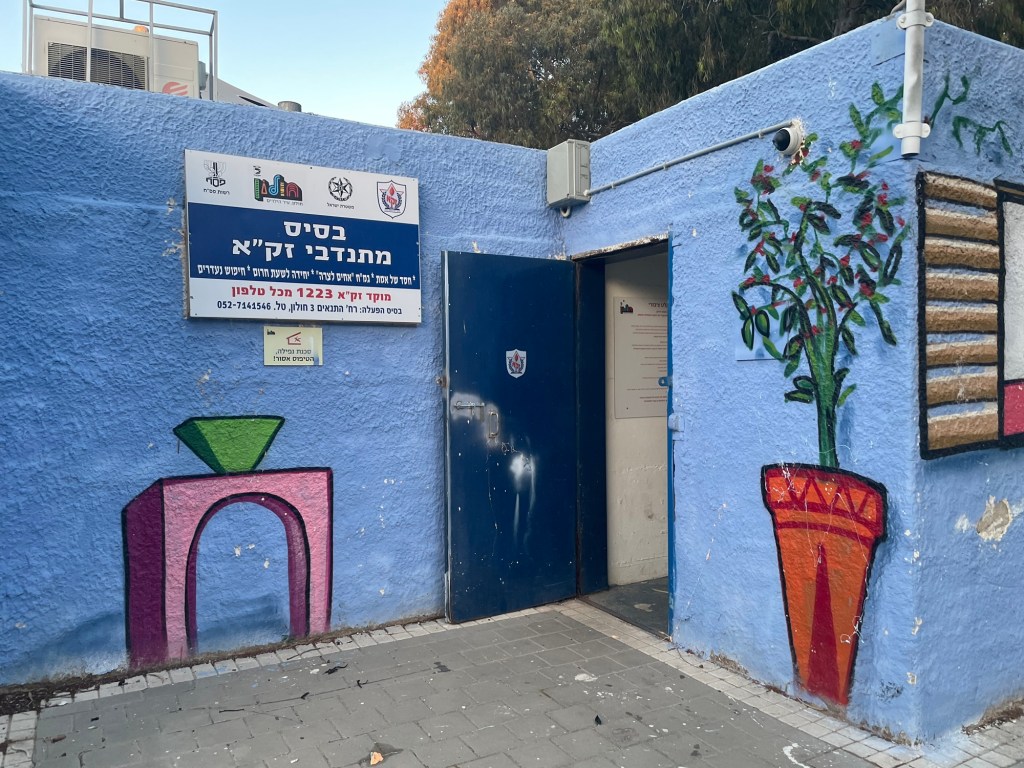
After my daughter pointed out where to hide under a building, we walked the two blocks to the little strip shopping area near her apartment. In the back was the entrance to the shelter. It is near a staircase, in the center of the building. Gary the weatherman would be so happy. Bomb shelters are like tornado shelters in many ways!!

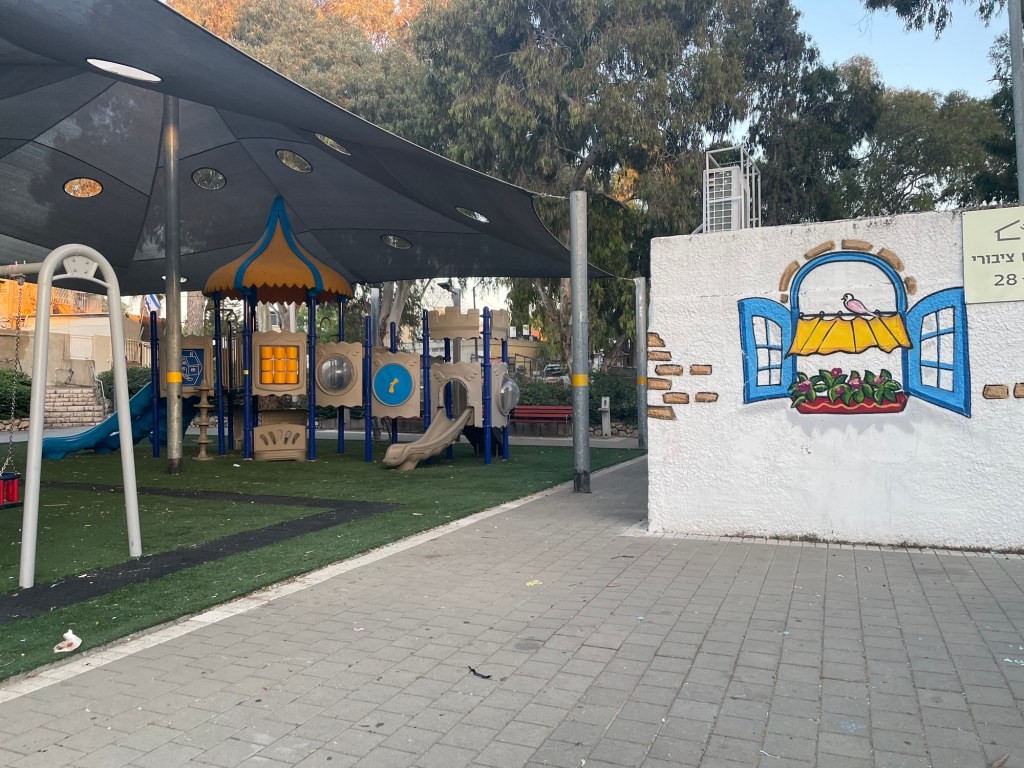
As we continued on our walk along the streets and alleys of Holon, we walked through many small parks. Within a one mile radius of my daughter’s apartment building are dozens of small parks, day care centers and schools. Located in the center of many of them are bomb shelters. Which makes sense, because children cannot run as quickly as adults. So best to have the shelter close at hand. What I really liked about the shelters is that the outsides are colorfully decorated to make them look cheerful and part of the fun of the park. In Holon, I think the same artist decorated most of them.

I thought about how difficult it would be for children to stop playing to run into the shelter, hide for ten minutes or so before coming out. And then I thought back to when my children were young. They NEVER argued when there was a tornado warning. When the sirens sounded, we all immediately went downstairs to the shelter. Sometimes they grabbed a cat if they could. But there was NEVER an argument. Never a discussion. Never rebellion. Taking shelter was the immediate goal. And then when the danger was over, we left the shelter. Sometimes it was 15 to 20 minutes. And sometimes we were down there for an hour or more. But when it was over, life just resumed. So I have to assume that children in Israel have the same response to a siren for a bomb attack as my children had for a tornado warning. Don’t argue, take shelter.

I do have to admit one caveat to taking shelter: Dads and husbands.. When my husband was home during a storm and tornado warning, sometimes he would stand outside for a while and watch the weather. This to me was not the brightest thing to do. But as many know, you a watch lots of videos of tornados heading towards someone’s home, and then finally someone yells, “We need to go inside now.” In Israel the same type of poeple stand outside and take videos of the Iron Dome rockets intercepting the missiles or bombs sent into Israel. I don’t quite understand this desire to watch in real time. But I do admit watching these videos myself.

But there is a major difference between a tornado siren and an air raid sirens. The intent. For a tornado you have to watch out for the debris. For a rocket/missile you have to watch out for the shrapnel. Similar but not exactly the same. Nature doesn’t take aim at your home because it hates you, it just is. While bombs falling around you are sent purposefully to kill you. That does change the dynamic of sheltering.

Although tornado shelters are here to stay, people should not have to have bomb shelters in their homes or their play grounds. Humans cannot stop tornados, but they can stop bombing each other with intent to kill. It is time for it to end.

Israel Version 2025

4 May

I noticed a difference the first evening in my daughter’s apartment in Holon, just south of Tel Aviv. We were unpacking my suitcases and going through the items I had brought for her, when I noticed the sounds of airplanes or jets in the sky.

I said, “I don’t remember so many planes flying overhead to the airport.

My daughter: “Mom, those are not commercial airlines.”

Me: “oh”

Then she added, “It is Shabbat, commercial airlines don’t fly. But military is exempt.”

In the morning I learned that the IDF had bombed part of Syria to protect the Druze population.

The peaceful view in Holon one hour after the siren.

I was not unaware of what it was like to live in Israel. I had studied in Israel for a year attending Hebrew University from July 1974 to July 1975. I had some experience with war time in Israel. The Yom Kippur War had been the previous October 1973. Most of the students I met had survived that war. Even the ones who did not have physical scars, had mental ones. And we all knew to report any backpack or bag that looked suspicious or was unattended. When on a bus, the driver always checked to make sure every backpack or bag had an owner on the bus. I had heard explosions and been to areas perhaps I should not have been to with my friends who had been called up for reserve duty so many years ago.

I had been in Israel with my children and parents in December 2004/January 2005 for a two-week trip. Israel was on high alert. It was in the process of leaving Gaza and turning it over to the Egyptian/Palestinians who were living there. The settlers who had to be removed were protesting. We had to avoid some places. And at times we saw the movement of tanks heading toward the Gaza envelop. I wonder what would have happened if Israel had not left Gaza. Would it had been better if Hamas had never been elected as the government there? If Israel had just kept its oversight? I know that the government thought/hoped this would bring peace. Unfortunately it brought 20 years of bombing, hate and then pogrom.

My husband and I were in Israel in November 2008 for a medical meeting where my husband was a presenter. We stayed after the meeting to visit our daughter in Beer Sheva where she was a graduate student at Ben Gurion University. One day the three of us went to an Air Force Museum. The young soldier who was our tour guide was a little tense. I noticed that lots of jets were taking off and landing. I asked the guide a question about it. Her response was they were doing drills. When we left the museum, I turned to my daughter and said something is going to happen. Before we left Israel, a few days later, I told my daughter to be careful. To pay attention to what was happening, I was extremely worried. Six weeks later was Cast Lead, Israel’s response to the continued bombings from Gaza/Hamas.

In the summer of 2016, a few months before my daughter and son-in-law got married, the couple purchased an apartment in Holon. “Mom,” she said, “you will be happy to know that our apartment has a ‘mamad’, a bomb shelter.” “I am happy your apartment has one,” I responded. “But I am sad you have to have one.”

In November 2022 I was in Israel with my daughter when the government tested the siren alarm system. It was the first time I had been in Israel that I heard the sirens go off. Although it was just a test, it made me aware that my daughter actually used her mamad. Something I still feel very sad about.

I have been on the phone with my daughter several times when she has had to take shelter. When the sirens were going off. Once when she was at the University, when I was on the phone with her, I actually heard the bomb hit, it was so close. And just last week, before I came here, we were talking when the sirens went off and she and her husband ran to their shelter. There have been ballistic missiles from Yemen and the Houthis for two years now. These were so large, that even when they were shot down, the shrapnel could cause damage.

I arrived at Ben Gurion Airport on May 2. This morning, 40 hours after my arrival, on May 4, 2025, I had my own mamad experience. This morning after they went to work, I planned to take a walk. But at 9:22 am, just as I was preparing to leave, the sirens went off. It was not a drill or a test. It was the real thing. Everything outside stopped. I went into the mamad. Here is what ensued as per our text conversation:

“The sirens are going off. how do I close the window?” Me

“Go to your room. There’s a metal slide on the right side. Pull it hard.” my daughter

“I cannot get the slide. The sirens stopped.” Me

“Or just stay away from the window. Stay in the room 5 minutes.” My daughter

“Ok” me

“Looks like the Houthis, so there’s probably nothing near us.” My daughter

“Ok I don’t think I will go for a walk right now.” Me

“Ok. Usually it’s just one.” My Daughter

“Well I was just going to go when the sirens went off. And I don’t know where the shelters are. Cars are starting to move. But it is still silent.” Me

“Yeah, the sirens only go off for a bit and turn off. But they say to stay inside 10 minutes. But for Houthis really 5 is fine.“ My daughter

“Everyone is still in shelters. All the construction stopped.” Me

“Everyone is leaving my shelter now. in Tel Aviv Everyone is outside.” My daughter

“We can walk tonight. You can show me where the shelters are.” Me

“Ok we’ll go on a walk tonight.”My daughter

“Sounds good. I hadn’t thought of that before. It would have freaked me out walking by myself… when the sirens went off.” Me

A bit later I found out that the missiles hit Ben Gurion Airport, 16 miles from Holon. Several people were injured. Many flights have been cancelled for 24 hours. A friend of mine, who lives in Tel Aviv, texted me. “Luckily you arrived before today’s mess at the airport. “Oy yes,” I responded.

Back in Holon, the construction is continuing. I hear the voices of children outside from the neighboring schools. I hear jets overhead. And I see commercial airplanes. The sky is a beautiful blue color. It is a lovely day, only 70 degrees. Life goes on. Just an hour later, and no one even thinks of the short time in the bomb shelters.

Israel Version 2025. Keep living.

https://www.ynetnews.com/article/rkkfwtvglg

The End Of Our Kauneonga Lake, Catskills Era

25 Nov

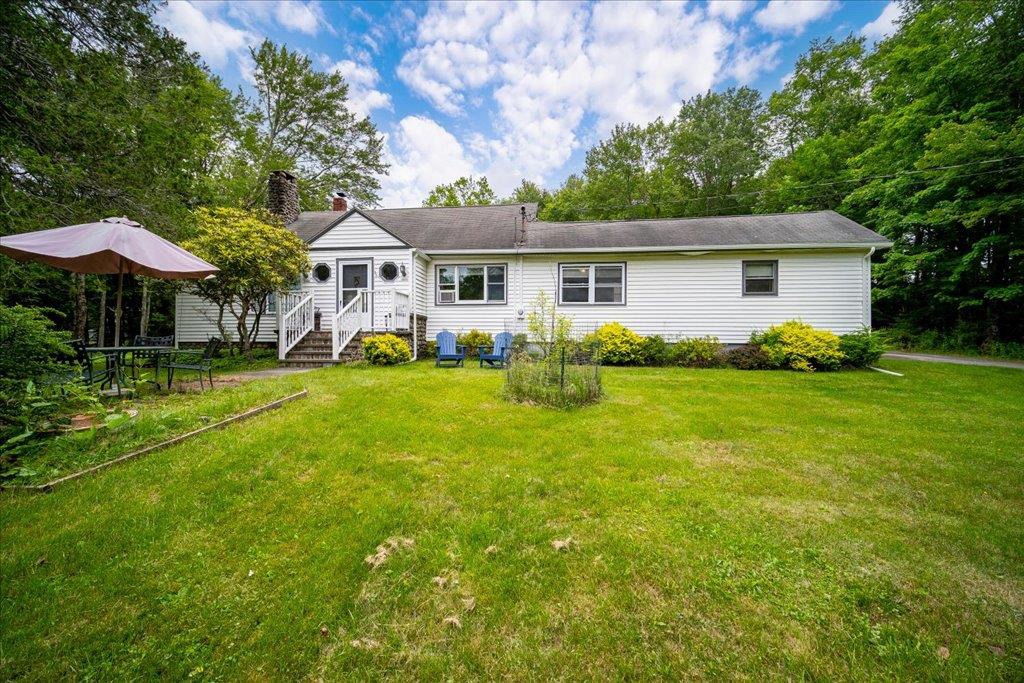
October was a bittersweet month for my siblings and me.  We sold our family home in Kauneonga Lake.  It has been in our family since 1962.  Since the late 1920s, my family has had a summer home in the Catskills of New York.  It was not an easy decision.

My grandparents first started visiting the Catskills before my mother was born in 1929.  They wanted a place away from the city, a place that would remind them of the home they left.  Grandpa from Trzciana, Mielic, Austria (now Poland); and Grandma from her home in Bolesslawiec and Viroshov in Poalnd.  Grandpa told me once, that when he was in the Catskills he could think of his family, who perished in the Shoah, and remember happy times.

I don’t know the exact year that they purchase their first place in Kauneonga Lake.  But by the 1930s they had a summer home and owned several acres of land directly across from Kauneonga Lake.  Soon they started building a small bungalow colony where they would rent bungalows out up into the late 1970s.  Eventually they sold off the bungalows individually along a road that is named after them.

Among the people who purchased the property were my two first cousins from the other side of my family.  Thus, although, my siblings and I no longer own any of the property.  We have family members who still remember the bungalows and are living on the property. Our cousins spent every summer in the Catskills with us, our parents, our grandparents, our aunts and uncles and many people who became more like family than just summer friends.

My grandparents had friends among the other colony owner and locals. We knew the plumber, the egg farmer, the trash man, the electrician and many of the business owners.  In the 1960s my grandparents decided that they wanted an all-year house in the Catskills.  They purchase a house on four acres that also had a bungalow.   The house had been divided into four little apartments. My grandparents began the process of making it one home again.  Enlarging the kitchen.  Added on a one-bedroom apartment.  Fixing the attic apartment and turning it into two bedrooms and a bathroom. They built a garage since they planned to stay there in the winters as well.

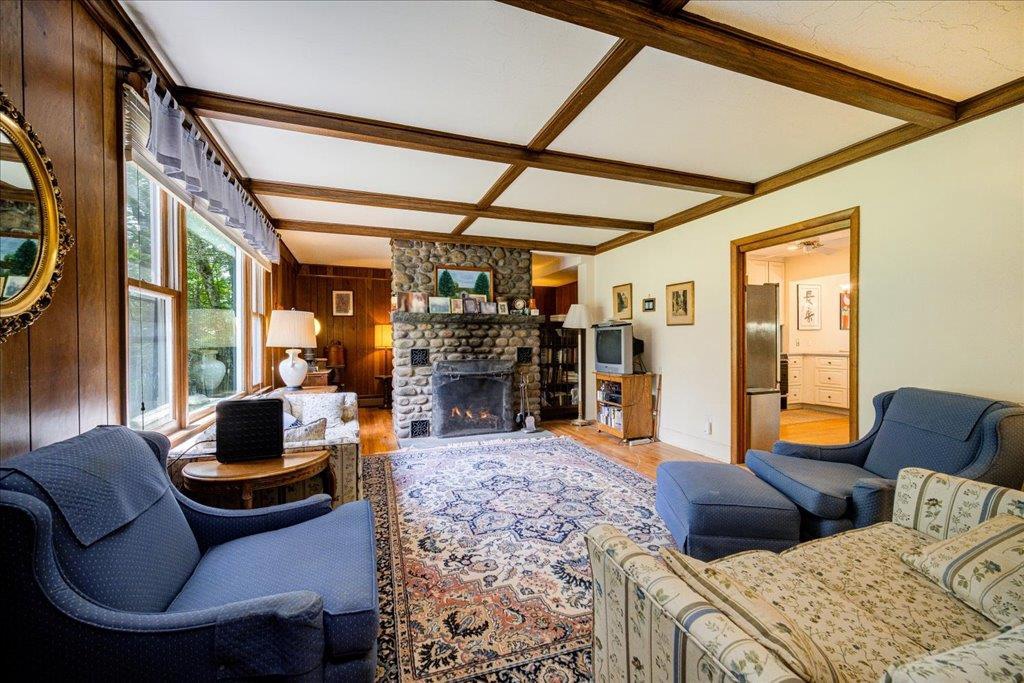
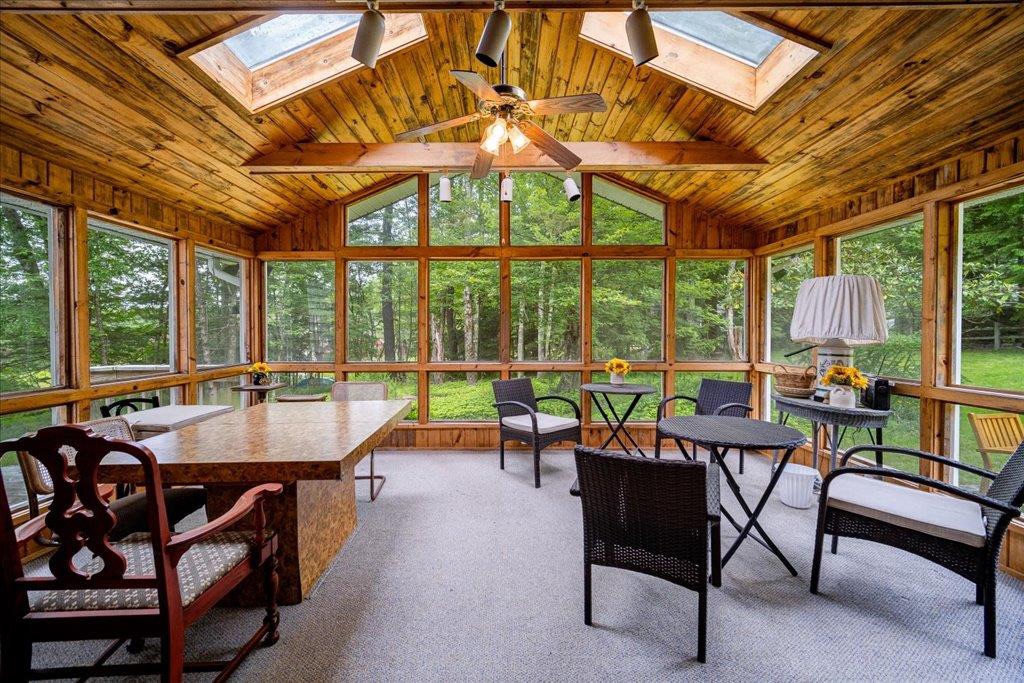
The best thing they did, in my mind, was creating the room that eventually became known as the stone room.  It was originally an outdoor patio that connected the house and the garage. But in winter it was so cold, that they closed in the two walls and put on a roof.  But kept the stone patio floor. The only thing they did that I hated, was removing the little eating nook that had a table and two benches. I loved sitting there. But it disappeared in the renovations and became part of a real dining room. Among the best permanent parts of the house is the wonderful stone fireplace and stone steps.

The most important thing they fixed was the furnace. When they first purchase the house, it had a coal burning stove and an open fire furnace.    You could see the fire from the furnace through a grill in the floor.  Soon that was replaced with a regulation furnace.  The coal burning stove was lovely. They did not get rid of it.  It was put in the basement where my grandfather used it to bake.

Everyone at the bungalow colony and in our family called it the Big House.  My grandparents moved in and started renting their bungalow at the colony, and eventually we moved up to the bungalow behind the Big House.  Leaving the comfort of the bungalow colony, but enjoying more space.

It was in this house that I learned to braid challah from my grandfather.  He had moved some of his bakery supplies from his New Jersey bakery there.  He baked for us and for the shul.  I loved watching his technique. He never measured anything with a measuring cup.  He would just put it up in his hand, shake it a bit and put it in the mixer. He taught he how to braid challah with one braid or with two. He showed me how to make a round challah for the holidays.  But I never learned his recipes. Mom and I tried to write them down, but they weren’t the same when baked.

It was in this house that we watched the walk on the moon in July 1969.  It was in this house that we watched the endless line of people walking up West Shore Road to Woodstock.  From our house it was an additional two miles up and down hills to get to the site of the concert.  We could feel the ground vibrate and hear the music and the announcements from our home.

Here we would lie on a blanket in the grass and watch the meteorite showers and sometimes see a flash of the aurora borealis, we would find the constellations. On rainy days it is where my friend and I would read Nancy Drew books. Our parents arranged to buy different ones in the series so we could switch when we finished. It was here that my grandfather and dad had a giant vegetable garden, and we all learned how to grow and harvest vegetables.

We would see deer, bears, woodchucks, rabbits, skunks and other forest creatures. 

We played cards and mah jong, ate meals and made memories with my grandparents, parents, relatives and friends.  The house was our summer world. And all year long we waited impatiently to return.

It was in our house that we sat shiva for my grandmother. She died in August, when all the summer people and the locals were there.  I won’t forget it. The plumber, Ab, and my grandfather, Nathan, were best buddies.  So great that when my grandmother passed away, it was Ab who took me to the hospital to sign papers and identify my grandma in death. My grandpa and my mom stayed at our house.  I will never forget the ride there and the ride back.

 It was members of the Catskills congregation of Beth El that prepared the house for the shiva after the funeral.  And that the locals and summer people came to tell stories and remember her, along with our family and the summer renters.  My grandparents, and my parents and us, belonged to the Congregation Beth-El, where my grandfather was a Cohen, so went to services often.  As a retired baker he often made goodies for after service kiddushim.  And I know there is a window that they sponsored. I think it is in the balcony area. We always went to the shul in Kauneonga/White Lake for the high holidays.

My grandfather died eight years later. It was November, so we sat shiva in New Jersey.  It was 1989.  He had over 60 years enjoying the Catskills.

After my grandparents died, my parents became the owners of the house. They remodeled the kitchen, and they added a screened-in porch.  They enlarged the master bathroom and added an on-suite bathroom.  Every wall they opened they had to update the electric from knob and tube and replace the plumbing.

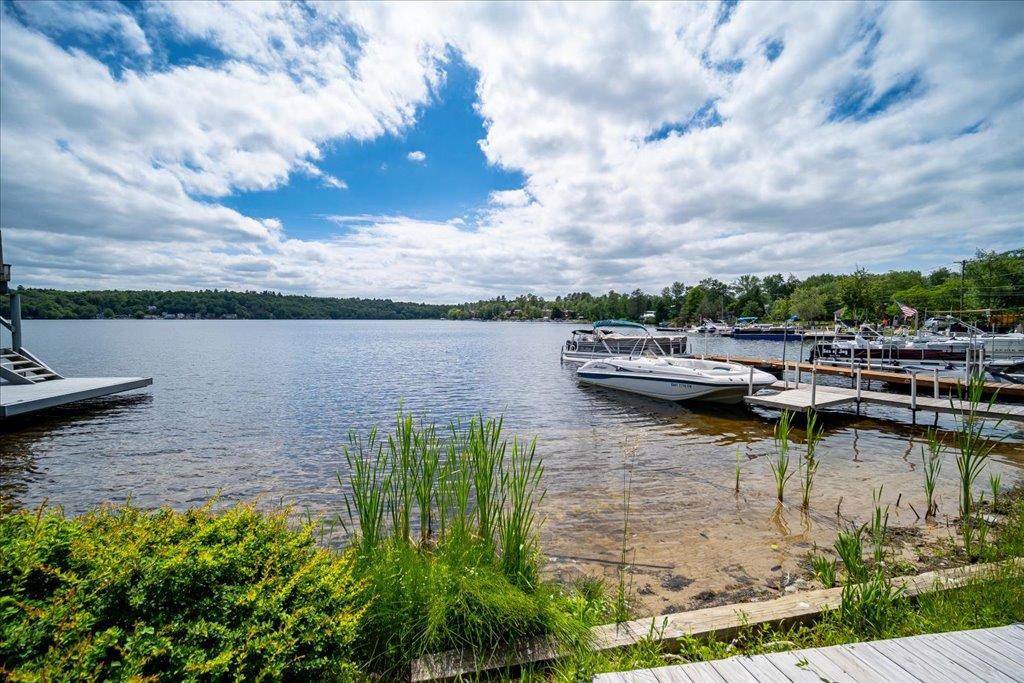
It was this house that eventually we would bring our children for summer visits.  And down at the lake we had a dock where my dad had a ponton boat. My children loved their yearly two-week visit to New York and New Jersey. They got to see so many cousins and go out in the boat and run around outside in the rain.

But since my parents died nine months apart in 2010 and 2011, we have not used the house the way it should be used.  One of my nephews did live there for two years during Covid. Then it did have some love and attention. But for most of the time, it was used once or twice a summer for a long weekend.  It was not getting the attention or love it needed.

Our Dock spot.
Two years ago, we made the decision. The house needed to go to a family who would actually use it.  With our lake frontage, it was the perfect home for someone who liked boating.  This year we put it on the market.  In August we had one last family weekend in the house as we sorted through everything and packed it up.

Then in the evening, my niece asked us to tell her stories about the house and the summers.  My brother, sister and I shared our memories. We laughed, we teared up, we remembered our parents and grandparents.  It was a great way to say goodbye to our house. 

Even though the house has been sold, and another family now owns it, we have 60 years of memories that will never go away.  And with our cousins still at Kauneonga Lake each summer, we have a place to sit on the beach if we like and talk about the past and plan for the future with our cousins whenever we want to visit.

With our children spread out across the country and overseas, our time as the owners of the Big House has ended along with our family’s long saga in the Catskills at Kauneonga Lake.

Remembering and Looking Forward 

7 Oct

The Anne Frank Center and Kahal Kadosh Beth Elohim

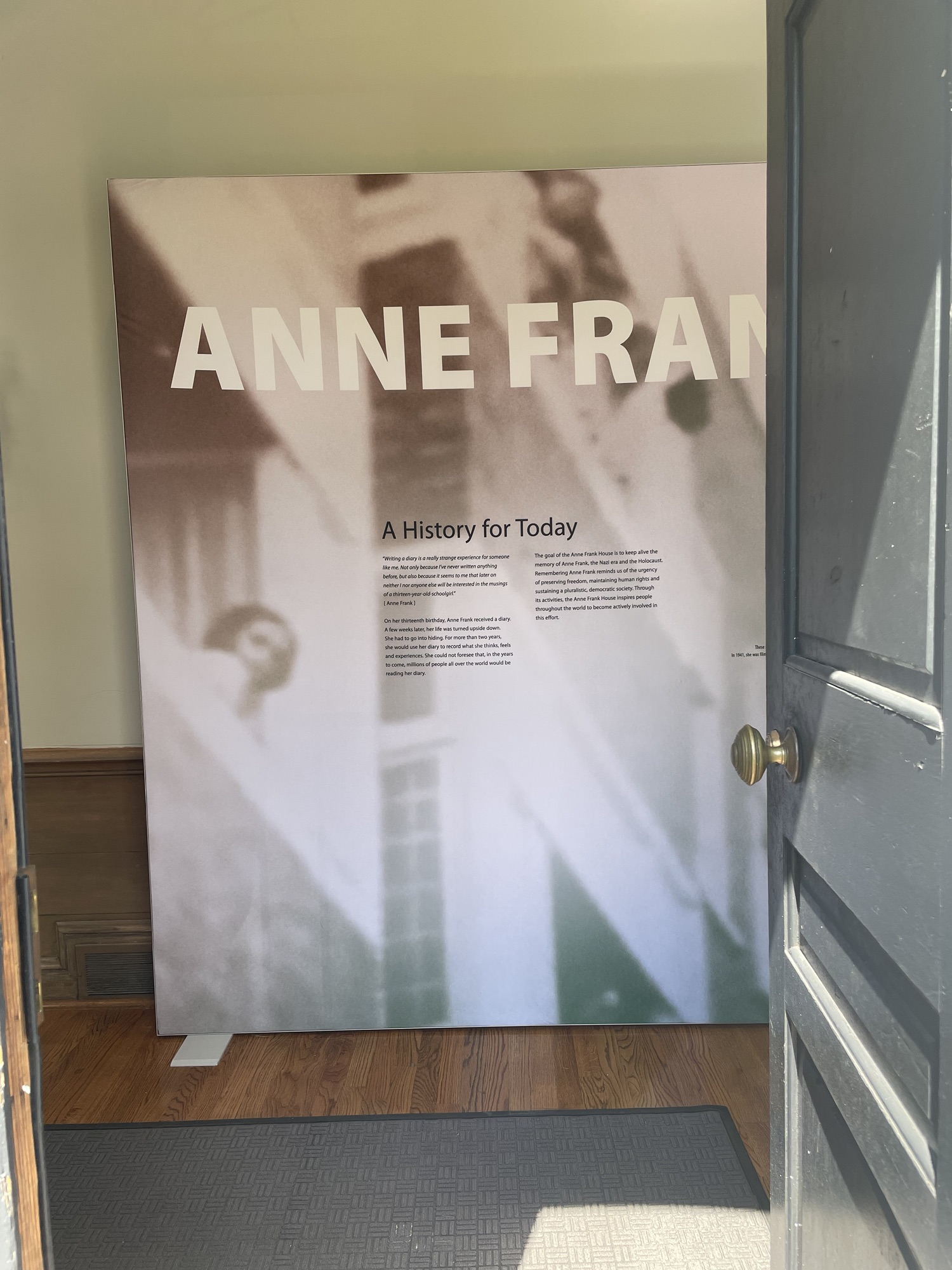
When we drove from Asheville to Charleston, before the hurricane, friends of ours who live in Charleston suggested we stop at the Anne Frank Center located on the campus of the University of South Carolina. 

I never expected South Carolina would be the home of one of four Anne Frank Centers in the world, and the only one in the United States, in partnership with the Anne Frank House in Amsterdam.  I contacted the Center before our trip and was able to make an appointment to tour the exhibits.

So today, on October 7, 2024, I feel that I must remember the distant past of Jew hatred as we mourn the one year anniversary of the vicious attack on Israel.

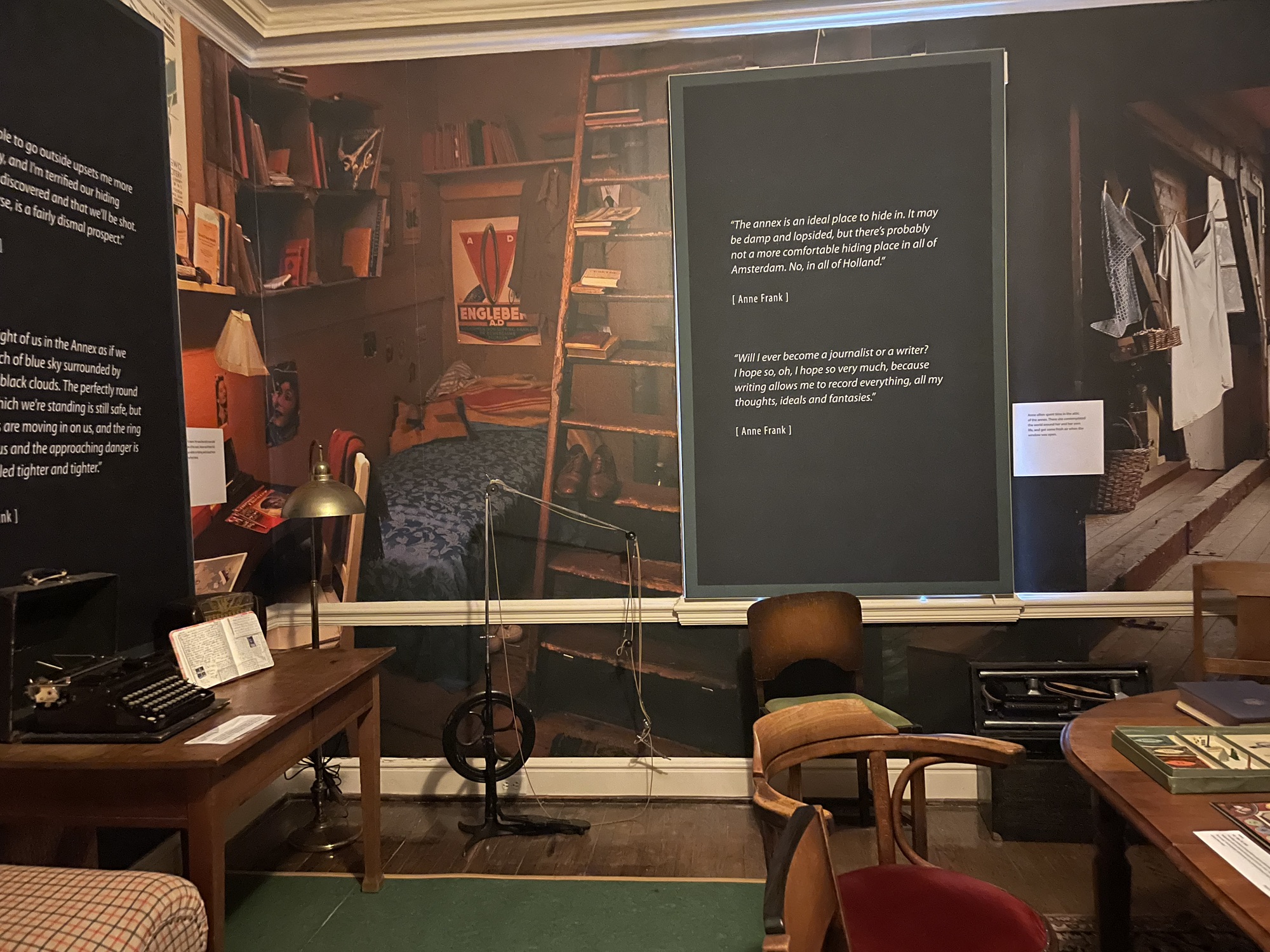
The Anne Frank House does an excellent job recreating the feeling of the hidden annex.  While touring the exhibit, visitors will enter a display of Anne Frank’s diary written in many languages on a wall of bookcases.  Not surprisingly one bookcase opens allowing visitors to enter a darkened room that helps tell the story of the Annex.  Having visited the Anne Frank House in Amsterdam, I was amazed about how this small display harkens to the feelings I had in Amsterdam.

Besides the onsite programs, the Anne Frank House also offers traveling exhibits that can be sent across the USA.  They teach local high school or college students to serve as the guides to the 32-panel exhibit. I would love to see this exhibit in my home community!  Our tour at the Anne Frank Center was led by a college sophomore who was doing her first tour for us and her dad!  Emma did a great job. I could see that she related to the world of Anne.

Going to the Anne Frank Center and remembering her words of hope help me see hope in the situation that we have in the Middle East today.  There are good people who want this violence to stop.  Who want terrorists to end their campaign of hatred.  No one wants innocents, like Anne Frank, to suffer or die.  So I have to believe there will be peace.

My feelings of hope continued in Charleston where we visited the 275-year-old Kahal Kadosh Beth Elohim synagogue, founded in 1749. It is the oldest synagogue in continuous use in the United States. The current building dates from 1841, after a fire in 1838 destroyed the second building.

 Originally a Sephardic synagogue with the bima in the center and balconies above for the women, it changed in 1879, when the bima moved to the front and women joined men in siting for services. Later, after the earthquake of 1886, the balconies were destroyed and were not replaced.

Standing in a building that has housed a congregation since 1840, almost 190 years, and knowing that the congregation itself is 275 years old gives me hope. This congregation has survived the Revolutionary War, Civil War, WW1, WW2, antisemitism, the creation of the State of Israel, the rise of the alt right in the south, and more.  The fact that it continuous to be an active congregation gives me hope.

Today, I remember my feelings on October 7, 2023, when my daughter called me from Israel to say she and her husband were okay, but that the situation was very bad. The entire country was in shock.  Everyone knows someone who died.  For me, although I knew no one, I do know people who lost family members and friends.  The past cannot be forgotten. However with education, like that of the Anne Frank Center, and endurance like that of Kahal Kadosh Beth Elohim, I believe we can look forward with hope to the future.

https://sc.edu/study/colleges_schools/education/partnerships_outreach/anne_frank/index.php

https://www.kkbe.org

Viroshov/Wieruszow: A Jewish Community Destroyed

28 Aug

With the days quickly leading up to Tisha B’Av, I cannot get the destruction of my grandparent’s families out of my mind. After writing about Boleslawiec and its small Jewish community, I feel it is important to write about a town that lies six miles away.  The town where my great grandmother Sarah Manes grew up: Viroshov/Wieruszow.

When I realized there were so few Jewish citizens of Boleslawiec, I had to reconsider some of the stories my Grandma told me about growing up.  She always talked about all her cousins and spending time with them.  Then I remembered, she told me about spending time with her grandmother Klindell Manes, and that is where she saw her cousins, in the town of Viroshov.   It took me a while to figure out that Viroshov, was Yiddish for Wieruszow.

All those stories she told me were about her Manes cousins. Those were the cousins I had met in Israel so long ago.  (See blogs below.)

I was right.  And once again I am forced to forgive my 20-year-old self for not paying enough attention.  For not wanting to hear the horrible stories.  For tuning out, while trying to escape from the seemingly endless number of survivors who insisted on seeing Grandma during our month-long stay in Israel in 1976.

I have written about several of these survivors and what I discovered. (See blog below.). And I even wrote about my Grandma’s cousin Dora before.  But now I need to revisit Dora and tell more of her story.

I now understand why her daughter was so protective of her when she called to set up a meeting with my Grandma.  I now have rachmanes, in my mature years, that I did not have as much in my youth.  I tried to be as courteous as possible, but I truly did not understand the undercurrents of everything that occurred.

Grandma had survived the war by being in the USA. She had saved her father and her sister by bringing them out of Europe in 1936.  In fact, their family did not know that my great aunt had escaped, and had even added her to the Yitzkor book of the town!

My grandmother and her children were safe.  She did not need to remake her life.  But Dora and so many others had had a different reality.   I now know Dora’s reality.  And I feel, once again, the burden of knowing someone, but not really understanding and knowing what happened.

Dora was married before the war, in 1924, a few months before my grandparents.  She and her husband survived.  But her mother, who was my great grandmother’s sister, Mascha, did not survive.  Her father, Eliazer, did not survive.  Her brother, Wolf, and her sister Yocheved, did not survive.  In all 13 people with the last name Manes, and more related to the family,  from Wieruszow were murdered.

Before the war, in 1921, there were 2300 Jews in the community of Wieruszow, making up 36 percent of the population.  In 1939, before the Nazis invaded there were 2400.  That all changed.  The Jewish community was slowly decimated. By 1940 there were 1740 Jews.  In September 1941 a ghetto was opened where 1200 Jews were imprisoned.  Then between August 11 and 23 the ghetto was ‘liquidated.’ I hate that word.  Just say the Jews were killed and moved to Concentration Camps.  This time, Chelmo.   But before they were taken, the old and sick were shot.

In April 21, 1942, there was a mass murder of Jews and a mass grave for 86 people was dug in the Jewish cemetery.   But, of course, that did not survive because the Nazis also had to wipe out cemeteries to destroy the memories.  The tombstones were used for pavers. The cemetery was dismantled.  But 100 tombstones still remain.   I doubt I would find my great great grandparents and great grandparents gravesites.

However, that mass grave gave me another clue to my family.  A stone was laid on the mass grave by a man with the last name Majerowicz.   That sent a shock through me as well.  Because in Israel, I also knew a man with the last name Majerowicz.   He was also my Grandma’s first cousin.  But he was a bit different.  I wrote about him because his sister was Grandma’s first cousin and best friend. His mother and my grandmother’s mother were sisters.

In all there were 135 names in the Yad VaShem database with the last name Majerowicz, or some similar spelling that perished in Viroshov/Wieruszow.  I noticed that many were duplicates, so perhaps only 80 people were listed.  And although not all were related to me, once again I will claim them as being related. Because I feel I must.

Now there are over 8600 people live in Wieruszow.  In a town that was once 36 percent Jewish, there are no Jews.  The cemetery is destroyed.  The original mikveh, where many Jews were murdered by the Nazis is gone.  There is just a list, a yitzkor book and some memories.

Once again thank you to Virtual Shetl, the Yad Vashem Database, Jewish Gen, and the Viroshov Yitzkor book.

https://zicharonot.com/2014/04/28/speaking-yiddish-always-brings-me-holocaust-memories/

https://zicharonot.com/2015/11/03/who-are-you-these-photos-call-out-to-me/

https://zicharonot.com/2016/10/01/the-rosh-hashannah-card-has-a-story/

https://zicharonot.com/2018/06/07/the-sorrow-of-shalom-hollander/

The Vaile Mansion, A Gem in Independence, MO

2 Jul

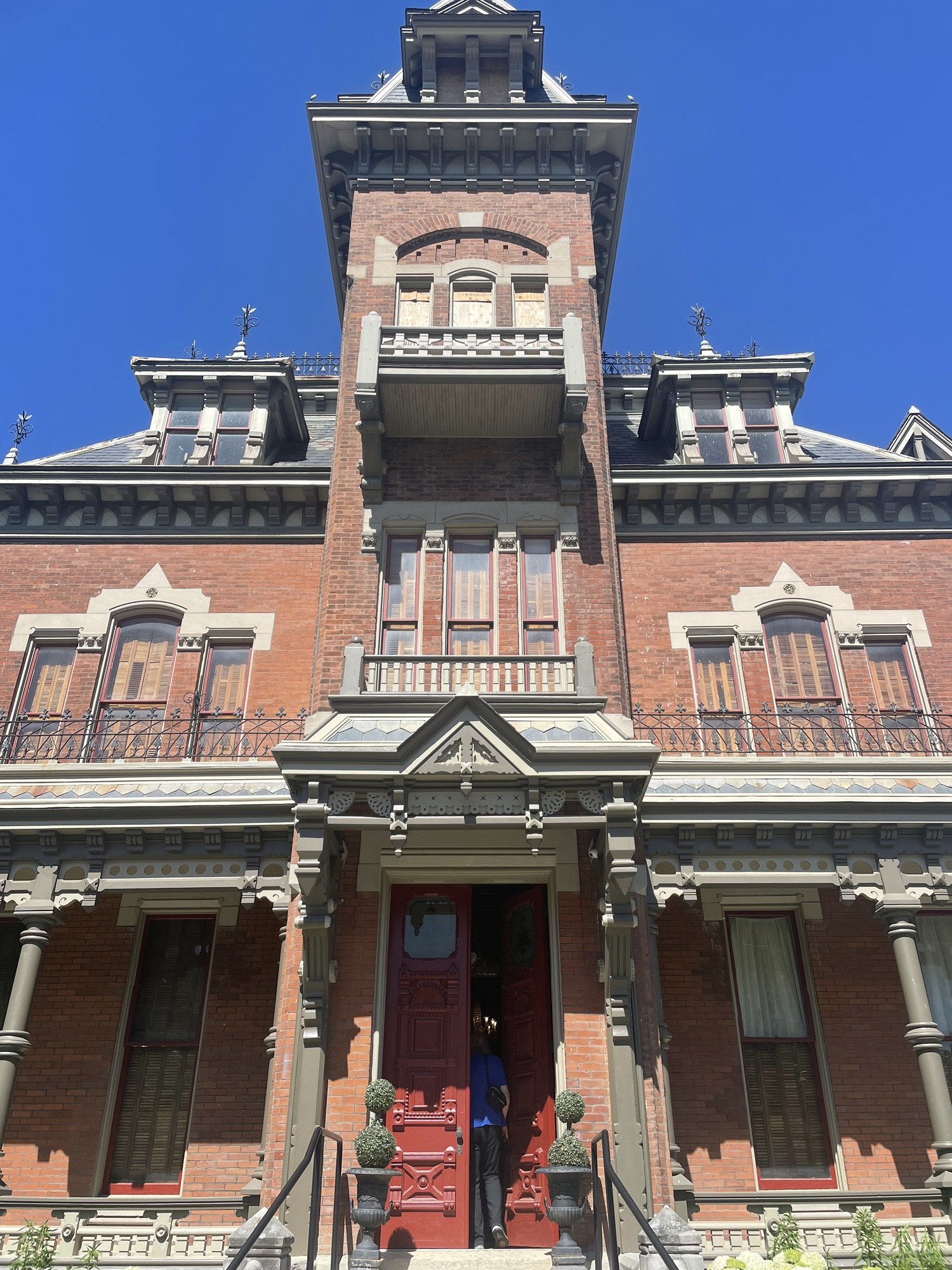
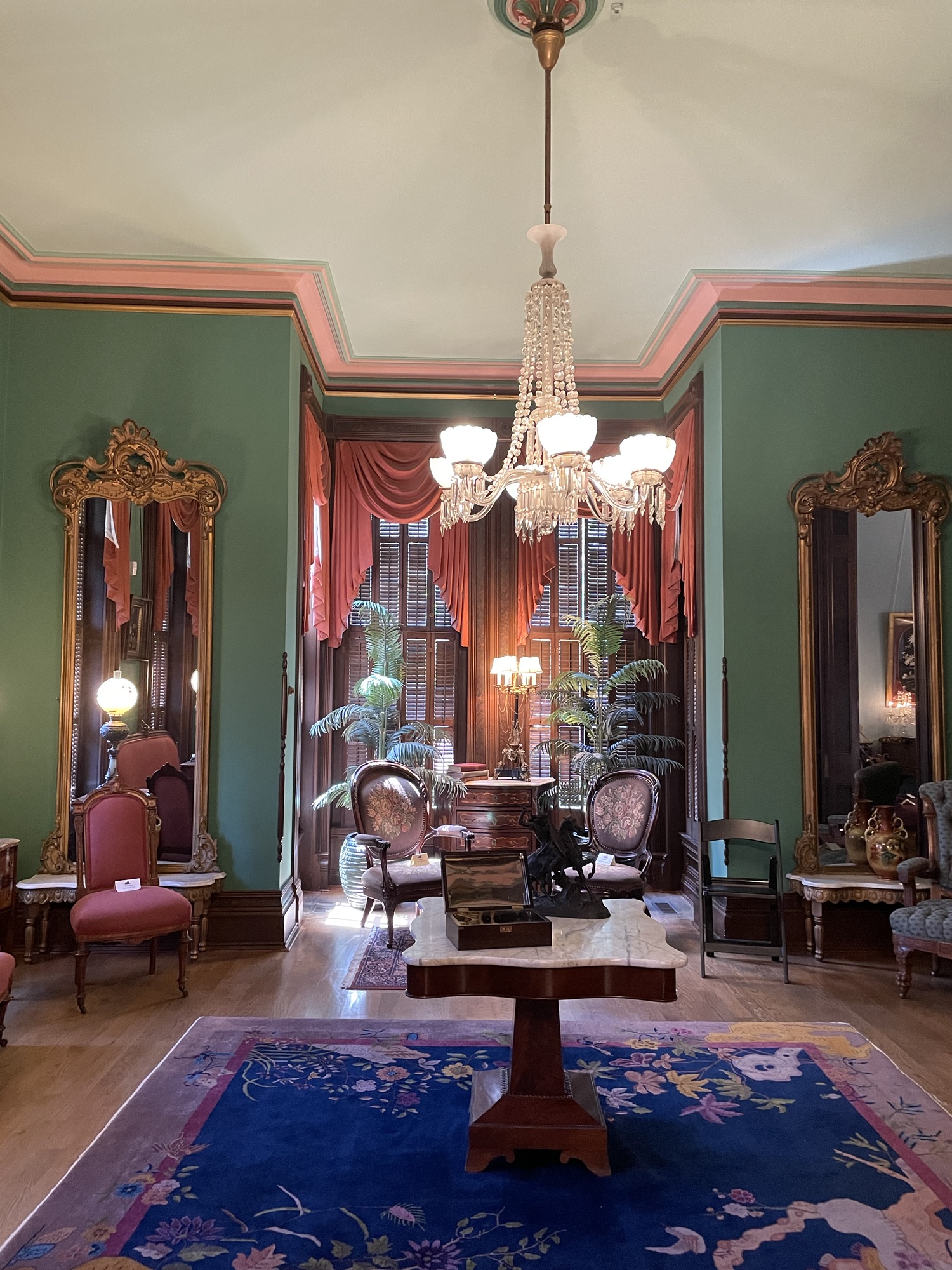
I love old homes that have been turned into museums.  So when I read about the Harvey M. Vaile Mansion in Independence, I knew it had to be part of one of our local excursions.  When I discovered it, the mansion was not open to the public.  It is only open from April 1 through October 31 on Thursdays through Sunday for regular tours, although it does have a holiday season in December. 

We planned our visit to the Vaile Mansion for May and took a short trip over to Independence to check it out. It was worth the trip!  The mansion is lovely.  It was built in 1881, the mansion has 31 rooms.  But what surprised me is that only two of the rooms were bedrooms!  There were not many people who lived there, but they had plenty of places to use to stay away from each other!! The brick hoe also has nine lovely marble fireplaces of different colors.  Important to keep warm with in the 1880s.

The house was designed by a local Kansas City architect, Asa Beebe Cross. It was the height of modern technology for its time.  It has flushing toilets, fueled by a 6000-gallon water tank.  Copper bathtubs were installed in the bathrooms.  The room where the tank was later used as an informal dining area. The kitchen had hot and cold water!!!

Unfortunately, Harvey Vaile and his wife, Sophia, did not enjoy the mansion for long.  Sophia, who had stomach cancer, died in 1883.  Vaile continued to live there, but he died in 1894.  They did not have any children.  But Harvey Vaile did have nieces and nephews that contested his will which led to a legal battle and their being unable to pay the attorney, who then acquired the mansion!

Over the years it was used as a sanatorium and a nursing home and owned by the attorney Carey May Carroll.  After she died and it was to be demolished a local couple, Roger and Mary Mildred DeWitt, purchased the mansion and began making repairs and restoring it. Mrs. DeWitt donated it to the City of Independence in 1983.

I loved it. The building looks like a mansion should look.  It has a gothic air of mystery!  In fact, my husband commented that it looked a lot like the house in a lithograph I have made by a local artist (Randal Spangler, see link below.)  about a spooky Halloween house!  We are sure it is the inspiration! In fact, in October they do hold Spooky Tours, and supposedly the house has a resident ghost!

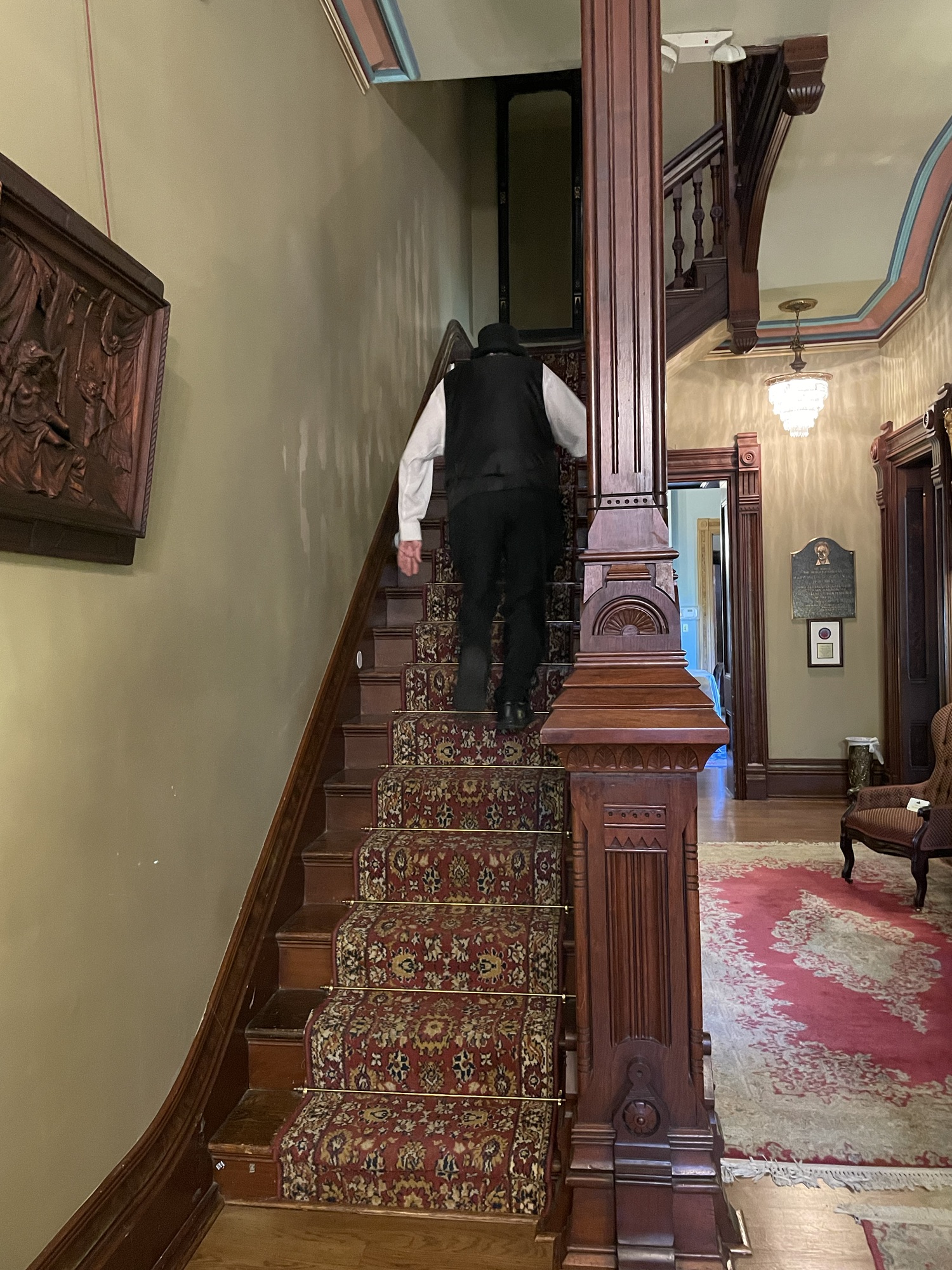
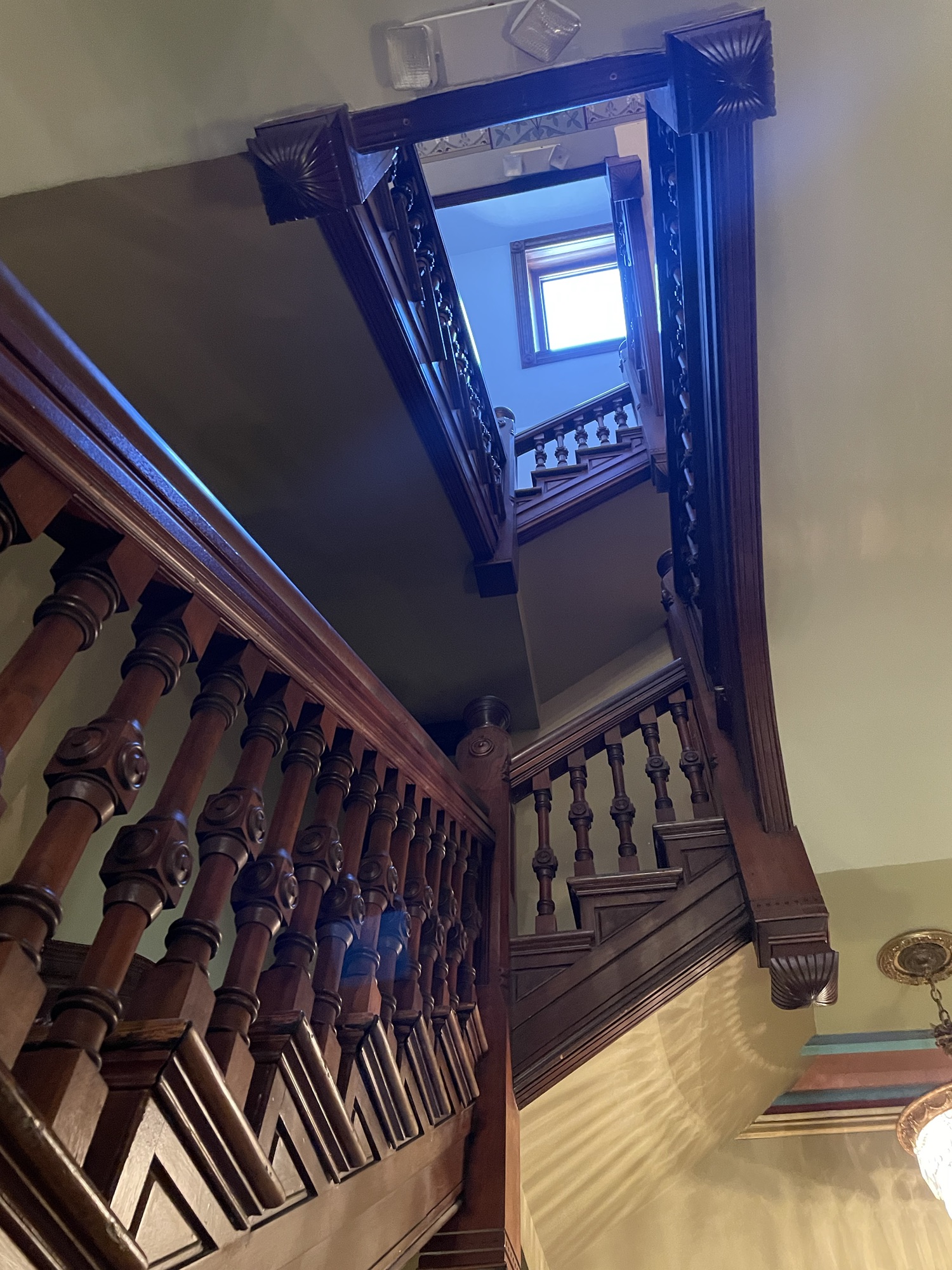
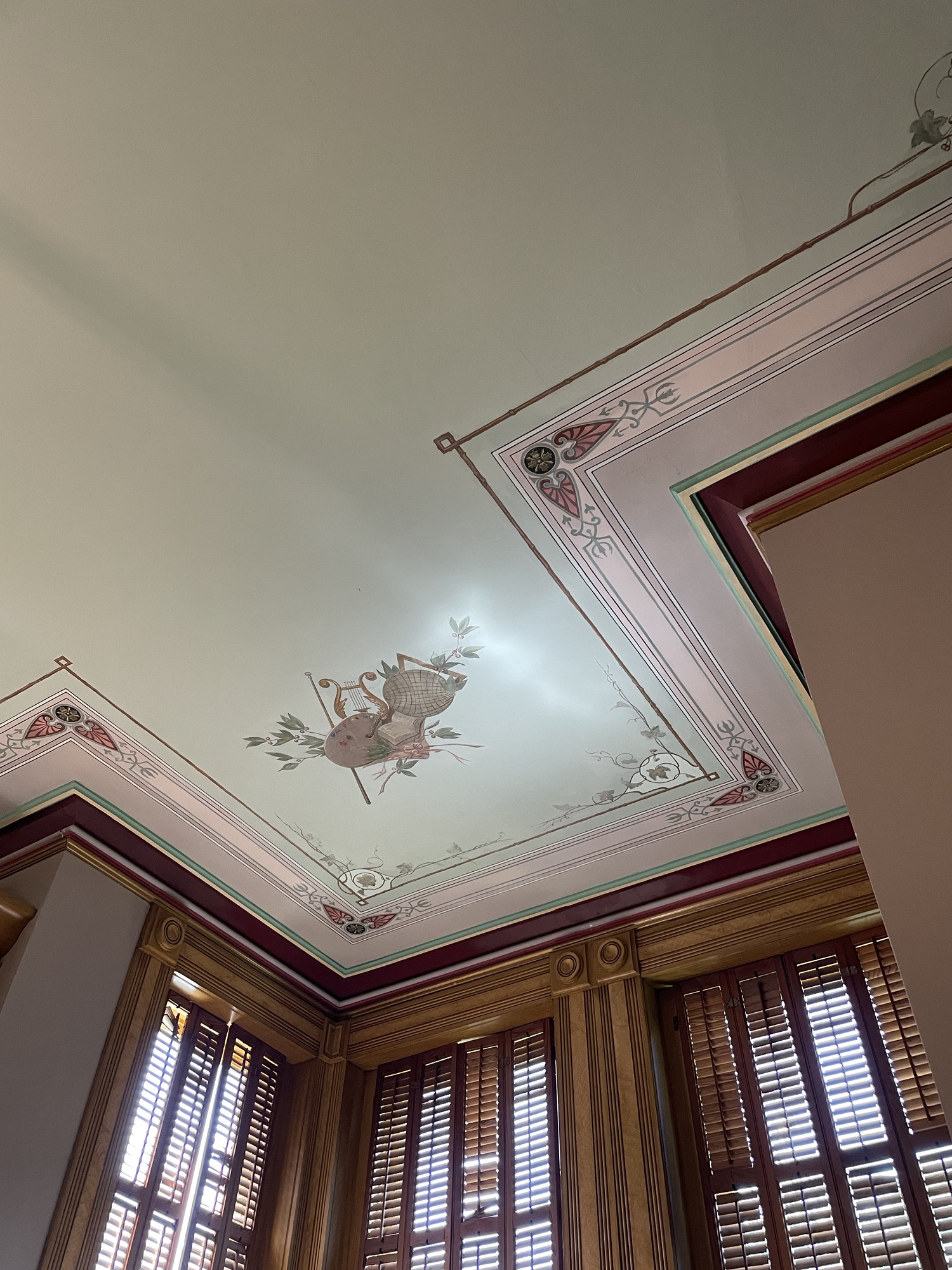
I loved the massive wooden entrance door, and the beautiful leaded glass throughout the house.  The staircase that goes up three stories and ends in a skylight at the top is wonderful.  All the carved wood bookcases and cabinets, along with the painted ceilings, which were part of the original house, makes it truly a gem. The bathrooms, with the cooper tubs and toilets are so unusual for the time! Colonel Vaile was forward thinking!

The furniture is all from the period, but none of it was original to the house. But there are many lovely pieces included an organ, piano and music box.  Throughout the house there are little pieces of history to experience. The best part is that a docent takes you on a tour of the house to point out special objects and to answer questions.

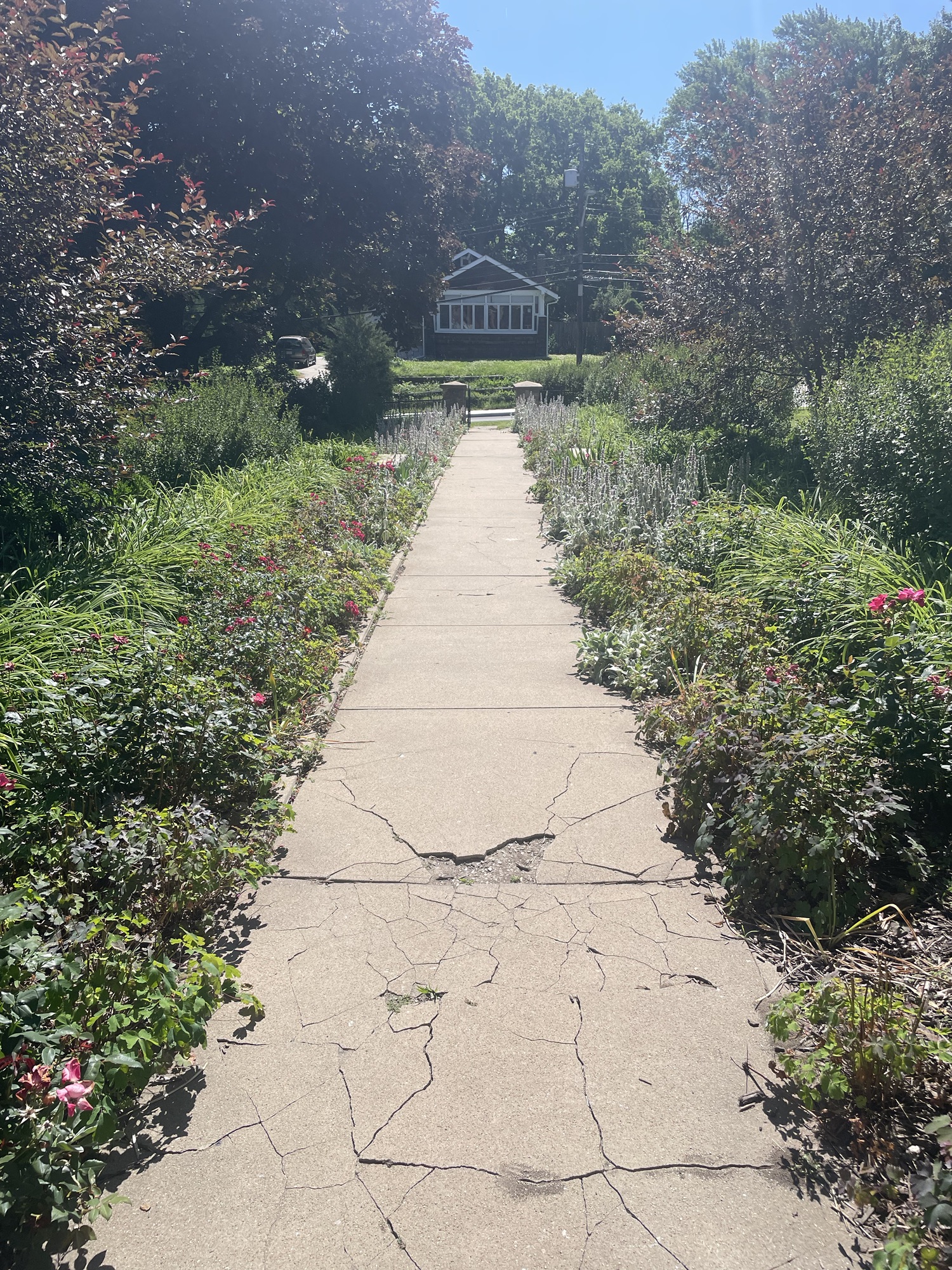
The grounds of the house are also lovely.  In early spring a Strawberry Festival is held there. Local couples can rent the house and its grounds for weddings.  It would be a great place to be married.

In all you just need about an hour or so to go through the house.  The day we went we were the only people at that time. As we were leaving more guests were arriving.  It is very close to the Independence Square, so we headed over to complete our day by eating lunch at the Court House Exchange.

https://www.vailemansion.org/

https://en.wikipedia.org/wiki/Vaile_Mansion

https://en.wikipedia.org/wiki/Asa_Beebe_Cross

Trick or Treat House: https://www.randalspangler.com/store-2-1/p/sanctuary-of-knowledge-tplyf-j8pyx-mmn56-8et9k-k4tkm-cshzd-b6res-r9t4e-3fes4-23a3n-59ghm

The Mysterious Loretto Stairs and Other Unusual Sites in Santa Fe

17 Jun

Santa Fe is a city of many diverging elements coming together to create a unique city. The art of the Navajo, Apache, and Pueblo people; and the multitude of art galleries and jewelry stores; the churches and religious sites; the unusual round State Capitol building; and the original adobe buildings; the restaurants; the museums, all combine together to give the visitor and the residents a place that stimulates the senses. 

My husband, who is enamored with AI, asked what would be the best 2.5 hour walking tour of Santa Fe. Its description of four places became our morning walking tour. None of these places take long to visit, unless you want to stay longer.  For this ‘tour’ you will be walking up hill on the Old Santa Fe Trail Road, which is right by the La Fonda Hotel downtown. Finally, you can always take your water bottle in with you.

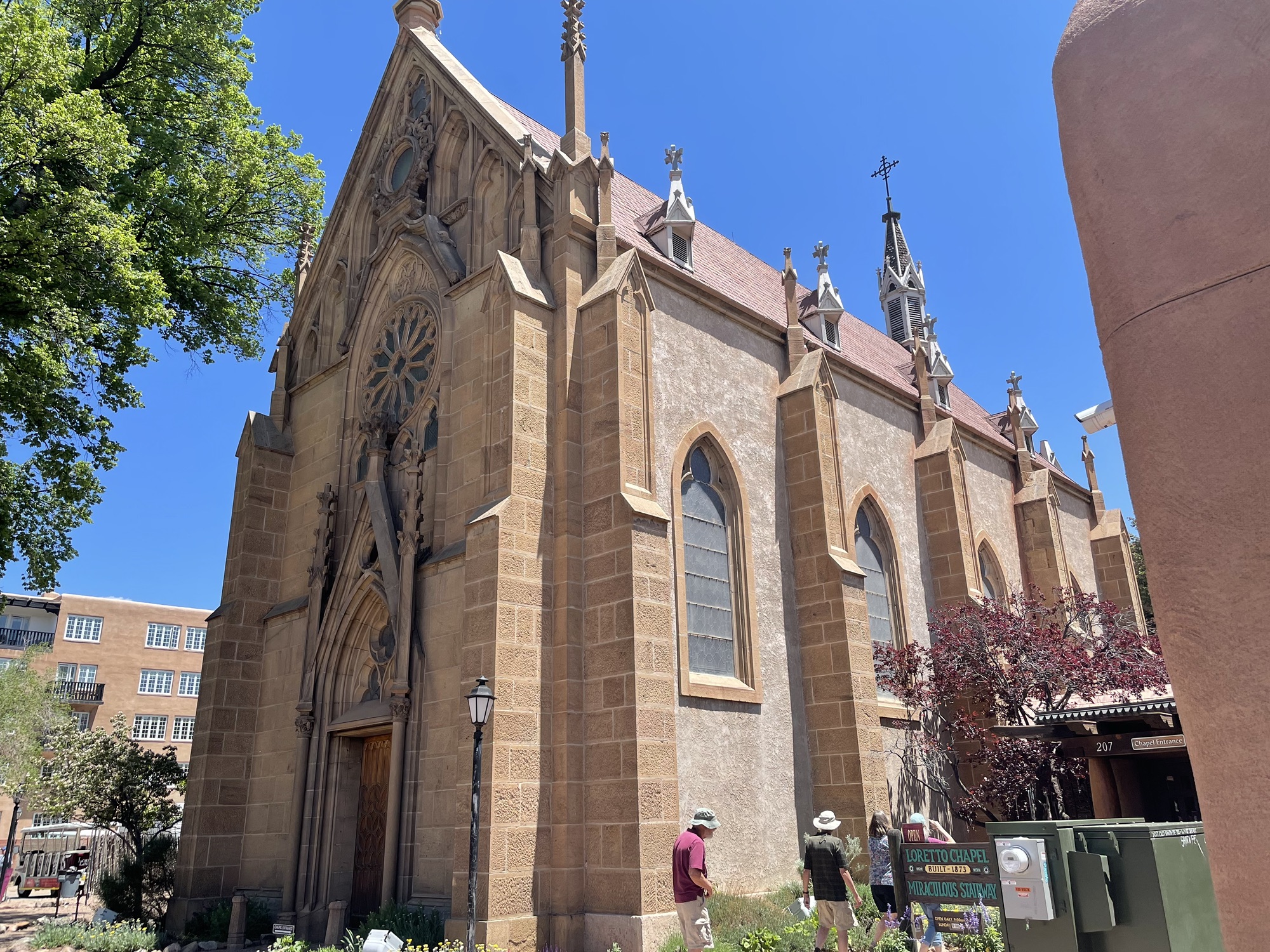
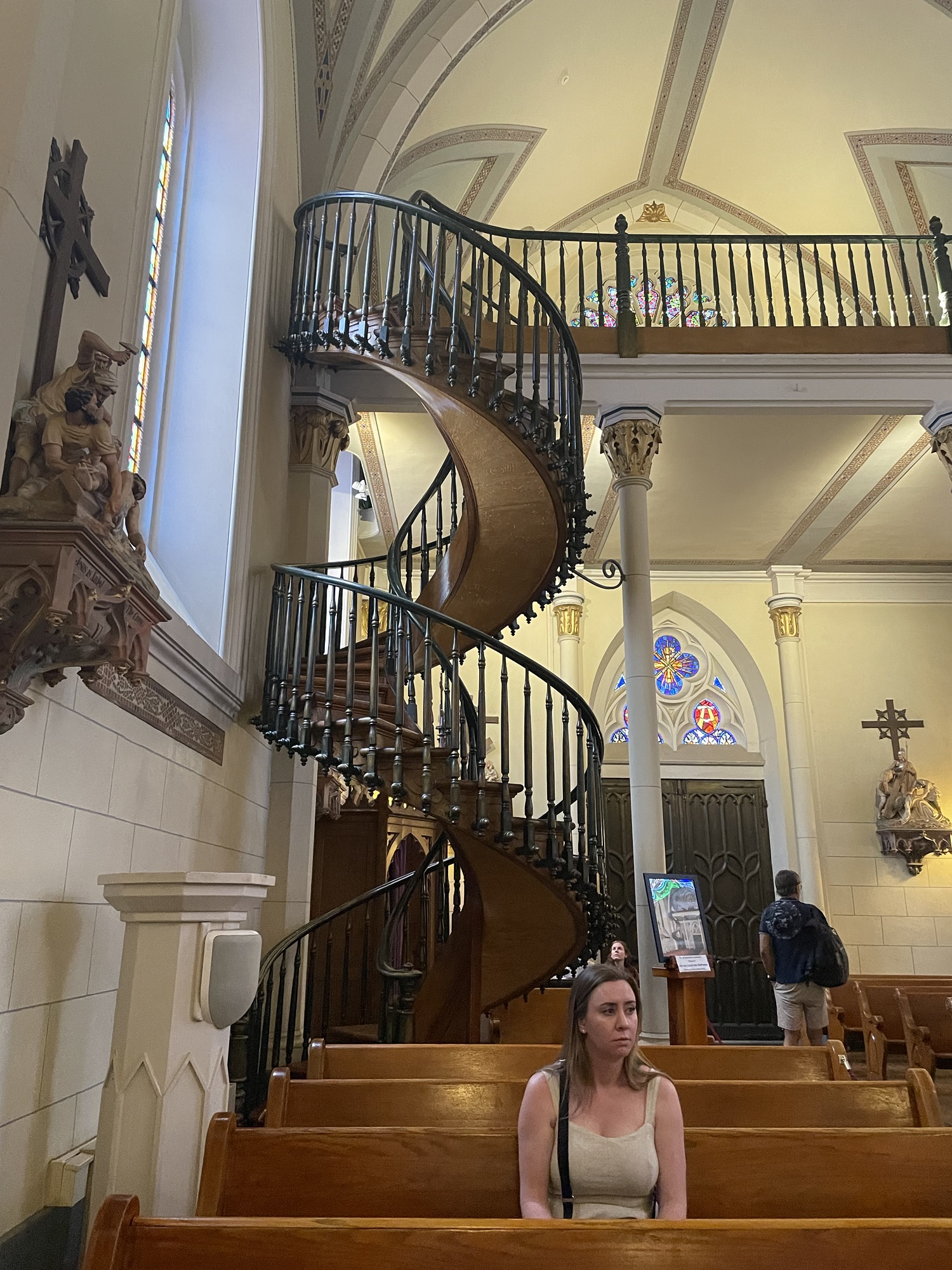
The Loretto Chapel and its mysterious, mystical stairs is worth the visit.  The chapel was once part of a girl’s school and was designed by the same architect as the Santa Fe Cathedral. The mystery of the stairs starts when the architect died before the staircase was built, the nuns were distraught and prayed for help.  An unknown carpenter appeared, built the stairs and disappeared. 

The staircase is a lovely gem to see, whether you believe that it was built by St. Joseph or not.  How it suspends and curves upwards without support is astonishing.  And it is beautifully carved.  But besides the beauty of the stairs, the chapel itself is lovely.  While you sit and visit, you listen to the story of the stairs.  This is no longer a consecrated church, so religious services are not held.

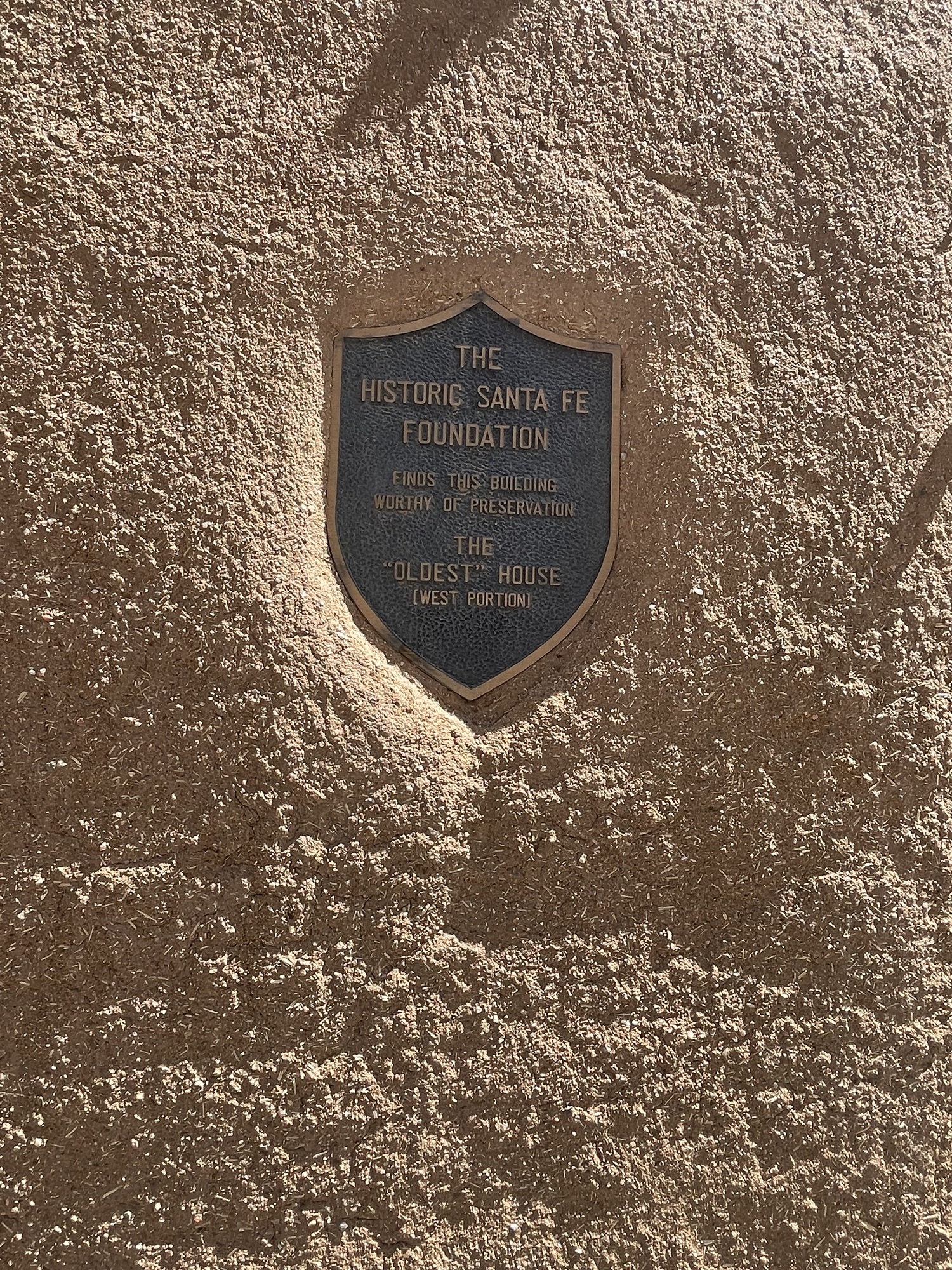
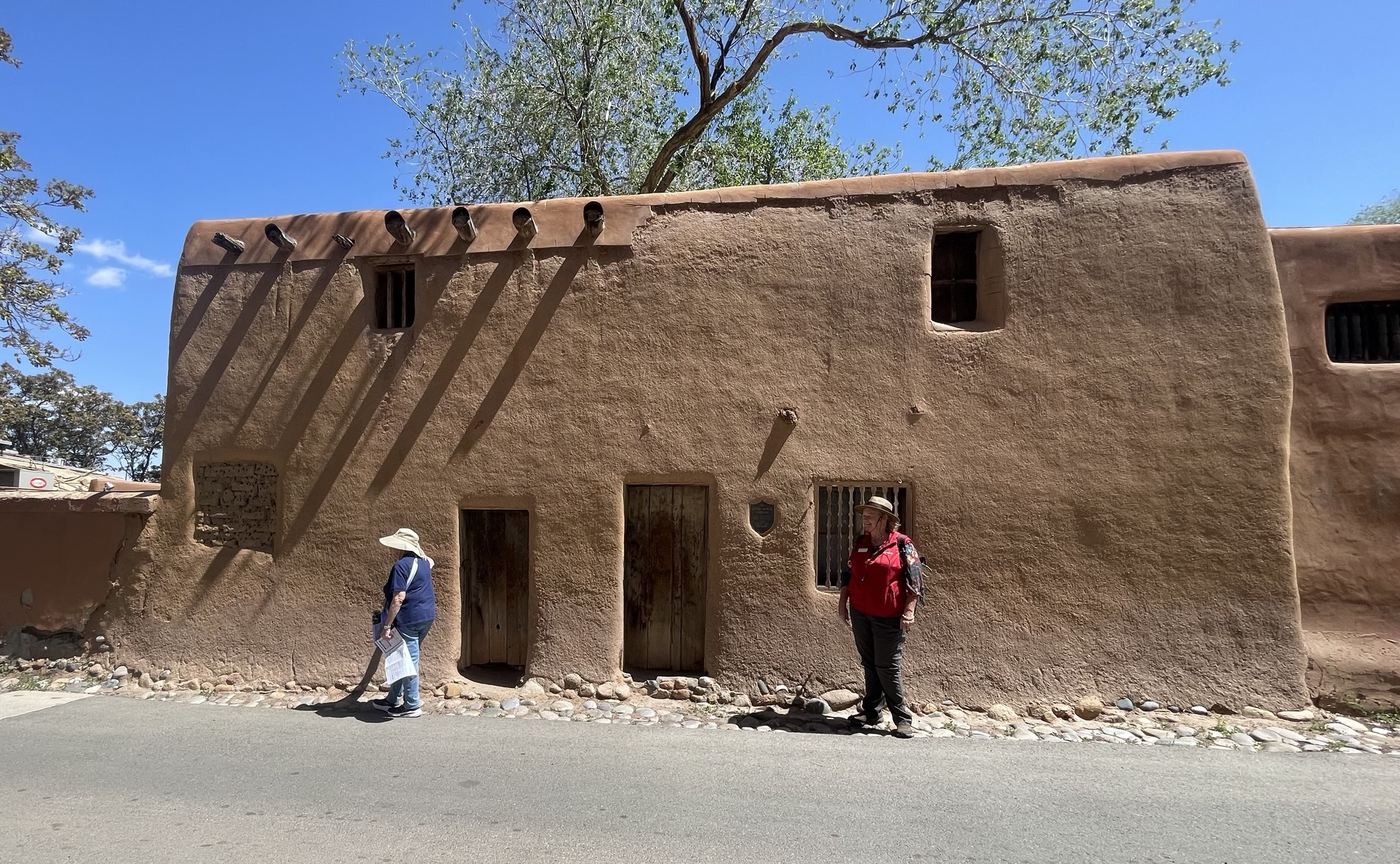
Two blocks further up the hill on Old Santa Fe is East De Vargas Street.  Turn left to walk through a narrow road to the Oldest House in Santa Fe, but I recommended you first go across the street to the San Miguel Mission Church. 

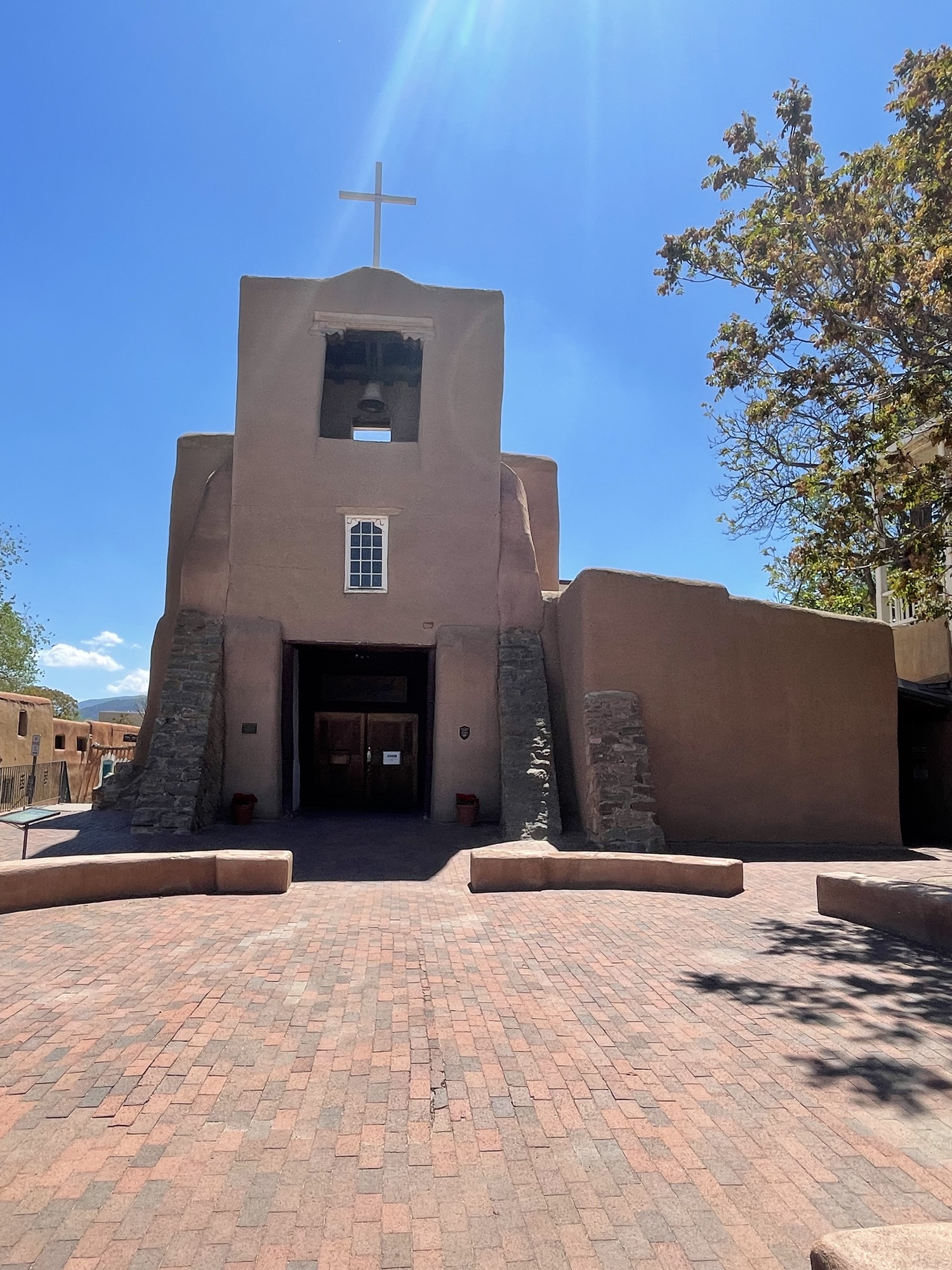
The San Miguel Mission Church sits on a hill on the hill. Probably a good place for watching what is going on around you. It is the oldest Catholic Church in the United States. People can attend mass on the first Sunday of each month.

It is not a big building, but it has a big history.  First built soon after the Spanish came into Santa Fe in 1598, the mission church was used by the Franciscan priests who came to New Mexico with the Spanish to convert the indigenous peoples and serve the Spanish settlers.  It was partially destroyed in 1680 when the pueblo peoples revolted against the Spanish and the church for the cruel treatment.  They burned the roof, destroyed some of the walls, and killed the priests.  The church was rebuilt when the Spanish returned about 30 years later. 

When you walk in there are two artifacts to notice. The first you see on the — the Victory bell that was brought from Spain. The bell had a long history that included helping Spain expel the Moors.  The story is whenever the bell rang, the Spanish had a victory.  The bell came to New Mexico for a Spanish family. But after the Pueblo Revolt, when the Mission was rebuilt the bell was put in the church belfry.  The second item hangs on the wall to the left. It is a 300-year-old replica of the painting of Our Lady of Guadalupe from the Mexico City Basilica.

The church itself is small and simple. The wooden ceiling is wonderful.  After you finish viewing the chapel and listening to the talk by the docent, please go down the stairs to the second room.  There are photographs that show the building from different angles, as well as two photos of the oldest house before it was restored.

Now you can go out of the chapel and down the steps to the side which lead to De Vargas Street.  Immediately across the street is the oldest house. The house, from the 1600s, is built on the remains of a home in what once was part of a pueblo It is attached to a gift store.

 You go into the store and to your left to enter the house.  There are just two rooms to see and they are tiny. But as all sites, it is worth seeing to understand how people lived.  If you are a bit claustrophobic, try to go when there is a not a group going in.  It gets tight.

When you are done at the oldest house, return to Old Santa Fe Trail Street and continue past the San Miguel Mission. Turn right on Paseo De Peralta.  You will soon come to the State Capitol building.  It is unusual in that it is both round and NOT built in the pueblo style.  (Which is what I thought it would be!). When we went there was an art show on display. But even if it is not there, it is worth going in to see the rotunda and the lovely architecture.  You basically walk in the main door and go out the back door getting you back to E. De Vargas street.

After this part of our tour, we went for lunch!  There are many, many excellent restaurants in the Plaza area.  So go and enjoy.  Also while walking around you will see many galleries and statues/art on the sidewalks.  Take time to enjoy them.  You might want to take a break and rest after lunch or do this next part in the morning.

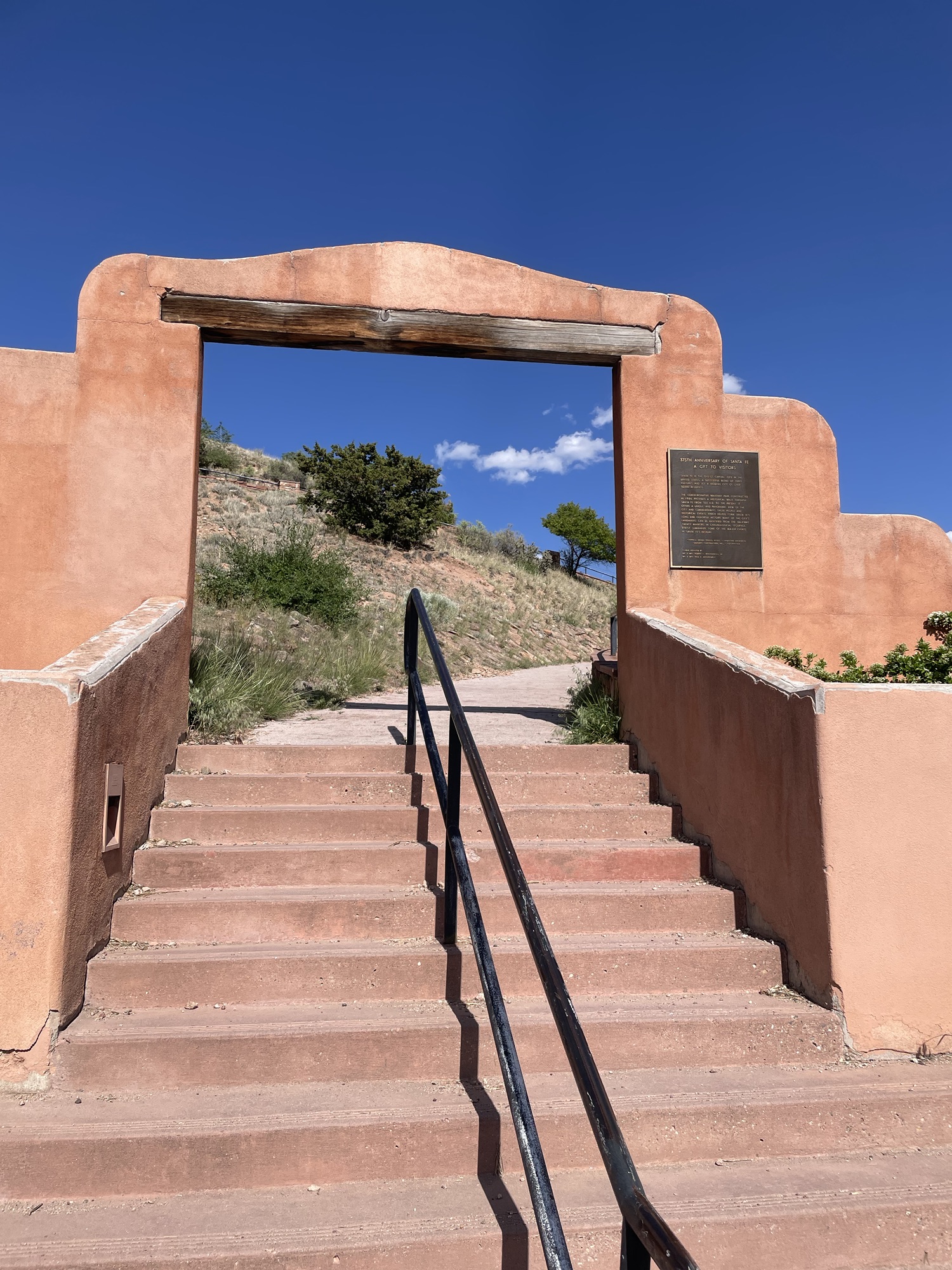
Martyr’s Cross and Marcy Fortress.  There is a way to drive to get closer to this site, but my husband and I did not have a car, so we walked.  It is located on Paseo de Peralta, the same street as the capitol building, but in the other direction. Depending on where you are staying will determine how you go.  But since we stayed near the Cathedral, we took Palace Avenue to Paseo de Peralta and turned left. You can see the cross on the hill and just head in that direction!

The entrance to walk up is marked by an adobe sign and arch.  You are going up hill.  There are rest areas where you can sit at the ends of each switch back.  And take water!! It is dry in Santa Fe.  The walk up was fun. Along the way are plaques that tell the history of Santa Fe, and as you go higher the views get better and better.

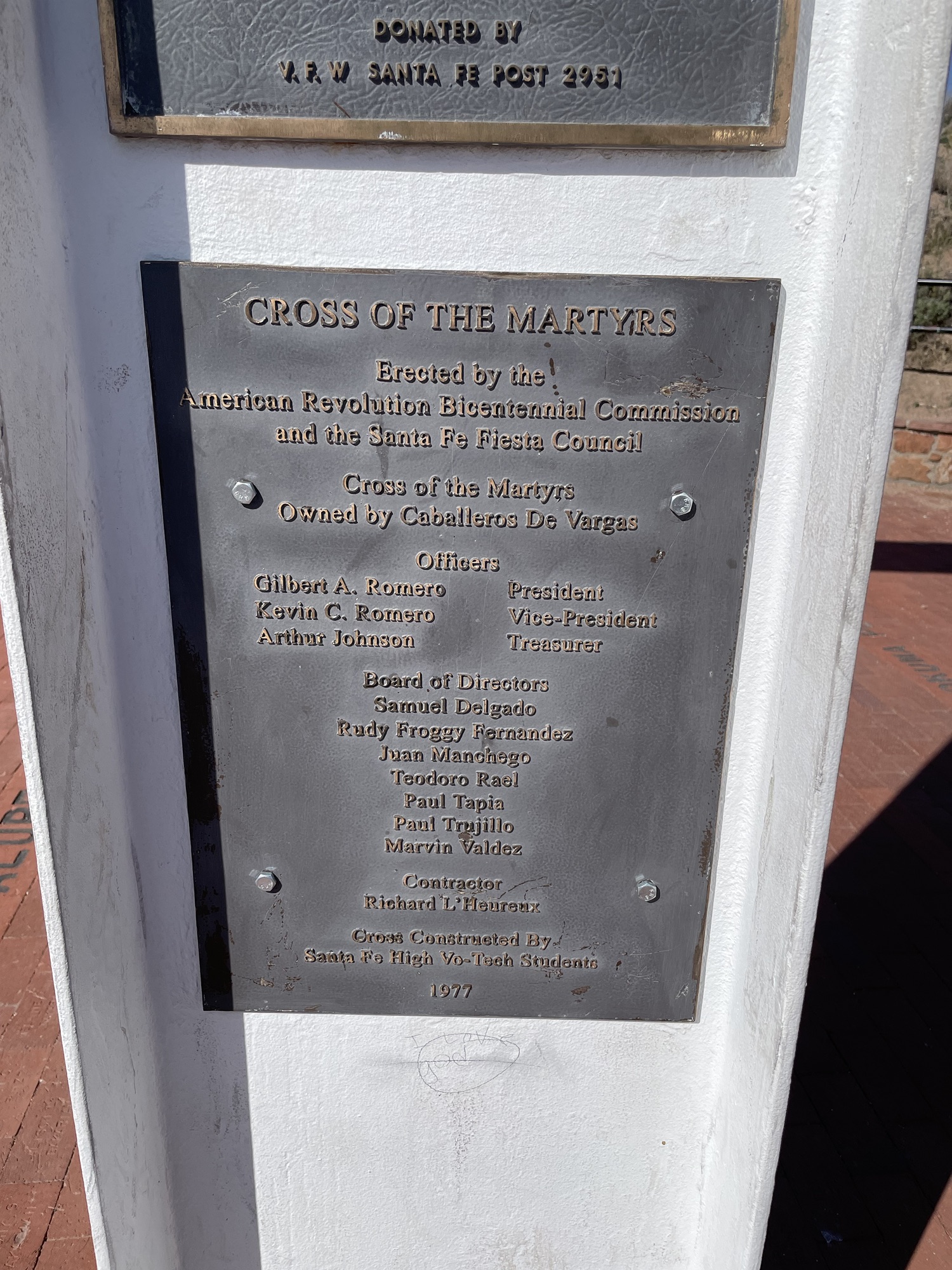
The Cross of the Martyrs honors the 21 priests and 380 Spanish settlers who were killed during the Pueblo Revolt  in 1680. The first cross was erected in 1920s. Over time it was replaced twice, the last time  in 1977 with a metal cross.

To be honest, we did not continue up the path to see the ruins of Fort Marcy.  It had been a long day, and we still had to walk about a mile or so back to our hotel.  But you can easily get to it. But that path is not paved.

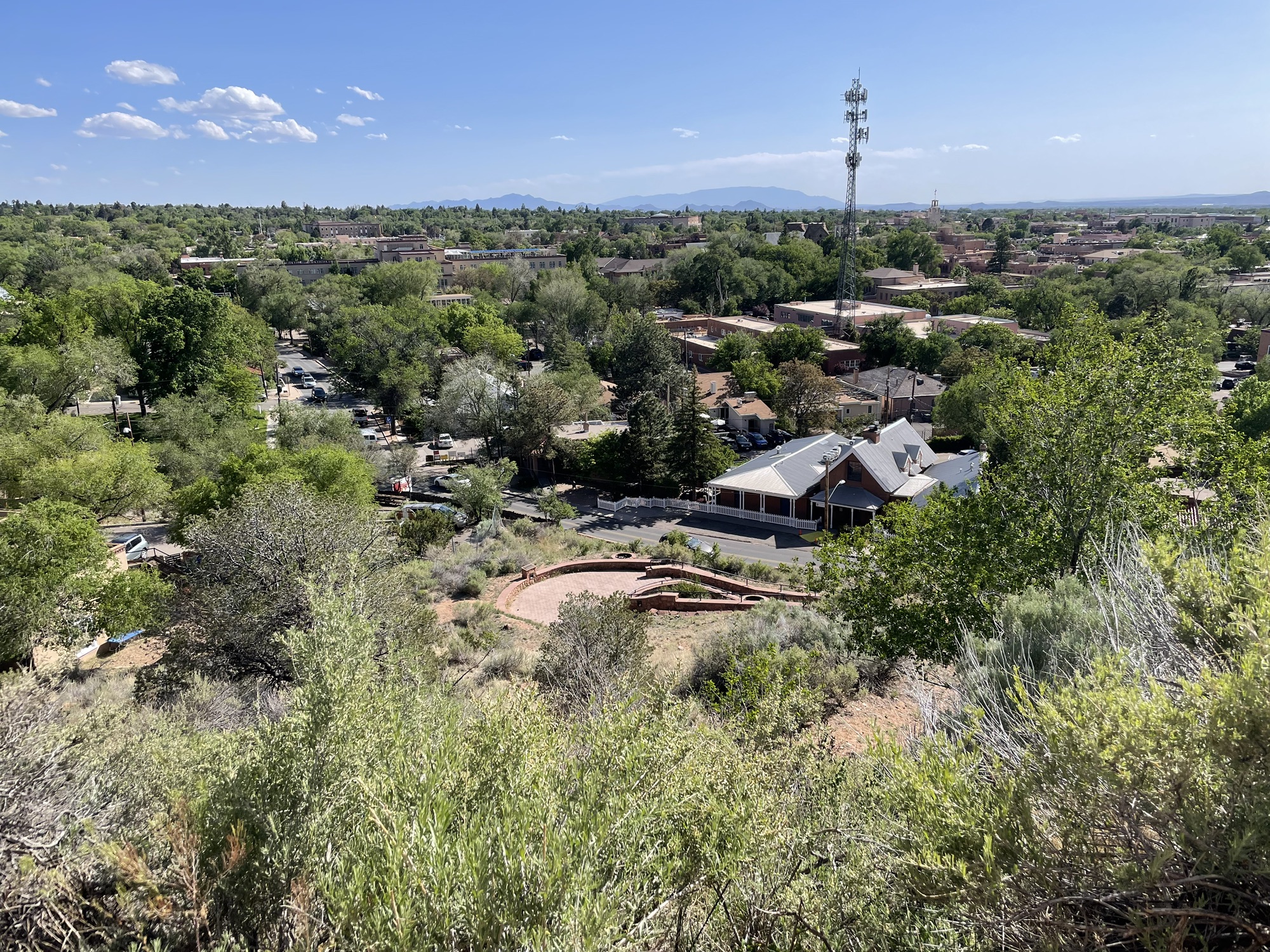
However, we did get some fantastic photos of Santa Fe from the top.

https://www.lorettochapel.com/

https://www.sanmiguelchapelsantafe.org/

Santa Fe’s  Multitude of Museums

9 Jun

Museums, museums, museums.  So many to choose from, so many to see.  We went to six museums over our six days in Santa Fe.  I decided I would list them all in one blog from my favorite to my least favorite.  That is not to say that any of them were bad, just that these are how I enjoyed them. 

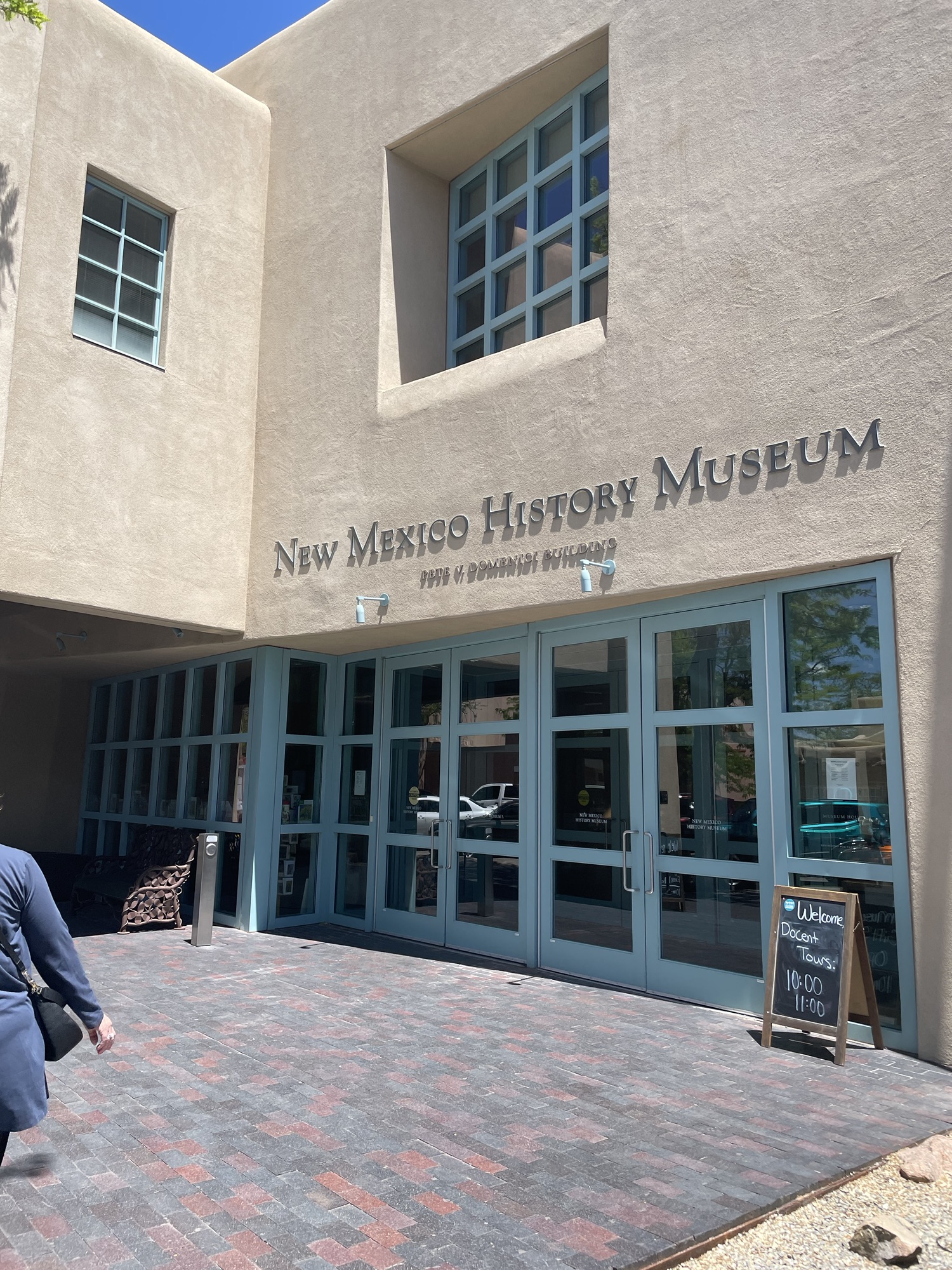
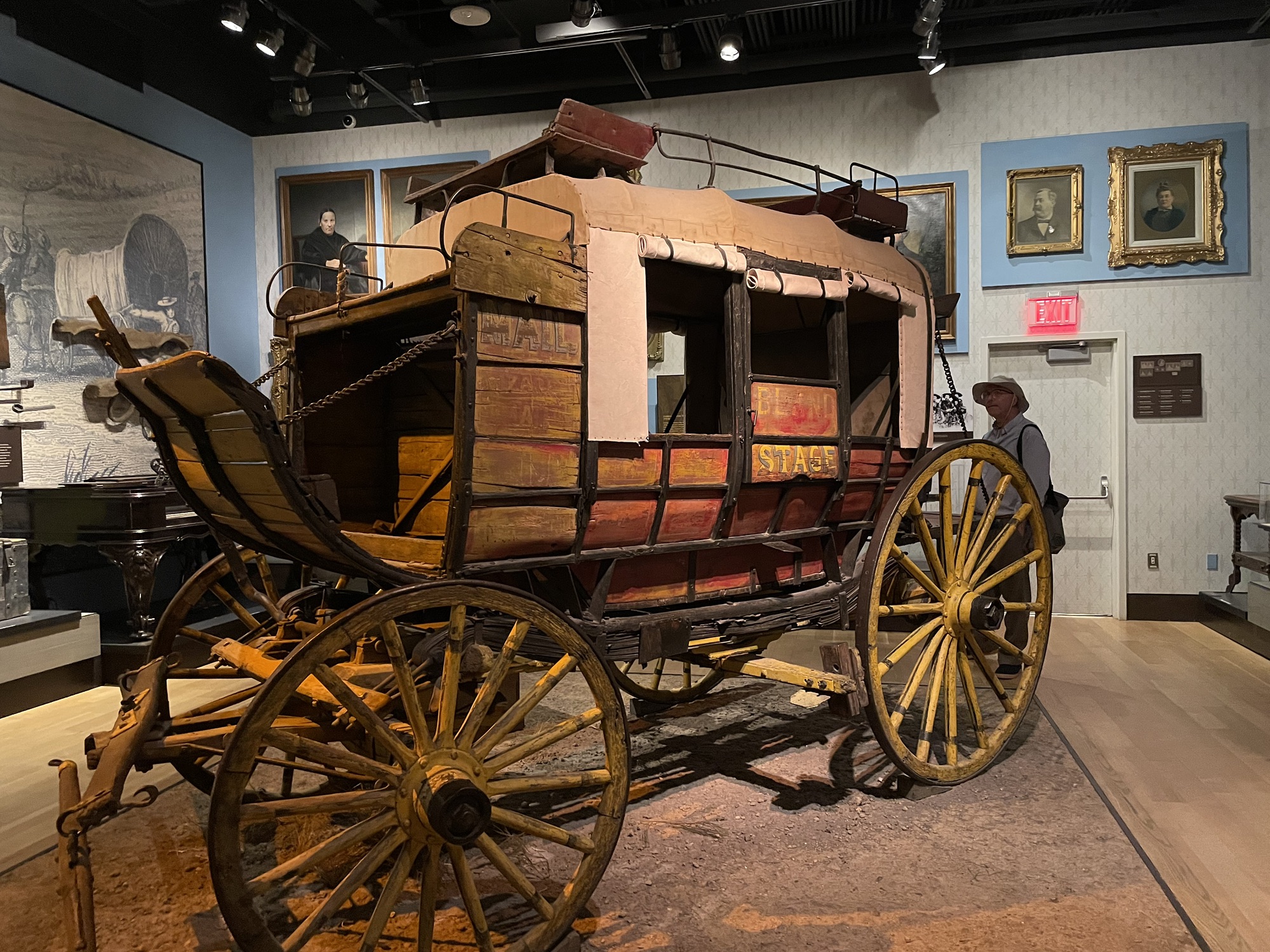
New Mexico History Museum/Palace of the Governors.  Located behind the Palace of the Governors, on Lincoln Avenue right off the Plaza, The New Mexico History Museum is a great place to understand Santa Fe and the relationships among the Native cultures, the Spanish heritage and the American ‘invasion.’  With three floors of exhibits and the additional space located in the Palace of the Governors, there is a lot to see here.  Way more than I anticipated, which is why I ended up not seeing all of it, even though I had good intentions to return on another day to complete seeing the exhibits in the Palace of the Governors. I do love learning history!

The first floor packed in 500 years of history!  It was a lot to take in, but really explained the importance of both the Native and Spanish and Catholic influences on New Mexico.  When the United States took over the New Mexico territory, the relationship between all these groups changed dramatically. 

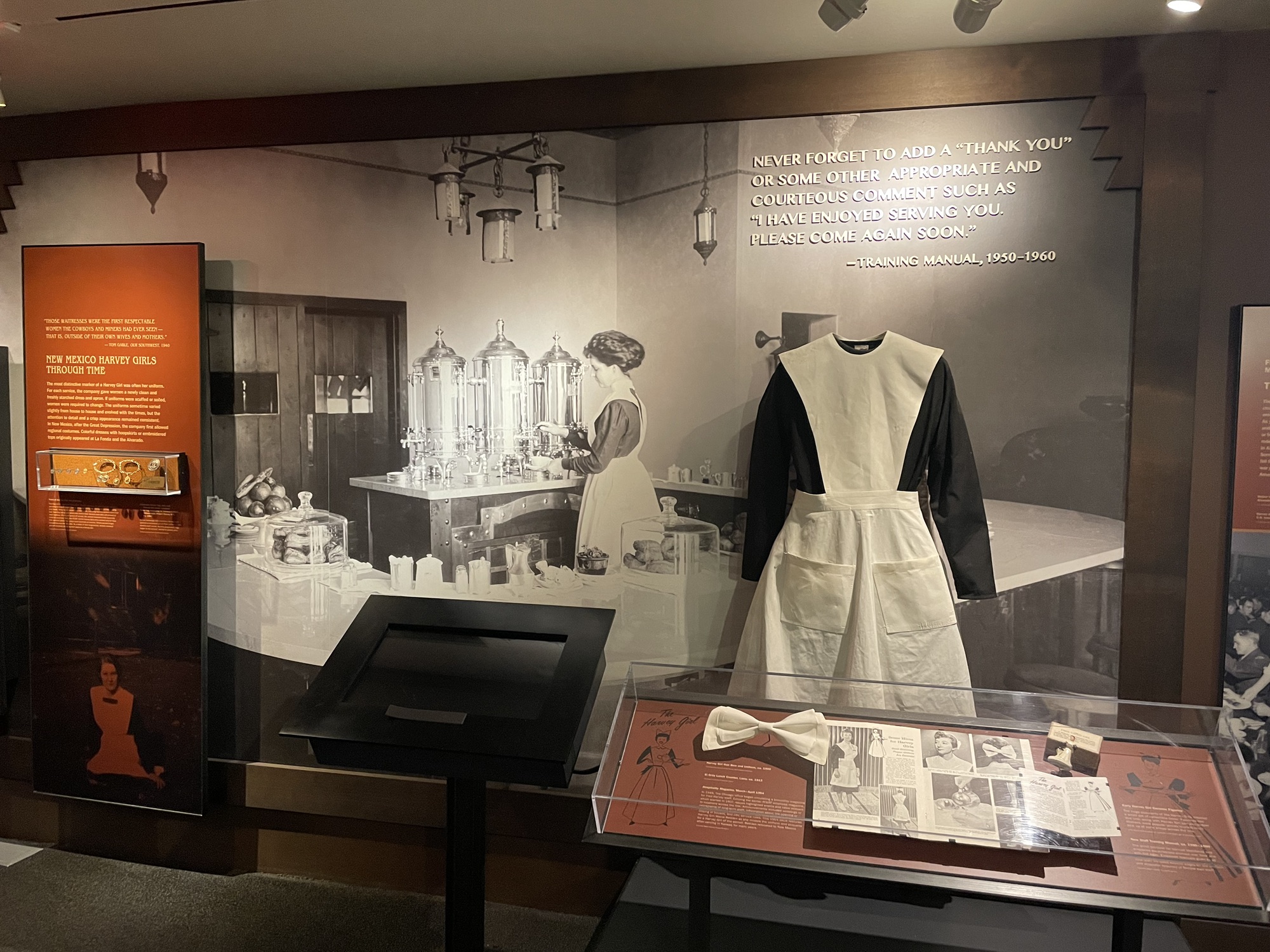
One of my favorite exhibits was in the mezzanine, “Settling the Standard: The Fred Harvey Company and Its Legacy.  Since Fred Harvey started in Kansas City, and I have seen the displays at our History Museum, I was delighted to see the story retold here.  This exhibit was much more in depth than the exhibit I have seen at a Kansas City museum.  It might have to be another blog!

The next two museums were at Museum Hill, just outside downtown: the Museum of Folk Art and the Museum of Indian Arts & Culture.  We decided to go to the Museum of International Folk Art first, turning to the right as we entered the museum plaza.  (I recommend getting a Culture Pass, which includes a number of museums for a $30 fee.)

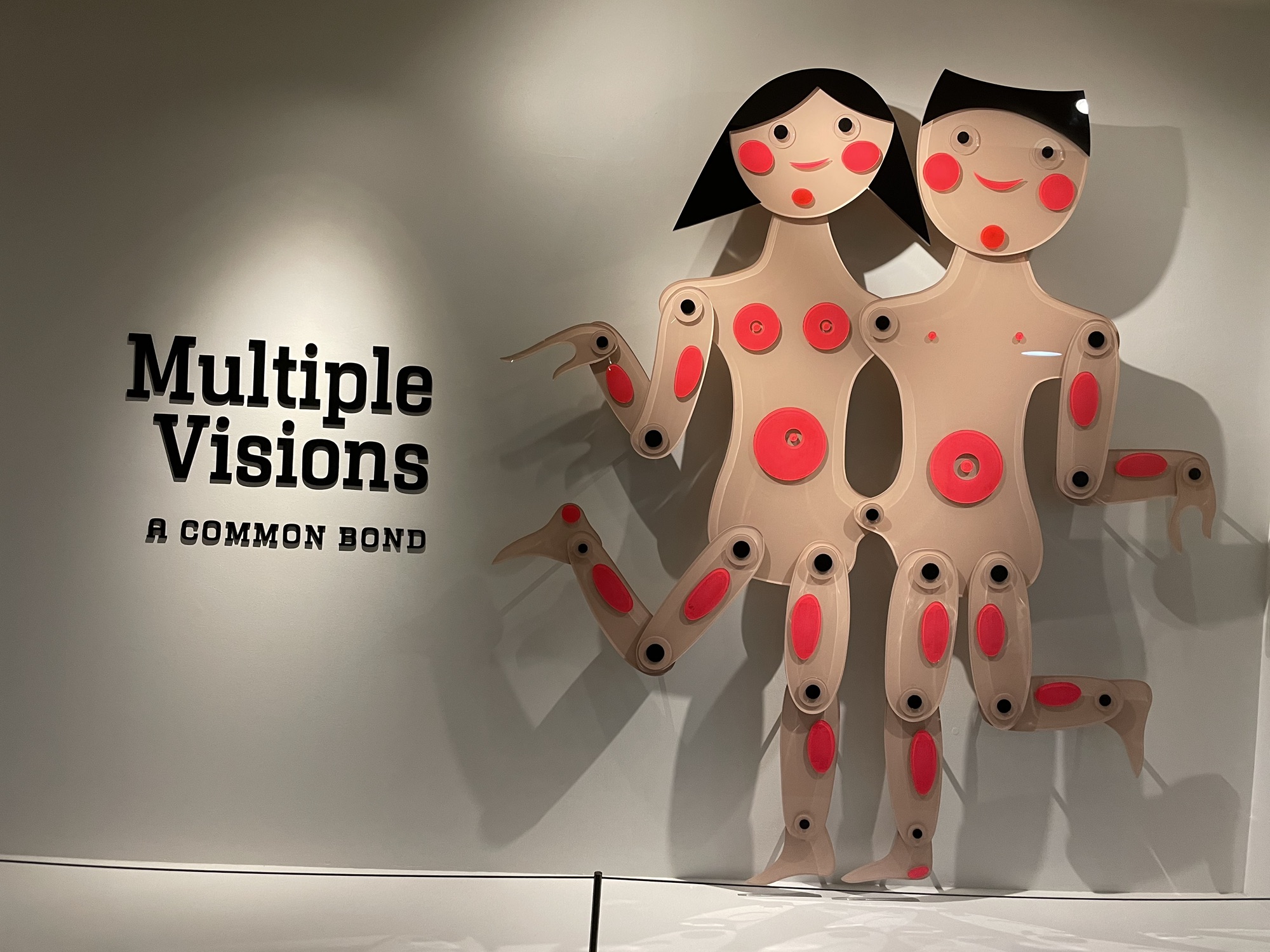
The first exhibit we visited was “Multiple Visions: A common Bond.” Alexander and Susan Girard donated their extensive folk art collection to New Mexico, and it was added to the Folk Art Museum.  When I entered this room, I was first excited and then overwhelmed.  The art seemed endless; it covered walls, hung from the ceiling, filled hundreds of display cases. We walked around the entire room, looked in every case, and were mentally exhausted, visually overstimulated, but filled with the joy of the art.

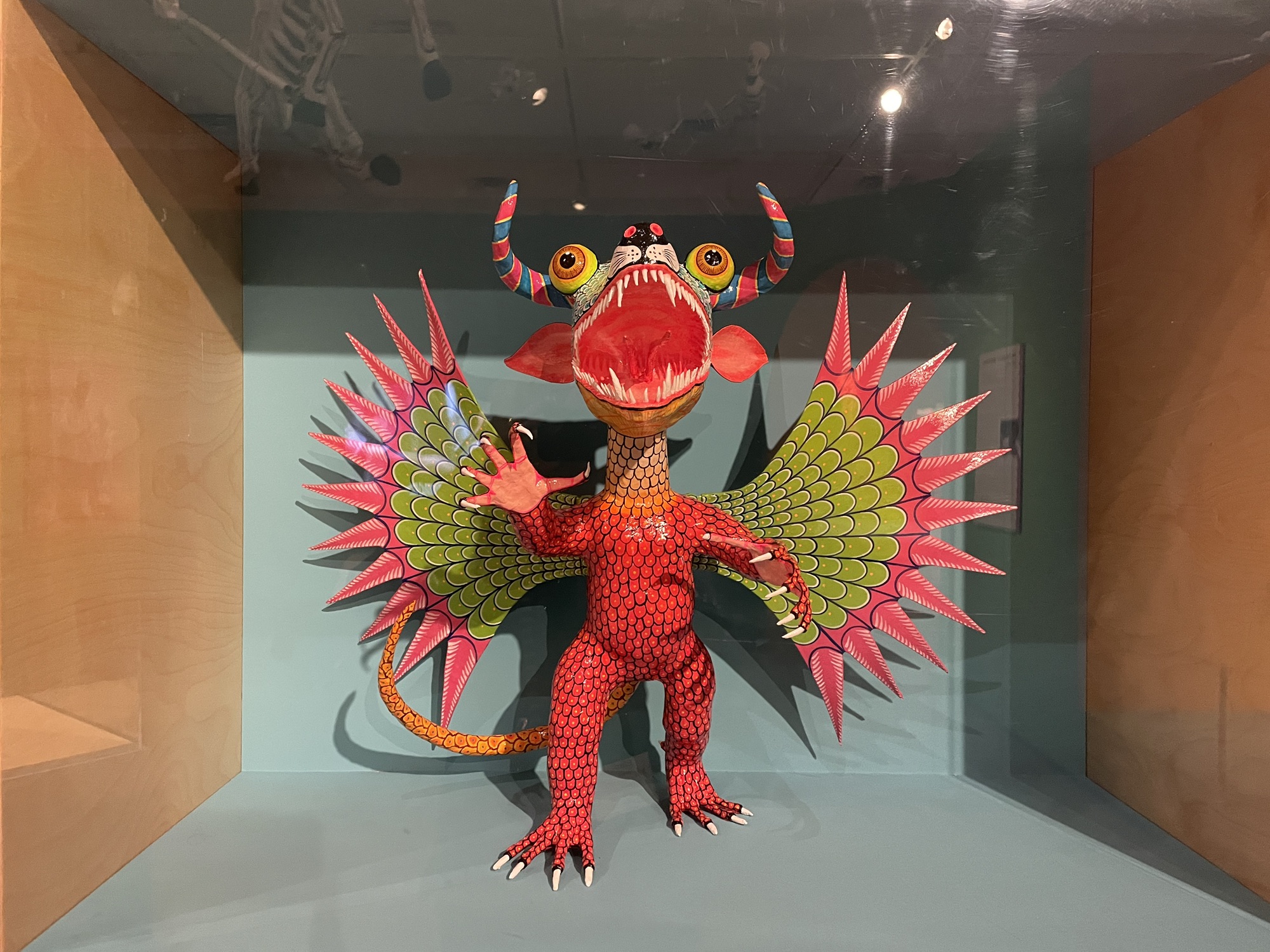
Luckily the next two rooms were much calmer, so we could feel more ease as we left the building.  I really enjoyed “la Cartoneria Mexicana,” which was several rooms of unusual creatures made of paper and paste.  Between the first exhibit and this one, there is a short movie that explains how the exhibit displayed.  I liked it. The creations made of paper and paste were magical.

The final room held the curators’ favorite pieces.  It was a calming room!  A short visit to the gift show then we walked the outside labyrinth to continue the calming process.  You really do need to rest your brain after being at the Folk Art Museum.

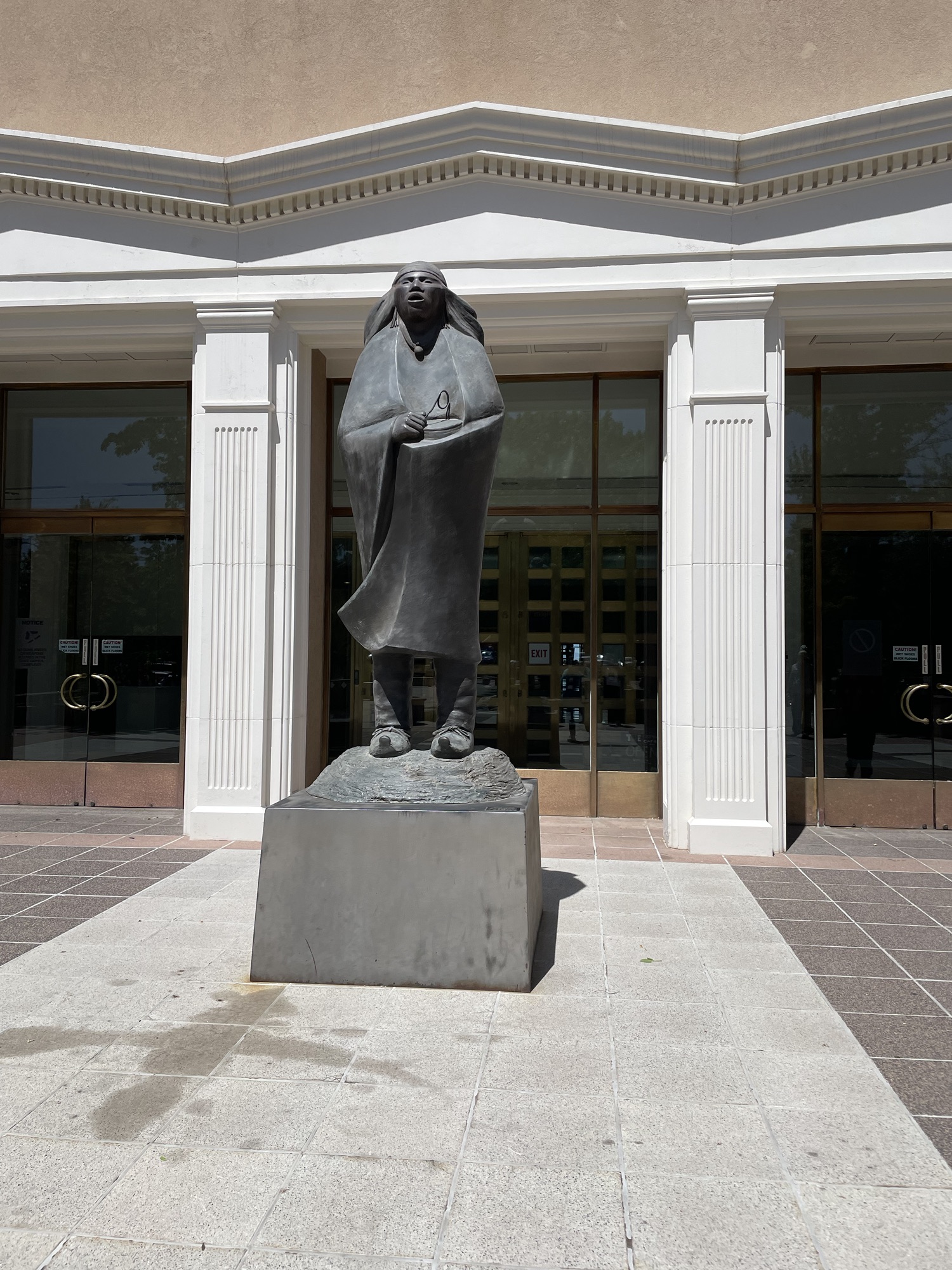
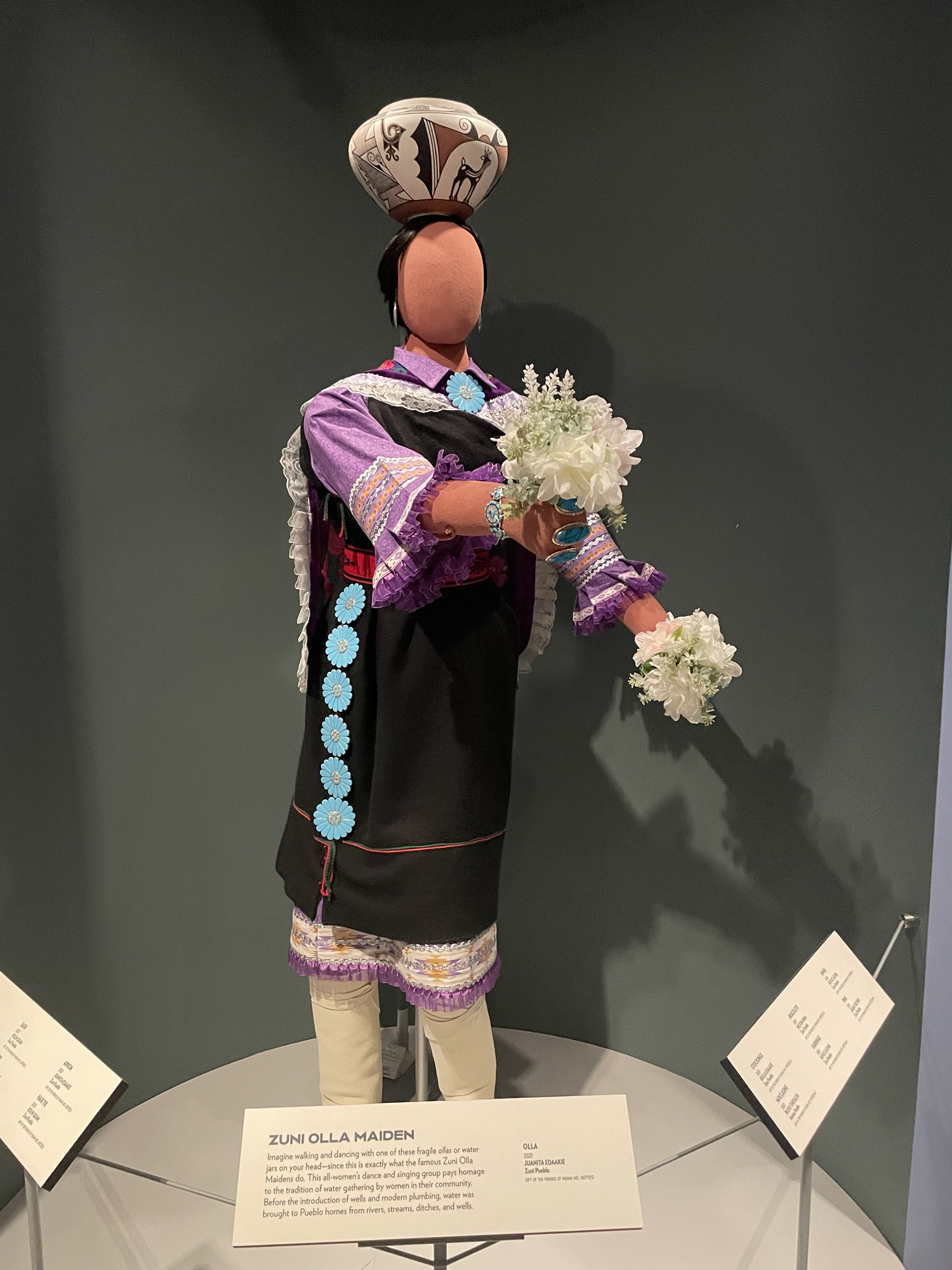
We ate lunch at the lovely restaurant on the hill, and then went over to the Museum of Indian Arts and Culture. Really an excellent place to learn about the indigenous peoples in the “Here, Now and Always” exhibit.  The statues outside the building brought me joy, especially the one of the young hoop dancer, it reminded me of the young girl we had seen doing the hoop dance in the Plaza. 

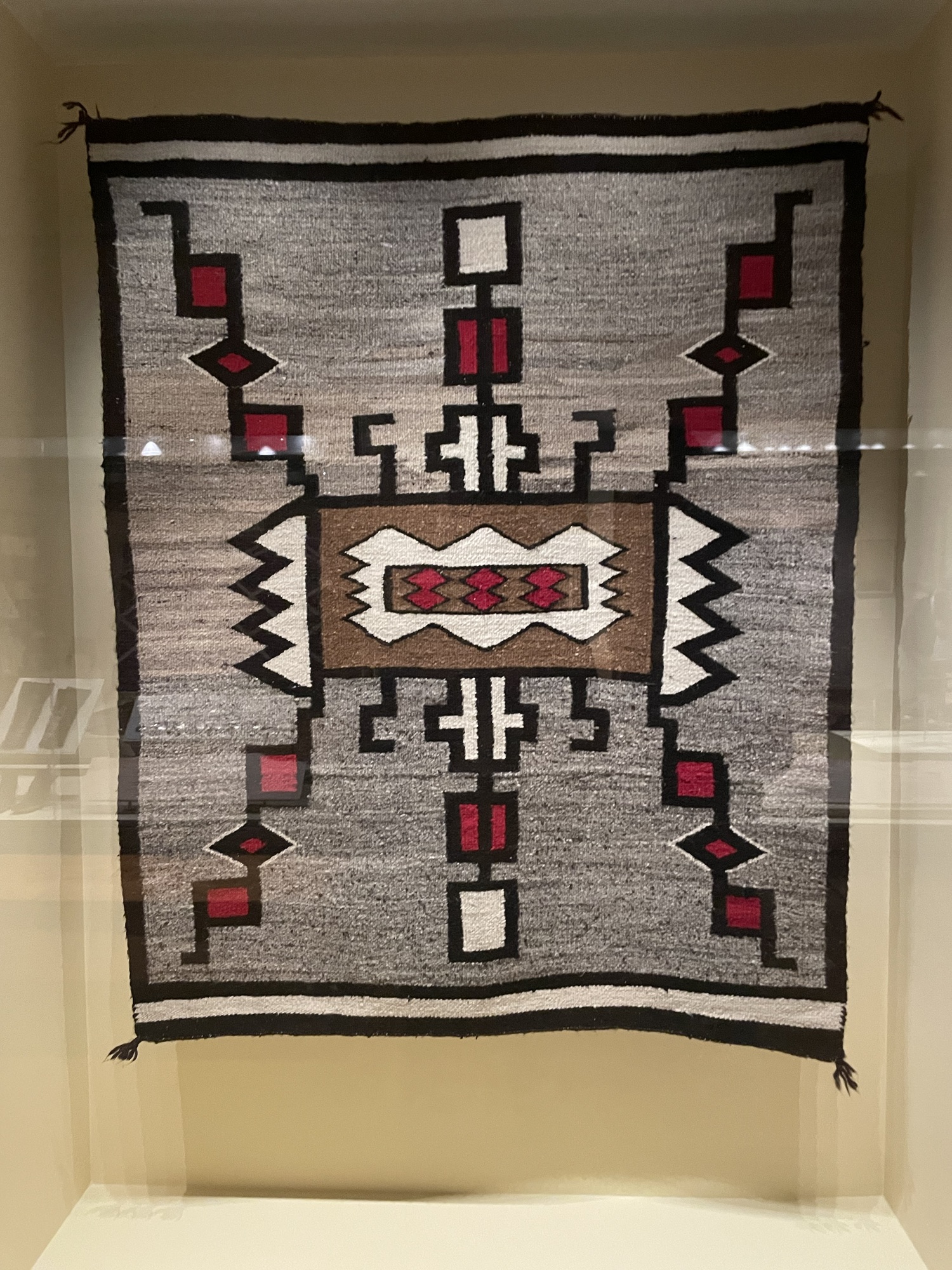
 Inside there was all the information needed to understand the native peoples who lived in the New Mexico area. The pottery, the weavings, the baskets, the jewelry, and the information on how they lived before the Spanish and then the United States took control is important to know.  Another great museum.

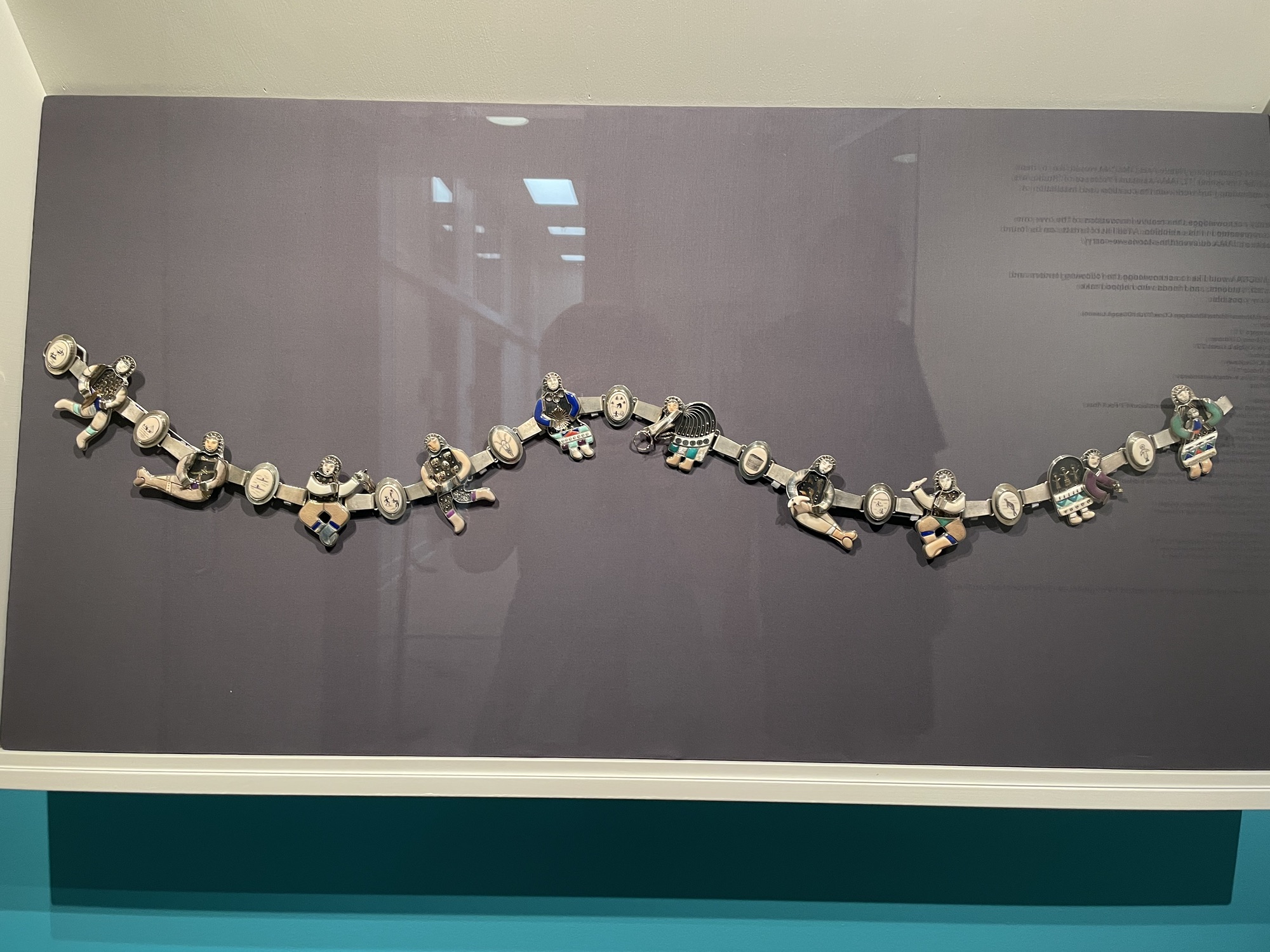
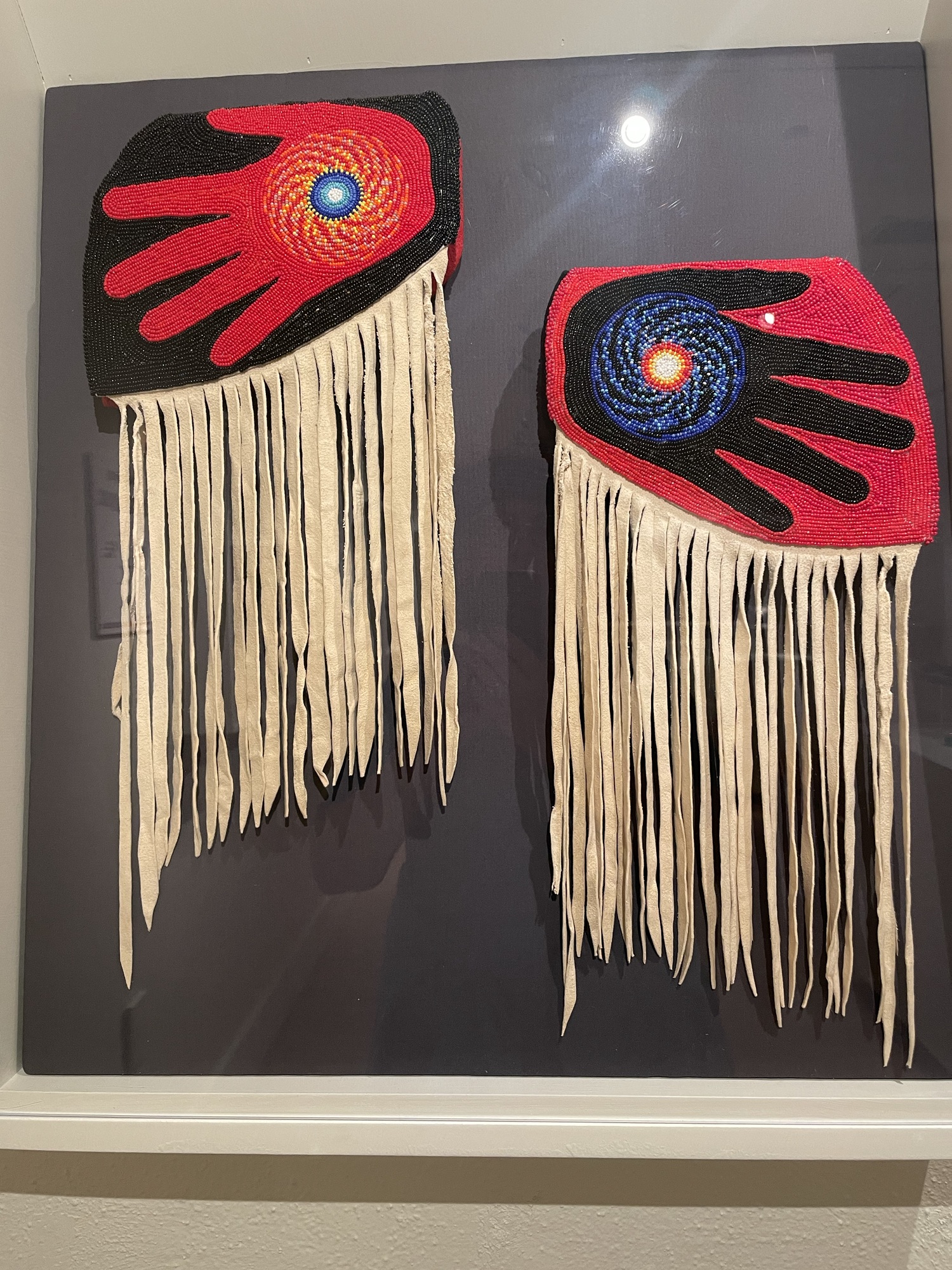
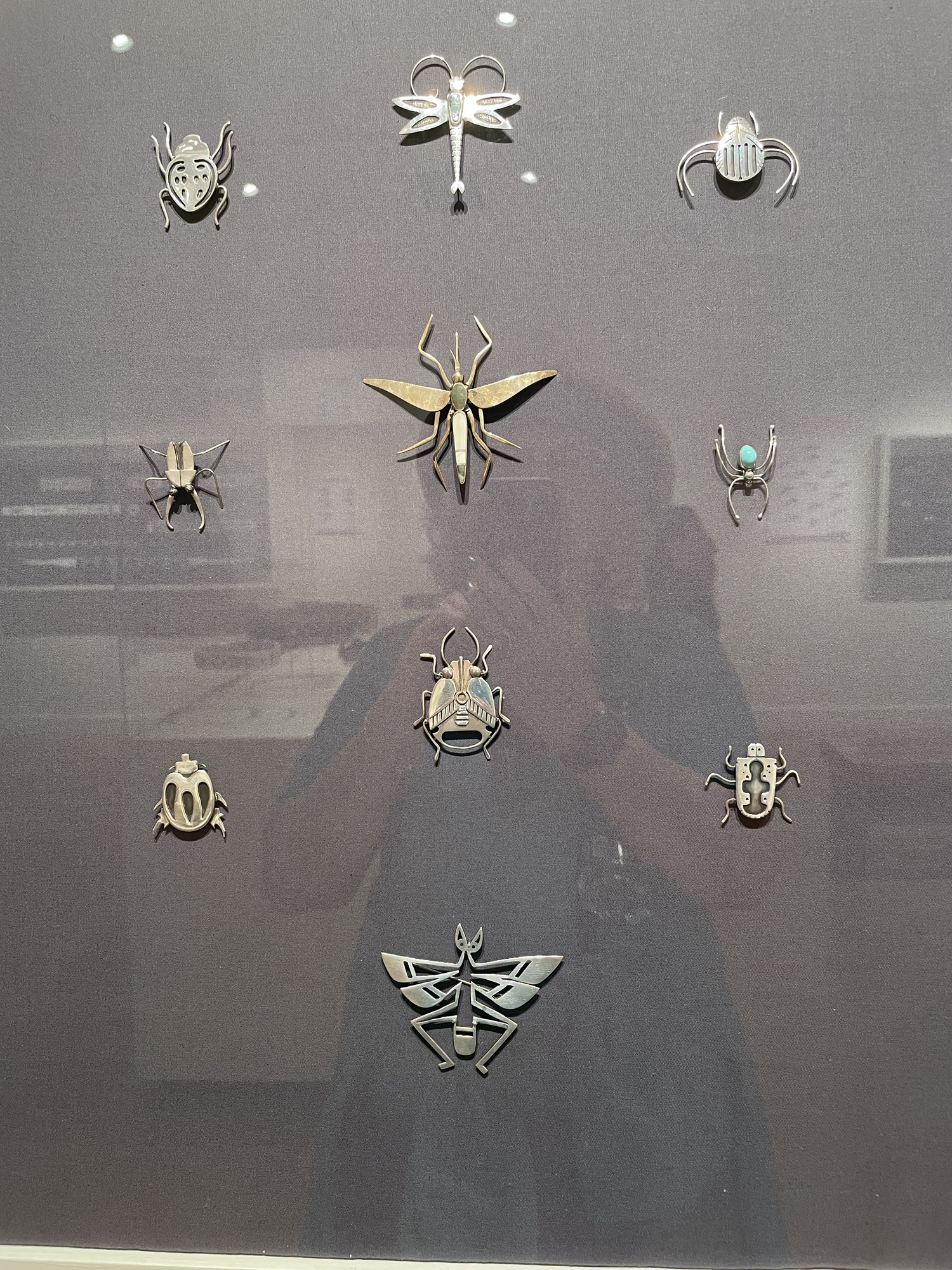
IAIA Museum of Contemporary Native Art: Near to the St. Francis Cathedral, this museum showcases the work presented by the Institute of American Indian Arts (IAIA). It displays the most progressive art.  I loved the interpretations of traditional objects and the jewelry.  There were some pins that looked like bugs that were stunning.  I loved a silver belt made by Denise Wallace and beaded cuffs made by Marcus Amerman. 

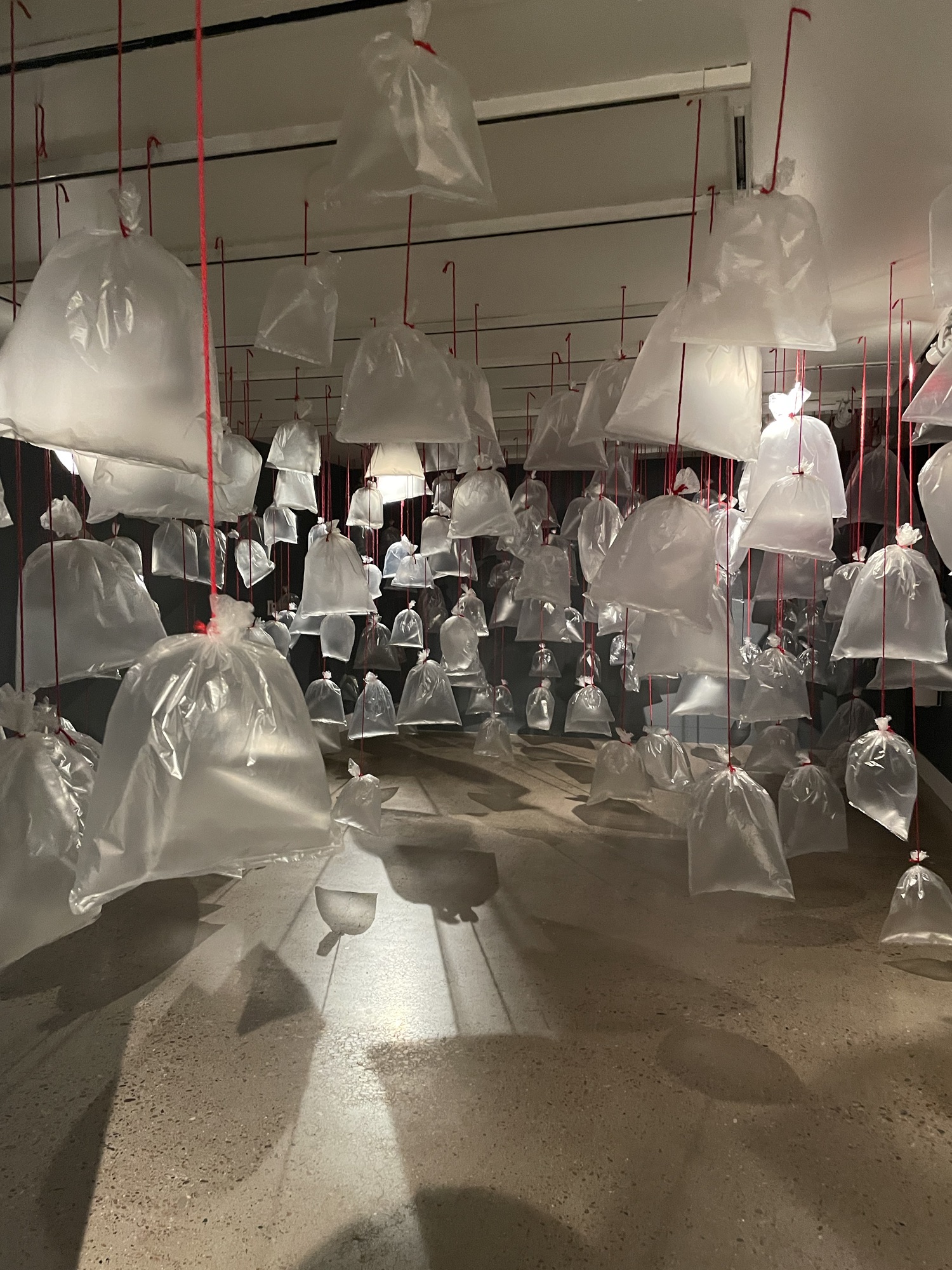
However the room filled with plastic bags, I viewed, I walked through the room and I tried to understand it.  I just did not get that exhibit. But then it was about the artist being frustrated about the inability to communicate, so perhaps I did understand it.  However, like anything else, art is subjective and there were many other exhibits in the museum I did enjoy.

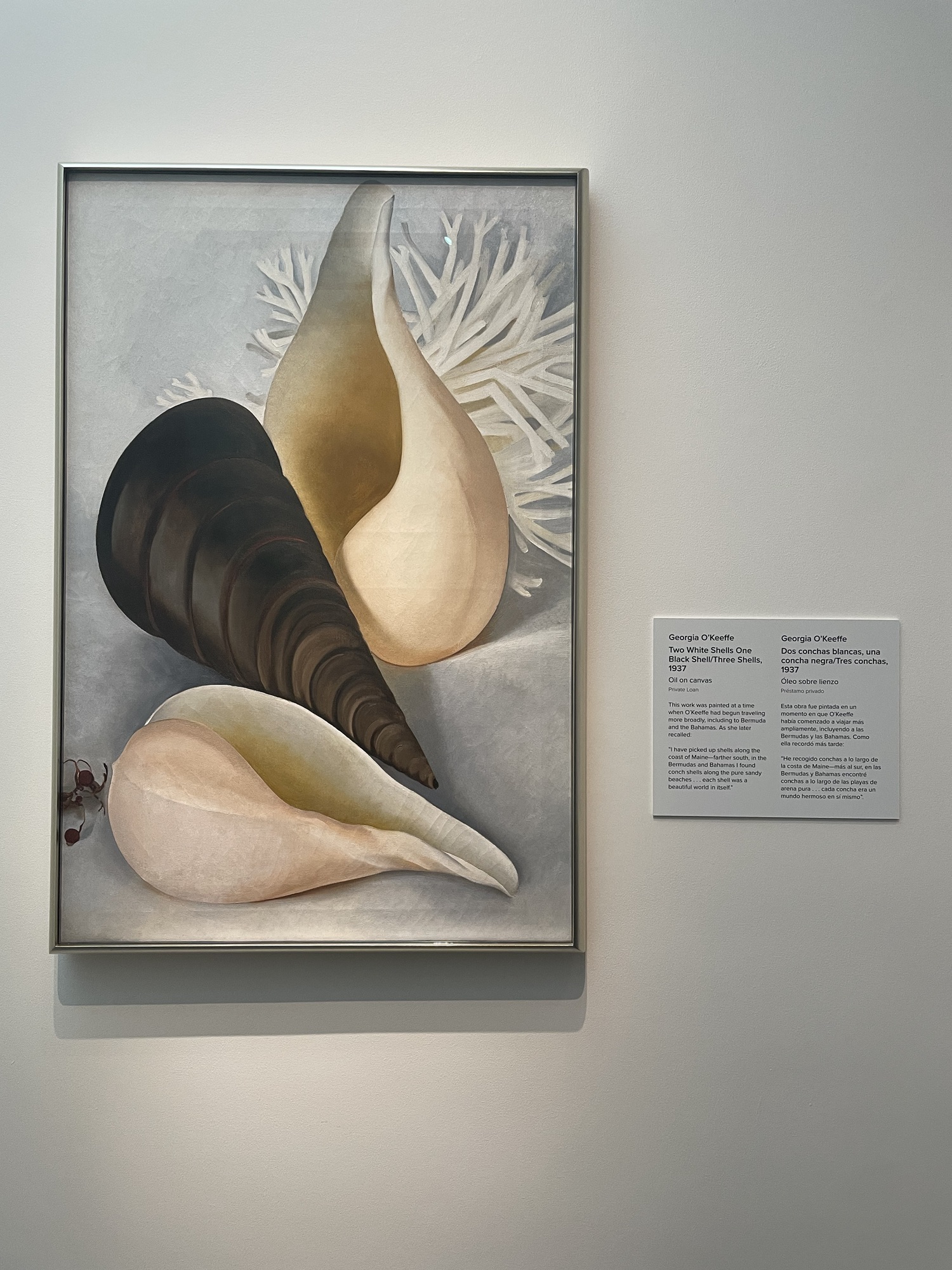
Georgia O’Keefe Museum: Just a few blocks from the Plaza, on Johnson Street, it is an easy walk. My instructions: Get your timed tickets in advance. This is a small museum, and they limit how many can be there at any one time!!!    See the movie first!  No one told us about the movie, so we did not see it until the end. 

The museum goes in one direction, so you have to turn around and walk back through all the rooms when you finish, so you could do one side going and the other side going back. As for the art. If you enjoy Georgia O’Keefe’s work you will enjoy this museum. I actually liked the last room the most, where there was information about her life, “Making a Life” and her art supplies. I have to be honest, much of her later art did not appeal to me. But it is interesting to see.

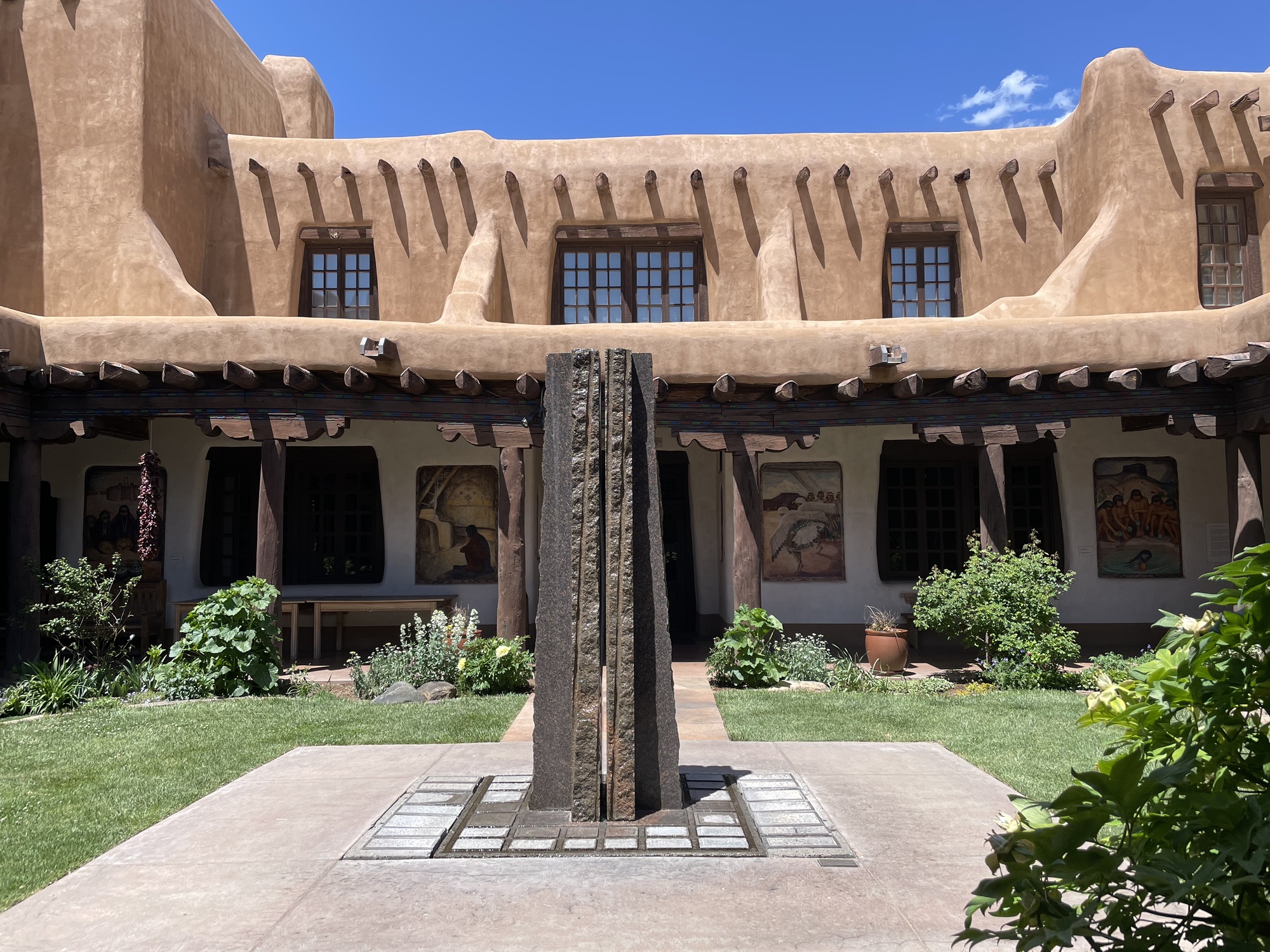
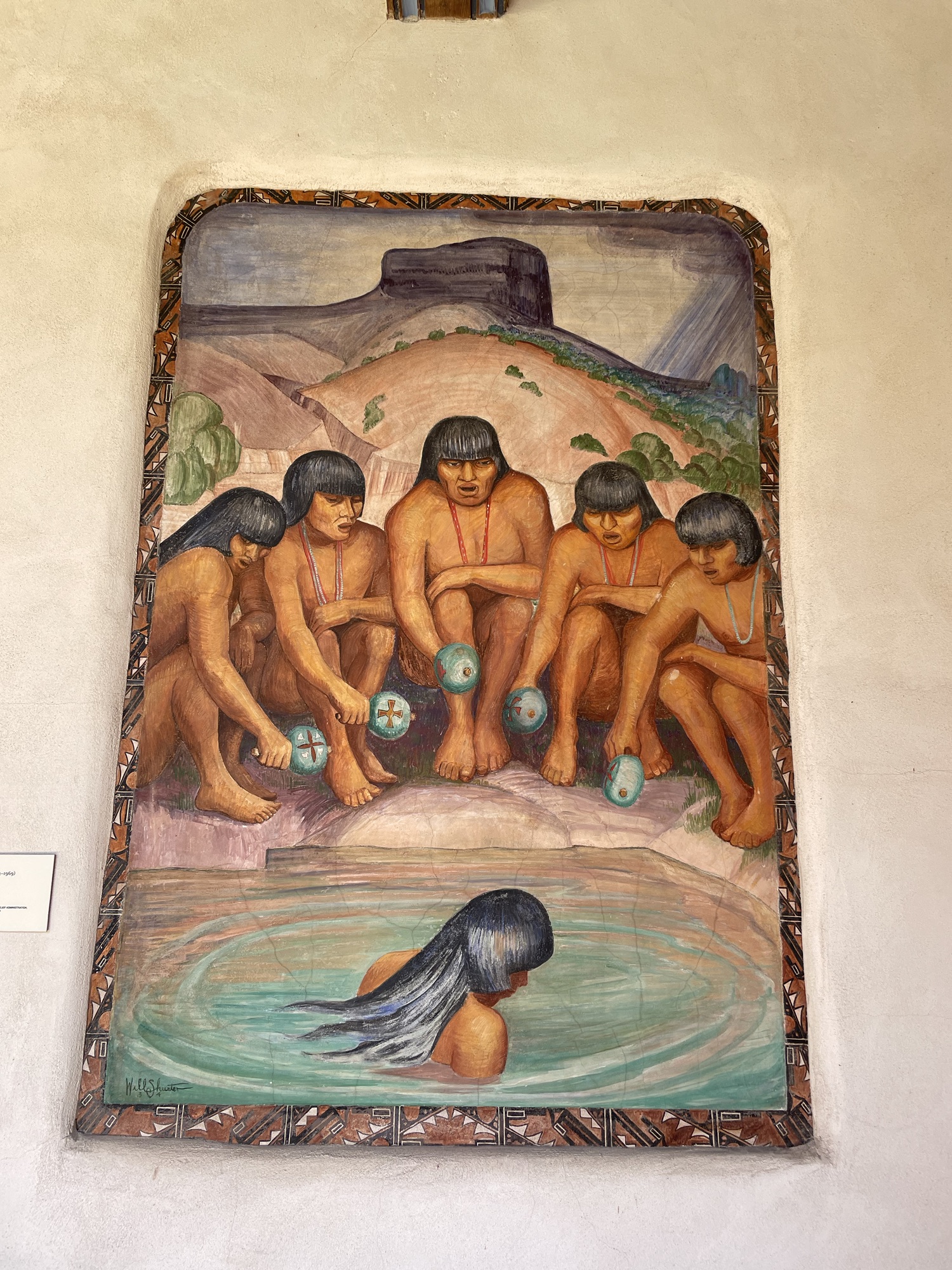
New Mexico Museum of Art: Situated catty corner from the Plaza on Palace Avenue,the museum building is set up like a hacienda.  You can walk around the exhibits in a circuit, or you can cut through the courtyard.  I loved the murals that decorated the courtyard.  I am not a big fan of some modern art, and so these exhibits were not my favorite.  However, I like to see what younger artists are doing, so I enjoyed seeing the interpretations of pottery design.

Other blogs about New Mexico: https://zicharonot.com/2024/06/06/the-great-rio-grande-river-gorge-and-taos-pueblo/.

https://www.nmhistorymuseum.org/

https://www.moifa.org

https://www.indianartsandculture.org

https://okeeffemuseum.org

Learning about the Crypto-Jews/Conversos in Santa Fe

28 May

As the descendent of a Jewish family that was forced to leave Spain in 1492 or convert, I have always been interested in learning more about the Crypto-Jews/ Conversos of New Mexico.  It was in the 1980’s when the information about this still hidden group first started to be revealed. It started when a Jewish man named Stanley Hordes because New Mexico’s State Historians, and people started coming to him to tell him their stories.  To me it was absolutely amazing that 500 years after the Inquisition in Spain, that descendants were still hiding and still keeping this secret!

I had wanted to attend the Roads Scholar program: “New Mexico’s Conversos and Crypto-Jews in Santa Fe” since 2019.  Covid interrupted my plans. But finally we were able to attend. My family were also once impacted by the Inquisition and Spain’s quest to either convert or eliminate all Jews.  My family chose to move to Portugal and then to Holland.  Our story is written in an earlier blog. (See below.)

We had lectures from the authors of the top two books.

Our first speaker was Professor Ron Duncan Hart, who gave us an overview of the history of the Jews journey to New Mexico. He wrote, “Crypto-Jews, The Long Journey.” Jews were in Spain were given a choice, convert or leave.  Many stayed, they could not afford to go or they thought it would not last long and they would just hide their Jewishness, some decided they really would become Catholic.  But all were doubted because they were not “pure of blood, “meaning they were not just Spanish, they were tainted by either having Jewish or Moslem descent. Those converted in name only and still practiced their religion in secret, known as Crypto-Jews…hidden Jews. Those who were forcibly converted and known as anusim also secretly practiced Judaism.

In fact, so many of the Portuguese who came over to Mexico in the 1600s were of Crypto-Jewish ancestry, that calling someone Portuguese was just another way to say he/she was Jewish. Since my family went from Spain to Portugal, I began to wonder if some of my family made this arduous journey to escape the Inquisition. To be allowed to go to the New World, you had to show that you were purely Spanish, not tainted with Jewish or Muslim blood.  Horrifying!  People actually had their genealogy redone to eliminate their Jewish past to fit the needed requirement.

The Crypto-Jews of today still live in the mountains in northern New Mexico.  They still keep their secret.  In fact, one of our speakers, when asked how many crypto Jews there actually was, basically said, “We do not know. They keep hidden.  They do not talk about it.  They know who the other families in their community are like them. But it is not discussed”

We heard from two women who have reclaimed their Jewish identity.  They were each the child in the home who a parent said “Somos Jodios,” “We are Jews.”  Maria Apodaca told us how difficult it was to come out of hiding and join a congregation and have a ceremony of return.  How family members were not always happy about what they had done.  Many feel, with the way the world is now, it is better to stay hidden!

Isabelle Medina Sandoval wrote a novel based on her family’s history: “Guardians of Hidden Traditions.”  She can trace her ancestry back to Portugal and was able to claim Portuguese citizenship based on her family history.  But she also said that coming out of hiding is a difficult process.  A poet, she has written poems about the Crypt-Jewish experience.

From these two women we learned some of the cultural/religious/cuisine that continues from their Jewish ancestry, like lighting candles on Friday night, covering mirrors when someone dies, making a fried treat at the winter holidays, cleaning the house on Friday.  It is amazing to me that these traditions continue.

Schelly Talalay Dardashti, spoke about: “The New World: Jewish Ehtnicity, DNA& Genetics.“ Schelly is the founder of Tracing the Tribe – Jewish Genealogy on FB. She explained the difference in the different DNA tests and how some do not look for Sephardic DNA, only Ashkanazi.  We were told that between 20-40 percent of people in New Mexico had some Jewish ancestors.  That there are genetic links between those living in northern New Mexico and isolated areas in Central/South America.  People who were also trying to hide away from the Inquisition.  And the final link, a rather sad one, the fact that the BRCA1 mutation that causes brest cancer in Jewish women, is also found in the Hispanic population in Mexico and New Mexico and came from those original converso/crypto Jewish arrivals from Spain in the early 1500s.   Wow.

We attended a performance of “Parted Waters,” a play written by Robert F. Benjamin about the Crypto Jewish community. It tells the story of three generations of a crypto Jewish family.  The grandfather, a crypto Jew; his son, who knows the background, but identifies with his life as a Catholic and does not want to talk about it; and his son, who has never been told about his ancestry.  When the grandson makes a racist comment to a Jewish woman, the truth comes out along with the ramifications.  It pulled together all that we had learned over the week.

Our last lecturer, Chris Herbst spoke about Outliers/Ousiders and Religion.”  He provided us some history about the area of northern New Mexico and more explanations about the genetic composition of the populations today in Spain and in New Mexico.  He said about 1/3 of the population of Spain today has either Jewish or Moorish ancestry.

Throughout all of our talks we were referred back to the book written by Stanley Hordes, who wrote an indepth book about the Crypto Jews called, “To the End of the Earth.”  The Spanish/Portuguese Crypto-Jews traveled to the End of the Earth, the mountains of New Mexico above Santa Fe, to escape the Inquisition.  It is like reading a college dissertation, but it was fantastic in the depth of the research.

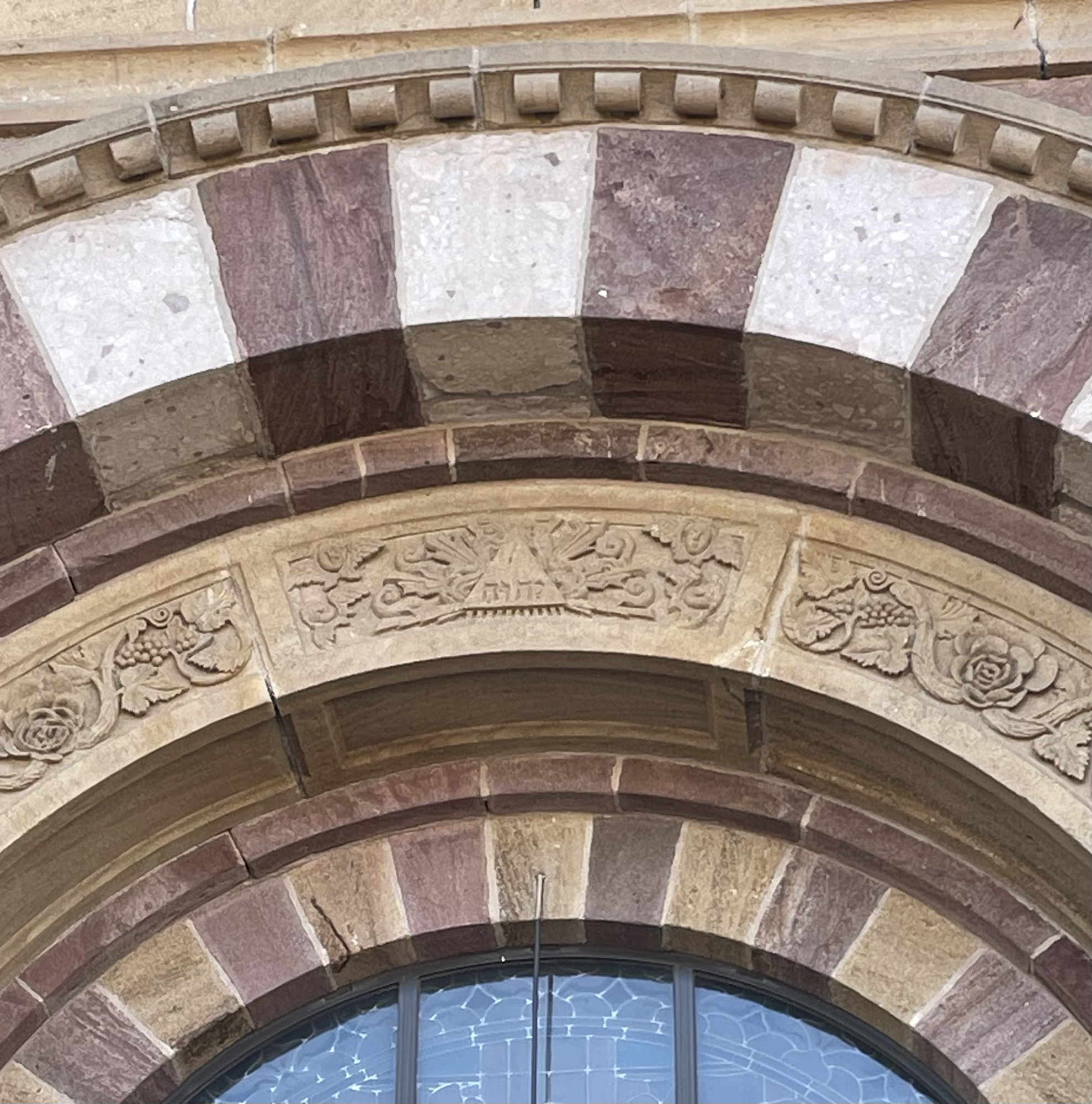
The Hebrew is in the triangle.

We did not spend all of our time learning, we also had time on our own to visit museums and explore Santa Fe.  We went to the  main cathedral of Santa Fe, where over the mantal of the front door, is an inscription in Hebrew and a Jewish Star on an internal wall. 

As part of our Roads Scholar program we also ate at many different restaurants with the most delicious food, toured historic Santa Fe, with our wonderful leader, Vennetta, and went to Taos and the World Heritage Site of the Taos Pueblo.

This was just a wonderful learning experience, where we were able to learn, experience, make new friends and enjoy the true wonders of Santa Fe, New Mexico. If you have any interest in learning more about the Crypto-Jewsof New Mexico, Mexico and Spain, I highly recommend this Roads Scholar program.

I will write about the other places we visited in future blogs.

My Genealogy Research Makes a Difference To A Distant Cousin

23 Apr

When I started my genealogy research, I did my research and wrote my blogs just for my siblings and immediate family.  Over time, I included my cousins on my blog posts.  And then it just snowballed.  I realized that by posting them on Facebook, specifically on Tracing the Tribe group, I might connect with other more distant relatives.  And it happened.  I have had people help me with my research who are not related. I am in touch with distant cousins including Evan, who has been an immense help in making connections.  I have met some of these cousins in person.  And my understanding of my family increases with each new contact.

This blog is different.  In this instance, I discovered that the information I had from speaking with my grandmother years ago helped solve the family mystery of a women who is actually my third cousin, our grandmother’s were first cousins.

It started with an email from Evan. (He really does a great job keeping in touch with all the cousins) He connected me with a distant cousin named Sherry, the granddaughter of a woman named Esther who was born about 1897/1898.  He said she was part of my branch of the family and thought I could help.  I could.

A number of years ago, I wrote a blog about my grandmother entitled “Too Many Esthers” (see blog below) and “Updated Esther “(see blog below).  My Grandma Esther was one of 5 or 6 first cousins all named for their maternal grandmother, all named Esther, all born around the same time. All were given nicknames.  My grandmother was known as Curly Esther.

Sherry wrote back to Evan and me: (She has given me permission to write this blog, I have edited her emails for privacy and brevity.).  “Thank you for contacting me!  I had trouble with my grandmother, and who her parents truly were.  There were so many unanswered questions and there are no living family members in my close family that know anything more than I do.  I got pretty frustrated and sort of put it on the back burner.  I would be really interested in what you found out!”

I immediately responded: “It’s nice to be reconnected. I am the granddaughter of another Esther born in 1898.  I have been researching the family for years. In late 1970s I sat down with my Grandma and got the names of all of her mother’s siblings. The children of Elka/Esther Lew and Victor/Avigdor Wolf. Here are two of my blogs that will lead back to some of my research and introduce you to the family. The attached photo is our great great grandparents Esther and Victor Wolf(f).

Actually, I knew immediately who her grandmother had to be, which is why I sent her the blogs about the Esthers.  There was one cousin known as Meshugannah Esther.  Her mother Chamka came to the USA pregnant with three children.  Her husband had passed away before she came.  After their daughter, Esther, was born and weaned, she was given to a different sister, Sarah, who could not have children, to raise as her own.  To make things more confusing, Chamka was known as Anna in the USA, but her Hebrew name was Nechama.  Her family called her only Chamka/Chamky.

I must say I was truly happy to receive a reply from Sherry.  Her response filled me with joy to know that my research and pictures helped her.  Here is an edited version of her response.

“Wow!  I am so overwhelmed and thrilled with this connection.  I was getting so frustrated with trying to figure out my grandmother’s story and had no one to ask.  

I did hear that “grandma didn’t find out until the day she was engaged that her aunt was her mother and her mother was her aunt”.  So I knew that there was information that I was missing in order to fill in the blanks.  

“Meshuganah Esther moved in with my family when I was 10 years old. We lived next door to Aunt Lenore and her family.  Grandma was married 5 times!  She felt she needed to do that in order for her to care for her children. My grandmother passed in June of 1993.

“Ellen, you spoke of the cousins’ club meetings.  I remember them although I think I spent most of the time hiding behind my mother’s skirt…

“I actually gasped out loud when I opened the picture of Esther and Victor Wolf.  I have that picture and I had no idea who they were.

Thank you, dear cousins.  This is a gift.”

My initial response to this was just as excited. I was elated that I could help.

“I am so glad that you were able to make connections about the family through my blogs. I am so glad that you have that photo as well, and now know who it is.  It is amazing to have photos of great grandparents, but great great grandparents is really special. 

“Did you see the picture of Chamka and Lenore?  I am not sure which blog it is in.

I can understand a bit why she wasn’t told which sister was her mother.  But I am sure it was a big shock at the time. It was one of those open secrets that everyone knows but does not discuss.”

Since she did not have nor seen the photo of her great grandmother Chamka with her granddaughter Lenore, I sent her the photo and the information that was written on the back. “Tante Chamky and Lenore. Lenore was Meshuggana Esther’s daughter. Esther was raised by Tante Sarah, but was really Chamky’s daughter.”

I am currently looking for the photo so I can send her it for her family records.

Thanks to Tracing the Tribe, over the years, I have connected with a number of cousins.  But this connection honestly made me immensely happy.