With the days quickly leading up to Tisha B’Av, I cannot get the destruction of my grandparent’s families out of my mind. After writing about Boleslawiec and its small Jewish community, I feel it is important to write about a town that lies six miles away. The town where my great grandmother Sarah Manes grew up: Viroshov/Wieruszow.
When I realized there were so few Jewish citizens of Boleslawiec, I had to reconsider some of the stories my Grandma told me about growing up. She always talked about all her cousins and spending time with them. Then I remembered, she told me about spending time with her grandmother Klindell Manes, and that is where she saw her cousins, in the town of Viroshov. It took me a while to figure out that Viroshov, was Yiddish for Wieruszow.
All those stories she told me were about her Manes cousins. Those were the cousins I had met in Israel so long ago. (See blogs below.)
I was right. And once again I am forced to forgive my 20-year-old self for not paying enough attention. For not wanting to hear the horrible stories. For tuning out, while trying to escape from the seemingly endless number of survivors who insisted on seeing Grandma during our month-long stay in Israel in 1976.
I have written about several of these survivors and what I discovered. (See blog below.). And I even wrote about my Grandma’s cousin Dora before. But now I need to revisit Dora and tell more of her story.
I now understand why her daughter was so protective of her when she called to set up a meeting with my Grandma. I now have rachmanes, in my mature years, that I did not have as much in my youth. I tried to be as courteous as possible, but I truly did not understand the undercurrents of everything that occurred.
Grandma had survived the war by being in the USA. She had saved her father and her sister by bringing them out of Europe in 1936. In fact, their family did not know that my great aunt had escaped, and had even added her to the Yitzkor book of the town!
My grandmother and her children were safe. She did not need to remake her life. But Dora and so many others had had a different reality. I now know Dora’s reality. And I feel, once again, the burden of knowing someone, but not really understanding and knowing what happened.
Dora was married before the war, in 1924, a few months before my grandparents. She and her husband survived. But her mother, who was my great grandmother’s sister, Mascha, did not survive. Her father, Eliazer, did not survive. Her brother, Wolf, and her sister Yocheved, did not survive. In all 13 people with the last name Manes, and more related to the family, from Wieruszow were murdered.
Before the war, in 1921, there were 2300 Jews in the community of Wieruszow, making up 36 percent of the population. In 1939, before the Nazis invaded there were 2400. That all changed. The Jewish community was slowly decimated. By 1940 there were 1740 Jews. In September 1941 a ghetto was opened where 1200 Jews were imprisoned. Then between August 11 and 23 the ghetto was ‘liquidated.’ I hate that word. Just say the Jews were killed and moved to Concentration Camps. This time, Chelmo. But before they were taken, the old and sick were shot.
In April 21, 1942, there was a mass murder of Jews and a mass grave for 86 people was dug in the Jewish cemetery. But, of course, that did not survive because the Nazis also had to wipe out cemeteries to destroy the memories. The tombstones were used for pavers. The cemetery was dismantled. But 100 tombstones still remain. I doubt I would find my great great grandparents and great grandparents gravesites.
However, that mass grave gave me another clue to my family. A stone was laid on the mass grave by a man with the last name Majerowicz. That sent a shock through me as well. Because in Israel, I also knew a man with the last name Majerowicz. He was also my Grandma’s first cousin. But he was a bit different. I wrote about him because his sister was Grandma’s first cousin and best friend. His mother and my grandmother’s mother were sisters.
In all there were 135 names in the Yad VaShem database with the last name Majerowicz, or some similar spelling that perished in Viroshov/Wieruszow. I noticed that many were duplicates, so perhaps only 80 people were listed. And although not all were related to me, once again I will claim them as being related. Because I feel I must.
Now there are over 8600 people live in Wieruszow. In a town that was once 36 percent Jewish, there are no Jews. The cemetery is destroyed. The original mikveh, where many Jews were murdered by the Nazis is gone. There is just a list, a yitzkor book and some memories.
Once again thank you to Virtual Shetl, the Yad Vashem Database, Jewish Gen, and the Viroshov Yitzkor book.
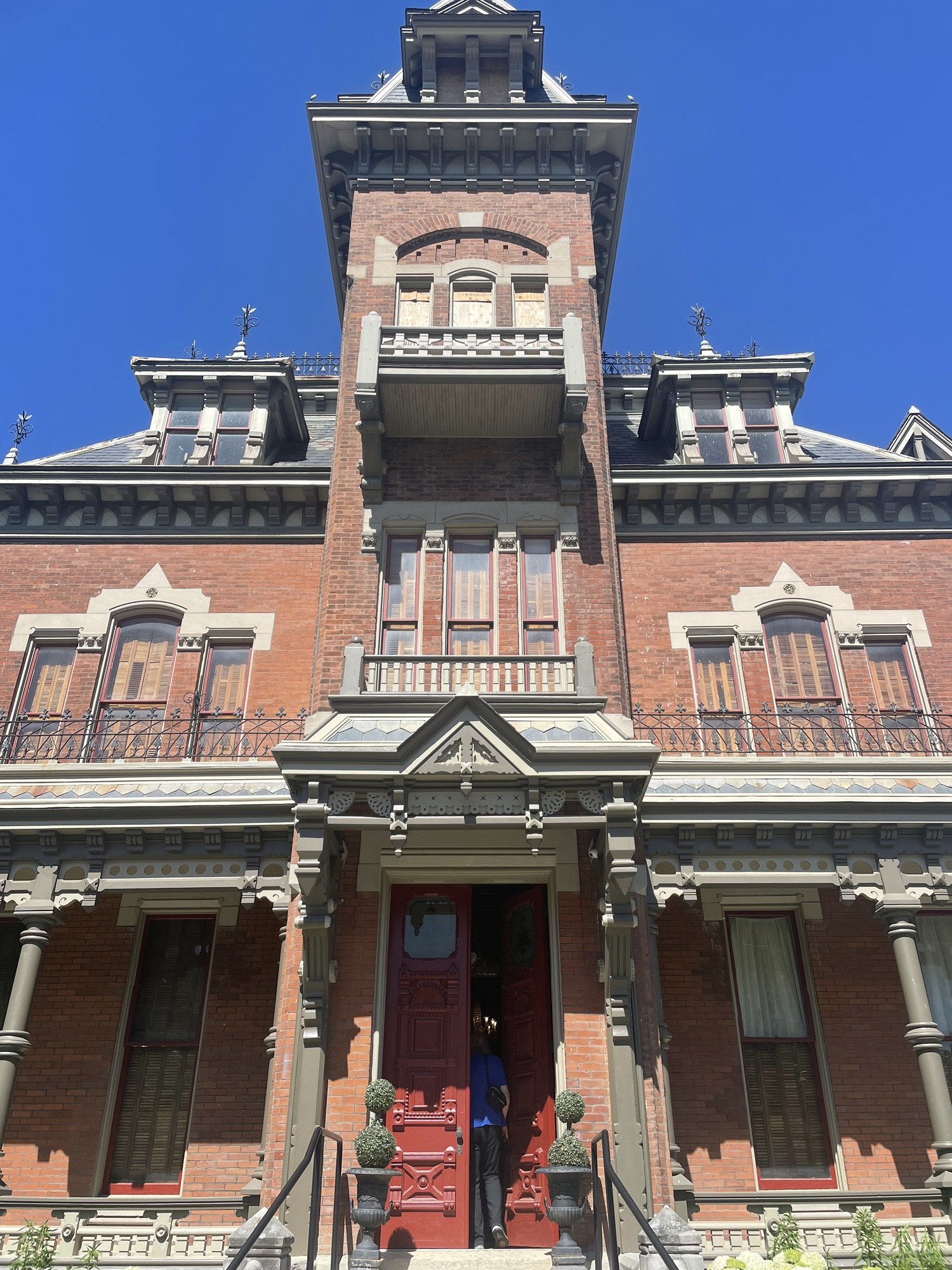
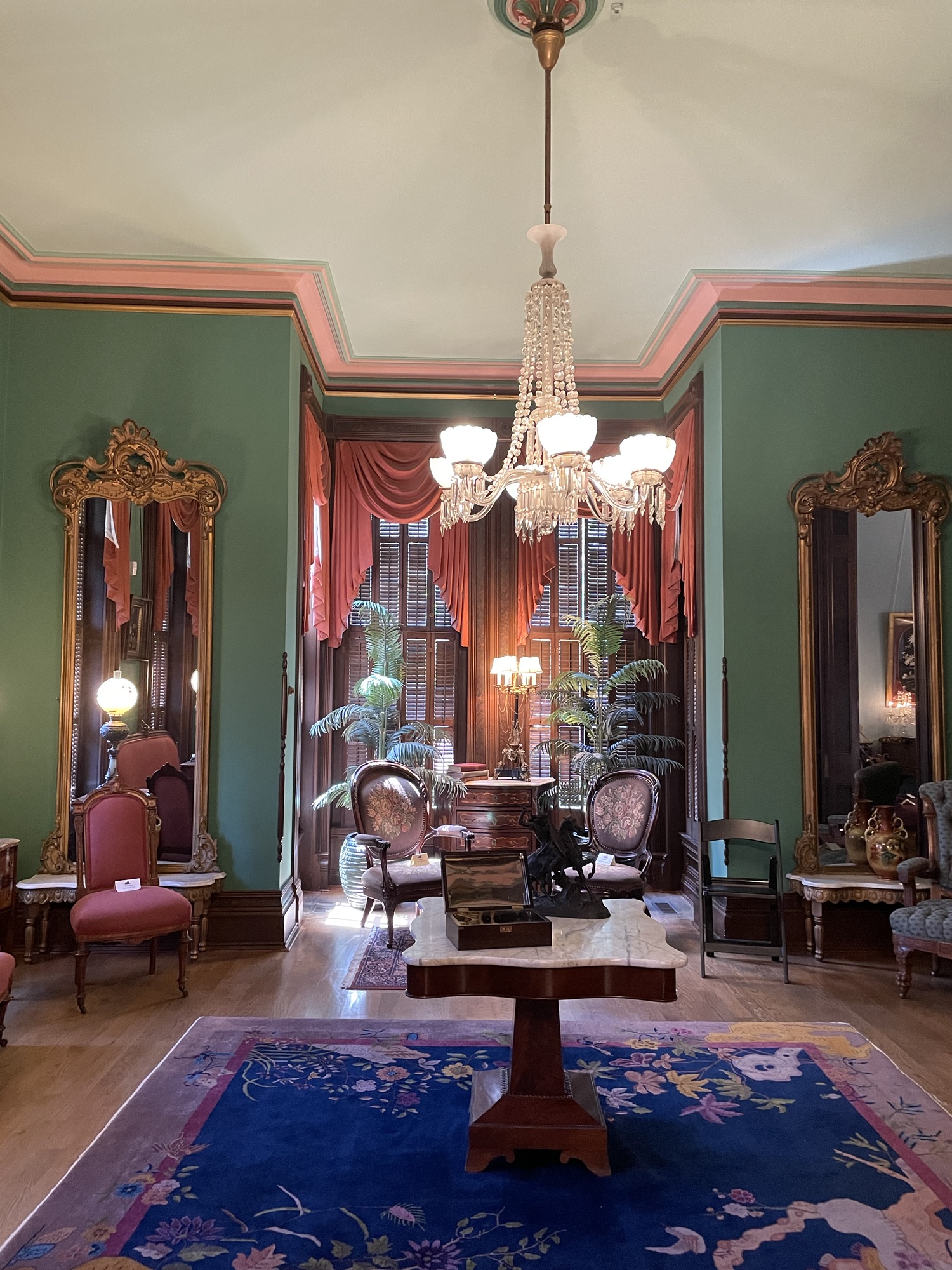
I love old homes that have been turned into museums. So when I read about the Harvey M. Vaile Mansion in Independence, I knew it had to be part of one of our local excursions. When I discovered it, the mansion was not open to the public. It is only open from April 1 through October 31 on Thursdays through Sunday for regular tours, although it does have a holiday season in December.
We planned our visit to the Vaile Mansion for May and took a short trip over to Independence to check it out. It was worth the trip! The mansion is lovely. It was built in 1881, the mansion has 31 rooms. But what surprised me is that only two of the rooms were bedrooms! There were not many people who lived there, but they had plenty of places to use to stay away from each other!! The brick hoe also has nine lovely marble fireplaces of different colors. Important to keep warm with in the 1880s.
The house was designed by a local Kansas City architect, Asa Beebe Cross. It was the height of modern technology for its time. It has flushing toilets, fueled by a 6000-gallon water tank. Copper bathtubs were installed in the bathrooms. The room where the tank was later used as an informal dining area. The kitchen had hot and cold water!!!
Unfortunately, Harvey Vaile and his wife, Sophia, did not enjoy the mansion for long. Sophia, who had stomach cancer, died in 1883. Vaile continued to live there, but he died in 1894. They did not have any children. But Harvey Vaile did have nieces and nephews that contested his will which led to a legal battle and their being unable to pay the attorney, who then acquired the mansion!
Over the years it was used as a sanatorium and a nursing home and owned by the attorney Carey May Carroll. After she died and it was to be demolished a local couple, Roger and Mary Mildred DeWitt, purchased the mansion and began making repairs and restoring it. Mrs. DeWitt donated it to the City of Independence in 1983.
I loved it. The building looks like a mansion should look. It has a gothic air of mystery! In fact, my husband commented that it looked a lot like the house in a lithograph I have made by a local artist (Randal Spangler, see link below.) about a spooky Halloween house! We are sure it is the inspiration! In fact, in October they do hold Spooky Tours, and supposedly the house has a resident ghost!
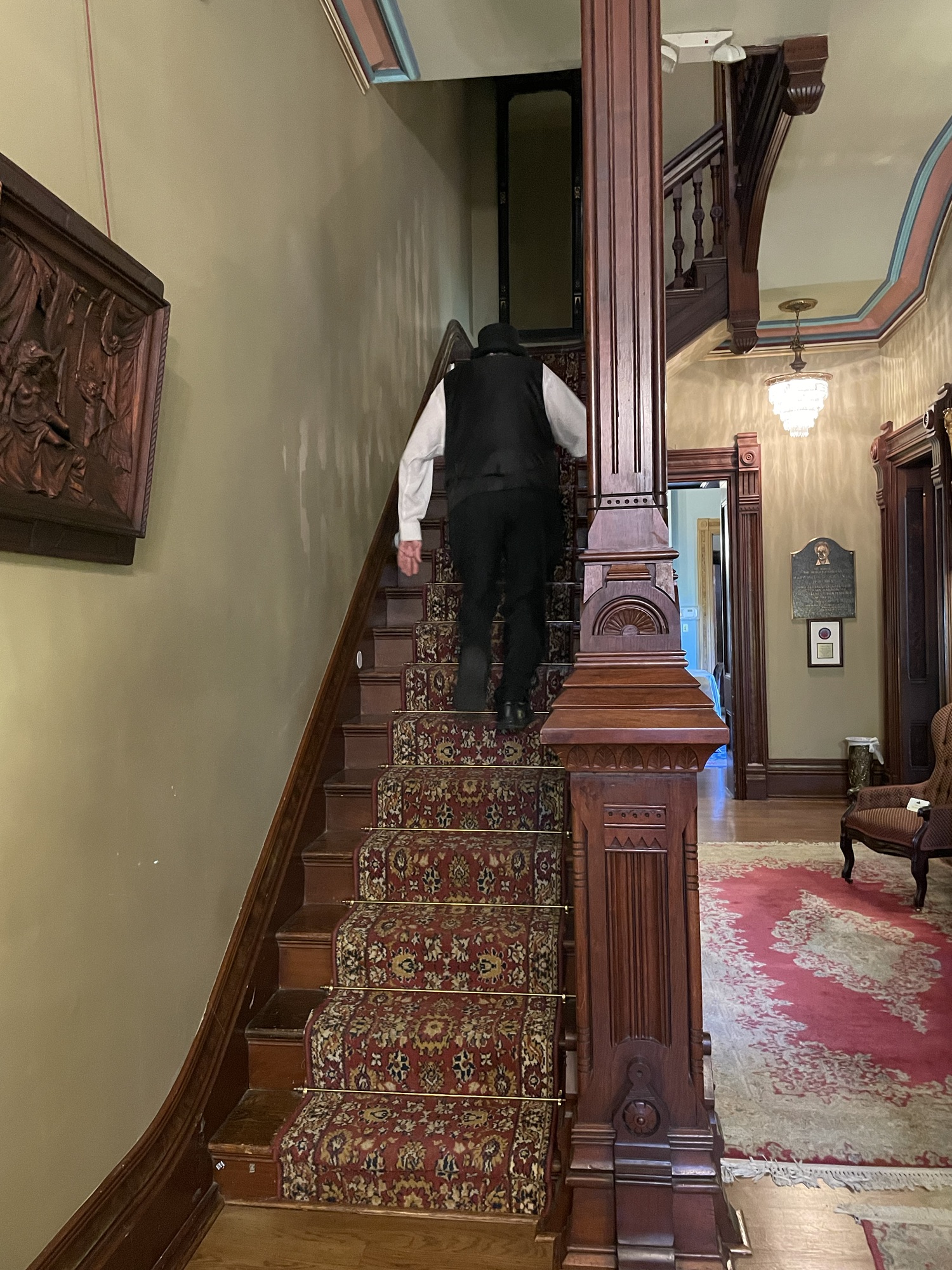
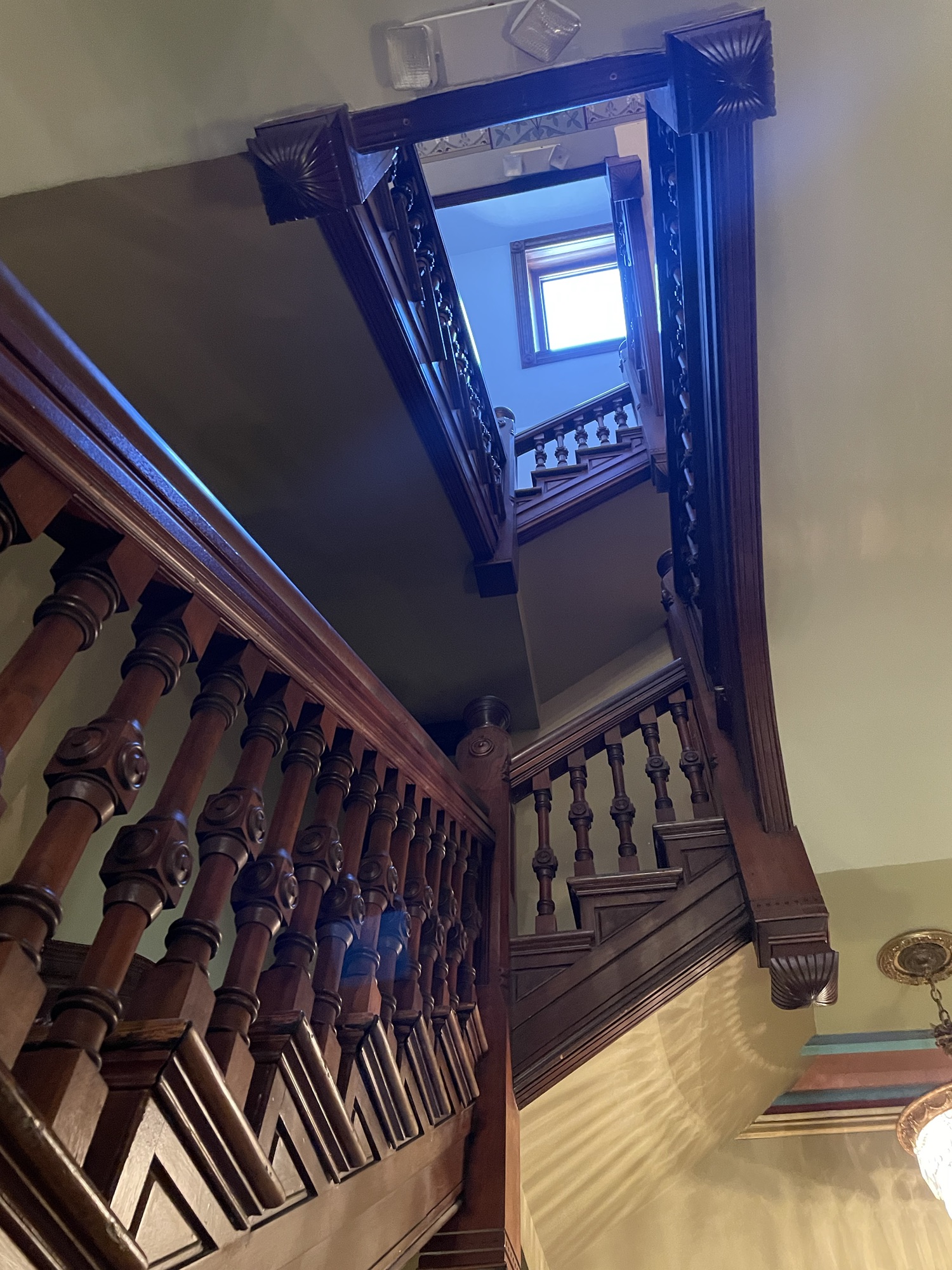
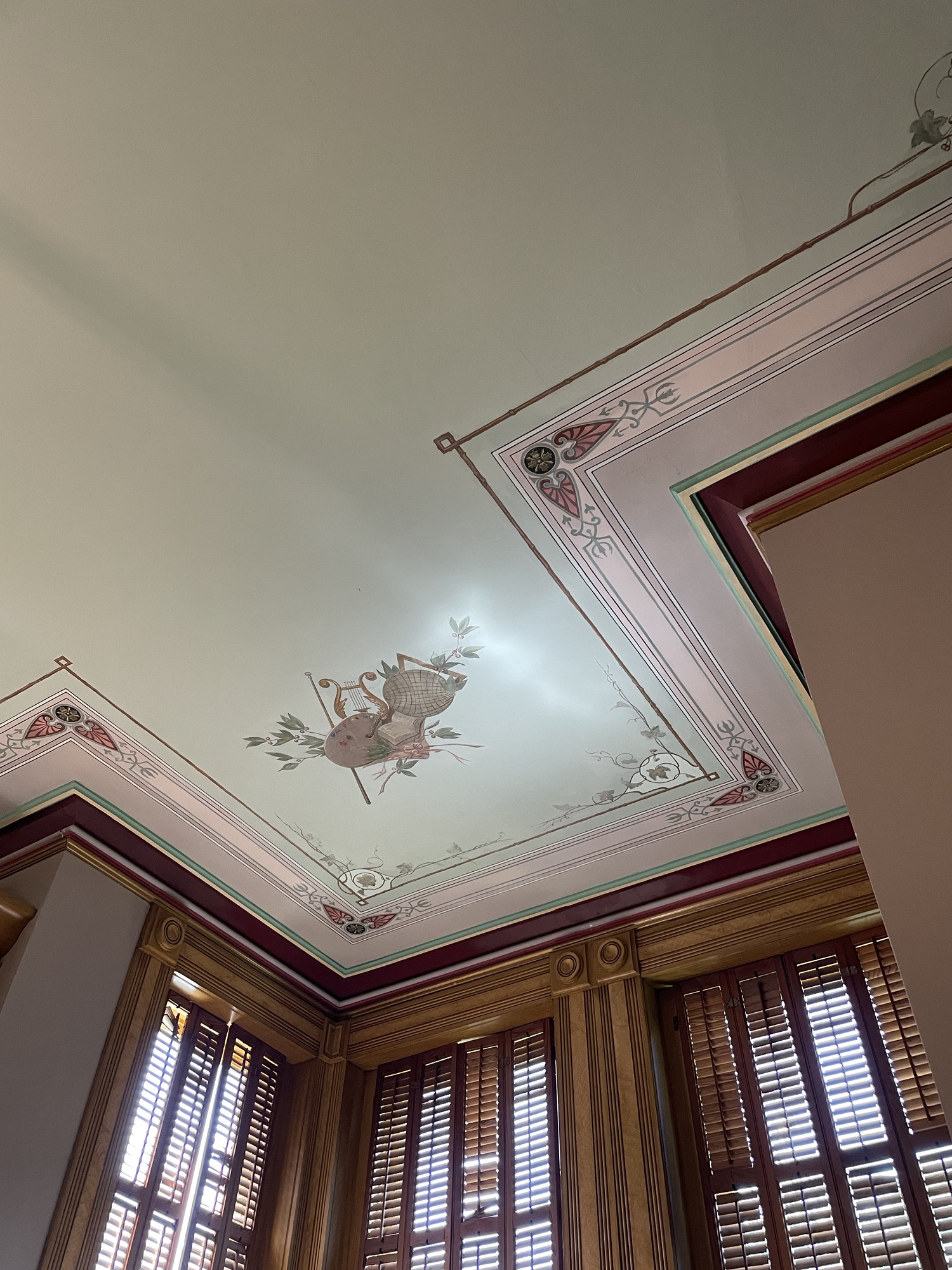
I loved the massive wooden entrance door, and the beautiful leaded glass throughout the house. The staircase that goes up three stories and ends in a skylight at the top is wonderful. All the carved wood bookcases and cabinets, along with the painted ceilings, which were part of the original house, makes it truly a gem. The bathrooms, with the cooper tubs and toilets are so unusual for the time! Colonel Vaile was forward thinking!
The furniture is all from the period, but none of it was original to the house. But there are many lovely pieces included an organ, piano and music box. Throughout the house there are little pieces of history to experience. The best part is that a docent takes you on a tour of the house to point out special objects and to answer questions.
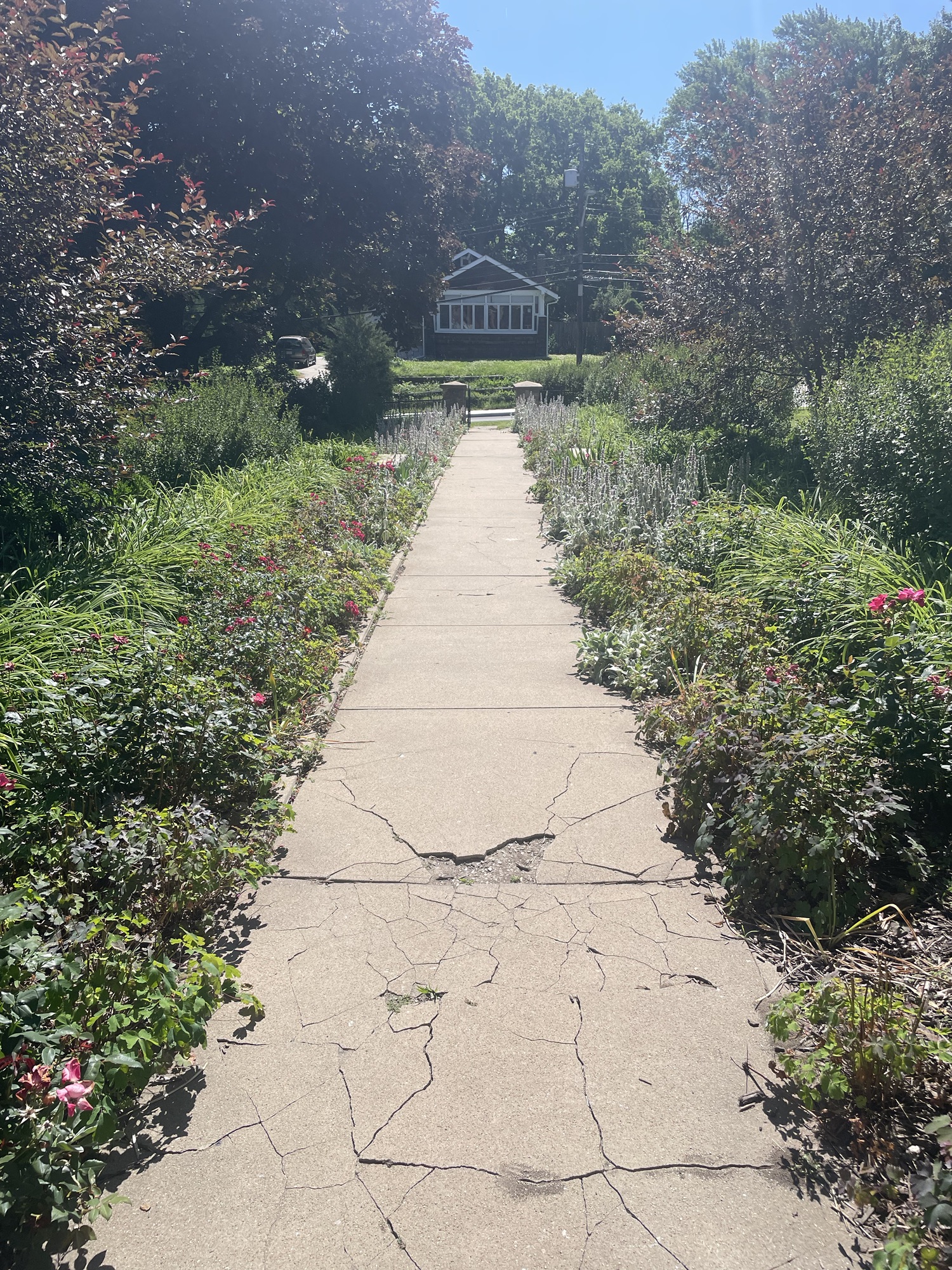
The grounds of the house are also lovely. In early spring a Strawberry Festival is held there. Local couples can rent the house and its grounds for weddings. It would be a great place to be married.
In all you just need about an hour or so to go through the house. The day we went we were the only people at that time. As we were leaving more guests were arriving. It is very close to the Independence Square, so we headed over to complete our day by eating lunch at the Court House Exchange.
Santa Fe is a city of many diverging elements coming together to create a unique city. The art of the Navajo, Apache, and Pueblo people; and the multitude of art galleries and jewelry stores; the churches and religious sites; the unusual round State Capitol building; and the original adobe buildings; the restaurants; the museums, all combine together to give the visitor and the residents a place that stimulates the senses.
My husband, who is enamored with AI, asked what would be the best 2.5 hour walking tour of Santa Fe. Its description of four places became our morning walking tour. None of these places take long to visit, unless you want to stay longer. For this ‘tour’ you will be walking up hill on the Old Santa Fe Trail Road, which is right by the La Fonda Hotel downtown. Finally, you can always take your water bottle in with you.
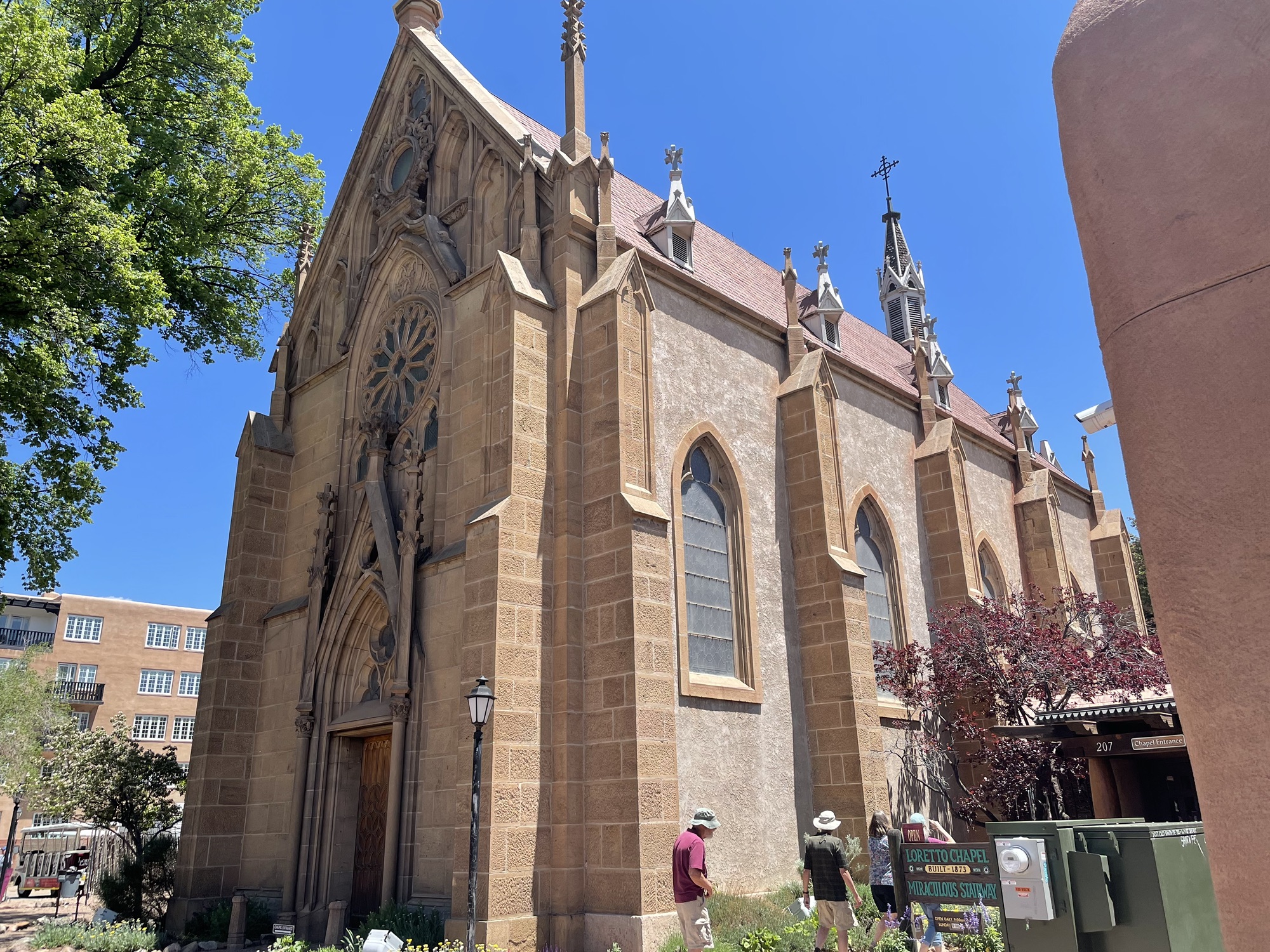
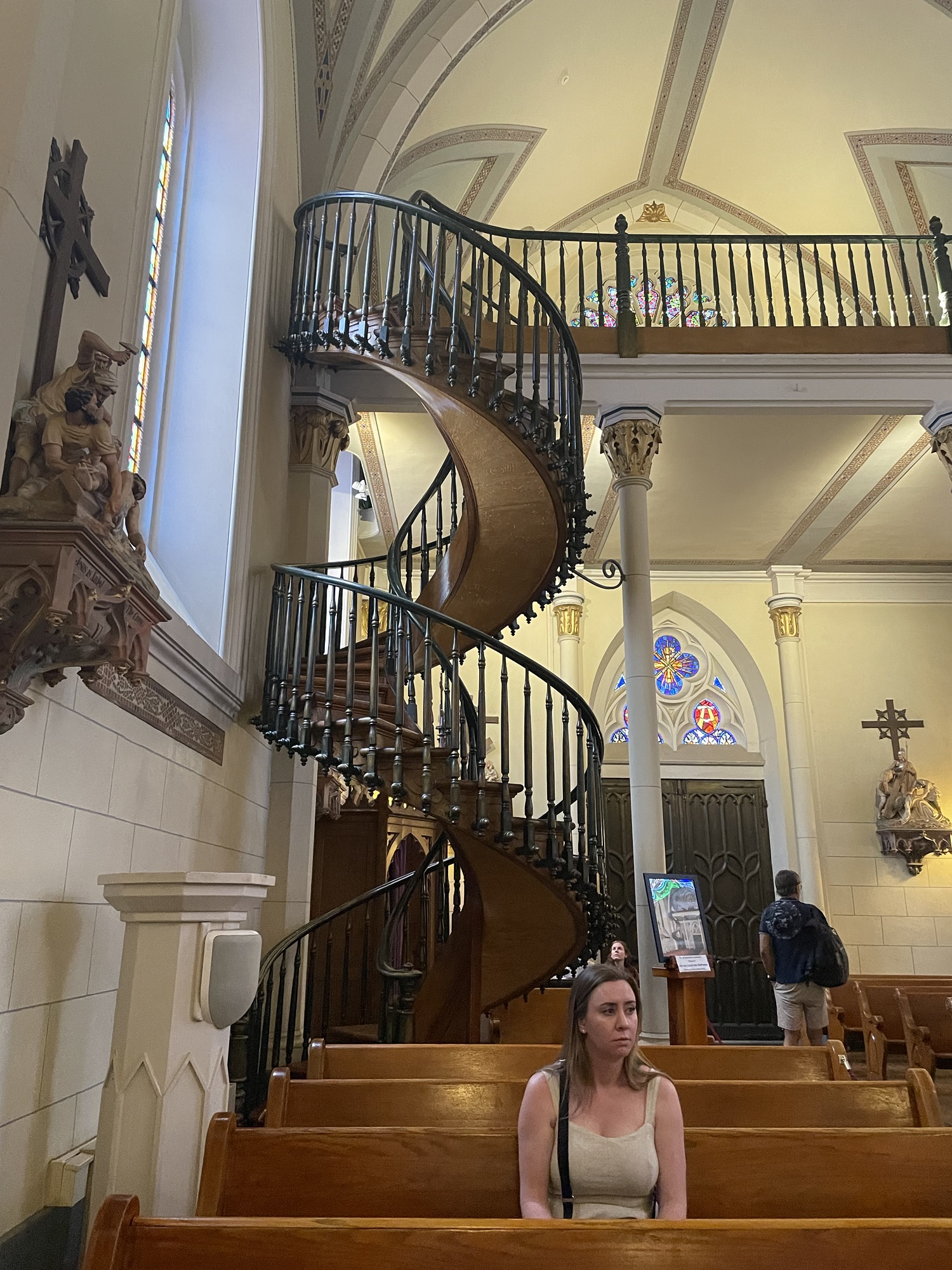
The Loretto Chapel and its mysterious, mystical stairs is worth the visit. The chapel was once part of a girl’s school and was designed by the same architect as the Santa Fe Cathedral. The mystery of the stairs starts when the architect died before the staircase was built, the nuns were distraught and prayed for help. An unknown carpenter appeared, built the stairs and disappeared.
The staircase is a lovely gem to see, whether you believe that it was built by St. Joseph or not. How it suspends and curves upwards without support is astonishing. And it is beautifully carved. But besides the beauty of the stairs, the chapel itself is lovely. While you sit and visit, you listen to the story of the stairs. This is no longer a consecrated church, so religious services are not held.
Two blocks further up the hill on Old Santa Fe is East De Vargas Street. Turn left to walk through a narrow road to the Oldest House in Santa Fe, but I recommended you first go across the street to the San Miguel Mission Church.
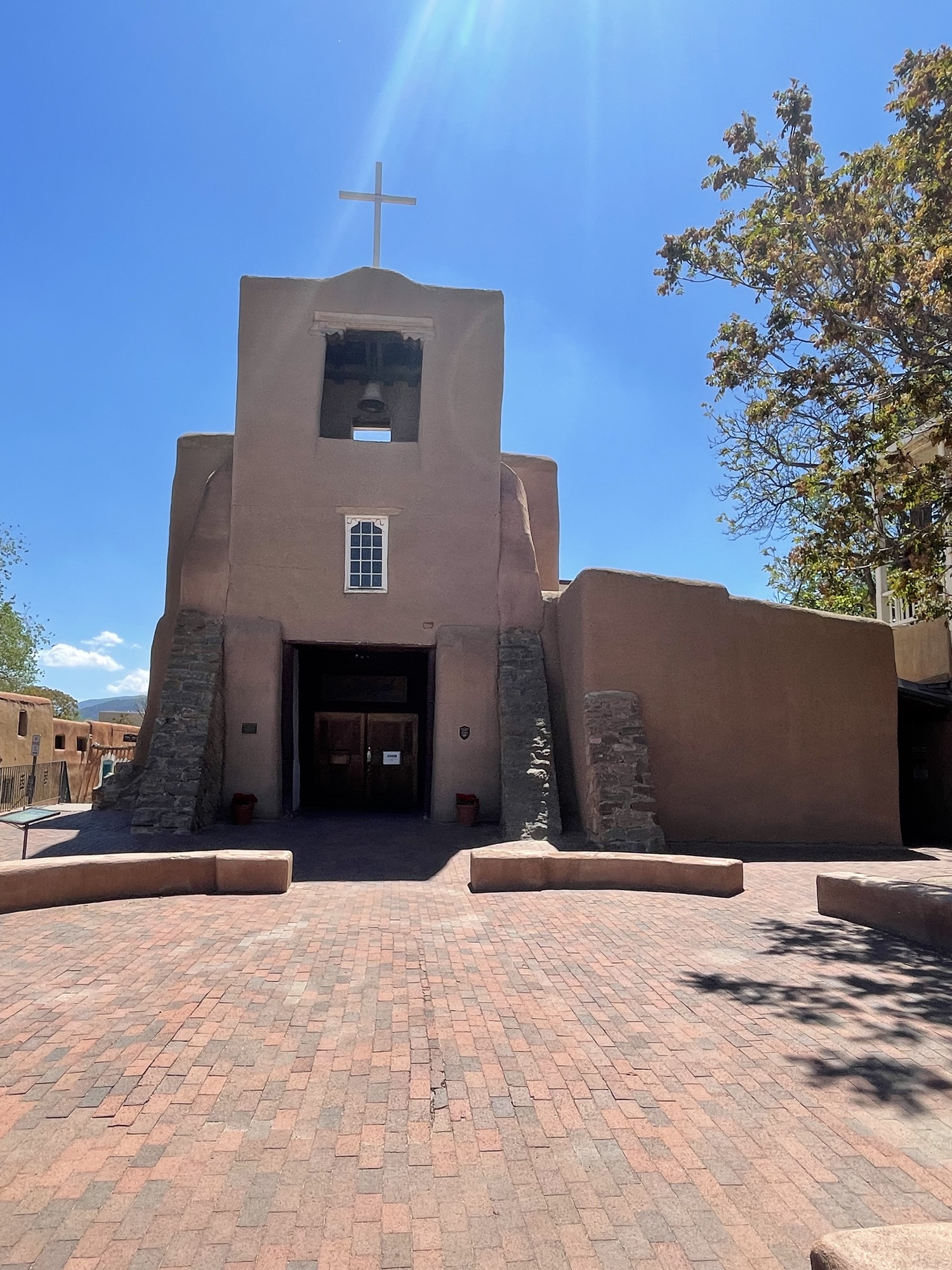
The San Miguel Mission Church sits on a hill on the hill. Probably a good place for watching what is going on around you. It is the oldest Catholic Church in the United States. People can attend mass on the first Sunday of each month.
It is not a big building, but it has a big history. First built soon after the Spanish came into Santa Fe in 1598, the mission church was used by the Franciscan priests who came to New Mexico with the Spanish to convert the indigenous peoples and serve the Spanish settlers. It was partially destroyed in 1680 when the pueblo peoples revolted against the Spanish and the church for the cruel treatment. They burned the roof, destroyed some of the walls, and killed the priests. The church was rebuilt when the Spanish returned about 30 years later.
When you walk in there are two artifacts to notice. The first you see on the — the Victory bell that was brought from Spain. The bell had a long history that included helping Spain expel the Moors. The story is whenever the bell rang, the Spanish had a victory. The bell came to New Mexico for a Spanish family. But after the Pueblo Revolt, when the Mission was rebuilt the bell was put in the church belfry. The second item hangs on the wall to the left. It is a 300-year-old replica of the painting of Our Lady of Guadalupe from the Mexico City Basilica.
The church itself is small and simple. The wooden ceiling is wonderful. After you finish viewing the chapel and listening to the talk by the docent, please go down the stairs to the second room. There are photographs that show the building from different angles, as well as two photos of the oldest house before it was restored.
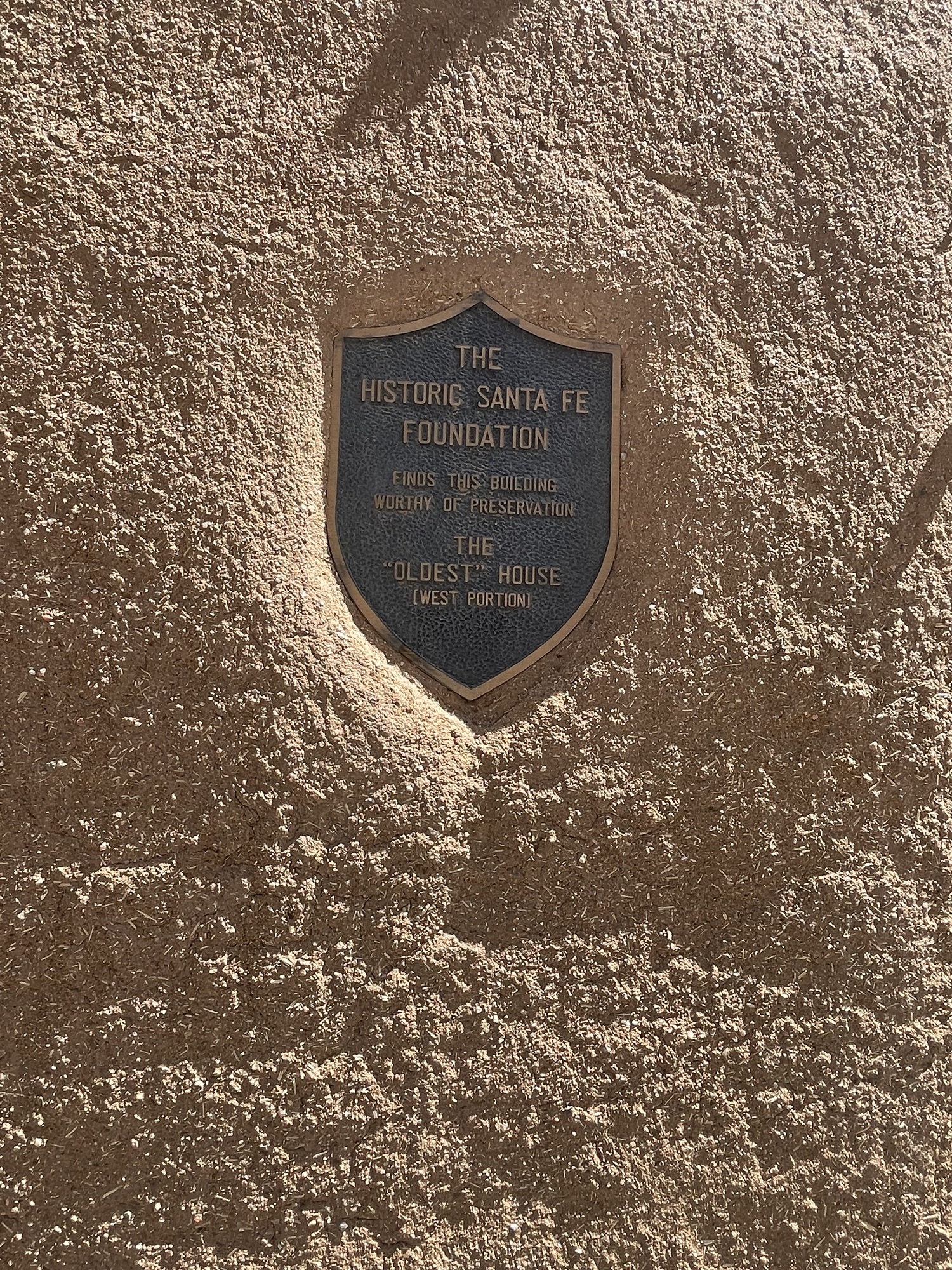
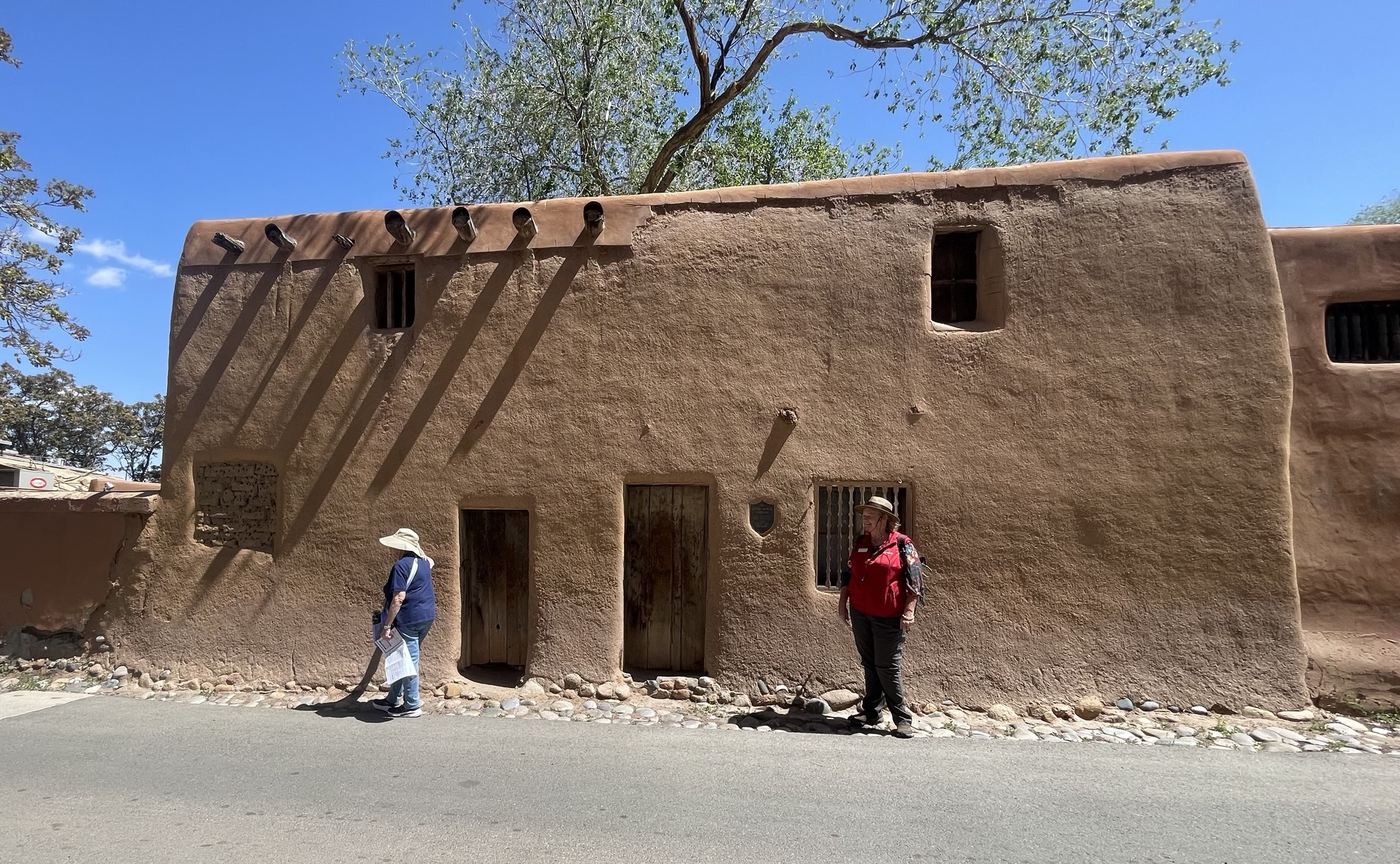
Now you can go out of the chapel and down the steps to the side which lead to De Vargas Street. Immediately across the street is the oldest house. The house, from the 1600s, is built on the remains of a home in what once was part of a pueblo It is attached to a gift store.
You go into the store and to your left to enter the house. There are just two rooms to see and they are tiny. But as all sites, it is worth seeing to understand how people lived. If you are a bit claustrophobic, try to go when there is a not a group going in. It gets tight.
When you are done at the oldest house, return to Old Santa Fe Trail Street and continue past the San Miguel Mission. Turn right on Paseo De Peralta. You will soon come to the State Capitol building. It is unusual in that it is both round and NOT built in the pueblo style. (Which is what I thought it would be!). When we went there was an art show on display. But even if it is not there, it is worth going in to see the rotunda and the lovely architecture. You basically walk in the main door and go out the back door getting you back to E. De Vargas street.
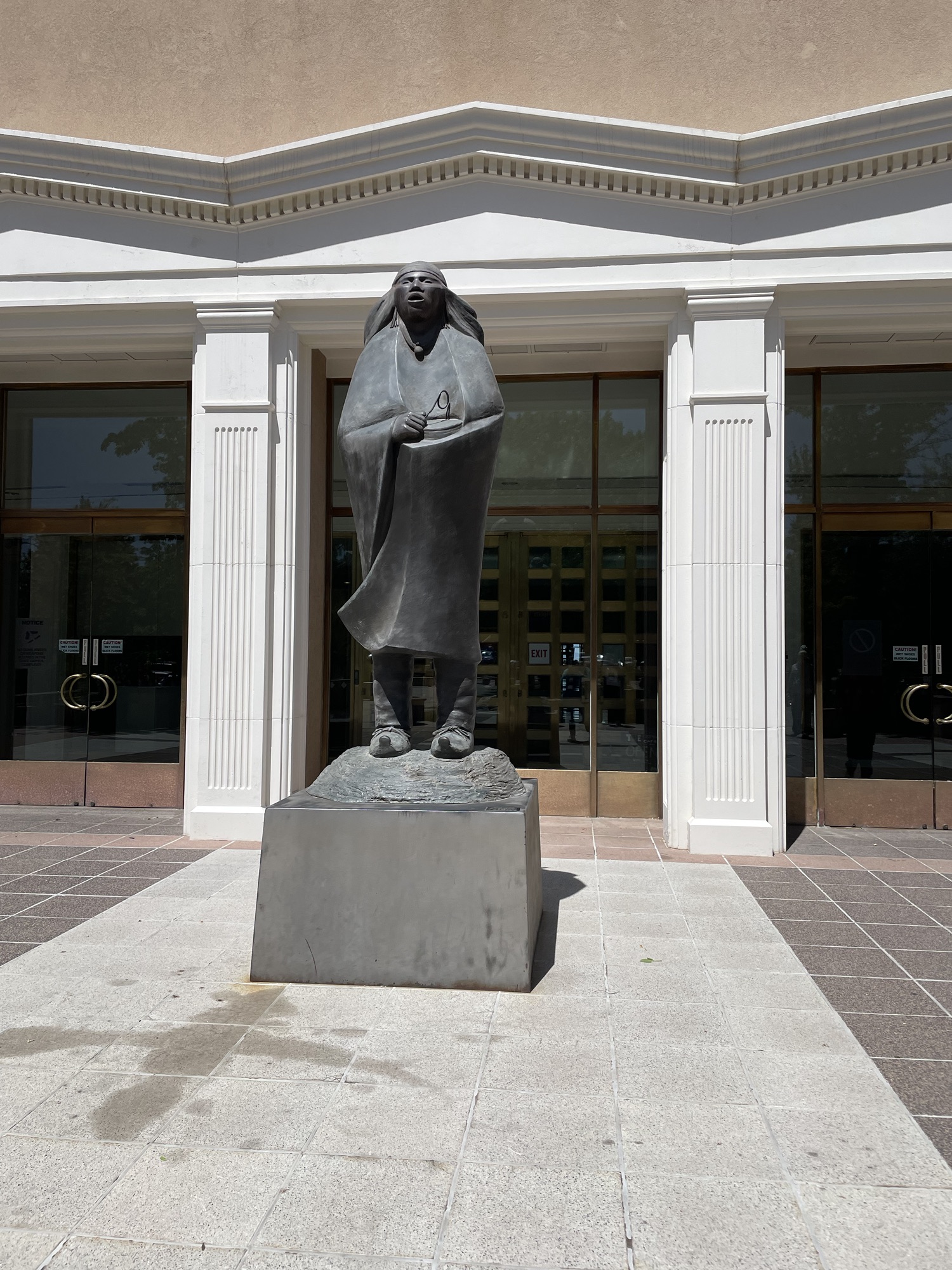
After this part of our tour, we went for lunch! There are many, many excellent restaurants in the Plaza area. So go and enjoy. Also while walking around you will see many galleries and statues/art on the sidewalks. Take time to enjoy them. You might want to take a break and rest after lunch or do this next part in the morning.
Martyr’s Cross and Marcy Fortress. There is a way to drive to get closer to this site, but my husband and I did not have a car, so we walked. It is located on Paseo de Peralta, the same street as the capitol building, but in the other direction. Depending on where you are staying will determine how you go. But since we stayed near the Cathedral, we took Palace Avenue to Paseo de Peralta and turned left. You can see the cross on the hill and just head in that direction!
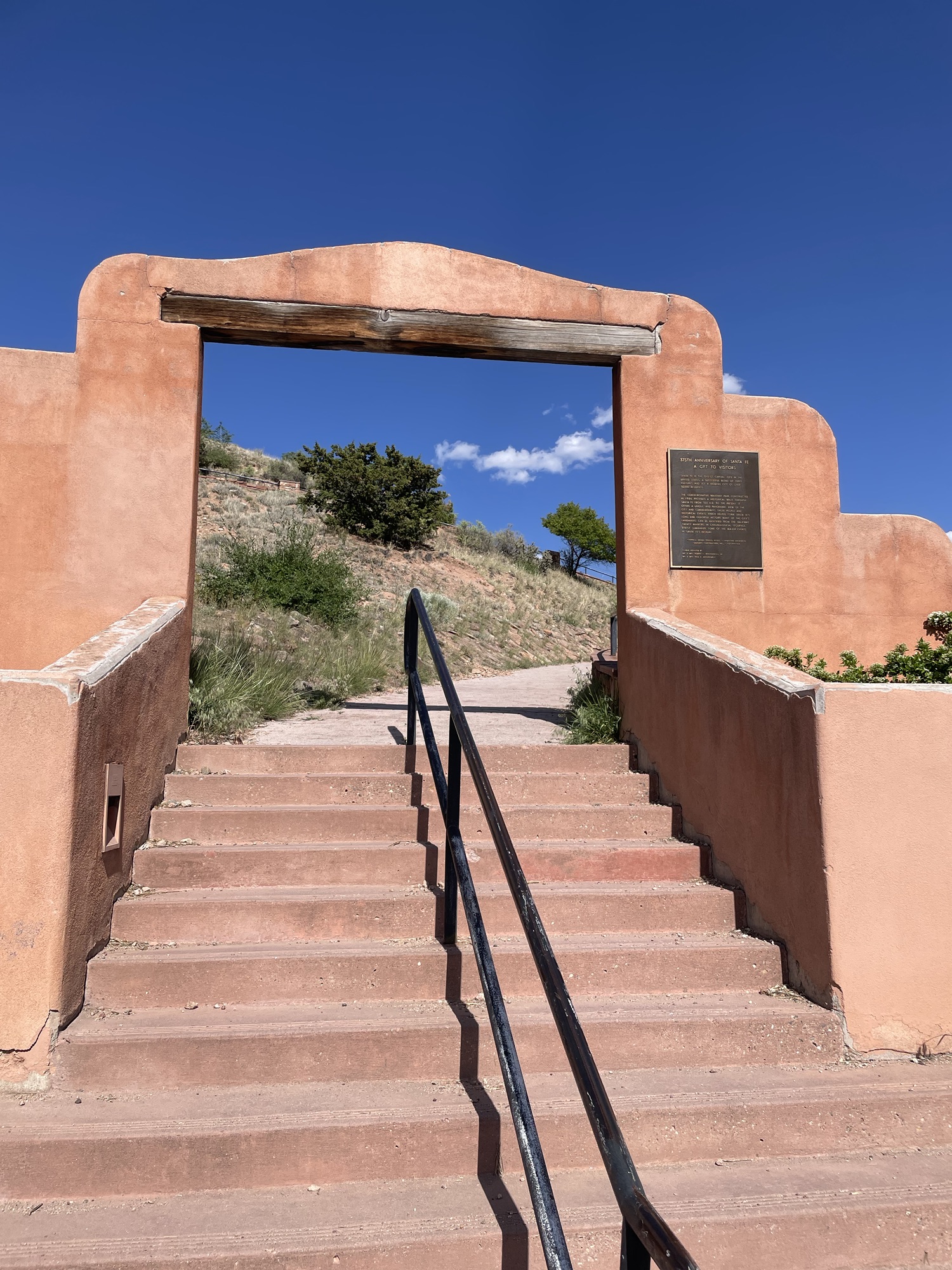
The entrance to walk up is marked by an adobe sign and arch. You are going up hill. There are rest areas where you can sit at the ends of each switch back. And take water!! It is dry in Santa Fe. The walk up was fun. Along the way are plaques that tell the history of Santa Fe, and as you go higher the views get better and better.
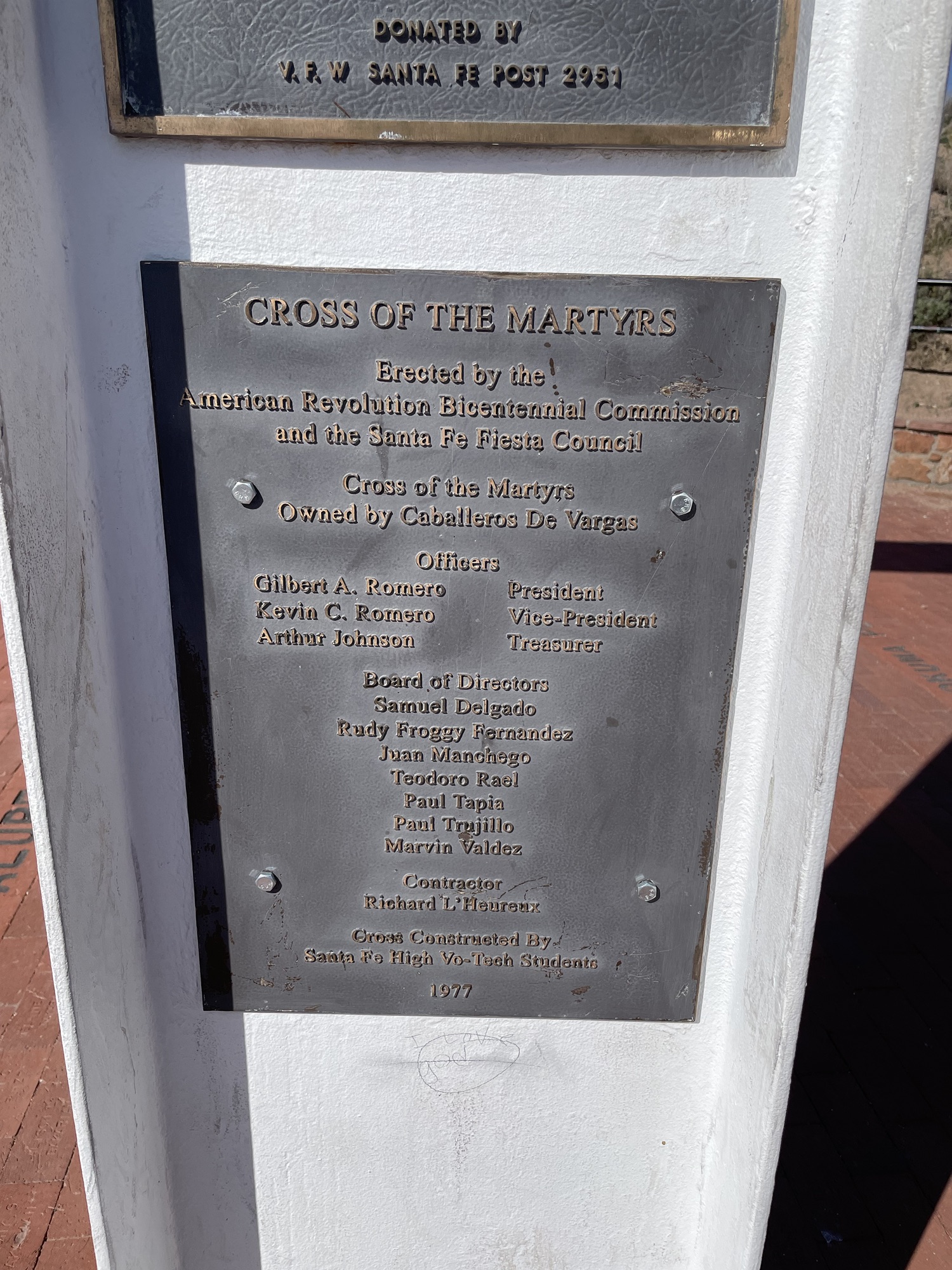
The Cross of the Martyrs honors the 21 priests and 380 Spanish settlers who were killed during the Pueblo Revolt in 1680. The first cross was erected in 1920s. Over time it was replaced twice, the last time in 1977 with a metal cross.
To be honest, we did not continue up the path to see the ruins of Fort Marcy. It had been a long day, and we still had to walk about a mile or so back to our hotel. But you can easily get to it. But that path is not paved.
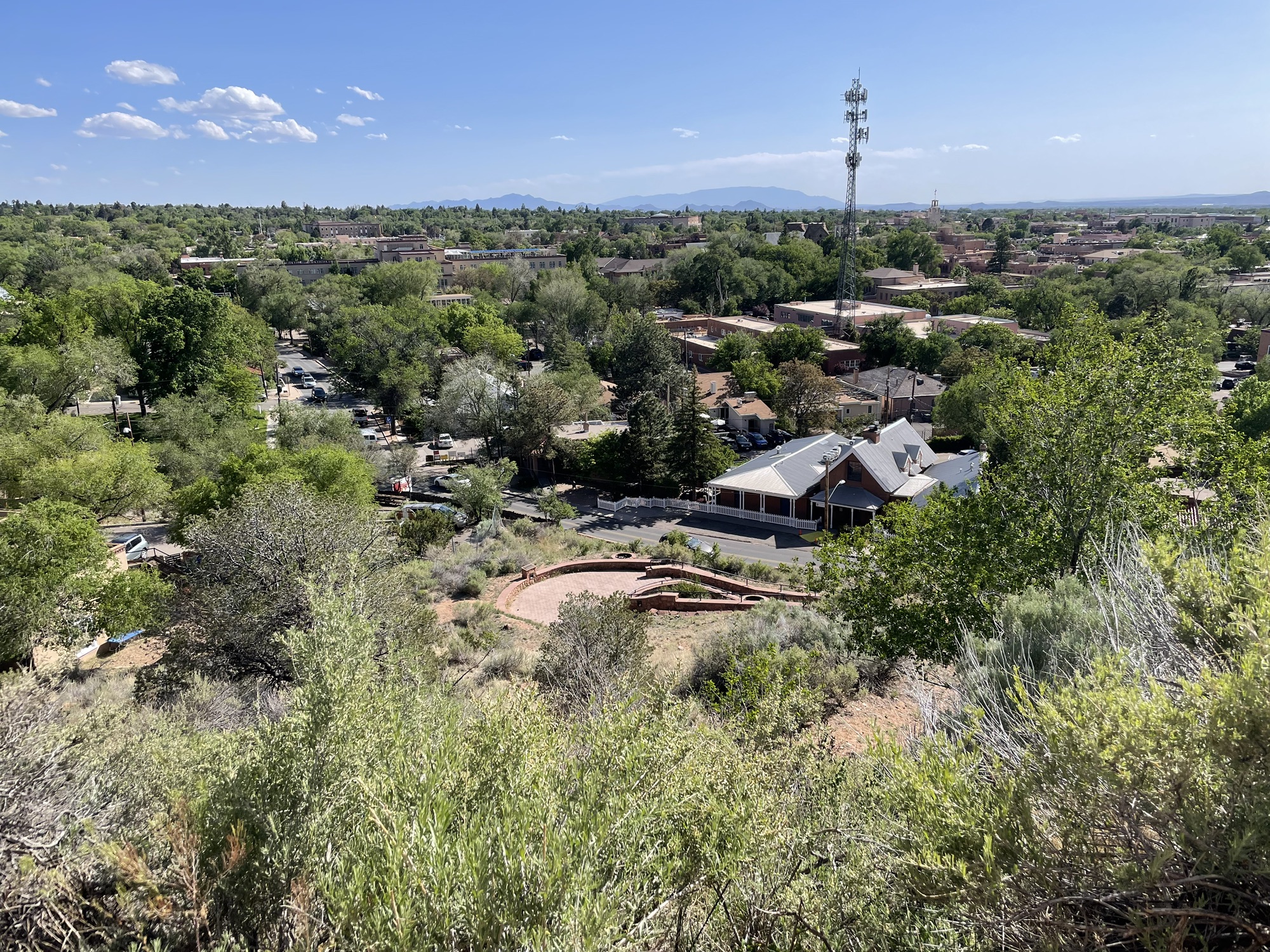
However, we did get some fantastic photos of Santa Fe from the top.
Museums, museums, museums. So many to choose from, so many to see. We went to six museums over our six days in Santa Fe. I decided I would list them all in one blog from my favorite to my least favorite. That is not to say that any of them were bad, just that these are how I enjoyed them.
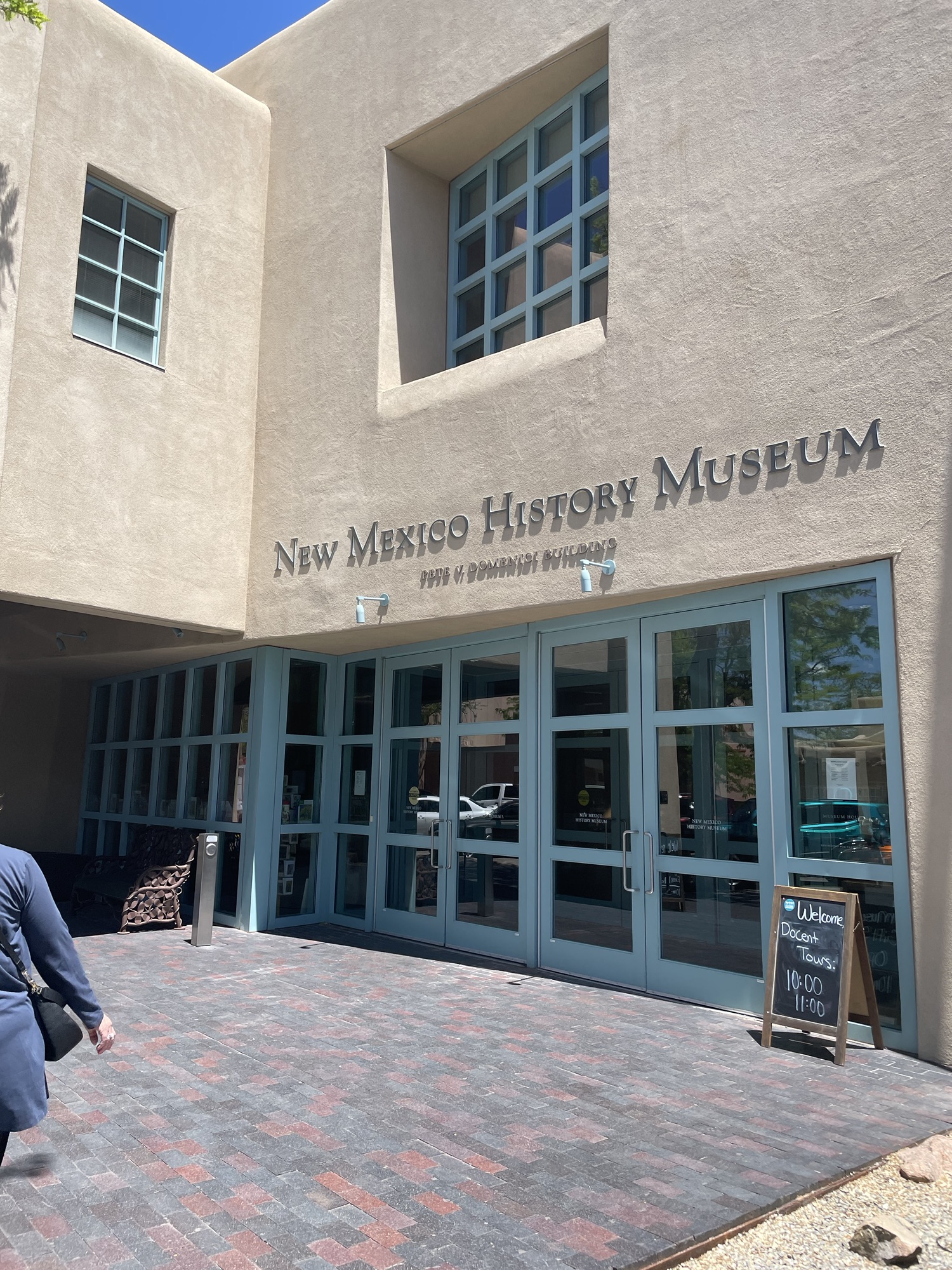
New Mexico History Museum/Palace of the Governors. Located behind the Palace of the Governors, on Lincoln Avenue right off the Plaza, The New Mexico History Museum is a great place to understand Santa Fe and the relationships among the Native cultures, the Spanish heritage and the American ‘invasion.’ With three floors of exhibits and the additional space located in the Palace of the Governors, there is a lot to see here. Way more than I anticipated, which is why I ended up not seeing all of it, even though I had good intentions to return on another day to complete seeing the exhibits in the Palace of the Governors. I do love learning history!
The first floor packed in 500 years of history! It was a lot to take in, but really explained the importance of both the Native and Spanish and Catholic influences on New Mexico. When the United States took over the New Mexico territory, the relationship between all these groups changed dramatically.
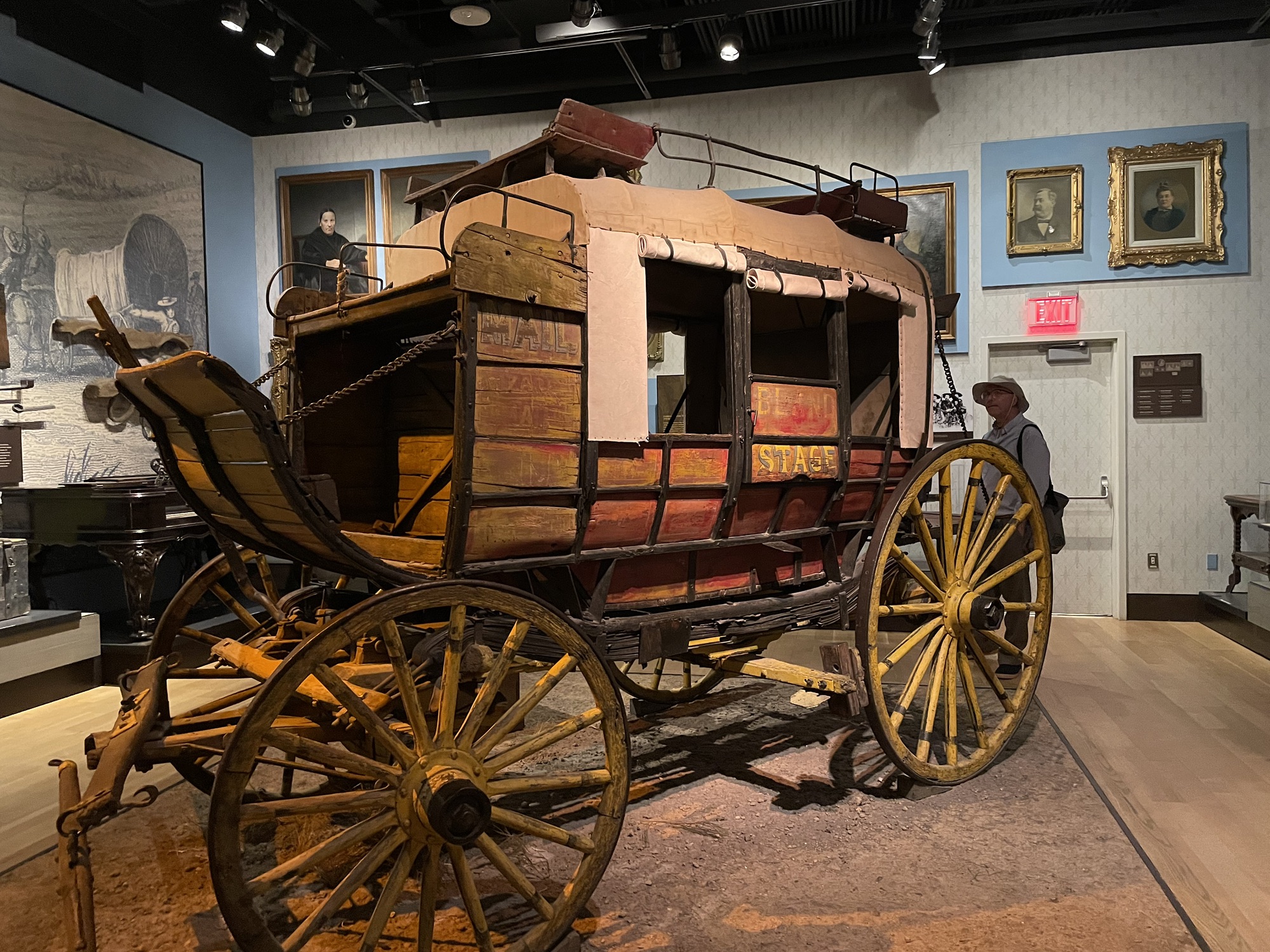
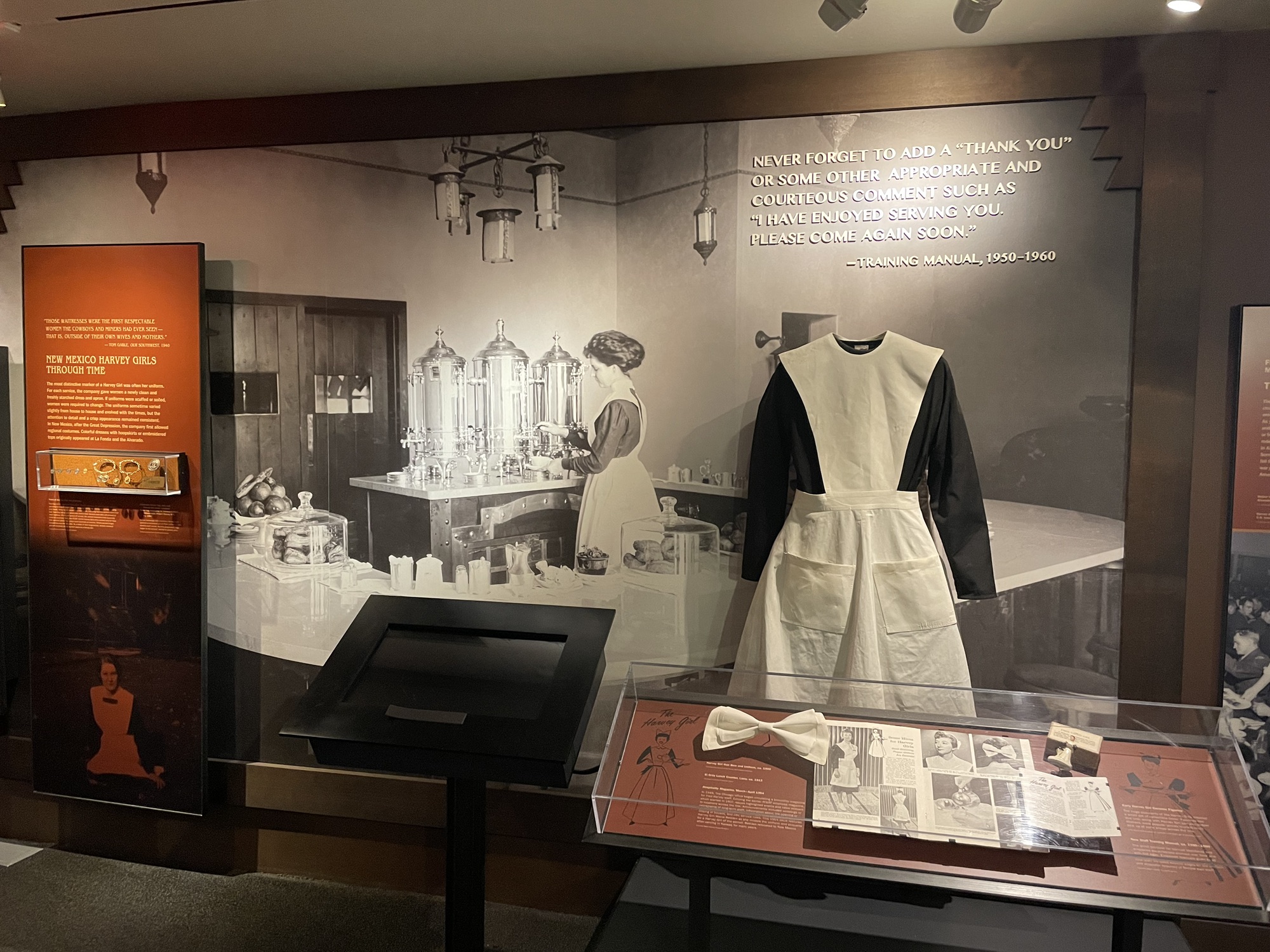
One of my favorite exhibits was in the mezzanine, “Settling the Standard: The Fred Harvey Company and Its Legacy. Since Fred Harvey started in Kansas City, and I have seen the displays at our History Museum, I was delighted to see the story retold here. This exhibit was much more in depth than the exhibit I have seen at a Kansas City museum. It might have to be another blog!
The next two museums were at Museum Hill, just outside downtown: the Museum of Folk Art and the Museum of Indian Arts & Culture. We decided to go to the Museum of International Folk Art first, turning to the right as we entered the museum plaza. (I recommend getting a Culture Pass, which includes a number of museums for a $30 fee.)
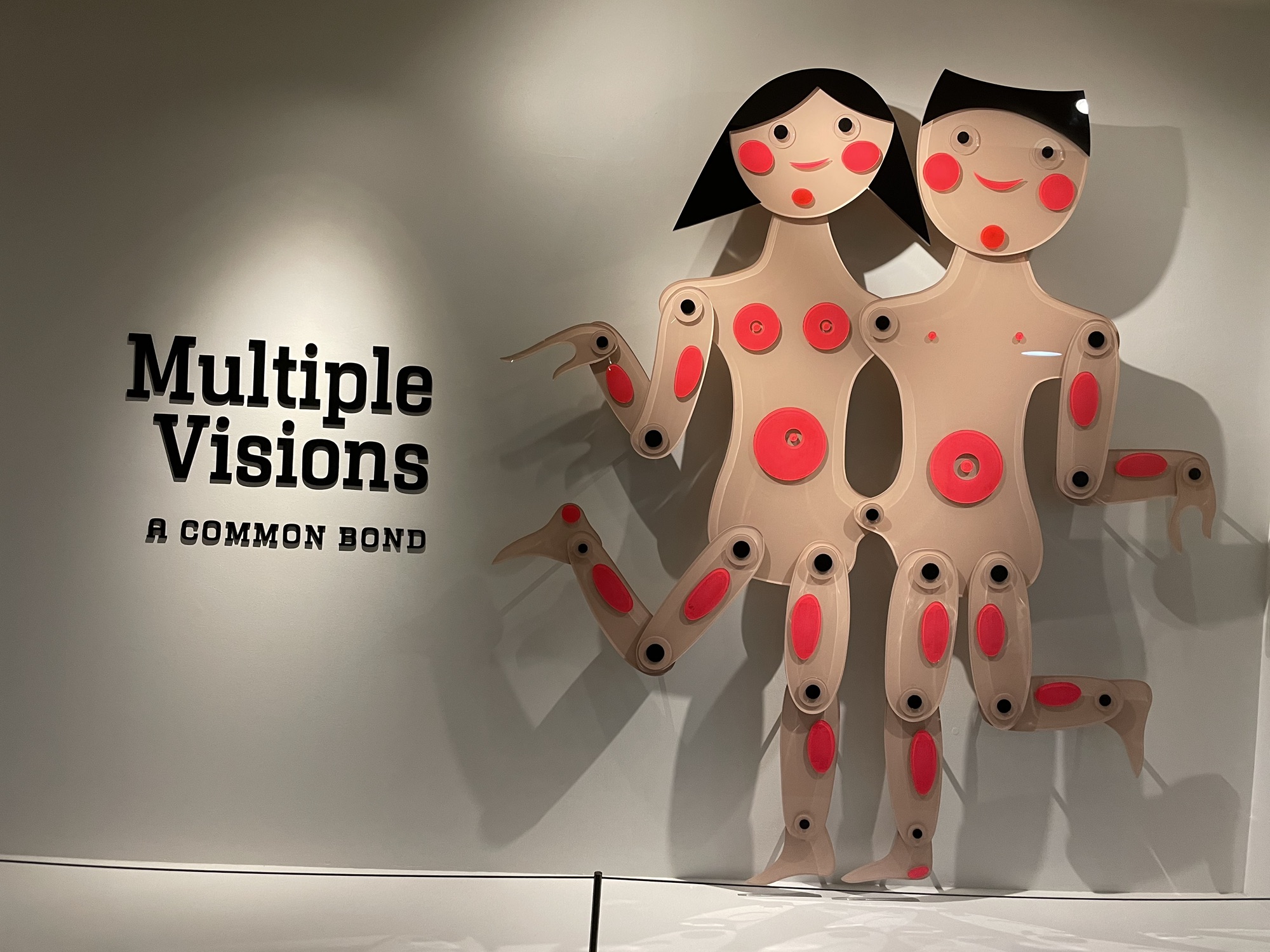
The first exhibit we visited was “Multiple Visions: A common Bond.” Alexander and Susan Girard donated their extensive folk art collection to New Mexico, and it was added to the Folk Art Museum. When I entered this room, I was first excited and then overwhelmed. The art seemed endless; it covered walls, hung from the ceiling, filled hundreds of display cases. We walked around the entire room, looked in every case, and were mentally exhausted, visually overstimulated, but filled with the joy of the art.
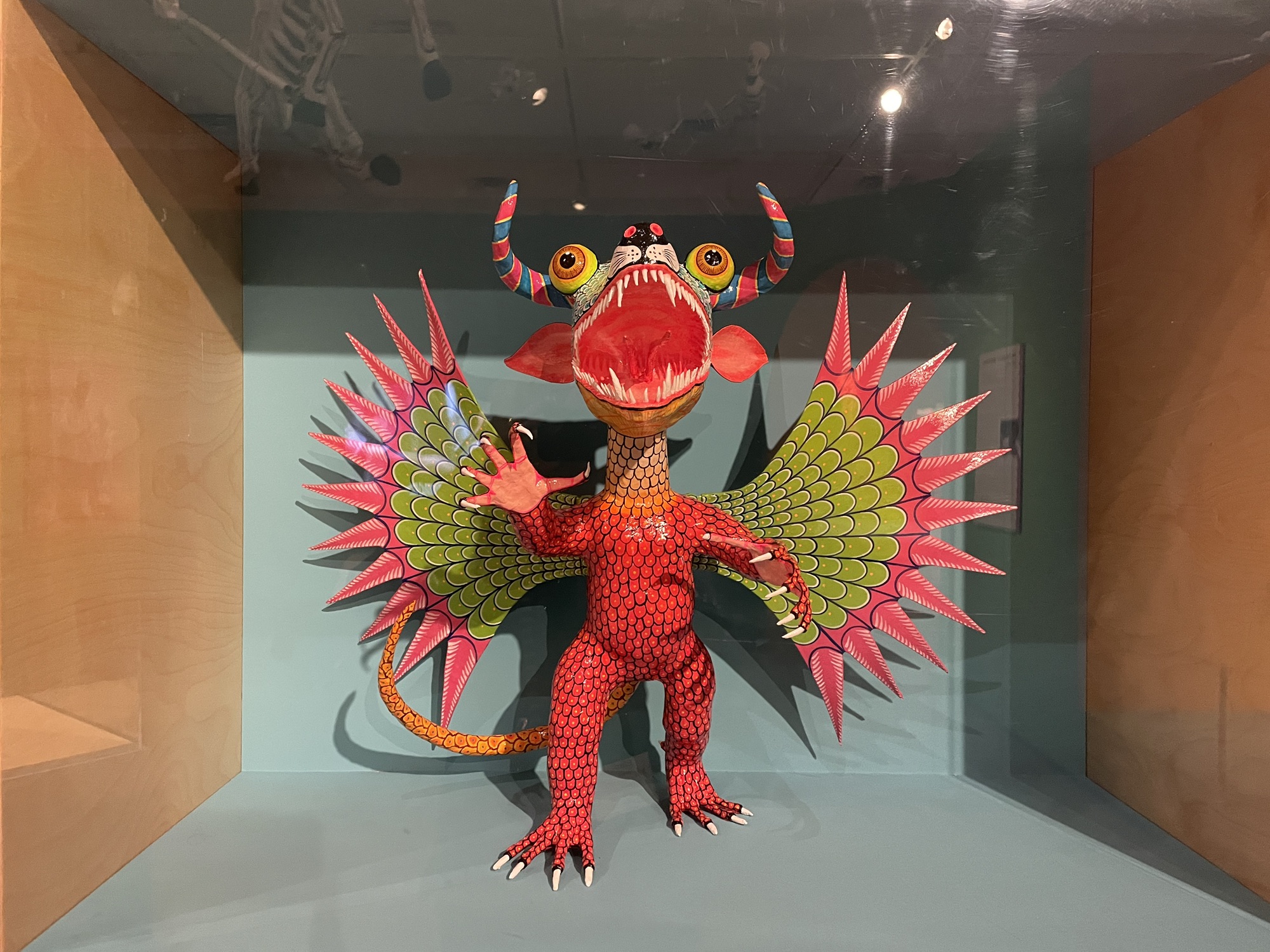
Luckily the next two rooms were much calmer, so we could feel more ease as we left the building. I really enjoyed “la Cartoneria Mexicana,” which was several rooms of unusual creatures made of paper and paste. Between the first exhibit and this one, there is a short movie that explains how the exhibit displayed. I liked it. The creations made of paper and paste were magical.
The final room held the curators’ favorite pieces. It was a calming room! A short visit to the gift show then we walked the outside labyrinth to continue the calming process. You really do need to rest your brain after being at the Folk Art Museum.
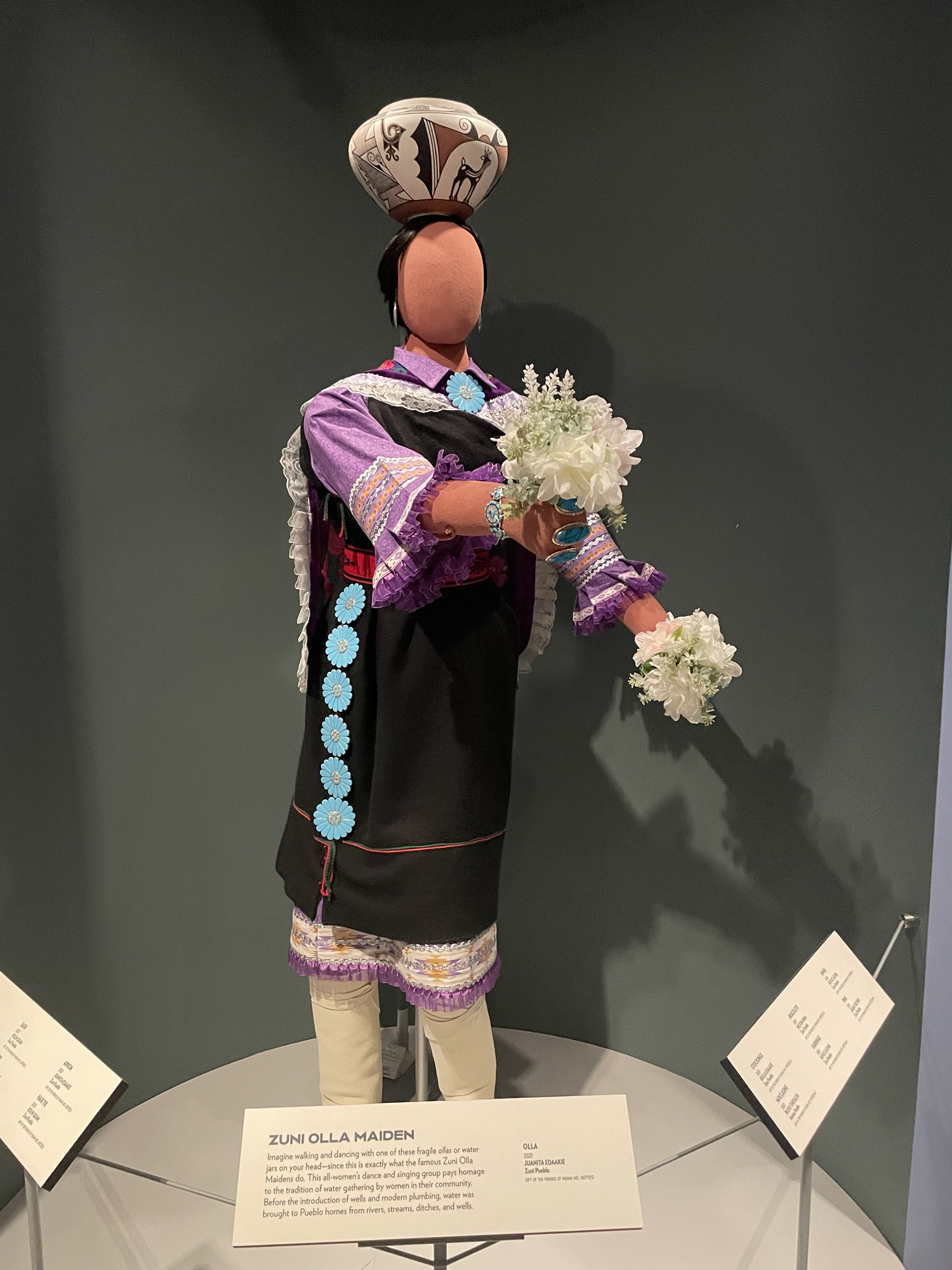
We ate lunch at the lovely restaurant on the hill, and then went over to the Museum of Indian Arts and Culture. Really an excellent place to learn about the indigenous peoples in the “Here, Now and Always” exhibit. The statues outside the building brought me joy, especially the one of the young hoop dancer, it reminded me of the young girl we had seen doing the hoop dance in the Plaza.
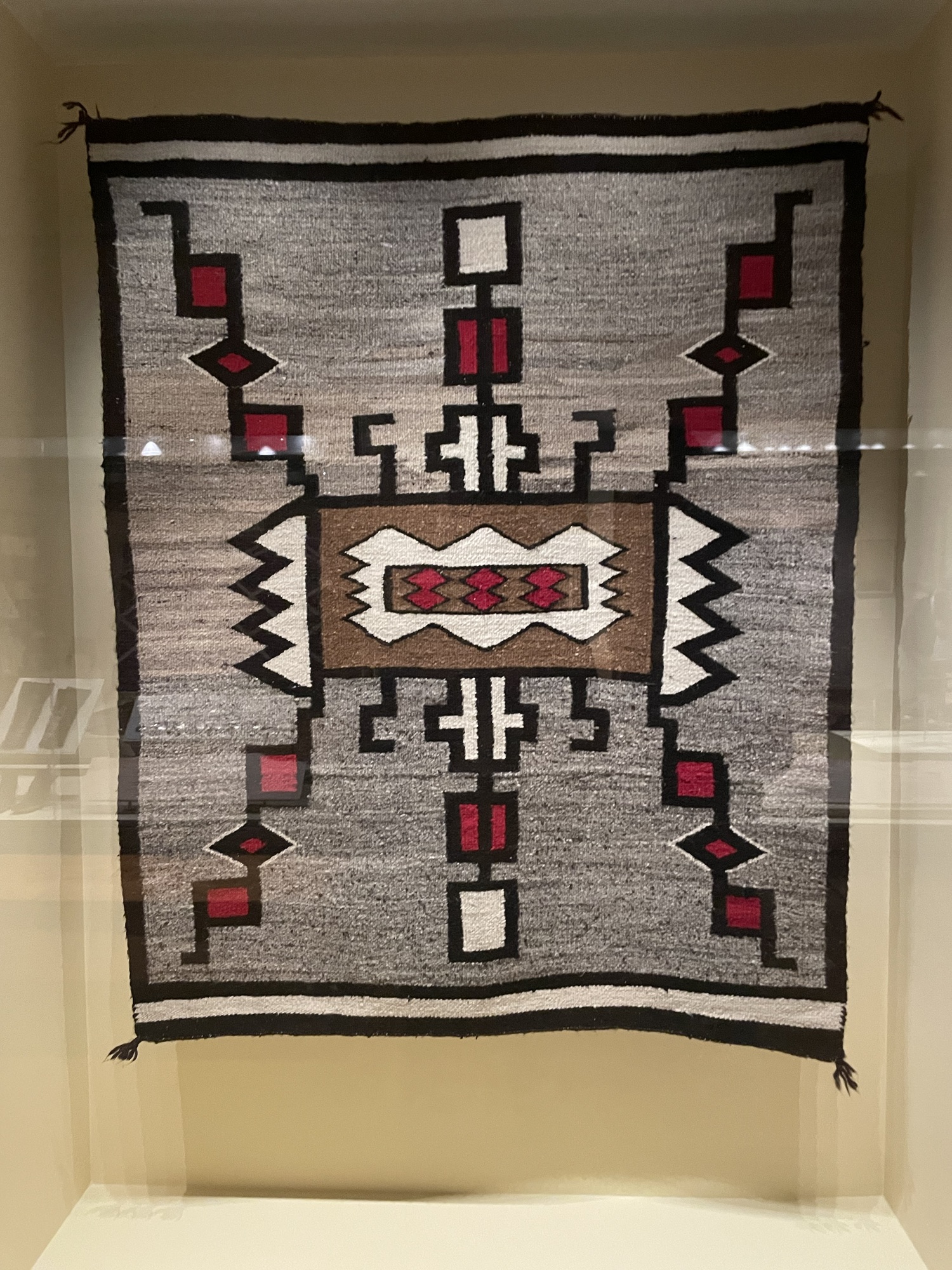
Inside there was all the information needed to understand the native peoples who lived in the New Mexico area. The pottery, the weavings, the baskets, the jewelry, and the information on how they lived before the Spanish and then the United States took control is important to know. Another great museum.
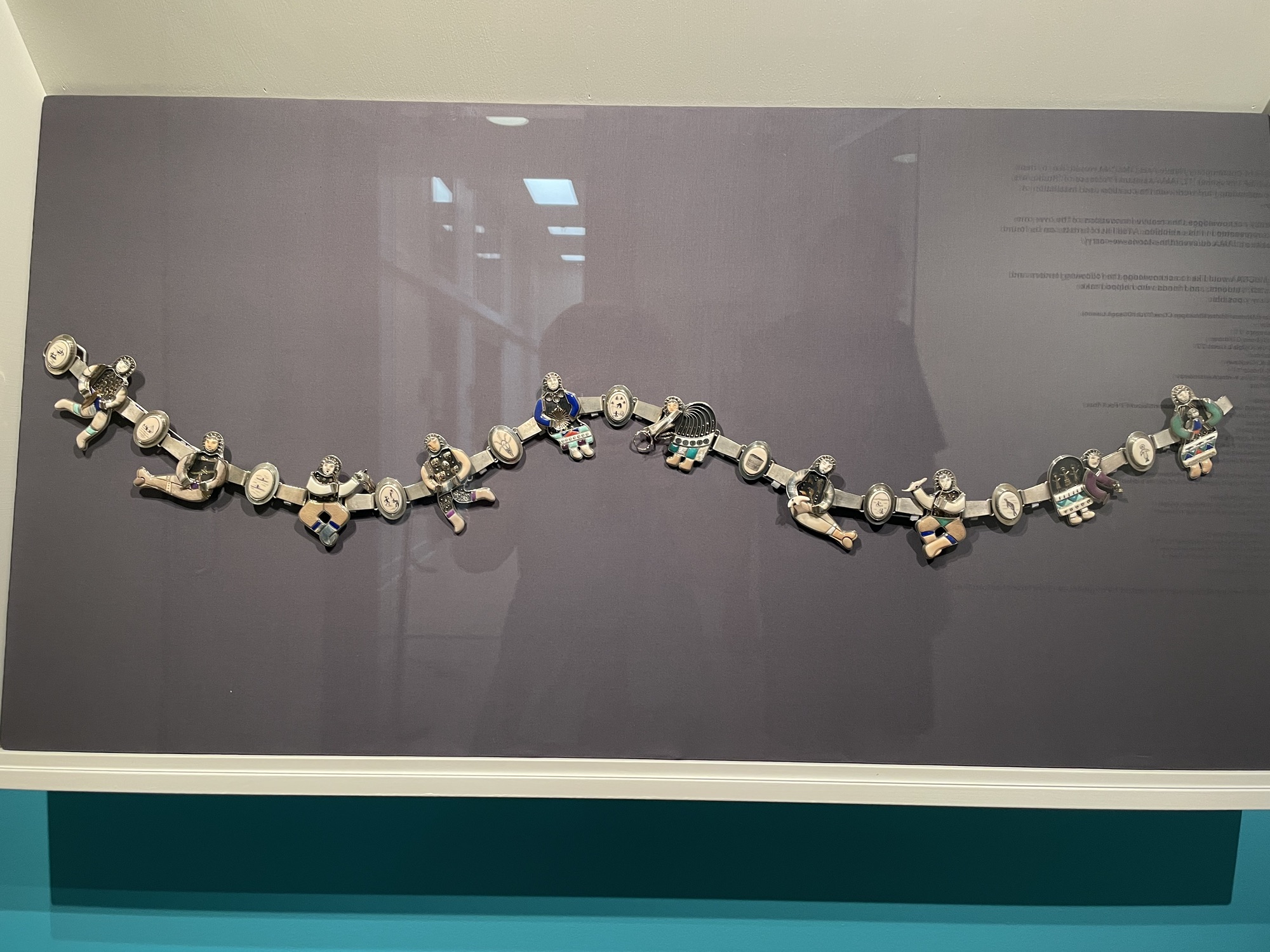
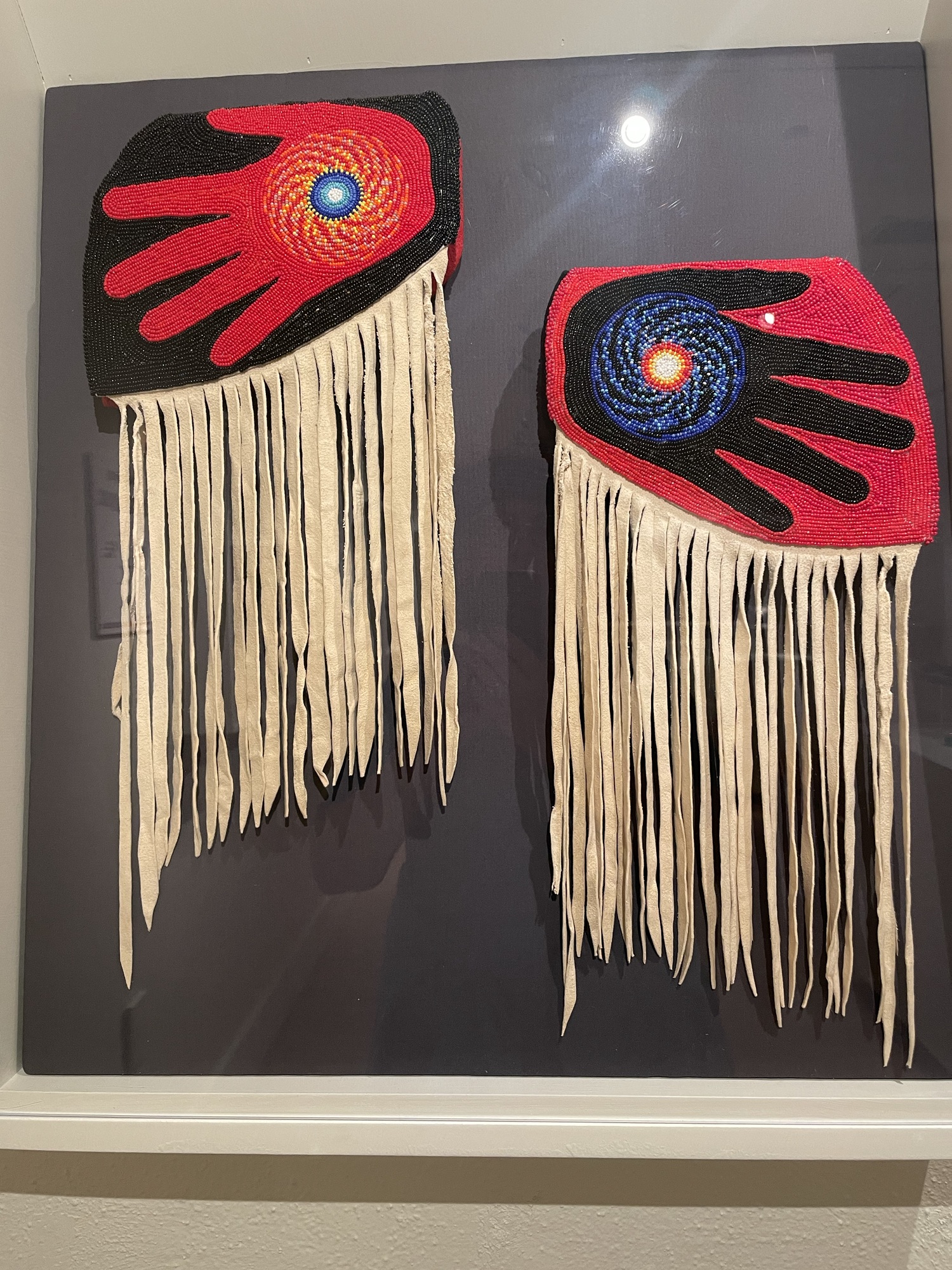
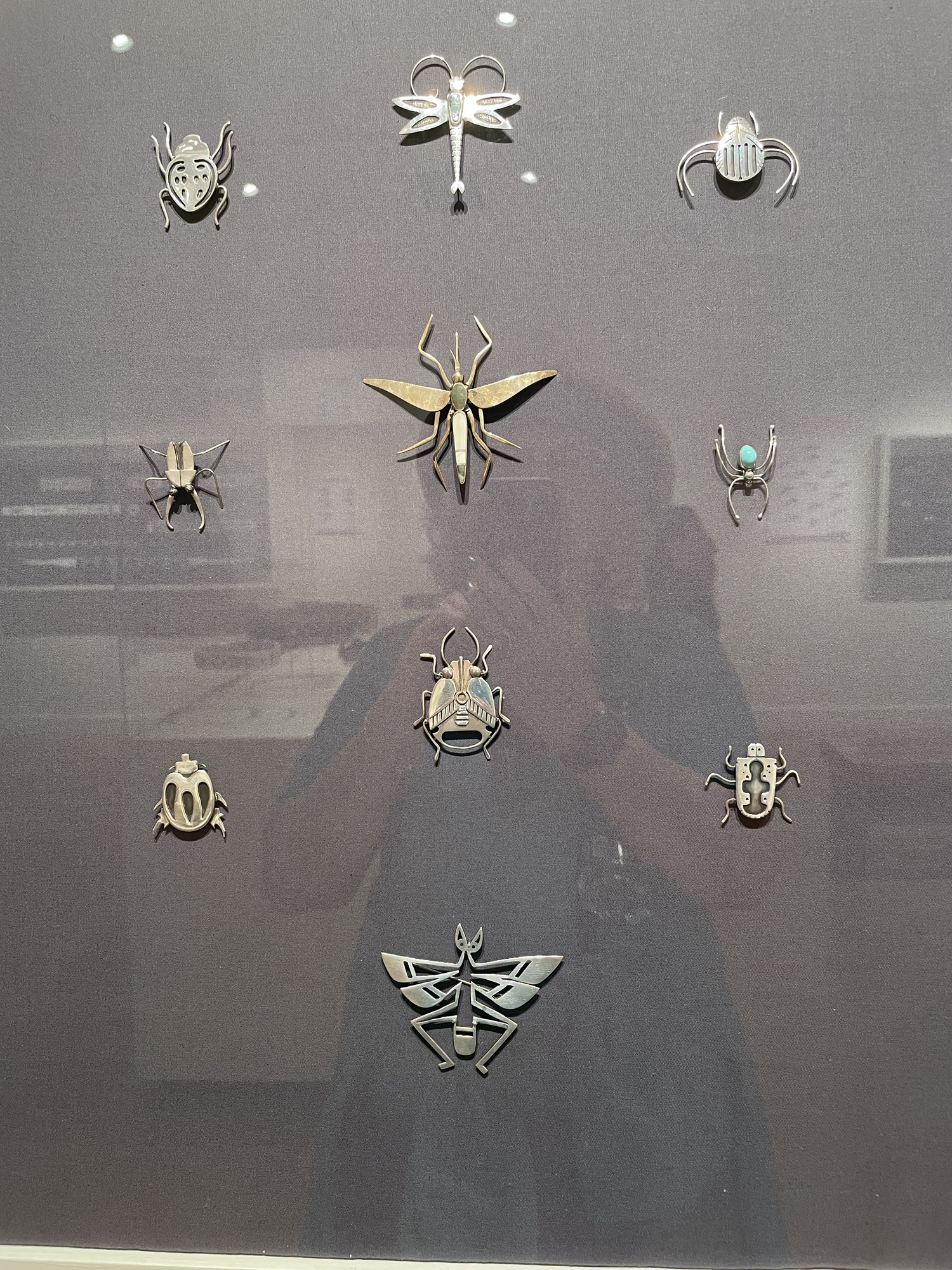
IAIA Museum of Contemporary Native Art: Near to the St. Francis Cathedral, this museum showcases the work presented by the Institute of American Indian Arts (IAIA). It displays the most progressive art. I loved the interpretations of traditional objects and the jewelry. There were some pins that looked like bugs that were stunning. I loved a silver belt made by Denise Wallace and beaded cuffs made by Marcus Amerman.
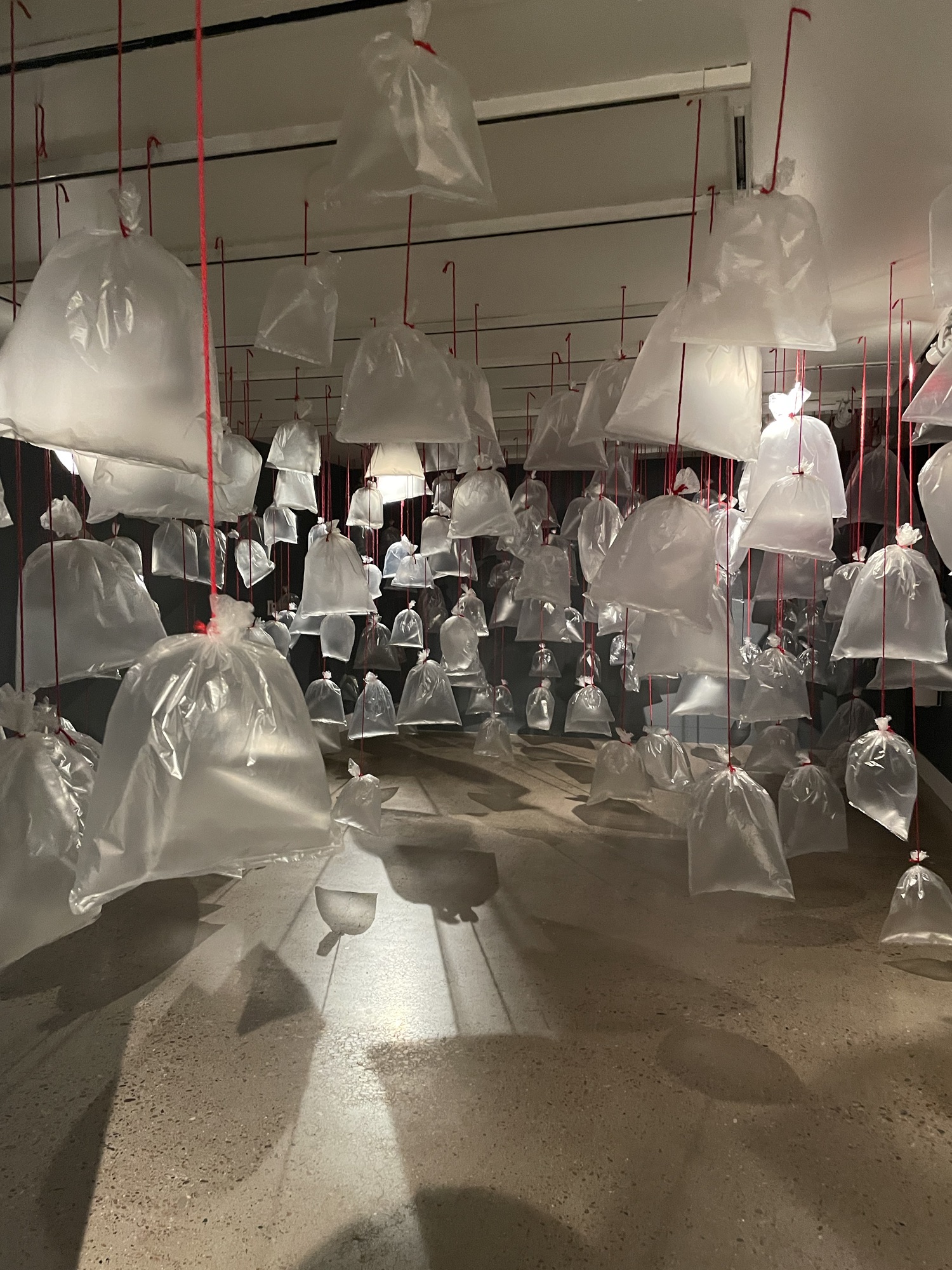
However the room filled with plastic bags, I viewed, I walked through the room and I tried to understand it. I just did not get that exhibit. But then it was about the artist being frustrated about the inability to communicate, so perhaps I did understand it. However, like anything else, art is subjective and there were many other exhibits in the museum I did enjoy.
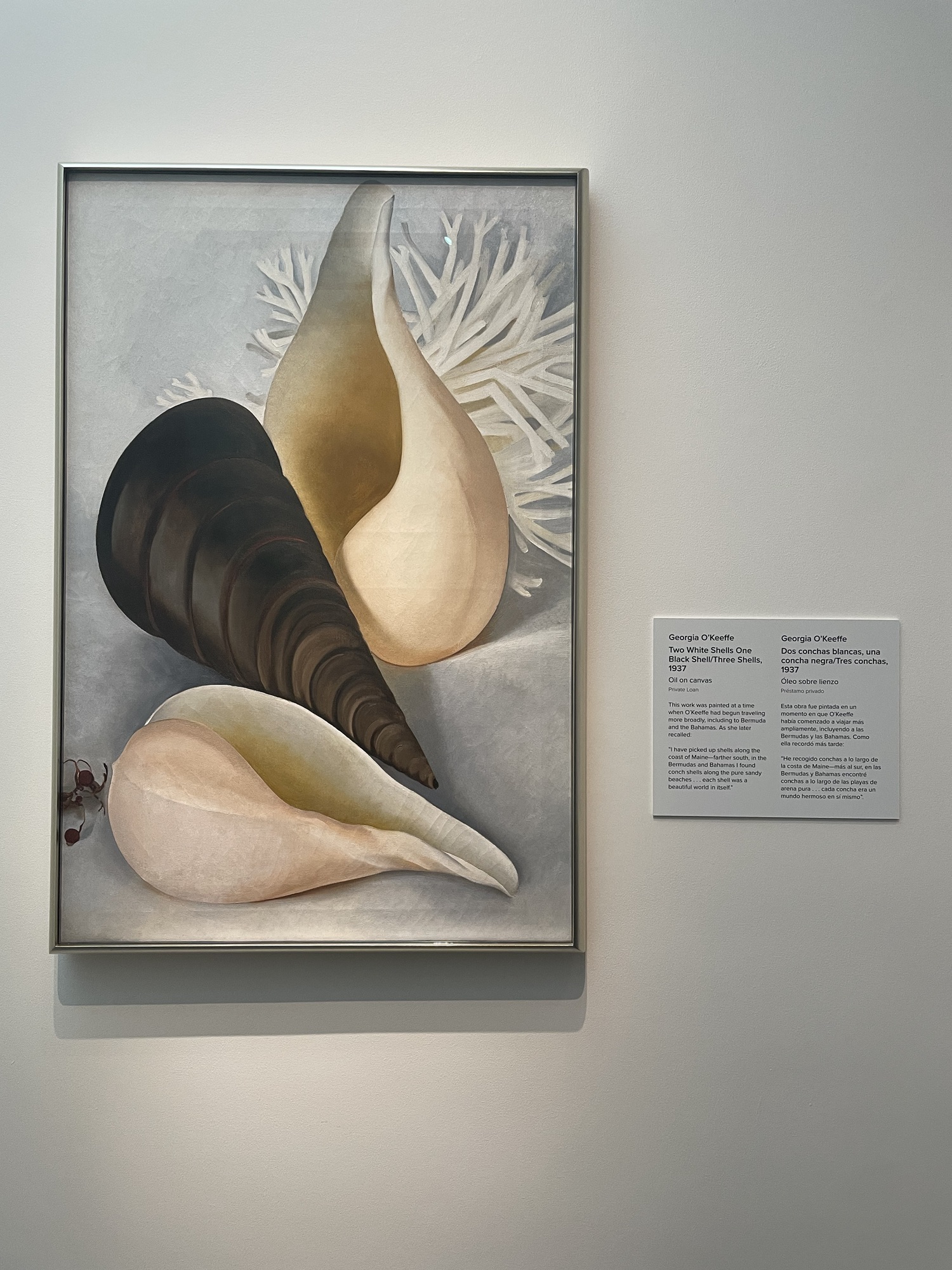
Georgia O’Keefe Museum: Just a few blocks from the Plaza, on Johnson Street, it is an easy walk. My instructions: Get your timed tickets in advance. This is a small museum, and they limit how many can be there at any one time!!! See the movie first! No one told us about the movie, so we did not see it until the end.
The museum goes in one direction, so you have to turn around and walk back through all the rooms when you finish, so you could do one side going and the other side going back. As for the art. If you enjoy Georgia O’Keefe’s work you will enjoy this museum. I actually liked the last room the most, where there was information about her life, “Making a Life” and her art supplies. I have to be honest, much of her later art did not appeal to me. But it is interesting to see.
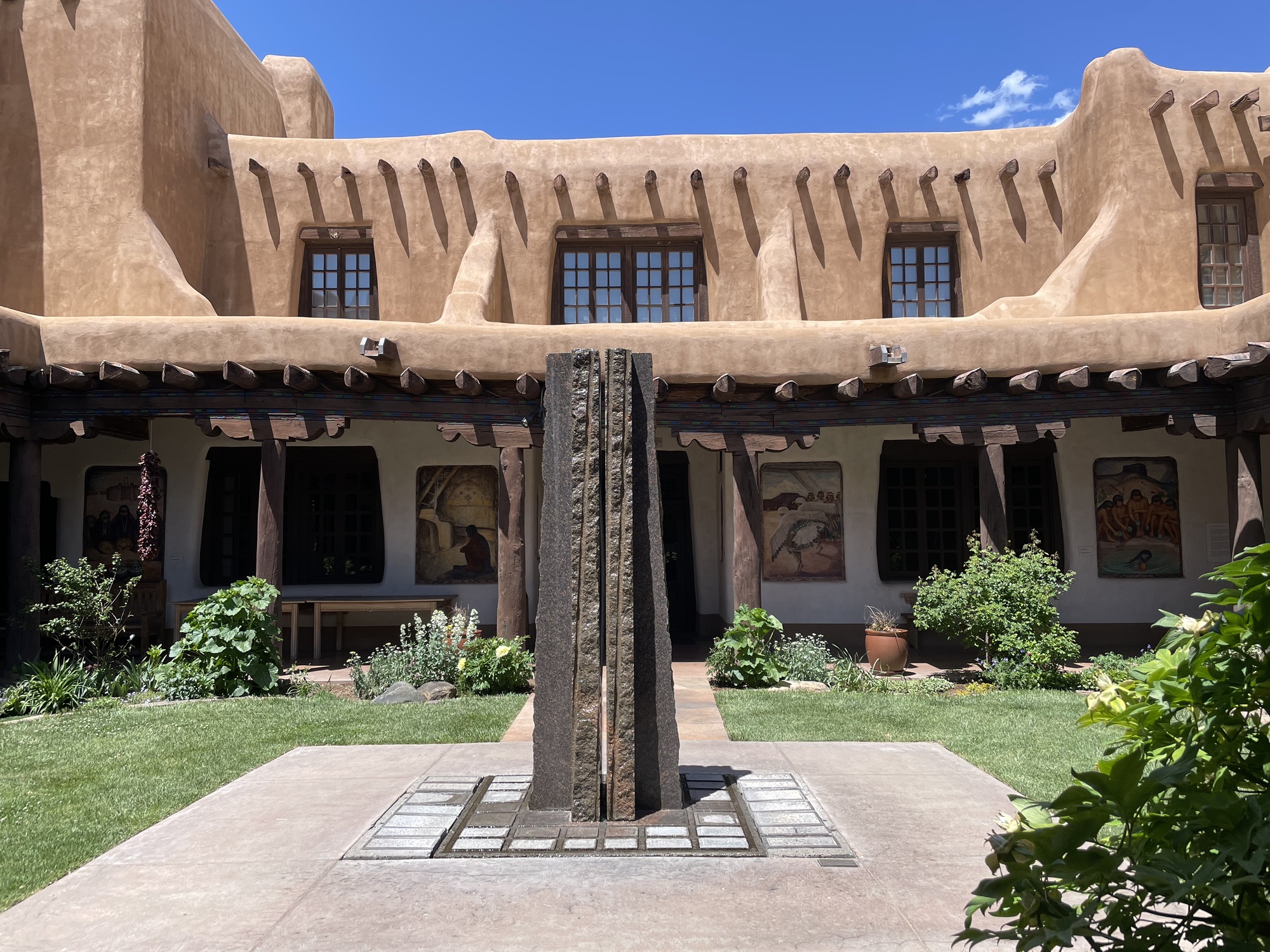
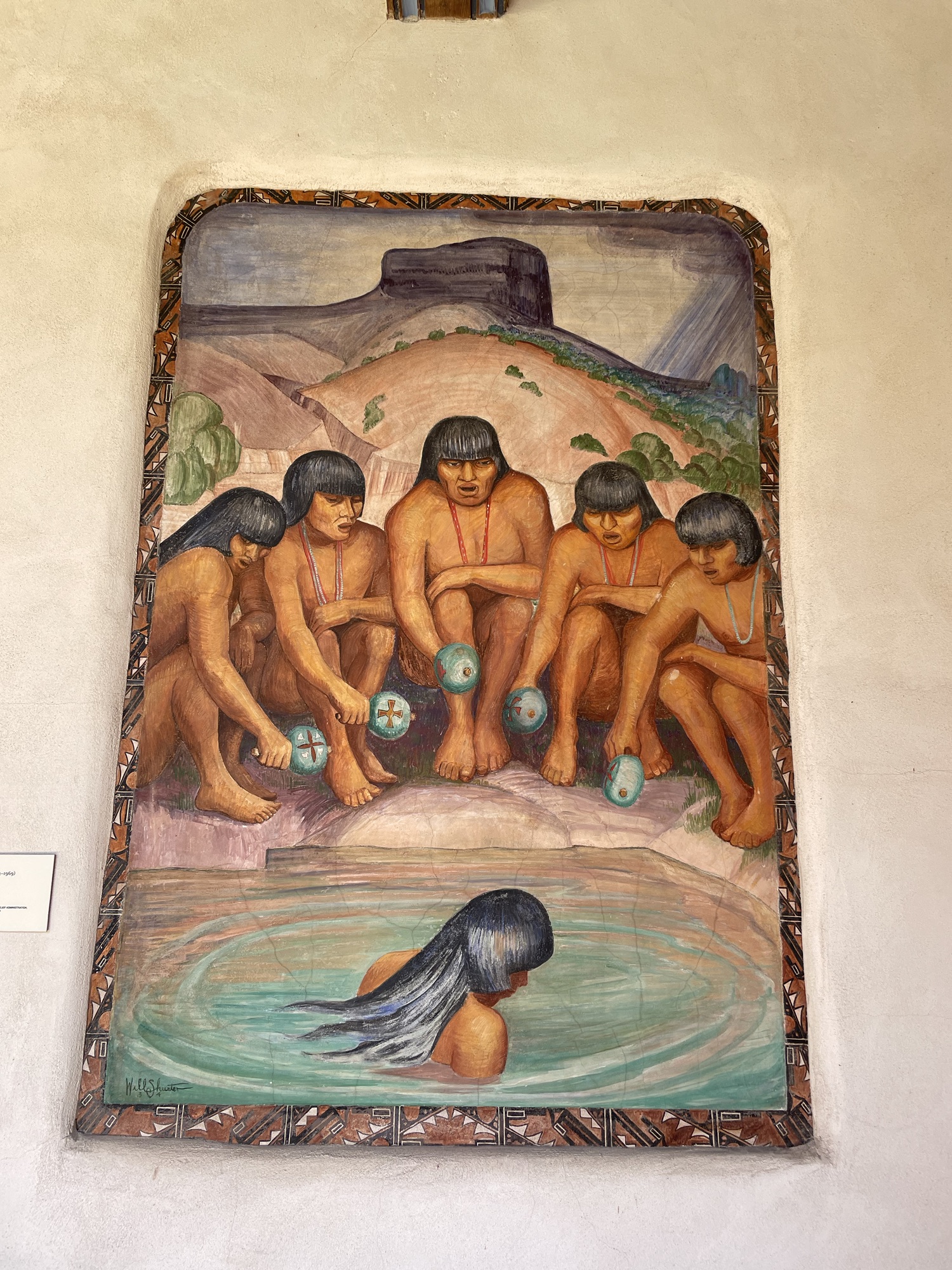
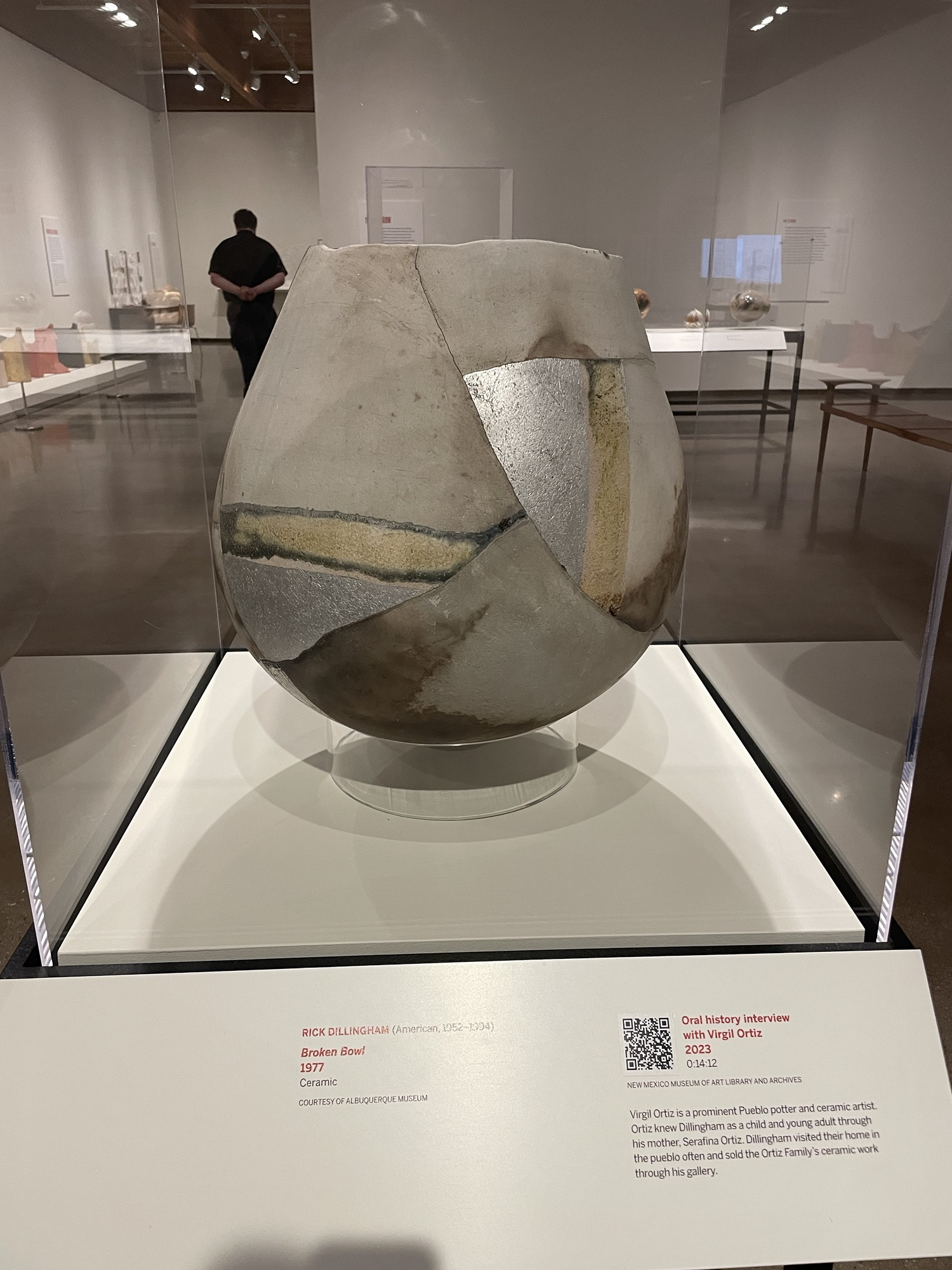
New Mexico Museum of Art: Situated catty corner from the Plaza on Palace Avenue,the museum building is set up like a hacienda. You can walk around the exhibits in a circuit, or you can cut through the courtyard. I loved the murals that decorated the courtyard. I am not a big fan of some modern art, and so these exhibits were not my favorite. However, I like to see what younger artists are doing, so I enjoyed seeing the interpretations of pottery design.
As the descendent of a Jewish family that was forced to leave Spain in 1492 or convert, I have always been interested in learning more about the Crypto-Jews/ Conversos of New Mexico. It was in the 1980’s when the information about this still hidden group first started to be revealed. It started when a Jewish man named Stanley Hordes because New Mexico’s State Historians, and people started coming to him to tell him their stories. To me it was absolutely amazing that 500 years after the Inquisition in Spain, that descendants were still hiding and still keeping this secret!
I had wanted to attend the Roads Scholar program: “New Mexico’s Conversos and Crypto-Jews in Santa Fe” since 2019. Covid interrupted my plans. But finally we were able to attend. My family were also once impacted by the Inquisition and Spain’s quest to either convert or eliminate all Jews. My family chose to move to Portugal and then to Holland. Our story is written in an earlier blog. (See below.)
We had lectures from the authors of the top two books.
Our first speaker was Professor Ron Duncan Hart, who gave us an overview of the history of the Jews journey to New Mexico. He wrote, “Crypto-Jews, The Long Journey.” Jews were in Spain were given a choice, convert or leave. Many stayed, they could not afford to go or they thought it would not last long and they would just hide their Jewishness, some decided they really would become Catholic. But all were doubted because they were not “pure of blood, “meaning they were not just Spanish, they were tainted by either having Jewish or Moslem descent. Those converted in name only and still practiced their religion in secret, known as Crypto-Jews…hidden Jews. Those who were forcibly converted and known as anusim also secretly practiced Judaism.
In fact, so many of the Portuguese who came over to Mexico in the 1600s were of Crypto-Jewish ancestry, that calling someone Portuguese was just another way to say he/she was Jewish. Since my family went from Spain to Portugal, I began to wonder if some of my family made this arduous journey to escape the Inquisition. To be allowed to go to the New World, you had to show that you were purely Spanish, not tainted with Jewish or Muslim blood. Horrifying! People actually had their genealogy redone to eliminate their Jewish past to fit the needed requirement.
The Crypto-Jews of today still live in the mountains in northern New Mexico. They still keep their secret. In fact, one of our speakers, when asked how many crypto Jews there actually was, basically said, “We do not know. They keep hidden. They do not talk about it. They know who the other families in their community are like them. But it is not discussed”
We heard from two women who have reclaimed their Jewish identity. They were each the child in the home who a parent said “Somos Jodios,” “We are Jews.” Maria Apodaca told us how difficult it was to come out of hiding and join a congregation and have a ceremony of return. How family members were not always happy about what they had done. Many feel, with the way the world is now, it is better to stay hidden!
Isabelle Medina Sandoval wrote a novel based on her family’s history: “Guardians of Hidden Traditions.” She can trace her ancestry back to Portugal and was able to claim Portuguese citizenship based on her family history. But she also said that coming out of hiding is a difficult process. A poet, she has written poems about the Crypt-Jewish experience.
From these two women we learned some of the cultural/religious/cuisine that continues from their Jewish ancestry, like lighting candles on Friday night, covering mirrors when someone dies, making a fried treat at the winter holidays, cleaning the house on Friday. It is amazing to me that these traditions continue.
Schelly Talalay Dardashti, spoke about: “The New World: Jewish Ehtnicity, DNA& Genetics.“ Schelly is the founder of Tracing the Tribe – Jewish Genealogy on FB. She explained the difference in the different DNA tests and how some do not look for Sephardic DNA, only Ashkanazi. We were told that between 20-40 percent of people in New Mexico had some Jewish ancestors. That there are genetic links between those living in northern New Mexico and isolated areas in Central/South America. People who were also trying to hide away from the Inquisition. And the final link, a rather sad one, the fact that the BRCA1 mutation that causes brest cancer in Jewish women, is also found in the Hispanic population in Mexico and New Mexico and came from those original converso/crypto Jewish arrivals from Spain in the early 1500s. Wow.
We attended a performance of “Parted Waters,” a play written by Robert F. Benjamin about the Crypto Jewish community. It tells the story of three generations of a crypto Jewish family. The grandfather, a crypto Jew; his son, who knows the background, but identifies with his life as a Catholic and does not want to talk about it; and his son, who has never been told about his ancestry. When the grandson makes a racist comment to a Jewish woman, the truth comes out along with the ramifications. It pulled together all that we had learned over the week.
Our last lecturer, Chris Herbst spoke about Outliers/Ousiders and Religion.” He provided us some history about the area of northern New Mexico and more explanations about the genetic composition of the populations today in Spain and in New Mexico. He said about 1/3 of the population of Spain today has either Jewish or Moorish ancestry.
Throughout all of our talks we were referred back to the book written by Stanley Hordes, who wrote an indepth book about the Crypto Jews called, “To the End of the Earth.” The Spanish/Portuguese Crypto-Jews traveled to the End of the Earth, the mountains of New Mexico above Santa Fe, to escape the Inquisition. It is like reading a college dissertation, but it was fantastic in the depth of the research.
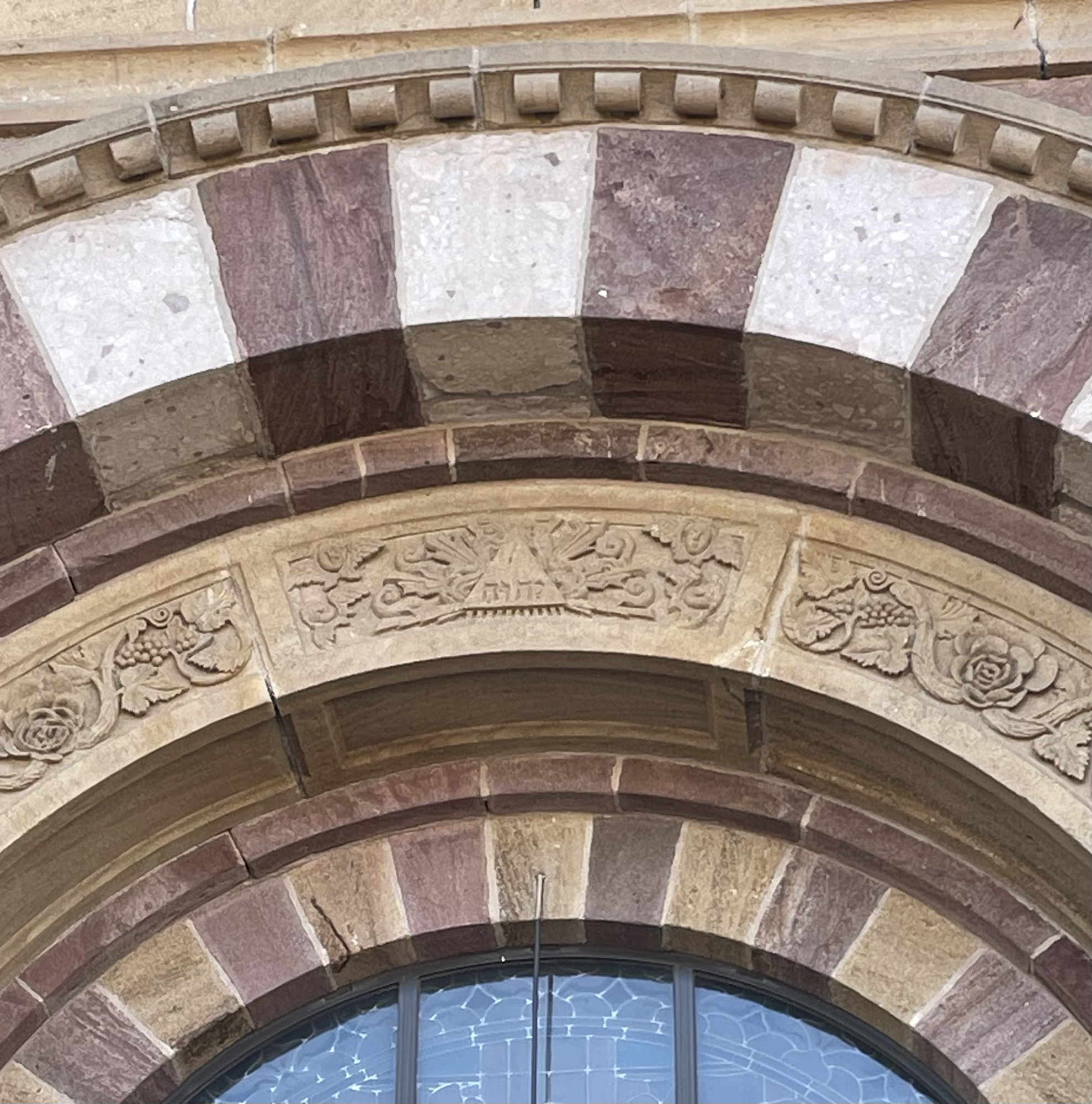
The Hebrew is in the triangle.
We did not spend all of our time learning, we also had time on our own to visit museums and explore Santa Fe. We went to the main cathedral of Santa Fe, where over the mantal of the front door, is an inscription in Hebrew and a Jewish Star on an internal wall.
As part of our Roads Scholar program we also ate at many different restaurants with the most delicious food, toured historic Santa Fe, with our wonderful leader, Vennetta, and went to Taos and the World Heritage Site of the Taos Pueblo.
This was just a wonderful learning experience, where we were able to learn, experience, make new friends and enjoy the true wonders of Santa Fe, New Mexico. If you have any interest in learning more about the Crypto-Jewsof New Mexico, Mexico and Spain, I highly recommend this Roads Scholar program.
I will write about the other places we visited in future blogs.
When I started my genealogy research, I did my research and wrote my blogs just for my siblings and immediate family. Over time, I included my cousins on my blog posts. And then it just snowballed. I realized that by posting them on Facebook, specifically on Tracing the Tribe group, I might connect with other more distant relatives. And it happened. I have had people help me with my research who are not related. I am in touch with distant cousins including Evan, who has been an immense help in making connections. I have met some of these cousins in person. And my understanding of my family increases with each new contact.
This blog is different. In this instance, I discovered that the information I had from speaking with my grandmother years ago helped solve the family mystery of a women who is actually my third cousin, our grandmother’s were first cousins.
It started with an email from Evan. (He really does a great job keeping in touch with all the cousins) He connected me with a distant cousin named Sherry, the granddaughter of a woman named Esther who was born about 1897/1898. He said she was part of my branch of the family and thought I could help. I could.
A number of years ago, I wrote a blog about my grandmother entitled “Too Many Esthers” (see blog below) and “Updated Esther “(see blog below). My Grandma Esther was one of 5 or 6 first cousins all named for their maternal grandmother, all named Esther, all born around the same time. All were given nicknames. My grandmother was known as Curly Esther.
Sherry wrote back to Evan and me: (She has given me permission to write this blog, I have edited her emails for privacy and brevity.). “Thank you for contacting me! I had trouble with my grandmother, and who her parents truly were. There were so many unanswered questions and there are no living family members in my close family that know anything more than I do. I got pretty frustrated and sort of put it on the back burner. I would be really interested in what you found out!”
I immediately responded: “It’s nice to be reconnected. I am the granddaughter of another Esther born in 1898. I have been researching the family for years. In late 1970s I sat down with my Grandma and got the names of all of her mother’s siblings. The children of Elka/Esther Lew and Victor/Avigdor Wolf. Here are two of my blogs that will lead back to some of my research and introduce you to the family. The attached photo is our great great grandparents Esther and Victor Wolf(f).
Actually, I knew immediately who her grandmother had to be, which is why I sent her the blogs about the Esthers. There was one cousin known as Meshugannah Esther. Her mother Chamka came to the USA pregnant with three children. Her husband had passed away before she came. After their daughter, Esther, was born and weaned, she was given to a different sister, Sarah, who could not have children, to raise as her own. To make things more confusing, Chamka was known as Anna in the USA, but her Hebrew name was Nechama. Her family called her only Chamka/Chamky.
I must say I was truly happy to receive a reply from Sherry. Her response filled me with joy to know that my research and pictures helped her. Here is an edited version of her response.
“Wow! I am so overwhelmed and thrilled with this connection. I was getting so frustrated with trying to figure out my grandmother’s story and had no one to ask.
I did hear that “grandma didn’t find out until the day she was engaged that her aunt was her mother and her mother was her aunt”. So I knew that there was information that I was missing in order to fill in the blanks.
“Meshuganah Esther moved in with my family when I was 10 years old. We lived next door to Aunt Lenore and her family. Grandma was married 5 times! She felt she needed to do that in order for her to care for her children. My grandmother passed in June of 1993.
“Ellen, you spoke of the cousins’ club meetings. I remember them although I think I spent most of the time hiding behind my mother’s skirt…
“I actually gasped out loud when I opened the picture of Esther and Victor Wolf. I have that picture and I had no idea who they were.
Thank you, dear cousins. This is a gift.”
My initial response to this was just as excited. I was elated that I could help.
“I am so glad that you were able to make connections about the family through my blogs. I am so glad that you have that photo as well, and now know who it is. It is amazing to have photos of great grandparents, but great great grandparents is really special.
“Did you see the picture of Chamka and Lenore? I am not sure which blog it is in.
I can understand a bit why she wasn’t told which sister was her mother. But I am sure it was a big shock at the time. It was one of those open secrets that everyone knows but does not discuss.”
Since she did not have nor seen the photo of her great grandmother Chamka with her granddaughter Lenore, I sent her the photo and the information that was written on the back. “Tante Chamky and Lenore. Lenore was Meshuggana Esther’s daughter. Esther was raised by Tante Sarah, but was really Chamky’s daughter.”
I am currently looking for the photo so I can send her it for her family records.
Thanks to Tracing the Tribe, over the years, I have connected with a number of cousins. But this connection honestly made me immensely happy.
In Ashkenazi Jewish custom we name our children for those beloved family members who have passed away. I was always told that I was named after three of my great grandmothers:
Chava was for my maternal grandfather’s mother, Chava, who was murdered in the Shoah.
Sara was for my maternal grandmother’s mother Sara/Sura, who died in the 1920s in Poland, and for my paternal grandfather’s mother as her name was Sarah as well.
I knew about my two maternal great grandmothers, because there were family stories about them. But I knew nothing about my paternal great grandmother even though she lived in the United States and is buried in New York. I have recently realized there is more to the story about her and my name.
I have been searching for information about my paternal great grandmother for years. The first real clue was when we first saw a photo of her about five years ago. We did not even know we had one! But my first cousin was searching through her family’s old photos and discovered one of her with my uncle. (See blog below.)
More information followed when my distant cousin, Evan, who is a great researcher, found my grandparent’s marriage license. They were married in January of 1923. It contained my great grandmother’s maiden name which we never knew: Ritt.
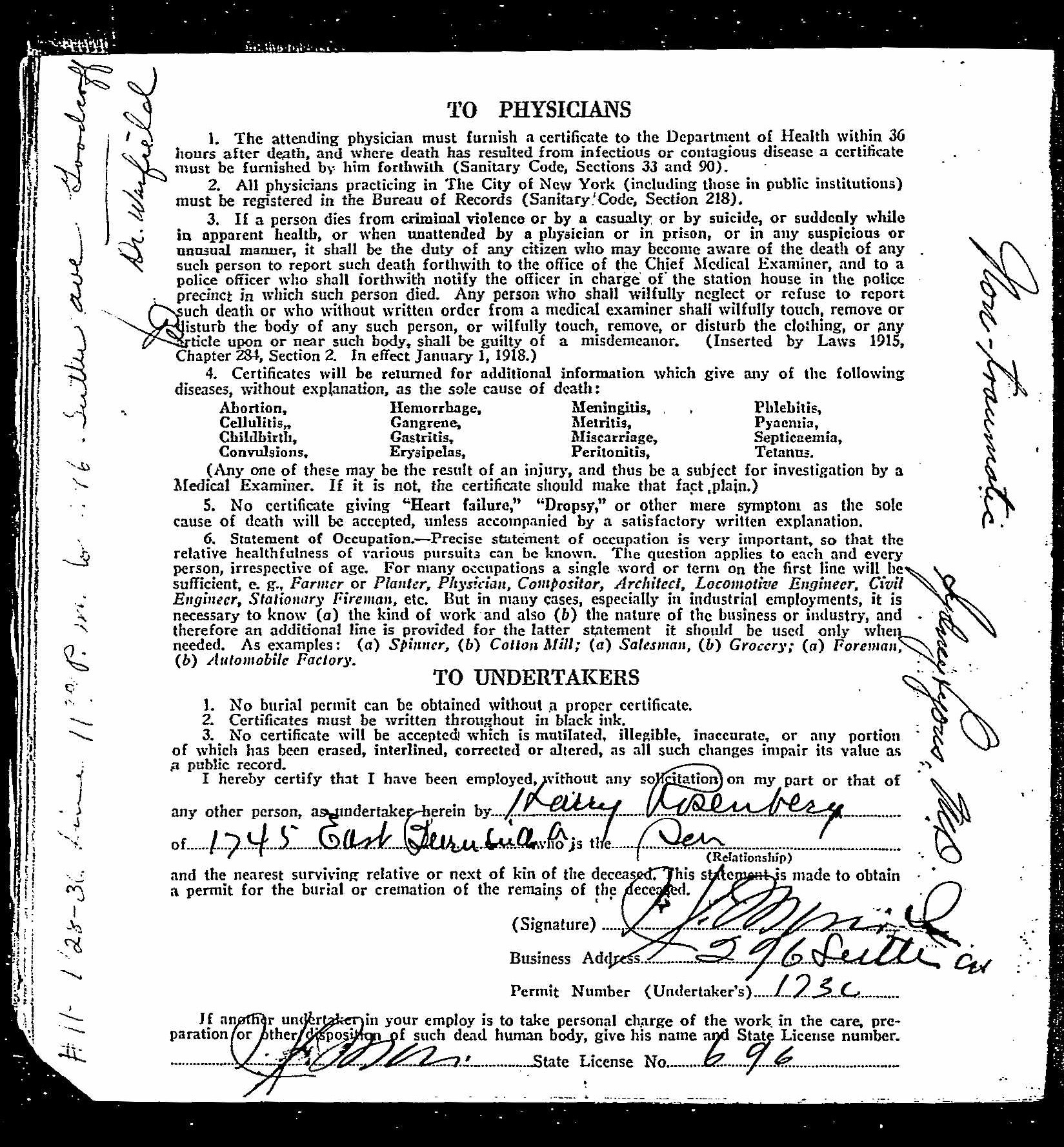
Evan also found a puzzle piece for me when he found her death certificate, which was packed with information. The final link was when Beth David Cemetery in Elmont, New York, where she was buried on January 29, 1938, sent me a photo of her matzevah (tombstone).
I now can tell my family more about my mysterious great grandmother, who I now know is named Chaya Sarah, so close to my own name of Chava Sara, that I think I was bound to have this name.
My great grandmother did not have an easy life. She gave birth to 11 children. Eight survived to adulthood. She lost her oldest daughter, Celia, to swine flu when she was in her 20s. Her oldest son, Samuel, was mentally ill and spent most of his adult life institutionalized. She and her husband, Abraham, were divorced in the 1930s. A very unusual occurrence for a Jewish woman, well for any woman, in that time period.
My Great Grandma Sarah died on January 28, 1938, from cancer of the panaceas at Jewish Hospital of Brooklyn, when she was 68 years old. My grandfather, then the oldest living child signed the death certificate and made the arrangements.
I have three thoughts about this information. First, the line through my grandfather is cancer free. But I have since learned that the line through his youngest sibling, Jacob, was not as kind. We all thought Jacob had disappeared after he moved to England when my dad was a child. But in fact he died when he was in his fifties from cancer, as did his son Rufus. The cancer gene followed them. (See blog below.)
Second, I think I know why I was named for her. She died in late January. Years later, I was born in late January. It made sense. Finally, I am currently close to her age when she died. And that touches me that I found out now.
I know that she was born about 1870, in France. That she and her parents lived in France surprised me. But her father and mother, Hirsh and Flora Ritt, were from Poland. So I think they were in transit from Poland to the USA when she was born. I have no proof, but it seems right. I also know that her father died before 1892 because my grandfather was named for him. Zvi Hirsh. I now know that she was about 22 when she had her third child, and her other children were toddlers when my grandfather was born.
She died when my Dad was just 9 years old. He really did not have many memories of her or information. But now we know her name and also the names of my great great grandparents: Chaya Sarah Ritt, the daughter of Hirsh Zvi and Flora Ritt. We now can add their memories to our family.
I want to thank the personnel of Beth David Cemetery. I now have photos of the graves of four of my great grandparents.
Of my paternal grandmother’s two brothers, I must admit I liked Uncle Sammy more. He was always jovial and happy. But he also had a bit of scandal attached to him. Whenever he was around or came to family events, my grandma would get a bit agitated, waiting for something to happen.
I know she was not great friends with his wife, who I always assumed was his second wife. I even wrote about her a previous blog. (See blog below.). But Uncle Sammy always had a smile. He was the youngest sibling and just seemed the most relaxed. Being around him made me happy. But then I also loved my great uncle Lenny, who taught me how to bet on the horses. (See blog below)
Uncle Sammy worked as a bus driver from the Port Authority in New York City. I actually remember one time waiting for a bus with my Mom at the Port Authority Bus Terminal, a giant bus hub in Manhattan, when I actually saw my great Uncle. It was such a surprise. He beeped his horn and stopped his bus for a moment and to say hello to us. I was so excited!
I vaguely remember that he eventually became a supervisor at the Port Authority. But, although I can find a docuent stating he was a bus driver, I have been unable tto confirm the promotion. When I ask my older cousins, they do not remember much about him at all. I might have been the only fascinated by him.
My Uncle Sammy died young, in his early 60s. I do not know the exact date, but I was probably 13 or 14. So around 1968 – 1969.
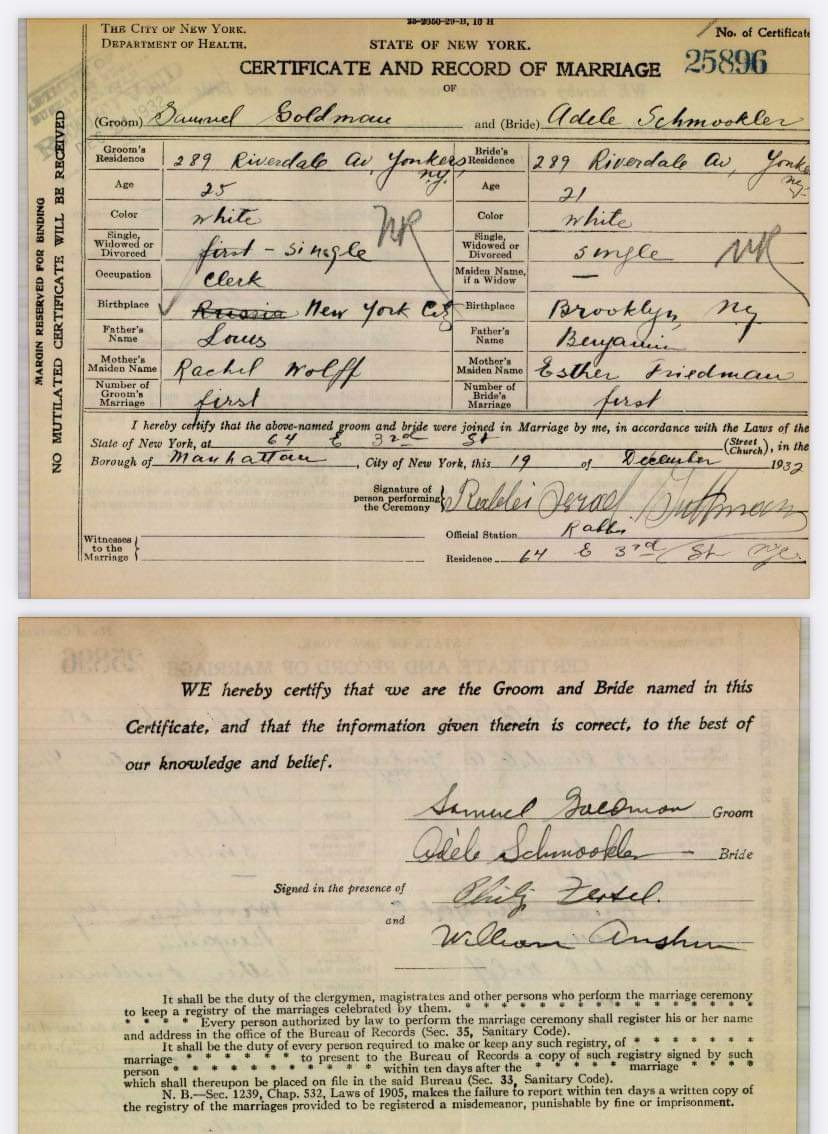
I knew he was married at least two times. He married his first wife, Adele, in 1932, when he was in his 20s. They had one daughter, Vesta. (Thanks to her unusual name, it is easy to find him!) I never knew Adele, although I did meet Vesta once or twice. She was 20 years older than me. When I knew Uncle Sammy, he was married to Sylvia, who I assumed was his second wife.
But my view of Uncle Sammy changed just a little while searching for my Grandmother’s young brother who died as a toddler. (See blog below.). While searching for Jacob, EW (my distant cousin and excellent researcher) found a startling fact about Uncle Sammy. It seems he had a third wife!!!
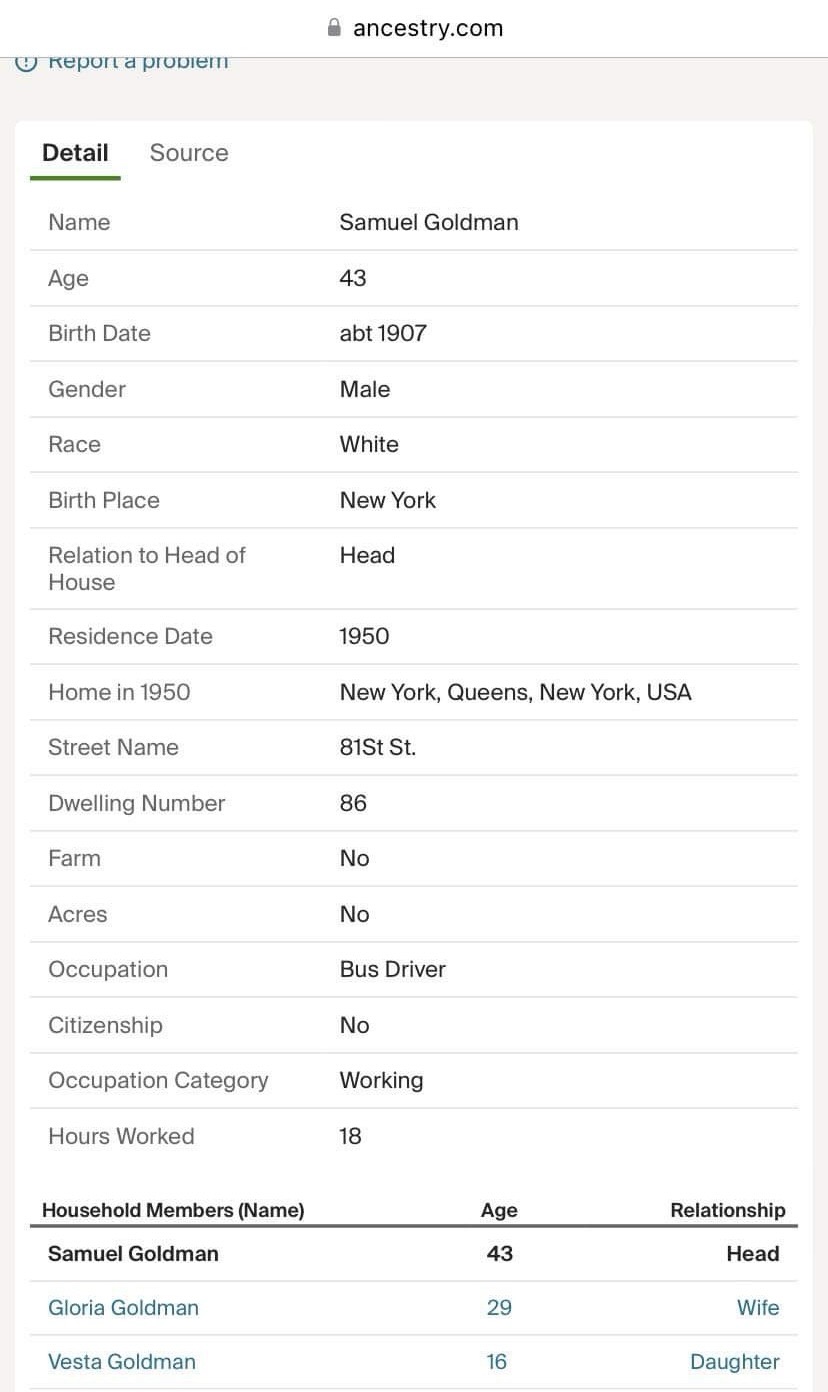
When he was 43 years old, in the 1950 census, he had a wife named Gloria who was 14 years younger, jsut 29. His then 16-year-old daughter was living with them. But this entry in the 1950 census is important because it confirms that he was a bus driver.
I have not been able to find any other documents about Uncle Sammy, not his death certificate or where he is buried. Although I do know that his widow Sylvia remained in Kew Gardens after he died. She stayed in touch with our family and came to family events.
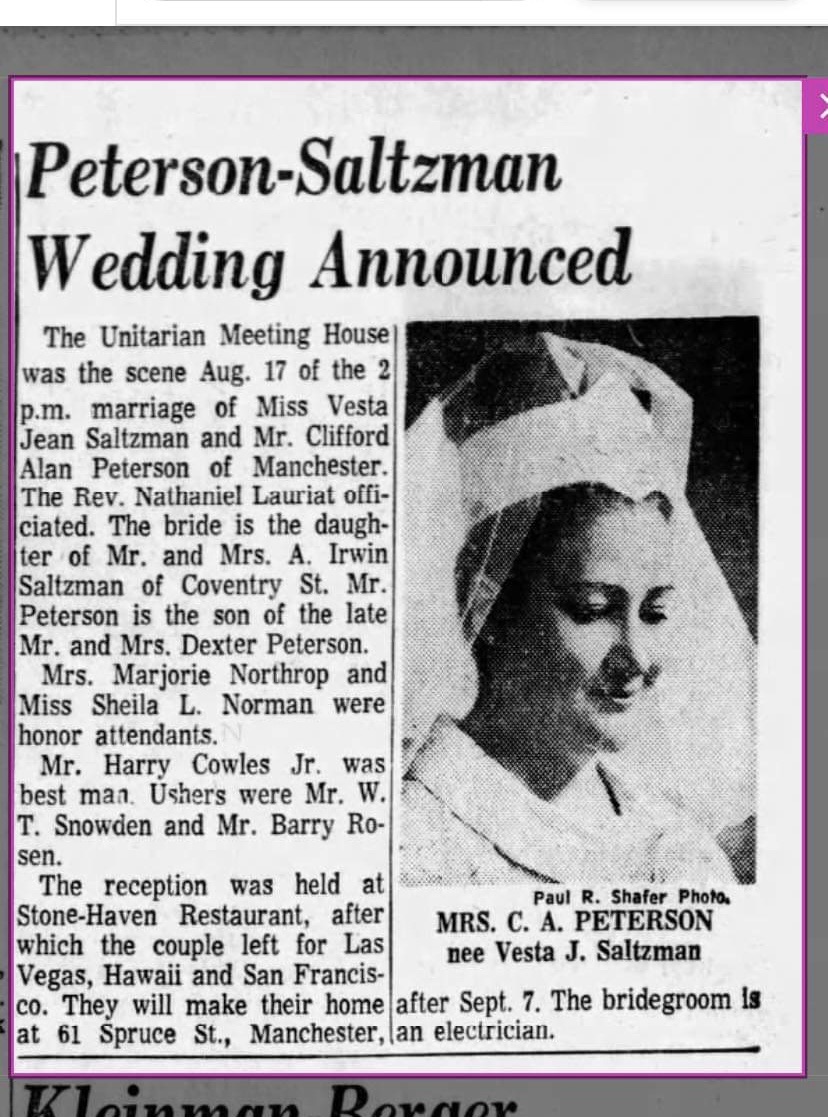
EW did find one more item for me. Uncle Sammy’s daughter, Vesta Jean got married in 1969. He told me that she is listed as Vesta Goldman on her marriage license But as you can see here, in the announcements she took her stepfather’s last name, Saltzman.
I think Uncle Sammy had passed away by then. Because I cannot imagine she would have written her dad out of her marriage if he was still alive. But I do not know for sure, as here it says that she was married by a Reverend. And marrying someone who was not Jewish might have been an issue, because I never knew that Vesta had married. And I do not think anyone in the Goldman family went to the wedding. As far as I know, Vesta and her husband Clifford, did not have children.
I hope I can one day find where Uncle Sammy is buried. With the name Samuel Goldman, he is difficult to find. There were many Samuel Goldmans in New York City. EW checked the Bialystoker lists, as other members of my family are listed there. But no luck. With this blog I hope to keep Uncle Sammy’s memory alive for our family.
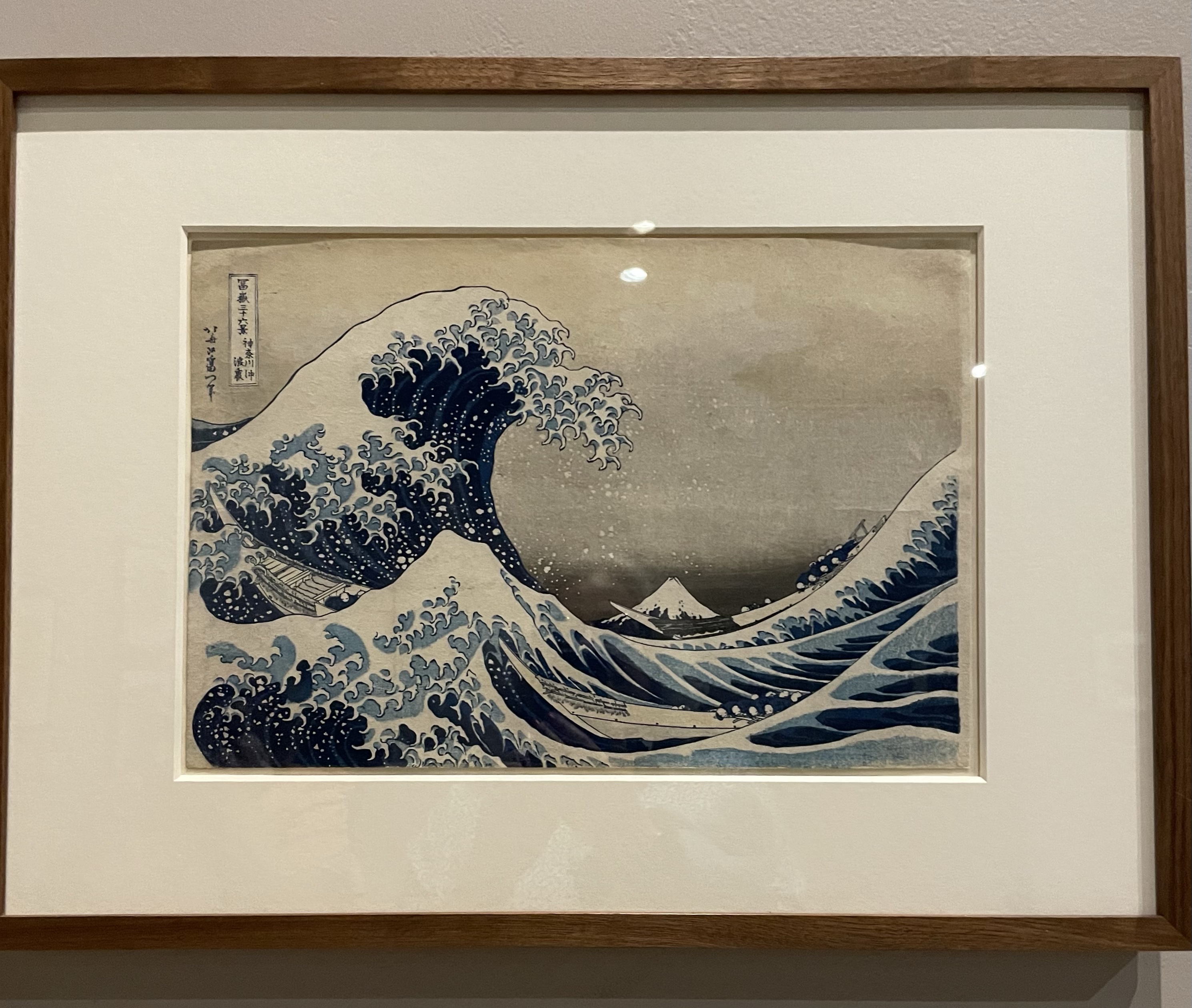
In November I was able to see Hokusai’s famous print, “The Great Wave” in person. As someone who has loved Japanese art since childhood, this was a special moment.
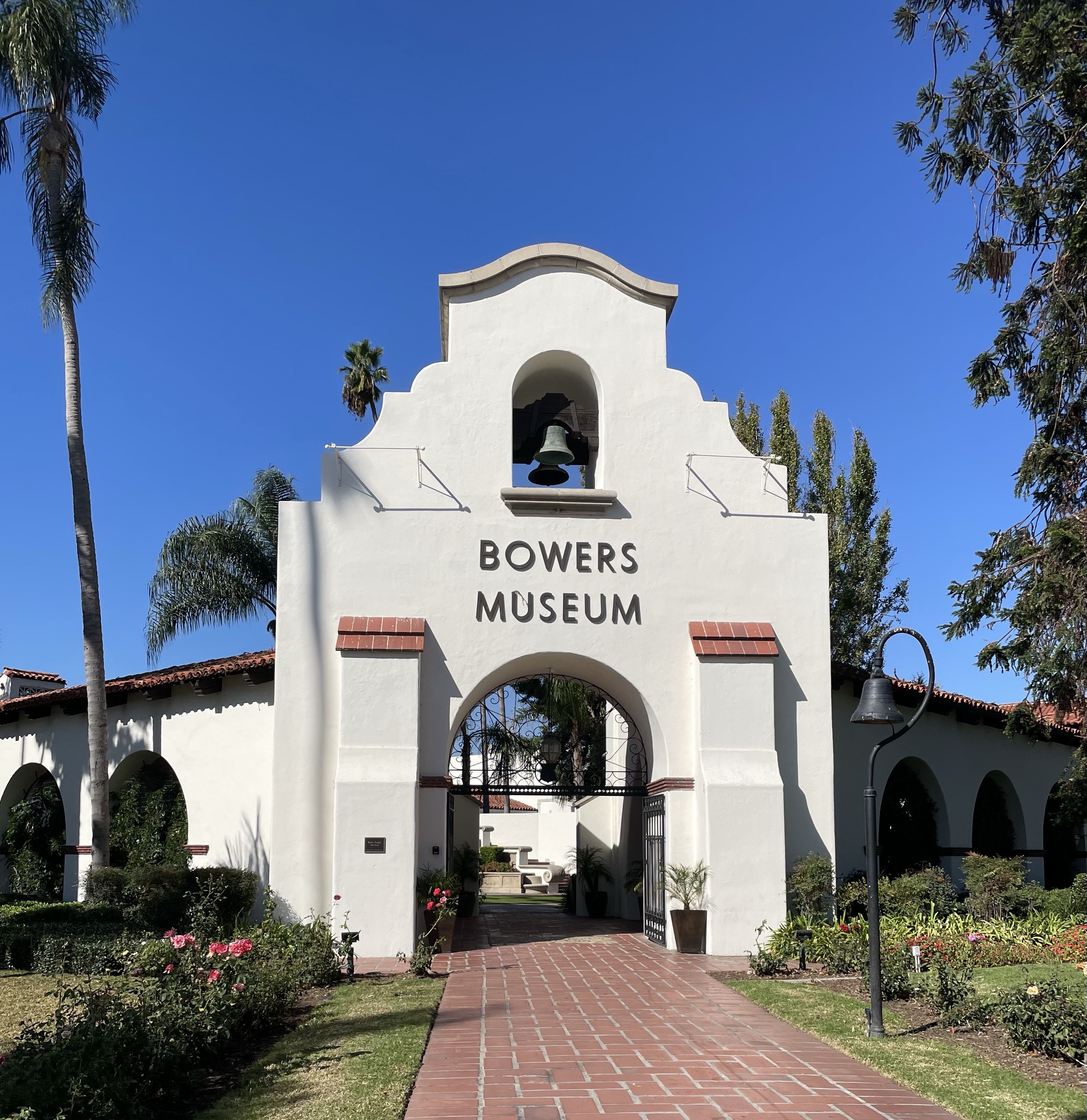
To be honest, I did not know I was going to see Hokusai’s work that day. My husband and I were in California for a meeting he was attendin. I had the day free for my own pursuits, so I spent the day with cousins. They recommended that we go to the Bowers Museum in Santa Ana, an plan that was wonderful to me, I love museums.
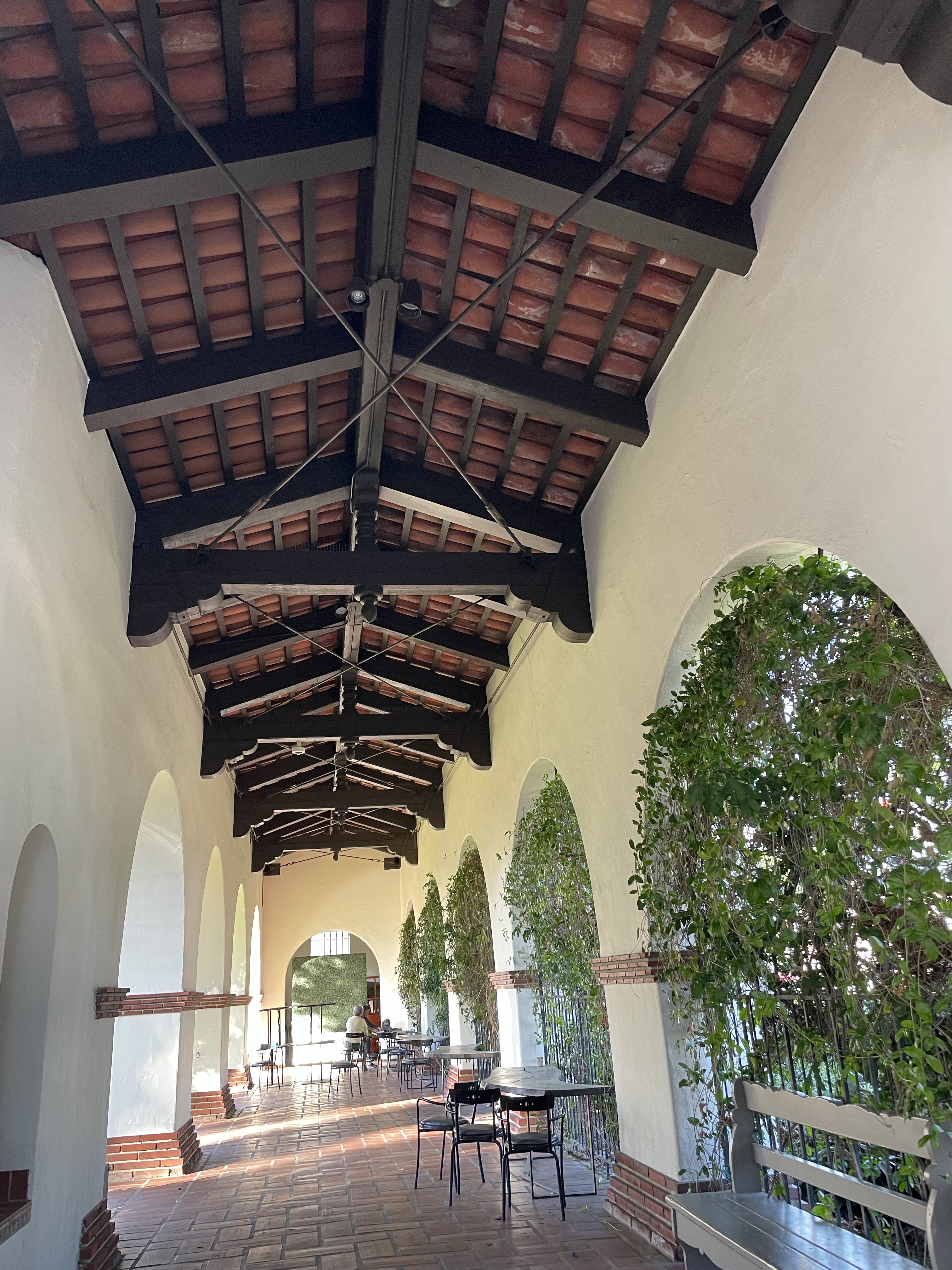
The main building is new, but it is attached to the original Spanish-style home that once belonged to the Bowers family. You enter the museum through a lovely Courtyard that leads you into the museum. Right at the front is the Tangata Restaurant where we ate lunch. Delicious. From the lovely entrance and delectable food, I knew this was going to be a great day.
I used to look at every single item in an exhibit, which would take me for hours. But now, on the advice of a friend’s daughter who was a museum curator, I find one or two items per exhibit and focus on them. So here are my favorites:
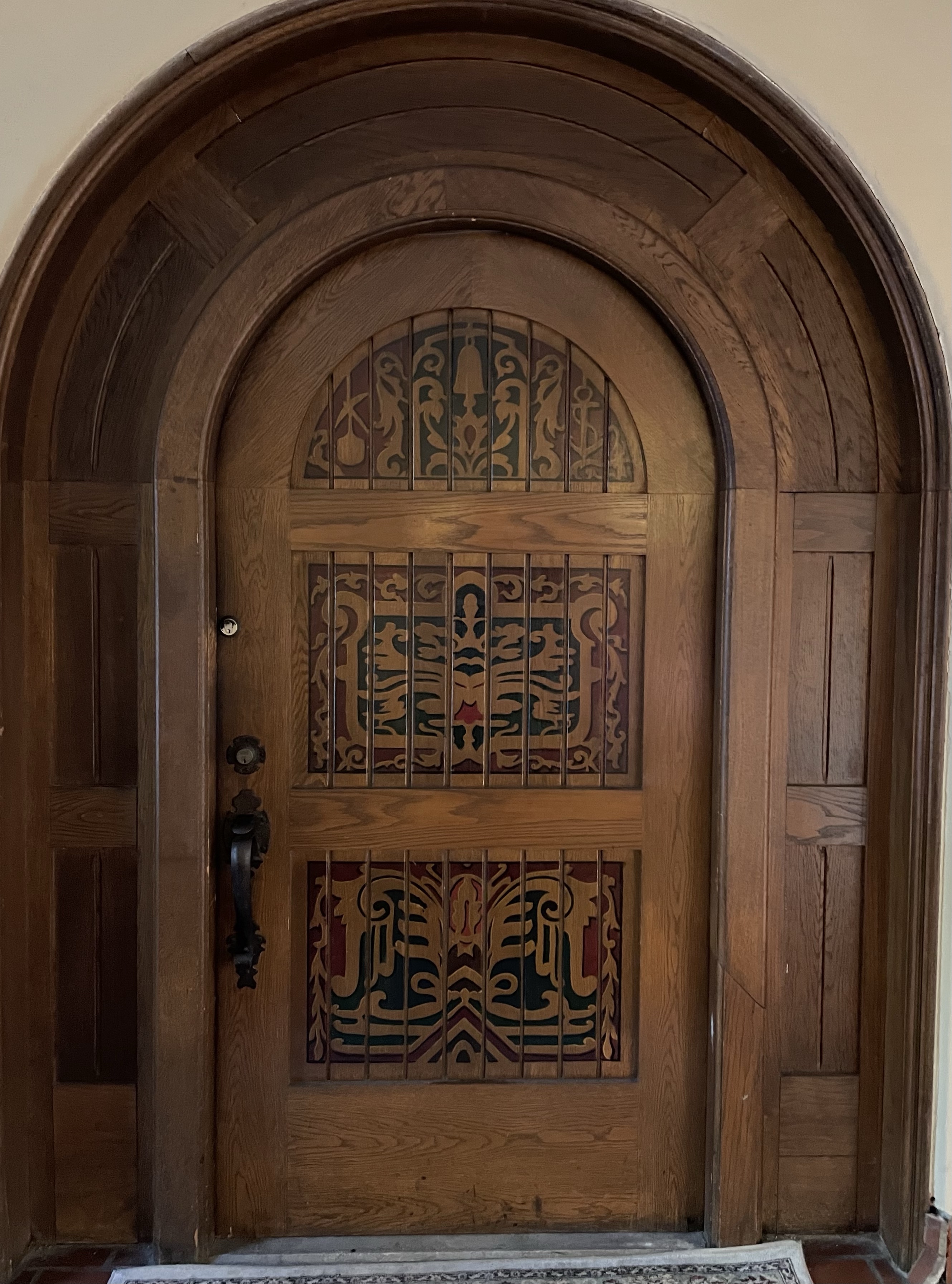
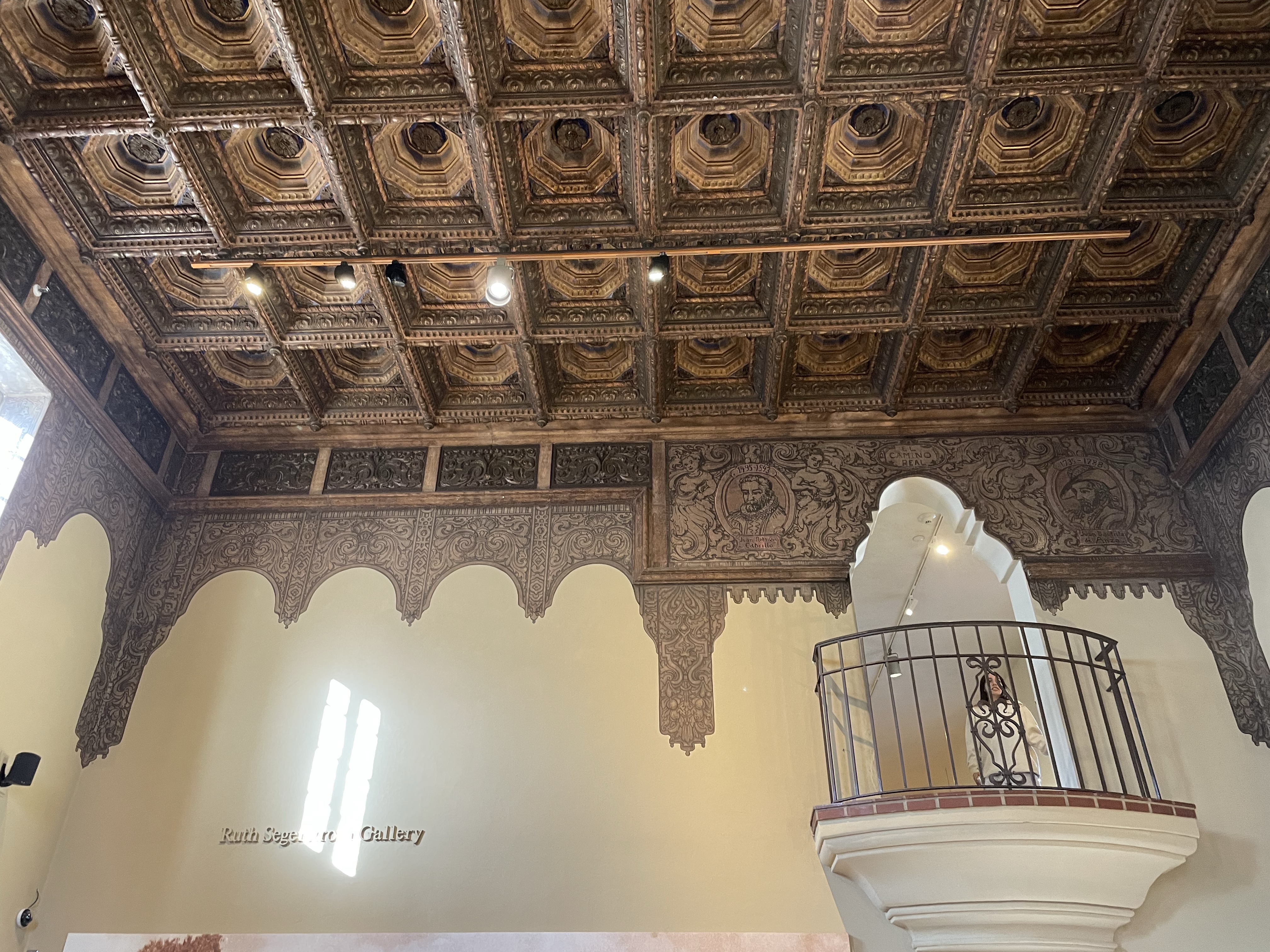
The original building is just stunning. The parts we could see, wood ceilings, carved doors, stone fireplaces, added to the atmosphere. In one room there was a display about some of the original settlers and members of the Bowers family featuring their possessions in the California Legacies exhibit.
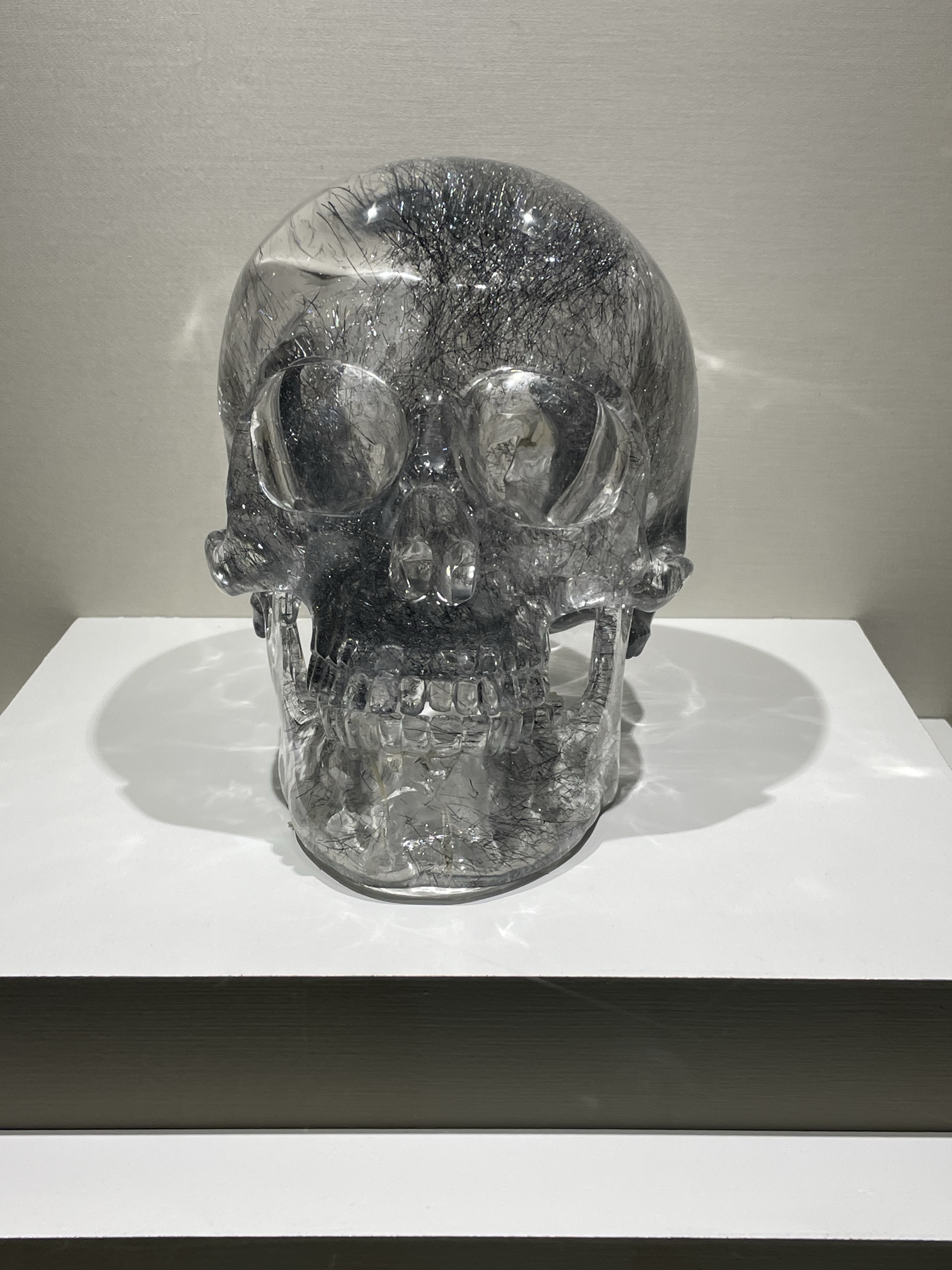
I enjoyed the exhibit, “Gemstone and Carvings.” The crystal skull made us all think of the Indian Jones movie. As for the native American art, my favorite display was the Women’s Basketry Hats that was in the First Californias exhibit. Woven by the Yurok, Hupa and Karok women, these hats caught my eye. I would actually wear one of them!
Finally, the special exhibit, “Beyond the Great Wave, Works by Hokusai from the British Museum.” It is only at the museum through January 7, 2024, so go soon. It is wonderful.
The exhibit follows Hokusai’s work throughout his life, leading up to the Great Wave and then beyond it. Seeing all these wonderful wood block prints, and the skill it would take to create them, was exciting. There is even a short video on how the wood blocks are made.
Seeing almost all the of prints from “36 Views of Mt. Fiji” and the one that has caught the attention of the world, I was surprised, honestly, about how small the prints were in size. In my mind they must be enormous. Instead they are all small enough to fit into a portfolio.
I enjoyed seeing the prints he made at different stages in his life. My favorites were the ones of scenes in Japan with people going about activities. They are extremely colorful. But I focused my camera on the Great Wave and two other prints from the series. I decided I liked these especially, because like the Great Wave, the main color was Prussian Blue, a color that I adore.
We did not have time to go to all of the exhibits in the museum. In reality you cannot see everything in a museum in one visit. But for those visiting the Santa Ana area, a visit to the Bowers Museum is worthwhile.
This is my diary over the last five weeks of the Israel – Hamas War. There are many more, but I think these do the best to explain my feelings. I already wrote a blog about thanking the helpers. You can see links to this and another blog below.
October 7. 7:30 am
Just spoke to my daughter. They spent hours in their safe room. They are ok. But stressed and distressed. Many Israelis have been killed, hundreds injured, and dozens taken captive. Hamas terrorists surprise attack on the southern areas and bombing of Jerusalem and Tel Aviv.
Hamas and Hezbollah are evil attacking civilians, women, children, Jews and Bedouin. They really don’t care who they kill. This was not an attack on a military area. This was attack on innocents at parties, at home at play.
October 12:
United just cancelled our flight to Israel. Not unexpected. But disappointing for several reasons. First, we do not get to see my daughter and son in law and all the other family and friends we planned to visit. Second because United is even afraid to fly a week from now which increases my anxiety by many multiplication of numeric factors.
In the spirit of the recent high holidays, I say: I am angry, I am anxious, I am not sleeping, I am saddened, I am frustrated, I am frightened. I keep thinking of Yom Kippur and how it is inscribed on who will die and how. And I have a scream that is sitting at the bottom of my throat waiting to come out.
October 18:
At this very moment, 8:39 am, I should be landing in Israel at 4:39 pm. Instead I am home in Kansas.
There is nothing else to say except love and prayers for all my family and friends in Israel who I was hoping to visit.
Family update. They are fine. There has only been one rocket a day for a while. My daughter is extremely busy with her work at CyberWell trying to stem the horrible flow of anti-Israel, anti-Semitic and violence toward Jews content off social media. They had a training for volunteers to help identify some of this. If you would be interested in watching the 50-minute webinar and do something productive. Let Lara or me know. I personally have reported posts to the social media platforms and also to CyberWell. This makes a big difference. If everyone one reported one or two a day we can make a change!!!
October 20
I am thankful that he is president during this difficult time. His support for Israel, his fight against baseless hatred is just what we needed. When I visit my elders, many of whom remember the late 1930s and 1940s and are terrified, I can honestly say this is not the same. The president of the USA and many others in government are supporting us.
October 21
My comment today: Do you think the bombing from Gaza has stopped because all you hear in the news is that Israel is attacking Gaza. Have you heard that rockets are still speeding to Tel Aviv, Yafo, Holon, and Rishon LeZion as well as to the south. Many rockets every day. Today my daughter’s alert told of of the incoming all around her community. It is not over. Hamas is still attacking Israel. There is a reason why Hamas has to be eradicated from the world.
Do I feel badly that children are being hurt. Of course. But I am tired of hearing now that Gaza is without water or electricity. Israel has said, return the hostages and we will turn it back on. Give them back.
I am tired of people saying Israel should step down. You are not under the threat of a bomb landing on your home, you are not attending funerals for people you know or family members, you are not sending you son, daughter, spouse, brother, sister off to battle.
The news media is not only focus on what Israel might do. Giving the impression that in Israel it is peaceful. NO it is NOT. Not on the truth about what is happening. Those who live around Gaza have been evacuated. Those who live in the north are on voluntary evacuation.
Stand up for Israel and the impact of this crisis on the citizens. If you want to be angry, be angry at Hamas for what they did murdering 1400 innocent people in their homes; for knowing that what they would do would impact the innocent people of Gaza; for preparing and protecting themselves from the bombing but not the civilians of Gaza. Be angry at the other Moslem countries surrounding the area that want to escalate the war, be angry at Egypt and Jordan and other countries that refuse to help ease the crisis in Gaza.
This war is not what Israel wanted. This is a war that Hamas started and Hamas wanted. Israel is a tiny country surrounded by large land masses inhabited by Moslems. They have all they and they could want. But what many do want is the total annihilating of Israel.
All over the world people are attacking Jewish people who have nothing to do with Israel. So the people who Chant “Not in my Name” are playing into the work of Hamas and so are also guilty for any more attacks on Jews. It is opening a door for more killing and it is wrong. What they should be saying is return the hostages and stop attacking Israel.
October 23
The false news reports about the hospital bombing which was a failed rocket by Hamas leads to violence against Jews world wide. It is amazing, Hamas attacks Israel and kills 1400 people and wounds over 3000. Sends over 6400 rockets and bombs into Israel and in the U.S. and throughout the world people attack Jews. Attack the terrorists who started this. I am horrified by the hatred.
November 3
I pray each day for the conflict in Israel/Gaza to end. For the Hamas to release the prisoners/hostages and to surrender and face the consequences of their crimes. Hamas has continued to threatened Jews and Israel throughout this month and has continued to send rockets into Israel. They have built tunnels under neighborhoods, hospitals and schools. They have threatened and attacked Israeli communities for decades!
I wish there was an easier way to stop the terrorists then this bombing and siege of Gaza City. But the Hamas has stockpiled rockets and weapons, as well as food, water, oil and other supplies. They prepared for this assault on Israel and the return assault on them without caring about any civilians.
During the attack on Israel, Hamas terrorists cut the supply lines that bring water and electricity from Israel to Gaza. Life means nothing to them until they destroy all Jewish life in Israel.
It is time for the terror of Hamas and Hezbollah to end. For all to face the fact that Israel exists and will not disappear. So that all people in the region can live in peace and coexist, so that children will not suffer and innocent people die on either side.
But the increased actions of Jew Hatred that is now growing throughout the world, actually shows the double standard with which Israel and the Jewish communities face. Israel did not start this. On a holiday weekend, when people were sleeping in their beds, Hamas attacked, murdered, mutilated, took captive and wounded almost 6000 people. Over 1400 dead, 240 captive, over 4000 wounded. those killed were mostly Jewish, but many were Moslem and Beduion. Now in the USA there a large numbers that did not condemn Hamas. That is shocking!
No one wants war. Not in Ukraine; Not in Syria; Not in Sudan; Not in Israel; Not in Gaza. Every life has value: Jew, Christian, Moslem, Bahai, Druze, Shinto, Buddist, Hindu, all religions, ethnicities and races.
Shalom, Saalam, Paz, Paix, Friedan, Pace, Peace!
November 4
This is the message I sent to the International Red Cross:
So far only 4 hostages taken by Hamas have been released. One of the main roles of the Red Cross is to help free hostages throughout the world. I have supported the Red Cross for many years. But the unequal and biased work going on now where the hostages, infants, children, women, men, elderly, are ignored because most of them are Jewish is an affront to all what the red cross is supposed to stand for. SHAME ON YOU! Tell Hamas to release the hostages.
We went to a Havdalah service at Leawood City Hall. After the service we each held the photo of a hostage and then stood in silence for 241 seconds in honor of those held hostage by Hamas.
November 13
A relative’s friend asked me if I at all thought Israel was wrong. Here is my response and it is what I believe.
Define wrong. Is it wrong for Hamas to have come into Israel and murder innocents children, women, men, elderly in their homes on a holiday weekend? Is it wrong for Hamas to build their tunnels and shoot rockets off from hospitals and schools using the children and the sick as shields against others? IS it wrong for Hamas to take the funding and cement and fuel sent into Gaza for the people to continue to create and buy weapons and tunnels to attack Israel? Is it wrong for Hamas to keep the people of Gaza captive for years, because you should know that Israel left the Gaze over 15 years ago and withdrew all their people and turn everything over to the Palestinians who voted to put Hamas in power? Is is wrong that Egypt also has a border with Gaza, but they usually keep their border closed and supply little to no help to the people there? Is it wrong that the surrounding Arab countries have kept the people who fled Israel in refugee camps and refused to intergrate them into society, while forcing out an equal number of Jewish citizens who were integrated into Israel, the USA and other countries? Just asking you how you define wrong.
Israel told people to evacuate, Hamas would not let them. ISrael waited over a week to attack so that people could leave. Israel gave fuel. For weeks we have heard that the hospitals would run out of fuel, they did not. Israel repeatedly told the hospital to evacuate. They did not. They have caved to Hamas demands.
You believe everything Hamas says, even though throughout the world they know they are terrorist. The 27 EU countries have condemned Hamas and supported Israel.
So define who is wrong here. To me it is Hamas. ISreal had no intention of going to war on Hamas till Hamas killed and mutilated over 1200 people. And took 240 hostages. What happened after October 7 is on the hands of Hamas.
This would end if Hamas released the hostages and surrender. Why don’t you call for that instead of condemning Israel?


























 zicharonot