Archive | Travel RSS feed for this section

Canyon De Chelly, The Most Lovely Grand Canyon

18 Mar

Visiting Canyons seems to be my newest craze.  I have written about seeing three grand canyons in the blog below.  This past week I visited what I think is one of the loveliest canyons: Canyon De Chelly, a National Monument and National Historic Place, located in Arizona on the Navajo Reservation.

Covering over 131 square miles in three canyons that merge together, Canyon De Chelly has been the home of the Navajo people, or Dine, for hundreds of years.  The Canyon itself ranges from 30 feet deep, where you can enter it near the town of Chinle, to over 1000 feet deep.  Its red sandstone cliffs are amazing to see.  The ancient pueblo homes of the original inhabitants can be viewed from the top of the Canyon as well as some by tours to the bottom.

There is more than just beautiful scenery and astonishing sites to be seen, there is the history of the Navajo to be learned.
img_2297

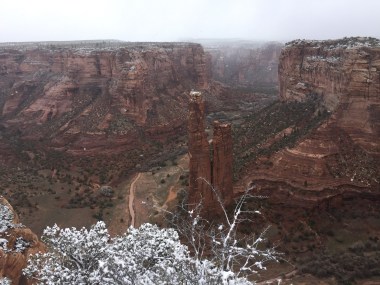
Spider Rock

We visited the rim alongside Spider Rock, where the Navajo believe that the Dine emerged into this world. She helped her people learn skills and protected them.  The Spider Rock is an amazing natural stone structure. To see its reach to the sky from the bottom of the canyon helps to envision the Navajo legends about the Spider Woman who lived there.  How else could one get up there?  It is just majestic as it reaches over 800 feet from the bottom.

Pueblo dwellers also lived in the Canyon.  You can still see the remains of their structures at White House and the Mummy Cave, as well as at other spots.  We viewed these two sites.  And they are amazing that so many centuries later the buildings are still recognizable and seem to exist outside of time.

But it is not only the formations and the ancient pueblos that make Canyon De Chelly special, it is also the history.  Navajo peoples have lived in the valley for centuries. It is here that they had their orchards and their farms.  It is here that Kt Carson, under the auspices of the US government, invaded the canyon to remove the Navajo. He used a scorched earth policy to destroy and starve the people in the Canyon. In an act of terror and misguided desire to cleanse the canyon of its native peoples, thousands were killed and rounded up for a long and treacherous march to New Mexico in 1864, where the Dine were kept prisoner at Fort Sumner for four years.

Finally, in 1868, the Navajo people were allowed to return home to their Canyon and try to rebuild their lives on what was now a protected Reservation. They were not returned to all their lands, but part of them.  This beautiful site still carries the memories of those who did not survive.  Some families still have claim to the land in the canyon’s valley. They still farm there and live there in the summer months.  To learn what happened to the Navajo/Dine people was depressing.  To see how harsh the US was on the first peoples made me want to cringe. But I felt some lightness of spirit to see that the canyon has been returned.

We visited the Canyon in March, where it was not supposed to be snowing, on a Road Scholar educational program.  It was informative and wonderful.  I must say the snow enhanced the beauty of the stone and the canyon.  Although we were unable to go to tour the bottom of the canyon as planned, due to the water and mud, seeing what we did was more than enough to make us deem this the loveliest of the Canyon’s we had seen.

I am glad that we decided to not just go to the Canyon De Chelly, but to have two excellent guides, one Navajo and one Hopi, from the Road Scholar program, who guided us through the two reservations and explained the history of their peoples as well as the magical and beautiful places we visited.
My Third Grand Canyon: Waimea Canyon, Kauai


Monument Valley Invokes Images Of My Dad

16 Mar

Monument Valley straddles Utah and Arizona, but for me it straddles my childhood and adulthood. I often watched old John Ford movies with my Dad, who was a major John Wayne fan. My job was to iron on the weekends, exactly when these old movies were on television. It gave me something to watch as I suffered through this chore and created a bonding time with my Dad.

Dad loved any John Wayne movie, military, westerns, Irish themed. I was more picky. There were three I loved. “The Quiet Man,” “The Searchers” and my favorite of all, “She Wore A Yellow Ribbon.” The last was filmed in Monument Valley, so I knew that one day I would make the trek to see this spectacular site. Finally I made it. It was more than I anticipated.

The visit came on the last touring day of a weeklong Roads Scholar program learning about the Hopi and Navajo Peoples and visiting their reservations. Monument Valley is located in the Navajo Reservation. It was worth the wait. Usually I write about my trips in order. But the emotional impact forced my mind to focus on this experience.

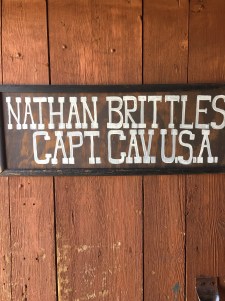
We arrived soon before lunch at the Goulding’s Trading Post, where we had time to visit some of the sites before we had lunch and continued into the valley. The movie crew used some of the outside of the buildings for the movie, including a storage building that became the office of Captain Nathan Brittles. Of course that was my first stop. John Wayne played this character in the movie. And although it is a small space lined with movie memorabilia, it touched a nerve in me. I started to cry as I exited the building, just missing my Dad.

The after lunch experience created moments of awe. As we toured the valley, stopping at many vistas along the way, including John Ford Point, and seeing sites that were visible in the movie, I kept thinking about my Dad. He would have LOVED seeing Monument Valley! He would have told me about every scene with a bit of Goulding’s or the Valley were in.

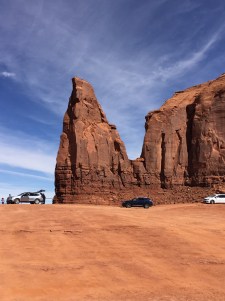
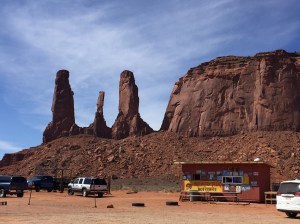
Dad would have relished the beauty of the valley. The bright red sand stone and majestic buttes would have inspired him as they inspired me. There are no words. Majestic is too small! Unbelievable is too trite! Incredible is ridiculous! Photos do not do it justice. Traveling along the 17 mile loop and listening to the young Navajo guide tell you the names given to the buttes and why they were named is a little surreal.

John Ford’s Point.

These buttes do not need names. They need appreciation! Each one still a work in process as the cold and water still invade the sandstone and split through the crevices causes giant portions of stone to fall and then crumble at the base.

I really felt Dad was with me in Monument Valley. Another woman on my trip was also on a pilgrimage in tribute of her husband who had passed away. He also loved old John Wayne movies. We decided that they were up there together watching us as we toured this site. And at the final stop on our tour of the Valley, she played her flute for the group. Her haunting melody swept across the silence, its lament echoed the sadness in my heart that my Dad never made it here. But at the same time the echoes of the music, the unbelievable, majestic and fantastic vistas brought me joy. Because I was there and in remembering my Dad I keep him alive.

I am so fortunate to have found the perfect educational program, great guides and wonderful experience to remember my Dad.

Our Daughter: Not An Astronaut

7 Mar

We always thought our daughter would become an astronaut.  It was not a crazy dream.  Our house was filled with books and videos focusing on the idea of space exploration.  My husband actually started filling out the application to join NASA, but an undetected medical issue ended his dream.  However, that did not stop him from always speaking about space. (See blog below.)

Because he could not be an astronaut, for his 40th birthday, I gave him a week of Adult Space Academy at the US Space and Rocket Center in Huntsville, Alabama in 1994, just four years after the program began. He had a wonderful time and came home with his own blue NASA jumpsuit, which became his Halloween costume for years.  As a pediatrician, it was important for him to have a great costume.  Each time he put it on, he glowed.

img_2062

My husband and daughter in Space Camp.

His constant discussions of the joys of space camp excited our daughter, who also wanted to go.  So in June 1995, my husband  took his NASA jumpsuit with him when he took our then nine-year old daughter to Huntsville for a weekend of Family Space Camp.  They had a wonderful time.

Our daughter was hooked. She also came home with a desire to learn everything she could about space and becoming an astronaut.  So the summer between sixth and seventh grade she went to Space Camp at the Cosmosphere in Hutchinson, Kansas.

There is a wonderful museum there that contains many space relics.   We had been members of the Cosmosphere for several years, after a tour there once on our way to Wichita.  It was a bit out of our way, but well worth the journey.

When our daughter went to Space Camp in Hutchinson, there was only one overnight Space Camp available.  But she lucked out.  The following year, the Cosmosphere added a second level to Space Camp.  In this new program, the campers had an overnight trip to Houston, Texas, to visit NASA. That was so exciting for her.

While they were in Mission Control, the Space Shuttle mission STS-93 was orbiting the earth commanded by the Astronaut Eileen Collins, July 1999.  Our daughter was able to speak to Astronaut Collins.  And they were there when the Space Shuttle actually returned to earth and touched down in Houston.  That was the highlight for her.  A woman in control  epitomized our daughter’s dreams.

Her next stop was Huntsville, Alabama, on her own for Space Academy.  She was in her happy place.  At 15 years old, the world was hers.  As a scuba diver, she had her happiest moment in the giant tank, while others were learning to scuba dive, she somersaulted and enjoyed moving around the mock-up of the space vehicles.   We flew in to attend her graduation, where we were told what an excellent student she had been that week.

We didn’t fly in just for her.  Since her program ended on a Friday, my husband and son were signed up for Family Space Camp that weekend. While they enjoyed camp, my daughter and I explored Huntsville.  And she told me all about her experience.  She came home with her own  NASA jumpsuit and joined my husband in dressing up each Halloween.

Thus, we were surprised when she did not go into science and pursue her space exploration adventures.  In fact, when she wrote her college essay, she focused on the strengths of Pippi Longstocking, and not the excitement of space camp.

Why asked why, she said that an astronaut had come to speak to them at camp. He told them that the astronauts currently in the program were like penguins, who would never fly. To our daughter that was the end of her NASA dreams.  She found another dream and earned two masters’ degrees.  But never joined NASA.

img_1233

Our daughter never became an astronaut, but her American Girl doll did!  Last year, 2018,  the American Girl Company came out with Luciana.  Our daughter and her husband were at the mall when she stopped into the American Girl store because she saw all the clothes and items available for Luciana.  She purchased a NASA like jumpsuit for her doll.  She dressed her Rebecca doll as an astronaut and joined her in her own NASA jumpsuit! (It still fit as it had when she was a teenager!)

Recently I was at the mall and saw all the space accoutrements.  I sent photos to our daughter to see what she thought, as it was close to her birthday.  And even though she is in her 30s, her American Girl dolls and space are still important to her.  She reminded me that she had purchased the jump suit, but her husband said she did not need anything else.  But what is need to a mom.  I got the space suit, the book and a few other items. Once again I state, my daughter might never have been an astronaut, but I could be sure that her doll reached the stars.


Space…Astronomy….and the First Walk on the Moon

Halvah, My Favorite Childhood Treat

26 Dec

Sometimes walking through a store brings back a memory. It happened to me today. One minute I was walking through a grocery store in Holon, Israel, with my daughter. And in an instant I was transported back in time and place. I was in my grandparents’ bakery in West New York, New Jersey.

I am sitting at the counter while my grandparents work. In front of me are three large rectangles of a most delicious treat, halvah. My favorite, marble halvah, is in the middle. And I so want to eat some of this sesame and sugar delight. My grandmother sees me sitting there. “Just take a small piece,” she says. And I do. I carry the love of halvah with me till now.

After some weekend visits, Grandma would send a half-inch slice home with me. My father and I were the biggest halvah fans. We would savor that slice, trying to make it last for a week. A feat that was a bit difficult to achieve!

After my grandparents closed their bakery to retire, my Dad would go to the local deli to buy halvah to satisfy our family’s cravings. My sister also loved the marble halvah. She remembers, “The halvah from the deli came wrapped in wax paper inside the white deli paper, like how lox came. I think because of the innate oiliness.”

In the summertime we could always get halvah at the bakery in Monticello or the deli. Halvah was always part of our life. But moving to the Midwest took me away from this treat.

In Kansas I never see full chunks of halvah. If I am lucky I find packaged process halvah By ‘Joyva’. However it is not the same. I have not tasted this treat in at least four years, since I don’t like the taste of the processed packaged squares of what should be a delectable treat that melts in my mouth.

The sign says “Halvah and sweets.”

But there in the large supermarket, Hetzi Hinam, was an entire counter of halvah with many different flavors. It called out to me. It took me back in time. I craved it. My daughter told me to get some. But I decided no, I just took a picture. I have been regretting that decision since we came home.

I have been going through every instance of halvah memory when I was denied my treat. When my husband, then fiancée, and I were in school, I kept my halvah in his refrigerator wrapped in a plastic bag with a handwritten sign saying this was mine, “Do Not Eat”. I would bring the halvah back from New Jersey to Missouri for those moments when I really needed cheering up. You can imagine my furious anger when I found out my husband’s roommate, David, ate my halvah without my permission. Let’s just say he never did that again.

My disappointment that day was overwhelming, I can still feel my anger even now 40 years later. So although my angst is not that bad today, I keep thinking, why. Why did I deny myself this treat? I could have purchased just a small chunk. But I said no.

Part of it, I think, is that I have such high expectations of halvah. I know what I remember it should taste like. But after eating those packaged chunks I have been disappointed. So I think seeing all those lovely rectangles made me a bit afraid. What if this halvah’s taste did not match my memory?

When I had it four years ago, I also purchased it in Israel. My daughter was living in Tel Aviv then, and I purchased a piece at a little shop. It was delicious. Perhaps my fears are unfounded. I should have purchased some! I could be eating a piece right now!

Instead I am here writing about halvah, remembering the taste, and wishing I had purchased just a bit of my favorite childhood treat.

Perhaps we can go back or find another store!

For those who wonder, according to Wikipedia, “The word halva entered the English language between 1840 and 1850 from the Yiddish halva(Hebrew: חלווה‎), which came from the Turkish helva (حلوا), itself ultimately derived from the Arabic: حلوى ḥalwá, a sweet confection .

Several Days At a Hospital Gives Me Hope For Israel

20 Dec

Sitting in a hospital in Holon has been a most eye-opening experience. The hospital sits on the border of Holon, Tel Aviv and Yafo serving an area mixed with Jewish and Muslim and Christian citizens. And it illustrates what I love about Israel.

I came to Israel because my daughter needed surgery. They day of her scheduled surgery we arrived at 6:25 am. After all the intake she was shown to her room where she would wait for surgery. Her roommate was a Muslim woman who had acute appendicitis and also needed surgery, ‘K’.

We were now linked together. They went down to surgery about the same time and returned to their room around the same time: five hours after we first went down. While we waited we sat in an area with many others: Jewish, Christian, and Muslim parents, children, spouses and friends waiting for their loved ones to emerge.

I do speak some Hebrew, but in my mother anxiety, my Hebrew left me and I mainly spoke English. Of course my daughter’s husband speaks Hebrew. But it really did not matter. Most of the nurses and aides could quickly move from Hebrew to Arabic to English and at times a Russian and Yiddish.

As patients were wheeled into the surgery area a barrage of languages wished them luck. And as families were reunited after surgery, those remaining behind sent prayers for speedy recovery to all no matter the religion; we were united in our need to comfort each other in our time of stress and anxiety.

When a 13-year-old boy was left to wait alone as his father had surgery, we banded together to speak to him and keep him calm till his much older brother arrived. It was K’s husband who told him what to tell his brother after the doctor came out, because the boy’s happy tears rendered him unable to speak. When his phone’s battery died, my son-in-law gave him our charger so he could call his brother again.

We became a team. When the nurse came in and started to speak to me in Hebrew, I responded in Hebrew, “more slowly please”. While K’s husband told the nurse to speak to me in English. When he left to walk his two young children out along with his sister, I held his wife’s head and cleaned her face after she vomited. She was young enough to be my daughter too.

At first, before the surgery, K’s husband put her Hijab over her hair when we were in the room. But after the surgery he did not bother. We were in this together. Only when visitors came did she put her Hijab on.

Later that evening, when my daughter started to vomit, I grabbed the garbage pail for her, while my son-in-law brought in another trash can. Then K’s mother began to laugh, the idea of the two of them vomiting simultaneously was just too much. I started to laugh as well. My son-in-law was a bit confused as to why we were laughing. But it was fine. We were in close quarters as the hospital was full, and we were put together in a single room.

When the nurse came, to check my daughter, we two mothers were asked to leave for a few minutes. We stood outside together and spoke about our daughters. We were together in wishing both a speedy recovery. It did not matter our language or religion, we were just moms whose daughters just had surgery.

Actually I really enjoyed listening to all the conversations, not to the words, but to the switching in one sentence from Arabic to Hebrew to English. The cadence of the melody changes with each language like a symphony of sound. At times I would be confused as to what language I was hearing, as the speakers would switch so fluently from one to another.

My daughter told me that Arabic spoken in Yafo is filled with Hebrew expressions.

Late that evening, after I had spent over 15 hours at the hospital, my son-in-law and I went back home. K’s husband spent the night. In the morning we found out that my daughter had been sick and he helped her after she threw up.

I felt terrible that I was not there. That she had not told us to return. Her answer when we asked was the room was way too small for us all to be there. Also in the morning before we came, it was K who told the nurse who came to check on her that my daughter had been sick during the night; that she needed to be checked as well.

That morning I purchased tulips for both of them because they were going to have to spend another night in the hospital. Yes being sick at night landed both of them another night in the hospital.

My daughter and K are now home. Their room is empty and being readied for the next patient.

In all I spent parts of four days at Wolfson Medical Center. While at the hospital I felt a sense of companionship. People working together to help everyone else. I get so sick of hearing about hatred and bigotry and stereotypes. At Wolfson we are one people. That is the Israel I love.

I am aware of what is happening elsewhere in Israel. At the borders and in the West Bank. But when you are at the hospital you know that the everyday people can live together and wish each other well.

Doctors, nurses, aides; patients and families; Jewish, Muslim, Christian; all together in one purpose: to help everyone feel better. At least that is the impression I had at Wolfson. That feeling is what gives me hope for Israel.

December in Israel

16 Dec

I seem to spend a bit of December in Israel. Facebook reminds me. Ten years ago, four years ago, two years ago, and now, another December in Israel. I actually like coming in early December. There are not many tourists. The 70-degree weather is wonderful compared to the below freezing weather at my home. And I get to spend time with my daughter and her husband.

Today, my first day here on this visit, was the perfect December day. We walked the two tiny dogs the half mile to a small grocery store to stock up for Shabbat.

We purchased Challah and Challah rolls. The bread here is so delicious. Freshly made from the bakery, it reminds me of my grandfather’s baking. I do have a habit of over eating bread when I visit! My first roll here surpassed my tastebud memories.

As we walked we met others out and enjoying the day, walking with their dogs and small children. It was just delightful.

There are so many little parks along the way that we walked through. It made it fun for all to be outside. We passed children playing in three playgrounds on our way home. So peaceful. It almost makes you forget what is happening in other areas of the country. Almost.

It is difficult sometimes to connect reality to what is reported in world news. It is now my third day here and there have been three terror attacks near Jerusalem. Two soldiers dead; one infant dead, and by my count 11 injured. You have to wonder why? Killing by terrorists does not bring about peace, just more hate. And the cycle continues on and on.

In the meantime the international media usually does not report the Hamas attacks against innocent Israelis. When they do it is usually in the context that Israeli military strikes back. And then they barely mention that which lead up to Israel’s response. Frustrating on so many levels.

But here in the Holon, Rishon LeZion area, all is relatively peaceful.

The only indication that anything is happening is when we look at my cousin’s grandchildren and speak of their future. Someone says out loud, “well maybe there will be peace before they have to go into the army.” And my cousins says, “Oy They keep saying that. 20 years ago, 40 years and before. And still no peace.”

Israel in December is lovely. But you cannot disconnect from reality.

Mass Transit: A Traveler’s Delight

22 Nov

Kansas City metro only has one really good accessible mass transit for tourists: the KC Street Car, a free light rail that circles 2.2 miles downtown, featuring Crown Center and the City Market.  Yes, Kansas City does have a bus system, but living in Johnson County, on the Kansas side, I recently realized how cut off we can be without a car.  Our daughter’s brother-in-law was traveling through the USA and wanted to use mass transit whenever possible.  My husband took him to work one day and dropped him off at the Street Car. That gave him an entire day of adventure.

However, it was the start of the Labor Day Weekend.  On Sunday he wanted to take the bus downtown to experience the Irish Festival.  We told him it was impossible. He said,
“No there is a bus a mile away.  I can walk there and take it.  We laughed. My husband showed him on the website that yes there was a bus to downtown, but it would not be running again until Tuesday.  No way to get to the Irish Festival.  (Don’t worry, we arranged for friends to take him.)

img_0859

Ferry from NJ to NYC.

It started me thinking about my experience with mass transit.  To begin with, I grew up in New Jersey, just across the Hudson River from Manhattan.  I spent many hours on busses, trains, subways and taxis.  It was a part of life if you wanted to go anywhere.  Many people who live in New York City do not even own a car.  Of course my mass transit of choice going from New Jersey to NYC is always the ferry!

img_0836

Mass Transit tickets

Since moving to the Midwest, I have experienced exciting weekends in Chicago, Illinois, using the mass transit system.  Chicago, like NYC, is another mass transit haven.   Using the Chicago subways is a no brainer.  Going from the airport into the city is so much faster, cheaper and easier than taking a taxi. And getting around to the different areas makes sense on the subways.

In major cities, I try to use the subways to avoid traffic. In Philadelphia we used the Philadelphia Transit Vehicles (PTV), and in Washington DC, using the METRO Transit System is a must to beat the traffic.  I will always remember the very long escalators down into the system when we traveled from a relative’s home in Maryland to downtown DC. Boston also has a mass transit system, the MBTA, that helps college students and travelers get around

I realized that my husband and I use Mass Transit whenever we can.  In Atlanta, the MARTA took us to and from the airport to the downtown hotels.  In California: we adore the Cable Cars in San Francisco. While staying in San Jose, we used the light rail to go the Winchester Mystery House in San and the Tech Museum from our hotel.

We used the light rail in Denver, Colorado, to explore the historic area and travel to and from our hotel. In one of my favorite cities, New Orleans, I used the street car with my children to get from our hotel to the French Quarter!

I have even used the mass transit in St. Louis!  Although I drive there all the time to see family, when I went to a graduation at Washington University, I was told parking was not available. I drove to the nearest MetroLink Station and traveled to the ceremony. What a delight to avoid all the traffic.

One of my favorite ‘mass transit’ rides was on the People Mover ride in Tomorrow Land at Disney World, and of course we love the mass transit success of the Monorail in Disney World.  Does that count?  I think so.  I thought of it recently when we were in Seattle.   I had the opportunity to use the one-mile monorail down to the Sky Needle and the Seattle Center, an area developed for the 1962 World’s Fair.

But it wasn’t only the monorail that had our patronage in Seattle, we also used the light rail system of SoundTransit.  The underground area was so clean!  Currently buses run through these tunnels in downtown Seattle, but I was told that would end in January 2019, as the city prepares for the expansion of its light rail.

I have also used mass transit in other countries.  Vienna, Hungary, we took our children on the subway.  I will admit there was one very loud and screechy turn.  We all held our ears.  In Israel, I have changed my allegiance from the busses to the trains. They are great and have free wi-fi.

The most interesting subway of all was in Athens, Greece. When they dug down to build the subway, the workers kept finding antique treasures. Now in the stations are displays of these lovely objects.  You get a history lesson, while waiting for the subway.

img_0858

Funicular in Quebec City.

Another favorite is using a funicular to get up and down a hill.  That was great fun in Quebec City, Canada.  I have used them in other places as well, like the Carmelit underground Funicular in Haifa, Israel, and the one at Marvel Cave in Branson, Missouri (this was my first funicular.)  But the one in Quebec City stands out in my mind.  I have seen them in Valparaiso, Chile, but did not actually need to use one.

All my experiences with mass transit makes me wish that my home town would invest a bit more in helping people move around.  I will admit that recently citizens voted to expand the light rail a bit further south to the shopping areas of Westport and the Plaza, as well as the University of Missouri Kansas City campus.  But it still doesn’t help those who live in my area.  But my dream lives on that eventually the entire city will have an operating, useful light rail system.

Finding Good In Seattle

19 Nov

When I travel I look for positive experiences. Besides the regular sites, I like to visit places to reflect my heritage and my desire to do good. So in Seattle, I was delighted to learn that two of the experiences selected by the group I was with were devoted to good deeds.

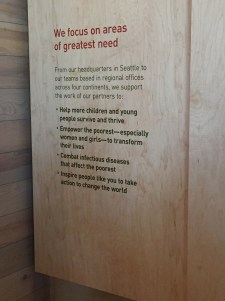
The Foundations aims

An interactive map.

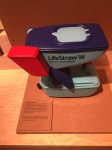
A safe way to transport vaccines.

First was the Bill and Melinda Gates Foundation Discovery Center. We had a docent speak with us and describe the Center, which explains and shows the philosophy and collaborations of the Foundation. In reality, you do not need a docent, the Discovery Center is quite user friendly and has many interactive activities that will intrigue adults and older children as well.

A poster I made in one activity.

Besides the regular exhibits, theater and activities, when I went there was a large exhibit on inventions designed to help people in locations far from technology. My two favorites were ways to clean water and really cool eyeglasses. As a myopic person, I understand the need to see clearly!

There is a big push from the foundation for clean water, better use of toilets and cleaning fecal matter, and vaccines. As many, I am glad the Foundation is doing all it can to save lives. But I must admit I did ask if they were doing anything to have more food and population control. Because saving all these lives in areas of Africa with famine and drought, were they adding to the problem if they did not also help create food and find ways for more water to get to these drought ravaged places. I will admit the docent did not have a good answer for me. But it was obvious it was a question the foundation was aware to be a concern.

Another big push is education, especially of women and girls. In fact they want to improve the quality of life for women. In all, I learned much about the areas of the world where people suffer from poverty, even in the USA.

And that leads to my second Seattle experience. For our annual luncheon we went to Fare Start Restaurant located at 700 Virginia in downtown Seattle. What a great meal and great program.

Learning about Fare Start before we eat. And the wall of corporate sponsors.

Fare Start has helped people in property get training in the restaurant business. They have helped people for over 25 years. They not only learn the business skills for food services, but also life skills. There are 16 week job trading programs for adults, as well as an eight-week program for youth aged 16-21. Another program helps homeless youths aged 16-24.

During the week the restaurant is open to the public. While in weekends it does private catering events like ours. I was so happy our catering dollars went to help this wonderful program.

Seattle has much to offer. This is my third trip here. Every time I find new and interesting experiences. One little happy note for me, in Seattle Restaurants where you clear your own plate, there are three cans: recycling, trash, compost!

Epiphany, Excitement, Discovery, Disappointment, Hope

16 Nov

In searching for my ancestors, I have learned that not everything turns out as I hoped. But part of the search is the excitement of discovery and sometimes just the process itself.

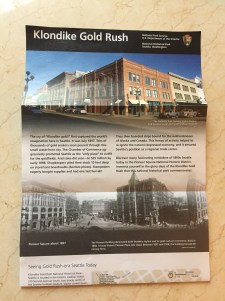
Museum brochure

While in Seattle with my husband, I decided we needed to go to the Klondike Gold Rush Museum, a National Park Service site. We had been to Alaska and seen the town of Skagway where the hordes of people climbed to start a cold and difficult journey to find gold. We have ridden on the White Railroad train to see the path these souls walked to the Yukon Territory.

But to be honest I never connected Seattle with the gold rush. Now I know I was wrong. Almost seventy percent of all those who joined the gold rush came through Seattle. It was the hub for stocking up with the many supplies needed. The idea to come to Seattle was reinforced by a strong media campaign by a Seattle in 1897-98 to encourage people to come to Seattle first.

After visiting the museum, I had an epiphany! I knew my great grandfather had abandoned his family in New York to go to Seattle in the late 1890s, but I never could understand why Seattle. Now I think I know. He joined the adventure seekers looking for gold.

My great grandfather did not return home after his adventure. I wrote about this in the blog below.

Seattle Public Library

Genealogy on the ninth floor!

Being in Seattle for a few days, I decided my next stop needed to be the Seattle Public Library! So in the morning I set off. The staff was so helpful. Who knew there would be a genealogist on staff! Many thanks to John, who helped me explore. And to the other kind staff member who got me started until John came to work.

The old city directories.

I started by looking through the Seattle City directories. I searched from 1898 through 1924. My excitement was high. I found three men named Abraham Rosenberg in my search. The first seemed the most positive. With finding his death certificate we saw that he was born about the time, 1868, that perhaps my great grandfather was born. I found him in the books beginning in 1917.

The wrong Abraham Rosenberg, 1917 city directory.

But it was a disappointing find. We found his obit, and from there realized he only had lived in Seattle from 1916. Could not be my lost ancestor. Not only that he had children at the same time my family was growing back east, in the late 1890s.

John and I were disappointed together. He searched for every reference he could for Abraham Rosenberg in different spellings and in Spokane as well as Seattle.

I am not giving up hope. I vaguely remember that my great grandfather lived a long life. It might be that he died in 1963, those death certificate records are not yet on line.

I know my grandfather found his father in Seattle in 1902 or 1903. So I know he existed.

An earlier Abraham Rosenberg.

I went back in time. And found in the 1904 and 1905 city directories an Abraham Rosenberg is listed. He is a tailor! My grandfather was a tailor. Could it be my missing ancestor? We might not have found him traces of him in other records. But I am positive that I will one day find him. I will not give up hope.

The process is part of the adventure. I had a wonderful adventure and met the nicest staff at the library!

The Sad Scandal That Forever Scarred My Grandpa Harry

Jeronimos Monastery and Manueline Designs

27 Oct

On our first day in Lisbon, we visited the Jeronimos Monastery, specifically the church section. We did not have a chance to visit the two museums that are also housed at the old monastery buildings. But the church was more than enough.

Here I was exposed to Manueline architecture, something I had not seen before, but now enjoy! King Manuel I of Portugal liked maritime designs in his buildings. So the architects, who designed for him, incorporated unique carvings like ropes, sea-life, and other maritime symbols in the structures, as well as nature items like leaves.

img_0076-1

Not the main entrance, but when we were there a bride and groom exited here.

img_0077

The surround of this window has some of the rope motif common in Manueline design.

img_0082

The ceiling was fantastic.

img_0085

These tall columns had many carvings of sea life/maritime symbols.

img_0100img_0110

Vasco da Gama’s tomb.
img_0111

People rub the hands.

The Jeronimos chapel is not filled with ornate gold and silver covered wooden structures, instead it is comprised of fantastically carved stone work that is breathtaking. The high chapel columns and arches are a tribute to the Manueline style. This structure was built in the early 16th Century during the reign of King Manuel I, who wanted to highlight the Portuguese maritime dominance and to emphasis the exploits of the explorer Vasco da Gama, who is buried here.

I think the pictures show why this style became so popular and why it became so associated with Portugal.

Belem Tower on the Tagus River.

The other Manueline structure we visited in Lisbon was the Belém Tower, which actually is located directly opposite the monastery on the banks of the Tagus River.

These two structures were built about the same time, during the reign of King Manuel I in what is now the Belém area of Lisbon. (I wrote about our visit to the tower in the blog linked below.)

Unfortunately, many of the structures built during the reign of King Manuel I were destroyed in the earthquake of 1755. This was a high Richter Scale earthquake and tsunami on the Iberian peninsula that caused major damage and changed the look of many cities in the region.

At the Pena Palace, an arch carved in Manueline style.

While in Lisbon, we spent a day in Sintra where we visited the Pena Palace. When it was built, in the late 1800s, the Pena Palace also incorporated some Manueline architecture within its quirky construction. It was fascinating to see a Moorish style building with a Manueline arch. But then this entire building is a fantastic blend of different design elements. (See link below.)

I understand that many other buildings incorporated this Manueline style in later years because of its Portuguese importance.

For me, the three structures I saw opened my mind to another form of art that I just like. I recommend anyone traveling to Portugal to learn about Manueline designs and enjoy these lovely structures.

An Extraordinary Visit to the Belem Tower

Sintra and the Palace of Pena