Archive | Szenk Feuer Blogs RSS feed for this section

The Rosh Hashannah Card Has A Story

1 Oct

szenk-1936-shana-tova

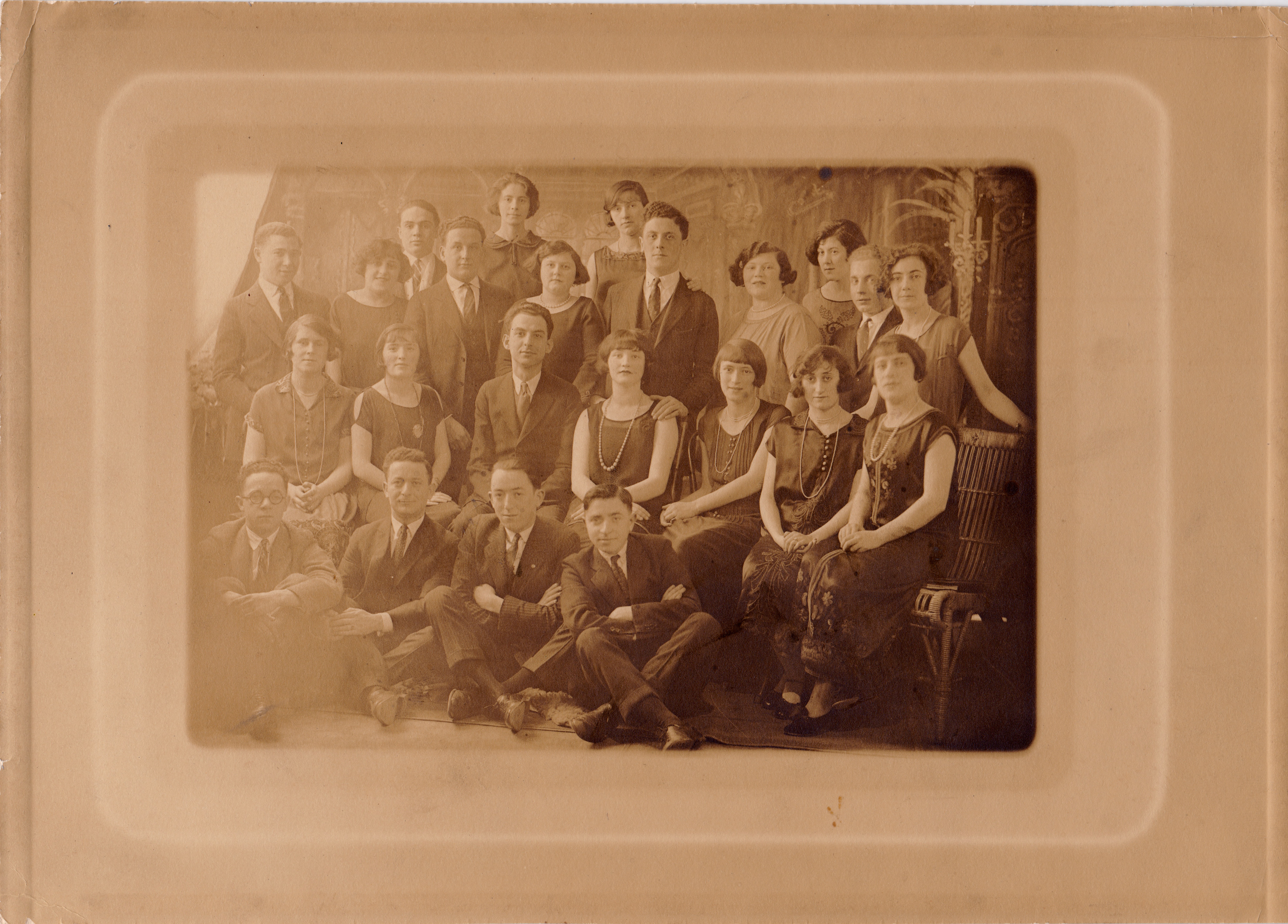
In 1936 my Grandma Thelma’s siblings sent her a Rosh Hashannah card from Poland. On the front is a photo of her siblings. Seated are her brother Isaac and his wife, Bronia. Standing are her youngest siblings David and Esther. Soon after this photo was taken the world really began to change.

This photo looks so peaceful and calm. But so much was going on behind the scenes. Plans were already being made. Getting out of Poland was their main goal.

My Grandmother worked diligently to get her family out of Europe. She and my grandfather owned a bakery and had two young children. Grandma had taken her children to Europe in 1931 and since her return had been searching for ways to rescue her family and my grandfather’s family. It was very difficult.

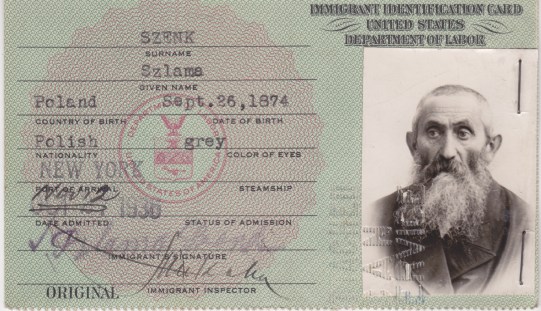
Eventually, she got documentation to bring my great grandfather Abraham (her mother had died young) and her younger sister, Esther, to the United States. Esther was older than 21, but she was very tiny. So they made her younger. And thus she was able to come with her father.

The age difference was a bone of contention for years. My Tante always stating her ‘fake’ age, my grandmother always correcting her. It was made worse by the fact that my Grandmother had traveled by herself to the USA in 1922, when she was only 16. To get the papers she needed, she made herself two years older! The war over their ages went on for years.

It was great until Tante wanted to retire. Truly she was 65, but legally she was 62. I remember this as my Grandmother and Tante would argue about this as well.   Like sisters, with love, they found many things to argue about.

Front Great grandpa USA Visa

In any case two were saved. I have my Great Grandfather’s passport and visa. In the passport it states that he has to leave Poland within a certain time or the visa is invalid. Luckily my grandparents also sent money. Saving family was utmost in my grandparents’ mind.

But my Grandmother was unable to rescue her brothers and bring them to the USA.   They decided that they had to leave Poland: Uncle Isaac and his wife, Bronia, along with David and Bronia’s sister, Rosa. The Rabbi said that David and Rosa must marry before they left Poland. So a quick wedding was held.

They escaped Poland to Russia. Not as great, but they were tailors…or they became tailors. And so, my grandmother would say, they were employed to make army uniforms for the Russian army.

Their lives were not easy. They suffered. But they survived. Many were not as fortunate.

After the war they wanted to leave Europe. They were in Italy and the Facists were on the rise. They were afraid. They wrote to their sisters in the United States, and to Bronia and Rosa’s sisters in Australia. They decided whoever sent documents first , they would go to that country. They just wanted out of Europe as quickly as possible.

Once again they were among the fortunate ones with sisters on two continents working to save their siblings. The sisters in Australia got documents first. My great aunts and uncles moved to Australia. There my cousin was born. There my Uncle David passed away when in was in his 30s. He is buried in Melbourne.

When my cousin was a child, they decided to move to Israel. My Great Uncle and his wife; his sister in-law, and niece. My cousin and her family still live in Israel. My grandparents, great aunts and uncles have all passed away. But when I look at this Rosh Hashannah card, I see hope. I wish everyone a blessed, happy, healthy and sweet new year.


To read more about the family:

https://zicharonot.wordpress.com/2014/04/28/speaking-yiddish-always-brings-me-holocaust-memories/

https://zicharonot.wordpress.com/2015/11/03/who-are-you-these-photos-call-out-to-me/


https://zicharonot.wordpress.com/2014/05/29/grandma-thelma-knows-what-she-knows/

The Mysterious Kalsbad Photos: Who Are They?

6 Jun

June 26, 1931. My Grandmother was in Europe with my Mother and my Uncle. She left them at the farm owned by my great grandparents in Poland while she went to Karlsbad (Karlovy Vary), Czechoslovia to take the waters and revive her health.

The doctors in the United States told her that she was going to die. She had been pregnant again in the USA. But doctors terminated the pregnancy through a very illegal abortion in an effort to save her life. But still she was sick. So she decided she would not burden my Grandfather with two young children, 5 and 2. She would take them to Europe to live with his parents and she would die there. He, then, would be free to continue his life.

I once asked my Grandfather, why he let her go. “She was a sick woman,” he told me. “I had to let her do what she thought was best.”

“Would you have left Mom and Uncle Stanley in Europe?” I asked. This was a very important question. His entire family perished. If he had left them, I would not be here.

He looked me in the eye, and said, “As soon as she died I was going to get on a boat and return with my children. I would never leave them there. “

His words made me feel a bit better. But if Grandma had died the world my Mom and Uncle lived in would have been very different. But at least I know my grandfather would not have abandoned them in Poland.

Luckily Grandma did get well. She stayed in Europe for six to eight months and then returned to the USA with my Mom and Uncle. She saw the rise of Hitler coming and now had a new purpose: get the family out. She could not save as many as she wanted. But she tried.

Grandma Thelam, Carlsbad

Grandma is sitting in the front. The date and place were added by my Mom. I think the two women are related. This is the photo we knew about.

We have several items from that trip to Europe. We have a ceramic vase that stays in her breakfront/curio cabinet in our Catskills’ home. We have stories about the trip.  We have a few photos. We knew of one. Grandma is with two other women. We have no ideal who they are. But I think they are related to her, one women sort of looks like her sister-in-law. We are not sure. There is no identifications on the back.

But I recently found another.

FullSizeRender (10)

Grandma is in back row on the left wearing a white hat.

It is a group photo. In the very back row, near the center is a woman in a white hat, that is my grandmother. She is 26 years old.

I do not know the other people. Are they family members who perished? Or are they just other people who are in Karlsbad? Sometimes I imagine that they are just other people at the resort who were pulled together for a group photo that the photographer would then sell to tourists.   Other times I imagine that people in the photo look like family, especially the man in the front on the left. But I honestly do not know.

This photo is different from the others we have from that trip. There is writing in Yiddish and English. The English is easy, her name and the address where she stayed in Karlsbad. Or is it a place she visited?

The Yiddish is more exciting to me. It is the only letter I have seen that she wrote to my Grandfather. (Thank you members of the Tracing the Tribe Facebook Group for translations!)

It says: “As a souvenir from your faithful wife, who hopes, to meet you again in good health.” Another translated it as “A souvenir from your devoted wife, who hopes to return to you in good health.”

Either makes sense. She was sick. She was away from my grandfather. She wanted to be reunited with her family and be healthy.

And that all happened. She returned to the US and lived an additional 50 years. And 80 years later, I keep finding treasures in her photo album!


https://zicharonot.wordpress.com/2014/04/28/speaking-yiddish-always-brings-me-holocaust-memories/

Holding My Grandparent’s Naturalization Papers Overwhelms Me

23 May


imageI have a small leather case that is inscribed with the words Certificate of Citizenship.  Enclosed are my grandparents naturalization papers that change them from immigrants to citizens.

I hold the papers in my hands and I wonder what my grandparents were thinking. Here are the legal documents that made them naturalized citizens of the United States of America. They were no longer Polish citizens. They were free of the past, or were they?

image

One paper is 84 years old.   My Grandmother became an American in 1932. She was 27 years old. I know she had just returned from a trip to Europe to regain her health and see her family and my grandfather’s family. She took her two small children, my mother and my uncle, with her for six months in Poland. And then she came home, a changed woman with a mission. Get as many family members out of Europe as possible.   Grandma was smart. She saw the coming tide of Hitler and his anti-Semitism. What would she think now with the new rise of hatred and xenophobia throughout the world?

The seal encompasses her photo. Her certificate has a small burn in it. The paper was folded when it happened. I can see my grandfather smoking a cigarette with an ash hanging off as it falls on the papers. I know my grandmother must have been furious. It looks like that type of burn to me. I am glad that my children have never seen a cigarette burn. When my father and grandfather smoked, papers often got singed.   But by the time my children were born, there were no more smokers in my family.

There on her paper is a space for Race. It says Hebrew. I wonder if she worried about that word on her papers? They were not yet putting yellow stars on Jews when she was in Europe. Even though she was worried, perhaps, being here made her feel safe enough. The good news is that 11 years later, when my grandfather became a citizen, there was no longer a space for Race. This item was removed from the naturalization papers. It makes me happy to see this change.

image

I wonder why Grandpa waited so long? He came to the USA in 1920. Did he originally think he would go back one day? Maybe. But the war probably changed his mind. He became a citizen in the midst of World War II — the war that destroyed his family. The war that murdered his parents and his siblings, his nieces and his nephews, his aunts and uncles, his cousins and his friends. Almost all perished. He did not yet officially know this in 1943. But perhaps he knew, since all letters stopped coming and there was no more contact with his family. It was not till after the war that he knew they had all died.

On this paper I see my grandparents’ signatures. I usually did not see it. To me Grandma only signed all letters Love, Grandma Thelma. Grandpa never wrote letters. In his later years, he forgot how to write his name in English. He only remembered how to write it in Hebrew. But here I see his signature. It gives me a thrill to see these names on these certificates.

image

On the back of Grandpa’s certificate of naturalization is an additional note. It was when he became an official citizen that he legally changed his name from Nisson to Nathan. He put away his Yiddish/Hebrew name and moved to an English name. This is the name I gave my son. Nissan, Nathan. He was born 11 months after Grandpa died. It seemed right that he should have his name.

By the time Grandpa became a citizen they had moved to the home they lived in for over 30 years. This was the location of their bakery in West New York, New Jersey. A home and a bakery where I spent many hours and enjoyed so much love. The same address where I spent the first three years of my life. Where my parents spent the first six years of their married life.

When I hold my grandparents’ citizenship papers I am overwhelmed. Because they moved here and left their homes when they were so young, 18 and 16, I am alive. Because they made a conscious choice my children have freedom. Because they were able to immigrate to the United States, we live in freedom.

I hope the United States will continue to be a beacon of light to immigrants throughout the world, as it was for my grandparents.


https://zicharonot.wordpress.com/2014/06/25/how-world-war-i-saved-my-family-or-my-grandpa-was-a-draft-dodger/

https://zicharonot.wordpress.com/2014/08/22/i-believe-mystically-and-magically-great-grandma-chava-watches-over-me/


https://zicharonot.wordpress.com/2014/05/29/grandma-thelma-knows-what-she-knows/


https://zicharonot.wordpress.com/2014/04/28/speaking-yiddish-always-brings-me-holocaust-memories/


The Necklace I Never Wear

2 Apr

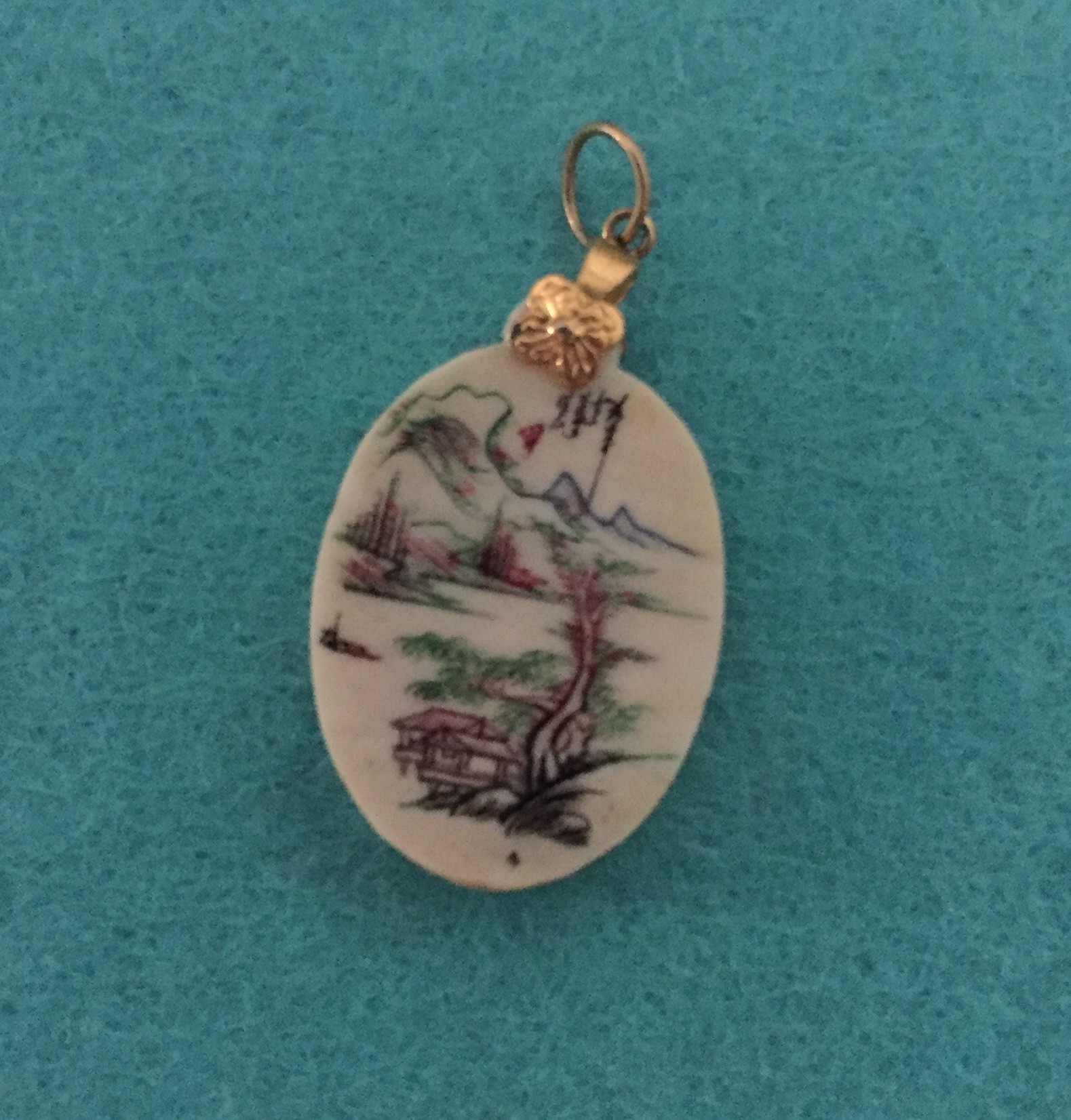
In a box in my closet is a small scrimshaw necklace that I never wear. I will never give it away. I will never sell it. I hope one day one of my children will take it.

The necklace I purchased with the money from Zeisel.

The necklace I purchased with the money from Zeisel.

It is not that old. I bought it when I was 20, when I spent my sophomore year of college in Israel, 1974 to 1975.

Many holocaust survivors were still alive. Some of them related to me through my maternal grandparents who were both from Europe. My grandparents came to the USA in the 1920s. But most of their family remained behind. Many perished, others survived and moved to Israel.

My grandmother went to Europe in 1931 with my Mom and uncle. I have written about this before. She stayed on the farm owned by her in-laws. While she was there her mother-in-law, my great grandmother Chava, gave her some family items. Two pieces of jewelry, a pearl necklace and an opal ring; and several embroidered and handmade pieces that Chava had made.   I own all but the pearl necklace. They were all given to me as the one named for Chava.

The pearl necklace disappeared in 1931. My grandmother went to use the shower at her inlaws. She took off the necklace to bathe and forgot to put it back on. When she realized it was gone, she went back to the bathroom. It was missing.

But she knew who took it. Zeisel. He was the only one who had been in the bathroom. But he denied taking it. And that was the end of the matter for 43 years, until I went to Israel for a year of college.

A month after I arrived in Israel, I received a letter from my grandmother telling me the story of the pearls. I had never heard it before. In the letter she wrote that the ‘goniff,’ Zeisel Feuer, my grandfather’s cousin, was going to give me some money to pay her back for the necklace he stole in 1931. I was to take the money and give my great uncle, her brother, half the money. The other half was to buy myself a necklace because I should have the pearls.

What? Was my grandmother insane?   I did not really want to do this.

I wrote her back saying that I thought 43 years meant the statute of limitations on a theft were over. And that she needed to let it go. And I did not need to have the necklace. But a few weeks later I received another letter instructing me how to find Zeisel in Tel Aviv. He worked at bakery on a specific street and I was to go there and speak to him. She said I had no choice. I had to do this. It was important to both of them to end this. And I would be the one to fix it. What?

Grandma ordered, so I obeyed. The next time I was in Tel Aviv, I went to the bakery. There was a man who looked so much like my grandfather, except smaller and bent. I knew it had to Zeisel. I introduced my self. He held for minute and had me sit at a table. He brought tea and a pastry. I waited while he finished working. Then we walked back to his apartment.

There he gave me Israeli lire, which in US would be worth about $100. And he told this story.

He was married with two children. He had a wonderful life. But he wanted more for his family. So when my grandmother left the pearls in the bathroom, he thought, “She lives in America. She is rich and has money. She does not need this necklace.” And he took it. And he lied.

In return the Nazis came. They killed his wife. They killed his children. They tortured him. He could no longer have any children.

And he knew that taking the necklace had brought all this pain to him and his family. And before he died he had to make amends. So he gave me the money. I was to do with the money whatever my grandmother said.  He had made peace.

I was stunned. I was 19. I did not know what to say but to cry.   When I left him, I took the money back to my dorm in Jerusalem at Hebrew University. A few weeks later I took half the money to my Uncle Isaac. The other money I kept in my room.

Each time I went to Tel Aviv after that, I always went to the bakery to see Zeisel. He always gave me tea and a pastry.   There were not many phones in Israel at the time. So I could not call in advance. I would just show up, or send him a letter telling him when I thought I would come. When my parents came to Israel that December of 1974, I took them to meet Zeisel and speak to him. It was a meeting my parents never forget as well.

In January I turned 20. I finally spent the $50 on a necklace for me. A necklace that carried so much pain. I could not wear it even though I knew my grandmother wanted me to have this jewelry from my great grandmother. So I keep it in a box in my closet. I know it is there. I know it is safe. It will not be lost. But I cannot wear it. When I see it, I always think of Zeisel and how much he lost.

It was not the pearl necklace that doomed his family. It was the rise of hatred. But he did steal it.  So for him giving me the money was closure. He had repented; he had done his “tashuvah.”  But for me it was the beginning of truly understanding the past.

I have written about the Zeisel and the pearl necklace before. It is a story that stays in my heart and my soul. But I have never talk about what I bought with the money. In my mind it is just not enough. It does not make up for the suffering surrounding one pearl necklace.  Zeisel was also the person who let my grandfather know that his entire family had perished in the Shoah.  He is forever bound in our family history.

Zeisel, my grandparents and my parents have all passed away. I am the only one who can remember this story. And so I tell it again.


https://zicharonot.wordpress.com/2014/08/22/i-believe-mystically-and-magically-great-grandma-chava-watches-over-me/


“Who are you?” These Photos Call Out to Me

3 Nov

I look through this photo album and I cringed. There are so many unnamed children and adults. Did they survive? How are they related? Who are you? Who ARE you?

For some I am fortunate, there are names written on the back of the photos in English, or German or Yiddish. And someone can translate the names for me. The English ones are easy, I usually know who they are and how they are related. Some are photos of people I knew about, but had not seen.  Some I post on Tracing the Tribe Facebook group to see if someone can translate the words written on the backs for me.

Others are photos of people now identified as a cousin. But I have no idea who they are? How they are related? Or what happened to them during or perhaps after the Shoah? The photos are from the 1920s and 1930s in Europe. It is almost painful to look at these photos because I do not know what happened.   And I imagine the worst. I only can look at a few photos at a time.

My grandmother's first cousin, Dora, and her husband. My grandmother’s first cousin, Dora, and her husband.

The ones I know give me a chill.   I see one of a couple, Dora and Max, from what I think is their wedding in 1924. Oh My. I met Dora in Israel in 1975 when I took my Grandma Thelma to Israel to see her brother and family.   She had not seen her brother since 1932, over 40 years. Much had happened to them and to their family.

While in Israel on this trip, I met many family members who came specifically to see my grandmother. Although I had lived in Israel and gone to college there for a year, I had not met these people before.

But really of the new family members I met, I remember Dora and her daughter the best.   I still l can hear her daughter asking me all sorts of questions about my grandmother. When I questioned her, she responded saying basically, “Look I am told that this Thelma is my mother’s first cousin. My mother lost so much in the war, I want to be sure who she is before I bring her to see this Thelma.”

And so I answered the questions. The answers were right. My grandmother and Dora were first cousins. They had not seen each other also in over 40 years.

They spoke only in Yiddish.

I will never forget their meeting. I will never forget the tears and the pain as Dora told my grandmother what had happened. I will never forget seeing them sit together on the couch in our room holding hands and crying. Dora’s daughter, who was the age of my mother, handing them tissues. I was overwhelmed. I was just 20, and this was beyond my abilities to cope. I sat and I listened and I watched.

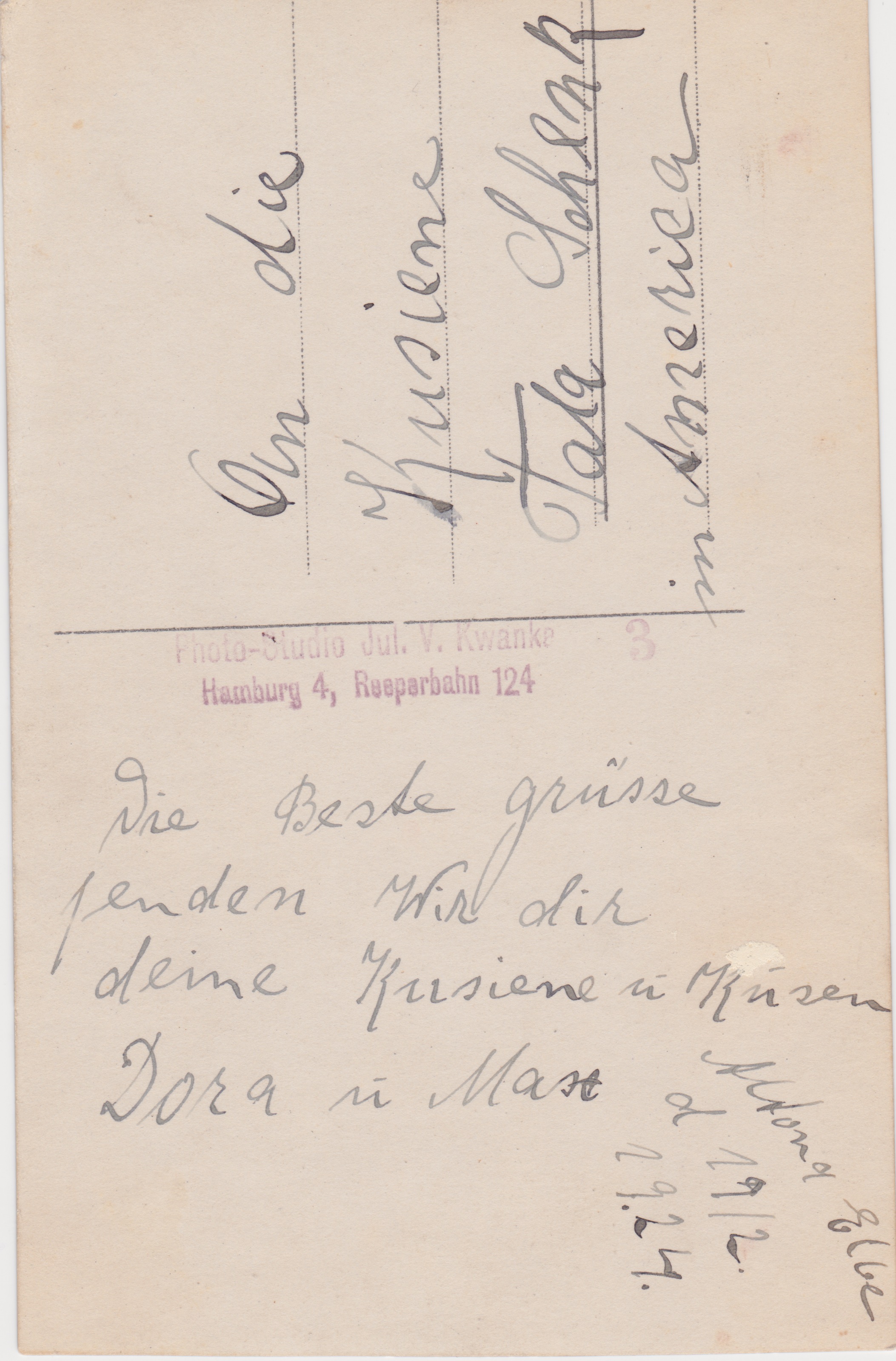
The back of the photo with the inscription. The back of the photo with the inscription.

So to open this album and see a photo of Dora and her husband from 1924 almost breaks my heart. A photo inscribed to my grandmother: “Die Kusiene Taba Schenk in America, Die Beste grusse fenden wir dir deine kusiene   Dora and Max 11/2/1924.”

Taba Schenk, Tova Szenk, my grandmother’s maiden name. My grandparents married a few months later, and my grandmother became Tova/Thelma Amsterdam.

In the photo, Dora is a young woman, but she looks just like the woman I met so many years ago in a hotel in Tel Aviv. She is not as old of course. But the face is the same. She is cleared eyed holding on to a long strand of pearls, her husband sitting next to her.
Dora’s life changed with the war.   But she survived. She had children and grandchildren. And eventually reunited for a visit with her kusiene Tova.

About the photo album:

https://zicharonot.wordpress.com/2014/08/19/old-photographs-bring-memories-to-life/

https://zicharonot.wordpress.com/2015/06/13/finding-katie/

An earlier post about the trip to Israel with my Grandma:  https://zicharonot.wordpress.com/2014/04/28/speaking-yiddish-always-brings-me-holocaust-memories/

Finding Katie!

13 Jun

When my maternal grandmother immigrated to the United States in 1922, she was sponsored by her father’s sister: her Aunt Gussie. I wrote about this in another blog, which I will reference at the end.

Grandma became very good friends with her first cousin, Katie L. They remained friends throughout their lives, even though they did not live near to each other. But the letters and phone calls seemed to keep their love for each other in tact.

Katie’s married name was Katie Alexander. That is the name we always heard, and this was the name we thought of when we spoke of Katie. It was so ingrained in our lives.   Grandma loved her cousin, Katie; she spoke of her often!

I think my sister was the most in love with the name.   She named her son, Alexander. And four years later, she named her daughter Katherine, or Katie. My Mom at first said, “How can you name her Katherine?” My sister was naming her daughter after my grandmother, whose name was Thelma in English/ Tova in Hebrew.

My sister reminded my Mom that Katie was Grandma’s friend and cousin. And since she did not want to name her daughter Thelma, she thought she would use Tova as the Hebrew name and Katie, Grandma’s cousin’s name for the English.

I laughed. I often tell my sister that she named her children for Katie Alexander. And so the name stays alive in my family.

Album

Last summer, while we were cleaning out the attic of the Catskill’s home that had been both our grandparents and parents, we found an old brown leather photo album. It was filled with photos from the 1920s. Many had no names. Some had Yiddish or Hebrew writing on the back. Some had just an address or a place.

Grandma:Katie

But within the photos was a photo from 1924 of Grandma and Katie. That was it. I decided I had to find out what happened to Katie Alexander’s family. Thanks to the Tracing the Tribe Facebook group, I now have that information. The wonderful members of the group found members of Katie’s family for me. And then I contacted them.

I have been in touch with one of her sons, a niece and a granddaughter. I have found out that another name we often heard in our home was Katie’s brother. We never knew Katie’s maiden name. She was always referred to by her married. But I realized after I send them some photos, that the Sam L. that my grandmother spoke was Katie’s brother. WOW!

I am hoping that they will be able to identify more of the photos in the album so we can put names to those nameless young men and women who were so important to my grandmother. I am so happy we were able to find Katie.

https://zicharonot.wordpress.com/2014/05/29/grandma-thelma-knows-what-she-knows/

https://zicharonot.wordpress.com/2014/08/19/old-photographs-bring-memories-to-life/

My Family’s Holocaust History Impacts My Observance of Rosh Hashannah

13 Sep

As Rosh Hashannah approaches, I have a new view of my family’s heritage, a new reality that will impact my observance and prayers this year and in all future years.

It started with a Facebook Group called, “Tracing the Tribe.” I actually was able to find a family member due to a blog I posted about my grandfather’s family history and his town in Austia/Galecia called Mielec. I met Susan when I was in New Jersey this summer. It is actually her husband who was related to me.

We spoke about the family and how we might be related. I actually found the connection. My great grandfather and her husband’s great grandmother are probably brother and sister.

She emailed me a testimonial written by her husband’s first cousin, “E”, about her Holocaust experience. “E” survived the Holocaust and settled in the USA. In this memoir, “E” recounts a story about the Jews of Mielec and how they died. She wrote that 600 were rounded up and burned alive in their synagogue. She received this information from relatives in Mielec.

What! I was somewhat stunned. No one had ever mentioned this to me before. Whenever there was discussion about our family who died, we were told that they were burned alive in the fires of the Holocaust; or that some had died in Auschwitz; or that my great grandmother had been hidden and then murdered by the people who had stolen the family farm. But this story was never mentioned. Never.

But I remember thinking, when my Mom would tell me that our family was burned alive, that in the crematorium, the people were dead before they were burned. Weren’t they? So why would I be told that they were burned alive? Could this be what happened?

My Grandfather never talked about his family. He lost almost everyone who still lived in Europe: his parents, siblings, nieces and nephews, aunts and uncles, cousins. Everyone! Only a few cousins survived. When I finally got him to talk to me and tell me about his family, he was vague when talking about the Holocaust. He would tell me a little about life when he was a boy. But he did not like to mention the names of the dead.

When I found out that Germany was giving money to those who could prove they had owned property, I suggested that he apply to get money for the family’s farm.

He was furious. “Will this money bring back my mother and my father?” He yelled at me. “Will this money bring back my brothers and my sisters and their families? NO! NO! I don’t want their blood money! Let them keep their blood money!”

I can still hear him yelling at me. So I stopped. I never asked again.

My mother told me that a relative, Zissle Feuer, came from Europe and told my grandfather what had happened. And then my Grandfather contacted the Red Cross. Everyone was confirmed dead. My mother was about 16 when they found out that everyone died. She said that every morning when my Grandpa came upstairs from the bakery she would hear him cry while sitting at the kitchen table; sobbing over the loss of his family.

Now I read this testimonial. What is the truth? How did they die? “E” was not there. She only heard about it. So I looked through all the papers I had gathered through the years. And I found one document that I guess I never read entirely. I just read the part about the city of Mielec before the war. I never read the section that was call Holocaust Years. Because there it states, halfway down the page, that on September 13, 1939, on the eve of Rosh Hashannah, 20 Jewish were pushed into a burning synagogue. If they tried to escape they were shot. Then the German soldiers put Jews into a slaughterhouse and set it on fire. Then they went to the Mikveh and killed Jews there. On the second day of Rosh Hashannah a second synagogue was set on fire.

So many burned alive on Rosh Hashannah. I do not know if it was 600, but even one is too many. What a horrible death!

How can I ever see Rosh Hashannah in the same way again? How can I understand that on this holiday my family might have been murdered, burned alive. Up until September of 1939 there were 4,000 Jews living in Mielec. When they were deported in March 1942 only 2,000 were still alive.

Did 600 get burned alive in the four buildings set ablaze during Rosh Hashannah of 1939? Did my great aunts, great uncles and cousins suffer in those flames? Did my great grandfather die there? Is this why my Grandfather could never talk about it? Did he know that is how most of his family perished? When my mother said they were burned alive, did she know as well?

Was it just too horrible to tell us?

Mielec, the home of my family, was one of the first to be totally depleted of its Jews. This report said only 200 Jewish people survived the war: 200 out of 4000. I know that four of them were cousins of my grandfather. I met them all: one settled in Montana; one in England; two in Israel. They have all since passed away.

On Rosh Hashannah we chant the Unetanah Tokef.   It is a prayer that has always made an impact on me. But this time when I read “who by water and who by fire,” I will be wondering: “Who died this way? Who?”

And I will chant Kaddish.

I believe Mystically and Magically Great Grandma Chava Watches Over Me

22 Aug

Chava Amsterdam

Even though I was born long after the Holocaust ended, I have a connection that defies logic. I am named for my great grandmother Chava. She was hidden during the war and was murdered when she returned to the farm her family owned by the people who occupied and stole it. I have been told that she was shot in the head.

I learned about her when I was 11 years old. Before that I only knew I was named for Grandpa Nat’s mother. And that was all.

But when I was 11 years old, living in North Bergen, NJ, I had a major fight with my younger sister. I ran after her screaming, “I am going to cream you.”   As she ran away from me, I felt a giant tug on my pony tail. My gentle Mom was dragging me to the sink. “Never use that word in my house. Never. They burned your Grandpa’s family alive in the fires of the crematoria of Austzvitz. You will never use that word in my house.”   And then she put soap in my mouth. I have never, ever forgotten that.

I never even thought of the slang word, “cream” meaning ‘to kill,’ had anything to do with the holocaust. But in my mother’s mind it meant crematoria. And perhaps she was right. I have not found a reference for it. But it does not matter. What it did do was open up a conversation.

My Mom was the gentlest person around. For her to do this, something horrible must have happened. And so I learned about the Shoah. I learned about my grandfather’s family and how they died: some of it, not all of it. Some came later.

But mainly I learned about Grandma Chava.

I thought about her so much, I started speaking to her in my mind. When I was worried about something, I spoke to her. When I was scared, I spoke to her. I knew she had been through so much that perhaps I could gain strength from her. And she would not let that happen to me. One generation was enough. When I was worried, I imagined her near to me.

When my son was little and afraid to sleep alone at night, I once told him that there are angels guarding him. And I mentioned my great grandma. I will admit this backfired. When my son was about 8 we went to see a production of “Footloose.” When they sang the song with the lyrics, “Somebody’s eyes are watching you,” he had to leave the theater. He told me he thought about my great grandma and her watching him. So I changed that image for him.

But for me, thinking of my great grandmother was always helpful. I did not think about how she died or what happened to the family. I thought that she would never let it happen again.

Often my Grandma Thelma, who had spent six months living with Grandma Chava in Europe, would say, “You are so much like Chava. She also was shreier or a machshafer or chachama.” Whatever she wanted to compare me with that day.

But basically Great Grandma Chava was a strong-willed person, as was I growing up. And I think I still am.

Because I was named for Grandma Chava, I was given jewelry that was hers and embroideries that she made. I now have a picture of a bird she embroidered hanging in my dining room. I was given the matzah cover she made for Pesach, which I have since donated to a museum. (See my blog: “Watching Antiques Roadshow Inspired Me to Donate my Great-Grandmother’s Matzah Cover.”)

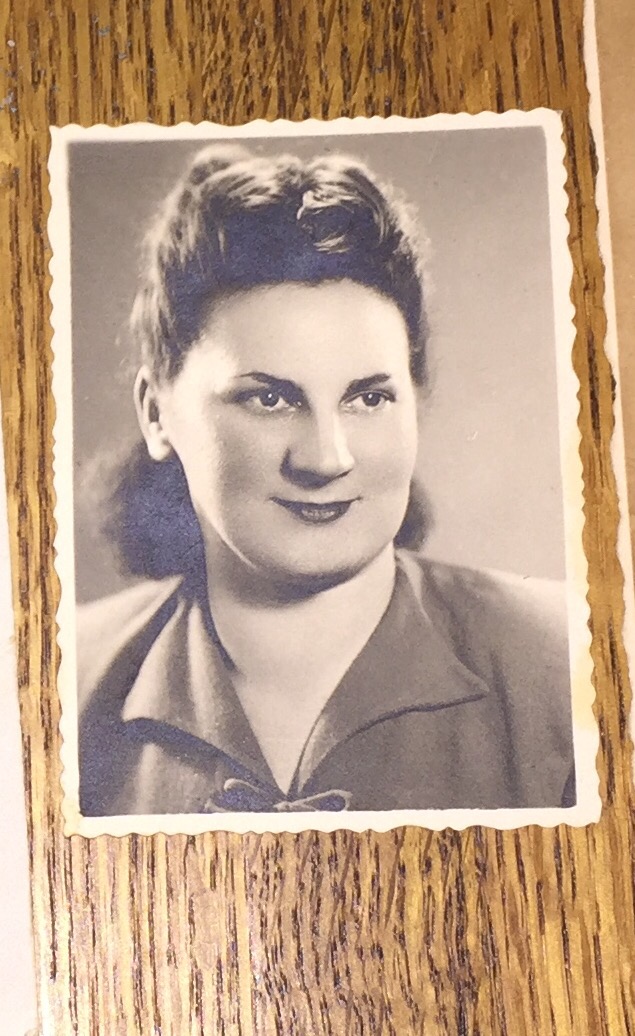
Recently we found a photo just of her. My Grandpa looked like his mother. My brother looks like her. One of my nieces looks like her. And I held her photo up to my daughter and there is a resemblance as well.

As for me, I look like the determination you can see in her face. She is staring straight at the camera, and in my eyes she is so strong.

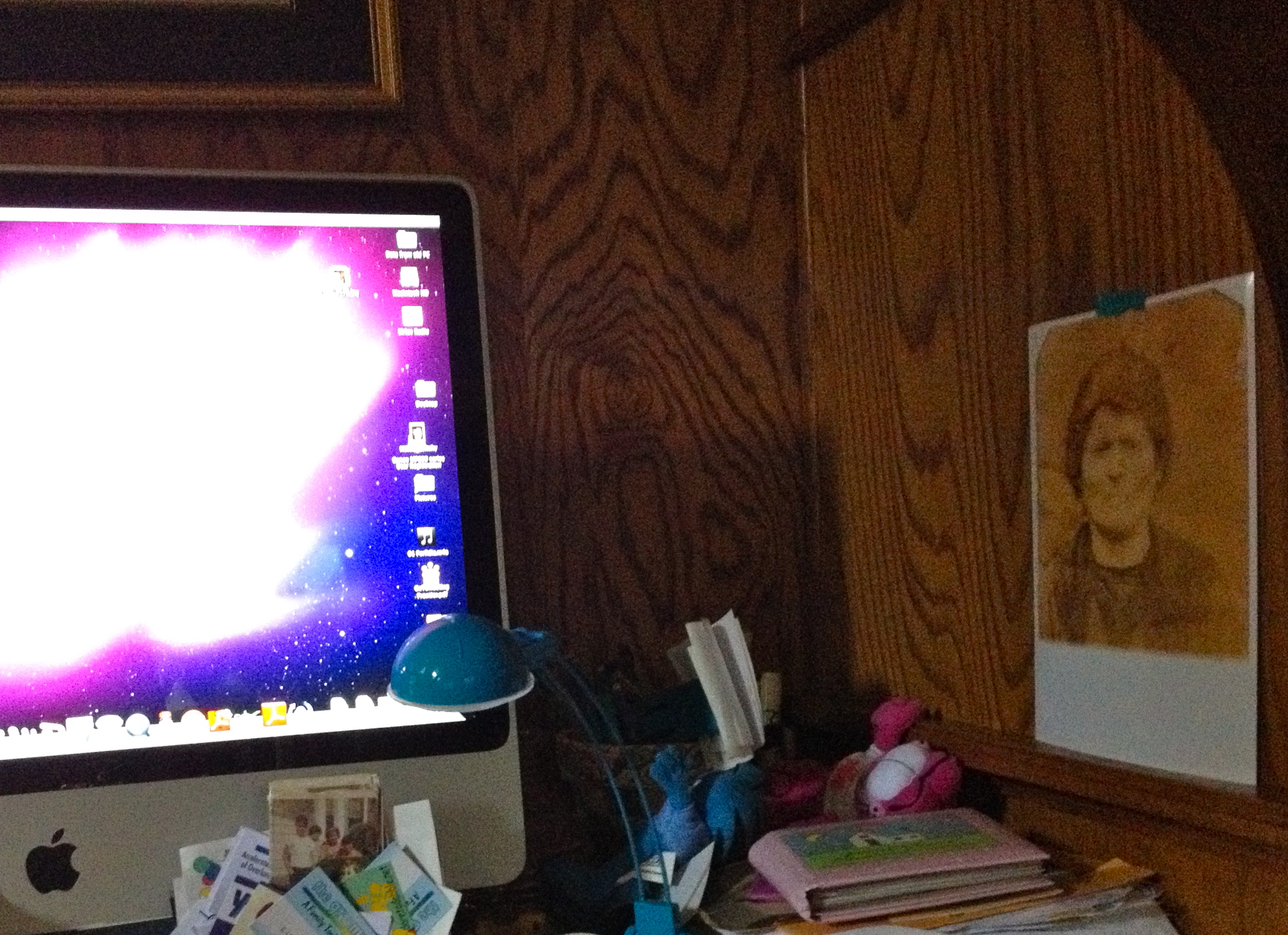
My desk with Great Grandma Chava watching.

My desk with Great Grandma Chava watching.

I enlarged the photo and hung it by my desk so I can see her whenever I am working. Because I always have and still feel that she is my guardian angel. We share the same nechama, the same essence.

Almost all of her children and grandchildren died in the Shoah, except my Grandpa and his family because he was in the USA. There were no grandchildren till years after the Shoah. My older boy cousin was named for my great grandfather, who also perished. And I, the oldest girl, was named for Chava.

So I sit at my computer working. And I turn my head slightly to see her. The world of magical thinking makes me believe that she knows we survived. That she knows her great-great granddaughter has moved to Israel. That she is not only looking over me, but also over my daughter.

As rockets fall in Israel, I think, ‘never again.’ Another Chava cannot lose her daughter to the hatred of anti-Semitism. And I believe, mystically and magically, that Great Grandma Chava is watching my daughter as well. And I feel her ruach, her comforting whisper. All will be well.


Schreier: screamer/yeller

Machshafer: witch

Chachama:  Smart one/intelligent

Nechama: soul, essence

Ruach: wind, spirit


http://lyrics.wikia.com/Footloose:Somebody’s_Eyes


Old Photographs Bring Memories to Life

19 Aug

My siblings and I recently spent a weekend together cleaning the attic, basement and garage of a house in the Catskills that our family has owned for well over 50 years.   And although our parents made an effort to clean out some of our grandparents’ items when they inherited it, it still was quite full.

It has been a process. This was our final weekend of cleaning. My brother with some help from his son and a friend, had already moved out the old metal bungalow furniture and moved in furniture from our parent’s apartment.

We had cleaned out clothing and personal items. We had moved out some items that we wanted in our respective homes. But now it was time to get rid of the stuff that had just collected and decayed over time.

My brother ordered a 20-cubit yard dumpster that he demanded be filled by the end of the weekend. My sister and I thought he was crazy. There was no way we would have that much junk. We were wrong. And it was, amazingly, filled. The house is now in order. Clean, organized and ready for us to use it. We had a feeling of accomplishment by the time we were done.

Two of my nieces were there as well. And the four women, my sister and my nieces and I did the heavy emotional work, we went through thousands upon thousands of photos. We sorted them for each family. We made piles for our cousins. There were some we just discarded and put into the dumpster. And then we put together the ones we all wanted for me to take home and scan into my computer, for I am the family archivist. I will make digital copies and send them out to everyone.

Front Great grandpa USA Visa

The treasures we found included our great grandfather’s passport and 1936 visa to come to the USA from Poland. Our grandparents worked diligently to get the paper work accomplished to bring him and my great aunt to the USA. It saved their lives. My Mom would tell the story of going to Ellis Island with my grandparents to get them when they arrived from Poland.

Years later, when my children were little, we went with my parents to Ellis Island. My Mom asked, “Where are all the cages?” The main room was a large empty space. But on the wall were photos of what the room looked like in the days it was in use. And the metal bars between lines of people could have looked like cages to a child. We think that is what she saw.

In the bags and albums, we found photos of people in Europe from before the Shoah. And wondered how many of them perished? We found photos of our great aunt Tova and our great grandmother Chava. Photos we had never seen before. Our great grandmother is young in this photo. My brother and niece have her mouth. We know they both perished, along with many other family members.

Photos of our parents taken in Hudson County Park, North Bergen, NJ, in the 1960s were also a rare find. They were dressed up, obviously ready to go out somewhere. Mom even had white gloves on… white gloves and a sort of ‘mini’ skirt: an interesting combination; a transition between two generations, two styles of dress. There are no full skirts here.

We found pictures of our aunts and uncles from both sides of our family, grandparents, great aunts and uncles; photos of us and our cousins when we were little. They were wonderful finds. We even found three photos taken during the Woodstock weekend in 1969. We thought all of them had been lost years ago when my Dad tried to mail them to me and the envelope broke while in route.

My nieces loved one photo in particular, of my brother, sister and I when we were in our teens. We hate it. But the girls wanted to keep it as ‘blackmail.’

We found wonderful documents: the list from our parent’s wedding; some of Dad’s school papers, and his army paper, a telegram he sent his parents from the army. One of his school papers said he was in the choir in high school. We all laughed, Dad could not carry a tune!

Grandma Thelma graduation from night school she is second in middle row

A favorite was group photo of our Grandma with the other students, when she graduated from night school, after immigrating to the USA in the 1920s.

The attic held a bonanza of information! We actually thought we had found it all because previous cleanings we had found 8mm movies that my brother had turned into DVDs and other photos that I had used to make a book of family history.

But the most amazing find was a photo album of my grandmother from before her marriage. There was one young woman in many of the photos with Grandma. We were sure it was her best friend and cousin, Katie. But there were no names written on any photo. It was so frustrating. But then we found a more recent photo with my grandparents and another couple. In this one the woman was identified. And yes it was Katie. My sister and I were so excited!! When we compared her face to the young women in the photos we knew that we had discovered and identified our lost relative.

There are many photos in the album that were taken in Europe. On the back many are inscribed to my loving cousin, Tova, in Yiddish and in German. I think they are photos given to her before she left Poland for the United States in 1922.

I have that album with me now. I am going to try to match some of the unnamed people with photos that we have where people are identified. I have already found photos of my grandmother’s siblings.

It is a puzzle, and I am determined to make as many matches as possible because these old photographs bring my grandparents’ and parents’ memories back to life.


How World War I Saved My Family or My Grandpa Was A Draft Dodger

25 Jun

World War I changed the world! One hundred years ago, Europe became a place of desolation and devastation. Young men from both sides were killed. Millions perished. From all I have read, it was horrible. The use of gases so horrific that laws were later passed banning the use of these and all future chemical weapons. We know that sometimes they are still used. But the world peoples are united against them.

For my family, World War I actually saved my branch of a family. My Grandpa Nat, you see, was a draft dodger.   As he would explain it to me, Jews in Galicia did not really have a chance in the military. They were often put in the worst positions, meant to die. And if they survived, they were conscripted for 25 years. So they never were able to live a Jewish life or return to their families again.

In 1918, when my Grandpa was about 18, his life changed; he received the dreaded notice that he was to report for military duty. It sent his family into action. Nissan, as he was known in Europe, had to be smuggled out of Galicia to save his life.

Thus began my Grandpa’s two-year journey to salvation and survival. He left his home in the middle of the night with just those things he could carry and wear. His intention was to get to British Mandate of Palestine and join the efforts to create a Jewish homeland. But his first goal was to get to his cousins in Belgium.

He wandered through Europe during the battles of 1918 and the aftermath of the war. Slowly making his way to Belgium. He had no real passport. Instead he was using the passport of a dead cousin.

Eventually he made it to Belgium and his cousins. Their reaction to his wish to travel to Palestine was, “Why go to Palestine? It is a desert! Go to the United States, to the Golden Medina. You have an Uncle there. He will help.”

So my Grandpa contacted his Uncle Julius, known as Uncle Yidel to us all, his mother’s brother. Uncle Yidel agreed to sponsor Grandpa to the United States.  But he had one problem, he had been robbed along the way and had to work to earn the money to pay for his trip to the United States.  But finally, after about nine months, the last leg of his journey began. Fortunately for him, his uncle did sponsor him, because when he arrived in the port of New York City, and the immigration site of Ellis Island, he had just a nickel. Without a sponsor he would have been sent back to Europe.

Grandpa often would tell us that we could be whatever we wanted to be. “Look at me,” he would say. “I came to this country with just a nickel in my pocket. And look at what I have.” So we learned early on not to complain to Grandpa and to never give up!

I tried finding my Grandpa’s immigration information from the Ellis Island sites, but could find nothing. My Grandma’s was easy to find. So I often wonder what that passport actually said. And how old he was supposed to be? But in 1920, immigration procedures were not as intense and documentation was not as precise as it is now.

Tanta Molly and Uncle Yidel

Tanta Molly and Uncle Yidel

Uncle Yidel and his wife, Tanta Molly (also known as Malchik)  welcomed Grandpa.

Growing up in Europe, my Grandpa had been a yeshiva brocha, a student of Torah. He had a beautiful singing voice, and perhaps might have been a cantor. But instead, somewhere along the way, he learned to be a baker. When he first came to New York, he worked two jobs. One as a butcher, the other as a baker.  But it is as a baker that he prospered in America. He and Uncle Yidel started a bakery eventually owning a building in New York City. (My Grandma told me that when Grandpa proposed he told her he had a place. She thought he rented an apartment. She did not realize he owned the building!)


Grandpa in his bakery in West New York, New Jersey, 1942.

Grandpa in his bakery in West New York, New Jersey, 1942.

They separated the business after my grandparents married, and Grandpa and Grandma opened a new bakery in Linden, New Jersey.  But in the early 1930s, when my grandmother took their children to Europe for six months, Grandpa sold the bakery in Linden and opened a new bakery in West New York, New Jersey.  He kept this bakery for over 35 years.

Grandpa had many cousins in the United States. His parents were first cousins. So he was double cousins to many of the family. They helped him settle in. But Uncle Yidel was the most important. Uncle Yidel and Tanta Molly were always a part of our lives. They had one son, Ezra.

Whenever we went to see them, we were welcomed in Yiddish. Tanta Molly would come running out to hug us. She would call out our Jewish names: “ Tovaleh, Fagaleh, Chavaleh!” I asked my Mom, “Why does she put an ‘aleh’ on all our names?”

“It means little,” my Mom replied. “Well that did not make sense, Tanta Molly is littler than us!” Was my response. “It means she loves us,” Mom laughed as she said that. Later I found out the ‘aleh’ did mean little, but really was an endearment.

My Grandpa always missed the hills of Galicia. He often told me that he bought his property in the Catskills because it made him think of his home and his childhood. Many years latter when I traveled to that part of Europe, I saw he was right. The rolling, low mountains and hills do look like the Catskills.

My Grandpa forever missed his family. World War I did save him. He came to the United States. But his parents, siblings, and many aunts/ uncles/cousins stayed in Galicia. They all perished in the Shoah.

My Grandpa Nat was a draft dodger, but he never stopped fighting for the right to practice his beliefs and to protect his family in the USA. He loved America. He never traveled outside of the United States. When asked, his reply was always:

“Why would I ever want to leave here? It is the best place in the world.”