Archive | Memories RSS feed for this section

The Kauneonga Lake Temple BethEl Recipe Book

12 Aug

I found a treat today. I decided to clean out my cookbooks. My daughter is getting married in a few weeks, and I am in a nesting mode. Sort like when I was pregnant. Now I am cleaning out my house and getting ready for hordes of guests.

I decided to clean out my cookbooks. There are many I have not used in years. I offered some to my daughter, but she informed me that she gets her recipes off the Internet. Fine. She does not want my cookbooks! I will give them to someone who wants them. And will appreciate them. But there are a few I will keep!

I like cookbooks, especially because some have much meaning and memories. I have my mother’s Settlement Cookbook. Probably the best cookbook ever made.   I have kosher cookbooks, healthy cookbooks, vegetarian cookbooks, light meal cookbooks, as well as a variety of cookbooks put together as fundraisers by various charitable organizations.

image

It was in the midst of these spiral notebook style cookbooks that I discovered a tiny treasure, “Cooking Favorites of Bethel,” put together by the Sisterhood of Temple Bethel, Bethel, New York. This is the congregation I belonged to throughout my childhood when we spent our summers and High Holidays in the Catskills. My grandparents lived in Kauneonga Lake throughout the year and davened at this small shul. I rejoined many years later as an adult to help support it.

I know this book is at least 35 years old, because my grandmother died in 1981. But it has to be older, based on the names of some of the women who contributed recipes. They passed away before my Grandma Thelma, like Clara Wagner. I close my eyes and I see Clara. She was Grandma’s best friend.   They spent many hours sitting and visiting. My Grandma was heartbroken when she passed away.

Then there is Nan Dasher, besides cooking, she would embroider tablecloths. Which she did constantly. I have two tablecloths she made. One specifically for me when I married, and one I took from my mother’s stash after Mom passed away. Nan lived in the White Lake Estates, not far from my grandparents.

So many other names of women I knew when I was a child submitted recipes: Lenore Liff, Yetta Gruber, Mrs. Elfenbaum, Goldie Lerner, Rebecca Rosenberg and more.

But the most exciting and enjoyable for me was finding my grandmother’s name in the book. Thelma Amsterdam contributed four recipes. HA! These recipes are a sort of lie! Grandma did not cook. Okay she cooked but not very well.

I still remember the trauma over this cookbook. Grandma had to submit recipes. She was an important member of the Sisterhood and needed to show she cared. I remember her coming to my Mom to get recipes. There they were sitting in the kitchen and writing down recipes that Mom gave her. The recipes that have my Grandma’s name, every one of them is from my mother. There is my Mom’s simple baked macaroni recipe. I still make it!!!! Even though I cannot eat dairy I have made it for Yom Kippur break the fast, and for shivas. It was so easy! However, Grandma NEVER made this meal.


recipe

So when I saw the four recipes she submitted I was filled with the laughter of remembering Mom giving her the recipes. I was filled with memories of my Grandma’s horrible cooking, although she could make the best mushroom barley soup and Pesach noodles. And I remember this book being put together and then published.

I should also tell you that this book is in perfect condition. I don’t think my Grandma ever opened it after she purchase in the effort to support the congregation and its sisterhood.

I honestly do not know when I got it. But I have a vague memory of Grandma giving it to me when I got married. Okay, I never used it either. It is so small it got hidden among my other cookbooks.

I am glad in a way, because now I have this tiny memory in such pristine condition. With it are many memories of Kauneonga Lake and going to shul!
Forks in the Flower Pots; Or Why I Keep Plants By My Kitchen Sink

10 Aug
image

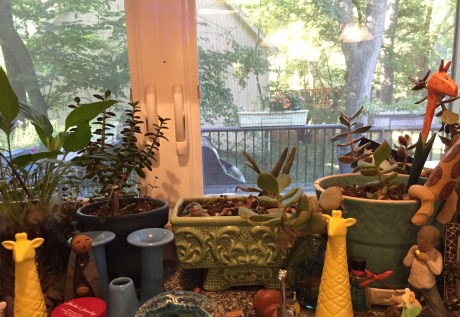
My kitchen window with my grandmother’s planter is the green one in the middle.

Above my grandparents’ kitchen sink in West New York, New Jersey were a variety of flower pots filled with plants.  But often interspersed among the plants were utensils.  Usually forks, but sometimes knives and spoons.

image

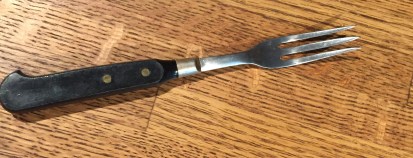
I own one of my Grandparents’ goupls.

When I was very young I remember thinking that my Grandma was special as she could grow metal in her pots. I especially wanted her to grow more of the special forks we called goupls, that we used in her home.  They had really thick and interesting handles. I thought goupl was a special name for this fork. We did not call the other forks, goupls, just these forks.  I found out when I was older that goupl is Yiddish for fork.

Usually standing upright, prongs in the dirt, were two or three forks each day. Amidst the plants the glow of silver.  Why?  My grandparents kept kosher. Meat and dairy is kept separate. My grandparents had utensils for milk meals and another set for meat meals. If they touched when they were wet, they had to be rekashered….made clean to use again.  One way, according to my Grandma,  is to bury it for 24 hours.  Grandma buried it by sticking the unclean item in a flower pot.

In reality, I think this was my grandmother’s interpretation of ne’itzah, a type of koshering for knives when you push them in dirt several times. Grandma just kept any utensil buried and unused.

My mother also kept plants in her kitchen at our hoe in North Bergen. But she did not keep kosher so there were never forks in the flowerpots. However having the plants was important to both my parents.  My Dad was always potting and repotting plants.  Plants freshen the air of your house according to my Dad. So besides helping to keep kosher, plants keep you healthy!

When I married, my husband and I decided to keep a kosher home. When we purchased our house a big draw for me was the window ledge above the sink.  A wonderful place for plants. But to be honest, I very rarely have put a fork or spoon or knife in a flower pot. However, they are there in case I need them.

image

My mother-in-law’s aloe plant.

Besides my kitchen sink plants, I have other plants including an aloe plant that is over 50 years old.  I have had it for 31 years. But before that it was my mother-in-law’s kitchen aloe plant.  I inherited when she passed away at only 59.  Aloe plants are important in the kitchen. My parents also had one.  If you burn yourself, you can quickly go to you aloe plant and break off a piece of a leaf. The thick goo is a healing source for burns.

Plants in my kitchen remind me of my grandparents, parents and in-laws.  Although I might not have forks in my flowerpots, I do have one of my grandmother’s flowerpots on my sink window.  My daughter is getting married in a month.  She has a window above her kitchen sink.  I plan to buy her a plant as a housewarming gift so she too can have flower pots in her kitchen.

Stunning Majesty of Glaciers

14 Jun

Each time I am in the presence of the stunning majesty of a glacier, I am aware that nature’s beauties outshine many man-made structures. 

The first waterfall as we traveled the fjord.


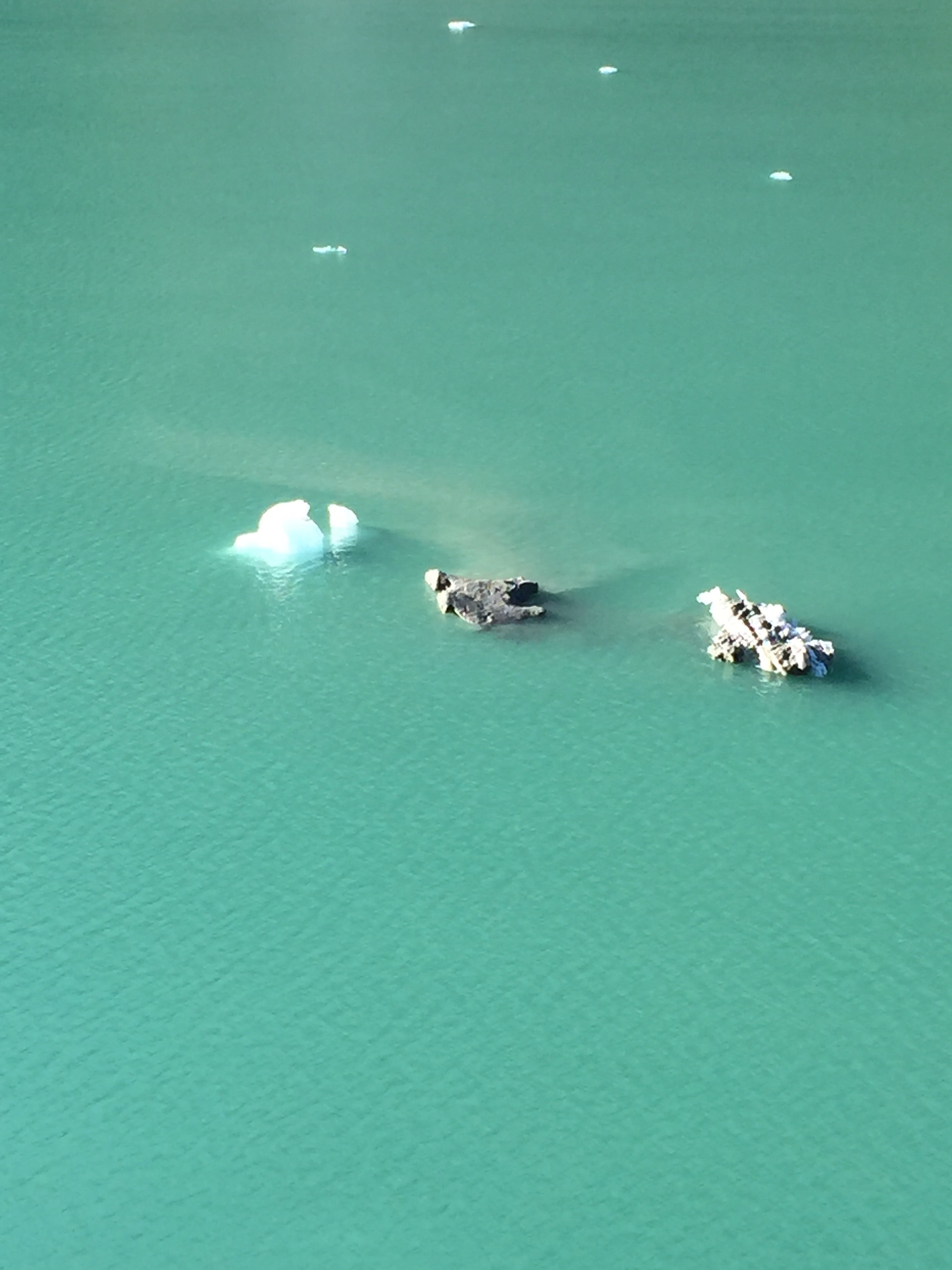
As we sailed into a fjord in Alaska early this morning I was watching for the signs that a massive glacier was near. First were the signs in the water:  the change in the color and texture. Once smooth, now choppier with thin ice. Then came the first, now tiny, ice floe making its way down the channel. 

Soon I heard the first sounds. The Wild Rush of water as the summertime waterfalls of gushing water streamed from the ice fields high in the mountains. I watched as the pounding water made its way into the fjord leaving swirls of water as it entered.  Later you can hear the moaning of the glacier as it moves forward down the mountain. Sometimes you can see and hear the crash as giant sections of glacier calve into the water. 

Ice floes traveled down the channel to greet us.


Soon larger and larger ice floes floated along side the ship. Not the size of an ice berg, but still sharp white and Aqua blue structures shimmering in the sunlight.  They can be dangerous and the ship shows respect by moving ever so slowly down the channel. 

I have been blessed to have seen glaciers in Alaska in 2002 and now today. Four years ago I traveled through the Straits of Magellan and experienced the cold of the glaciers there as well as we winded our way from Chile to Argentina. 

But now, in Alaska, I began to feel the cold wind that comes off the glacier. Even with a coat and gloves, even with the sun shining, I felt deeply chilled. 

My first view of Daws Glacier.


Then the ship made a small turn. Up ahead I saw the glacier filling my view. Its face jagged and tall as it met the water. White and blue with streaks of broken rock within that looked like stripes of dirt. But are really the crushed stone and silt pounded by the relentless force of the glacier. 

The glacier fills the end of the fjord.


Seeing a glacier in a bay is different then seeing it more inland ending in a lake like the Mendenhall Glacier in Juneau. I saw that glacier first in 2002 and then again two days ago. I was shocked by how much it had retreated!  There was even a time-lapse movie of how it has changed from 2007 until now. Imagine six years more of melting! Hundreds of feet of glacier has disappeared. Diminishing it!


The park ranger told us how global warming and the use of fossil fuels is changing the glacier and Ice fields in Alaska. There is hope as we move to renewable energy. But if you saw the glaciers, you would know the change is real. 

As the glaciers recede in Alaska another increase occurs. As the weight of the glacier diminished the land actually rises in rebound. 

When we first came to Alaska 14 years ago we took our children. My then 11 year-old son was impressed at first with the Mendenhall Glacier. But later in the trip when I woke him early in the morning to see the majestic glacier in Glacier Bay, he was a snarky pre-teen, who commented: “Seen one glacier, seen them all.” This became a major joke in our family, but it is not true. 

Each glacier has its own beauty. If you ever have the opportunity, come to see a glacier. The ones within the continental USA at Glacier National Park are almost gone. Only in Alaska can you still see them. 

Do not miss the stunning beauty of a glacier. 

The Mysterious Kalsbad Photos: Who Are They?

6 Jun

June 26, 1931. My Grandmother was in Europe with my Mother and my Uncle. She left them at the farm owned by my great grandparents in Poland while she went to Karlsbad (Karlovy Vary), Czechoslovia to take the waters and revive her health.

The doctors in the United States told her that she was going to die. She had been pregnant again in the USA. But doctors terminated the pregnancy through a very illegal abortion in an effort to save her life. But still she was sick. So she decided she would not burden my Grandfather with two young children, 5 and 2. She would take them to Europe to live with his parents and she would die there. He, then, would be free to continue his life.

I once asked my Grandfather, why he let her go. “She was a sick woman,” he told me. “I had to let her do what she thought was best.”

“Would you have left Mom and Uncle Stanley in Europe?” I asked. This was a very important question. His entire family perished. If he had left them, I would not be here.

He looked me in the eye, and said, “As soon as she died I was going to get on a boat and return with my children. I would never leave them there. “

His words made me feel a bit better. But if Grandma had died the world my Mom and Uncle lived in would have been very different. But at least I know my grandfather would not have abandoned them in Poland.

Luckily Grandma did get well. She stayed in Europe for six to eight months and then returned to the USA with my Mom and Uncle. She saw the rise of Hitler coming and now had a new purpose: get the family out. She could not save as many as she wanted. But she tried.

Grandma Thelam, Carlsbad

Grandma is sitting in the front. The date and place were added by my Mom. I think the two women are related. This is the photo we knew about.

We have several items from that trip to Europe. We have a ceramic vase that stays in her breakfront/curio cabinet in our Catskills’ home. We have stories about the trip.  We have a few photos. We knew of one. Grandma is with two other women. We have no ideal who they are. But I think they are related to her, one women sort of looks like her sister-in-law. We are not sure. There is no identifications on the back.

But I recently found another.

FullSizeRender (10)

Grandma is in back row on the left wearing a white hat.

It is a group photo. In the very back row, near the center is a woman in a white hat, that is my grandmother. She is 26 years old.

I do not know the other people. Are they family members who perished? Or are they just other people who are in Karlsbad? Sometimes I imagine that they are just other people at the resort who were pulled together for a group photo that the photographer would then sell to tourists.   Other times I imagine that people in the photo look like family, especially the man in the front on the left. But I honestly do not know.

This photo is different from the others we have from that trip. There is writing in Yiddish and English. The English is easy, her name and the address where she stayed in Karlsbad. Or is it a place she visited?

The Yiddish is more exciting to me. It is the only letter I have seen that she wrote to my Grandfather. (Thank you members of the Tracing the Tribe Facebook Group for translations!)

It says: “As a souvenir from your faithful wife, who hopes, to meet you again in good health.” Another translated it as “A souvenir from your devoted wife, who hopes to return to you in good health.”

Either makes sense. She was sick. She was away from my grandfather. She wanted to be reunited with her family and be healthy.

And that all happened. She returned to the US and lived an additional 50 years. And 80 years later, I keep finding treasures in her photo album!


https://zicharonot.wordpress.com/2014/04/28/speaking-yiddish-always-brings-me-holocaust-memories/

Remembering Our Bodies, Ourselves Thanks to an NPR report

2 Jun
My original Our Bodies, Ourselves Books

My original Our Bodies, Ourselves Books

Listening to NPR while driving in my car is a joy. Almost every day I find out something new. Today while driving I listened to a program about Our Bodies OurSelves, and how it was saved through internet crowd funding. Robin Young, of “Here & Now,” spoke to the new executive director, Julie Childers, who went to college in Tulsa, Oklahoma.   That made me laugh. The new ED of  the “Our Bodies Ourselves” organization went to college in what is now a state worse than Kansas. Ugh! Oklahoma has not been very good to women’s issues. Maybe that is why she is working on this important book.

In any case, when I got home, I pulled out my 1976, second edition copy of Our Bodies, Ourselves and my 1978 first edition of Ourselves And Our Children.   There was still a paper napkin marking a spot in the book that I obviously felt was important.  I was 21, and a college junior when I purchased my copy.

For those of you who might not know, before Our Bodies, Ourselves there was a dearth of information for women about their own health issues. The medical field seemed to be ruled by men, who did not really understand women’s health issues. I, personally, had horrible time during my menstrual cycles. And was told as a young girl that it just me. And I should get over it.

Years later, when I was in my mid 20s, I found out I had endometriosis, which was causing my horrible periods. I only found out when I was going to an infertility doctor who, even though was a man, truly helped women.  (There were some!)

To be honest, now I only go to women doctors for my major health needs. I grew up in a time when men really did not get it!

It was Our Bodies, Ourselves that helped me. I know I am one of millions, who must thank the Boston Women’s Health Book Collective and their work to help women learn about their own bodies, their sexuality and their health care.

Although I have not taken to the streets, I have been a strong supporter of women’s rights, and their reproductive rights, throughout my adult years. Our Bodies, Ourselves was my second awakening to women’s rights issues. My first occurred the day before my 18th birthday, when the “Roe Vs Wade” decision was announced.

The young women today have lived their lives not knowing the battles of the 70s and early 80s.   They do not have the workplace issues we faced. But most important, with the rise in so many more women doctors, they no longer face the condescending attitudes to our health care needs that we often faced.

I thank Our Bodies, Ourselves for this awakening of women’s health needs and the evolution of medical care.

http://hereandnow.wbur.org/2016/06/02/our-bodies-ourselves


https://en.wikipedia.org/wiki/Our_Bodies,_Ourselves


Holding My Grandparent’s Naturalization Papers Overwhelms Me

23 May


imageI have a small leather case that is inscribed with the words Certificate of Citizenship.  Enclosed are my grandparents naturalization papers that change them from immigrants to citizens.

I hold the papers in my hands and I wonder what my grandparents were thinking. Here are the legal documents that made them naturalized citizens of the United States of America. They were no longer Polish citizens. They were free of the past, or were they?

image

One paper is 84 years old.   My Grandmother became an American in 1932. She was 27 years old. I know she had just returned from a trip to Europe to regain her health and see her family and my grandfather’s family. She took her two small children, my mother and my uncle, with her for six months in Poland. And then she came home, a changed woman with a mission. Get as many family members out of Europe as possible.   Grandma was smart. She saw the coming tide of Hitler and his anti-Semitism. What would she think now with the new rise of hatred and xenophobia throughout the world?

The seal encompasses her photo. Her certificate has a small burn in it. The paper was folded when it happened. I can see my grandfather smoking a cigarette with an ash hanging off as it falls on the papers. I know my grandmother must have been furious. It looks like that type of burn to me. I am glad that my children have never seen a cigarette burn. When my father and grandfather smoked, papers often got singed.   But by the time my children were born, there were no more smokers in my family.

There on her paper is a space for Race. It says Hebrew. I wonder if she worried about that word on her papers? They were not yet putting yellow stars on Jews when she was in Europe. Even though she was worried, perhaps, being here made her feel safe enough. The good news is that 11 years later, when my grandfather became a citizen, there was no longer a space for Race. This item was removed from the naturalization papers. It makes me happy to see this change.

image

I wonder why Grandpa waited so long? He came to the USA in 1920. Did he originally think he would go back one day? Maybe. But the war probably changed his mind. He became a citizen in the midst of World War II — the war that destroyed his family. The war that murdered his parents and his siblings, his nieces and his nephews, his aunts and uncles, his cousins and his friends. Almost all perished. He did not yet officially know this in 1943. But perhaps he knew, since all letters stopped coming and there was no more contact with his family. It was not till after the war that he knew they had all died.

On this paper I see my grandparents’ signatures. I usually did not see it. To me Grandma only signed all letters Love, Grandma Thelma. Grandpa never wrote letters. In his later years, he forgot how to write his name in English. He only remembered how to write it in Hebrew. But here I see his signature. It gives me a thrill to see these names on these certificates.

image

On the back of Grandpa’s certificate of naturalization is an additional note. It was when he became an official citizen that he legally changed his name from Nisson to Nathan. He put away his Yiddish/Hebrew name and moved to an English name. This is the name I gave my son. Nissan, Nathan. He was born 11 months after Grandpa died. It seemed right that he should have his name.

By the time Grandpa became a citizen they had moved to the home they lived in for over 30 years. This was the location of their bakery in West New York, New Jersey. A home and a bakery where I spent many hours and enjoyed so much love. The same address where I spent the first three years of my life. Where my parents spent the first six years of their married life.

When I hold my grandparents’ citizenship papers I am overwhelmed. Because they moved here and left their homes when they were so young, 18 and 16, I am alive. Because they made a conscious choice my children have freedom. Because they were able to immigrate to the United States, we live in freedom.

I hope the United States will continue to be a beacon of light to immigrants throughout the world, as it was for my grandparents.


https://zicharonot.wordpress.com/2014/06/25/how-world-war-i-saved-my-family-or-my-grandpa-was-a-draft-dodger/

https://zicharonot.wordpress.com/2014/08/22/i-believe-mystically-and-magically-great-grandma-chava-watches-over-me/


https://zicharonot.wordpress.com/2014/05/29/grandma-thelma-knows-what-she-knows/


https://zicharonot.wordpress.com/2014/04/28/speaking-yiddish-always-brings-me-holocaust-memories/


Memories of My Grandparents Or Why I Always Read Street Signs

8 May

I can be annoying when driving or sitting in the passenger seat of a car. Why? Because I read all the road signs…out loud…always: street signs, billboards, ads. If it is on the street or the highway, I read it.   And I read quickly. When you learn to read by reading street signs, you learn to recognize letters and words and read before the car passes the sign.

I did, in fact, learn to read, or at least enhance my reading through verbalizing what was written on signs.  Although we had plenty of books in our house, it was street signs that were important. My maternal grandmother started this habit. She read every street sign as my grandfather drove. When I was a child I did not know why, I just knew we had to read all the signs. As a teen, I realized the importance of reading signs when Grandpa was driving.

My maternal grandparents came to the US from Europe in the early 1920s. Although my grandmother went to night school and learned to read and write English, my grandfather never did. He was great in Yiddish, Hebrew and Polish. But English, he never really learned. So it was Grandma who read the papers, kept the books and read the street signs for him.

Grandpa did drive the car. I guess driver’s licenses were easier to get back then. No written tests I assume, because Grandpa could not read or write English well. He could read slowly and write his name. But overall not well enough to read the street signs. To make finding their destination easier, in the times of no GPS telling you what to do, my grandmother would always read the street signs to let him know exactly where we were: Stop, Yield, Merge were easy. I know he learned to recognize those signs over time.

But my Grandma did not stop there, she read all those street signs as to where you were and special billboards as we drove along. If there was a sign, she read it. Eventually, we just read along starting at a unusually early age. I think at times there was a race to see who could read the signs first, as my sister and my brother and my Mother also read the street signs.

My Grandpa needed it. My Dad never said anything about it. Perhaps he thought it was cute when we were children. In reality, it is a habit I cannot stop. I still do it. I read when I am driving, or when someone else is driving.   Lately the ones that really get my reading mind in gear are in Missouri. They have all these electronic billboards that say things like, “Buckle up, MODOT cares.” I read all of them out loud. I cannot read them silently. Part of reading a street sign is to read for everyone to hear. At one point while we were driving to St. Louis, my husband piped up and said, “Don’t get into an accident reading all those MODOT signs.”

My husband probably had no idea why I always read the signs. But he puts up with it and has not said anything about it in years. At one point early in our relationship, he did say something about being able to read for himself. But that stopped when our children were little. I think he thought I was reading for them. But I was not.   I was just continuing a childhood habit.

To be honest, I usually do not read the signs around our home and neighborhood. Those are not necessary to read. However, as soon as I get on a highway and, especially, if I am in a new place, I start reading those signs.  Last year we had a road trip to Minneapolis. It was a road sign Bonanza, especially after my GPS stopped working. (We accidentally popped out the little disk.)

I have a few friends who I know find it annoying when they are driving with me. I think they think I do it when I have nothing else to say, just to hear my own voice. But that is not the reason. Reading signs is second nature. I remember long car rides to the Catskills with my grandparents. I hear my Grandma’s voice as we drive along. And I know we will be safe. We know where we are going.

Am I A Passover Slacker?

14 Apr

I am feeling like a slacker. I was at a meeting recently with several other Jewish women. One said “I made my chicken soup today. ”

We all knew what she meant. She was getting her food ready for Pesach. Wow. I am always amazed at those who start cooking over a week in advance.

I have not even started cooking. I have started cleaning. And I did start buying matzah and other staples. But cooking. No!

I really felt badly when the numbers started coming. 30, 25, 24. I am only having 14 and only second night. First night I am going to a friend who is hosting 45 people. All of these women either empty their family rooms of all furniture or set the Seder up in their basements. With just 14, I can use my dining room. I am a Pesach slacker!

Seder Table

2014 Passover Seder. 

However we all agreed that under 25 is the best number for Seder. Large enough to be inclusive but not so big you feel overwhelmed.

There is a definite learning experience that comes with making a Seder. I think it is Passover Seder that creates the ability for most Jewish mothers to easily have extra people for dinner. After preparing a Seder any other meal is simply a breeze.  After cleaning, chopping, cooking and creating the festive Seder meal, nothing can faze me.

We learn so young. I cannot remember the first time I helped prepare for a Seder. I learned to make charosets as a small child. I loved sprinkling the cinnamon into the mixture. There are a few recipes that were only pulled out for Pesach. Most we could just cook as we went along. It was a brain memory. But at the time for the Seder all was in order.

We always did one Seder with my Dad’s family when I was little.  It was at my Uncle Bernie and Aunt Mickey’s house after my grandmother could no longer fit us all in.  And we did the second seder at my Mother’s family.  Sometimes Mom made it, sometimes my Aunt Paula and Uncle Stanley.  But we all knew the routine. And everyone brought something to the table.

I have friends who ask me how I can make a party or dinner without days of planning?  And I am surprised. Without the need to make charosets, Maror, five courses and all the other special  foods demanded for the Seder meal,  any other dinner creates no anxiety. It just easily occurs.

Like so many, I always prepare more food than we need. I never want anyone to go hungry and there always has to be enough for one more, or two, if needed.

Preparing the Pesach Seders taught me how to organize, use my time wisely, plan for the future and make my guests comfortable while running an extraordinary busy meal. We learn to have everything set to go and how to effectively clean between courses and after the meal.

I have a special scrapper just to get the matzah crumbs off the table!

Perhaps I am not a Passover slacker!  My Seder meal will be ready when we need it as it has been in the past and will be in the future.

The Necklace I Never Wear

2 Apr

In a box in my closet is a small scrimshaw necklace that I never wear. I will never give it away. I will never sell it. I hope one day one of my children will take it.

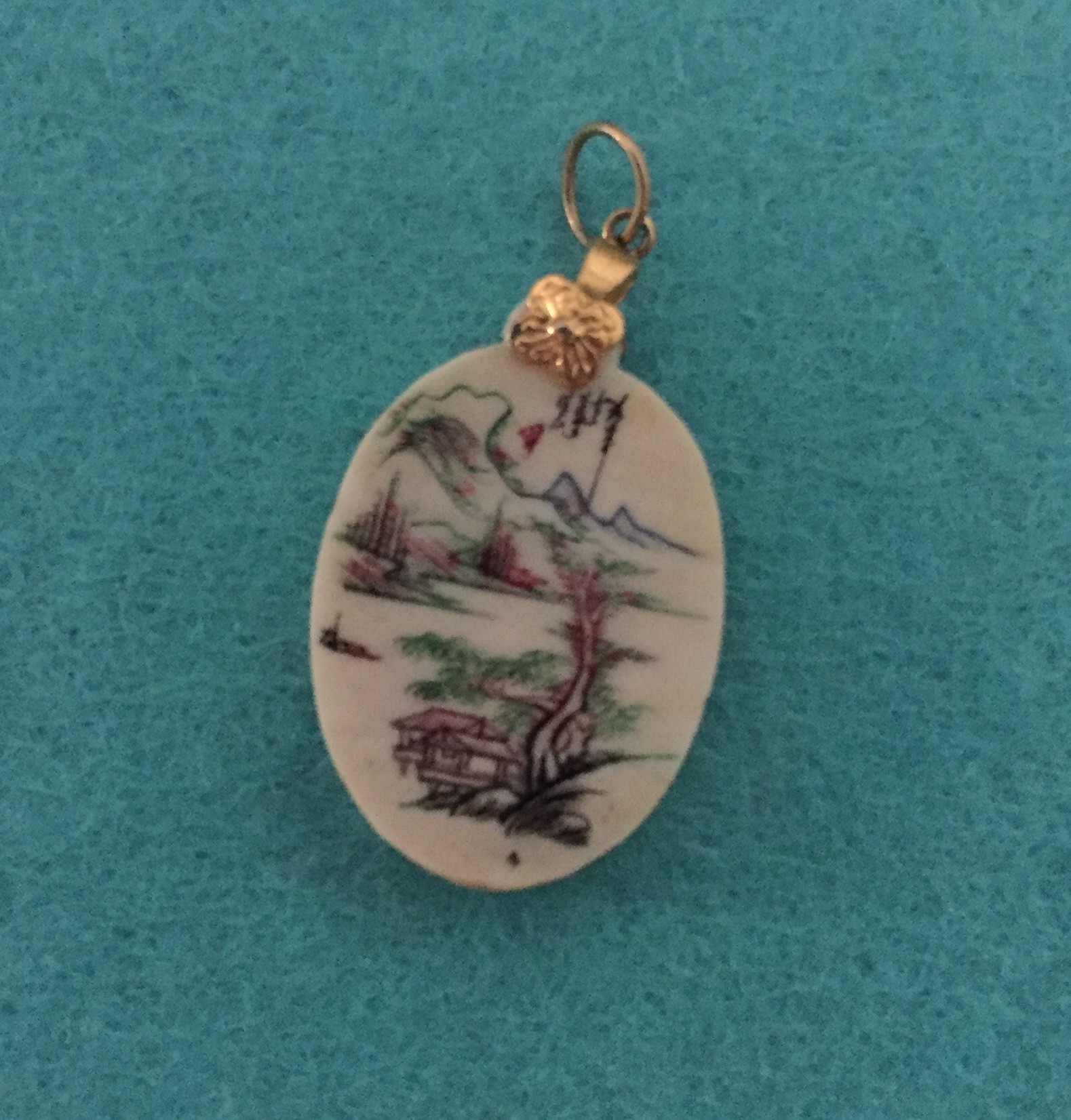
The necklace I purchased with the money from Zeisel.

The necklace I purchased with the money from Zeisel.

It is not that old. I bought it when I was 20, when I spent my sophomore year of college in Israel, 1974 to 1975.

Many holocaust survivors were still alive. Some of them related to me through my maternal grandparents who were both from Europe. My grandparents came to the USA in the 1920s. But most of their family remained behind. Many perished, others survived and moved to Israel.

My grandmother went to Europe in 1931 with my Mom and uncle. I have written about this before. She stayed on the farm owned by her in-laws. While she was there her mother-in-law, my great grandmother Chava, gave her some family items. Two pieces of jewelry, a pearl necklace and an opal ring; and several embroidered and handmade pieces that Chava had made.   I own all but the pearl necklace. They were all given to me as the one named for Chava.

The pearl necklace disappeared in 1931. My grandmother went to use the shower at her inlaws. She took off the necklace to bathe and forgot to put it back on. When she realized it was gone, she went back to the bathroom. It was missing.

But she knew who took it. Zeisel. He was the only one who had been in the bathroom. But he denied taking it. And that was the end of the matter for 43 years, until I went to Israel for a year of college.

A month after I arrived in Israel, I received a letter from my grandmother telling me the story of the pearls. I had never heard it before. In the letter she wrote that the ‘goniff,’ Zeisel Feuer, my grandfather’s cousin, was going to give me some money to pay her back for the necklace he stole in 1931. I was to take the money and give my great uncle, her brother, half the money. The other half was to buy myself a necklace because I should have the pearls.

What? Was my grandmother insane?   I did not really want to do this.

I wrote her back saying that I thought 43 years meant the statute of limitations on a theft were over. And that she needed to let it go. And I did not need to have the necklace. But a few weeks later I received another letter instructing me how to find Zeisel in Tel Aviv. He worked at bakery on a specific street and I was to go there and speak to him. She said I had no choice. I had to do this. It was important to both of them to end this. And I would be the one to fix it. What?

Grandma ordered, so I obeyed. The next time I was in Tel Aviv, I went to the bakery. There was a man who looked so much like my grandfather, except smaller and bent. I knew it had to Zeisel. I introduced my self. He held for minute and had me sit at a table. He brought tea and a pastry. I waited while he finished working. Then we walked back to his apartment.

There he gave me Israeli lire, which in US would be worth about $100. And he told this story.

He was married with two children. He had a wonderful life. But he wanted more for his family. So when my grandmother left the pearls in the bathroom, he thought, “She lives in America. She is rich and has money. She does not need this necklace.” And he took it. And he lied.

In return the Nazis came. They killed his wife. They killed his children. They tortured him. He could no longer have any children.

And he knew that taking the necklace had brought all this pain to him and his family. And before he died he had to make amends. So he gave me the money. I was to do with the money whatever my grandmother said.  He had made peace.

I was stunned. I was 19. I did not know what to say but to cry.   When I left him, I took the money back to my dorm in Jerusalem at Hebrew University. A few weeks later I took half the money to my Uncle Isaac. The other money I kept in my room.

Each time I went to Tel Aviv after that, I always went to the bakery to see Zeisel. He always gave me tea and a pastry.   There were not many phones in Israel at the time. So I could not call in advance. I would just show up, or send him a letter telling him when I thought I would come. When my parents came to Israel that December of 1974, I took them to meet Zeisel and speak to him. It was a meeting my parents never forget as well.

In January I turned 20. I finally spent the $50 on a necklace for me. A necklace that carried so much pain. I could not wear it even though I knew my grandmother wanted me to have this jewelry from my great grandmother. So I keep it in a box in my closet. I know it is there. I know it is safe. It will not be lost. But I cannot wear it. When I see it, I always think of Zeisel and how much he lost.

It was not the pearl necklace that doomed his family. It was the rise of hatred. But he did steal it.  So for him giving me the money was closure. He had repented; he had done his “tashuvah.”  But for me it was the beginning of truly understanding the past.

I have written about the Zeisel and the pearl necklace before. It is a story that stays in my heart and my soul. But I have never talk about what I bought with the money. In my mind it is just not enough. It does not make up for the suffering surrounding one pearl necklace.  Zeisel was also the person who let my grandfather know that his entire family had perished in the Shoah.  He is forever bound in our family history.

Zeisel, my grandparents and my parents have all passed away. I am the only one who can remember this story. And so I tell it again.


https://zicharonot.wordpress.com/2014/08/22/i-believe-mystically-and-magically-great-grandma-chava-watches-over-me/


Joyous Occasions in Discovered In Yiddish

14 Mar
IMG_6556

My Uncle Bernie and part of the article about his bar mitzvah.


Besides articles about my Great Grandfather Louis Goldman/Baruch Lev Litwack, there were also announcements of family events in the Bialystoker Stimme magazines under the title “Simcha by Landslight,”   or “Joyous Events by our community members.”   I found three events in Yiddish about my extended family members, which my friend, Blumah, translated for me as well.

The first was about my Uncle Bernie, or Bernard, about his bar mitzvah:

“A nice bar mitzvah party took place on Shabbat. The 11 of June by Mr. Bernard.  A nice, accomplished young man, the son Mr. and Mrs. H Rosenberg and the grandson of our dear friends and active community members Louis and Ray Goldman from the Bronx.

A nice private group of close family celebrated by the simcha. They wished much nachas to the parents from this bar mitzvah boy.

As is well known, Mr. and Mrs. Louis Goldman, the grandfather and grandmother, are actively in the Bialystoker Center and the Ladies Auxiliary.

Mr. Goldman is now the president of the Bialystoke charity organization that was the Bialystoke Free loan society: Bialystoke Somech Noflim, (It was started in 1886 in the USA.) This is he oldest charity association that the Bialystoke started.

We wish the zayde and bubie, and the parents to live to have much nachas and much joy from Bernard and the other children.”

I loved that even in an announcement of my uncle’s bar mitzvah, it was important to the writer to list my great grandfather and great grandmother’s accomplishments in the Bialystoke societies.   I am thinking it is to give them even more ‘kovod,’ honor. Or perhaps it is to encourage others to volunteer?

In later years, when the Bialystoker Stimme had more English, there is another Bar Mitzvah announcement for my father. But it is much shorter and written in English.

One of my father’s cousin’s is also mentioned in “Joyous Occasions.” My Dad’s first cousin David M. made the Yiddish paper, in a shorter and less flowery article.

“The Goldman’s talented grandson, David M., graduates with honors. The 16 year old grandson of our active members, Mr. and Mrs. Louis Goldman, of the Bronx. He just graduated from Townsend Harris High School. He was immediately accepted in City College. We wish the parents Mr. and Mrs. Eli Marks and the grandparents of David much nachas from their very capable David.”

The final “Joyous Occasion” in Yiddish was my great Uncle Sam’s wedding announcement, for his first marriage. I never knew the woman mentioned in this announcement. But I do know that they had one daughter. I honestly only remember meeting her when I was a young child. I think the family lost touch with her.

“Sunday Dec. 11, our friends, Mr. and Mrs. Louis Goldman brought their youngest child to the Huppah: Samuel with the beautiful, intelligent Miss Otta Schmuckler. The wedding was private, and the supper was afterwards celebrated in Central Plaza, where many friends from both sides were part of the joyous occasion.

We wish Mr. and Mrs. Louis Goldman and the young couple much nachas.”

The only thing I can say about this announcement is that I always thought his first wife’s name was Yetta. And that might have been the name she used in English.

Every one of these little Yiddish articles is like a jewel for me. I find out tiny bits about my family’s life in the 1920 – 1940s. I see pieces of my Dad’s childhood. He probably was at all these simchas: his brother’s bar mitzvah, his cousin’s graduation party, his uncle’s wedding. We do have a few photos from this time. But I have never seen the photos of my uncle and my Dad’s cousin that shown in these articles.

The Bialystoker Stimme continues to be a treasure for me and I hope for my family.


https://zicharonot.wordpress.com/2016/03/08/louis-of-the-blessed-heart/