Archive | Holocaust RSS feed for this section

Amazing Coincidences After Finding My Ancestors; We Are One People

1 Feb

It has been a crazy time since I found out the lineage of my two times great grandmother Esther (Etka Lew) Wolff. I have connected with distant family through the Tracing the Tribe Facebook page. I have been welcomed to see our very large family tree on Geni. And I have found out who my ancestors were back to 1720.

Amazing.

But the amazement does not seem to end. In one of the many emails my two distant cousins sent me I saw that a branch of the family, one of my three times great uncles descendants migrated to Kansas City. What! I live in the Kansas City metro area. I have lived here for 18 years with no family except my immediate family. For a while my husband had cousins here, but they moved away. Now I find out I have distant cousins here. Really?

And then I thought about it. Many years ago, when the Bialystok Home for the Aged still existed and they still did a newsletter, I would get the “Bialystoker Stimmer.” I was a supporter of the Home for the Aged because my great grandparents, my grandma and my parents were always supporters. So the tradition continued.

In any case, in one issue I read, there was an article by a man and his daughter from Kansas City. And I knew his daughter. I mentioned the article to her, and we would joke about it and call ourselves “Landsmen,” which we were. So when I heard that I had distant cousins here, I immediately thought of her.

I sent her an email.

“What was your maiden name? I just found out that a branch of my family, last name Lew/Lewin/Levin moved to the Kansas City area. (Originally from Bialystok region). Just curious.”

She wrote back. And it all fit. They were from the same small town, Ciechanowiec. Her dad’s last name was Lewin but he changed it to Levine in the USA. We were third cousins.

And I thought that was all.

But my contacts back east (EW and AB), who had been feeding me all this information, were not done. They had heard of my friend/cousin. But there were others as well. They sent me a diagram. And asked if I recognized any other names. I did. One was a boy the same age as my son, they had gone to school together through second grade and had played together. The family belonged to the same synagogue my family belonged to. We have been friendly acquaintances for 20 years. We are related through the father.

I sent them an email because I find it all so interesting. I would never have expected to find family in Kansas! I am still in a state of determined amazement. Jew from the small Polish village of Ciechanowiec settled in Kansas and Missouri!

When my children were little they went to the local Jewish day school. My daughter used to feel sad sometimes because everyone was related to everyone else, except for her. She had no cousins at the school. I wish I had known this when they were little, as they were in school together, although their children were younger and more my son’s age. We might not be family, but they would have been ‘cousins.’

My daughter lives in Israel now. Many of her cousins who she is in contact with are also third cousins. These are branches of my family and my husband’s family that we have been in contact with forever. She has many second cousins, as my husband’s first cousin moved to Israel 27 years ago. These cousins have all been welcoming and loving. It is strange that some lines of the family stay in contact, and we see these cousins even with the distance in relationship; we consider ourselves close family.

But some lines of a family are lost over time. The movement from Europe. The aftermath of the Shoah; the younger generations moving away.   I had information from my Grandma and my Aunt mentioning these lines of the family, but we had no contact with them.

What an amazing coincidence to find some of these third and fourth cousins in Kansas. Of course we are distantly related. Third and fourth cousins are not so close. But it was surprising to find a connection where I was not expecting to find one.

But even more important, it shows that the Jewish people are really one. We are interconnected. My family, with its approximately 20,000 descendants is a perfect example of the inter-relations between all Jewish families. And even though a number of my family, from both my maternal and paternal sides perished in the Shoah, we remain.

That is the most amazing aspect of my continued search for my ancestors how we are truly one people.


https://zicharonot.wordpress.com/2015/01/27/serendipity-wins-in-finding-a-family-connection/

Is Lassana Bathily, The French Hero, a Lamed Vovnik?

16 Jan

Since I was a teen, I hoped that I could be a Lamed Vovnik, one of the 36 righteous or just people who keep balance to the world. Of course in Jewish mysticism, the 36 are men. But in my modern mind, I believe that a woman has just as much chance of being one of these 36 special people as any one else.

I first learned of the Lamed Vovnik legend when I read the Holocaust novel, The Last of the Just, by Andre Schwarz-Bart. This book had a tremendous impact on my life. As I read about these two just men and the trials they suffered, I felt a kinship. I felt a need to bring good into the world.

The important belief about the Lamed Vovnik is that these righteous people do not know they are part of this elite group. So I thought, “What if everyone acted as if they were one of the Lamed Vovnik? What if we all practice looking for the good? What if we all do good deeds?”

And that is how I live my life. I try to find something good in everything that happens. Every event is a learning experience. Every one I meet teaches me something.

I focus on the positive, just as I think a righteous person should. I focus on the spark of God that is inside each one of us. I try to do gemulat chasidem, good deeds. I try to work on tikun olam, repairing the world. Just as I think a Righteous Lamed Vovnik would work.

That there are 36 righteous people is important. Each Hebrew letter has a number attached to it. The letters for the number 18 are Het and Yod. These two letters together form the word, Chai, or Life. So many Jewish people present gifts to someone in multiples of 18. There are 36 righteous Lamed Vovnik, which is twice Chai, twice life.

As I watched the events unfolding in France; when I heard of the wonderful deeds of Lassana Bathily, the Muslim worker in the Kosher market, I thought “Could he be a Lamed Vovnik? Could he be bringing balance to the world?”

Think: upstairs in the grocery as Black Muslim man was shooting and killing Jews just because they were Jewish.   He killed four. But two stories below a Black Muslim man was saving Jewish people, hiding them in a freezer. Balance!

Upstairs and man was hiding from the police. Downstairs, a man made the decision to go to the police to tell them about the Jews hiding downstairs. Balance!

He left the building. It took time for the police to believe. And thanks be to God, they did.

With him was a key to the metal gate, as well as in his mind a key to the layout of the store.

Lassana Bathily brought balance, love and righteousness to a horrible situation.

To me he is a Lamed Vovnik, a righteous man. A guttah neshumah, a good soul. And a mensch, a man of high standing.

Baruch Dayan haEmet . May the names of those who perished always be for a blessing. But the name of Lassana Bathily is also a blessing because he provided safety for those who lived. The spark of God within him shines!

My Family’s Holocaust History Impacts My Observance of Rosh Hashannah

13 Sep

As Rosh Hashannah approaches, I have a new view of my family’s heritage, a new reality that will impact my observance and prayers this year and in all future years.

It started with a Facebook Group called, “Tracing the Tribe.” I actually was able to find a family member due to a blog I posted about my grandfather’s family history and his town in Austia/Galecia called Mielec. I met Susan when I was in New Jersey this summer. It is actually her husband who was related to me.

We spoke about the family and how we might be related. I actually found the connection. My great grandfather and her husband’s great grandmother are probably brother and sister.

She emailed me a testimonial written by her husband’s first cousin, “E”, about her Holocaust experience. “E” survived the Holocaust and settled in the USA. In this memoir, “E” recounts a story about the Jews of Mielec and how they died. She wrote that 600 were rounded up and burned alive in their synagogue. She received this information from relatives in Mielec.

What! I was somewhat stunned. No one had ever mentioned this to me before. Whenever there was discussion about our family who died, we were told that they were burned alive in the fires of the Holocaust; or that some had died in Auschwitz; or that my great grandmother had been hidden and then murdered by the people who had stolen the family farm. But this story was never mentioned. Never.

But I remember thinking, when my Mom would tell me that our family was burned alive, that in the crematorium, the people were dead before they were burned. Weren’t they? So why would I be told that they were burned alive? Could this be what happened?

My Grandfather never talked about his family. He lost almost everyone who still lived in Europe: his parents, siblings, nieces and nephews, aunts and uncles, cousins. Everyone! Only a few cousins survived. When I finally got him to talk to me and tell me about his family, he was vague when talking about the Holocaust. He would tell me a little about life when he was a boy. But he did not like to mention the names of the dead.

When I found out that Germany was giving money to those who could prove they had owned property, I suggested that he apply to get money for the family’s farm.

He was furious. “Will this money bring back my mother and my father?” He yelled at me. “Will this money bring back my brothers and my sisters and their families? NO! NO! I don’t want their blood money! Let them keep their blood money!”

I can still hear him yelling at me. So I stopped. I never asked again.

My mother told me that a relative, Zissle Feuer, came from Europe and told my grandfather what had happened. And then my Grandfather contacted the Red Cross. Everyone was confirmed dead. My mother was about 16 when they found out that everyone died. She said that every morning when my Grandpa came upstairs from the bakery she would hear him cry while sitting at the kitchen table; sobbing over the loss of his family.

Now I read this testimonial. What is the truth? How did they die? “E” was not there. She only heard about it. So I looked through all the papers I had gathered through the years. And I found one document that I guess I never read entirely. I just read the part about the city of Mielec before the war. I never read the section that was call Holocaust Years. Because there it states, halfway down the page, that on September 13, 1939, on the eve of Rosh Hashannah, 20 Jewish were pushed into a burning synagogue. If they tried to escape they were shot. Then the German soldiers put Jews into a slaughterhouse and set it on fire. Then they went to the Mikveh and killed Jews there. On the second day of Rosh Hashannah a second synagogue was set on fire.

So many burned alive on Rosh Hashannah. I do not know if it was 600, but even one is too many. What a horrible death!

How can I ever see Rosh Hashannah in the same way again? How can I understand that on this holiday my family might have been murdered, burned alive. Up until September of 1939 there were 4,000 Jews living in Mielec. When they were deported in March 1942 only 2,000 were still alive.

Did 600 get burned alive in the four buildings set ablaze during Rosh Hashannah of 1939? Did my great aunts, great uncles and cousins suffer in those flames? Did my great grandfather die there? Is this why my Grandfather could never talk about it? Did he know that is how most of his family perished? When my mother said they were burned alive, did she know as well?

Was it just too horrible to tell us?

Mielec, the home of my family, was one of the first to be totally depleted of its Jews. This report said only 200 Jewish people survived the war: 200 out of 4000. I know that four of them were cousins of my grandfather. I met them all: one settled in Montana; one in England; two in Israel. They have all since passed away.

On Rosh Hashannah we chant the Unetanah Tokef.   It is a prayer that has always made an impact on me. But this time when I read “who by water and who by fire,” I will be wondering: “Who died this way? Who?”

And I will chant Kaddish.

I believe Mystically and Magically Great Grandma Chava Watches Over Me

22 Aug

Chava Amsterdam

Even though I was born long after the Holocaust ended, I have a connection that defies logic. I am named for my great grandmother Chava. She was hidden during the war and was murdered when she returned to the farm her family owned by the people who occupied and stole it. I have been told that she was shot in the head.

I learned about her when I was 11 years old. Before that I only knew I was named for Grandpa Nat’s mother. And that was all.

But when I was 11 years old, living in North Bergen, NJ, I had a major fight with my younger sister. I ran after her screaming, “I am going to cream you.”   As she ran away from me, I felt a giant tug on my pony tail. My gentle Mom was dragging me to the sink. “Never use that word in my house. Never. They burned your Grandpa’s family alive in the fires of the crematoria of Austzvitz. You will never use that word in my house.”   And then she put soap in my mouth. I have never, ever forgotten that.

I never even thought of the slang word, “cream” meaning ‘to kill,’ had anything to do with the holocaust. But in my mother’s mind it meant crematoria. And perhaps she was right. I have not found a reference for it. But it does not matter. What it did do was open up a conversation.

My Mom was the gentlest person around. For her to do this, something horrible must have happened. And so I learned about the Shoah. I learned about my grandfather’s family and how they died: some of it, not all of it. Some came later.

But mainly I learned about Grandma Chava.

I thought about her so much, I started speaking to her in my mind. When I was worried about something, I spoke to her. When I was scared, I spoke to her. I knew she had been through so much that perhaps I could gain strength from her. And she would not let that happen to me. One generation was enough. When I was worried, I imagined her near to me.

When my son was little and afraid to sleep alone at night, I once told him that there are angels guarding him. And I mentioned my great grandma. I will admit this backfired. When my son was about 8 we went to see a production of “Footloose.” When they sang the song with the lyrics, “Somebody’s eyes are watching you,” he had to leave the theater. He told me he thought about my great grandma and her watching him. So I changed that image for him.

But for me, thinking of my great grandmother was always helpful. I did not think about how she died or what happened to the family. I thought that she would never let it happen again.

Often my Grandma Thelma, who had spent six months living with Grandma Chava in Europe, would say, “You are so much like Chava. She also was shreier or a machshafer or chachama.” Whatever she wanted to compare me with that day.

But basically Great Grandma Chava was a strong-willed person, as was I growing up. And I think I still am.

Because I was named for Grandma Chava, I was given jewelry that was hers and embroideries that she made. I now have a picture of a bird she embroidered hanging in my dining room. I was given the matzah cover she made for Pesach, which I have since donated to a museum. (See my blog: “Watching Antiques Roadshow Inspired Me to Donate my Great-Grandmother’s Matzah Cover.”)

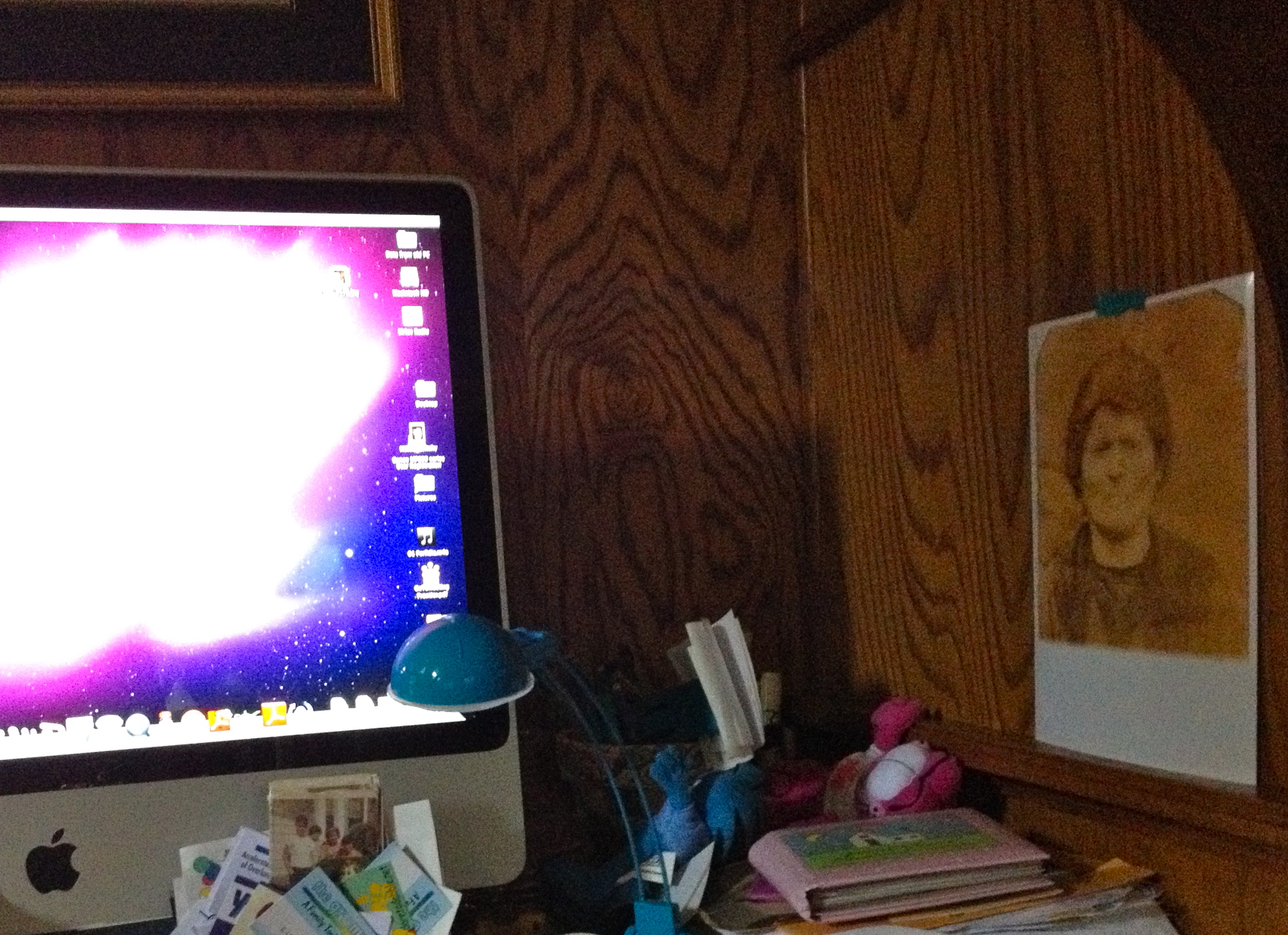
Recently we found a photo just of her. My Grandpa looked like his mother. My brother looks like her. One of my nieces looks like her. And I held her photo up to my daughter and there is a resemblance as well.

As for me, I look like the determination you can see in her face. She is staring straight at the camera, and in my eyes she is so strong.

My desk with Great Grandma Chava watching.

My desk with Great Grandma Chava watching.

I enlarged the photo and hung it by my desk so I can see her whenever I am working. Because I always have and still feel that she is my guardian angel. We share the same nechama, the same essence.

Almost all of her children and grandchildren died in the Shoah, except my Grandpa and his family because he was in the USA. There were no grandchildren till years after the Shoah. My older boy cousin was named for my great grandfather, who also perished. And I, the oldest girl, was named for Chava.

So I sit at my computer working. And I turn my head slightly to see her. The world of magical thinking makes me believe that she knows we survived. That she knows her great-great granddaughter has moved to Israel. That she is not only looking over me, but also over my daughter.

As rockets fall in Israel, I think, ‘never again.’ Another Chava cannot lose her daughter to the hatred of anti-Semitism. And I believe, mystically and magically, that Great Grandma Chava is watching my daughter as well. And I feel her ruach, her comforting whisper. All will be well.


Schreier: screamer/yeller

Machshafer: witch

Chachama:  Smart one/intelligent

Nechama: soul, essence

Ruach: wind, spirit


http://lyrics.wikia.com/Footloose:Somebody’s_Eyes


Old Photographs Bring Memories to Life

19 Aug

My siblings and I recently spent a weekend together cleaning the attic, basement and garage of a house in the Catskills that our family has owned for well over 50 years.   And although our parents made an effort to clean out some of our grandparents’ items when they inherited it, it still was quite full.

It has been a process. This was our final weekend of cleaning. My brother with some help from his son and a friend, had already moved out the old metal bungalow furniture and moved in furniture from our parent’s apartment.

We had cleaned out clothing and personal items. We had moved out some items that we wanted in our respective homes. But now it was time to get rid of the stuff that had just collected and decayed over time.

My brother ordered a 20-cubit yard dumpster that he demanded be filled by the end of the weekend. My sister and I thought he was crazy. There was no way we would have that much junk. We were wrong. And it was, amazingly, filled. The house is now in order. Clean, organized and ready for us to use it. We had a feeling of accomplishment by the time we were done.

Two of my nieces were there as well. And the four women, my sister and my nieces and I did the heavy emotional work, we went through thousands upon thousands of photos. We sorted them for each family. We made piles for our cousins. There were some we just discarded and put into the dumpster. And then we put together the ones we all wanted for me to take home and scan into my computer, for I am the family archivist. I will make digital copies and send them out to everyone.

Front Great grandpa USA Visa

The treasures we found included our great grandfather’s passport and 1936 visa to come to the USA from Poland. Our grandparents worked diligently to get the paper work accomplished to bring him and my great aunt to the USA. It saved their lives. My Mom would tell the story of going to Ellis Island with my grandparents to get them when they arrived from Poland.

Years later, when my children were little, we went with my parents to Ellis Island. My Mom asked, “Where are all the cages?” The main room was a large empty space. But on the wall were photos of what the room looked like in the days it was in use. And the metal bars between lines of people could have looked like cages to a child. We think that is what she saw.

In the bags and albums, we found photos of people in Europe from before the Shoah. And wondered how many of them perished? We found photos of our great aunt Tova and our great grandmother Chava. Photos we had never seen before. Our great grandmother is young in this photo. My brother and niece have her mouth. We know they both perished, along with many other family members.

Photos of our parents taken in Hudson County Park, North Bergen, NJ, in the 1960s were also a rare find. They were dressed up, obviously ready to go out somewhere. Mom even had white gloves on… white gloves and a sort of ‘mini’ skirt: an interesting combination; a transition between two generations, two styles of dress. There are no full skirts here.

We found pictures of our aunts and uncles from both sides of our family, grandparents, great aunts and uncles; photos of us and our cousins when we were little. They were wonderful finds. We even found three photos taken during the Woodstock weekend in 1969. We thought all of them had been lost years ago when my Dad tried to mail them to me and the envelope broke while in route.

My nieces loved one photo in particular, of my brother, sister and I when we were in our teens. We hate it. But the girls wanted to keep it as ‘blackmail.’

We found wonderful documents: the list from our parent’s wedding; some of Dad’s school papers, and his army paper, a telegram he sent his parents from the army. One of his school papers said he was in the choir in high school. We all laughed, Dad could not carry a tune!

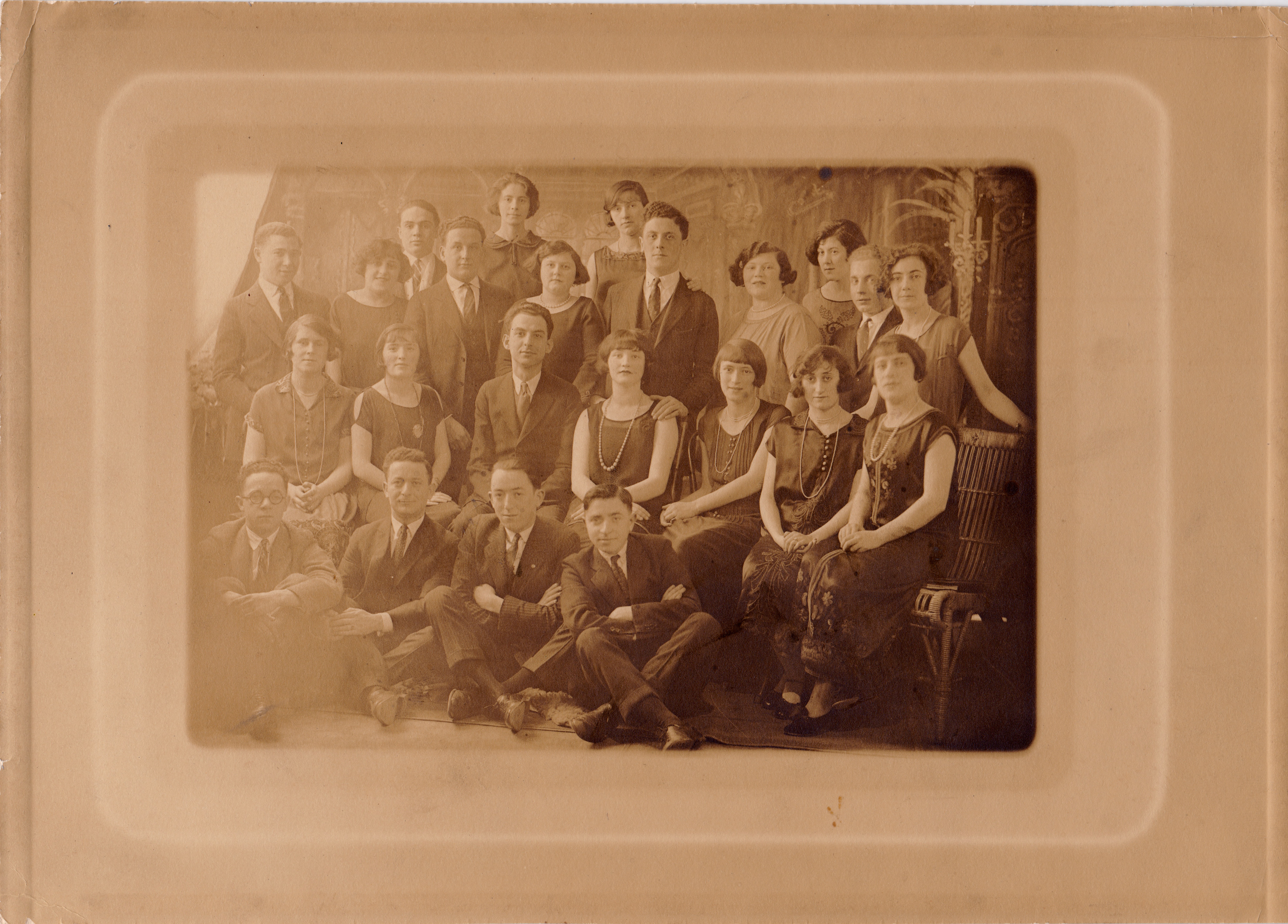
Grandma Thelma graduation from night school she is second in middle row

A favorite was group photo of our Grandma with the other students, when she graduated from night school, after immigrating to the USA in the 1920s.

The attic held a bonanza of information! We actually thought we had found it all because previous cleanings we had found 8mm movies that my brother had turned into DVDs and other photos that I had used to make a book of family history.

But the most amazing find was a photo album of my grandmother from before her marriage. There was one young woman in many of the photos with Grandma. We were sure it was her best friend and cousin, Katie. But there were no names written on any photo. It was so frustrating. But then we found a more recent photo with my grandparents and another couple. In this one the woman was identified. And yes it was Katie. My sister and I were so excited!! When we compared her face to the young women in the photos we knew that we had discovered and identified our lost relative.

There are many photos in the album that were taken in Europe. On the back many are inscribed to my loving cousin, Tova, in Yiddish and in German. I think they are photos given to her before she left Poland for the United States in 1922.

I have that album with me now. I am going to try to match some of the unnamed people with photos that we have where people are identified. I have already found photos of my grandmother’s siblings.

It is a puzzle, and I am determined to make as many matches as possible because these old photographs bring my grandparents’ and parents’ memories back to life.


A Strand of Pearls is Not Just Jewelry, It is a Circle of Love

6 Jul


To me wearing my pearls infuses them with love.

To me wearing my pearls infuses them with love.

I wear two strands of pearls to every family wedding. One strand, the longer one, belonged to my mother-in-law, Lee. She died when she was only 59, but I know that she would want to be at every wedding of her grandchildren and family members. The other strand, is slightly shorter, but has a lovely clasp. It belonged to my Mom, Fran. She also loved weddings and would want to be at every family wedding! Amazingly both strands of pearls have the same size pearls. And they look so good together.

Last night I wore the pearls to the latest family wedding, our niece. The pearls came up in conversation, and I told my brother-in-law, and another nephew and niece, why I wore two strands. My brother-in-law said, “I know they are here.” And my nephew and niece, who knew my Mom but not his own Grandma, said, “Your Mom would have loved the weddings.” And it is true.

It makes me feel as if these two wonderful women were there with us when I wear these necklaces. Pearls are so warm. And to me their glow sends off the warmth of love.

Pearls have much meaning in my family. My grandmother had opera length pearls. And my mother had them made into three necklaces, once for each of her granddaughters. As they turned 18, each girl was presented with the pearl necklace from my mother.

Unfortunately she passed away a few months before the youngest turned 18.   My Dad had us present the pearls to my niece in the hospital where my mother was soon to die. I know it was a difficult time for my niece. But I hope as time has passed she realizes how much her grandparents loved her and how important it was for my Dad, her Grandpa, that she get the pearls while Grandma was still alive.

My Great grandmother, for whom I am named, gave my Grandma a strand of pearls in Europe in 1932. They would have been mine. But another relative stole the pearls while she was in Europe. She always suspected who had taken them.

Over 40 years later he wrote her a letter. He had survived the Shoah, but his entire family had been killed, his wife and his children. He blamed himself. He believed that if he had not stolen the pearls, they would have lived.

I know this because I met him. I was living in Israel at the time. My Grandma Thelma wrote to me to meet up with “the goniff.” He was going to give me 400 lira…about $100 at the time. I was to take some of the money and buy myself something and give the rest of the money to my great uncle.

I met Zissel and he told me his story. He was a sad, sad man. He told me how his family had died and the horrible things that occurred to him. He told me how he had stolen the pearls.

“Your grandmother went into the bathroom to bath. When she came out the pearls were on the sink. I thought, she lives in America; she is rich. I can use these pearls more than she can. And I took them. Now everyone is dead, and it is my fault.” Zissel and I both cried as he told me the story. I was only 19 years old. The pain of that day lives with me. He believed if he paid my Grandma back, it would take away some of the guilt. I hope it did.

I began to visit him whenever I was in Tel Aviv. He worked in a bakery across from the giant shuk. I would meet him there, get a pastry and tea and talk to him Sometimes I would go back to his apartment.

When my parents came to visit me in Israel, I took them to see Zissel as well. His Yiddish was much better than his Hebrew. So when my parents came, he spoke mainly to them in Yiddish. He told more stories. And my mother and I cried along with him. I hope that his sad soul found peace.

The pearls were a bond between Zissel and me.

And so for me pearls, any pearls, have a story to tell. My mother-in-law’s
pearls and my mother’s pearls will be filled with joy as they experience only happy events. Every wedding will bring happiness to these pearls. And the sadness of the pearls that Zissel took will be wiped away.

The pearls my daughter and nieces have are also filled with love. And when I see them wearing my mother’s/grandmother’s pearls, their great-grandma, I know that the love of these two women are surrounding them.

A strand of pearls is not just a piece of jewelry, it is a circle of love.


How World War I Saved My Family or My Grandpa Was A Draft Dodger

25 Jun

World War I changed the world! One hundred years ago, Europe became a place of desolation and devastation. Young men from both sides were killed. Millions perished. From all I have read, it was horrible. The use of gases so horrific that laws were later passed banning the use of these and all future chemical weapons. We know that sometimes they are still used. But the world peoples are united against them.

For my family, World War I actually saved my branch of a family. My Grandpa Nat, you see, was a draft dodger.   As he would explain it to me, Jews in Galicia did not really have a chance in the military. They were often put in the worst positions, meant to die. And if they survived, they were conscripted for 25 years. So they never were able to live a Jewish life or return to their families again.

In 1918, when my Grandpa was about 18, his life changed; he received the dreaded notice that he was to report for military duty. It sent his family into action. Nissan, as he was known in Europe, had to be smuggled out of Galicia to save his life.

Thus began my Grandpa’s two-year journey to salvation and survival. He left his home in the middle of the night with just those things he could carry and wear. His intention was to get to British Mandate of Palestine and join the efforts to create a Jewish homeland. But his first goal was to get to his cousins in Belgium.

He wandered through Europe during the battles of 1918 and the aftermath of the war. Slowly making his way to Belgium. He had no real passport. Instead he was using the passport of a dead cousin.

Eventually he made it to Belgium and his cousins. Their reaction to his wish to travel to Palestine was, “Why go to Palestine? It is a desert! Go to the United States, to the Golden Medina. You have an Uncle there. He will help.”

So my Grandpa contacted his Uncle Julius, known as Uncle Yidel to us all, his mother’s brother. Uncle Yidel agreed to sponsor Grandpa to the United States.  But he had one problem, he had been robbed along the way and had to work to earn the money to pay for his trip to the United States.  But finally, after about nine months, the last leg of his journey began. Fortunately for him, his uncle did sponsor him, because when he arrived in the port of New York City, and the immigration site of Ellis Island, he had just a nickel. Without a sponsor he would have been sent back to Europe.

Grandpa often would tell us that we could be whatever we wanted to be. “Look at me,” he would say. “I came to this country with just a nickel in my pocket. And look at what I have.” So we learned early on not to complain to Grandpa and to never give up!

I tried finding my Grandpa’s immigration information from the Ellis Island sites, but could find nothing. My Grandma’s was easy to find. So I often wonder what that passport actually said. And how old he was supposed to be? But in 1920, immigration procedures were not as intense and documentation was not as precise as it is now.

Tanta Molly and Uncle Yidel

Tanta Molly and Uncle Yidel

Uncle Yidel and his wife, Tanta Molly (also known as Malchik)  welcomed Grandpa.

Growing up in Europe, my Grandpa had been a yeshiva brocha, a student of Torah. He had a beautiful singing voice, and perhaps might have been a cantor. But instead, somewhere along the way, he learned to be a baker. When he first came to New York, he worked two jobs. One as a butcher, the other as a baker.  But it is as a baker that he prospered in America. He and Uncle Yidel started a bakery eventually owning a building in New York City. (My Grandma told me that when Grandpa proposed he told her he had a place. She thought he rented an apartment. She did not realize he owned the building!)


Grandpa in his bakery in West New York, New Jersey, 1942.

Grandpa in his bakery in West New York, New Jersey, 1942.

They separated the business after my grandparents married, and Grandpa and Grandma opened a new bakery in Linden, New Jersey.  But in the early 1930s, when my grandmother took their children to Europe for six months, Grandpa sold the bakery in Linden and opened a new bakery in West New York, New Jersey.  He kept this bakery for over 35 years.

Grandpa had many cousins in the United States. His parents were first cousins. So he was double cousins to many of the family. They helped him settle in. But Uncle Yidel was the most important. Uncle Yidel and Tanta Molly were always a part of our lives. They had one son, Ezra.

Whenever we went to see them, we were welcomed in Yiddish. Tanta Molly would come running out to hug us. She would call out our Jewish names: “ Tovaleh, Fagaleh, Chavaleh!” I asked my Mom, “Why does she put an ‘aleh’ on all our names?”

“It means little,” my Mom replied. “Well that did not make sense, Tanta Molly is littler than us!” Was my response. “It means she loves us,” Mom laughed as she said that. Later I found out the ‘aleh’ did mean little, but really was an endearment.

My Grandpa always missed the hills of Galicia. He often told me that he bought his property in the Catskills because it made him think of his home and his childhood. Many years latter when I traveled to that part of Europe, I saw he was right. The rolling, low mountains and hills do look like the Catskills.

My Grandpa forever missed his family. World War I did save him. He came to the United States. But his parents, siblings, and many aunts/ uncles/cousins stayed in Galicia. They all perished in the Shoah.

My Grandpa Nat was a draft dodger, but he never stopped fighting for the right to practice his beliefs and to protect his family in the USA. He loved America. He never traveled outside of the United States. When asked, his reply was always:

“Why would I ever want to leave here? It is the best place in the world.”

Watching Antiques Roadshow Inspired Me to Donate My Great-Grandmother’s Matzah Cover

12 Jun


Matzah cover made by my Great Grandmother Chava.

Matzah cover made by my Great Grandmother Chava.

Watching the Antiques Roadshow, a PBS show, is one of my favorite television experiences.   I started watching it with my parents years ago. Whenever they came to visit, this was one of their favorite shows. They got me hooked on it!

I love learning about different items of furniture, jewelry and knick knacks. It is a history lesson along with seeing the beautiful items. But every once in a while, someone brings in a special ephemeral item: photos, letters, a diary. In my opinion, these items should really be in a museum, some place where researchers and students and others can see the items and learn from them.

It drives me crazy. I even say it out loud. Occasionally we find out that the family did donate the item. Like when a family had the musical notations of the “Star Spangled Banner.” They donated it to a museum, and that made me feel good!

I often wondered: would I be able to do that. Would I be able to donate a family treasure to a museum? The answer is yes.

When my siblings and I were cleaning out our parents’ apartment we found two items that my brother, sister and I all wanted, but knew something special had to be done with them. One was a program from the 1930s for a benefit to help the Jews of Europe, the other was a cookbook in English and Yiddish to help immigrants learn to cook American meals.

My sister contacted the Museum of Jewish Heritage in Battery Park and asked if they would want these documents. The answer was a resounding yes. So we donated them. This way they will survive, and others who might be doing research or want to know about life for immigrant women would have these items. They will be protected. The curator told us that they had only seen one other program like ours, but it was from a Chicago event. Ours was from a New York City event.

The three of us were glad that we made this decision.

I recently made another decision to donate.

I am donating the matzah cover my great-grandmother Chava made in 1901 to the same museum. I have thought about this for several years, and decided it was the best choice for this family heirloom.

The matzah cover is made of beige linen and a teal silk. I think the silk was originally blue. On the matzah cover my great grandmother embroidered the date she made it in Hebrew letters and the words: “Seder shel Pesach” (Seder of Passover) in Hebrew. It has beautiful cut work embroidery made into a Jewish star (Mogan Dovid) with embroidered roses along the edge.

My mother gave it to me about 25 years ago for several reasons: first because I was named for my great grandmother; second, because I also do embroidery; third because my parents would come and spend the second night of Pesach with me; fourth because my daughter is the oldest grandchild. I think they thought I would pass it on to her.

But I will not.

The matzah cover was made in Galicia before the First World War. I think it was made for my grandfather’s first birthday, as he was born in 1900 on the first of Nissan. It came to the USA in 1932. My Grandmother took my mother, then age 2, and her brother, age 5, to Europe for six months. They stayed with my great grandparents. And my great grandmother gave the matzah cover and some other family items to my grandmother to bring back to the United States with her family.

At some point my grandmother gave the matzah cover to my mother. And then it became mine.

I used it every year for Passover. I would cover the matzah on the table before the meal. But as soon as the food and wine came out, I would switch to a matzah cover that I made. I did not want anything to happen to this cover because I was not sure how I could ever clean it without destroying it.

As the years have passed, it has become more and more fragile. I want it to survive. My great grandmother did not survive. She and most of my grandfather’s family perished in the Shoah. This is the only religious item she made that remains.

I also thought about donating my matzah cover because I had a mild infestation of fabric eating bugs. Ugh. They are gone now. And the matzah cover is safe. But part of me was worried. What if they had reached the cover? Perhaps there is something better I can do with this item?

First I asked my daughter how she felt about my donating this item. She thought it was a great idea.

So I contacted the museum and the woman who helped us with the other donations. She asked for photos.

And then she said yes, they would like the matzah cover for their collection. She told me that the matzah covers they had that were that old were all stained and in disrepair, while mine was in wonderful shape. Which is true.

I told her I wanted to use it for one more Passover before I donated it.

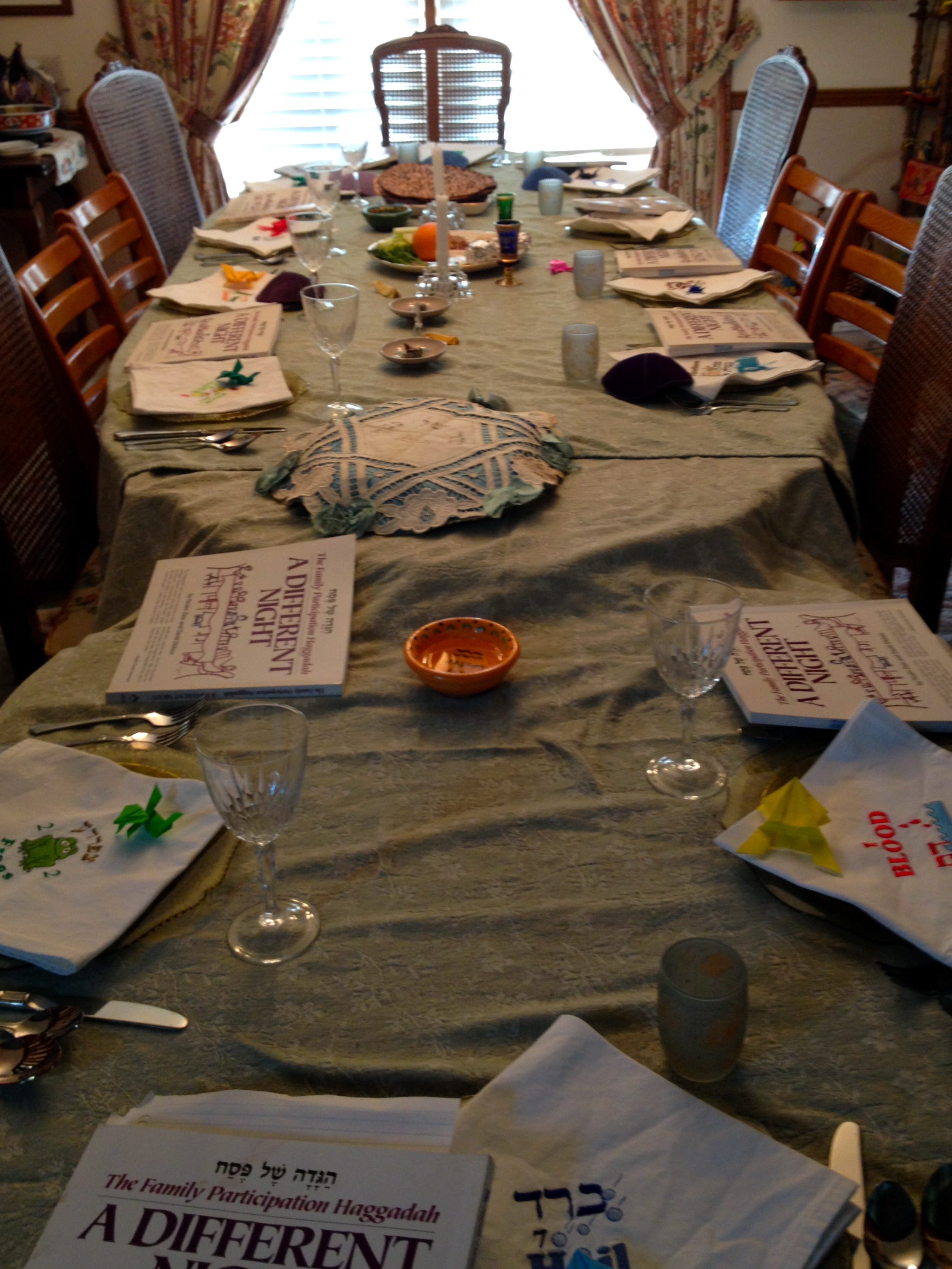
2014 Passover Seder.  Matzah cover in the middle of the table.

2014 Passover Seder. Matzah cover in the middle of the table.

She asked that I take photos of it in use. Which I did and you can see here.

She promised me that anyone in my family would always have the right to come and see it privately when it was not on display, although we would never be able to touch it again. (Probably a good thing as fabric decays.)

In August I will take my matzah cover from Kansas back to New Jersey, and then to its new home at the museum. I hope by sharing it with so many people, it will have continued life, and perhaps help people understand how extraordinary Jewish life was in Europe before the Shoah.

I donated the matzah cover on August 12, 2014.

How My Grandparents Impacted My Life

15 May


Summer of 1979 in the Catskills.  Eight months before my wedding.

Summer of 1979 in the Catskills. Eight months before my wedding.

I am so fortunate to have had all four of my grandparents walk down the aisle at my wedding! Two of them were alive when my daughter was born, and knew her. And one of my grandparents survived and knew my son as well. They had a major impact on my life, especially since I spent every summer in the Catskills with all four of my grandparents near by.

My Grandpa Harry, born in 1888 or 1889, was my oldest grandparent. He did not have the easiest childhood. The oldest of five children, he spent two years as a teen searching for his father who abandoned the family. He found him in Seattle, Washington, quite far from his family in New York City. Grandpa returned home, became a tailor and supported his family. All of his siblings graduated college, a feat for women of the time. And Grandpa supported them. The saddest part is that after they were college educated, they treated Grandpa as if he was not quite good enough for them.

I took sewing classes beginning when I was 14, and Grandpa and I started to really talk! He was proud of the things I made and would check the seams and my work. Grandpa taught me how to match plaids, not an easy thing to do. But from him I learned that to make something well, you need to take the time and effort to make it nice. To this day, I cannot buy clothing where the plaids or lines do not match up.

My favorite memory of Grandpa Harry was his guarding the sweet table every holiday. My Grandma Esther was a great cook and baker. Each holiday had amazing treats set aside on special table. Grandpa would sit at the end. I think he counted how much each of the nine grandchildren ate. If we came back too often, he would intone: “The Trolley car stops, too!” From this I learned moderation. You need to take a break.

(From my cousins I learned that there were extra treats hidden in the back bedroom.)

Grandma Esther was also born in the New York City area, but in 1898. She was also one of five children, and was surrounded by cousins. I have written about her teaching me to crochet and knit (See “Grandma Esther’s Afghans Wrap Me in Love” and “Knitting and Crocheting Brings Love and Memories.”) But she taught me many other important concepts as well.

When I was old enough to date, Grandma Esther sat me down to discuss choosing the perfect spouse. She had already dealt with my Grandpa Harry’s family for years, so it was not surprising when she said, “When you get married, you marry the family as well. So be careful. Check out his family before you say yes. Find someone whose family is like your family.” And I did. Almost 35 years later, I can say, Thank you!

The most important help my Grandma gave me was teaching me how to nurse my daughter. Grandma flew out to Kansas when she was 88 years old to meet my daughter. (My sister and her husband flew with her.) When she saw my feeble attempts at nursing, 28 years ago, she was shocked.

First she said, “Only poor people nurse. Your cousins’ wives did not do this.” My response was, “Grandma, they say this is much better for the baby. I want to do it.” Her second response, “Well if you are going to do it, do it right.”

And she showed me how to do it the right way. It made such a big difference. I then taught all my friends the tricks my Grandma showed me. Our mothers had not nursed. So we needed someone who actually had done it to point out the way.

The last advice she gave me was in naming babies. She was one of five cousins named Esther. And she hated that each of them had nicknames. She was Curly Esther because of her hair. But there also was Topsy Esther and Meshuganah Esther as well. I never heard the other nicknames. So she made sure her children’s English names were different from their cousins, even though their Hebrew names were the same.

My Grandpa Nat (Nissan) was born in Europe in 1900. He spent two years traveling to get to the Golden Medina, the USA. He arrived in 1920. Grandpa was a baker (See “Bakery Aromas Bring Back Delicious Memories.”) But most important is that he had a great work ethic, as well as a great sense of humor.

Every spring we had to help get his bungalow colony ready for another season. He would say to my siblings and I, as he handed us paint scrappers, “If you don’t work, you don’t eat.” Which is true. As an adult you have to have a job to get food. He was proud of our college educations. Having grown up in Europe and seen the treatment of Jews there, he said, “They can take everything away from you, but they can never take away your education.”

One of his fun, and my favorite saying of his, “It is as easy to follow a heavy cart, as it is to follow a empty one.” I am sure it is a translation from Yiddish. But it was his marriage advise meaning, try to find someone who has a little more assets. It will help in the long run. But all time favorite saying was “Every Pot has a Lid.” This might have been my Grandma Thelma who said this. But the main point is that everyone has someone.

Grandpa Nat loved us. His entire family, parents, siblings, nieces and nephews, many aunts, uncles and cousins had perished in the Shoah. (“Speaking Yiddish Always Brings Me Holocaust Memories.”) But he never lost a sense of humor, and he always showed us love.

But the most important person to him was my Grandma Thelma (Tova). She was born in Poland in 1906. Grandma was strong willed and determined; she came to the USA when she was 16, worked all day and then went to night school to learn English. She read, wrote and spoke three languages. And she was afraid of Nothing.

Grandma Thelma sang Yiddish songs to me to put me to sleep. “Ofyn Pripetchik “ was my favorite. Grandpa sang to us as well. Their singing of the Yiddish songs was so heartfelt. Grandpa’s version of “Rozhinkies mit Mandlen,” “Was itz Geven Ist Geven,” “Tum Balalayke,” “Eli Eli” and “Schtela Beltz “ still echo in my mind. He had a beautiful voice. My siblings and I often sang along with him.

Advice from Grandma Thelma was never ending. She and I battled for power constantly. She called me the Machshefah, the witch.   But from her I learned to be strong. I learned never to give up. I learned to trust myself.

When I was at college, she would send me letters with a bit of ‘gelt’ (money) so I could buy stamps and write back. Wherever I lived, not matter what I did or where I wanted to go, she was my ally. We could fight, but she backed me up always. When I needed to stand up to my parents, to be who I wanted to be, Grandma was standing behind me.

Her shopping advise was intense,  “When you buy jewelry, always buy real. When you buy gold, always buy solid, never buy hollow.” Grandma taught me how to sew jewelry into clothing, because you never know. She kept silver coins in every purse. And money buried in the basement. Her experiences growing up in Europe scarred her, but she was defiant and not scared. Luckily I never had to use this final advice.

I am who I am because of my grandparents. I think of them often with love.

Remembering those who passed: Yom Hazikaron

5 May
My son thinking in the map of the communities destroyed at Yad V Shem.

My son thinking in the map of the communities destroyed at Yad V Shem.

In 2005, I took my children and parents to Israel for a family wedding and a three-generational trip. We hired a private guide, as my Dad had a heart condition, and I wanted the trip to be as easy as possible for him.   It was wonderful in that sense. Our tour guide knew all the downhill paths for my Dad to walk.

Although my daughter was in college at the time, my son was just in eighth grade. I was a little concerned about taking him to Yad V Shem and Mt. Herzl. But we went because it was important.

At Yad V Shem, the Holocaust Memorial, my son was uncomfortable, especially when we went through the memorial for the children who perished. But the map of Europe and the destroyed communities felt more comfortable. He walked through that section with my Dad. They stopped at Bialystok, where my Dad’s family had lived before coming to the US. And my Dad told him some stories.  My son sat and thought about what he had seen.

After that it was to Mount Herzl. To see all the grave of Theodor Herzl, who helped to establish a Jewish homeland, and  of young men and women who died fighting for Israel was difficult. My son asked a question, “Why are there some stones with no names, or no dates on them?”

These are the graves of people who came over from Europe, who survived the camps. The first thing they did upon arriving in Israel was to fight for survival again for the independence of the state of Israel. Unfortunately, many of them no one knew their name or their date of birth. Just the day they died.   This is what the guide told my son.

We continued walking through the cemetery to the graves of famous people, when I realized my son was missing.   I did not want to go yelling through a cemetery, but I was concerned. So we all split up looking for him.

Then I saw him putting stones on a grave. This is a Jewish tradition. We do not leave flowers, we leave stones as remembrances.. This is an old tradition, and I am not sure why. But I think perhaps as we return to dust, we become part of the ground. I could be wrong.

In any case, there he was putting stones on the graves of soldiers.

“What are you doing? Why did you leave us?” I demanded.

“Mom,” he said. “I am putting stones on all the graves of people with no names. I wanted to make sure someone remembered them. I wanted them to know someone loved them.”

My heart; my son. I still cry for these unnamed soldiers. And I still cry remembering the love in my son.

Yom HaZikaron. We will always remember.