Archive | Anti-semitism RSS feed for this section

Discovering Karola’s Kielce Pogrom Testimony

12 Aug

In February 2017 I published a blog about discovering my grandmother’s cousin was in Kielce, Poland, during the Pogrom in July 1946. (See blog link below.) Since then I have been continuing my research on the lost remnants of my grandparent’s families.  Along the way, I have discovered more about Karola.

First off, I now know her entire name, which brings me more understanding. Korala’s mother and my great grandmother were sisters.  My grandmother was her first cousin.

Our families did keep in touch.  My father often went to Paris on business, occasionally my Mom would accompanied him and would visit a cousin who lived there.  That cousin was Karola.  She had changed her name from the Polish sounding to a more French name, and of course I recognized the last name.

In any case, it was when I found the village where my great grandmother was born, that I found also the Viroshov Yitzkor Book published in 1970.   In it, written in Yiddish, was Karola’s testimony about the Kielce Pogrom.   I must thank my friend, Blumah W., the local Chabbad rebbetzin, who spent several hours with me as she translated this moving memory.

I think with what is going on in Poland today, with the country’s wanting to deny their people’s involvement in the Nazi’s intent to destroy and annihilate the Jewish population.  Karola’s story and memory is even more important because it tells the truth of what really happened in the years pre, during and after the war.

The Kielce Pogrom By Karola Manes F. as translated by Blumah W.

 “A lot has already been told about the ferocious anti-Semitism of how the majority of Polish treated their Jewish neighbors during all the years of the Polish existence. It is still fresh in memory.  The anti- Jewish politics in pre-war Poland using power against the Jewish workers and merchants, and the hooligans acting against the Jewish young students. 

        Also, during the time of the War, being under the German occupation, the Poles did not forget their anti-Semitic tradition.  They were very much supportive of the Nazi program and worked with the Nazis for the annihilation of the Jewish nation.  (“G-d forbid,” added by Blumah.)

          When the war finished, the Jewish remnants were hidden in different places. A few Jewish people who were saved began to look in their birth places for their relatives; their flesh and blood.   Also, then there came upon these survivors, unruly/wild Polish bandits, bands of Poles, who murdered these few left over Jews.

           The culmination point of this ferocious Polish behavior was the tragic well-known Kielce Pogrom, which was accomplish over these few ‘leftovers’ in the summer of the year 1946.

            Being be that I was in that time in Kielce where I lived through this tragic chapter, then I will tell what happened during this incident.

            After the war, in Kielce there was the concentration of a larger group of Jews.  The portion of them came from hidden places and from the forests, where they were involved with the armed partisans combat.  Larger groups from back from Russia, where they found themselves during the time of the war.  In order to deal with stream of survivors, a Jewish committee was formed that found themselves on Planty Street. 

           The Polish people right away, in the first days, immediately began to agitate and incite against the Jews.  “TOO many of you remained!”  They said with extreme hate.

           The first provocation was when someone threw the dead body of a Christian woman into the Jewish compound.  It was accompanied with an incitement that they said the Jews murdered this woman.

           Only at night, Russian soldiers came dressed in Polish uniforms and made order. They arrested a number of Polish hooligans.   The next morning, on the way to the funeral, the Jewish people accompanying the dead, were guarded by the Russian soldiers in order to avoid any further incidents by the wild and unruly Polish population

            May these words act as a monument for the holy martyrs of the Kielce Pogrom; May G-d avenge their blood. “

In the last paragraphs, Karola does not talk about how people were murdered or what truly happened on the day of the pogrom.  Instead she talks about the fact that it was Russian soldiers who stopped the pogrom by dispersing the Polish hooligans.

To be honest, I was a bit disappointed.  I wanted to know from her mouth/her pen what truly happened. What she as a survivor saw.  But then, I realized, it was too much.  She had survived a ghetto, a concentration camp and now a pogrom, who am I to want more from her?

What Happened To Karola?


Boleslawiec Pottery Pieces Create a Feeling of Despondency

15 Jul

(I found out on September 24, 2018, that there are actually two Boleslawiec.  The village my grandmother came from is different from the one the pottery comes from in Poland. But since they are intertwined in my mind, the blog still is accurate.)

Lately I have been seeing the name of the city, Boleslawiec, quite a bit because of the beautiful Polish ceramic pottery that is created there and sold throughout the world.   As I walked through the historic section of St. Charles, Missouri, I saw a store dedicated to this pottery.  My sister-in-law and I walked through and admired all the lovely blue-toned, designed pottery.

Later that month, I was in Tuesday Morning, a discount store, that had a selection of this pottery as well.  Here, I actually purchased a piece of the pottery in the shape of a heart as a memory of my grandmother who grew up in Boleslawiec.  But my remembrance of my Grandmother is not her love of her home town, but rather to remember how much my grandmother hated Boleslawiec.  How excited she was when she was 16 to get her exit visa to the USA.  Leaving Boleslawiec was the best thing that happened to my Grandma.  It really was not a friendly spot for Jewish inhabitants.

In 1925 there were 103 Jewish people in Boleslaweic.  In 1933 the town of Boleslawiec had over 19,500 people, but only just over 100 Jewish residents.  By 1938 there were just 64 remained. My family was among those who lived there.  And after World War 2, there were no Jews left in the city.

img_5528

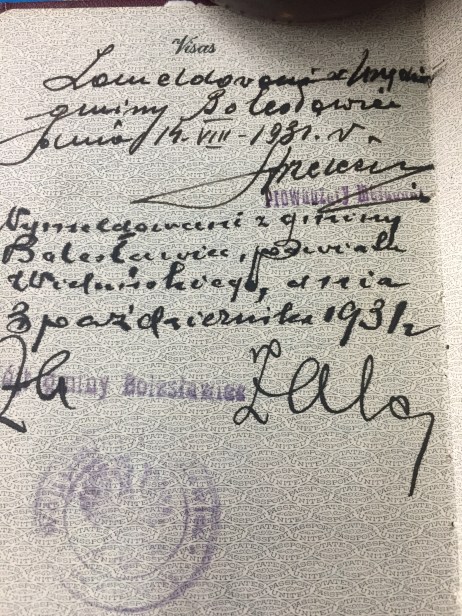
The special visa for 1931 visit to Boleslawiec.

My Grandma left Boleslawiec in 1922 to escape to the United States.  In 1931 she returned to Boleslawiec with my mother and uncle.  They stayed for several months.  We even have a special visa in the passport used by my Mom and Uncle that gives them permission to be in Boleslawiec.

It was during this visit that Grandma became aware of how bad it was for Jews in Europe.  Upon her return to the USA, she immediately began to work to get family members out.  She was able to rescue her father and her sister, who she brought to the United States. She could not rescue her two brothers and their spouses, but they did survive. Her mother, my great grandmother, Sara Manes Szenk,  died in 1919 as did a younger sister. (See blogs below.)

She was right to worry.  On Krystalnacht, November 9-10, 1938, Jewish business and the synagogue were set on fire.  They were destroyed.  Now just an empty lot is left.  The cemetery was also destroyed.  The few tombstones or matzevot left are at The Museum of Ceramics.   So my Great Grandma Sara’s grave — Sara, who I am also named for — is now unmarked, as are the other relatives who died before the Shoah.  An empty field marks the spot of the Jewish cemetery.  Luckily my great grandfather and aunt were already in the USA by then.   And my great uncles had fled.

Members  of Grandma’s family were murdered in the war. (See Blog about Speaking Yiddish below.).  I have not been able to find everyone.  But since the names Manes and Szenk were the surnames of her parents, I will claim all the Jewish people who lived in Boleslawiec who perished and had those surnames or maiden names.  I cannot claim for sure that they are related to me.  But in a town with just 100 Jewish members, I feel a strong level of confidence that they are my family.

Moshe Schenk(Szenk) and his wife, Yenta Fridel Schenk(Szenk), from Boleslawiec died in the Chelmo Death Camp in Poland in 1942.  Moshe’ siblings died as well:  Hana Leah and Bluma, also Bluma’s daughter Sara.  Two people wrote testimony for Moshe Schenk/Mosze Szenk: an uncle and a cousin.  That cousin also left testimony for Hana Leah, while the daughter/sister of Bluma and Sara, left testimony of their murders.

Many people who died in Chelmo were transferred there from the Lodz Ghetto in 1942.  So I will assume that these relatives were taken from Boleslawiec, to the Lodz Ghetto before their murders at Chelmo.  The Lodz Ghetto was the second largest ghetto in Poland.  Later, when the ghetto was destroyed in August 1944, many were taken to Auschwitz as well. Of the 68,000 Jews who were imprisoned there, 877 Jews remained hidden and were liberated by the Russians. When the war was over, only 10,000 Jews of Lodz Province remained alive. (Wikipedia).

Besides my Szenk/Schenk family who were murdered, there were at least four members of the Manes family killed: Franka Manes and three of her adult children: Sara, Eli and Reize.  Their sister entered the testimony in Yad VaShem.

I know that others perished as well because I met some of the survivors of Boleslawiec. I still cannot find their names, and that truly disturbs me. But the Manes family was from another small town nearby.  I have not yet completed my research about what happened in that village, but it was also in Lodz.  So I would assume the same route, Lodz Ghetto then Chelmo or Auschwitz.

When people think of the Polish city of Boleslawiec, they think of the beautiful pottery.   And only that.  I wish I could think that way as well.  Blue is my favorite color, and the pottery truly is lovey.  I know people who collect it.

I look at the lovely ceramic heart on my kitchen counter, and I think that it is amazing how a piece of lovely pottery that brings joy to so many people, brings me a feeling of despondency.   It is a symbol to me that people can create beautiful objects,  but carry biased hatred in their hearts. Even allowing that hatred to contribute to the deaths of others.  Unfortunately, I see that hatred rising again and happening today. So I look at the heart and I hope that kindness overcomes hatred.

Three websites, besides Wikipedia,  have helped me in the search about my Grandmother’s family who lived in Boleslawiec, Poland, located in the Province of Lodz.   Thank you to Jewish Gen; Vtrual Shtel; and my obsession, the Yad VaShem Database.

Update, There are actually two Boleslawiec cities in Poland.  The larger one is where the pottery is made; my grandmother probably lived in the smaller one.  But the pottery still brings the same response in my heart.

https://zicharonot.com/2014/04/28/speaking-yiddish-always-brings-me-holocaust-memories/

https://zicharonot.com/2017/12/04/the-us-passport-a-matter-of-life/

https://zicharonot.com/2016/10/01/the-rosh-hashannah-card-has-a-story/

The Yad VaShem Shoah Database: Each Name Becomes A Memory

11 Jul

The Yad VaShem Shoah database is killing me, while at the same time becoming addictive.  I have learned the secret of advance search where you can enter the name of a person who has given testimony and find all the other people that person has remembered.

For me it has been a personal trial as I try to find all the family names, while at the same time finding so many names, knowing that hundreds of family members perished in the Shoah.  My grandfather’s family all lived in a small area of Galicia surrounding the village of Mielec.

I enter names that are common to my family and I search.  Today I found a Tova Gital Feuer (her maiden name).  Those are two names that are used over and over again in my grandfather’s family.   Gital was the name of my great-great grandmother.  This Gital Tova/Tova Gital was born in 1889 in Mielec and died when she was 54 in Belzec 1942. That is where my great grandfather and great uncle also perished:  in Belzec.  They are sure to have been cousins of some sort, since they had the same last name in such a small town.

The person who gave testimony was Gital Tova’s daughter Ruth, who survived and made a new live in Israel.  But her immediate family did not survive.  Her father, Abraham, died in Treblinka.   Two of her brothers,  Lieb Arie and Anczel/Anshel died in the Debica/Dembitz Murder Site.  Anshel was a Polish soldier, I find that amazing.  He was 21 when he perished.

Debica/Dembitz was so close to where my grandfather and his family lived. It was actually part of the same area, and one set of his grandparents lived in Debica/Dembitz.

According to Wikipedia, the Nazi’s built a military base in 1941 in Debica.  They had 15,000 slave laborers who perished, including 7,500 Jews, 5000 Soviet POWs and 2500 Poles.  Their remains were buried in a nearby cemetery.  In Debica, the Nazis forced all of the Jews in to a ghetto and then murdered most of them there and in Auschwitz.
I had not heard of the Debica/Dembitz Murder Site. So I searched some more.   I found that in a Jewish Gen document. “The Murder of the Jews of Dembitz” by Reuven Siedlisker-Sarid, translated by Jerrold Landau.

This testimony tells about the formation of the ghetto, and that until 1943 the Jews were murdered in Belzec.  I believe this description is the Debica Murder Site that Ruth meant, as reported in the testimony:

“The Gestapo men approached the rows of kneeling people,and removed about 180 or 200 men. Those were placed on transport trucks and driven by the S. S. men to the edge of the Wilicka Forest at Lisa Gora. They were brought into the forest and shot into a communal grave that had previously been prepared by the Polish Junaks. The Junaks were then called to cover over the grave at the conclusion of the dreadful murder. This took place on the 7th of Av, 5702 (1942).”https://www.jewishgen.org/yizkor/debica/Dem141.html

Now I know about the murder site. All I can think is how horrible is that!   I have no idea how many members of my family died there. I have found so many horrible ways that my family members were killed by hatred.

Ruth’s parents and two brothers were not the only ones to be murdered:  In all seven of her siblings were killed: Lieb Arie and Anczel/Anshel in Debica; Shumel, 19; Simcha, 6 or 8, in Asuchwitz; Eliezar, 13; Mala/Malka, 23; Hanna, 14, Belzec.

I wish the list ended there, but Ruth also testified about the deaths of her aunts and Uncle Zlata, Sima and Hershel.   Another Aunt and Uncle: Hava and Zalman, and their 17-year- old son, Nissan.  These names got to me in a personal way.  My name is Hava, named for my great grandmother who perish in the Shoah.  And my grandfather was also Nissan Feuer.  It could have been us.

All were from Mielec.  And although Zlata and her husband Hershel and Sima were from Ruth’s father’s side, and might not be directly related to me, I claim them.  My great great grandfather on my grandfather’s maternal side was named Hershel.  He was both my great grandmother and great grandfather’s grandfather.  They were first cousins.  So many cousins married each other in Europe!

Ruth also gave testimony on several friends and acquaintances who also perished.   Ten more people.  I assume she saw them die either in the ghetto, or the death camps.  I do not believe I am related to any of them, as she did not mention a family relationship.

Of the 4,000 Jewish people who lived in the Mielec/Dembitz area only about 200 survived the war and the death camps.

I wish that I would not keep finding these horrific bits of information.  I wish I could stop searching the Yad VShem website.  Years ago, when I first tried researched my family, I tried the website database, but it was not as good as it is now.   Something makes me continue to search.   I continue to find more names to keep in my memory and in my heart.  Each name adds to my understanding of my grandfather and how important was for him to have our family.  Each name helps understand my Grandmother and her reactions when we traveled to Israel in 1976.  They lost so much in the Shoah.

For Ruth’s family, I feel a teeny, tiny less sad because Ruth survived.  She married.  I hope she had children, who had children, who had children to keep the memory and names of her parents, siblings, aunts and uncles, and cousins alive.  I hope she was able to live a happy life.  She entered these names in 1999.

For me each name I find is a blessing and a remembrance that I hope will keep in the hearts of my family.

Baruch Dayan HaEmet.


Here is one other blog about my Yad VaShem searches:  https://zicharonot.com/2018/06/07/the-sorrow-of-shalom-hollander/


Working on An Ancestor Mystery

20 Jun

You would think that with my niece’s wedding in two days my sister (the mother of the bride) and I would focus on the wedding. But not us. After a day of running wedding related errands, my sister and niece were putting together a display about our family weddings, when my sister and I got into a mini dispute over a wedding date.

This lead to my sister logging into her ancestory account to check the date, which of course led us into a lengthy look into our family mystery: our paternal grandfather’s family.

Once again we started searching for his family on the census documents and in other areas. We know his birthdate and the names of some of his siblings. And we think we found his family. We knew of six siblings in his family. We are now up to eight in the 1905 census. But there is one brother not yet listed. And we cannot find another census with the family listed. So we honestly do not think this is our family. We need to investigate more.

But that is not our only mystery. Sometimes the documents have all but one child born in the USA. Others show all but one born in a Russia. Some say the father, our great grandfather came in 1880 or earlier. Others say 1890. We know he was born in 1859 and his wife in 1865 we know they married in 1883 and started having children in 1885. The biggest problem is their very common names. If only we could find documents with the original last name of Grau instead of looking for Rosenberg.

We know our great grandfather abandoned the family when our grandpa was about 13. It is now looking as if grandpa might have been a bit older.

The names are so common that we have to be careful we are staying with the right family when we search. And it is difficult and confusing.

In the midst of this research, while I was looking for a post relating to my paternal grandfather’s family, I found a post I put up a while ago of two young girls which was never translated. This lead us down another path and, thanks to a Tracing The Tribe member, connected us to a relative on my maternal grandmother’s family. I need to do a bit more research before I can write about this photo.

But we have found a photo of my grandmother and what looks to be this woman. We know my grandmother visited family in Breslau in 1931, where this woman lived. And we know her mother has the same name of our great grandfather’s sister. So we are pretty sure she, this women murdered in The Shoah, is grandma’s first cousin.

My sister and I love mysteries and searching for our family in Europe. Identifying our family who perished in the Shoah is important to us. We want their names to stay in our memories.

So at my niece’s wedding, I sat with my mother’s first cousin and showed her some of the information. Sometimes she remembers a name or knew someone that my siblings and I never met.

My grandmother left Poland when she was 16 in 1922, while my great aunt stayed until 1936, when she was 22. So she had stronger connections with the extended family in Poland right before the war.

However, with this family member, my cousin had no memory to share. In fact she did not seem to know about the cousins my grandmother visited in Breslau in 1931. However she reminded me that my grandma was 8 years older than her mother.

We have one last link. The Yad Vshem testimony was submitted in 1999. I have a contact name and address. I know the person who submitted it would probably be in her 80s now. But I plan to send her a letter with our information and copies of the three photos I have. Perhaps we can make a connection.

The Sorrow of Shalom Hollanders

7 Jun

In my blog “Murdered in Belzec” I wrote about Shalom Hollander, the relative who put in the information about my great grandparents and great uncle on the Yad VeShem datebase.  I had met him in 1976. when I was 20 years old in Israel, when took my Grandmother to Israel to see her brother (See blog link below).

After I found those three names, I decided I needed to see if Shalom entered other names on the Yad VeShem website, since I could only find one of my grandfather’s siblings.  I did an advance search using only Shalom’s name as the one who put in the testimonies.  About 45 names showed up.  After going through all of them, I realized that he had duplicated some names.  Mainly his own children.  So in reality there were probably 40 names of people that were somehow related to me, of these 18 were children.

And although I was looking for my grandfather’s siblings and their children, finding these three families and their children touched my heart.  They were also my family.

Among the many names were his wife and his five children.  With this information I found out how he was closely related to me.  His wife, Cerla or Tzira Feuer, was my great grandfather’s niece and so my grandfather’s first cousin.  She was 38 when she was murdered.  (I knew two of her brothers who survived the Shoah, one settled in Montana of all places and one in England. Another brother also survived.)

Shalom’s children were:  Elish (Ptakhia), 11 years old when murdered in Auschwitz; Etla, seven years old when murdered at Auschwitz; Mordechai, five years old when murdered at Auschwitz; Gital Tila, four years old when murdered at Auschwitz; Ita, two years old when murdered in Auschwitz.  They all were murdered in August 1942 on the day that the Jews of Mielec were deported .

Before they were murdered at the camp, they lived in the Tarnow Ghetto.  What a horrible short life they lived.

In the earlier blog I wrote that I thought he had no family in Israel.  I now know why.  All of these deaths.

But it doesn’t stop there.

His sister also perished: Chaja/Serka/Khala Holander Viner/Wiener also died.  I like how he gave all the names she used.  She died in Belzec.  Also dying was her husband: Pinchas Viner/Wiener. He died in a different camp, Plaszow Camp, which was first a slave labor camp. Then a death camp.

It doesn’t stop there because his parents Mordechai and Tova also perished in the Shoah.  They died on March 9, 1943, in Beredechow, Ropczyce, Krakow.  I wonder what happened that day?  Why were they both murdered then?  I tried seeing if such a date was important in some way, but could not find anything.  But I guess it was important because Mordechai and Tova were murdered that day.

His father was related to my great grandmother, an Amsterdam. But Shalom chose to use his mother’s maiden name. Or perhaps his parents never had a civil marriage as what happened to many Jewish couples in Galicia, so he had his mother’s name.

I am looking back at my 20 year old self in horror.  I remember spending several hours with Shalom and my grandmother.  We had a meal or drink together in a restaurant.  We walked around for a while as my Grandma talked to him.  I remember being a bit annoyed because I had to take Grandma by bus to a place I really did not know so well to meet him. I think it was in Haifa.  I knew Tel Aviv much better.
I still remember what he looked like.  He was relatively tall for an ‘old man.’ Probably in his mid-70s.  He had the look of my grandfather, but not as much as another relative I had met.

They spoke in Yiddish.  I tuned it out.  I was so exhausted from all the Holocaust memories I had been listening to during that four-week trip.   Can a person have delayed Jewish guilt?  Can those memories really cause so much sorrow to me now?

They do.   I went back to Israel a year later and spent over three months. But I did not go to see him again.  Other survivors who I knew, I did see. But not Shalom.

I cannot imagine what losing all those people he loved did to him.  I cannot imagine what sorrow he carried with him.   I knew another of my grandfather’s relatives who survived. I wondered if they knew each other.  Now I know that they did.  Although Ziesel and Shalom were both related to my grandfather from different sides of his family, they married into his close family by married sisters, his two first cousins.

I do remember a bit of that visit with Shalom.  I remember Grandma telling me that this visit would be different, that I would be meeting one of Grandpa’s relatives, not one of hers. And that she did not know him very well.  I remember the overwhelming sense of pain that came from him while they spoke.  My grandmother spoke to him in a way I had never heard before.  With him she was so gentle.  Almost whispering to him as they conversed.  Easing the words out of him.

I remember Grandma and me being exhausted after this visit.  I remember Grandma went to bed as soon as we returned to the hotel.  It really was too much to comprehend.  Too much sorrow.  So maybe I just let myself forget.

Now, as an adult,  I realize that I must remember Shalom and his wife Tzira; his children Elish, Etla, Mordechai, Gital and Ita; his sister Chaja and her husband, Pinchas; his parents Mordechai and Tova.  May their names be a blessing, may I use this blog to keep their memories alive.  Baruch Dayan haEmet.

https://zicharonot.com/2018/06/05/murdered-in-belzec/

https://zicharonot.com/2018/05/01/zysel-ziesel-feuer-survivor/

https://zicharonot.com/2014/04/28/speaking-yiddish-always-brings-me-holocaust-memories/

https://www.encyclopedia.com/religion/encyclopedias-almanacs-transcripts-and-maps/mielec

Murdered In Belzec

5 Jun

I have not gone to the Yad Veshem website in years.  I already had all the information about my great grandparents.  But in writing about a mystery cousin, several people suggested I go see if he was listed at Yad VeShem.  He is not.  So I will assume he survived, (optimistic I know) and look elsewhere. (See blog below.)

However, the website looked so different, I decided to look at my great grandparents again. I knew that there was an entry for both of them. But when I first saw it, I could not read much of it.  Now it is all translated into English. More important, it was put up by a survivor, a cousin, someone I met in Israel in 1976 with my grandmother: Shalom Hollander.

I had not seen his name in 42 years.  When we met, in Haifa or Tel Aviv, Grandma and Shalom only spoke in Yiddish.  And at the time, although I did understand some of what they said, I did not really pay attention.  I heard so many holocaust stories when I was with grandma that month, and I was just 20.  (See link blog below.)

It has been many years since I last looked at the listing in Yad VeShem.   Besides their updated website, I have been on a mission to record what has happened to my family.

Recently I listened to an audio tape made by my grandfather in 1981.  I had it made into a cd earlier this year. (See link below.) In it he talks about the village where he grew up.  We always thought it was in Mielec.  Which it was to a degree, but it was actually in a small village near Mielec called Trzciana.

We knew that my great grandmother, Chava, was killed near her home. That she had been hidden and did not go to the concentration camps.  The Yad VeShem records confirm that she was murdered in Mielec/Trzciana.

I did not know which concentration camp my family had perished. I only knew that they had all died.   However the testimony provided by Shalom Hollander is clear.  They were murdered in Belzec.  I am not so sure I am happy about that. But I now know that is where Gimple Feuer, my great grandfather died.

In Belzec approximately 500,000 Jews were murdered. Nazis were killing people at Belzec for nine and a half months.  Thus, I now also know that my family was murdered between March 17 to December 1942.  But at Belzec the Nazis not only murdered and buried my family, when the war was near the end, the Nazis secretly dug up their bodies and burned them.   Most depressing is that of all the Jews who were sent to Belzec only seven survived according to Wikipedia.

In the past I have also tried to find any reference to my grandfather’s siblings.  My biggest problem is that I do not know his sisters’ married names.  However, the most amazing aspect of going to the Yad Veshem datebase this time is that I found one of my Grandpa’s siblings: Shimon. Born in 1910.  Single.  A merchant.  Murdered in Belzec.  I knew all my grandfather’s siblings died. But I never saw it in writing before: Murdered in Belzec.

Shalom also did the records for his own parents.  Mordechai Amsterdam, a cousin of my great grandma; and Tova (Tauba) Holander Amsterdam.  His parents were probably cousins as well, as we were all related: Amsterdam, Feuer, Hollander, Brenner.

But there it is.  Murdered in Belzec.  No one is named for Shimon.   I do not think Shalom Hollander had a family.  Or at least I did not meet them in Israel.  I guess my next job is to search for any of Shalom’s descendants.

I am still stuck on those three words.  Murdered in Belzec.

Thanks to Tracing the Tribe members for their suggestions, especially Amy.

https://en.wikipedia.org/wiki/Be%C5%82%C5%BCec_extermination_camp

https://zicharonot.com/2018/06/04/the-mystery-of-abraham-prantki/

https://zicharonot.com/2018/05/15/my-grandpas-voice-can-still-be-heard/

https://zicharonot.com/2018/05/01/zysel-ziesel-feuer-survivor/

https://zicharonot.com/2014/04/28/speaking-yiddish-always-brings-me-holocaust-memories/

The Shoah Impacts My DNA Relatives

24 Apr

Today I went on my 23 and Me account to access some information.  I manage both my account and that of my now deceased father, since I am the one who had him provide a sample about six months before he passed away.  I am so glad I did that.  It has provided me with my father’s Y chromosome information, which I otherwise would not have had.

I have over 1100 relatives on 23 and Me.  Most are third or distant cousins.  But today I had a revelation.  An unhappy one I must say.  There are 49 pages of relatives.  I just started scanning them.  And page after page after page, I kept seeing the same words, “on your father’s side,” after every entry.  Over and over again, not a single relative from my mother’s side. NO close relatives.  No distant relatives.

I started to cry.

Then I finally found ONE.  One distant relative. One.  I know that there were cousins who survived the Shoah. Not many.  And there were a few relatives already here in the USA. But I guess they are not on 23 and Me.  But in reality, most of my mother’s relatives perished.  She had one aunt and two uncles who survived. But among them, they only had two living children.  I know them well.   They also had descendants, I am happy to report.  Some live here in the USA, others in Israel.

But all those distant relatives are GONE.  Those distant relatives who share bits of my Dad’s and my DNA are welcome. But the missing ones from my mother’s side are so obviously a result of the Shoah that it reminds me of the horror of the loss.  I should have an equal number of distant relatives from my mother.  Instead of 1100 people, there should be 2200 people who share a bit of my DNA.

I am feeling a sense of loss I have not felt before.  Maybe because I am working on an article about my grandparents’ survival story.  So I am already feeling the dread of reliving their sorrow over their family’s loss.  But this was a blatant reminder that my family really is not like every other.

Jerusalem In My Heart

7 Dec

Yesterday I told my daughter not to go to Jerusalem. She and her husband live in Holon, about an hour from Jerusalem. I know that violence will explode as Hamas lashes out over the US decision to recognize Jerusalem as Israel’s capital. It makes me ill.

Nothing has really changed.  But those who work toward hatred use it as a cry to kill and destroy.  And the way the media and the politicians across the world reacts adds to the mob mentality of hatred.  If you show people rabble rousing then they will turn into hate filled mobs.  Why not use some common sense.  And just relax.  The US Congress recognized Jerusalem as the capitol of Israel decades ago. This is not news.

I love Jerusalem. It is in my heart. I spent my sophomore year of college in a Jerusalem attending Hebrew University, living in both Givat Ram and then Har Hasofim campuses. I traveled the roads and went throughout the area surrounding Jerusalem with ease. In 1974 and 1975 we could easily go anywhere in and about Jerusalem. There was no intifada. There were no walls and barricades. We all went where we wanted.

But still my family worried.  It was less than a year after the Yom Kippur War.  My Grandma Esther, who was born in the USA, would send me letters with newspaper clippings and write, “You could kill me in easier ways.”  My Grandma Thelma, who was born in Poland, would send me letters telling me to meet up with her family who had come to Israel after the Shoah.

My love of Jerusalem started before I even saw it,  when I was 11 years old.  The movie, “To Cast A Giant Shadow,” came out. I went to see it with my cousins and grandmas during the summer. I sat next to Grandma Rose, my cousins’ grandma. But we shared her. She had been a citizen of Jerusalem during the siege in 1948 when the Arab nations declared war on Israel after the UN declared the new country of Israel.  Jews in the Jewish Quarter of the old city were cut off without food or water as the siege started. They survived due to old hidden waters in the City.

Grandma Rose, Grandpa Asher and Uncle  Jack survived. But Grandma Rose told me she never forgot looking back to her city, to Jerusalem and wondering if she would ever see it again, when she was forced to leave. When all the Jews, families who had lived there for centuries, were taken out of the city by the Jordanian soldiers. She did not go back, but she never forgot. She died in the USA.

When I lived in Jerusalem, I was there when Uncle Jack returned for the first time, 26 years after he had been forced out as young man. My uncle and aunt came to Israel for their 25 wedding anniversary. And I got the benefit of being with them as my Uncle relived his childhood and told me about the siege and how they survived. He also never forget the last look back as he left his home.

I have been to Jerusalem many times. The heart of Israel. Where the Israeli government has its parliament, the Knesset; where the Israeli Supreme Court makes decisions that benefit those of all religions; where the holy sites of Jews, Christians and Moslems exist in close proximity.

It was in Jerusalem,  the city of peace, that I was taught to use an Uzi and an M-16 automatic rifle to survive.  It was soon after the Yom Kippur War and it was not always safe.  It was in Jerusalem that I became used to the bus drivers who would walk through the bus and ask about every package to find out who it belonged to , to make sure there were no bombs.  It was in Jerusalem that I felt the ground shake as the military detonated bombs it had found nearby in an empty field.  The terrorist groups have been attacking Jerusalem and Israel for decades.  Nothing seems to stop it.  There is always another reason they claim to try to kill or cause chaos. So this decision really changes nothing. The violence ebbs and flows like a tide.

I have been to the Temple Mount and visited the mosques; I have seen the tomb of Jesus in the Church of the Holy Sepulcher and the Church of Nativity in Bethlehem; The tomb of Rachel on the road to Bethlehem; the tomb of the Patriarchs in Hebron. Some of these places are difficult for Jews to access now.

Every time I go to Jerusalem now, I see signs of hatred rising. I love Jerusalem, like many others say they love it as well. But some times I wonder about their signs of love; they are are hard to decipher, to understand. Throwing stones, setting fires, stabbing, terrorists attacks. These are not signs of a people loving a city.  These are signs of destruction.

Recently I was at the Harry Truman Presidential Library.  I read about his recognizing the State of Israel and how so many American and international politicians were against this decision. But he did what he thought was right.  The world survived.

Instead of focusing on the one issue of Jerusalem, why is the world not focusing on the proxy war between the Shia and Sunni that is taking place in Syria?  Why not focus on the war occurring in Yemen?  Why not see the horrors that are happening in Turkey?  Why not Iran and Saudi Arabia?  Hundreds of thousands people have been killed.  Millions have been displaced.  Israel has nothing to do with any of it… so the Arab world stays silent.

Jerusalem is not the reason for all these conflicts.  There are much bigger conflicts within the Moslem Arab nations that is causing unrest in the Middle East.  I hope one day there will be a end of hostilities.  That both sides will decide to just live in peace.  That they will move forward and not ruminate on the past.  To be honest neither side can win, unless they let the past go free.

The US Passport: A Matter of Life

4 Dec

I recently saw the documentary, “Big Sonia,” about a local Kansas City area woman who survived the Holocaust and three concentration camps from ages 13 to 19; how she and her husband started their own tailor shop; how the tailor shop became an important part of her life; and how the Holocaust impacted her life, her family and those around her.  Although I do not know Sonia, I do know her sister-in-law, who belongs to my congregation.

Both Sonia and Ann are contemporaries of my Mom.  And when I hear of their Holocaust survival story, I cannot help but think, “there for the grace of G-d, could have been my Mom.” But she would have just been 10 when the horrors really began, and she might not have survived.  It stabs at my heart.  Here is why:

img_5529

When I look at the smiling children in the 1931 passport, I feel fear in my heart.  They are my Mom and my Uncle.  My grandmother is getting ready to take them to Poland.

In 1931, most Jews in Poland and Europe were not yet concerned about escaping. Although Hitler’s rise to power was advancing, he did not become chancellor of Germany until January 1933.  Thus, I guess in some ways, my Grandmother was not afraid to take her two small children, my Uncle, who was 4 ½, and my Mom, who was 2 1/2, to Europe to stay with family while she tried to regain her health.

Boat to Europe 1931

The kneeling sailor is speaking to my Mom;  behind her my Uncle; behind him my Grandma.

I always knew this had occurred. I have seen the photo taken of my Mom and Uncle on the ship to Europe. I knew that my grandmother almost died aboard the ship on the way to Europe. I have seen several photos of my grandmother in Kalsbadt and with family members during that trip.

Both their visa and Passport were issued on May 18, 1931.  I think their visa was good until May 18, 1932.  This part of the Visa is in German. Since my Grandfather’s family lived in the area of Galicia which was then Austria, it makes sense. They arrived in Europe on May 26, 1931.

I heard the stories of my Mom and Uncle coming back from Europe only speaking Yiddish. Their English left them while they spent six months with their paternal grandparents.  This would not happen again, as these grandparents perished in the Shoah.

img_5528

This registers my uncle and mom as living in Boleslawiec.

But now that I have the Passport, and have had part of it translated,  I know that this story is not totally true.  They spent at least two and half months in Boleslawiec, Poland,  from August 14 to October 3, 1931.  This is where my Grandmother was born.  They spent at least that time staying with their maternal grandfather and his children. That was a surprise.

So at some point, my Grandmother traveled across Europe with two small children, going from Mielic, Galicia, Austria, to Boleslawiec, Poland.  WOW.  I wonder how the trains were then.  I am sure she went with her American dollars and was able to travel easily.  But the idea of them on a train in Austria and Poland sends shivers through my body.  I can so easily image the other members of my family who traveled on much less kind trains a number of years later to their deaths in the concentration camps.

I also knew it was this trip and her visits to the mineral waters of Kalsbadt that saved and cured my grandmother.  Her experiences in Europe over these months also made her resolute to get as many family members out of Europe that she could.  Unfortunately, she was only successful in rescuing her father and sister.  Her in laws refused to leave, and they perished.

However, until I held the Passport that jointly named my Uncle and Mom as USA citizens and saw the visas, I somehow did not quite fathom the enormous consequences.   This passport was only valid for two years. What if they had been stuck in Europe? I had asked my grandfather when I was younger what he would have done if Grandma died in Europe.  He assured me that he was not going to leave his children in Europe.  He let her go because she was ill, but his children would return to the USA.

That always made me feel better, as the family they stayed with, my grandfather’s family, all perished.  I always believed that Grandma took the children to her in-laws and traveled by herself.  But that is not true.  She also took them to see her father and siblings as well. And miraculously my Grandmother’s two brothers and their wives survived even though Grandma could not get them out of Poland.

The Passport was originally made out only for my Uncle in May 1931.   I found that strange.  Was my Grandmother going to leave my 2-year-old mother with my grandfather in the States, while she traveled with my Uncle?  What changed her mind? I will never know that story. I found the Passport long after my grandmother had passed away.

I do know that they came home.  They arrived back in the USA on October 13, 1931. I can see the US Immigration stamp. The trip itself took a week or so crossing the Atlantic.  They grew up in New Jersey.  They married. They had children and grandchildren. Their memories of Europe faded quickly.  Perhaps my Uncle remembered more, but for my Mom it was just stories she heard.

My Mom did not go through the horrors and Hell that Big Sonia experienced.   Her American Passport and visa and ticket to return saved her and my uncle.  In 1936 Mom went with my Grandmother to Ellis Island to gather my great grandfather and Tante (great aunt).  My Grandmother was successful in saving them.

Not everyone had a life saving Passport. I often think of those who perished.   I still remember the day I found out about the Holocaust.  I cannot forget.

With the vitriol and anti-Semitic language and acts of bullying throughout the country, I think it is important that no one forgets.  Everyone should go and see “Big Sonia” and learn about real courage, and the horrible consequences of baseless hatred and bigotry.

Thank you to members of the Facebook Groups: Tracing the Tribe and Jewish Ancestry in Poland for the translations.

http://www.bigsonia.com

https://www.facebook.com/bigsoniamovie/?fref=mentions

https://zicharonot.wordpress.com/2016/06/06/the-mysterious-kalsbad-photos-who-are-they/

https://zicharonot.wordpress.com/2014/04/28/speaking-yiddish-always-brings-me-holocaust-memories/

Thinking of My Dad on Memorial Day

29 May

A rose and a Snapple for my Dad. 2016.

My  Dad was the recipient of two Purple Hearts and a Bronze Star. During the Korean War, he was a forward observer, which meant he had the job of going in front of the front lines, laying the radio cable with which they communicated, and observed what the enemy was doing.   Sometimes he disappeared for a while, with no communications home to my Mom or to his Mother.

Before he left f or Korea, my Dad got engaged to my Mom, married her on his last leave, June 17, 1951, and spent time in California training. At first, I think because of his advanced age, he was almost 23, he taught map reading to new recruits. Dad loved to read maps. Honestly, I think GPS systems would have driven him crazy, as paper maps have almost vanished. For Dad a map was important.

His time as a instructor was limited. One day during exercises, an officer insulted my Dad, making anti-Semitic comments and making fun of the mezuzah he wore around his neck.   Dad was not a tall man, but he was a big man. He tackled the officer and broke his jaw.

Not a good thing to do at all. But Dad was from the Bronx. He learned at a young to defend himself. And perhaps going to an all boy high school, DeWitt Clinton, in NYC, made his sure of himself.  And he was not stupid.  He knew exactly what he was doing. But NO one was  going to make fun of him for being a Jew. (Okay, I will admit he dropped out of college, CCNY,  his biggest mistake,  he ended up in Korea instead of in a classroom.)

He was lucky, his commanding officer, a Captain, saw the incident. He and several others hustled Dad back to camp.   As far as anyone was concerned, Dad was not there when the Lieutenant had his jaw broken.   But Dad was demoted a grade and sent to Korea. He always said that the USA paid for his first cruise…to Japan and then to Korea.

Dad’s first Purple Heart came when they were going up a hill. His group was being bombarded.   The noise was horrendous. Years later when Dad saw “Saving Private Ryan,” he discussed that noise. The movie brought back his memories, as he was part of the amphibious landing in Lochi.  My Mom said he cried during the opening sequences.

He told us, They got everything right, even the sounds of the bullets hitting the sand, but they could not get the horrendous smell.”

Dad was injured on the hill. Shrapnel entered his legs. He was bleeding. His friends cried out, “Rosie! Get Down! You are wounded! Medic Medic!. “ He said he did not even feel the pain in the rush to get up the hill.   It was Dad’s first visit to a MASH unit.   Needless to say, Dad loved the television comedy M.A.S.H. The MASH doctors fixed Dad up and he went back to war.   Years later the shrapnel began to exit his legs, causing him much pain.

Besides being a forward observer, Dad was a radio man. He laid wires and fixed faulty wiring. He received a citation for bravery for fixing wiring at the base during a bombardment. He was up on a pole fixing it, while bombs fell around him.

His Bronze Star was a unit award. Quotes from my sister: “His unit got in during the Inchon incursion when the South Korean army units on the flanks bugged out and left his division holding the line against North Korean army until relief units arrived.”

My brother disagrees. He says yes it was a unit award, but was not for Inchon. They were actually in the mountains and were abandoned by the South Koreans. The unit got the Bronze  Star for this mission, for fighting their way back to their encampment and surviving.

His second Purple Heart got him the trip home. This time by plane to Hawaii and the big pink military hospital on the hill.   (I waved to it when I went to Hawaii 17 years ago.   Dad asked me to do that for him.) Then to California and one to Massachusetts, where Mom was able to meet up with him.

She always said that Dad was not the same person when he came home. She would say that he was not a human being. That it took a full year for the real Donald to come back.

Dad was the kindest, gentlest man. He loved people. He loved his family. But his time in the army changed him.   Certain noises would impact him.   Military movies made him cry.   He went to pay respects at the Korean War Memorial in Washington, DC, as well as the one here in Kansas. At both he cried for those who did not come home.

2017 Remembering my Dad and Mom. Two roses.

On Memorial Day, I always think of my Dad, and all the others who served our country.  I go to the Korean War Memorial near my home and put roses on the stone I put in for my Dad.   Roses for Rosie….and I drink a diet peach Snapple, his  and my favorite drink.

Another Blog about my Dad:  https://wordpress.com/posts/zicharonot.wordpress.com?s=My+Dad+was+a+Proud+Veteran

https://zicharonot.wordpress.com/2015/11/10/museums-help-me-honor-our-relatives-who-served-on-veterans-day/