Tag Archives: memories

Matzah Brie 

15 Apr

Why do I only make matzah brie during Passover?  I truly love it. I heat up my frying pan and make it at least twice each year. And I always make enough to last two days. But once the holiday is over, my desire for matzah brie disappears. 

I have learned over the years that not everyone makes matzah brie the same way.  Nor do they call it the same thing. I say matzah brie, others say matzah briet or matzah brun. There might be even more names. 

My husband’s cousin would break a piece of matzah in half and soak both halves in a egg mixture before deep frying them. It was delicious, but not my style at all.

 I wonder if the area of Europe a family came from or perhaps where in the USA they settled impacts how the matzah brie is made? 

Making matzah brie is something I learned as a child. In my family we make the same batter we do for French toast. Eggs and vanilla mixed together.  Then we run the matzah under water, breaking it down to smallervand smaller pieces till we crumble the matzah into the batter.  The number of matzah we use is determined by the number of eggs we use; about two pieces of matzah for every egg. 


I then take the mixture and place it into a frying pan that I have place a small amount of oil and have  preheated. I smooth out the top of the mixture and make sure I fill the entire pan. Then it cooks. I like mine golden brown. I use a spatula to divide it in half to easily turn it. Then cook the other side.  The smell is enticing. 


Finally I cut it to smaller pieces and I am ready to eat. In my house there is just one way to it eat, with sugar sprinkled over the top. I know some use syrup, but I am a sugar purest. 

Another delicious Passover memory.  But I know when the holiday passes, I will once again crave my Sunday morning challah French toast. All thoughts of matzah brie wil be gone till next spring! 

Hope everyone is having a zissel Pesach! 

Cruise Conversations That Linger In My Heart

6 Apr

When I travel I have learned to expect the unexpected.  You never know who you will meet or what will occur.  The best is to be flexible.  But occasionally you meet someone who makes an impression.

The first time this happened was on a cruise over 25 years ago.    At lunch time, on a cruise, you get to sit with many different people.  You never know who you will meet or what you will talk about.  On the second day of this Caribbean cruise, we ate lunch with an older man, who when he reached across the table,  I saw numbers tattooed on his arm, numbers obviously from Nazi days.

I said nothing.  I remember as a child, in the early 1960s, I saw numbers on the arm of my parent’s friend.   I asked the question, “Why do you have numbers?”  The room grew silent, and I was taken from the room and told never to ask that question again.  It wasn’t until I was much older I understood that  in the early 60s people did not talk about the numbers.

But this was the early 1990s and I was no longer a child.  Since we were seated next to each other, I waited.   When most of the people left, I asked.  I had the most interesting conversation.  The man next to me was a retired priest.  He was on board to hold services.   He had been in the camps as a young man because he and his parents resisted the Nazis and were part of the intelligentsia and were ardent Catholics.  He and I had several conversations over the week-long cruise. We spoke about his experiences and the death of my grandfather’s family in the Shoah. Although I have forgotten his name,  I have never forgotten him.

But when we went on a cruise this past March, I did not think I would meet another survivor. So many years have passed, and among those survivors who are still alive, few still travel.   At lunch one day, I found my husband speaking to a much older couple.  The man was obviously elderly and perhaps recovering from an illness.  But he spoke strongly with a distinct British accent and he had a much different life experience.

His story touched my heart.  He and his brother were sent away from his home in Germany on a Kindertransport to England when he was 14.  He was one of the lucky ones.  His parents survived as well!   “We had a wonderful life in Germany,” he told us.  “We were more German than Jewish.”

But of course that did not help.  His parents were quite wealthy and aware enough to start the search for visas and relief early on.

When he turned 18, he enlisted in the US army and was sent to the United States.  His service helped him become an American citizen, because until then he was a man without a state.  While in the USA, just before he left for Germany, he became a US citizen.  His commanding officer advised him to change his name from Adolf and the very Jewish last name to something less Jewish sounding.

“If they capture you in Germany with that name, they will not keep you as a prisoner, they will kill you,” his commander told him.  Since he was getting citizenship he should change his name now.  So while he traveled to court he kept thinking of a good name.  He decided on Ralph for his first name.  For his  privacy I will not relate his last name.  He did go to Germany and was a translator for the Army during the closing days of the war and afterwards.

I have read about the Kindertransports and heard speakers discuss these train rides to freedom,, but I never actually met someone and had an informal conversation with someone who survived through this path.

Although I have read many books about the Shoah and spoken to many survivors, these two men will remain in my memory. My conversations with them linger in my heart.

Defacing a Cemetery and Bomb Threats Make Me Angry

20 Feb

I was not sad today when I found out more Jewish Community Centers had received bomb threats that forced evacuations.  I was not sad today when I found out Chessed Shel Emeth Cemetery was vandalized and over 100 stones were toppled.  I was not sad.

I was ANGRY! I am still angry. I am frustrated that people believe hatred wins. It does not win.

This wave of anti-Semitism has touched me on several occasions. My sister and nephew were exercising at the Tenafly, NJ, JCC when it had to be evacuated in bitter cold weather. Children and elderly had to walk or be taken to a safe place.

The Jewish Community Center in Kansas has been on high security for over two years now since a horrible instance of anti-Semitic violence led to three deaths. And twice bomb threats have been received this year. I am used to seeing armed guards at the JCC and at our synagogues.

But today was the final straw. Today the cemetery where my husband’s parents and grandparents, as well as his great aunt and uncle,  are buried was vandalized. Chessed shel Emeth in University City, Missouri, in St Louis.  I am so angry that someone thinks toppling graves is acceptable. I think my anger is intensified because so many of my family have no graves. Their remains are included in the ashes of the concentration camps and destroyed Jewish communities in Europe.

I think I am angry because by destroying graves, they– the haters– try to wipe out out memory. I am always searching in my family’s genealogy, always wondering about who came before and how are we related. So I say to the haters, “It will not happen. We carry each person’s name and memory as a blessing. ”

I contacted the cemetery as soon as I found out to discover the status of our family graves. I was surprised at how quickly I had a response. I was contacted within an hour that Our stones were not toppled.

I want to thank all those who reached out to us. I am glad that the community is coming together to help repair the damage.  Donations can be made to help pay for the damage,. (See link below.)

And I say to those making threats and trying to destroy cemeteries, You will be found. You will be punished. This is not Europe of 1939. This is the United States of America. And you are in the wrong. We stand united.

I am angry, but I believe in goodness.  And I will continue to work with and focus on those who want a better world. I think we need to spread kindness, but we also need to find those who are perpetuating these acts and hold them responsible for their actions. It is just wrong.
If you want to help the cemetery please go to this site: https://www.chesedshelemeth.org/how-to-donate.html

http://kplr11.com/2017/02/20/vandals-target-historic-jewish-cemetery-in-university-city/

Memories of the Multi-Colored, Rainbow Fence

19 Jan

My son and I recently completed a project in my home. We stripped wallpaper off the walls of a bathroom and covered the vacant walls with a lovely sea foam-colored paint. I loved working on this project with my son over his winter break!

While we were painting, I kept flashing back to my Grandpa Nat, for whom my son is named. Grandpa would have loved that my son was taking on a painting project and successfully meeting my expectations.   It was my grandfather who taught me the skill of scrapping and painting and keeping a home in shape.

As the owner of a small Catskill’s bungalow colony in Kauneonga Lake, Grandpa did much of the maintenance on his own, with help from my Dad and us, his grandchildren.   The difficult plumbing and electrical work was done by professionals, the painting was a chore we could all do. And we did.

“IF you don’t Work, you don’t Eat,” Grandpa would intone. Of course we always ate, but he wanted us to know that it was important to have a good work ethic. In the real world, not working meant no money.

In the spring, that work ethic was obvious. We would go up to the Catskills before the season began for my Dad to help Grandpa get the bungalows ready. My brother and I were scrappers and painters. They would put us along the bottom of the bungalows that needed to be painted, where we scrapped off the peeling paint.

When that chore was completed to Grandpa’s satisfaction, my brother and I would be allowed to paint the bottom.   I actually loved it! It was my favorite chore, even though all the buildings were painted white. (I think my sister was too young to be part of the paint squad!)

img_4330

We still have the furniture.  It is well over 65 years old, and needs painting!

When the bungalows were done, we had to paint the wooden lawn furniture.  Grandpa went for the greens, blues and gray tones.  Scrapping those chairs and painting the wooden slats and metal legs was backbreaking work.  We got to do it because we were lower to the ground!  But I still remember how tired I would be when we completed this chore.

Now I have to tell you that my Grandpa was colorblind. ALL colors looked the same for him. Whereas, my Grandma loved colors. So in a way what happened one spring is partly my grandmother’s fault.

Every other spring, my grandfather would paint the wooden fence that surrounded the colony. Our colony was located across from the lake along the side of West Shore Road.   During the week, the road was quiet with virtually no cars. But on the weekend, the road was zipping with cars.   The fence kept all the children safe.

I do not know why, but one spring Grandpa painted the fence when we were not there.   And instead of getting new paint cans, he decided to use all the old paint that was in storage: exterior and interior paint. Why waste it? He did not mix the cans together. That might have been better, as everything would have been grey.   However, that is not what he did!

Instead as he finished one can of paint, he opened another and continued painting where he left off, over and over again. It was rainbow like in its many colors, but not in any rainbow order. When we drove up to the Catskills and arrived at the colony, we were amazed to see, what I thought was lovely, a multi-colored fence surrounding the property. I cannot remember all the colors that covered the wood. But it was noticeable. My parents were stunned. And then they laughed.

My grandfather had no idea what the fuss was about. When they told him, he just roared in laughter.

I think it stayed that way for two years, even though some of the tenants complained. Although my mother and grandmother were not fans of the multicolored fence, I was. It made me happy. We were the only bungalow colony with such a joyful fence. When he repainted it, he used just one color, grey.   After that he often mixed all the paints together when we worked in the spring creating different tones of grey!

So as my son painted the walls in my bathroom, a joyful sea foam blue, I continually flashed back to the joyful multicolored, rainbow fence that surrounded our bungalows.

Missing My Friend

14 Sep

Now that my daughter’s wedding is over. I have time to reflect on the other major event in my life.

Women have several best friends. I do not have just one best friend, I have several: different women who give me support, love, a sounding board, comfort, friendship, and family. I am fortunate to have many best friends: the women who have gone through life’s joys and challenges and have always been there for me, just as I have been there for them.

Right before my daughter’s wedding I lost one of my best friends to cancer. It broke my heart.  Every time someone we love dies, it takes a little slice of the heart. I have survived the deaths of my grandparents, parents, cousins, aunts and uncles and even some friends. But this loss just breaks my heart.

My daughter said, “Mom I know you are so sad, but this is my wedding. Please focus on me and how happy I am.” So I had to push away my tears and focus on the joy of my daughter and future son-in-law. I needed to stop grieving and join the celebration.

The Friday before the wedding…two days before, my husband and I went to the funeral. How could I not go and say goodbye. I sat with another close friend. I held her hand and my husband’s hand as the funeral service progressed. Just as I was thinking ,“How will I get through the wedding.”   My friend turned to me and said, “What would she want? How would she act?” We both knew that she would want me to be so joyful at my daughter’s wedding.

We did not go to the cemetery. My husband and my friends insisted that I go home and get into wedding mode. I asked my close friend to shovel dirt for me. Even though I could not be there, I wanted to complete the act.

As we left the funeral, my friend’s husband rolled down the window of the limo to reach out to me. We spoke. I hugged him. Any other time in my life, I would have been there for him and their sons.

Another of my best friends called. She was preparing a shiva meal. And would put my name on it. There was no way I could go to any of the shiva services. I had the rehearsal dinner, the wedding and company throughout the holiday weekend. I felt the love of my friends to help me get through this bittersweet time.

My friend fought a battle with cancer. She was always gracious and strong. She was the kindest person. Everything was delightful in her world. I would ask, ‘Do you want to go for lunch?’ Her answer, “that would be delightful.” We would go out with her and her husband. Any thing I suggested would be delightful. When she chose the show or the restaurant, I in turn would say, “That would be delightful.” Delightful became one of my favorite words to use. It is so uplifting, just as she was to everyone.

It was not an act. She saw the world as a happy place. And her oh so happy attitude transformed people. She got things done. There was never a need for accolades and attention. If something needed to be done, she did it. Write a grant, organize lists of names, write letters, be there for a friend. Even when she was sick, she never stopped helping others.

Over the last year or so, she could not travel. Whenever I went out of town, she told me to send her photos. I sent many text messages with photos from throughout the country, Alaska, Canada, Seattle, New York, New Jersey, even the world: India, Israel, Italy, Spain. Wherever I went, she went with me.   I sent the most beautiful photo I took each day. She would respond with little messages telling me about her treatments and how things were going.

When I returned from a trip expecting to go and see her, she sent me a message.   She was going back into the hospital. “I just realized I never sent a welcome home,” she wrote. “The docs have decided to put me in the hospital… Sorry for the bad news. I am going this evening….”

So like her. Sorry for the bad news. She always thought about the ones who loved her. She knew it would hurt me that she was not progressing as well as we hoped. I visited her in the hospital. I visited her almost every week. I did what I could, as did her other friends.

But nothing really prepared me.

She called me three weeks before she died. She wanted me to come over with soup from our favorite deli. She was home alone. We spoke for two hours. It was our last visit. I cleaned the kitchen. I hugged her. I basically begged her to live to come to my daughter’s wedding. I knew it would not happen. But the thought of losing her was so very difficult.

I did not go back to see her. We continued to text back and forth for the next two weeks. I sent photos and long messages. She sent one or two words. Our last words, I said, “Love you.” She responded, “You too.” And that was the end. I kept sending messages even though I knew she would not/could not respond.

And now the wedding is over. My daughter and her husband have left town. Now I can grieve for my wonderful, delightful, kind, nice, bright friend. Only now can I open the box I kept in my heart during the wedding and cry.

Only now can I think about how much I will be missing my friend.

The Kauneonga Lake Temple BethEl Recipe Book

12 Aug

I found a treat today. I decided to clean out my cookbooks. My daughter is getting married in a few weeks, and I am in a nesting mode. Sort like when I was pregnant. Now I am cleaning out my house and getting ready for hordes of guests.

I decided to clean out my cookbooks. There are many I have not used in years. I offered some to my daughter, but she informed me that she gets her recipes off the Internet. Fine. She does not want my cookbooks! I will give them to someone who wants them. And will appreciate them. But there are a few I will keep!

I like cookbooks, especially because some have much meaning and memories. I have my mother’s Settlement Cookbook. Probably the best cookbook ever made.   I have kosher cookbooks, healthy cookbooks, vegetarian cookbooks, light meal cookbooks, as well as a variety of cookbooks put together as fundraisers by various charitable organizations.

image

It was in the midst of these spiral notebook style cookbooks that I discovered a tiny treasure, “Cooking Favorites of Bethel,” put together by the Sisterhood of Temple Bethel, Bethel, New York. This is the congregation I belonged to throughout my childhood when we spent our summers and High Holidays in the Catskills. My grandparents lived in Kauneonga Lake throughout the year and davened at this small shul. I rejoined many years later as an adult to help support it.

I know this book is at least 35 years old, because my grandmother died in 1981. But it has to be older, based on the names of some of the women who contributed recipes. They passed away before my Grandma Thelma, like Clara Wagner. I close my eyes and I see Clara. She was Grandma’s best friend.   They spent many hours sitting and visiting. My Grandma was heartbroken when she passed away.

Then there is Nan Dasher, besides cooking, she would embroider tablecloths. Which she did constantly. I have two tablecloths she made. One specifically for me when I married, and one I took from my mother’s stash after Mom passed away. Nan lived in the White Lake Estates, not far from my grandparents.

So many other names of women I knew when I was a child submitted recipes: Lenore Liff, Yetta Gruber, Mrs. Elfenbaum, Goldie Lerner, Rebecca Rosenberg and more.

But the most exciting and enjoyable for me was finding my grandmother’s name in the book. Thelma Amsterdam contributed four recipes. HA! These recipes are a sort of lie! Grandma did not cook. Okay she cooked but not very well.

I still remember the trauma over this cookbook. Grandma had to submit recipes. She was an important member of the Sisterhood and needed to show she cared. I remember her coming to my Mom to get recipes. There they were sitting in the kitchen and writing down recipes that Mom gave her. The recipes that have my Grandma’s name, every one of them is from my mother. There is my Mom’s simple baked macaroni recipe. I still make it!!!! Even though I cannot eat dairy I have made it for Yom Kippur break the fast, and for shivas. It was so easy! However, Grandma NEVER made this meal.


recipe

So when I saw the four recipes she submitted I was filled with the laughter of remembering Mom giving her the recipes. I was filled with memories of my Grandma’s horrible cooking, although she could make the best mushroom barley soup and Pesach noodles. And I remember this book being put together and then published.

I should also tell you that this book is in perfect condition. I don’t think my Grandma ever opened it after she purchase in the effort to support the congregation and its sisterhood.

I honestly do not know when I got it. But I have a vague memory of Grandma giving it to me when I got married. Okay, I never used it either. It is so small it got hidden among my other cookbooks.

I am glad in a way, because now I have this tiny memory in such pristine condition. With it are many memories of Kauneonga Lake and going to shul!

Forks in the Flower Pots; Or Why I Keep Plants By My Kitchen Sink

10 Aug
image

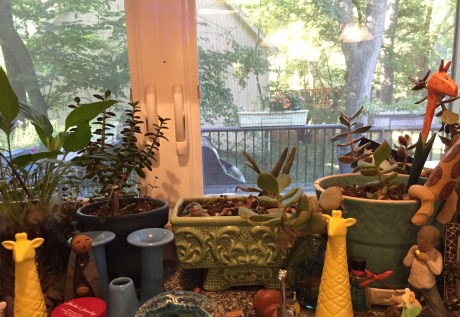
My kitchen window with my grandmother’s planter is the green one in the middle.

Above my grandparents’ kitchen sink in West New York, New Jersey were a variety of flower pots filled with plants.  But often interspersed among the plants were utensils.  Usually forks, but sometimes knives and spoons.

image

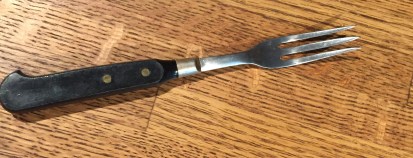
I own one of my Grandparents’ goupls.

When I was very young I remember thinking that my Grandma was special as she could grow metal in her pots. I especially wanted her to grow more of the special forks we called goupls, that we used in her home.  They had really thick and interesting handles. I thought goupl was a special name for this fork. We did not call the other forks, goupls, just these forks.  I found out when I was older that goupl is Yiddish for fork.

Usually standing upright, prongs in the dirt, were two or three forks each day. Amidst the plants the glow of silver.  Why?  My grandparents kept kosher. Meat and dairy is kept separate. My grandparents had utensils for milk meals and another set for meat meals. If they touched when they were wet, they had to be rekashered….made clean to use again.  One way, according to my Grandma,  is to bury it for 24 hours.  Grandma buried it by sticking the unclean item in a flower pot.

In reality, I think this was my grandmother’s interpretation of ne’itzah, a type of koshering for knives when you push them in dirt several times. Grandma just kept any utensil buried and unused.

My mother also kept plants in her kitchen at our hoe in North Bergen. But she did not keep kosher so there were never forks in the flowerpots. However having the plants was important to both my parents.  My Dad was always potting and repotting plants.  Plants freshen the air of your house according to my Dad. So besides helping to keep kosher, plants keep you healthy!

When I married, my husband and I decided to keep a kosher home. When we purchased our house a big draw for me was the window ledge above the sink.  A wonderful place for plants. But to be honest, I very rarely have put a fork or spoon or knife in a flower pot. However, they are there in case I need them.

image

My mother-in-law’s aloe plant.

Besides my kitchen sink plants, I have other plants including an aloe plant that is over 50 years old.  I have had it for 31 years. But before that it was my mother-in-law’s kitchen aloe plant.  I inherited when she passed away at only 59.  Aloe plants are important in the kitchen. My parents also had one.  If you burn yourself, you can quickly go to you aloe plant and break off a piece of a leaf. The thick goo is a healing source for burns.

Plants in my kitchen remind me of my grandparents, parents and in-laws.  Although I might not have forks in my flowerpots, I do have one of my grandmother’s flowerpots on my sink window.  My daughter is getting married in a month.  She has a window above her kitchen sink.  I plan to buy her a plant as a housewarming gift so she too can have flower pots in her kitchen.

A Chair, A Baby Grand Piano and Yiddish Songs

2 Aug

image

As the oldest granddaughter, my grandmother made it clear that I would inherit my grandparents’ cherry mahogany bedroom set. The most important pieces of furniture that came with it were my grandmother’s vanity and the small chair that goes with it.

The swivel chair is covered in a gold silk fabric. It is now a bit tattered, but I will not change it. In this chair my grandmother held me at night and sang Yiddish songs to me before I went to sleep.

She usually sang “Oif’n Pripetshik,” a song about children learning in their alef beiss, the alphabet. Even now, over 50 years later, listening to this song calms me. I feel my grandma’s arms around me; I smelled her scent; I feel the softness of her hair and her breath in my ear as she sings and slowly spins in the chair.

If one song did not get me ready to sleep, she would start singing, “Rozhinke Mit Mandlen.” I tried to stay awake so she would have to sing me both songs before I got into bed. When I was very young I slept with my grandmother.   I loved being with her in the winter under the big feather bed! I still have the one pillow left that was made from that giant duvet over 50 years ago. (See link to blog below.)

My grandparents kept the traditions they grew up with in Europe: Two twin beds, always. Grandpa would get up very early in the morning to go to their bakery and make the fresh bread and pastries.  Their apartment was on the top floor of the building that housed their bakery in West New York, New Jersey, right on Palisades Avenue.

Grandma would stay in bed with me a bit longer. Before she left she always whispered, “Remember, when you get up, get dressed and come down to the bakery.” Then a soft “Geh shluffen.” And she would be gone as well.

My grandfather also sang to us in Yiddish. He had a beautiful voice. Among his favorites to sing were “Tumbalalaika,” “Eli, Eli,” “Die Greene Koseene,” “Belz, Mine Shetele,” and “Wus Geven is Geven Un Nitu.”

Sometimes we would sit with him and sing together. Other times we would just listen. Occasionally, at a synagogue dinner in the Catskills, he would sing his Yiddish songs for the congregation. I remember once for my parent’s anniversary he sang several songs. But my Mom got very upset when he say, “Wus Geven is Geven un Nitu.”  I honestly do not think he meant to hurt her feelings.  He just loved to sing that song.

My grandparents had a beautiful carved walnut baby grand piano. The keys made of ebony and ivory. It was my Mom’s piano. She studied as a special student at Julliard when she was in high school. And even though she loved to play the piano, she went to college to learn to be a teacher instead of continuing at Julliard.   My grandparents felt teaching was a much better professional for a young woman in 1947.

I also learned music on this piano: years of lessons. I was never as good as my mother. But I did learn to love it. My teacher was kind. He let me chose the songs I wanted to learn. It was obvious that I would never be a concert pianist.

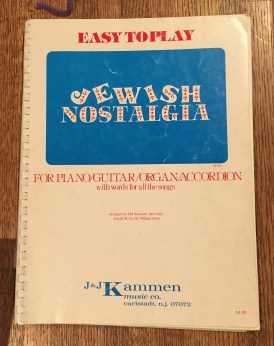
When I married, the piano and the bedroom set moved to my home. When I was pregnant with my daughter I would play the piano every day. I often played from a book of Yiddish music: “Jewish Nostalgia For Piano/Guitar/Organ/Accordian” published by the J & J Kammen Music Co. Sometimes I could feel my daughter kick within me as I played her favorite songs.

I know that she heard the music! After she was born, when she was fussy, I would bring her into the music room and play “Oif’n Pripetshik” for her. Within minutes she would be calm listening to the music.

My grandfather, Papa, lived until she was 3 ½.   He would sing to her in Yiddish as well. She does not remember much about him. But he would hold her close to his face while he sang.   What she remembers is that “Papa had a scratchy face.” He did not shave as often when he was in his late 80s.

When she was old enough, my daughter also took her first piano lessons on our family’s baby grand piano. Like me, she was not meant to be a concert pianist. But we both learned to love and read music while learning to play piano. I would often play music for my children when they were little. I often would play the Yiddish music of my childhood.

Over the years, many people have come to visit and would play the piano.   One childhood friend came to visit several years ago.   She asked what happened to my Mom’s piano.   I took her into my living room to see it.  She cried as she stood in front of it.  There was so much love invested in my piano.

I am so fortunate.  I have a chair to sit in to remember when my grandmother sang to me; a piano to play the music that my grandparents taught me.  I have the  Yiddish songs that I continue to hear in my mind and sometimes still play on my piano. Amazing memories and sounds of Yiddish songs from just looking at a chair and a piano.


https://zicharonot.wordpress.com/2014/06/08/why-i-love-my-pillow/


The Mysterious Kalsbad Photos: Who Are They?

6 Jun

June 26, 1931. My Grandmother was in Europe with my Mother and my Uncle. She left them at the farm owned by my great grandparents in Poland while she went to Karlsbad (Karlovy Vary), Czechoslovia to take the waters and revive her health.

The doctors in the United States told her that she was going to die. She had been pregnant again in the USA. But doctors terminated the pregnancy through a very illegal abortion in an effort to save her life. But still she was sick. So she decided she would not burden my Grandfather with two young children, 5 and 2. She would take them to Europe to live with his parents and she would die there. He, then, would be free to continue his life.

I once asked my Grandfather, why he let her go. “She was a sick woman,” he told me. “I had to let her do what she thought was best.”

“Would you have left Mom and Uncle Stanley in Europe?” I asked. This was a very important question. His entire family perished. If he had left them, I would not be here.

He looked me in the eye, and said, “As soon as she died I was going to get on a boat and return with my children. I would never leave them there. “

His words made me feel a bit better. But if Grandma had died the world my Mom and Uncle lived in would have been very different. But at least I know my grandfather would not have abandoned them in Poland.

Luckily Grandma did get well. She stayed in Europe for six to eight months and then returned to the USA with my Mom and Uncle. She saw the rise of Hitler coming and now had a new purpose: get the family out. She could not save as many as she wanted. But she tried.

Grandma Thelam, Carlsbad

Grandma is sitting in the front. The date and place were added by my Mom. I think the two women are related. This is the photo we knew about.

We have several items from that trip to Europe. We have a ceramic vase that stays in her breakfront/curio cabinet in our Catskills’ home. We have stories about the trip.  We have a few photos. We knew of one. Grandma is with two other women. We have no ideal who they are. But I think they are related to her, one women sort of looks like her sister-in-law. We are not sure. There is no identifications on the back.

But I recently found another.

FullSizeRender (10)

Grandma is in back row on the left wearing a white hat.

It is a group photo. In the very back row, near the center is a woman in a white hat, that is my grandmother. She is 26 years old.

I do not know the other people. Are they family members who perished? Or are they just other people who are in Karlsbad? Sometimes I imagine that they are just other people at the resort who were pulled together for a group photo that the photographer would then sell to tourists.   Other times I imagine that people in the photo look like family, especially the man in the front on the left. But I honestly do not know.

This photo is different from the others we have from that trip. There is writing in Yiddish and English. The English is easy, her name and the address where she stayed in Karlsbad. Or is it a place she visited?

The Yiddish is more exciting to me. It is the only letter I have seen that she wrote to my Grandfather. (Thank you members of the Tracing the Tribe Facebook Group for translations!)

It says: “As a souvenir from your faithful wife, who hopes, to meet you again in good health.” Another translated it as “A souvenir from your devoted wife, who hopes to return to you in good health.”

Either makes sense. She was sick. She was away from my grandfather. She wanted to be reunited with her family and be healthy.

And that all happened. She returned to the US and lived an additional 50 years. And 80 years later, I keep finding treasures in her photo album!


https://zicharonot.wordpress.com/2014/04/28/speaking-yiddish-always-brings-me-holocaust-memories/

Drinking An Ooglie Mooglie/Gogli Mogli Always Made A Sore Throat Feel Better

11 May

Recently while at lunch with my Kansas Yiddish buddy, we were talking about how some children did not like eggs and the ways their mothers snuck eggs into their diet.

I told how my husband hated eggs so much, his mother would make him chocolate chip pancakes so that he would have eggs without knowing. Not such a harsh way to eat eggs! In fact, I laughed about it. But it was a tradition my husband continued with our children.  Scrambled eggs were not the right Sunday morning breakfast in his mind,  you gave your children pancakes and biscuits to have them eat eggs.

My friend’s mother had a sneakier way to get her to eat eggs. My friend would drink a malted after school each day. Her mother would mix a raw egg into my friend’s malted. She was surprised that her mother would do such a thing. When she found out what her mother was doing from her young uncle, she never trusted those special drinks again.

“It was a good thing I never got salmonella,” my friend said.

But then they did not think about salmonella over 50 years ago….okay I am giving away our ages.  In fact, serving raw eggs was considered a delicacy. Personally, I was not surprised about putting raw eggs in a drink. I asked her, “Well didn’t you ever have an ooglie mooglie?”

“What are you talking about?” She said as she looked at me as if I was crazy.

I could not believe she never had one of this special ‘treats’ when she had a sore throat or cold. Raw egg mixed with sugar and beaten till it was smooth and frothy, an Oogle Moogle or Ooglie Moogli was a treat that I had on occasion from my grandmother.  But never from my own mother.

However, when I lived in Israel during my sophomore year of college, I had many occasions to have an Oogle Moogle from my great aunt and uncle.   Holocaust survivors, they often made this treat for their daughter, who loved them. She would have them all the time if she could.   I remember the first time they made one for me,  I was so sick.  She wanted one as well!   But they only made one for me!  It was delicious.

I told all this to my friend, and to prove I was not crazy, I googled (LOL) oogle moogle. And there on Wikipedia was an entire page devoted to this treat, I show the first paragraph here:

“Kogel mogelGogl-MoglGogel-MogelGogol-Mogol (Russian: Гоголь-моголь), Gogli-Mogli, or Gogle-mogle (Yiddish: גאָגל-מאָגל‎) is an egg-based homemade dessert popular in Central Europe and Caucasus. It is made from egg yolkssugar, and flavorings such as honeyvanillacocoa or rum, similar to eggnog. In its classic form it is served slightly chilled or at room temperature. Served warm or hot, it is considered a home remedy for sore throats. As a home remedy it could be of Russian or Yiddish origin. Variations include milk, honey and soda.[1][2] https://en.wikipedia.org/wiki/Kogel_mogel

There was my proof, except the name was slightly different: Gogli Mogli. Perhaps I had misunderstood what it was called, but probably over time, I just forgot and changed the pronunciation. It did not matter, my friend still had never heard of it.

But since she never liked eggs, I cannot imagine that her mother or any relative would ever offer her a drink made primarily of eggs and sugar. Whereas I can still see my great uncle mixing the drink and stirring it so quickly till it turned to forth. To me the memory of an Ooglie Mooglie or a Gogli Mogli is a wonderful memory, especially when I am suffering with a sore throat. It would make it feel so much better.