Tag Archives: history

The Trial For the Murder of Chava “Gimplowa” Feuer

19 Nov

I am almost 70 years old.  My Hebrew name is Chava.  As I say this to myself, I shiver sometimes.  I am the only Chava in my family.  It should not be that way.  My grandfather’s mother was Chava.  She had five children and should have had many grandchildren. At least one girl in each family would have been named Chava. 

In the family there were multiple people named Nissan, Moshe, Mordechai, Gital, Cerla, Gimple, Chava.   As the next generation goes on, there should be multiples of these names as well. But there are not.  There is one Nissan, my son, who is actually named Nissan Mordechai.  There is one Gimple, my cousin, who passed away and now his grandson has that name.  There are no Cerla or Gital.  There are no Shimon or Nuta.

Why aren’t there multitude of cousins with these names? Because they were ALL murdered in the Shoah.  There is no one to carry on these names. But we still must remember them.

My great grandmother Chava was 70 when she was murdered by the Nazis.  As the world is so crazy with Jew Hatred.  As I am turning 70. As my name is also Chava.  Should I be afraid?  As I read in detail from witnesses about what happened to my great grandmother on the day she died. Should I worry about the hate in the world around me?  Could it happen again?

A few years ago, I wrote about the murder of my great grandmother, Chava.  I have a book called “The Holocaust and European Societies” that talks about her murder. (See blog below.). The death of my great grandmother is discussed in this book.  When I found it, I was astonished.  I agonized.  What was she thinking as they took her to be killed? Now I know.  Is it good that I know?  I am really not sure. 

When I first started meeting with Izabela S. online, I had no idea how much she would be able to find out.  Now, through the work of history profession named, Tomek, who has investigated the death of my great grandmother, I have the testimony of first hand witnesses.  I can see in my mind what happened.  I can feel her suffering.  I thought, should I share this? Should it end with me?  Isn’t it enough that I know? 

But then I again think about what is happening in the world today, and I think not.  I think everyone needs to know what happened to my great grandmother.  No one should be able to say, this could never happen.  Because it has and it did.

The next question I have to ask myself is, “When Do I Give Up.” That is a question I know my great grandmother faced.  Her husband was dead, her children were gone, probably dead.  So many of her relatives murdered all around her.  The one child she knew was alive, my grandfather and his family, was so far away.  Safe, but she would never see him again. And if she lived, would that reunion ever happen.

Before I start, Izabela asked that I not name the Polish people who are mentioned in the testimonies.  So I will not name them except for the one I have named before.

This is what happened on the day my great grandmother Chava was murdered from testimony from a trial held in Poland after the war. 

 The first witness is my relative Zissel Feuer, who has played a part in my families Shoah story for years, because he did survive.  Zissel was hiding in the forest of Trzciana.

“I would like to mention that a few days before Goldklang was shot, while I was in the barn of a farmer in Trzciana near the forest, I saw through a crack how Josef S. from Trzciana, together with two other people, were leading Chava Feuer, my aunt;  then I heard from someone that Jozef S. was supposed to take Chava Feuer to the village head in Trzciana.  The village leader in Trzciana was supposed to give a signal.  Then Chava Feuer wsa taken to the German colony of Czermin and handed over to the Germans, who shot Chava.

(Just so his testimony makes sense, A few days later, Zissel heard shots and the sounds of pain, he went to look and saw a man named Jakub Goldklang.  He told him that he had given all his property to a Polish man who was supposed to give him food, but instead another man, Josef Sypek, came and shot him.  (He is mentioned in the book as well.)

Zissel realized he could not help Jakub so we went back into hiding. )

There is testimony that another man who saw the arrival of my great grandmother to the village head, who knew her and called her by the honorific, Gimplowa (Gimple’s wife). 

“Gimplowa,” he said. “Why are you wandering around?  Why can’t you hide somewhere in the forest?”

They knew there were Jews hiding in the forests around Trzciana.  Some of the Polish people were providing them food, even though it could lead to their deaths. Others were turning them in.  This man seems be upset that she is not hiding.

But in reality, it is her answer that breaks my heart.  My grandparents always said that she was a very strong-willed person.  That I reminded them of her because I don’t back down and I say what I think needs to be said.  For me, Chava/Gimplowa’s answer is devastating.

“I don’t care anymore,” she said.  “I have already decided on everything and I can’t stand it any longer.”

Where is the line that keeps a person going;  that says keep living against that line that is defeated?  When do you reach it? It was already April 1943 close to Easter and Passover.  She had been hiding for almost two years.  I don’t fault her, I feel her pain, but my heart says, ‘If only you had waited a bit longer.’

Another witness, a woman who recognized Gimplowa, saw her being taking away by some men she did not recognize.  My great grandmother called out to her by name. and told her: “Stay with G-d.”   Can you imagine that you are being taking to your death and you see someone you know, perhaps a friend, and you tell them “Stay with God”. The woman does not answer. She is probably afraid also of the men she does not recognize.

Another witness states “it happened on Maundy Thursday, at 3 pm in 1944.  (This is the story that was in the book I mentioned earlier.)  Josef S.’s wife called a group of neighbors together and said there was a Jewish woman, Gimplowa, in her house and she did not want to leave.  She said, ‘Do whatever you want with me.’  “

Josef’s wife told the villages to do whatever we wanted, to kill her or to take her somewhere, because if the Germans found out and burned the village, she did not want anyone to blame her for supporting the Jews.  “So we decided to take her by foot to the village head.”

The witness continued: The village head also did not want any responsibility for her.  So he told them to take her to the German colony in Czermin.  She did not want to go there, so she said she was old.  So they got wagons to take her to the colony and hand her over to the German’s mayor Jukub Hesler.  What he did with her, I don’t know, because I didn’t see it with my own eyes.”

He did not know for sure, but he knew.  The witness was asked:

Q: Were you aware that you were leading this Jewish woman to her death?

A: Yes, we were aware of it, but we didn’t want to answer to it. So we brought it to the Germans so they could do whatever they wanted.

I know that fear overcomes kindness.  But this is just too much for my heart and soul.  It’s not our problem, let the Germans handle it.  Even though we know they will kill her.

And one last witness to the last years of my great grandmother’s life.

During the German occupation, the Jewish woman Gimplowa was hiding with other neighbors.  (So at first they did help her.)  But on Good Friday, they were all talking because the Germans had set fire to the town of Bodborz because they believed that the people were hiding Jews there.  So a neighbor who was drunk, made the first move to say we must take the woman who was hiding in my house to the village elder. We all supported this motion. And she was taken to the village elder.

How do you decide what is evil.  My great grandmother was being hidden and helped through Easter of 1943.  But now the Germans were burning villages where they found Jews hiding.  So was it wrong of them to turn Chava over to the Germans?  I, of course, think so.  Why couldn’t they just send her out with some food to the forests?

But my great grandmother said she did not want to leave.  I don’t think she wanted to hide in the forest any longer. She was done.  She was tired.  In my work as a spiritual care volunteer, I have seen what it means when a person tells me that they are very tired.  When they are tired of living. When they want it to end.

My great grandmother wanted it to end.  She was not in physical pain, but I am sure she was in emotional pain.  The only thing I can think and hope is that the Germans shot her in the head and she died quickly. 

I have to consider what she was thinking on the way to her death. Was she thinking about all who died in the past three years? Was she thinking about her son and grandchildren in America who she knew would survive. Did that give her a glimmer of joy.  She had cared for my mom and my uncle for six months in 1931-32.  Perhaps that memory of happy grandchildren helped her on her way to die.

It would be nice to know where she is buried. But I am sure she is in a mass grave somewhere near the town of Mielec or Trzciana. Or perhaps not. I will never know.

Baruch dayan HaEmet.  May her name and memory be forever a blessing.  May her murder by the hands of those who feared and the Nazis bring some goodness into the world. I carry her memory and name with me for all my life.   I hope that as I turn 70, the world veers away from its direction of Jew hatred, or any hatred, and realize we are all one.

(The dates are sometimes a bit off as to when events occurred. There are several different dates for when Chava died. But now we know it was 1943 because it happened after the burning of a certain village.)
Charleston, A Lovely City, But the History of Slavery Cannot Be Ignored

14 Oct

Every Year on the Fourth of July, we watch the movie version of the play 1776.  We love the music; we love the acting; we love the retelling of the founding of our country.  But for me the scene that always hurts my soul is when Edward Rutledge sings “Molasses to Rum to Slaves.’  That moment in the movie is so strong and so emotional.  When John Adams says, “For God’s Sake Mr. Rutledge,” I can feel the pain.

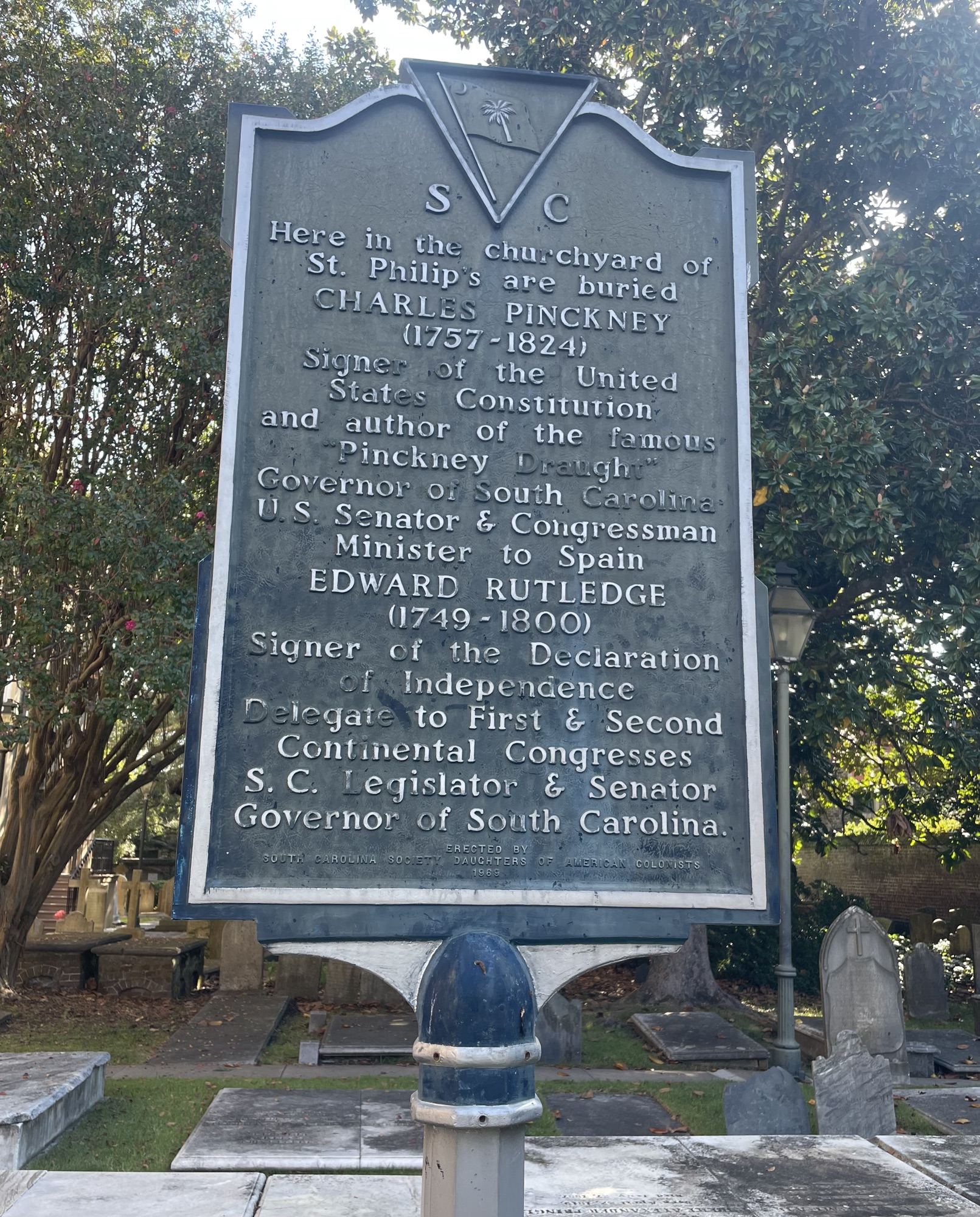
When we were in Charleston, South Carolina, we knew that part of our visit there was to learn more about the slave trade: to see where it happened.  We visited St. Philip’s Church and walked through the historic cemetery where some of those involved in the American Revolution are buried, including the infamous Edward Rutledge.  We saw the area where the slave market was held and walked down the cobblestone streets.  The historic district of Charleston is unique and extremely interesting.

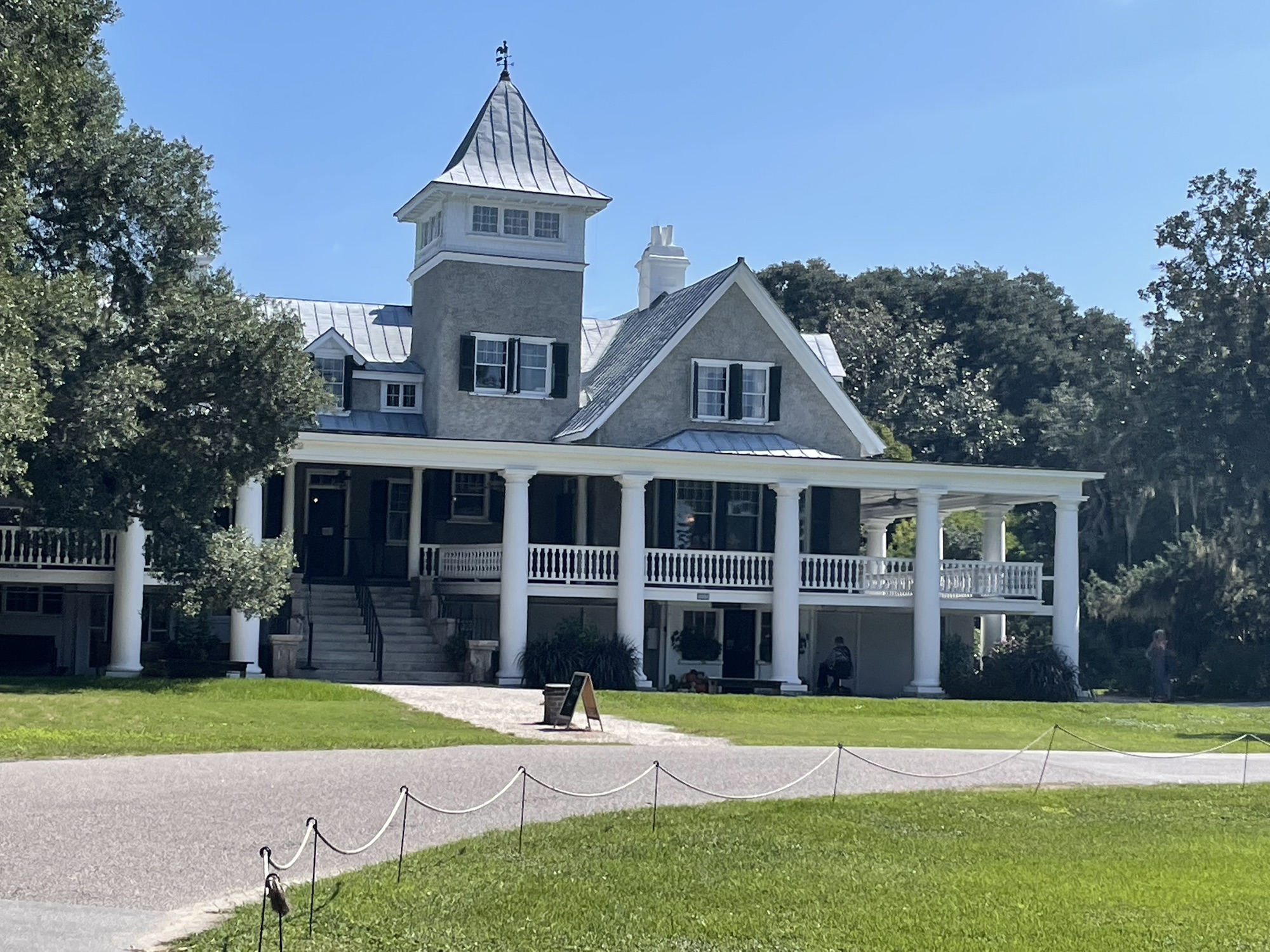
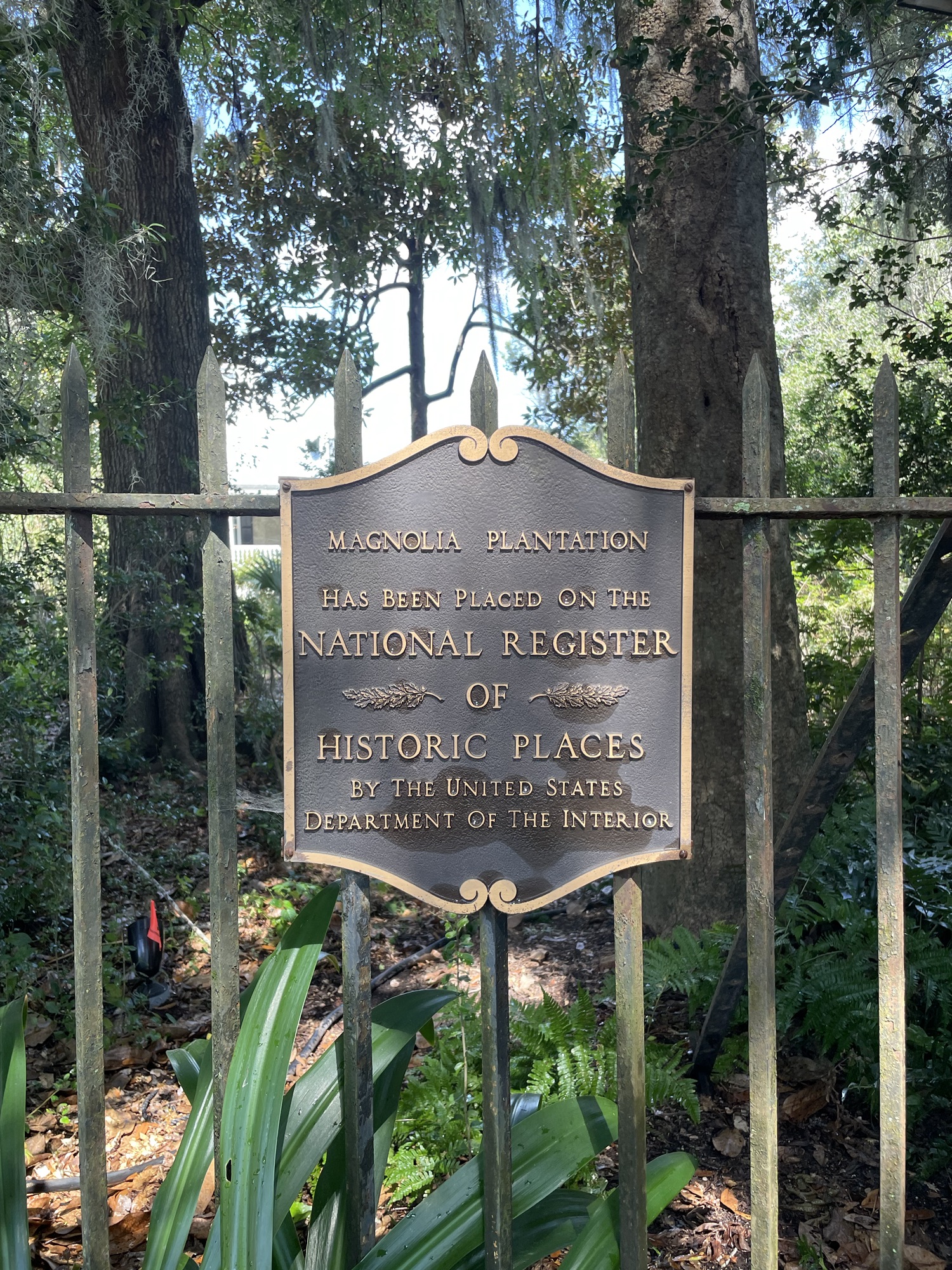
I learned interesting information about the history of slavery while in Charleston.  This new- found information started with our visit to the Magnolia Plantation, which is just outside Charleston.  I never knew that Carolina Gold referred to golden rice.  Actually, I never knew that rice was grown in the south.  I always just think of tobacco and cotton.  My eyes have been opened.  What I learned created a burn in my heart.

While at the Magnolia Plantation where saw the area where the slaves lived. Four families to a building. There are only a few rebuilt slave buildings now.  Most were destroyed in previous hurricanes. At one time there were 11 or more ‘homes’.  Almost 250 slaves lived on the Magnolia Plantation.  Their main job was growing and harvesting rice.

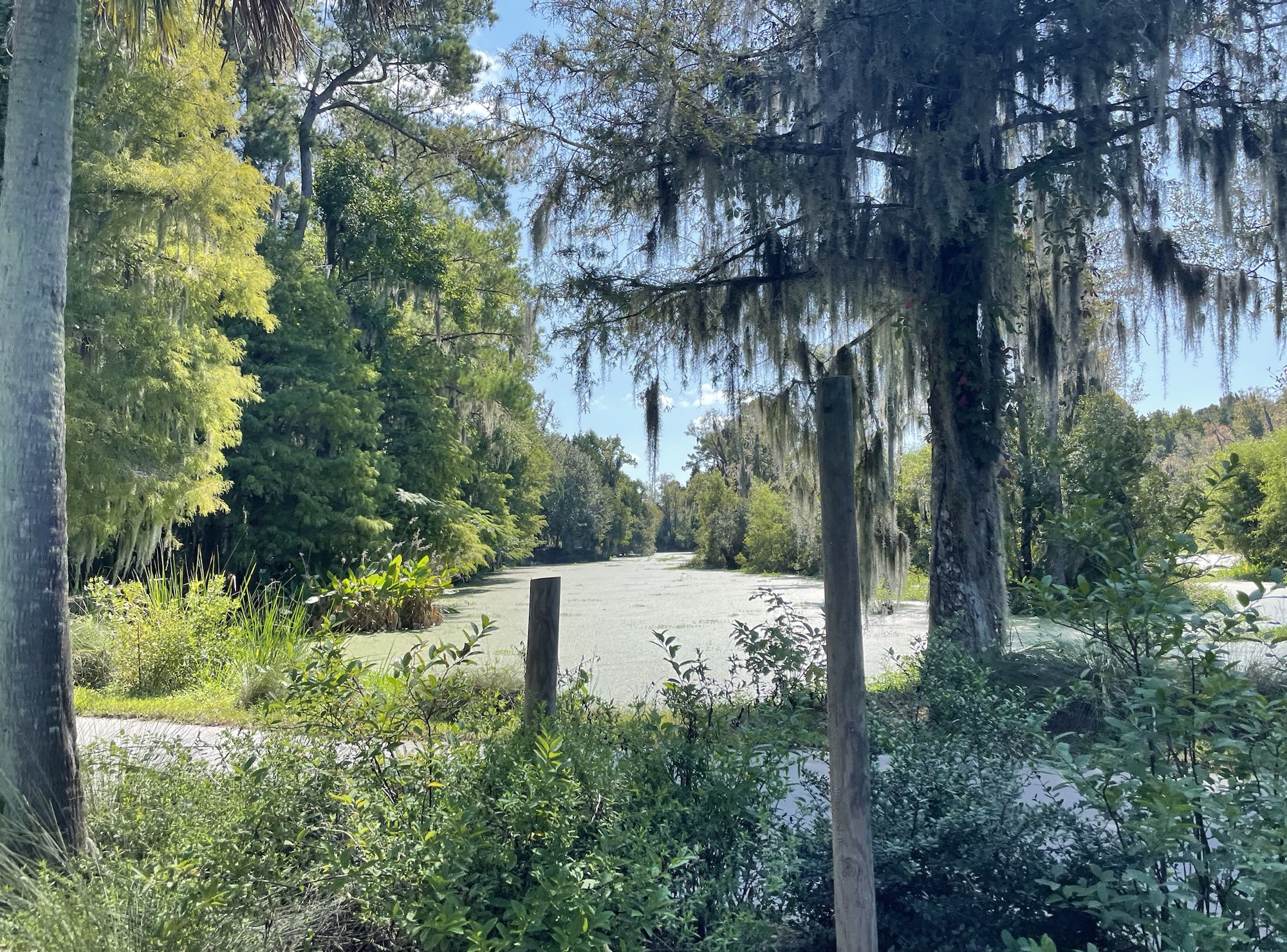
We saw where the rice paddies once were located. Some of them still have water. It is from the tides that wash over the banks of the Ashley River and fill up areas that have been dug out down three feet and contained by low levees, so the water doesn’t all recede. A perfect spot for growing rice and also good homes for alligators and water moccasins. Two creatures that are adept at killing humans.

We found out that once a child was tall enough, he or she went into the rice paddies to work.  The average length of time that someone survived the rice paddies was six to eight years!!!  Someone who was 20 years old and still alive after being exposed to deadly snakes, alligators and disease, was considered old.  That was something I did not know. And that makes me a bit sick to my stomach.  How could they use children this way? Really disgusting!  No one there are people who are adamant to keeping the real story out of our schools.

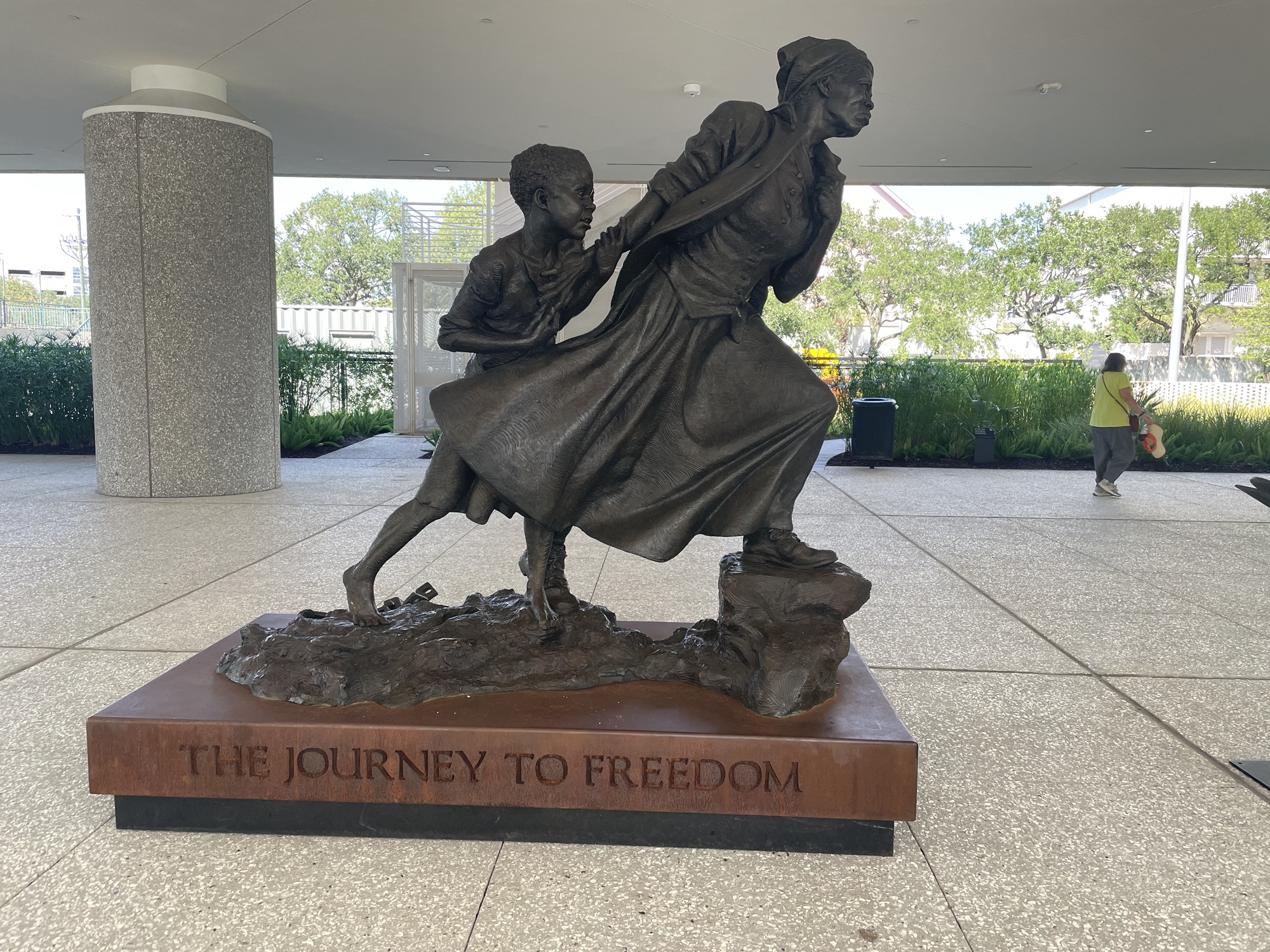
Going the next day to the International African American Museum cleared up a puzzle for me.  How did these slaves know how to grow rice?  It seems when the white men came to Africa to purchase captured slaves, they were going with a list of who they wanted. And what they wanted were farmers who knew how to grow rice and indigo.  They were enslaving people who had the knowledge that would make the plantation owners rich, while the slaves would not only be enslaved but most likely die young.  It seems so unreal.  But it is true. I always knew the slave owners became rich due to slavery, but I never knew the stave traders went to Africa with a shopping list of which Africans they wanted to enslave.  A definite eye-opening experience.

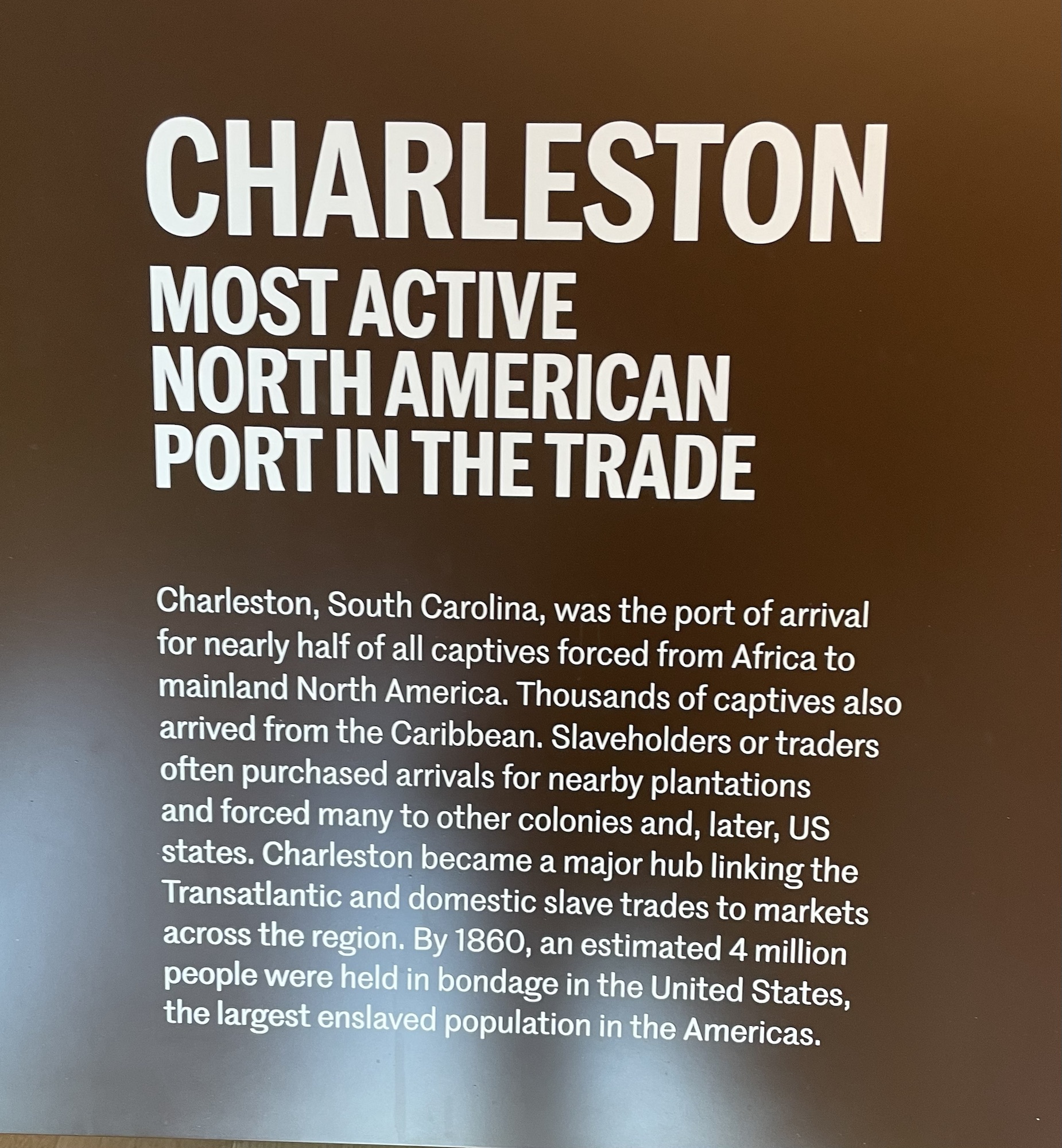
We enjoyed learning at the museum.  The first section discusses the African American community in South Carolina and how the Middle Passage from African often ended up in Charleston, which was the most active port in the slave trade. Many people died on the way over and those who survived that horrible journey had more horrors ahead.

I also learned more about the Low Country Gullah Geechee population and their unique culture, which is so interesting.   The descendants of slaves, the Gullah Geechee people were able to hold on to their African heritage because they were isolated on island and costal plantations.

The second section of the museum was filled with facts and information decade by decade of the African American experience.  To be honest, this is not a museum to take young children, there is just too much reading and too much standing.  I wish they had some benches along the winding hallways to take a break both physically and mentally. There is so much to absorb.  It was difficult for me.  And after a bit I was exhausted from the stories, the reading and the standing.

A few years ago, we visited the Charles H. Wright Museum of African American History in Detroit, Michigan. The permanent exhibit, “And Still We Rise,” was so immersive and left a permanent mark in my memory about how horrible the Middle Passage was for the enslaved and captured Africans.  It does a much better job, visually, explaining the slave trade and having the visitors feel the impact, while its special exhibits focus on more cultural experiences. 

The museum in South Carolina, however, does a much better job about explaining and detailing the history of the African American community over the centuries by highlighting important events, dates and people.  But trying to see it all in one day is too much. 

There were two little exhibits that stuck out to me as I walked through this museum.  They had a display of the Green Book that told African Americans where they could stay as they traveled around the USA.  I turned to pages to Kansas, where I currently live, to see where people could spend the night.  There are not many places, which is disturbing. But in a way, being Jewish, I understand this pain, as Jewish people were also discriminated against and not allowed to stay in many places.

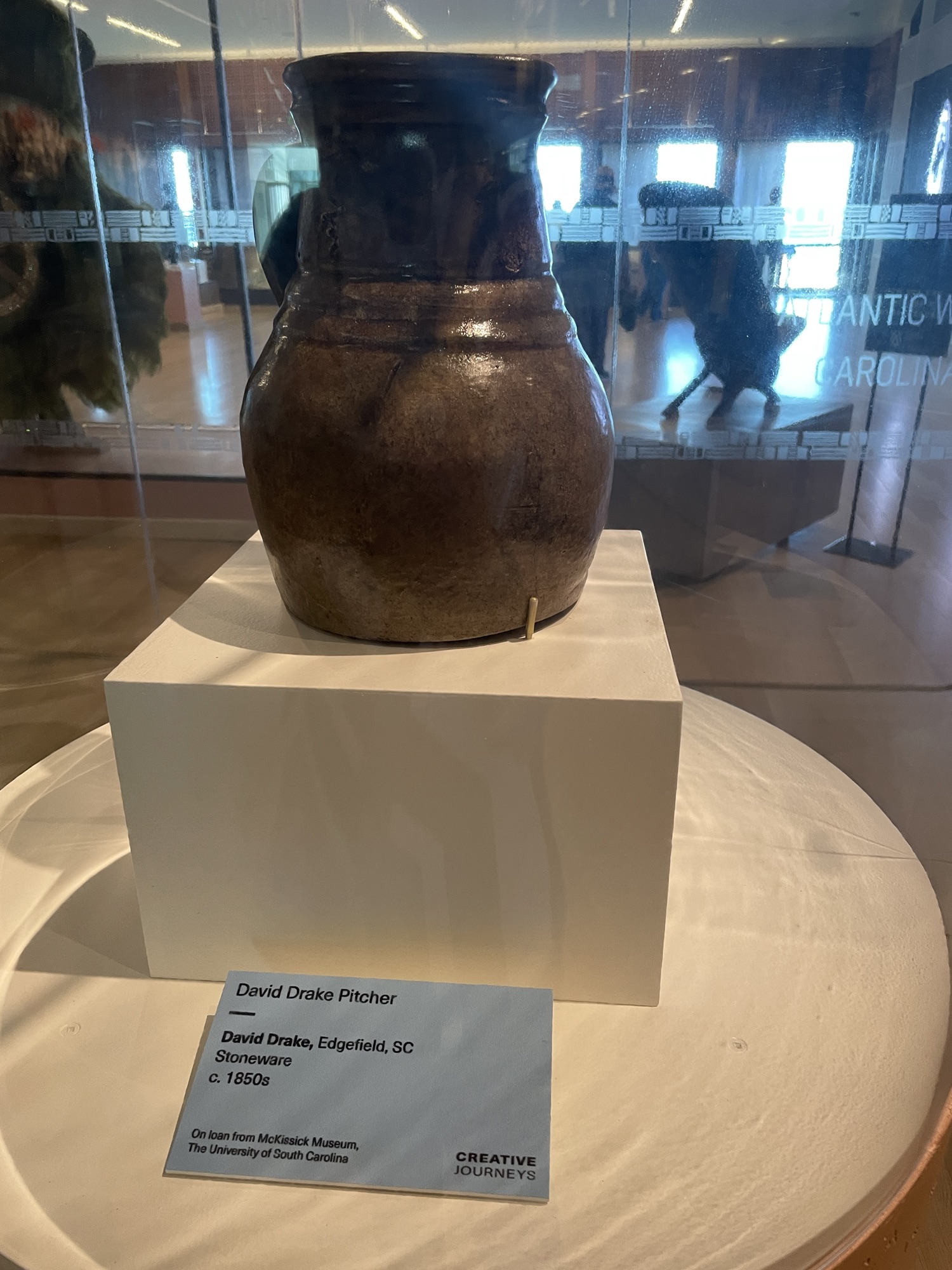
I did enjoyed seeing two of David Drake’s pottery pieces.  I had seen his work several times on the Antique Roadshow, so was excited to see them in person.  We saw another one at the Gibbes Museum in downtown Charleston.  It was interesting to note the fact that he could write and sign his name was a quiet protest against slavery since slaves were not allowed to learn to read or write. This knowledge could have cost him his life.

Charleston was a lovely city to visit.  There is so many places to immerse yourself into the history of our country.  But while learning about things we can be proud of, we cannot forget the darkest, bitter moments of our country’s past due to its support of slavery.

https://en.wikipedia.org/wiki/St._Philip%27s_Church_(Charleston,_South_Carolina)

https://www.thewright.org/

https://en.wikipedia.org/wiki/David_Drake_(potter)

https://www.magnoliaplantation.com/

https://www.gibbesmuseum.org/

The Mysterious Loretto Stairs and Other Unusual Sites in Santa Fe

17 Jun

Santa Fe is a city of many diverging elements coming together to create a unique city. The art of the Navajo, Apache, and Pueblo people; and the multitude of art galleries and jewelry stores; the churches and religious sites; the unusual round State Capitol building; and the original adobe buildings; the restaurants; the museums, all combine together to give the visitor and the residents a place that stimulates the senses. 

My husband, who is enamored with AI, asked what would be the best 2.5 hour walking tour of Santa Fe. Its description of four places became our morning walking tour. None of these places take long to visit, unless you want to stay longer.  For this ‘tour’ you will be walking up hill on the Old Santa Fe Trail Road, which is right by the La Fonda Hotel downtown. Finally, you can always take your water bottle in with you.

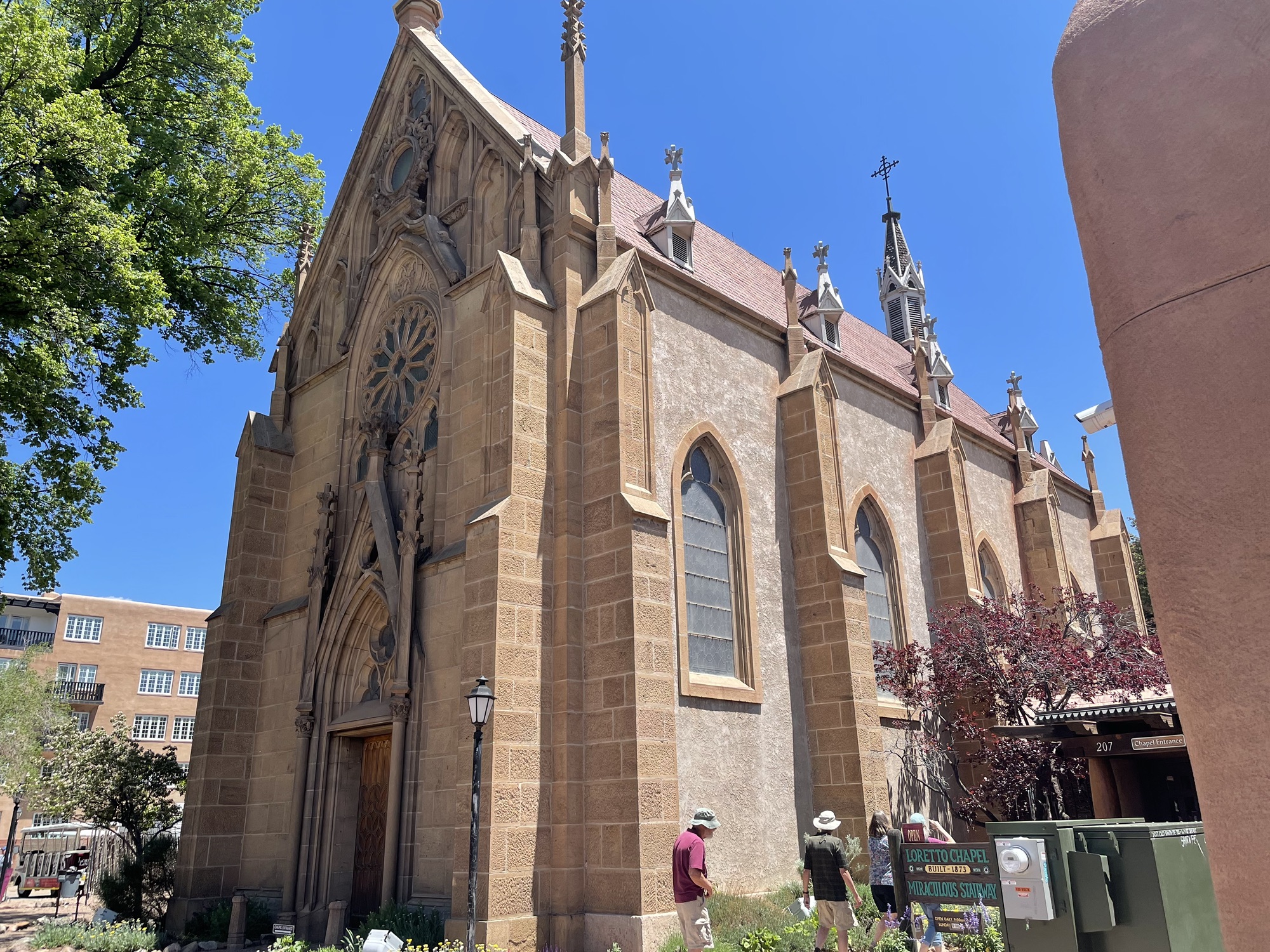
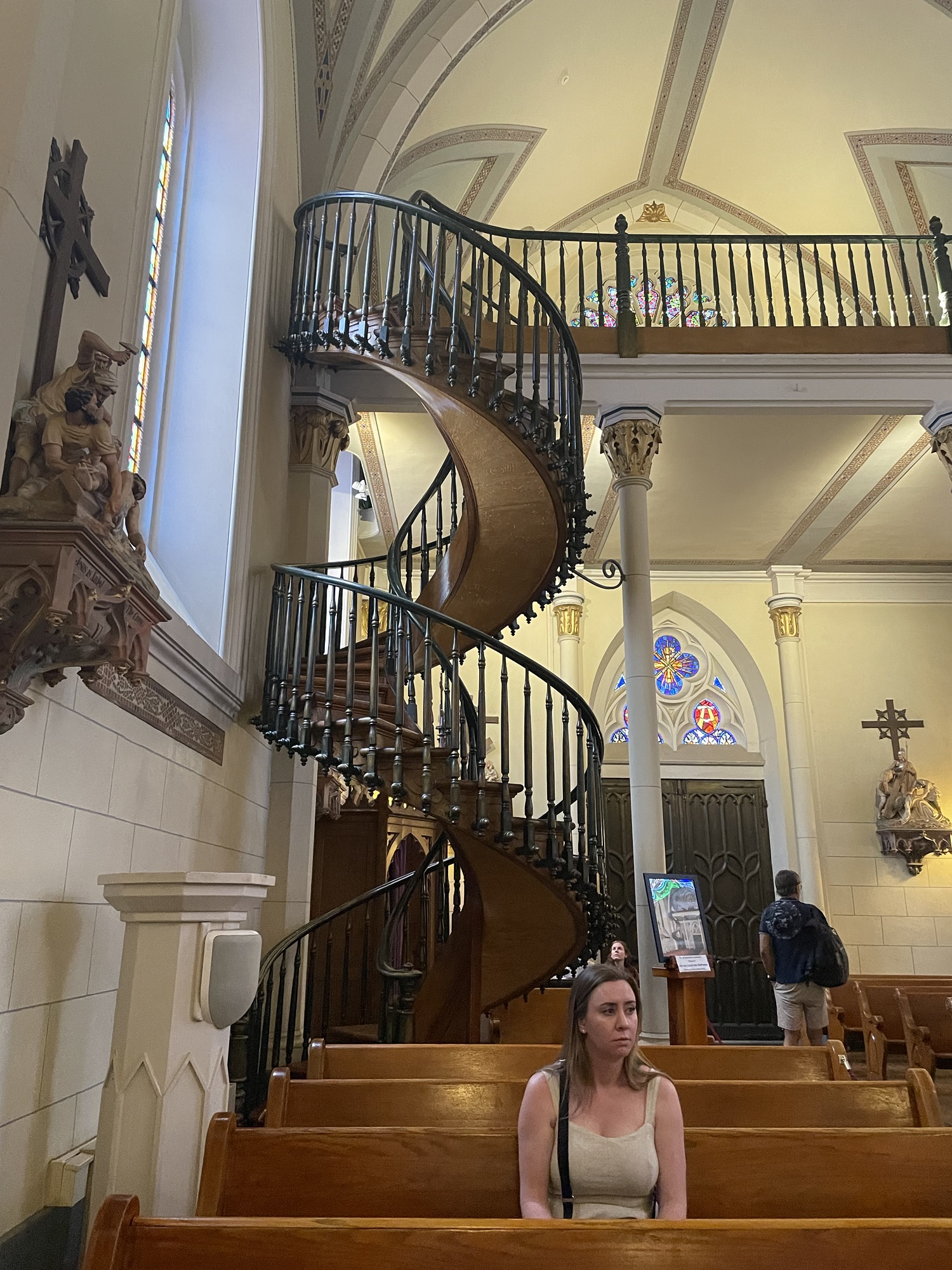
The Loretto Chapel and its mysterious, mystical stairs is worth the visit.  The chapel was once part of a girl’s school and was designed by the same architect as the Santa Fe Cathedral. The mystery of the stairs starts when the architect died before the staircase was built, the nuns were distraught and prayed for help.  An unknown carpenter appeared, built the stairs and disappeared. 

The staircase is a lovely gem to see, whether you believe that it was built by St. Joseph or not.  How it suspends and curves upwards without support is astonishing.  And it is beautifully carved.  But besides the beauty of the stairs, the chapel itself is lovely.  While you sit and visit, you listen to the story of the stairs.  This is no longer a consecrated church, so religious services are not held.

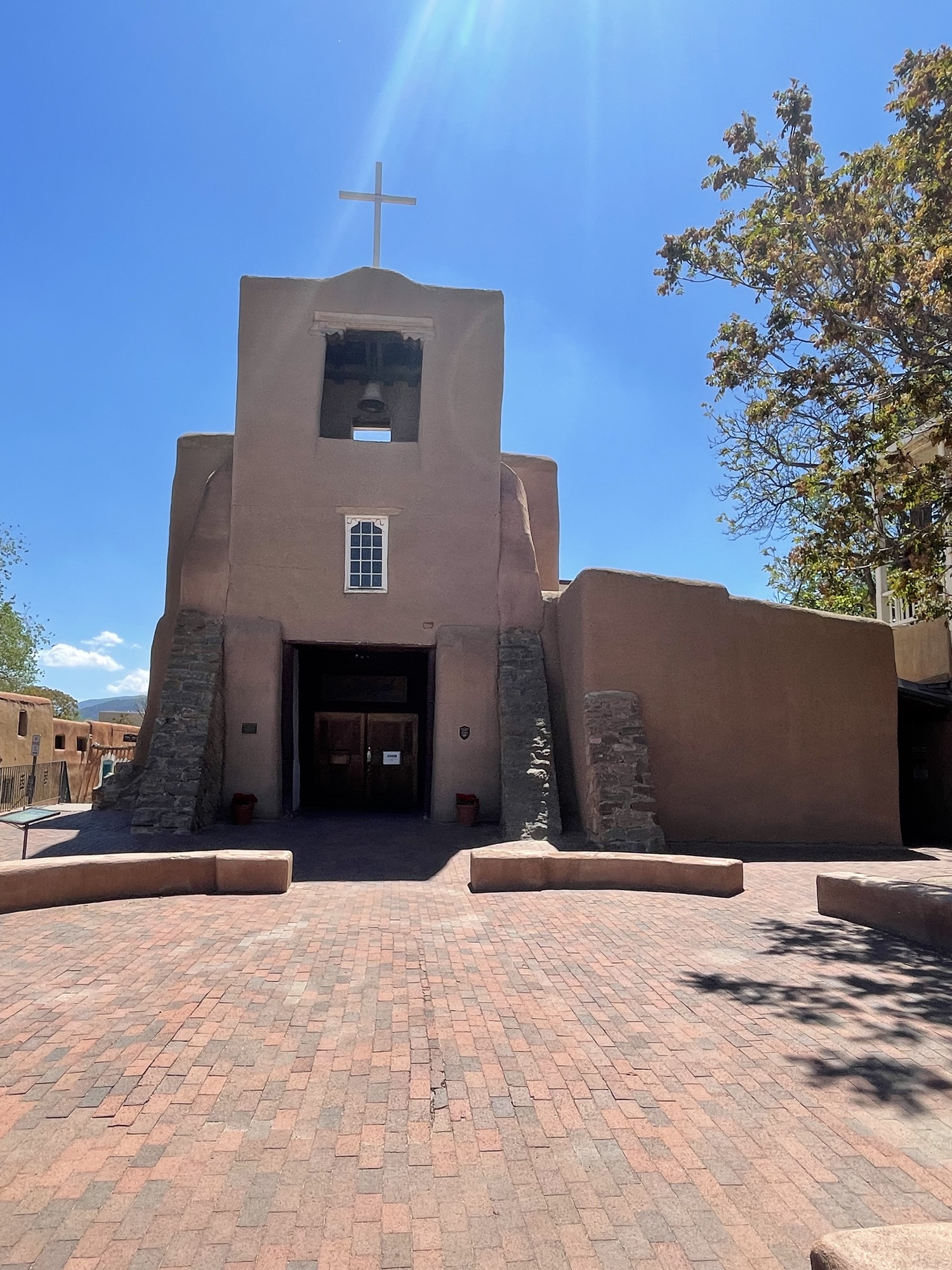
Two blocks further up the hill on Old Santa Fe is East De Vargas Street.  Turn left to walk through a narrow road to the Oldest House in Santa Fe, but I recommended you first go across the street to the San Miguel Mission Church. 

The San Miguel Mission Church sits on a hill on the hill. Probably a good place for watching what is going on around you. It is the oldest Catholic Church in the United States. People can attend mass on the first Sunday of each month.

It is not a big building, but it has a big history.  First built soon after the Spanish came into Santa Fe in 1598, the mission church was used by the Franciscan priests who came to New Mexico with the Spanish to convert the indigenous peoples and serve the Spanish settlers.  It was partially destroyed in 1680 when the pueblo peoples revolted against the Spanish and the church for the cruel treatment.  They burned the roof, destroyed some of the walls, and killed the priests.  The church was rebuilt when the Spanish returned about 30 years later. 

When you walk in there are two artifacts to notice. The first you see on the — the Victory bell that was brought from Spain. The bell had a long history that included helping Spain expel the Moors.  The story is whenever the bell rang, the Spanish had a victory.  The bell came to New Mexico for a Spanish family. But after the Pueblo Revolt, when the Mission was rebuilt the bell was put in the church belfry.  The second item hangs on the wall to the left. It is a 300-year-old replica of the painting of Our Lady of Guadalupe from the Mexico City Basilica.

The church itself is small and simple. The wooden ceiling is wonderful.  After you finish viewing the chapel and listening to the talk by the docent, please go down the stairs to the second room.  There are photographs that show the building from different angles, as well as two photos of the oldest house before it was restored.

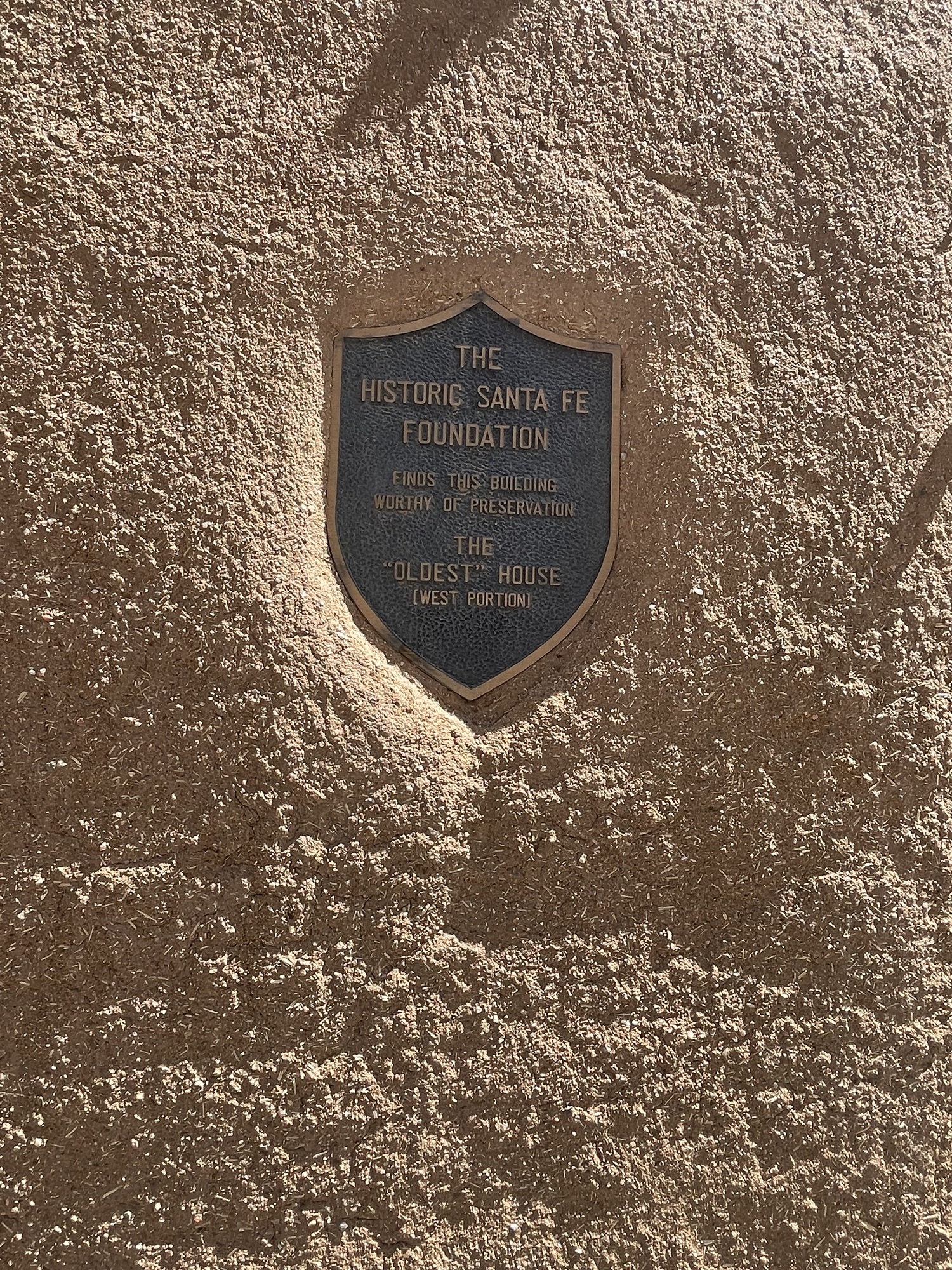
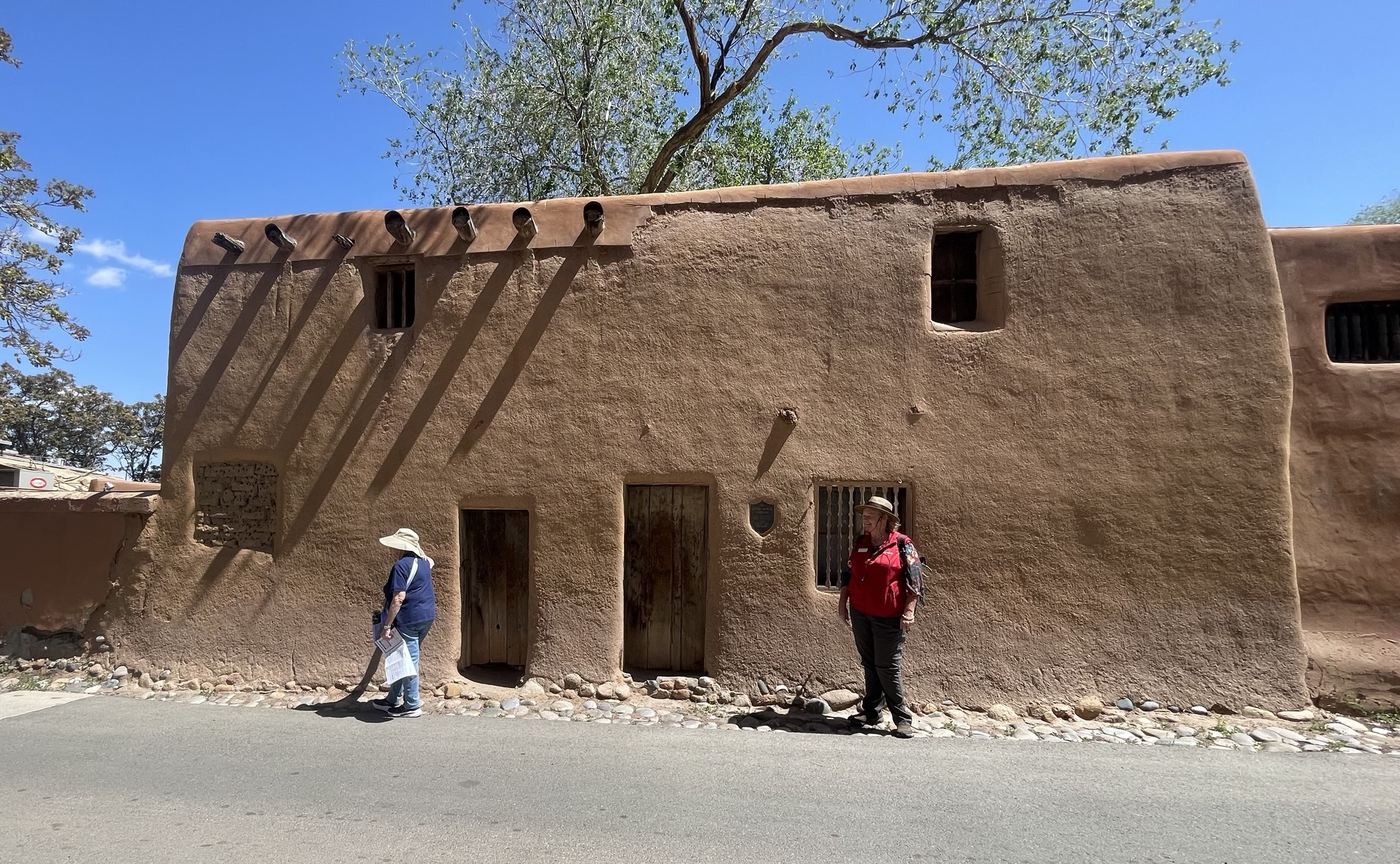
Now you can go out of the chapel and down the steps to the side which lead to De Vargas Street.  Immediately across the street is the oldest house. The house, from the 1600s, is built on the remains of a home in what once was part of a pueblo It is attached to a gift store.

 You go into the store and to your left to enter the house.  There are just two rooms to see and they are tiny. But as all sites, it is worth seeing to understand how people lived.  If you are a bit claustrophobic, try to go when there is a not a group going in.  It gets tight.

When you are done at the oldest house, return to Old Santa Fe Trail Street and continue past the San Miguel Mission. Turn right on Paseo De Peralta.  You will soon come to the State Capitol building.  It is unusual in that it is both round and NOT built in the pueblo style.  (Which is what I thought it would be!). When we went there was an art show on display. But even if it is not there, it is worth going in to see the rotunda and the lovely architecture.  You basically walk in the main door and go out the back door getting you back to E. De Vargas street.

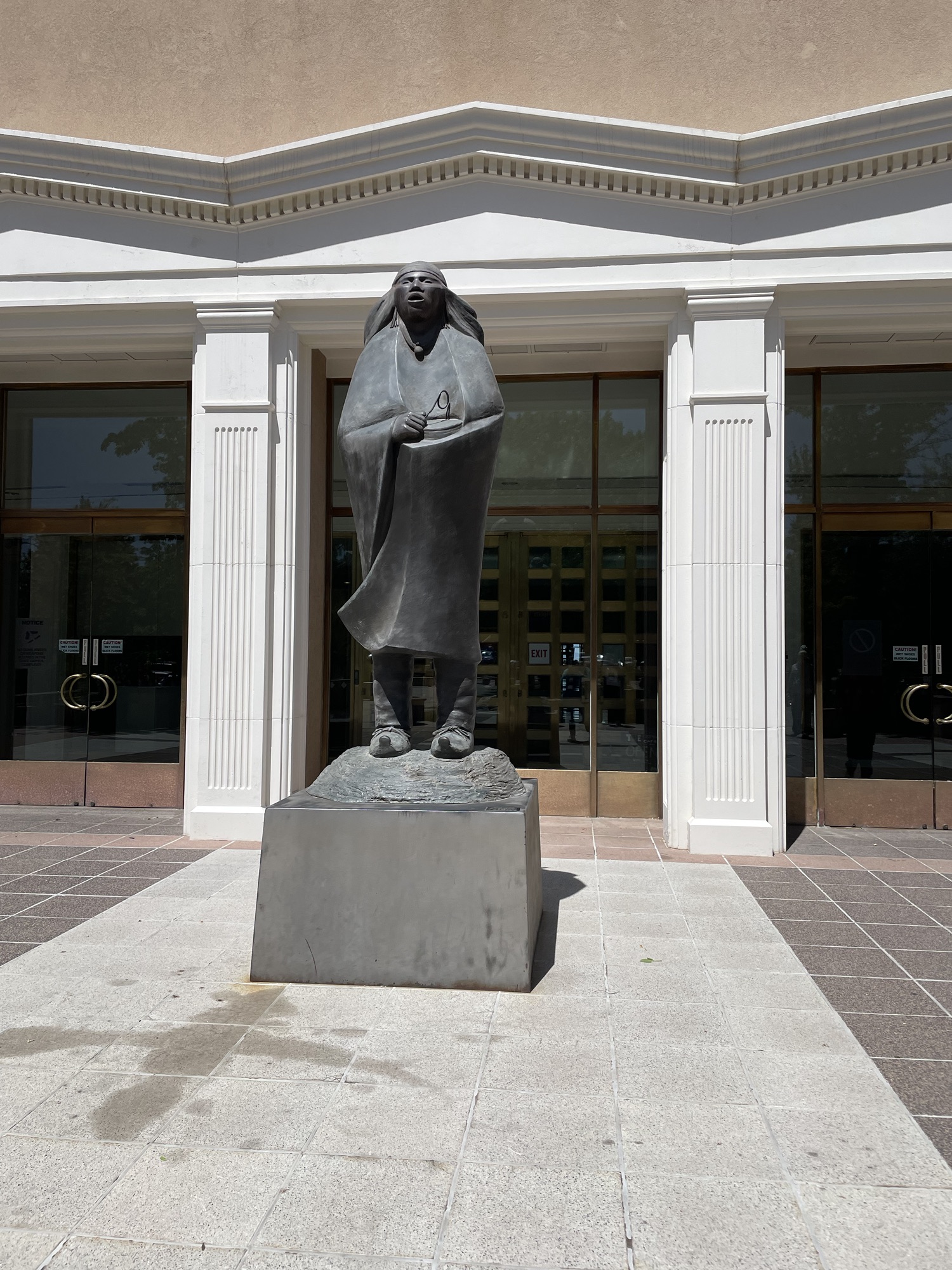
After this part of our tour, we went for lunch!  There are many, many excellent restaurants in the Plaza area.  So go and enjoy.  Also while walking around you will see many galleries and statues/art on the sidewalks.  Take time to enjoy them.  You might want to take a break and rest after lunch or do this next part in the morning.

Martyr’s Cross and Marcy Fortress.  There is a way to drive to get closer to this site, but my husband and I did not have a car, so we walked.  It is located on Paseo de Peralta, the same street as the capitol building, but in the other direction. Depending on where you are staying will determine how you go.  But since we stayed near the Cathedral, we took Palace Avenue to Paseo de Peralta and turned left. You can see the cross on the hill and just head in that direction!

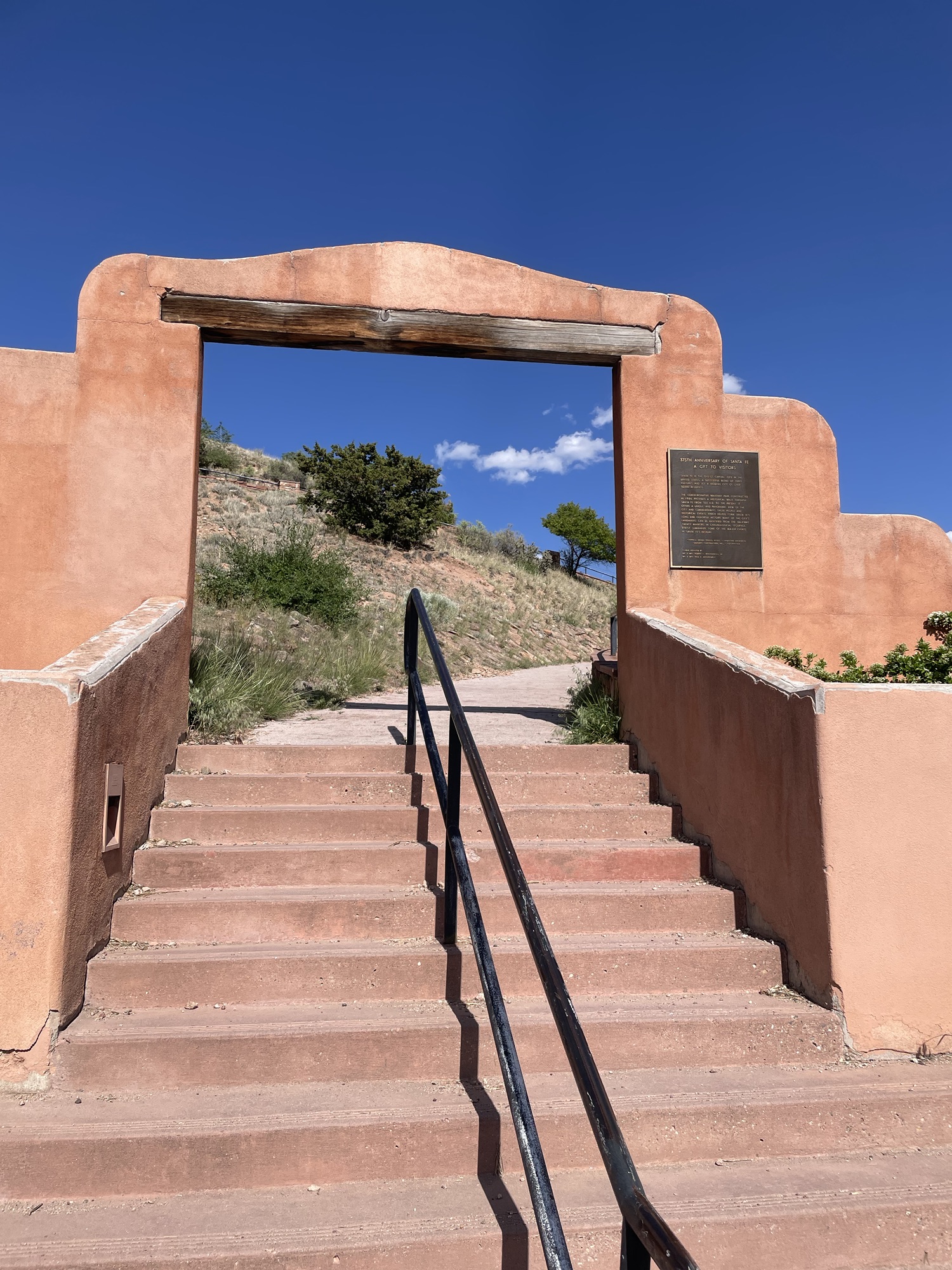
The entrance to walk up is marked by an adobe sign and arch.  You are going up hill.  There are rest areas where you can sit at the ends of each switch back.  And take water!! It is dry in Santa Fe.  The walk up was fun. Along the way are plaques that tell the history of Santa Fe, and as you go higher the views get better and better.

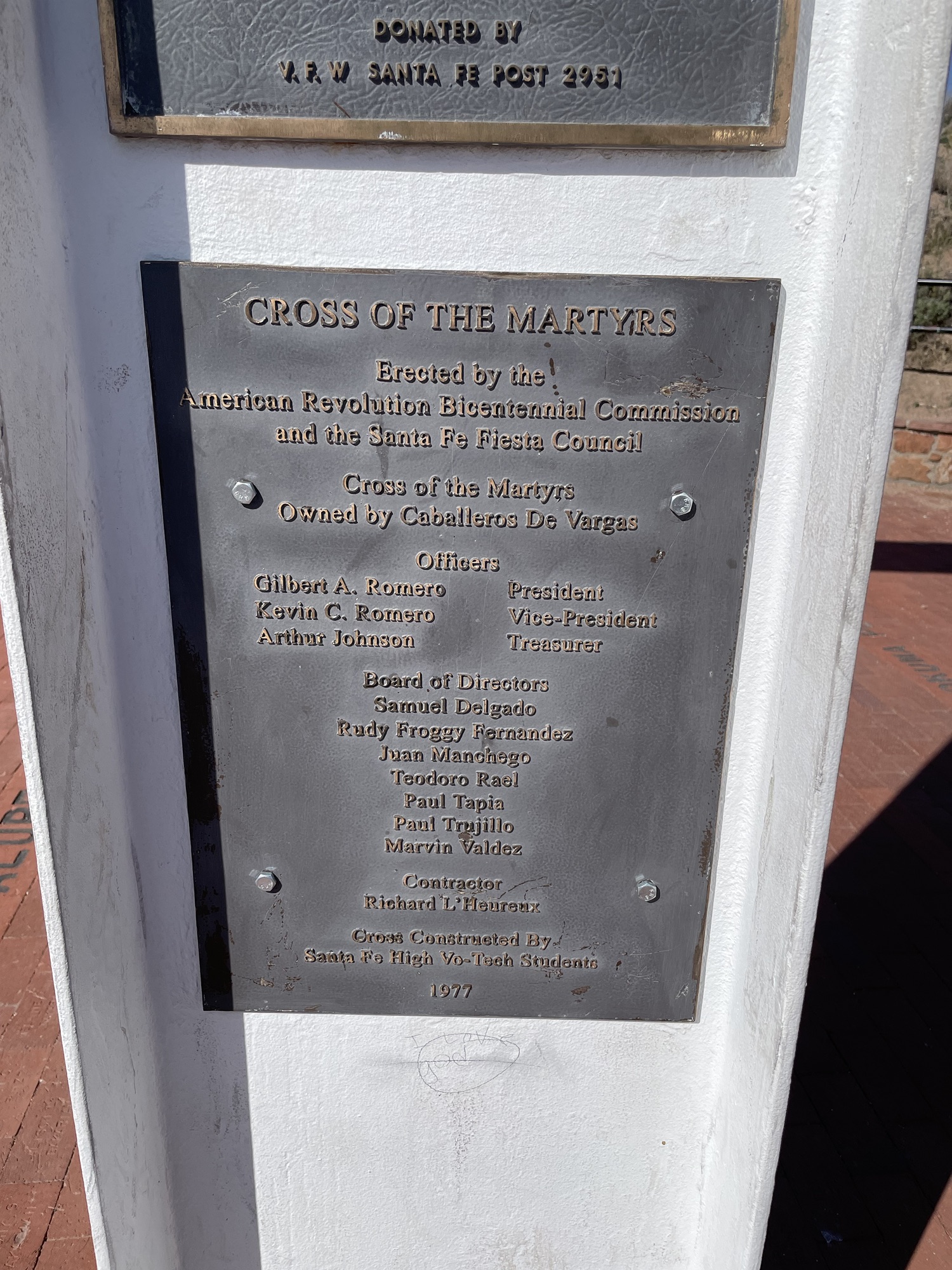
The Cross of the Martyrs honors the 21 priests and 380 Spanish settlers who were killed during the Pueblo Revolt  in 1680. The first cross was erected in 1920s. Over time it was replaced twice, the last time  in 1977 with a metal cross.

To be honest, we did not continue up the path to see the ruins of Fort Marcy.  It had been a long day, and we still had to walk about a mile or so back to our hotel.  But you can easily get to it. But that path is not paved.

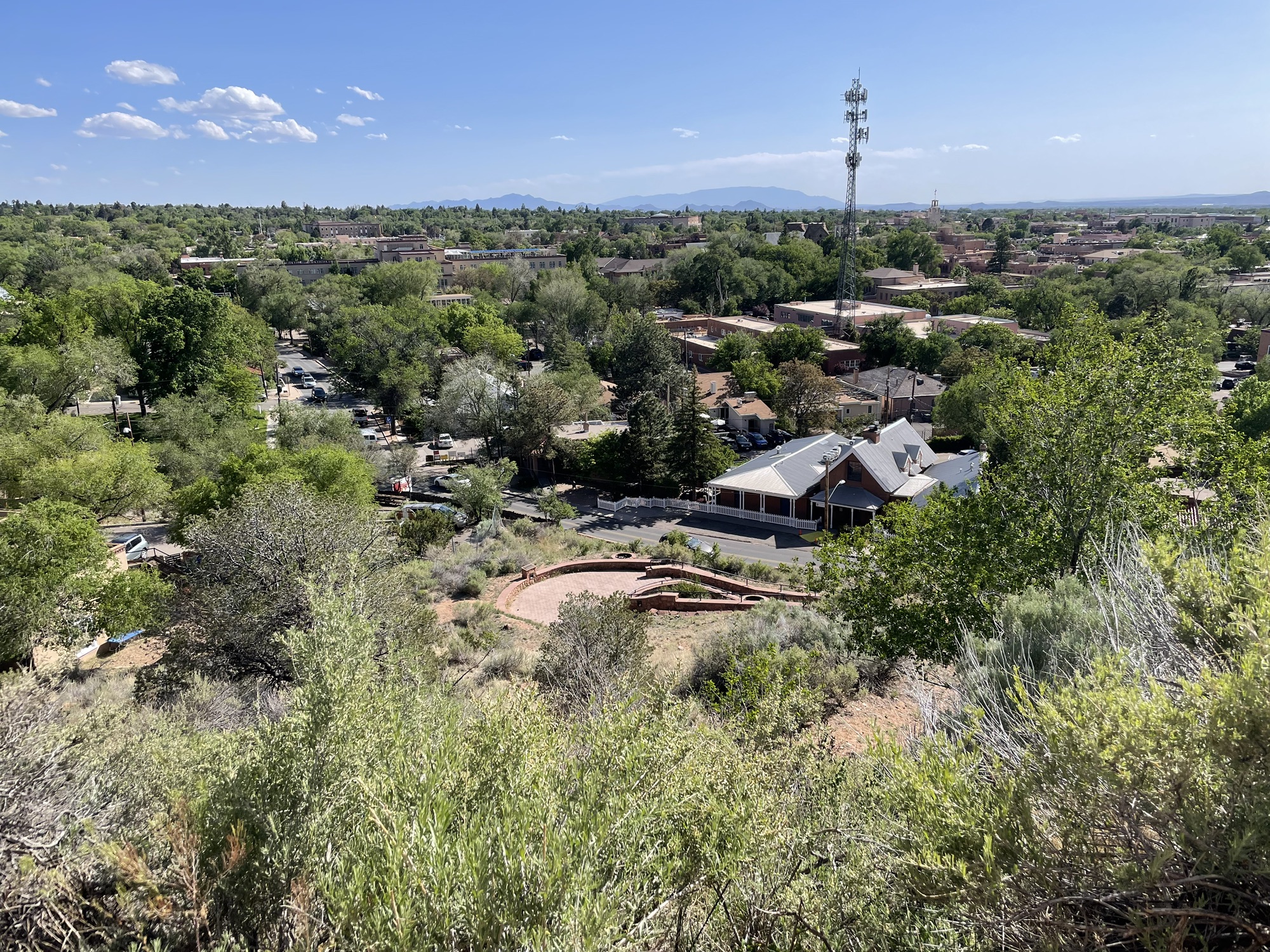
However, we did get some fantastic photos of Santa Fe from the top.

https://www.lorettochapel.com/

https://www.sanmiguelchapelsantafe.org/

Learning about the Crypto-Jews/Conversos in Santa Fe

28 May

As the descendent of a Jewish family that was forced to leave Spain in 1492 or convert, I have always been interested in learning more about the Crypto-Jews/ Conversos of New Mexico.  It was in the 1980’s when the information about this still hidden group first started to be revealed. It started when a Jewish man named Stanley Hordes because New Mexico’s State Historians, and people started coming to him to tell him their stories.  To me it was absolutely amazing that 500 years after the Inquisition in Spain, that descendants were still hiding and still keeping this secret!

I had wanted to attend the Roads Scholar program: “New Mexico’s Conversos and Crypto-Jews in Santa Fe” since 2019.  Covid interrupted my plans. But finally we were able to attend. My family were also once impacted by the Inquisition and Spain’s quest to either convert or eliminate all Jews.  My family chose to move to Portugal and then to Holland.  Our story is written in an earlier blog. (See below.)

We had lectures from the authors of the top two books.

Our first speaker was Professor Ron Duncan Hart, who gave us an overview of the history of the Jews journey to New Mexico. He wrote, “Crypto-Jews, The Long Journey.” Jews were in Spain were given a choice, convert or leave.  Many stayed, they could not afford to go or they thought it would not last long and they would just hide their Jewishness, some decided they really would become Catholic.  But all were doubted because they were not “pure of blood, “meaning they were not just Spanish, they were tainted by either having Jewish or Moslem descent. Those converted in name only and still practiced their religion in secret, known as Crypto-Jews…hidden Jews. Those who were forcibly converted and known as anusim also secretly practiced Judaism.

In fact, so many of the Portuguese who came over to Mexico in the 1600s were of Crypto-Jewish ancestry, that calling someone Portuguese was just another way to say he/she was Jewish. Since my family went from Spain to Portugal, I began to wonder if some of my family made this arduous journey to escape the Inquisition. To be allowed to go to the New World, you had to show that you were purely Spanish, not tainted with Jewish or Muslim blood.  Horrifying!  People actually had their genealogy redone to eliminate their Jewish past to fit the needed requirement.

The Crypto-Jews of today still live in the mountains in northern New Mexico.  They still keep their secret.  In fact, one of our speakers, when asked how many crypto Jews there actually was, basically said, “We do not know. They keep hidden.  They do not talk about it.  They know who the other families in their community are like them. But it is not discussed”

We heard from two women who have reclaimed their Jewish identity.  They were each the child in the home who a parent said “Somos Jodios,” “We are Jews.”  Maria Apodaca told us how difficult it was to come out of hiding and join a congregation and have a ceremony of return.  How family members were not always happy about what they had done.  Many feel, with the way the world is now, it is better to stay hidden!

Isabelle Medina Sandoval wrote a novel based on her family’s history: “Guardians of Hidden Traditions.”  She can trace her ancestry back to Portugal and was able to claim Portuguese citizenship based on her family history.  But she also said that coming out of hiding is a difficult process.  A poet, she has written poems about the Crypt-Jewish experience.

From these two women we learned some of the cultural/religious/cuisine that continues from their Jewish ancestry, like lighting candles on Friday night, covering mirrors when someone dies, making a fried treat at the winter holidays, cleaning the house on Friday.  It is amazing to me that these traditions continue.

Schelly Talalay Dardashti, spoke about: “The New World: Jewish Ehtnicity, DNA& Genetics.“ Schelly is the founder of Tracing the Tribe – Jewish Genealogy on FB. She explained the difference in the different DNA tests and how some do not look for Sephardic DNA, only Ashkanazi.  We were told that between 20-40 percent of people in New Mexico had some Jewish ancestors.  That there are genetic links between those living in northern New Mexico and isolated areas in Central/South America.  People who were also trying to hide away from the Inquisition.  And the final link, a rather sad one, the fact that the BRCA1 mutation that causes brest cancer in Jewish women, is also found in the Hispanic population in Mexico and New Mexico and came from those original converso/crypto Jewish arrivals from Spain in the early 1500s.   Wow.

We attended a performance of “Parted Waters,” a play written by Robert F. Benjamin about the Crypto Jewish community. It tells the story of three generations of a crypto Jewish family.  The grandfather, a crypto Jew; his son, who knows the background, but identifies with his life as a Catholic and does not want to talk about it; and his son, who has never been told about his ancestry.  When the grandson makes a racist comment to a Jewish woman, the truth comes out along with the ramifications.  It pulled together all that we had learned over the week.

Our last lecturer, Chris Herbst spoke about Outliers/Ousiders and Religion.”  He provided us some history about the area of northern New Mexico and more explanations about the genetic composition of the populations today in Spain and in New Mexico.  He said about 1/3 of the population of Spain today has either Jewish or Moorish ancestry.

Throughout all of our talks we were referred back to the book written by Stanley Hordes, who wrote an indepth book about the Crypto Jews called, “To the End of the Earth.”  The Spanish/Portuguese Crypto-Jews traveled to the End of the Earth, the mountains of New Mexico above Santa Fe, to escape the Inquisition.  It is like reading a college dissertation, but it was fantastic in the depth of the research.

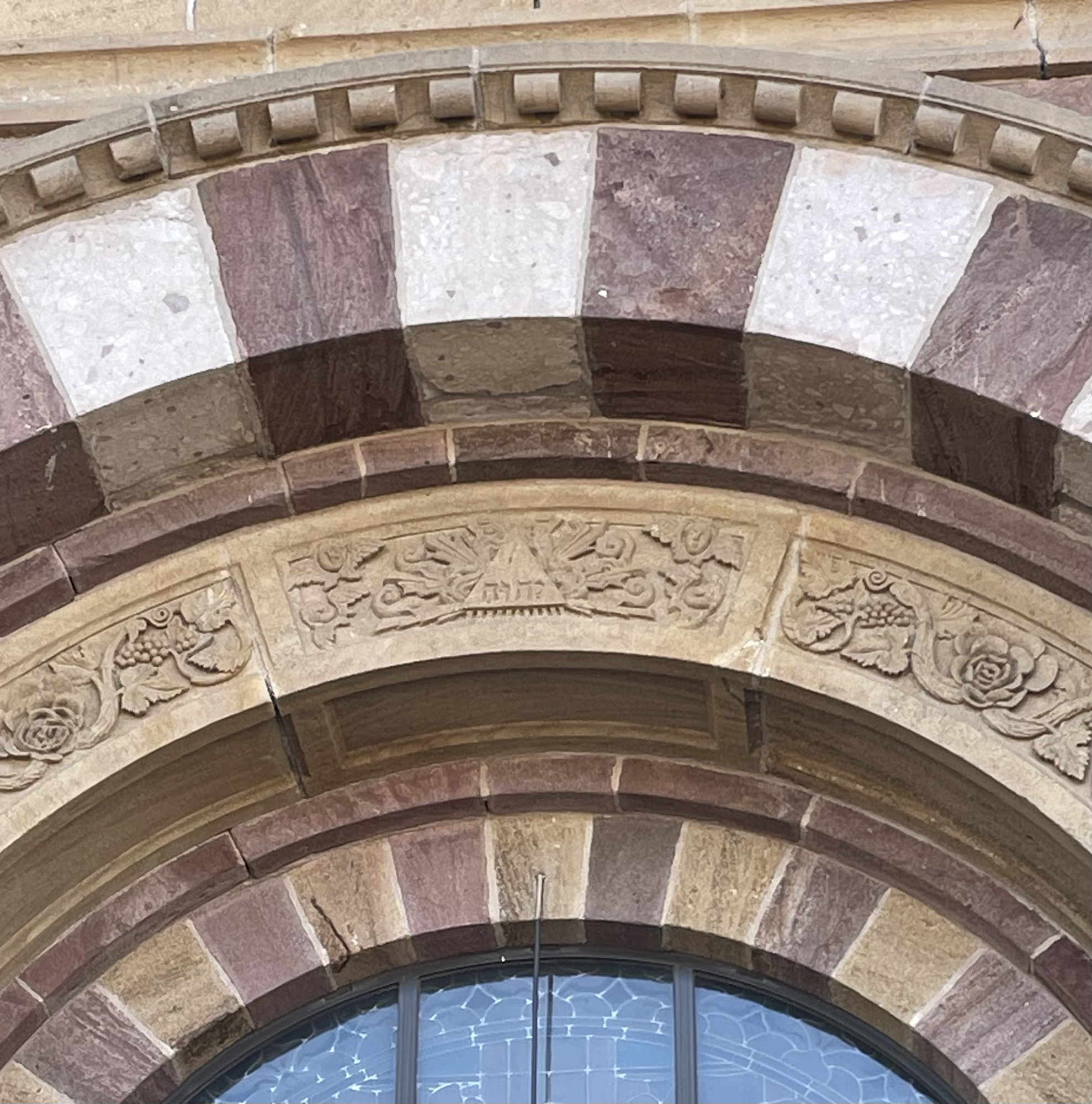
The Hebrew is in the triangle.

We did not spend all of our time learning, we also had time on our own to visit museums and explore Santa Fe.  We went to the  main cathedral of Santa Fe, where over the mantal of the front door, is an inscription in Hebrew and a Jewish Star on an internal wall. 

As part of our Roads Scholar program we also ate at many different restaurants with the most delicious food, toured historic Santa Fe, with our wonderful leader, Vennetta, and went to Taos and the World Heritage Site of the Taos Pueblo.

This was just a wonderful learning experience, where we were able to learn, experience, make new friends and enjoy the true wonders of Santa Fe, New Mexico. If you have any interest in learning more about the Crypto-Jewsof New Mexico, Mexico and Spain, I highly recommend this Roads Scholar program.

I will write about the other places we visited in future blogs.

 Finding Answers About My Paternal Great Grandmother

17 Apr

In Ashkenazi Jewish custom we name our children for those beloved family members who have passed away. I was always told that I was named after three of my great grandmothers:

Chava was for my maternal grandfather’s mother, Chava, who was murdered in the Shoah.

Sara was for my maternal grandmother’s mother Sara/Sura, who died in the 1920s in Poland, and for my paternal grandfather’s mother as her name was Sarah as well.

I knew about my two maternal great grandmothers, because there were family stories about them.  But I knew nothing about my paternal great grandmother even though she  lived in the United States and is buried in New York.  I have recently realized there is more to the story about her and my name. 

I have been searching for information about my paternal great grandmother  for years.  The first real clue was when we first saw a photo of her about five years ago.  We did not even know we had one!  But my first cousin was searching through her family’s old photos and discovered one of her with my uncle.  (See blog below.)

More information followed when my distant cousin, Evan, who is a great researcher, found my grandparent’s marriage license.  They were married in January of 1923.  It contained my great grandmother’s maiden name which we never knew: Ritt.

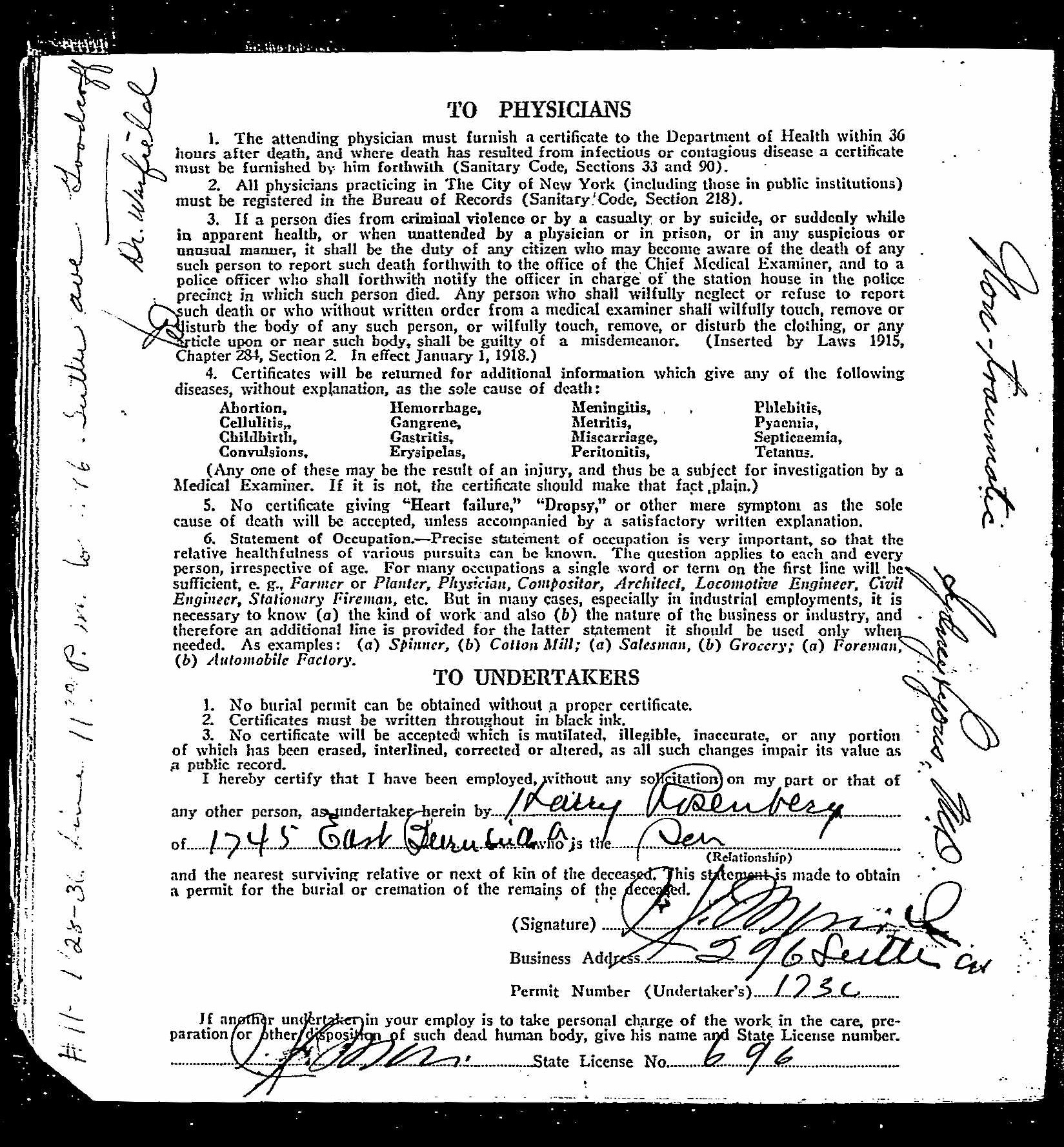
Evan also found a puzzle piece for me when he found her death certificate, which was packed with information. The final link was when Beth David Cemetery in Elmont, New York, where she was buried on January 29, 1938, sent me a photo of her matzevah (tombstone).

I now can tell my family more about my mysterious great grandmother, who I now know is named Chaya Sarah, so close to my own name of Chava Sara, that I think I was bound to have this name.

My great grandmother did not have an easy life.  She gave birth to 11 children. Eight survived to adulthood.  She lost her oldest daughter, Celia, to swine flu when she was in her 20s.  Her oldest son, Samuel, was mentally ill and spent most of his adult life institutionalized.  She and her husband, Abraham, were divorced in the 1930s.  A very unusual occurrence for a Jewish woman, well for any woman, in that time period.

My Great Grandma Sarah died on January 28, 1938, from cancer of the panaceas at Jewish Hospital of Brooklyn, when she was 68 years old.  My grandfather, then the oldest living child signed the death certificate and made the arrangements.

I have three thoughts about this information.  First, the line through my grandfather is cancer free.  But I have since learned that the line through his youngest sibling, Jacob, was not as kind. We all thought Jacob had disappeared after he moved to England when my dad was a child. But in fact he died when he was in his fifties from cancer, as did his son Rufus.  The cancer gene followed them. (See blog below.)

Second, I think I know why I was named for her.  She died in late January.  Years later, I was born in late January.  It made sense.  Finally, I am currently close to her age when she died.  And that touches me that I found out now.

I know that she was born about 1870, in France.  That she and her parents lived in France surprised me. But her father and mother, Hirsh and Flora Ritt, were from Poland.  So I think they were in transit from Poland to the USA when she was born.  I have no proof, but it seems right.  I also know that her father died before 1892 because my grandfather was named for him. Zvi Hirsh.  I now know that she was about 22 when she had her third child, and her other children were toddlers when my grandfather was born.

She died when my Dad was just 9 years old.  He really did not have many memories of her or information.  But now we know her name and also the names of my great great grandparents: Chaya Sarah Ritt, the daughter of Hirsh Zvi and Flora Ritt.  We now can add their memories to our family.

I want to thank the personnel of Beth David Cemetery. I now have photos of the graves of four of my great grandparents.

An Unexpected ‘Grave’ Mystery

3 Mar

With the uptick in anti-Semitic events, with masked college students attacking Jewish students at colleges, with a Hamas murderous pogrom in Israel, I am still amazed when events from the Shoah are revealed in present day. I feel like I am in a time warp.  Reading about the events at the UC Berkley campus and at the same time reading an email from a distant cousin telling me about a mass grave found in Poland that contains members of my extended family.  Don’t college students learn anything about history? 

My newest journey started with a email from a distant cousin concerning the Holocaust and my family. I get unusual requests now and then because I have been the family historian, trying to document all the family who were murdered during the Shoah.  A task I realize is virtually impossible with all large number of people in my family who were murdered. 

My distant cousin received a letter through JewishGen’s Family Finder.  Her great aunt, who I keep in contact with, suggested she send the email to me.

Her email contained a series of emails between two people in Europe that forced my brain back in time to all that my maternal family had suffered so many decades ago during the horrors of the Shoah.

The first was from a retired baker in London who had been contacted by a researcher who wanted information about a family named Brenner who were murdered by the Nazis and whose bones were recently found in a mass grave and in accordance with state law were re-interred in a Catholic cemetery.

His mother was born Kornbluth and her father was born in Mielec, Poland, where many Kornbluth’s were living when the Nazis invaded. They believed the bones were those of a woman whose maiden name was Kornbluth; her married name was Brenner.

My family was from Mielec and its surrounding small towns.  I have written about the destruction of the Jewish population in this city and its surrounding in other blogs.  Brenner is one of the names in my family. Which made me think that I could have a connection with this grave.  Although the last name Kornbluth is familiar, I wasn’t entirely sure of the connection to us.  But I kept reading.

The baker then include emails from a representative of the Zapomniane Foundation that deals with locating and commemorating the graves of the Holocaust victims. He found the baker through JewishGen Family Finder.


“I represent the Zapomniane Foundation that deals with locating and commemorating the graves of the Holocaust victims (zapomniane.org or our profile on FB). I’m currently researching the case of the Brenner family murdered in 1942 and buried in a mass grave near Mielec. According to what I have learned so far among the victims probably were Lazar and Sara Brenner. Her maiden name was Kornbluth. Before the war they lived in a village called Hyki (today it is called Sarnow). They were killed together with their children and Sara’s brother. Would you happen to know this story and/or have any information about Sara Brenner nee Kornbluth?

Sincerely
A N”

Then came more information from the Zapomniane Foundation:
“ Here is the story of how I have learned about the Brenner family:

Two years ago I went to Czajkowa (a village near Mielec) to see the location of a place where the Brenner family (seven people) was killed and buried in August 1942.My guide was Robert P. who told me the story of his aunt Anna P. Anna’s real name was Ryfka Amsterdam she was Jewish, converted to catholicism before the war and married Andrzej P, Robert’s relative and became Anna P. The Brenner family were the relatives of Anna/Ryfka: perhaps Ryfka’s sister with husband and children and possibly Ryfka’s (and Sara’s?)brother. There are no names, only the last name of the father of the family i.e Brenner.”

Well now we are getting closer to my family, since Amsterdam is my grandfather’s last name. I know that any one named Amsterdam is definitely somehow related to me. This is the first time ever that I have heard about a family member who converted to Catholicism before the war.  But to be honest, if someone left the family to marry outside of the faith, it was probably not discussed. 

What the email says next really touched my soul! I could not image how this young man would have felt when he dug up the grave.


“The gravesite of the Brenner family was partially destroyed in 2003 by an excavator. Obviously the grave itself has never been marked, it was just a hole in the ground.  As a result the bones from this grave were taken by the police and buried in an anonymous grave in Tuszów Narodowy catholic cemetery. Ironically the guy who worked with the excavator and dug out the bones was the grandson of Ryfka Amsterdam/Anna P. He was interrogated by the police in 2003. Anna/Ryfka had three children, her son born in 1950 is still living in Mielec.”

Next shock!  A non-Jewish descendant of Rikva/Anna born just a few years before me, still lives in Mielec.  They stayed there even after all her Jewish relatives were murdered. I cannot understand that reality. Could you comfortably walk the streets of a city, see the houses of your relatives, know that they were murdered and that others were living in their homes?  Would you ever feel safe?

Not only that, it was Anna’s grandson who accidentally dug up the grave of people who might be his great aunt and uncle and their children, his cousins.  I could almost see this as a movie.  Could this truly be happening?  But yes, it was and it is.  So now he has not only dug up a grave 80 years after they were buried, but it is his family buried there.  I really have no words.

The researcher  continued:

“I found the information about Chaim Brenner via the Holocaust Survivor Program. Thus I knew the names of his parents and their fate that fits the story I know from the Polish archives:

Czajkowa
Aug. 15, 1942
Captured and shot by German police, beginning w/ oldest family member; gendarme Franiszek Wojtas identified as likely shooter; family did not report to ghetto and remained in hiding for approx. 3 mos.; hid in forest and empty home of Kamuda; group consisted of two families; relatives of prewar converts to Christianity, Amsterdams, who survived war in same village

So my big questions are who was buried in the grave destroyed by the excavator 20 years ago and how can we commemorate them.”


The retired baker then tells my cousin that he contacted her because she has a Nathan Amsterdam in her family tree who told Yad VaShem about the death of a niece with the maiden name of Kornbluth. Could she help? Which is how I became part of this Nazi murder/grave mystery.

I knew I really could not help, but I felt like I had to say something I emailed both the baker and the Zapomniane Foundation.  Here is a shortened version of the email I sent.

Your question about the grave and the Brenner/Amsterdam/Kornbluth murders, was sent to me as I have become an Amsterdam family researcher for a while now.

She knew I would be interested in this question.

Unfortunately, I do not know who was buried in the unmarked grave.  Not much help I know. But I can tell you that there are many named Nathan Amsterdam in our family.  My cousin’s great grandfather and my grandfather were both were named Nathan Amsterdam and they were cousins who were born in Austria/Poland in the Mielec area.

The family in Meilec and the surrounding area had four main family names: Amsterdam, Feuer, Brenner and Hollander. The family is Cohanim. Hence the names Feuer/ FIre and Brenner/ Burner. The other names came because the family did go from Spain to Portugal to Amsterdam and then a group moved to Austria/Poland. There was much intermarriage between people with these four surnames.

Almost the entire family who remained in Europe died during the Shoah. Mielec was one of the first areas that the Nazis made judenfrei. Only a few cousins survived. They are all gone now.  One moved to the USA, two went to England and two moved to Israel.

Here is the info on the family that survived and moved to England. Perhaps you might find a descendant. I met them in the early 1960s when they came to the USA to visit the family here.

Zacheriah and Elka had seven children.  Only three survived the Shoah.  Gimple Feuer married and moved to England.  They had four children.  (I then named the four children who they might be able to reach. I am not publishing their names here as they might still be alive.)
Lazar Feuer also lived in England after the war, I never met him.  He had three children: (I named these three as well.)

I am sorry I cannot tell you or the researcher there who exactly is buried in that grave.  But I can tell you that several hundred members of the family were murdered in the Shoah in many different places and methods.  But as the names were Brenner and Amsterdam, I can tell you that they are my distant relatives and that the men were probably Cohanim.”

Because I think finding a way to commemoriate these people is important, I am posting this on Tracing the Tribe Facebook page to see if anyone else has a connection that could help.

The Antique European Hannukiah

5 Jan

When my husband’s mother died in 1984,  we were given the opportunity to chose some of her personal items.  My husband and I were her only children who were dedicated to having a Jewish family, so we took most of the Jewish religious items, including this Hannukiah that belonged to his grandparents.

My mother-in-law told me that  was her father’s and had come with her parents from Europe in the early 1900s.  This was the Hannukiah the family used when she grew up. It was the item she chose to keep after her father died, when she was 16.

I know it is bronze.   I know that once it burned oil, as the dark burn stains still are visible.  But we have never used it.

Years ago, when I went to the Jewish Museum on 92nd Street, in New York City, I purchased a book entitled, Treasures of The Jewish Museum, published in 1986.  While looking through the book, I discovered on page 66, a hanukkiah much like ours.  It said it came from Spain or France and was first used in the end of the 13th or beginning of the 14th century.  The book says, “The gabled end of a Gothic catherdral, rose window and all, was the model for the backplates of the first pendant lamps.”

I remember thinking, impossible.  But it is so similar.  The only difference was that on the museum hannukah lamp, the shamash area was elevated, instead of off to the side, as in our design.

And so the hanukkiah stayed on my book shelf as a decoration along with  other, more modern ones,  that joined the collection over the years.  But that was it.   I never did any follow up.  As long as it was part of the family’s lore and history, that was more than enough for me.

Until this past December, when I went to Israel for a visit.  While there, I spent the day at the Israel Museum with my daughter’s mother-in-law.  As a resident of the Jerusalem area,  she has visited the museum many times.  She suggested we take an English tour of the permanent exhibit.  So we did.  We were the only two who signed up for it.  Lucky for us, we had a private 90-minute tour of the museum.

Since it was close to Hanukkah, the guide took us to see the collection of Hannukiot/hanukkah lamps that the museum owns:  covering many centuries and many countries.  There, on the wall, the very first one, was an exact duplicate of my husband’s grandfather’s Hannukiah!  The one that came from Europe and that he had used when studying medicine in France during the late 1800s.  Wow.

I asked our guide about that Hannukiah, as the touch screen was not working.  She said it was the oldest Hanukkah lamp that the Israel Museum owned.  She thought it came from the 17th century.

So to my husband’s Matassarin/Matassaru family in the USA and Israel: the family Hanukkiah survived.  It did not get destroyed in the Shoah.  No Leon brought it to the USA with him and his family, and used it with his children.

It has been an amazing journey for this centuries old work of Jewish religious ritual item. It traveled with my husband’s grandfather from his home in Europe with him to medical school in France.  From there, he took it to England, where he met his wife and they had their first three children.  Onward to Canada and to the United States, where he settled in Kansas!   He served as a colonel in the US military in World War 1, then settled in Leavenworth, Kansas.  After he died, his daughter (child 8 of 10) had it in her home in St. Louis.  And finally it resides with us back in Kansas.

I am honored that this Antique European Hanukkiah lives with us.