Tag Archives: grandparents

Bungalow Life was Ruptured When the Water Heater Blew Up!

26 Feb

Bungalow colony life in the Catskills was peaceful. Each day we knew some of the basics of what would happen.

The mothers played cards and mah jonng on a set schedule. The grandmas played canasta. All the women knitted and crocheted during the day. We went swimming. We played. We picked blueberries. We rode our bicycles. We just had fun. On the weekends, the dads came up. It was simple and quiet, except for the sounds of childhood and the sometimes yells of the moms.

The moms had several important needs. One was hot water.

We needed to shower and the moms needed to do laundry. Without hot water, life at the bungalows would come to a standstill. Children got extremely dirty with all the outdoor activities in the summertime. We could wash off in the lake, but not our clothing. So the moms were always busy with laundry.

People did their laundry on certain days because there were only two washing machines in our colony. I think they might have had a schedule, but I cannot be sure. I do know that the laundry room often had loads of laundry waiting to be done. People would put their baskets in the laundry room, with their detergent on top of the clothes, and as one person finished her load, she would load up the next person’s laundry in the machine and start it.

The wet laundry had to be hung on lines. We did not have dryers at our colony. I am not even sure if clothes dryers were available when I was little. So the clotheslines were always in use. Clothespins were important. I still have some I saved from the Catskills!

This meant that rainy summers were a disaster for the moms. Children would sometimes have to wear the same dirty clothes for another day, if they could not be washed and dried. During rainy summers, we often had laundry hanging all over the bungalow during the week. And it really did not dry that well because it was all so damp. Sometimes my Mom would put the oven on to try to dry out the laundry.

We would visit our friends during rainy summers, and walk through layers of drying laundry! Clean clothes, clean linens, clean towels were important!

So imagine the aggravation it caused when the water heater went out. It did not happen very often. But once in a while the pilot light would go out and the heater would stop making hot water. Usually one of the men would go and light the heater. It usually was no problem. The heater lit easily.

Except for one time. The time my best friend, Vicki’s, Dad went to light the water heater. I cannot remember if someone tried to light it before him. I do not remember if he was the only dad up there, so he got to do it. I do know that usually my dad did all the chores since my grandparent’s own the colony. I do not know why it was Normie who had the job on this particular day. But he did.

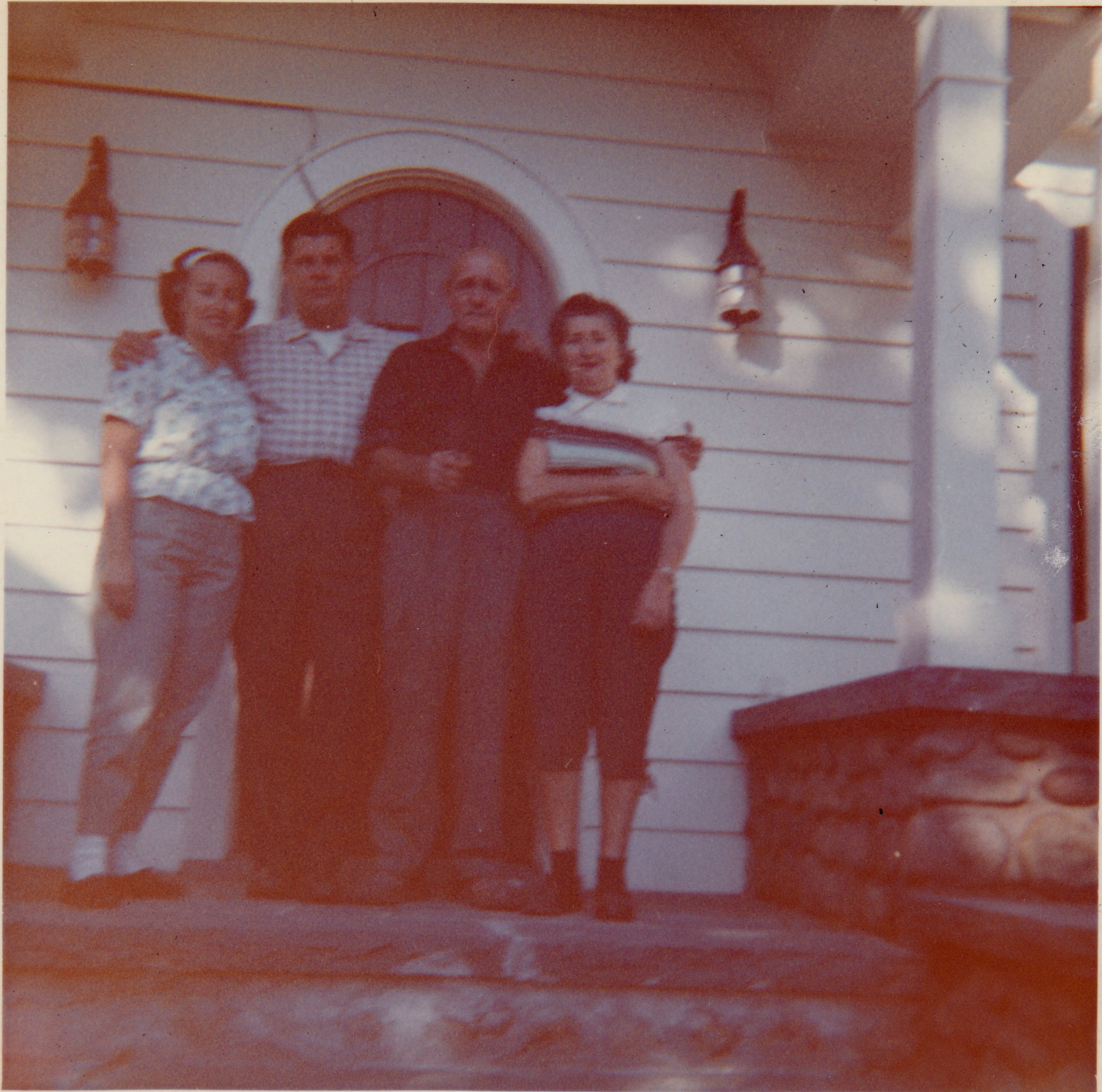
Normie and his wife, Wini, in matching sweaters in the center. My grandfather stands behind my grandma.  Wini's parents are the women sitting on the left and the man standing on the right.  At the bungalows in the Catskills in the 1950s.

Normie and his wife, Wini, in matching sweaters in the center. My grandfather stands behind my grandma. Wini’s parents are the women sitting on the left and the man standing on the right. At the bungalows in the Catskills in the 1950s.

His in-laws and my grandparents were best friends. My Mom and his wife were best friends. (A friendship that continued till my Mom passed away.   And still continues with us.) And his daughter, Vicki, and I do not know life without each other. So it made some sense that Normie would take on this responsibility if my Dad or uncle was not there.

But we are not sure why it was Normie who went to light the water heater pilot.

I was just a little girl. But I remember what happened next.

Normie went to light the water heater, it was behind a bungalow.

A moment later there was a big “BOOM” explosion and a blast of fire shooting into the sky.

It was so scary!!! Everyone was momentarily stunned. Then there was chaotic movement.

I vaguely remember Normie walking out from behind the bungalow, dazed. Perhaps burning. Or maybe not! Maybe it was just people rushing towards him to get him away from the fire. There was a lot of screaming; a lot of running around. It is so confused in our memories. But there was good new, he was alive.

Then the Moms gathered the children and made us go inside. I am sure Vicki went with me. All I remember is that we were quickly moved out of the way.

Next thing came the fire engine and ambulance and the volunteer firemen and ambulance/EMT crew. It was amazing how quickly they got to the colony. The fire was soon extinguished. Normie was taken away. The children, me included, were terrified.

My friend Vicki remembers, “I remember going to see him in the hospital. He smelled like A & D ointment or some kind of burn cream he had on.

“I was so devastated that happened to him. I thought he would never come home!”

But Normie did come home. He had no eyebrows or eyelashes, but the fire did not reach his face. He had no chest hair; the fire singed that off. The main damage was to his legs. They were burned.

I remember before the explosion, he had large varicose veins on his legs, but after the fire, you would not really see them.

He often wore a bathing suit in the summer time. And we all got used to seeing his burned, scarred legs.

It was a summer event I cannot forget. To this day I hate when someone has to light a pilot light.   I know that it can explode because of my memories of the day the water heater blew up.


The Melody of “Autumn Leaves “ Haunts Me

23 Feb

IMG_2370

Bob Dylan recorded Johnny Mercer’s Autumn Leaves for his new album, “Shadows in the Night”! This song has been haunting me since 1981! But now Bob Dylan is singing it, too!

My history with this song is driven by emotion. So to hear Bob Dylan’s rendition of it on the radio while I was driving somewhat stunned me. Luckily I was close to home and was able to pull into my garage. Yes, the song has that big of an impact on me! I even sent a text message to my sister and husband about it. They know my issues with the song.

My Grandma Thelma passed away from a massive stroke in 1981. I flew in from Kansas just in time to see her once more. She could not talk to me when I came to the hospital. But when I bent over her, she grabbed me with her good arm and pulled me closer. She then licked her hand and rubbed her kisses on my face. She could no longer really move her lips, even though she wanted to kiss me.

I felt her love. I knew that she was near death. I was glad I was able to see her once more.

She died that night. I think she was waiting for me to come. I was the one to tell my grandfather.

After her funeral in New Jersey, my parents, my grandfather and I drove back to the Catskills together where Grandpa and Mom would be sitting shiva at my grandparent’s home. It was August, and everyone was up in the mountains for the summer. It made sense to be where all their friends could visit with Grandpa.

The song haunts me.

All during the way, the long drive back to Kauneonga Lake, it seemed for the entire two hours, my Grandpa Nat sang Autumn Leaves. He told us that Grandma and he had made a vow to sing that song when the other passed away. It was their favorite song. In reality, I am sure he did not sing the entire trip, but it felt as if he did.

We did not notice the beautiful scenery along the way. We did not notice the landmarks that usually mark our journey. We listened to my grandfather sing. He had a beautiful voice. He sang and sobbed. My mother and I sobbed with him. I honestly do not know how my Dad drove. The words and melody were etched into my heart. For weeks it echoed in my mind.

The song continued to haunt me.

Years later a movie came out called, “Midnight in the Garden of Good and Evil.” It’s sound track featured songs by Johnny Mercer, including Autumn Leaves.

I have never seen this movie. I did not want to hear that song.

But one day, while my husband and I were in the movie theater waiting to see another show, I began to feel sick to my stomach.

“I don’t know what is wrong,” I told my husband. “But I really don’t feel well. I feel like something horrible is going to happen. I think we have to leave.”

“It is the song,” he said. He knew about my issue with Autumn Leaves. “They are playing the melody of Autumn Leaves. Why don’t you leave the theater for a few minutes.”

I left, and came back when the song was over. My feeling of dread disappeared and I relaxed once I knew why I felt sick. I was really amazed by how my mind, my unconscious mind, could relate so strongly to a song, while my conscious mind was unaware that it was impacting my emotions.

However, in a way, the sound track to “Midnight in the Garden of Good and Evil” helped me. For a few months the song was playing all the time on the radio. I started to be able to hear the melody without crying. Eventually I could also listen to the words without crying. I still felt an ache in my heart when I heard it, but I realized that this song was a commentary on my grandparents love for each other.

My Mother’s birthday is this week. Perhaps it is fitting that I have heard Autumn Leaves a few days before my Mom’s birthday. Perhaps it is fitting that Bob Dylan is singing this song. I have loved Bob Dylan’s music for my entire life. I still remember the first time I heard him sing Pete Seeger’s, “Where have all the Flowers Gone.”

I know that the melody and lyrics of Autumn Leaves will always haunt me. Even though I can now listen to the song without that awful feeling of dread, or thinking something horrible will happen, I still feel that ache. I remember that trip back to the Catskills. I envision memories of my grandparents and parents whenever I hear it. And whenever autumn leaves begin to fall, I feel my loved ones’ spirits close to me.


http://www.lyricsmode.com/lyrics/j/johnny_mercer/autumn_leaves.html


https://www.youtube.com/watch?v=Gnp58oepHUQ&list=PL1012F30BBCC1BEE9&index=4


http://www.bobdylan.com/us/songs/autumn-leaves


Amazing Coincidences After Finding My Ancestors; We Are One People

1 Feb

It has been a crazy time since I found out the lineage of my two times great grandmother Esther (Etka Lew) Wolff. I have connected with distant family through the Tracing the Tribe Facebook page. I have been welcomed to see our very large family tree on Geni. And I have found out who my ancestors were back to 1720.

Amazing.

But the amazement does not seem to end. In one of the many emails my two distant cousins sent me I saw that a branch of the family, one of my three times great uncles descendants migrated to Kansas City. What! I live in the Kansas City metro area. I have lived here for 18 years with no family except my immediate family. For a while my husband had cousins here, but they moved away. Now I find out I have distant cousins here. Really?

And then I thought about it. Many years ago, when the Bialystok Home for the Aged still existed and they still did a newsletter, I would get the “Bialystoker Stimmer.” I was a supporter of the Home for the Aged because my great grandparents, my grandma and my parents were always supporters. So the tradition continued.

In any case, in one issue I read, there was an article by a man and his daughter from Kansas City. And I knew his daughter. I mentioned the article to her, and we would joke about it and call ourselves “Landsmen,” which we were. So when I heard that I had distant cousins here, I immediately thought of her.

I sent her an email.

“What was your maiden name? I just found out that a branch of my family, last name Lew/Lewin/Levin moved to the Kansas City area. (Originally from Bialystok region). Just curious.”

She wrote back. And it all fit. They were from the same small town, Ciechanowiec. Her dad’s last name was Lewin but he changed it to Levine in the USA. We were third cousins.

And I thought that was all.

But my contacts back east (EW and AB), who had been feeding me all this information, were not done. They had heard of my friend/cousin. But there were others as well. They sent me a diagram. And asked if I recognized any other names. I did. One was a boy the same age as my son, they had gone to school together through second grade and had played together. The family belonged to the same synagogue my family belonged to. We have been friendly acquaintances for 20 years. We are related through the father.

I sent them an email because I find it all so interesting. I would never have expected to find family in Kansas! I am still in a state of determined amazement. Jew from the small Polish village of Ciechanowiec settled in Kansas and Missouri!

When my children were little they went to the local Jewish day school. My daughter used to feel sad sometimes because everyone was related to everyone else, except for her. She had no cousins at the school. I wish I had known this when they were little, as they were in school together, although their children were younger and more my son’s age. We might not be family, but they would have been ‘cousins.’

My daughter lives in Israel now. Many of her cousins who she is in contact with are also third cousins. These are branches of my family and my husband’s family that we have been in contact with forever. She has many second cousins, as my husband’s first cousin moved to Israel 27 years ago. These cousins have all been welcoming and loving. It is strange that some lines of the family stay in contact, and we see these cousins even with the distance in relationship; we consider ourselves close family.

But some lines of a family are lost over time. The movement from Europe. The aftermath of the Shoah; the younger generations moving away.   I had information from my Grandma and my Aunt mentioning these lines of the family, but we had no contact with them.

What an amazing coincidence to find some of these third and fourth cousins in Kansas. Of course we are distantly related. Third and fourth cousins are not so close. But it was surprising to find a connection where I was not expecting to find one.

But even more important, it shows that the Jewish people are really one. We are interconnected. My family, with its approximately 20,000 descendants is a perfect example of the inter-relations between all Jewish families. And even though a number of my family, from both my maternal and paternal sides perished in the Shoah, we remain.

That is the most amazing aspect of my continued search for my ancestors how we are truly one people.


https://zicharonot.wordpress.com/2015/01/27/serendipity-wins-in-finding-a-family-connection/

Serendipity Wins In Finding a Family Connection!

27 Jan

Serendipity is when events happen by chance and cause success or benefit the person who the events occur around. Today, a few days after my birthday, my life was ruled by serendipity!

For about a year now I have belonged to a Facebook group entitled “Tracing the Tribe.” I joined it mainly to see if I could find anybody related to my maternal grandparents. And last summer I did make contact with a family member through this group.

Recently I began thinking about my paternal grandparents, and wondered if I could find anything out about them. A few days ago someone started a comment asking people to put up the names of the families they were searching for on to the site. I did not do this. But I was watching. They then put all the names into a spreadsheet.

GG Grandparents

So this morning, I checked. And there was a name I knew, Wolf or Wolff, or Wolfe. That was my great great grandparents last name. So I put up a post on the page addressed to the woman who had posted about the name Wolf. I just wrote, “ My gg grandparents were Victor and Esther Wolff. Does that match your search?” She was not related to me.

However, soon another man posted, EW. He had some interesting facts and names. Names that were familiar. We soon realized there was a connection. It was a distant one. But it seemed possible that his three times great grandfather was the brother of my two times great grandmother. If so, I would have much more information for my family tree.

And so we sent emails back and forth throughout the day. I sent him a photo of my great great grandparents. He sent me a photo of his great grandfather. And there were some similarities.

And through these emails and looking into my family information that I had gathered from my Grandma Esther in the 1970s, it was definite. We were related.

His three times great grandfather Israel Lew was the brother of my great great grandmother Esther Wolf.   And I now had the names of her parents, Jankiel and Mindel Lew/Lewin/Levin (who were cousins) from Ciechanowiec. I also now had the names of more of her siblings, including Israel Lew, there was Azriel Aharon Lew, Fedjda Perlowicz, Betzalel Lew, Abram Boruch Lew and three more!

WOW! I always knew that my Grandma Esther was named after her grandmother, but I now learned that my Great Aunt Minnie was named after her great grandmother Mindel. That was exciting.

Not only all this. But I found out that Victor’s Hebrew/Yiddish name was Awigdor/Avigdor, which I had not known before now. Although I knew he had to have a Hebrew name. And that Esther was also known as Etka, which was probably the European name.

EW also found the date that my great grandparents, Louis and Ray, married: January 28, 1894, almost exactly 121 years ago! What serendipity that I was finding this all out now. Right near their anniversary! I was a bit stunned. All by chance. By one little message on a Facebook group’s page!

There was so much information in the multiple emails my new relative sent me, I think I had an information melt down. As I read each email it made more and more sense, and I could see the lines making the connections.   It was like a mini revelation!

I cannot explain the glow and the excitement that went through me! One little posting and I learned so much!

I was so glad that I had sat with my grandmother 40 years ago to get this information so that I could now say with certainty, I can go back one more generation in my family’s lineage.

And perhaps more! My sister and I have been trying to find out where our great grandparents were buried. There in all the emails was information on Beth David Cemetary in Elmont, NY. If other relatives were buried there, I believe there is a good chance our great grandparents are also there.

Serendipity, Chance and little guts to put a post up on Facebook.   What a win!


Update.  Found out my great aunt and uncle are in Beth David Cemetery, but my great grandparents are in Washington Cemetary in Brooklyn.

Update 2:  Thanks to another distant ‘Lew’ relative, AB,  I have now seem my family tree of my great great grandmother Esther Lew Wolf and have seen my ancestor back to my seven times great grandparents…back to an ancestor born in 1720!  For a Jewish family that is quite amazing.  And I can do that in my maternal side as well!

Personal Mail Delivery at the Bungalows

27 Dec

Each summer before my brother could have a ‘real’ job, he had a job devised by my grandfather. Since my grandparents owned the small bungalow colony where we stayed each summer, they were responsible for certain amenities. One of these was mail delivery.

It was before the time of email and cell phones. Communications with people who had stayed behind in the City for the summer relied on mail.   And since most people did not have cars at the bungalow colony, someone had to walk into Kauneonga Lake and pick up the mail. It became my brother’s job when he was 10 years old.

Before him, he believes one of our cousins got the mail for a year. My Grandpa gave the job to the boys until they could get a real job. Then it was passed down to the next younger boy.

My brother got the job for several reasons. First, of course, someone did have to get the mail. Second, my brother was a grandchild. Third, my brother was an extremely active child. I think my grandfather was trying to give my Mom a break and also to wear my brother out. But honestly, nothing wore my brother out!

My brother’s morning went something like this.   Get up early. Eat a bowl or two of cereal. Then walk to the bungalows. We lived about 1/3 mile up the road from the colony in a bungalow behind our maternal grandparent’s home.

When he arrived at the bungalow colony he first went to the bungalow where our paternal grandparents and great aunt Minnie stayed to have the second breakfast waiting for him. Usually they had eggs, toast and cookies for him. My Grandma Esther was a great baker.   They had to give him enough energy to finish the walk to get the mail. I think she also gave him a nickel or so because he picked up her newspaper.

He would take the mail that people had given him or my Mom the day before, but first checking to see if anyone left him anything on their front steps, and set off for his journey into town.   Sometimes he was given additional jobs, like buy a newspaper at Vassmer’s.   Or buy stamps. So he always had a little bit of money that he needed to take with him and to keep track of it.

It was about mile or so walk into town. Sometimes he would have company. Another boy would walk with him. But other times he had to go on his own. If it was raining, he did not have to walk into town. The mail could wait. No one wanted him to get sick!

The post office to the left and the fire station to the right, across from the lake side on the other side of the grassy triangle.

The post office to the left and the fire station to the right, across from the lake side on the other side of the grassy triangle.

The town of Kauneonga Lake has a grassy triangle in the middle. Around it are the streets that lead to 17 B, West Shore Road and Swan Lake Road.   On the other side of the street were the stores on one side, the fire station on the other side, along with the buildings for the post office and the bakery.

Once he returned from his two-mile journey he would go to each bungalow and deliver the mail and whatever else they had ordered. It was a lot of work for a young boy, but he had a routine.

After he delivered the mail he would wander over to the bungalow where our Aunt Leona stayed. And, as he says, “If the timing was right I would deliver their mail and have my third breakfast.” That is right, breakfast number three. Goodness knows my aunt did not want him to go hungry! And since she was feeding her three boys, what was one more?

He ended his deliveries with my maternal grandparents. He would walk back up the hill to their home and deliver their mail. And have his fourth breakfast with our Grandfather.   My brother said that was usually burnt rye bread toast and coffee. It was burnt on purpose; Grandpa loved burnt rye bread toast! (Honestly I love it as well.)

Yes, my brother ate three or four breakfasts every single weekday morning.

But after he ate the fourth breakfast, Grandpa Nat would give him a chore to do before he could play: cut the grass, pick up leaves, or even straighten nails.   To be honest he and one of my cousins had the nail straightening job whenever they misbehaved.

He would come back to our bungalow and check in with Mom delivering the last mail of the day to her. I think she always asked him if he was hungry because my parents did not know at first that he was eating so many meals. Once they found out, they were amazed. Where was the food going? Did he have a hollow leg? He was so skinny!!! But he was able to pack it away.   I do not know how he did it.

The most amazing aspect is that he still had room for lunch a couple of hours later.

My brother enjoyed his four summers as the mail delivery service.   After he ‘retired’ and got a real job, I became the part-time mail person. Yes, I was a girl, but by then Grandpa had run out of boys.  So a change was made.

The next summer I worked at the bakery in town three or four days a week, and the bakery was in the building attached to the wooden building that housed the post office. So it made sense that I got the mail when I finished working. I only worked in the mornings. So the mail was delivered by lunch. And no, I did not get four meals!

The first summer I worked at the bakery, Grandma Thelma worked with me. But many days, when the store was not busy, she would just go and visit with Mrs. Driscoll.   In reality the post office was the center of town. You not only got your mail there, you also got all the gossip from Mrs. Driscoll.

I loved going to the post office with my Grandma.

While I walked to the left hallway where all the mailboxes were located, they would continue their discussions about Kauneonga Lake happenings. Sometimes when I got too close to them, they became quiet. So I knew to stay by the mailboxes or make believe I was looking at all the “Wanted” posters, so I could listen to all the gossip of the town.

I continued to get the mail one more summer, when I worked at the bakery by myself. But after that summer people started having cars at the bungalows and opening their own post office boxes. So they went to get their own mail.

We had the same mailbox for over 50 years, Box 792. We no longer have a mailbox in Kauneonga Lake. And of course Mrs. Driscoll and my Grandma are no longer with us. But my brother and I have wonderful memories of the post office and our years as the mail delivery service.

Thank you to my brother for sharing his memories and helping to make this an accurate description of a summer activity.

Giving Tzedekah is Entwined In The Essence of My Soul

22 Dec

For the past week I have been writing checks. It is the time of year when every charity I have ever donated to sends me reminders. Many of them I give to throughout the year. But at the end of the year, as much as my husband and I are able, I give more: to Harvesters, the food bank; to domestic violence shelter, to organizations that help children; to Jewish charities, to schools. The list goes on and on.

I was taught that you have to give to others. Not just money but time. Volunteering is an important part of my life. In the years when I was not working, I volunteered so much that it seemed I had several jobs. Yes I do have favorite organizations I for which I do most of my volunteering. But there are many that I do one-time events when asked by friends.

My favorite volunteer job is chairing a scholarship committee for the Greater Kansas City Section of National Council of Jewish Women. I became a member of NCJW because of scholarship, and I recently realized that I have been on this committee for almost 30 years. WOW.

As chair, I keep my committee going. Our numbers had fallen. But over the past three years, I have been able to have six or seven new members join. And this past year, I have gone after even younger women. We need continuity. Keeping the scholarship committee alive and well is important to me.

Each year we provide college scholarships for almost 30 students. They come to us first as high school seniors. And if they get our scholarship, they can continue it for all four years of college as long as their grades are relatively good and they still have financial need.

Over the years we have provided many scholarships for students who are the first in their family to go to college. And many have had hardships that make the committee members want to cry. As chair I am fortunate to read all the thank you notes that they send. And see the difference we have made in the lives of these students.

I often wondered when did the importance of volunteering and helping others first become so important to me? I honestly cannot remember a time when I was not involved in something. In high school I was a Candy Striper, a hospital volunteer. In college, I chaired and served on many committees to help others, including the first ever Orientation Committee.

Even my jobs have focused on not for profit work. It is in the essence of my soul.

My father was the president of his synagogue for 11 years. I think this has to be a record! My parents helped people and taught us to care for others. It was important to them that we had a ‘gutah neshama,” a good soul. It was important to be a mensch.

A favorite saying of my Dad’s was “You have to be able to get up in the morning at look at yourself in the mirror, and like what you see.”

Giving to others; understanding Tzedakah, righteousness, was important.

My Grandparents in the Catskills in July  around 1954. It was my Grandma's birthday.

My Grandparents in the Catskills in July around 1954. It was my Grandma’s birthday.

Today I received an email that shook me up in a way and made me realize that the need to do tzedakah came not just from my parents, but also my grandparents.

Through this blog I am in contact with several people who I knew as a child in the Catskills. Several have reached out to me over the year and asked if I remember certain people or places. One reached out to me in the past week. It is someone we knew not only in the Catskills, but in New Jersey as well. His mother is still alive. And he sent me this message:

“…she (his mother) was always grateful to your grandfather for helping my parents out when my brother and I were babies:  Even though the rent on the bungalow was ridiculously cheap, my parents were broke and Mr. Amsterdam (as she still calls him) let my parents pay out the summer rent through the entire winter a little bit at  a time. Otherwise we would have been stuck in steamy Hudson County.“

I have to be honest, I cried.   My grandparents were very quiet people. But I already knew that during the Great Depression, they allowed many people to buy groceries and bread from their bakery on credit, even though they knew they would not be paid. My Mom told us the story of people coming back years later to pay their debts.

But I never knew that they had allowed people to pay off the summer rent during the year. This was a major mitzvah. The cities in the early 1950s were not safe for children in the summer time; it was the season of polio.

I always knew my grandparents were righteous people.   And I know now that giving tzedekah is entwined in the essence my soul from my parents and my grandparents.

My Five Levels of “OY”

4 Nov

I recently realized that in my mind there are actually five levels of Oy. These five different levels provide me the ability to express sorrow or sadness with an oy-statement.

The first, of course, is the simple ‘oy.’ This mean ‘oh’ or ‘ouch.’ I use OY when my cat jumps on my stomach or I drop something. Sometimes I use oy when someone is telling about an embarrassing experience they had. A response of “Oy” is always appreciated.

I never use oy when something bad has happened. It is usually used for events that are a little bit funny. I guess someone slipping on a banana peel without getting hurt would be an oy moment.

It sometimes has an “I cannot believe I did that,” feeling. After you do it, you think, “Oy! Why did I do that!”

But when I say “Oy Vey” I have amped up the response. Now I have feelings of woe, which is exactly what “oy vey” means, “oh woe!” I think the following is a good example of an oy vey experience.

The summer of 2013, on Fathers’ Day, my husband and I were at a party. During the party a storm blew in to the area. It was tornado weather in Kansas. We all took shelter in the house. Although the wind blew and the rain came down, it was not too bad where we were.

All those branches on the ground should be in the tree.  Oy Vey

All those branches on the ground should be in the tree.         Oy Vey

However, when we got home, OY VEY!!!   Our beautiful Sugar Maple was destroyed in a microburst of rain and wind. Branches and limbs were all over our front yard. Part of our fence was crushed.   It looked like a disaster zone in our neighborhood. And our house seemed to be the epicenter.

But it was only an Oy Vey, the second level of oy, because no one was hurt. No homes were damaged. Yes, the tree was going to have to be taken down, but in the long run it was just a second level oy experience.  My son and his friends came over and helped my husband collect all the branches and to get the big branch off the fence. Those branches were big and heavy!

The next day I called the tree service we use. Luckily they had trimmed that tree just six months before, which probably lessened the damage. I will admit watching the tree service actually take the tree down was a second oy vey experience. It was a very large tree! But they took care of everything, while I watched and took photos…all the time chanting, “Oy Vey!”

“Oy Vey Iz Mir” is a much stronger, “Woe is ME! “ When I say the entire sentence, then I am really worried. When I say, “Oy Vey IZ Mir,” something horrible has happened.   Someone I know is sick. Or an elderly parent is in hospice or has passed away. Sometimes I say that when someone has lost a job. It is a statement for a calamity, but not for a tragedy. Or maybe something scary has occurred.

When I was a child in the Catskills, the boys who lived in the house next door were shooting BB guns and aiming at a target made of wood. The BBs ricocheted into our yard. All I remember was the leaves rustling and my Dad, who had served in Korea, jumping on us yelling, “Get Down!! Get Down!!!”

One of my grandparents said “Oy Vey iz mir.” I think both because of the guns and because of Dad’s reaction. He stormed over to the house and yelled. After that there were no BBs for a while. Then I think they built a target with straw behind it. But that “Oy Vey iz mir” has stayed with me!

I think the English saying, “Woe is me” is an example of Yiddish phrasing in English. I have woe. I feel woeful. I am sad. Those are all English. But in Yiddish, Oy Vey iz Mir. Oh woe is me!!!

For a tragedy I have my fourth level of Oy. That is seven oys in a row followed by Vey Iz Mir.   “Oy oy oy oy oy oy oy vey iz mir.” That is when I feel absolutely terrible about what I have just heard: when some one has had a true tragedy. What could that be? A young person has passed away.   Someone’s son or daughter has been in a serious car accident. During my children’s teen years, there were unfortunately several times when the fourth level of oy was invoked.   A suicide is a definite fourth level of oy. Where I might forget why I used the first three levels of oy, when I have a fourth level of oy moment, it lives with me forever.

When I reach this level I usually need a piece of chocolate and a glass of tea. When I say this I know that I would love to speak to my Mom or Dad and debrief. The fourth level of oy moments are the times when I end up making phone calls or sending out emails to let others know, so that we can band together and help.

But I said there are five levels of Oy. So what could be worse than level four? Well there is level five, when I say, “Oy, a Bracha.” With this I am saying “woe is me, we need a blessing.” With the fifth level of oy I am calling on God to help.

When war breaks out in Israel, it is an “oy a bracha,” moment. With a daughter living in Tel Aviv and many family members throughout Israel, the threat of weapons, rockets, war, and destruction makes me very anxious.

For me 9/11 was a fifth level oy moment. We needed all the blessings we could get then. And so for me, it was saying “Oy, a Bracha!” Help us, bless us.

My five levels of oy have been part of my life as long as I can remember.   I am glad that most of my oy moments are level one and level two oys. But I am also glad I know a bit of Yiddish so I have a way to express exactly how I feel.

Old Movie Memories Invade My Mind

2 Nov
Our grandparents purchased this house in 1962,  a few years after the last movie was filmed.

Our grandparents purchased this house in 1962, a few years after the last movie was filmed.


In the attic of our home in the Catskills, my brother found a box of old 9 mm movies. These 29 movies recount the early days of our parent’s marriage. There is my Mom’s shower, and even a movie of the wedding itself. We were shocked when we found it!

The majority of the movies were filmed between 1951 and 1958, with a few a little bit later. So we have film of my parents, grandparents, aunts and uncles, my brother and I…and a few of my sister who was born in 1958. We figure after the third child was born, there was not a lot of time to film us!

My brother took the films to be put on to DVDs. So we now each have two DVDs filled with 3 ¼ hours of family memories, in color. There is no sound, but it does not matter. We can often figure out what they are saying.

They are so young in these films. My parent’s wedding is especially poignant: seeing so many family members who have passed away. To see them once again in this movie means so much to all of us. You can see the joy and excitement in the synagogue in West New York, NJ.

I knew that movies existed. We had seen them as children. But did not know where they were. So the find of the box filled with movies was extraordinary! It provided much joy for my siblings and me.

I always thought the movies were in black and white. I remember seeing a few of them when we were children. My Dad would set up his projector in the living room and show the movies against a wall. Some of the movies we found, I remember so well. I thought I remembered the incidents themselves. But when I saw the movies, I realize what I remember is the movie of what happened.

The bulk of the movies were taken in the Catskills at my grandparent’s bungalow colony. I see my aunts and uncles, cousins, family friends. People I knew my entire life. There are also people I do not recognize. Did they only come up for just a year or so? Or perhaps they are people who passed from my parents’ lives and were not important? Maybe they were just visitors or friends of friends.

Some I might not recognize because they changed so much from the time I was young to when I remember them as I grew up. But it does not matter who they are, they were part of our parent’s life, so we are glad to see them.

It is fun to see the clothes and cars from the 50’s, to see them laughing and goofing off at the bungalows, to see them so alive is so joyful! I wish I could watch these movies everyday.

I cannot. Because along with the joy of the movies, is the realization that not only they are gone, but also the joy of bungalow colony life.   This is the zenith of Jewish bungalow colony life in the Catskills. The 1950s, 60s and early 70s is when so many people journeyed up to the ‘mountains’ for vacation.

It was also important to get children out of the city in the late 40s and early 50s, before the polio vaccine was developed. By being in the Catskills, they were somewhat spared this dread disease.

My parents and grandparents in front of the home in 1962.  My siblings and I now own it.

My parents and grandparents in front of the home in 1962. My siblings and I now own it.

I miss my summers in the Catskills. I am lucky as my siblings and I own our grandparent/parent’s home which our grandparents purchased in 1962. The house has so many happy memories.   We still have a place to stay and enjoy the peace. We are also lucky because our cousins have summer homes in Kauneonga Lake as well. When we go up, we create new memories, but we also have the history of experiences shared.

Next summer I plan to bring the DVDs up to the Catskills. I think my siblings, cousins and all the children would have a great time sharing these memories as we see our parents alive once again.

Traditions Survive Across Generations

4 Oct

My grandfather was a Cohen. Born in Poland, he took this role seriously. Cohanim lead off the aliyot at synagogue; they have to be present at a “pinyon ha ben,” the ceremony for the redemption of the first born. They cannot marry a divorced woman. They do not go to the cemetery or funeral except for a very close relative. And for me the most intriguing, they lead the dukhanen on the high holidays

When I was a little girl I loved to go sit with Grandpa in shul. He had a large tallit ( prayer shawl) and would wrap me into it as I sat next to him. Whenever the Shema was said, he would lift his tallit so it covered his head and face. “Why do you do that?” I asked. Most of the other men just kept their tallit on their shoulders.

“When I say the Shema I speak to G-d,” he told me. “When you say the Shema you have to cover your eyes, ” he told me, “and think about the prayer .” To this day whenever I say the Shema I put my right thumb on one eyelid and my forefinger on my other eyelid to keep my eyes closed, just as Grandpa taught me. And I think about the words I am saying. I taught this to my children.

Because Grandpa was a Cohen on special holy days he would perform the priest prayer, the dukhanen, with other Cohanim descendants. They would be dressed in white kittals, robes, over which they wore their tallit. When they entered the sanctuary they stood at the front if the congregation and covered their heads with their tallit.

At this point my Mom told me to look away. “When the Cohanim chant this prayer they speak to G-d and his light comes. If you look once, you will go blind in one eye. If you look twice you will go blind. If you look the third time you will die,” she said.

How can you possibly die if you are already blind? Okay she admitted you cannot die, but still you must turn your face away and not watch. To this day I do turn away. I still cover my eyes. But sometimes I sneak a peek. And I said the same thing to my children.

Many congregations no longer do the dukhanen , but my congregation continues this tradition. At Rosh Hashannah this year, as I watched the Cohanim walk in and prepare for their chant I remembered my grandfather. In my mind I could see him walking to the front of the room.

My father was not a Cohen. As an Israelite, he had no special role, but he loved his Judaism and his congregation. My Dad was president of his synagogue for 11 years. A record I am sure. He worked to pass his love of Judaism to his grandchildren. Before each of my children’s bar/bat mitzvah, my parents came to stay with me. My Dad studied with them each day for the week before the service, listening to them chant Torah, helping. He was so proud as each of his six grandchildren reached this important day.

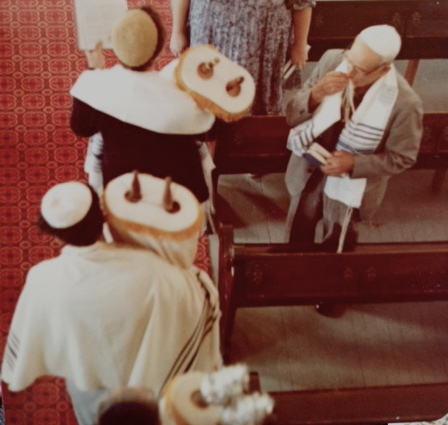
Grandpa kissing his tallit after touching the Torah.

Grandpa kissing his tallit after touching the Torah.

As the Torah comes through the aisles before being returned to its resting place behind the curtains and the doors, beneath the everlasting light,  I touch it with my siddur.  My Mother taught me to do this, as I watch the men touch it with the fringe of their tallit.  This I also taught to my children.

When I go to shul, I am never alone. Even if my husband is not with me, in my mind I see my grandparents and parents. When I chant the Amidah, standing with my feet together, I gently sway back and forth, Schukling. My children would sway with me when they were little. Sometimes my children would lose my rhythm and sway into me. Now just my husband is with me. And he sways into me sometimes with a lilt in his eye.

My husband is a Levi.  Although he does not participate in the dukanen itself, he is called out before it to help the Cohanim prepare.   Many times, he does not have to do anything, because there are more Levi than Cohanim. But he goes, he says for the exercise.  But I know that it is a tradition that remains.

When we daven together, I feel the bond lasts across the generations.
As I recently stood to say Yahrzeit for my Dad, my son was with me. He now wears my Dad’s tallit. On his head was one of my Dad’s caps. As I stood, he lean my Dad’s hat against my hand. When I sat, he turned and said,” I thought you would want Grandpa near to you.” And I did.

But when I am in shul they are always with me. Their voices swirl among the other voices chanting.

Misty Lakes and Cold Mornings Were Wonderful In The Summertime

1 Oct

Those who think climate change is not a reality did not spend their summers in the Catskills during the late 1950s and 1960s! Those brisk summer mornings made waking up and getting out of bed a little difficult at times. The summer mornings do not seem as cold now!

We slept under feather beds and quilts, and always put our clothing under our pillows to warm them up during the night. Sometimes your nose would be so cold that you would put the covers over your head as well. And everyone wore ‘footsie’ pajamas!

In the mornings we would all get dressed while still lying under our blankets. First came layer one, underwear; then layer two, shorts and t-shirt; then layer three, jeans and a long sleeve shirt. Socks went on as well. And with no heat, those bungalows were cold! . You could sometimes see your breath in the mornings, so dressing while still in bed made sense!

My sister and I would wait to see who could hold their bladder the longest. No one wanted to be the first to sit on the cold toilet seat. My brother was lucky; he could stand up!!! But finally one would have to jump out of bed and start the day.

Mom would be making breakfast for us. And soon she would shoo us out of the bungalow. But first we had to put on sweaters or lightweight jackets.

When we looked across the street form our bungalow, we could see Kauneonga Lake. In the early morning the mist would rise from the warm water into the cool air of the July or August day. It was the most beautiful view.

The lake water was much warmer than the outside air. Some early mornings, my grandmother would take me to the lake. I would have my bathing suit on and a large towel wrapped around me. We would slip into the lake from our dock and settle into the warm water. She would wash my hair and her hair with ivory soap. She had very long hair that she usually kept braided on the top of her head. But these mornings, she would have it hanging down.

Grandma grew up in Poland. She told that lake water was the best to wash your hair. She would tell me stories about washing her hair in the water near her house when she was a little girl.

Sometimes through the mist we could see rowboats and fishermen. That was before everyone had motorboats and the lake water had gasoline and oil in it.

The water felt so warm and wonderful, until it was time to get out. Grandma would make me sit on the steps while she got out and dried off. Then, as I – shivering – exited the water, she would wrap me in the towels. We would return to the bungalows as quickly as possible to get into warm, dry clothes. This was a special treat.

Usually, after breakfast my sibling and I would go outside to play with all the other children.   There was a fence around the colony that was to keep us inside. We knew better than to go beyond the perimeter without a mother’s permission.

My family and friends in Kauneonga Lake.

My family and friends in Kauneonga Lake.

As the day went on and it warmed up, we would slowly shed clothes. First off the sweater, then the long –sleeved shirt, and finally the jeans.   At lunch time we would start begging, “Can we swim today? Can we? Is this a good day?” I think the Moms decided as a group. We had to wait at least an hour till the food digested. (What I now know was a bubbameister, we really did not need to wait.) Then around 3 or 4 in the afternoon, if the weather was nice, we changed into our bathing suits and went swimming in the lake: all the moms, grandmas and children. On the weekends the dads were there as well!

We would all go to the dock with our towels, carefully crossing the street under our Moms’ observant eyes. The older children holding the hands of the younger, we would run to the dock.

The lake water was wonderful in the afternoon. I liked to stay where the bottom was sandy, where most people usually went. To either side was mush, or as we called it the gush, …seaweeds. And hidden in the mush were fish that nibbled your feet and snapping turtles. Sometimes, like always, the older boys tried to push the younger children into the mush. The screaming would begin. But nothing really bad ever happened because all the Moms and Grandmas were watching. We would spend a wonderful hour or two swimming and playing, until the Moms said, “Done. Get out of the water, Now.”   We hated that. But eventually we would all return to the dock and dry off.

We would clean up after swimming and before dinner. It was too cold after dinner to shower and clean up. And to be honest, if we went swimming we were considered clean enough. There was no need to take a bath!!!

As the day ended, the reverse would occur. Soon the jeans went back on, then the long-sleeved shirt and finally a sweater. Sometimes after dinner we would just put our pajamas on and stay in the bungalow. Other times we would all sit outside and just visit. It was quiet time, and it was the Moms time. Several nights each week, a different mom would host the gin rummy or mah jong game in her bungalow.

There were three ‘grandpas’ at the colony (two were mine), as well as at least one dad. Each week a different dad would take his vacation and spend time with all the families. And while the Moms played their games at night, the grandpas were always on bungalow control. They would walk from bungalow to bungalow to make sure all the children were asleep and everyone was safe.

One year one my sister started sleepwalking. The first time it happened my grandpa was so upset when he saw her running around the front lawn. After that they put a clothespin in the door to make it more difficult to get out. But we still could get out in an emergency.

Those cool summer nights and morning were so delightful. It was a time before air conditioning, and the City was hot and dirty. Misty lakes and cold mornings were wonderful summertime gifts from our parents.