Tag Archives: grandfather

An Unexpected Email Reveals Family Shoah History

30 Oct

In the last week I have been in contact with Izabela S., who lives in Tarnow, Poland, which is close to both Mielec and Trzciana, where my family lived and where they were murdered in the Shoah.   Izabela has been working for the past three years to clean up the Jewish Cemetery and get information about the places where the Jewish residents were murdered and put up plaques to commemorate them in the Mielic area.  She also writes a blog and has a Facebook page to write and remember the Jewish residents who were murdered in the Shoah.  Before the war, of the 10,000 residents in Mielec, 5,000 were Jewish.  After the war, maybe 200 survived!

(See video about Izabela below.)

My quest to find my grandfather’s family started in the late 1970s after I spent time in Israel and met those who survived.  My grandpa lost his entire family in the Shoah, except for a few cousins, and except for his mother, he never knew how his father and siblings died.  I told him that I would find out. It has taken almost 50 years, but I never gave up! Over the years I have written many blogs about them. (Some are linked below.). But I could not find out about three of his siblings.  Now I know more.

But then there is the question?  When you find these things out, do you really want to know?  And are some ways of dying better than other ways.  In the towns my family came from people were burned alive in the synagogue and mikve, starved to death or died of disease in the Lodz Ghetto, gassed at Belzec, shot at a mass grave.  Which is worse? 

I guess I decided that being shot is the kindest way to die among those options.  A distant cousin of mine (Her great grandfather and my grandfather were second cousins, l believe), thought her great great grandparents were burned alive in the synagogue.  She now knows, thanks to Izabela, that they were shot. And in a weird way it is better.  I think.

My family came from the small town of Trzciana. Before the war there were about 1000 people.  The town was known for its windmills.  I can imagine that it was lovely.   Izabela wrote about it this way:

“Jewish families lived in Trzciana: the Amsterdams, the Hollanders, the Brenners, and the Feuers. They were closely related to each other. In  Next is the night: The fate of Jews in selected counties of occupied Poland, vol. II Tomasz Frydel writes that every Sabbath, members of the Amsterdam family from the village of Trzciana went to the synagogue in Czermin, where more Jews lived among the German colonists. This family was widely respected, its members gave grants to the Roman Catholic parish and distributed potatoes and beets to local peasants.”  This was my family.

I knew already how my great grandmother, Chava, died. (See blog below.)  But I now know my grandfather was not killed in Belzec with his son, Shimon.  Instead he was murdered on March 9, 1942 with many others of his family during a round up/deportation and slaughter of Jews.  He was shot in Cieszanow.    I now know that their daughter, Tova, was also in that roundup. But was not killed then. So probably died in one of the camps. I know Jews from Meilec went to four camps, Belzec, Sobibor, Treblinka and Majdanek. 

I now know that outside of the town there is a mass grave of 800 Jews.  Many of them my relatives. I know about one for a fact.  Natan Feuer ran.  He was able to get about 50 yards when the Nazis shot him and dragged him back to the pit where they threw him in still alive. And he perished. But Natan story really hits home as my grandfather’s brother was named Nueter/Natan. So is this him? I will never know.

I believe that my grandfather’s cousin, Morris Brenner, who owned a candy store in Linden, NJ, and whom I wrote about before, (See blog below.), had two sisters and a nephew who are buried in the Jewish cemetery on Traugutta Street: Cerla Kleinman nee Brenner, her son David, and sister, Sara Brenner.  His mother, Gital, died in 1941, before the mass murder of the Jews.  I have to admit that gives me a bit of joy. It is nice that someone died a natural death and wasn’t murdered because she was Jewish.

I had heard of the brothers Tuvia, Zus, and Asael Bielski, from the book and the movie Defiance.   I now know that there was also the Amsterdam Brothers, Johanan and Abraham,  who led a group in the forest near Bulcza Mielka called The Amsterdam Group.  According to Izabela, it was a large group of Jews who hid and the core of this group were families from Trzciana.   There were 84 Jews in Trzciana before the war, all related to me.  The two brothers, who had been in the Polish Army before the war, commanded the group.   They built a series shelters and hideouts where they survived the winter of 1943.  They hid in  bunkers and acquired weapons from the peasants as well as gaining them in battles with the police and Germans.  They divided into small groups to keep more people safe.

A survivor named Ryvka Schenker wrote about the conditions in the hidden camp:

“It was very cold back then, the snow fell, You had to be very careful – every step was known. How they went out to the country Shopping, they made their feet like the birds they have. It was made of wood, They made the same traces as birds walked. No one could have Imagine there are people in the middle of the forest. We sat all day very long calmly, one read a lot, others wrote diaries, some embolden images, Everyone made it through that day. We always lived the hope that It will be after the war soon, but it was just a dream.   There were severe frosts, nobody had The right clothes, let’s get out of the field little. The men were more Resilient. We had a lot of water because it froze.”

I am Amazed!  And feel proud that my family tried to survive in every way that they could.

There is so much information it will take me a while to unravel all of the connections and organize in my mind so that I can write about this family that was almost wiped out. My family.  But I felt it was important to write this down when the emotion of discovery was still strong. Baruch Dayan HaEmet.  May their memories live through these remembrance and that we never forget those who have been murdered by hate and evil.

Video of Izabela S.and her work.

About Morris Brenner

https://www.facebook.com/groups/1318997264939643/

I Just Love Bakery Cookies

16 Dec

Recently a friend of mine asked me to come to speak to a group of 4-6th grade children and their parents/grandparents who were taking a baking class. The children learn a new recipe and also listened to a short talk about the recipe’s place of origin.

I was asked to speak about living in New York City and, black and white cookies.  This was an easy task for me. I have a thing for black and white cookies.  Also, I grew up basically in a bakery.  My grandparents owned a kosher bakery in West New York,  New Jersey,  until I was 14.  Meaning I spent many hours helping and visiting and eating in the bakery.

I easily spent 15 minutes talking about living above a bakery; apartment houses; fire escapes; and other New York differences for these children who live in the suburbs of Kansas. Apartment dwelling in tall buildings is not a common occurrence in Kansas!

The talk was over quickly, but it started me thinking about the cookies.  Perhaps the holiday season helped to think of cookies —  not that this is a difficult topic to think about.  But I did start thinking about my favorite bakery cookies!

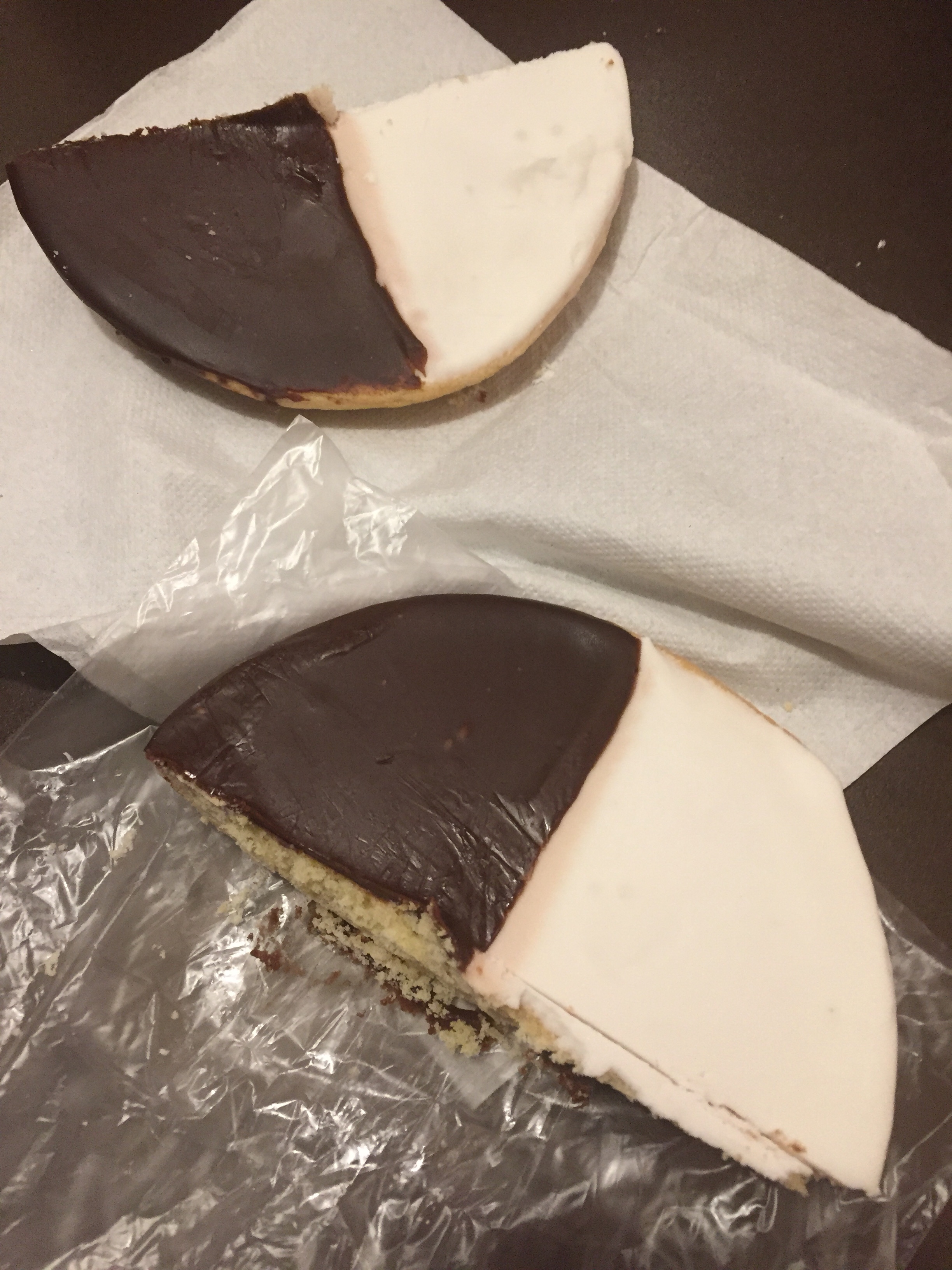
I love black and white cookies. These large round cookies are covered by both chocolate and vanilla icing divided down the middle of the cookie.

And I am telling you now, when you cut a black and white cookie in half, you must always give each person half the white and half the black.  The only time I made an exception to this rule was for my son….he never ate the chocolate side.  But for everyone else, the rule remains!

There is only one place in Kansas City that I have found black and white cookies that are decent.  The D’Bronx Deli near my house is where I go for this comfort food.  A typical lunch for me is a bowl of chicken noodle soup with a Matzah ball, iced tea and a black and white cookie. I do share it, as described above.  But if my companion does not want to share, I am always content to take it home to devour later.

I have tried other black and white cookies available in Kansas, but none have matched the cookies at D’Bronx.

My cookie desires follow me.  Whenever I go to New Jersey, my sister knows that a visit to Miller’s Bakery in Tenafly is a must stop for some black and white cookies.  Last time I was home, the bakery was OUT of my favorites.  We had to order some for the next day.  But the day was not a wasted, the bakery did have New York Chinese chocolate chip cookies.  These are also quite excellent.  A large chocolate chip cookie with a giant dab of melted chocolate on the top marks a Chinese Cookie in an East Coast Deli.

14656250_10154702481348566_7357037773989779256_n

There does not seem to be any real information on where these cookies originated, except they might come from Chinese almond cookies, as they do have an almond taste.  I haven’t seen them anywhere but in New York and New Jersey, but I assume wherever there is a Jewish bakery or deli, there might be these delicious cookies.

In any case, when I could not get my black and white cookies, I went to second choice…Chinese Chocolate Chip Cookies.  It was equally yummy, in a slightly different way!

Honestly, my sister and I find it good exercise to walk the mile to Millers for a cookie and coffee. Sometimes one of our friends meets us there. Then we walk back. No guilt cookie eating!

In an effort to be fair to all bakery cookies, I will admit that there is one more that touches my taste memory as well.  The raspberry linden cookie, also known as a Linzer Torte.  My grandfather always called them linden cookies.  These are two-layer cookies.  The bottom is round with scalloped edges. The top matches the size of the bottom and the scallops, but the center has a hole where the raspberry jelly can ooze through.  These are quite excellent if you are in a gooey, sugary mood.

Actually I have no problem eating any of these three cookies.  Growing up in a bakery, however, impacted my taste buds.  Whatever cookie I eat always is in competition by the taste memories I have from my grandfather’s bakery.  To be honest no cookie ever meets the challenge. But I have fun searching, because I just love bakery cookies.

My Family’s Holocaust History Impacts My Observance of Rosh Hashannah

13 Sep

As Rosh Hashannah approaches, I have a new view of my family’s heritage, a new reality that will impact my observance and prayers this year and in all future years.

It started with a Facebook Group called, “Tracing the Tribe.” I actually was able to find a family member due to a blog I posted about my grandfather’s family history and his town in Austia/Galecia called Mielec. I met Susan when I was in New Jersey this summer. It is actually her husband who was related to me.

We spoke about the family and how we might be related. I actually found the connection. My great grandfather and her husband’s great grandmother are probably brother and sister.

She emailed me a testimonial written by her husband’s first cousin, “E”, about her Holocaust experience. “E” survived the Holocaust and settled in the USA. In this memoir, “E” recounts a story about the Jews of Mielec and how they died. She wrote that 600 were rounded up and burned alive in their synagogue. She received this information from relatives in Mielec.

What! I was somewhat stunned. No one had ever mentioned this to me before. Whenever there was discussion about our family who died, we were told that they were burned alive in the fires of the Holocaust; or that some had died in Auschwitz; or that my great grandmother had been hidden and then murdered by the people who had stolen the family farm. But this story was never mentioned. Never.

But I remember thinking, when my Mom would tell me that our family was burned alive, that in the crematorium, the people were dead before they were burned. Weren’t they? So why would I be told that they were burned alive? Could this be what happened?

My Grandfather never talked about his family. He lost almost everyone who still lived in Europe: his parents, siblings, nieces and nephews, aunts and uncles, cousins. Everyone! Only a few cousins survived. When I finally got him to talk to me and tell me about his family, he was vague when talking about the Holocaust. He would tell me a little about life when he was a boy. But he did not like to mention the names of the dead.

When I found out that Germany was giving money to those who could prove they had owned property, I suggested that he apply to get money for the family’s farm.

He was furious. “Will this money bring back my mother and my father?” He yelled at me. “Will this money bring back my brothers and my sisters and their families? NO! NO! I don’t want their blood money! Let them keep their blood money!”

I can still hear him yelling at me. So I stopped. I never asked again.

My mother told me that a relative, Zissle Feuer, came from Europe and told my grandfather what had happened. And then my Grandfather contacted the Red Cross. Everyone was confirmed dead. My mother was about 16 when they found out that everyone died. She said that every morning when my Grandpa came upstairs from the bakery she would hear him cry while sitting at the kitchen table; sobbing over the loss of his family.

Now I read this testimonial. What is the truth? How did they die? “E” was not there. She only heard about it. So I looked through all the papers I had gathered through the years. And I found one document that I guess I never read entirely. I just read the part about the city of Mielec before the war. I never read the section that was call Holocaust Years. Because there it states, halfway down the page, that on September 13, 1939, on the eve of Rosh Hashannah, 20 Jewish were pushed into a burning synagogue. If they tried to escape they were shot. Then the German soldiers put Jews into a slaughterhouse and set it on fire. Then they went to the Mikveh and killed Jews there. On the second day of Rosh Hashannah a second synagogue was set on fire.

So many burned alive on Rosh Hashannah. I do not know if it was 600, but even one is too many. What a horrible death!

How can I ever see Rosh Hashannah in the same way again? How can I understand that on this holiday my family might have been murdered, burned alive. Up until September of 1939 there were 4,000 Jews living in Mielec. When they were deported in March 1942 only 2,000 were still alive.

Did 600 get burned alive in the four buildings set ablaze during Rosh Hashannah of 1939? Did my great aunts, great uncles and cousins suffer in those flames? Did my great grandfather die there? Is this why my Grandfather could never talk about it? Did he know that is how most of his family perished? When my mother said they were burned alive, did she know as well?

Was it just too horrible to tell us?

Mielec, the home of my family, was one of the first to be totally depleted of its Jews. This report said only 200 Jewish people survived the war: 200 out of 4000. I know that four of them were cousins of my grandfather. I met them all: one settled in Montana; one in England; two in Israel. They have all since passed away.

On Rosh Hashannah we chant the Unetanah Tokef.   It is a prayer that has always made an impact on me. But this time when I read “who by water and who by fire,” I will be wondering: “Who died this way? Who?”

And I will chant Kaddish.