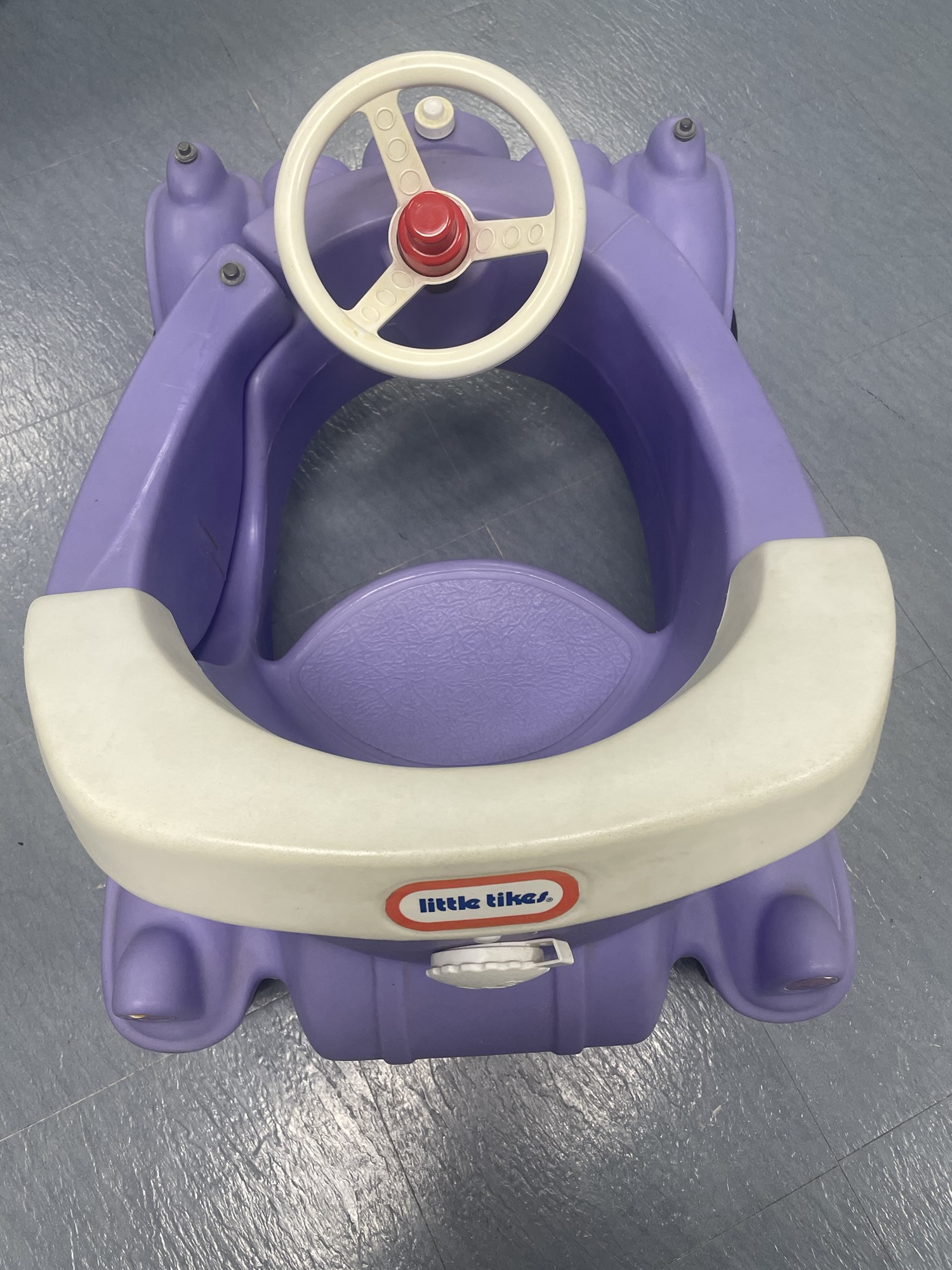
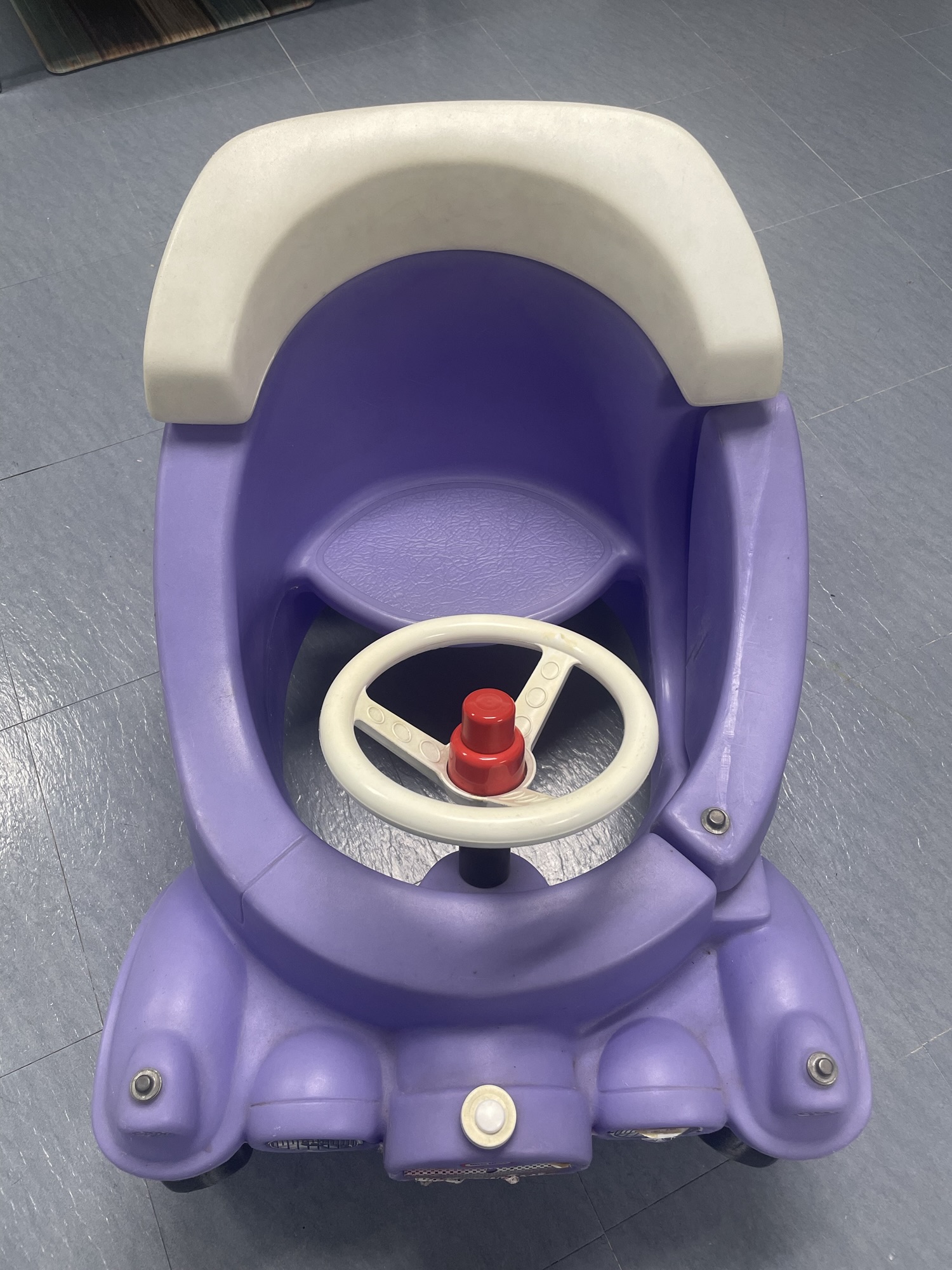
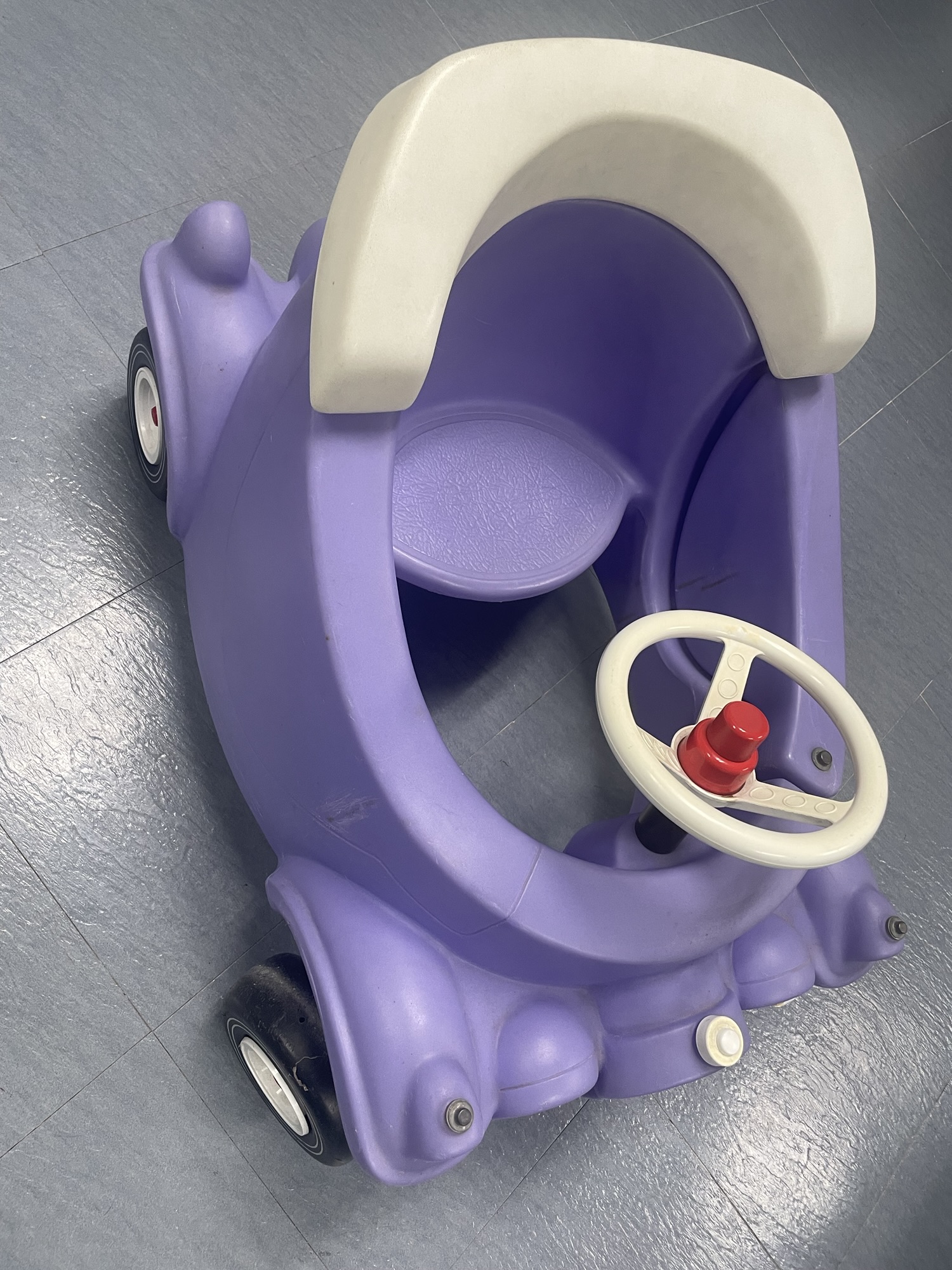
Years ago, I wrote a blog about my daughter’s purple princess Little Tikes car and how much it meant to her to have it returned to our family after 17 years being loved by another family. (See blog below.)
I thought that was the end of my need to comment about this car. I was wrong.
Recently I received a message from a man in the United Kingdom who was looking for that very same Little Tike’s purple princess car as his daughter had loved hers as well, and he now had a granddaughter he wanted to have the same experience. He asked if he could buy my car.
I told him I felt his pain, but since I had a family member who was loving it, and I had promised my daughter to never give that car away again, I could not help him.
He was happy I had someone enjoying it, and that he would continue his search!
When I told the story to my daughter, she had a different point of view. “Mom,” she said, “Maybe you can start a campaign to connect people with purple cars.”
Maybe I can!!! What a great idea!!! I like doing things to make peopel happy. This could be one of those callings.
I have two thoughts.
First:
If you have a little Tikes purple princess car, or a pink one, please comment on this blog. If you are looking for one of these cars, please check this blog and comment!
I am hoping I can help all people who love these cars find new homes for them with loving children.
Second:
Little Tikes are you listening? People want to have this lovely Purple Princess car. Perhaps you can start making it again!!!
In our home the Purple Princess Car will always be loved. So Little Tikes, I am sure it will be loved by families everywhere.
PS: I did contact Little Tikes and had a nice conversation with a representative. She sadi: Wewill certainly pass your request on to our Marketing Team for consideraton. Thank you for shairing and loving our product.”
In response to my saying that the purple princess car has such personality. She responded. “It does. Itwas called the Model T.” And added that her son loved it as well!!!
While in Isarel, I finally renewed a family connection which started 50 years ago. When I was 20, I met two survivors of the Shoah. They were married to sisters before the war. The sisters perished in the Shoah, but the two men remained connected for the rest of their lives.
I have written about both of these men before, (Lieb) Zissel Feuer and Shalom Hollander. Both were distant cousins of my grandfather. But their wives were his first cousins. I wrote about meeting Zissel and Shalom and what happened to them during and after the war, and a bit about my contact with them in Israel between 1974-76. (See blogs below.). Over the years my perception of the two changed, as I learned more about their lives.
Now I have a different story to share, because I have met Shalom’s oldest son Chaim, as well as the great nephew of his first wife, who is also my third cousin, Jeff, and his daughter.
For me it was a meeting that completed a story. For them, I hope I was able to fill in stories about the family and answer question about the family before the war. As we shared our stories, I could see where my knowledge and theirs combined and differed. I spoke about meeting Zissel at the bakery in Tel Aviv across from the Shuk HaCarmel. Chaim smiled while I told my stories about meeting Zissel there each time I came to Tel Aviv. Chaim, of course, knew the bakery and even Zissel’s address. Although I had been at his apartment several times, I did not remember the address. But we had other shared memories.
I think when I talked about the bakery, Chaim knew then that I was really a relative. I really had met Zissel. I don’t think he thought I was lying , but he had never heard of me, yet there I was a family member from the USA, unknown to him. Also when I told him about meeting his father, how elegant he seemed. And Chaim agreed, his dad had that old world charm.
Chaim actually made me feel better about Zissel. I knew he did not have a family. Shalom was not related to him at all, once their wives died. Shalom. remarried. Zissel never did. But Chaim told me that Zissel was always part of Shalom’s family. He came to be with them for all the haggim, the holidays. That eased my heart. Really, I am tearing up even now. For me Zissel was such a sad soul. So to know he was not alone, helped.
We talked about the importance of what Ziseel and Shalom did after the war to help others from Mielec who survived and to keep the memory of those who were murdered. Shalom purchased the land where a mass burial of 800 Jews were buried and put up a fence and a marker. Both men also testified against those who were the murderers, as Zissel had done for the murderer of my great grandmother, his aunt by marriage. Our discussion filled in so many blanks for me.
Chaim and his wife gave me memoirs written by both Shaom and his second wife, Ita, about what happened during the war.
I in turn could tell them about those who made it to the United States before the war.
How Julius/Judah/Yidel Amsterdam, my grandfather’s uncle, came first. As other relatives came to the New York/New Jersey area, he gave them a choice. You can be a butcher or a baker. There was a cousin who was a butcher, and Uncle Yidel was a baker. My grandfather chose to be a baker. Chiam laughed as I told the story, because his uncle who went to the states became a butcher. I said he was probably helped by my great uncle Yidel as well.
With Jeff, I could talk about his great uncle Morris, who lived in Helena, Montana. My grandfather always stayed in touch with his first cousin. I knew one of this sons because when I moved to Kansas, they gave me Jack’s phone number. He lived in Denver. To my grandfather and his cousin Morris, this was close enough. We never actually met, but we spoke several times.
For me I have a feeling of completion. When I found out about these relatives, through the research of Izabela S. I knew I had to see them when I was in Israel visiting my daughter. They lived quite a distance. But my daughter said that this was my Mother’s Day gift. It was the one thing I really wanted to do. So we took the long drive from Holon to a small Kfar near Netanya.
Over the years of my research I have found out how the members of my family were murdered during the Shoah. I know how a small numbered survived. I know that they are not forgotten. I am not the only who keeps their memory alive within the family. And there are people like Izabela in Poland, who also work to keep the memory of the Jewish population alive.
I never thought I would ever want to go to Trzciana or Mielec. My grandfather never wanted to go back there after his family was murdered. But now I do want to go. I what to see where they lived. Where Shalom and Zissel created a Jewish community after the war. Where the Amsterdam group hid in the nearby forest. The town where my great grandmother was murdered. The mass grave where my great aunts are probably buried.
But most of all I am so glad that I found out what that Zissel and Shalom did after the war. I, as a young woman, saw both Zissel and Shalom as such sad people talking about Death. I did not hear the stories about what they did to give people a reason to LIVE after the war. And to create a place of memory for those murdered.
I now know that Shalom and his wife, who was also a survivor from Mielec, had four children, a girl who survived whom they adopted and three sons. Chaim and his wife have seven children, 40 grandchildren and 19 great grandchildren so far.
I know that Zissel was not alone. That Zissel and Shalom stayed connected throughout their lives. I also know that Zissel died in Holon. I think he might be buried there. So next time I am in Israel, I hope to find his grave and put place a rock of remembrance on his matzevot.
At 70 years old, I envisioned that I would be sailing through my retirement years comfortable with my world. Enjoying my family, watching my country continue to flourish, seeing the United States and its reputation be strong in the world, as my husband and I continued to travel and enjoy visiting new places.
This is a far distant vison than the one my great grandmother faced 82 years ago, when in April 1943, she was murdered by the Germans at age 70 in Poland. It was the Thursday before Easter, and after her husband and four children had been murdered and her farm and property had been confiscated by the Germans.
My great grandmother is a bit different than the many unknown who were murdered during the Shoah, as there is a record of her last day taken during the trial held after the war for her murder. I know what she did, what she said, and who killed her. (See blog below.)
For fifty years I had been on a quest to find out what happened to my grandfather’s family. A quest that started after I spent my sophomore of college in Jerusalem. A year when I met many members of my family who survived the Shoah and ended up living in Eretz Israel, the land of Israel.
When I returned home, I was the child who said, I need to know. I sat with all of my grandparents to hear their stories. I wrote everything down. In the 1970s there was no internet, no easy way to discovered what happened. But I kept my papers and over the years when I met other members of my family I wrote down what they said. And slowly, slowly the stories came out.
In some instances, I found out history that perhaps I did not want to know. I learned about my father’s family who came to the USA in the 1870s. I learned of both tragedies and joys.
I learned about a great uncle who ended up in a mental institution, a great aunt who died from the Spanish flu, multiple children who died in their infancies; family menbers who did not speak to each other and a child who was raised by an aunt and did not know till she got engaged.
For my mother’s family, both of her parents came to the USA in the early 1920s, I learned about the hundreds of cousins, siblings, parents, all many of relatives that were murdered in the Shoah, as well as ones who had been saved.
I learned about relatives who were on Schindler’s List. Those who were saved by the Kinder Transport and ended up in England. A cousin who survived the Kelce Pogrom. Others who hid in the forests near their home town and formed a group like the one in the movie, “Defiance,” but these were my family.
I learned about a relative who converted to Catholicism before the war, but during the war she tried to save her sibling and her children. She was not successful. Their bodies were found buried in a field when construction was being done about three years ago. The driver of the vehicle was the grandson of the relative who converted, so Catholic himself. He had dug up the bodies of his own dead Jewish great aunt and her family. Can you imagine the irony of this?
I learned that owning property or having money does not save you. What might save you is luck, fortitude, or relatives who might have a chance to get your out. But you also had to make your own luck. You had to want to survive.
My great grandmother finally gave up. Everyone was dead, she had been hiding in the forest with others for a while. But then she was done. It was too much sorrow. Too much loss.
In this world with the chaos and uncertainty surrounding the economy; the round up of immigrants, even those with legal residences; the job losses; the attacks on education; the attacks on the rights of LGBTQ communities; the rise in anti-Semitism and hatred toward Israels and Jews, I have had to re-evaluate.
Could our property be confiscated? Could our savings be stolen? Could people in the USA be forced to hide in the woods to stay safe? Will people just give up?
Am I really so different from my great grandmother whom I am named after? Should I consider my own exit strategy? Believe me my mind often mulls over the options.
But it is the Tuesday before Pesach and Easter. It is two days before the 82nd anniversary of my great grandmother’s murder by the German mayor of Czermin, Jukub Hesler.
So I am pondering and considering and hoping that our Constitution is strong enough. That our courts are strong enough. That our elected politicians remember who they vow allegiance to: The CONSTITUTION of the United States of America. And who they serve, the people of their states and districts.
I wish everyone a Zissel Pesach, a happy Pesach. And I wish all who celebrate Easter a happy Easter. And I wish to everyone throughout the countries of the Earth a peaceful and joyful 2025.
I am almost 70 years old. My Hebrew name is Chava. As I say this to myself, I shiver sometimes. I am the only Chava in my family. It should not be that way. My grandfather’s mother was Chava. She had five children and should have had many grandchildren. At least one girl in each family would have been named Chava.
In the family there were multiple people named Nissan, Moshe, Mordechai, Gital, Cerla, Gimple, Chava. As the next generation goes on, there should be multiples of these names as well. But there are not. There is one Nissan, my son, who is actually named Nissan Mordechai. There is one Gimple, my cousin, who passed away and now his grandson has that name. There are no Cerla or Gital. There are no Shimon or Nuta.
Why aren’t there multitude of cousins with these names? Because they were ALL murdered in the Shoah. There is no one to carry on these names. But we still must remember them.
My great grandmother Chava was 70 when she was murdered by the Nazis. As the world is so crazy with Jew Hatred. As I am turning 70. As my name is also Chava. Should I be afraid? As I read in detail from witnesses about what happened to my great grandmother on the day she died. Should I worry about the hate in the world around me? Could it happen again?
A few years ago, I wrote about the murder of my great grandmother, Chava. I have a book called “The Holocaust and European Societies” that talks about her murder. (See blog below.). The death of my great grandmother is discussed in this book. When I found it, I was astonished. I agonized. What was she thinking as they took her to be killed? Now I know. Is it good that I know? I am really not sure.
When I first started meeting with Izabela S. online, I had no idea how much she would be able to find out. Now, through the work of history profession named, Tomek, who has investigated the death of my great grandmother, I have the testimony of first hand witnesses. I can see in my mind what happened. I can feel her suffering. I thought, should I share this? Should it end with me? Isn’t it enough that I know?
But then I again think about what is happening in the world today, and I think not. I think everyone needs to know what happened to my great grandmother. No one should be able to say, this could never happen. Because it has and it did.
The next question I have to ask myself is, “When Do I Give Up.” That is a question I know my great grandmother faced. Her husband was dead, her children were gone, probably dead. So many of her relatives murdered all around her. The one child she knew was alive, my grandfather and his family, was so far away. Safe, but she would never see him again. And if she lived, would that reunion ever happen.
Before I start, Izabela asked that I not name the Polish people who are mentioned in the testimonies. So I will not name them except for the one I have named before.
This is what happened on the day my great grandmother Chava was murdered from testimony from a trial held in Poland after the war.
The first witness is my relative Zissel Feuer, who has played a part in my families Shoah story for years, because he did survive. Zissel was hiding in the forest of Trzciana.
“I would like to mention that a few days before Goldklang was shot, while I was in the barn of a farmer in Trzciana near the forest, I saw through a crack how Josef S. from Trzciana, together with two other people, were leading Chava Feuer, my aunt; then I heard from someone that Jozef S. was supposed to take Chava Feuer to the village head in Trzciana. The village leader in Trzciana was supposed to give a signal. Then Chava Feuer wsa taken to the German colony of Czermin and handed over to the Germans, who shot Chava.
(Just so his testimony makes sense, A few days later, Zissel heard shots and the sounds of pain, he went to look and saw a man named Jakub Goldklang. He told him that he had given all his property to a Polish man who was supposed to give him food, but instead another man, Josef Sypek, came and shot him. (He is mentioned in the book as well.)
Zissel realized he could not help Jakub so we went back into hiding. )
There is testimony that another man who saw the arrival of my great grandmother to the village head, who knew her and called her by the honorific, Gimplowa (Gimple’s wife).
“Gimplowa,” he said. “Why are you wandering around? Why can’t you hide somewhere in the forest?”
They knew there were Jews hiding in the forests around Trzciana. Some of the Polish people were providing them food, even though it could lead to their deaths. Others were turning them in. This man seems be upset that she is not hiding.
But in reality, it is her answer that breaks my heart. My grandparents always said that she was a very strong-willed person. That I reminded them of her because I don’t back down and I say what I think needs to be said. For me, Chava/Gimplowa’s answer is devastating.
“I don’t care anymore,” she said. “I have already decided on everything and I can’t stand it any longer.”
Where is the line that keeps a person going; that says keep living against that line that is defeated? When do you reach it? It was already April 1943 close to Easter and Passover. She had been hiding for almost two years. I don’t fault her, I feel her pain, but my heart says, ‘If only you had waited a bit longer.’
Another witness, a woman who recognized Gimplowa, saw her being taking away by some men she did not recognize. My great grandmother called out to her by name. and told her: “Stay with G-d.” Can you imagine that you are being taking to your death and you see someone you know, perhaps a friend, and you tell them “Stay with God”. The woman does not answer. She is probably afraid also of the men she does not recognize.
Another witness states “it happened on Maundy Thursday, at 3 pm in 1944. (This is the story that was in the book I mentioned earlier.) Josef S.’s wife called a group of neighbors together and said there was a Jewish woman, Gimplowa, in her house and she did not want to leave. She said, ‘Do whatever you want with me.’ “
Josef’s wife told the villages to do whatever we wanted, to kill her or to take her somewhere, because if the Germans found out and burned the village, she did not want anyone to blame her for supporting the Jews. “So we decided to take her by foot to the village head.”
The witness continued: The village head also did not want any responsibility for her. So he told them to take her to the German colony in Czermin. She did not want to go there, so she said she was old. So they got wagons to take her to the colony and hand her over to the German’s mayor Jukub Hesler. What he did with her, I don’t know, because I didn’t see it with my own eyes.”
He did not know for sure, but he knew. The witness was asked:
Q: Were you aware that you were leading this Jewish woman to her death?
A: Yes, we were aware of it, but we didn’t want to answer to it. So we brought it to the Germans so they could do whatever they wanted.
I know that fear overcomes kindness. But this is just too much for my heart and soul. It’s not our problem, let the Germans handle it. Even though we know they will kill her.
And one last witness to the last years of my great grandmother’s life.
During the German occupation, the Jewish woman Gimplowa was hiding with other neighbors. (So at first they did help her.) But on Good Friday, they were all talking because the Germans had set fire to the town of Bodborz because they believed that the people were hiding Jews there. So a neighbor who was drunk, made the first move to say we must take the woman who was hiding in my house to the village elder. We all supported this motion. And she was taken to the village elder.
How do you decide what is evil. My great grandmother was being hidden and helped through Easter of 1943. But now the Germans were burning villages where they found Jews hiding. So was it wrong of them to turn Chava over to the Germans? I, of course, think so. Why couldn’t they just send her out with some food to the forests?
But my great grandmother said she did not want to leave. I don’t think she wanted to hide in the forest any longer. She was done. She was tired. In my work as a spiritual care volunteer, I have seen what it means when a person tells me that they are very tired. When they are tired of living. When they want it to end.
My great grandmother wanted it to end. She was not in physical pain, but I am sure she was in emotional pain. The only thing I can think and hope is that the Germans shot her in the head and she died quickly.
I have to consider what she was thinking on the way to her death. Was she thinking about all who died in the past three years? Was she thinking about her son and grandchildren in America who she knew would survive. Did that give her a glimmer of joy. She had cared for my mom and my uncle for six months in 1931-32. Perhaps that memory of happy grandchildren helped her on her way to die.
It would be nice to know where she is buried. But I am sure she is in a mass grave somewhere near the town of Mielec or Trzciana. Or perhaps not. I will never know.
Baruch dayan HaEmet. May her name and memory be forever a blessing. May her murder by the hands of those who feared and the Nazis bring some goodness into the world. I carry her memory and name with me for all my life. I hope that as I turn 70, the world veers away from its direction of Jew hatred, or any hatred, and realize we are all one.
(The dates are sometimes a bit off as to when events occurred. There are several different dates for when Chava died. But now we know it was 1943 because it happened after the burning of a certain village.)
With the days quickly leading up to Tisha B’Av, I cannot get the destruction of my grandparent’s families out of my mind. After writing about Boleslawiec and its small Jewish community, I feel it is important to write about a town that lies six miles away. The town where my great grandmother Sarah Manes grew up: Viroshov/Wieruszow.
When I realized there were so few Jewish citizens of Boleslawiec, I had to reconsider some of the stories my Grandma told me about growing up. She always talked about all her cousins and spending time with them. Then I remembered, she told me about spending time with her grandmother Klindell Manes, and that is where she saw her cousins, in the town of Viroshov. It took me a while to figure out that Viroshov, was Yiddish for Wieruszow.
All those stories she told me were about her Manes cousins. Those were the cousins I had met in Israel so long ago. (See blogs below.)
I was right. And once again I am forced to forgive my 20-year-old self for not paying enough attention. For not wanting to hear the horrible stories. For tuning out, while trying to escape from the seemingly endless number of survivors who insisted on seeing Grandma during our month-long stay in Israel in 1976.
I have written about several of these survivors and what I discovered. (See blog below.). And I even wrote about my Grandma’s cousin Dora before. But now I need to revisit Dora and tell more of her story.
I now understand why her daughter was so protective of her when she called to set up a meeting with my Grandma. I now have rachmanes, in my mature years, that I did not have as much in my youth. I tried to be as courteous as possible, but I truly did not understand the undercurrents of everything that occurred.
Grandma had survived the war by being in the USA. She had saved her father and her sister by bringing them out of Europe in 1936. In fact, their family did not know that my great aunt had escaped, and had even added her to the Yitzkor book of the town!
My grandmother and her children were safe. She did not need to remake her life. But Dora and so many others had had a different reality. I now know Dora’s reality. And I feel, once again, the burden of knowing someone, but not really understanding and knowing what happened.
Dora was married before the war, in 1924, a few months before my grandparents. She and her husband survived. But her mother, who was my great grandmother’s sister, Mascha, did not survive. Her father, Eliazer, did not survive. Her brother, Wolf, and her sister Yocheved, did not survive. In all 13 people with the last name Manes, and more related to the family, from Wieruszow were murdered.
Before the war, in 1921, there were 2300 Jews in the community of Wieruszow, making up 36 percent of the population. In 1939, before the Nazis invaded there were 2400. That all changed. The Jewish community was slowly decimated. By 1940 there were 1740 Jews. In September 1941 a ghetto was opened where 1200 Jews were imprisoned. Then between August 11 and 23 the ghetto was ‘liquidated.’ I hate that word. Just say the Jews were killed and moved to Concentration Camps. This time, Chelmo. But before they were taken, the old and sick were shot.
In April 21, 1942, there was a mass murder of Jews and a mass grave for 86 people was dug in the Jewish cemetery. But, of course, that did not survive because the Nazis also had to wipe out cemeteries to destroy the memories. The tombstones were used for pavers. The cemetery was dismantled. But 100 tombstones still remain. I doubt I would find my great great grandparents and great grandparents gravesites.
However, that mass grave gave me another clue to my family. A stone was laid on the mass grave by a man with the last name Majerowicz. That sent a shock through me as well. Because in Israel, I also knew a man with the last name Majerowicz. He was also my Grandma’s first cousin. But he was a bit different. I wrote about him because his sister was Grandma’s first cousin and best friend. His mother and my grandmother’s mother were sisters.
In all there were 135 names in the Yad VaShem database with the last name Majerowicz, or some similar spelling that perished in Viroshov/Wieruszow. I noticed that many were duplicates, so perhaps only 80 people were listed. And although not all were related to me, once again I will claim them as being related. Because I feel I must.
Now there are over 8600 people live in Wieruszow. In a town that was once 36 percent Jewish, there are no Jews. The cemetery is destroyed. The original mikveh, where many Jews were murdered by the Nazis is gone. There is just a list, a yitzkor book and some memories.
Once again thank you to Virtual Shetl, the Yad Vashem Database, Jewish Gen, and the Viroshov Yitzkor book.
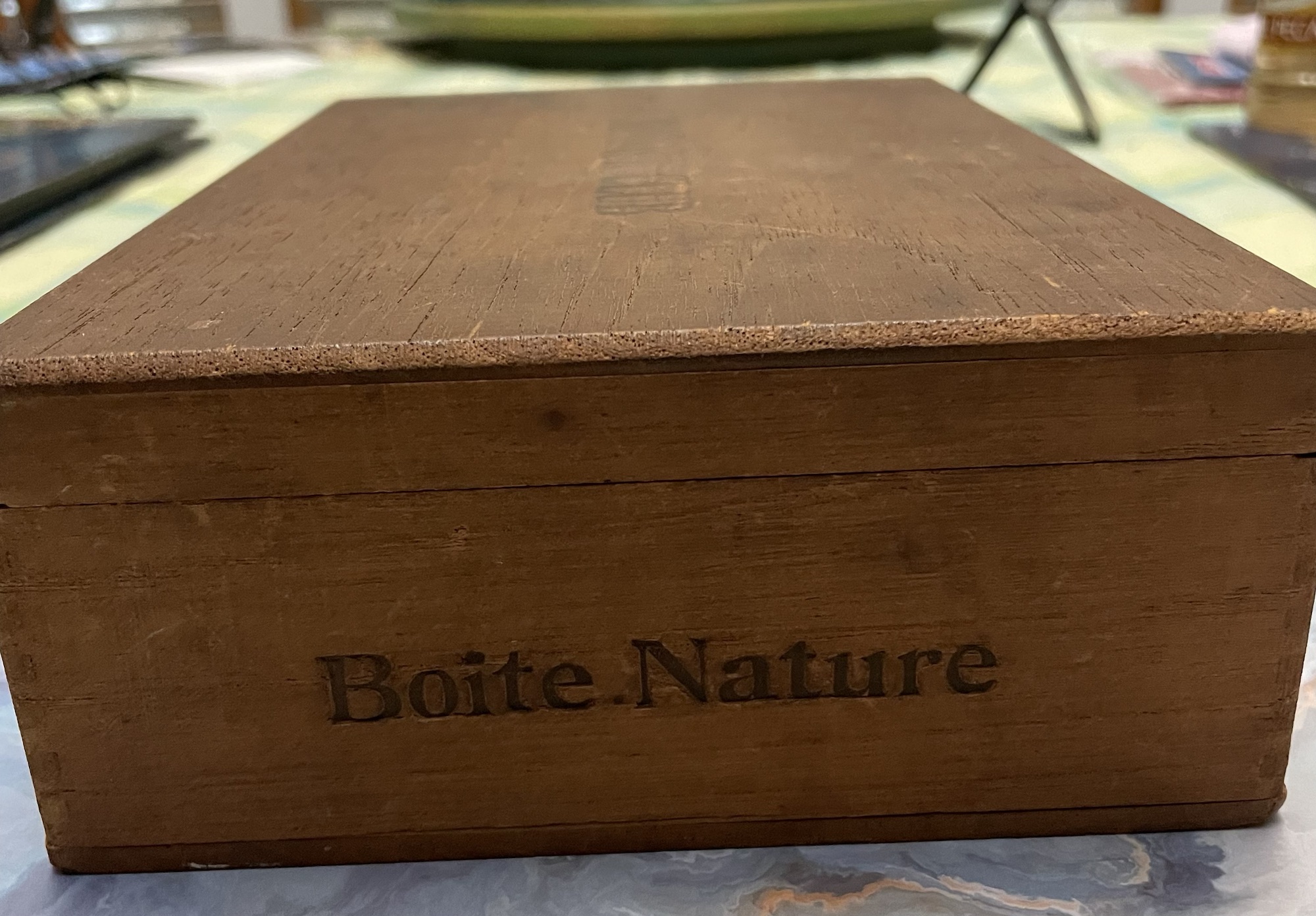
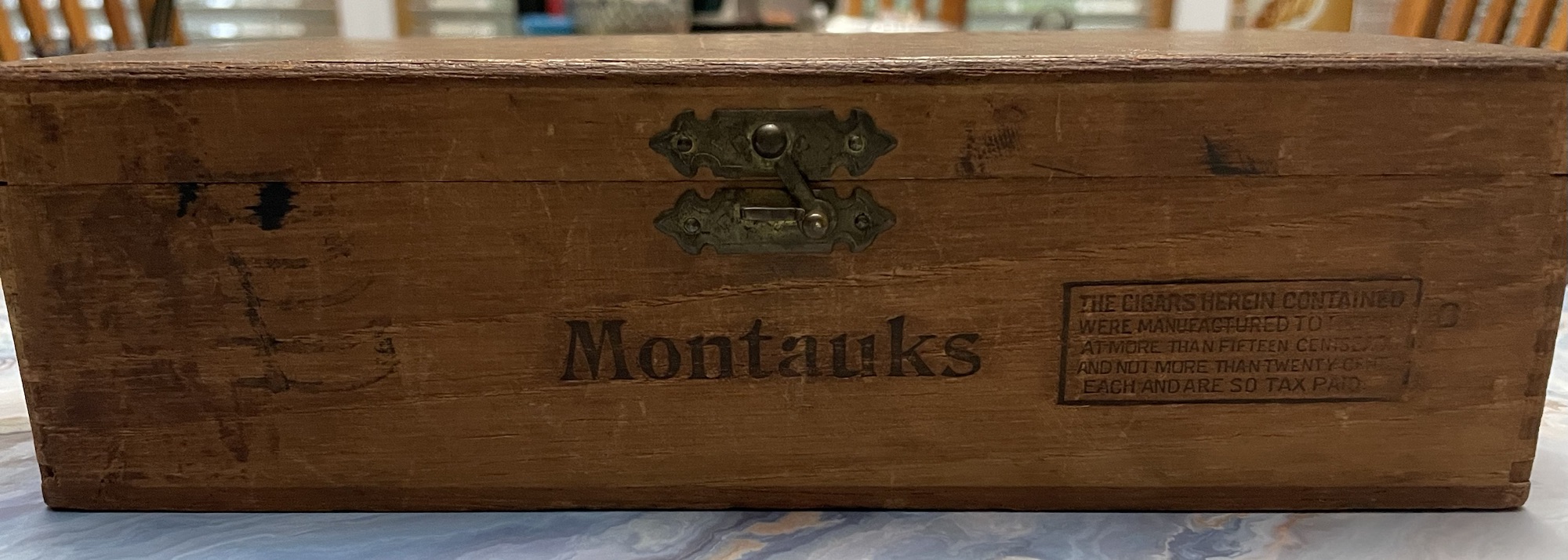
This might be the last treasure box found in our Catskill home. After being in our family for 63 years and after a 90-year presence in Kauneonga Lake, we are selling our home. None of our children, who are widely dispersed, can care for it. Our fortune is that we have cousins who still have homes near the lake, so we can visit.
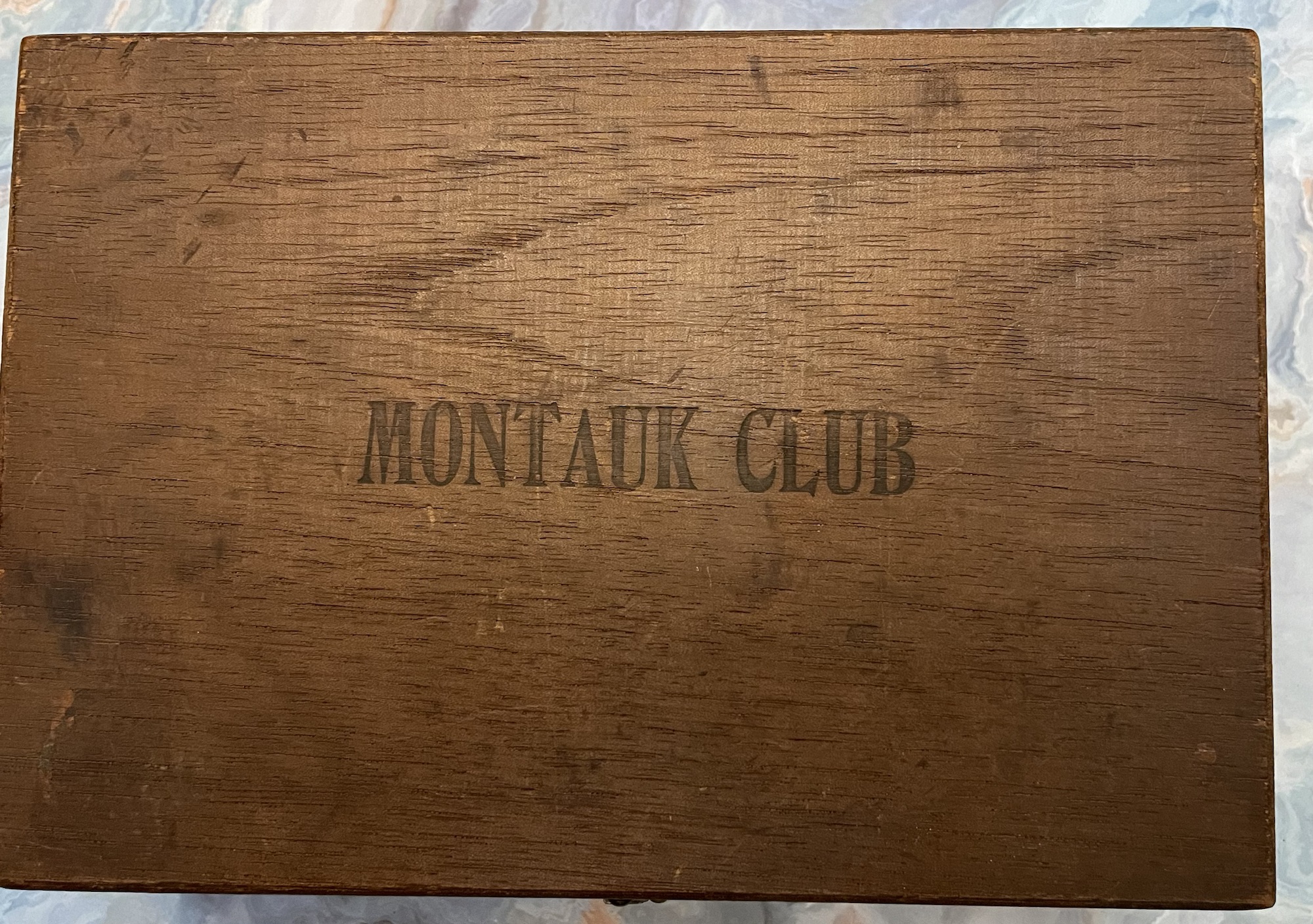
But in cleaning out the house and the drawers and the closets, my niece came upon this last treasure buried in a drawer under linens: a beautiful cedar box from Montauks Cigars. In it were postcards written from my grandmother when she was in Europe with my mother and her brother in 1931-32. Postcards written to my grandfather in Yiddish and English, The Yiddish will have to be translated. I am hoping the generous members of Tracing the Tribe will translate these, as they are just short paragraphs.
I had to laugh because all the stamps had either been peeled off or torn. They were given to one of the grandchildren who were collecting stamps. It might have been me. I collected postcards as well. But these were probably too important to my grandparents to give to a child who might lose them.
There are letters written in German and Polish to my grandmother during the time she was in Europe. I know one is from her cousin Dora, who survived the Shoah and moved to Israel. Others I think were written by my great aunt Esther to my grandmother, her sister. The German I can understand a bit. But the Polish is impossible for me. I will need to find a translator for these letters.
There are photographs in the box. Almost every one of them is identified in English, Yiddish or German. The ones that are not identified, I actually recognize the people in the pictures.
I have already sent scans of two of the photos to my third cousin. One shows her grandmother at her elementary school graduation. Her grandmother and my grandmother were first cousins. When my grandma came to the USA she stayed with her aunt’s family. The two girls became best friends. The other photo shows five brothers who lived in the same building. My grandmother’s cousin married two of them. One when she was young with whom she had her children. And later when her husband died, she married one of his brothers who also lost his wife. My cousin was glad to see the photos. I am going to send her the original of one. The other my niece wants because she shares the same first name.
I have written about these people in other blogs. So below are links to their stories.
I think this box will be giving me much more to write about. Every time I think I have finished the story of my European family, another piece of information turns up. I hope to start with the notes my grandmother wrote to my grandfather from Europe. I always wondered if they were able to communicate. As well as what she was thinking when she was there, as we know she went to Europe so sick, she thought she would die. Her plan was to leave my mother and uncle in Europe. Thank goodness she got well!
When I started my genealogy research, I did my research and wrote my blogs just for my siblings and immediate family. Over time, I included my cousins on my blog posts. And then it just snowballed. I realized that by posting them on Facebook, specifically on Tracing the Tribe group, I might connect with other more distant relatives. And it happened. I have had people help me with my research who are not related. I am in touch with distant cousins including Evan, who has been an immense help in making connections. I have met some of these cousins in person. And my understanding of my family increases with each new contact.
This blog is different. In this instance, I discovered that the information I had from speaking with my grandmother years ago helped solve the family mystery of a women who is actually my third cousin, our grandmother’s were first cousins.
It started with an email from Evan. (He really does a great job keeping in touch with all the cousins) He connected me with a distant cousin named Sherry, the granddaughter of a woman named Esther who was born about 1897/1898. He said she was part of my branch of the family and thought I could help. I could.
A number of years ago, I wrote a blog about my grandmother entitled “Too Many Esthers” (see blog below) and “Updated Esther “(see blog below). My Grandma Esther was one of 5 or 6 first cousins all named for their maternal grandmother, all named Esther, all born around the same time. All were given nicknames. My grandmother was known as Curly Esther.
Sherry wrote back to Evan and me: (She has given me permission to write this blog, I have edited her emails for privacy and brevity.). “Thank you for contacting me! I had trouble with my grandmother, and who her parents truly were. There were so many unanswered questions and there are no living family members in my close family that know anything more than I do. I got pretty frustrated and sort of put it on the back burner. I would be really interested in what you found out!”
I immediately responded: “It’s nice to be reconnected. I am the granddaughter of another Esther born in 1898. I have been researching the family for years. In late 1970s I sat down with my Grandma and got the names of all of her mother’s siblings. The children of Elka/Esther Lew and Victor/Avigdor Wolf. Here are two of my blogs that will lead back to some of my research and introduce you to the family. The attached photo is our great great grandparents Esther and Victor Wolf(f).
Actually, I knew immediately who her grandmother had to be, which is why I sent her the blogs about the Esthers. There was one cousin known as Meshugannah Esther. Her mother Chamka came to the USA pregnant with three children. Her husband had passed away before she came. After their daughter, Esther, was born and weaned, she was given to a different sister, Sarah, who could not have children, to raise as her own. To make things more confusing, Chamka was known as Anna in the USA, but her Hebrew name was Nechama. Her family called her only Chamka/Chamky.
I must say I was truly happy to receive a reply from Sherry. Her response filled me with joy to know that my research and pictures helped her. Here is an edited version of her response.
“Wow! I am so overwhelmed and thrilled with this connection. I was getting so frustrated with trying to figure out my grandmother’s story and had no one to ask.
I did hear that “grandma didn’t find out until the day she was engaged that her aunt was her mother and her mother was her aunt”. So I knew that there was information that I was missing in order to fill in the blanks.
“Meshuganah Esther moved in with my family when I was 10 years old. We lived next door to Aunt Lenore and her family. Grandma was married 5 times! She felt she needed to do that in order for her to care for her children. My grandmother passed in June of 1993.
“Ellen, you spoke of the cousins’ club meetings. I remember them although I think I spent most of the time hiding behind my mother’s skirt…
“I actually gasped out loud when I opened the picture of Esther and Victor Wolf. I have that picture and I had no idea who they were.
Thank you, dear cousins. This is a gift.”
My initial response to this was just as excited. I was elated that I could help.
“I am so glad that you were able to make connections about the family through my blogs. I am so glad that you have that photo as well, and now know who it is. It is amazing to have photos of great grandparents, but great great grandparents is really special.
“Did you see the picture of Chamka and Lenore? I am not sure which blog it is in.
I can understand a bit why she wasn’t told which sister was her mother. But I am sure it was a big shock at the time. It was one of those open secrets that everyone knows but does not discuss.”
Since she did not have nor seen the photo of her great grandmother Chamka with her granddaughter Lenore, I sent her the photo and the information that was written on the back. “Tante Chamky and Lenore. Lenore was Meshuggana Esther’s daughter. Esther was raised by Tante Sarah, but was really Chamky’s daughter.”
I am currently looking for the photo so I can send her it for her family records.
Thanks to Tracing the Tribe, over the years, I have connected with a number of cousins. But this connection honestly made me immensely happy.
In Ashkenazi Jewish custom we name our children for those beloved family members who have passed away. I was always told that I was named after three of my great grandmothers:
Chava was for my maternal grandfather’s mother, Chava, who was murdered in the Shoah.
Sara was for my maternal grandmother’s mother Sara/Sura, who died in the 1920s in Poland, and for my paternal grandfather’s mother as her name was Sarah as well.
I knew about my two maternal great grandmothers, because there were family stories about them. But I knew nothing about my paternal great grandmother even though she lived in the United States and is buried in New York. I have recently realized there is more to the story about her and my name.
I have been searching for information about my paternal great grandmother for years. The first real clue was when we first saw a photo of her about five years ago. We did not even know we had one! But my first cousin was searching through her family’s old photos and discovered one of her with my uncle. (See blog below.)
More information followed when my distant cousin, Evan, who is a great researcher, found my grandparent’s marriage license. They were married in January of 1923. It contained my great grandmother’s maiden name which we never knew: Ritt.
Evan also found a puzzle piece for me when he found her death certificate, which was packed with information. The final link was when Beth David Cemetery in Elmont, New York, where she was buried on January 29, 1938, sent me a photo of her matzevah (tombstone).
I now can tell my family more about my mysterious great grandmother, who I now know is named Chaya Sarah, so close to my own name of Chava Sara, that I think I was bound to have this name.
My great grandmother did not have an easy life. She gave birth to 11 children. Eight survived to adulthood. She lost her oldest daughter, Celia, to swine flu when she was in her 20s. Her oldest son, Samuel, was mentally ill and spent most of his adult life institutionalized. She and her husband, Abraham, were divorced in the 1930s. A very unusual occurrence for a Jewish woman, well for any woman, in that time period.
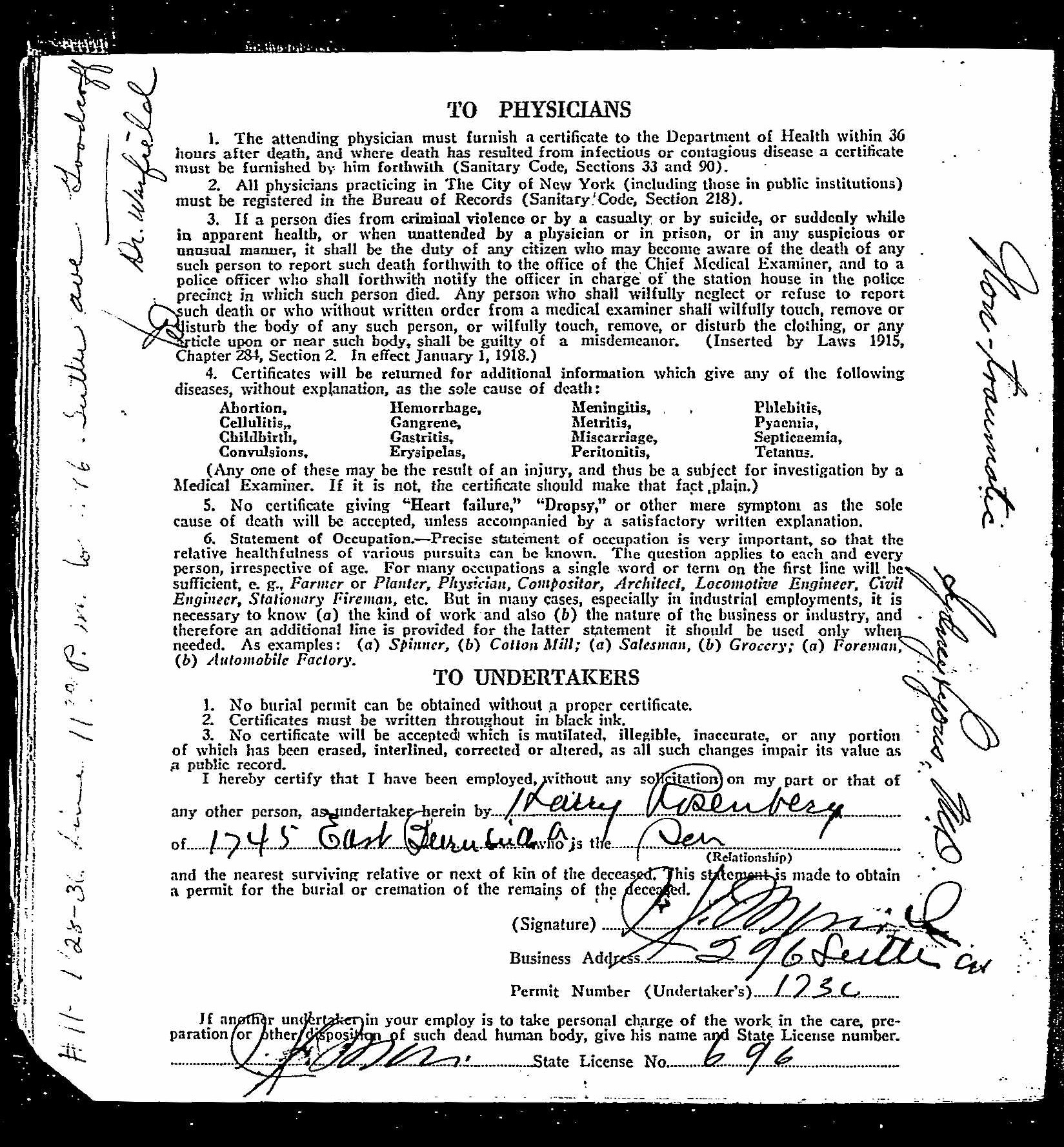
My Great Grandma Sarah died on January 28, 1938, from cancer of the panaceas at Jewish Hospital of Brooklyn, when she was 68 years old. My grandfather, then the oldest living child signed the death certificate and made the arrangements.
I have three thoughts about this information. First, the line through my grandfather is cancer free. But I have since learned that the line through his youngest sibling, Jacob, was not as kind. We all thought Jacob had disappeared after he moved to England when my dad was a child. But in fact he died when he was in his fifties from cancer, as did his son Rufus. The cancer gene followed them. (See blog below.)
Second, I think I know why I was named for her. She died in late January. Years later, I was born in late January. It made sense. Finally, I am currently close to her age when she died. And that touches me that I found out now.
I know that she was born about 1870, in France. That she and her parents lived in France surprised me. But her father and mother, Hirsh and Flora Ritt, were from Poland. So I think they were in transit from Poland to the USA when she was born. I have no proof, but it seems right. I also know that her father died before 1892 because my grandfather was named for him. Zvi Hirsh. I now know that she was about 22 when she had her third child, and her other children were toddlers when my grandfather was born.
She died when my Dad was just 9 years old. He really did not have many memories of her or information. But now we know her name and also the names of my great great grandparents: Chaya Sarah Ritt, the daughter of Hirsh Zvi and Flora Ritt. We now can add their memories to our family.
I want to thank the personnel of Beth David Cemetery. I now have photos of the graves of four of my great grandparents.
I have written about my Grandmother’s two brothers who died relatively young: one as baby, the other in his early 60s. I did not know them that well. I decided I should write more about my Aunt Minnie, my grandmother’s older sister, because she was important in our lives.
Aunt Minnie is in many of my blogs because she was always with us. When my grandmother moved to Co-op City in the Bronx in the late 1960s, Aunt Minnie moved to Co-op City in the Bronx, in an apartment directly under my grandparents.
When my grandparents came up for the summer to the Catskills, Aunt Minnie came up for the summer to the Catskills and stayed in the same bungalow with my grandparents. I honestly do not know how they did that. My grandparents had the bedroom, Aunt Minnie slept on trundle bed in the kitchen area.
Every holiday, Aunt Minnie was there. She was basically another grandmother. She gave us gifts for our birthdays and Hanukkah, $5 each. She hugged us, she scolded us sometimes, and she told us what to do, just like my two other grandmothers.
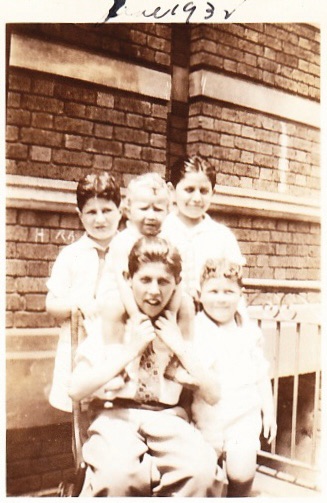
My father was the youngest boy. He is the lower right.
Aunt Minnie’s married in 1918. Her husband, Uncle Eli or Uncle Al, died before I was born, in 1949. They had two sons, who were older than my uncle and my dad. But, in reality, the four boys, and then my aunt who was the youngest, were basically raised together. Part of the reason is that my great grandparents lived with my grandparents. My grandfather and great grandfather worked together in a tailor shop they owned. (See blog below.) Family gatherings were always at their apartment in the Bronx.
With all that togetherness, what amazed me is that one of Aunt Minnie’s sons, Victor, married and moved to New Orleans. He left the fold. The other, David, met a lovely woman in England during World War Two and brought into the family a British war bride who was not Jewish, but by the time I can remember she was a loved member of the family. In our family these two men were known as Cousin Victor and Cousin David. They weren’t uncles, but they were not to be called by their first name alone. And their wives were also referred to as cousin, before their first names.
Cousin David had two children, who I won’t name because they are still living. However, I will tell you one story about Cousin David. He had a very bad stutter growing up and into his adulthood. When he was anxious he would stutter then slowed his speech till it stopped. As a child, I had a bad speech impediment. I started meeting with a speech therapist before I even started school and continued through eighth grade. This made me very shy and wary of speaking to strangers. Cousin David was my advocate. At every family event we both attended he would stop to talk to me to give me coping skills which I still use today. I am very adept in the middle talking to switch words because a word I can say today, I might now be able to say tomorrow. I have a thesaurus of words sitting in my mind waiting for an emergency. Cousin David’s advice has been well used over the decades.
Another little Cousin David story. My father is also named for the same person David was named for. But my dad had a different first name that began with D, only his Hebrew name was David. This goes back to my Grandma Esther’s dislike of being one of five girl first cousins named Esther. (See blog below.)
Cousin Victor and his wife lived in New Orleans and had three children. I did not know them at all. I remember meeting them at my wedding, when they came up for the celebration. My Aunt Minnie had died about two years before when she was in her early 80s, and I think the cousins decided that they needed to celebrate together not just go to funerals. One spring break we took our children to New Orleans and spent time with Cousin Victor and met his son and his family. Once again, I won’t name them.
But I will say that Cousin Victor’s son died late last year. He and I kept in touch over the years as I sent him updates on my family discoveries. When my daughter went through a pregnancy crisis, he was so supportive as his daughter had gone through a similar crisis several years previously. He spent hours on the phone with me one day helping me sort through all the emotions this caused. I always enjoyed my contact with him. And I will miss him. We often would say how much our dads and grandmothers would like knowing that we continue to keep in touch.
Aunt Minnie and my Grandma Esther are forever entwined in my mind and in my heart.
Of my paternal grandmother’s two brothers, I must admit I liked Uncle Sammy more. He was always jovial and happy. But he also had a bit of scandal attached to him. Whenever he was around or came to family events, my grandma would get a bit agitated, waiting for something to happen.
I know she was not great friends with his wife, who I always assumed was his second wife. I even wrote about her a previous blog. (See blog below.). But Uncle Sammy always had a smile. He was the youngest sibling and just seemed the most relaxed. Being around him made me happy. But then I also loved my great uncle Lenny, who taught me how to bet on the horses. (See blog below)
Uncle Sammy worked as a bus driver from the Port Authority in New York City. I actually remember one time waiting for a bus with my Mom at the Port Authority Bus Terminal, a giant bus hub in Manhattan, when I actually saw my great Uncle. It was such a surprise. He beeped his horn and stopped his bus for a moment and to say hello to us. I was so excited!
I vaguely remember that he eventually became a supervisor at the Port Authority. But, although I can find a docuent stating he was a bus driver, I have been unable tto confirm the promotion. When I ask my older cousins, they do not remember much about him at all. I might have been the only fascinated by him.
My Uncle Sammy died young, in his early 60s. I do not know the exact date, but I was probably 13 or 14. So around 1968 – 1969.
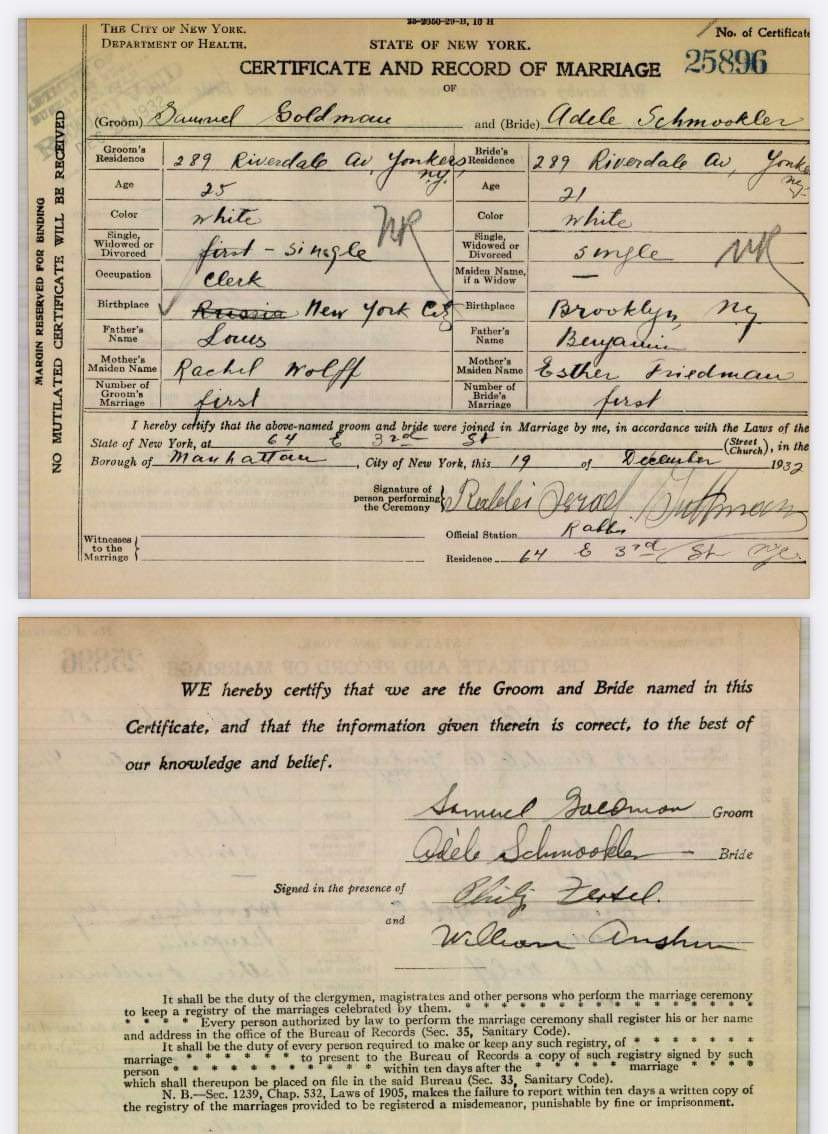
I knew he was married at least two times. He married his first wife, Adele, in 1932, when he was in his 20s. They had one daughter, Vesta. (Thanks to her unusual name, it is easy to find him!) I never knew Adele, although I did meet Vesta once or twice. She was 20 years older than me. When I knew Uncle Sammy, he was married to Sylvia, who I assumed was his second wife.
But my view of Uncle Sammy changed just a little while searching for my Grandmother’s young brother who died as a toddler. (See blog below.). While searching for Jacob, EW (my distant cousin and excellent researcher) found a startling fact about Uncle Sammy. It seems he had a third wife!!!
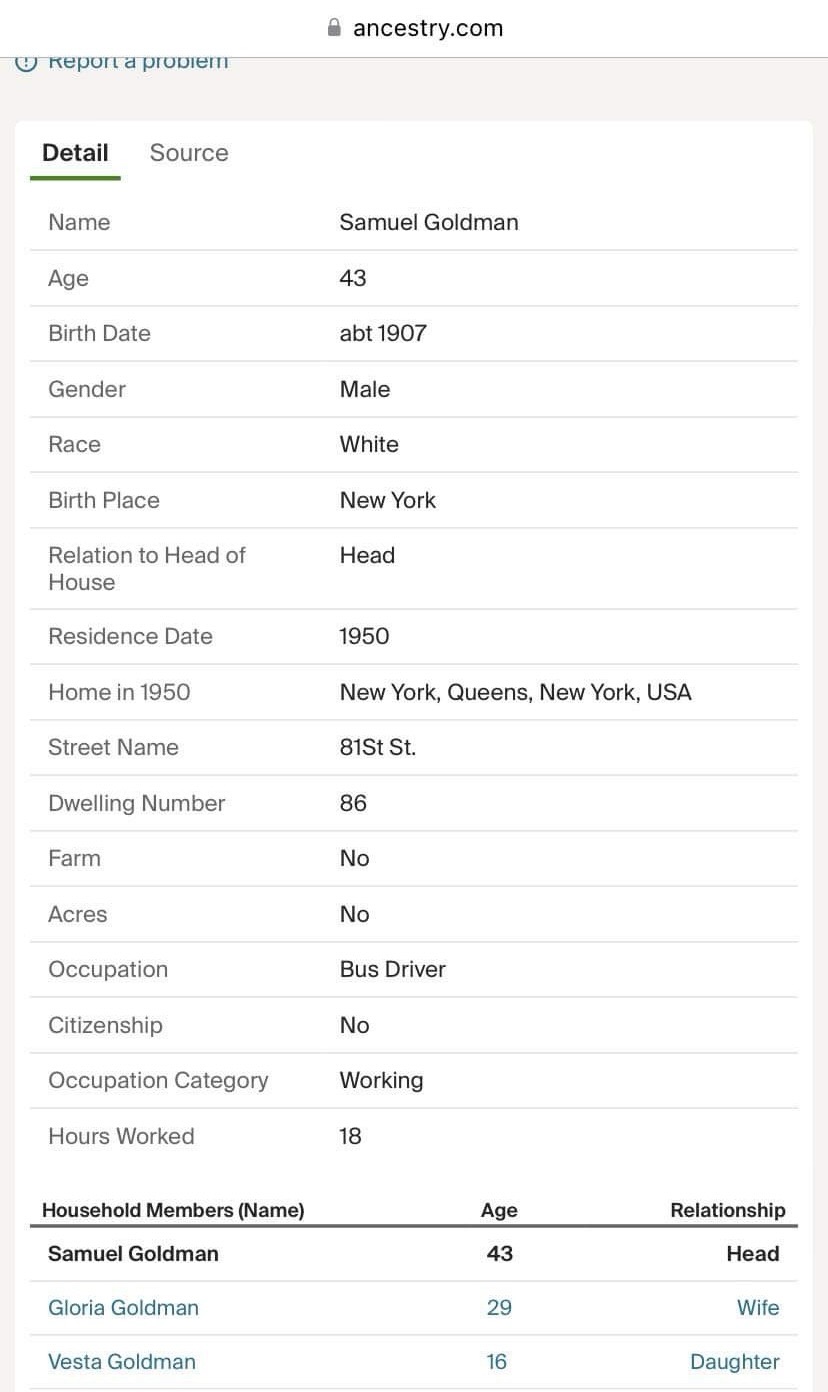
When he was 43 years old, in the 1950 census, he had a wife named Gloria who was 14 years younger, jsut 29. His then 16-year-old daughter was living with them. But this entry in the 1950 census is important because it confirms that he was a bus driver.
I have not been able to find any other documents about Uncle Sammy, not his death certificate or where he is buried. Although I do know that his widow Sylvia remained in Kew Gardens after he died. She stayed in touch with our family and came to family events.
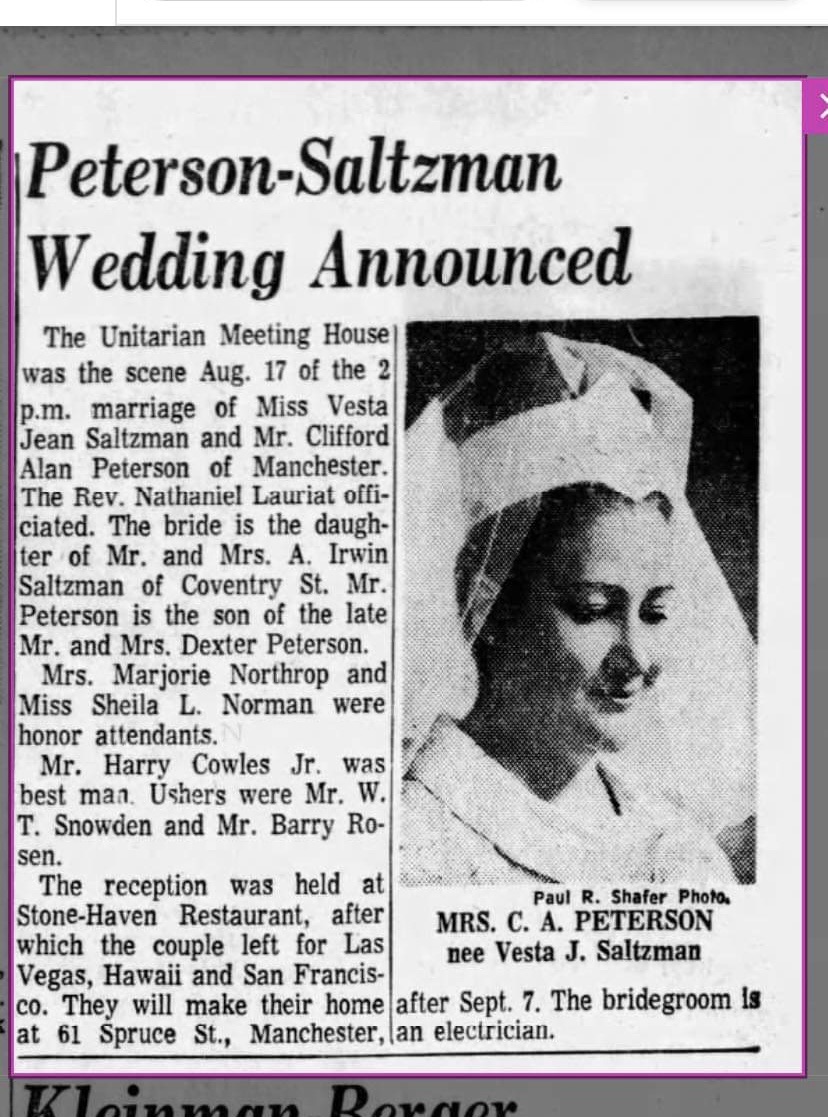
EW did find one more item for me. Uncle Sammy’s daughter, Vesta Jean got married in 1969. He told me that she is listed as Vesta Goldman on her marriage license But as you can see here, in the announcements she took her stepfather’s last name, Saltzman.
I think Uncle Sammy had passed away by then. Because I cannot imagine she would have written her dad out of her marriage if he was still alive. But I do not know for sure, as here it says that she was married by a Reverend. And marrying someone who was not Jewish might have been an issue, because I never knew that Vesta had married. And I do not think anyone in the Goldman family went to the wedding. As far as I know, Vesta and her husband Clifford, did not have children.
I hope I can one day find where Uncle Sammy is buried. With the name Samuel Goldman, he is difficult to find. There were many Samuel Goldmans in New York City. EW checked the Bialystoker lists, as other members of my family are listed there. But no luck. With this blog I hope to keep Uncle Sammy’s memory alive for our family.





 zicharonot