Forks in the Flower Pots; Or Why I Keep Plants By My Kitchen Sink

10 Aug
image

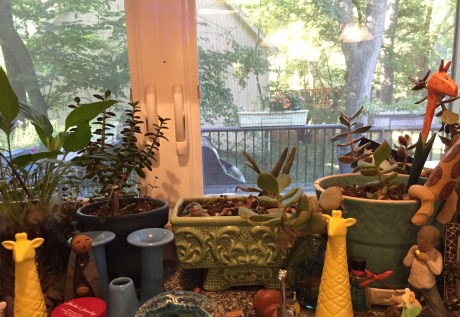
My kitchen window with my grandmother’s planter is the green one in the middle.

Above my grandparents’ kitchen sink in West New York, New Jersey were a variety of flower pots filled with plants.  But often interspersed among the plants were utensils.  Usually forks, but sometimes knives and spoons.
image

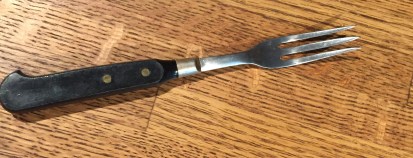
I own one of my Grandparents’ goupls.

When I was very young I remember thinking that my Grandma was special as she could grow metal in her pots. I especially wanted her to grow more of the special forks we called goupls, that we used in her home.  They had really thick and interesting handles. I thought goupl was a special name for this fork. We did not call the other forks, goupls, just these forks.  I found out when I was older that goupl is Yiddish for fork.

Usually standing upright, prongs in the dirt, were two or three forks each day. Amidst the plants the glow of silver.  Why?  My grandparents kept kosher. Meat and dairy is kept separate. My grandparents had utensils for milk meals and another set for meat meals. If they touched when they were wet, they had to be rekashered….made clean to use again.  One way, according to my Grandma,  is to bury it for 24 hours.  Grandma buried it by sticking the unclean item in a flower pot.

In reality, I think this was my grandmother’s interpretation of ne’itzah, a type of koshering for knives when you push them in dirt several times. Grandma just kept any utensil buried and unused.

My mother also kept plants in her kitchen at our hoe in North Bergen. But she did not keep kosher so there were never forks in the flowerpots. However having the plants was important to both my parents.  My Dad was always potting and repotting plants.  Plants freshen the air of your house according to my Dad. So besides helping to keep kosher, plants keep you healthy!

When I married, my husband and I decided to keep a kosher home. When we purchased our house a big draw for me was the window ledge above the sink.  A wonderful place for plants. But to be honest, I very rarely have put a fork or spoon or knife in a flower pot. However, they are there in case I need them.

image

My mother-in-law’s aloe plant.

Besides my kitchen sink plants, I have other plants including an aloe plant that is over 50 years old.  I have had it for 31 years. But before that it was my mother-in-law’s kitchen aloe plant.  I inherited when she passed away at only 59.  Aloe plants are important in the kitchen. My parents also had one.  If you burn yourself, you can quickly go to you aloe plant and break off a piece of a leaf. The thick goo is a healing source for burns.

Plants in my kitchen remind me of my grandparents, parents and in-laws.  Although I might not have forks in my flowerpots, I do have one of my grandmother’s flowerpots on my sink window.  My daughter is getting married in a month.  She has a window above her kitchen sink.  I plan to buy her a plant as a housewarming gift so she too can have flower pots in her kitchen.
A Chair, A Baby Grand Piano and Yiddish Songs

2 Aug

image

As the oldest granddaughter, my grandmother made it clear that I would inherit my grandparents’ cherry mahogany bedroom set. The most important pieces of furniture that came with it were my grandmother’s vanity and the small chair that goes with it.

The swivel chair is covered in a gold silk fabric. It is now a bit tattered, but I will not change it. In this chair my grandmother held me at night and sang Yiddish songs to me before I went to sleep.

She usually sang “Oif’n Pripetshik,” a song about children learning in their alef beiss, the alphabet. Even now, over 50 years later, listening to this song calms me. I feel my grandma’s arms around me; I smelled her scent; I feel the softness of her hair and her breath in my ear as she sings and slowly spins in the chair.

If one song did not get me ready to sleep, she would start singing, “Rozhinke Mit Mandlen.” I tried to stay awake so she would have to sing me both songs before I got into bed. When I was very young I slept with my grandmother.   I loved being with her in the winter under the big feather bed! I still have the one pillow left that was made from that giant duvet over 50 years ago. (See link to blog below.)

My grandparents kept the traditions they grew up with in Europe: Two twin beds, always. Grandpa would get up very early in the morning to go to their bakery and make the fresh bread and pastries.  Their apartment was on the top floor of the building that housed their bakery in West New York, New Jersey, right on Palisades Avenue.

Grandma would stay in bed with me a bit longer. Before she left she always whispered, “Remember, when you get up, get dressed and come down to the bakery.” Then a soft “Geh shluffen.” And she would be gone as well.

My grandfather also sang to us in Yiddish. He had a beautiful voice. Among his favorites to sing were “Tumbalalaika,” “Eli, Eli,” “Die Greene Koseene,” “Belz, Mine Shetele,” and “Wus Geven is Geven Un Nitu.”

Sometimes we would sit with him and sing together. Other times we would just listen. Occasionally, at a synagogue dinner in the Catskills, he would sing his Yiddish songs for the congregation. I remember once for my parent’s anniversary he sang several songs. But my Mom got very upset when he say, “Wus Geven is Geven un Nitu.”  I honestly do not think he meant to hurt her feelings.  He just loved to sing that song.

My grandparents had a beautiful carved walnut baby grand piano. The keys made of ebony and ivory. It was my Mom’s piano. She studied as a special student at Julliard when she was in high school. And even though she loved to play the piano, she went to college to learn to be a teacher instead of continuing at Julliard.   My grandparents felt teaching was a much better professional for a young woman in 1947.

I also learned music on this piano: years of lessons. I was never as good as my mother. But I did learn to love it. My teacher was kind. He let me chose the songs I wanted to learn. It was obvious that I would never be a concert pianist.

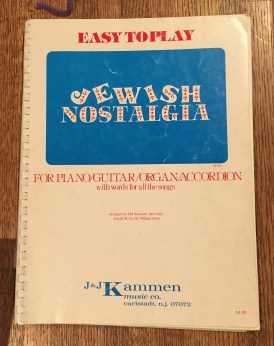
When I married, the piano and the bedroom set moved to my home. When I was pregnant with my daughter I would play the piano every day. I often played from a book of Yiddish music: “Jewish Nostalgia For Piano/Guitar/Organ/Accordian” published by the J & J Kammen Music Co. Sometimes I could feel my daughter kick within me as I played her favorite songs.

I know that she heard the music! After she was born, when she was fussy, I would bring her into the music room and play “Oif’n Pripetshik” for her. Within minutes she would be calm listening to the music.

My grandfather, Papa, lived until she was 3 ½.   He would sing to her in Yiddish as well. She does not remember much about him. But he would hold her close to his face while he sang.   What she remembers is that “Papa had a scratchy face.” He did not shave as often when he was in his late 80s.

When she was old enough, my daughter also took her first piano lessons on our family’s baby grand piano. Like me, she was not meant to be a concert pianist. But we both learned to love and read music while learning to play piano. I would often play music for my children when they were little. I often would play the Yiddish music of my childhood.

Over the years, many people have come to visit and would play the piano.   One childhood friend came to visit several years ago.   She asked what happened to my Mom’s piano.   I took her into my living room to see it.  She cried as she stood in front of it.  There was so much love invested in my piano.

I am so fortunate.  I have a chair to sit in to remember when my grandmother sang to me; a piano to play the music that my grandparents taught me.  I have the  Yiddish songs that I continue to hear in my mind and sometimes still play on my piano. Amazing memories and sounds of Yiddish songs from just looking at a chair and a piano.


https://zicharonot.wordpress.com/2014/06/08/why-i-love-my-pillow/


We Always Have Our Minds, We Must Use Them

21 Jul

“They can never take your education or your mind,” my Grandfather told me. He escaped from Europe in 1918 in an effort to avoid service in the military. For a Jew in 1918, a military career was not a good option.

Although Grandpa’s formal education ended, he was a strong believer in education for his children and grandchildren. He came to a country, that although it had quotas for college at the time, there was still an opportunity to get an advanced education for everyone. In New York City, many children of immigrants went to CCNY, City College of New York, where education was basically free!

He would be proud to know that five of his great grandchildren have or are working on secondary degrees: four master’s degrees already completed, one in progress and a PhD on its way. No one can take this education away.

We are the people of the book, the Torah. We are a people who stress learning and education. My family is one that continues this tradition. In this country we have had the opportunity to learn at any college or university. We have had the freedom to study Torah as free and independent people.

My Grandfather never learned to read English well. We grew up reading street signs for him as he drove. In fact, I learned to read by listening to my Grandmother read to him.   My Grandmother also came from Europe and was fortunate enough to go to night school to learn English.

But do not think my Grandfather was uneducated. He was not. He was literate in Yiddish, Hebrew and Polish, as was my Grandmother. English was their fourth language.

My Grandfather was a Cohen, from the priestly group of Judaism.   He had a beautiful voice. When I was a small child, I loved to sit under his tallit with him as he chanted the prayers.

I also stress education.   I have taught high school. I work at a school now. And I made it clear to my children, from infancy, that education was the most important job they had.

No matter what you do in life. No matter where you live. Nothing can ever take your education away from you.

In Israel they know this. Recently Shimon Peres, the 93-year-old, past president, said: “In Israel, a land lacking natural resources, we learned to appreciate our greatest resource, our minds.”

This is a truth for everyone.   Education and your mind are always yours. No one can take these away.

The United States has been a country of immigrants; a country where people can get an education. Where people can read the books they want to read, study the topics they want to study; use their minds to be whatever they want to be. The USA is a country of free speech and freedom of religion.

I hope it continues. We always have our education and our minds. I hope people use their minds this November.  I hope they remember that we all came from elsewhere.  Use their minds and their education to do what is best to keep our country free, to keep the haven for immigrants alive, to avoid the pitfalls we see in Europe.  The world is a scary place right now.  But we need to use our minds to keep out fear and to reject those who would use fear and hatred to change American.

Donating My Holocaust Books to the Right Place

12 Jul

image

My husband and I are members of the Midwest Center for Holocaust Education (MCHE) in Kansas. There is an important reason for our support. I was named for my great grandmother who was hidden during the Shoah and then murdered by the people who stole her property. In her memory I feel it is important to keep contact with Holocaust organizations.

Since MCHE started, I have attended a few events and made financial donations. This year, we were among those honored for our 20 years of support. But two years ago, I became a bit more involved. I started serving as a preliminary judge for its White Rose Essay Contest. Open to students in eighth through twelfth grade, it is held each year in the Kansas City area. Preliminary judges help to weed the multitude of admissions down to ten in each category 8th and 9th grade/ 10th – 12th grade.

I enjoy reading the essays. It is amazing what some of these students do under the guidance of their teachers. The students have to research a specific topic, which changes each year, using both internet sources and books, many of which are held in the MCHE library.

I look forward to the essay contest each year and being a part of this process. I learn the stories of survivors as I read these essays, which has helped to encourage me on my path to discovering more about my family.

I have a collection of Holocaust books, both non-fiction and fiction. I have way too many books to be honest. Even with a Kindle, I still cannot let go of books very easily. But this weekend I had an urge to purge my bookshelf of books I no longer read.   And a thought occurred.   I had read all these Holocaust books, some several times. Perhaps the MCHE could use them for the White Rose contest, as well as for other researchers.

With that goal in mind, after two days of sorting through my books, I found 17 I was willing to part with and which I thought could be used for research. These 17 non-fiction books pertaining to the Shoah only touch the surface of my collection. But for me it is a positive start.

I contacted MCHE and offered my books.   There were six the historian definitely wanted for the library. The books were already in the car waiting to go. As soon as I got the email, I sorted the books into two groups and took all of the books over.

When I entered the Center, the director said, “Were you waiting in your car for my email?”

I smiled. “The books were in the car,” I admitted.

I did arrive within an hour of getting her email. To be honest, I really wanted a good home for these books where they would be used and appreciated. I think I found that home.

But on the other hand, I was worried that I would go through the books again and change my mind. It is difficult for me to relinquish a book. I even emailed my daughter with a list of the books and asked her opinion.

“I am planning to donate the following. If you have a feeling for any of these books speak now,” I wrote her.

She responded with one word: Donate.

The books they did not want for their library they will offer for sale to their members. That would be fine with me, as the income would still go to MCHE.

However, as I spoke to the Director I suggested they review my books. All were in excellent shape. Perhaps they should replace the books on their shelves with my almost pristine copies? She agreed this was a great idea. It made me feel even better. Perhaps even more of my books would remain on the shelves of the library.

Whatever MCHE and its historian do with my books, I am glad. I am letting go. When I get my letter acknowledging the donation, I will think about those who will continue to read and use my books and know that I donated my books to the right place.


http://mchekc.org/white-rose-student-essay-contest/


What I Think About on The 2016 Fourth of July

4 Jul

I am a fortunate person. My paternal great grandparents immigrated to the United States in the 1880s, and my maternal grandparents arrived in the early 1920s, before the Immigration Act of 1924 severely limited immigration and imposed a strict quota system. It was a bigoted act designed to limit immigration of Africans as well as Southern Europeans and Eastern Europeans.   It actually banned the immigration of Arabs and Asians.   It was due to this horrible act that so many Jewish people trying to escape Nazi Germany were banned from entering the United States and were murdered.

Finally, the Immigration and Nationality Act of 1965 was passed and enacted on June 30, 1968, just in time for a Fourth of July celebration. It ended the strict limits of the quota systems and allowed preference visa categories that took into account an immigrant who had family members who were citizens, as well as an immigrant’s special skills.

Think of what this act might have meant for tens of thousands of Jews stuck in Europe. In my own family, the 1924 act caused the death of my grandfather’s family. He was able to get Visa’s for his parents, but not for his siblings. His parents refused to leave. And so everyone perished in the Holocaust.   My grandmother was able to get a visa for her father and younger sister, but not her brothers. Fortunately they survived.

The Immigration Act of 1990 increased the total immigration allowed and the number of visas from the 1965 law. But also in the 1990s other laws were passed to make it more difficult for legal and illegal immigrants adding reasons for deportations, according to a Wikipedia article on “The Laws Concerning Immigration.”

But the world changed on September 11, 2001, and along with it views on immigration. People got scared. We began to allow fear to rule the country. And if we do that, we let the terrorist win through fear. That is what they want.

We seemed to have gone back to the ways of the 1920s, when the white men in power seemed so afraid of those that were different. Many restrictive laws were enacted before women had the right to vote. The 19th Amendment was only ratified on August 18, 1920. At first many women did not vote. It took time for women to stand up and have their voices heard.

I cannot prove that having women’s votes changed the direction of the United States, but I believe that women voters have influenced many aspects of life in the USA.

The fact that we now have three women on the Supreme Court has made a difference. The fact that we have women in office on all levels of government: local, state, national, has made a difference. The fact that we have had women running for the two highest offices in the USA: vice president and president, has made a difference.

I am so proud and glad to be a citizen of the United States of America. I am so glad that my ancestors made the journey to the USA in times that were so difficult and were allowed to settle here and become citizens.

I hope that we all remember what is written in the Declaration of Independence:

“We hold these truths to be self-evident, that all men are created equal, that they are endowed by their Creator with certain unalienable Rights, that among these are Life, Liberty and the pursuit of Happiness.–That to secure these rights, Governments are instituted among Men, deriving their just powers from the consent of the governed, –That whenever any Form of Government becomes destructive of these ends, it is the Right of the People to alter or to abolish it, and to institute new Government, laying its foundation on such principles and organizing its powers in such form, as to them shall seem most likely to effect their Safety and Happiness.”

We must not let fear of the other make us forget that the United States was founded by the ‘other.’ Everyone who signed the original Declaration of Independence was the descendant of an immigrant. We were not perfect. The treatment of the Native Americans and slave ownership was not right. But the founders did their best with the information they had. The Constitution helped them make changes to reflect the society. Slavery ended, women got the right to vote.

With the death of Elie Wiesel, we must remember his words as he reminded us of the Shoah and our responsibility to keep another one from happening: “We must always take sides. Neutrality helps the oppressor, never the victim. Silence encourages the tormentor, never the tormented.”

And we must side with the victim. We are a country founded by people searching for religious freedom, searching for a place to live with freedoms and the rights to be as equal as anyone else.

This Fourth of July, we must not give in to fear and hatred. We must protect those fleeing from war. We must not become a bigoted, hateful country. We must remain the defender of the victim. That is the heritage I want to rejoice on this July Fourth.


Stunning Majesty of Glaciers

14 Jun

Each time I am in the presence of the stunning majesty of a glacier, I am aware that nature’s beauties outshine many man-made structures. 

The first waterfall as we traveled the fjord.


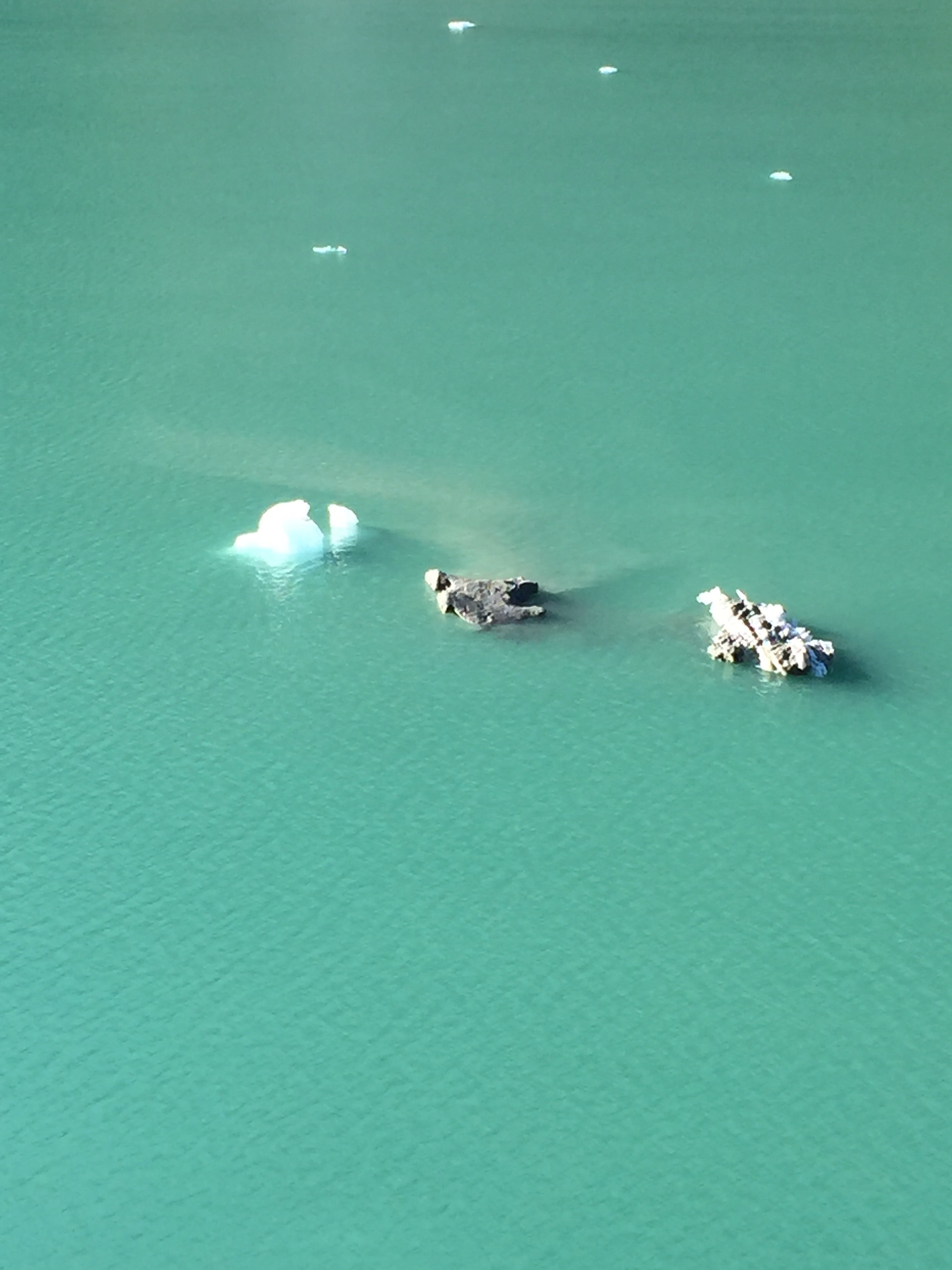
As we sailed into a fjord in Alaska early this morning I was watching for the signs that a massive glacier was near. First were the signs in the water:  the change in the color and texture. Once smooth, now choppier with thin ice. Then came the first, now tiny, ice floe making its way down the channel. 

Soon I heard the first sounds. The Wild Rush of water as the summertime waterfalls of gushing water streamed from the ice fields high in the mountains. I watched as the pounding water made its way into the fjord leaving swirls of water as it entered.  Later you can hear the moaning of the glacier as it moves forward down the mountain. Sometimes you can see and hear the crash as giant sections of glacier calve into the water. 

Ice floes traveled down the channel to greet us.


Soon larger and larger ice floes floated along side the ship. Not the size of an ice berg, but still sharp white and Aqua blue structures shimmering in the sunlight.  They can be dangerous and the ship shows respect by moving ever so slowly down the channel. 

I have been blessed to have seen glaciers in Alaska in 2002 and now today. Four years ago I traveled through the Straits of Magellan and experienced the cold of the glaciers there as well as we winded our way from Chile to Argentina. 

But now, in Alaska, I began to feel the cold wind that comes off the glacier. Even with a coat and gloves, even with the sun shining, I felt deeply chilled. 

My first view of Daws Glacier.


Then the ship made a small turn. Up ahead I saw the glacier filling my view. Its face jagged and tall as it met the water. White and blue with streaks of broken rock within that looked like stripes of dirt. But are really the crushed stone and silt pounded by the relentless force of the glacier. 

The glacier fills the end of the fjord.


Seeing a glacier in a bay is different then seeing it more inland ending in a lake like the Mendenhall Glacier in Juneau. I saw that glacier first in 2002 and then again two days ago. I was shocked by how much it had retreated!  There was even a time-lapse movie of how it has changed from 2007 until now. Imagine six years more of melting! Hundreds of feet of glacier has disappeared. Diminishing it!


The park ranger told us how global warming and the use of fossil fuels is changing the glacier and Ice fields in Alaska. There is hope as we move to renewable energy. But if you saw the glaciers, you would know the change is real. 

As the glaciers recede in Alaska another increase occurs. As the weight of the glacier diminished the land actually rises in rebound. 

When we first came to Alaska 14 years ago we took our children. My then 11 year-old son was impressed at first with the Mendenhall Glacier. But later in the trip when I woke him early in the morning to see the majestic glacier in Glacier Bay, he was a snarky pre-teen, who commented: “Seen one glacier, seen them all.” This became a major joke in our family, but it is not true. 

Each glacier has its own beauty. If you ever have the opportunity, come to see a glacier. The ones within the continental USA at Glacier National Park are almost gone. Only in Alaska can you still see them. 

Do not miss the stunning beauty of a glacier. 

Serenity In Alaska Fractured

13 Jun


Alaska. Serene. Snow topped mountains. Glaciers.  Abundance of trees. Clouds. Drizzle. The perfect spot for a serene, peaceful and relaxing cruise. 

The bad side of cruising now is unlimited wifi. The worse part of wifi is being connected to the world. When I first cruised, 36 years ago, there was no phone service; no television. My husband and I still do not watch television when cruising. 

But the Internet, emails, Facebook, and the world can now reach out and fracture the serenity. 

I am an advocate for gun control. I say all automatic and semi automatic weapons must be banned. I say the NRA and its lobby are killing us by allowing the mentally ill and terrorists get guns. 

The NRA members are not acting like patriots, as they support a way for terrorists to get guns. Especially loopholes for Internet and gun show sales. 

I say vote out all legislators who receive money from the NRA. There are many more of us then them. Support legislators who take a stand against gun violence!

I am tired of my vacations being destroyed by reports  of mass murders, this time senseless killings in Orlando. And week after week after week. Do not tell me guns don’t kill. 

You would think after Sandy Hook people would understand. But no. Instead across the country schools have become little fortresses.  Children learn by drills what to do if a killer enters their building. A sad reflection on our world. 

I am, like many others, praying for a return to serenity of a peaceful world. A world where a vacation cannot be destroyed by reports of mass murders. 
Petitions.whitehouse.gov.    Go to Ban the AR-15 From Civilian Ownership. 

Chihuly, Stunning

10 Jun

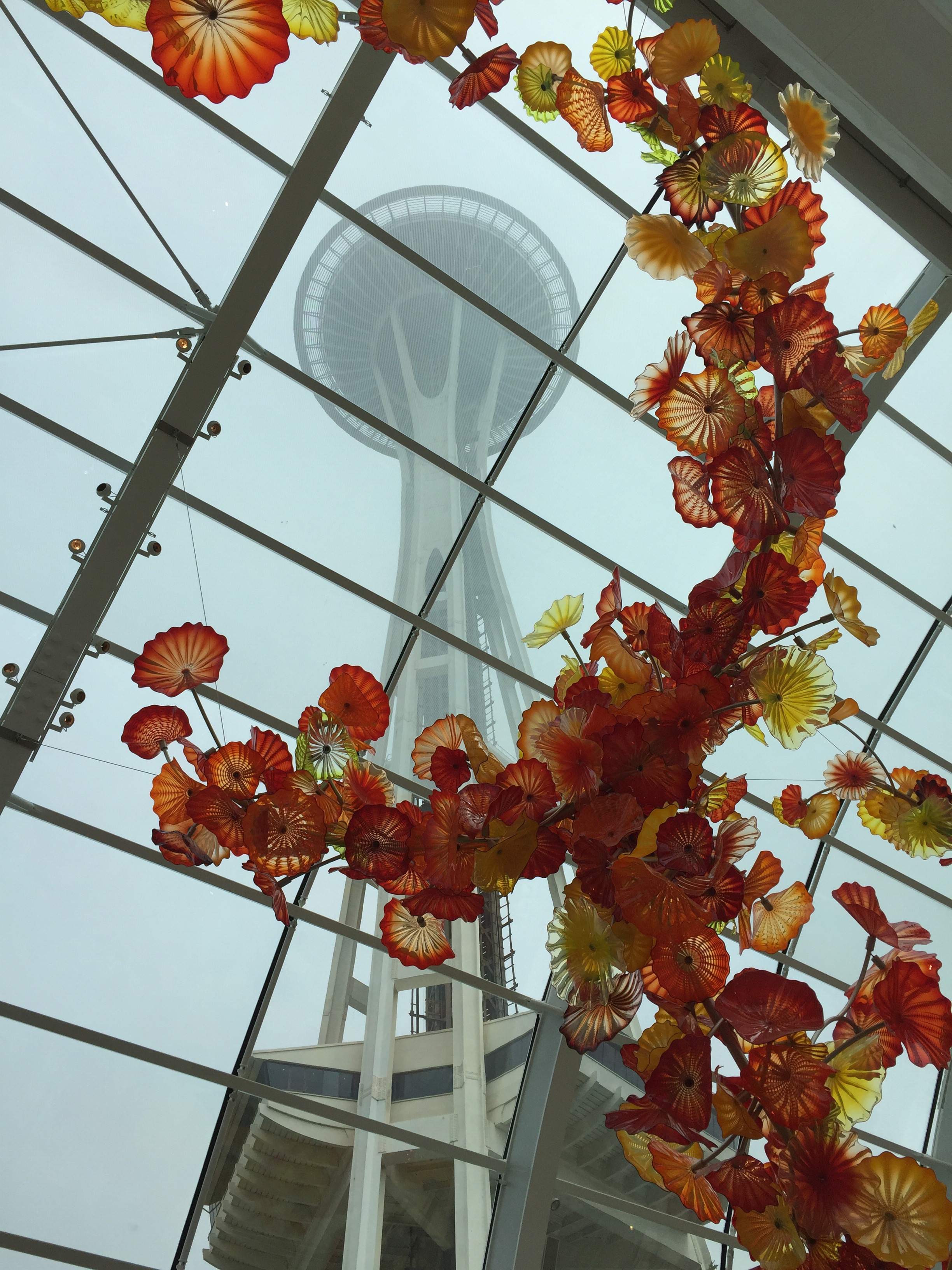
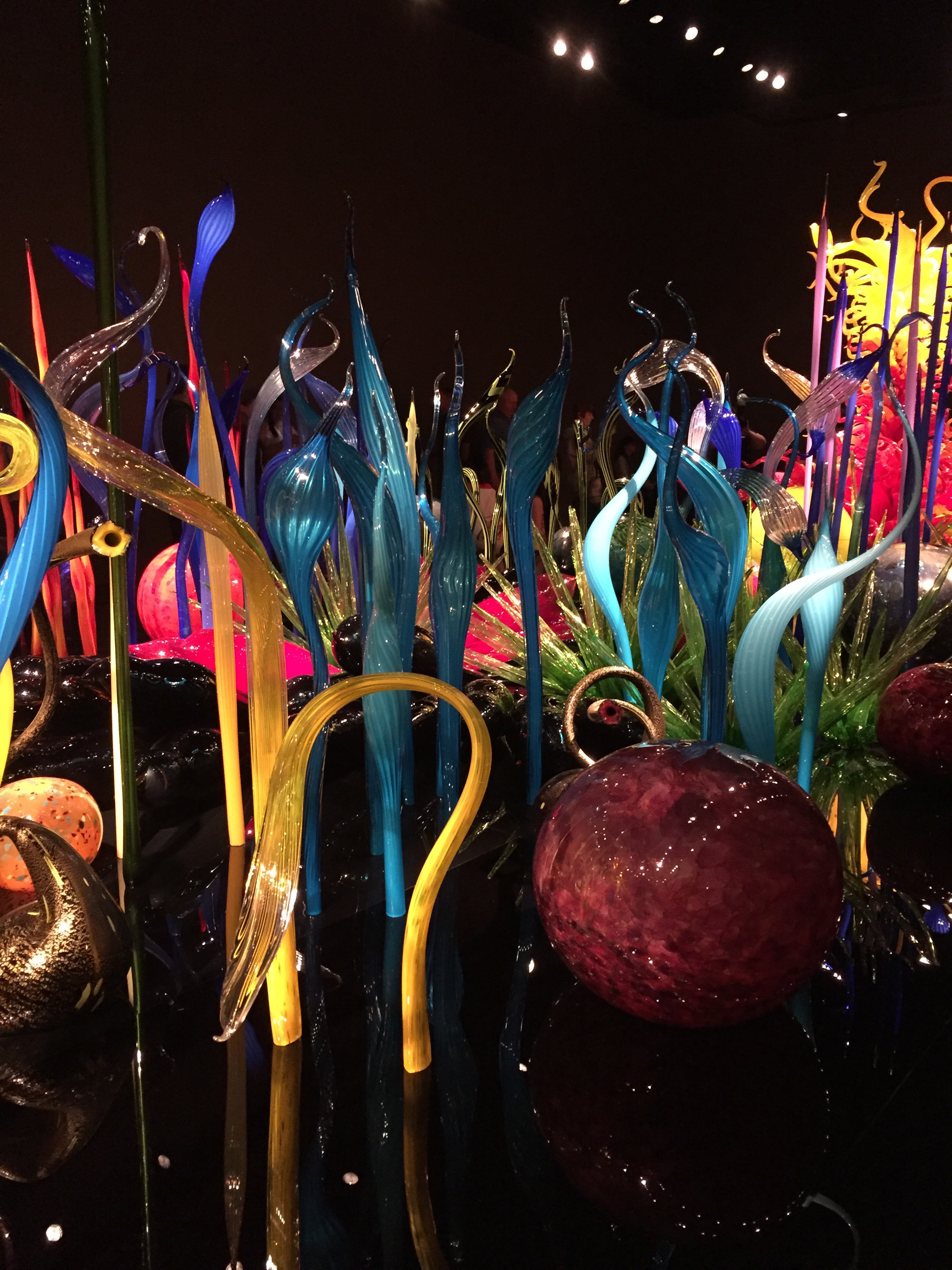
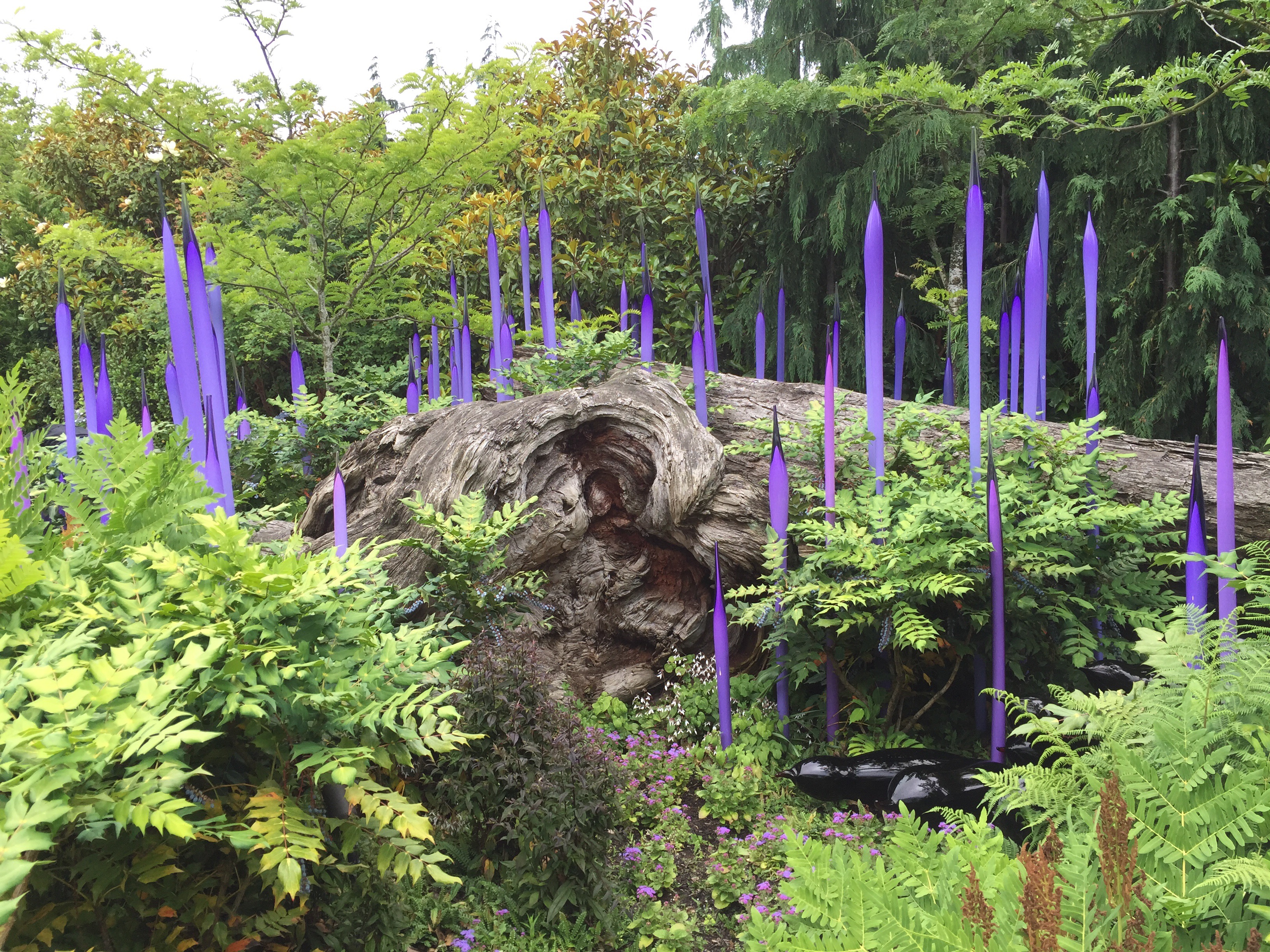
I love the glass art developed by Dale Chihuly. I have seen his art work throughout the United States in Florida, Nevada, Arizona, Arkansas   And finally in his home state of Washington when I visited the Chihuly Garden and Glass museum that shares his name next to the SpacecNeedle in Seattle, Washington. There is something about the vibrant colors and twisted shapes that cheers me. Each of his designs provide me a moment of childhood delights. 


Blues, teals, reds, lilac, violet, orange, gold, black, green, yellow; solids, stripes, mottled; tall, short, rotund, pointed, rounded, spiral, straight, curved.  Is there a descriptive word that cannot be used to describe his work?  I think not. 
For me the glass art of Chihuly is magical! Beautiful, fanciful.


Whether his displays be indoors, within the confines of an exhibition hall, or outside nestled alongside plants or sitting within a pond or creek, each installation is unique and intriguing.  

For those who have not seen his glass sculptures, I entreat you to make the effort. The sparkle of delight will bubble in your soul. At least I hope it will, as it does in mine. 

The Mysterious Kalsbad Photos: Who Are They?

6 Jun

June 26, 1931. My Grandmother was in Europe with my Mother and my Uncle. She left them at the farm owned by my great grandparents in Poland while she went to Karlsbad (Karlovy Vary), Czechoslovia to take the waters and revive her health.

The doctors in the United States told her that she was going to die. She had been pregnant again in the USA. But doctors terminated the pregnancy through a very illegal abortion in an effort to save her life. But still she was sick. So she decided she would not burden my Grandfather with two young children, 5 and 2. She would take them to Europe to live with his parents and she would die there. He, then, would be free to continue his life.

I once asked my Grandfather, why he let her go. “She was a sick woman,” he told me. “I had to let her do what she thought was best.”

“Would you have left Mom and Uncle Stanley in Europe?” I asked. This was a very important question. His entire family perished. If he had left them, I would not be here.

He looked me in the eye, and said, “As soon as she died I was going to get on a boat and return with my children. I would never leave them there. “

His words made me feel a bit better. But if Grandma had died the world my Mom and Uncle lived in would have been very different. But at least I know my grandfather would not have abandoned them in Poland.

Luckily Grandma did get well. She stayed in Europe for six to eight months and then returned to the USA with my Mom and Uncle. She saw the rise of Hitler coming and now had a new purpose: get the family out. She could not save as many as she wanted. But she tried.

Grandma Thelam, Carlsbad

Grandma is sitting in the front. The date and place were added by my Mom. I think the two women are related. This is the photo we knew about.

We have several items from that trip to Europe. We have a ceramic vase that stays in her breakfront/curio cabinet in our Catskills’ home. We have stories about the trip.  We have a few photos. We knew of one. Grandma is with two other women. We have no ideal who they are. But I think they are related to her, one women sort of looks like her sister-in-law. We are not sure. There is no identifications on the back.

But I recently found another.

FullSizeRender (10)

Grandma is in back row on the left wearing a white hat.

It is a group photo. In the very back row, near the center is a woman in a white hat, that is my grandmother. She is 26 years old.

I do not know the other people. Are they family members who perished? Or are they just other people who are in Karlsbad? Sometimes I imagine that they are just other people at the resort who were pulled together for a group photo that the photographer would then sell to tourists.   Other times I imagine that people in the photo look like family, especially the man in the front on the left. But I honestly do not know.

This photo is different from the others we have from that trip. There is writing in Yiddish and English. The English is easy, her name and the address where she stayed in Karlsbad. Or is it a place she visited?

The Yiddish is more exciting to me. It is the only letter I have seen that she wrote to my Grandfather. (Thank you members of the Tracing the Tribe Facebook Group for translations!)

It says: “As a souvenir from your faithful wife, who hopes, to meet you again in good health.” Another translated it as “A souvenir from your devoted wife, who hopes to return to you in good health.”

Either makes sense. She was sick. She was away from my grandfather. She wanted to be reunited with her family and be healthy.

And that all happened. She returned to the US and lived an additional 50 years. And 80 years later, I keep finding treasures in her photo album!


https://zicharonot.wordpress.com/2014/04/28/speaking-yiddish-always-brings-me-holocaust-memories/

Remembering Our Bodies, Ourselves Thanks to an NPR report

2 Jun
My original Our Bodies, Ourselves Books

My original Our Bodies, Ourselves Books

Listening to NPR while driving in my car is a joy. Almost every day I find out something new. Today while driving I listened to a program about Our Bodies OurSelves, and how it was saved through internet crowd funding. Robin Young, of “Here & Now,” spoke to the new executive director, Julie Childers, who went to college in Tulsa, Oklahoma.   That made me laugh. The new ED of  the “Our Bodies Ourselves” organization went to college in what is now a state worse than Kansas. Ugh! Oklahoma has not been very good to women’s issues. Maybe that is why she is working on this important book.

In any case, when I got home, I pulled out my 1976, second edition copy of Our Bodies, Ourselves and my 1978 first edition of Ourselves And Our Children.   There was still a paper napkin marking a spot in the book that I obviously felt was important.  I was 21, and a college junior when I purchased my copy.

For those of you who might not know, before Our Bodies, Ourselves there was a dearth of information for women about their own health issues. The medical field seemed to be ruled by men, who did not really understand women’s health issues. I, personally, had horrible time during my menstrual cycles. And was told as a young girl that it just me. And I should get over it.

Years later, when I was in my mid 20s, I found out I had endometriosis, which was causing my horrible periods. I only found out when I was going to an infertility doctor who, even though was a man, truly helped women.  (There were some!)

To be honest, now I only go to women doctors for my major health needs. I grew up in a time when men really did not get it!

It was Our Bodies, Ourselves that helped me. I know I am one of millions, who must thank the Boston Women’s Health Book Collective and their work to help women learn about their own bodies, their sexuality and their health care.

Although I have not taken to the streets, I have been a strong supporter of women’s rights, and their reproductive rights, throughout my adult years. Our Bodies, Ourselves was my second awakening to women’s rights issues. My first occurred the day before my 18th birthday, when the “Roe Vs Wade” decision was announced.

The young women today have lived their lives not knowing the battles of the 70s and early 80s.   They do not have the workplace issues we faced. But most important, with the rise in so many more women doctors, they no longer face the condescending attitudes to our health care needs that we often faced.

I thank Our Bodies, Ourselves for this awakening of women’s health needs and the evolution of medical care.

http://hereandnow.wbur.org/2016/06/02/our-bodies-ourselves


https://en.wikipedia.org/wiki/Our_Bodies,_Ourselves