Archive | Uncategorized RSS feed for this section

The Beautiful, Yet Horrible Blue Flowered Dress

1 Jun

I close my eyes and I can still see the four dresses next to each other on the bed in my Grandma Esther’s spare bedroom at the apartment in the Bronx. Four identical blue dresses, with Peter Pan collars, bright yellow and red rickrack and springs of tiny flowers printed all over the gingham dress. The dress had a built-in sash and dirndl skirt. Each dress was a slightly different size: one each for my two first cousins, also sisters, as well as one each for my sister and I. I must have been about seven, my sister three, my cousins were about eight and ten.

My grandmother had an urge to buy us matching dresses. I don’t know if it was a special occasion, or she just saw them while coming home from working and decided to get them. I think there is a photograph somewhere of us all wearing the dress at the same time. But I do not know where it is, or if it was really taken. I have searched in my albums looking for some photo of these dresses. But they do not exist. (If a photo did exist, my sister probably destroyed it.)

All I know is that this was a wonderful gift. And we all said, “Thank you!” to Grandma Esther, who was very excited about getting these dresses for us.

The dresses came home.   I wore mine for school, occasionally, after the initial ‘for special occasion only’ wearing. In the early 1960s, girls always wore dresses to school. I had both school clothes and play clothes that I changed into as soon as I got home. So it was fine to have another dress to wear. But really this was to be my dressy dress, for special occasions.

I loved the dress. Blue is my favorite color, and my Mom often dressed me in red or pink because of my black hair. I do not like those colors. So I was happy to finally have a blue dress. I liked the rows of rickrack running along the bottom and bodice. I liked that it had some three-dimensional treatments. I loved the pretty flowers.   I wore it happily. And when I was handed down my oldest cousin’s dress, I was happy to wear that one as well. To me it was just the best blue dress ever!

Notice the generous amounts of rickrack not only on her costume, but also braided to make the headpiece.

Notice the generous amounts of rickrack not only on her costume, but also braided to make the headpiece.

Because of this dress I developed a love of rickrack. I do not remember having it on a dress before this special dress. I fell in love with the feel and texture of rickrack. I also loved to say the word! When I had a daughter, I often made her dresses and costumes with rickrack on them, using all different colors.

As for my cousins, they do not have the same memories of this dress. In fact, they do not remember this dress at all. My sister and I were telling one of our cousins about the dress once, and there was a blank look in her eye.   I think because they only wore the dresses for a short time, and did not have the extra dresses to wear, they did not have as strong an impression.

However, my sister will tell you a different story about the dress. She learned to hate it, even though I think was a pretty dress. But she does have a relatively good reason.

You see, as stated earlier, there were four dresses. She was the youngest. My cousins only wore the dress one year or two. But as each cousin outgrew the dress, it was passed down to the next child. Because one cousin was only nine months older than I was, I did not really get that dress to wear. But my sister did. She wore the same dress for years, as each one was passed down to her.

I should add, that my sister wore the last of the same dress for an extra long time. My Mom saved that dress. She even said to my sister, “That dress still fits you. It has a nice big hem.”

My Mom realized she could buy matching rickrack and lower the hem, then sew the rickrack along the crease where the hem had been.

Because they were dresses for a special occasion, they were not worn out. I think my sister wore some version of that blue dress till she was about 11 or 12…so at least eight long years.

When we talk about the blue dress, my sister gets a sort of pained look on her face and tightens up her body.   It is almost as if she is trying to get the memory of even wearing it out of her mind.

Her daughter did have a similar navy blue dress made by her paternal grandmother. But instead of flowers, it had the alphabet printed on it and apple appliqués. My sister had a difficult time even putting the dress on her daughter. She had a visual and visceral pain seeing her daughter in the dress. After that, her mother-in-law always let my sister help pick the fabric for dresses.

Because of the blue dress, my sister was against matching clothes for our daughters. Whereas some families get matching clothes for family photos, we never did this. We might mention a color theme, but NO matching clothes.

And when I think about it, I cannot remember seeing my sister wear navy blue dresses even today. The impact and memory of the beautiful, yet horrible blue dress lives with her forever.

Grandma Thelma Knows What She Knows

29 May

We always wondered how old my Grandma Thelma was when she celebrated her birthday. She insisted that she was born in 1906 and arrived in the United States when she was 16. This is a debate that went on for years, as her passport had her as two years older.

Her explanation was that she was so desperate to get out of Poland, she made herself two years older to get out. In fact when she finally got her passport and papers in Poland, the official said to her, something like, “I hope you have a safe trip and return safely.” When she got to the door, she turned around and said, “I will never come back here, never.” And then ran for home. Her happiest day was the day she arrived into the New York City harbor.

I have her passenger records from Ellis Island. She arrived as Tauba (Tova), from Boleslawiec, Poland, on November 7, 1922. An 18 year-old, single female, she traveled by herself on the Gothland from Antwerp, Belgium.

Grandma reinvented herself to Thelma. She stopped using the name Tova except in synagogue.

She lived with relatives, her Aunt Gussie, her father’s sister, had agreed to sponsor Grandma. Aunt Gussie had four children, three boys and a girl. But the stories Grandma told always revolved around the cousin who was her age, Katie, who was treated as a queen. While my Grandma said she was treated as the “deinst,” the maid. She had to work all day, go to the school at night, and then when she was in the apartment clean and work for her board.

When Katie would have her friends over, they would tease my grandmother because she was a “greener.” My grandmother also had to ‘serve’ them, and was not allowed to really just sit and visit. It made my Grandma mad, as many of Katie’s friends were also once “greeners.” It also made her mad to be treated like that when she was family. However, she and Katie did become friends, because despite everything, they liked each other.

It was a difficult life made more difficult because her Aunt Gussie wanted her to marry an old widowed man with children. And Grandma did not want to marry him. She had met my grandfather, Nathan (Nissin) who was a baker and either four or six years older than her (depending on the birth year accepted). My sister and I think one reason Grandma and Katie became firm friends is that she helped my Grandma in her romance with Grandpa.

This became a battle with Aunt Gussie. My grandmother took matters into her own hands by writing her father, Avraham Shlomo, in Poland.   She told him about her love for Nathan and the pressure from Aunt Gussie to marry the other man. My great grandfather did what any good Jewish father would do for his daughter, he investigated Grandpa’s family; found out they were a good family of Cohen descent, and approved the marriage. When the letter arrived from Poland, my grandmother got her way, and married my grandfather.


Grandma Thelma and Grandpa Nat in their wedding finery. Grandma Thelma and Grandpa Nat in their wedding finery.

Grandma always kept in touch with Katie. Throughout their lives, they did not see each other, but they wrote many letters. We remember whenever a Katie letter arrived in the Catskills, Grandma sat down and read it. They were always in Yiddish. And then Grandma wrote her a many-paged response. Although Grandma loved her cousin, Katie, she never forgave Aunt Gussie for the harsh treatment. It was difficult because she was also always grateful that her aunt had sponsored her to come to the United States and gave her a place to live, however begrudgingly.

In the meantime, my Grandpa and his Uncle Yidel (Julius) had a bakery. Their business grew. At some point they decided to separate. Uncle Yidel stayed in New York, while Grandma and Grandpa moved to New Jersey and opened their own bakery.

My Grandma was a shrewd businesswoman. She enabled the business to survive through the 1929 stock market crash. She had two children to support, but during the Great Depression she gave out food on credit to those who needed it.   She invested in the Stock Market, but at the same time she had money spread out in lots of different banks. I remember going bank hopping with her in both New Jersey and New York City. She would bring all her bank passbooks at the end of each month, to have the interest entered.

My Grandma is 36 or 38 in this photo. My Grandma is 36 or 38 in this photo.

Over the years, my grandparents became financially and personally successful. They had the bakery and the building it was in; they owned a small bungalow colony in the Catskills, as well as a winter home about half mile from the bungalows. They had investments. They had two children and five grandchildren. All was happy and well.

The memories of Katie A and her parents, as well as their treatment of Grandma, had stayed within my Grandma’s memories and were not really discussed until one day in the Catskills. A day I will always remember, because it shows you how small the world can be, and how connections make changes.

Both my Dad’s parents and their siblings were born in the United States. His mom, my Grandma Esther, was one of five siblings, including her brother Sam. Uncle Sam was a little different from everyone else. He worked for the New York City Port Authority, and he was divorced and remarried. I loved my great Uncle Sam. He had a great sense of humor and was wonderful with us children. His second wife, Sylvia, had a little yappy dog, who scared us all. She carried that dog everywhere. Aunt Sylvia was always perfectly dressed, blonde hair in a French twist. She expected elegance wherever she went, thus she did not like to come to the Catskills because she felt it was too middle class.

Her feelings might have changed the day they decided to finally take a ride up to the Catskills and see everyone. My father’s parents and sister and her family stayed at the bungalow colony owned by my maternal grandparents. So first Uncle Sam went there to see his sister and visit. Later in the day, he and Aunt Sylvia drove up to the ‘big’ house where my maternal grandparents lived, and where we had our bungalow.

Of course there were introductions all around so that Grandma Thelma and Grandpa Nat could meet Uncle Sam’s wife Aunt Sylvia.

When my Grandma met Aunt Sylvia, she said, “I know you.”

“No,” Sylvia replied. “I never met you before.”

I started walking with Grandma back to the house. “I know her,” she said again. My Mom heard. “Mom,” she said. “She probably just reminds you of someone.”

I thought it was over. No big deal. But a short time later, Grandma came back to our bungalow, where we were sitting outside. She walked up to Aunt Sylvia and said, “Sadie, you are Sadie. You were a friend of my cousin, Katie. I remember you.”

Aunt Sylvia…now Sadie, looked at my Grandma and said, “Tova, is that you!?”

And it was. They hugged. They kissed. They spoke in Yiddish for hours.

When Uncle Sam and Aunt Sylvia left, my Grandma Thelma had a new ‘best’ friend. They had so many memories to share.

And then my Grandma turned to my Mom and said, “I told you I knew her.” We should have known that Grandma Thelma knows what she knows.

This incident impacted my Grandma Esther as well, once she heard what had happened. From then on, whenever her sister-in-law made her crazy, she would say, “Sylvia…she is so hoity toity, but she is really just Sadie from Brooklyn.”

Thanks to my sister for remembering with me.

Beautiful Skies Light Up Catskills Nights

27 May

“Do you know what weekend you are coming?” My sister asked, when I gave her the dates I planned to come to New York for my annual Catskill visit. “It’s the weekend of the Perseid meteor shower!”

“Perfect!” was my response. “Do you remember lying out on the grass to watch?”

The night sky in the Catskills is so beautiful. No city lights block out the view. The nights are so quiet and so dark, (and sometimes scary), it makes watching the sky and the stars special.

In the Catskills, it is crisp and cool when the sun goes down. We often spent the nights sitting out on the wooden lawn chairs watching the sky, while wrapped in woolen blankets. Sometimes we would put blankets on the ground so we could look straight up at the sky. This gave us a much better view. But the grass was often damp at night, so my Mom had to give the okay to get some blankets wet.

Watching the sky during the second week of August was our favorite time. How many meteors would we see? Who would see the first one? How late would we be allowed to stay up to watch? How many nights would we actually be able to see the meteors? Although August 12 is the most active night for shooting stars, they appear for a few nights before and after.

I also remember my Dad pointing out man-made satellites and telling us how we could tell the difference between them and shooting stars. (Man-made satellites move steadily through the sky, while shooting stars go quickly and then disappear.)

When we had our own children and started taking them to the Catskills, we shared the love of the night sky and taught them to count the shooting stars. We loved passing along this tradition to our children. Sitting out on a wooden chair with a child in your lap is so warm and wonderful.

Occasionally, when we were little in the 1960s and 1970s, we were also able to see the aurora borealis. It did not happen often, but every once in a while, to the north, those greenish yellow lights would shoot up to the sky from behind the trees, or so it seemed.

I still remember the first time I really understood what it was when I saw them. I was about ten years old. And one evening, while looking for shooting stars, I noticed a yellowish glow above the line of trees. I was worried; was it a fire? The adults assured me it was not fire, instead it was the Northern Lights, the aurora borealis lighting the sky. I still remember the sight of the dancing green and yellow lights above the trees. This is the spot where, in the future, we would normally see them. I remember at night always turning to this spot on our property to look for the lights.

Whenever I see the aurora borealis, and I have seen it several times in my adult life, I always think of one of my favorite stories about my sister’s husband. Let me set the stage:

The first point is that my sister’s son was a very fussy baby at times. He did his best sleeping when being driven in a car. My sister and her husband spent many hours driving my nephew’s first six months of life.

The second point is that my sister’s husband had not spent his childhood summers in the Catskills, so had no true experience with the night sky. He was a metropolitan New York, Long Island boy, who had never seen the northern lights.

That is the setting. Now the story:

One night, when their son was being fussy, my sister and her husband took their baby for a drive in the Kauneonga Lake, Bethel, Swan Lake area, part of the time along old 17B. My brother in law kept driving and driving and driving, for quite a long time, along the dark, hilly, curving roads. Finally my sister asked, “Where are you going?”

“I am going to drive to those lights…to that city,” he responded.

My sister knew there was no city there. And those were definitely not the lights of any city.

“You will be driving for a very long time,” she told him. “Those are the Aurora Borealis.”

He had no idea that we could see them in the Catskills. He was mildly incredulous, but he did turn around and head back to my parent’s home.

We had been getting worried. It was the time before cell phones, so all we could do is wait for them to return. My father considered calling the state troopers. But they returned before the call was made.

When they got back, and my sister told us what happened, we loved it! Even better, my nephew continued sleeping.

I still love that story!

My husband did not have that problem. He recognizes the aurora borealis. He studied astrophysics and quantum mechanics at Cal Tech (in Pasadena, California) for two years of undergrad before he changed his major and his college. But his interest in the night sky started when he was very young, when he was growing up in St. Louis.   His Dad told me how he took my husband to classes at the St. Louis McDonnell Planetarium when he was a boy. And my husband told me how his Dad slept through the presentations. But at least his Dad went with him.

My husband’s interest in astronomy made the beautiful night skies an added attraction and enjoyment during his visits to our home in Kauneonga Lake. When he came up, he would set a blanket out on the grass at night and star gaze for hours. When our children were old enough, he would take them outside to watch the sky with him. They would stay out there for hours wrapped in blankets.

My children learned the name of the stars and the constellations at an early age. They also learned at a young age that Dad would wake them up in the middle of the night if there was something interesting going on in the sky. In the Catskills it was easy to see these special sky events, which made them much more fun.

There might more lights on in the Catskills at night now. But it is still dark enough to enjoy the night sky and the meteor showers. I cannot wait to see them this year. I wish everyone happy star gazing!

Man Versus Squirrel: Devastation, Disaster, Depression and Destruction of Dreams

18 May

Since the moment we moved into our home 29 years ago, my husband has been in a silent battle with the squirrels that share our land.

Squirrel=proof bird feeders and flower boxes

Squirrel-proof bird feeders and flower boxes

It started simply. We wanted to feed the birds. There are beautiful trees in our backyard, including a mulberry tree, which attracted the birds. But we wanted to help them in the fall and winter. So my husband wanted to put bird feeders on the deck. His first ones were failures. Within minutes of the bird food entering the feeder, they were emptied. Not by birds, but by squirrels. Over a two-year period, my husband tried every type of birdfeeder and squirrel baffle.   Finally he found the bird feeders we have now. The squirrels can no longer get to the bird food. The only problem now is how quickly the birds eat the food!

His second issue with the squirrels revolved around our flower boxes. We have nine flower boxes adorning our deck. Each fall the squirrels bury walnuts in the flower boxes. Then they make a mess digging them up, throwing dirt everywhere. In the spring they often dig up the first flowers we plant. This is annoying, but there is really nothing my husband can do to stop the behavior. So he has learned to live with it, and just replants the flowers.

Issue number three caused quite a battle. Each spring my husband would plant tomatoes.   He would nourish them and watch them grow from tiny yellow flowers into little green tomatoes, until finally they were large and ripe enough to eat. We used to keep them on the vine until they turned red. BIG mistake. The squirrels would pick those red tomatoes, take one bite out of them, and then leave them on the deck right outside our kitchen atrium doors so that we could see the ruined tomato! It was so frustrating.

My husband dealt with in a mature way.   He started planting cherry tomatoes. Even if the squirrels ate a few; even if they took a bite or two, they still were not wasting an entire large tomato. Also, with cherry tomatoes, there were always some for us. Additionally, he started picking the tomatoes before they were totally red, and we let them ripen in the house.

But this final battle has devastated my husband. It has been a pitiful and emotional week.

We found out last year that the ash borer has entered our state. This is disturbing to us because we have eight beautiful ash trees on our property. The word from local arborist is that within five years all the ash trees might be dead. We have already suffered from the destruction of the elm trees. So my husband decided he would take proactive measures. He would start growing trees now.

He first planted a maple from seed. And it grew! He was so excited, he decided on another challenge. He really likes oak trees. So last fall, during one of our walks, he picked up acorns from the ground near an oak tree. He selected the best acorns he could find and brought them home.

After much research, he put these acorns into a zip lock bag with a bit of water, and kept them in our refrigerator all winter. He would check on them, add water when needed, and nurture them.

In mid March, he took the acorns outside and planted them in our flower boxes. He covered each box with the heavy metal tops to our outside tray tables. The trees could get water and light, and had room to grow. The metal screens kept the squirrels out.

Every single day after work, he would go out side to tend and speak to his acorns. And then, miraculously saplings appeared: six baby oak trees. He was so excited. He told all his friends his plans to replace our ash trees with the oak trees that he was growing from seed.

Slowly they grew to about six to eight inches high.   He decided it was time to make a change. They all had leaves on them. So he took them out of the flower boxes, away from their protective metal screens, and planted them in individual, deeper pots.

He continued to visit them each day after work. He was beyond excited.

Yesterday, the routine changed.

He came home and went outside to check on his trees. He was only out for a moment, when he came back in and flopped on a chair. I could see the dejection in his face.

“What’s wrong?” I asked.

“Gone. They are all gone. My trees are gone. “

The squirrels had taken each and every acorn seed; dug them up and ate them. Besides that, they had stripped each little sapling of all of its leaves: leaving devastation, disaster, depression and destruction of dreams.

My husband was beyond comforting. He had nurtured and nourished those saplings. Now all his work was destroyed.

I was so sorry for him. It was the saddest I have seen him in a long time.
“Perhaps you can try again next year,” I said.

“No. I am done. I never thought they would eat them once the saplings were this big. I am done,” he said as he pouted in distress.

“Okay,” I responded. “But at least your maple tree is okay.   Perhaps you can grow more maple trees.”

“No, I don’t have the energy to do this again. I am done,” he replied. “I guess we are just going to have to buy new trees.”

The squirrels have won this battle.


How My Grandparents Impacted My Life

15 May


Summer of 1979 in the Catskills.  Eight months before my wedding.

Summer of 1979 in the Catskills. Eight months before my wedding.

I am so fortunate to have had all four of my grandparents walk down the aisle at my wedding! Two of them were alive when my daughter was born, and knew her. And one of my grandparents survived and knew my son as well. They had a major impact on my life, especially since I spent every summer in the Catskills with all four of my grandparents near by.

My Grandpa Harry, born in 1888 or 1889, was my oldest grandparent. He did not have the easiest childhood. The oldest of five children, he spent two years as a teen searching for his father who abandoned the family. He found him in Seattle, Washington, quite far from his family in New York City. Grandpa returned home, became a tailor and supported his family. All of his siblings graduated college, a feat for women of the time. And Grandpa supported them. The saddest part is that after they were college educated, they treated Grandpa as if he was not quite good enough for them.

I took sewing classes beginning when I was 14, and Grandpa and I started to really talk! He was proud of the things I made and would check the seams and my work. Grandpa taught me how to match plaids, not an easy thing to do. But from him I learned that to make something well, you need to take the time and effort to make it nice. To this day, I cannot buy clothing where the plaids or lines do not match up.

My favorite memory of Grandpa Harry was his guarding the sweet table every holiday. My Grandma Esther was a great cook and baker. Each holiday had amazing treats set aside on special table. Grandpa would sit at the end. I think he counted how much each of the nine grandchildren ate. If we came back too often, he would intone: “The Trolley car stops, too!” From this I learned moderation. You need to take a break.

(From my cousins I learned that there were extra treats hidden in the back bedroom.)

Grandma Esther was also born in the New York City area, but in 1898. She was also one of five children, and was surrounded by cousins. I have written about her teaching me to crochet and knit (See “Grandma Esther’s Afghans Wrap Me in Love” and “Knitting and Crocheting Brings Love and Memories.”) But she taught me many other important concepts as well.

When I was old enough to date, Grandma Esther sat me down to discuss choosing the perfect spouse. She had already dealt with my Grandpa Harry’s family for years, so it was not surprising when she said, “When you get married, you marry the family as well. So be careful. Check out his family before you say yes. Find someone whose family is like your family.” And I did. Almost 35 years later, I can say, Thank you!

The most important help my Grandma gave me was teaching me how to nurse my daughter. Grandma flew out to Kansas when she was 88 years old to meet my daughter. (My sister and her husband flew with her.) When she saw my feeble attempts at nursing, 28 years ago, she was shocked.

First she said, “Only poor people nurse. Your cousins’ wives did not do this.” My response was, “Grandma, they say this is much better for the baby. I want to do it.” Her second response, “Well if you are going to do it, do it right.”

And she showed me how to do it the right way. It made such a big difference. I then taught all my friends the tricks my Grandma showed me. Our mothers had not nursed. So we needed someone who actually had done it to point out the way.

The last advice she gave me was in naming babies. She was one of five cousins named Esther. And she hated that each of them had nicknames. She was Curly Esther because of her hair. But there also was Topsy Esther and Meshuganah Esther as well. I never heard the other nicknames. So she made sure her children’s English names were different from their cousins, even though their Hebrew names were the same.

My Grandpa Nat (Nissan) was born in Europe in 1900. He spent two years traveling to get to the Golden Medina, the USA. He arrived in 1920. Grandpa was a baker (See “Bakery Aromas Bring Back Delicious Memories.”) But most important is that he had a great work ethic, as well as a great sense of humor.

Every spring we had to help get his bungalow colony ready for another season. He would say to my siblings and I, as he handed us paint scrappers, “If you don’t work, you don’t eat.” Which is true. As an adult you have to have a job to get food. He was proud of our college educations. Having grown up in Europe and seen the treatment of Jews there, he said, “They can take everything away from you, but they can never take away your education.”

One of his fun, and my favorite saying of his, “It is as easy to follow a heavy cart, as it is to follow a empty one.” I am sure it is a translation from Yiddish. But it was his marriage advise meaning, try to find someone who has a little more assets. It will help in the long run. But all time favorite saying was “Every Pot has a Lid.” This might have been my Grandma Thelma who said this. But the main point is that everyone has someone.

Grandpa Nat loved us. His entire family, parents, siblings, nieces and nephews, many aunts, uncles and cousins had perished in the Shoah. (“Speaking Yiddish Always Brings Me Holocaust Memories.”) But he never lost a sense of humor, and he always showed us love.

But the most important person to him was my Grandma Thelma (Tova). She was born in Poland in 1906. Grandma was strong willed and determined; she came to the USA when she was 16, worked all day and then went to night school to learn English. She read, wrote and spoke three languages. And she was afraid of Nothing.

Grandma Thelma sang Yiddish songs to me to put me to sleep. “Ofyn Pripetchik “ was my favorite. Grandpa sang to us as well. Their singing of the Yiddish songs was so heartfelt. Grandpa’s version of “Rozhinkies mit Mandlen,” “Was itz Geven Ist Geven,” “Tum Balalayke,” “Eli Eli” and “Schtela Beltz “ still echo in my mind. He had a beautiful voice. My siblings and I often sang along with him.

Advice from Grandma Thelma was never ending. She and I battled for power constantly. She called me the Machshefah, the witch.   But from her I learned to be strong. I learned never to give up. I learned to trust myself.

When I was at college, she would send me letters with a bit of ‘gelt’ (money) so I could buy stamps and write back. Wherever I lived, not matter what I did or where I wanted to go, she was my ally. We could fight, but she backed me up always. When I needed to stand up to my parents, to be who I wanted to be, Grandma was standing behind me.

Her shopping advise was intense,  “When you buy jewelry, always buy real. When you buy gold, always buy solid, never buy hollow.” Grandma taught me how to sew jewelry into clothing, because you never know. She kept silver coins in every purse. And money buried in the basement. Her experiences growing up in Europe scarred her, but she was defiant and not scared. Luckily I never had to use this final advice.

I am who I am because of my grandparents. I think of them often with love.

Remembering My College During Graduation Season

12 May


Walking through the balloon arch at Drew University graduation. This was in 2008.

Walking through the balloon arch at Drew University graduation. This was in 2008.

With the May graduation season, I always think of my own graduation. I graduated from college 37 years ago… I find that a bit frightening to admit. But it is true. I still remember the green and yellow balloons (In 1982 the colors turned to blue and green) that we walked under on our way to our seats. I still remember my excitement at graduating magna cum laude. I still remember that my grandparents and parents came to my graduation!

I loved my time at Drew University. It was the best place for me. A small liberal arts school, Drew is situated on the most beautiful campus. Large trees, quiet paths, lovely buildings, great professors all in one place, with easy access to New York City and an easy train ride home. I learned; I made friends; I found my place in life at Drew.

As an English major I had two professors in particular that had a major influence on me. Professor Joan Steiner and Professor Robert Chapman were my inspirations and both added much to my love of words.

Not only did I take Professor Chapman’s classes on literature, I also took classes on semantics and I was his paid assistant one year. He was working on revising his Dictionary of American Slang, and I helped. Dr. Chapman was well known for his dictionaries and thesaurus. He loved words and language. His excitement about words encouraged my love of language and words!

For the second edition of the Dictionary of American Slang, we had to find three references for each new word for it to be included in the dictionary. Each word was put on an index card…. no computers in those days. If we found a new word in a printed reference, we started a card with the referenced article. I had to do a lot of reading of popular publications: newspapers and magazines.

My biggest achievement was the word “carpool.” I will never forget the moment I found my third reference in Newsweek magazine. I was visiting my parents for the weekend. While reading my Dad’s Newsweek, I found it. I was beyond excited.

“Dad,” I said. “Read this page now. I have to take it back to school with me.” He didn’t even argue when I ripped the page from the magazine.

I remember racing to Prof. Chapman’s office in the Browne Hall with the page from the magazine in my hand on Monday. That was it. The word could now be added to the files for the second edition of the dictionary.   I then helped with writing the official definition of the word. I walked on air for days after that. The two of us were so excited. Carpool was officially a new word!

I know it sounds strange now. Carpool is such a common word. People use it all the time. Mothers and fathers plan carpools with friends in order to take their children to school and sports and afterschool activities. Co-workers organize carpools to work. But in the early 1970s it was a new word. And I helped define it for the dictionary.

I cannot remember the other words I helped uncover that year. It is the word carpool that forever stays in my memory. I get a moment of joy whenever I see the word in print or hear it used. “Carpool” is my word! And yes, carpooling is also my word!

Most important for me, however, was that Professor Chapman encouraged my love of words and added to my interest in language. His discussions on the leveling of language and how languages change stayed with me throughout my time in college, graduate school and in life.

Besides Professor Chapman’s support, I had the support of my advisor and mentor, Professor Joan Steiner. It was her encouragement throughout college that led me to become an English major. I had started my college career focusing on studying psychology. But after my first few literature classes, I realized that my love of literature was more important.

Joan Steiner and me graduation

With Joan Steiner as my advisor, I was able to focus on English during my last two years at Drew. But more important, she help me find what I really wanted to be, which was a writer. And with her help, I focused on journalism as a career and went on to earn my master’s degree in journalism.   I kept in touch with Professor Steiner for many years. Since I live in Kansas, our contacts were usually holiday greeting letters. But once my daughter also went to Drew for her undergraduate years, Professor Steiner and I had a bit more contact.

I miss her wonderful letters. And I feel blessed that she was part of my college life and that we had contact later in my life.

I so loved my time at Drew that when my daughter was a sophomore in high school, I took her to see the campus during one of our annual visits to my parents in New Jersey.   She fell in love with the campus as well. But not only the campus, the focus on political science and religion was important to her. (A Methodist seminary school is also situated on the Drew Campus.) When it was time to make her college choice, she chose Drew.

I am proud that my daughter graduated Drew 31 years after I did. She received her double major in Political Science and Religion. She participated in the semester at the United Nations through Drew and participated in many activities, although she did not follow my major and goals in college. I worked on the newspaper, the yearbook and was a member of the OC (Orientation Committee). She focused on political science organizations, mediation and policy. She even interned at the County Courthouse working with domestic abuse victims. But she walked the steps I walked and loved the school as much as I did.

Her graduation also included the blue and green balloon archway that led to the outside graduation behind Mead Hall. And she, also, graduated magna cum laude, wearing the cords from two honor societies. We did not have those when I graduated from Drew.

My parents were once again there, as was my entire family: siblings and their spouses, and all the cousins. My daughter, as the oldest grandchild, was the first to graduate college. And since my entire family lived in New Jersey, it seemed important that all be at her graduation.   Afterwards we had lunch with her then boyfriend’s family and friends. It was a wonderful celebration.

I love graduation. I love the transition to another stage of life. But for my daughter and I, I am so glad that we were able to experience college life at Drew. And share a graduation experience 31 years apart.


To see the beautiful campus go to : http://www.drew.edu/

An Angel of Compassion to Pets

9 May

Topaz was my first cat. My husband and I adopted him soon after we were married. When our children were young, Topaz became quite ill. He probably had colon cancer. But I could not bring myself to put him to sleep…to have him killed. So he died on Halloween at home.   I always felt somewhat guilty about this because I knew he was suffering. And I should have relieved him from pain sooner. But I was young, and not truly compassionate to the pain of others. I was more concerned with my pain of losing my beloved pet.

Losing a beloved pet is difficult. But should they suffer? I think not!

Years later our cat, Ziggy, was very ill. Our vet could not save him. He made it clear. The best thing, the kindest thing, the most humane thing, was to put our pet to sleep. It was gut wrenching, as this was my son’s pet. And Ziggy was just three years old.

Ziggy had lots of personality.

Ziggy had lots of personality.

So I told my son, “You are not making this decision. The vet and I have made it.   Your only decision is whether you want to be in the room with us, or sit in the waiting room, or have me take you home.” My son chose to hold his beloved pet during the procedure and to cuddle him until the end.

It was emotionally draining. But it was the right thing to do. We cried, the vet tech cried, the vet cried. They let us stay in the room for as long as my son needed. I don’t know how I drove home.

But I knew it was the kindest action we could take for our animal family member.

I thought I was done with euthanasia for a long time. Our other cat was very healthy. And when we got another kitten, I was sure all would be well. Except, I forgot about my friends and relatives. I seem to be the person to call when pets are in critical need.

It started with my walking partner. Her dog was in a lot of pain and was starting to nip at children. The vet recommended that it was time. But my pal could not go by herself.   So she called me. I sat in the room with her and her Shoshi as the medication was administered. We stayed till the end. Then I comforted my friend, took her out for coffee and went home with her for a bit. We visited with her other dog, Jakey. And when all was calm, I left.

“Now,” I thought, “I am done.”

Not so! A few weeks later, my daughter and I went to St. Louis for a girls’ weekend with my sister-in-law and niece.   When I arrived at their home, I was shocked to see the state of their 16 year-old-dog. Camdy could not walk and was in obvious pain.

“What is going on here?” I asked.

“My Mom has been waiting for you to come,” my niece responded.  My sister-in-law could not do this without extreme moral support.

Our first action that weekend was for the four of us to take Camdy to the vet and have her put to rest. We all cried. Camdy had been the alpha dog in the family. We would all miss her.

We all knew we had done the right thing. And, although it put a slight pall on the weekend, we still knew we did the right thing because we knew Camdy was out of pain. We spent the weekend lavishing love on Sox, Camdy’s sister.

I was beginning to see a definite pattern here. For some reason, I was being called upon to help put pets to their eternal sleep. Was I becoming the angel of death, or was I a compassionate friend?

I had a ten month respite, then my neighbor called. Her cat had cancer years before, and I had talked her into saving Kasey. I told her that my three years volunteering in an animal shelter (Wayside Waifs) proved to me that an animal could live and function well with just three legs. And so Kasey had her cancerous limb removed, and lived at least three years longer.

But the cancer had returned. And the vet said it was time. So I got the phone call. On my birthday, I drove my friend, her daughter and Kasey to the vet. My friend could not stay in the room during the procedure. So I stayed with her daughter and Kasey while the medicines were administered. We petted her and gave her comfort as the medicine enabled her to enter peace.

I tried to warn my friend’s daughter what would happen. But until you have seen the life leave, you cannot understand that moment. The remains left are no longer the loving pet, just the shell. The life source/force/soul does make a difference.

And then I drove them home, where their dog, Heidi was waiting. At least they were not alone. It was a difficult trip to make on my birthday, but I am glad I was there to help them.

Valentine’s Day 2014, I had planned to eat lunch with a good friend of mine, and then go to a movie in the afternoon with my husband. When I arrived at her house, I did not see her 17 year-old- cats anywhere. “Where are they?” I asked. “We will discuss it when we get back from lunch,” my friend told me.

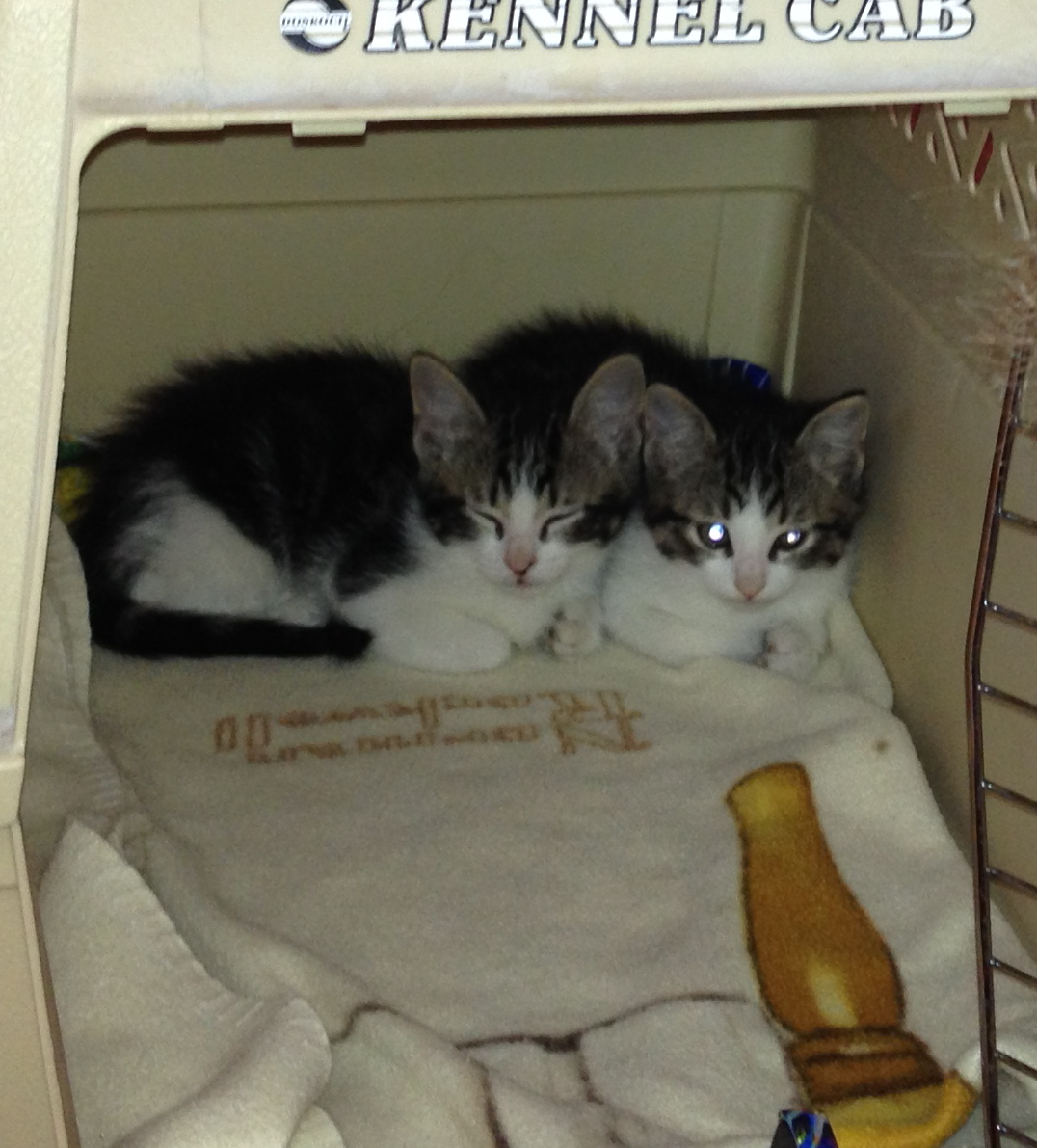
It was less than three months ago, and I cannot remember where we ate because of the conversation about her cats. She had been to the vet the day before, and he said it was time. Also someone had brought had two abandoned kittens to the clinic. The vet felt it would be good for my friend to have pets to bring home. To provide a home for these kittens.

We returned to her house, and I saw the cats hiding under the covers in her bed. They had not moved for hours. It was obvious they were in pain. They were so skinny. It was not a good situation.

I called the vet. (I also called my husband and said there would be no movie.) Then I took my friend and her beloved pets to the vet. I stayed with them during the procedure, while my friend sat in the waiting room and sobbed. I petted them and spoke to them, as did the vet and his assistants. Even though it was time, I still felt the tears well up in my eyes. I remembered them as kittens.   But I also felt that as a Valentine’s Day gift, we were giving her cats the gift of love and peace and relief from pain.

When it was over I went to sit with my friend, as the vet assistants cleaned her carrying case, and put the two kittens in so we could bring them home to my friend’s house. I stayed an hour more helping to clean up and get the house ready for the kittens — to help them and my friend adjust to their new situation. And yes, play with them. I am their godmother.

Kittens came home on Valentine's Day 2014.

Kittens came home on Valentine’s Day 2014.

When I got home that night, I really felt exhausted. I did not exactly feel like celebrating Valentine’s Day.   I had a thought, “Was there something about me that caused my friends to think of me when animals needed to be put down? Was I heartless? Was I cold?”

My children and husband made me feel better. They told me that it was not because I was cold and heartless that I was asked to do this over and over again. Rather it was because I had so much heart and compassion. Because I knew we were doing what was best for each pet.

I believe that is true and I am an angel of Compassion to our pet friends!

Remembering those who passed: Yom Hazikaron

5 May
My son thinking in the map of the communities destroyed at Yad V Shem.

My son thinking in the map of the communities destroyed at Yad V Shem.

In 2005, I took my children and parents to Israel for a family wedding and a three-generational trip. We hired a private guide, as my Dad had a heart condition, and I wanted the trip to be as easy as possible for him.   It was wonderful in that sense. Our tour guide knew all the downhill paths for my Dad to walk.

Although my daughter was in college at the time, my son was just in eighth grade. I was a little concerned about taking him to Yad V Shem and Mt. Herzl. But we went because it was important.

At Yad V Shem, the Holocaust Memorial, my son was uncomfortable, especially when we went through the memorial for the children who perished. But the map of Europe and the destroyed communities felt more comfortable. He walked through that section with my Dad. They stopped at Bialystok, where my Dad’s family had lived before coming to the US. And my Dad told him some stories.  My son sat and thought about what he had seen.

After that it was to Mount Herzl. To see all the grave of Theodor Herzl, who helped to establish a Jewish homeland, and  of young men and women who died fighting for Israel was difficult. My son asked a question, “Why are there some stones with no names, or no dates on them?”

These are the graves of people who came over from Europe, who survived the camps. The first thing they did upon arriving in Israel was to fight for survival again for the independence of the state of Israel. Unfortunately, many of them no one knew their name or their date of birth. Just the day they died.   This is what the guide told my son.

We continued walking through the cemetery to the graves of famous people, when I realized my son was missing.   I did not want to go yelling through a cemetery, but I was concerned. So we all split up looking for him.

Then I saw him putting stones on a grave. This is a Jewish tradition. We do not leave flowers, we leave stones as remembrances.. This is an old tradition, and I am not sure why. But I think perhaps as we return to dust, we become part of the ground. I could be wrong.

In any case, there he was putting stones on the graves of soldiers.

“What are you doing? Why did you leave us?” I demanded.

“Mom,” he said. “I am putting stones on all the graves of people with no names. I wanted to make sure someone remembered them. I wanted them to know someone loved them.”

My heart; my son. I still cry for these unnamed soldiers. And I still cry remembering the love in my son.

Yom HaZikaron. We will always remember.

Speaking Yiddish Always Brings Me Holocaust Memories

28 Apr

My maternal grandparents were from Poland and Galicia. They came to the United States in the 1920s. Met and married when Grandma was 19, Grandpa was 29. At home they spoke to each other only in Yiddish, although both learned to speak excellent English. And Grandma was a ferocious reader in several languages.

When I stayed with them, they spoke Yiddish to me as well. As a young child I could respond and easily speak to them. But that ended when my parents realized that my siblings and I spoke and understood Yiddish. They had been using it as a secret language to discuss finances and personal matters. So the order went out…stop speaking Yiddish to the children. My Mother, in later years, would tell me that she regretted making that demand.

But Yiddish connected me to my grandparents. And I studied German in high school and Hebrew in college. Then I spent a year in Israel at Hebrew University. While there I spent so much time with my great uncle and great aunts, who spoke Yiddish at home. So my Yiddish slowly improved, and I became more fluent.

The kneeling sailor is speaking to my Mom;behind her my Uncle; behind him my Grandma.

The kneeling sailor is speaking to my Mom;behind her my Uncle; behind him my Grandma.

My Grandma’s family was lucky. She went to Europe in 1931 with my Mom and Uncle and stayed for six months. When she returned to the US in 1932, she told my grandfather that they had to get everyone out. And she started the process. She was able to get visas for her father and sister. They made my great aunt younger than her real age, so she could come in on her father’s passport. Her brothers and their wives were not as fortunate. But they did survive the war.

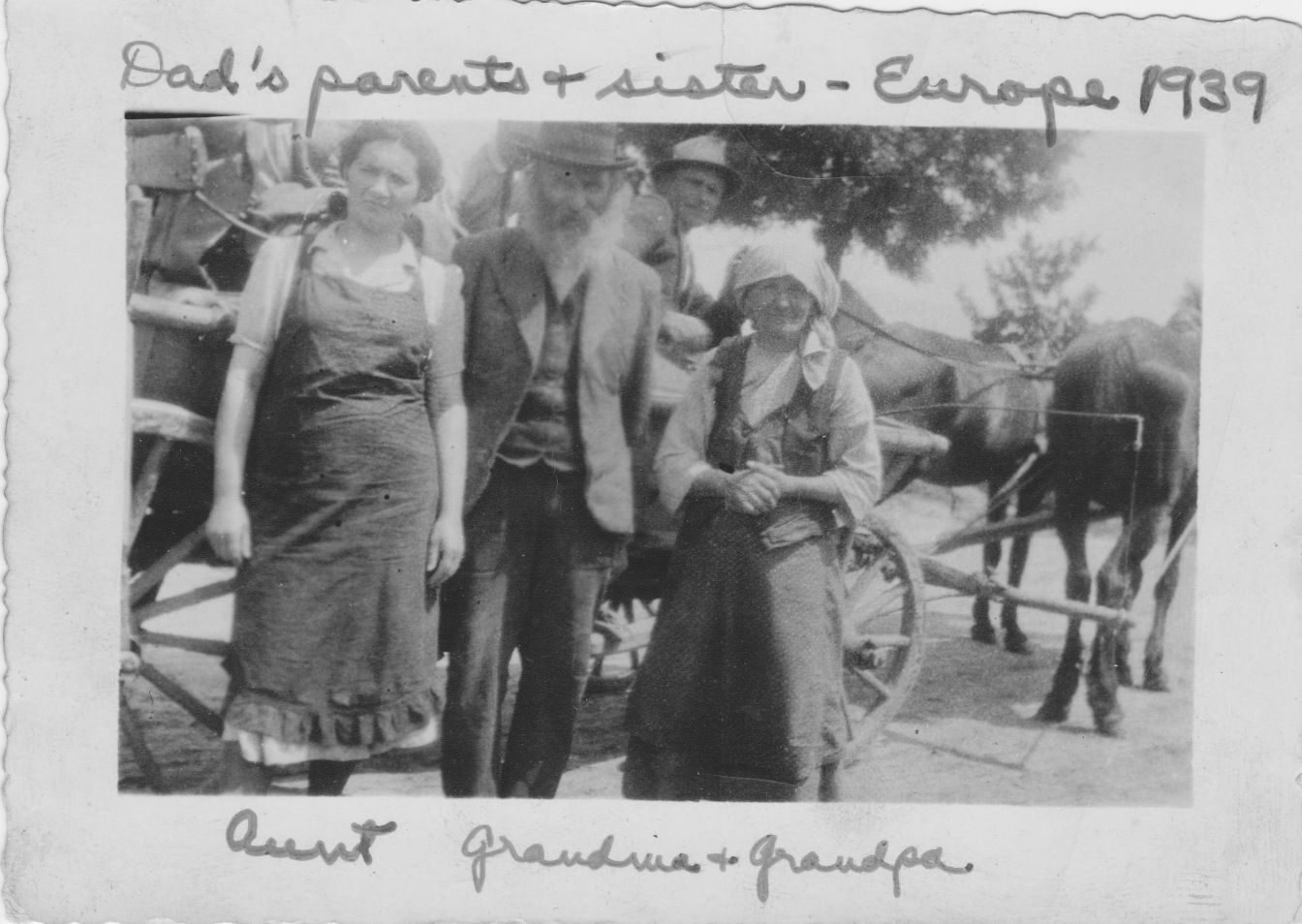
My great aunt Tova, my great Grandparents Gimple and Chava. The man driving is an Uncle. And the horses and cart they bought with the money my grandparents sent. They all perished.

My great aunt Tova, my great Grandparents Gimple and Chava. The man driving is an Uncle. And the horses and cart they bought with the money my grandparents sent. They all perished.

My Grandpa’s family was not fortunate at all. They all perished. My grandparents did send his parents money and visa to come to the US. But they could not believe what would happen. They took the money and bought a horse and cart. They did not want to leave their other children and grandchildren. And my grandparents could not get everyone visas.

My mother used to tell me that every morning after work, when he found out that his entire family was murdered, my grandfather would sit in the kitchen and cry. He was a baker…up all night. But before he went to sleep for the day, he cried for all he lost.

In the meantime, my grandparents thrived in the US. They had two children, five grandchildren; two businesses, both a bakery in New Jersey and a bungalow colony in the Catskills.

Grandma wrote to her brother in Israel often. When I went as a college sophomore, I spent a year of college at Hebrew University. I had a cousin who was my age, and my great uncle and aunts (one uncle had died in the 1950s.) I met a few other relatives who had survived the Shoah. But no one ever spoke to me about it. I was young. But my Hebrew and Yiddish were improving rapidly.

Then when I was a junior in college, I took my Grandma to Israel with me during winter break. She had not seen her brother in 42 years. We spent a month together. A month I will never, ever forget.

The phone calls at the hotel would be in Hebrew. Someone would call and speak to me. “I understand the Tova S. is here,” they would say. “Yes,” I would respond. They would then ask genealogy. Who were her parents? Where did she live? When all the right answers were given, I would hear. Yes. She is my mother’s or father’s or someone’s cousin. And they would set up an appointment to meet with us: to see my Grandma.

And the holocaust became real to me. Each person in Yiddish told my Grandma their story of how they survived the Shoah. And who had died during that horrible time. If I did not understand a word, Grandma would translate. Sometimes they would tell me the word in Hebrew. Day after day, week after week, I heard so many stories.

But then came the worst of all. Rafael came. I knew him and his wife and daughter. His mother and my great grandfather were siblings. Rafael and his wife had never spoken to me about their experiences. But when Rafael saw my Grandma, it was an outburst of pain and crying from both of them. Rafael was my Grandma’s first cousin. His sister, Tova Malcha, had been my Grandma’s best friend. And Tova Malcha had not survived. When Rafael and Grandma met their memories overflowed. Not only on death, but on the lives they had left behind.

At that moment, at that time, my Yiddish was at its best. I understood all.

After Rafael left, I asked Grandma why no one had ever told me these stories? Why I had not met all these people who kept showing up? Why Uncle had only introduced me to a few of the relatives when I spent my year there?

There was no answer.

When we returned to the US, my Grandpa was so happy to see Grandma. “Never leave me again,” he said. He did not come with us, because he refused to ever leave the United States.

She never left him again, till she died.

And I never speak Yiddish or hear Yiddish without the images and sounds of that month in Israel and the Shoah ever present in my mind.

Why I thought An Iguana Urinating on Me Was Good Luck

27 Apr
The offending iguana before he was chased.

The offending iguana before he was chased.

I knew the moment the teen-aged boy chased the iguana that something was going to happen. The lizard had been happily sunning itself on a ledge about five feet above me and to the left just minding its’ own business and watching the ocean.

I was sitting on a little ledge below taking photos of my husband and a few others in a pool with two giant green turtles during a supervised turtle encounter. This was a preserve for all turtles on St. Thomas that were injured. Most were returned to the wild, these two were too badly injured to ever leave.

The shade and the breeze made sitting there perfect. While walking around the Coral World sea park, I had been warm and a bit uncomfortable. But here I was so comfortable that I put down my water bottle and focused on taking photos, until the iguana started running from the teen.

It went scurrying on the ledge above me. I looked up at the teen, and in my best mother voice said, sarcastically, “Thanks, that was really nice of you!” He got the message and left. The iguana did not leave. He was still, with his tail hanging over the ledge. I had nowhere to go, as I was sitting just above the pool in a restricted area on a small ledge. So I went back to taking photos.

My ledge.

My ledge.

Then I felt it.   A rain of urine fell on my arm and back, as well as landing all over my water bottle. I jumped up, luckily before the rest came out. I think I shrieked because everyone in the turtle pool looked at me, even the turtles. They actually swam over to where I was standing and popped their heads out of the water to look at me.

The turtles came to check me out after I screamed.

The turtles came to check me out after I screamed.

Sorry,” I said, “but an iguana just urinated on me.”

“I took some tissues out of my purse to clean off my arm. I could not reach my back. The biologist apologized. “For what?” I asked. “This is life. He didn’t do it on purpose. I was just startled. And my son is going to love this story.” We all laughed.

We always had lizards at home when my son was growing up: geckos, newts and snakes. He wanted a bearded lizard, but I ended that idea. So having an iguana urinate on me and defecate near me was not a big deal, just disgusting!

But the strange thing is being urinated on brought back a memory of my Mom. I was in college, but home for a vacation. My Mom and I went shopping on the Avenue in West New York. She was telling me about her days in college at the New Jersey College for Women, which was part of Rutgers. (Later it became Douglass
and then just Rutgers.)

In any case, she told me about the time she was walking to class and a bird pooped on her. She was so upset. She could not decide whether to go back to her room and shower again, or go to class. Class won out. When she told her mom, my grandma, her response was that when a bird poops on you it is good luck.

The best part of the story, as she told me, a bird pooped on my Mom, as we walked down the Avenue, all over her top. We were both so shocked and just started to laugh. We cleaned her off with tissues and continued on our way.  Later, when we told what happened to my Dad and siblings, we went inside. We were afraid if we told it outside, another bird would come along.

So when the iguana urinated on me, after I got over my shock, I wondered, “Good luck?” And I decided, “YES!” It brought my Mom alive for a minute as I remembered her bird encounters, which brought a smile to my mind.

And it provided me a wonderful story that I know my son (and daughter) will love!