Archive | Travel RSS feed for this section

Five Highlights Of Our Mexico Cruise

13 May

For 14 days in April we cruised down the coast of Mexico and into the Sea of Cortez on the Holland America Zaandam. We had a fantastic time. Here are five of my six favorite places that we visited. One place needs its own special blog.

Orchidarium in Manzanillo, Colima.
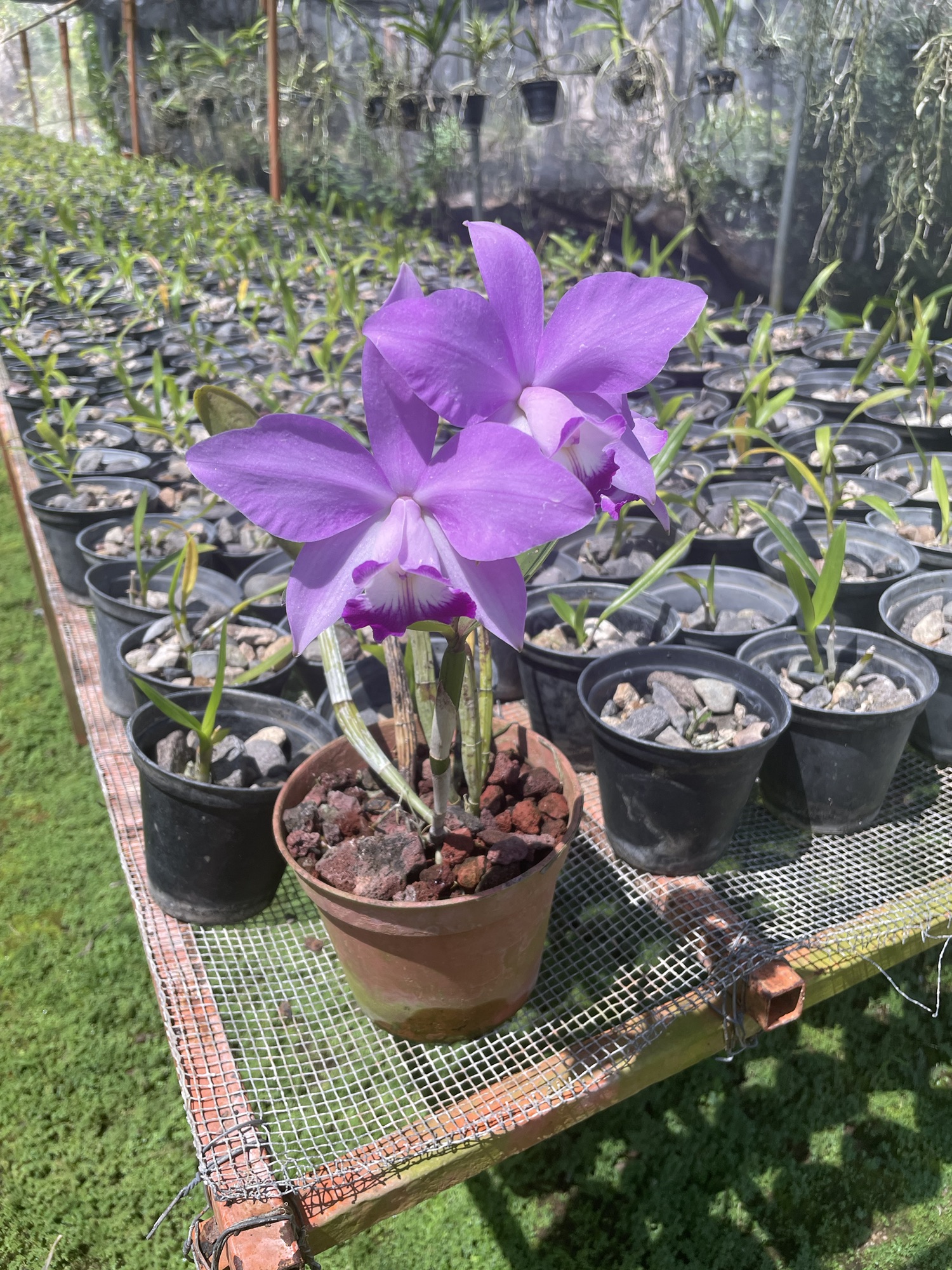
Our visit to the Orchidarium was great.  We got to see orchids in many different stages of growth, but most important, the owner gave us a great deal of information about growing orchids. For years I have been trying to grow Orchids. I have failed every time.  The longest I have kept my orchids alive is two years.  Now I know why. 

First: Orchids like fresh air and shade.  I had my orchids near a closed window on the south side of my house.  The sun was too harsh on the leaves.  Not having an open window made it sad.  Orchids live on air.    My next orchids will live in an area that only has morning sun and is near a window that opens.

Second:  Orchids do not like a lot of water!  You do not need to water them every week.  You only water them when the roots are bone dry.  Also they must be in a pot with many holes so that the water drains out.

Finally repotting an orchid puts it into decline.  Only repot an orchid after the flowers fall off.  Then do not be surprised if it doesn’t grow for a year.  I did wait to repot mine after the flowers fell.  But I thought it had died too soon.

Zihuatanejo/Guerrero:
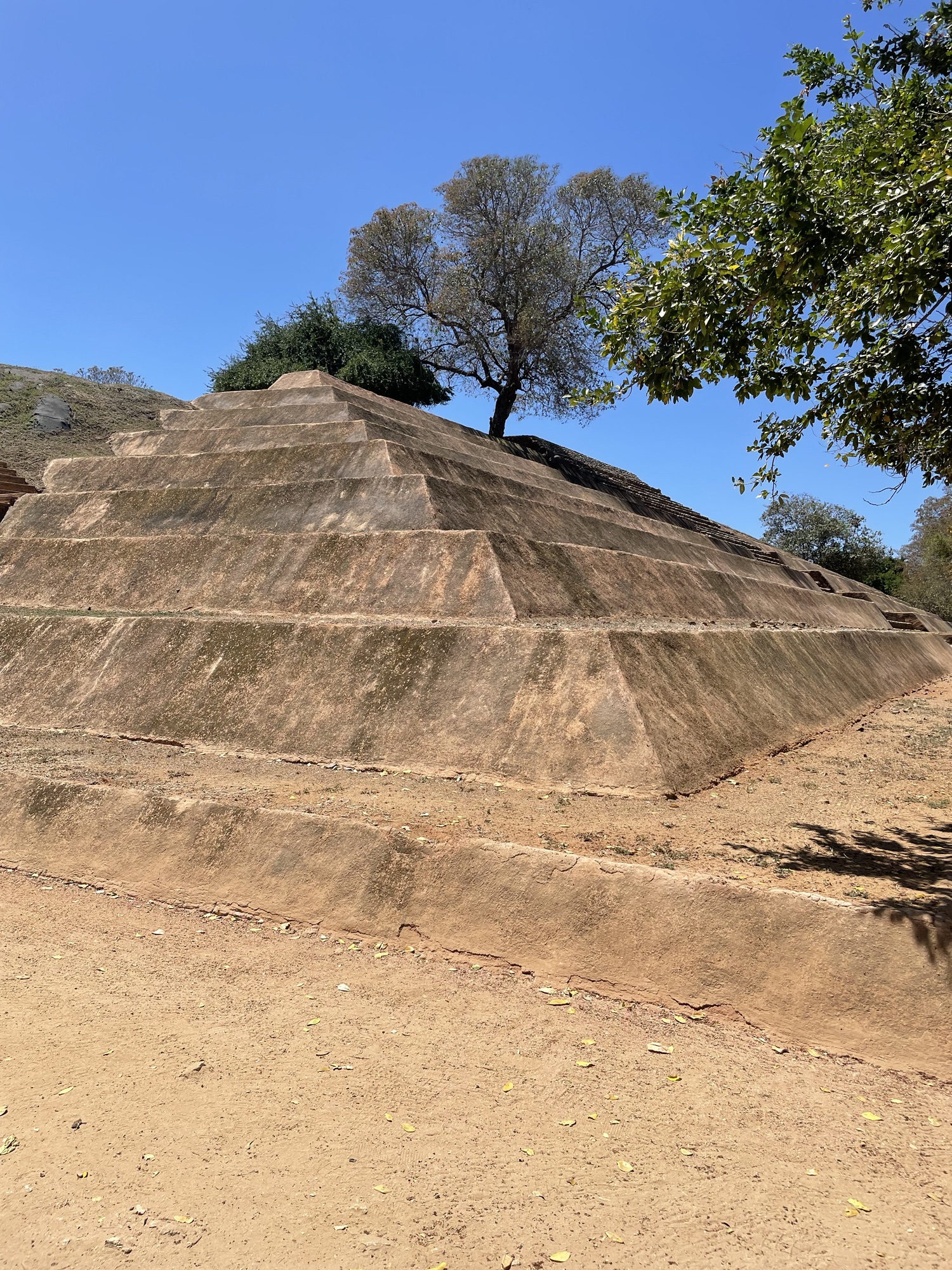
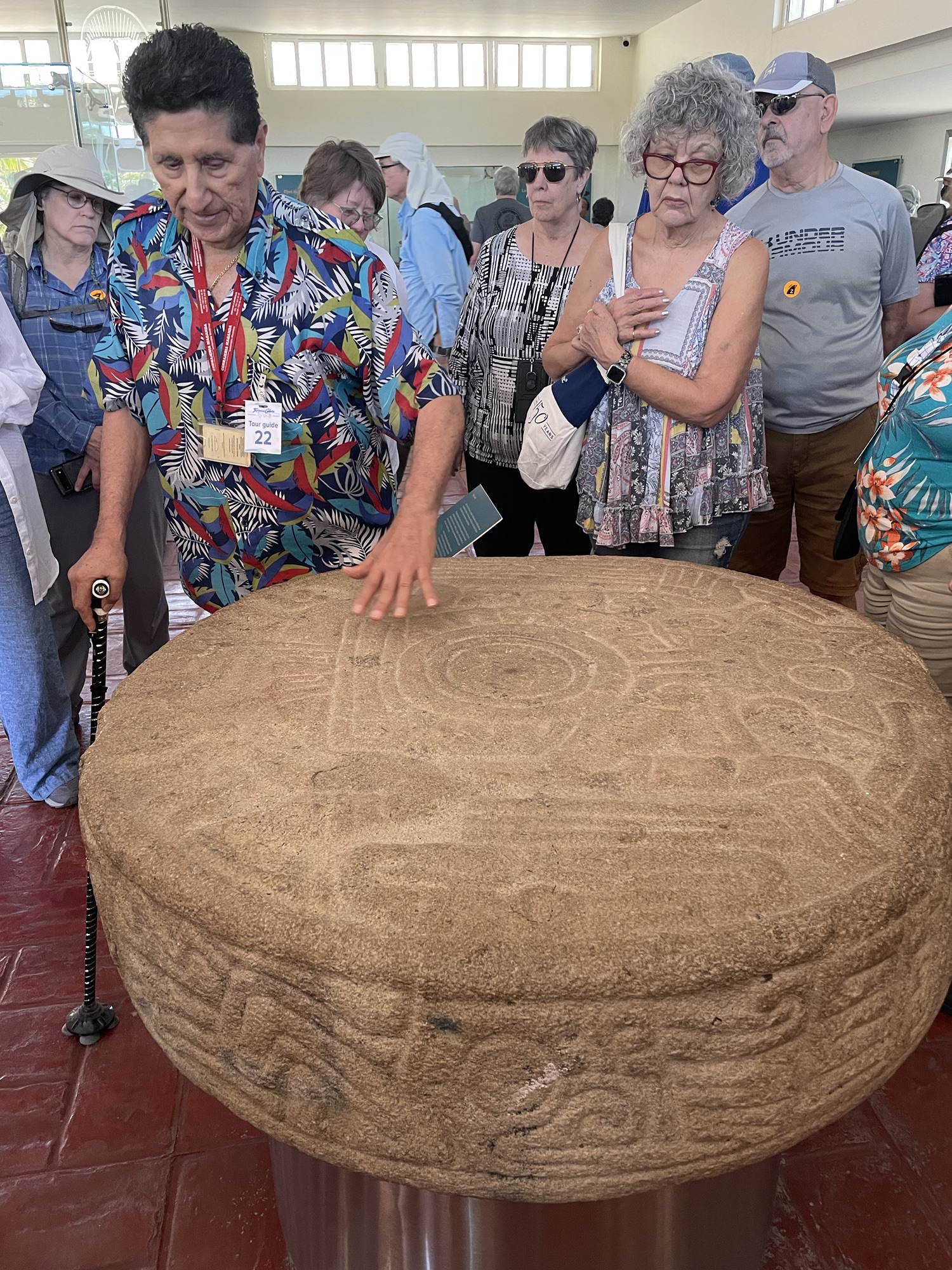
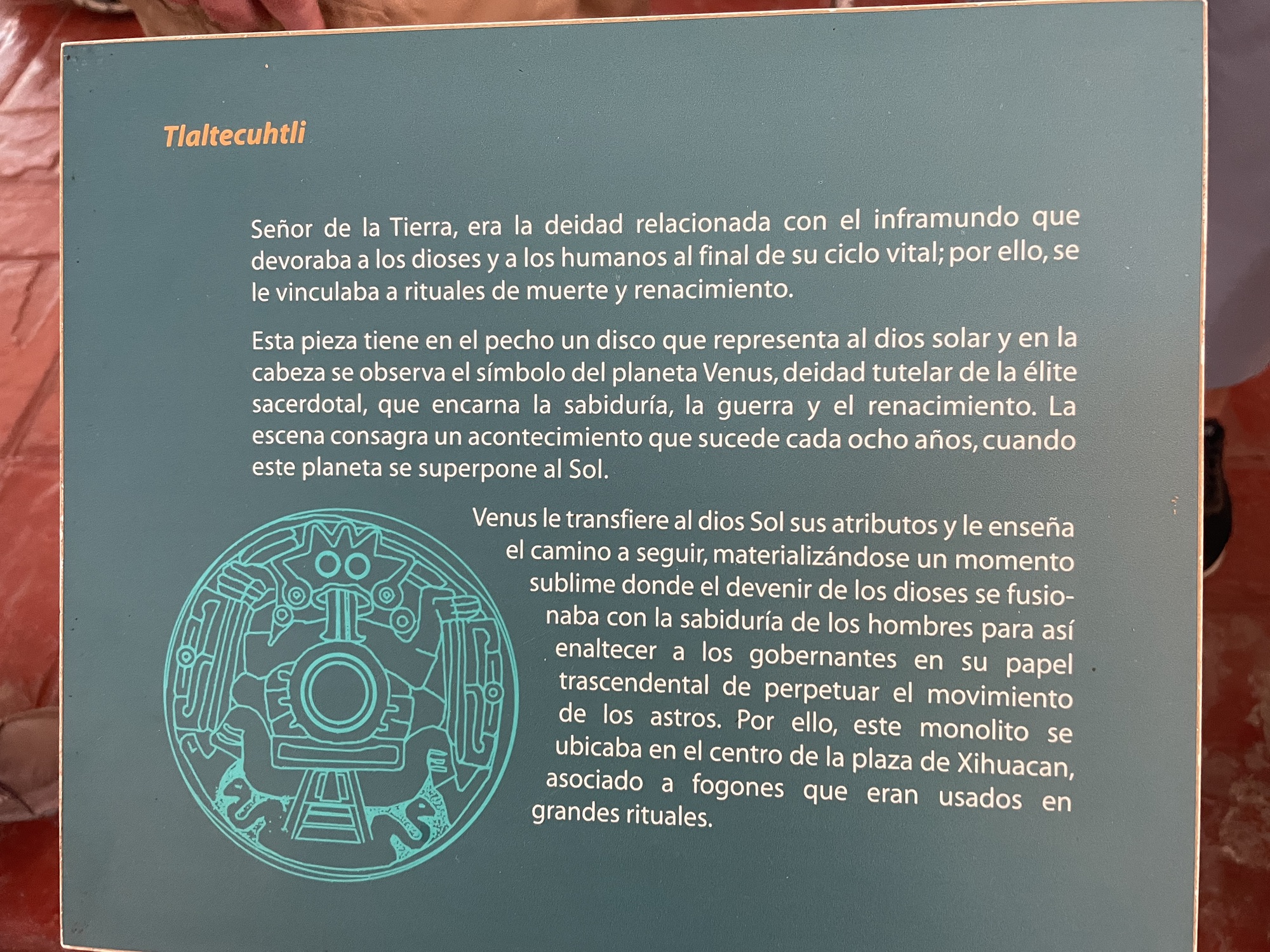
We went to the Xihuacan archelogical site in Gerrero near Zihuatanejo.  I will say that our tour guide for this trip was very proud and inspired to tell us all about the museum and the two area we were able to see, including the very large Mesoamerican ball court. In the museum was the sacrifice circular stone that represents the goddess of the earth. I did not climb up the steps of this pyramid because on our last trip, I fell a bit coming down.  I vowed not to climb any steps without handrails again.  I just watched my husband climb up and enjoyed seeing his photos.

I love learning about the early civilizations, and I have written about our visits to other Mayan, Aztec and Mesoamerican sites in other blogs. The amazing aspect about this site is that most of it is still buried under vegetation. Just a small area has been reclaimed. But I found out from our tour guide that there are so many of these sites, they just cannot afford to uncover all of them! (See blog below.)

Oaxaca and Zapotec Textiles

Oaxaca is known for its wonderful textiles and embroidery.  This is the stop I was waiting for because I love textiles. My Dad owned an embroidery shop when I was little and worked in the textile industry for years.  I am a crafter who focuses crochet now, but I did embroidery, crewel and sewing for many years.

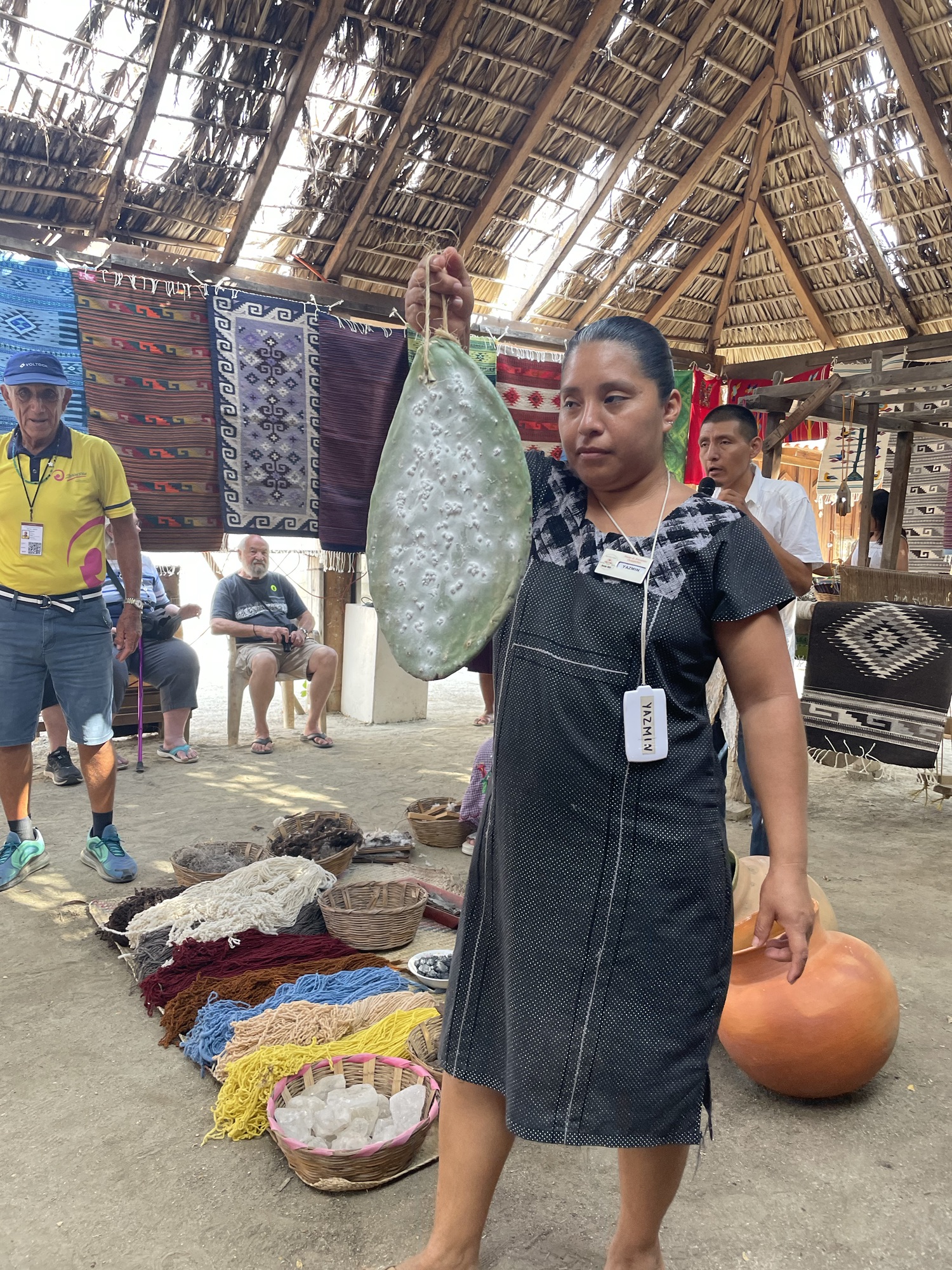
We had a wonderful time visiting with a family from the Zapotec tribe that weaves using wool and cotton that they produce, using dyes that they make from the cochineal bugs. We saw these bugs on the leaves of the cactus. We saw how the colors change by adding natural substances like lemon juice or baking soda.  We watched the weaving and we saw the undyed and dyed yarns.  The weavings were stunning, and I had to get myself one of the woven cotton shawls.

La Paz

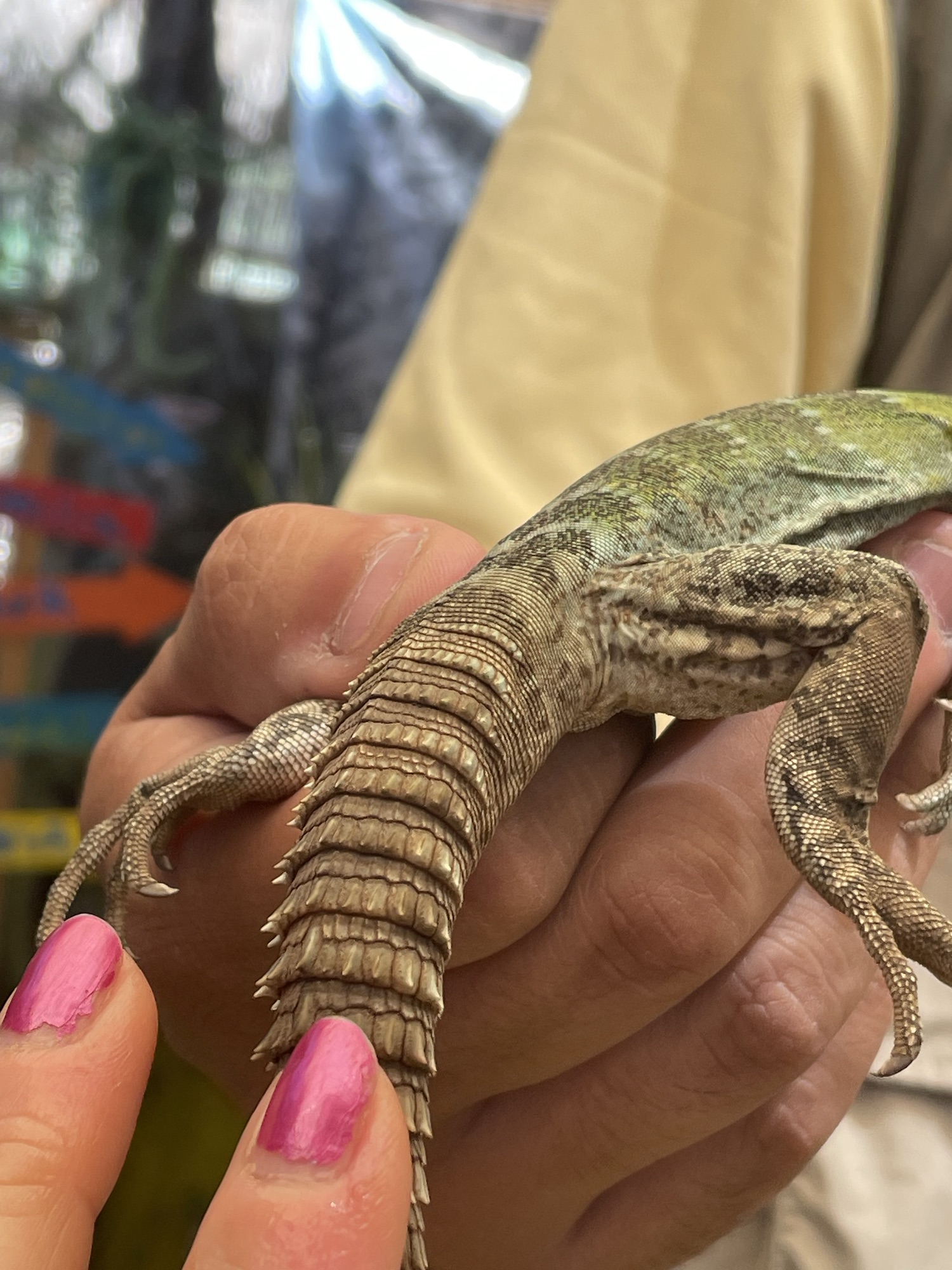
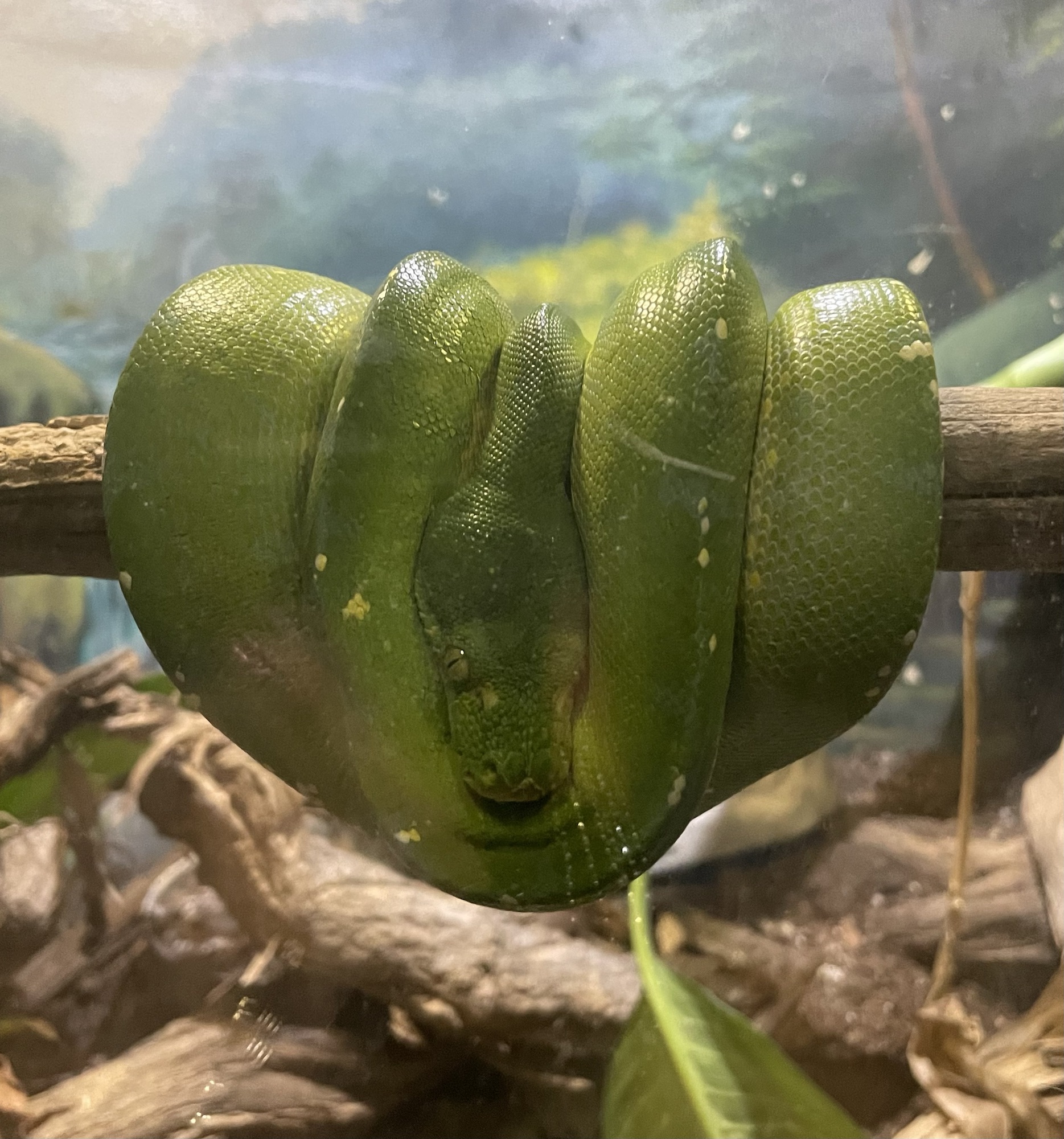
El Serperntario Reptile and Wildlife Rehabilitation Center.  Marcos, our guide was fantastic for many reasons, but the most important is that he loves the Serpentario. He is a volunteer there besides being a tour guide. His love showed throughout our private presentation.  The Serperntario was founded to rescue and rehab reptiles and snakes and to take those reptiles and creatures that are not indigenous to the area out of the community so that they do not kill the local species.   I got to pet the tail of an spiney tailed iguana!

To be honest we went to see this because when our son was young we house his fire bellied newt, two geckos and a ribbon snake. So as a mom I had experiences with lizards and snakes. Also, as a young girl I loved salamanders!  Although I do not especially love reptiles now, I am interested in their survival.

There are giant turtles, snakes of all sizes, multitudes of iguanas and many other unusual creatures living safely behind the walls of the Serpentario.  The gift store has some cute items.  But I focused on getting a t-shirt for my adult child.  It was a necessary purchase!  And all proceeds help to fund this not-for-profit center.

Cabo San Luca/Blown Glass Factory:

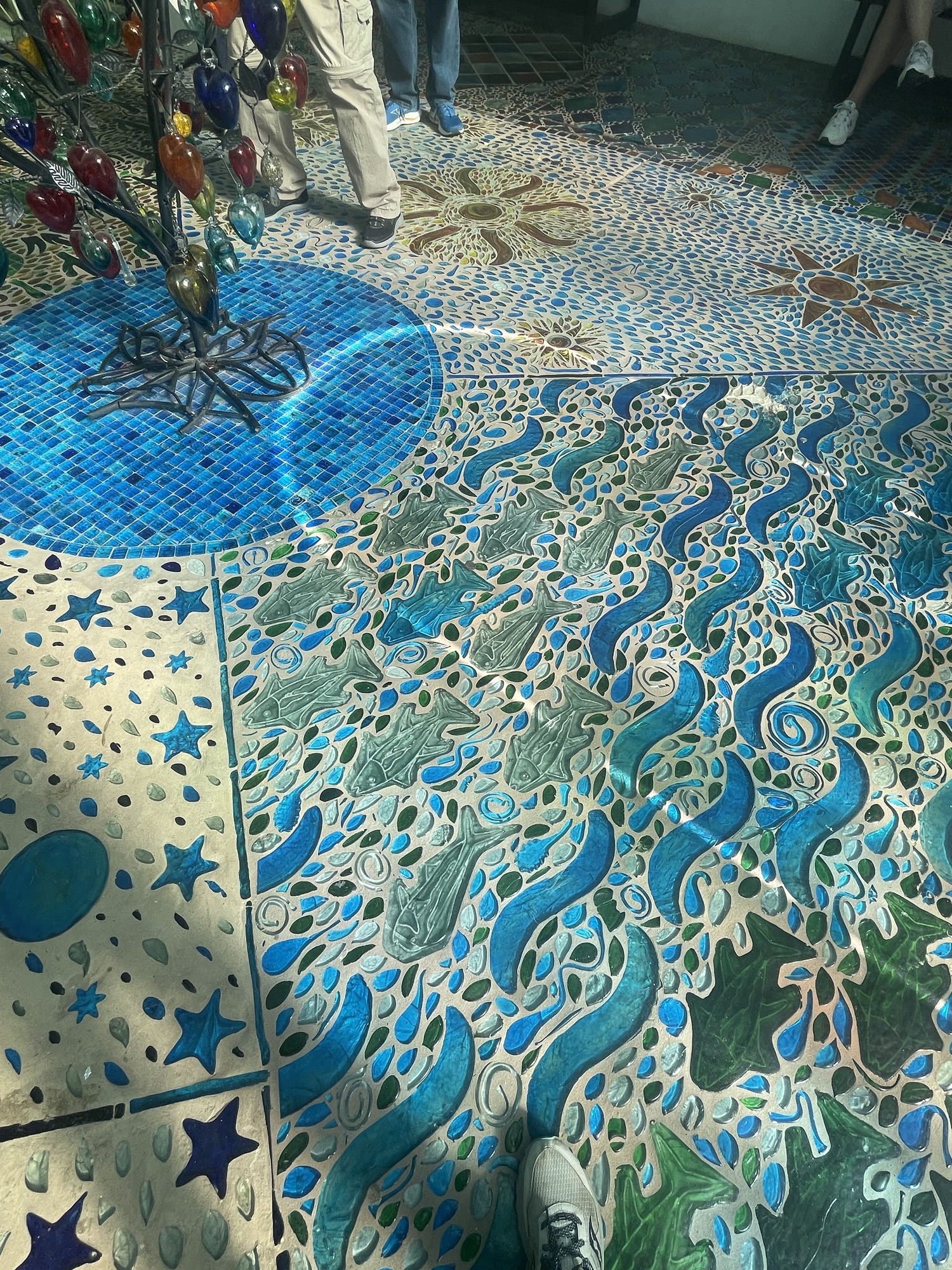
I have spent a week in Cabo San Luca. So when we were there on the cruise I wanted to do some touring. I am so glad we did. We had the chance to visit the Blown Glass Factory. What a delightful and beautiful spot! Besides helping the environment by using recycled glass to make their lovely objects, the building itself is a glass gem! Just walking though and looking at the ceiling, the glass art and the objects for sale is a joy. We got to see two artisans make a whale, and we learned how the glass factory came to be. We are going back to Cabo in January. I plan to visit again and this time buy something to take home!!

https://en.wikipedia.org/wiki/Xihuacan

https://en.wikipedia.org/wiki/Textiles_of_Oaxaca
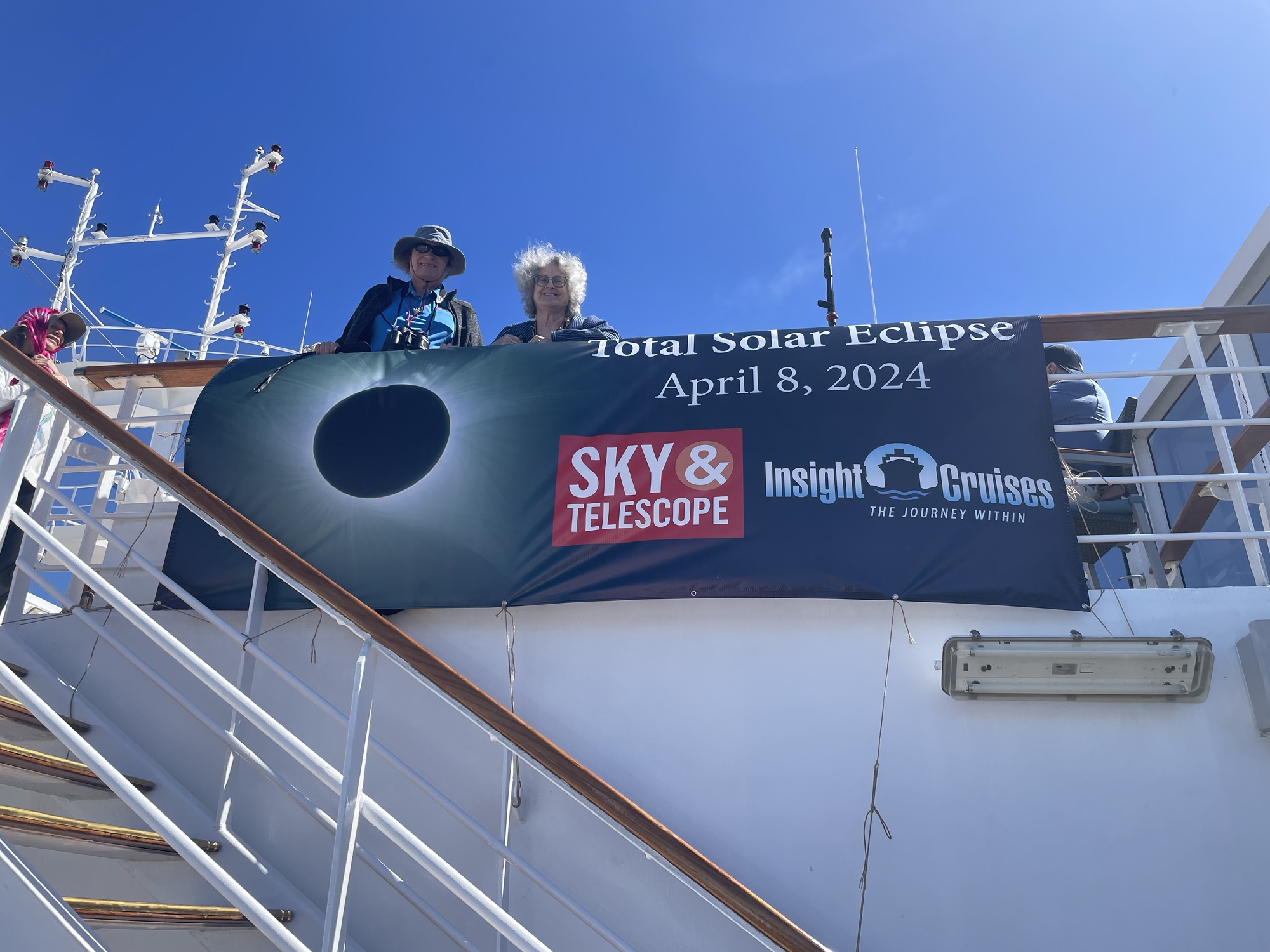
As Umbraphiles, we Loved The 2024 Eclipse!

29 Apr

We are eclipse chasers or umbraphiles. The first time I heard that word was from a fellow eclipse chaser with whom we have seen three eclipses. I was shocked that there was a special word to describe this passion.   But, eclipse chasing is a topic in Wikipedia, which does an excellent job describing those who travel to see eclipses.

“Eclipse chasing is the pursuit of observing solar eclipses when they occur around the Earth[1] Solar eclipses must occur at least twice and as often as five times a year across the Earth. Total eclipses may occur multiple times every few years.[2]

A person who chases eclipses is known as a umbraphile, meaning shadow lover.[3] Umbraphiles often travel for eclipses and use various tools to help view the Sun including solar viewers also known as eclipse glasses, as well as telescopes.[4][5]   “    Eclipse chasing/Wikipedia.  See link below.

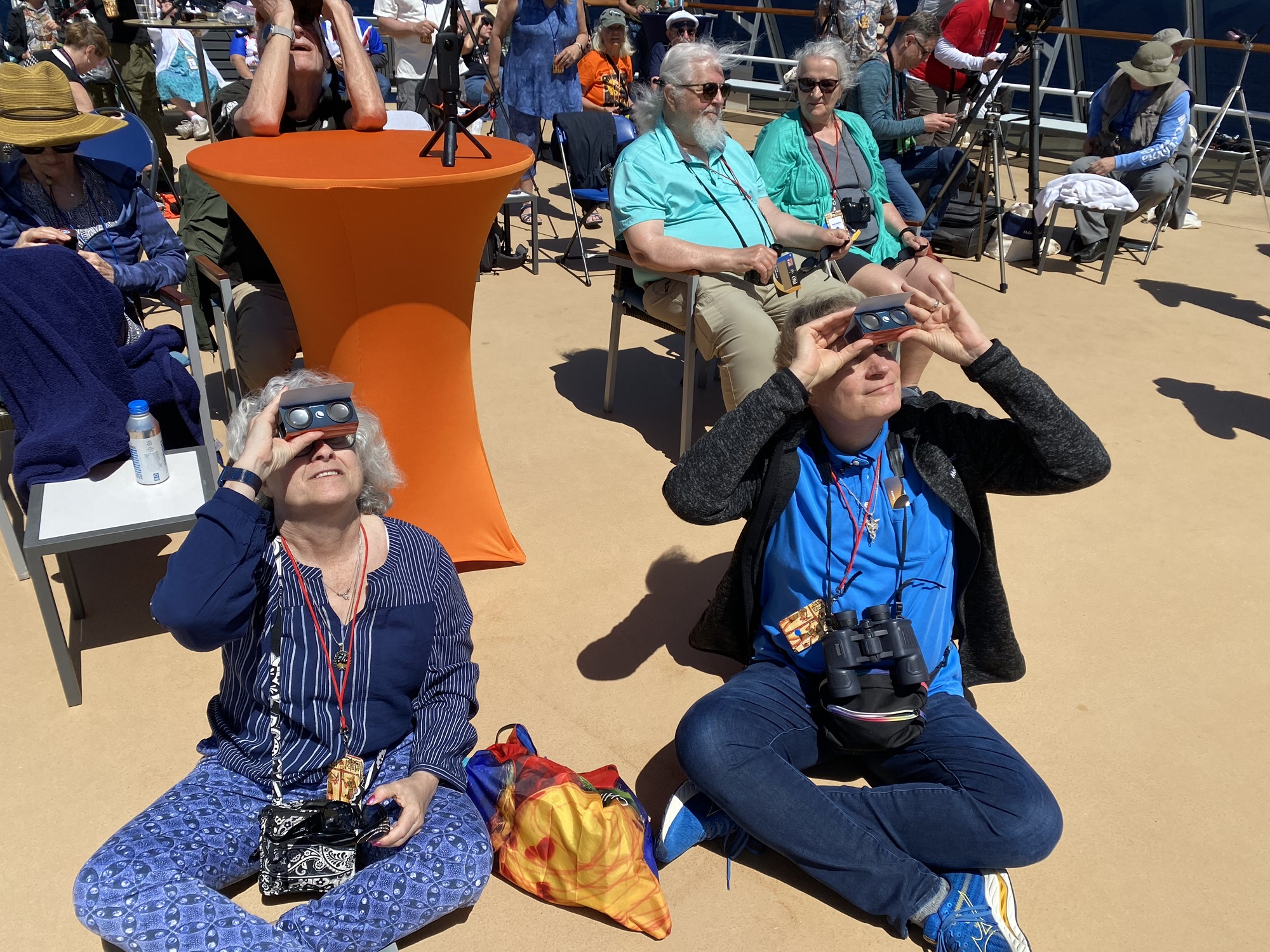
In Early April I saw my sixth total eclipse along with 1700 people on the cruise ship, Zaandam, 100 miles off the coast of Mexico as part of a Sky and Telescope/Insight Cruises group. When I was a teenager in New Jersey, I saw my first eclipse.  With my husband, in our eclipse chasing, we have been off the coast of Aruba in 1998; in Austria/Hungary in 1999; off the coast of Greece in 2005; in Jackson Hole, Wyoming, in 2017; and now in the Pacific Ocean. 

Once you see a total eclipse of the sun, it envelops you with its majesty and awe.  You easily understand why primitive people were petrified when then sunlight disappeared and darkness and chill covered the Earth.  Even today, with all the information about eclipses, you can hear it in the voices of the people who know exactly what is happening, but still are overcome.  Especially those who are seeing their first eclipse.  Many often say. “This is my first one, but it will not be my last!”  And if they have the means, I know it is true.

The Captain of the cruise ship was one of these first timers.  He did everything he could to get us on the path of totality aware from clouds. This meant traveling 100 miles off the coast of Mexico and centered on the eclipse path!  He was as caught in the excitement as everyone else, passengers and crew, spending time with the passengers.  “ Many asked, who is driving the boat.” And “Are all the crew members getting to see it?”  Arrangements were made so that everyone who wanted to could take a quick peek outside.

On this cruise, there were 250 in our group under the auspices of Sky and Telescope/Insight Cruises, and 100s of others who came with other astronomic groups to see the eclipse. There was even a group of Trekkies who came in association with our group. 

Astronomers, both professional and amateur, astronauts, physicists, college professors, scientists, and many ordinary people like me, who just love the thrill of seeing the sun go black and the corona become visible. 

To feel the cool breezes as the sunshine diminishes.

To see the heightened shadows and the ripples in the ground.

To see the darkness overhead, while all around in the horizon, there is light.

My husband says this is where the word AWE came from. The awe of the total eclipse of the sun.

We umbraphiles own welders glasses, obsidian, special viewing glasses, binoculars, telescopes and other special materials to make our viewing the best it can be.  We, personally, do not bring telescopes. But those who do bring them are often eager to share their equipment for others to get a peek. But we do bring binoculars which were great to see the sun at totality and also to see the two NASA jets high in the sky chasing the eclipse!

The art of making pinholes that allow miniature partial eclipse to slip through brings joy to some.  People have colanders or straw hats so they can see dozens of partial eclipses showing on the ground of on white paper. Some make pinhole designs to capture a unique view of the eclipse.

It is true that before, during and after the eclipse, there are people humming the melody or singing out loud the words to “I’m Being Followed by a Moon Shadow” by Cat Stevens. I am one of the hummers.  Actually, we are following the moon shadow.

On our trip were many who had seen over 10 – 12 eclipses.  They go to every one possible.  My husband and I have missed some we wish we could have seen. But we make an effort to see as many as we can. We have spent close to 25 minutes in the darkness of the moon’s shadow in totality. And yes we already have plans to see one off the coast of Spain in 2026!  If you get the chance, chase at least one eclipse.  You will not regret it!

https://en.wikipedia.org/wiki/Eclipse_chasing

Olathe, Kansas, Field Trip for our Anniversary

24 Mar

As I have written before, I love museums.  So for the last few years, my husband and I have discovered new places on field trips close to home to visit. The last two years, we have spent our anniversary day seeking new places to see. (See blogs below.). This year I focused on two sites in Olathe, Kansas.

First stop, Museum of Deaf History, Arts and Culture, A Deafhood Institute. I became intrigued by the site and the museum when I served on jury duty at the courthouse in Olathe.  Each morning and afternoon I would drive passed the Kansas School For the Deaf. and think that we should visit it. There is a personal connection as my husband is a member of the hearing impaired community and has needed hearing aids for the past six years  My interest piqued when the school I worked at added sign language to the curriculum and I met two people who taught there.

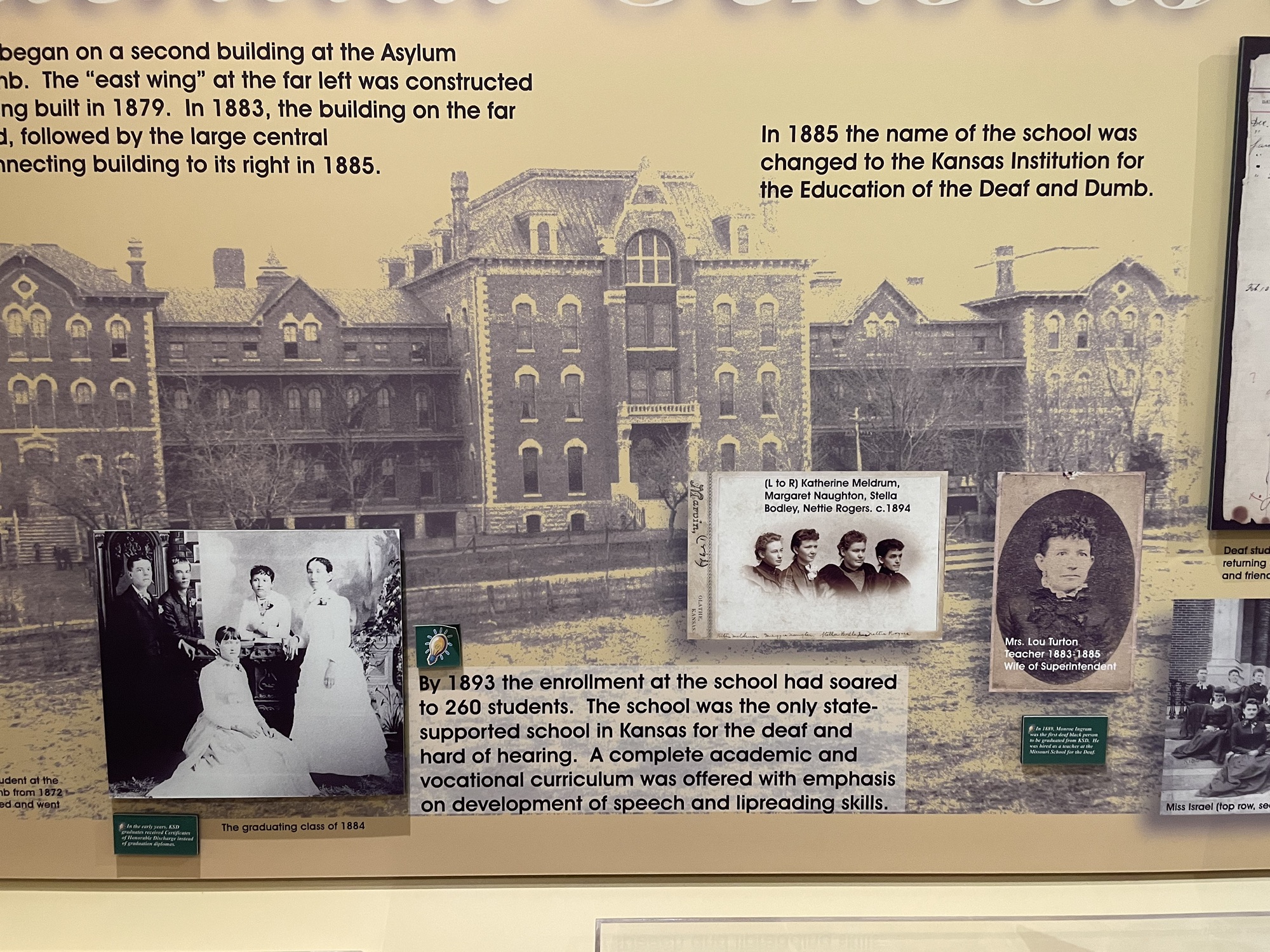
The school was established in 1861 as the Kansas Deaf-Mute Institute.  Its’ name changed over the years, using words we no longer use to describe it.  It received its’ current name in the early 1900s. The school serves Kansas children starting at age 3 and continuing through age 21. Its mission is: “To ensure that all students we serve achieve their full potential in a language-rich environment.”

The Museum of Deaf History, Arts & Culture was founded in 1988, with the museum building opening across the street from the school’s campus in 2001 and getting its name officially in 2017.

I was intrigued to see the changes in how the deaf community has been treated over the years and the rise of abundant social, cultural and educational opportunities.  Learning how sign language came to the United States through a French educator and how that changed the lives of many deaf people to me was important to know.

 For me the most interesting was watching a 17-minute documentary about the deaf community of Martha’s Vineyard.  This island had a larger than normal population of deaf people.  A large percentage of the population of the island used sign language and spoken English to communicate. Offically called Martha’s Vineyard Sign Language (MVSL), it was used until the 1950s. With the development of American Sign Language, this local sign language slowly disappeared. However, some of the signs in American Sign Language come from MVLS. 

Also known as the William J. Marra Musuem, the museum is opened Wednesday through Sunday from 10:00 am to 4:00 pm.  It is free, but there is a donation box at the entrance.

About a mile from this museum was our next stop, The Mahaffie StageCoach & Farm Historic Site.  I had been there almost 40 years ago when I worked for the local Girl Scout Council for a large scout event.  I remember it as a small site with the main limestone house that was built by the Mahaffie family on land that bordered the Santa Fe Trail and ended being used as resting stop for travelers both on wagon trains or stagecoach. 

The house was built in 1865 by Beatty and Lucinda Mahaffie as a home for their family of eight children, it is one of the last remaining stagecoach stops left! Their farm was one of the most successful farms in the area.  And even though the trains brought the end of the wagon trains, this farm survived!

Now operated by the City of Olathe Parks and Recreation Department, it is a much larger restored site than I remembered.  There is now a large Agricultural Heritage Barn and the Heritage Center to explore that has exhibits and information about the family and life in the 1800s.

When we went on a Friday afternoon, the main house was closed. However, we were able to explore the Heritage Center and walk around the grounds of the farm and the buildings.   During this time of year, the house is only open on Saturdays. But between Memorial Day and Labor Day it is open from Wednesday through Sunday and has living history activities, which are also available on weekends in April, May, September and October. Cost is $3.00 a person.

https://www.ksdeaf.org

https://www.museumofdeaf.org

https://en.wikipedia.org/wiki/Martha%27s_Vineyard_Sign_Language#:~:text=Martha’s%20Vineyard%20Sign%20Language%20(MVSL,to%20participation%20in%20public%20life.

https://www.mahaffie.org

https://wordpress.com/posts/zicharonot.com?s=Anniversary

Illinois Holocaust Museum: A Response to Jew Hatred

12 Dec

During Covid, I tried to do as many activities that I could from the confines of my home.  I took online classes, I attended family life events, I even toured museums and their special exhibits.  One of the best ones I toured was the Ruth Bader Ginsburg exhibit at the Illinois Holocaust Museum located in Skokie, Illinois.  So when I knew my husband and I were going to Evanston, Illinois, for a wedding, I put visiting this museum in person at the top of my list.  It did not disappoint.

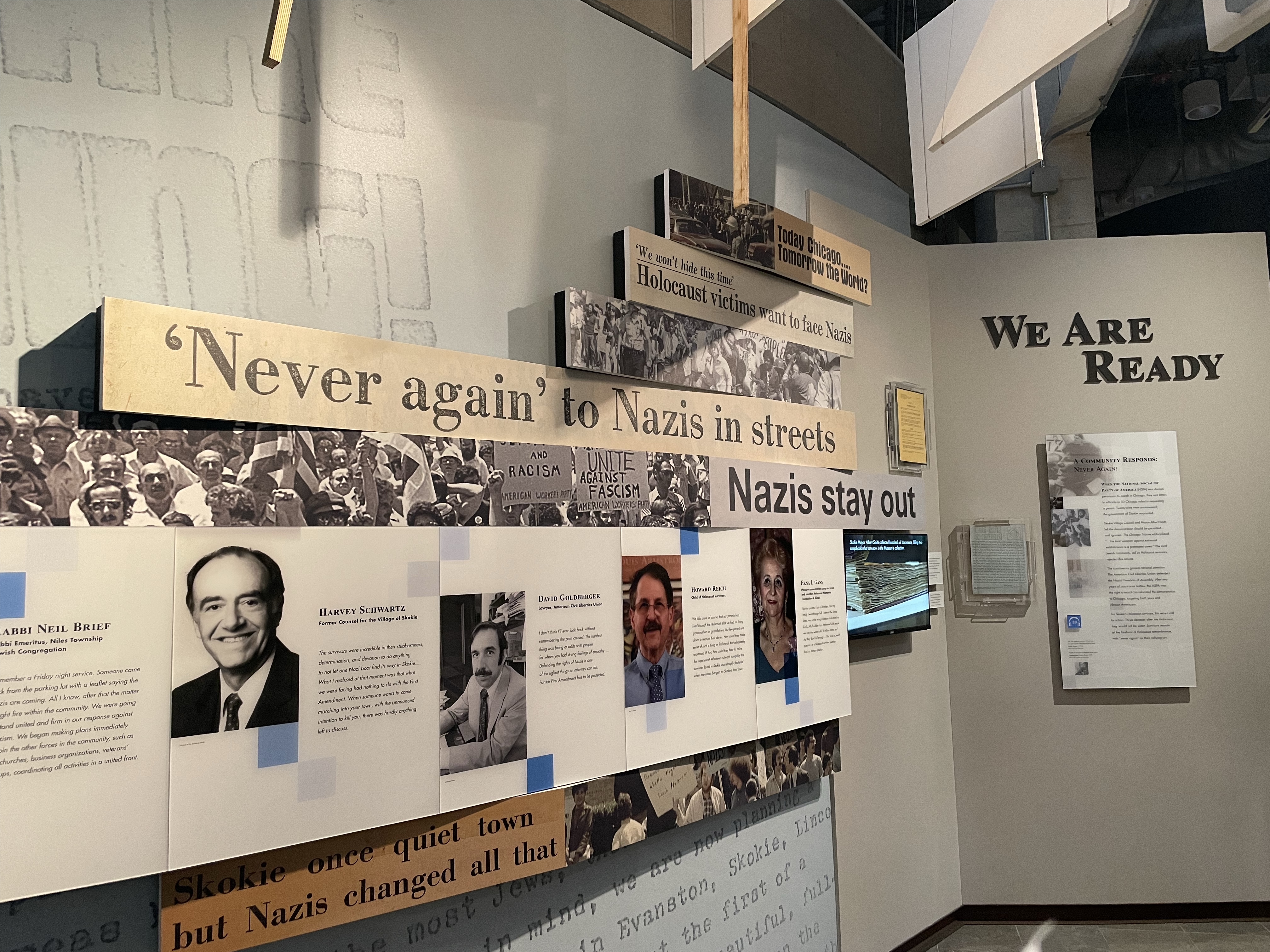
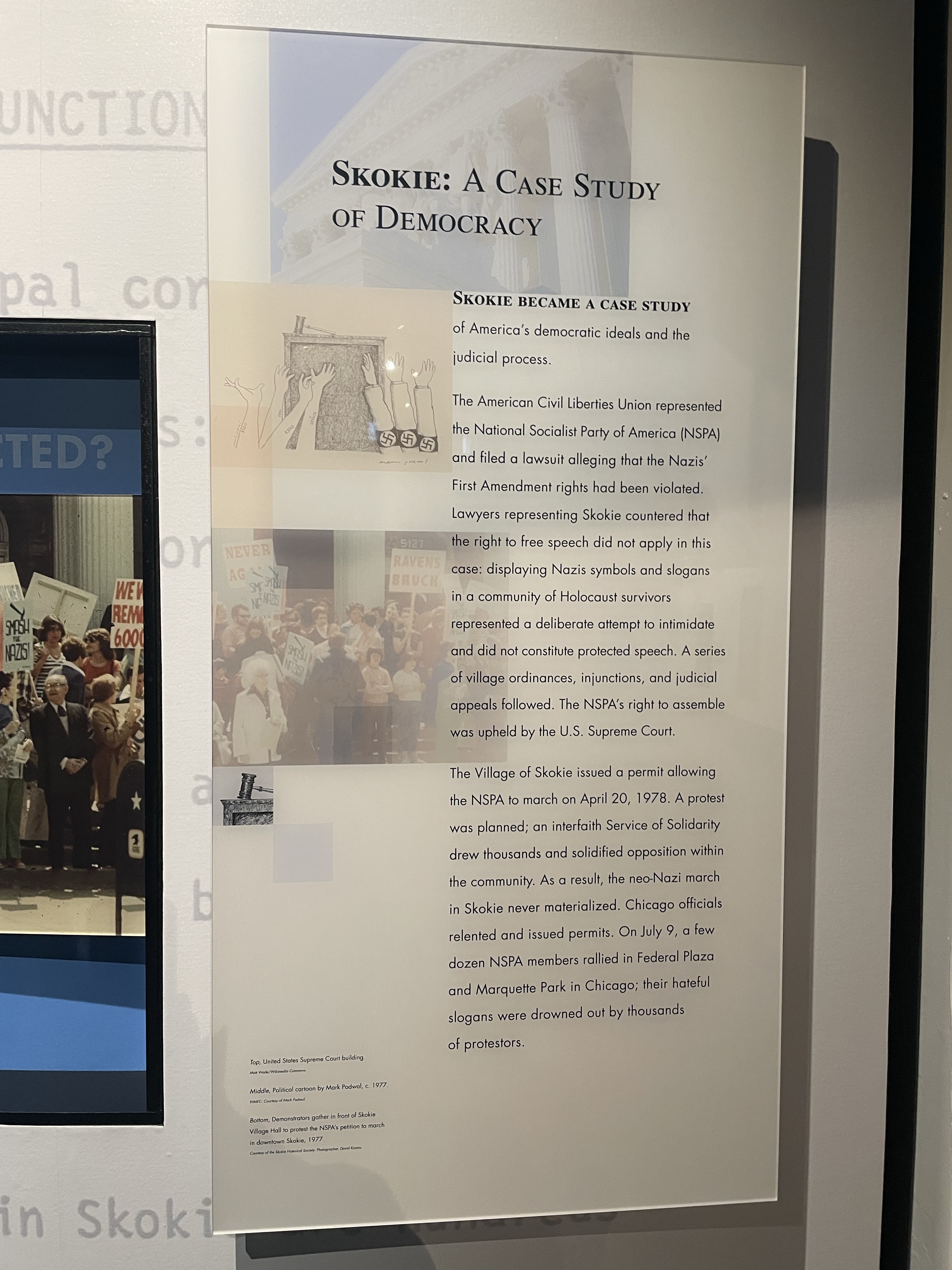
The museum opened in 2009.  It was a work in process for 40 years after the Skokie Jewish community was the object of a neo-Nazi group who decided to march through Skokie, a suburb of Chicago that is home to many Jewish residents.  The Jewish community started with a small space.  But their aim was to fight against anti-Semitism and hatred through education.  It looks like they are succeeding in their mission. 

The Illinois Holocaust Museum is worth the visit. It was designed by architect Stanley Tigerman. The building is made is to bring the visitor through the darkness of the Shoah and then back out to the light. As we went through the exhibit we could see this change. The entrance to the exhibit is dark and moody with narrow halls lined with photos, videos and memorabilia. But by the end, when we learned about the resistance and the survivors, the light increased.

While we were there on a Friday morning, there were four different school groups also going through the museum with docents.  Every so often the group would fill the space available, so we would stop to hear the discussion.  In this time of great turmoil and rise of Jew Hatred, seeing these students and their teachers learning about and basically experiencing what happened was important. 

There are many short films/videos and photographs throughout the museum that were taken by the Nazis during their killing spree as well as films taken after the war by survivors and rescuers. 

The films are difficult to watch.   I saw several students holding their hands and sweaters over their faces as they tried to block the view. I did not want to see it either, even though I have seen these images or ones like them many times.

But this time, I imagined the children on October 7 trying to block the view as they saw the terrorist of Hamas reenacting the hatred of the Nazis and they saw their loved ones murdered and waited for their own deaths.  It created harrowing moments for me.  I envisioned being held hostage by Hamas underground as if in a camp barracks waiting without food and little hope.

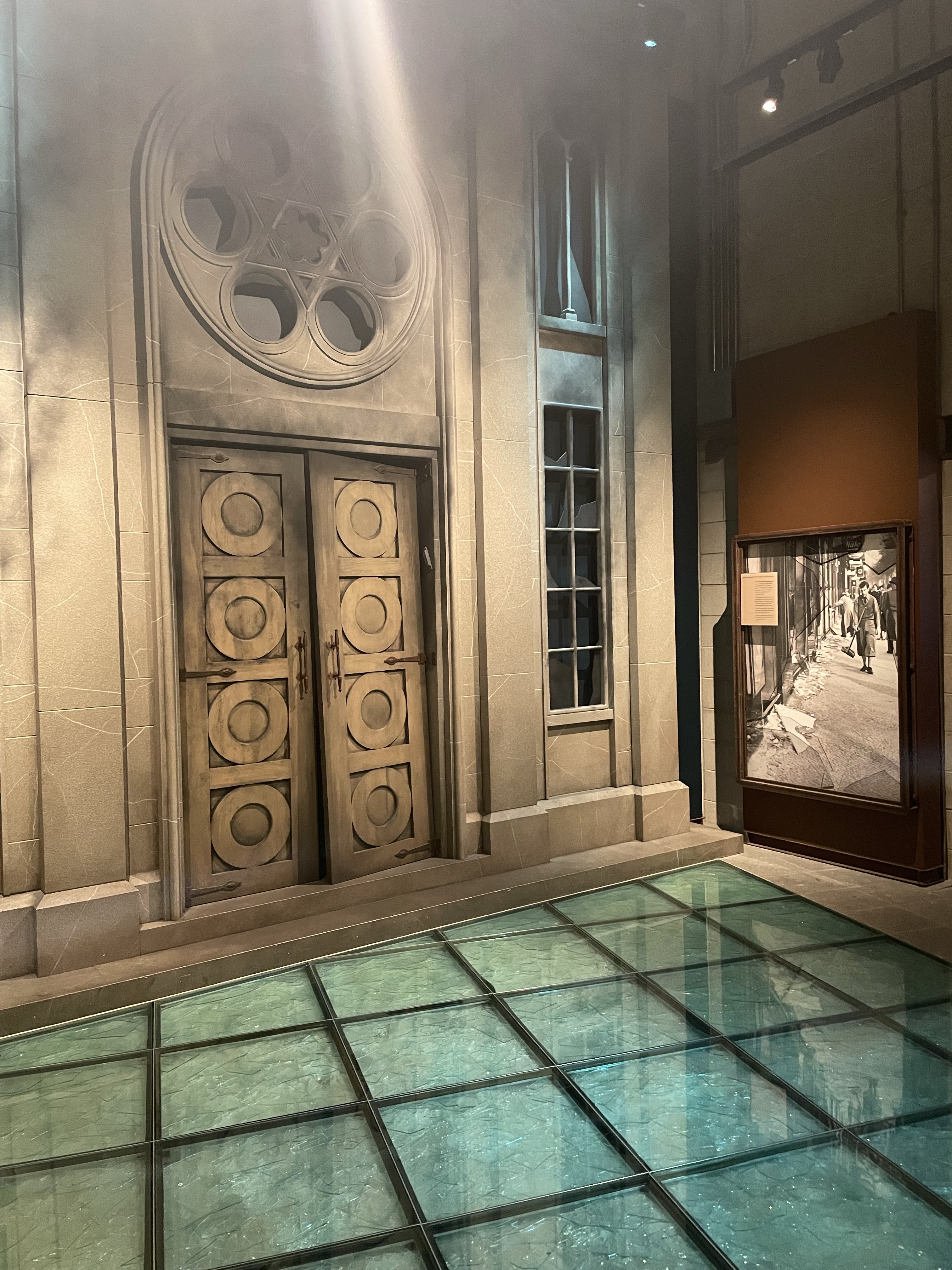
The Holocaust exhibit itself Is well thought out and takes you through all the stages of the Shoah.  The moment I saw the Krystal Nacht exhibit, which has a clear floor you walk over with shards of glass underneath, in front is the edifice of a synagogue with broken windows, I knew exactly what you will see next.  You can walk into a real cattle car from 1930s Europe.  It is an eerie feeling to be standing in that darkened wooden container and think about what it was like for those who were stuffed in and perished.  This is not a museum for someone who wants to avoid the past.  It puts it right into your vision.

After you weave your way through the seemingly endless horrors of the Shoah, you see a small exhibit about what happened when the Nazis came to Skokie.  It puts into ‘context’ what is happening now throughout the USA on college campuses and in some cities.  And I will say that calling for the annihilation and extermination of any people is always wrong. No matter what a college president says.

This is emphasized with the movie at the end that discusses both the genocide of the Jews and the continued times others have been targeted like the Tutsi people in Rwanda. We sat with two student groups as we watched the film.  It was not easy to watch as people testified about what happened to them during this more recent horror. Many of the students lowered their heads.  I think I spent as much time watching the students as I did watching the film.

After we finished the exhibit, we went to the Hologram theater where we spoke with the Hologram of Pinchas Gutter.  This is an excellent way to learn about the Shoah.  Those brave survivors who spent a week being interviewed and videoed while they told their story have created a way to keep the memory alive. 

The museum is not all gloom and depression.  There is the good of those who survived.  But also when we were there the special exhibit was about delis, “I’ll Have What She’s Having” The Jewish Deli.  It was a great way to wash away some of the somber emotions we were having after going through the Shoah. 

As a teenager and college student, I worked in a Jewish deli.  So for me this was especially joyful as I remember my time behind the counter making sandwiches, cutting lox, deboning white fish and making catering trays.  I would almost smell the corned beef, feel the texture of sable fish as I prepared some for a customer, and felt the smooth taste of a potato knish in my mouth.

It was good to end the visit on an upbeat note. But throughout it all I remembered that this museum was founded in response to Jew Hatred. Once again, we are experiencing a major rise Jew Hatred throughout the United States and the rest of the world. There are many who support us. However, when I look at college campuses, I know the work to end anti-semitism and Jew Hatred is far from done. What will be our response globally? In Skokie a museum was created. I am not sure it is enough.

Hokusai’s 36 Views of Mt. Fiji at The Bowers Museum

8 Dec

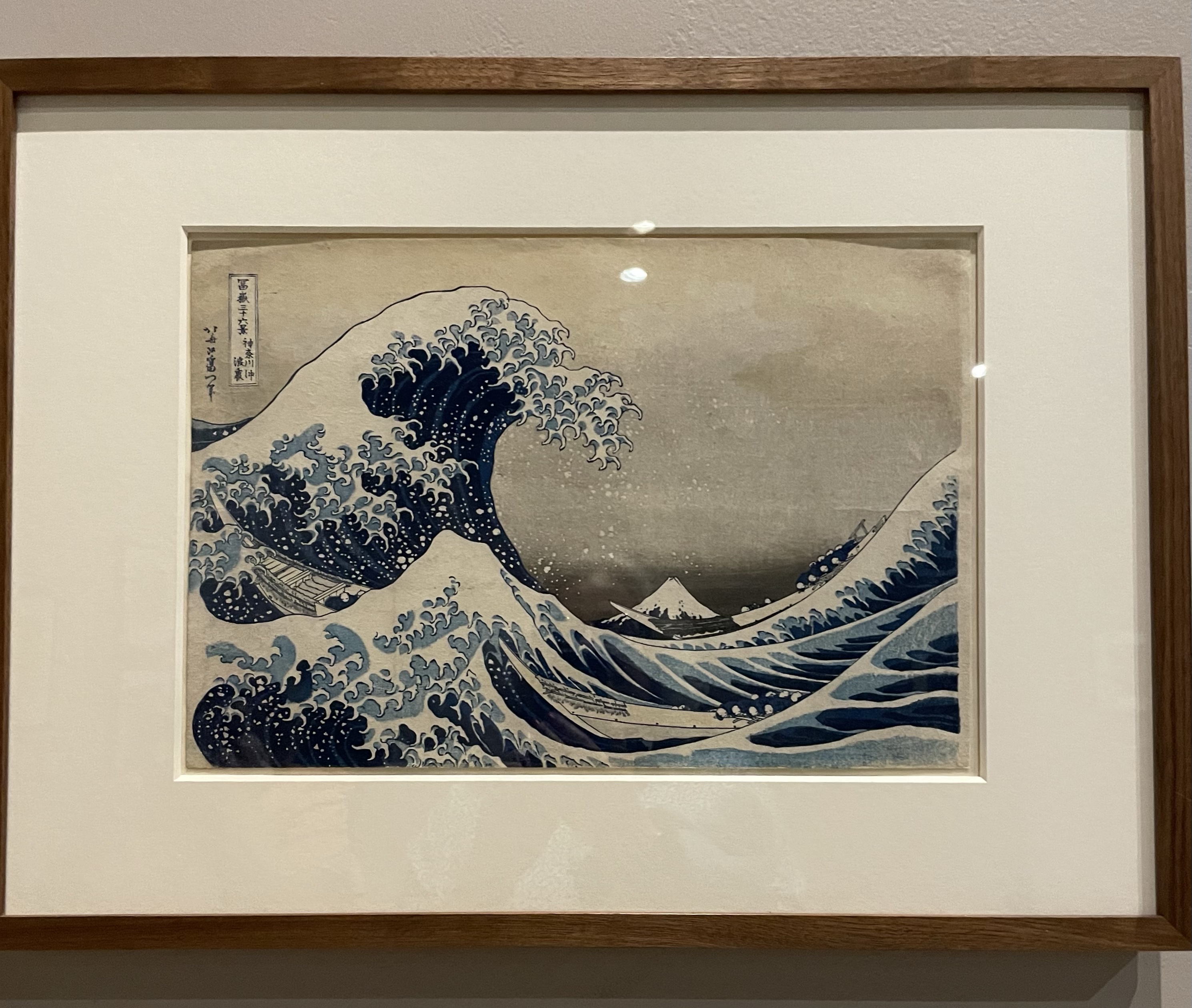
In November I was able to see Hokusai’s famous print, “The Great Wave” in person.  As someone who has loved Japanese art since childhood, this was a special moment. 

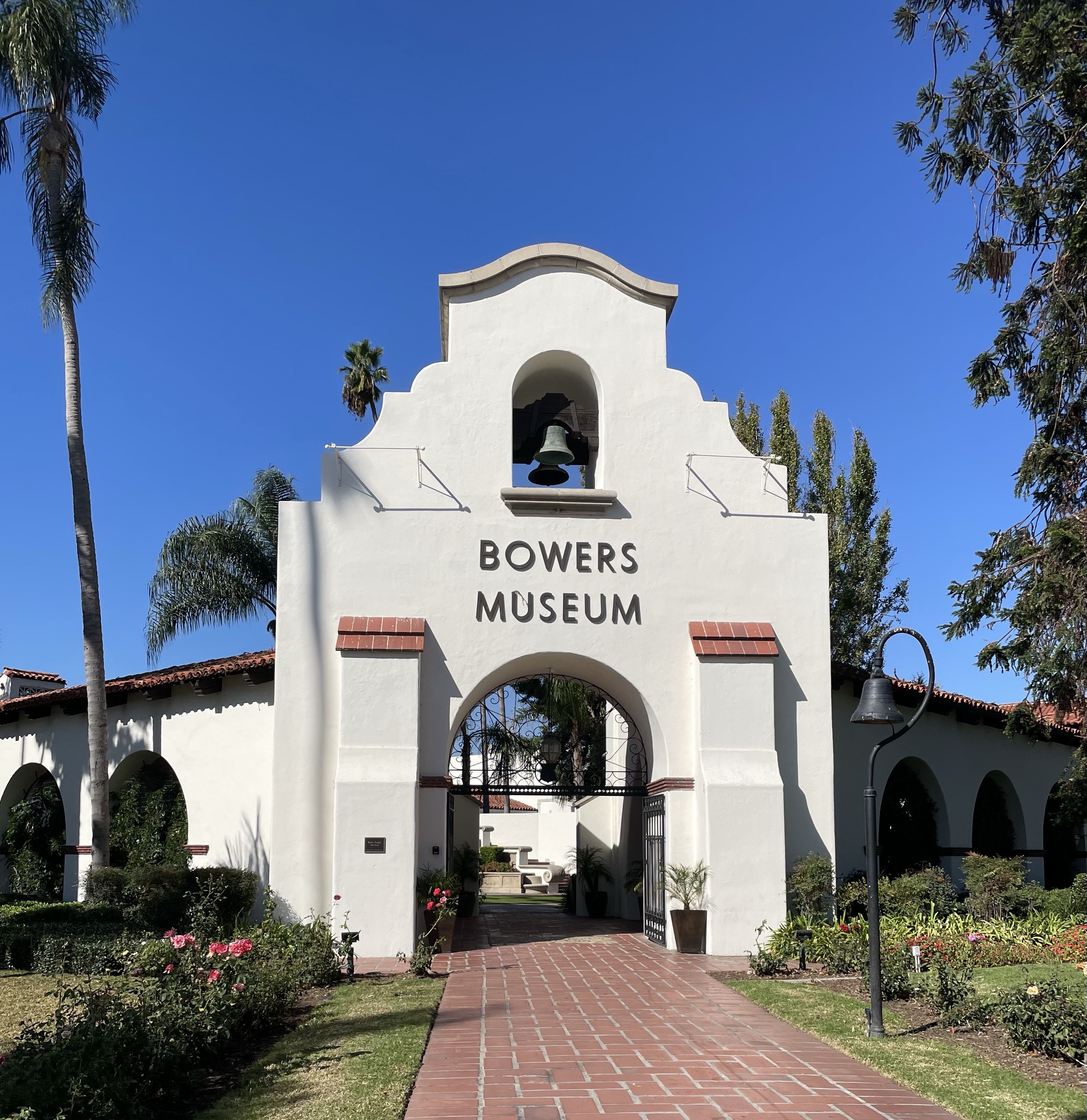
To be honest, I did not know I was going to see Hokusai’s work that day. My husband and I were in California for a meeting he was attendin.  I had the day free for my own pursuits, so I spent the day with cousins.  They recommended that we go to the Bowers Museum in Santa Ana, an plan that was wonderful to me, I love museums.

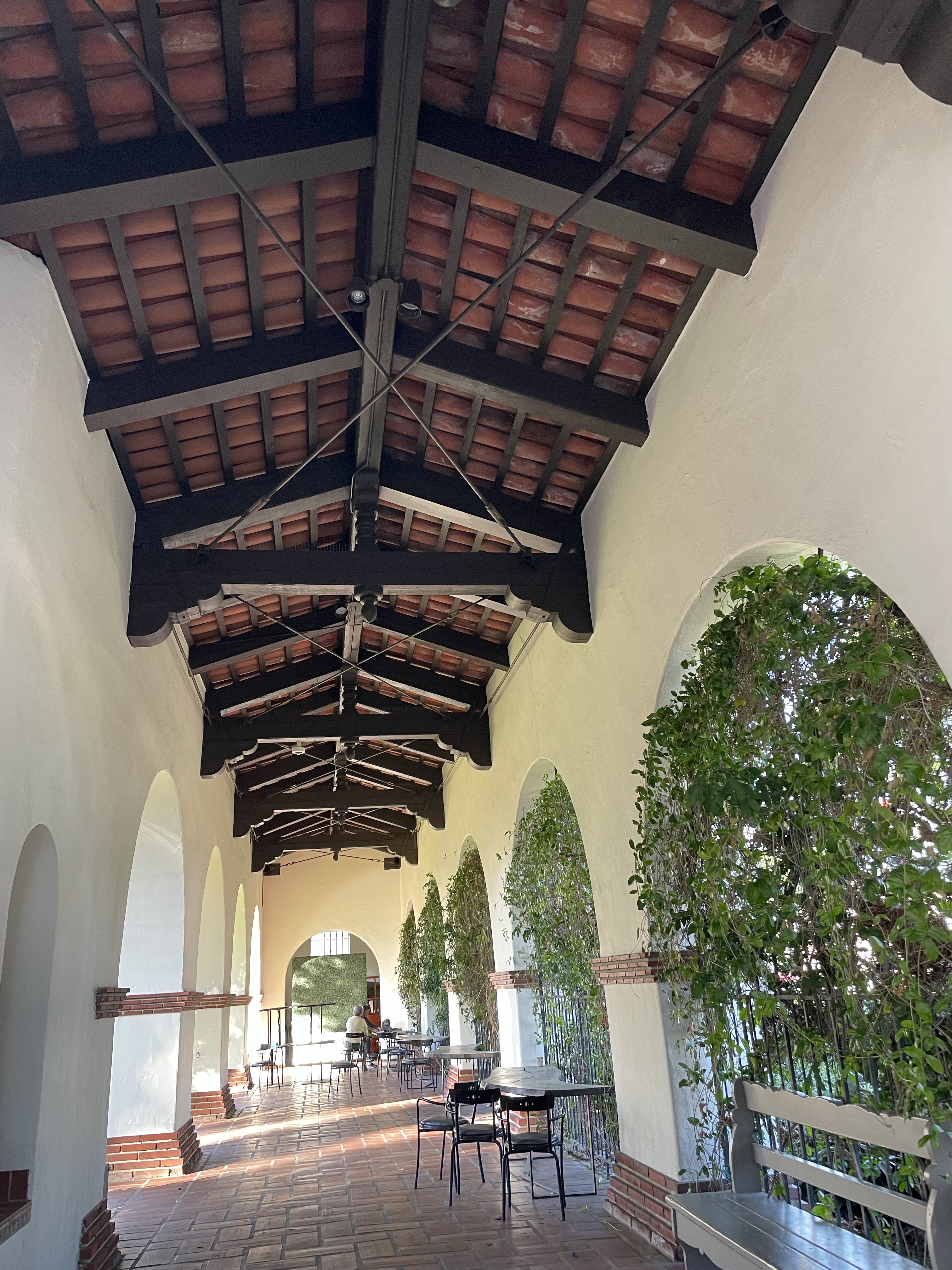
The main building is new, but it is attached to the original Spanish-style home that once belonged to the Bowers family.  You enter the museum through a lovely Courtyard that leads you into the museum.  Right at the front is the Tangata Restaurant where we ate lunch.  Delicious.  From the lovely entrance and delectable food, I knew this was going to be a great day.

I used to look at every single item in an exhibit, which would take me for hours.  But now, on the advice of a friend’s daughter who was a museum curator, I find one or two items per exhibit and focus on them.  So here are my favorites:

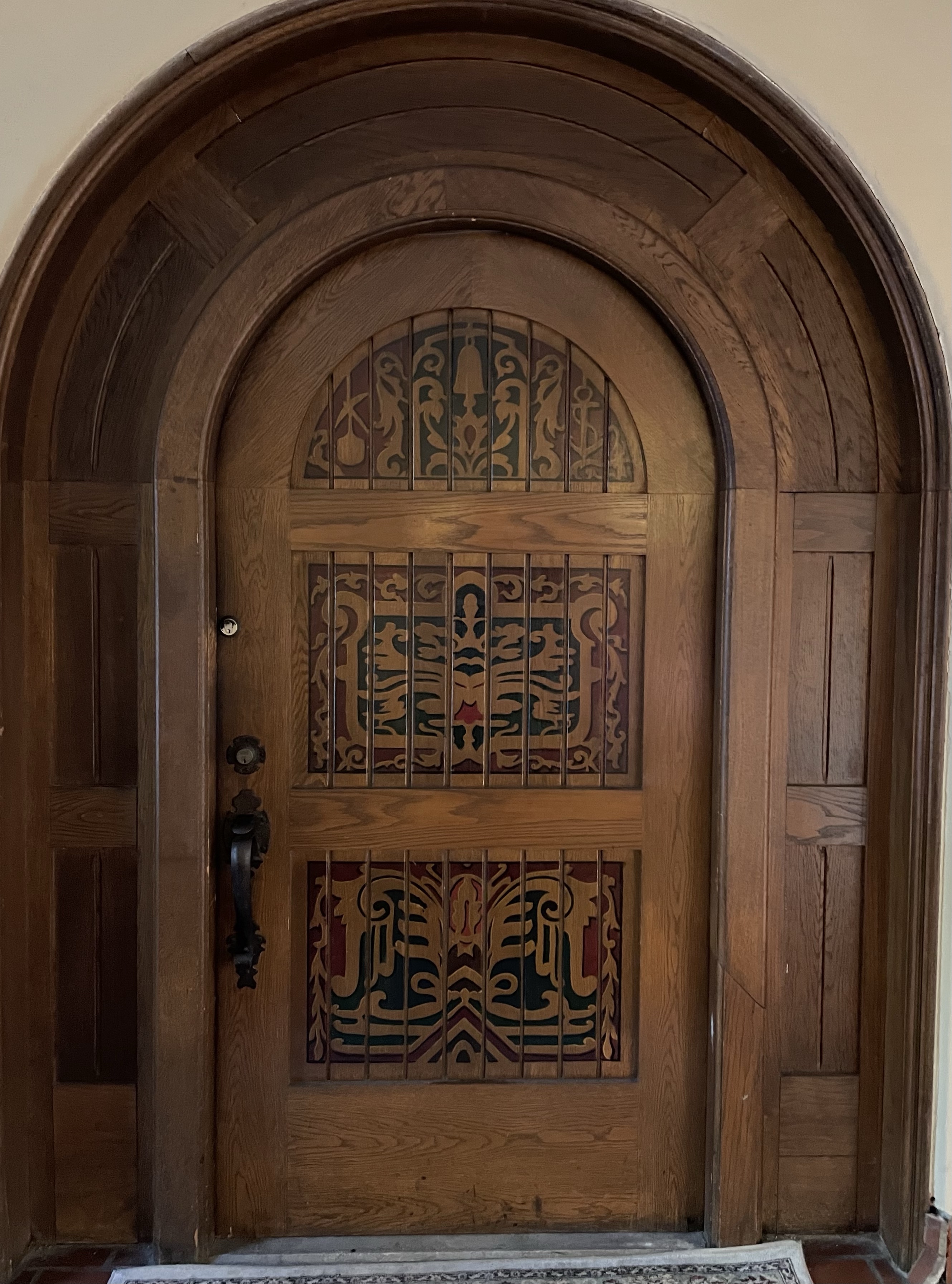
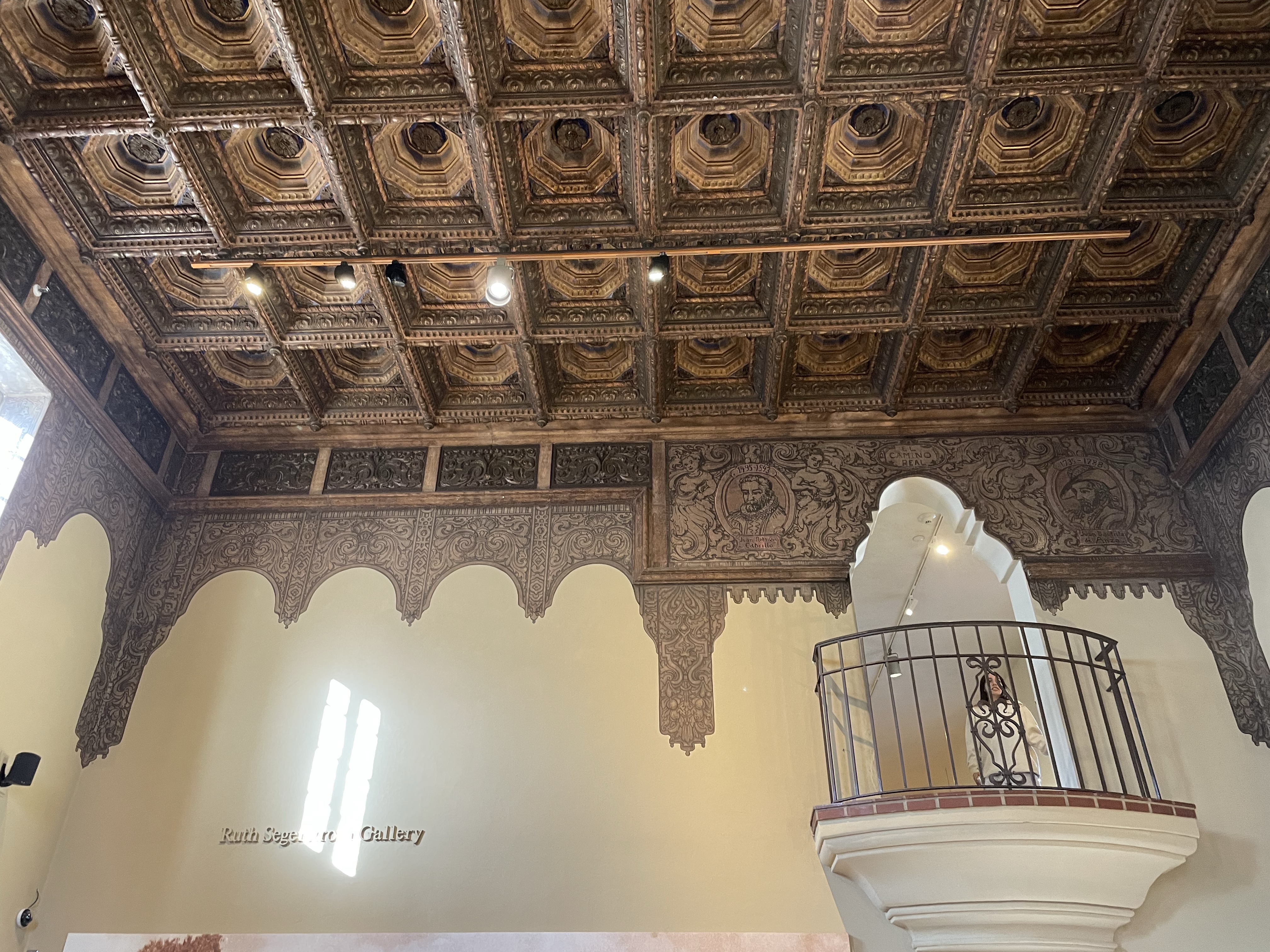
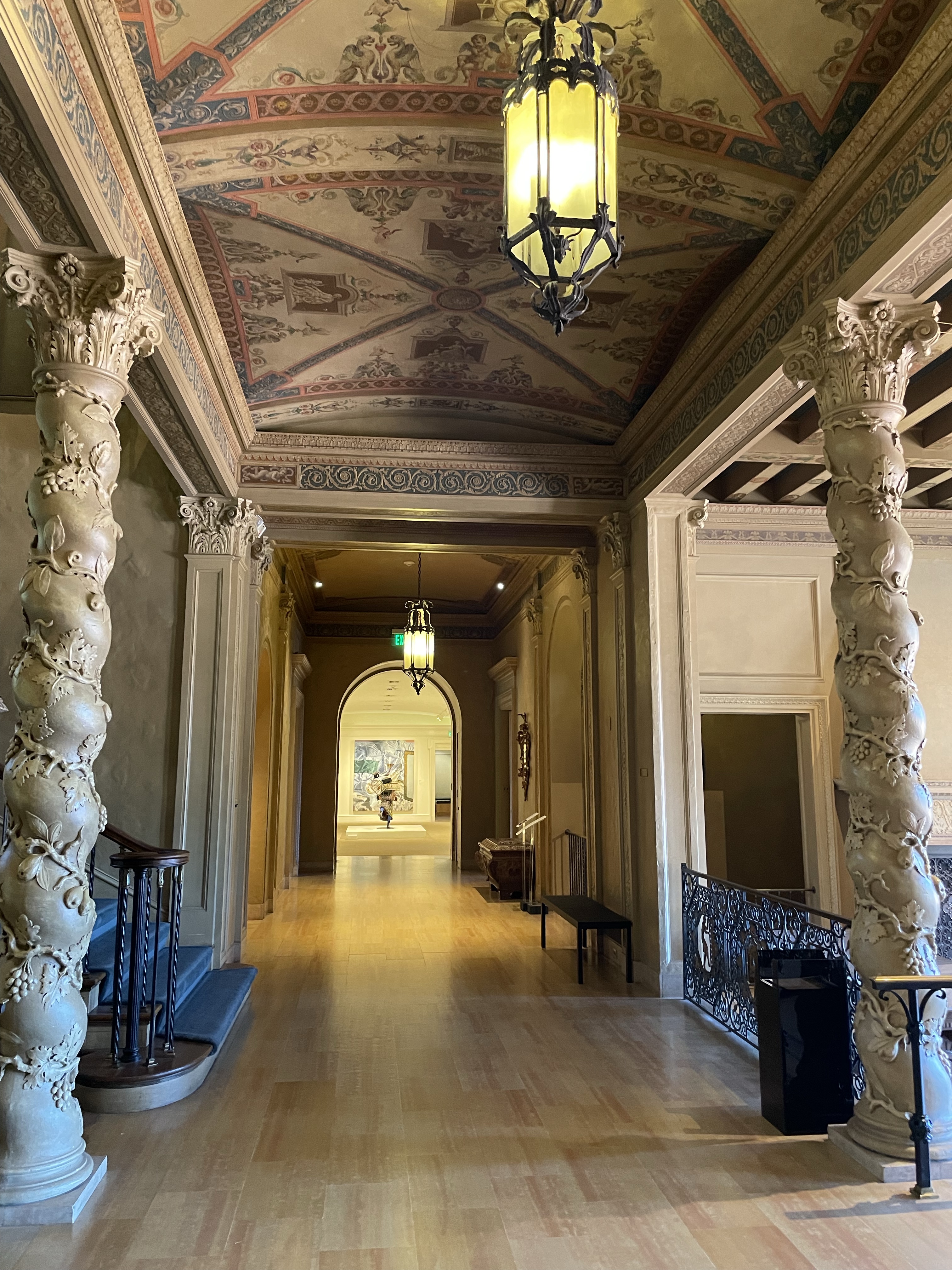
The original building is just stunning.  The parts we could see, wood ceilings, carved doors, stone fireplaces, added to the atmosphere.  In one room there was a display about some of the original settlers and members of the Bowers family featuring their possessions in the California Legacies exhibit.

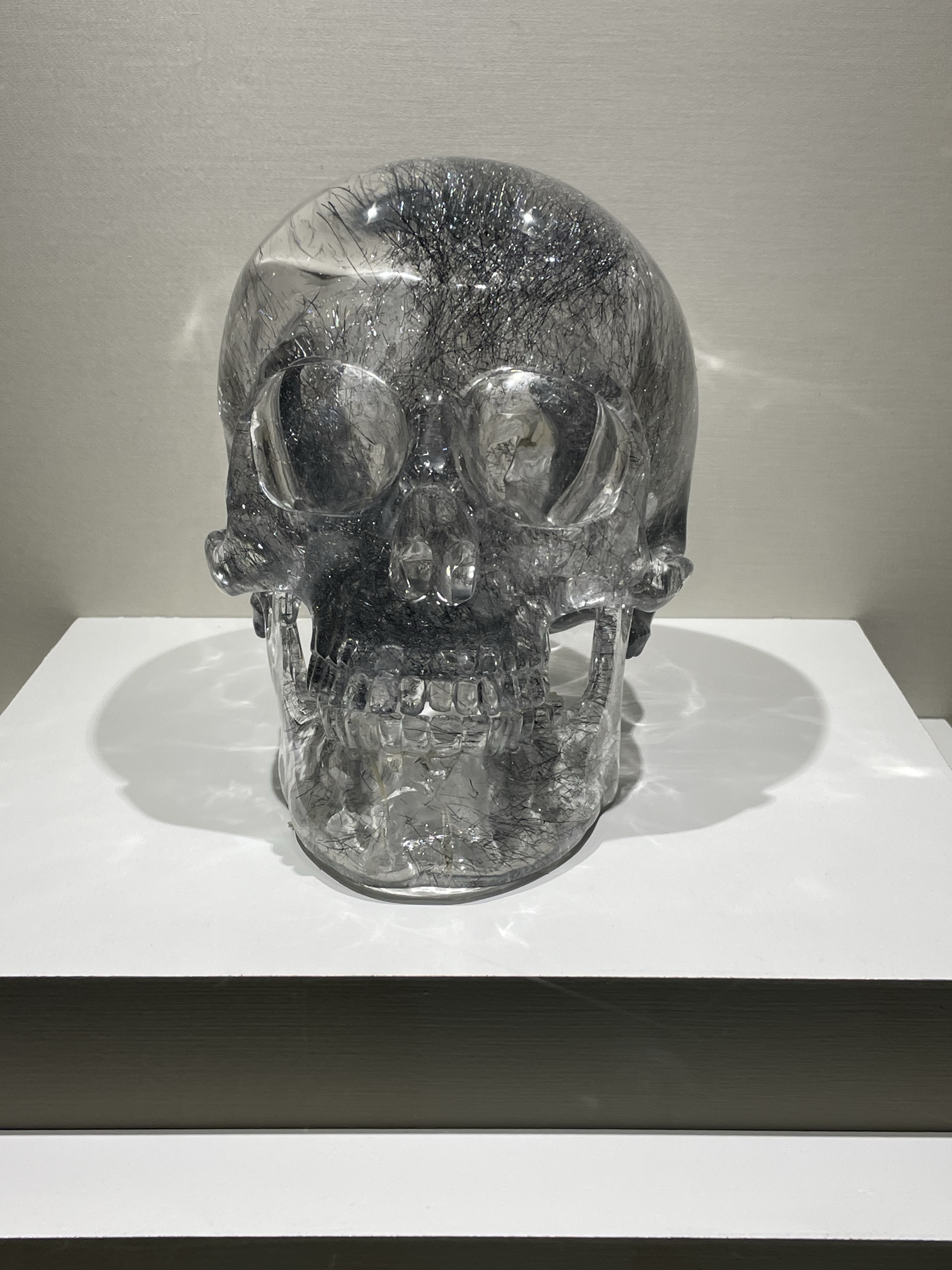
I enjoyed the exhibit, “Gemstone and Carvings.” The crystal skull made us all think of the Indian Jones movie. As for the native American art, my favorite display was the Women’s Basketry Hats that was in the First Californias exhibit. Woven by the Yurok, Hupa and Karok women, these hats caught my eye.  I would actually wear one of them!

Finally, the special exhibit, “Beyond the Great Wave, Works by Hokusai from the British Museum.”  It is only at the museum through January 7, 2024, so go soon.  It is wonderful.

The exhibit follows Hokusai’s work throughout his life, leading up to the Great Wave and then beyond it.  Seeing all these wonderful wood block prints, and the skill it would take to create them, was exciting.  There is even a short video on how the wood blocks are made.

Seeing almost all the of prints from “36 Views of Mt. Fiji” and the one that has caught the attention of the world, I was surprised, honestly, about how small the prints were in size.  In my mind they must be enormous. Instead they are all small enough to fit into a portfolio.

I enjoyed seeing the prints he made at different stages in his life.  My favorites were the ones of scenes in Japan with people going about activities. They are extremely colorful.   But I focused my camera on the Great Wave and two other prints from the series. I decided I liked these especially,  because like the Great Wave, the main color was Prussian Blue, a color that I adore. 

We did not have time to go to all of the exhibits in the museum.  In reality you cannot see everything in a museum in one visit.  But for those visiting the Santa Ana area, a visit to the Bowers Museum is worthwhile.

We Couldn’t Go To Israel: Road Trip To Madison, Wisconsin

20 Nov

Since my husband had over two weeks off for our trip to Israel that got cancelled due to terrorism and war, we had to keep moving or the anxiety would get to us.  Our first Road Trip lasted only three nights.  The second trip took six nights.

We have driven to Madison, Wisconsin, several times.  Always doing it in just one day.  But this time, I decided we needed to stop every now and then and just relax; so we did.

Day one:  On the road to Altoona, Iowa.  Why Altoona?  It is on the eastern outskirts of Des Moines.  And there was something to do.   On our wat to Altoona, we stopped at the Amish Store that is just across the border from Missouri to Iowa.  I love this store.  Jams, spices, seasonings, candy and cookies. All home-made and delicious.  We stopped for lunch and stocked up on gifts for our Madison hosts and for us. 

Next stop the hotel in Altoona.  My planning was excellent because across the street was a wonderful discount mall.  If it hadn’t been so cold and windy, we would have walked there.  Instead, we drove over and walked around this outdoor mall for a while helping the economy of Altoona.  We also found an Italian restaurant halfway between our hotel and the mall and ate dinner there. Yum.

Day two: On the road to Madison with a planned stop in Dubuque, the last stop in Iowa before Wisconsin.  We have driven through this Mississippi River town several times and always said we wanted to stop.  This time we did.  Our aim was to visit the National Mississippi River Museum and Aquarium.  Even though it was cold, and we had to walk outside between the two buildings, it was a great experience.  But I am sure it is even more wonderful if you have children. There is just so many activities for them.

We did not go to the main movie, but we did see all the aquariums and visited the displays.  One building holds the aquariums for the part of the Mississippi, the Gulf of Mexico, that enters the ocean. There were jelly fish, seahorses, an octopus, stingrays and other ocean animals.  The other building held the aquariums for river life: sea otters, turtles, snakes, fish.  I had never seen real paddlefish before.  They really do have a paddle on their snouts!

Our favorite exhibits were the Riverways History Gallery and the Innovation Currents Gallery. We also ate lunch there in a restaurant that overlooks the Mississippi and the outdoor displays.  If it was warmer, we might have spent more time outside because there was a lot to see there as well.

Two hours later we were on our way to Madison.

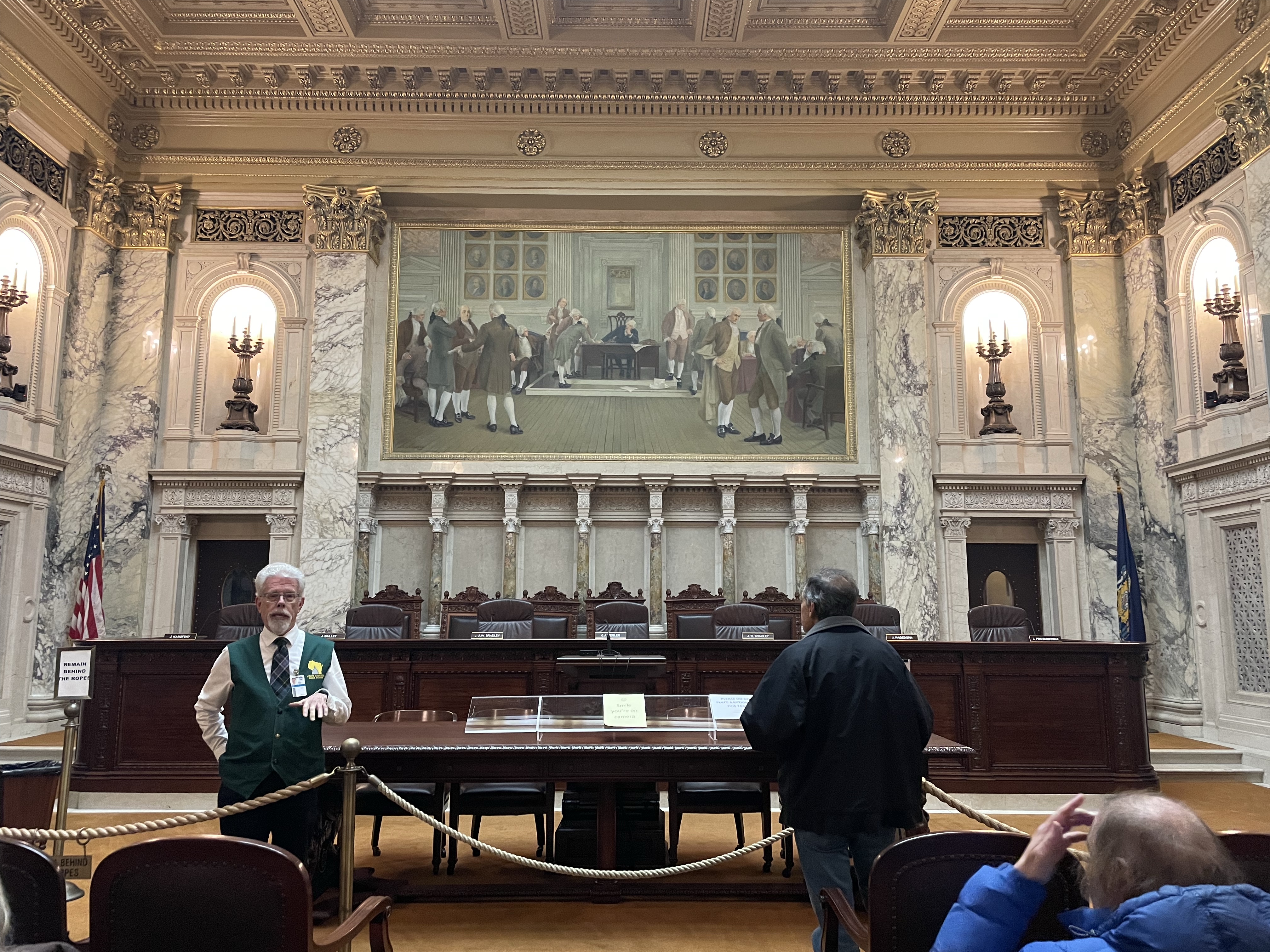
Days Three-Five: Being in Madison with our friends was great. We had a good time visiting and seeing some of the sites.  Our highlights was a tour of the State Capitol and the Chazen Museum of Art.

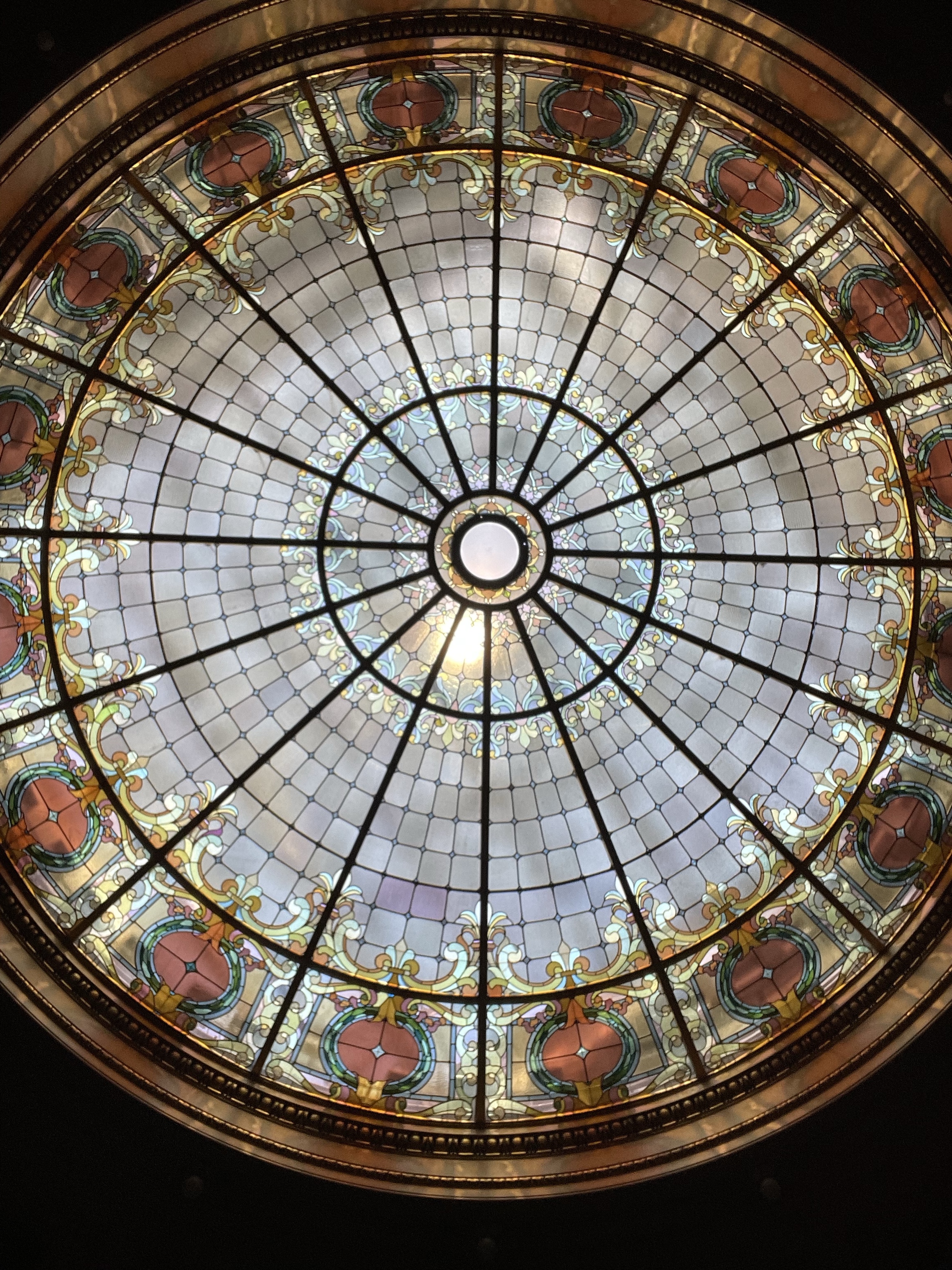
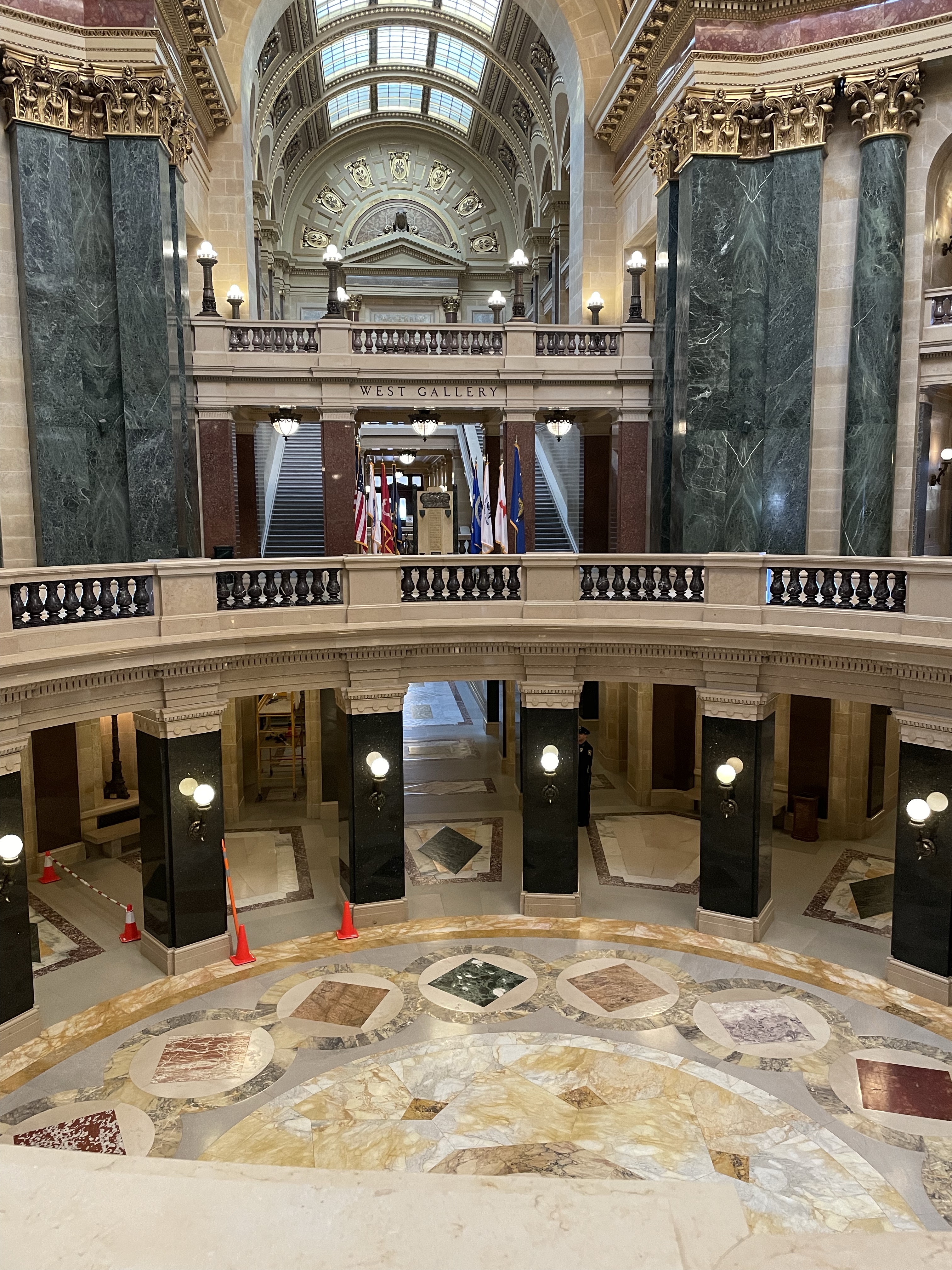
The Wisconsin state capitol building is really lovely. The building itself is over 100 years old. What makes it so amazing is that all branches of the state government still meet in the building. There are four magnificent rooms. One for the House of Representatives, one for the senate, one for the Supreme Court and one for hearings and meetings. Each room has a beautiful and large stain glass sky light that illuminates the room. Another lovely room is the senate’s private parlor.

There are free tours of the capitol each day. We were lucky in that we arrived at the capitol rotunda just a few minutes before the tour and we four were there only ones there allowing us to have the best private tour of the capitol that you would want.  Our tour guide, Mike, was excellent.  You could tell that he loved the building.  And there is so much to love.  Which you can see by the photos of the rooms.

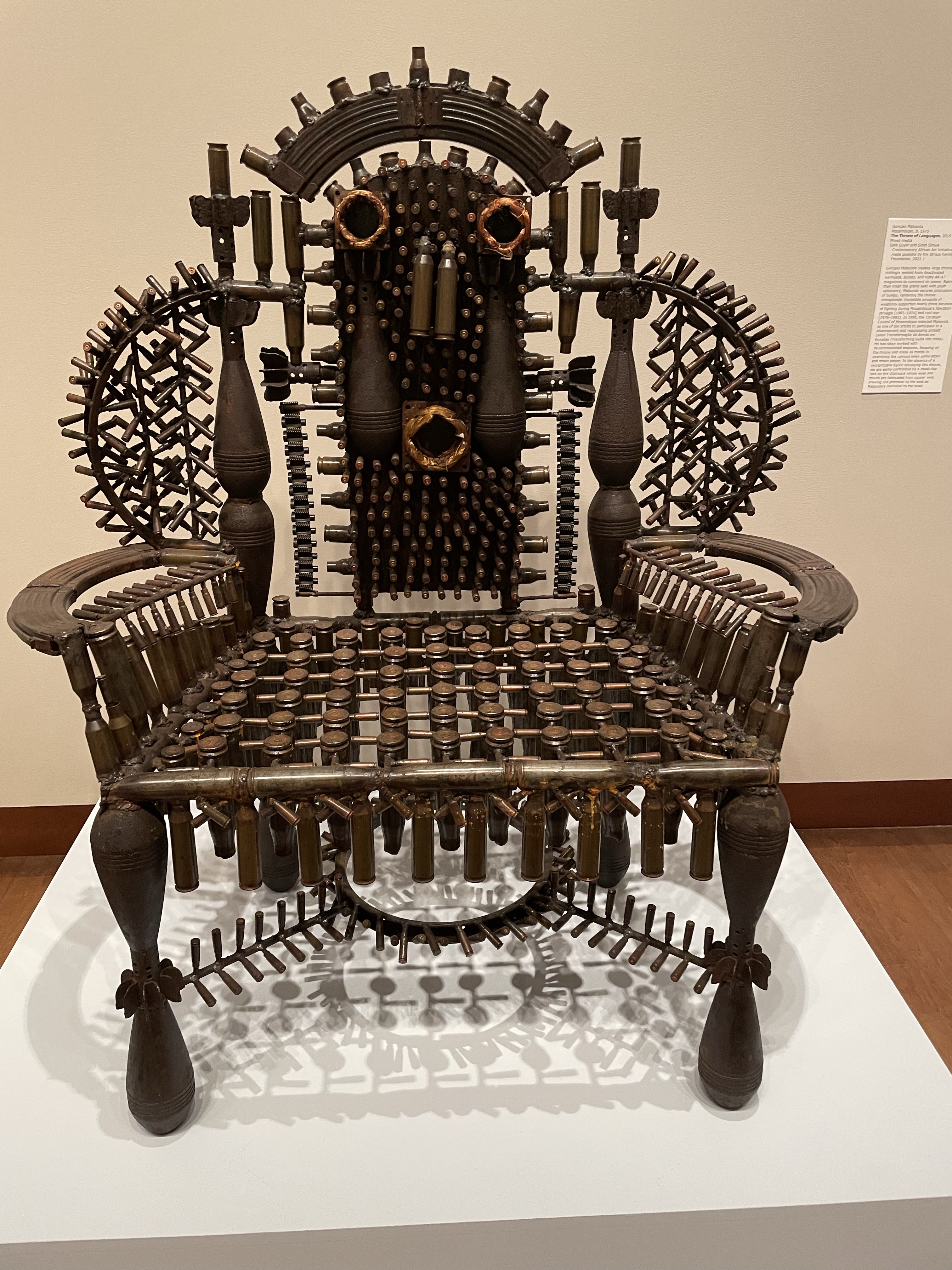
Another day we went to the Chazen Museum of Art, which is on the University of Wisconsin’s campus. Although not a large museum, it was filled with amazing art. We were fortunate to see a special exhibit: Insistent Presence: Contemporary African Art, had several pieces that caught our attention. Petro Beads, with was a giant set of prayer beads made from old metal petro containers. The Throne of Languages made from old military devices was an eye opener.

In other blogs I have written about my love of the glass art of Dale Chihuly.  I really enjoyed seeing some of his early art work. He studied at the University of Wisconsin earned his MFA from the School of Education’s Art Department under Harvey Littleton, who was a well-known glass artist.  We saw a few pieces of his work as well.  I am sad to say I did not get to see The Mendota Wall at the Kohl’s Center. That will have to wait for another trip.

Day 6 and home:

It was going to be a long drive on highway 39 and 90 to the State Capitol of Illinois, Springfield. We had no plans to visit the capitol building there. Instead, our destination was the Abraham Lincoln Presidential Library and Museum. Before I discuss our visit to the Library, I must tell you that I wish had more time in Springfield. We were only there for a few hours and were totally focused on the library. But it has many other sites to visit. We will go back.

I love how this library is set up. There is a central Plaza area that all the different exhibits lead off from. It was so fun to explore. After walking through a front yard, you enter a replica of the Lincoln log cabin. As you exit the cabin from the other side, you enter a wonderful exhibit all about slavery and the Emancipation Proclamation. As you leave that exhibit, you are right in front of the entrance to the White House replica. There you walk through a room and enter an exhibit about politics in the time of Lincoln. I could not believe the horrible nasty political cartoons that made a mockery of Lincoln. It made me realize that ugliness in politics has been around for a long time.

We watched one of the two shows and walked through the Treasures Gallery where you can see some items own by the Lincolns as well as some important documents. 

We love our visit there, but as I said earlier, wished we had more time to visit some of the other Lincoln sites and to see the capitol.

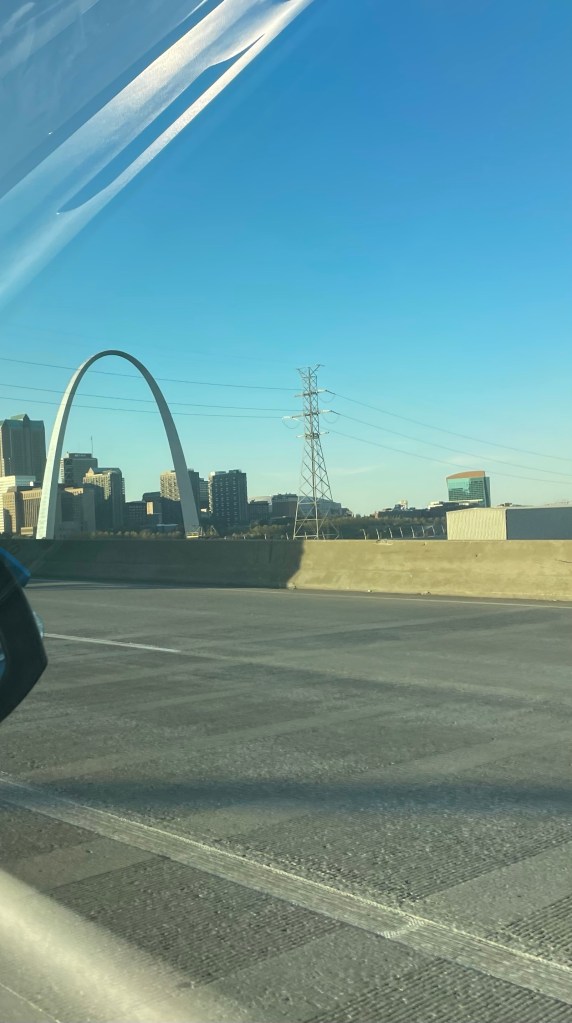
When we left Springfield, we knew that our trip was almost over. We spent the night in St. Louis, my husband’s hometown and visited with family. Then the next morning we headed home. We went through five state: Kansas, Missouri, Iowa, Wisconsin and Illinois.

My husband’s vacation is officially over. We have completed our road trips for the fall.  We look forward to the future when we can visit Israel in peace.

After A Trip Was Cancelled, We Went to Tulsa

7 Nov

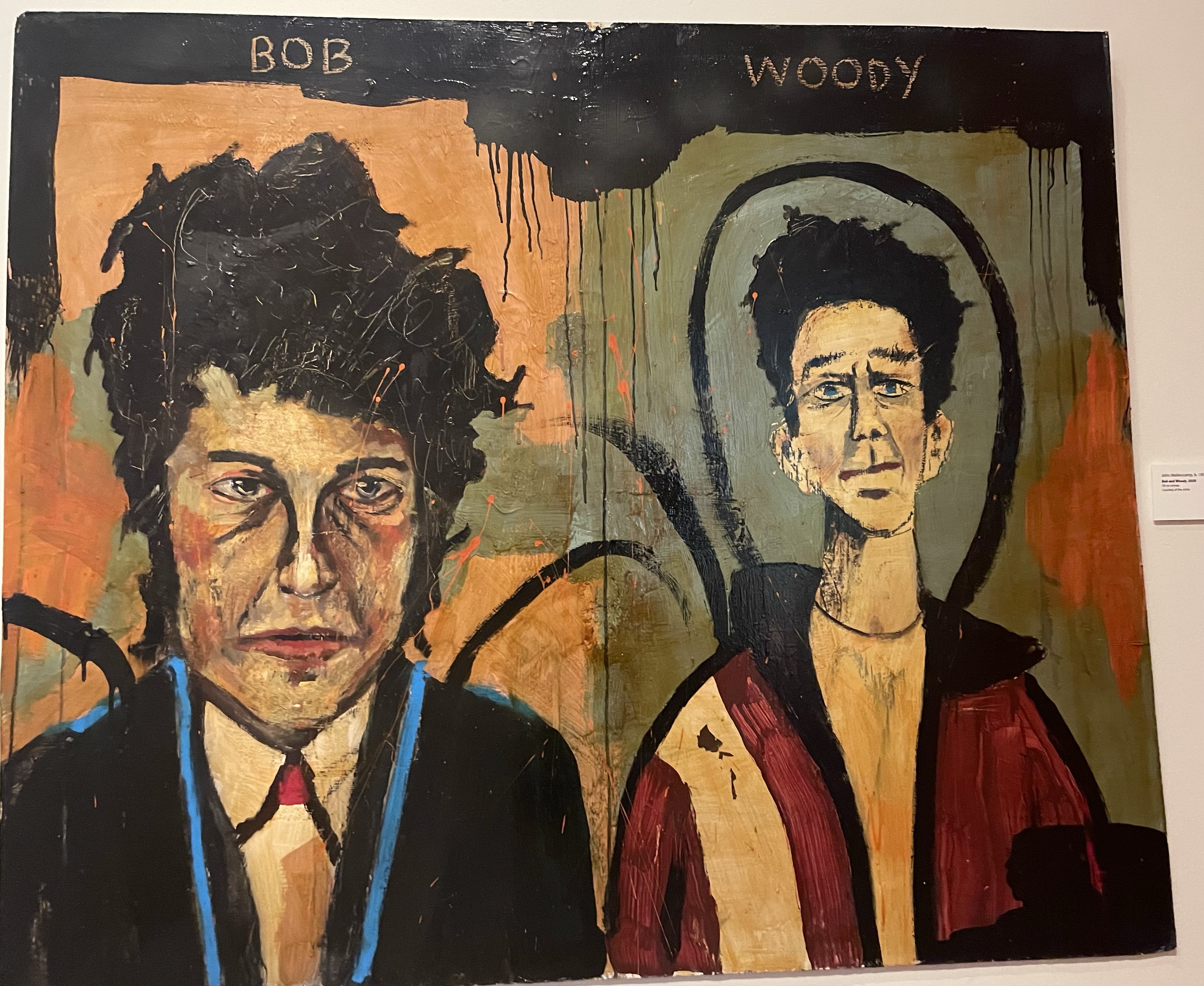
Since April, I have been telling my husband that I wanted to go to Tulsa, Oklahoma, and visit the Bob Dylan and Woody Guthrie museums.  I had the trip planned for the longest time.  Our first stop would be these two museums, then we would visit with friends of his and perhaps one of his cousins in Oklahoma.  On the way back I wanted to stop in Wichita, see more cousins, spend the night, then on the way home visit the Cosmosphere in Hutchinson, Kansas.

Though I kept talking about it, we never got around to do it this summer.  But this fall, our plans changed quickly and radically.  We were supposed to go to Israel where our daughter and her husband live.  The war changed our plans, but my husband still had two weeks of vacation.  I had to do something.  Just sitting home and moping and worrying was not an option. I am the type of person who can usually find the good in any situation.  And I was determined to find some small element of good.

Road Trip Number 1!

We reached out to our people; I made hotel reservations; and off we went.

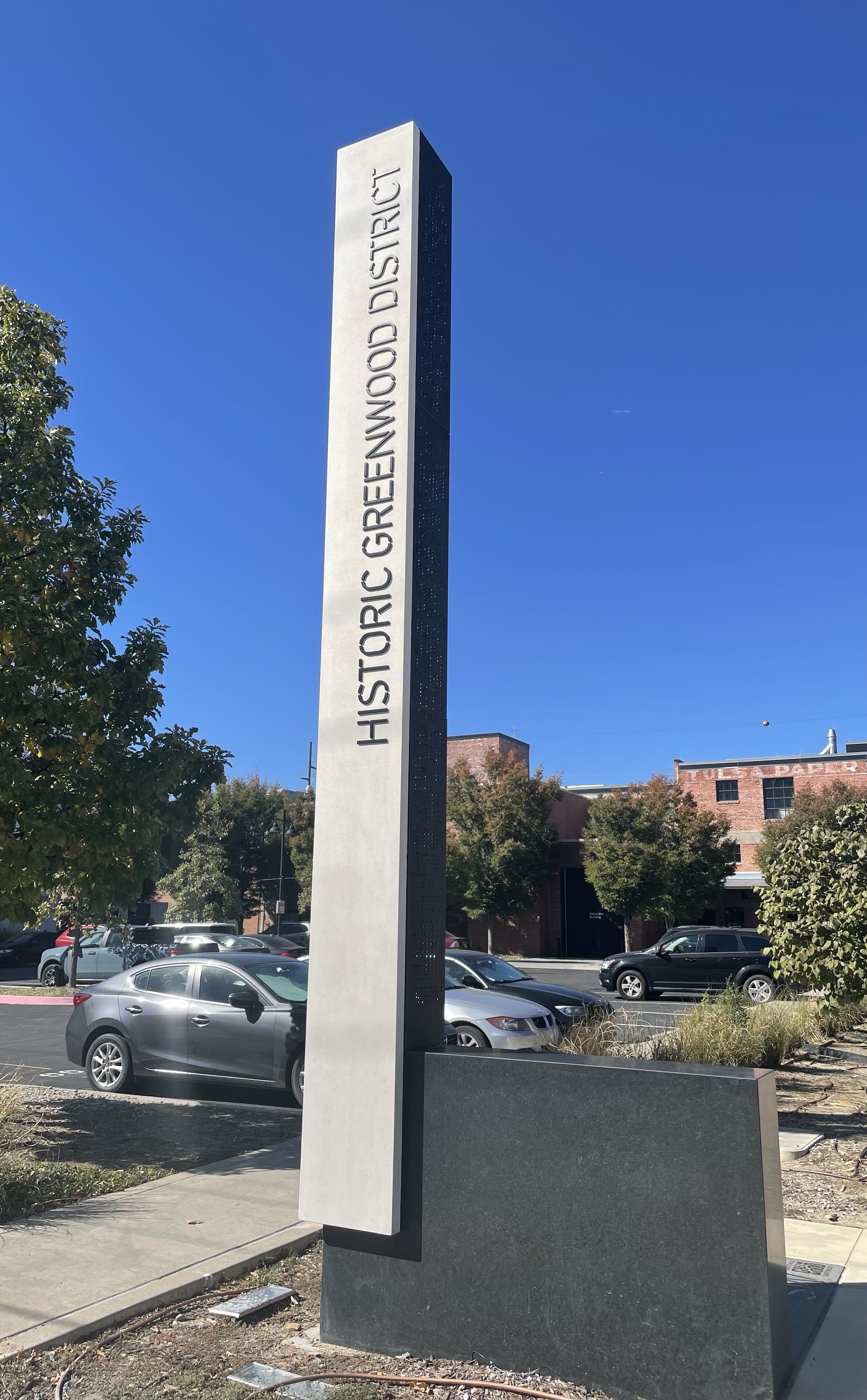
The hotel we stayed at in downtown Tulsa was in easy walking to the two archive/museums.  They are next door to each other.  On our walk towards the museums, we saw a large post indicating that we were entering the Historic Greenwood District. This is the area where once a thriving Black community settled before the 1921 Tulsa Race Massacre took place.  We thought it was extremely apropos that the museums dedicated to these two musical activists were in this area.  It just fit.

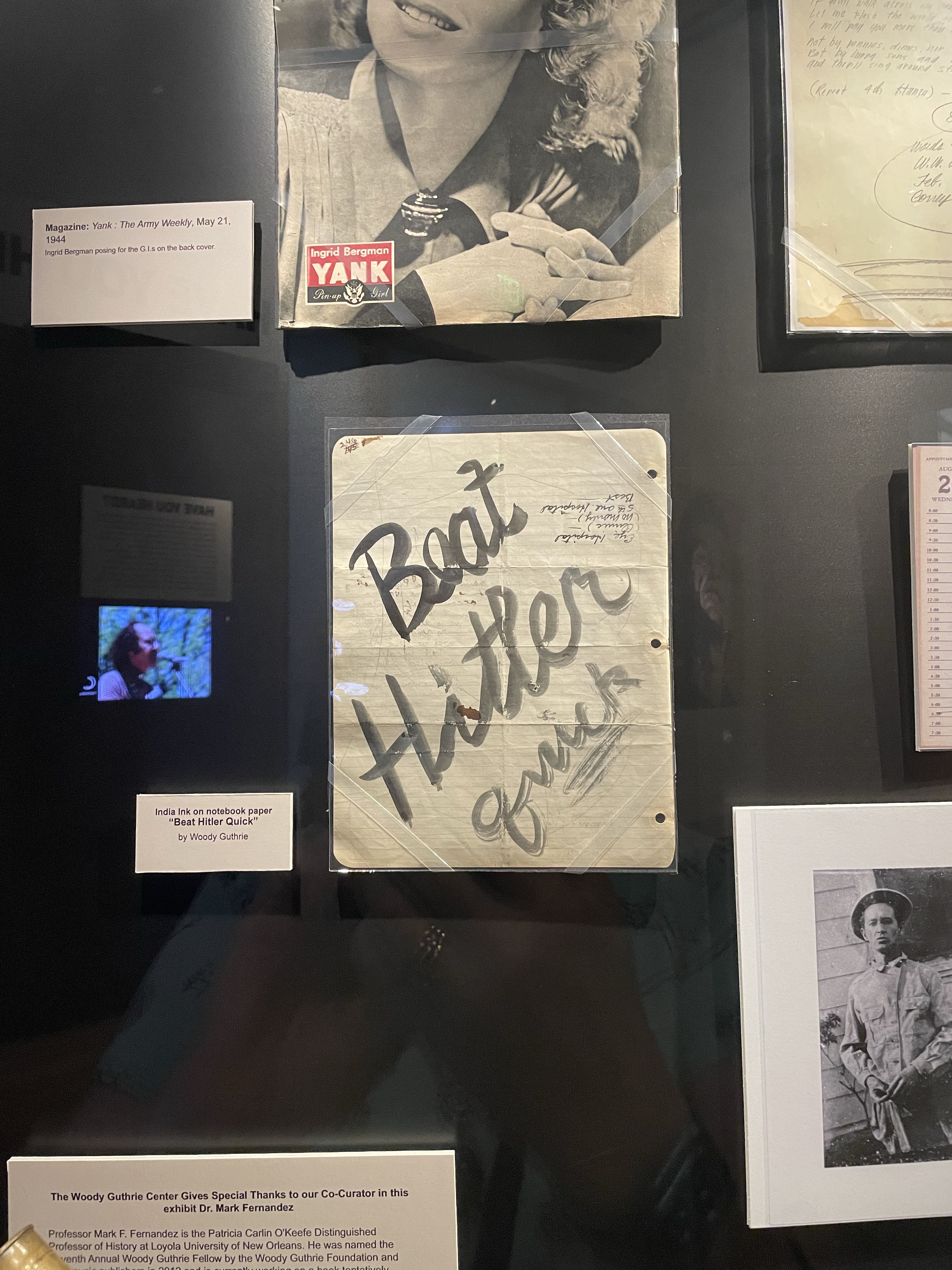
I loved both museums.  They each traced the lives of two of my musical heroes.  Even though their music was written decades apart, they actually knew each other.  One was born Jewish, the other was married to a Jewish woman and fought in WW2. Among Guthrie’s papers is one that reads, “Beat Hitler quick.” That resonated with me with all the Jew Hatred going on right now. The museums are both well worth the visit.  You can spend time watching the videos or just walk through.  I loved reading about them, listening to their music, and looking at their artifacts.  At the Guthrie Museum, you must try the virtual reality of the dust storms that devastated Oklahoma. WOW.

That evening we ate dinner with our friends. I asked about the two museums I wanted to see. The husband actually serves on the board of the Sherwin Miller Museum of Jewish Art.  At dinner he told us a bit about the museum, I realized it was much bigger than I anticipated.  For a community of about 1800 Jewish residents, it was really special. 

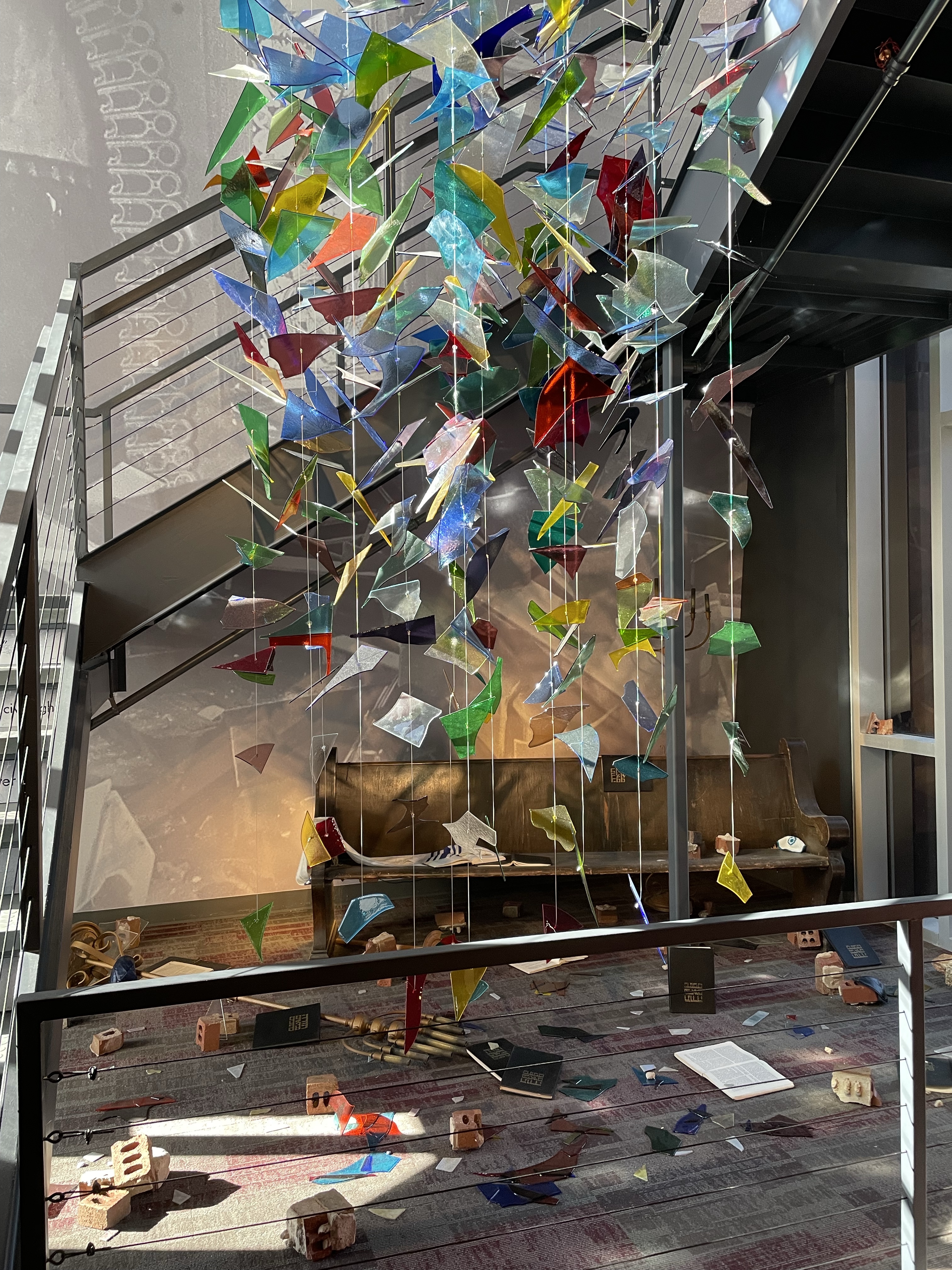
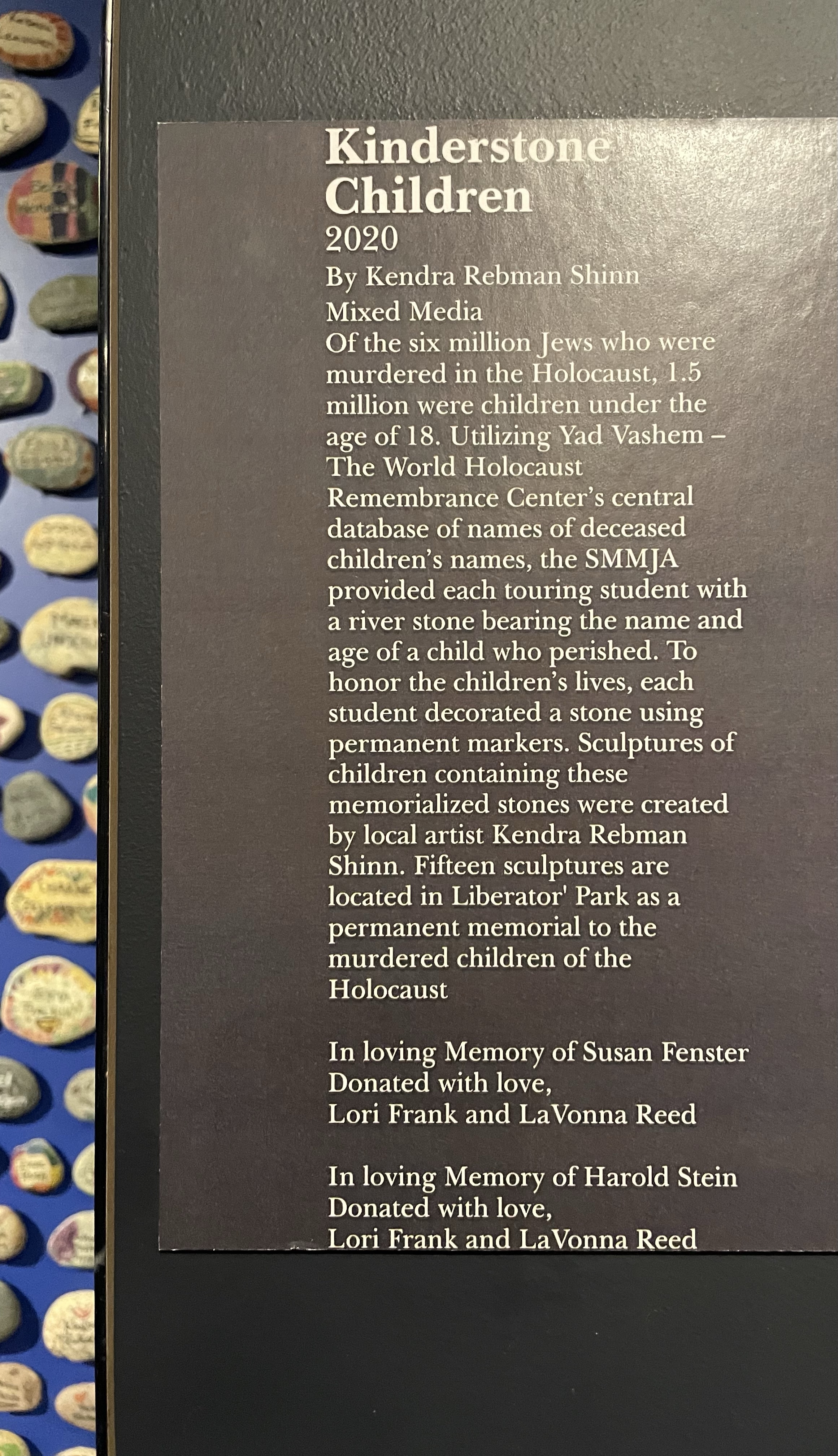
The section about the Holocaust was difficult as such museums always have to be.  But I loved how they imagined KrystalNacht.  I was so touched by the stone display that is a memorial to the 1.5 million Jewish children killed. I had tears in my eyes thinking about the children who were recently murdered by Hamas.  How could I not compare the two? The death of every child takes a toll on society.

Upstairs was dedicated to modern Jewish Life.  They had a sanctuary set up that must be wonderful to teach about Judaism to those who come to visit.  For me, personally, I loved the special exhibit of mezuzahs, the scrolls we put on our doorposts.

From there we went to the Philbrook Museum of Art. The house was built by Waite Phillips, who started a ‘little’ oil company. Phillips and his family lived there for only 11 years, and then they gifted the house and 23 acres of land to Tulsa for an art museum. Okay, I will be honest with you, the art in the house is great.  But the house itself is amazing.  I love old houses.  And this one does not disappoint.  The grounds are also stunning.  Well worth a couple of hours to walk through and visit.  It just cheered me up. I could see myself sitting outside for hours.  We especially loved all the wonderful milkweed and butterfly gardens. 

After we got back to our hotel, my husband’s cousin drove in from Oklahoma City to visit us.  She surprised me with a gift, her grandmother’s mah jong set.  She told me that no one in her family plays and she knew that I did, so she gave it to me.  Her grandmother and my husband’s mother were sisters.  I have to say having both of their mah jong sets gives me joy.  It was great catching up with her and seeing pictures of her family and sharing photos of our family.

The next morning it was on to Wichita.  One note about the drive from Texas to Kansas.  It is VERY flat and dusty.  There were no crops really, just fields and fields of red dirt.  However, and I am really sorry I could not get a photo of this, besides the oil well arms pumping away there were also giant windmills.  And at one spot there was a windmill farm circulating air and making e;ectricity above the same field where the oil well arms were pumping oil.  It would have been a great photo representing the changes coming to society as we switch to rely on renewable energy.

Of course I contacted our Wichita cousins as soon as we arrived and then spent the next seven hours with them.  It was great.  We had two meals with everyone. But also had time for us older adults to just visit.  We have not seen them for about six years, which is ridiculous.  Wichita is just three hours from home. I vowed that we would come back more often.  We need to see his first cousins and also visit some museums.  (My husband hates museums, but he loves me.)

Next morning on to Hutchinson and the Cosmosphere, one of my favorite museums in Kansas.  Honestly, we went several times when our children were younger.  In fact, our daughter attended two summers of Space Camp there and loved them.  Even though we have been members for about 28 years, we have not been there for about 20 years.  It was definitely time to go back and see the changes!

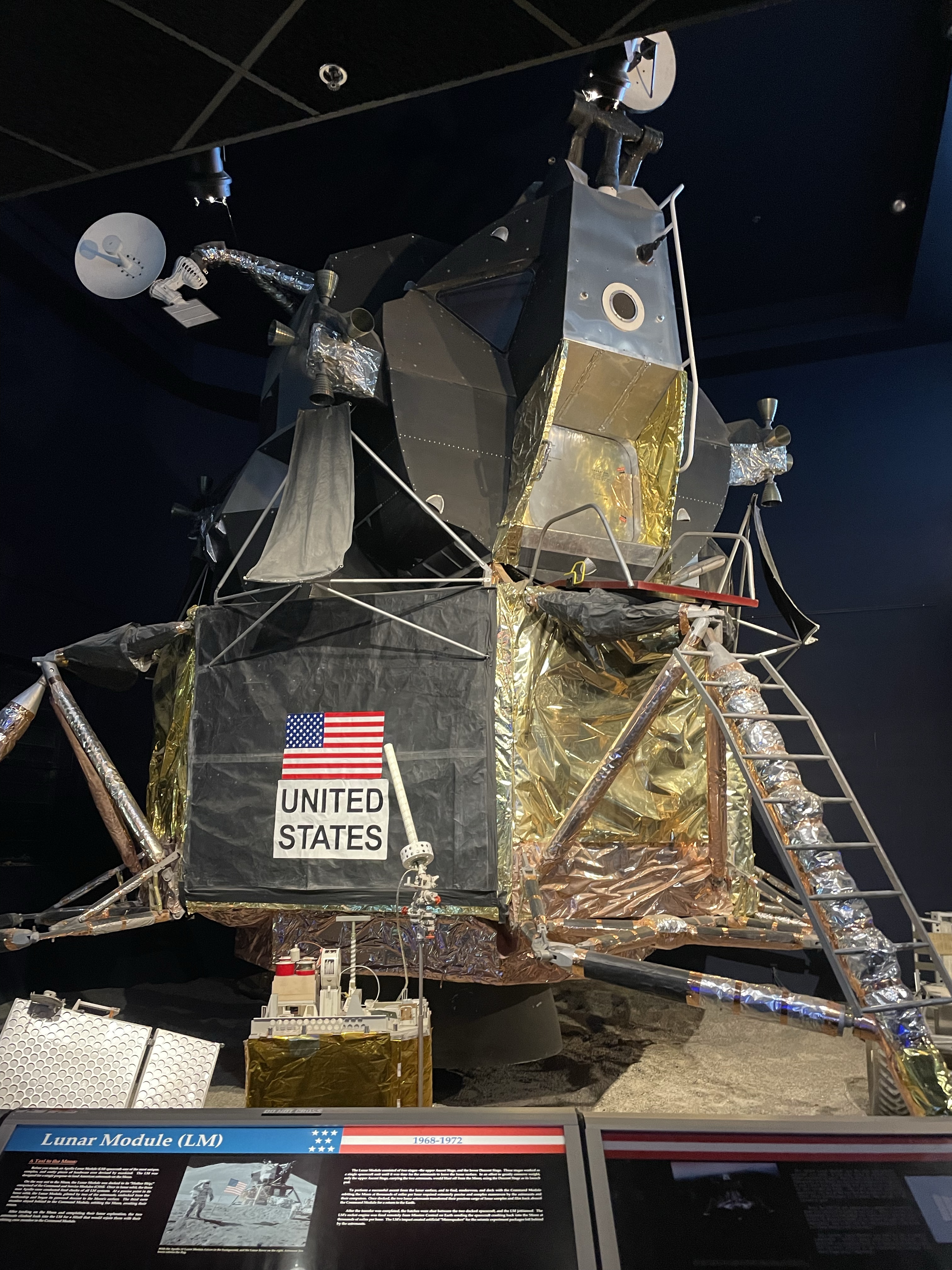
The museum exhibits are wonderful.  If you love space and NASA, you will love this museum. The real Apollo 13 space craft is there. All the exhibits have been redesigned since our last trip. Definitely for the better.  We watched one of the two movies, about the Blue Whales.  That cheered us up. We were pretty sure that this documentary would end on a sad note, but NO, the Blue whales are coming back and increasing in numbers.  Honestly, I think Star Trek’s movie has something to do with that. It was a good start to the visit. 

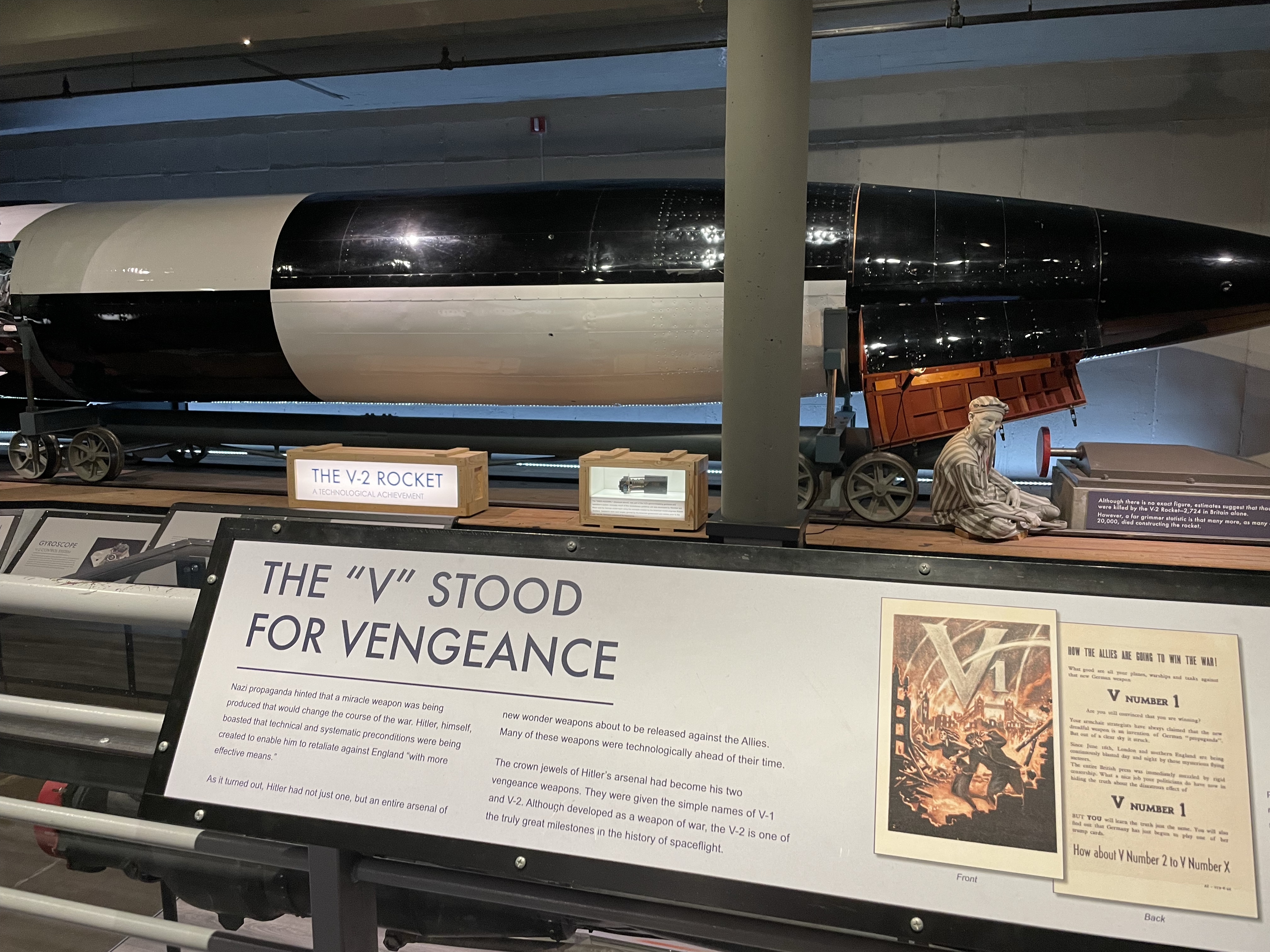
While we were walking around, I noticed a little exhibit off to the side, The V-2 Gallery, which was all about the V-1 and V-2 rockets that the Nazis used to bomb and terrorize London.  In the past the history of these rockets was sort of not mentioned.  Just as it was not always advertised that Wernher von Braun, who helped start the United States aerospace industry, was a member of the SS and helped Nazis build their death rockets.  This exhibit made it very clear.  It also made clear that the rockets were built by slave laborers in concentration camps.  And over 500 prisoners were killed when the Allies bombed the factory, as the prisoners were locked in and could not escape.  These rockets decimated London causing the deaths of over 20,000 people.  A sad start to the aerospace history. But one I think should not be forgotten.

Our first Fall Road Trip was a great adventure.  We loved seeing friends and family.  We loved visiting new museums and revisiting the Cosmosphere.  Personally, in this time of great stress for the Jewish community of the world and the horrors of war, I was glad to get away.  But at the same time, I am glad that we were able to visit places that show good in the world and how society can survive war and hatred. 

http://www.jewishmuseumtulsa.org

http://www.cosmo.org

http://www.Philbrook.org

http://www.bobdylancenter.com

http://www.woodyguthriecenter.org

A Bit of Maine: Acadia National Park

26 Sep

My cousins recently purchased a home in Maine close to Acadia Park overlooking the Atlantic Ocean.  Since they moved there for part of the year, I have been bombarded with demands that I visit.  That I would love it.  That I had to come to see their new home.  So this summer my sister and I went to see them.   I am so glad we did.

I will not tell you the exact little town that they live in, but it was easy driving to the Schoodic Institute at the Acadia National Park, which is located at Schoodic Point. The Institute studies environmental changes taking place in Acadia and provide educational programs for learners of all ages.   They help manage research projects throughout the park. 

The land at Schoodic Point, 2000 acres, was donated to National Park Service in 1929 by the John Moore family.  Also starting in 1935 until the 1990s, there was a US Naval Security Group Activity Base located there, which included the most lovely building in the middle of the site. When the base closed, the National Park Service worked to develop a research learning center using the buildings that were going to be left unoccupied after the base was closed.

Now everyone can visit The Rockefeller Hall Visitor Center at the Schoodic Institute in Acadia National Park.  It houses a nice little museum and wonderful Park Rangers who can answer your questions!

After we visited the Center, we drove around to look at some of the stunning scenery.  The black volcanic rock intermingled with the pink granite creates a wonderful vista when you look out to the ocean.  You can walk along these scenic, rocky beaches. When we went to my cousins’ favorite spot, there was an older couple sitting on the stones, who insisted that we skip some small rocks into the ocean.  It brought back memories of skipping rocks into the lake I grew up at in upstate New York.  We soon learned that the pink stones crumble as they skipped, while the black volcanic stones made wonderful skips!

Another great place to visit is the Tidal Pools, where you can see the starfish caught in the tide pools, pick them up and touch them for a few moments before returning them to their safe havens.  (Just be careful as the rocks are slippery and can move beneath your feet.  I found out the hard way!)

We ate in a wonderful seafood restaurant near their home.  I had haddock. Yum!  Saw lots of lobster boats and other little boats that made for brightly colored photos in each little cove.

Since we had one very rainy day while there, we stayed in an watched several documentaries created by local residents about the area and about the Penobsoct Indian Nation. They were extremely interesting and gave us information about the history of the area. Later we visited some of the areas mentioned in the documentaries.

When the weather cleared, we took a trip to Ellsworth.  This lovely town has a quaint downtown and refers to itself as “The Museum in the Streets.”   We had a great time visiting the shops and eating lunch. We still talk about the twin sisters who work in stores next to each other and were extremely helpful. We did our best to help the economy of this lovely shopping district.

While there we also saw one of the many granite sculptures that are scattered throughout the area.  Some are on the side of The Schoodic National Scenic Byway, others are in town centers. I think we saw five. But there are many more.

Our final scenic vista came during a visit to Jones Pond.  To this community it was a pond, but to me it looked much like the lake I spent my summers visiting.   Except there were no boats docked on the Jones Pond, only a sea plane!!  I loved seeing all the water lilies.  We walked on a path along the coast of the pond for a bit.  We were the only people there: a most peaceful and meditative experience.

A visit to the Acadia Park area in Maine is well worth the trip! I hope to go back again with my husband and visit many of the places we could not see in just four days.

http://www.schoodicinsititue.org

Learning More About The Manhattan Project

20 Aug

We went to see Oppenheimer, a movie I knew I had to see, but at the same time I was dreading it. We all hear about Los Alamos and what happened secretly in New Mexico for years as the science was developed to create the Trinity device that effectively ended WW2, while also changing the world for eternity. 

I have been to the Truman Library in Independence, Missouri.  I saw the documentation about how President Truman found out about the Manhattan Project. The movies about the impact of the bombs were horrifying.  To see the ‘green plug’ from the Fat Man, plutonium bomb that fell on Nagasaki actually made me shiver.

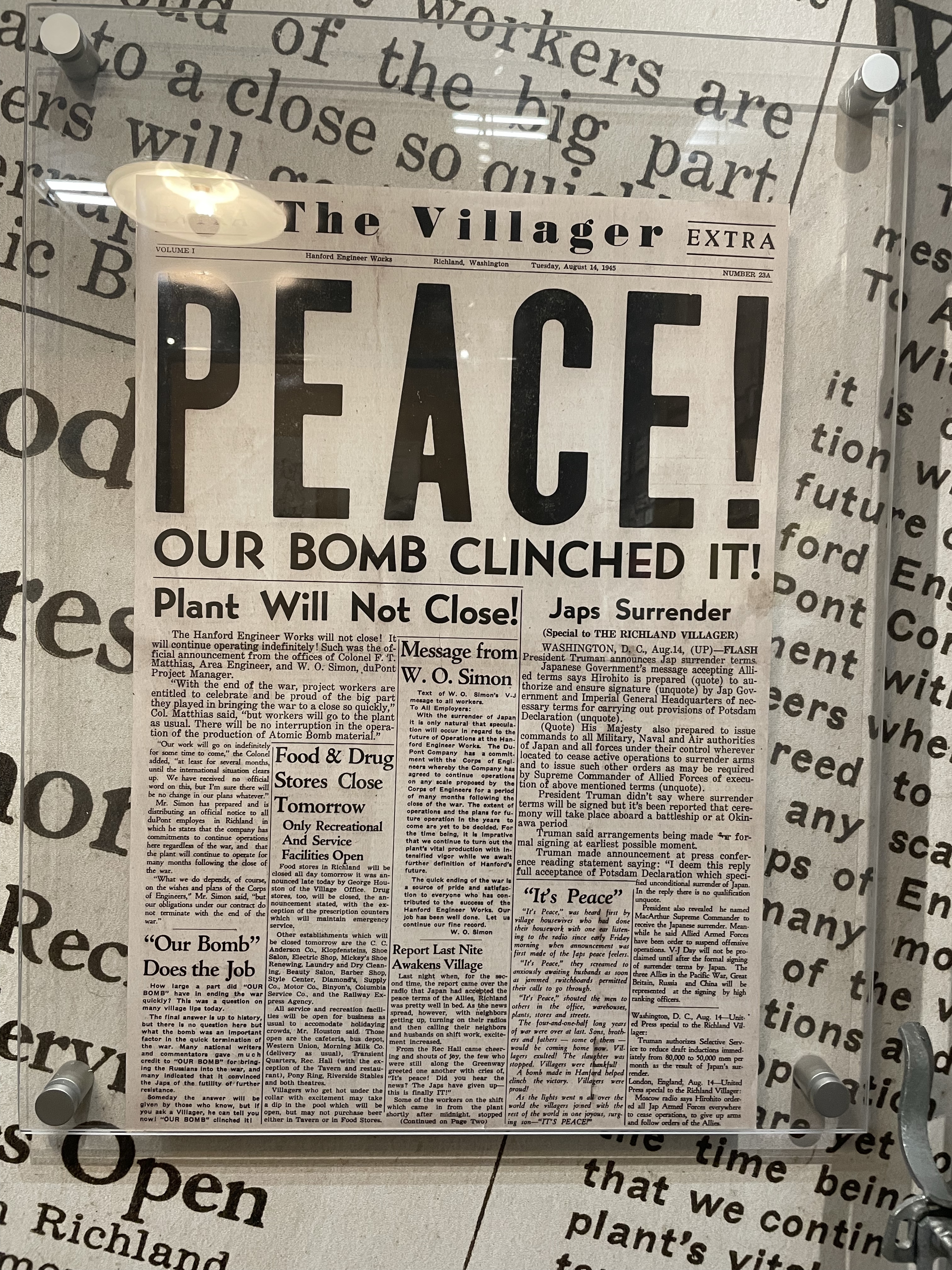
I knew about the Manhattan Project and the work done in Los Alamos, but I was not aware of what happened in Oak Ridge, Tennessee.  And it was not until this summer that I learned about Hanford, Washington.

Oak Ridge, Tennessee, was the military headquarters for the Manhattan Project.  The town of Hanford, Washington, was where the plutonium was processed. I am not a physicist or an historian of WW2. I knew the little bit that I knew, and to be honest that was enough. Knowing what I know now is a bit frightening.

This summer we took a cruise on the Columbia and Snake rivers to learn about the Lewis and Clark Expedition.  Though I did learn so much about the history of that journey, docking near Hanford. opened my eyes to the immensity of the Manhattan Project and the multiple places where the secret experiments were carried out and the bombs were manufactured.

The Hanford Engineering Works was where the plutonium was processed.  This almost 600-square-mile site was another secret city where people worked on the development of the nuclear bomb.   To this day, two thirds of our country’s nuclear waste is contained somewhere on this site.  The water and air continue to be monitored. Barriers have been built to keep the waste contained.   Families with children live and work here.  I am not sure I would want to live there.  But many do.

While in the Hanford area, in what is called the Tri-Cities, we visited the REACH Museum. The museum focus on this area and the time before Hanford became part of the Manhattan Project, but it also has an area devoted to the development of the atomic bomb.  For me this was a revelation.  I had absolutely no idea what happened here! Just like in Los Alamos, an entire town and community was developed in a secluded area basically uninhabited.

In 2015 the Manhattan Project National Historical Park was created.  This part preserves areas in the three sites where the atomic bomb and its secret development was worked on: Los Alamos, Oak Ridge and Hanford. Parts of these sites are open to the public.

Watching Oppenheimer was emotionally intense.  To see how these people came together to invent the unimaginable and how some were horrified by what they had developed.  To see Oppenheimergo from a man honored for his work as the director of the Manhattan Project to a pariah for his work afterwards to keep additional bombs from being developed. 

To see how he was attacked and verified was a bit frightening.  I knew about MaCarthyism and the attack on many Americans because they might have once been communists.  I learned in college how these attacks hurt many innocent people.  And how Joseph McCarthy was finally stopped.  I did not know that the fear about communism also impacted Robert Oppenheimer. 

In the movie they ask him when opinions on the bomb and what he did had changed.  To me this was a ridiculous question. Can you imagine being among those scientist who learned how to use the power of the atom and plutonium to kill hundreds of thousands of people?   I would imagine that many had second thoughts about what they had unleashed even though the bombs did end the war with Japan.

At the REACH Museum this display indicates increased bombs during the Cold War.

We all need to learn about how the bomb was developed and the efforts to stop the continued development of bombs in the 1950s.  Perhaps the world would be a different place if that had happened.  Because even today the fear of nuclear bombs continues to be a threat to our world.  So we have to ask, as Oppenheimer did, did he “become Death, the destroyer of worlds”? 

I hope not.

To learn about the Manhattan Project National Park   https://www.nps.gov/mapr/index.htm

The Reach Museum: https://visitthereach.us/

Day Trips to Mt. St. Helens and Mt. Hood

19 Aug

Soon after I married Mt. St. Helens began to awaken. Two months later the volcano’s explosive eruption was international news.  I remember picture after picture of the eruption, the area around the volcano and the loss of life so well.  Although in my life, my marriage was the most important event of 1980, I knew for everyone else it was the sight of Mt. St. Helen’s eruption.

Each anniversary for this tragic day, I think back to my friends who were married in Washington state just a few days after the devastation.  Although they lived closer to Spokane, and were not impacted by the actual eruption, the smoke and ash did make the trip and changed the atmosphere of their wedding.  I wish I could have been there to see their wedding and the ash!  But I could not.

This event has been etched in my mind! I had to see for myself what Mt. St. Helens looks like now.  In June I finally had that chance. 

Before a cruise we were taking along the Columbia and Snake River, my husband and I took a tour up to Mt. St. Helens. We were supposed to go to the Johnston Ridge Observatory, where the volcanologist, Davide Johnston, died. Unfortunately, there was a mudslide a few days before our trip. Instead we went to the Elk Overlook and then to The Weyerhaeuser’s Charles W. Bingham Forest Learning Center, then to the Mt. St. Helen’s Visitors Center operated by the National Park Service.

Seeing the volcano, even from a distance, was stunning.  You can see clearly where the side of the mountain blew out!  At the learning center, there are photos of the area before and after the blast.  It is amazing how the logging company has planted millions of trees and changed the look of the area.  Within the national park site. Nothing has been planted by man. All the new growth was by nature alone.

The Cascades are amazing.  The Douglas Fir trees and Giant Sequoias meet all expectations!

After seeing Mt. St. Helens, it seemed apropos to also go to see her sister volcano, Mount Hood. It has been dormant since 1866, but it is still monitored in case it decides to wake up.  Tourists can get much closer to Mt. Hood. In fact, people can walk a trail to the top.  We did not do that, but we did walk part of the trail.  There was snow so I was glad I had a jacket.

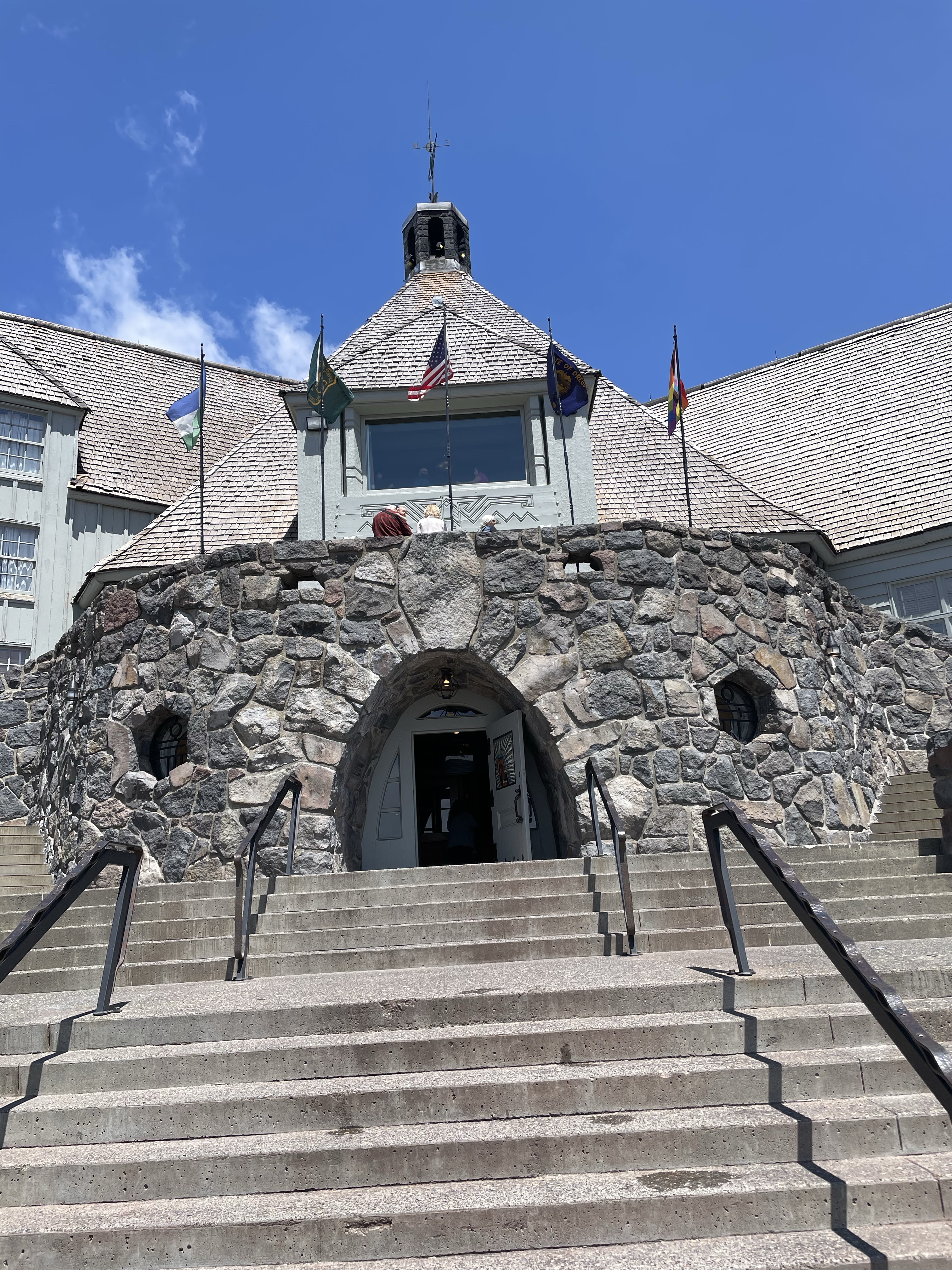
We started our visit there at the lovely Timberline Lodge, which was built in the 1930s during the Great Depression.  The giant timbers used to make the hexagon lobby are impressive.  There are many lovely carvings and other artworks throughout that make it a great place to visit. 

From the lodge there are many wonderful views of the volcano as well as the start of the walking trails up the mountain and around it. 

It is an active hotel and ski resort.  I would love to be there as an overnight guest. We ate lunch in the dining room and the food was delicious.

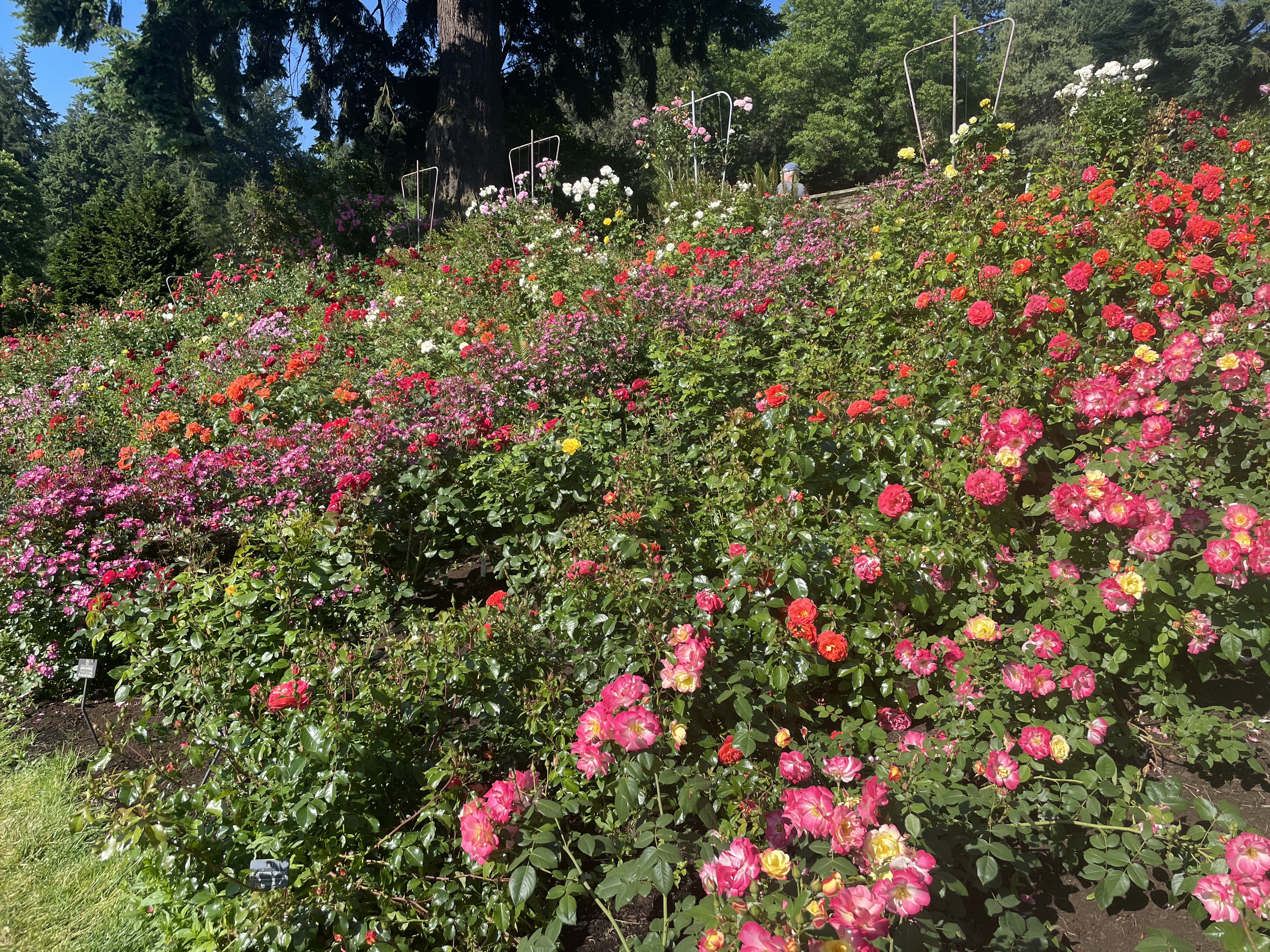
If you are in area of Portland, Oregon, or Vancouver, Washington, taking trips to these two volcanos would be great.  Besides seeing the mountains, we also visited the Rose Gardens in Portland, a stop that any rose lover should not miss.  There were thousands upon thousands of magnificent roses.  We visited the roses on the way to Mt. St. Helens.  Before we went up to Mt. Hood, we spent some time walking the trails and seeing the 611-foot high, Multnomah Falls. Also a lovely place to visit.

These two days were among the highlights of our trip!