Archive | Travel RSS feed for this section

Amazing Dinosaur Displays In Bozeman, Montana

26 Sep

On our way to Yellowstone, we spent two nights in Bozeman, Montana, home to the Montana State University and the wonderful Museum of the Rockies. We never got to visit the campus of the University, but we did spend a couple of hours examining the exhibits at the museum. 

The Museum basically has three parts: Dinosaurs, Yellowstone Park, and an outdoor farmstead.  We did not tour the outside area because it was closed for the season, and it was cold and raining. But we definitely enjoyed our visit to the inside exhibits, even though two were closed as they were preparing new exhibits for the fall.

The Dinosaur Exhibit hall is spectacular.  The museum has a relationship with the paleontology department of Montana State University.  I believe that many of their dinosaur skeletons and the research and work on them are done by faculty and students from the university.   And you can tell as you walk through the exhibits that they are meant to be interactive and educational. You do not just look at the dinosaur bones, you participate in activities that explain what you are seeing.

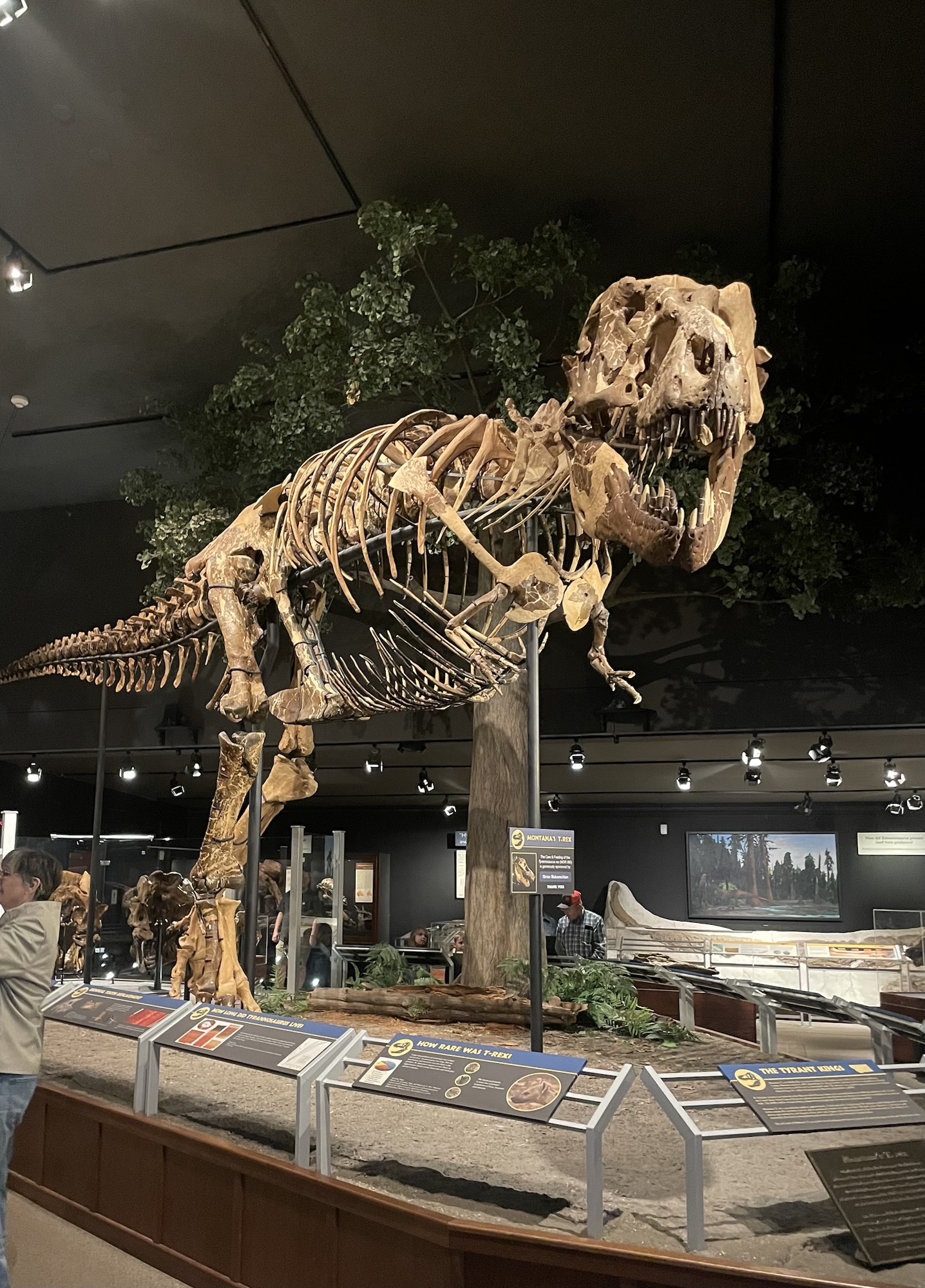
However, what you are seeing is so wonderful that sometimes you just have to look up in awe, especially at the Montana T-Rex that stares at you as you enter one of the rooms. The entire time I was there, I was thinking that I wished I had come here with my son when he was a child. He loved dinosaurs. The only books he wanted to read were about reptiles and dinosaurs.  He would have just loved this museum. 

Two of my favorite displays were the clutches of unopened dinosaur eggs and the sad display of a group of young diplodocus that got stuck in mud eons ago and died.  A section of their tomb is now on display at the museum. 

I loved how they displayed the underwater dinosaurs.  The carpet color changed to blue as did the walls. It made me feel that I was underwater.  My new bit of knowledge there, was that one water dinosaur, Plioplatecarpus peckensis had teeth on the roof of its mouth to clamp down on prey.  Ouch.  The outer teeth were scary enough, without the inner line of teeth ready to dig in.

Unfortunately, we got there just a week after the giant T-Rex, Sue, left. It had been on loan from the Field Museum in Chicago.  But not to worry.  I had visited several times with my family.  However, I did feel sad that we just missed seeing it again.

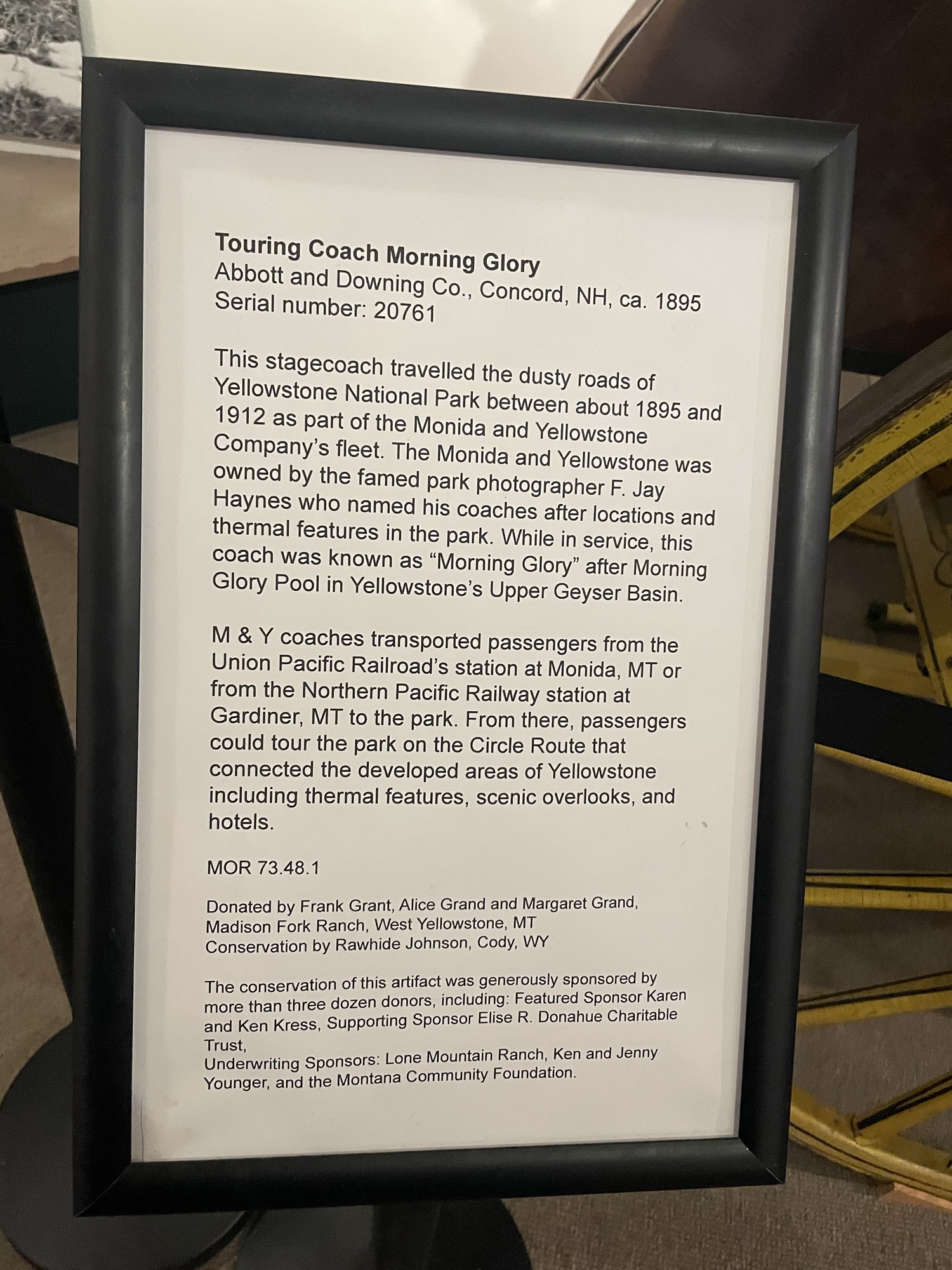
The next section of the museum also interested us because we were on our way to spend six days in Yellowstone National Park. Reading the displays in the museum and seeing the items from the Park’s early days was a wonderful introduction to what we would be experiencing. I enjoyed seeing an original park ranger uniform and the touring coach that transported people throughout the park during the early 1900s, before there were paved roads and cars.

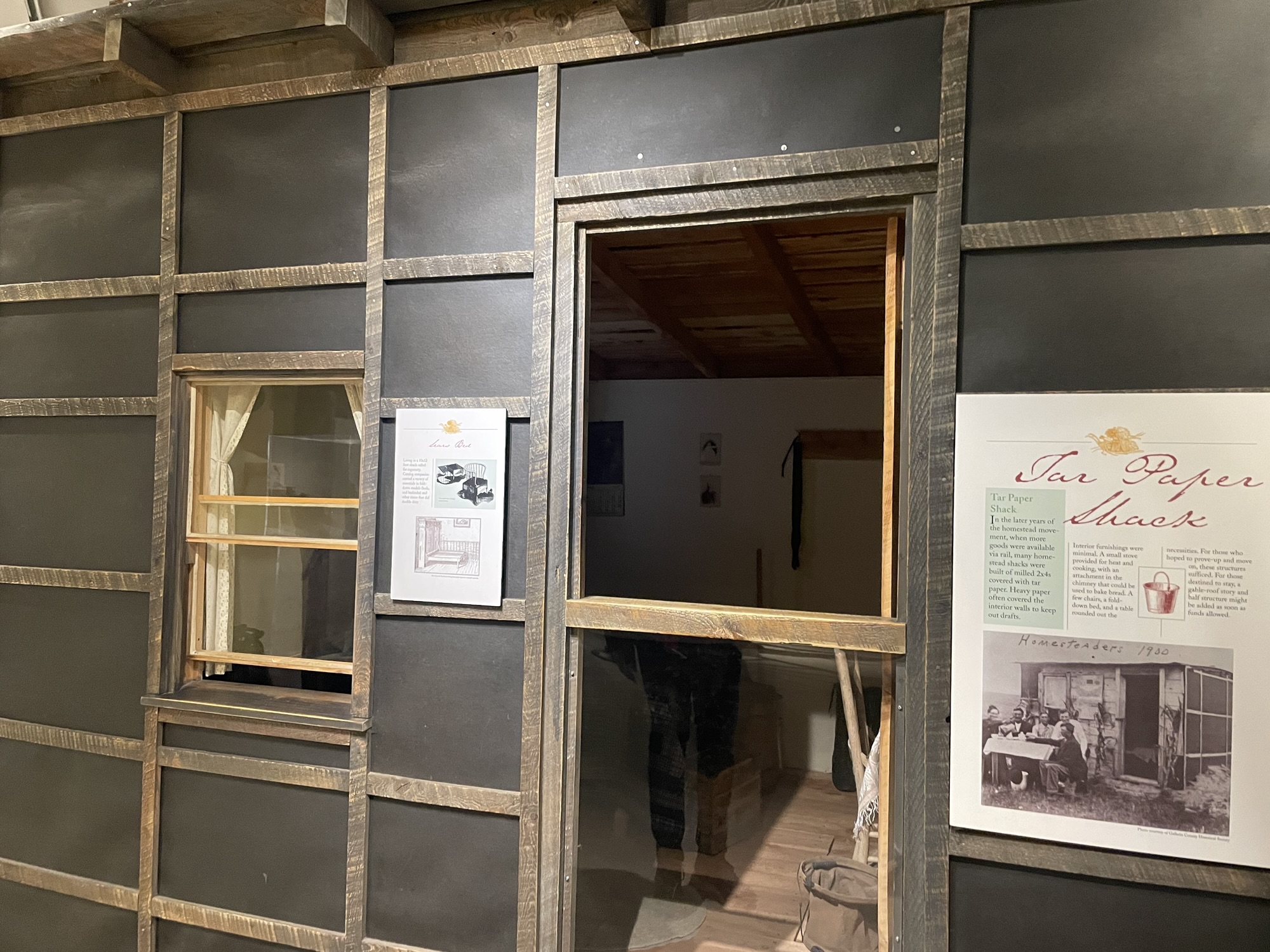
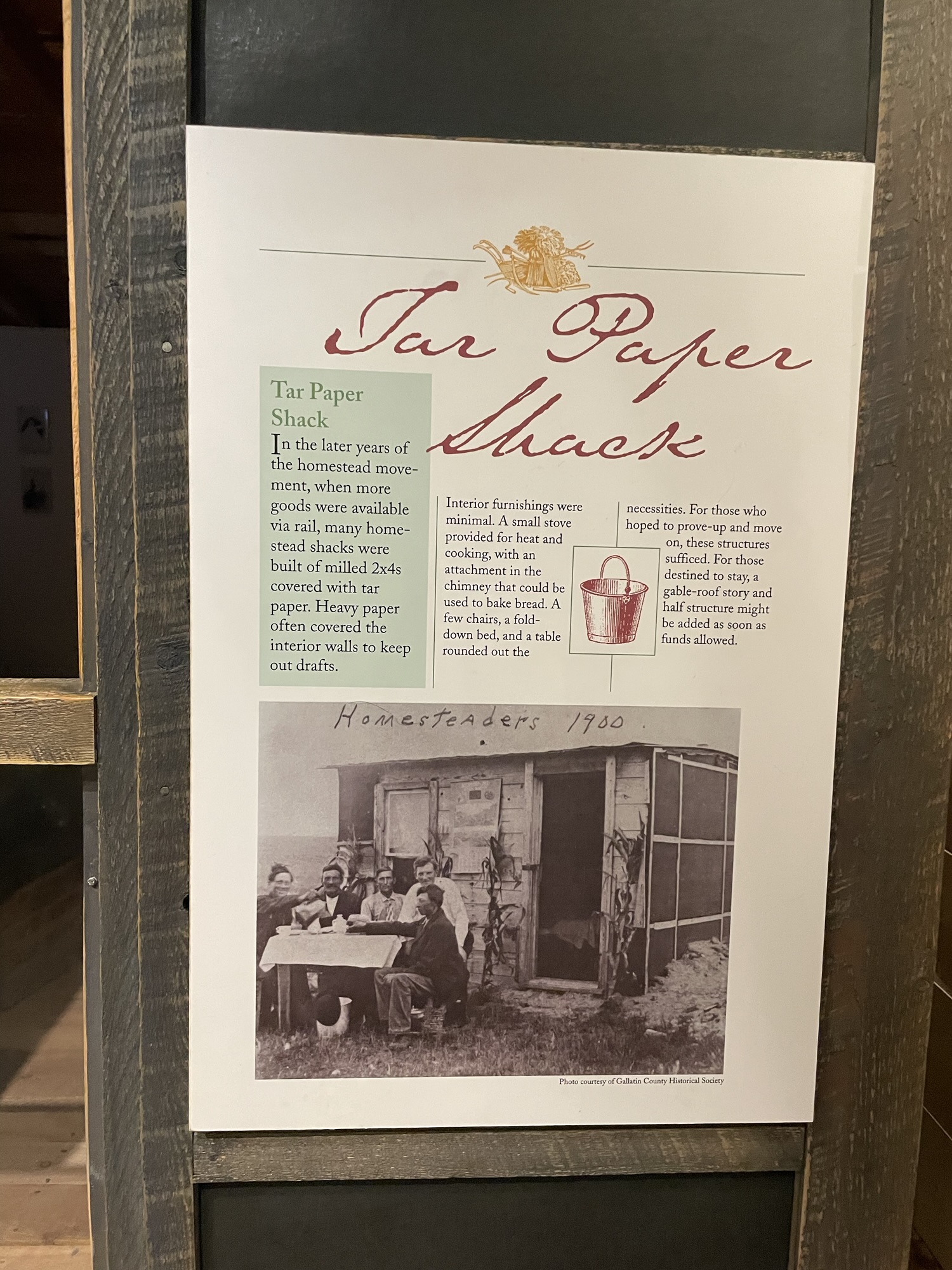
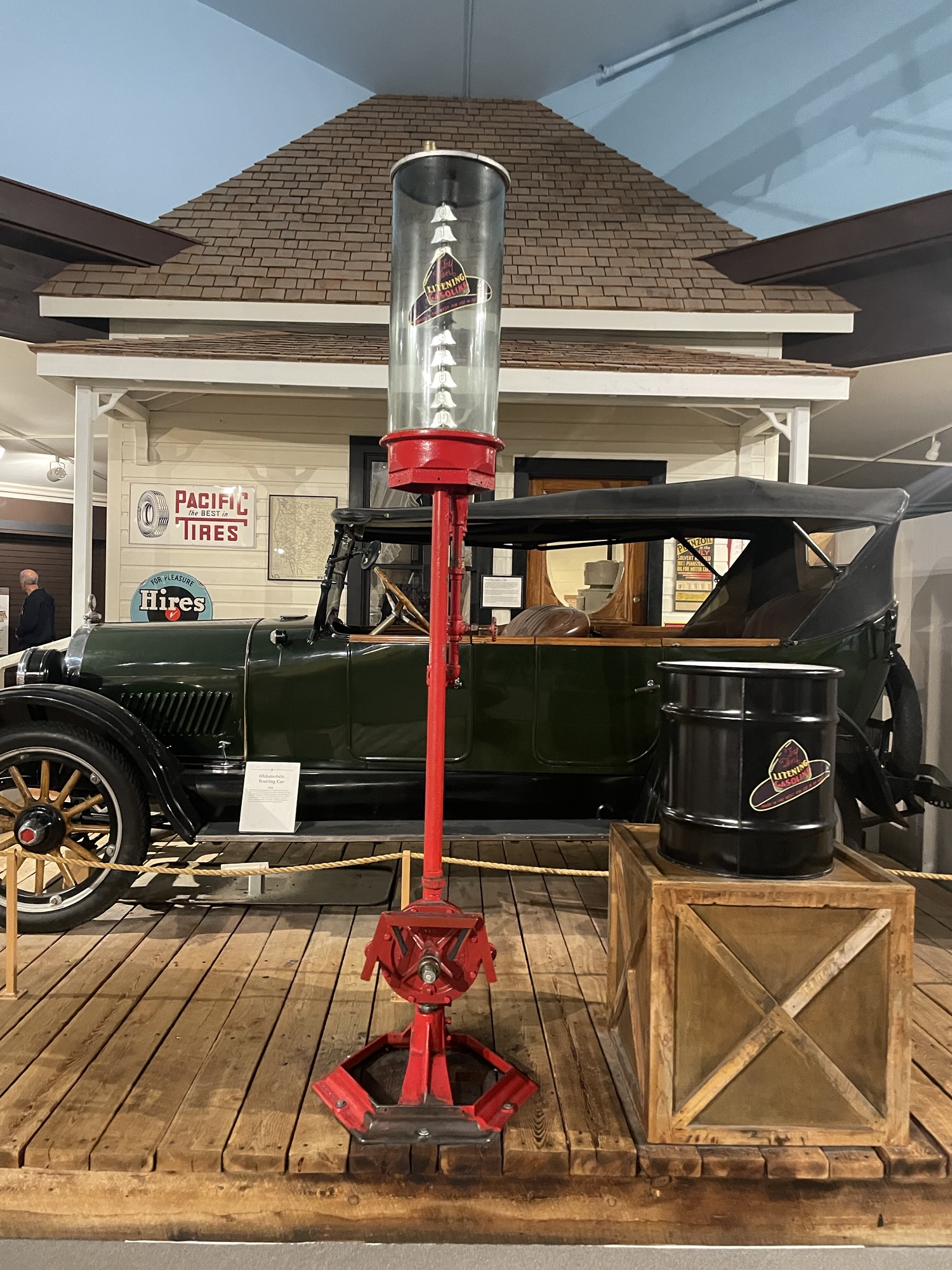
And because I love seeing old houses, seeing both a tar paper house and a small wooden house inside the museum, made me more aware of how difficult life was for early settlers in Montana. It is cold there.  I cannot imagine living in these houses without insulation and the modern conveniences. But the other interesting point was that gasoline stations were also the homes of the settlers. It was important for the new automobiles to be able to refuel. It would have been quite a lonely life, but instead they met people traveling to Yellowstone!

This was a great way to start our week-long trip to Montana and Wyoming and the wonderfully weird Yellowstone National Park!

https://museumoftherockies.org/

My favorite Places in Iceland

22 Aug

Our cruise in July started in Iceland.  We arrived while the volcano was erupting.  We could see it from the road as we traveled from the airport to Reykjavik.   It was exciting for us because years earlier we were in Hawaii when the volcano was erupting, but the day that our cruise ship was going to be able to see the lava flow, it stopped.  A great disappointment.  Seeing the eruption in Iceland fulfilled a desire to see an erupting volcano.

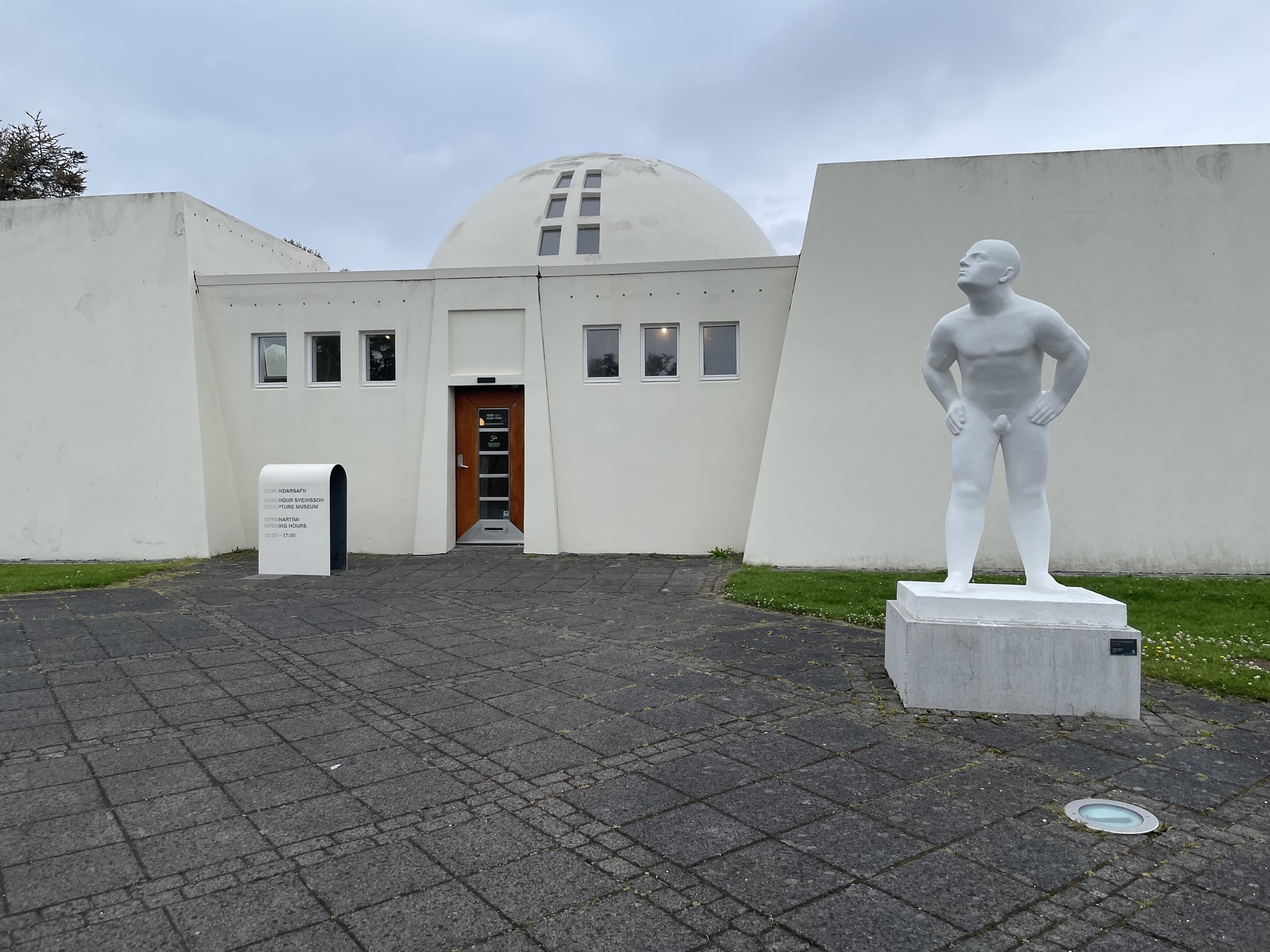
We visited two off the beaten path places in Reykjavik that were in walking distance to our hotel.   The first was the Asmundur Sveinsson home and sculpture garden/museum at the Reykjavik Art Museum.. Honestly, I had never heard of him before, however one of his statures I had seen, “The Woman with A Churn”.  Some of his large sculptures did not appeal to me.  I think I like figures that I understand a bit more.  Before we read the description in the guide we used, my husband and I tried to figure out what some of the sculptures represented.  I think we needed to understand more about Iceland mythology culture to really appreciate the figures.  But I am glad we went.

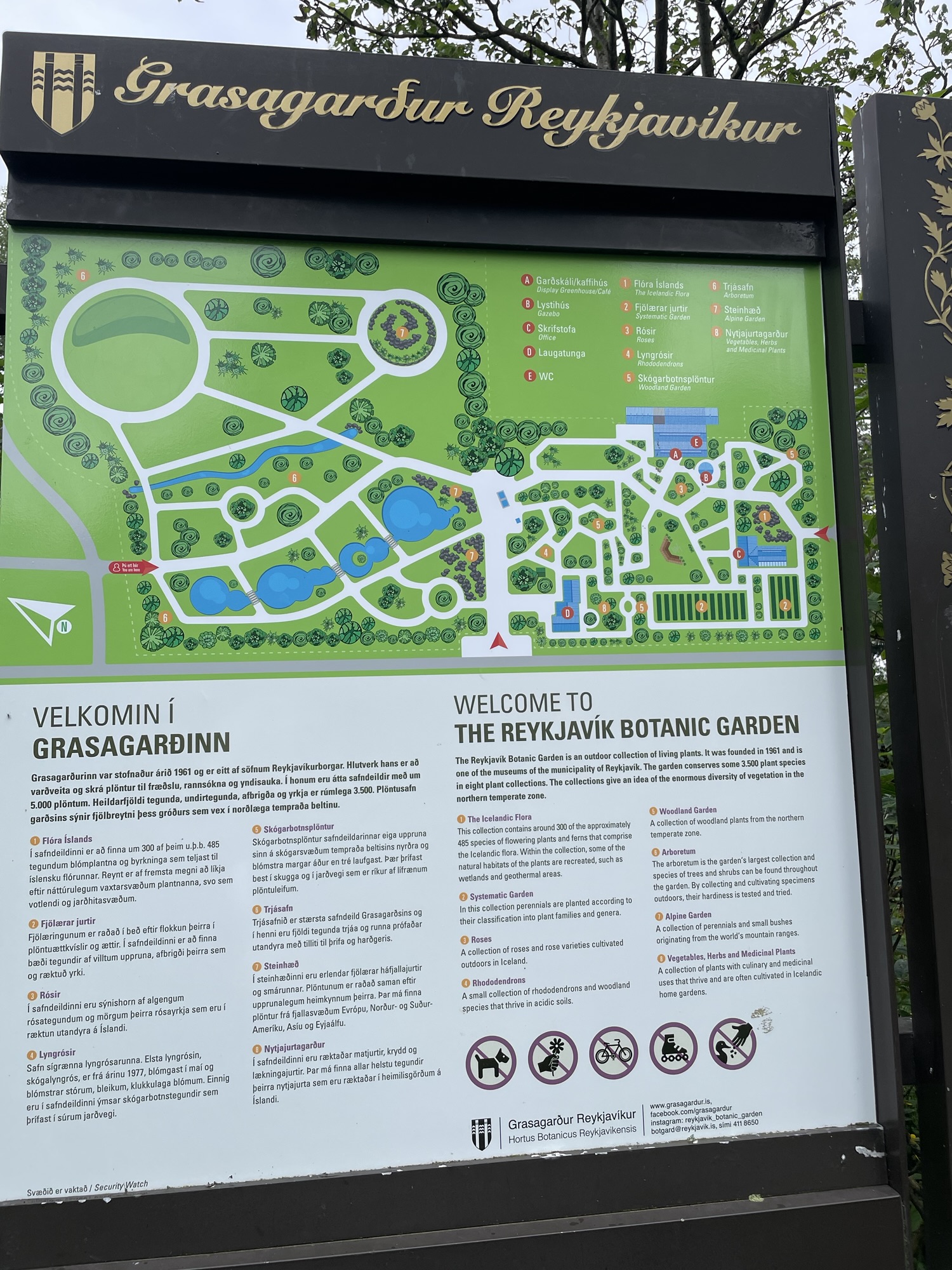
From the museum we walked to the Reykjavik Botanic Garden, “Grasagardur Reykjavikur.” I love botanical gardens, and this one was lovely, especially since the flora of Iceland is much different than those I had visited before! Much of it is low to the ground and nestled into rocks and crevices.  I liked how there were paths through the rock gardens so we could get up close to these plants.  It was a quiet place to walk and enjoy, as well as to see all the families there enjoying the paths as well.  I am sure it is a great place for families because it is also free and open to the public.

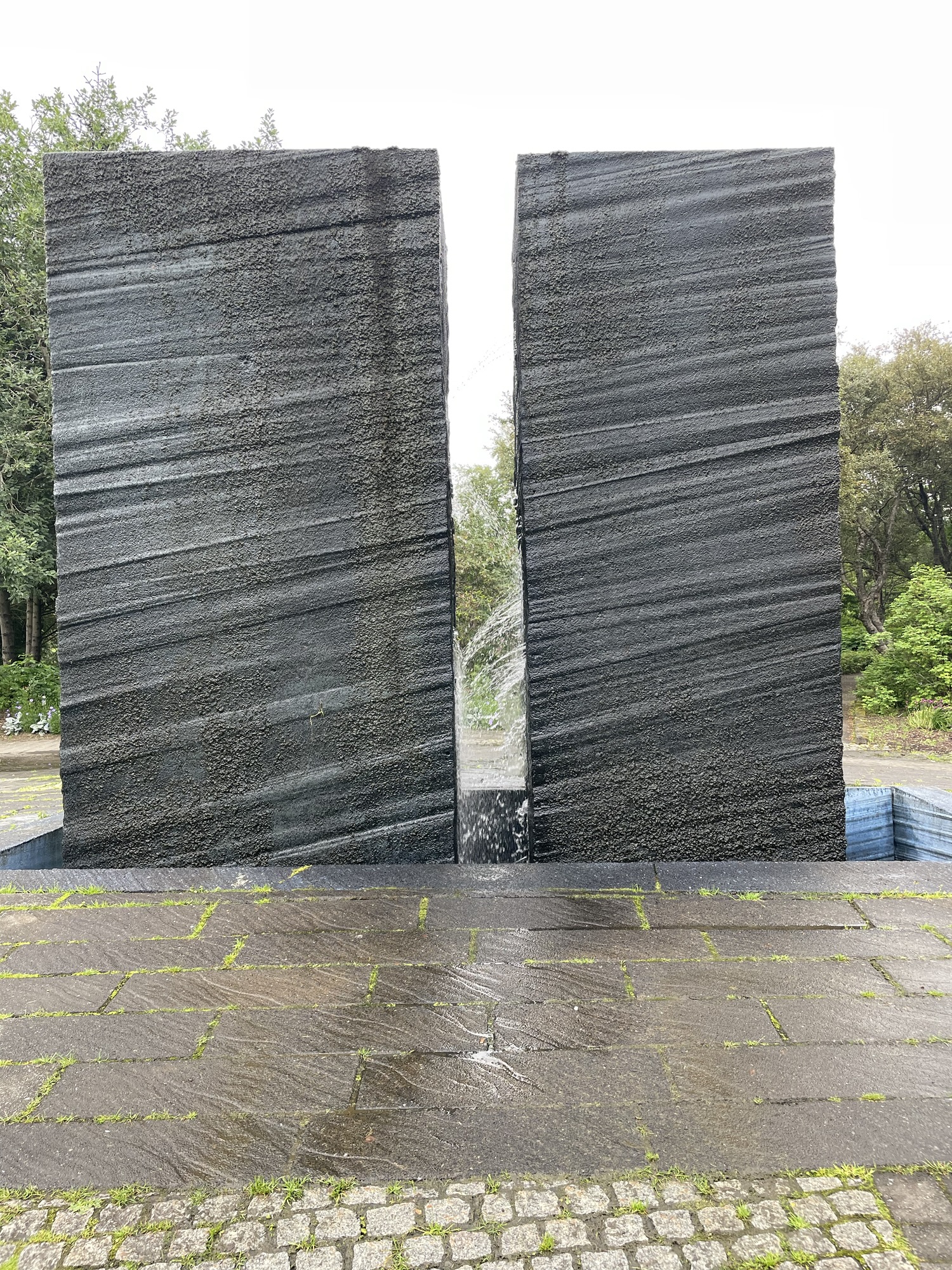
There is a wonderful sculpture in the park of two towers and between them is a water feature that ebbs and flows.  It stands right in front of one of the rock gardens.  I enjoyed seeing its water display with the plants below.  The botanical garden does have a café, where many of the families were eating.  We chose to leave the park to walk a bit through the town and ate at a lovely little restaurant called, Ginger.  It was excellent.
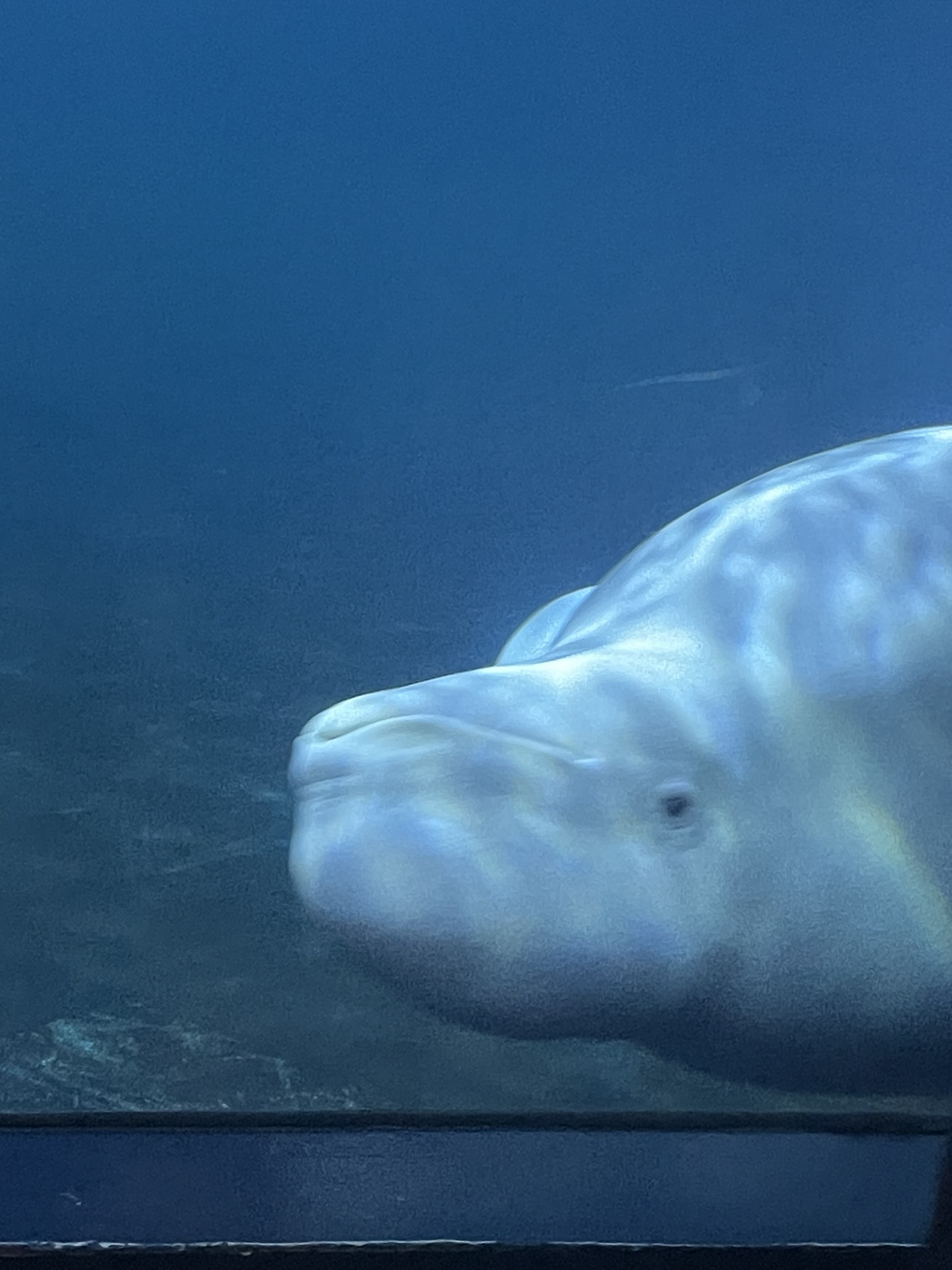
My other favorite spot in Iceland was our at first stop on the cruise at Vestmannaeyjar on Heimaey Island.  Before our tour, we took a quick walk around town and decided to visit the Beluga Whale Sanctuary at Sealife Trust.   I have been singing the Beluga Whale song, “Baba Beluga.”  by Raffi for years. First to my children and now to my granddaughters.  So I absolutely had to visit this sanctuary and donate to support the whales.  Their two whales were rescued from show and now live peacefully.  They Sealife Trust is preparing a bay at Heimaey Island to eventually releases the beluga whales to live in.  I am glad we made this stop before meeting up with our tour.

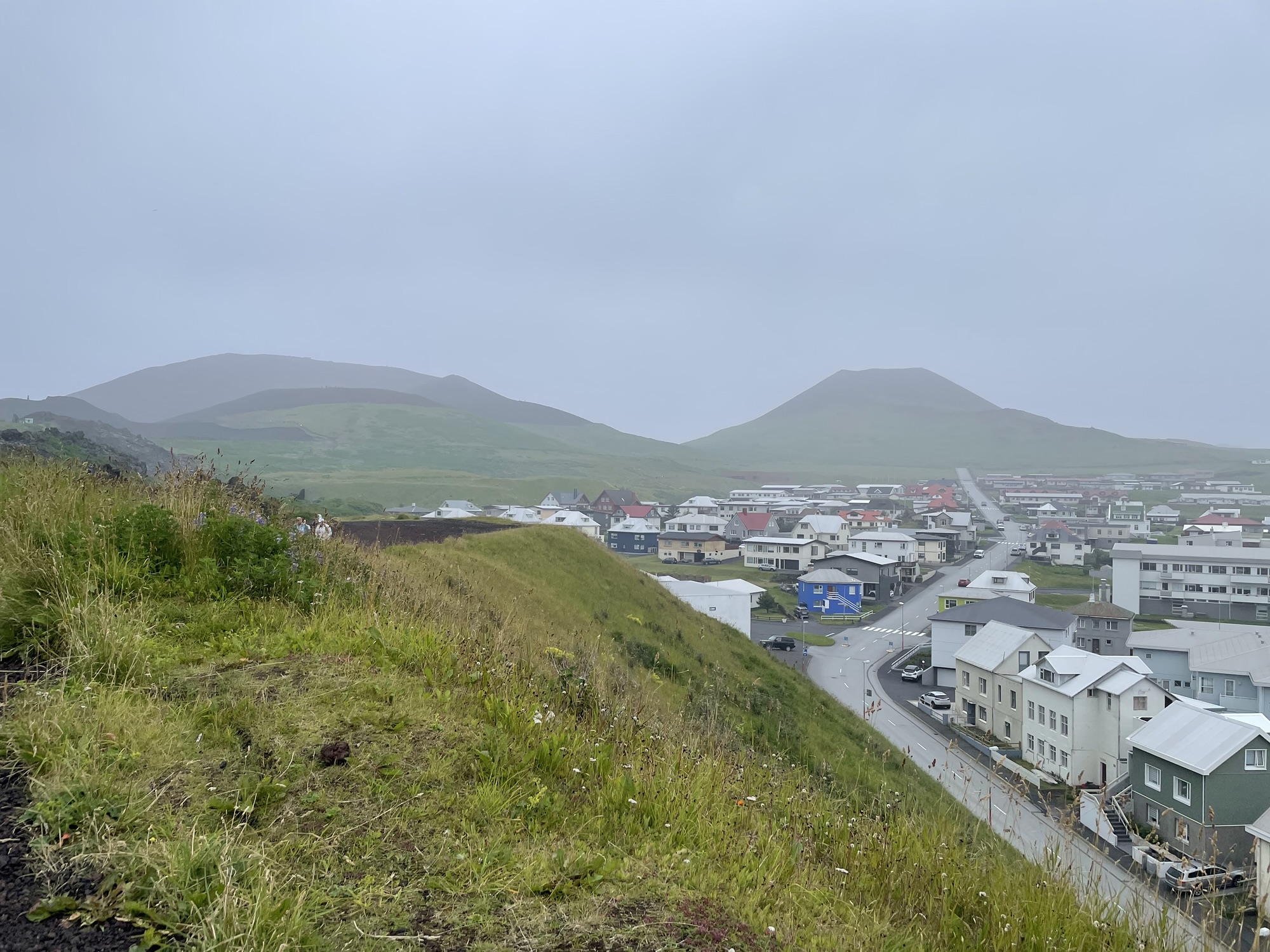
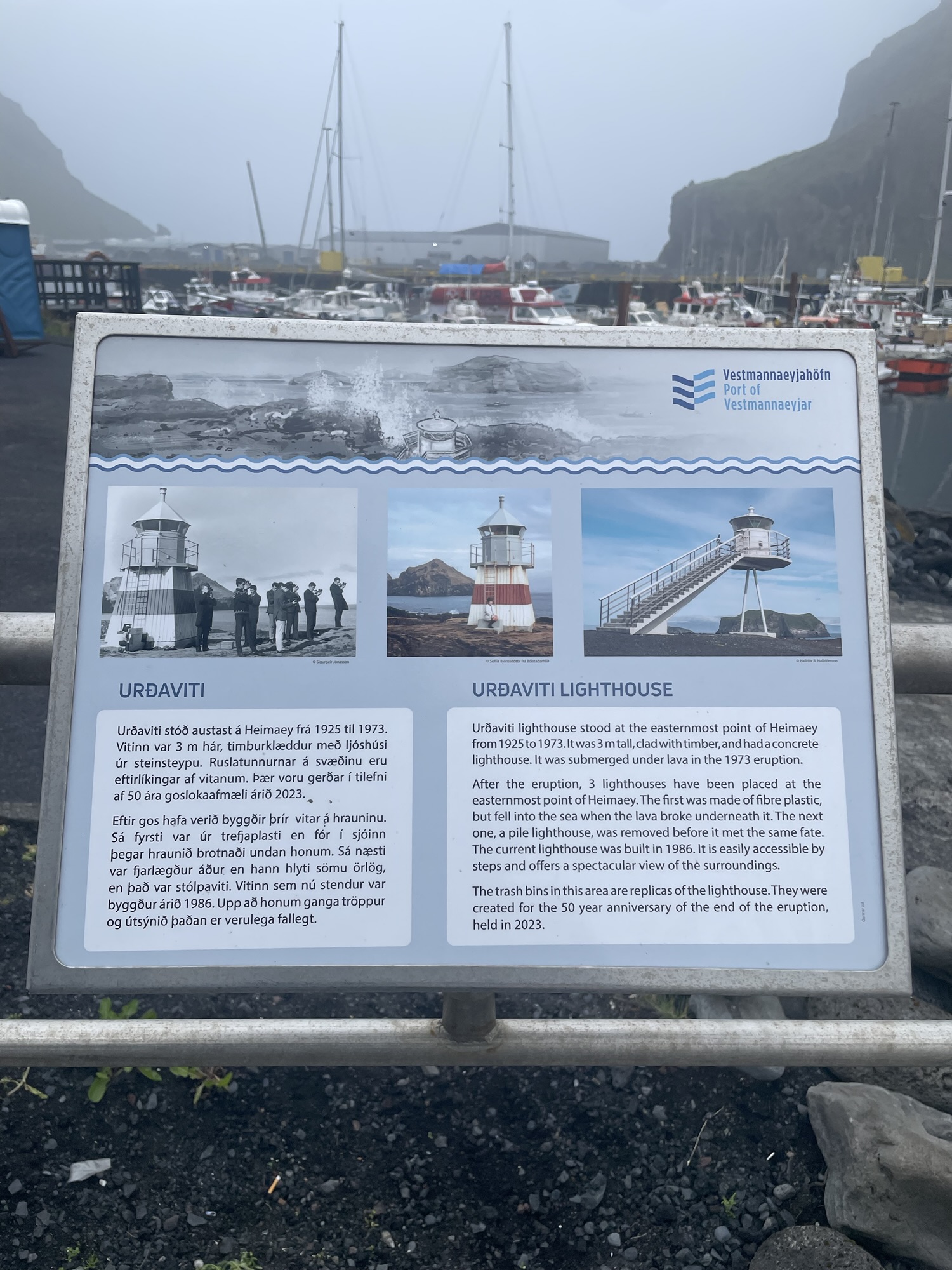
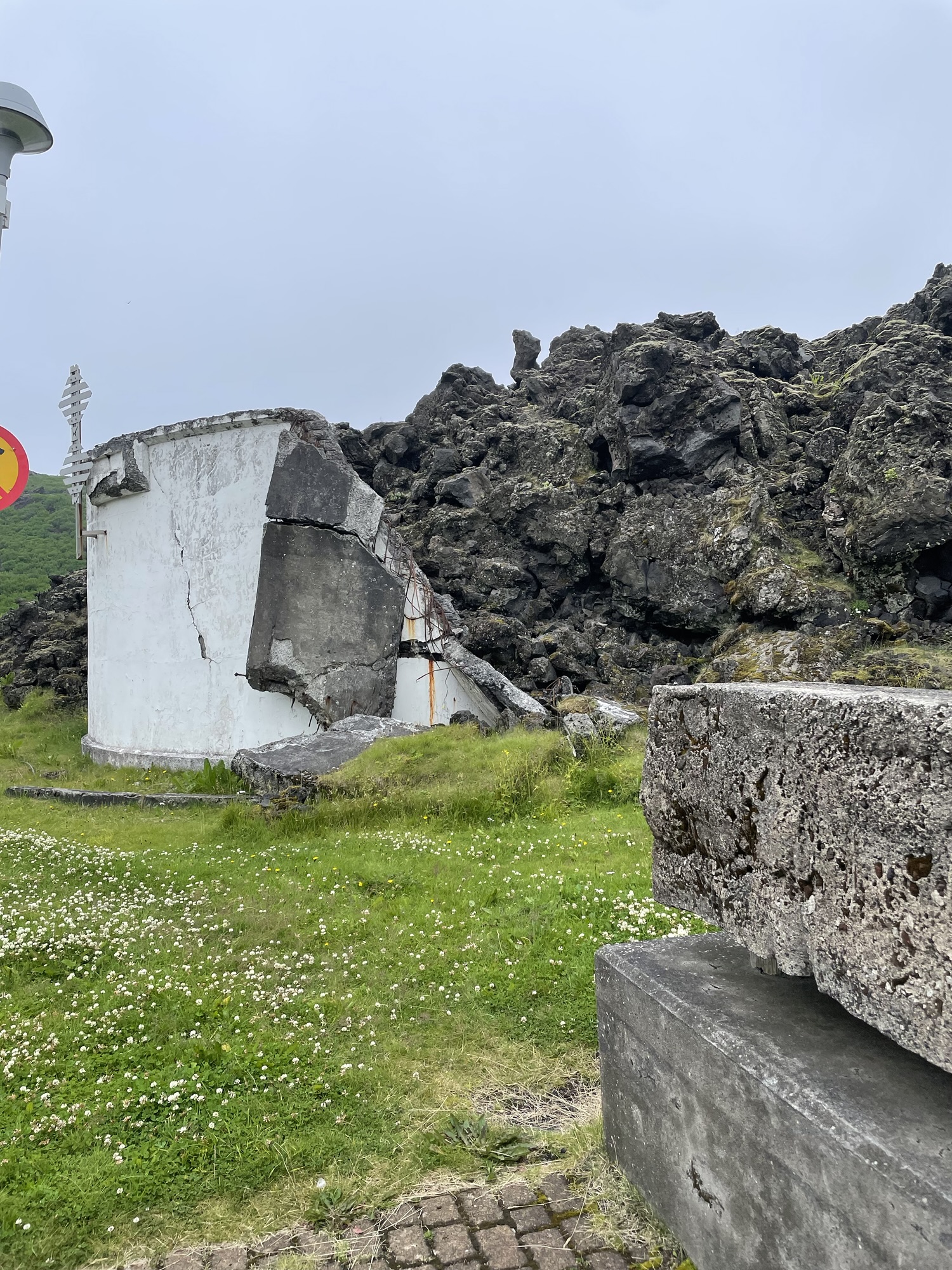
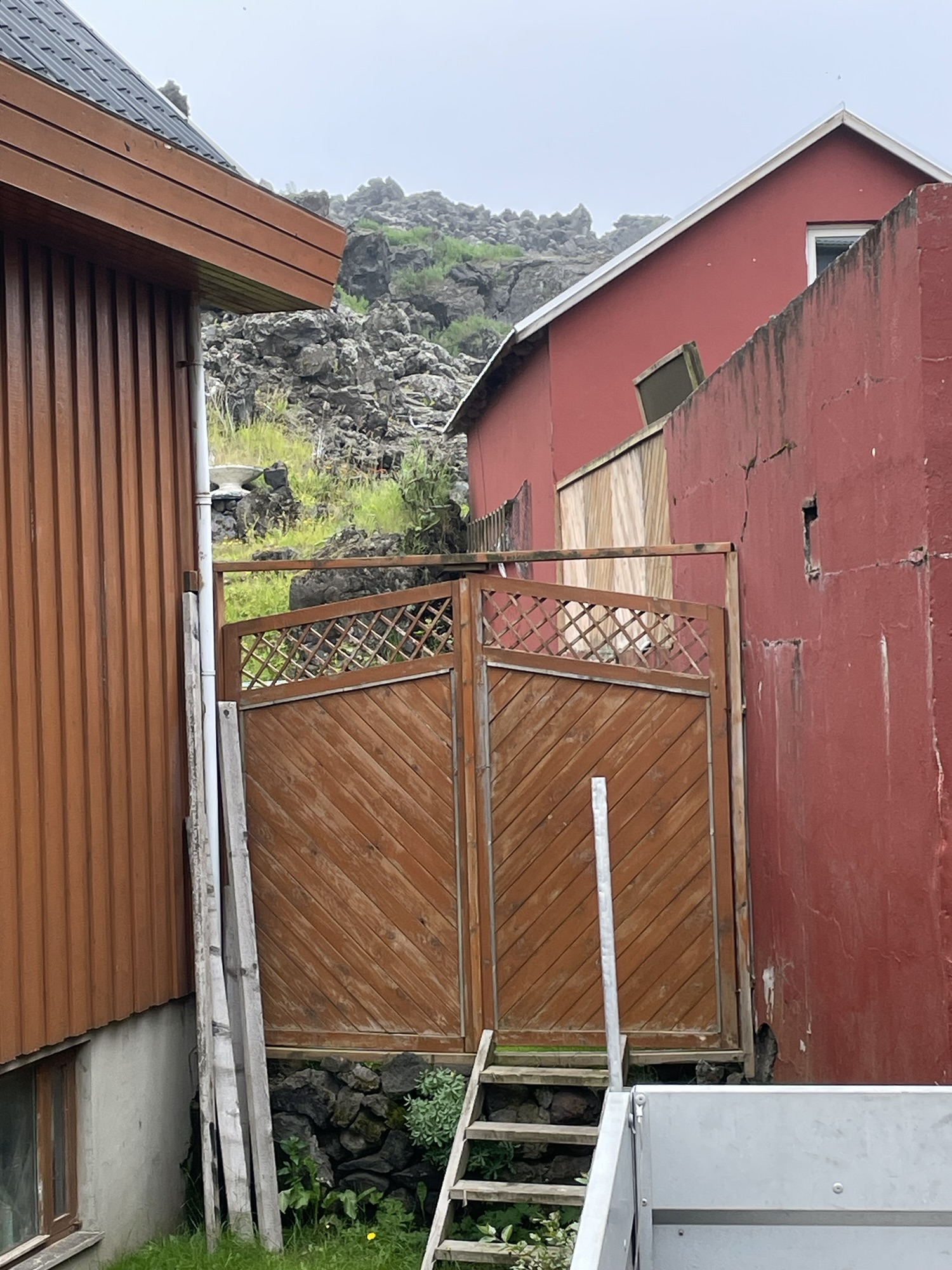
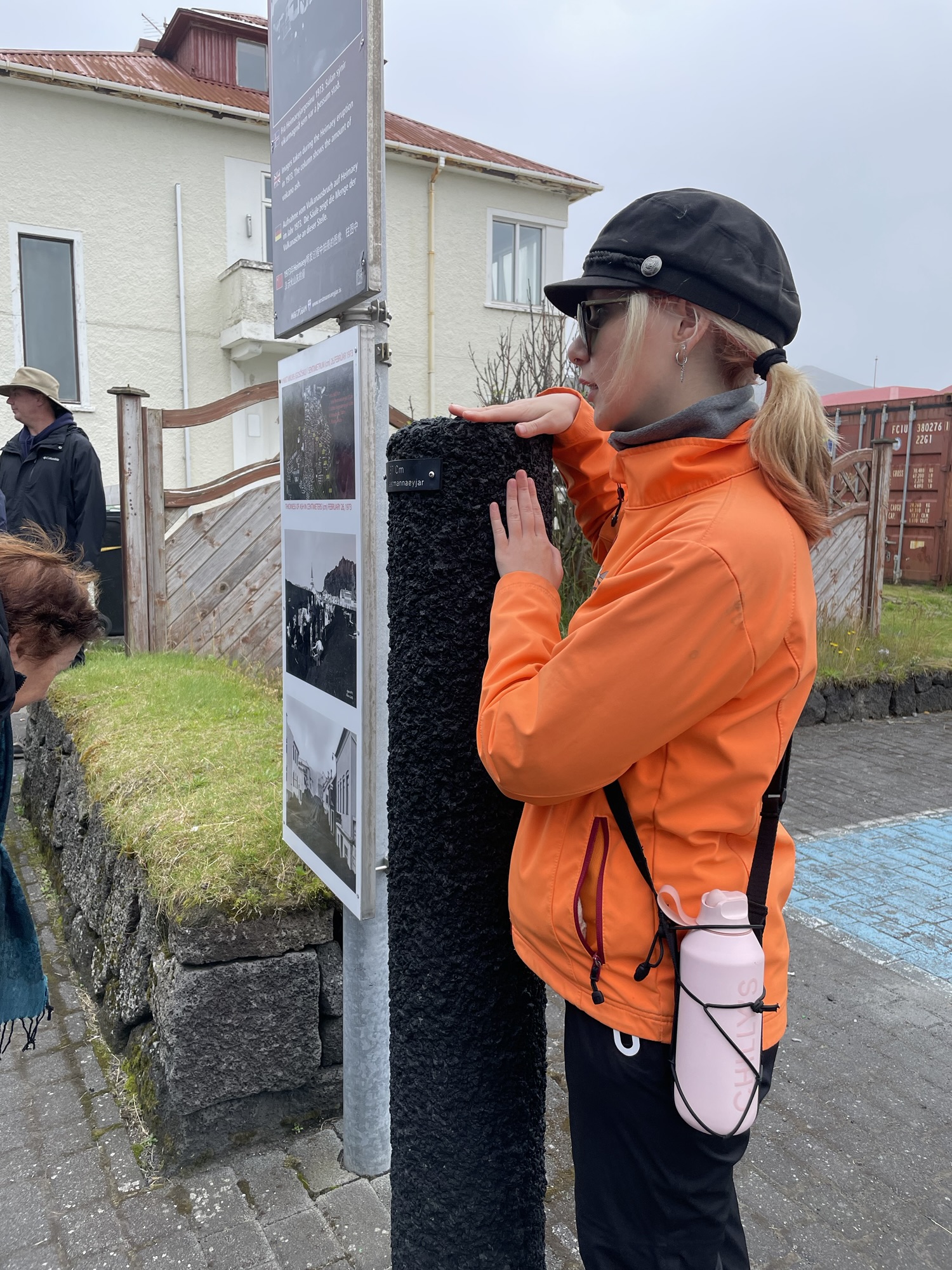
I chose our tour because of my fascination with volcanos.  Years ago my husband and I visited Pompeii, the most famous of the once lava and ash covered ancient cities.  Well Vestmannaeyjar, has a similar history.  In 1973, the Eldfell volcano erupted for six months.  It covered most of the city in ash and lava.  Over the years, the people have dug out some of the town. But a large area is still covered by the lava.  We joined a group that took a lava walk along the top of this lava flow above the now covered town. Luckily even though this eruption happened in the early morning, almost all the residents were able to escape to mainland Iceland. Just one person perished.

Our tour guide for the trip was a local resident, whose grandparents and mother lived through the eruption.  They were fortunate as their home was on the far side of town, and so not destroyed. But like all the other residents, they had to evacuate.  She also told us how the town saved their bay from the lava flow thus making it possible to the town to survive after the eruption.   They took salt water from the ocean and continuously sprayed it on the lava, which helped stop it just a short distance from the bay,

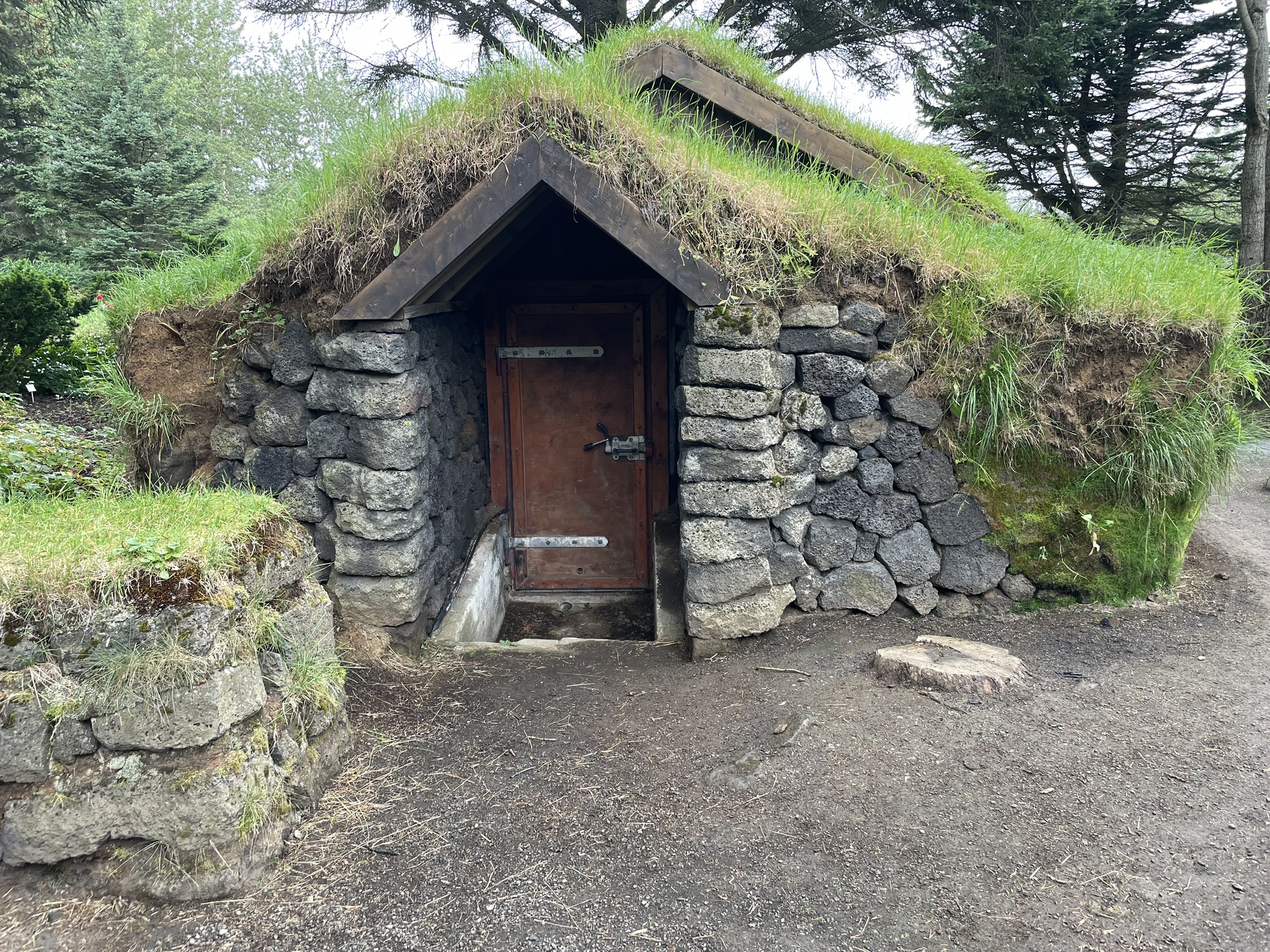
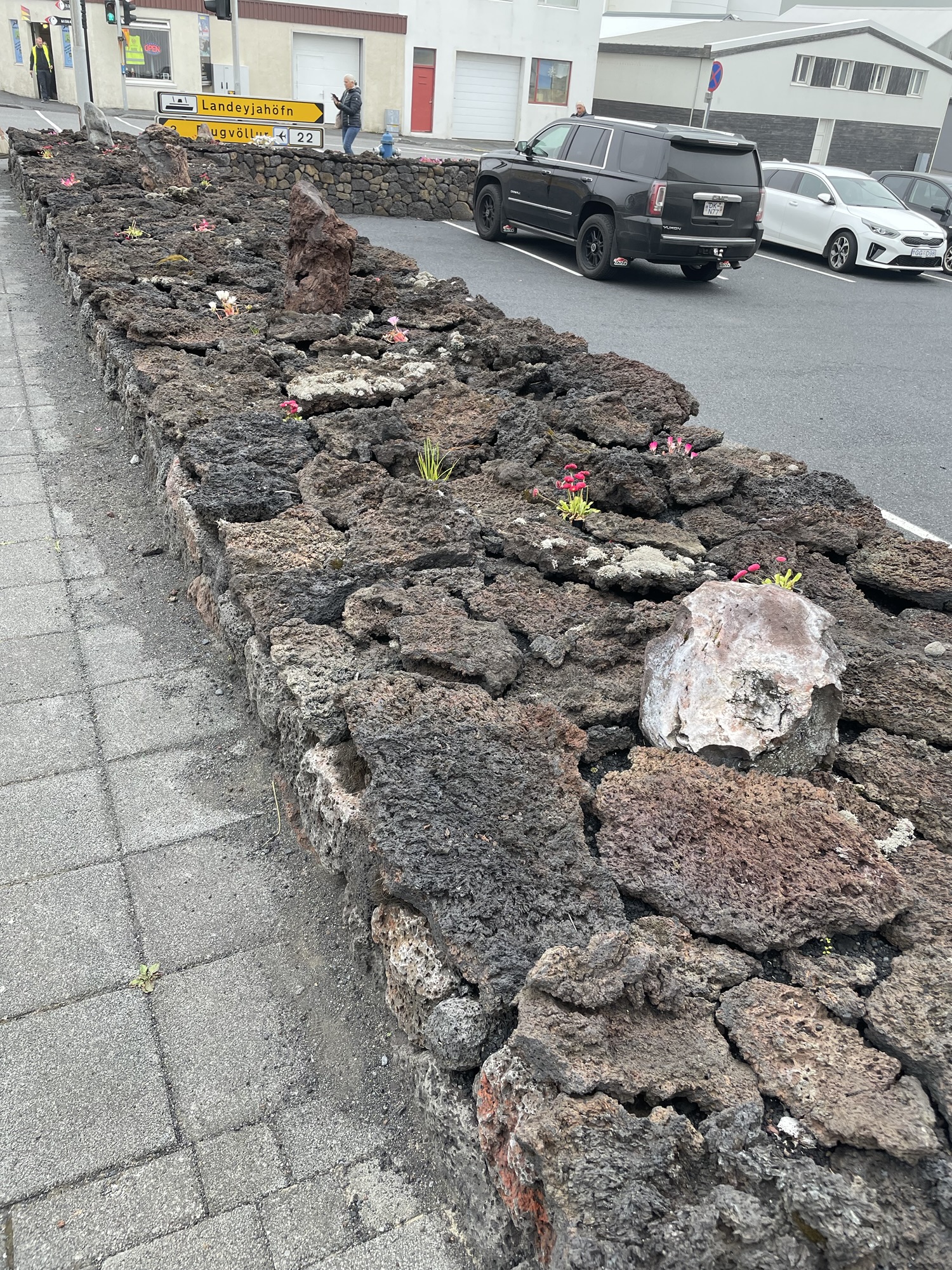
The lava increased the size of the island by two miles, also the town was able to use the heat generated by the still warm lava for decades to heat the homes and businesses!  I also noticed that a lot of fences and walls are made from lava in the city.

We could see what was left of Eldfell now, but noticed there is another older volcano, Helgafell, nearby that still has the typical volcano shape.

I really did enjoy our lava walk and tour. But honestly, I also wish part of it was to visit the Eldheimar Volcano Museum. It was a great disappointment. But by the time I realized we would not be visiting it, we had to head back to the ship.  I guess I will have to go back one day.

belugasanctuary.sealifetrust.org

Peaceful Kinderdijk Windmills

17 Aug

The windmills of Holland were always a site I wanted to see since I was a child and read the book Hans Brinker or the Silver Skates. I was mesmerized by the idea of the dykes and the water issues that impacted the Netherlands.   But even though I read the book, I never realized how important the windmills were to keep the water at bay.  Now I know.

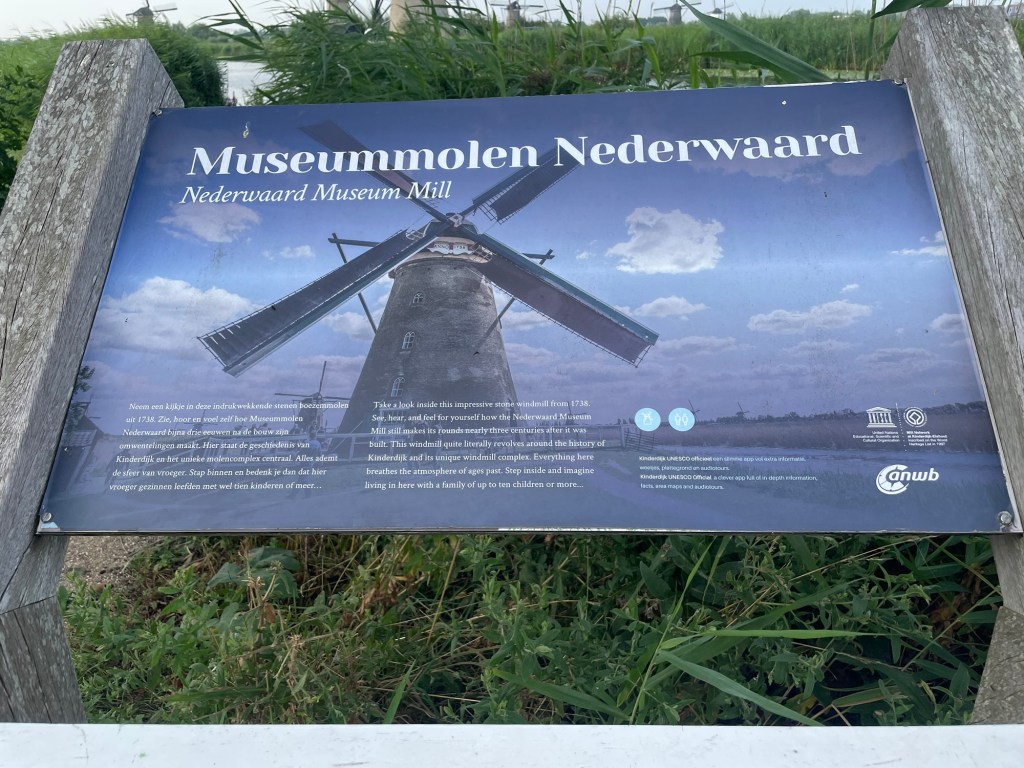
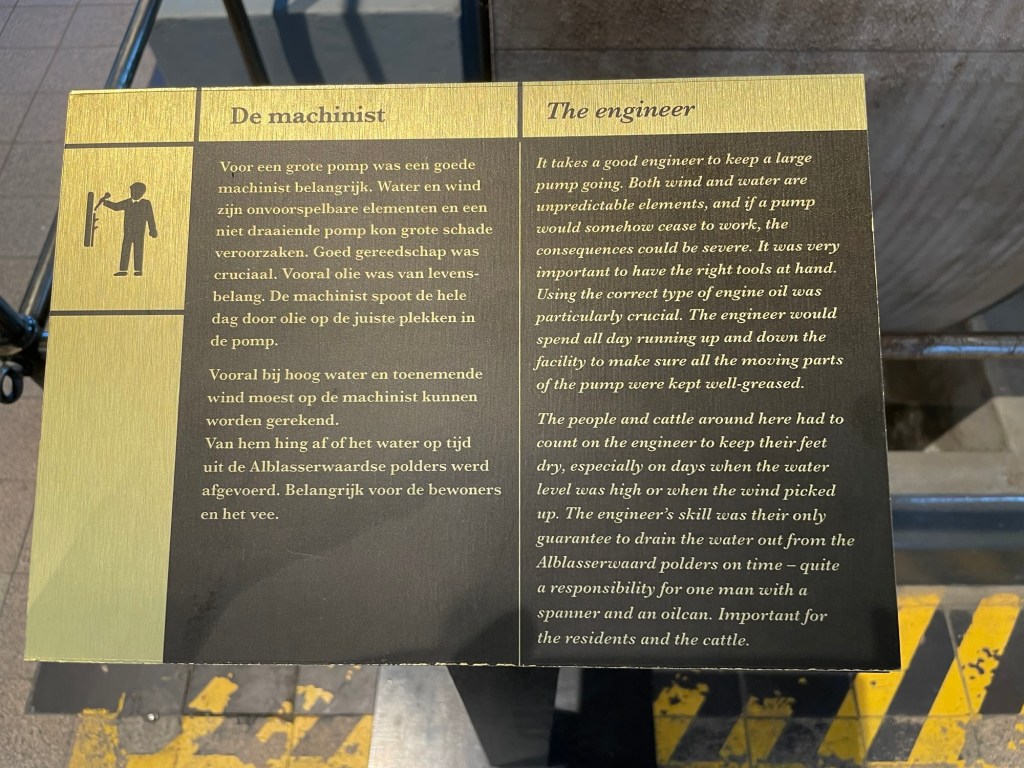
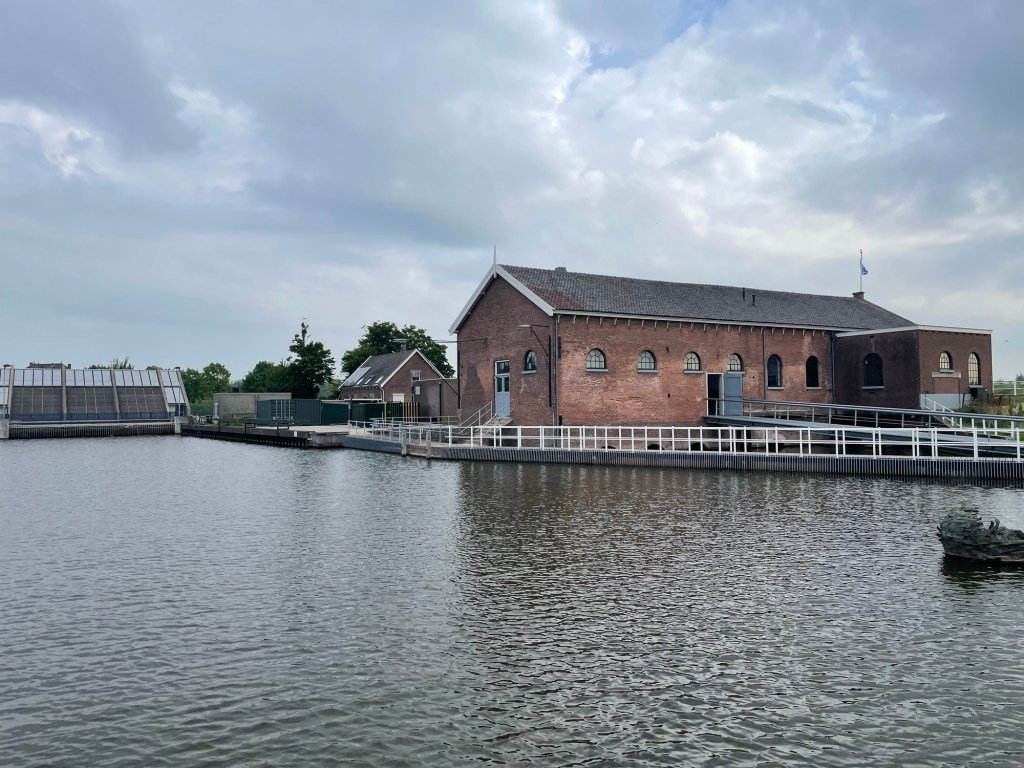
I actually learned several important facts about windmills during our visit to the Kinderdijk Windmills, a UNESCO Site.  The most important is the actual reason the windmills were there, and that is to pump the water out of the ground and put it into canals that then are pumped out into rivers that run to the ocean.  Without these windmills doing this work for centuries, the Netherlands would be under water.  Now, of course, the windmills have been replaced with upscaled motors and water engineering that works much more efficiently.

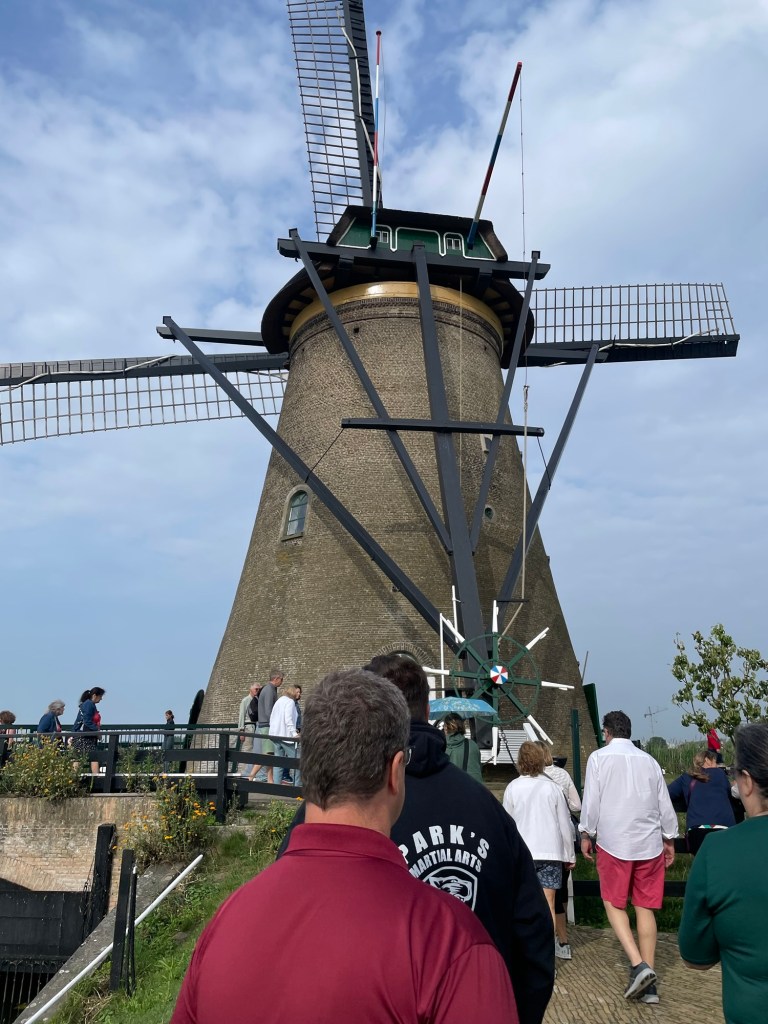
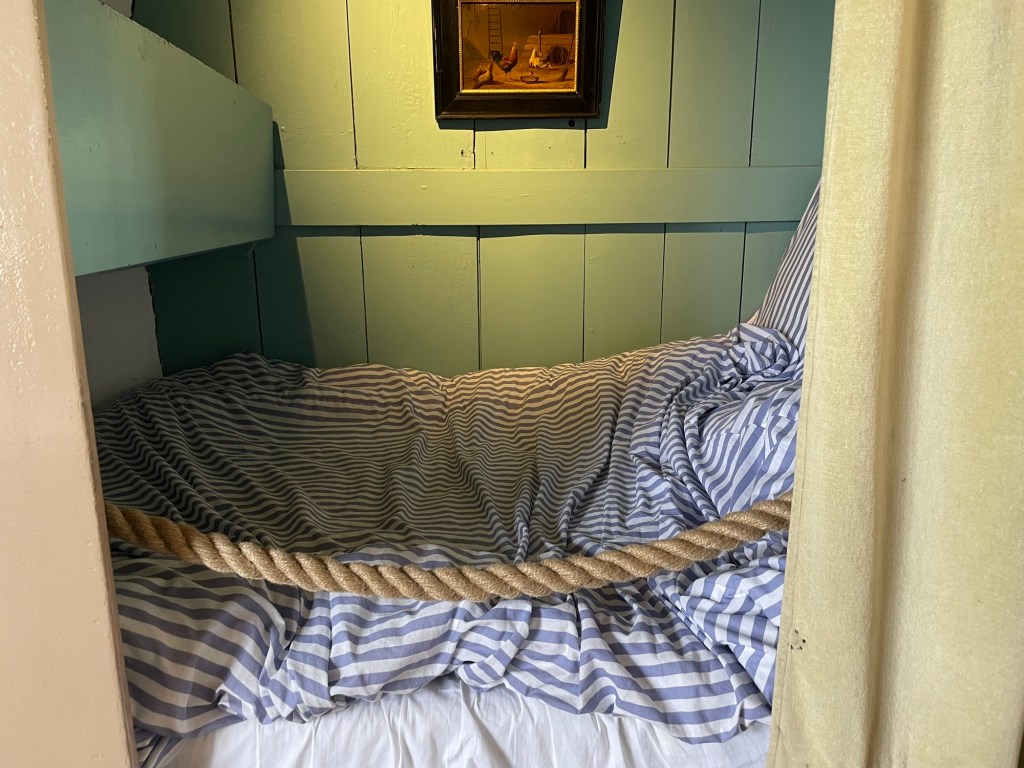
I also learned that people actually lived in the windmills!  It never occurred to me that the ‘miller’ who cared for the windmills and made sure that they were facing the right direction lived in them with their families.  But now I know.  We were able to enter one of the windmills and see how families lived.  It was tight quarters, with low ceilings, but they made it work.  All windmills have two entrances so that they can always get in and out as the blades of the windmill do get reoriented. That made sense to me!  I always want an exit.

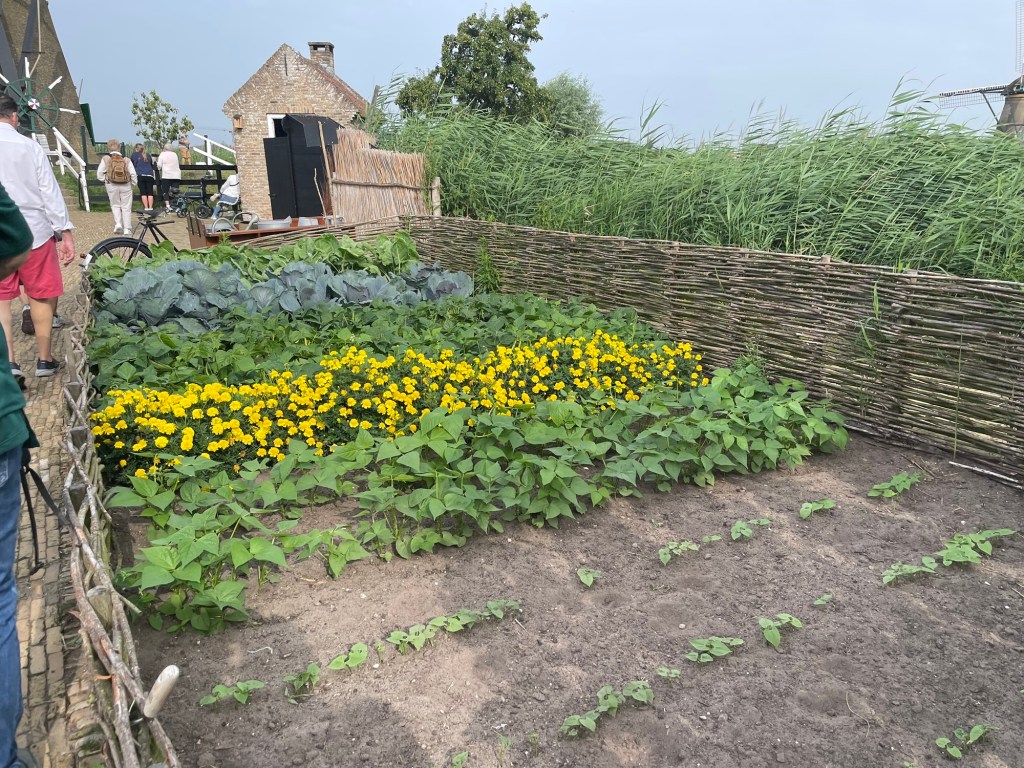
The guide told us that the people who lived in the windmills were the poor of the poor.  So they also had vegetable gardens and some animals for food.  We were able to see the recreation of one of the gardens at the windmill.

So a windmill was both the work and home of the millers who kept the area from being flooded, as much as possible.  As a side note, the people really did wear wooden shoes.  Since the ground was so swampy. Wooden shoes were the best way to keep their feet dry.

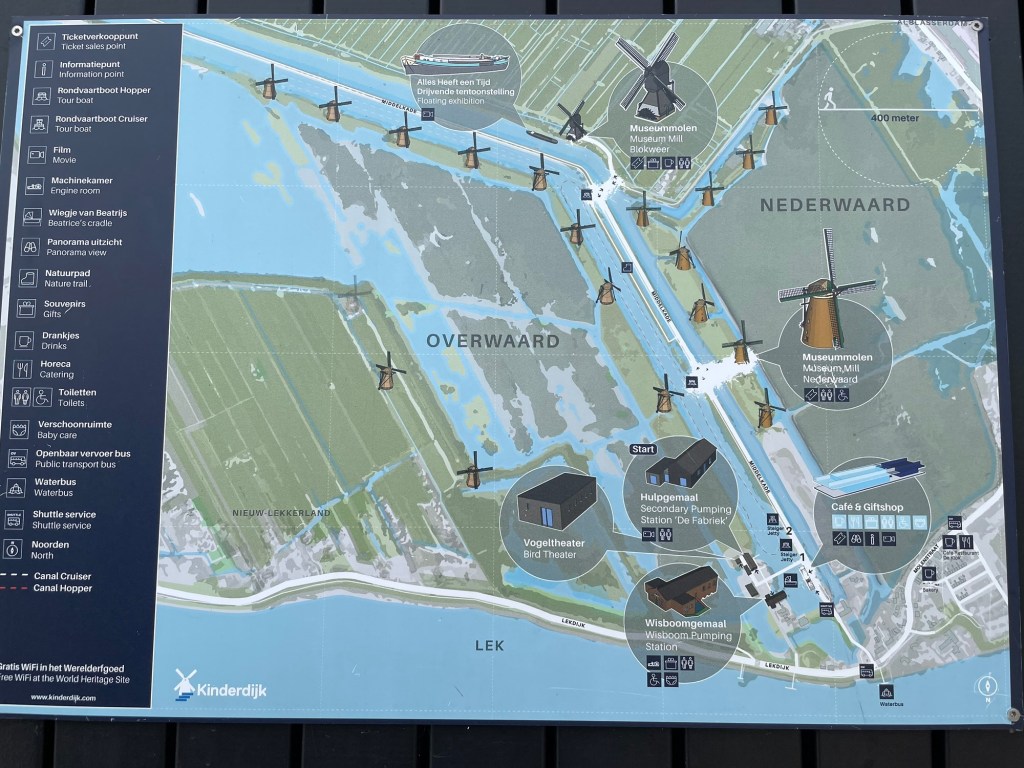
The Windmills at Kinderdijk encompasses 18 windmills, a pumping station, a visitors’ center, canals, and a statute of a cat, cradle and baby. As well as a lovely pathway to visit the site.

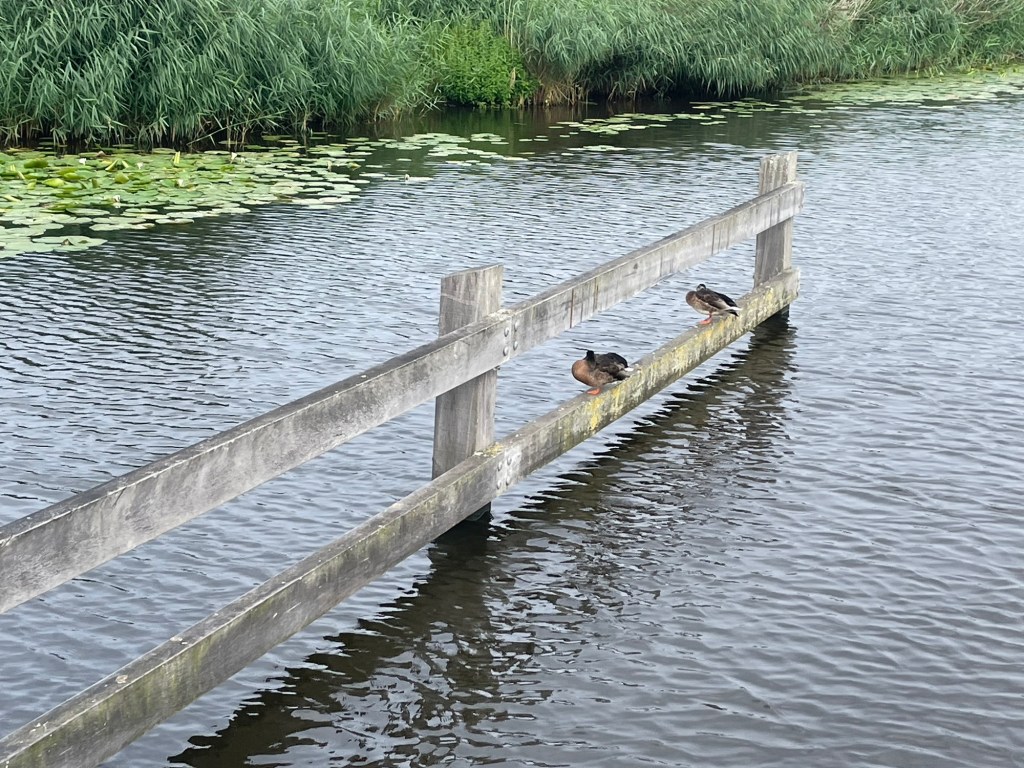
We really enjoyed the walk around to the windmills.  It was so peaceful and serene. The canals looked lovely with the lillypads bobbing in the water , and the wildflowers growing on the banks along side the canals.  Besides the tourist visiting the windmills, locals were riding their bicycles along the path.

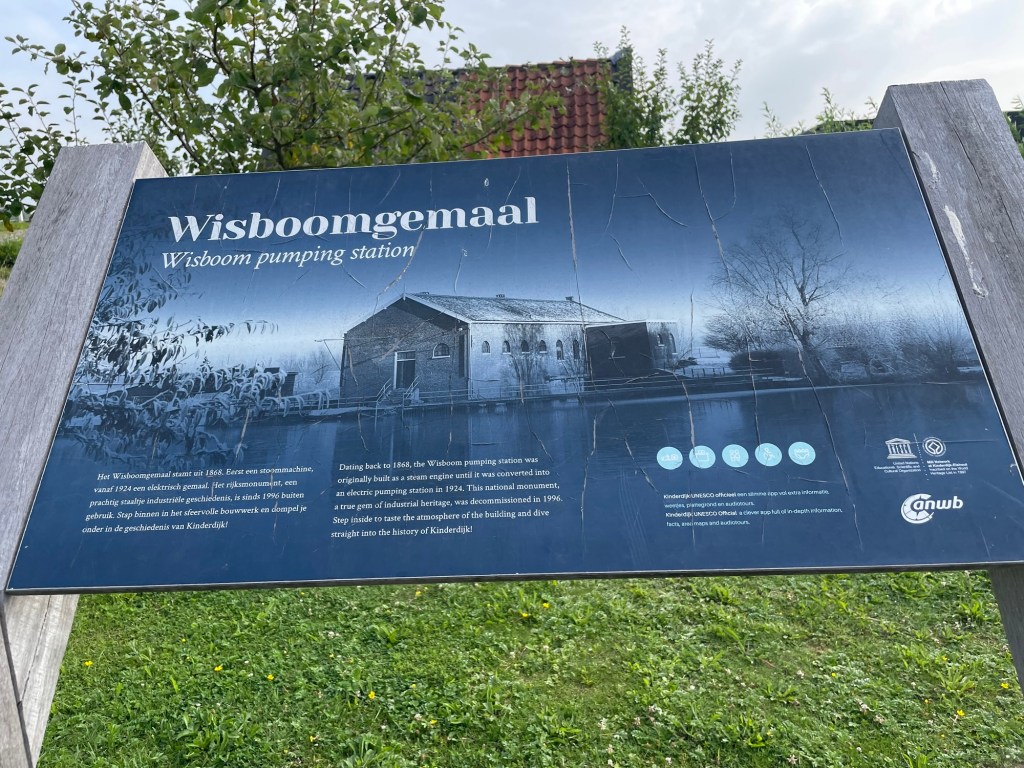
I like history, and I love learning how things work. So seeing the demonstration on how they moved the blades of the windmill and then watching it catch the wind and twirl was great.  Later we walked into the Wisboom pumping station and spoke to the docent about the different engines and how the pumping system changed over time.  I really enjoyed that.

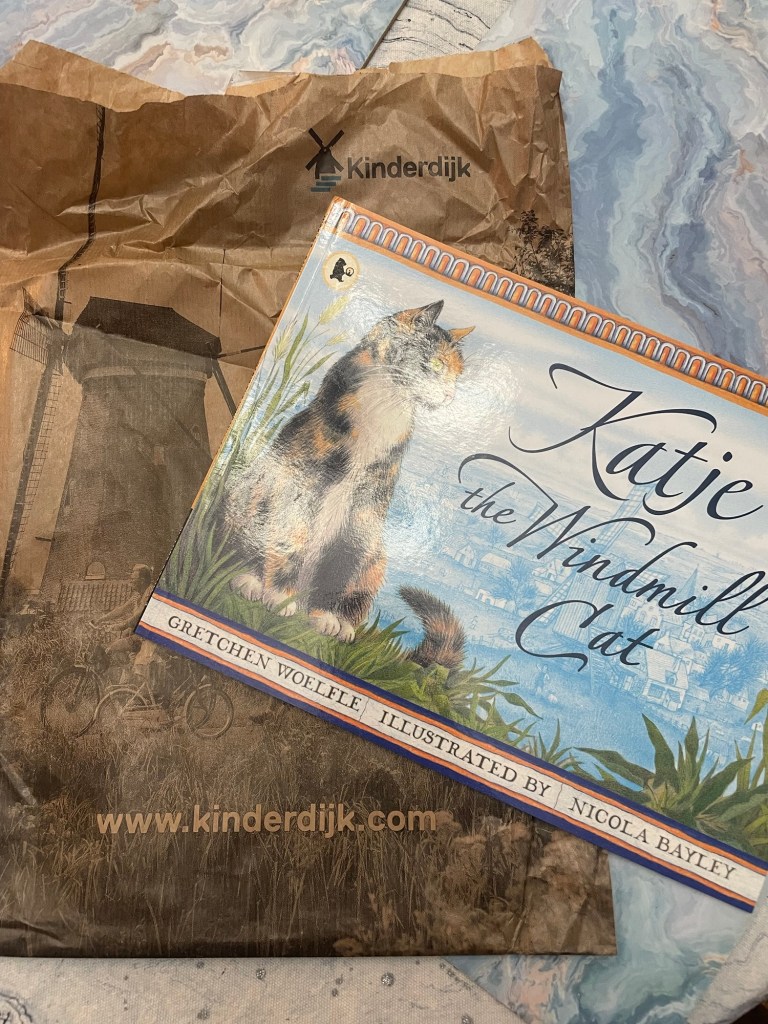
We also took some time to enter  the Visitors’ Center and have a snack, visit the gift store. And learn more about the story of the cat that saved the baby by rocking the cradle in the water during a flood in 1421. This story is the basis of the statute that sits in the pond at the site.  So of course I had to buy the book, Katie, the Windmill Cat, to take home for my granddaughters. This story is also why the city and the site is called Kinderdijk, or Child’s Dyke, to memorialize this story.


Home

Magical Castles of Scotland

8 Aug

When I discovered that the Unicorn was the official animal of Scotland, everything I ever knew about Scotland made sense. The murder mysteries that included fairies and scared trees. The love stories that included love that spanned centuries and traveled between times. The stories of the highlands and the low roads leading to a romantic castle on the shore of a Loch where magic lights appear and spirits bring lovers together.  It all had to be true if Unicorns were the official animal of Scotland.

Just to be clear, the people I met in Scotland assured me that they knew unicorns were mythical creatures, and that I would not see any unicorns roaming the streets or fields of Scotland. But they said that in the same breath that they told me about the many sightings of the Loch Ness Monster, known affectionately as Nessie.

However they might deny it, I must admit that during my visits to both the Castle in Edinburgh and the ruins of the Urquhart Castle on the shore of Loch Ness in Inverness, I was waiting for the fairies to peek out and smile at me. And there were times I thought they just might be around, hiding in a darkened alley or behind a piece of furniture. Such is the magic of Scotland, with a unicorn as its official animal, one believes that anything could happen!

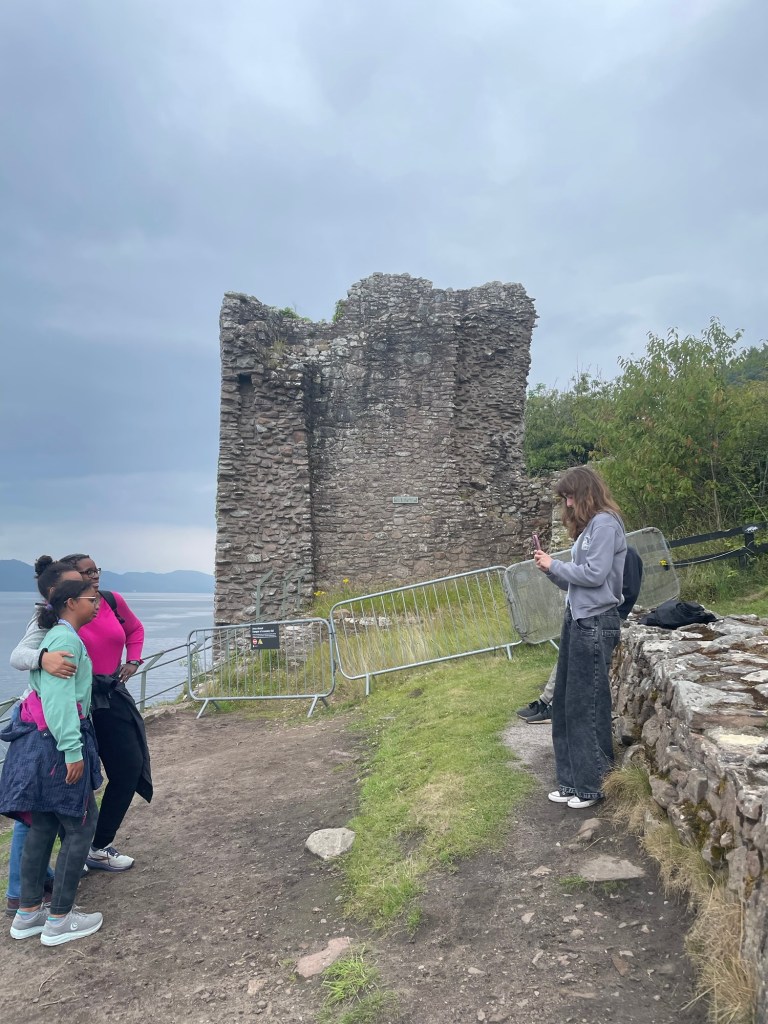
Urquhart Castle was destroyed by the clan that lived there to keep the fortification from being used by the Jacobites. Since they felt they could no longer keep it secure, they determined blowing it up would be the wise choice. Then the ruins were left to rot on the side of Loch Ness for centuries. It was only in modern times that the Scots determined that this would be a great spot for tourists to visit the romance of a castle and at the same time sit near the coast of Loch Ness and search the waters for Nessie. I know that my husband and I enjoyed doing both.

Ruined castles have now unhidden staircases, towers standing solo reaching towards the sun. The buildings around them slumped in ruin but still given the site a romantic air, because that is what castle are all about in our day.  A romantic place for people to fall in love. But really this castle was the scene of many bloody battles. After reading its history I understand why they blew it up.

But still, for many a tourist it was a place of wonder to explore and take many photos, while imagining the place when it was intact. I loved our visit to Inverness and Urquhart Castle.  In fact, my husband and I want to go back to spend a week there one day.

The Urquhart castle was taken over by the government in 1913 and developed over the years to the attraction seen today. There is a lovely visitor center on the hill above the castle. I must warn people with mobility issues, that this visit includes much walking from the parking lot to the visitor center and then more walking down to the castle. Also within the castle there are many steps and uneven walkways. It is the ruins of a castle from the 1600s. Just be aware.

The next Castle was Edinburgh Castle, the home of the kings and queens of Scotland as well as the current home of the Royal Jewels. Edinburgh Castle is differently not a ruin. 

Staring up at from the Royal Mile, you start to realize the size and majesty as you get closer and closer. But then when you are about to enter the Portcullis Gate of Edinburgh Castle, it looks small again, until you past through the gate.

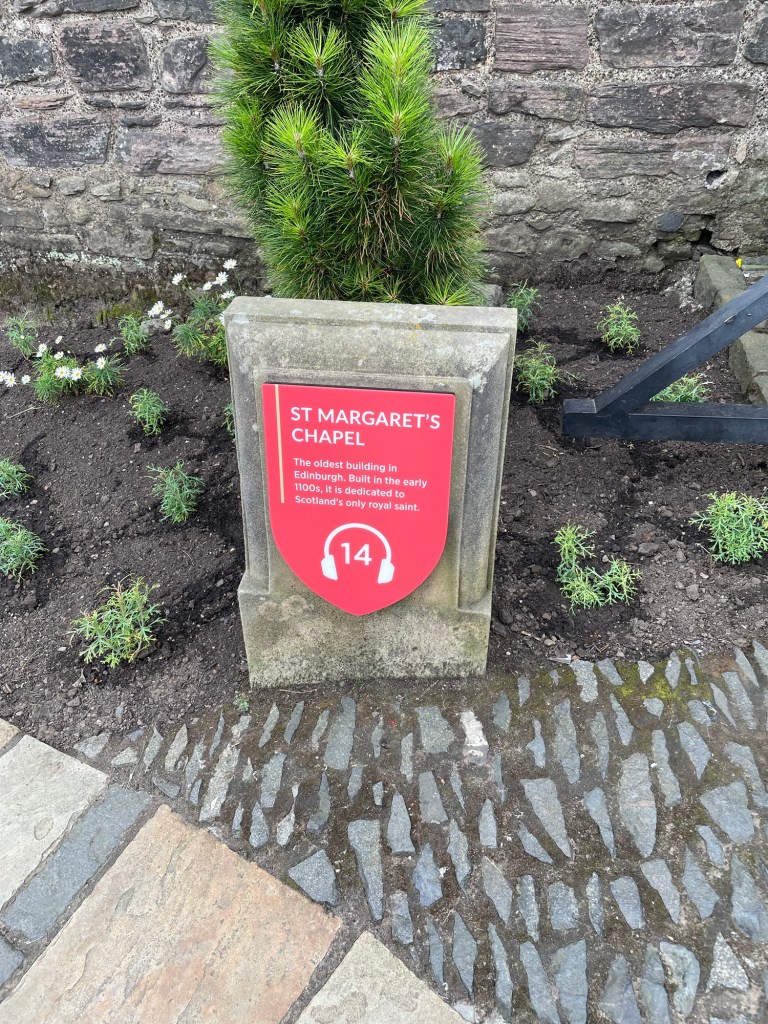
It took a while get through the gate, as we were not the only tourists there who wanted to enter this magical world. You must book your time and date in advance in order to get in to experience the many wonderful places to see. I personally loved just walking around and around the cobblestone road upward to the top. We enter the Great Hall, the Memorial for Fallen Soldiers and paid our respects to those that died for Scotland. We went through a small museum about the Scottish Military. We looked at the long line to see the Crown Jewels and decided we did not want to stand in a line,  so we continued our walk.  I enjoyed seeing St. Margaret’s Chapel, the oldest building at the castle.  Then at one o’clock, our attention changed as we heard the explosion and resounding blast of the one o’clock cannon. Everything stopped for a moment in silence before we all continued our visit.

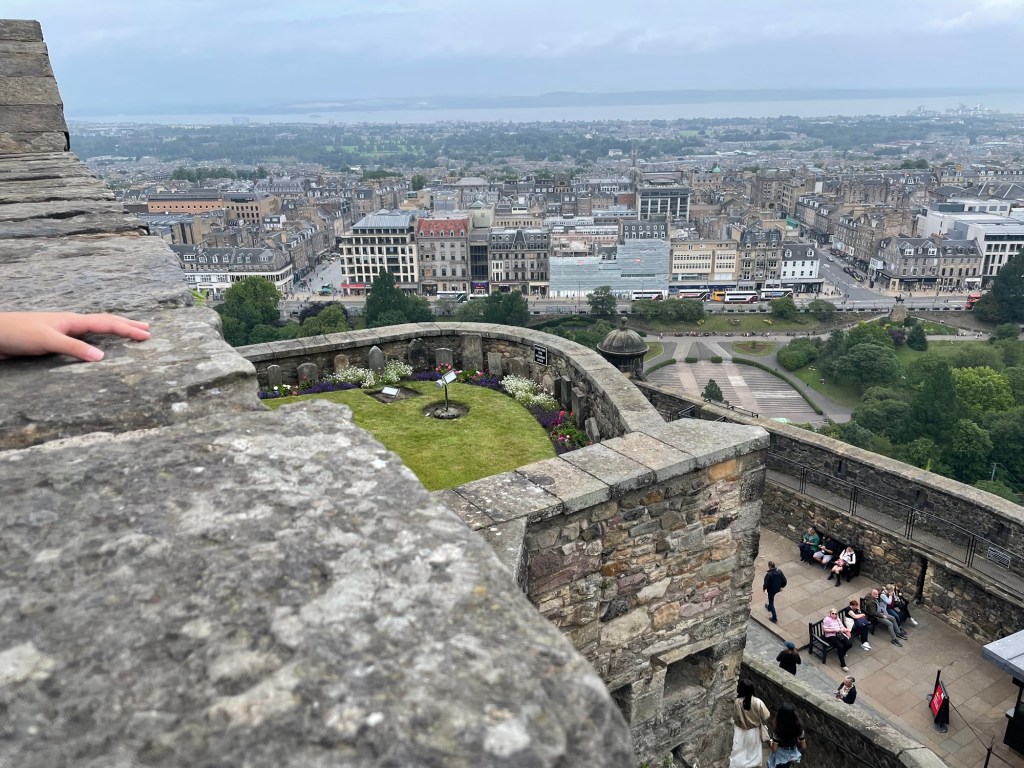
While I was waiting for the cannon bast,  I believe I found the place where the fairies hang out at Edinburgh Castle. While looking over the stone walls I saw a little garden area.  Supposedly this is the cemetery for the soldiers’ dogs. And yes, I did see tombstones. But I did not see any way to enter this garden. And to me it looked like the perfect spot for a fairy tea party. Okay, I might just be imagining it, but since my time at the Castle, I have had several dreams about this garden and there are always fairies in it.
The Edinburgh Castle is well worth the wait to go through and the crowds that enter.  As you walk closer to the top, the numbers of people thin out, and you get that feeling that you could go back in time and see the medieval residents of the castle. But seeing from the outside and imagining is the best, because, in reality, I would probably would have been a serf and not welcome there. 

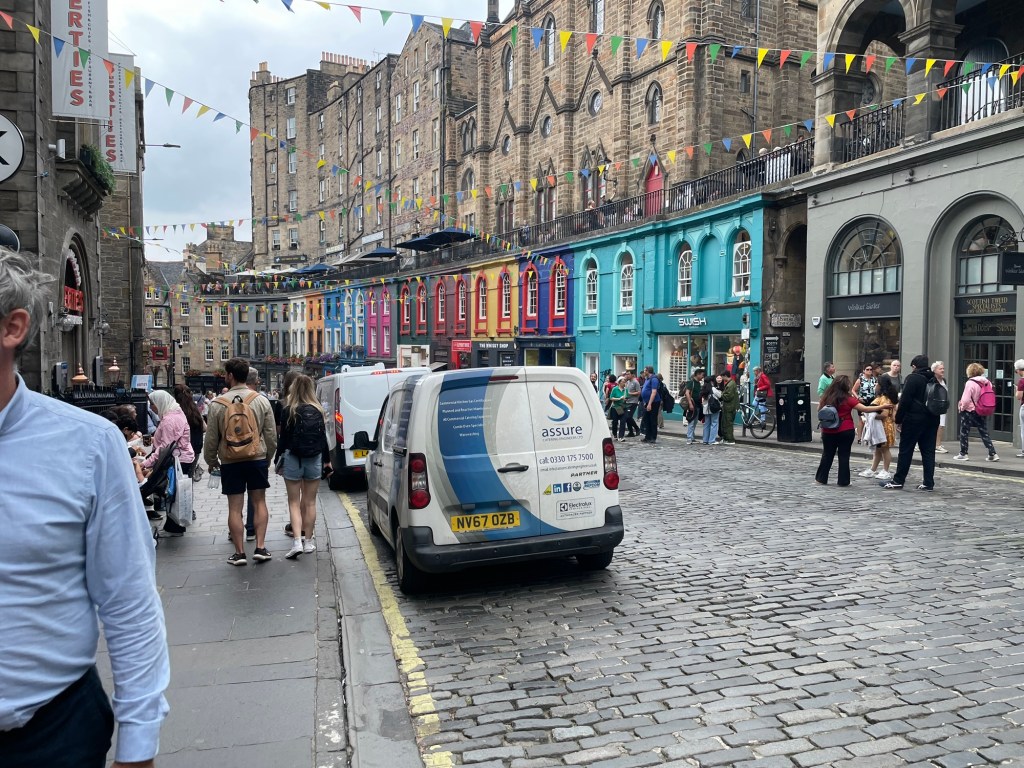
After we left the castle, we returned to the Royal Mile and found the most important place for my husband, an Ice Cream Store.  With ice creas in hand, we walked along the Royal Mile happily eating ice cream, seeing the sites, including Victory Street, which is supposedly the inspiration for Diagon Alley in the Harry Potter stories. Fairies, wizards, muggles, dementors: of course, Harry Potter was from Scotland. There is no where else to create these characters then a bit of magic from Scotland and castle.


https://www.visitinvernesslochness.com/listings/urquhart-castle-visitor-centre

https://www.edinburghcastle.scot/the-castle/history/


Honoring Those Who Do Good In Times Of Crisis

28 Jun

The Lowell Milken Center For Unsung Heroes has exhibits that all children and adults 12 and older should experience. A friend and I went there specifically to see the Anne Frank Exhibit, “Anne Frank: A History for Today,” which is now completed. But that was just a minor part of this learning experience. Since that special exhibit is over, this blog will focus on the usual museum sights.

First Panel of Anne Frank Exhibit

Located just two short blocks from the Ft. Scott National Historic Site, the Lowell Milken Center, is a wonderful place to learn about people who stand up and do good in times of crisis.  The centerpiece of the museum is “Irena Sendler: Life In A Jar,” the story of Irena Sendler, a Polish social worker, who saved over 2500 children from the Warsaw Ghetto during World War Two. She had a group of about 20 people who helped her. But it was Sendler who organized the group and saved the names of the children who were rescued.

Irena herself was rescued from obscurity by a group of high school children from a small town in Kansas. Their discovery led them to find out Irena was alive. They had the chance to meet her and wrote a play about her that has been shown hundreds of times, which led to Irena being nominated for the Nobel Peace Prize. Unfortunately, she passed away before she could be recognized as the prize cannot be awarded to someone who is deceased.  Her story and the story of the girls who brought her story to life is the centerpiece of the Center.

However, it is not just about Irena’s story.  There are many unsung heroes whose stories are on display at the Center. Each story was discovered by students and then written about for display at the Center. Student can enter their research into the Discovery Award competition which recognizes outstanding Unsung Heroes projects by students in grades 4-12.

In these times of increased online hatred and the rise of anti-immigration, ICE raids, and Jew Hatred, the Lowell Milken Center is an oasis of goodness.  Each panel tells the story of someone who stood up to be counted in times of peril, helping those in need. These people, of all religions, follow the Jewish value of doing good, repairing the world , “or “Tikun Olam.”

While we were there, we met briefly with a group of international teachers who had come to the Center to learn about the programs and how to bring it to their schools. The two people leading the discussions were part of the original Irena Sendler discovery: the high school history teacher and one of the students.  That student, Meagan, now works at the Lowell Milken Center. 

This brought me joy, as I saw the original play when the girls were in high school and they presented in Kansas City.  Then a few years later, I saw the expanded play as well.  My friend had seen it with me. We were pleasantly surprised to meet her.  She told the international teachers that we had seen the play!  Smiles all around. It was so wonderful to see that she continues to dedicate her life to teaching others to do good!

I have written about Ft Scott before. (See blog below.). So I will tell you that an excellent summer field trip day with your middle school and older children would be to visit Ft. Scott in the morning. There is a Park Ranger to help as you walk around the site, clean bathrooms and a store. Have lunch at one of Ft. Scott’s restaurants. 

Then during the heat of the day, go to the Lowell Milken Center to  immerse yourself and your children in goodness and kindness.  Your heart will be filled with the knowledge that there are truly good people in the world.

A Disney Experience in Marceline

22 Jun

I am a dedicated Disney enthusiast.  I have been to both Disneyland and Disney World multiple times. When the Disney 100 Anniversary Exhibition visited Kansas City, I made sure that my husband and I had tickets to go through the exhibit.  I loved it! 

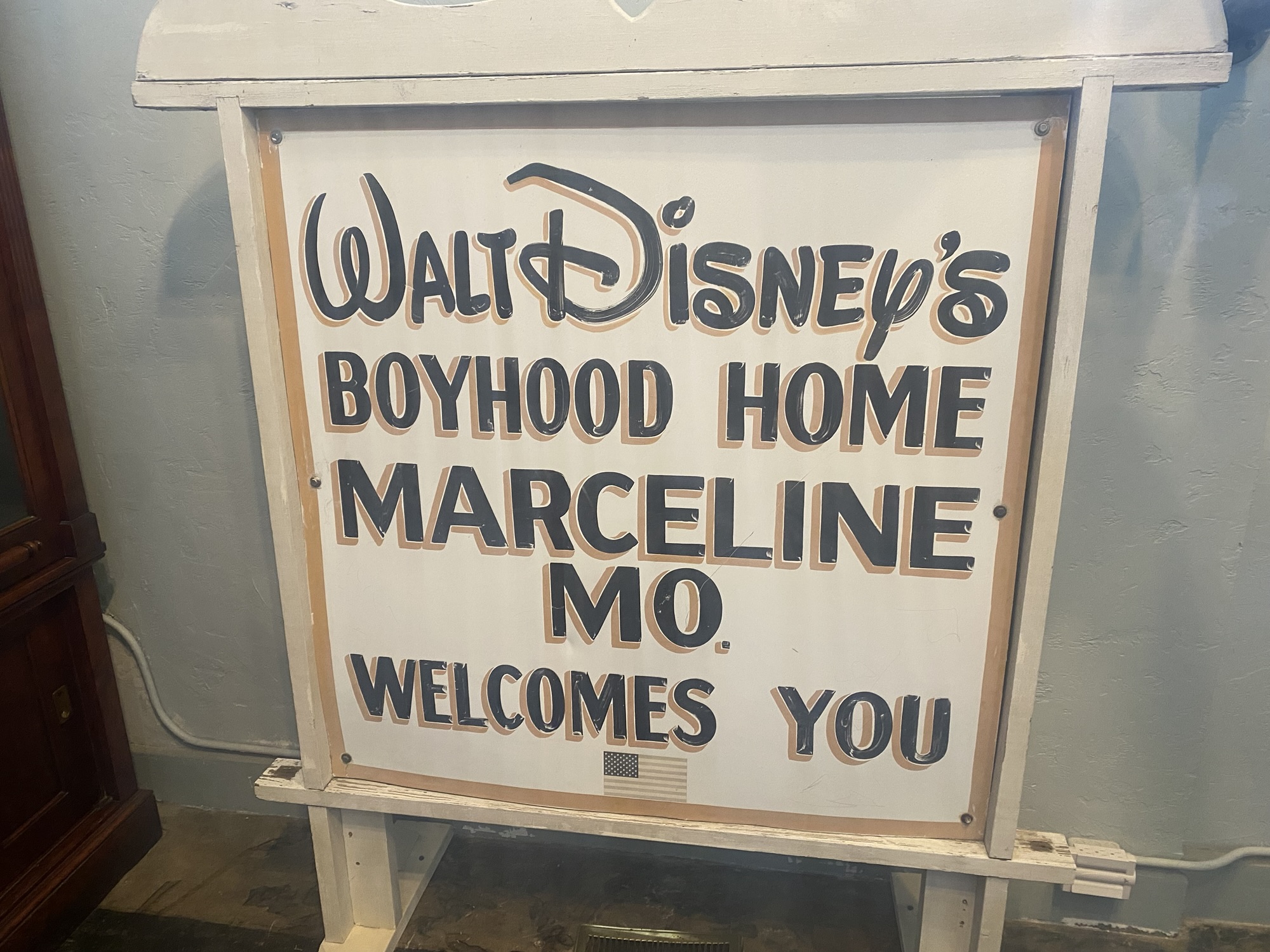
I have passed by the Laugh O Gram building in Kansas City many times. I am still hoping that one day KC will have its own little piece of Disney.  Now I can add a new Disney experience.  I finally got to visit the Disney hometown of Marceline, Missouri.

It was worth the over two-hour drive from our home.  Was it everything I thought it would be, not exactly.  But despite that, even my husband said that the museum was very interesting.  And it was.

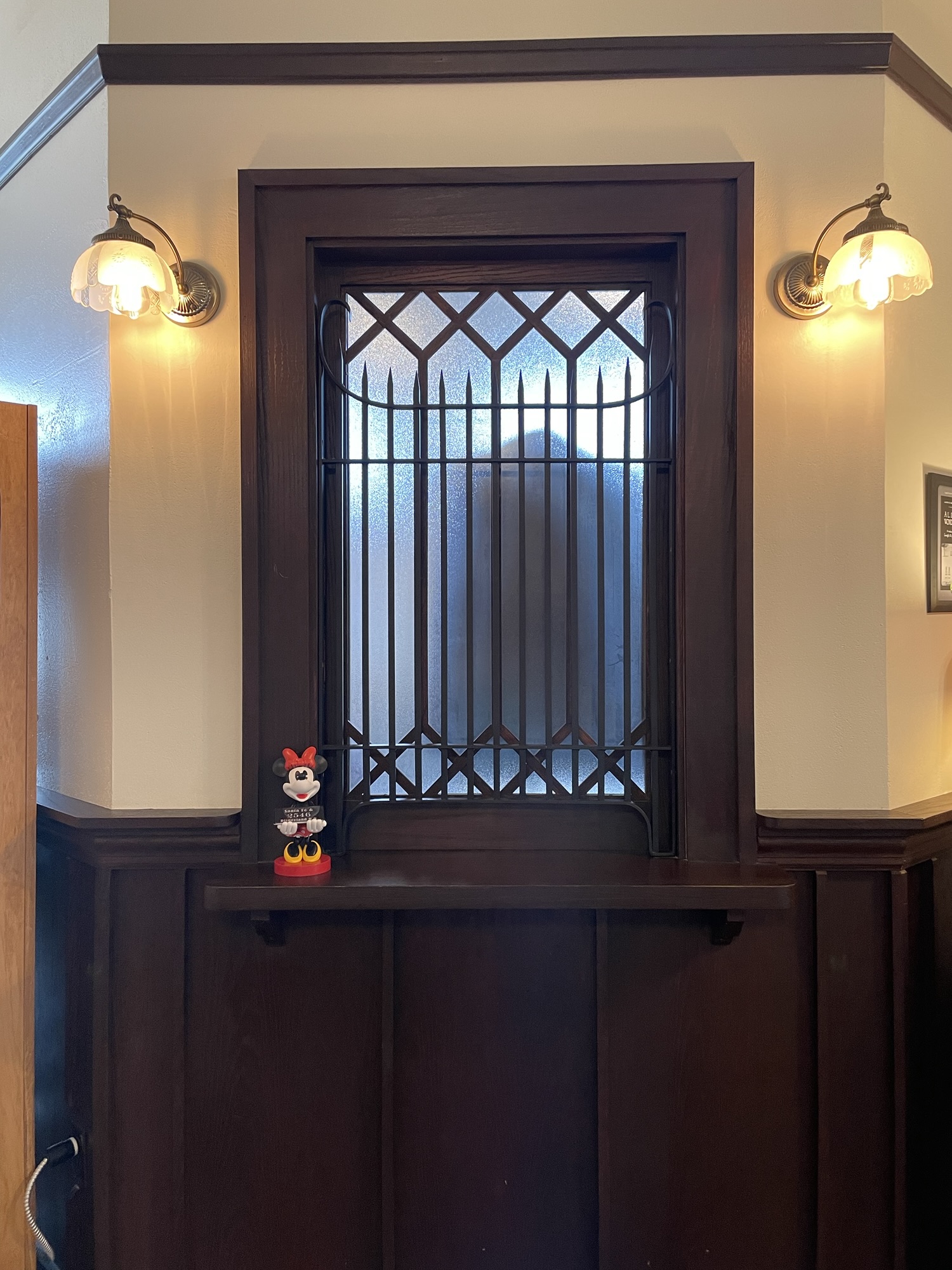
The Disney Hometown Museum is housed in the original Marceline Sante Fe train depot.  A perfect spot for a Disney museum because Walt Disney loved trains. Parts of the train station are still obvious.  The original ticket office still exists with some train memorabilia.  Also the train comes by every so often, so you get to hear the sounds and whistle. 

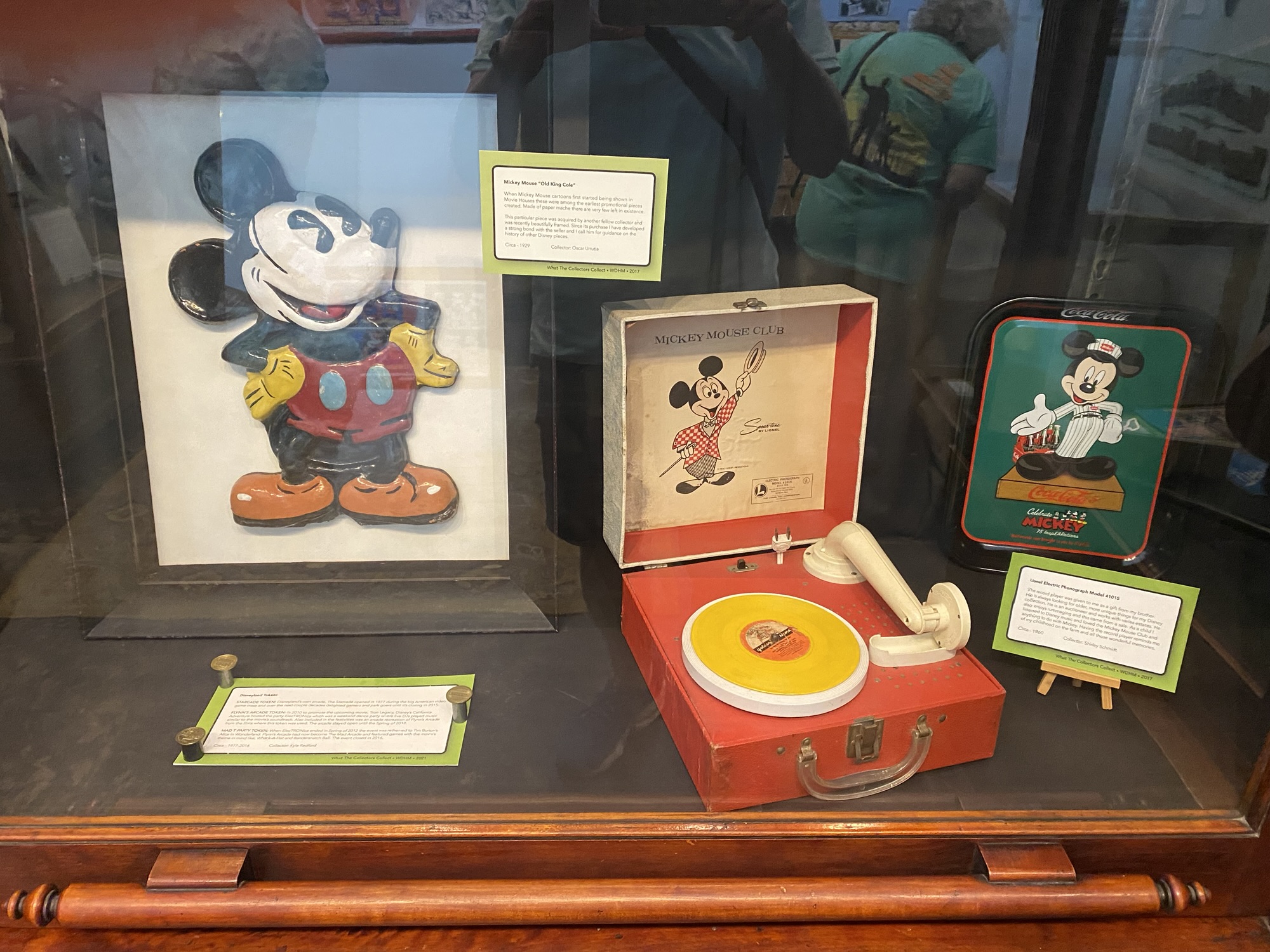
Most of the collection was from the estate of Walt and Roy’s sister, Ruth.  Even though she was not employed by the Disney company, she received many Disney artifacts and letters throughout her lifetime.  Many of the items on display were hers.

Also included are many Disney family items. Photographs and letters line display boxes.  Information about the Disney parents and siblings is an important part of the museum.  I loved learning about how Walt and Roy took care of their family throughout their lives, giving them Disney stock and other items.  In fact, the one Disney sibling who never married, left millions of dollars the Shriners’ Children Hospital. What a great place for the profits of the Disney company to end up!

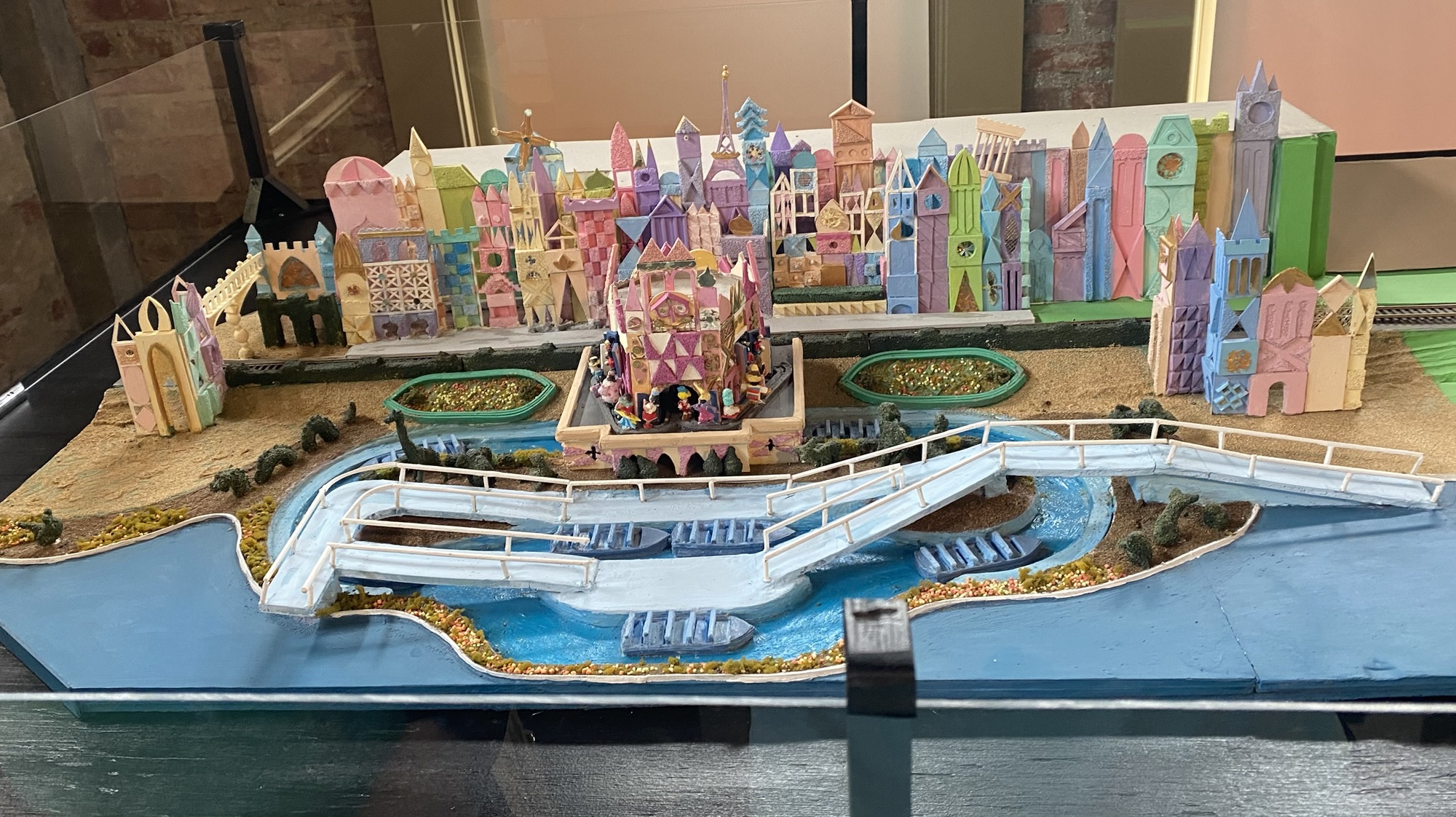
I really enjoyed the displays on the second floor of the original Disneyland models.  Seeing the view of the It’s a Small World Ride and the teacups in miniature, as well as the castle and other rides was really a thrill.  This is what they were trying to create in full size, and they succeeded!

As an aside, the Teacups were my favorite ride when I was younger. But as I aged I realized I did not like to be spinning around. For my sister and daughter “It’s a Small World” was the best ride ever.

I loved seeing the items like the model dressed in the Davy Crockett regalia and the giant Mickey Mouse.  There were dozens of items to enjoy. Some of which I remember from my children hood. My brother was a big Davy Crockett fan!

I have to also comment on the kindness of the people who worked there.  They made the experience so warm and friendly.  But then they knew we were true enthusiasts as I was wearing one of my Disney shirts.  In fact ,you could tell in each family who was there who the Disney fan was…that was the person who people wearing Disney clothes!

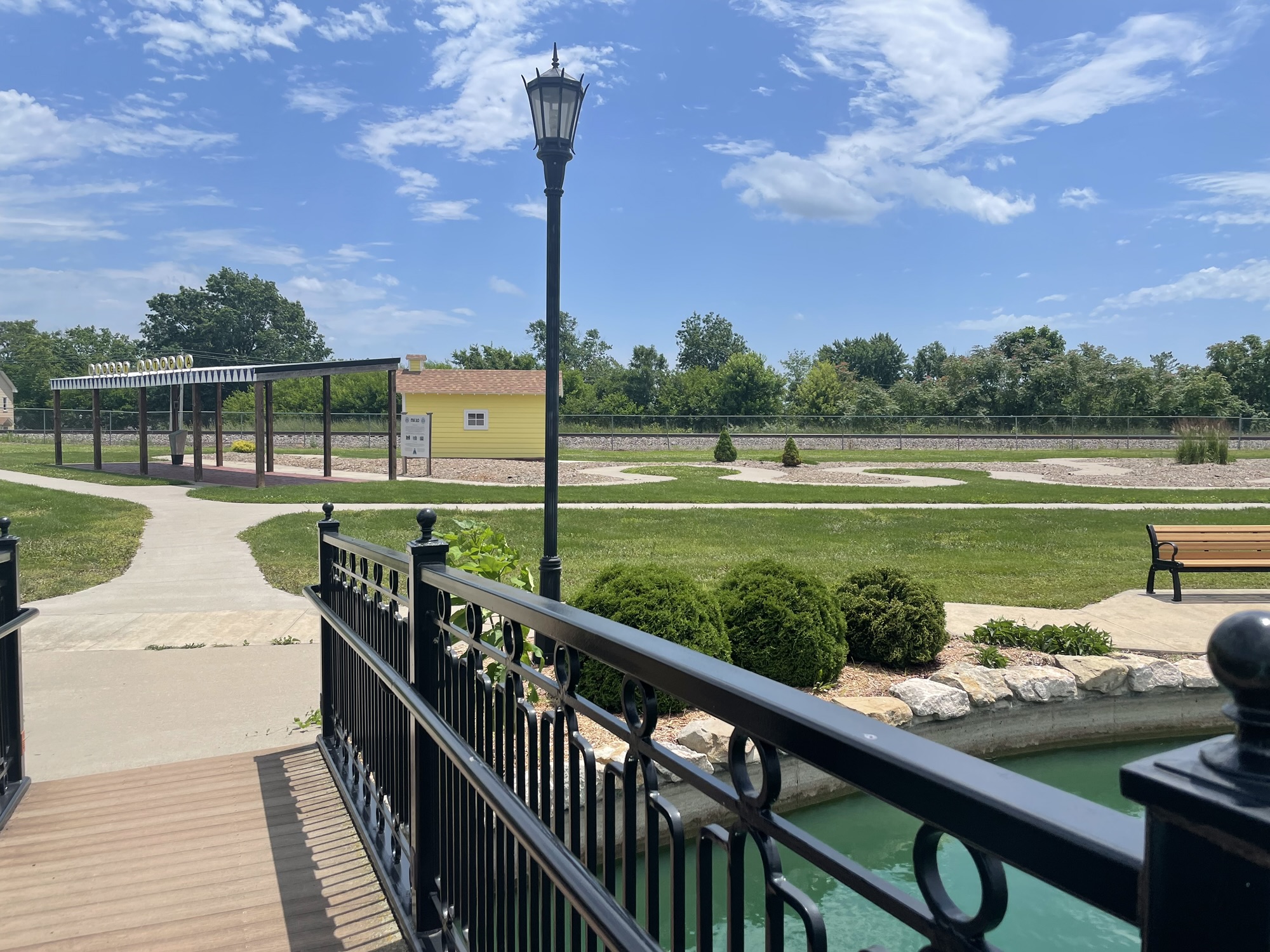
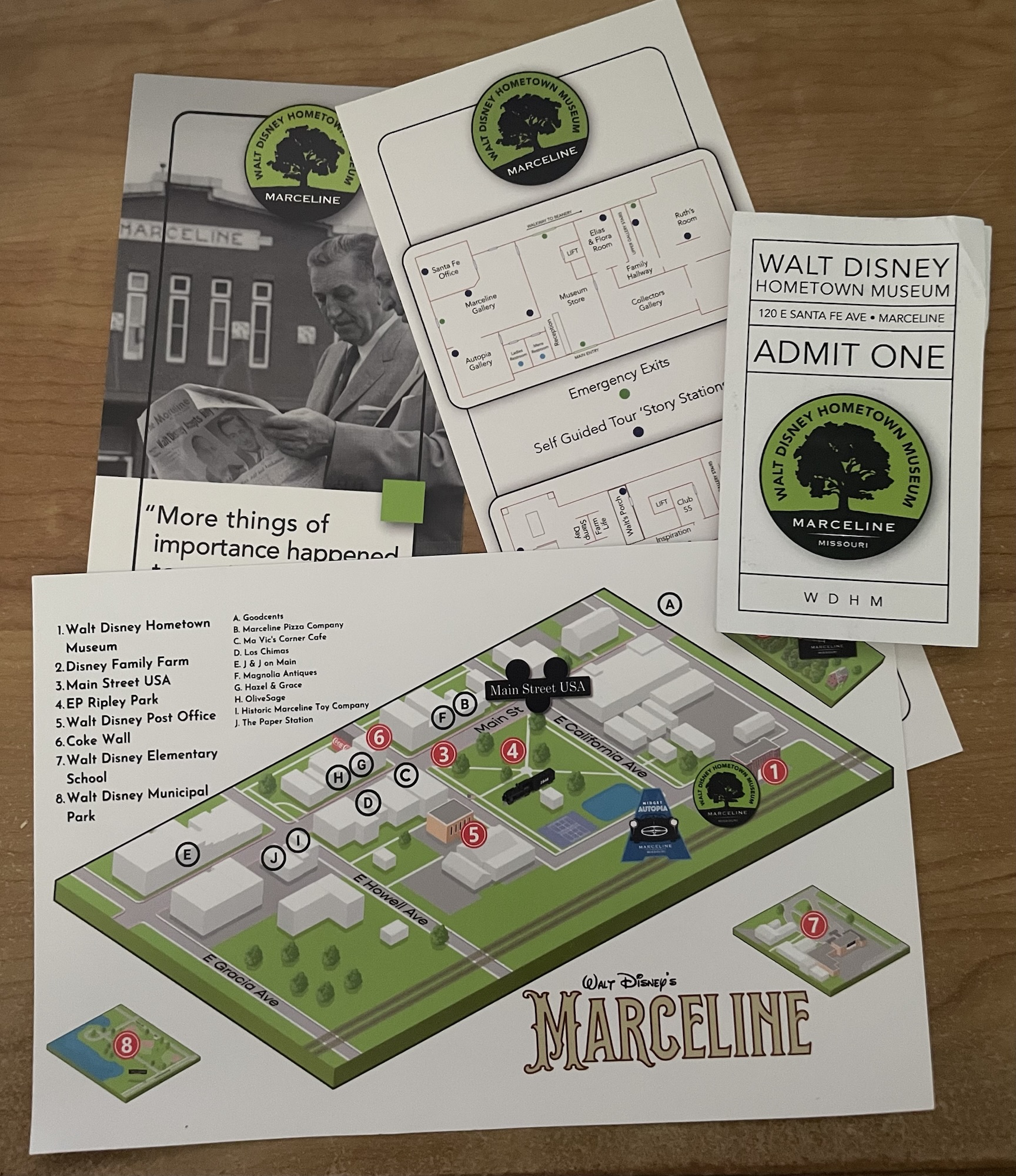
After the Museum we walked over to Ripley Park, where the Midget Autopia ride was installed after it was taken out of service at Disneyland.  The only ride ever to be given away after it left the park!! I am sure it is a shorter car trail than what was used on Disneyland. You can still see where it was, as it is still set up to be used. But currently the cars are no longer there.  Although there is one car on display in the museum.

In the park you can also see both a diesel locomotive and a steam locomotive. They are quite huge.

For lunch we ate at Ma Vic’s Corner Café. It was crowded with locals and  with the people who had been to the museum. I saw  two other restaurants in town, but I am not sure they are open for lunch.  

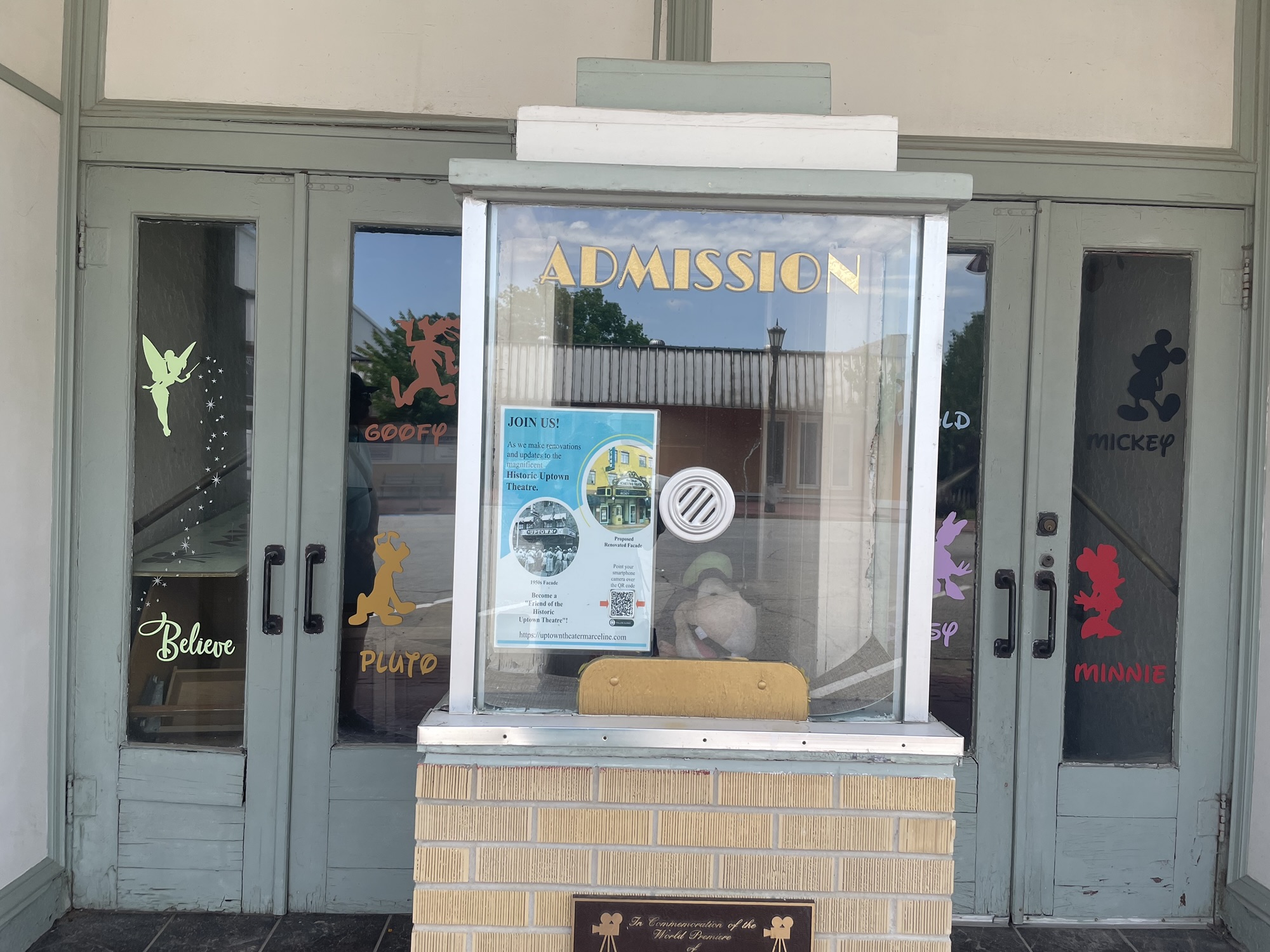
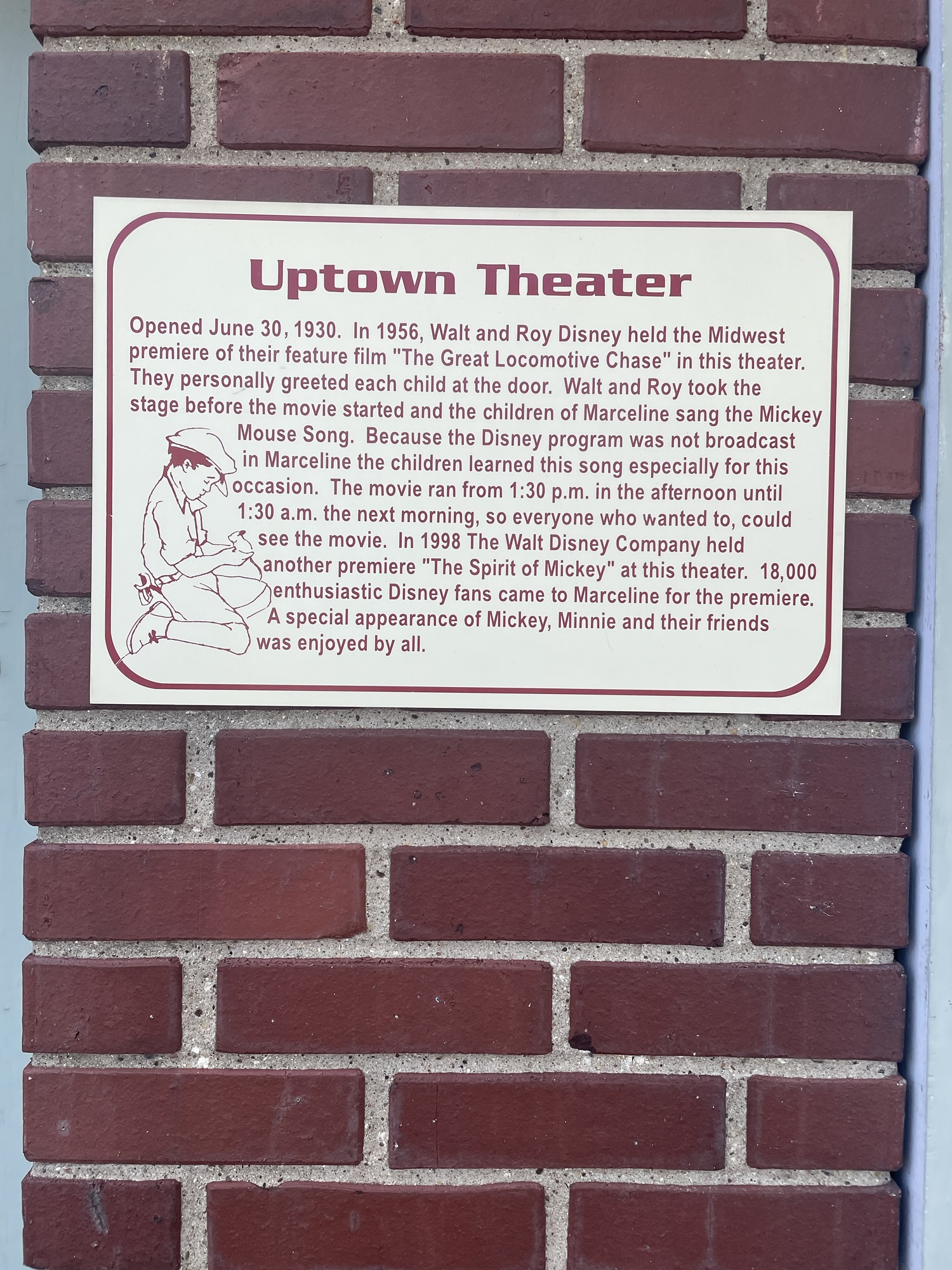
We also walked past the Uptown Theater where Disney premiered two of his movies and where he saw movies as a child.  It is closed now. But it does resemble the movie theatre on Main Street USA at the Disney parks.

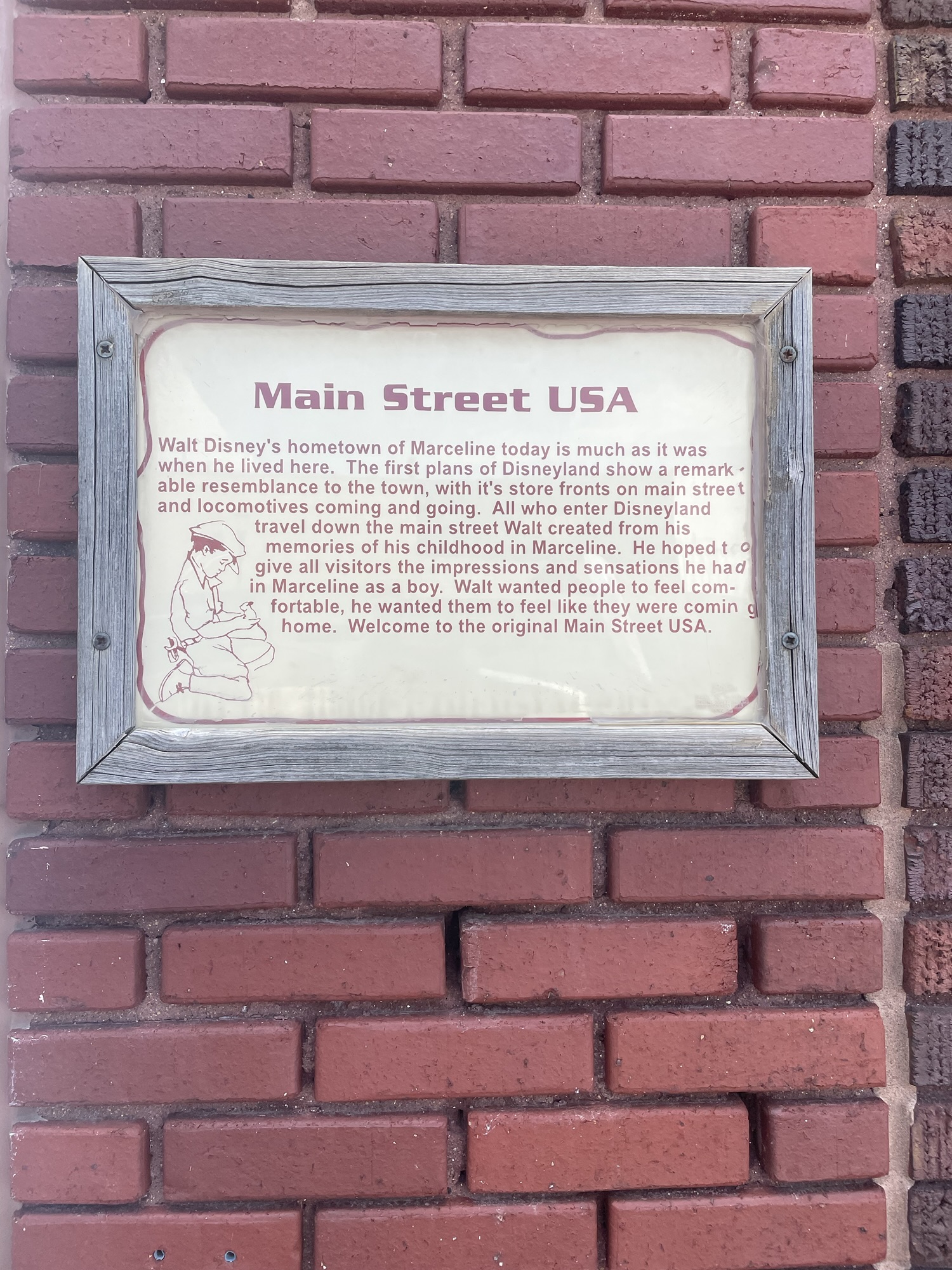
Main Street USA was a disappointment. We walked up and down Main Street USA, which Walt Disney used as the guiding force of the Main Street in Disneyland/Magic Kingdom. But it was somewhat sad.  Most of the store fronts were empty. There were a few things in the windows, but many had no businesses.  A few shops were open, when we were there,  while some that opened only in the afternoon. I guess I was hoping for more Disney spirit in downtown.

When we went back to the museum, before we left, I asked about the Main Street stores.  We were told that someone had purchased the buildings to keep the look of the town intact, but really there was not a lot of business. 

Honestly, although there is a small shop in the museum, I think that they should use one or two of the store fronts to open a Disney store in Marceline.  I think it would be busy with those of us who would love to purchase more in Disney’s hometown.  Look at Hamilton. It was a dying town, but with all the fabric stores, it is now a quilting mecca.  I think something more can be done with Marceline.   But don’t worry, I did help the economy by buying myself a t-shirt, two magnets and presents at the museum.

We did not visit the Disney farm or school.  I am not sure the school would be open to visitors, but at the museum we saw that Disney artists had painted murals throughout the school.  However, with our two-hour drive home and the heat of the day, we ended our visit to Marceline.

The Disney Hometown Museum is definitely worth the drive for Disney enthusiasts.  My husband and I truly enjoyed our time there viewing all the artifacts, reading the letters and materials and talking with some other Disney fans and the museum staff.

https://www.waltdisneymuseum.org/

Israel Version 2025

4 May

I noticed a difference the first evening in my daughter’s apartment in Holon, just south of Tel Aviv. We were unpacking my suitcases and going through the items I had brought for her, when I noticed the sounds of airplanes or jets in the sky.

I said, “I don’t remember so many planes flying overhead to the airport.

My daughter: “Mom, those are not commercial airlines.”

Me: “oh”

Then she added, “It is Shabbat, commercial airlines don’t fly. But military is exempt.”

In the morning I learned that the IDF had bombed part of Syria to protect the Druze population.

The peaceful view in Holon one hour after the siren.

I was not unaware of what it was like to live in Israel. I had studied in Israel for a year attending Hebrew University from July 1974 to July 1975. I had some experience with war time in Israel. The Yom Kippur War had been the previous October 1973. Most of the students I met had survived that war. Even the ones who did not have physical scars, had mental ones. And we all knew to report any backpack or bag that looked suspicious or was unattended. When on a bus, the driver always checked to make sure every backpack or bag had an owner on the bus. I had heard explosions and been to areas perhaps I should not have been to with my friends who had been called up for reserve duty so many years ago.

I had been in Israel with my children and parents in December 2004/January 2005 for a two-week trip. Israel was on high alert. It was in the process of leaving Gaza and turning it over to the Egyptian/Palestinians who were living there. The settlers who had to be removed were protesting. We had to avoid some places. And at times we saw the movement of tanks heading toward the Gaza envelop. I wonder what would have happened if Israel had not left Gaza. Would it had been better if Hamas had never been elected as the government there? If Israel had just kept its oversight? I know that the government thought/hoped this would bring peace. Unfortunately it brought 20 years of bombing, hate and then pogrom.

My husband and I were in Israel in November 2008 for a medical meeting where my husband was a presenter. We stayed after the meeting to visit our daughter in Beer Sheva where she was a graduate student at Ben Gurion University. One day the three of us went to an Air Force Museum. The young soldier who was our tour guide was a little tense. I noticed that lots of jets were taking off and landing. I asked the guide a question about it. Her response was they were doing drills. When we left the museum, I turned to my daughter and said something is going to happen. Before we left Israel, a few days later, I told my daughter to be careful. To pay attention to what was happening, I was extremely worried. Six weeks later was Cast Lead, Israel’s response to the continued bombings from Gaza/Hamas.

In the summer of 2016, a few months before my daughter and son-in-law got married, the couple purchased an apartment in Holon. “Mom,” she said, “you will be happy to know that our apartment has a ‘mamad’, a bomb shelter.” “I am happy your apartment has one,” I responded. “But I am sad you have to have one.”

In November 2022 I was in Israel with my daughter when the government tested the siren alarm system. It was the first time I had been in Israel that I heard the sirens go off. Although it was just a test, it made me aware that my daughter actually used her mamad. Something I still feel very sad about.

I have been on the phone with my daughter several times when she has had to take shelter. When the sirens were going off. Once when she was at the University, when I was on the phone with her, I actually heard the bomb hit, it was so close. And just last week, before I came here, we were talking when the sirens went off and she and her husband ran to their shelter. There have been ballistic missiles from Yemen and the Houthis for two years now. These were so large, that even when they were shot down, the shrapnel could cause damage.

I arrived at Ben Gurion Airport on May 2. This morning, 40 hours after my arrival, on May 4, 2025, I had my own mamad experience. This morning after they went to work, I planned to take a walk. But at 9:22 am, just as I was preparing to leave, the sirens went off. It was not a drill or a test. It was the real thing. Everything outside stopped. I went into the mamad. Here is what ensued as per our text conversation:

“The sirens are going off. how do I close the window?” Me

“Go to your room. There’s a metal slide on the right side. Pull it hard.” my daughter

“I cannot get the slide. The sirens stopped.” Me

“Or just stay away from the window. Stay in the room 5 minutes.” My daughter

“Ok” me

“Looks like the Houthis, so there’s probably nothing near us.” My daughter

“Ok I don’t think I will go for a walk right now.” Me

“Ok. Usually it’s just one.” My Daughter

“Well I was just going to go when the sirens went off. And I don’t know where the shelters are. Cars are starting to move. But it is still silent.” Me

“Yeah, the sirens only go off for a bit and turn off. But they say to stay inside 10 minutes. But for Houthis really 5 is fine.“ My daughter

“Everyone is still in shelters. All the construction stopped.” Me

“Everyone is leaving my shelter now. in Tel Aviv Everyone is outside.” My daughter

“We can walk tonight. You can show me where the shelters are.” Me

“Ok we’ll go on a walk tonight.”My daughter

“Sounds good. I hadn’t thought of that before. It would have freaked me out walking by myself… when the sirens went off.” Me

A bit later I found out that the missiles hit Ben Gurion Airport, 16 miles from Holon. Several people were injured. Many flights have been cancelled for 24 hours. A friend of mine, who lives in Tel Aviv, texted me. “Luckily you arrived before today’s mess at the airport. “Oy yes,” I responded.

Back in Holon, the construction is continuing. I hear the voices of children outside from the neighboring schools. I hear jets overhead. And I see commercial airplanes. The sky is a beautiful blue color. It is a lovely day, only 70 degrees. Life goes on. Just an hour later, and no one even thinks of the short time in the bomb shelters.

Israel Version 2025. Keep living.

https://www.ynetnews.com/article/rkkfwtvglg

Beautiful Outdoor Experiences in Florida

30 Apr

On a recent trip to Florida to visit family, my cousin insisted that we couldn’t just sit at her home and visit.  We had to go somewhere and see something new. That was great because leading up to the trip, I had read about the Morikami Japanese Gardens.  It was a place I wanted to see.  It turned out to be an excellent adventure.

We walked the loop around the lake that had once been owned by a Japanese farmer. George Sukeji Morikami, who had come to Florida in the early 1900s with a group of other Japanese immigrants to start a farming community.  When he passed away, he donated 200 acres of his land to the community.  On this lovely piece of land, a Japanese Garden was built. The Roji-en Garden of the Drops of Dew.

We walked the loop around the lake visiting all of the 25 marked attractions.  We were lucky to have wonderful weather to walk in and out of the shade trees, the quaking bamboo that wavered and clicked together in the wind.  We saw the statures, visited the bonsai collection on Yamato Island,  sat quietly at the two rock gardens, the Contemplation Pavilions and the Nelson Family Memorial Garden.  The peaceful areas also included waterfalls. Watching the water make its way down a small hillside through the rocks was relaxing after walking for a while.

We were not the only ones enjoying the lovely weather and the beauty of the park.  There was a teen girl gettin her quinceanera photos.  I could see the park as a wonderful site for weddings! 

After our walk we had a delicious lunch at the café sitting outside and enjoying the view of the gardens.  Unfortunately, on the day we went, the museum was closed as they were getting new displays ready. But we did visit the tea room and of course donated to the garden and museum by our purchases at the gift shop.  I honestly cannot believe that I have been to Florida dozens of times, and never went to these gardens.

The next day my cousin had another place to visit not far from her home.  The Wakodahatchee Wetlands and Bird Sanctuary.  This was another looped walk but instead of in a garden around a lake, we were walking on a high wooden path through marshland and trees see the roosting Storks, Cranes, Purple Marlins, Egrets, Herons in the trees, as well as a few iguanas; and the alligators down in the water.
The wetlands were opened o the public in 1996 and is a 50-acre site of previous wastewater utility property. Now free and open to the public, the wetlands is the nesting place of many different birds.  What a great way to use this land for the community and for the wildlife.  It is just wonderful place to spend an hour or so.
It was amazing how close we could get to the birds. I do not think I have the words to describe the scene, so you will have to see my photos. But I will say this was not a quiet and peaceful walk, as the squealing of the young birds calling out to their parents for food was quite loud. 

I was walking around taking photos with my phone.  But there were many people with professional size cameras and massive telescope lenses to get much better photos.  In fact, throughout our walk, I kept thinking about a former student of mine who takes the most amazing bird and wildlife photos.  I wished he was there to enjoy the sights. Below is the website for the Wetlands which includes a live web stream!! Enjoy!

My recommendation to everyone who goes to Palm Beach County is to see both of these wonderful outdoor adventures. I am so glad my cousin insisted that we visit them.

Charleston, A Lovely City, But the History of Slavery Cannot Be Ignored

14 Oct

Every Year on the Fourth of July, we watch the movie version of the play 1776.  We love the music; we love the acting; we love the retelling of the founding of our country.  But for me the scene that always hurts my soul is when Edward Rutledge sings “Molasses to Rum to Slaves.’  That moment in the movie is so strong and so emotional.  When John Adams says, “For God’s Sake Mr. Rutledge,” I can feel the pain.

When we were in Charleston, South Carolina, we knew that part of our visit there was to learn more about the slave trade: to see where it happened.  We visited St. Philip’s Church and walked through the historic cemetery where some of those involved in the American Revolution are buried, including the infamous Edward Rutledge.  We saw the area where the slave market was held and walked down the cobblestone streets.  The historic district of Charleston is unique and extremely interesting.

I learned interesting information about the history of slavery while in Charleston.  This new- found information started with our visit to the Magnolia Plantation, which is just outside Charleston.  I never knew that Carolina Gold referred to golden rice.  Actually, I never knew that rice was grown in the south.  I always just think of tobacco and cotton.  My eyes have been opened.  What I learned created a burn in my heart.

While at the Magnolia Plantation where saw the area where the slaves lived. Four families to a building. There are only a few rebuilt slave buildings now.  Most were destroyed in previous hurricanes. At one time there were 11 or more ‘homes’.  Almost 250 slaves lived on the Magnolia Plantation.  Their main job was growing and harvesting rice.

We saw where the rice paddies once were located. Some of them still have water. It is from the tides that wash over the banks of the Ashley River and fill up areas that have been dug out down three feet and contained by low levees, so the water doesn’t all recede. A perfect spot for growing rice and also good homes for alligators and water moccasins. Two creatures that are adept at killing humans.

We found out that once a child was tall enough, he or she went into the rice paddies to work.  The average length of time that someone survived the rice paddies was six to eight years!!!  Someone who was 20 years old and still alive after being exposed to deadly snakes, alligators and disease, was considered old.  That was something I did not know. And that makes me a bit sick to my stomach.  How could they use children this way? Really disgusting!  No one there are people who are adamant to keeping the real story out of our schools.

Going the next day to the International African American Museum cleared up a puzzle for me.  How did these slaves know how to grow rice?  It seems when the white men came to Africa to purchase captured slaves, they were going with a list of who they wanted. And what they wanted were farmers who knew how to grow rice and indigo.  They were enslaving people who had the knowledge that would make the plantation owners rich, while the slaves would not only be enslaved but most likely die young.  It seems so unreal.  But it is true. I always knew the slave owners became rich due to slavery, but I never knew the stave traders went to Africa with a shopping list of which Africans they wanted to enslave.  A definite eye-opening experience.

We enjoyed learning at the museum.  The first section discusses the African American community in South Carolina and how the Middle Passage from African often ended up in Charleston, which was the most active port in the slave trade. Many people died on the way over and those who survived that horrible journey had more horrors ahead.

I also learned more about the Low Country Gullah Geechee population and their unique culture, which is so interesting.   The descendants of slaves, the Gullah Geechee people were able to hold on to their African heritage because they were isolated on island and costal plantations.

The second section of the museum was filled with facts and information decade by decade of the African American experience.  To be honest, this is not a museum to take young children, there is just too much reading and too much standing.  I wish they had some benches along the winding hallways to take a break both physically and mentally. There is so much to absorb.  It was difficult for me.  And after a bit I was exhausted from the stories, the reading and the standing.

A few years ago, we visited the Charles H. Wright Museum of African American History in Detroit, Michigan. The permanent exhibit, “And Still We Rise,” was so immersive and left a permanent mark in my memory about how horrible the Middle Passage was for the enslaved and captured Africans.  It does a much better job, visually, explaining the slave trade and having the visitors feel the impact, while its special exhibits focus on more cultural experiences. 

The museum in South Carolina, however, does a much better job about explaining and detailing the history of the African American community over the centuries by highlighting important events, dates and people.  But trying to see it all in one day is too much. 

There were two little exhibits that stuck out to me as I walked through this museum.  They had a display of the Green Book that told African Americans where they could stay as they traveled around the USA.  I turned to pages to Kansas, where I currently live, to see where people could spend the night.  There are not many places, which is disturbing. But in a way, being Jewish, I understand this pain, as Jewish people were also discriminated against and not allowed to stay in many places.

I did enjoyed seeing two of David Drake’s pottery pieces.  I had seen his work several times on the Antique Roadshow, so was excited to see them in person.  We saw another one at the Gibbes Museum in downtown Charleston.  It was interesting to note the fact that he could write and sign his name was a quiet protest against slavery since slaves were not allowed to learn to read or write. This knowledge could have cost him his life.

Charleston was a lovely city to visit.  There is so many places to immerse yourself into the history of our country.  But while learning about things we can be proud of, we cannot forget the darkest, bitter moments of our country’s past due to its support of slavery.

https://en.wikipedia.org/wiki/St._Philip%27s_Church_(Charleston,_South_Carolina)

https://www.thewright.org/

https://en.wikipedia.org/wiki/David_Drake_(potter)

https://www.magnoliaplantation.com/

https://www.gibbesmuseum.org/

Remembering and Looking Forward 

7 Oct

The Anne Frank Center and Kahal Kadosh Beth Elohim

When we drove from Asheville to Charleston, before the hurricane, friends of ours who live in Charleston suggested we stop at the Anne Frank Center located on the campus of the University of South Carolina. 

I never expected South Carolina would be the home of one of four Anne Frank Centers in the world, and the only one in the United States, in partnership with the Anne Frank House in Amsterdam.  I contacted the Center before our trip and was able to make an appointment to tour the exhibits.

So today, on October 7, 2024, I feel that I must remember the distant past of Jew hatred as we mourn the one year anniversary of the vicious attack on Israel.

The Anne Frank House does an excellent job recreating the feeling of the hidden annex.  While touring the exhibit, visitors will enter a display of Anne Frank’s diary written in many languages on a wall of bookcases.  Not surprisingly one bookcase opens allowing visitors to enter a darkened room that helps tell the story of the Annex.  Having visited the Anne Frank House in Amsterdam, I was amazed about how this small display harkens to the feelings I had in Amsterdam.

Besides the onsite programs, the Anne Frank House also offers traveling exhibits that can be sent across the USA.  They teach local high school or college students to serve as the guides to the 32-panel exhibit. I would love to see this exhibit in my home community!  Our tour at the Anne Frank Center was led by a college sophomore who was doing her first tour for us and her dad!  Emma did a great job. I could see that she related to the world of Anne.

Going to the Anne Frank Center and remembering her words of hope help me see hope in the situation that we have in the Middle East today.  There are good people who want this violence to stop.  Who want terrorists to end their campaign of hatred.  No one wants innocents, like Anne Frank, to suffer or die.  So I have to believe there will be peace.

My feelings of hope continued in Charleston where we visited the 275-year-old Kahal Kadosh Beth Elohim synagogue, founded in 1749. It is the oldest synagogue in continuous use in the United States. The current building dates from 1841, after a fire in 1838 destroyed the second building.

 Originally a Sephardic synagogue with the bima in the center and balconies above for the women, it changed in 1879, when the bima moved to the front and women joined men in siting for services. Later, after the earthquake of 1886, the balconies were destroyed and were not replaced.

Standing in a building that has housed a congregation since 1840, almost 190 years, and knowing that the congregation itself is 275 years old gives me hope. This congregation has survived the Revolutionary War, Civil War, WW1, WW2, antisemitism, the creation of the State of Israel, the rise of the alt right in the south, and more.  The fact that it continuous to be an active congregation gives me hope.

Today, I remember my feelings on October 7, 2023, when my daughter called me from Israel to say she and her husband were okay, but that the situation was very bad. The entire country was in shock.  Everyone knows someone who died.  For me, although I knew no one, I do know people who lost family members and friends.  The past cannot be forgotten. However with education, like that of the Anne Frank Center, and endurance like that of Kahal Kadosh Beth Elohim, I believe we can look forward with hope to the future.

https://sc.edu/study/colleges_schools/education/partnerships_outreach/anne_frank/index.php

https://www.kkbe.org