Archive | Travel blog Book RSS feed for this section

A Cathedral, A Basilica, A Black Jesus, and Slowly Sinking Buildings

6 Dec

What is a trip to Latin America without going to churches?  You just cannot do it.

In Mexico City there were two church sites we had to visit.  The first was Mexico City Metropolitan Cathedral of the Assumption of the Most Blessed Virgin Mary Into Heaven.  They just call it the Metropolitan Cathedral.  I understand why.
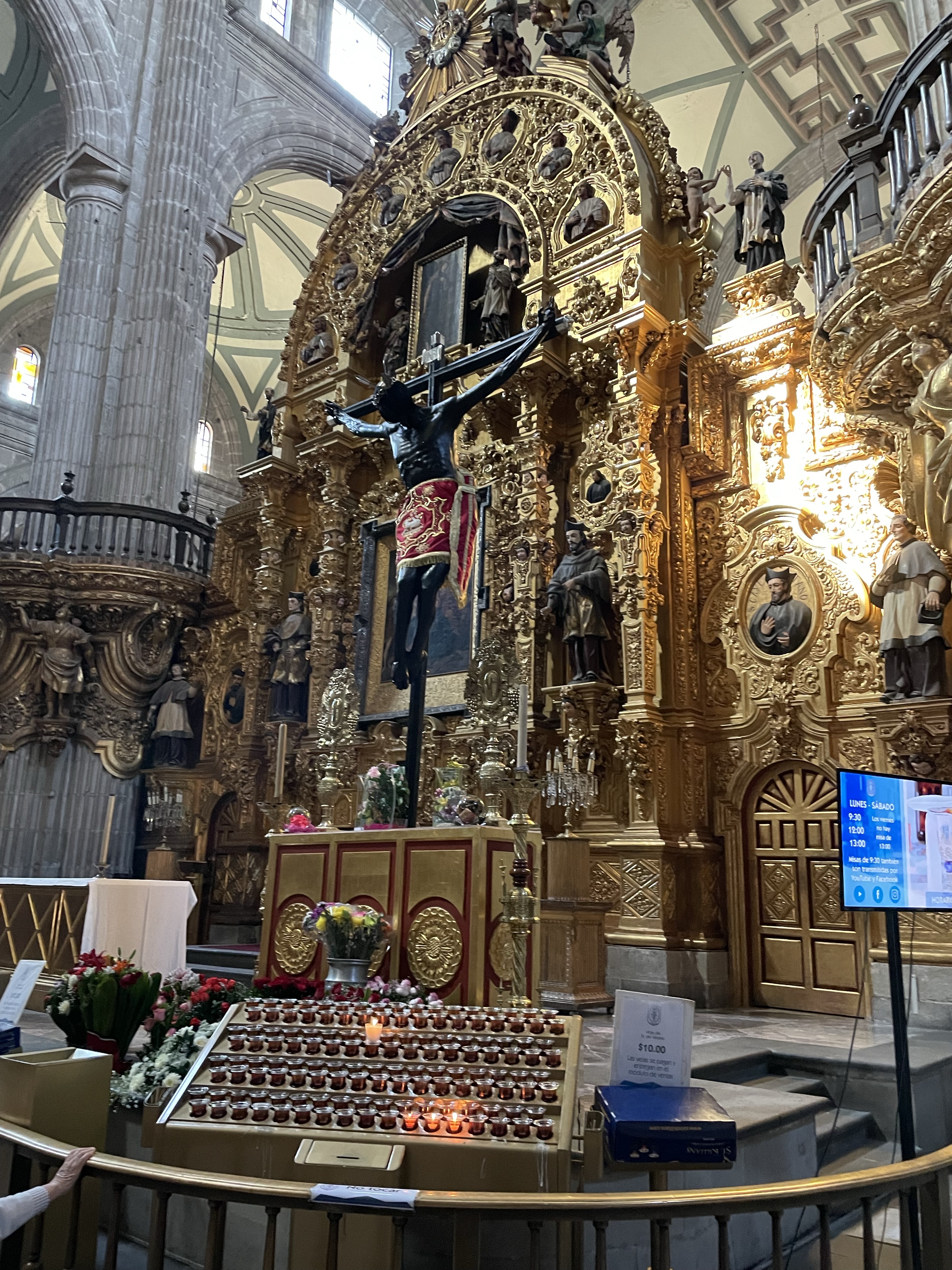
Cristo Negro/The Black Jesus

There were several facts about this Cathedral that make it special.  The first deals with the tradition of Black Jesus/Cristos Negros of the area.  There are several countries that have wooden Jesus sculptures on a cross that have darkened and turned black over the ages.  The one in Mexico City has a story.   Supposedly the bishop always prayed at the crucifix as he entered the cathedral.  There were those who wished him to die.  So they put poison on the feet of the wooden Jesus, knowing that the bishop would kiss the feet when he was done praying.

The bishop did as he always does, and kissed the feet, but he did not die.  Instead, the Jesus sculpture turned black. 

To be honest this is not my first Cristo Negro, or Black Christ/Jesus.  I have been to Portobelo, Panama, and saw the one in the Inglesia de San Felipe. It is special because it was found in the town’s harbor and it wears a robe!   I have also seen the black Madonna in Montserrat, also known as Our Lady of Montserrat. Many go on pilgrimages to see these statues.  For me they have been a happy surprise. (See blogs below.)

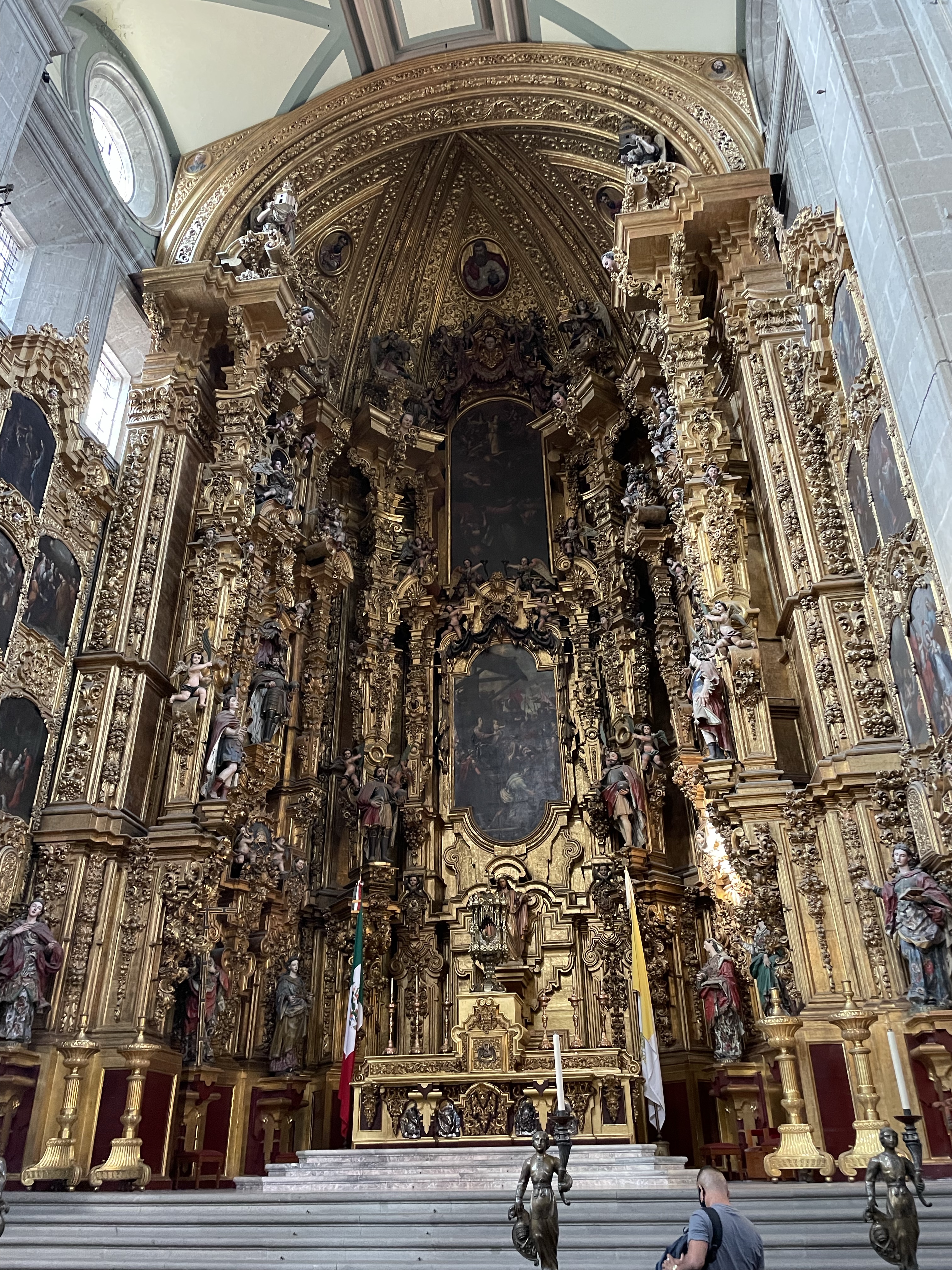
This is not the only special site within the cathedral.  There is also magnificent altar and intricately carved wooden sculpture behind it.  Outside, in front of the cathedral, there is a statue of Pope John Paul with an image of the Lady of Guadalupe carved into his robes.  This foreshadows the second religious site we visited.

Statute of the Pope.

But the most obvious and unusual aspect of the building is that it is sinking.  Completed in the mid 1600s, the cathedral was built on land that was once the bottom of a giant lake.  It was also built in the area where the Aztec’s had their temples. In fact, the stones used in the construction of the church were parts of the dismantled Aztec temple.  The cathedral was built upon the ruins.  One way of saying to the Aztec, we beat you.  But not so great centuries later.  

Around the cathedral you can see the excavations of the Aztec sites. A model of what the plaza area looked like when the Spanish first came is near the excavations.

Part of the excavation of the Aztec ruins.

 Within the church, you can see how they have worked to stabilize it.  Marble stone stairs, now sit on a bed of concrete stairs.  A pendulum hangs from the high ceiling and shows if the building is still standing straight or sinking again.  By the lines on the floor, one can see how tilted it once was, and how close to straight it stands now.

Our second religious site was the Basilica of the Lady of Guadalupe.   This site is also sinking, and many of the buildings, the older basilica, the first church and the convent, were also tilting.  They have been stabilized. But you can see that much work still needs to be done.  The newer, larger, round Basilica built in the 1970s seems fine for now.

The Basilica and all the other buildings on the site, including the original basilica from the early 1700s were constructed to honor Saint Juan Diego and his visions and miracles of the Lady of Guadalupe. Sometime around 1530 a picture of the Lady of Guadalupe/Mary appeared on his cloak, which he said was a signal that the indigenous people should convert to Catholicism.  There have been visitors/pilgrims to this site ever since. And many buildings have been constructed to provide a place for them to pray.
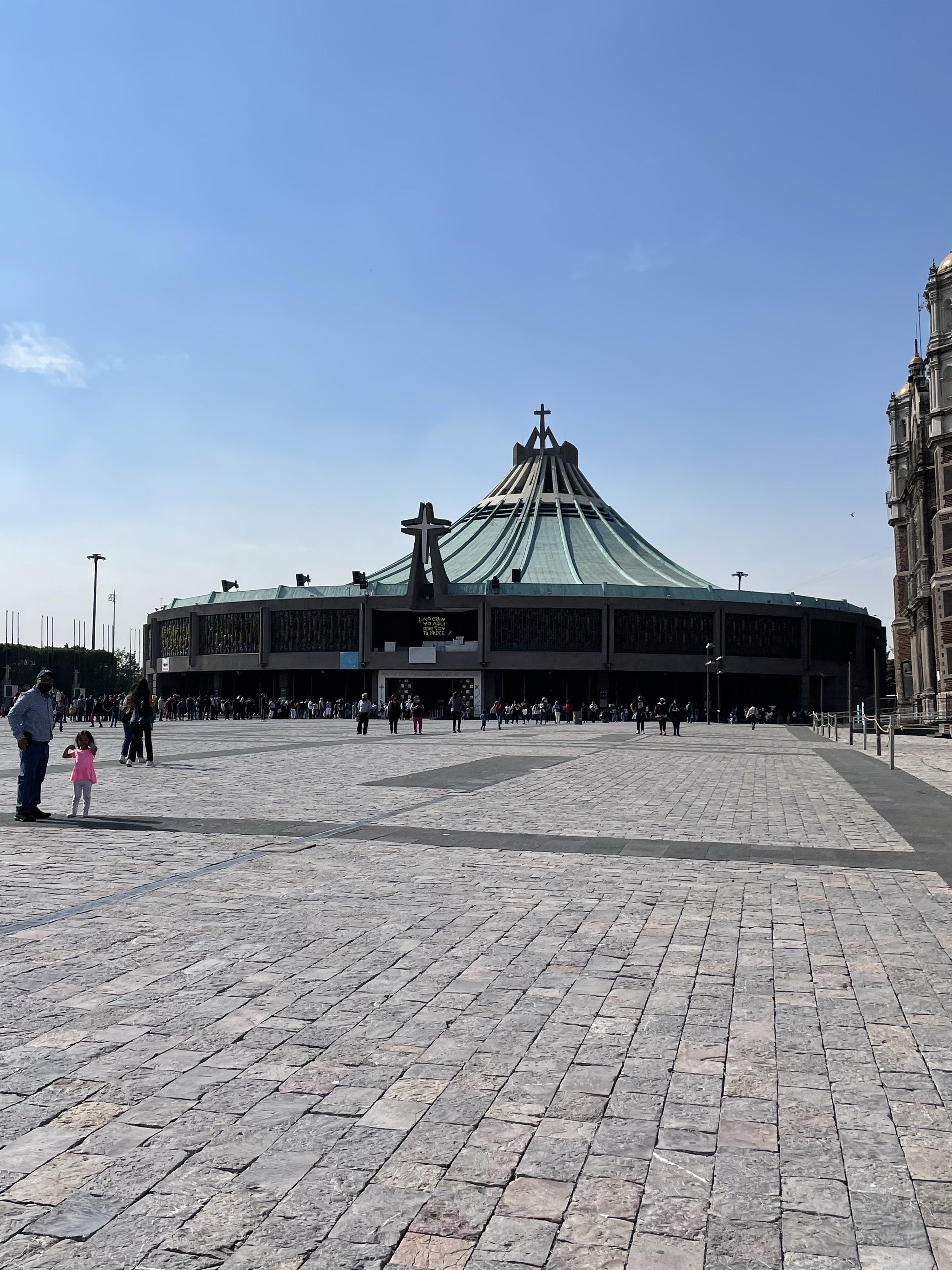
Today the new Basilica houses the image.  Encased in two frames, one silver and one gold, it is mounted on the wall near one entrance of the Basilica. You must get on a short moving walkway to see it, which keeps everyone moving forward and no one can stay in front of it for too long.  The Basilica is constantly being used by the people for Mass.  Each hour a new Mass begins. 

Statue of the Pope along side the old basilica.

There is a large open plaza on one side of the Basilica.  It is here that Pope John Paul came to  dedicate the site. A statue to him stands between the old and new basilicas.  He also came here a second time to canonize Juan Diego.
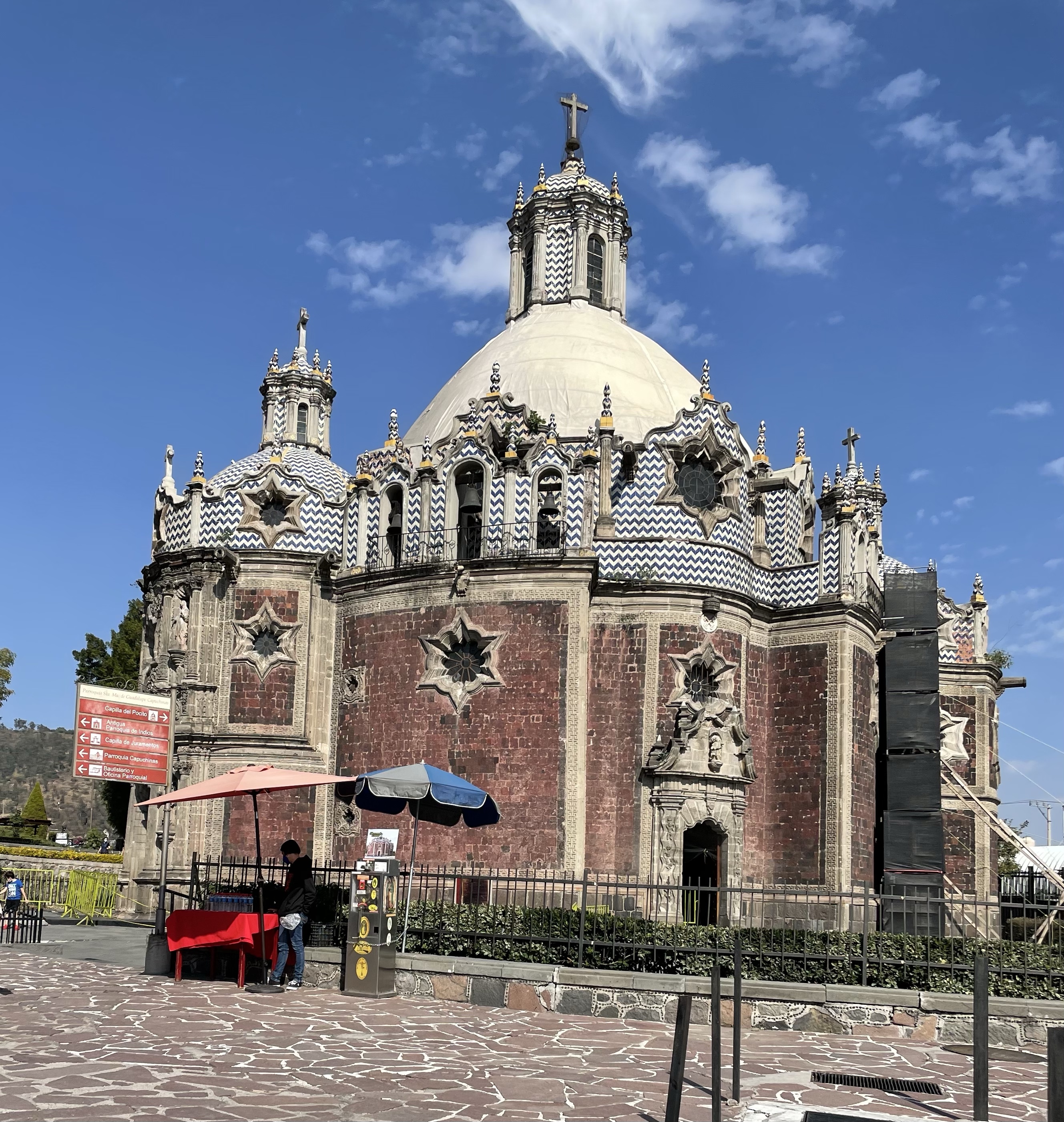
The temple of the well.

We could not enter all the buildings. But I will admit my favorite was the one that covers the well.  It was a lovely little building.  And each of the windows was in the shape of a six-pointed star.  For my Jewish mind it was perfect.  Miriam, the sister of Moses, was known for her affinity for water. When they were in the desert, water followed Miriam.  So to know that here at the site of the visions of the Lady of Guadalupe/Mary/Miriam, there is a well with a temple with six-pointed stars, gave me a little joy.
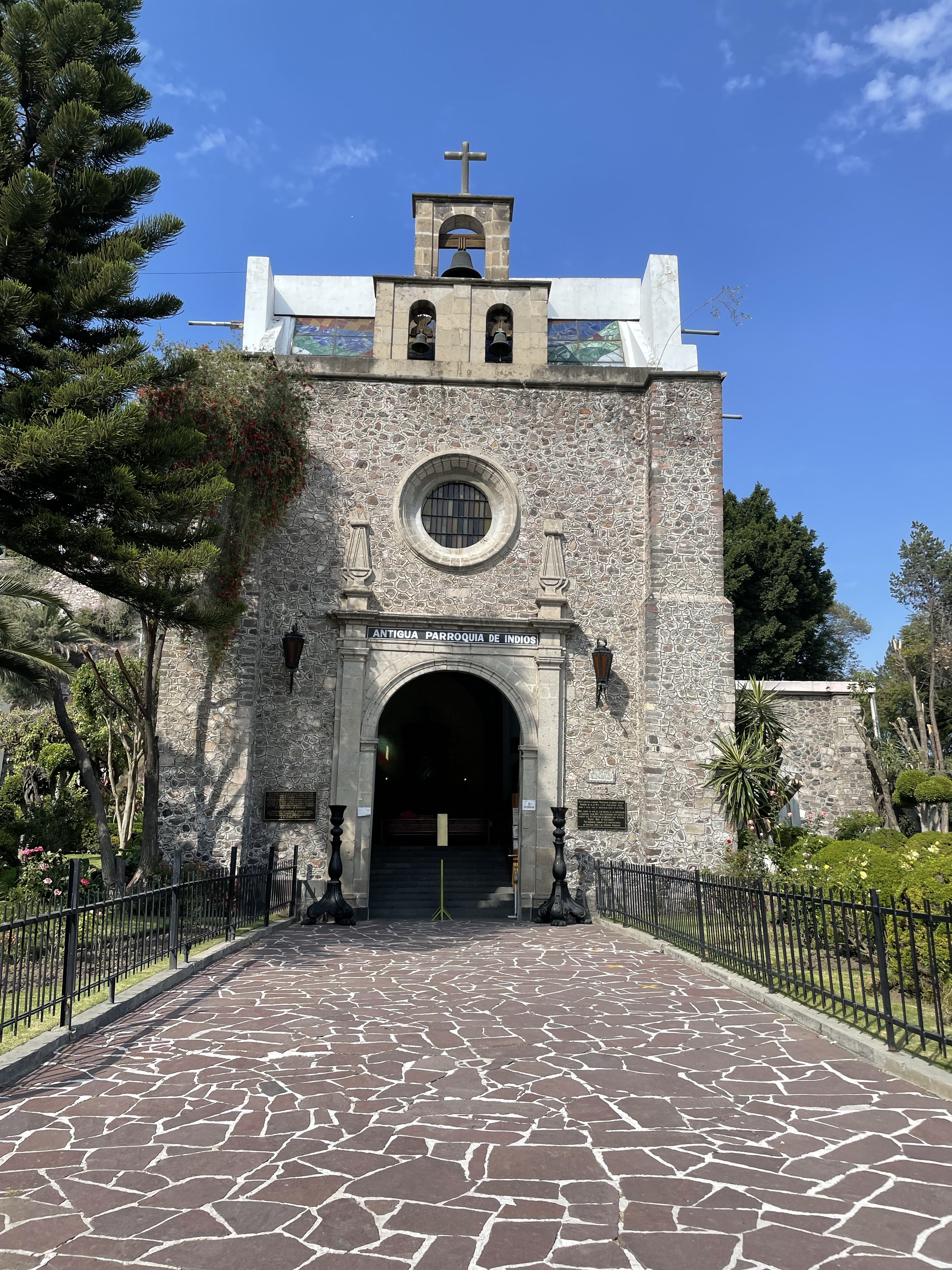
My second favorite building was a small church that is still standing, but only with the help of metal beams.  In front of it was a small water way, with no water right now, except for a bowl of water that a mama cat was enjoying while her kitten struggled to reach it.

It is quite a site, much larger than I anticipated.  To be honest, I did not want to go.  We had spent the morning visiting the Pyramids of the Sun and Moon, and I was both exhausted and not feeling well.  But our guide insisted that we had to see it.  As it was on our way back to the hotel, I figured I would say yes, but could always back out.

That did not happen.  I was hot, tired and feeling ill.  But I got out of the van and walked the many steps to the entrance of the site. And then for over an hour walked the grounds and through the buildings to see all that I could.  I was amazed that I started to feel better as we walked.  It was so interesting that I forgot to think about not feeling well.  So I have to commend our guide who insisted we visit.

Bosque de Chapultepec: Visiting Chapultepec Park

30 Nov

While we were in Mexico City, we stayed at a hotel that was located on Reforma, just a short half mile walk from the wonderous Bosque de Chapultepec.  We visited three important sites within the park, besides passing by many others and seeing all the activities enjoyed by park visitors.

rOur three main stops were: National Museum of Anthropology/Museo Nacional de Antropologia; The Chapultepec Castle: and Jardin Botanico del Bosque de Chapultepec/the botanical gardens.  We passed by the Ghandi Garden, the entrances to other sites like the Zoo and the History Museum; and walked through an open air market, where I purchased a straw hat.  We also ate in one of the restaurants within the park, El Lago Restaurante.

Honestly, we did not do these activities in one day.  The park is enormous with so much to see.  But I thought it is best to put it all together in one blog.

The first place anyone who goes to Mexico City must visit is the National Museum of Anthropology.  Besides its wonderful architecture, the museum galleries are filled with pre-Columbian masterpieces.  We had a tour guide who explained what we were seeing in English, which was extraordinarily helpful as almost all the signage is only in Spanish.

The building itself is built around a central courtyard with a large umbrella like structure providing shade. As you walk through the different galleries, you return to the center courtyard between areas.  I found that refreshing.  A way of clearing my mind before entering another new world.

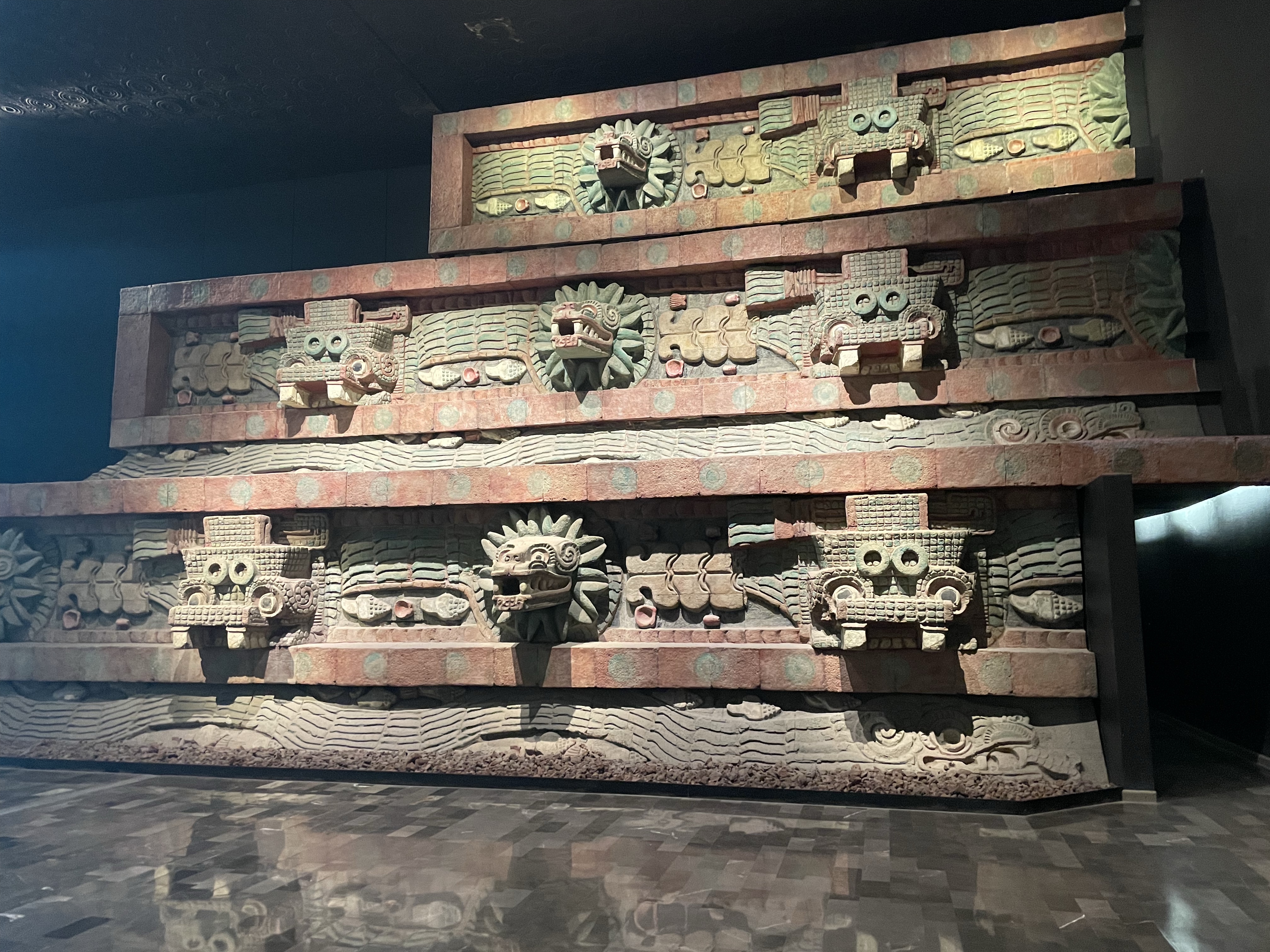
We learned about the Inca, Mayan, Aztec, Olmec  and other peoples who once lived in the various areas of Mexico.  I knew that human sacrifice was a large part of the religions.  Owever, I was shocked at the brutal and almost daily sacrifices.  The artwork of these groups, especially the Aztec, focused on skulls, dismemberment and death.  We learned about the Goddess of Rain and the God of the Sun and the feathered snakes that adorned many of the buildings.  The immense stone carvings were beautiful and many were so intricate, you wonder how they were made centuries ago without modern tools.

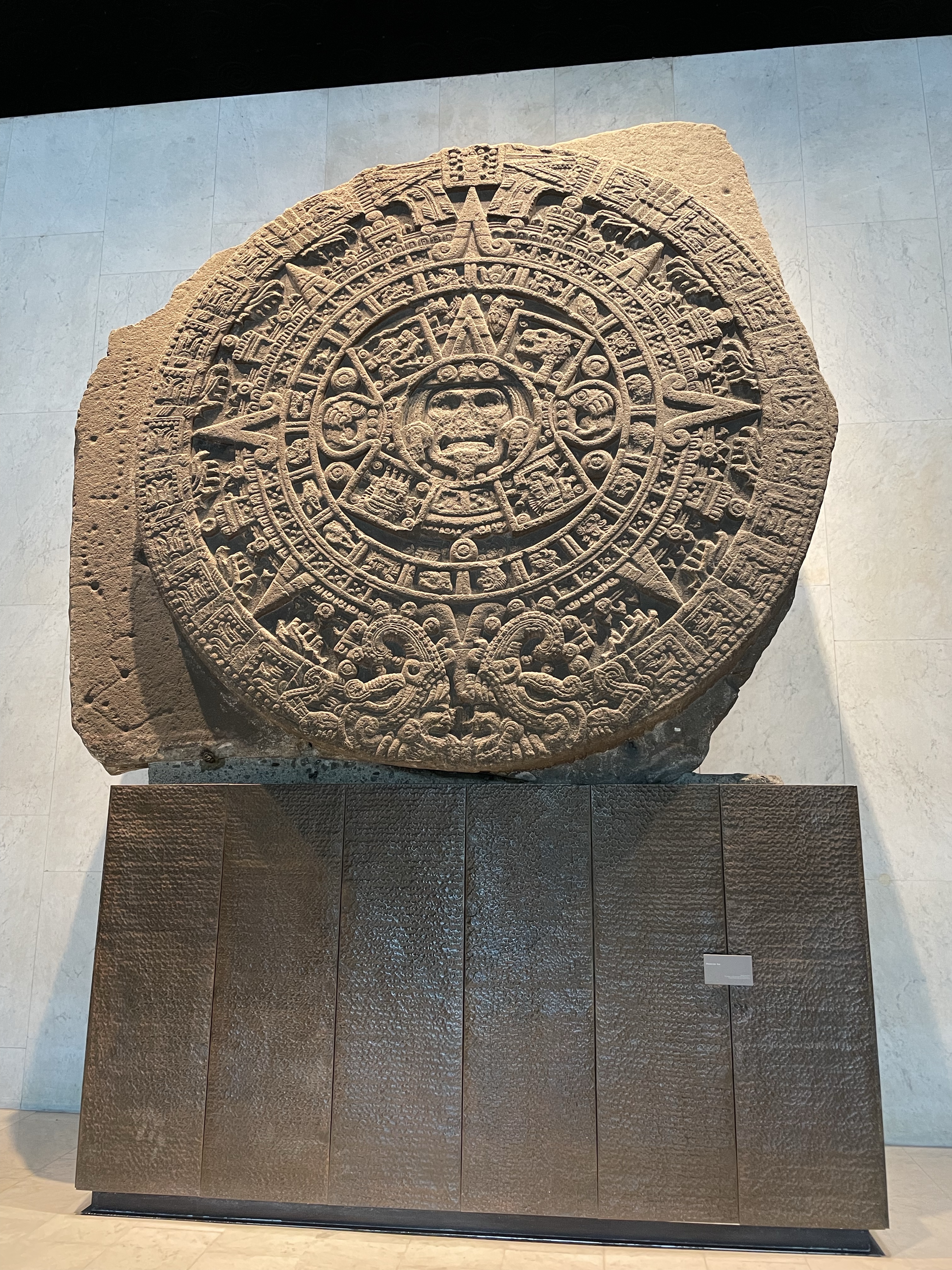
The original Aztec Sunstone is on display, as well as many other majestic and large works of art.  The Statute of Chaichiuhiticue,  and the Olmec stone heads were immense.  Each were carved from one block of stone.  I don’t know how they moved them!

I honestly cannot tell you what was the most interesting thing to see because there were so many!  I did like learning about the game they played with balls that had to go through a stone hoop. However, I was sad to learn that after each game, someone was sacrificed. 

We spent three hours visiting all the rooms of this museum.  I took many photos.  But in the last room, I was exhausted.  I knew I had had enough because I did not take one photo.  I was mentally done.  There is just so much to see.  It is a museum you could visit again and again and still see and learn about things you missed on an earlier visit.

Needless to say, we left the museum exhausted and ready to eat lunch.  We knew we would be back to the park!

We returned the following evening for a dinner at El Lago Restaurant.  It is situated by one of the lakes in the park and is just lovely.  The food is delicious as well.  But the main reason I am mentioning it, is that while we ate, a young man asked his girlfriend to marry him!  It was quite exciting and everyone cheered when she said yes!  It added an extra bit of charm to an already charming trip.

With the park so close to our hotel, we knew that we would be walking back another day.  We chose the morning after we took our Covid tests to make sure we could return to the USA.  Even though we knew we did not feel sick in any way, having to wait several hours for the results would have made me anxious if I just sat around.  We started walking to the park.  Our first planned stop was the botanical gardens.  This one was filled mainly with succulents and orchids, two of my favorite plantsWe walked around the gardens enjoying the quiet.  We ended with walk through the orchid house and enjoying the many succulents planted in cement cinder blocks!  I want to do that in my garden.

Chapultepec Park is considered the lungs of Mexico City.  The acres upon acres of trees supplies the valley with clean air, which is important, because there is pollution in the valley that encompasses Mexico City.

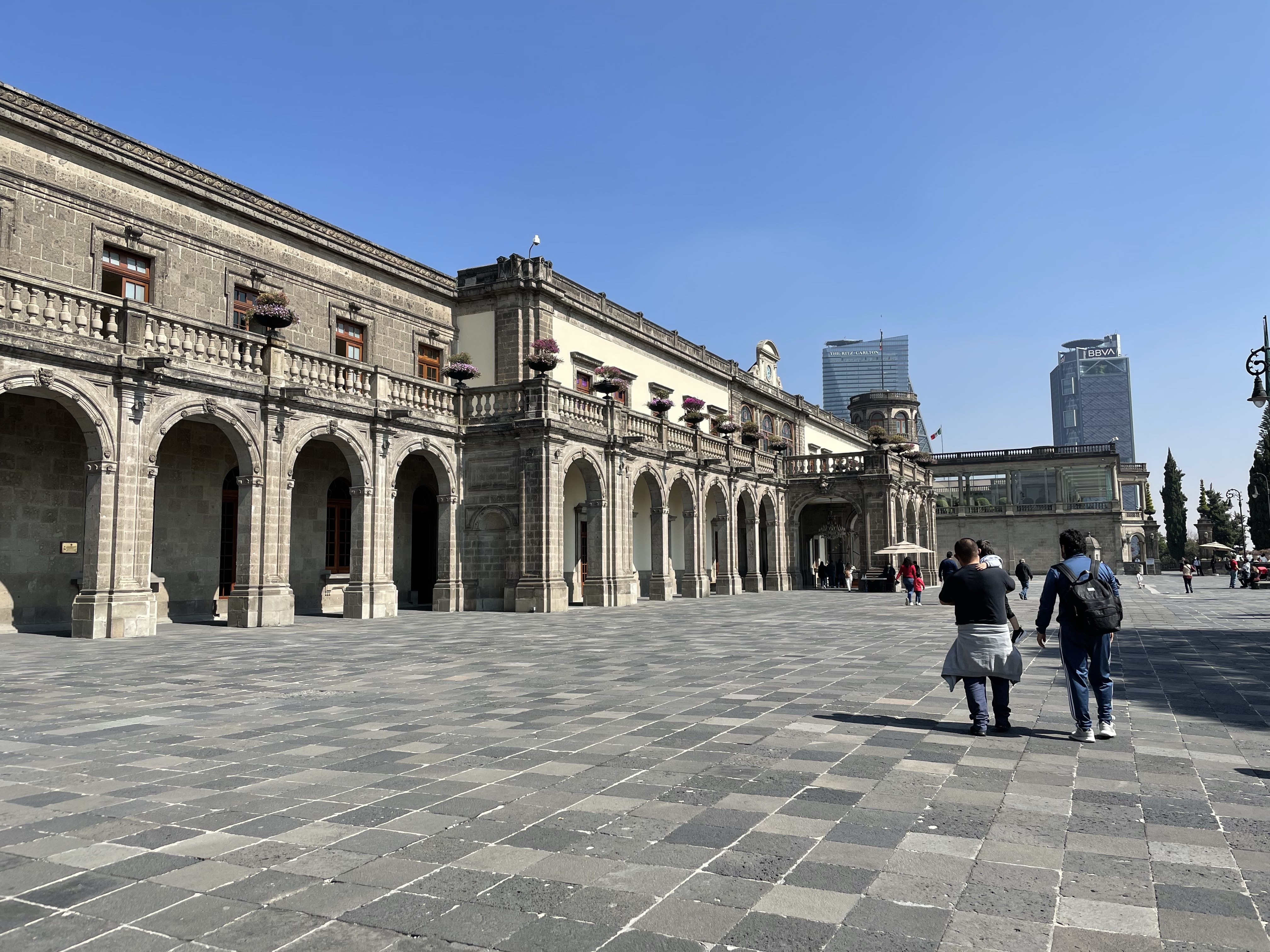
After we left the gardens we continued walking through the park towwards the hill where the Capultepec Castle sits. The first building of the castle began in 1795 as a summer home for the viceroy.  Eventually it was enlarged and became the home of Emperor Maximillian and his family.  Maximilian did not survive for long in Mexico.  He became Emperor in 1864 and was executed in 1867. The unfortunate thing is that Maximillian seemed to care about the people of Mexico.  But it did not save him from execution.  

The Castle then became the home of the President of Mexico and continued as the Presidential residence until 1939.  Now it is a museum. It does cost 85 pesos to enter.  I did not have that much cash, and they do not take credit cards.  However, if you are over 60, which my husband and I definitely are, you can enter for free!  The cashier said,  “Are you over 60?”  I said yes.  She said go in for you it is free.  Thank you Mexico!!  It would have been so sad not to have seen this building and its gardens!

You do have to walk up the hill.  But the slope is easy to climb.  However, I will say with the altitude of 7500 feet in Mexico City, I am glad I waited for the third day to make that climb!  We walked slowly.  You can take a bottle of water to go up the hill.  But once you get to the entrance of the Castle grounds, you cannot bring it in with you.

To describe the building, all you need to do is think about Vienna and St. Petersburg.  Maximillian was a member of the Habsburg family.  So, of course, his home reflected the elegance and grandeur that a member of that family needed/demanded.  It was a bit offsetting to see the grand carved furniture of Europe throughout the areas of the home.  But it was beautiful.  A major difference from a European home, is that each of the rooms could be entered from the interior of the house, but they also had large doors that opened to the outside.  To see the mansion, we walked along the perimeter of the home and looked into the rooms through opened doors.

The view of the park and the city from the top of the mountain is wonderful.  Even better was going all the way to the top and visiting the gardens on the roof and seeing the view from there.

Another added bonus to our visit to the park was finding a parade was in progress on Reforma!  It was Revolution Day in Mexico.  We spent almost an hour watching the music, the floats, the marchers in colorful outfits denoting their province of Mexico, before we discovered the underground walkway that enabled us to return to our hotel.

Visiting Chapultepec Park is a must.  We only saw a few of the many interesting museums and sites to see there.  Honestly, you could spend a week just visiting Chapultepec Park!

https://www.wmf.org/project/chapultepec-park

https://en.wikipedia.org/wiki/Chapultepec

https://en.wikipedia.org/wiki/Chapultepec_Castle

https://en.wikipedia.org/wiki/National_Museum_of_Anthropology_(Mexico)

https://en.wikipedia.org/wiki/Maximilian_I_of_Mexico

The Pyramids of the Sun and the Moon: A journey to Teotihuacan

28 Nov

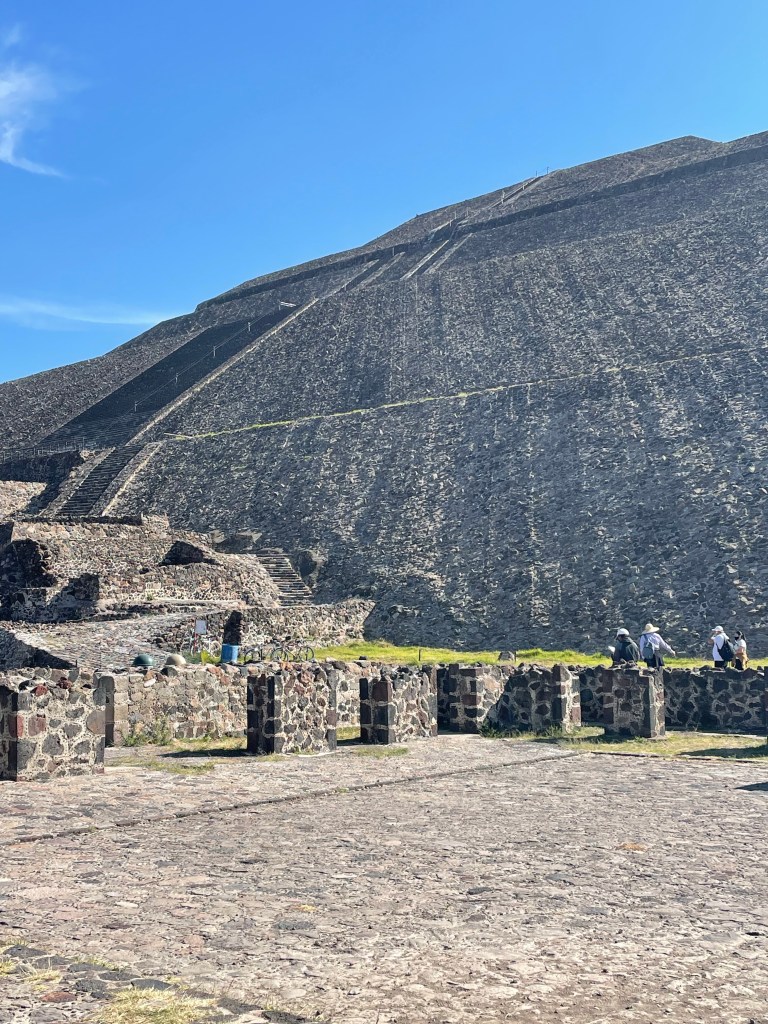
Wow.  My husband and I spent over three hours exploring the Teotihuacan site of the Pyramids of the Sun and the Moon and many, many other buildings, temples, and vast plazas.

It was incredible that such an intricate community was built in the early third century, around 200 AD. 

Nearly 2000 years later, the site is still spectacular.  I can only imagine what it looked like to the eyes of people so many years ago.  The wonder and disbelief to what was built had to be awe inspiring and truly a monument to the gods.

For me it was the completion of another item on my list of places that I needed to see in my life time. And it was well worth the journey from Mexico City to Teotihuacan. My husband and his family went to Mexico City in December 1978. He climbed the Pyramid of the Sun. It was on that trip that he realized he missed me. When we saw each other back at Missou, he proposed. I rally needed to see this site!!

When at first you see the Temple rising from the fields as you drive along the highway, I really could not image the massive height of these temples.  Even up close I was stunned.  And it is not just the temples. It is the entire complex of buildings, homes, and plazas.  Each plaza has its own temples and homes. 

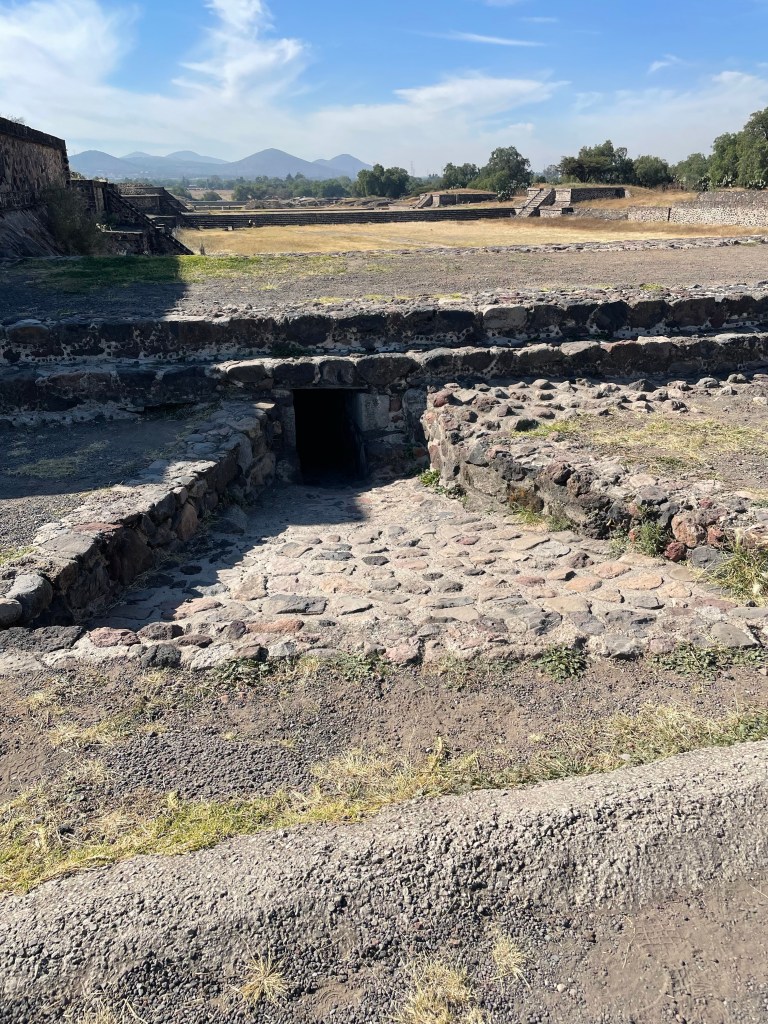
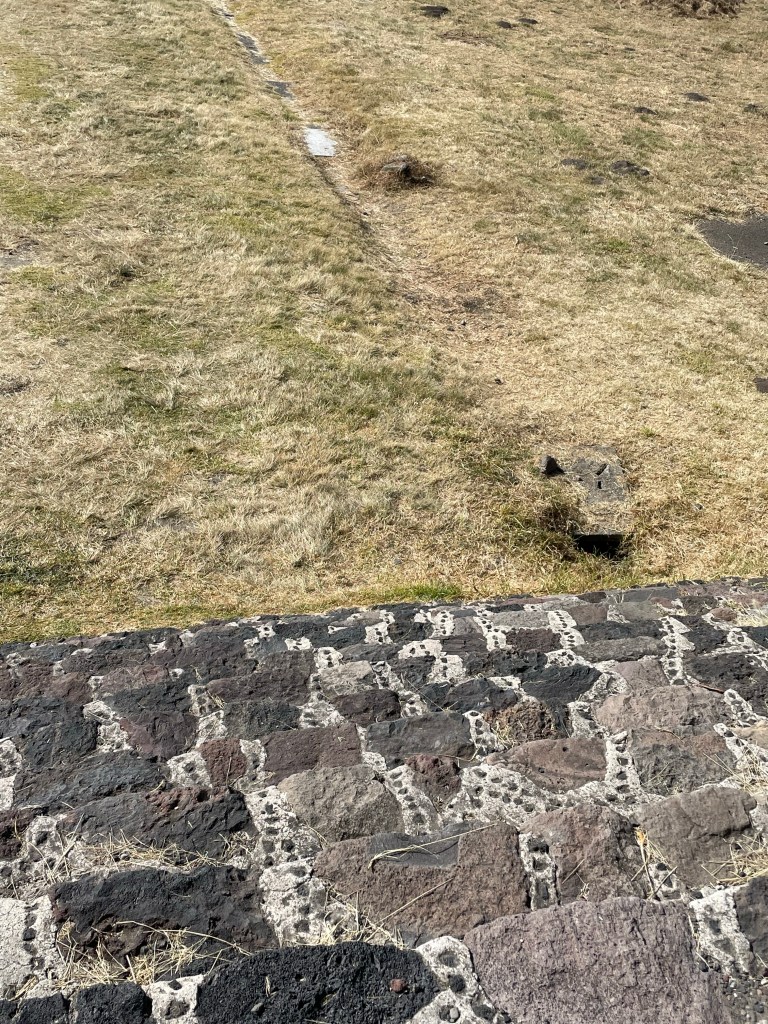
The drainage system to keep the clean water from flooding and the waste water from combining with the fresh water was great.  We could see where the rainwater would travel continually downhill till eventually it reached the river.  Keeping the two waters separated made using the fresh water easy.  However, when they reached the river, they combined.  (The river, unfortunately, is quite polluted and smelly!!)

The welcoming plaza with its temples to other religions was grand.  I could imagine myself walking there and being mesmerized by the central temple to the gods surrounded by the many temples of the visiting travelers. Each plaza is so large.  Closing my eyes, I tried to imagine each one filled with worshippers on holy days.  We learned that they believe the priests would meet together before each mass gathering so that they would preach the same information to all the worshippers.   Good planning.

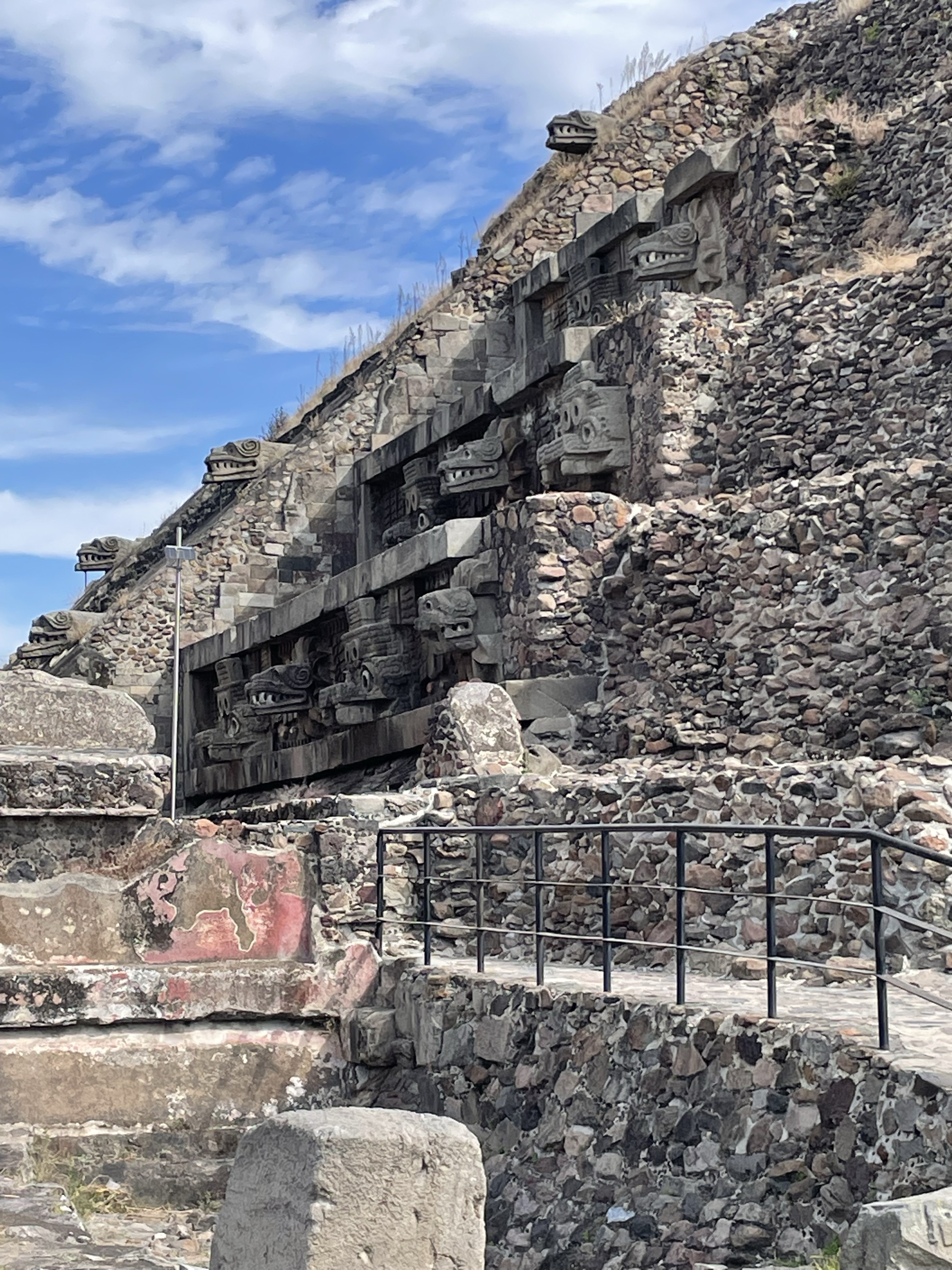
A pyramid’s original decoration rediscovered.

But really nothing can prepare you for the size of the Pyramid of the Sun reaching up to the sky. And also the Pyramid of the Moon strategically placed in front of a mountain that makes its size seem even more gigantic.  Someone had a great eye for drama.  The Pyramid of the Moon demonstrates that drama.

Originally these brick and stone monuments were covered with stucco and painted. There are a few areas where the art and color still remain.  It was interesting to have a local man show us how the colors came from the plants to paint the stucco.  That truly surprised me. But the mural of the puma lets you envision how the entire plateau once looked.

We did not just stay in the large plaza dedicated to the Sun and the Moon. We walked the entire two kilometer site. Climbing up and down the steep stairs to get to yet another plaza.  To be honest it made me think of the song that goes, “the bear went over the mountain to see what he could see. HE saw another mountain.”  For us we climbed over another stairway to see another plaza to see another stairway to walk through to another plaza.  I kept saying to my husband, I think this is the last one.  And it was not.  Till it was.  But honestly, this seemingly endless trek through plazas and up and down steep stair cases was amazing, and worth the trip!

https://en.wikipedia.org/wiki/Pyramid_of_the_Sun

Completing My Personal NASA Mission

10 Nov

In honor of the 50th anniversary of the Apollo 11 landing on the moon, I decided I needed to revisit the space centers. In June I went to Kennedy Space Center, which you can read about below. Yesterday I completed my mission with a visit to the Johnson Space Center in Space City … Houston Texas.

I had visited this Center 30 years ago with my husband and then three-year-old daughter. I found it much changed with an excellent museum area that caters to children and families with many hands-on exhibits.

Luckily for me the hotel I was out could sign me up for a tour of sorts. If two people wanted to go, the Houston Tour Company would provide a van for the round trip and the entrance tickets for the Space Center. When I first went to the concierge desk, I was the only one who had signed up. But I left my name and room number in case someone else was interested. My plan succeeded. Within a few hours I got a call that my trip was on. And then a friend of mine decided she would go as well.

The next morning we met our new friend and traveling partner along with our van driver, Ruby, for our adventure.

I first need to say that years ago when I went to the Johnson Space Center, we just wandered the lovely campus of the Space Center, walking to the different buildings on our own. Now it is much more controlled. The entrance ticket included everything. But to see the actual Johnson Space Center you now have to take a tram. There are two to chose from. The blue line, which we took, goes to Mission Control and to see the Saturn V rocket.

Seeing the control room where most of the space shuttle missions, and in a few short years, the Orion Missions, will be watched over by a flight director and his crew was interesting as was the presentation. We could see a live feed into an active control room where the space station was being watched.

Along the way to the next stop, our tram driver told us about the other buildings, including the Astronaut Training Center, which is the first destination of the red tram line. He also pointed out a grove of trees planted in memory of the astronauts who perished during a mission and others who had an important role in the space program. Both lines stop at the Saturn V building.

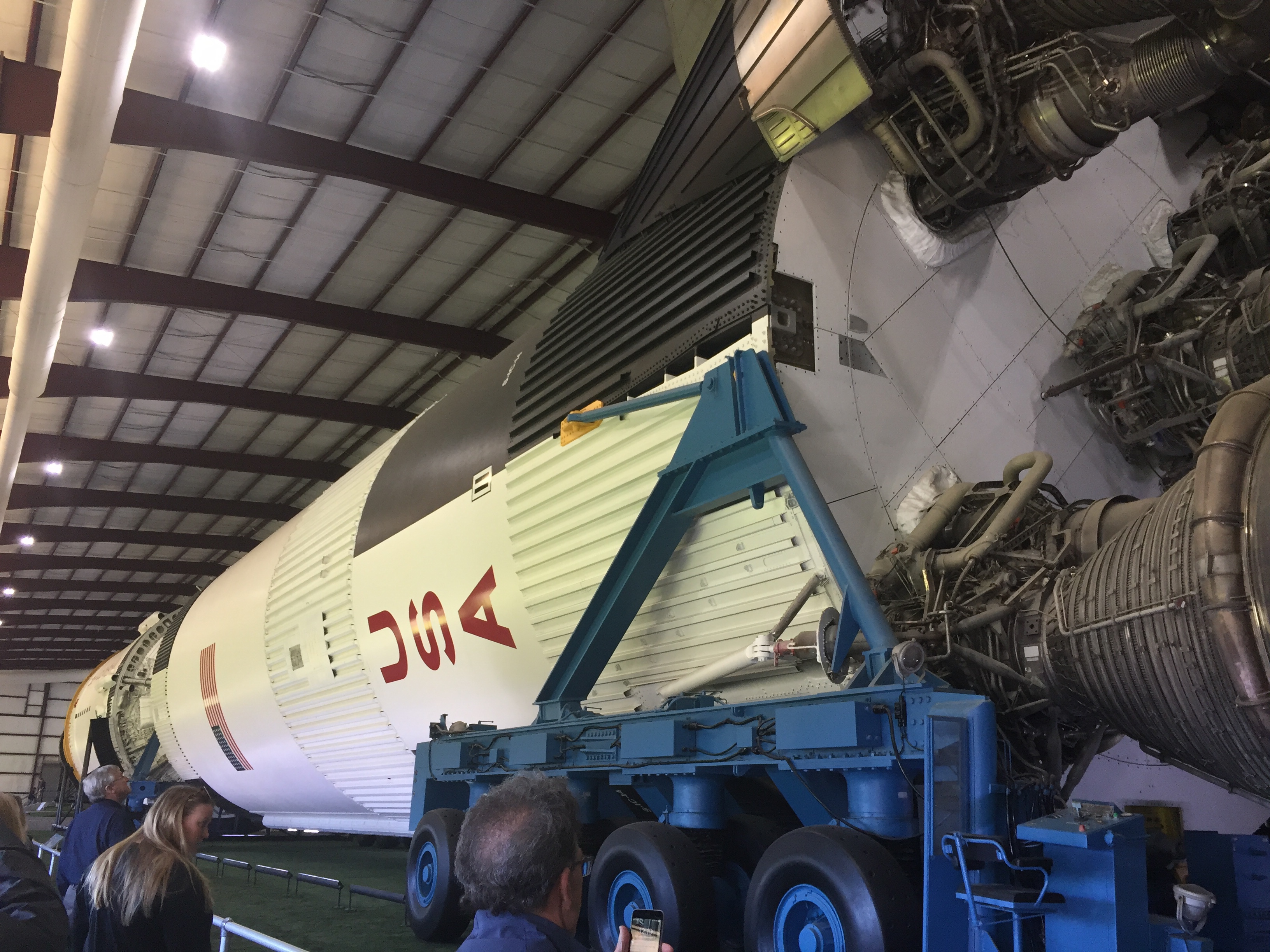
It is exciting to see the size of the Saturn V Rocket. It lies on its side so visitors can walk around it and see how it connected the different stages and fuel tanks. The Apollo capsules were just a tiny portion at the top of the rocket.

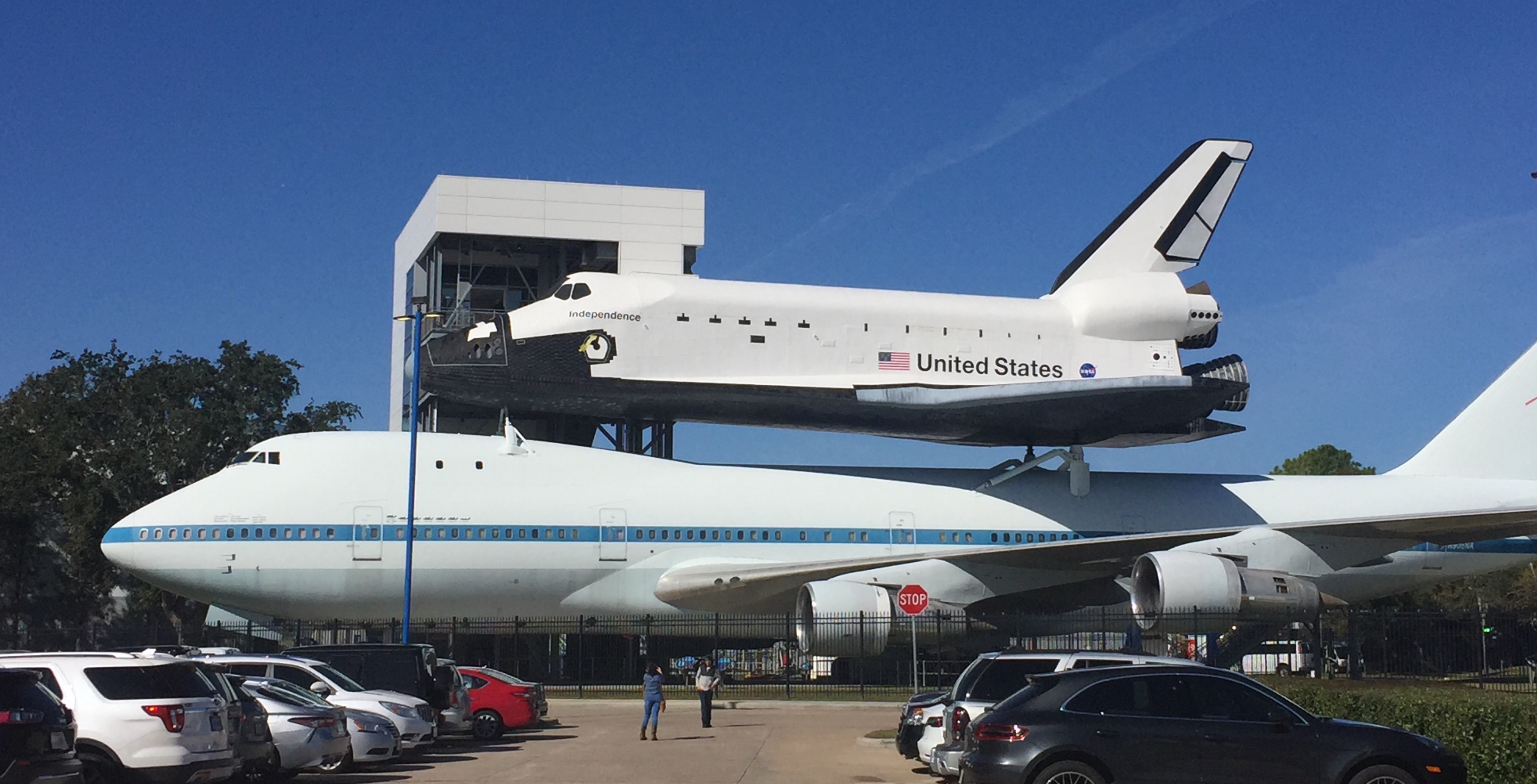
We took the tram back to the museum area, and went to a 15 minute movie about the history of the space program. When it is over you then tour an area that has the original Apollo 17 capsule and much more space memorabilia. But the highlight is the Discovery Space Shuttle perched on a 747. You can go up and enter both. In the place is an exhibit on how the space shuttle was attached for transfer. And you can enter the Space Shuttle and see how astronauts lived while on it.

Another highlight for me was seeing all the moon rocks and actually getting to touch one. The museum employee in the room said that this stone was once rough and thicker, but over the years has become as smooth as glass. I can attest to that as I ran my thumb over it along with all the children.

There is so much to do. We were there for five hours and could not see everything. There were two shows at the I-Max Theater, which we did not see. I wish we had checked the times of the shows when we entered. We might have arranged our visit a bit differently. However, it was fun and exciting to see all the artifacts from space.

I loved walking the exhibits and trying out some of the interactive activities. There are virtual rides to help you experience the actual feel of space. Many families stood on line for these activities.

I believe I have celebrated mankind’s space accomplishments with these two visits. I look forward to seeing the start of the Orion Missions.

For true space enthusiasts, I also recommended a visit to the Cosmosphere in Hutchinson, Kansas, and the US Space and Rocket Center in Huntsville, Alabama. I have visited both places when my daughter and son went to Space Camp. (See blog below.)

https://zicharonot.com/2019/06/06/visiting-kennedy-space-center-my-celebration-of-the-walk-on-the-moon/

https://zicharonot.com/2019/03/07/our-daughter-not-an-astronaut/

Visiting Kennedy Space Center: My Celebration of the Walk on the Moon

6 Jun

With the fiftieth anniversary of the Moon Landing fast approaching, I knew our recent trip to Florida had to include a visit to the Kennedy Space Center.  How could we not go and relive the excitement of the United States’ journeys to the sky and the moon?  So we did!

We went on an uncrowded Sunday, the first one in June 2019.  Not quite seven weeks before the historic 50 anniversary which will be on July 20!  Although we did not take the bus tour to the launch pads, since we did that four years ago, we still had more than enough to do by touring through the exhibits.  At each one remembering our own excitement as we watched the race to space advance during our lifetime.

While there, we made sure to visit the memorial to those men and women who gave their lives while involved in the space program. The names of the Apollo and shuttle crews who perished are inscribed in a black wall reaching to the skies.  We were the only ones at the memorial when we went.  I wish everyone would visit this area of the Space Center.  Those who perished in the two shuttle catastrophes are also memorialized in the exhibit featuring the Atlantis Space Shuttle.

Atlantis, the last of the Space Shuttles, is housed in a giant building.  You cannot appreciate the size of the shuttle and its rockets until you are standing next to them.  Impressive! You learn so much about the ability of so many who worked together to create the space program.

But before the space shuttles came the Mercury, Gemini and Apollo programs.  The Center is filled with information about the astronauts, the engineers and the many people who helped create the leap into space.

img_3711

Friendship 7 Mission Control

The Heroes and Legends includes an Astronaut Hall of Fame and an exhibit of the original mission control.  While looking at this room, you watch a short video about John Glenn’s first orbits around the Earth and the fears when one of the lights came on indicating that the heat shield had come loose.  Luckily that was not the case, but you sense the fear.  Mission control looks so outdated today.  Computers and electronics are now so advanced.

I now understand, even more, why the mathematicians I learned about in the book and movie, Hidden Figures, were so important.  The state of technology was low, and brains were important.  I loved learning about Katherine Goble in the movie.  Seeing the mission control short movie about the Friendship 7, reminded me the importance of her calculations, which were also used in the Apollo 11 and Space Shuttle missions, even though she is not mentioned.   I believe it is important to remember all the women who also had an impact on the space programs! I once thought my daughter would join these women at NASA. (See blog below.)

img_3700

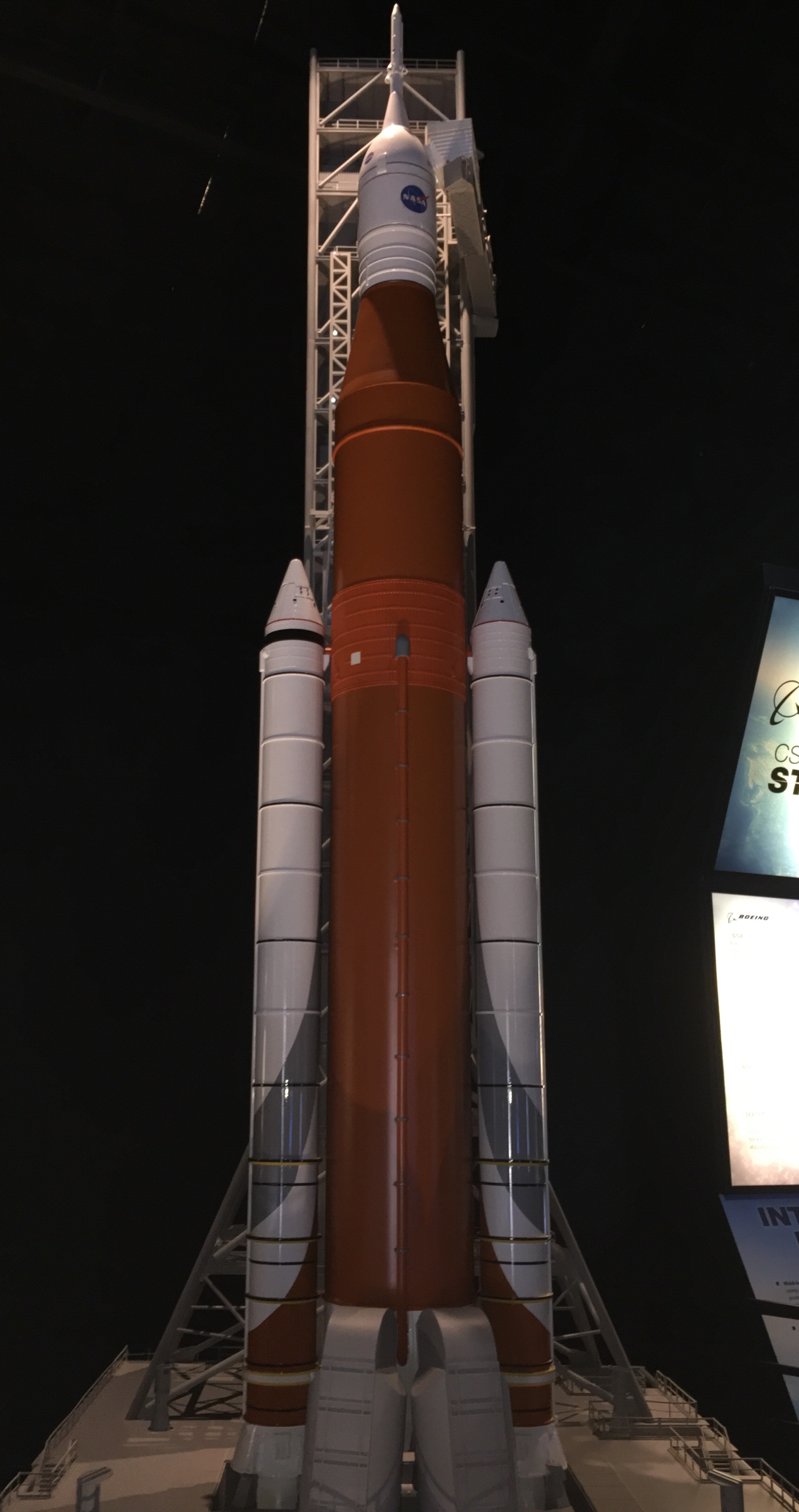
Mock up of the newest moon rocket.

At the Kennedy Space Center, you can watch a variety of movies on the space program at the IMAX theater.  My favorite was the opportunity to listen to a briefing about what is happening at NASA and the chance to meet an astronaut at the Universe Theater.   We did learn that there is an effort to return to the moon in 2024 and we even saw a mockup of the space craft that will take astronauts there.

I still remember watching Neil Armstrong’s first steps on the moon. (See blog below.). The summer of 1969 Is one I will never forget for both the walk on the moon and for the Woodstock music festival that was less than two miles from my home in the Catskills.

Space has had a place in the fabric of my family.  Visiting the Kennedy Space Center and learning about the past, present and future of the space program is a way to celebrate innovation and science.

img_3851

I visited the gift shop to purchase a t-shirt commemorating the 50th anniversary. I had to get a Snoopy shirt.  For me, the Apollo missions to the moon will forever be attached to Charles Shultz and his cartoon character, Snoopy.  In fact, the Apollo 10 lunar module was called Snoopy, while the command one was called Charlie Brown.

Earlier this year I watched as Israel sent its first spacecraft to the moon with the help of Space IL and the Israel Aerospace Industries.  The Beresheet spacecraft crashed in its final moments, just before landing.   Think of the capabilities of technology today compared to 1969!  And even today it is nearly impossible to have a perfect landing.  This indicates so spectacularly how remarkable were the United States early trips to the moon.   I look forward to the 55th anniversary and the next attempt by the USA to have a man and a woman once again walk on the moon.


https://zicharonot.com/2019/03/07/our-daughter-not-an-astronaut/

https://zicharonot.com/2014/06/29/spaceastronomy-and-the-first-walk-on-the-moon/

www.KennedySpaceCenter.com

https://www.nasa.gov/feature/nasa-and-peanuts-celebrate-apollo-10-s-50th-anniversary

https://www.space.com/israeli-beresheet-moon-landing-attempt-fails.html


Visiting the Van Vleck House and Gardens

3 May

Another delightful site to visit in Montclair is the Van Vleck House and Gardens.  Once a private estate, the house and its gardens were donated to The Montclair Foundation in 1993 by the heirs of Howard Van Vleck, who owned this Italianate villa.  The house was built in 1916.  While other homes once were on the estate as well, this is the only house that still remains.

img_3092

img_3108

The original main entrance to the house on Van Vleck Street.

The gardens are open to the public for free every day!  No holiday closures!  The lovely house is used as a center for nonprofit groups for meetings, events, and fundraisers.  I actually saw people having a yoga class in one of the rooms! What a spectacular yoga studio!  The windows overlook the gardens!

The house and gardens were a short walk from the Montclair Art Museum, just along Upper Mountain Avenue.  Our visit came after several days of rain, so all the grass was lush.  But the blooming season, except for the daffodils was not yet in progress.  I think by the end of May these gardens will be stunning.  When we saw them, everything was greening up, but not much was flowering.

img_3101

The formal garden in the back of the house.

There are several walkways and levels of gardens.  The formal gardens behind the main house are lovely. Staff members were setting up for an event when we were there, so we tried to stay out of the way. Although not much was blooming yet, it was a great place to get a good walk in a lovely setting.

img_3097

One of my favorite spots.

The Upper Lawn had several stations to check out.  You can download the Van Vleck house’ app and learn about the different areas using codes on the signs.  I liked an area on the upper lawn that had many daffodils and a bird house.  When you walk across the upper lawn, you come to the Mother’s Garden and then to a percola that was renovated.

At first, I was not sure if you were allowed to walk on the lawn, as there were no paths. But seeing the information signs across the way gave me some confidence that this was acceptable.  Also the Garden Etiquette flyer we picked up at the Visitor Center, says, “Walk only on the pathways and grassy areas.”  So we did!

img_3094

The Visitor Center with an Ap sign.

The children’s butterfly garden should be lovely as well. It is located behind the Visitor Center. (Where there are good restrooms.  Always important when walking.)  I also liked the colorful signs with details about insects and disease impacting trees and what to look for that lined the path from the butterfly garden to the front of the Visitor Center.  I was glad to see on the website that there are many children and family activities planned throughout the spring and summer.

img_3095

The pavilion by the Tennis Garden.

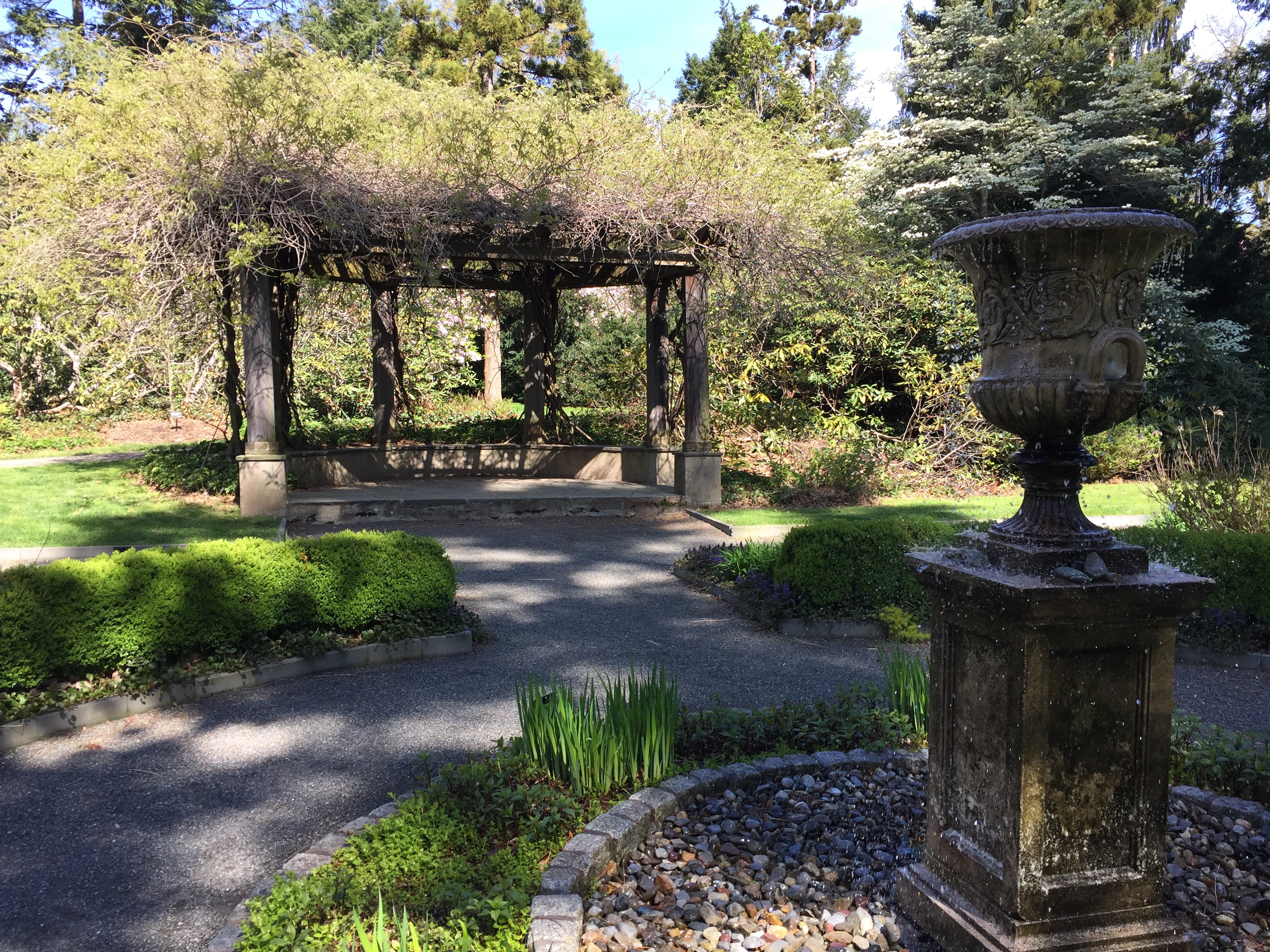
We did not go on the Rhododendron Walk.  It was somewhat muddy and damp, and I was not in the right shoes for that.  However, I did enjoy the Tennis Court Garden, planted where the estate’s tennis court once stood.  To the side is little pavilion.  I could, in my mind, see people resting there between sets of tennis, or watching those playing while enjoying the shade.

I hope to go back to Montclair and visit the Van Vleck gardens when everything is in bloom!


To learn more about the gardens and home, go to: www.vanvleck.org


A Little Gem, the Montclair Art Museum

1 May

img_3053

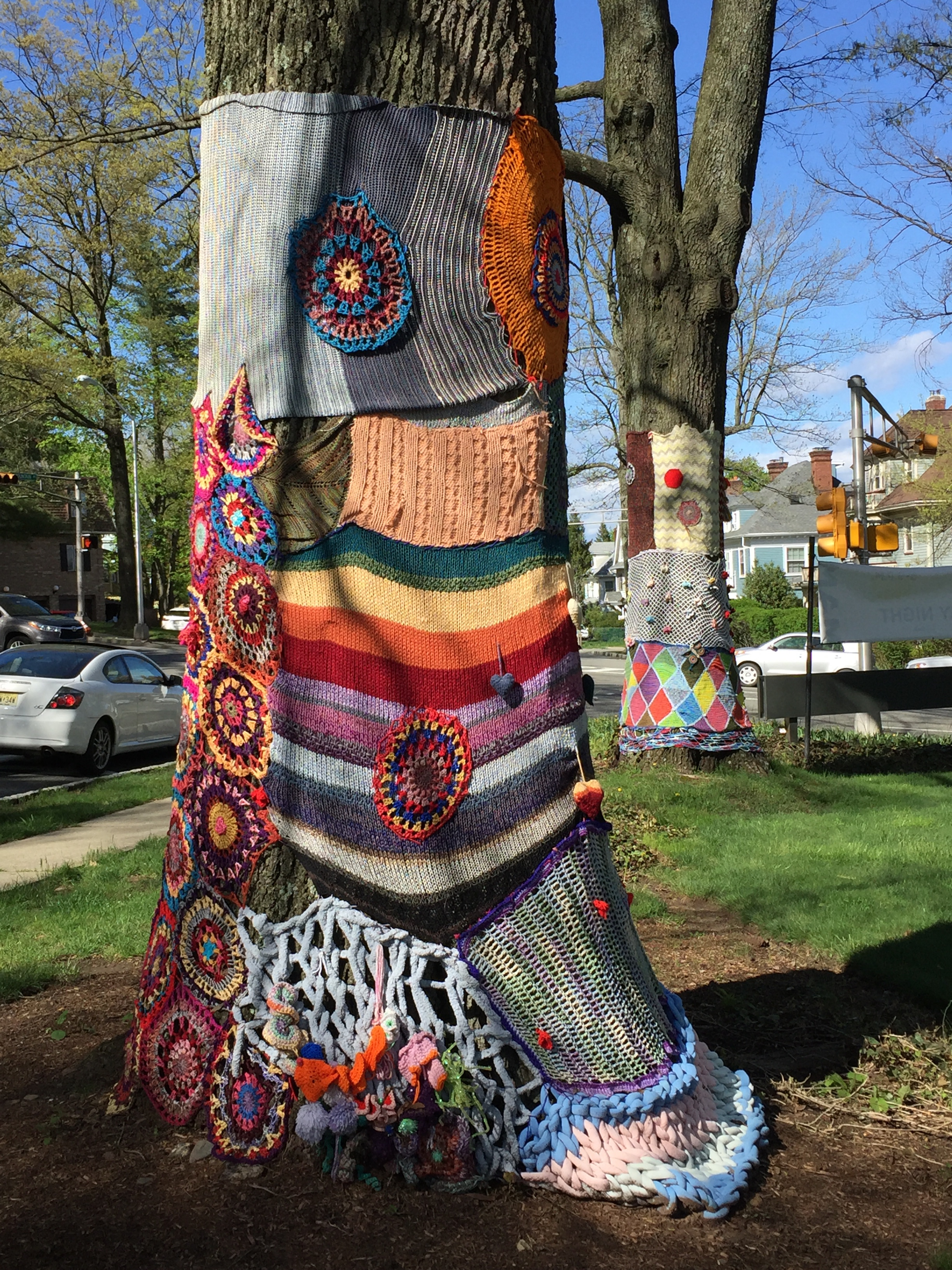
I just spent five days in Montclair, New Jersey, visiting my sister who recently moved there.  When we drove to her apartment, we passed the Montclair Art Museum.  Outside many of its trees were covered with crochet and fiber art works, my attention was immediately captivated.

She knew what I was thinking.

“Yes, we are going.  I knew you would want to go.” And I did.  I crochet; I knit; I sew; I have embroidered; I do candlewick embroidery; I needlepoint.  In simple terms, I love fiber arts.  And this display was calling my name.  I wanted to take photos of the trees from her moving car.  But she told me to calm down.  We could actually easily walk over to the museum

img_3056

On exhibit at the museum is the 2019 new Jersey Arts Annual – Crafts, “New Directions In Fiber Arts.”  It will be at the museum until June 16, 2019.

There was felt art, and crochet art, and quilt art.  Each of the 32 artists have their own specialty.  Each is special.  But I must admit, I have my favorites.

One artist, Jeanne Brasile, does water color and embroidery over braille newspapers.  I loved the geometric shapes and the colors of her work. They are delightful. Another, Robert Forman, makes yarn paintings.  I liked how the yarn formed another painting over the existing work.  You sort of see two different works of art at one time.  Geri Hahn sees art in musical sounds.  Her work on fabric looked like butterflies dancing to me. So Yoon Lym’s lovely felt painting looked like a water color.  I also enjoyed the story quilt by Faith Ringgold.

But every artist’s work had something to intrigue.  I enjoyed that each one wrote a statement about their work.  I, of course, read every one.  But I also purchased the booklet that went along with the exhibit to help me remember.  Actually, I should be honest, my sister purchased it for me, as she is a member.  Thanks!

img_3047

I also liked that scattered among the art works were little signs called Family Threads for family activities and questions.  This made the the exhibit much more interactive and family/child friendly.

The fiber exhibit was not the only gallery that I enjoyed.  Currently, the “Undaunted Spirit: Art of Native North America” is also on display until mid-July.  Part of the display, the baskets, I believe, are always on display.  The gallery that housed this exhibit, The Rand Gallery, is named for Annie Valentine Rand, and some of the many Indian art baskets and art works that were collected by her and her daughter, Florence Rand Lang, are on display there.

In March, my husband and I  spent a week on the Navajo and Hopi Indian Reservations in Arizona, so I was fascinated by the many baskets which reminded me of what I saw in Arizona.  But seeing the art work of the Plains Indians also called out to me as I live in Kansas and enjoy seeing Indian Art locally as well.

My sister and I loved walking through the room filled with George Inness paintings. Many showed scenes from Montclair in the late 1890s.   My favorite was the Niagara Falls and Winter Moonlight.

Outside of the walled museum, there are art sculptures on display.  But for me the fun was walking to each tree and seeing the fiber art that encompassed the trunks and some of the branches of the trees.  I love seeing yarn bombing examples.  I felt a bit badly as it rained several of the days we were there which was dampening to the art and to the spirit.  Luckily, a break in the rain helped our visit to the outside grounds more enjoyable.

The museum is closed on Mondays and Tuesdays, and open from 12 – 5 pm on the other days. To find out more about the museum and its programs and events go to  www.monthclairartmuseum.org


Adventures in Mathematics at the National Mathematics Museum

29 Apr

After a losing hope about the state of mathematics in the world, I was delighted to learn about and visit the National Mathematics Museum (MoMath)in New York City. Located at 11 East 26 Street, it opened to the community in December 2015. It is worth the trip!

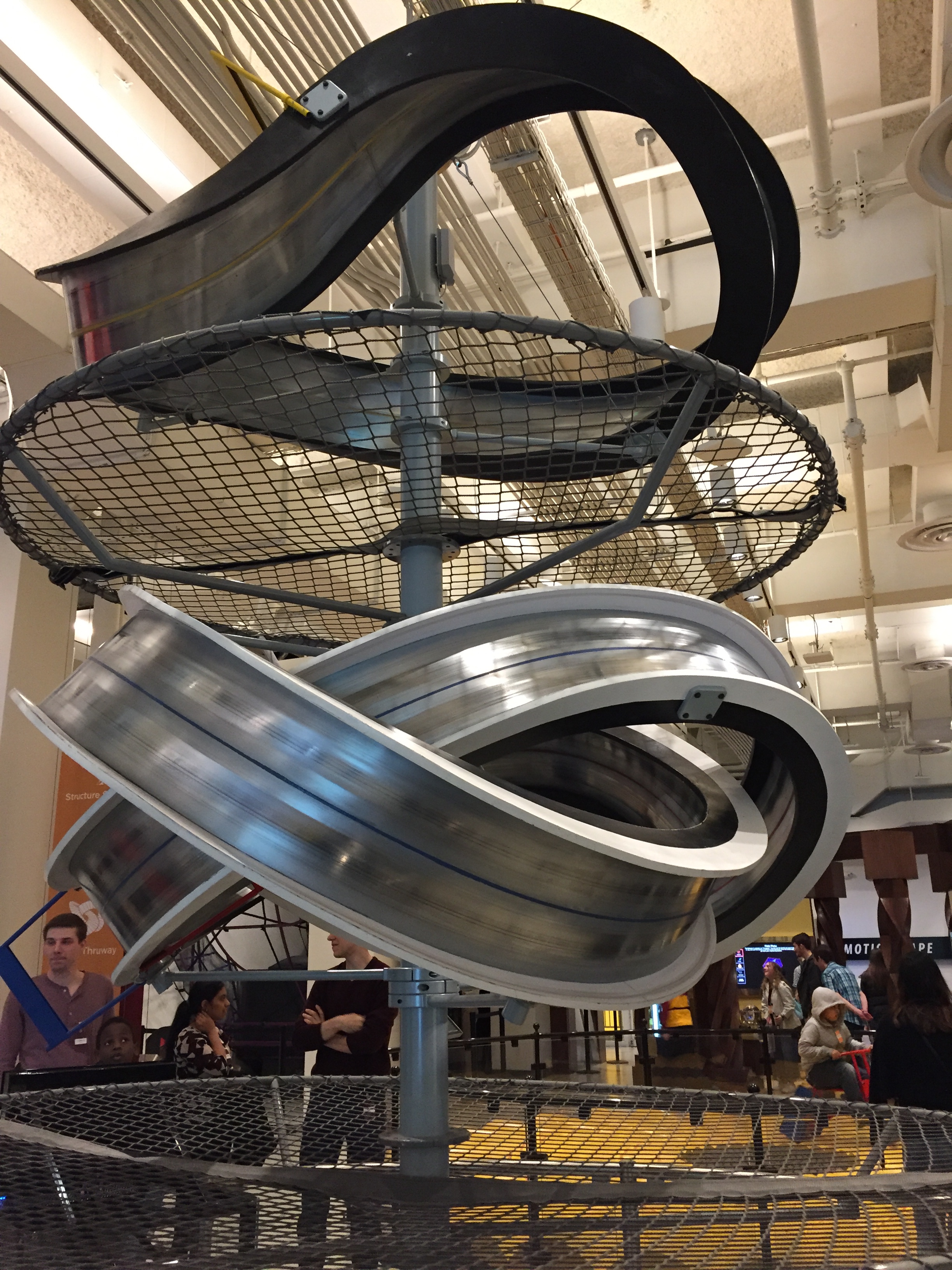
From the Pi symbol door handles to the hologram engraved art work, each inch of this museum is filled with interesting sites and many interactive activities! I loved riding a bicycle with square wheels. It was a little hard on the rear! But fun.

We three adults were having as much fun as the children. There are two floors of activities that parents and children can work on together. Some are math and logic problems to solve. Others are just fun activities like watching your arms branch out into fractals in a living tree exhibit.

I wish I can tell you my favorite activity, but I cannot since so much of it was great fun.

There is also a room where temporary exhibits are housed. When we were there it was unbelievable math art that has to be made through 3-D printers. And fantastic origami art.

The gift shop is packed with educational games and activities to buy. More important this museum is open every day except for Thanksgiving! Need something to do with your children school age and older, go here! There are events and activities listed on its website which I put below.

It is an easy walk to Madison Garden Park where you can sit for a bit and people watch, take great photos of the flatiron building and buy lunch or a snack.

Being there gave me hope. There are parents and children and grandparents interested math and learning. I did not see one frown while there, I just saw adults and children intrigued by what they were seeing and learning while having an adventure at the MoMath!

Www.momath.org

Mass Transit: A Traveler’s Delight

22 Nov

Kansas City metro only has one really good accessible mass transit for tourists: the KC Street Car, a free light rail that circles 2.2 miles downtown, featuring Crown Center and the City Market.  Yes, Kansas City does have a bus system, but living in Johnson County, on the Kansas side, I recently realized how cut off we can be without a car.  Our daughter’s brother-in-law was traveling through the USA and wanted to use mass transit whenever possible.  My husband took him to work one day and dropped him off at the Street Car. That gave him an entire day of adventure.

However, it was the start of the Labor Day Weekend.  On Sunday he wanted to take the bus downtown to experience the Irish Festival.  We told him it was impossible. He said,
“No there is a bus a mile away.  I can walk there and take it.  We laughed. My husband showed him on the website that yes there was a bus to downtown, but it would not be running again until Tuesday.  No way to get to the Irish Festival.  (Don’t worry, we arranged for friends to take him.)

img_0859

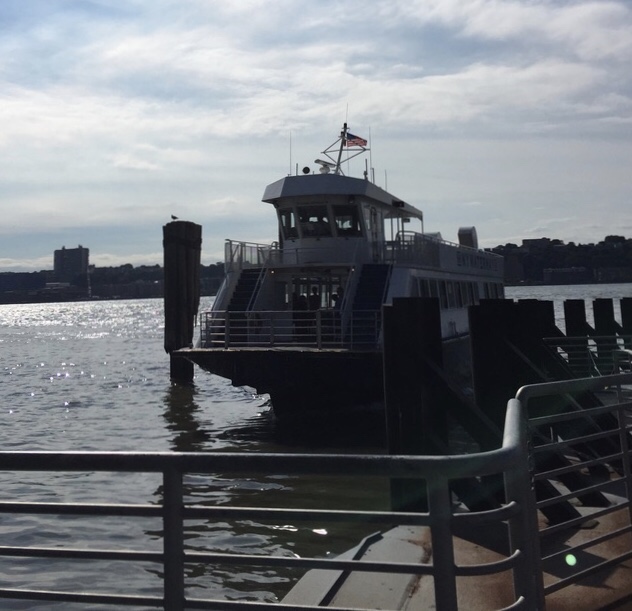
Ferry from NJ to NYC.

It started me thinking about my experience with mass transit.  To begin with, I grew up in New Jersey, just across the Hudson River from Manhattan.  I spent many hours on busses, trains, subways and taxis.  It was a part of life if you wanted to go anywhere.  Many people who live in New York City do not even own a car.  Of course my mass transit of choice going from New Jersey to NYC is always the ferry!
img_0836

Mass Transit tickets

Since moving to the Midwest, I have experienced exciting weekends in Chicago, Illinois, using the mass transit system.  Chicago, like NYC, is another mass transit haven.   Using the Chicago subways is a no brainer.  Going from the airport into the city is so much faster, cheaper and easier than taking a taxi. And getting around to the different areas makes sense on the subways.

In major cities, I try to use the subways to avoid traffic. In Philadelphia we used the Philadelphia Transit Vehicles (PTV), and in Washington DC, using the METRO Transit System is a must to beat the traffic.  I will always remember the very long escalators down into the system when we traveled from a relative’s home in Maryland to downtown DC. Boston also has a mass transit system, the MBTA, that helps college students and travelers get around

I realized that my husband and I use Mass Transit whenever we can.  In Atlanta, the MARTA took us to and from the airport to the downtown hotels.  In California: we adore the Cable Cars in San Francisco. While staying in San Jose, we used the light rail to go the Winchester Mystery House in San and the Tech Museum from our hotel.

We used the light rail in Denver, Colorado, to explore the historic area and travel to and from our hotel. In one of my favorite cities, New Orleans, I used the street car with my children to get from our hotel to the French Quarter!

I have even used the mass transit in St. Louis!  Although I drive there all the time to see family, when I went to a graduation at Washington University, I was told parking was not available. I drove to the nearest MetroLink Station and traveled to the ceremony. What a delight to avoid all the traffic.

One of my favorite ‘mass transit’ rides was on the People Mover ride in Tomorrow Land at Disney World, and of course we love the mass transit success of the Monorail in Disney World.  Does that count?  I think so.  I thought of it recently when we were in Seattle.   I had the opportunity to use the one-mile monorail down to the Sky Needle and the Seattle Center, an area developed for the 1962 World’s Fair.

But it wasn’t only the monorail that had our patronage in Seattle, we also used the light rail system of SoundTransit.  The underground area was so clean!  Currently buses run through these tunnels in downtown Seattle, but I was told that would end in January 2019, as the city prepares for the expansion of its light rail.
I have also used mass transit in other countries.  Vienna, Hungary, we took our children on the subway.  I will admit there was one very loud and screechy turn.  We all held our ears.  In Israel, I have changed my allegiance from the busses to the trains. They are great and have free wi-fi.

The most interesting subway of all was in Athens, Greece. When they dug down to build the subway, the workers kept finding antique treasures. Now in the stations are displays of these lovely objects.  You get a history lesson, while waiting for the subway.

img_0858

Funicular in Quebec City.

Another favorite is using a funicular to get up and down a hill.  That was great fun in Quebec City, Canada.  I have used them in other places as well, like the Carmelit underground Funicular in Haifa, Israel, and the one at Marvel Cave in Branson, Missouri (this was my first funicular.)  But the one in Quebec City stands out in my mind.  I have seen them in Valparaiso, Chile, but did not actually need to use one.

All my experiences with mass transit makes me wish that my home town would invest a bit more in helping people move around.  I will admit that recently citizens voted to expand the light rail a bit further south to the shopping areas of Westport and the Plaza, as well as the University of Missouri Kansas City campus.  But it still doesn’t help those who live in my area.  But my dream lives on that eventually the entire city will have an operating, useful light rail system.

Finding Good In Seattle

19 Nov

When I travel I look for positive experiences. Besides the regular sites, I like to visit places to reflect my heritage and my desire to do good. So in Seattle, I was delighted to learn that two of the experiences selected by the group I was with were devoted to good deeds.

The Foundations aims

An interactive map.

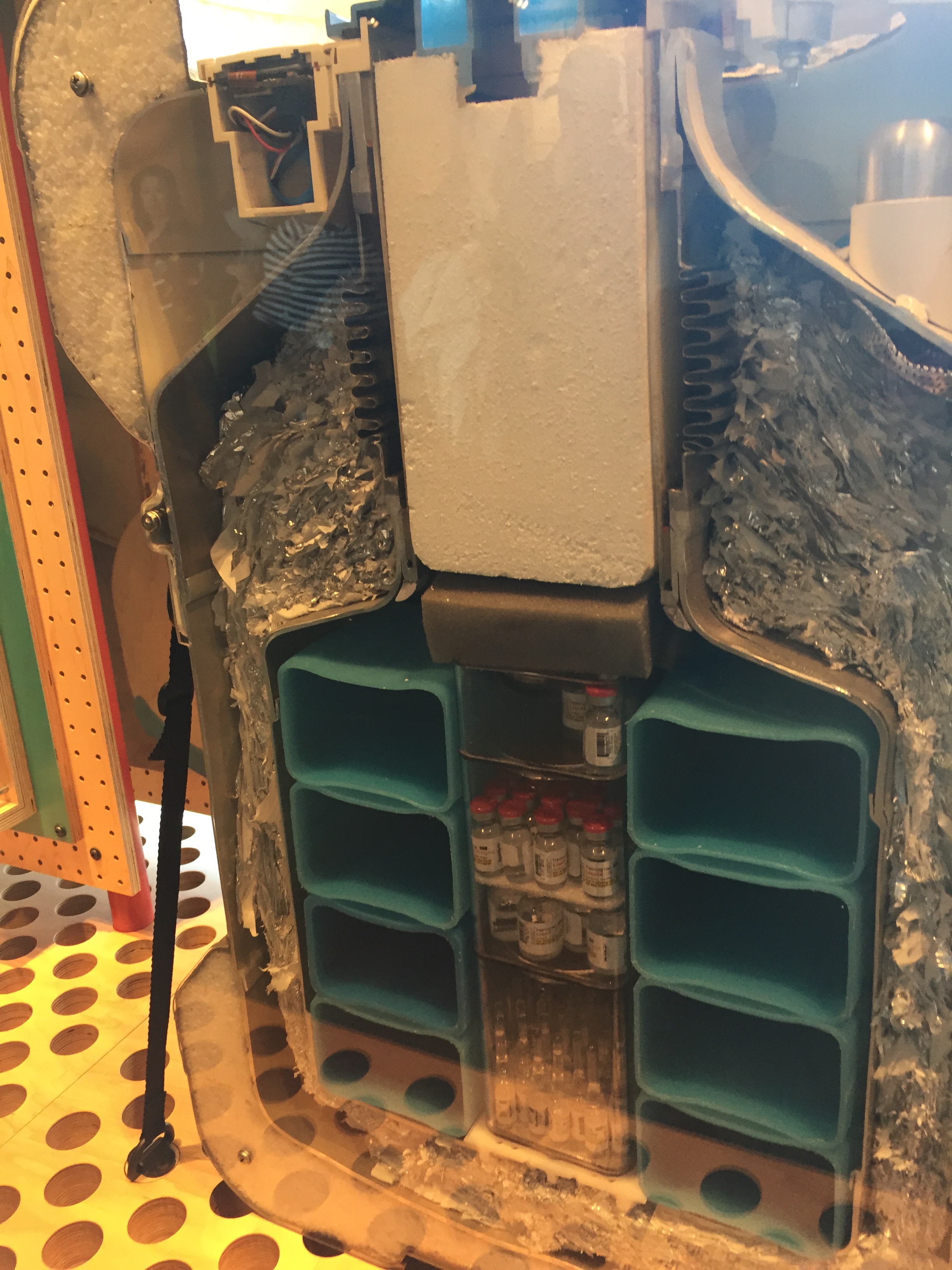
A safe way to transport vaccines.

First was the Bill and Melinda Gates Foundation Discovery Center. We had a docent speak with us and describe the Center, which explains and shows the philosophy and collaborations of the Foundation. In reality, you do not need a docent, the Discovery Center is quite user friendly and has many interactive activities that will intrigue adults and older children as well.

A poster I made in one activity.

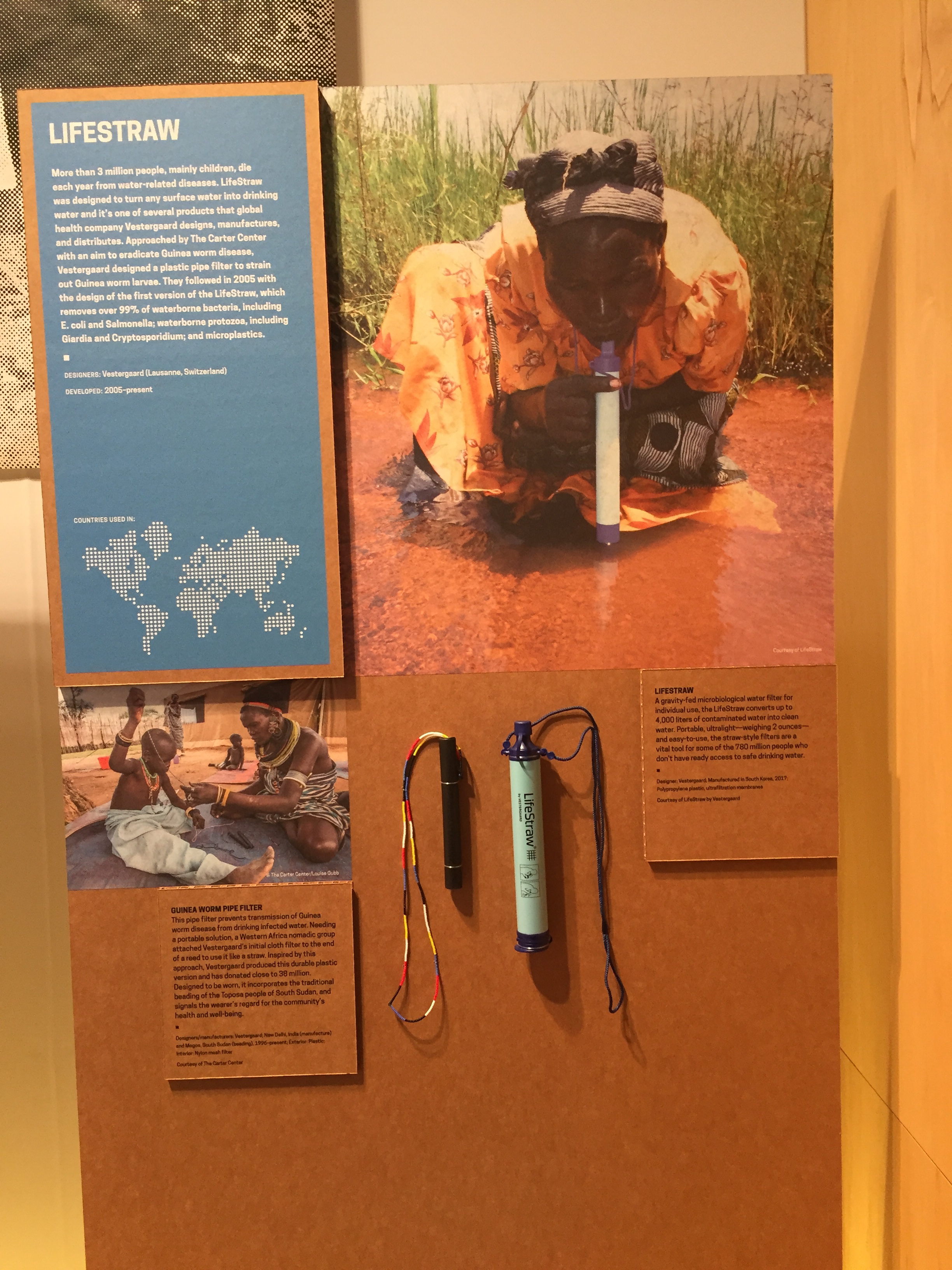
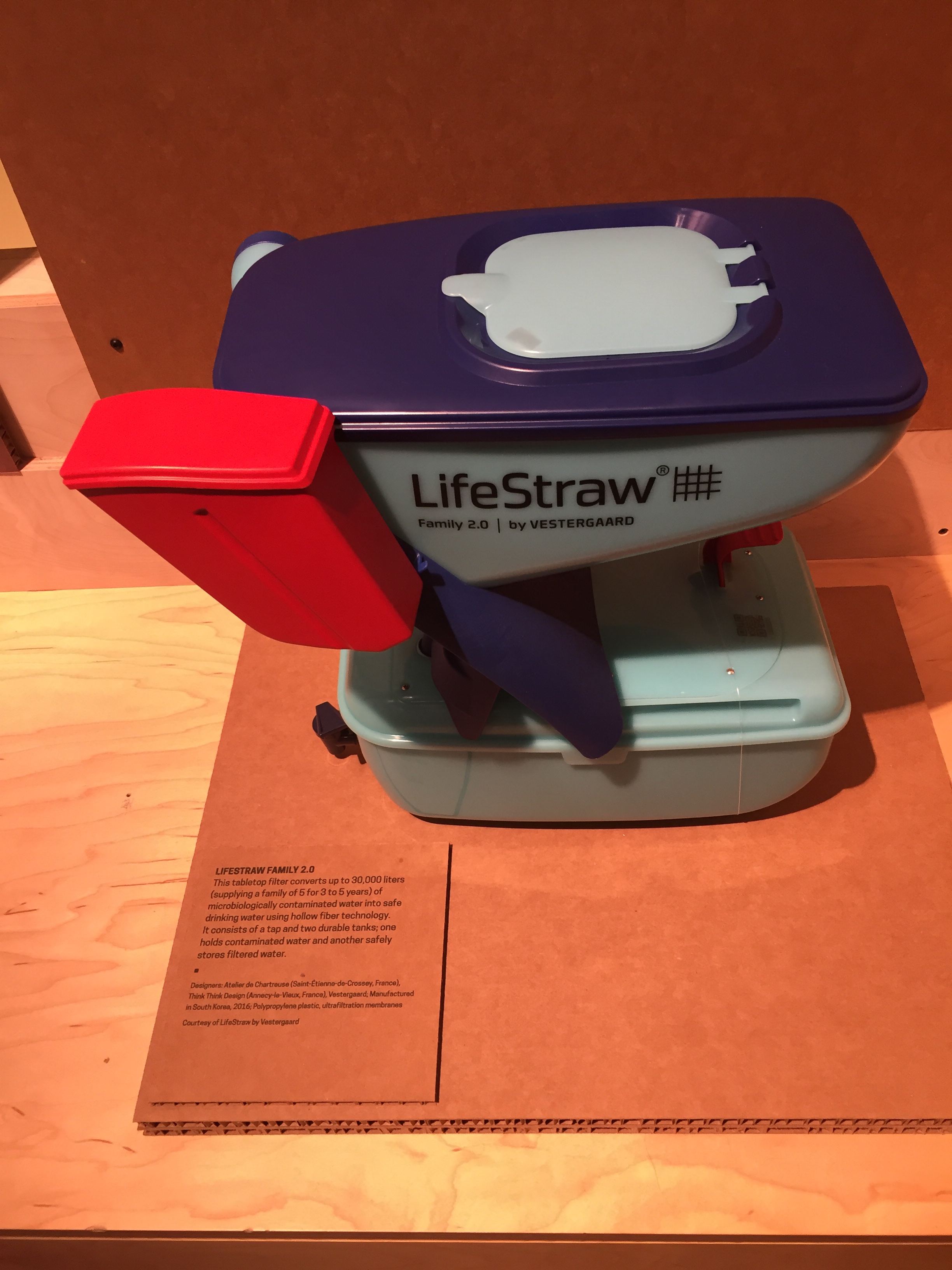
Besides the regular exhibits, theater and activities, when I went there was a large exhibit on inventions designed to help people in locations far from technology. My two favorites were ways to clean water and really cool eyeglasses. As a myopic person, I understand the need to see clearly!

There is a big push from the foundation for clean water, better use of toilets and cleaning fecal matter, and vaccines. As many, I am glad the Foundation is doing all it can to save lives. But I must admit I did ask if they were doing anything to have more food and population control. Because saving all these lives in areas of Africa with famine and drought, were they adding to the problem if they did not also help create food and find ways for more water to get to these drought ravaged places. I will admit the docent did not have a good answer for me. But it was obvious it was a question the foundation was aware to be a concern.

Another big push is education, especially of women and girls. In fact they want to improve the quality of life for women. In all, I learned much about the areas of the world where people suffer from poverty, even in the USA.

And that leads to my second Seattle experience. For our annual luncheon we went to Fare Start Restaurant located at 700 Virginia in downtown Seattle. What a great meal and great program.

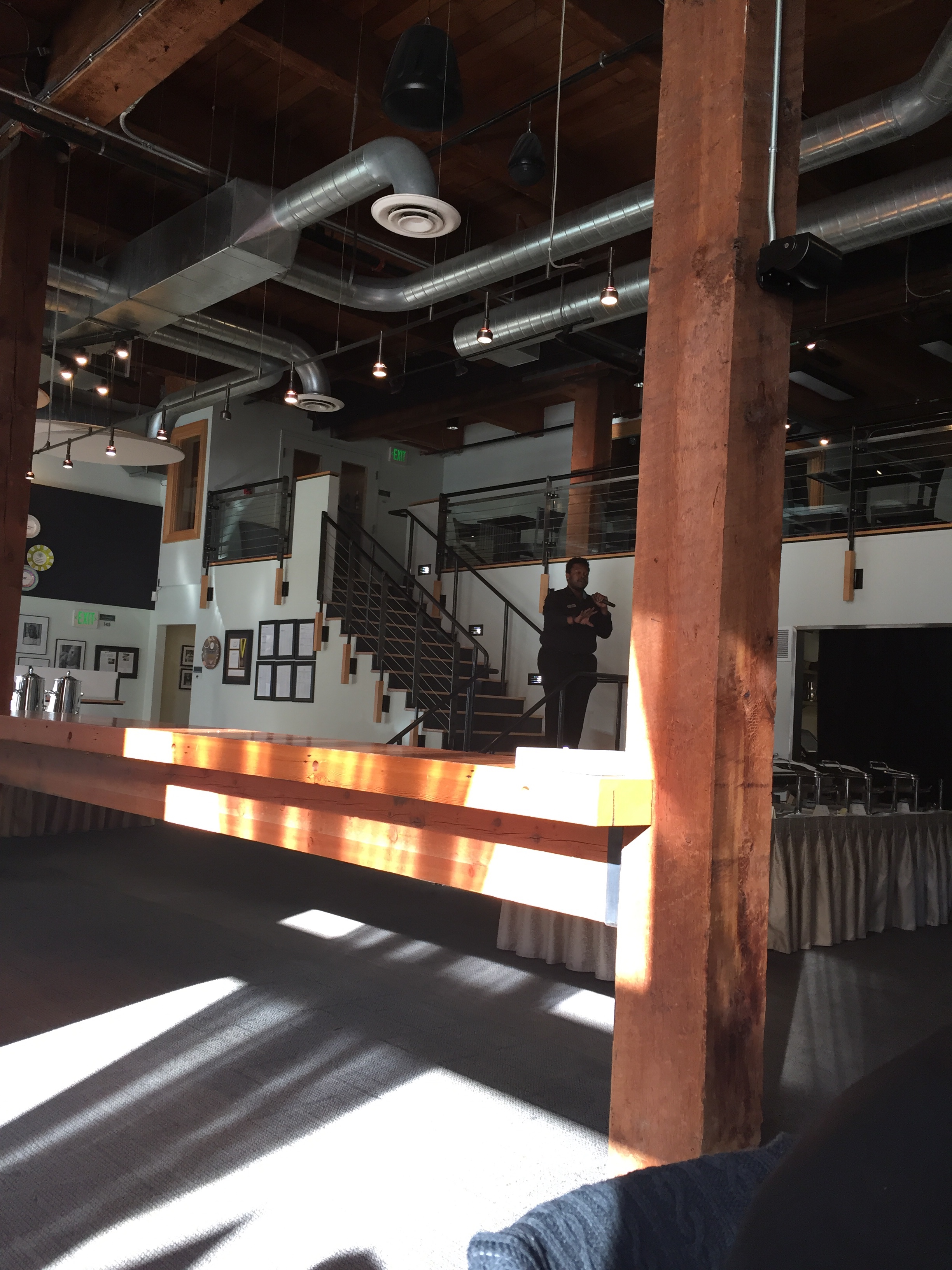
Learning about Fare Start before we eat. And the wall of corporate sponsors.

Fare Start has helped people in property get training in the restaurant business. They have helped people for over 25 years. They not only learn the business skills for food services, but also life skills. There are 16 week job trading programs for adults, as well as an eight-week program for youth aged 16-21. Another program helps homeless youths aged 16-24.

During the week the restaurant is open to the public. While in weekends it does private catering events like ours. I was so happy our catering dollars went to help this wonderful program.

Seattle has much to offer. This is my third trip here. Every time I find new and interesting experiences. One little happy note for me, in Seattle Restaurants where you clear your own plate, there are three cans: recycling, trash, compost!