Archive | Expulsion from Spain RSS feed for this section

ANU: The Story of My People

19 Oct

Visiting the Museum of the Jewish People in Tel Aviv

In August I visited ANU – The Museum of the Jewish People on the campus of Tel Aviv University.   There was much I saw at the museum that resonated in my heart. But honestly, I just could not write about my visit.  At that time, I was not in the right mind frame to discuss what we, the Jews, have been through in the past few years, as we were dealing with the worldwide Jew hatred and still praying for the hostages held by Hamas in Gaza.

But this week when the living hostages were finally released, and it felt possible that this seemingly endless war of survival is shifting, I revisited my time at ANU.  I remembered what stood in my mind then and still remains with me now.

I am a descendant of Jews who fled Spain and Portugal and ended up in Amsterdam before moving to Austria.   Although I know of one distant relative who was burned at the stake in Portugal for being a crypto Jew, most of my family kept their Judaism when they moved to the Netherlands.
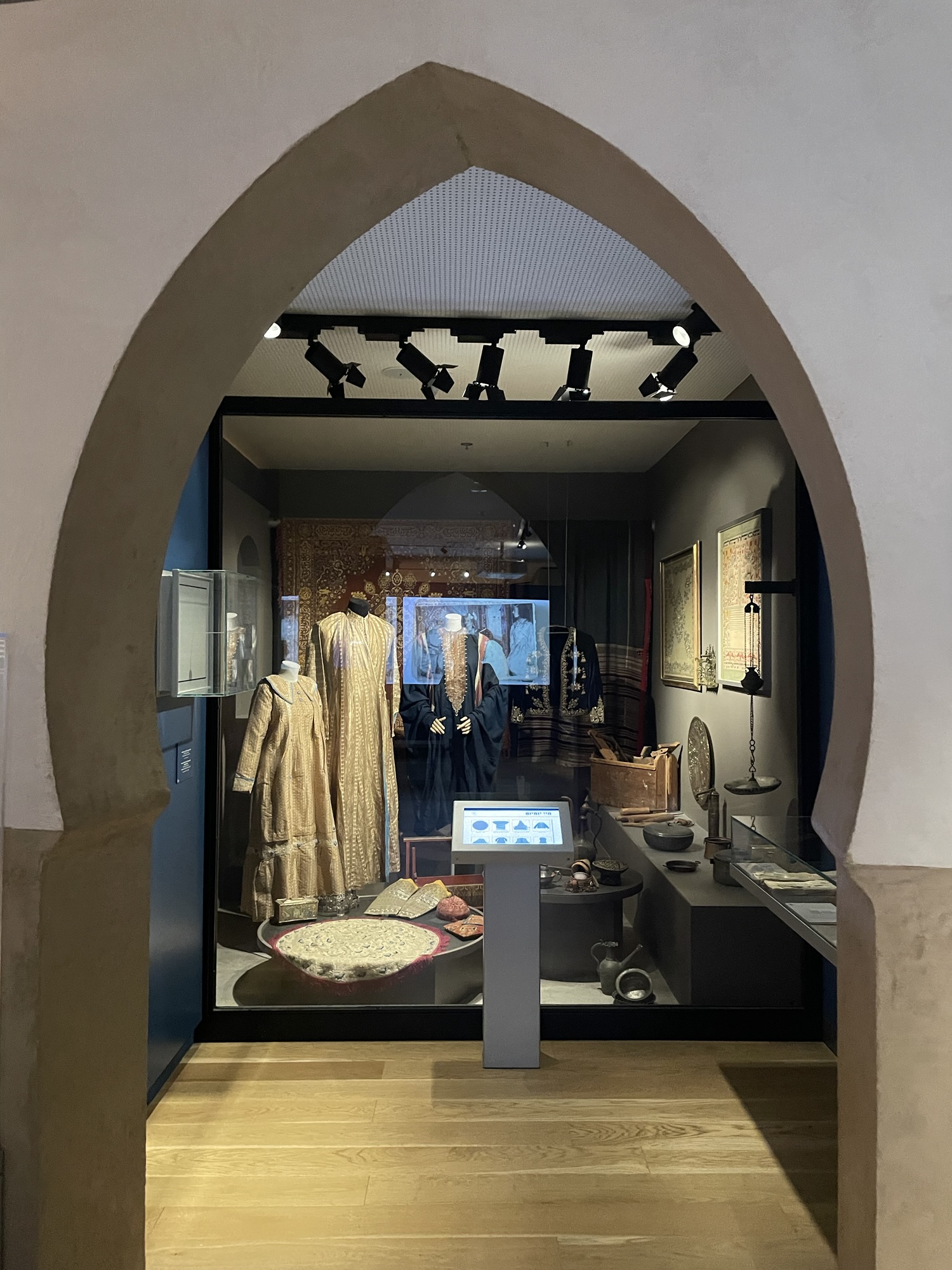
I found out that the Jews of Spain and Portugal were not the only Jews who had to practice their religion in secret. At ANU I learned of the hidden Jews of Iran. In the 1800s the Jewish people of Mashhad, Iran, were forced to convert to Islam or be killed. For over 100 years the hidden Jew of Mashad were outwardly following Islam, but on Shabbat they celebrated their Judaism.  Forced to live in a ghetto area for these “new Muslims,” called Jadid al-Islam,” they married within their community.  Finally, in the 20th century they reclaimed their Jewish identity. About 10,000 Jews still live in Iran.

My family story mirrors stories retold at ANU.  My family, who had settled in Amsterdam, made a life changing decision in the late 1700/early 1800s.  A branch of my family settled in Galicia, Austria, in a small town called Mielec and my immediate family settled nearby in Trzciana.  For decades they lived peacefully with their neighbors.  But with the rise of the Nazis, everything changed.  Of the 5000 Jews who lived in Mielec area, only a little over 100 survived the extermination of the Jews.  Two of them were my relatives. Everyone else who stayed were murdered.

My grandfather came to the USA in 1920.  He did not suffer as most of his family did in the 1940s.  His suffering was the not knowing what happened to his loved ones. 

My family have lived the American dream which up in till the last decade or so has been wonderful.  Yes there was antisemitism, but it was kept quiet. Most people treated each other with civility.  However, in recent years that quietness faded and people felt empowered to spew Jew Hatred. Social media has been a major source of spreading all types of Hatred.  With October 7, a war that Hamas started not just to kill the Israelis but to cause a fire storm of hatred toward Israel, social media has become a cesspool of hate.   Using social media to life stream the attack on Israel and then to spread its hate has been an outrageous attack on Jewish people. And that fact that the news media does not vet its information makes matters worse.  Social media and some news media have been complicit in the spread of hate.

This web of hatred seems impossible to deal with at times. But the other important information I learned by visiting ANU, is that we survive. We have the will to survive. We are innovative and positive. We as a people make contributions in science, medicine, math, literature, agriculture, film and more. Our identity and culture keep us strong. I believe that inner strength will define us.

At ANU is the Sasson Codex, one of the oldest complete Hebrew Bible.  It is currently in a protected spot due to the missiles that have been launched toward Tel Aviv.  But a replica is on display. It is a treasure of Judaism.  And it is the Jewish Torah that has influenced the Western world, even though at times it seems they have forgotten the words that are at the heart of religious life: Feed the hungry, clothe the naked, welcome the stranger, visit the sick, etc. We are said to be the people of the Book, and that book is Torah.

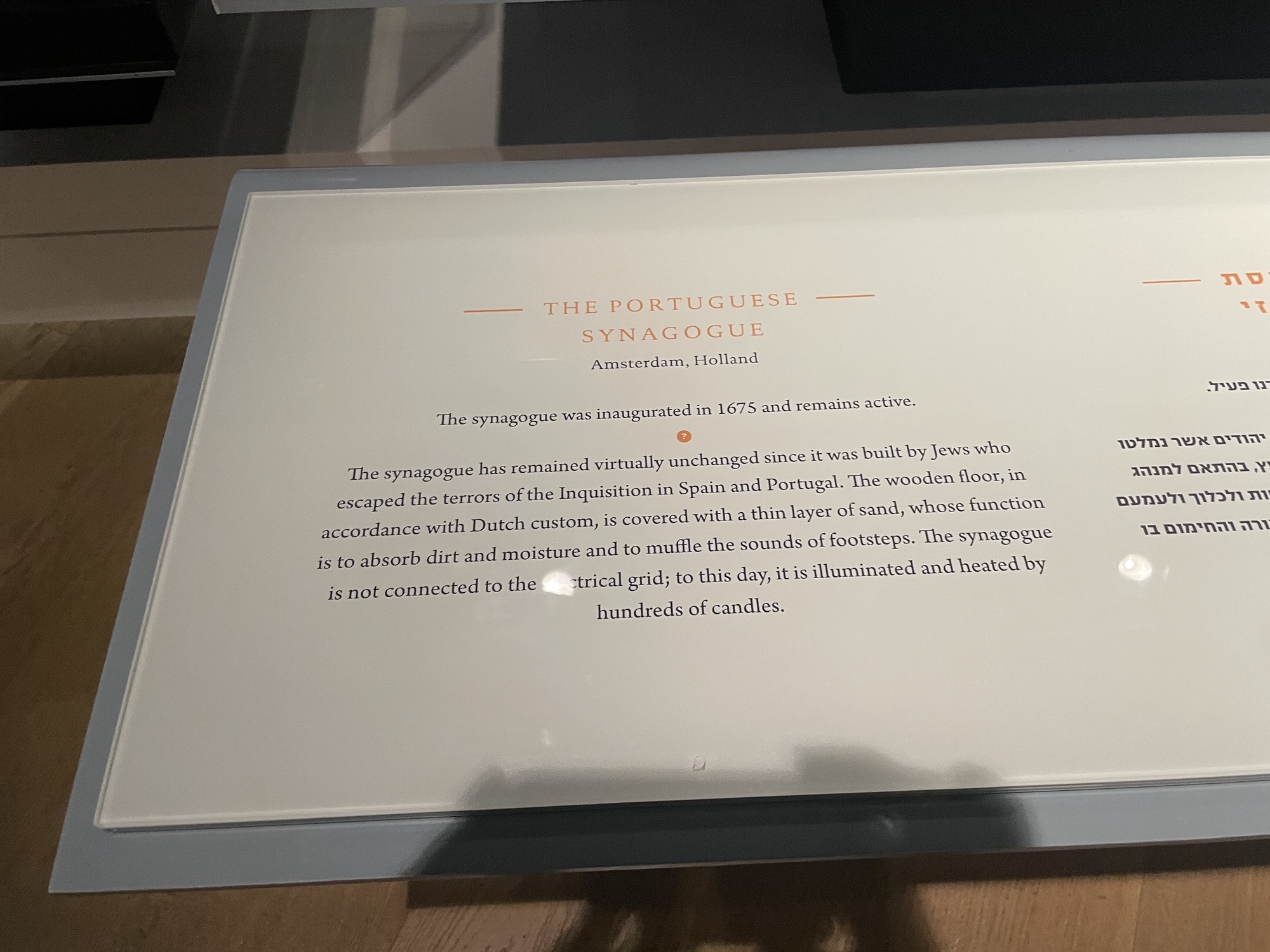
At ANU miniatures of the famous synagogues of the world are on display, including the Portuguese Synagogue in Amsterdam. A synagogue that has been present for 350 years, where my family might once had prayed. Throughout all the wars and waves of Jew Hatred this Synagogue has remained! It continues as a the place of prayer for the Jews of Amsterdam who survived the Shoah, while other synagogues now serve as museums.
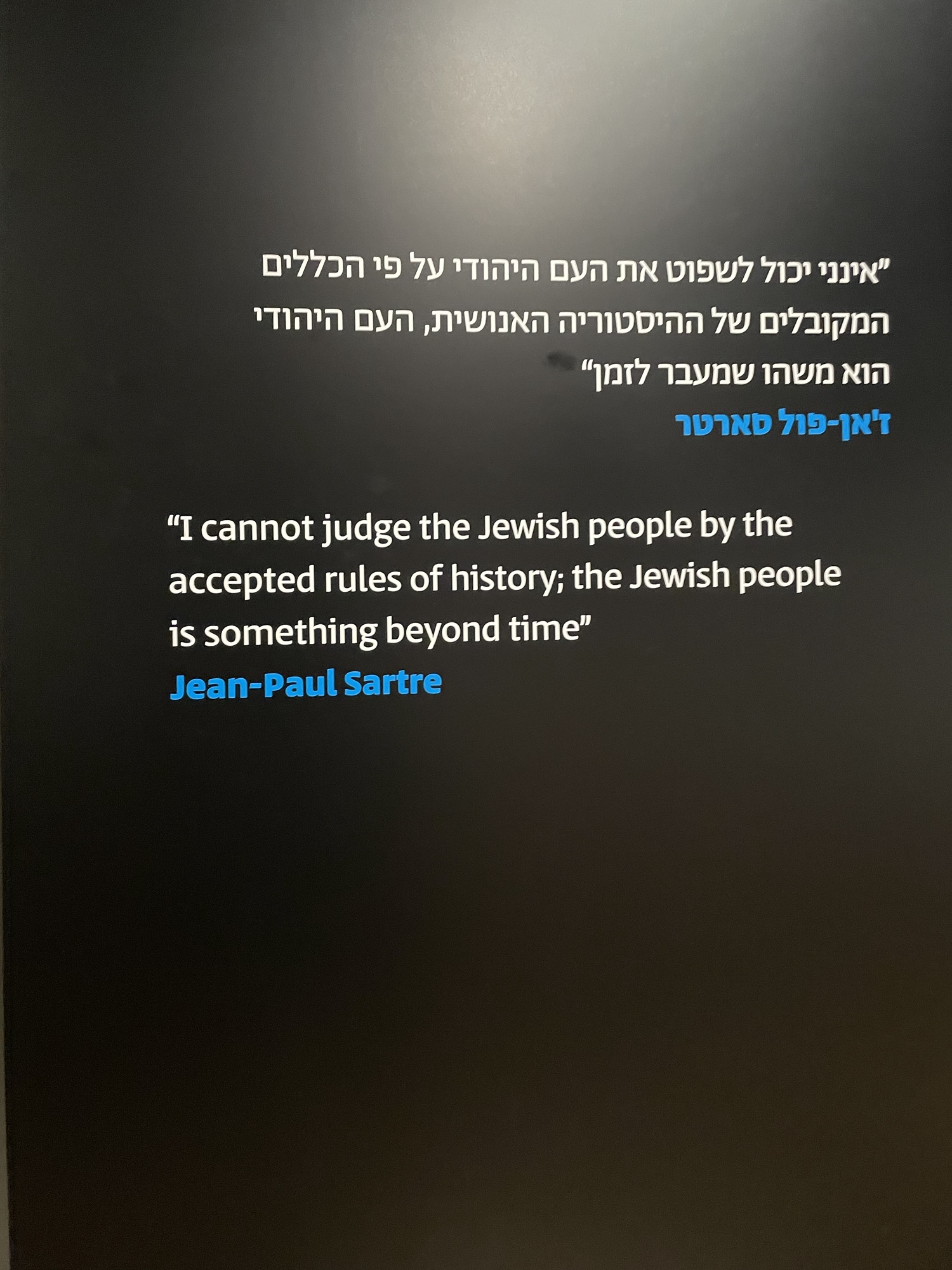
At ANU, I saw highlighted quotes by famous people about the Jewish people.   This one by Jean-Paul Satre, felt right to me: “I cannot judge the Jewish people by the accepted rules of history, the Jewish people is something beyond time.”

Let it be so.  Am Israel Chai.  The people of Israel, the Jewish people. They lived; they live; they will live.  Now and beyond time.  Amen Selah.

Learning about the Crypto-Jews/Conversos in Santa Fe

28 May

As the descendent of a Jewish family that was forced to leave Spain in 1492 or convert, I have always been interested in learning more about the Crypto-Jews/ Conversos of New Mexico.  It was in the 1980’s when the information about this still hidden group first started to be revealed. It started when a Jewish man named Stanley Hordes because New Mexico’s State Historians, and people started coming to him to tell him their stories.  To me it was absolutely amazing that 500 years after the Inquisition in Spain, that descendants were still hiding and still keeping this secret!

I had wanted to attend the Roads Scholar program: “New Mexico’s Conversos and Crypto-Jews in Santa Fe” since 2019.  Covid interrupted my plans. But finally we were able to attend. My family were also once impacted by the Inquisition and Spain’s quest to either convert or eliminate all Jews.  My family chose to move to Portugal and then to Holland.  Our story is written in an earlier blog. (See below.)

We had lectures from the authors of the top two books.

Our first speaker was Professor Ron Duncan Hart, who gave us an overview of the history of the Jews journey to New Mexico. He wrote, “Crypto-Jews, The Long Journey.” Jews were in Spain were given a choice, convert or leave.  Many stayed, they could not afford to go or they thought it would not last long and they would just hide their Jewishness, some decided they really would become Catholic.  But all were doubted because they were not “pure of blood, “meaning they were not just Spanish, they were tainted by either having Jewish or Moslem descent. Those converted in name only and still practiced their religion in secret, known as Crypto-Jews…hidden Jews. Those who were forcibly converted and known as anusim also secretly practiced Judaism.

In fact, so many of the Portuguese who came over to Mexico in the 1600s were of Crypto-Jewish ancestry, that calling someone Portuguese was just another way to say he/she was Jewish. Since my family went from Spain to Portugal, I began to wonder if some of my family made this arduous journey to escape the Inquisition. To be allowed to go to the New World, you had to show that you were purely Spanish, not tainted with Jewish or Muslim blood.  Horrifying!  People actually had their genealogy redone to eliminate their Jewish past to fit the needed requirement.

The Crypto-Jews of today still live in the mountains in northern New Mexico.  They still keep their secret.  In fact, one of our speakers, when asked how many crypto Jews there actually was, basically said, “We do not know. They keep hidden.  They do not talk about it.  They know who the other families in their community are like them. But it is not discussed”

We heard from two women who have reclaimed their Jewish identity.  They were each the child in the home who a parent said “Somos Jodios,” “We are Jews.”  Maria Apodaca told us how difficult it was to come out of hiding and join a congregation and have a ceremony of return.  How family members were not always happy about what they had done.  Many feel, with the way the world is now, it is better to stay hidden!

Isabelle Medina Sandoval wrote a novel based on her family’s history: “Guardians of Hidden Traditions.”  She can trace her ancestry back to Portugal and was able to claim Portuguese citizenship based on her family history.  But she also said that coming out of hiding is a difficult process.  A poet, she has written poems about the Crypt-Jewish experience.

From these two women we learned some of the cultural/religious/cuisine that continues from their Jewish ancestry, like lighting candles on Friday night, covering mirrors when someone dies, making a fried treat at the winter holidays, cleaning the house on Friday.  It is amazing to me that these traditions continue.

Schelly Talalay Dardashti, spoke about: “The New World: Jewish Ehtnicity, DNA& Genetics.“ Schelly is the founder of Tracing the Tribe – Jewish Genealogy on FB. She explained the difference in the different DNA tests and how some do not look for Sephardic DNA, only Ashkanazi.  We were told that between 20-40 percent of people in New Mexico had some Jewish ancestors.  That there are genetic links between those living in northern New Mexico and isolated areas in Central/South America.  People who were also trying to hide away from the Inquisition.  And the final link, a rather sad one, the fact that the BRCA1 mutation that causes brest cancer in Jewish women, is also found in the Hispanic population in Mexico and New Mexico and came from those original converso/crypto Jewish arrivals from Spain in the early 1500s.   Wow.

We attended a performance of “Parted Waters,” a play written by Robert F. Benjamin about the Crypto Jewish community. It tells the story of three generations of a crypto Jewish family.  The grandfather, a crypto Jew; his son, who knows the background, but identifies with his life as a Catholic and does not want to talk about it; and his son, who has never been told about his ancestry.  When the grandson makes a racist comment to a Jewish woman, the truth comes out along with the ramifications.  It pulled together all that we had learned over the week.

Our last lecturer, Chris Herbst spoke about Outliers/Ousiders and Religion.”  He provided us some history about the area of northern New Mexico and more explanations about the genetic composition of the populations today in Spain and in New Mexico.  He said about 1/3 of the population of Spain today has either Jewish or Moorish ancestry.

Throughout all of our talks we were referred back to the book written by Stanley Hordes, who wrote an indepth book about the Crypto Jews called, “To the End of the Earth.”  The Spanish/Portuguese Crypto-Jews traveled to the End of the Earth, the mountains of New Mexico above Santa Fe, to escape the Inquisition.  It is like reading a college dissertation, but it was fantastic in the depth of the research.

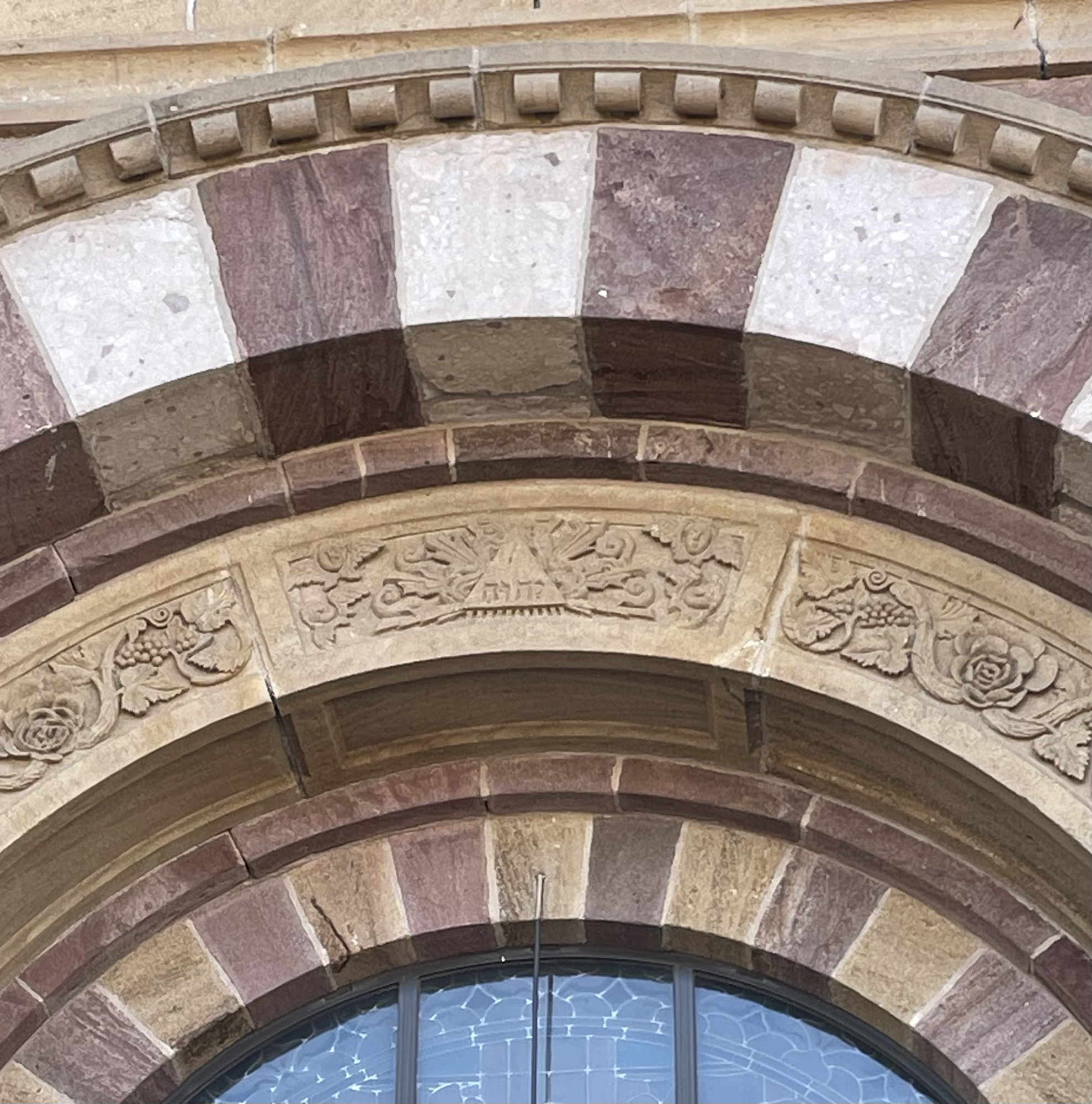
The Hebrew is in the triangle.

We did not spend all of our time learning, we also had time on our own to visit museums and explore Santa Fe.  We went to the  main cathedral of Santa Fe, where over the mantal of the front door, is an inscription in Hebrew and a Jewish Star on an internal wall. 

As part of our Roads Scholar program we also ate at many different restaurants with the most delicious food, toured historic Santa Fe, with our wonderful leader, Vennetta, and went to Taos and the World Heritage Site of the Taos Pueblo.

This was just a wonderful learning experience, where we were able to learn, experience, make new friends and enjoy the true wonders of Santa Fe, New Mexico. If you have any interest in learning more about the Crypto-Jewsof New Mexico, Mexico and Spain, I highly recommend this Roads Scholar program.

I will write about the other places we visited in future blogs.

Discovering My Amsterdam Heritage in Amsterdam

26 Aug

Amsterdam has been the destination my heart has yearned to visit. My Grandfather’s last name was Amsterdam. We know his family moved from Spain to Portugal to Amsterdam to Poland where his family got the last name Amsterdam while others became Hollanders. So I always wanted to see where my family found safety. (I have written about this in the blog below.)

My first connection came unexpectedly. We first toured the Anne Frank House, which was of course heartbreaking to know how close they came to survival. But while there I noticed something I never realized. Anne’s mother’s maiden name was Hollander. I had an Oy vey moment. I knew that Anne Frank and my mom were both born in 1929. But now there was the connection in name. Could we possibly have been distantly related? My horror was multiplied. I have already found so many of my family murdered in the Shoah. (See blog below.)

Then while taking a canal tour we rode past the new town hall and ballet. We were told that the old Jewish Section of town was razed to build this and there was a community outcry. But it still happened. As we rode past I saw a black monolith with Hebrew inscribed in gold. I knew I would be back.

The next morning my husband and I took the 14 tram to the Portuguese Synagogue. We walked around the area. It was not open yet, so we could not go inside. But I assume this is where my family worshipped after their arrival in Holland. I saw the outside of the Jewish Museum. I need to go back to visit these sites in he future.

In front of the Synagogue was a statute with the date February 25, 1941. On this date was major strike started against the Nazis because of the roundup of Jewish citizens. The Germans were harsh in stopping the strike. Many would died and be deported. It was my first reminder of the Shoah.

But my focus was on finding the monolith. My husband and I started walking the almost mile to the Town Hall. Along the way I saw my first stolperstein, golden stones, in front of a home listing the Holocaust victims. I knew they existed but had never seen them before outside of photos. It was another ache to the heart.

We continued our walk until we found the monolith on the edge of the land overlooking the canal. The black monolith commemorating those who died. Again I thought of all who found safety there in the 1600s but could not find it in the 1900s. I have to be honest, it reminded me of the giant black monolith of “2001 A Space Odyssey ” indicating great change. The change here was the decimation of the Jewish community.

A short walk away from the monolith was a statute in honor of Spinoza, who was born in Amsterdam at this location. I was surprised to find it here, although I know his history. There was a plaque nearby that discussed Spinoza’s impact on ethics and philosophy.

My desire to discover my Amsterdam heritage in Amsterdam was not totally quenched. I will need to go back to the Synagogue and museum another time. But I still feel closer to my family history.

https://zicharonot.com/2014/06/09/as-spain-welcomes-back-jews-expelled-in-the-1400s-i-share-my-spanish-roots/

https://zicharonot.com/2018/06/07/the-sorrow-of-shalom-hollander/

Finding My Heritage In Spain

28 Oct

Our trip to Spain and Portugal had a special purpose for besides wanting to see places I had not seen. I also wanted to see the bits and pieces left of the Sephardic Jewish imprint on Spain. I have written about my maternal grandfather and his family’s Spanish roots in an earlier blog (see below). Now I wanted to see what I could see.

I was on a mission that started in Barcelona. I had been to this lovely city before and heard the story about the Jewish cemetery destroyed and replaced with a Christian cemetery. Now the only Jewish aspect was the name of the hill: Montjuic. However, in Barcelona you can visit the site of the Major Synagogue. A small space that you must walk down to see, this tiny space reflects the rule that no religious site would be bigger than the smallest church. So it is small. But I was glad to see that it has been found and reclaimed. There is a guide on site who gives a 10 minute presentation about it. So I am glad we went. Most places do not even have that!

Our next stop with a bit of Jewish history was surprising to me. We went to the small city of Sagunt or Sagunto near Valencia. I was not expecting what I found. First they were having a festival to celebrate their Middle Ages history, and as we entered I saw a menorah symbol on banners. The town had its Jewish quarter still designated including one of the original arches, called the Blood Arch. The tour guide did not know why. I have my own ideas. You actually walked through the Jewish Quarter in order to get up to the Roman teacher.

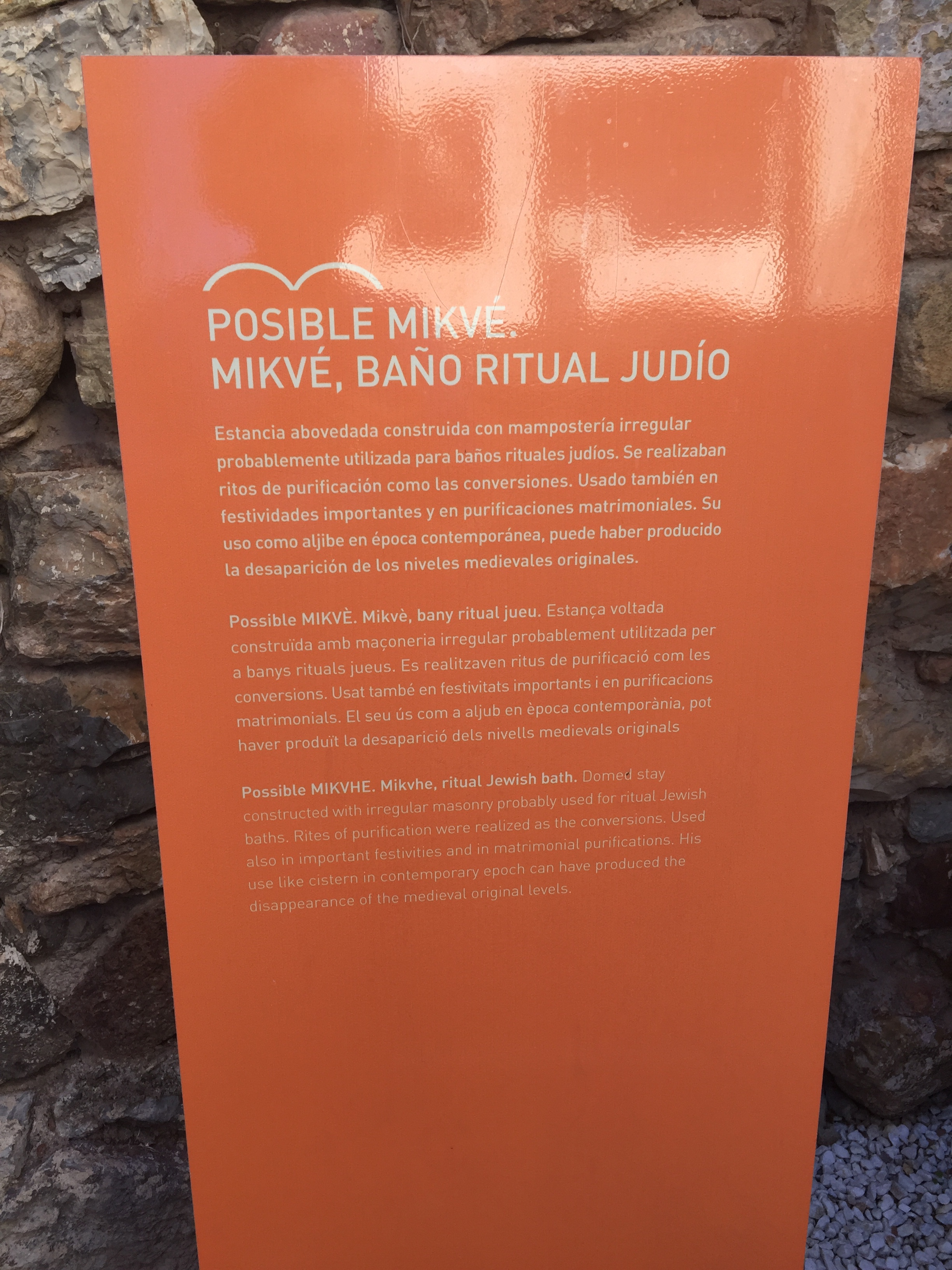
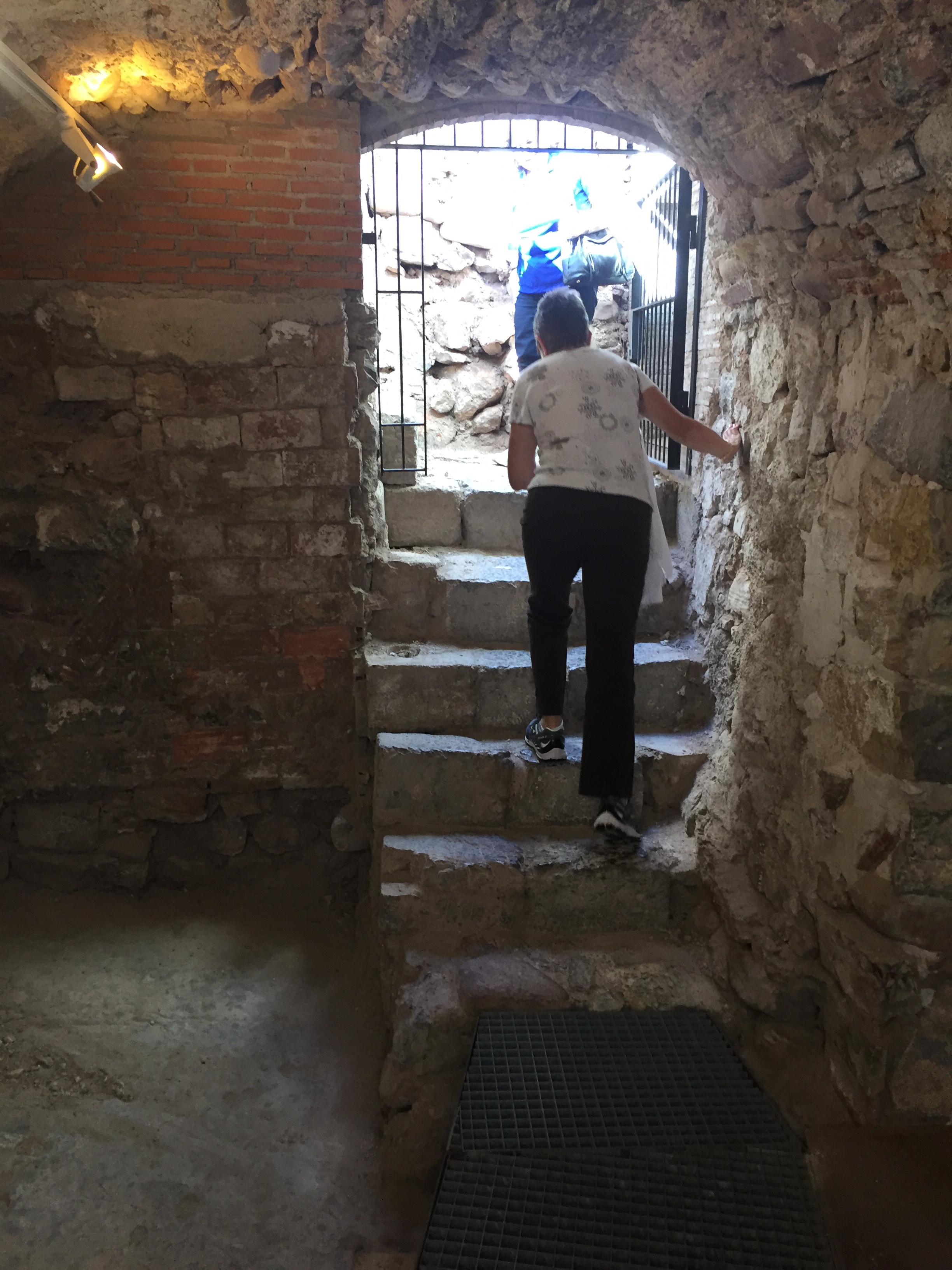
The narrow, hilly streets are picturesque, and walking through the quarter you come to the top where a private house stands on the site of the original synagogue, with an iron Menorah window. We were also able to see the archeology site of where they think the mikveh was located.

I have since researched and learned that in ancient days this town was called Morviedro. Here the Jews were protected from massacres in 1391 and Jews from other areas took refuge there. When the 1492 decree was made, the Jewish residents arranged safe passage out about 500 people.

In fact almost every city we went to had some remains of its Jewish inhabitants. In Malaga, the birthplace of Picasso, we found it was also the birthplace of Yehudah Ben Gabriel, who revitalized Jewish literature. And we found the Jewish Quarter nit far from the Picasso Museum.

Gibraltar had a thriving Jewish community and still does. We saw people walking the streets wearing kippot. We walked to the old Flemish Synagogue and took a photo of the door to the walled area. Unfortunately we could not go in.

Only in Cadiz was all remnants of the Jewish community destroyed. Probably because of the 1755 earthquake and tsunami. But at one time there was a thriving community that had to escape due to the forced expulsion of the Jewish people. In fact 8000 Jews left Cadiz and traveled to North Africa.

A sign in Sintra

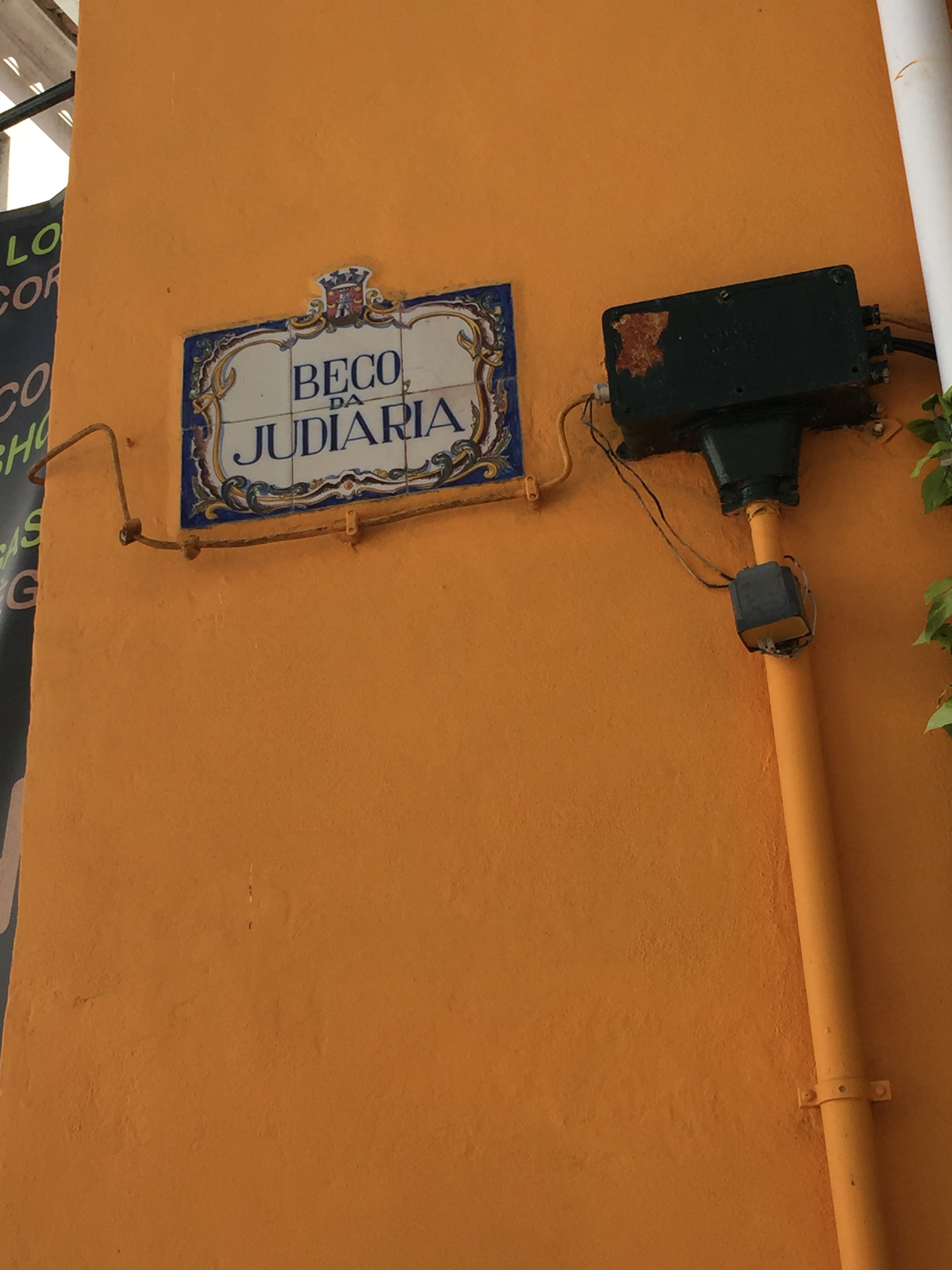
In Portugal we went to Sintra to see the Pena Palace. But while walking through the narrow streets of the city, I found a cork store where I purchased a purse. Then I noticed its address: Beco Judaea. The street of the Jews.

Church of Sao Domingos where Jewish citizens murdered in 1500s

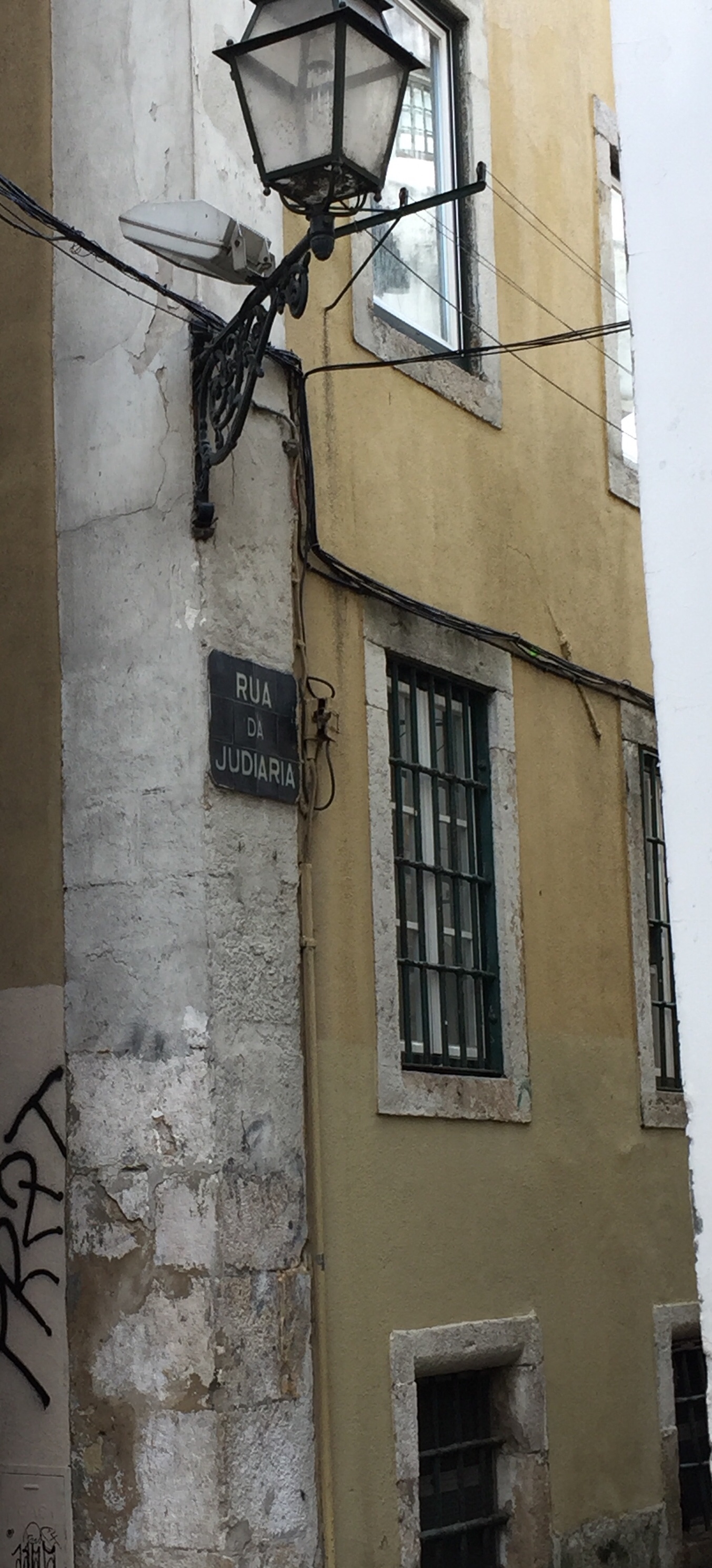
The Jewish Quarter.

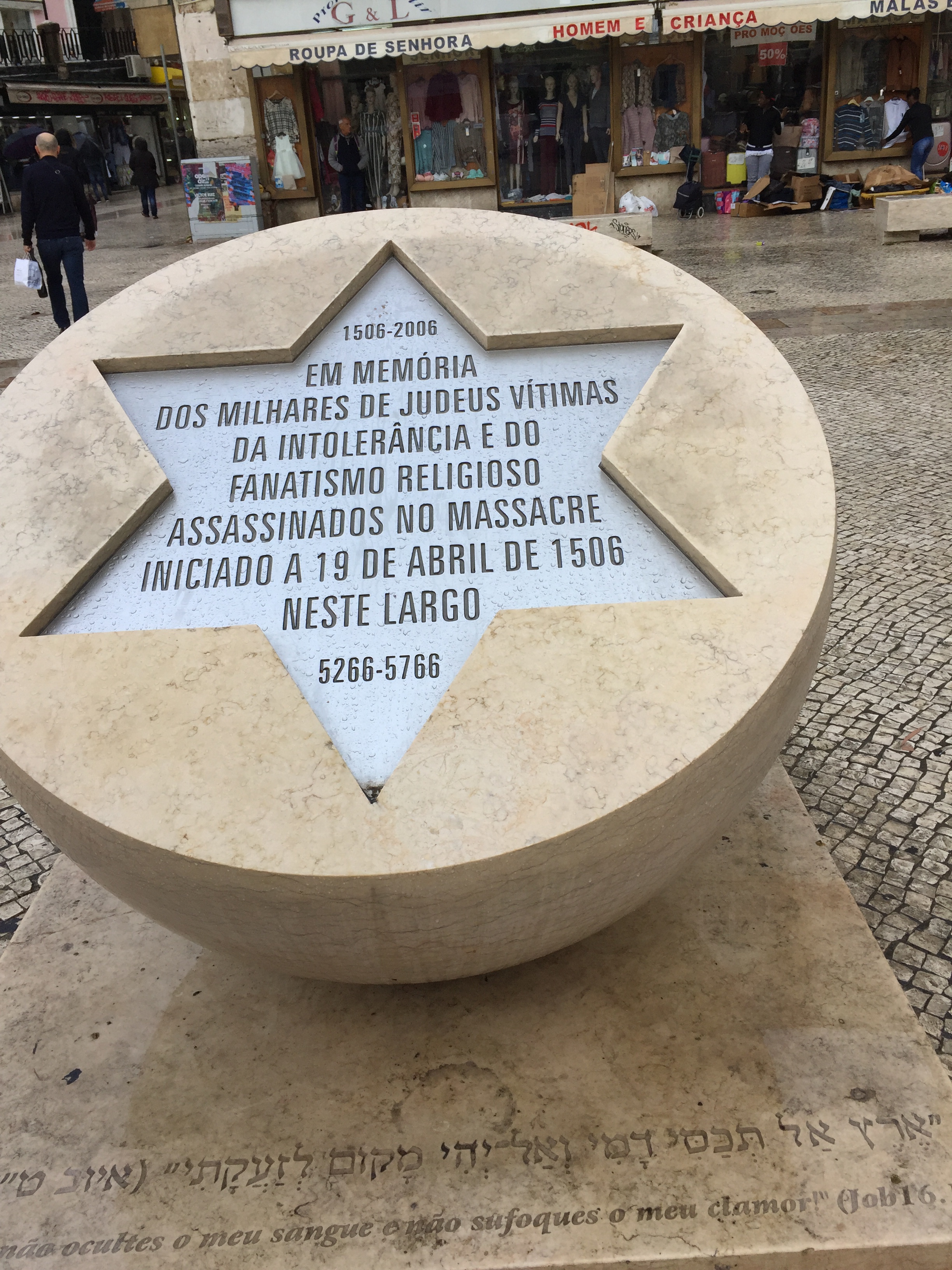
But it was in Lisbon that we had the most in-depth experience. Besides visiting some of the important sites like the palace of the inquisition and Rossi’s Plaza where the Crypto Jews were tortured, we visited the church, Sao Domingos, where the massacre of Jews began in the 1506, walked the Jewish Quarter, and learned how King Manuel I tricked the Jewish population and baptized them all without their permission. He wanted to marry the daughter of the king of Spain, but he also wanted to keep his Jewish citizens. This was his solution.

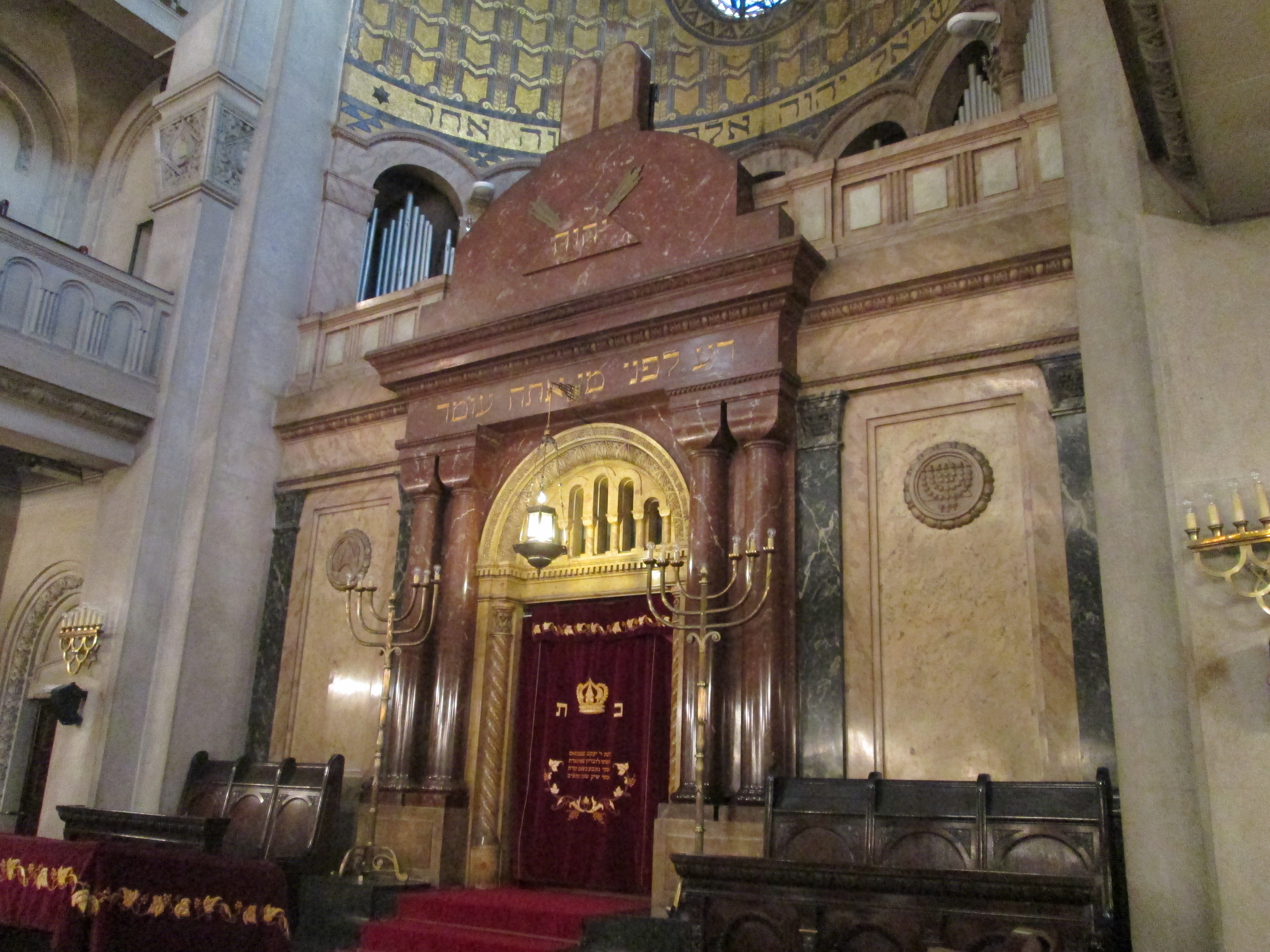
Finally we visited the Lisbon synagogue built in the early 1900s that still has services today. Portugal was a neutral country during the war, a Lisbon was a place of refuge. Today 2000 Jews live in Portugal.

Https://dis.bh.org.il murviedro-sagunto

Savannah Sojourn Is for History Lovers

19 Apr

For our 38th anniversary we went to Savannah, Georgia.  I have been wanting to visit Savannah for our entire married life because my first job out of graduate school was for a local Girl Scout Council.  And all Girl Scouts know that the founder, Juliette Gordon Low, was from Savannah.

It exceeded my expectations.  I want to go back!

img_6606

Juliette Gordon Low house.

On our first day,  I did go to the Juliette Low Gordon house.  I saw the rooms she walked in.  I saw ceramics and paintings she had created.  I walked in the garden with my husband.  Yes, I did buy something at the gift shop.  I had to.   Later we went to the Andrew Low house, where she spent her adulthood and passed away.  Unfortunately, we were too late to get on a tour.  But we did walk over the first Girl Scout headquarters, which is just beyond the gardens.  While there, a purchase of Girl Scout cookies was made.

But Savannah is not only for Girl Scout fans.  There was so much else to see.  So many lovely old homes from the early 1800s. Due to a group of women who started saving these homes in the 1960s, Savannah was saved from being a faceless and bland city to one that kept its local charm and ambiance.

I loved those restored homes.  We went on an architecture walking tour of the historic area, seeing many houses from the outside.  The next day, we visited three homes that were designed by William Jay in the 1820s: Owens-Thomas House, a home museum;  the Telfair Academy Art Museum which was once the home of Mary Telfair; and Scarborough House, built for the owner of the Savannah steamship.  This home is now the setting for the Ships of the Sea Maritime Museum. This museum is packed with wonderful models of sailing ships.  But the history of the building is also unique, it was once a school during segregation.

img_6856

Inside the Owens-Thomas house.  There is actually a bridge on the second floor connecting the two sides.

At each home I learned a bit more about William Jay, the architect, and even more about the economic slump of the 1820s that led to most of the original homeowners losing all their money and their homes, soon after they moved in.  These homes passed to other families and some fell into disrepair. Thank goodness for the Historical Society and the ladies that saved them!

img_6664

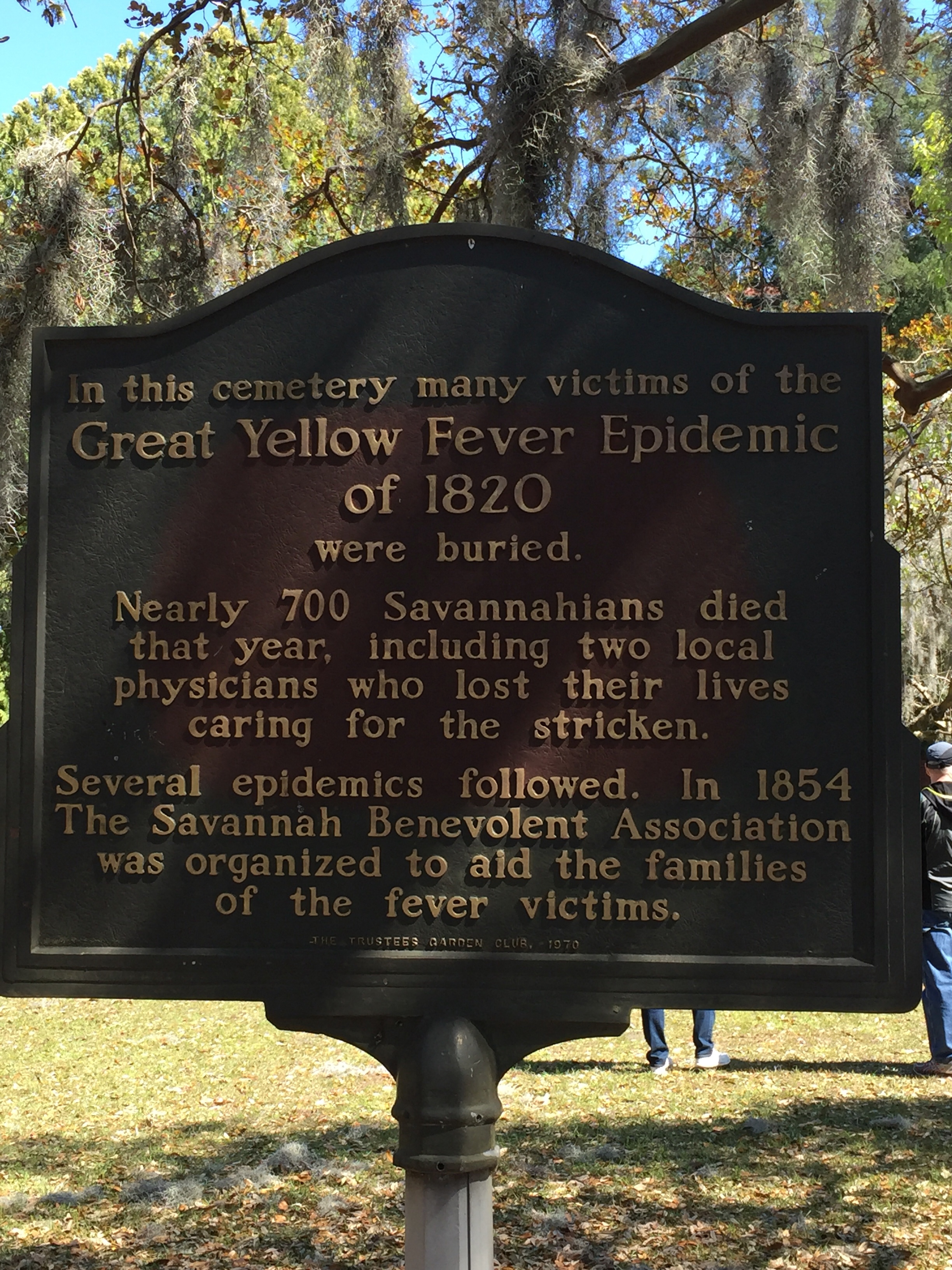
We walked the paths in Colonial Park Cemetery, reading the markers that told of the famous and infamous people who were buried there.  The saddest were the number of children who perished.  So many died in the epidemics of Yellow Fever that swept through Savannah several times.

I loved walking through the historic district and visiting every one of the 22 squares that still exists.  Yes, we went to every single one.  Each square has its own personality, some with a statue and a historic marker telling about that area.  I loved it.  I took photos of almost every marker.

We also meandered along the river and walked in and out of candy stores and gift shops.   The many diverse restaurants served the most delicious foods. My favorite was Elizabeth’s on 37th Street.  We ate in two different restaurants each day, some fancy, others just fun. Some we enjoyed were: the Funky Brunch Café;  Boar’s Head Grill and Tavern, near the river; The Lady and Sons Restaurant, surprising delicious; and Lulu’s Chocolate Bar.  I was surprised that I did not gain an ounce. But then we did walk 4 to 6 miles most days.

We also learned how Prohibition impacted Savannah!  It seems that lots of booze smuggling and speakeasy joints were part of the riverfront during the 1920s. A visit to the American Prohibition Museum is a must.  And yes get a drink at the end in the speakeasy.  You do not have to have an alcoholic drink…but my husband loved his.  I went for an original lemon soda mixed from scratch!


I found the history of the city is intriguing.  But for me, the Jewish history was amazing. Who knew that just a few months after the first settlers arrived, a group of 42 Jewish settlers arrived in 1733 bringing a Torah and starting a Jewish community in Savannah that survives today! This group of Sephardic Jews had been forced to leave Spain and settled in England just a decade or so earlier.  They then traveled to the unknown on their search for religious freedom.  WOW!

img_6638

Built in the late 1870s, this building has always been a synagogue: Mikve Israel.

We went to visit the current synagogue building in the historic district:  Temple Mikve Israel.  Built in the late 1870s, the building is still used as by a congregation.  It contains a small museum and you can visit the chapel area.  But when we were there it was undergoing renovations, so we could not enter.

img_6629

The Torah brought to Savannah in 1733, written on parchment made from deer hide.

We got to see one of the oldest Torah’s in the USA. The one that was brought here from England in the 1700s.  It is written on deer skin.  For me this was a thrill to see that a strong Jewish community still exists and has been a part of the Savannah community for 285 years.

I did not see all that I wanted to see in Savannah.   I loved staying in the Marshall House, with its evening wine and cheese, speakers and musicians, and wonderful staff.  But next time I want to stay in a bed and breakfast.  I have the spot picked out.   I could spend another five days in Savannah eating, walking and visiting museums.  I love learning about history and walking through Savannah is a living history lesson!


A Touch of Jewish Philanthropy In Lincoln, Massachusetts 

30 Oct

The entrance to the museum. The house is on the hill.

I always enjoy going to Boston, as I can immerse myself in our nation’s history. And I love history.  I also enjoy going because I get to visit with my college roommate. She is my official Boston tour guide.  With this visit she decided it was time to get out of Boston and see some of the surrounding sites. It was a beautiful fall day. I am always ready for a new Museum.

Her choice was the de Cordova art museum and sculpture garden in Lincoln. With my interest in Jewish genealogy, I was very familiar with the name De Cordova or Cordova as a Sephardic Jewish name.  But searching for the name of Julian De Cordova online, there was no mention of any Jewish roots.   Just that he was a the son of a Jamaican merchant with Spanish roots.  So to me it was obvious that this was a family which left Spain due to the expulsion of the Jews and ended up in Jamaica.  I love the white wash of history.

In any case I was excited to see this museum, walk through the sculpture garden and visit with my friend.  We decided to go inside first and see the exhibits.  The main topic was screens and  the different interpretations of a screen:  television screens, screens that separate rooms,  screens that keep people out. It was interesting.   But as we wandered the through the museum, we passed a little display on a wall that discussed the history of Julian de Cordova.

Part of the house.

Julian was the son of a Jewish family of merchants in Jamaica who was able on his own merit to become a successful business man in Lincoln,   He and his wife, who was from the local Dana family,  I assume not Jewish,  traveled the world and purchased art wherever they went.  He loved going to Spain because of his family’s Spanish roots. While there,  He also fell in love with castles and so remodeled his summer home in Lincoln to look like a castle.

He also set up that when he died, this summer home, its land and his art would be donated to the city of Lincoln as a museum.  When he died in 1945, the de Cordova Museum was established.

One of my favorite pieces.

So although most do not know that this lovely estate and museum was once the abode of a Jamaican, Sephardic Jewish man, to me it added a bit of joy as I walked the grounds, enjoyed the art and the lovely setting.  It made me appreciate how immigrant Jewish families have added to our country and the arts.

My friend and I spent two hours walking through the museum,  most of our time was spent walking around the sculptures, along the paths that led to the pond and lovely gardens.   Afterwards we spent time in Concord and the Minute Man National Park.  But this little jewel of a museum is well worth the visit.

Always Searching For a Touch of Jewish History

7 Jul

Whenever I travel, I try to incorporate a touch of Jewish history into all my trips. It started when I had little children, and an older friend recommended that I include something of our heritage whenever we traveled. It seemed like a good idea, so I started this tradition.

Our first attempt to fulfill this commitment was seeing a production of a new opera about the Golem in the Aspen Opera House. It was a wild opera. Many people walked out. But my children LOVED it. A great success.

Great Synagogue in Buenos Aires.

Great Synagogue in Buenos Aires.

Since then we have visited Jewish sites throughout the world: Jewish museums thorugh out the United States,as well as the Jewish Museum in Vienna and my husband visited the Jewish Museum in Athens. We have seen the synagogue on St. Thomas, the Great Synagogue in Buenes Aires, the holocaust memorial and several synagogues in Montivideo, Uraguay. We have visited Jewish sites in Canada.

Holocaust memorial in Montevideo, Uruguay.

Holocaust memorial in Montevideo, Uruguay.

So my trip to Europe this summer was no different. We had to incorporate a bit of Judaism into our trip, especially with all the rise of anti-Semitism in Europe. I needed to do this!

While in Rome, we used the tour company, Jewish Roma, to book tours of the Jewish Quarter and the Vatican (to get a slightly Jewish slant on this very Catholic compound. ) The tour of the Jewish Quarter, or what used to b the Ghetto, was wonderful. Walking down the streets and seeing where so many Jews had been forced to live during the Middle Ages, in fact up until the 19th century, touched me.

I loved seeing the Great Synagogue and the museum with all its religious objects. I listened to the tales of the Shoah and the life of Jews in Rome for centuries. I was shocked to see the plaque on a church that once stood just outside the gate of the ghetto that was written in Hebrew but encouraged Jews to convert. I had heard of this practice, but to actually see it, was painful. I am glad they kept it there.

The Great Synagogue in Rome, Italy

The Great Synagogue in Rome, Italy

The small community of 12,500 Jewish people in Rome support synagogues, a day school and a hospital. They are well aware of their standing in the community.  Near the synagogue is a square where over 1,000 Jews were rounded up by the Nazi’s.  This October date is memorialized.  Of the 1,000 taken, only 18 returned.

I learned that in Rome the Jews are neither Sephardic nor Ashkenazi in their religious practice. Their service comes from a time before the divide. It is a Roman service. How interesting!?  We also ate fried artichokes, a Jewish Roman delicacy.  I enjoyed walking through the Jewish Quarter, seeing the Jewish Day School, eating lunch in a kosher bristol.

Our tour guide, Sara, told us how her family was actually from Sicily but was forced to move to Rome centuries ago. So I was excited when we were in Sicily to have to tour guide point out the original synagogue, now a church of course, and the road where the Jews once lived. There is a plaque on the wall of the street indicating that it was once the home to the Jewish population of Sicily.

What was once the synagogue in Sicily, now a church.

What was once the synagogue in Sicily, now a church.

Although there were small Jewish communities in some of the other places we visited, like Corsica, it was not until Barcelona that we had our next Jewish encounter. Near the harbor is a hill that is still called Montjuic, Mountain of the Jews. It was where the Jewish cemetery once was located. But as our tour guide told us, when the Jews were expelled the cemetery was destroyed. In fact the Jews of Barcelona were cast out in the 1390s, a hundred years before they were expelled from the rest of Spain. Now this is part of the site of the Barcelona Olympics from the 1990s. So although there are no Jews there anymore, the name remains.

We walked in the Gothic area of the city where the Jewish population once lived and where the old synagogue still remains, although we did not see it.

Our other touch of Judaism was going to a Flamenco performance. I had read that many people believe the Flamenco dance was an outgrowth of the closeness of the Roma community with the Sephardic Jewish community. Our tour guide, Bettina, commented on this connection as well. She told us about how the Jews were expelled and forced to leave.  When our tour was over, I commented privately to her about my family’s distant roots in Spain.  And how our family, then known as Faya was forced to leave.  I guess, that   even though the Jews left Spain so many centuries ago, little pieces remain behind. And that brings me some peace.

I do wish I had booked a private Jewish tour of Barcelona before we went instead of relying on public tours and asking my questions. But I am glad that I have continued in my search to find a bit of Jewish heritage with every trip I take.