Archive | Catskills RSS feed for this section

Memories of the Multi-Colored, Rainbow Fence

19 Jan

My son and I recently completed a project in my home. We stripped wallpaper off the walls of a bathroom and covered the vacant walls with a lovely sea foam-colored paint. I loved working on this project with my son over his winter break!

While we were painting, I kept flashing back to my Grandpa Nat, for whom my son is named. Grandpa would have loved that my son was taking on a painting project and successfully meeting my expectations.   It was my grandfather who taught me the skill of scrapping and painting and keeping a home in shape.

As the owner of a small Catskill’s bungalow colony in Kauneonga Lake, Grandpa did much of the maintenance on his own, with help from my Dad and us, his grandchildren.   The difficult plumbing and electrical work was done by professionals, the painting was a chore we could all do. And we did.

“IF you don’t Work, you don’t Eat,” Grandpa would intone. Of course we always ate, but he wanted us to know that it was important to have a good work ethic. In the real world, not working meant no money.

In the spring, that work ethic was obvious. We would go up to the Catskills before the season began for my Dad to help Grandpa get the bungalows ready. My brother and I were scrappers and painters. They would put us along the bottom of the bungalows that needed to be painted, where we scrapped off the peeling paint.

When that chore was completed to Grandpa’s satisfaction, my brother and I would be allowed to paint the bottom.   I actually loved it! It was my favorite chore, even though all the buildings were painted white. (I think my sister was too young to be part of the paint squad!)

img_4330

We still have the furniture.  It is well over 65 years old, and needs painting!

When the bungalows were done, we had to paint the wooden lawn furniture.  Grandpa went for the greens, blues and gray tones.  Scrapping those chairs and painting the wooden slats and metal legs was backbreaking work.  We got to do it because we were lower to the ground!  But I still remember how tired I would be when we completed this chore.

Now I have to tell you that my Grandpa was colorblind. ALL colors looked the same for him. Whereas, my Grandma loved colors. So in a way what happened one spring is partly my grandmother’s fault.

Every other spring, my grandfather would paint the wooden fence that surrounded the colony. Our colony was located across from the lake along the side of West Shore Road.   During the week, the road was quiet with virtually no cars. But on the weekend, the road was zipping with cars.   The fence kept all the children safe.

I do not know why, but one spring Grandpa painted the fence when we were not there.   And instead of getting new paint cans, he decided to use all the old paint that was in storage: exterior and interior paint. Why waste it? He did not mix the cans together. That might have been better, as everything would have been grey.   However, that is not what he did!

Instead as he finished one can of paint, he opened another and continued painting where he left off, over and over again. It was rainbow like in its many colors, but not in any rainbow order. When we drove up to the Catskills and arrived at the colony, we were amazed to see, what I thought was lovely, a multi-colored fence surrounding the property. I cannot remember all the colors that covered the wood. But it was noticeable. My parents were stunned. And then they laughed.

My grandfather had no idea what the fuss was about. When they told him, he just roared in laughter.

I think it stayed that way for two years, even though some of the tenants complained. Although my mother and grandmother were not fans of the multicolored fence, I was. It made me happy. We were the only bungalow colony with such a joyful fence. When he repainted it, he used just one color, grey.   After that he often mixed all the paints together when we worked in the spring creating different tones of grey!

So as my son painted the walls in my bathroom, a joyful sea foam blue, I continually flashed back to the joyful multicolored, rainbow fence that surrounded our bungalows.
Kuk Eyn:  Give a Look

26 Dec

“Kuk eyn!” My grandma would say when she wanted my Mom to look at something quickly, usually when we were out of the house in public place. Kuk eyn, two Yiddish words that mean look, eye.  But when Grandma said it, it meant, “Look now, give a look!”

“Kuk eyn!” my grandparents said as thousands of young people walked past our summer home on the way to Woodstock. “Look at them, what are they doing?” Is what they added to their two word exclamation. Everyone was looking at the mass of people walking by.

Kuk eyn, when we were shopping and someone was acting or dressed unusually. Kuk eyn in synagogue if someone dressed inappropriately. Kuk eyn whenever something out of the ordinary happen.

These two words were a signal, a notification. Sometimes they meant, “Watch out! Something is happening!” Whenever I heard Grandma or my Mom said these words, I always looked up with interest. I knew something was up. They were a secret code to pay attention.  “Kuk eyn” in a whisper, “be careful, watch out.”

Kuk eyn.  Give a look.  After grandma died, my Mom continued to use the expression with my sister and me. It was almost always said quietly. Not to draw attention, but to point something out. A whisper in my ear.

My mother has passed away, but I still say it to my sister and daughter. The first time I saw someone with brightly colored hair, when I took my daughter to college to begin her freshman year, I said it to my daughter. The girl with bright pink hair became one of her best friends. It is so common to see pink and purple and peach and blue hair now, I do not even react with a “Kuk eyn.”

Sometimes a “Kuk eyn” is coupled with a nod of the head in the direction to look. A sweep of the eyes to the side was another indication. It was our way to communicate without drawing attention.

Occasionally the words were said in an joyful voice to point out something we really liked. A sort of, “Wow! Look at that!”

Like most of the phrases I know in Yiddish, these two words, said with different inflections, have so many meanings.

There have been times I have been out with friends who do not know Yiddish, when I so wish I could say, “Kuk eyn.”

A Kansas Wedding With a Catskills Honeymoon

10 Sep


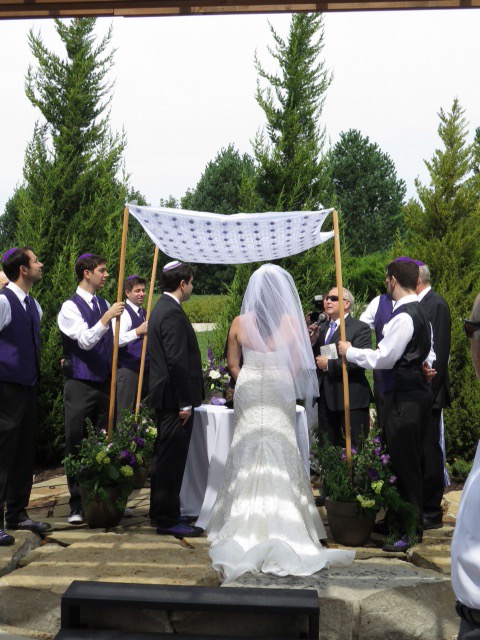
My daughter and her beloved were married last week in a traditional Jewish wedding held outside in a park in Leawood, Kansas.  Gezer Park was established to represent Leawood’s relationship as the sister city to the Gezer region in Israel. 

It was the perfect spot for them to marry as they live in Israel near the Gezer Region. They chose to marry in a quiet area of the park called the Havdalah Garden. 

The small, private ceremony for family and their friends reflected their commitment to focus on their marriage.  And so the park’s limit on guests reflected their desire to keep the ceremony intimate. Later that day there was a larger reception for friends who have had an impact on her life. 

They married under a chuppah that I crocheted for them. Intertwining threads created purple flowers within each white square. Four of the groom’s brothers steadied the poles as the bride and groom stood beneath.  

It was a beautiful day tinged with a bit of sadness. A close friend had lost her battle with cancer and the funeral was the Friday before the wedding.  And then there was the sad fact that they had no grandparents at the wedding. I had all four of my grandparents at my wedding. But I decided the beautiful weather was the gift from all who could not attend. 

From a wedding in Kansas, the couple went on a honeymoon to the Catskills at our home in Kaunenga Lake. They are not the first in our family to honeymoon in the Catskills.  When my parents married in 1951, they spent a weekend at Grossingers before my dad left for an extended tour of duty in the Korean War. 

My grandparents went to have dinner with them each night. My Dad used to say he was the only person he knew who shared his honeymoon with his in laws. They always said that they just wanted to pay for dinner. 

My daughter’s honeymoon is similar, but different. There is no Grossingers. It closed years ago. But we still own our family home. My siblings, who own the home with me, were more than happy to let the couple honeymoon there. 

And my sister is recreating the role of my grandparents. My daughter has never been there without family, and was a bit worried about being there ‘alone.’ She welcomed and actually insisted my sister come as their driver and company. We have been calling her the chaperon. Now to give my sister credit, she offered them a car and keys so they could go by themselves. But they wanted her to come along. We are all getting a good giggle defining her role. 

It is a bit more emotional for me as this weekend is also my father’s birthday weekend. I know that he and my Mom, as well as my grandparents, would be filled with joy knowing that another young couple is enjoying the peace and beauty of our Catskills home. They would kvell knowing that the bridal couple chose to be there for their first trip together as a married couple. 

I know they have walked to the lake and seen the places where my daughter spent many happy moments. They have seen where my grandparents had their bungalow colony. They stopped at the Woodstock site and had ice cream at Candy Cone. They have made new joyful memories. 

It was a beautiful wedding, a lovely reception, a glorious weekend of joy which has led them to a peaceful few days in the Catskills. I hope these moments are reflected in their marriage. Which I hope is filled with love, joy, laughter, glorious moments, peace, contentment and beautiful memories. 

The Kauneonga Lake Temple BethEl Recipe Book

12 Aug

I found a treat today. I decided to clean out my cookbooks. My daughter is getting married in a few weeks, and I am in a nesting mode. Sort like when I was pregnant. Now I am cleaning out my house and getting ready for hordes of guests.

I decided to clean out my cookbooks. There are many I have not used in years. I offered some to my daughter, but she informed me that she gets her recipes off the Internet. Fine. She does not want my cookbooks! I will give them to someone who wants them. And will appreciate them. But there are a few I will keep!

I like cookbooks, especially because some have much meaning and memories. I have my mother’s Settlement Cookbook. Probably the best cookbook ever made.   I have kosher cookbooks, healthy cookbooks, vegetarian cookbooks, light meal cookbooks, as well as a variety of cookbooks put together as fundraisers by various charitable organizations.

image

It was in the midst of these spiral notebook style cookbooks that I discovered a tiny treasure, “Cooking Favorites of Bethel,” put together by the Sisterhood of Temple Bethel, Bethel, New York. This is the congregation I belonged to throughout my childhood when we spent our summers and High Holidays in the Catskills. My grandparents lived in Kauneonga Lake throughout the year and davened at this small shul. I rejoined many years later as an adult to help support it.

I know this book is at least 35 years old, because my grandmother died in 1981. But it has to be older, based on the names of some of the women who contributed recipes. They passed away before my Grandma Thelma, like Clara Wagner. I close my eyes and I see Clara. She was Grandma’s best friend.   They spent many hours sitting and visiting. My Grandma was heartbroken when she passed away.

Then there is Nan Dasher, besides cooking, she would embroider tablecloths. Which she did constantly. I have two tablecloths she made. One specifically for me when I married, and one I took from my mother’s stash after Mom passed away. Nan lived in the White Lake Estates, not far from my grandparents.

So many other names of women I knew when I was a child submitted recipes: Lenore Liff, Yetta Gruber, Mrs. Elfenbaum, Goldie Lerner, Rebecca Rosenberg and more.

But the most exciting and enjoyable for me was finding my grandmother’s name in the book. Thelma Amsterdam contributed four recipes. HA! These recipes are a sort of lie! Grandma did not cook. Okay she cooked but not very well.

I still remember the trauma over this cookbook. Grandma had to submit recipes. She was an important member of the Sisterhood and needed to show she cared. I remember her coming to my Mom to get recipes. There they were sitting in the kitchen and writing down recipes that Mom gave her. The recipes that have my Grandma’s name, every one of them is from my mother. There is my Mom’s simple baked macaroni recipe. I still make it!!!! Even though I cannot eat dairy I have made it for Yom Kippur break the fast, and for shivas. It was so easy! However, Grandma NEVER made this meal.


recipe

So when I saw the four recipes she submitted I was filled with the laughter of remembering Mom giving her the recipes. I was filled with memories of my Grandma’s horrible cooking, although she could make the best mushroom barley soup and Pesach noodles. And I remember this book being put together and then published.

I should also tell you that this book is in perfect condition. I don’t think my Grandma ever opened it after she purchase in the effort to support the congregation and its sisterhood.

I honestly do not know when I got it. But I have a vague memory of Grandma giving it to me when I got married. Okay, I never used it either. It is so small it got hidden among my other cookbooks.

I am glad in a way, because now I have this tiny memory in such pristine condition. With it are many memories of Kauneonga Lake and going to shul!

Louis of the Blessed Heart

8 Mar
image

A photo of my great grandfather, Louis Goldman, and the article about him.


I knew my great grandfather, Louis Goldman, had a good heart. His Hebrew name, Baruch Lev, ‘blessed heart,’ echoed his kindness. Now thanks to the books I found in the Catskills’ bookcase, I know even more of what a “mensch” and a “guttah neshumah” he was to many people.

I found two larger articles about my great grandfather in the bound Bialystoker Stimme magazines I found last summer. And finally, I was able to meet with my friend, Blumah, who translated these articles for me. What a blessing and what a joy! This blog is about one of the articles.

The article from 1938 honors him on the 50th anniversary of his arrival in America. So I now know that he arrived in 1888, when he was a teen. I already knew he married my great grandmother in January 1894.

The article is in praise of Louis Goldman, born Baruch Lev Litvak.  This is paraphrased, but close to the translation:

“It is already 50 years that Goldman is an American, and he still looks like a young man. He remembers things as if he had just yesterday came off the ship. He is like a walking encyclopedia,   He knows things as if they are ‘in his vest pocket.’ In general he knows many people.

He has the honor of being president of the oldest Bialystoker organization the ‘Somach Naflim,’ helping the fallen (Free Loan Society). And he is the vice president of the Center. (Bialystoker Home for the Aged.)

He acts with great warm love with the Home for the Aged. ‘He is the one and only one in the way he gives love and warmth, there is nobody that can be compared to him.’

In addition to bringing in friends whom he strongly interested in this project (Home for the Aged), his beloved institution, he also brought in his wife, children and grandchildren to be involved.

The grandchildren Goldman are already involved.   (This included my Dad and his siblings.)

With out a doubt, the children and grandchildren honor their father/ grandfather. If these children do not outshine him, they will put out less effort.   They will not do less than what you expect a human being to achieve.

Such an exceptional feeling!

From good dough, the saying goes, good baked goods will come out. (Such a wonderful analogy as his parents were bakers.)

Few fathers and grandfathers have the merit to have such an influence on their families. Especially in our world .

We are proud of the true, great honor of Louis Goldman!

A little bit of jealousy we could feel about him. But we still hope that he will bring his great grandchildren to the same level.”

WOW! My heart was so filled with love  and joy as Blumah read and translated for me.  Some of the words I could understand with my limited Yiddish.  But the overall sentiment was so loving. It made me proud to be his great granddaughter.

My Great Grandfather’s legacy continues into the next generations.   My Dad was president of his synagogue for 11 years and remained on the board until his death. My parents and grandparents and aunts and uncles would go to the Bialystoker Home for the Aged benefit dinners each year.

I continue work for the Jewish community as a board member of our synagogue, and many other Jewish and secular organizations.

My daughter works for the Peres Center for Peace in Yaffo, Israel. I think my great grandfather, her great, great grandfather would kvell with naches.

But it is not just my immediate family that continues in this tradition. My siblings, my cousins and their children also live a life of gemalut chasidim, doing good works.

I believe that our ancestor, Louis Goldman would be proud of us as we are of his good works.

The gene to do good, to be agents of tzedakah, is strong in our family. It is our Force. And I am so proud to be descendant from this man, Baruch Lev. Louis of the blessed heart.


(See links below to other blogs about Louis and the books I found.)

Mensch, good person; Guttah Neshuman, A good soul; Kvell, bursting with pride; Naches, proud enjoyment; Gemalut chasidm, doing good works.


https://zicharonot.wordpress.com/2015/08/16/treasures-in-the-bookcase/


https://zicharonot.wordpress.com/2015/10/10/12-delancey-street-and-my-family/


https://zicharonot.wordpress.com/2015/10/21/another-bialystok-treasure-investigated/


https://zicharonot.wordpress.com/2014/12/01/take-mom-to-work-day-at-the-peres-center-for-peace-in-jaffa-israel/


I Want My Sandy Back: Our Short Duration of Dog Ownership in 1961

6 Mar

When I was about six years old my father got us a dog. Sandy, a beautiful Cocker Spaniel, was so wonderful   We were in the Catskills for the summer when Dad brought the dog to the bungalow. My brother and I were ecstatic.

My sister was just a toddler, so I am not sure how she felt, but she seemed to love the dog as well. Her favorite game was to ride Sandy like a horse. Since she was so little, and Sandy so active, they both had a good time.   My sister seems to remember that the horse riding was my idea. That could have been, I loved horses!

We got to name him, because the dog’s given name was Harry, which was my grandfather’s name. So the first thing we did was have a family conference to name the dog. His name matched his color, a beautiful golden brown.

We often let Sandy run free on the fenced in front lawn of the bungalow colony, right outside our front door. My other grandfather would stand and laugh at the dog running crazy circles. He would scratch his head and say in Yiddish, “Look at that meshuggahan hundt (crazy dog)!”

The summer was wonderful. It was easy to take Sandy on walks, and he had space to run around in the bungalow colony. But then Labor Day came and it was time to return to North Bergen.

We lived in the second floor apartment of a three-story home on Third Avenue.   Sandy was not as happy there as he had been in the Catskills, even though my brother, sister and I showered love on our dog. His adventures became mainly indoor adventuress; not great for an outdoor dog.

In fact, my brother remembers that my parents would put Sandy in the bathroom at night, so he would not roam the apartment. One Sunday morning, my brother got up early and went to the bathroom. He found my young sister wrapping the dog in all the toilet paper!

“What a mess to clean up as he ran around the apartment trailing toilet paper!” My brother remembered.

Actually, overall, having a dog in our apartment was not going very well.

My parents and my brother were usually the ones to walk him. It was a hassle to get him down the stairs and out to the street several times a day. My brother and I were in school. And my Mom was home with my sister, who was still sleeping in a crib. I think my Mom was getting very tired of dog ownership.

Then one day I offered to take Sandy for a walk. I bundled up and took him downstairs. As we were walking, he pulled me into the street. Someone helped me get Sandy back on the sidewalk. I was not going to tell my MOM. But one of the neighbors did. (In those days, every neighbor was like another parent!)

That was the final straw for my Mom. Sandy had to go. “It was not safe to have a dog in the city. It was not fair to Sandy to be locked up in an apartment,” was what my parents told us.

My brother tried to talk them out of giving Sandy away. He promised to walk him every day, if they let us keep our dog. But it did not help.

Soon after that, my Dad found someone who had plenty of land to take Sandy. I still remember the day he came to take our pet. I hid Sandy under my sister’s crib and put the sides down. I put pillows all around to hide him. But it did not work. Sandy followed me out and left our lives forever.

I remember crying for days, “I Want MY Sandy back! I want my Sandy BACK!” I am sure my crying and whining drove my parents crazy. But they were patient and explained over and over how this was better for the dog.

Nothing worked. I never saw Sandy again. However, my parents did report back at least once, that he was loving his life on a farm.

To this day, I cannot watch Disney’s “Lady and the Tramp” without thinking of my Sandy. This was my daughter’s favorite movie when she was a child. I watched it almost every day. Each time I watched I would think of my cocker spaniel.

I have never owned a dog after Sandy. My husband and I always had cats. I think part of the reason for me, was that I never wanted a dog to pull someone in the street and be sent away. Cats stay indoors and care for themselves in many ways.

It was just about five months that Sandy was in our family. He arrived in the early summer while we were in the Catskills and was gone by Hanukkah in North Bergen.

Many times I wished I lived in the Catskills throughout the year so that we could have kept Sandy.

Grandpa Nat Loved His Four Roses

24 Dec

My Grandpa Nat was a baker. This meant he was often going to bed soon after we were getting up, as he would work all night baking the breads and cakes for the next day.   Or if not all night, at least he would get up pretty early in the morning to start baking.

So often when we were having breakfast, Grandpa was having his lunch or even his dinner. But before he had dinner or anything else to eat, Grandpa always had a schnapps, a shot glass of Four Roses whiskey.

When I was little, I loved that bottle. It had four roses on it. So I thought it was pretty. He kept the bottle in a little cabinet beneath the counter in the kitchen in the Catskills. We were not allowed to touch. It was Grandpa’s special orange juice, or so we were told.

My Grandpa was from Galicia. His family owned a farm there, with grain silos and a tavern. One of his favorite stories to tell was when he and a cousin were sent to clean out the grain silo and got drunk on the fumes. They got really sick. I have learned that people can die from the fumes in a grain silo. Luckily that did not happen to Grandpa.

But I remember the first time I saw “Fiddle on The Roof” with him. His eyes filled with tears. I asked what was wrong. And he said it reminded him of his home. His family had a tavern like the one in the movie. And so like in the tavern scene when they sing “To Life”: “We’ll raise a glass and sip a drop of schnapps in honor of the great good luck that favors you,” my grandfather had a schnapps for many occasions.

(I should say he cried for a reason, his entire family was murdered in the Shoah.  He cried for the life that was gone forever.)

His Four Roses was his special treat. He said his one glass a day kept him healthy! Since he lived to almost 90, perhaps it did!

He kept a bottle in his New Jersey home as well. I believe it was in the kitchen. I remember him having a ‘shot’ of whiskey there as well. But I think because I was so young when they moved into the home in the Catskills, I have better memories of him having his Four Roses in the Catskills. Also we spent three months of the summer with them, so I had more opportunity to be with my grandparents in the mornings.

Grandpa sold his bakery in the 1960s because he had baker’s asthma and needed to retire. Perhaps he has some heart condition as well, but I am not sure about that. However, in the summertime he worked for Katz’s and helped to bake for the summer crowds.

In fact, my brother got one of his first adult summer jobs as a baker: going to the bakery with my grandfather and learning all there was to be a baker. I think that is why my brother became a chemist… You have to know formulas to bake as well. So my brother often came home early in the morning with Grandpa and had a schnapps along with him.

My brother went to college at Penn State and would sometimes drive to my grandparent’s home in the Catskill for the weekend in the fall or winter. He remembers being offered some schnapps as soon as he arrived to warm up.

My brother said, “I would show up for a weekend Grandpa would greet me with a shot of schnapps from the shot glasses that were never washed just dried and stored under the cabinet!” Alcohol sterilizes the glasses, according to Grandpa!

My grandfather would share his schnapps with my Dad and other adult men. I never saw any women drink the schnapps. It was orange juice for men.

When I got older, I had no desire to drink it! I understood that it was whiskey, and not exactly a good whiskey.  And I did taste it once when I was in the Catskill during the winter. After we shoveled snow and were outside for almost an hour, Grandpa had some schnapps and offered me a taste. I had to try. To be honest, it was disgusting! I never tried it again.

Grandpa and Schnapps

My Dad gave my Grandpa a bottle of “good’ stuff for Hanukkah.

My Dad was always trying to get my Grandpa to try something better. He called Four Roses rotgut cause it would rot your guts. He would say that Four Roses was not smooth when it went down, instead it burned your intestines. For Hanukkah he would buy my grandfather some of the Good stuff, which my Grandpa would promptly put away. Perhaps he used it for guests?

Grandpa would sometimes have another shot of schnapps when something special or unusual was happening.

For example, Woodstock: after watching the thousands upon thousands of young adults pass our property that first day, Grandpa turned to my Dad and to George, his tenant and my dad’s friend, and said, “Come we have a schnapps.” He definitely needed a schnapps or two that weekend! It was a very strange time, and a little fortitude was needed.

Good news was also the time to celebrate with schnapps. There were libations of schnapps as each grandchild became engaged and then married. More schnapps with the birth of the six great grandchildren he was alive to meet. I know that when the next two arrived, my Dad had schnapps to continue the tradition.

I can still close my eyes and see my Grandpa move one of the high stools in the kitchen and bend over to reach into the small cabinet to get out his bottle of Four Roses. The only thing in the cabinet was his schnapps and some shot glasses.

We never went into that cabinet without Grandpa. It was his special cabinet with his cherish Four Roses.


May 2018 update.  I recently found out that Grandpa’s heart specialist told him to have a drink every day because he had a slow heart rate.  His love of Four Roses was medicinal!


My Doll Survived Because of the Catskills Attic

19 Dec
IMG_0015

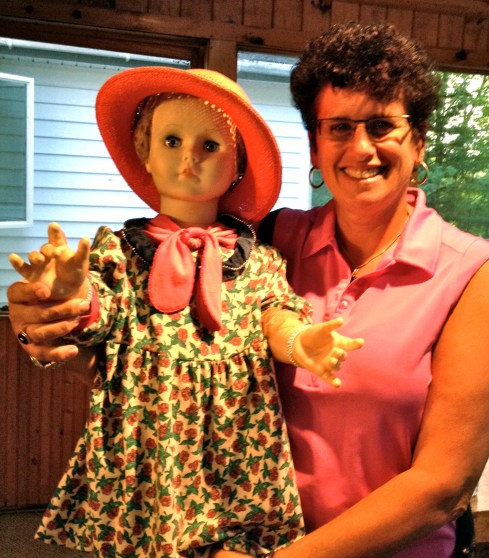
In the Catskills Betsy, my doll, with my cousin who has finally made friends with her.


I only have one toy left from my childhood. It is not that I purposely saved it because I loved it the best. I actually had other toys that I loved more. But this toy survived because of her journey to the Catskills.

When my sister was born, I was gifted a large standing doll. The doll is over two and half feet tall. I did love her. And I believe I named her Betty or Betsy or perhaps Becky, which was what my Dad called my Mom, even though that was not her name. I kept her in my bedroom and I loved her!

I remember when the doll arrived. She had a pink dress, light brown hair, pink shoes and socks. My Grandma Esther knitted her another beautiful pink dress. I enjoyed playing with her, but there was a problem. She was so big , I really could not cuddle with her. She was best for tea parties, playing school and perhaps discussing an issue. She seemed so real. And that was her biggest problem.

Betsy was so real looking. During the day she was not a problem, but if you woke up in the middle of the night, she would be standing there staring at you with her big eyes open! My sister and I were used to her, but one of my cousins lived in fear of her. She was afraid to sleep when the doll was in the room.

She really was too big for the apartment we lived in during the winters in New Jersey. So Betsy the doll moved up to our Catskill’s bungalow in Kauneonga Lake to be used only in the summer time. In the Catskills we had much more room to play. And she loved being up there.

Eventually I outgrew playing with the doll. But my sister grew to love her. She says, “I loved to play with her and thought of her as mine, since you had outgrown her.”

In time, Betsy moved from our bungalow to my maternal grandparent’s house, until one summer when she was gone. That is what happened with toys. They just disappeared when you outgrew them. I assumed she was given away.

To be honest I don’t think I even looked for her. There is so much to do in the summer time. And Betsy was no longer an important part of my life. She lived in my memories.

But my sister still had a relationship with Betsy. The doll was moved to the attic bedrooms of my grandparent’s Catskills winter home. My sister would play with her and see her when she went to visit in the winters. I was four years older, so while I was away at college, my sister was still spending time in the Catskills in the fall and winter. “Remember,” she told me, ”we did not go into the attic that much in the summer. ” Of course not…it was HOT up therein the summer, but wonderful in the winter.

After my sister went away to college, the doll was put into a closet and eventually forgotten. At some point my grandparents moved her from a closet to one of the hidden nooks.

But Betsy was not totally forgotten. We often talked about my big doll and how scary she was at night, or when you weren’t expecting to see her. We would remember the people who came in and were frightened the first time they saw her thinking she was a real toddler.

Years later, when I was in my early 30s, after both my grandparents had passed away,  my parents inherited the house in the Catskills. They started the process of cleaning it out. We all helped. I was assigned the two bedrooms in the attic, cleaning out the nooks that were hidden in the crawlspace walls of the bedrooms.

Usually the doors into these spaces were covered by the beds. But we moved the beds away and went in to clean them out.   I was surprised to find one perfectly clean except there, lying on the floor, was Betsy! She was a little ragged. Her clothes were gone. Her hair was a little messy. But she had survived, alone in that hidden space for years!

I was excited. I now had a toddler daughter, and I thought she would love Betsy.

I brought the doll downstairs. My mom, sister and I washed and cleaned her up.   She needed clothing!   My daughter wanted to give her some of her clothes, but we decided to buy her something just for her.

The women (Mom, my sister, my daughter and I) went to the Apollo Mall in Monticello and we purchased a 2 Toddler dress. I also found her a beautiful pink straw hat. She looked refreshed and wonderful.  Eventually the granddaughters gave her some lovely bracelets as well!

It took us a while to decide where she would stay. No one wanted her in a bedroom. TOO scary. My parents decided to put her in the stone room, where new generation of girls began to play with her…the granddaughters. But she would not disturb anyone’s sleep.

To this day, 25 years later, Betsy still stands in the stone room by the back door, which is the door that welcomes our guests. She has a purse; she has the same dress; she does not always wear her hat. She guards the door! Some people are startled when they first walk in. But she does not look so real anymore.

However, my cousin, who was afraid of her as a child, still had a little fright when she entered the stone room and saw her for the first time as an adult. She had to share her scary Betsy stories. I think after the sharing, she was able to become friends with Betsy.

My parents have both passed away. My siblings and I own the Catskills house. Betsy stands guard. She is a wonderful reminder of my childhood.
It seems Betsy is a Patty Play Pal doll. Thanks to Maxene for the information.

Kauneonga Lake Was A Peaceful Winter Wonderland

13 Dec

Unlike many bungalow colony owners, my grandparents eventually moved up to the Catskills to live full time in the 1960s. For a while they kept a small apartment in the building they owned in West New York, NJ, which was above their original bakery. But eventually they sold that building and no longer traveled back to the “city” in the winters.

Their home in Kauneonga Lake was a ‘winter’ home, and not a small bungalow. It was warm and cozy. They would close off the parts of the house they did not use in the winter. It was a bit scary at first when the furnace turned on as we could actually see the flames through an open grill in the floor. After a few years they replaced this antique system and the house was warmer. There was also a beautiful stone fireplace that helped to keep the house warm.

With my mother’s parents in the Catskills, for my family that meant we would have to travel up to the Catskills in the winter time and visit my grandparents. Usually we went when there was a long weekend, or a holiday. We knew that there would be snow and cold. The snow was sometimes several feet deep. We would be spending most of our time indoors playing cards, board games, watching television and talking.

When we did go outside we would bundle up with every scarf and hat we could find. I would double glove my hands for warmth! BRRRR! We often would sled down the hill in the front lawn and sometimes we would walk into town.

The walks to town were special in the winter. We would walk to the lake and then ACROSS the lake into town. The lake was so frozen that people would actually drive their cars across it in the winter months.

I loved walking on the lake.   It was exciting to step out on to what was usually water and sort of skim my feet across the top. Others would ice skate. Some people fished in the lake and cut holes into the ice to reach the moving water where the fish survived the harsh winters.

In later years, my parents kept cross-country skis up at the house for those days when traveling by car was impossible. They would just stay home and ski in the yard and around the area just for the fun and exercise. My memories do not include skiing, although I think my younger sister did some cross country skiing when she visited. ( My sister reminded me that they also had snow shoes, and our mother enjoyed using them in the winter.)

During my freshman year of college, my parents drove up during winter break for an overnight with my grandparents, and left me up there with them. My grandmother was lonely and needed company. That was my job. Keep Grandma entertained for a week or so.

It snowed and snowed and snowed. And even though my grandfather had someone who usually plowed the long driveway, we still had to dig out. I remember that we could not get plowed for several days. So Grandpa decided we would make a one-car lane through the snow.  Did I tell you it was a very long driveway!

We would go out and shovel for 30 or 40 minutes and then go in for something warm to drink or a cup of soup. My grandma was not a great cook, but she made excellent soup. And on a cold day it was beyond delicious.

That year, for the first time in my life, my face broke out in acne. I think it was the stress of being a college student and living away from home for the first time. My grandmother had a solution. In Poland, where she spent her childhood, there were no fancy medicines, there was just natural solutions to acne. And she wanted to try them all on me.

Every time I went outside she would yell out, “Put some snow on your face. It will help.” And every time I walked back in, she would ask if I had put some snow on my face, which I did. But she was making me a bit upset.

My grandfather finally told her to leave me alone. When that did not work, he took action. When we came in after shoveling for a while, he walked in after me. And when Grandma said, “Did you put snow on your face?” He walked right up to her, and rubbed snow all over her face. She laughed hysterically. And he said, “How do you like to have snow on your face! Enough with the snow!“ That was it. She did not bug about snow again.  (I will be honest, the snow did dry out the acne, and helped to clear it up.  But it was so COLD.)

When the weather was nice, we would visit with the few others who braved the winters. My grandparents had several good friends up there, although most went to Florida for the winters. The people who stayed up throughout the year watched out for each other. There was always someone calling to make sure they were okay or if they needed food.

Winters in Kauneonga Lake were so peaceful. I loved the quiet time to read. I loved visiting with my grandparents and hearing their stories. I even loved when my parents and siblings were there as well and we had major snow ball fights outside. Those were not so peaceful. But to see the giant pine trees covered in snow; to see the lake frozen; and to see people helping each other gave me wonderful memories.

The Lighthouses That Made Me Feel Safe

22 Nov

When I was a little girl, my family drove every weekend from North Bergen, New Jersey, into New York City to have dinner with my paternal grandparents and my father’s family. We had to drive over the George Washington Bridge and into the Bronx.

My favorite part of this drive was usually on the way home. Then sometimes my Dad would drive in a round about way so we came to a point where we could see the little red lighthouse under the bridge. We did not always see it, but when we did it made me happy!

We had often read the book by Hildegarde Swift, “The Little Red Lighthouse and the Great Gray Bridge.” It was one of my favorites. I loved the story about the lighthouse being happy till the bridge was built, and then had to realize it was still important. I loved that little lighthouse that lives in Washington Park. So those little excursions to see it filled me with joy.

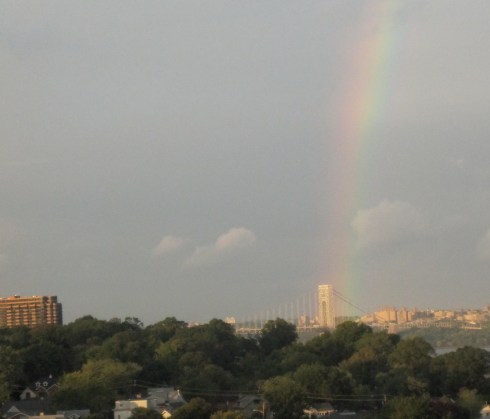
Rainbow and bridge

Near the bottom of the rainbow stands the little red lighthouse. View from my parents apartment.

Even now, whenever I am back east, I try to get a glimpse of the lighthouse. But it is much harder to see from the roads with all the barriers up, unlike the 60s when it was more open.

When my siblings and I were married, my parents moved into an apartment in Cliffside Park. Their view overlooked the Hudson River. From my parent’s apartment we could look north and see the George Washington Bridge and the New York City skyline. Whenever I was there I would try, perhaps through the trees, with binoculars, to see the little red lighthouse.

I really not see it. But I would imagine it sitting across the river just under the bridge, at the end of a rainbow.   In my mind it was always saving people, even though it had not be used in decades. The lighthouse was placed on the National Register of Historic Places in 1979.

I know it is more than just the book and the adorableness of this little red beacon that made me love lighthouses. Our family had its own attachment to the security a lighthouse provides. My maternal grandparents had a lighthouse nightlight that kept us safe at night in the Catskills.

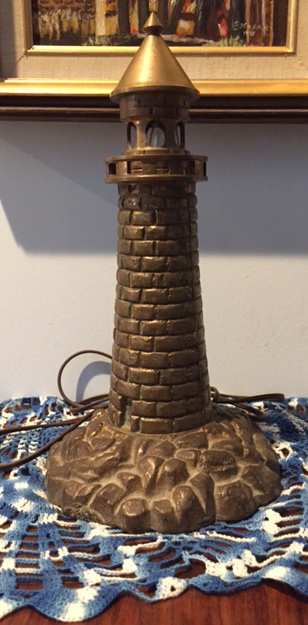
Lighthouse in the Catskills

The lighthouse nightlight in the Catskills house.

Night in Kauneonga Lake is extremely dark. There are no street lights. And when the night comes and the lights go out…it can be scary for children. Well for adults too, if you do not like the dark. And I do not like the dark!

It was this little lighthouse nightlight that made me feel safe.   It was not the usual nightlight. This heavy brass sculpture has a tiny light bulb in the top that can be switched on and off. Throughout my life, well since about 1964, it sat on a table at the bottom of the stairs. And every night that I spent at my grandparents’ and then my parent’s Catskill home, this lighthouse’s small beacon illuminated the scary dark nights. It was a beacon that kept use all safe. I loved that little lighthouse, as did my siblings and all the grandchildren.

The watchtower nightlight

My watchtower nightlight.

So when my children were little, I also bought a ceramic lighthouse/tower/nightlight that I kept it at the bottom of my stairs, in deference and in honor of the lighthouse I so remembered and loved. My nightlight was not really a lighthouse. It is more of watch tower with a dragon guarding it. But it was the idea of it that made me want to own it and use it in my house. It reminded of my grandparent’s nightlight.

Lighthouse

The Catskills lighthouse in my house.

I now have both nightlights.   After my parents passed away, and we divided some of the belongings, I took the lighthouse back to Kansas with me. I have it sitting on a small half table, just as it sat on a small half table in the Catskills. I have it near the bottom of the stairs. But it is not plugged in anymore. The cord is frayed and I am concerned about the chances of sparks. But I see daily, and I remember the glow of its light.

Across from it is the newer nightlight watch tower. The watch tower is plugged in, but with no children at home, I no longer turn it on. Both lights are out now. But in this troubled time, I still l feel a sense of security when I see a lighthouse and my lighthouse night lights.  I imagine sometimes that they nod to each other and whisper, “we kept them safe.”


https://en.wikipedia.org/wiki/Little_Red_Lighthouse