Archive | antiques RSS feed for this section

A Hidden Gem: Kansas City Automotive Museum

5 Nov

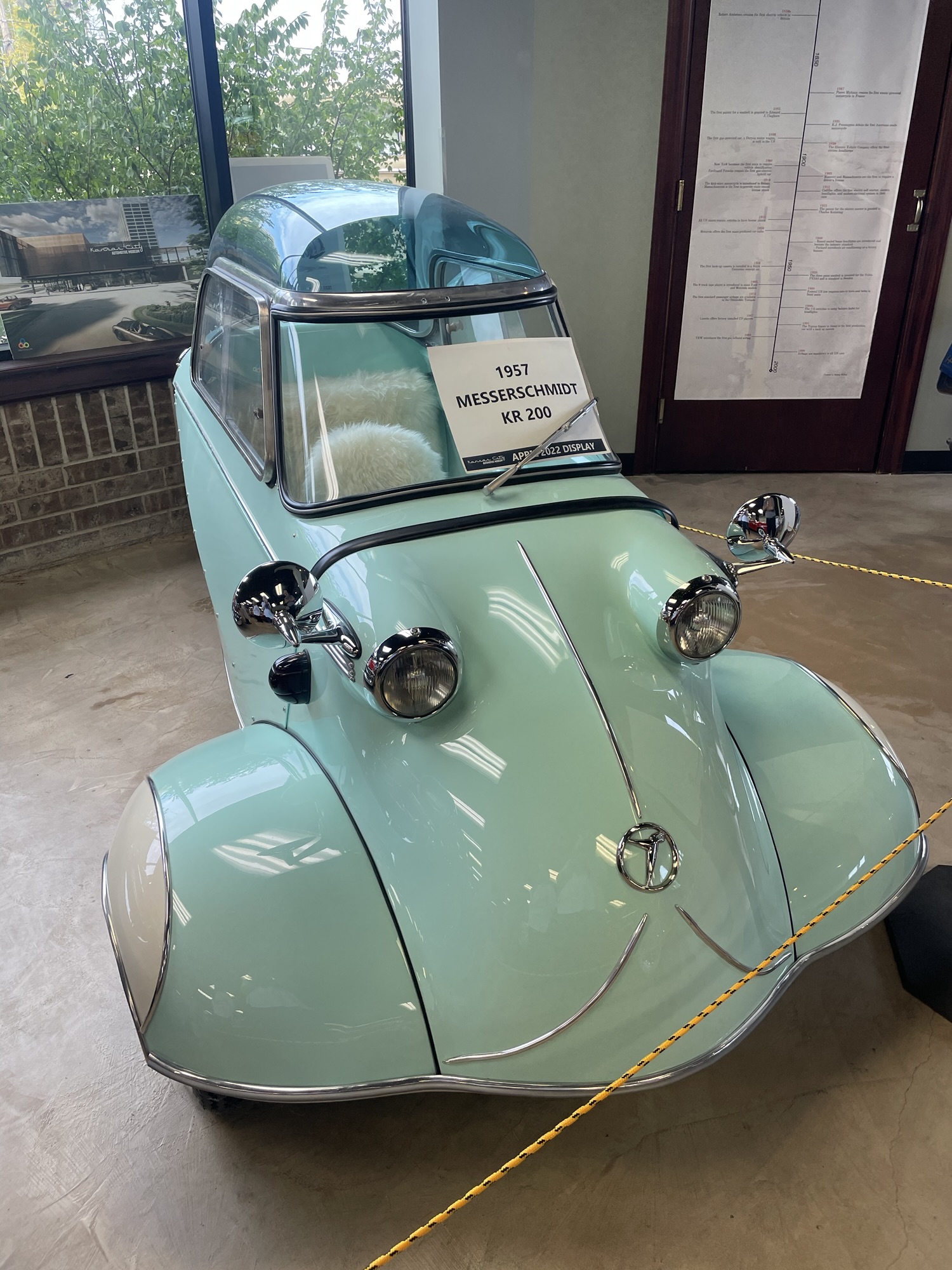
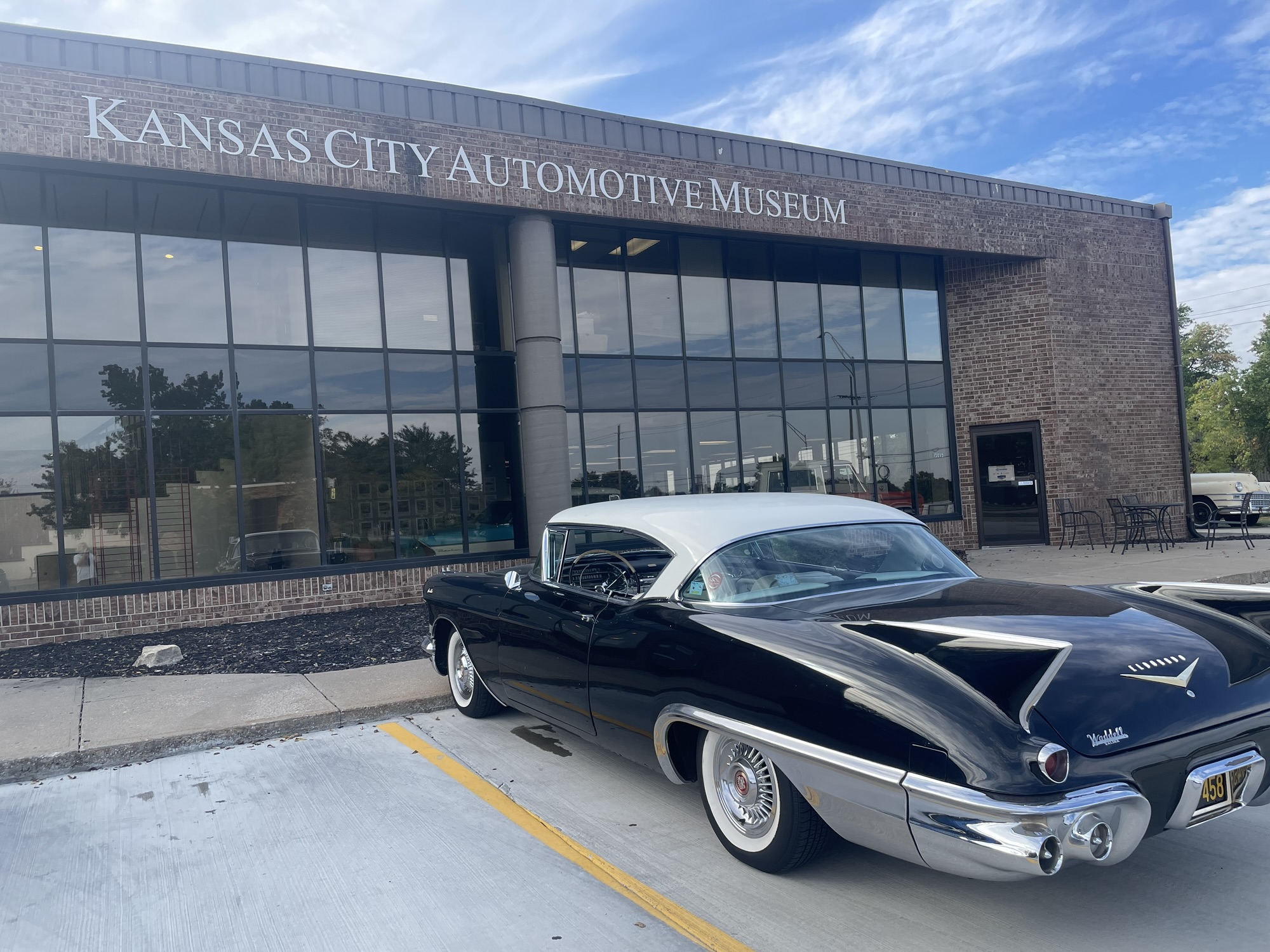
The current home of the Kansas City Automotive Museum is a little bit hidden away in Olathe, Kansas.  This 10,000 square-foot museum is PACKED with all sorts of cars and information. Much more than I anticipated.  Founded and opened in 2014, the Automotive Museum houses many cars and other objects that are on loan from their owners, where they are safe but also provide a place for others to share in the joy of their uniqueness.

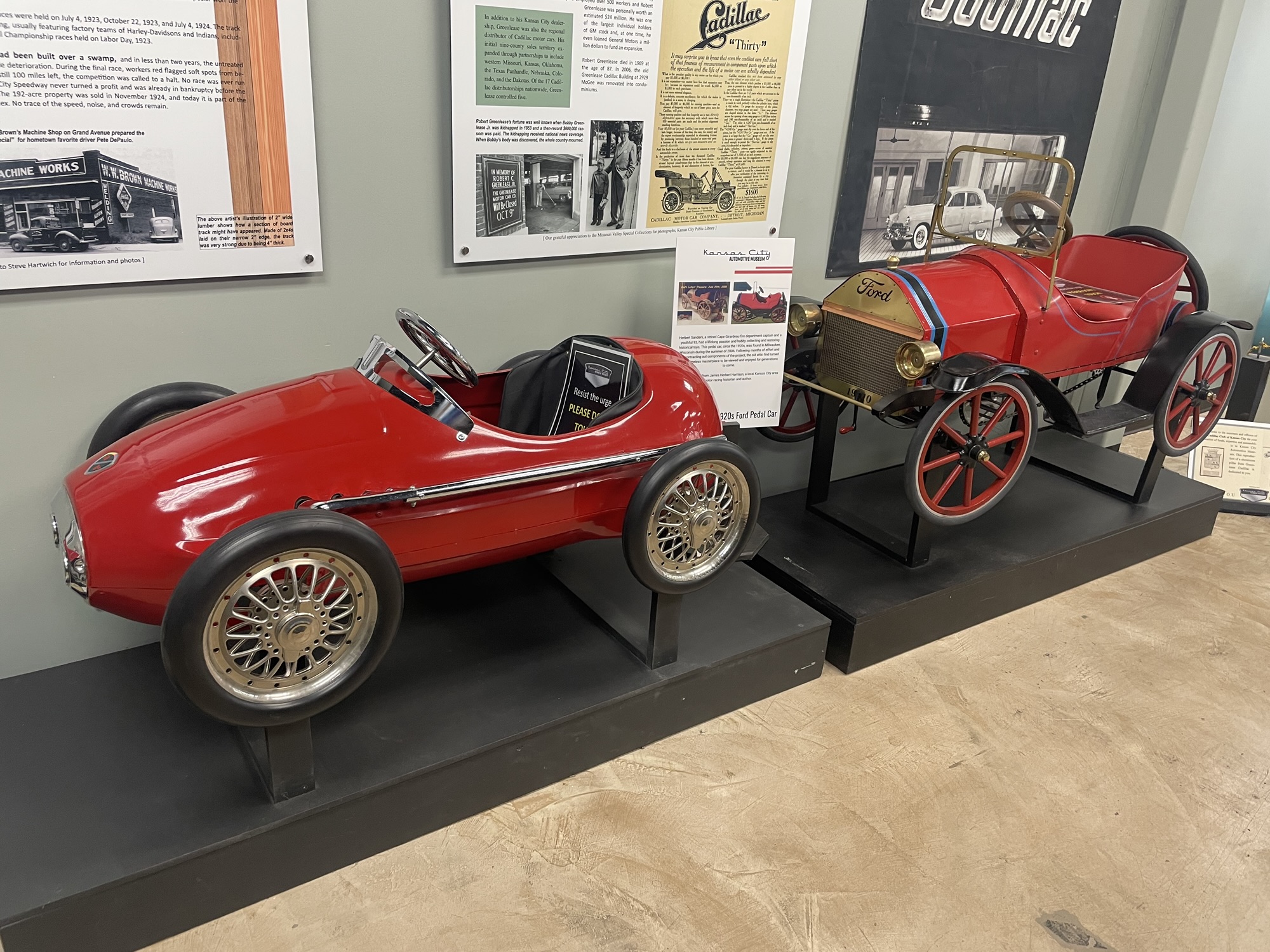
There are race cars, turquoise-colored cars from the 1950s, an original Model T, 1912 Ford Model T, Packard Roadster, Studebacker, Bentley, Jaguar, Chevrolet Sport Phaeton, a bubble car, children’s go-carts, and so much more.  I am not a car enthusiast, but I definitely enjoyed this experience.

We went with friends in October and were delighted to have a docent go through the entire museum with us.  He was fantastic in explaining the different cars and what made them special; the special exhibits; the history of cars in Kansas City, and answered all of our questions, even the naïve ones.
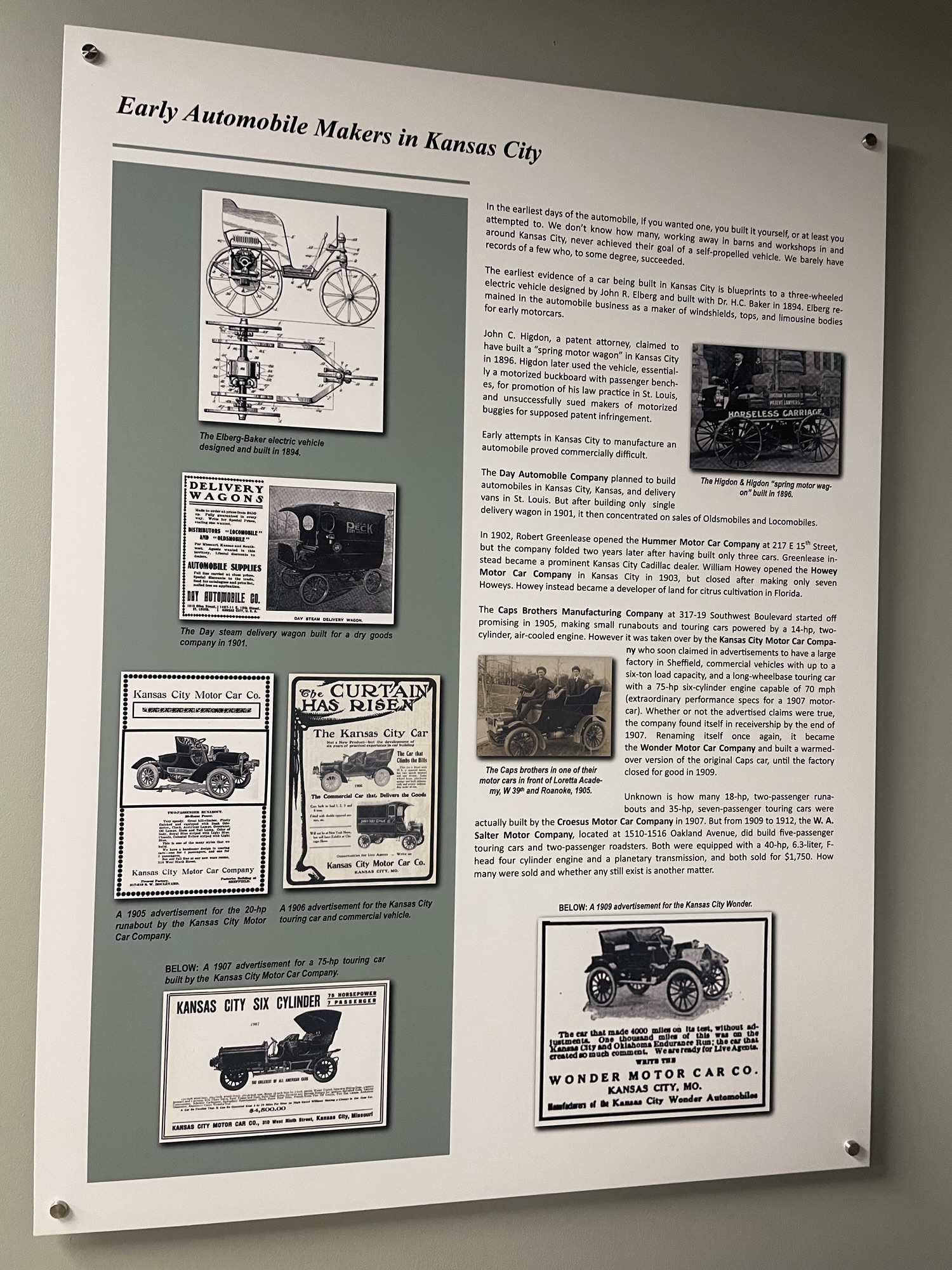
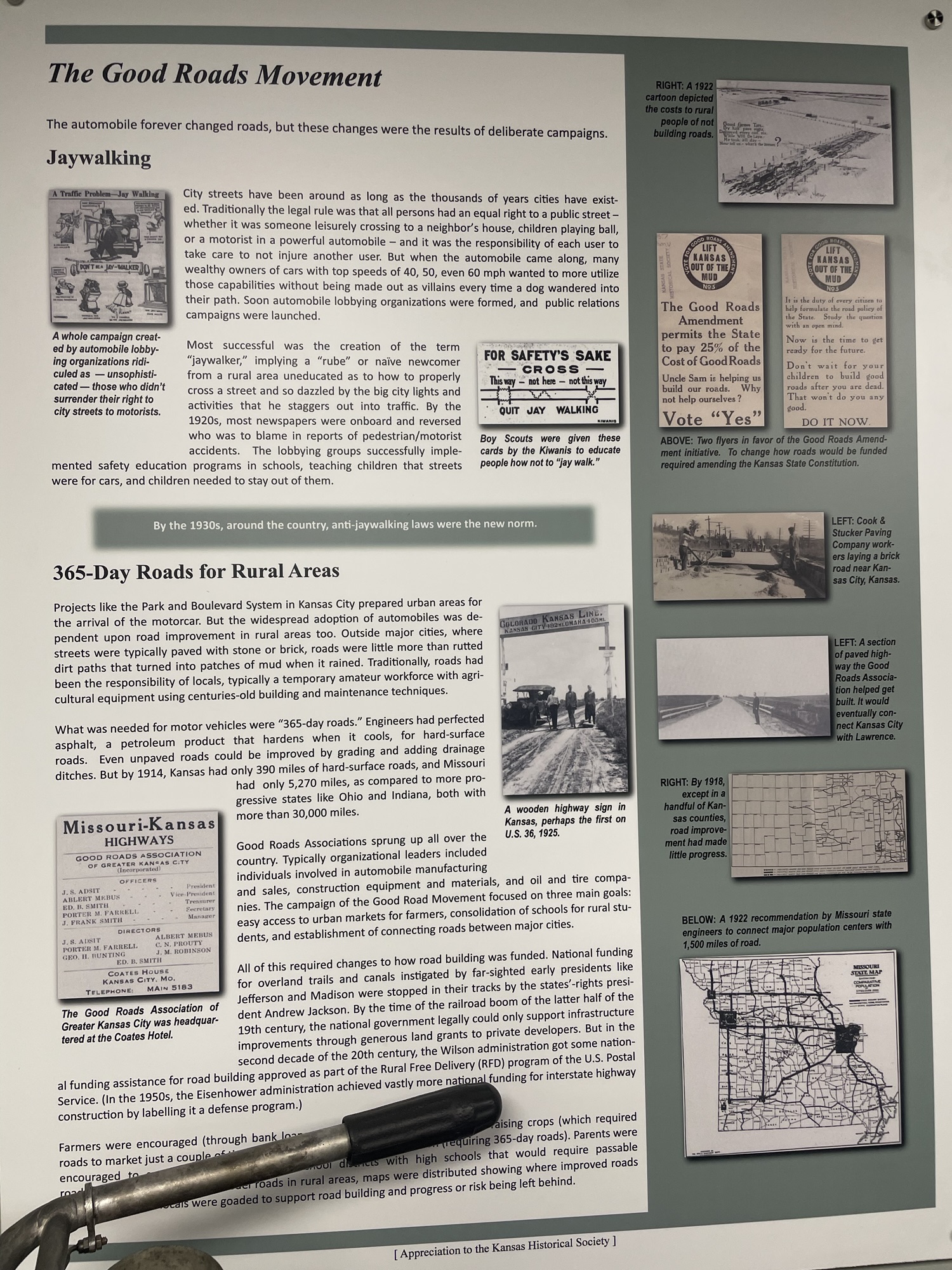
Along the walls was information about the Kansas City automotive industry.  I knew we have factories here, but I had no idea how long cars have been made in the area.  I also did not realize that in the early years there were many small car companies that made perhaps dozens of cars before they closed.  But that makes sense as all cars were originally made by hand.  It wasn’t until Ford came up with the assembly line that car making became quicker and cheaper. 

I was also amazed about how streets were developed. There was not always all the pavedc roads everywhere. They had to be built. One fun fact I learned was the origins of  the term Jaywalking. It was a term for people who crossed the street in front of cars, making them seem not very smart..  Unlike now when motorists is blamed if they go too quickly and hurt someone, then they turned it around and blamed the pedestrian if they went in front of a car or were hit by a car!!!!

The Homer B. Roberts Gallery is in honor of the first African American car salesman in the Kansas City area. In the early 1900s he had an office at 14th and Vine where he sold cars to the African American community.  I had not thought of that before, white salespeople did not sell to African Americans, but in order to make more money they needed a salesperson.  Enter Homer B. Roberts and Roberts Motor Mart.
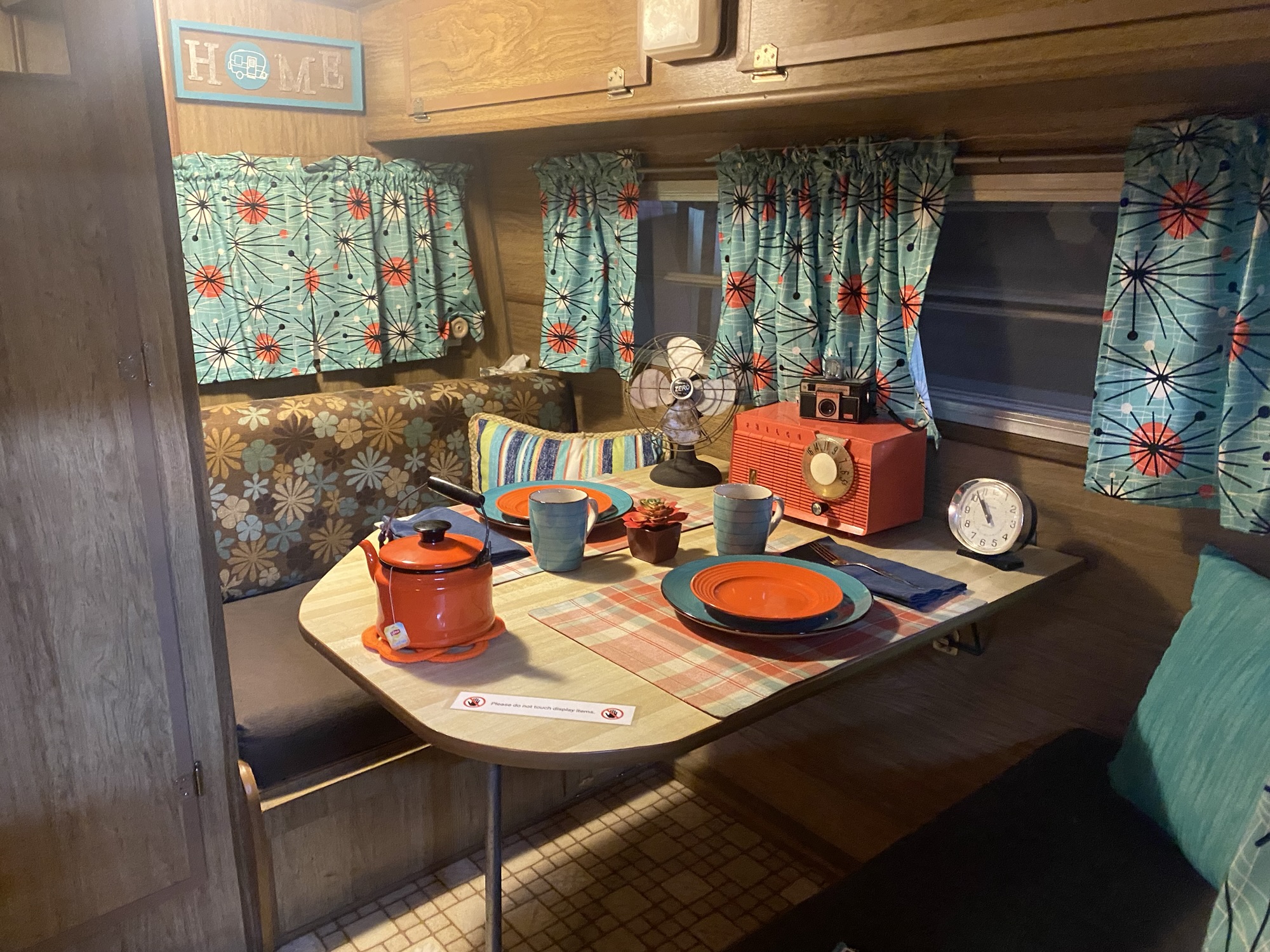
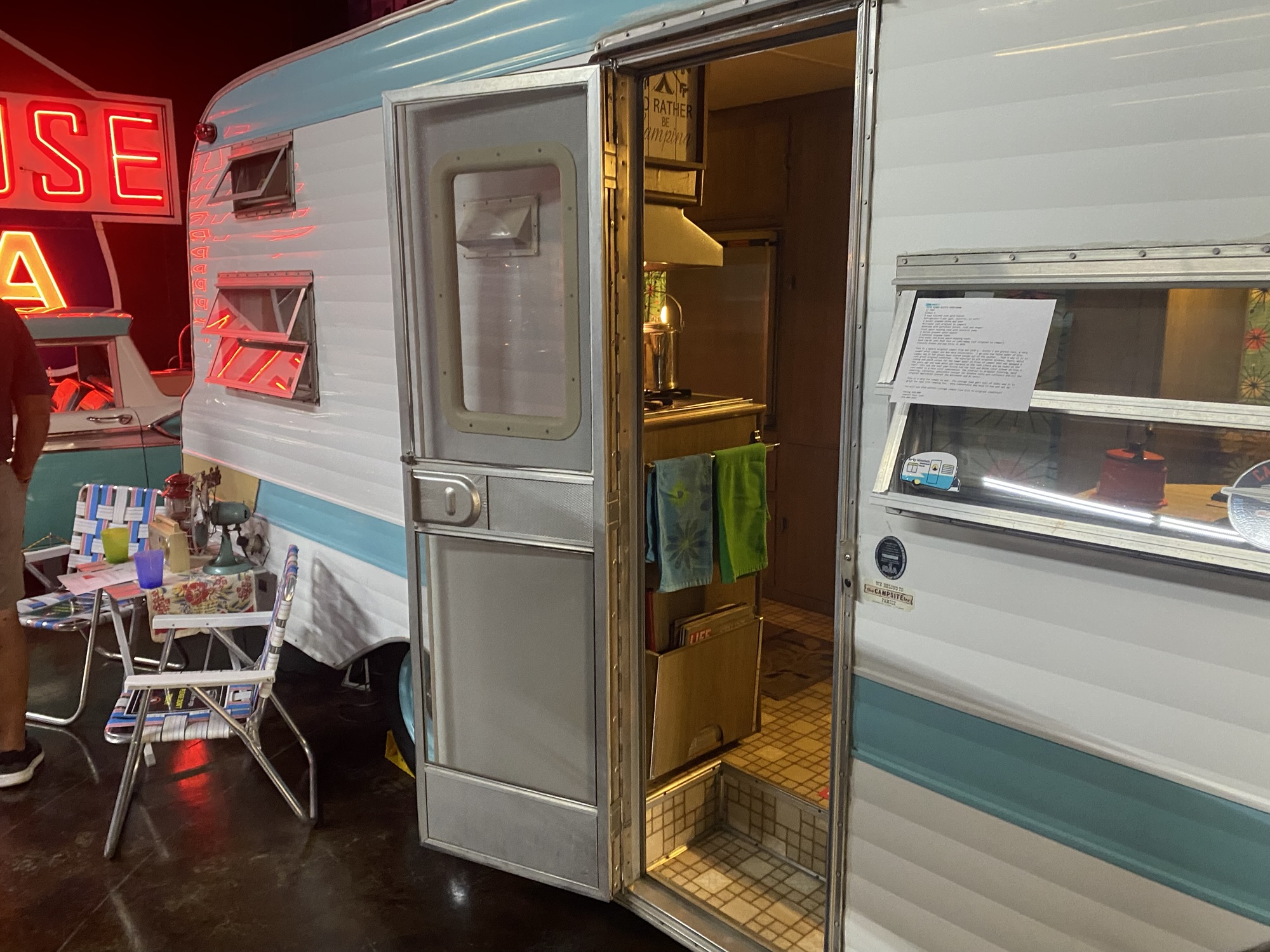
There is so much information in the permanent displays of the museum, a car enthusiast could spend hours looking at cars and listening to the stories.  But there is also an exhibit room for special displays. When we went there were motor homes/campers from the early 1970s.  Some were all in one, others were ones that were pulled by a car.  I enjoyed seeing those as well.

The Kansas City Automotive Museum is building a new home in Kansas City, Missouri, on the north side of 31 street between Broadway Boulevard and Southwest Trafficway.  It will be much bigger, 40,000 square feet, and able to display many more of the community’s antique and special cars.

This is a fun and informative museum, a hidden history gem, in Olathe.  But when it moves to Kansas City, Missouri, set to open in 2027, I believe it will be even more impressive.  I look forward to visiting the new museum then. For more information go to the website, https://kansascityautomuseum.com/
The Vaile Mansion, A Gem in Independence, MO

2 Jul

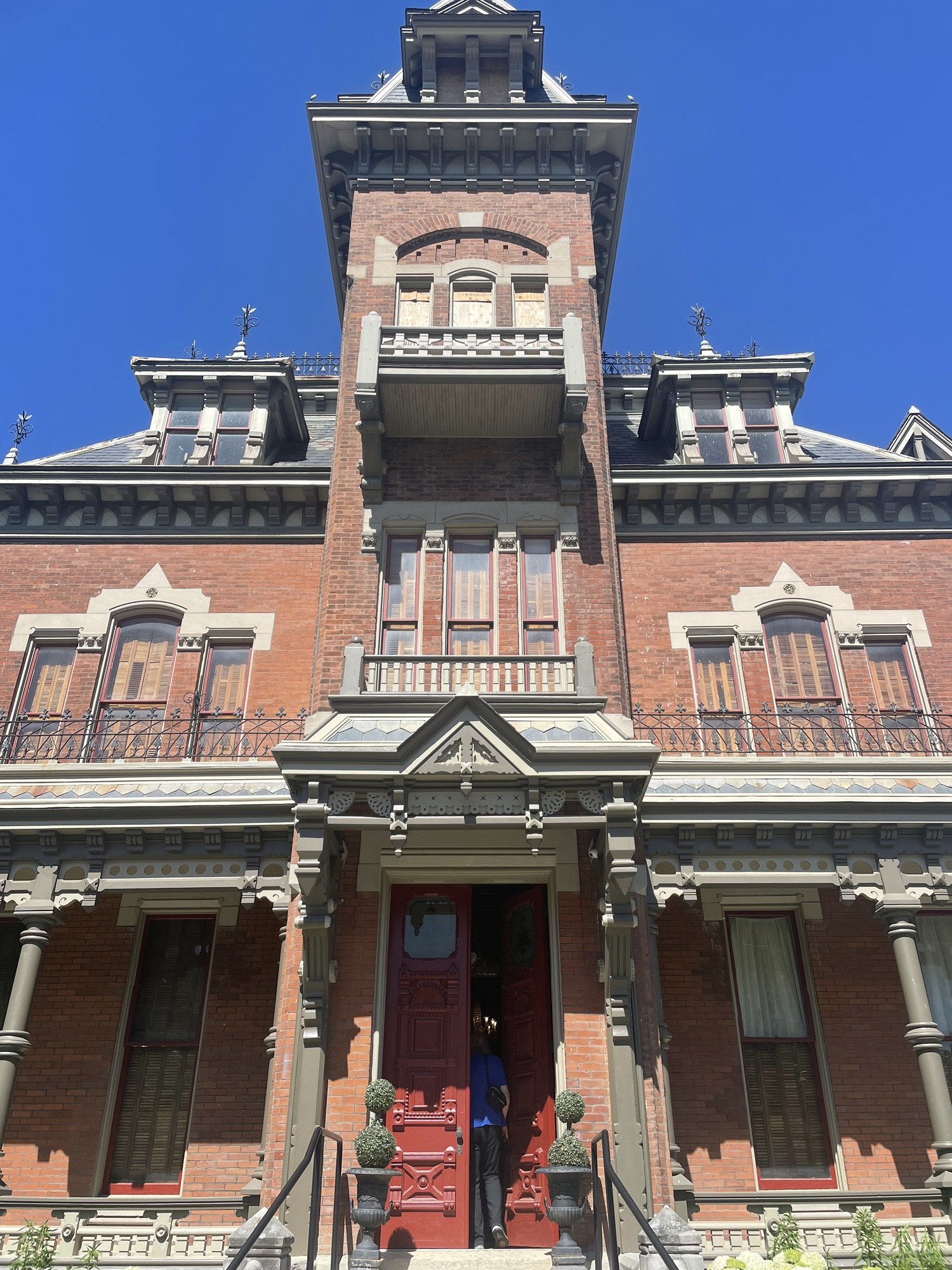
I love old homes that have been turned into museums.  So when I read about the Harvey M. Vaile Mansion in Independence, I knew it had to be part of one of our local excursions.  When I discovered it, the mansion was not open to the public.  It is only open from April 1 through October 31 on Thursdays through Sunday for regular tours, although it does have a holiday season in December. 

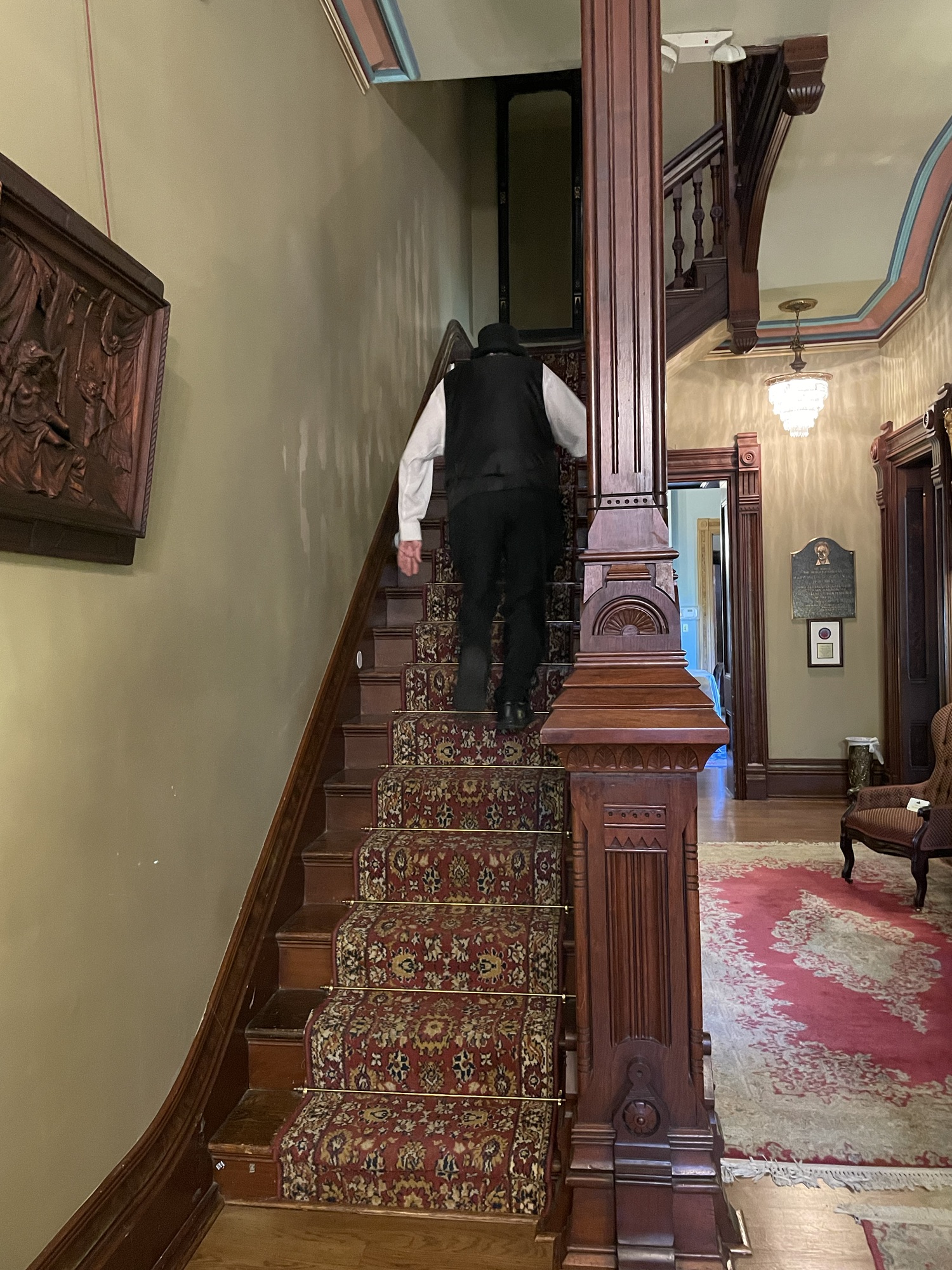
We planned our visit to the Vaile Mansion for May and took a short trip over to Independence to check it out. It was worth the trip!  The mansion is lovely.  It was built in 1881, the mansion has 31 rooms.  But what surprised me is that only two of the rooms were bedrooms!  There were not many people who lived there, but they had plenty of places to use to stay away from each other!! The brick hoe also has nine lovely marble fireplaces of different colors.  Important to keep warm with in the 1880s.

The house was designed by a local Kansas City architect, Asa Beebe Cross. It was the height of modern technology for its time.  It has flushing toilets, fueled by a 6000-gallon water tank.  Copper bathtubs were installed in the bathrooms.  The room where the tank was later used as an informal dining area. The kitchen had hot and cold water!!!

Unfortunately, Harvey Vaile and his wife, Sophia, did not enjoy the mansion for long.  Sophia, who had stomach cancer, died in 1883.  Vaile continued to live there, but he died in 1894.  They did not have any children.  But Harvey Vaile did have nieces and nephews that contested his will which led to a legal battle and their being unable to pay the attorney, who then acquired the mansion!

Over the years it was used as a sanatorium and a nursing home and owned by the attorney Carey May Carroll.  After she died and it was to be demolished a local couple, Roger and Mary Mildred DeWitt, purchased the mansion and began making repairs and restoring it. Mrs. DeWitt donated it to the City of Independence in 1983.

I loved it. The building looks like a mansion should look.  It has a gothic air of mystery!  In fact, my husband commented that it looked a lot like the house in a lithograph I have made by a local artist (Randal Spangler, see link below.)  about a spooky Halloween house!  We are sure it is the inspiration! In fact, in October they do hold Spooky Tours, and supposedly the house has a resident ghost!

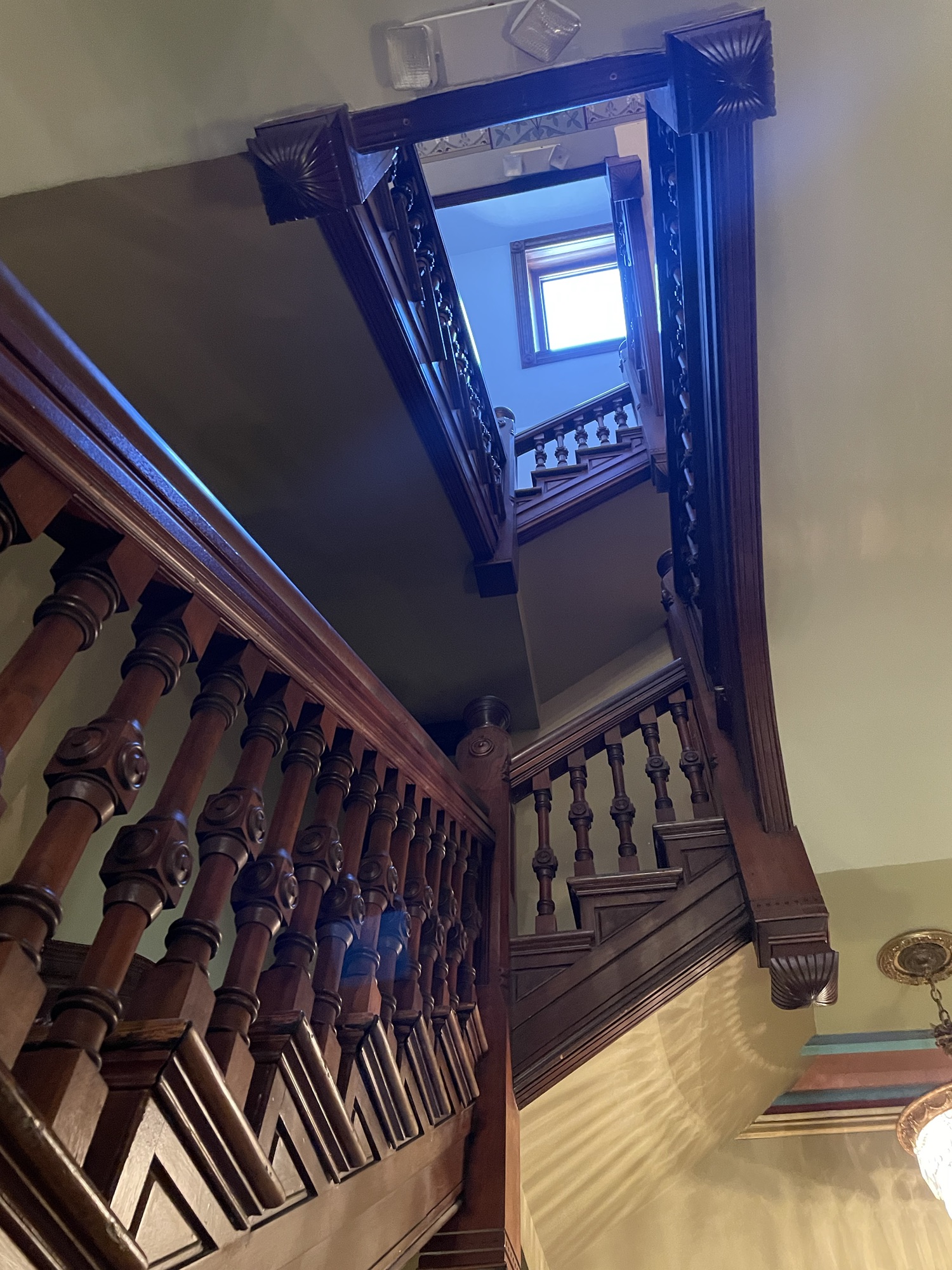
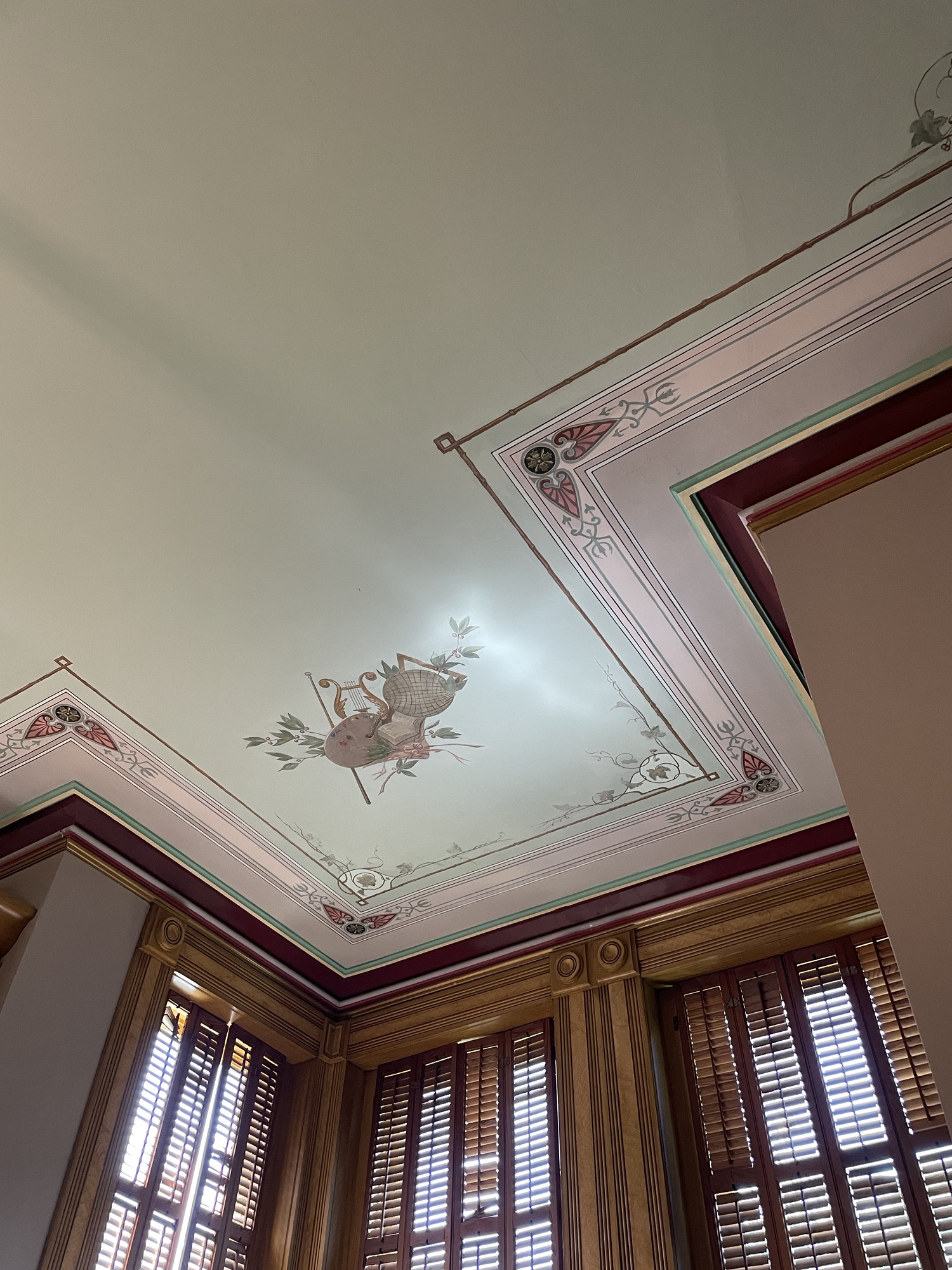
I loved the massive wooden entrance door, and the beautiful leaded glass throughout the house.  The staircase that goes up three stories and ends in a skylight at the top is wonderful.  All the carved wood bookcases and cabinets, along with the painted ceilings, which were part of the original house, makes it truly a gem. The bathrooms, with the cooper tubs and toilets are so unusual for the time! Colonel Vaile was forward thinking!

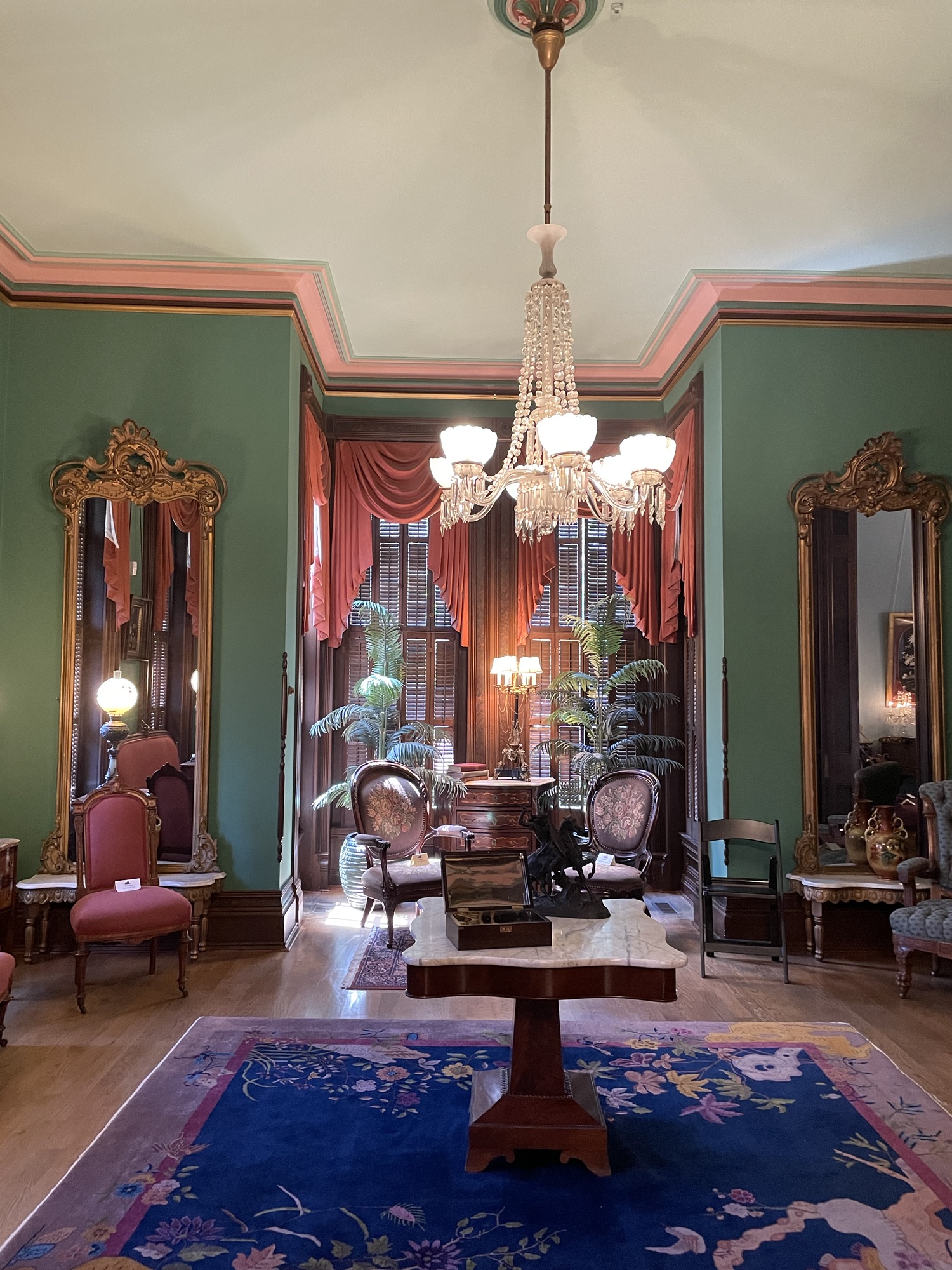
The furniture is all from the period, but none of it was original to the house. But there are many lovely pieces included an organ, piano and music box.  Throughout the house there are little pieces of history to experience. The best part is that a docent takes you on a tour of the house to point out special objects and to answer questions.

The grounds of the house are also lovely.  In early spring a Strawberry Festival is held there. Local couples can rent the house and its grounds for weddings.  It would be a great place to be married.

In all you just need about an hour or so to go through the house.  The day we went we were the only people at that time. As we were leaving more guests were arriving.  It is very close to the Independence Square, so we headed over to complete our day by eating lunch at the Court House Exchange.

https://www.vailemansion.org/

https://en.wikipedia.org/wiki/Vaile_Mansion

https://en.wikipedia.org/wiki/Asa_Beebe_Cross

Trick or Treat House: https://www.randalspangler.com/store-2-1/p/sanctuary-of-knowledge-tplyf-j8pyx-mmn56-8et9k-k4tkm-cshzd-b6res-r9t4e-3fes4-23a3n-59ghm

Bosque de Chapultepec: Visiting Chapultepec Park

30 Nov

While we were in Mexico City, we stayed at a hotel that was located on Reforma, just a short half mile walk from the wonderous Bosque de Chapultepec.  We visited three important sites within the park, besides passing by many others and seeing all the activities enjoyed by park visitors.

rOur three main stops were: National Museum of Anthropology/Museo Nacional de Antropologia; The Chapultepec Castle: and Jardin Botanico del Bosque de Chapultepec/the botanical gardens.  We passed by the Ghandi Garden, the entrances to other sites like the Zoo and the History Museum; and walked through an open air market, where I purchased a straw hat.  We also ate in one of the restaurants within the park, El Lago Restaurante.

Honestly, we did not do these activities in one day.  The park is enormous with so much to see.  But I thought it is best to put it all together in one blog.

The first place anyone who goes to Mexico City must visit is the National Museum of Anthropology.  Besides its wonderful architecture, the museum galleries are filled with pre-Columbian masterpieces.  We had a tour guide who explained what we were seeing in English, which was extraordinarily helpful as almost all the signage is only in Spanish.

The building itself is built around a central courtyard with a large umbrella like structure providing shade. As you walk through the different galleries, you return to the center courtyard between areas.  I found that refreshing.  A way of clearing my mind before entering another new world.

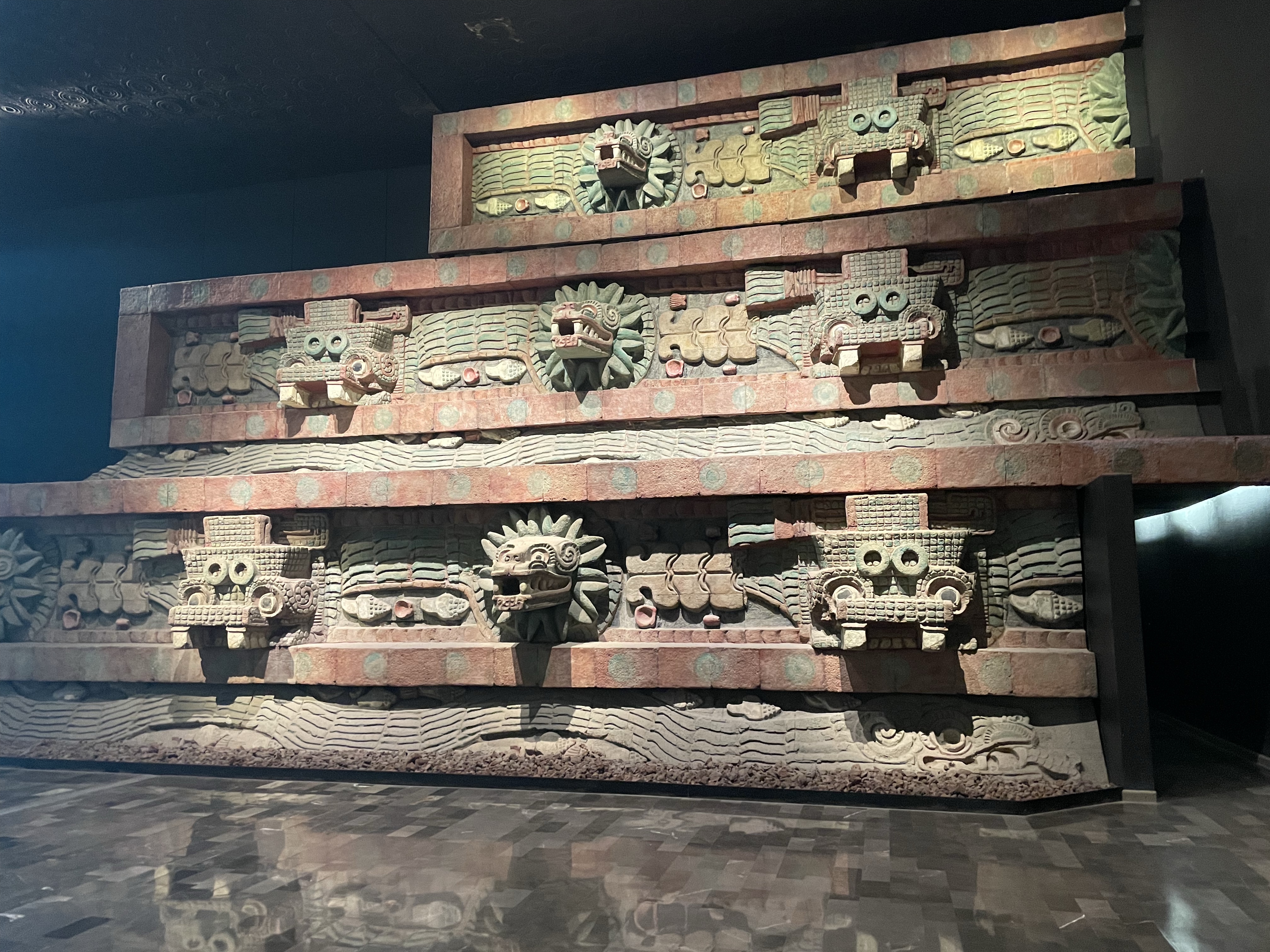
We learned about the Inca, Mayan, Aztec, Olmec  and other peoples who once lived in the various areas of Mexico.  I knew that human sacrifice was a large part of the religions.  Owever, I was shocked at the brutal and almost daily sacrifices.  The artwork of these groups, especially the Aztec, focused on skulls, dismemberment and death.  We learned about the Goddess of Rain and the God of the Sun and the feathered snakes that adorned many of the buildings.  The immense stone carvings were beautiful and many were so intricate, you wonder how they were made centuries ago without modern tools.

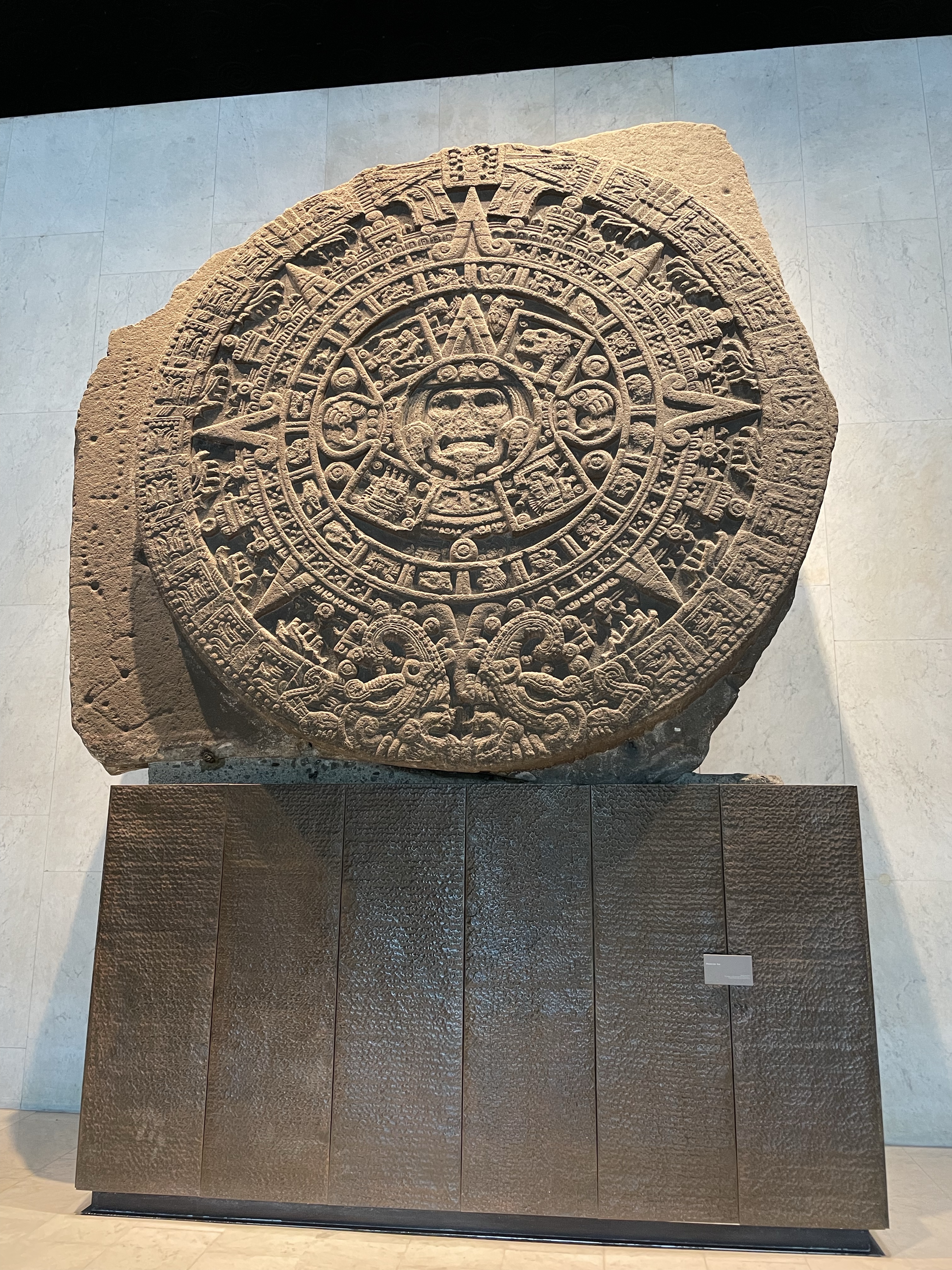
The original Aztec Sunstone is on display, as well as many other majestic and large works of art.  The Statute of Chaichiuhiticue,  and the Olmec stone heads were immense.  Each were carved from one block of stone.  I don’t know how they moved them!

I honestly cannot tell you what was the most interesting thing to see because there were so many!  I did like learning about the game they played with balls that had to go through a stone hoop. However, I was sad to learn that after each game, someone was sacrificed. 

We spent three hours visiting all the rooms of this museum.  I took many photos.  But in the last room, I was exhausted.  I knew I had had enough because I did not take one photo.  I was mentally done.  There is just so much to see.  It is a museum you could visit again and again and still see and learn about things you missed on an earlier visit.

Needless to say, we left the museum exhausted and ready to eat lunch.  We knew we would be back to the park!

We returned the following evening for a dinner at El Lago Restaurant.  It is situated by one of the lakes in the park and is just lovely.  The food is delicious as well.  But the main reason I am mentioning it, is that while we ate, a young man asked his girlfriend to marry him!  It was quite exciting and everyone cheered when she said yes!  It added an extra bit of charm to an already charming trip.

With the park so close to our hotel, we knew that we would be walking back another day.  We chose the morning after we took our Covid tests to make sure we could return to the USA.  Even though we knew we did not feel sick in any way, having to wait several hours for the results would have made me anxious if I just sat around.  We started walking to the park.  Our first planned stop was the botanical gardens.  This one was filled mainly with succulents and orchids, two of my favorite plantsWe walked around the gardens enjoying the quiet.  We ended with walk through the orchid house and enjoying the many succulents planted in cement cinder blocks!  I want to do that in my garden.

Chapultepec Park is considered the lungs of Mexico City.  The acres upon acres of trees supplies the valley with clean air, which is important, because there is pollution in the valley that encompasses Mexico City.

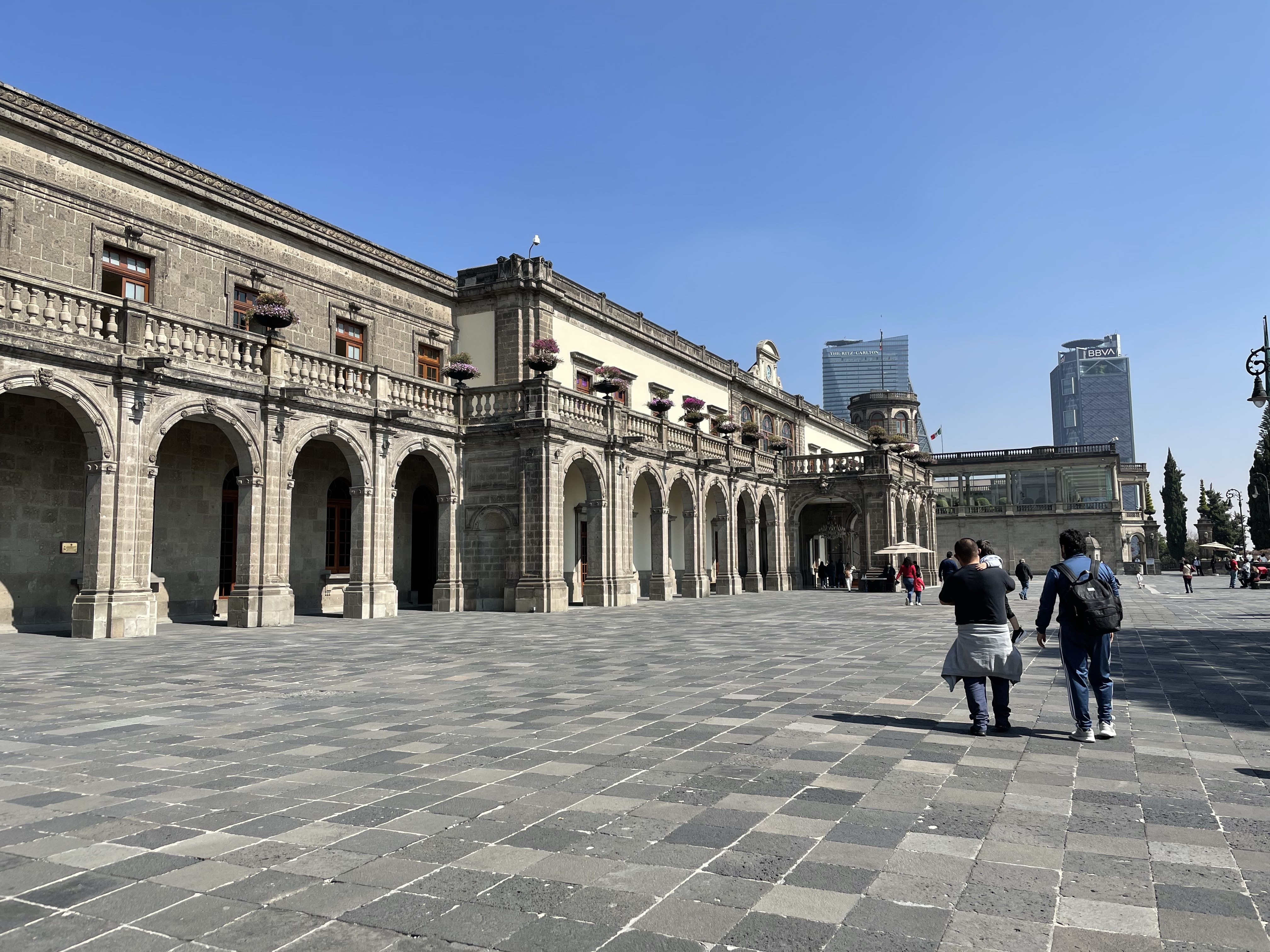
After we left the gardens we continued walking through the park towwards the hill where the Capultepec Castle sits. The first building of the castle began in 1795 as a summer home for the viceroy.  Eventually it was enlarged and became the home of Emperor Maximillian and his family.  Maximilian did not survive for long in Mexico.  He became Emperor in 1864 and was executed in 1867. The unfortunate thing is that Maximillian seemed to care about the people of Mexico.  But it did not save him from execution.  

The Castle then became the home of the President of Mexico and continued as the Presidential residence until 1939.  Now it is a museum. It does cost 85 pesos to enter.  I did not have that much cash, and they do not take credit cards.  However, if you are over 60, which my husband and I definitely are, you can enter for free!  The cashier said,  “Are you over 60?”  I said yes.  She said go in for you it is free.  Thank you Mexico!!  It would have been so sad not to have seen this building and its gardens!

You do have to walk up the hill.  But the slope is easy to climb.  However, I will say with the altitude of 7500 feet in Mexico City, I am glad I waited for the third day to make that climb!  We walked slowly.  You can take a bottle of water to go up the hill.  But once you get to the entrance of the Castle grounds, you cannot bring it in with you.

To describe the building, all you need to do is think about Vienna and St. Petersburg.  Maximillian was a member of the Habsburg family.  So, of course, his home reflected the elegance and grandeur that a member of that family needed/demanded.  It was a bit offsetting to see the grand carved furniture of Europe throughout the areas of the home.  But it was beautiful.  A major difference from a European home, is that each of the rooms could be entered from the interior of the house, but they also had large doors that opened to the outside.  To see the mansion, we walked along the perimeter of the home and looked into the rooms through opened doors.

The view of the park and the city from the top of the mountain is wonderful.  Even better was going all the way to the top and visiting the gardens on the roof and seeing the view from there.

Another added bonus to our visit to the park was finding a parade was in progress on Reforma!  It was Revolution Day in Mexico.  We spent almost an hour watching the music, the floats, the marchers in colorful outfits denoting their province of Mexico, before we discovered the underground walkway that enabled us to return to our hotel.

Visiting Chapultepec Park is a must.  We only saw a few of the many interesting museums and sites to see there.  Honestly, you could spend a week just visiting Chapultepec Park!

https://www.wmf.org/project/chapultepec-park

https://en.wikipedia.org/wiki/Chapultepec

https://en.wikipedia.org/wiki/Chapultepec_Castle

https://en.wikipedia.org/wiki/National_Museum_of_Anthropology_(Mexico)

https://en.wikipedia.org/wiki/Maximilian_I_of_Mexico

Reupholstery Keeps the Spirit of My Furniture, I Hope

20 Oct

Over 30 years ago a truck arrived at my home delivering my grandparent’s bedroom furniture to my home.  Made in the early 1930s, the cherry mahogany furniture was hand carved. The two chairs were covered in yellow silk and stuffed with horsehair, I knew that because the fabric was beginning to fray and the stuffing was coming out. 

The mirrors and furniture were beautiful to see and to touch.  I had so many memories of my grandparents entwined in the furniture.  From my early childhood in New Jersey, when the furniture was in their apartment above the bakery.  When I spent the night, as a small child, I slept in bed with Grandma.  Grandpa was usually up and baking throughout the night. His bedtime began about 8 am.  In the early morning grandma would leave to go work in the bakery.  I knew that when I woke up. I was to get dressed and go downstairs, where Grandma would make me breakfast.  I was never afraid. I was in a safe place, near the chair where Grandma sang Yiddish songs to put me to sleep and under the feather quilt in the winter.  So cozy.

Later the furniture moved to their home in the Catskills where they lived after they closed the bakery.    They would spend most of the winter in the Catskills, but would return to their home in West New York for a few weeks when it got too cold.   The bedroom furniture, along with their other lovly 1930s furniture, stayed there after Grandma died in 1981 and until Grandpa died in 1989. The only piece that did not make the move, was the baby grand piano. (See blog below.)

The bedroom furniture was promised to me, the oldest granddaughter.  And when my grandfather passed away, about 9 years after my grandmother, my parents packed up the furniture, found a mover, and sent it to me along with a few other pieces.  (See blog below.)

I made some changes.  My grandparents slept in twin beds. I saved the headboards, but I had the foot boards and the side railings made into a lovely television stand that matches the rest of the suite.  We did not need these as we use a king mattress.  The headboards are in my basement.  Too lovely to get rid of, they sit waiting for some future date when they will be used.

I left the yellow silk on the chairs.  All these years.  It was the original upholstery, and I could not change it.  In my mind when I saw the fabric, I could see my grandparents. I could remember sitting in the vanity chair and hearing my grandmother singing to me.   I could see myself sitting at the vanity brushing my hair and trying out her hair adornments.  I could remember Grandma sitting behind me and brushing my hair 100 strokes, to make it shine.  The fabric stayed.

The chairs with the original fabric.

Over the 30 years I have had the furniture, the fabric faced the many challenges of two small children.  It continued to decay, fray and split.  Finally, after 86 years, I decided this fabric was done. I had to reupholster the furniture.

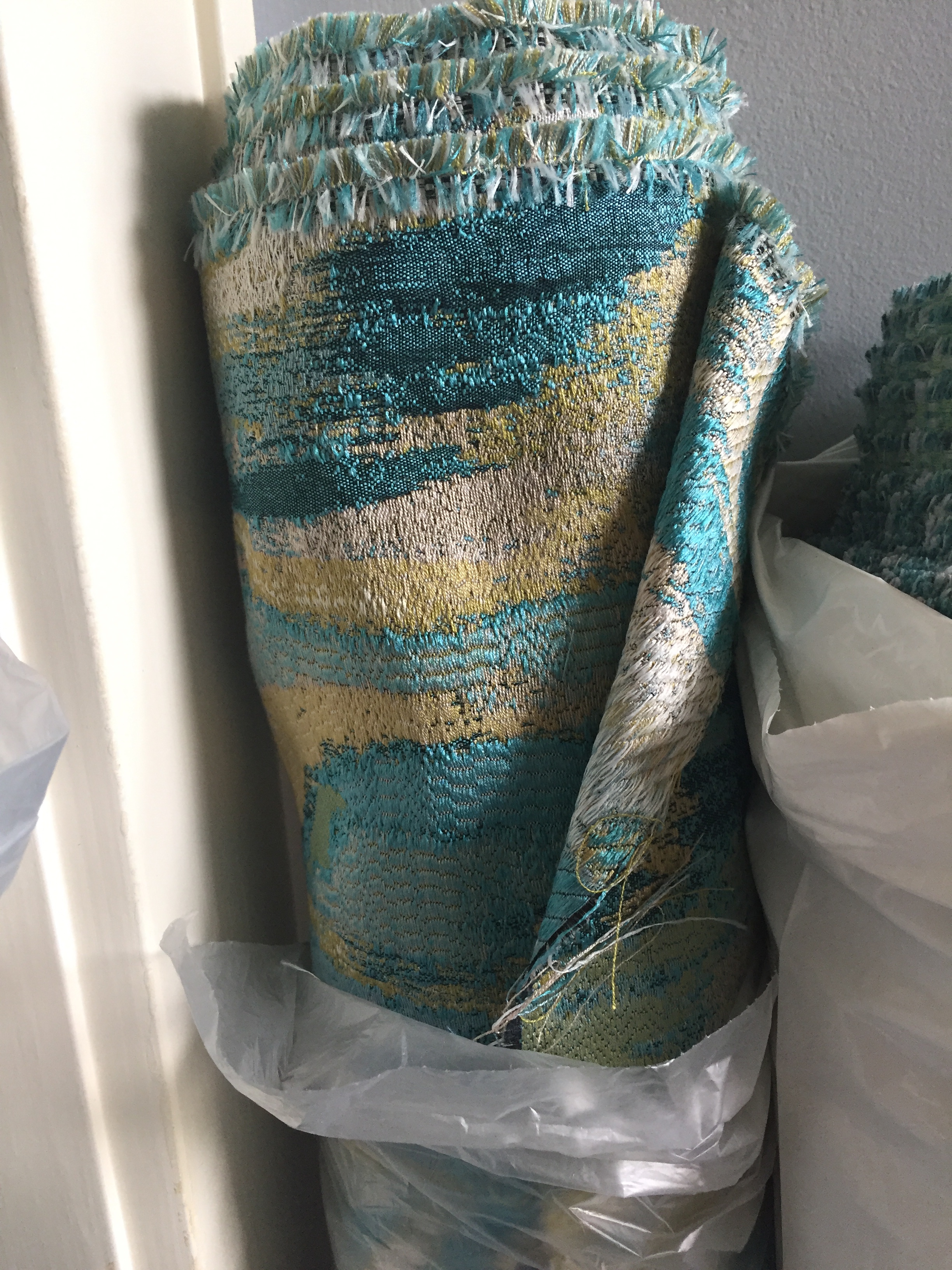
I did it tentatively.  It took me months to find a fabric that I liked. A fabric I thought would go with the furniture, but also recall the fabric that was part of it for almost nine decades.  My Grandmother liked yellow and flowers.  I love teals and blues and geometric shapes.  How could I compromise? 

But then, the perfect fabric appeared. Amazingly it was at Joann’s, the craft and fabric store. And Grandma was watching out for me. It was on sale, 40 percent off!. I also was given the name of a fantastic upholstery, Gearhart Upholstery in Buckner, Missouri.

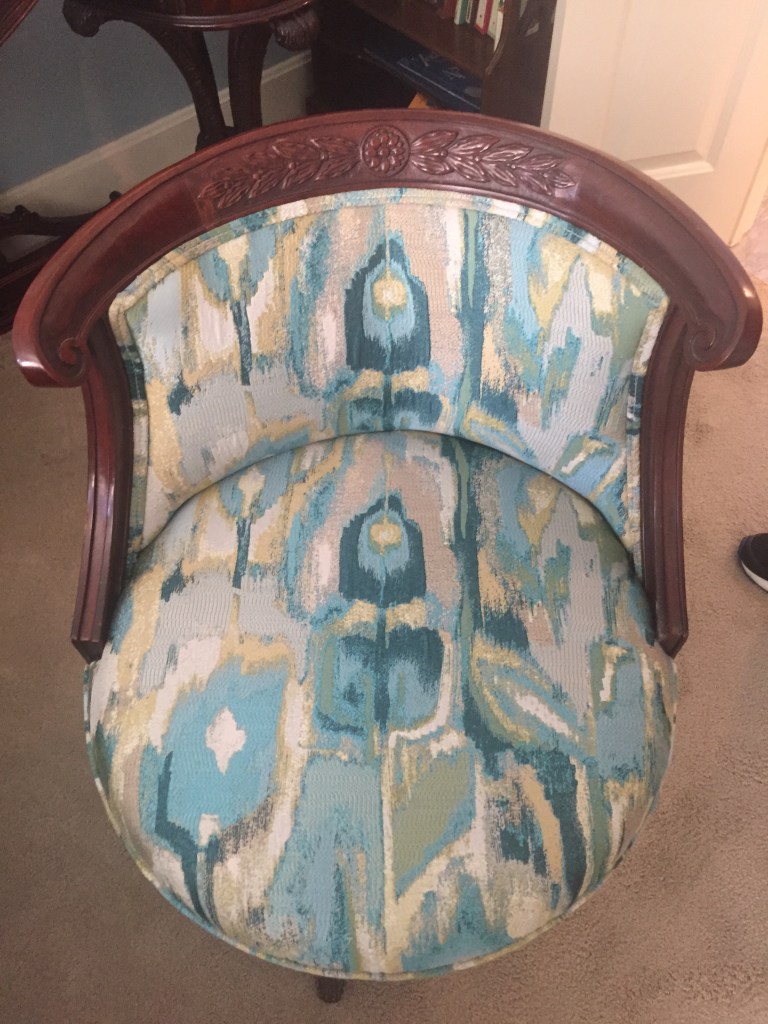
The mainly blue and teal woven upholstery has a bit of yellowish gold swatches.  And the pattern is both geometric, but there are flowers.  Lovely blue and teal flowers. Even though the colors are different, in my mind I kept the spirit of grandparent’s furniture. 

Purchased by my grandparents in 1936.  Sent to me in 1990.  And finally recovered in 2020.  I hope the furniture is loved by my family for many more decades. I hope the memories I cherish will turn into new memories for another generation

Vintage Greeting Cards Stir My Imagination

A Chair, A Baby Grand Piano and Yiddish Songs

The Piano Behind the Fireplace

13 Sep

Our house in the Catskills has been in our family since 1962.  It has gone through many changes.

When my grandparents purchased it, the house had been divided into four apartments.  Slowly, slowly it was returned to a single-family home, with an attached apartment.  Rooms that were divided were opened up or reunited with the house.  Small additions were redone. New additions were created. (See blog below.)

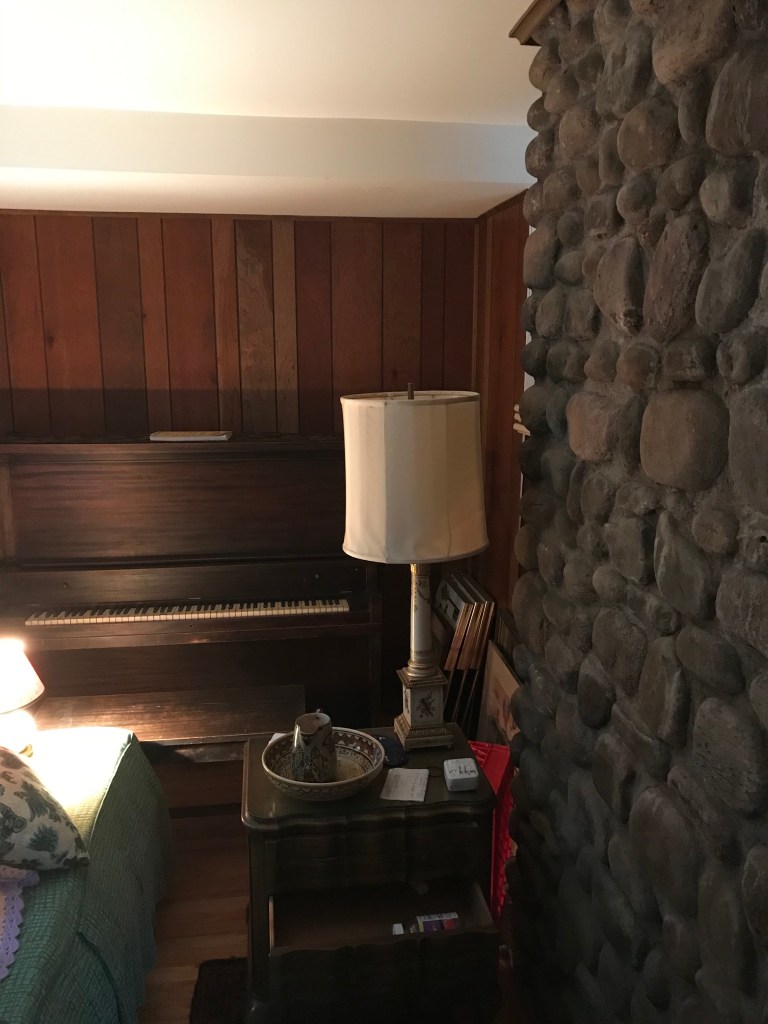
In the living room, a stone fireplace is the focal point.  At one time the back side was covered up and behind it a tiny kitchen and bathroom was put in.  My grandparents restored it to one room.  Behind the fireplace they put a trundle bed for grandchildren and, eventually, their old upright piano.

The fireplace in the center of the living room.

That piano was the bane of my summers.  Over 100 years old now, the piano was purchased second hand for my Mom to use when she was a child.  But Mom’s abilities outpaced this piano, and in the late 1930s, when Mom was about 10 years old, my grandparents purchased a baby grand piano for her use in their New Jersey home. (See blog below.).

Mom eventually became a special student at Julliard.  She studied music there all through high school and had hoped to go there for college. But my grandparents thought a music career was not a good choice.  So Mom went to Douglas University in New Jersey and studied education.

When the baby grand piano arrived, my grandparents had the old upright taken up to the Catskills to their bungalow in the small colony they had created.  Their bungalow was one of the bigger ones, with two bedrooms, a kitchen sitting area, and an enclosed porch.  The piano was put on the porch.

As little children, before my sister was born, my brother and I actually stayed in this bungalow with my parents and grandparents. But once my sister arrived, we started staying in our own bungalow.  The piano stayed with my grandparents.  Whenever Mom wanted to play, she just went over there.  

When I started piano lessons,  I was expected to practice….even during the summer when I had NO lessons. At first it was not a problem, I just showed up to my grandparents and went in and played.  I got treats and lots of positive reinforcement for practicing, even though I would rather be outside playing.

However, my feelings changed after the 1962 summer.  My grandparents moved up to the new “big house.”  We moved up there as well, to live in a bungalow behind the house.  That freed up two bungalows at the colony that now could be rented.  The piano stayed down at the bungalow for at least a year.

Here is where my angst began.   I was expected to go down to the colony, which I wanted to do to see my cousins and my friends. But instead of playing, I was expected to go and practice the piano.  It was no longer my grandparents’ bungalow.  It now was rented by my sort of aunt and uncle.  They were actually the brother and sister in law of my uncle by marriage.  My Grandma Rose and their son, who I considered a cousin, lived there as well.  (See blog about Grandma Rose below.)

The last thing I wanted to do was practice the piano.  Two reasons, first I felt like I was invading their territory.  I now had a set time when I had to be there to practice.  Also, I wanted to play!  Everyone else might be in the lake, but when my set time came, I had to go over to their bungalow.  There were many fights over this with my Mom.  But eventually she let me stop.  It was just not fun.

My angst ended then.  The next summer a space was made for the piano.  That little kitchen and bathroom behind the fireplace were gone, as was all the plumbing and fixtures.  The walls were cleaned and wood paneling was put in.  In the area that was once a bathroom, the upright piano now stood, back in my grandparents’ house.

So now, I could practice anytime of the day.  I left my music in the house.  On a rainy day, I could practice for as long as I liked.  While, on a beautiful day, I could just run in after a day at the lake. A low note chord broke when I was young, and we never replaced it.  I used the note so rarely, that at the times I did, I would be shocked when no noise came out.

Over time, I went to college, got married and moved away.  The piano was rarely touched and soon went out of tune.  When I started going up with my children for two weeks each summer, I wanted to get the piano tuned.  But the person we called said it was impossible, it had sat untuned for so long and it was too old.  That made me so sad.  But we left the piano there, and occasionally I would still play even with the discordant sounds that came out.

But in this time of COVID-19, the piano has been revitalized.  My nephew, who also plays the piano.  Needed a place to stay.  He had planned a long trip to Europe and had not renewed his big city apartment lease.  He asked to stay at the Catskills home.  We all agreed.  It was perfect for all of us, because we have used his time there to get some chores done and things fixed that were benignly neglected as we are usually there only on weekends.

Thanks to my nephew, we now have internet in the home and we have tasked him with meetings with an electrician, plumber and other workers.  He got a dock put in at our lake front section of Kauneonga Lake.. 

However, his greatest success, for me, is the piano.  My nephew plans to spend the winter there as well. As it is a four-season house, he can. It was my grandparents’ full-time home. So he decided to get the piano tuned!!! He found an old-time piano tuner, who has restored the sound!  This gentleman slowly got it back into shape, by doing it correctly. Over several months he came and tuned the piano just a bit until the sound board and strings could accept a full tune.

But besides tuning it, the piano tuner has dusted it and oiled the wonderful old wood.  The piano looks better than it has in 20 years. It brings me joy that the piano behind the fireplace is now a working piano giving my nephew a chance to practice his hobby as he experiences the cold winter months in Sullivan County.

(Exact dates of when of when the piano moved to the house and when I practiced at the bungalow are somewhat unknown, as it was many many years ago.)

Remodeling My Bathroom Reminds Me of Our Catskills House: The House Which Always Changed

A Chair, A Baby Grand Piano and Yiddish Songs

Movie Night in the Catskills Was A Wonderful, Magical Night

A Theodor Herzl Pocketknife And Anti-Semitism

31 Dec

I have been thinking about Theodor Herzl lately.  I know it is because of the upswing in anti-Semitism and Herzl’s role in establishing the State of Israel, which now leads to anti-Zionism, which is finally being realized as just another name for anti-Semitism.

It was Herzl who, after the horrible affair of French anti-Semitism when an innocent Jewish officer, Alfred Dreyfus, was sent to prison despite his innocence, became an ardent Zionism.  Herzl campaigned for the establishment of a homeland for the Jewish people. He was a founder of the Zionist Organization, which encouraged Jewish immigration to what was then Palestine, to form a Jewish state.  I have visited Herzl’s grave in Jerusalem at the cemetery on Mt. Herzl. (See blog below.)

Perhaps I am thinking about Herzl because I am going to Budapest next fall.  Herzl was born there in 1860 on the Pest side of the river.  Herzl’s family lived next door to the famous Dohany Street Synagogue, which I am going to see when I am there. I will also see where Herzl spent his early years as I am also going to Vienna, where Herzl went to college.

But it is Herzl’s defense of the Jewish people against anti-Semitism and his desire for them to have a safe place to live reverberates with me.   I keep asking myself, is it true?  Do all Jews really need to move to Israel to escape the hatred that seems to be rising throughout the world?  There are days when I am just stunned by what is happening. And I consider this option.

However, I feel safe where I live. I know people of all religions are supportive of interfaith discussion and community. I belong to several groups, like the Sisterhood of Salaam/Shalom, that work to create positive relationships.  But even here we have had a vicious anti-Semitic attack several years ago when three people were killed at the Jewish Community Campus and Village Shalom, the home for the elderly. The irony is that all three people murdered were not Jewish.  It was a raging anti-Semite who committed the crimes.

img_7197

It was a little bit of a shock when I found a Herzl penknife in a small drawer in my bedroom while on a recent cleaning binge.  It was a reinforcement of my feelings of dread. The little knife belonged to my husband’s father.  We have no idea where he got it, or why he had it.  But it shows age and use.

The pocketknife is slim.  About 3 inches by ½ inch by 1/3 inch deep.  Engraved on the front is a Star of David, with inlaid white and blue stones (a few pieces are missing or damaged) and an engraved portrait of Herzl with his name underneath it in Hebrew.

There are two blades, one is engraved on both sides.  On one side is a symbol of what looks like an ancient king or warrior holding two blades and underneath it is:  SMF Solingen.  The other side of the same blade has two lines of writing that is a bit worn.  The bottom word is Germany.  Above it are two words: perhaps, Leopold Borwitz.  Let me know what you think!?

I have found out that Solingen, Germany, where Adolf Eichmann was born, is known for its blades, it is the main industry of the region since the middle ages.  It is actually known as the “City of Blades.” Knifes and blades for all reasons, cooking, hunting, killing, protection, pocket-knives, cutlery, swords, scissors and razors and other items made of steel and silver are produced there. The city was bombed repeatedly by the British because of the many weapons companies.

I found this company mark that is similar to mine on Items from Solingen, Stocker & Company, SMF, Solingen.   Their mark has added lines in the clothes and sword, but otherwise it is the same mark. On the company website are many pocketknives/penknives that are similar in size to mine, some are vintage models, others are newer.

The painful part is that this company made knifes for the Nazis!  Among the vintage knifes are ‘rare’ German Nazi Luftwaffe paratrooper knives, World War 2 Nazi Gravity Knives, SS daggers, Hitler Youth daggers, and more.  Imagine my shock as I think about anti-Semitism, and I find a knife with Herzl and a Star of David, and then I find out that this company made knives for the Nazis. I believe this company went out of business in the early 1970s.

In 1932 the city of Solingen had only 265 Jewish residents before the war. By 1933 over one hundred had already left Germany by emigrating.  By 1938 the official Jewish population was only 89.  Some of these souls died in Dachau, some in Theresienstadt. A few survived the war. But the Jewish community along with its synagogue was destroyed.

I have been to Germany.  It actually now has a thriving Jewish community made up mainly of Jews from the former Soviet Union and Israelis who families were Germans before the war and can claim citizenship.

But this does not help to solve the mystery of this knife.  When was it made?  I am assuming it came after the Second World War. Perhaps to commemorate the establishment of Israel?  I am not sure I will ever know.  I looked on EBay and other websites to see if I could find another penknife like this. But there were none!

My little Herzl pocketknife takes on so many meanings in my mind.  Its history, its maker, why my husband’s father had it?  Many thoughts are going through my mind.  Anti-Semitism, Anti-Zionism, Nazis, Germany, Herzl, Israel.  They all seem to coalesce in this knife.

As the new year begins, I hope for a year of peace and civility.  I hope that as it says in the Torah, we will beat our swords into plowshares (Isiah 2:4).  And that is the message I will take from my knife.  A company that can make weapons for the Nazis, then can make a knife to commemorate Herzl and Israel.

I am hoping that 2019 was an aberration and that 2020 will bring light back to us all.


https://zicharonot.com/2014/05/05/remembering-those-who-passed-yom-hazikaron/

https://en.wikipedia.org/wiki/Solingen

https://www.reference.com/history/history-rostfrei-knives-644fa4d4588eebbe

http://www.dg.de/en/maker/smf-solinger-metallwaffenfabrik-solingen-stoecker-rzm-m7-9


Childhood Events Definitely Impact My Adult Choices

5 Dec

When I was a child, I remember going to my grandparents’ cousin’s candy store on Bergen Boulevard near Journal Square in Jersey City.  My brother and I have discussed their names, as it is a memory from long ago, over 50 years.  He remembers the wife as Anna, and I remember the husband, as Morris Brenner.  We will go with these two names.

Like my grandparents, they were from Europe.  I believe that Morris was my grandfather’s second cousin.  That is a connection I have yet to finalize.  But I am pretty sure he was not a first cousin.  However, in the area they came from in Galicia, Mielec, my grandfather’s family was large and very intermingled.

The best part of going to the candy store, of course, was the candy.  We could eat whatever we wanted, within the reasonable constraints of my mother. The other part was seeing Morris and Anna, who were always excited to see us.  They never had children of their own, but they loved us.

Sometimes, my Mom would drive my grandmother, my brother and I to visit them in the candy store.  I have good memories of being there. My grandmother and Anna always had a good time visiting.  So even though it was my grandfather’s cousin, my grandmother often went to visit without him.  And since she never learned to drive, my Mom had that job and we got to tag along.

Morris always sat behind the counter and ran the cash register. He sat there because he no longer had legs, he lost them to diabetes.   Anna ran the store.  She was tiny and very energetic.  That is why what happened is so sad.

img_1484

Morris’ rocking chair. Now owned by my brother.

Anna died first.  I don’t think she was that old.  But when she died, Morris could no longer stay alone. The store was closed; their belongings were sold or given away, and Morris went into a nursing home.  I remember my parents speaking about it, because we were gifted his rocking chair.  It did not go to the nursing home with him.  My brother still has the rocking chair in his home.  The tangible evidence that Morris and Ann were part of our world.

The nursing home Morris lived in for the rest of his life was in Bayonne, New Jersey, close to where our family dentist had his office.  Usually we all went to get our teeth done at one time.

But on this day, it was just my Mom and me.  As we drove away from the dentist office, she turned to me and said, “I want to go visit Morris.  I know he lives near here.”I don’t remember how old I was, somewhere between 10 and 12.  To be honest, I thought we were going to the candy store.  But I was in for an unpleasant and emotional surprise.

When we arrived at a large one-story building, my mother and I entered and went to the desk, where Mom announced that she wanted to see Morris.  The woman stopped what she was doing and called to someone, a nurse/supervisor/care giver came out.   Both were so surprised that we were there to see him.  The supervisor said, ‘Oh my, who are you? You are the first people who have ever come to visit him.”

My Mom was stunned.  “Are you kidding me.  He has nieces and nephews.”  But she was not joking.  No one had visited Morris in the year or so he had been living there.

The nurse walked us to his room.  In fact, by the time we got there, I think three or four nurses or caregivers were following us.  Mom walked in first and knelt down beside Morris.  “Morris, It’s me Frances, Nat and Thelma’s daughter.” She said in Yiddish as she reached out to him.

Morris started cry.  He put his hands on either side of Mom’s face and sobbed, “Frances Frances.” Her name was like a chant.   While Mom hugged him with one arm, she put out her other arm, I knew that meant I needed to come over.

“Here is Ellen,” she said.  My face was now embraced by his hands as he cried into my hair and stroked my face.  I was crying by then as well, as were Mom and the nurses/caretakers.  We stayed and talked to him for about an hour.  It felt longer.  He spent most of the time crying and hugging us. And asking about all the family. I have never forgotten.

As we went to leave, the supervisor asked Mom for her address and phone number in case they needed to reach someone.  They had no contacts for him.

We went and sat in the car.  My Mom cried for an additional half hour or so.  Just sobbing, with her arms crossed on the steering wheel and her face down in her arms.  I cried with her.  It was one of my saddest moments as a child.  When we got home, my Mom called her parents.

I never went back to the nursing home.  I think because every time I thought of him, I started to cry.   But I know my Mom and my grandparents went.  To be honest he did not live long after our visit.   My sister, who is four years younger than me, does not remember Morris or Anna. But what she does remember is my grandparents and my mom talking about him.  And my mother always talking about what happens to someone when they are all alone in the world.

For the past ten months I have been a Spiritual Care Volunteer at an elder care facility.   Over and over again people have asked me:  How can you do that?  Doesn’t it bother you? Isn’t too difficult when someone dies?

The answer to all these questions is an emphatic NO.  Each week when I go, I am greeted by smiles and joy.  I speak to each one of them.  Some days I give them hugs.  Sometimes someone cries, especially if they have recently lost a loved one.  Most of them have family members who often come to see them.  Most important to me is that I know that I am going every week.  I am giving them the attention that Morris so deserved and did not receive.

This childhood event definitely impacted my adult choices. Each time I go, I feel a little lift to my heart, knowing that I have helped to brighten someone’s day.  It is the best feeling, because each time I go, a little of the sadness that has followed me for over 50 years, whenever I think about Morris, dissipates.

Bells Chiming Make Me Feel Better

15 Jul

When I was a child, and home sick, my mother would give me a little bell to ring if I needed her.   My brother and sister also had the use of the bell when they were sick.  I loved that bell.  I knew as long as I had that bell, my Mom or my Dad would come into the room and make me feel better just by being there. Its sound brought me comfort.

img_4176

Space shuttle bell on the left; Tinkerbell bells in the back.  Chilean bells in the front.

So, of course, when I had children, I also wanted them to have a special bell to ring for me.  I tried many.  For my daughter, I tried a little plain bell first.  But the sound was really dull.  With her bedroom upstairs, I needed something that would sound better and stronger.  We found one in Disney World.  A little Tinkerbell bell that was perfect, as my daughter loved Tinkerbell.   In fact, my Dad would call her ‘Tink’ all the time.  Although in reality, she thought she was Tigerlily.  That is a story for another day!

When that Tinkerbell bell eventually broke from use, we purchase a new one. It was not the same for her.  Too bright, not darkened with use.  But luckily, we were able to rehang the original bell, fixing it and reclaiming its tinker.

For my son, I purchased a bell from the Kennedy Space Center.  I am not sure why the space center sold bells, but the sound was good.  Since my son liked space ships and rockets, this bell was perfect for him, with its dangling space shuttle.

Whenever they were sick, I would give each of them their special bell to call me when needed.  Did it always work?  No, not often.  Usually they would just call me, and I would come. But for me it was a comfort to know they had a bell.  In my mind, having a bell was about continuity and love. By giving them a bell, I was giving them the power to bring me to them, like a magical wish.

I always have been attracted to the sound of bells. I love listening to handbell choirs. There was even a Hershey’s television commercial that used chocolate kisses as bells.  I loved it.  So when I travel, if I see an interesting bell, I am attracted to it.    I did fine some lovely bells in Chile a few years ago. To be honest, although they are lovely to look at, they do not sound good at all.   In fact, no bell quite sounds as good as my mother’s bell.

Actually, I have my mother’s bell, so I really need no other.   I believe my Mom brought to me when she came to visit one time because she knew my attachment to it.   I keep it in my family room.

It is a small brass bell, with a bit of red trim, set in a holder.  On the bottom it says “Made In India.”  But 60 years ago, when my mother first had this bell, I do not think there were many things from India for sale in the USA.  I now know that it is called an elephant claw bell, because of the shape of the bottom.   I have seen several similar bells with base for sale on line.  Sometimes they are called “antique ceremonial meditation bells.”

I can see it being a meditation bell, as It has the loveliest of tones. My bell has the same tones as those used by my yoga instructor to indicate the end of class.  But for my bell, when I ring it, my soul and heart returns to those happy memories. And I see my Mom in my mind — my young mom, the mother of three small children.

Another bell was important to my family. We used it only in the Catskills, my Mom and my Grandma used a large metal dinner or cow bell to call us to come in.  The bell hung outside the door of my grandparents’ house, facing the back towards our bungalow.  We had four acres of land including woods, so they often did not know where we, the children, were playing. Sometimes we were at our neighbors’ yards playing. It did not matter, when heard that large bell ringing, we knew to come.

Grandma would also ring that bell when she wanted one of us to come down to her house to get something or do something for her.  My mother would ring to bring us in, yelling our names along with sounding the bell.  It was used daily.  When she had grandchildren, my Mom used the bell to call them in as well.

Th bell is still at our Catskills’ home waiting for another generation to be called. Its loud clanging, not so beautiful in tone, but beautiful in memories.

The sound of bells chiming almost always puts me in a good mood and make me feel better.


https://www.thetabernaclechoir.org/videos/carol-of-the-bells-mormon-tabernacle-choir.html


https://www.youtube.com/watch?v=Pe4IZ7aGikw


When A Trading Post Becomes A National Park or A Grand Canyon Hotel!

23 Mar

Part of our tour of the Navajo and Hopi reservations were visits to different trading posts and shops along the way.   But nothing prepared me for the wonderful Hubbell Trading Post National Historic Site in Ganado, Arizona.

First you need to know that I love historic homes.  Show me a home museum, and you have shown me the spark of joy!   The Hubbell Trading Post combines the history of trading between the outside world and the Navajo as well as a historic home.

The trading post itself was an important commerce arena for the Navajo.  John Lorenzo Hubbell, his wife, Lina Rubi, and their children were friends to the Navajo people.  Although they made money off of them through the trade of their native art works for goods sold at the trading post, they cared about the people.  This shows in the fact that the Hubbell Trading Post was under the business eye of the Hubbell family from the 1880s until well past Hubbell’s death in 1930.  In fact a member of the Hubbell family ran the trading post until  1967, when his daughter-in-law Dorothy Hubbell sold the post to the National Park Service.

The Trading Post still works as a trading post today along with the US post office at the post.  Today it is managed by the Western National Parks Association, with the profits going to programs of the National Park Service.

But seeing and shopping at the Trading Post is not the only highlight of this visit.  We also had the opportunity to see the Hubbell home, which sits behind the trading post.  The big central room has three doors on each side leading to the bedrooms used by John and Lina and their children.   We did not see the kitchen, which was a separate area.  But we were happy to see the house.  It was a snowy cold day and they allowed us in, with the caveat that we had to take off our shoes!!!  BRRRR.

The original woven rugs are no longer on the floors, but the recreations are also stunning.  The walls filled with painting and art work, the ceilings covered with woven baskets, the giant wooden beams, the high ceilings, the unusual lighting, all create an atmosphere that gave me joy.

img_2271

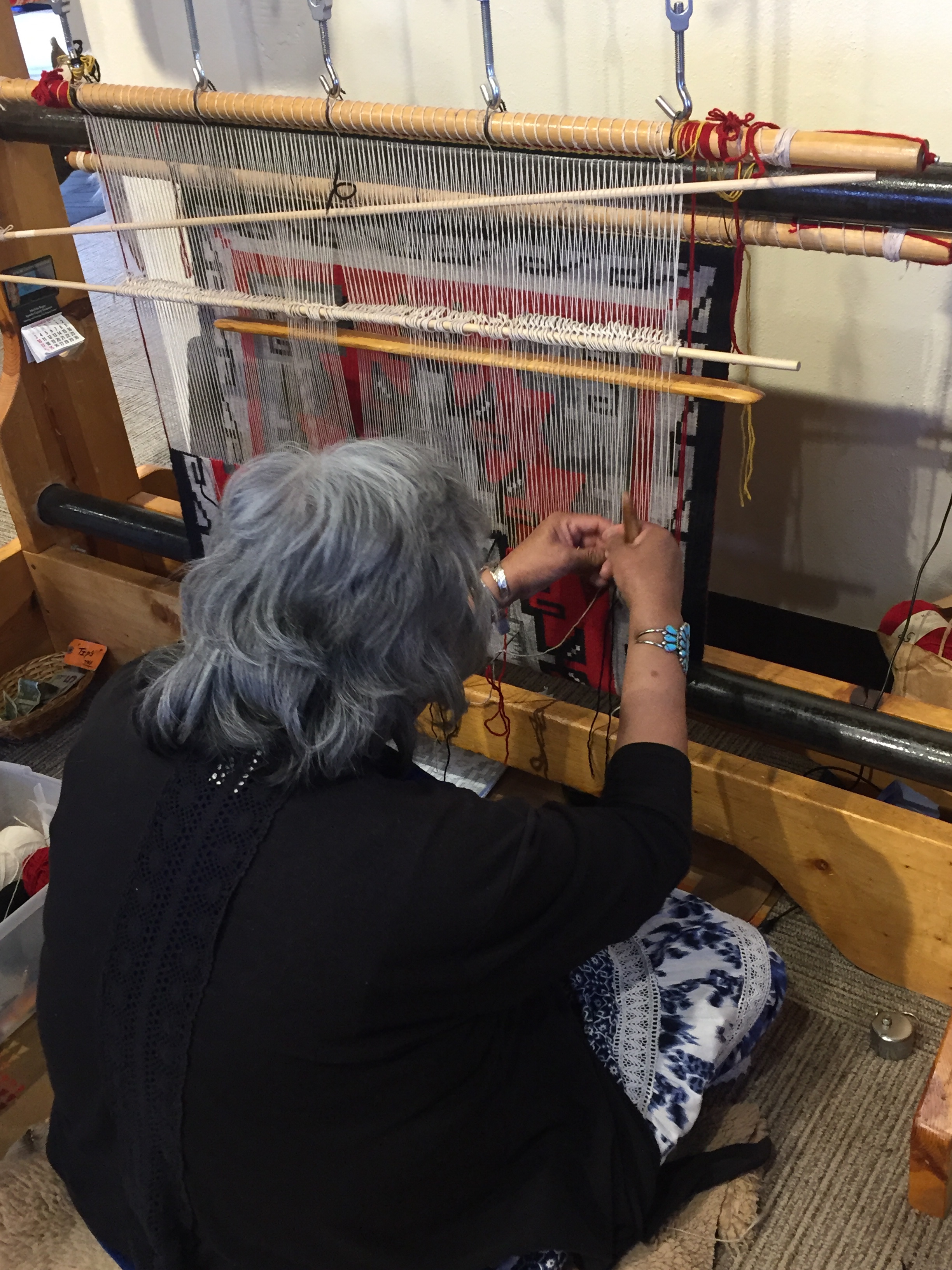
The Visitors’ Center a few steps away from the Trading Post was also a great stop.   Inside you can pick up brochures, learn about the history of the trading post. The display about weaving was wonderful.  The best part was the opportunity to watch a woman weave in the traditional manner.  Well worth the visit!

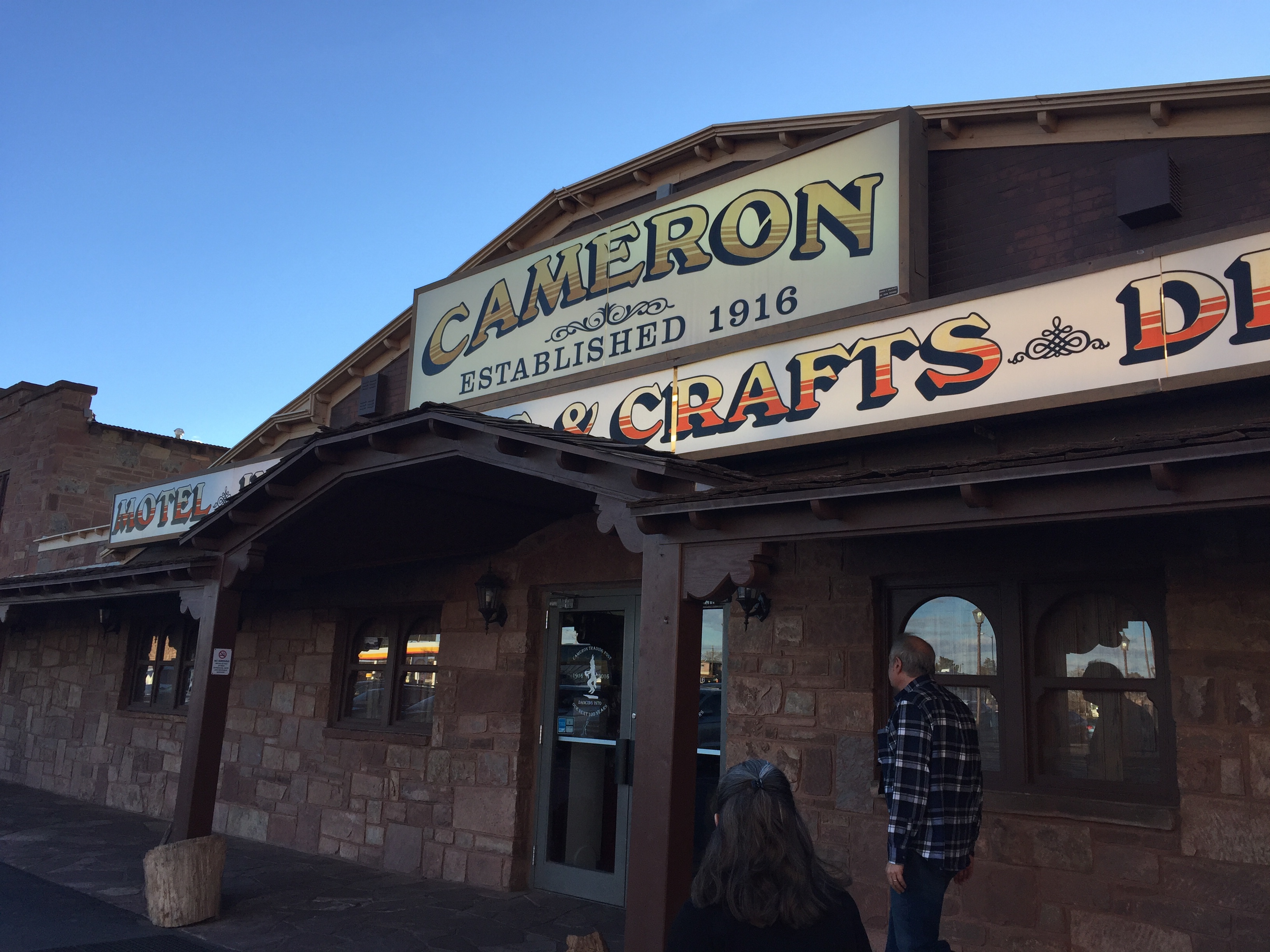
Seeing the Hubbell Trading Post would have been enough for my trading post desires, but we had an additional bonus. The last night of our trip was spent at the hotel at the Cameron Trading Post. Just over 100 years old, (founded in 1916) it is just one mile from the Grand Canyon and just steps away from the Little Colorado River.

img_2511

The enormous store or trading post is filled with items from the Navajo and Hopi.  It was a feast for the eyes, but not for the wallet!!!  We went through the shop many times on our way to the restaurant, and just for entertainment.     The dining hall was a work of art itself with its tin ceiling, wonderful rock fireplace, rug hangings and antique windows.

We enjoyed the night in our spacious hotel room where we could easily go out and see the bridge that spanned the river.

img_2515

I was glad that we were able to learn the history of trading posts that were positive for the Navajo and Hopi peoples.  It was exciting to spend time at them and to learn about the importance in the past and their continued importance now.


Do I Need A Thimble? I Guess So.

23 Oct

When I first started sewing and doing needle work like embroidery, my paternal grandmother gifted me two thimbles. One was hers and well worn, the other was brand new and silver. She told me that I needed a thimble because it would make sewing much easier and would protect my fingers from calluses and cuts.  She was probably right.

I still have these two thimbles, but to be honest, I actually hated using one.  I tried for the longest time to get comfortable having a metal hat on my finger.  I usually did not wear the thimble all the time, rather I just put it on for a moment when I had a tough, stubborn stitch to get through layers of fabric.

My paternal grandparents are the ones who nurtured my interest in the sewing/knitting/crocheting arts.  Grandma taught me how to knit and crochet.  Grandpa was a tailor who helped me with the intricate details of sewing like the best way to match plaids, especially around pockets.

He also taught me how to cut/design a pattern to fit a specific person.   This came in handy as my maternal grandmother had scoliosis, so when I made her dresses, I had to make one side of the dress two to three inches shorter than the other side without it looking weird. Thanks to my grandfather, I was able to accomplish these designs. I have written about my grandfather’s tailor shop on Delancey Street.  See blog below.)

The gifts of the two thimbles were part of that nurturing and encouragement.  I kept them close in my sewing basket for those times when I did need them.  But after a while, I put them in a safe place, because I did not want to lose them.

img_0332

My printer’s box and almost all my thimbles.

Eventually the two thimbles became the start of my thimble collection.  It is not large, about 60 thimbles in all.  Although I have not purchased a thimble in years, I still have them on display in my kitchen’s printer’s box – the perfect spot for tiny collections.

Printer’s boxes were popular about 35 years ago, when printers went from hot type to computer generated type.  As a journalism student, I actually learned to set type and had to memorize where the different letters and spacers and numbers were kept in this box.  I still remember some.  My first cousin gave me my printer’s box as a gift.  It was the perfect for me for my journalism background and for my thimbles.

Most of my thimbles came from places I visited.  They were the perfect item to remember a trip, as they did not cost too much and were convenient to carry.  I have thimbles with Disney characters; others showing famous sites like Golden Gate Bridge or the Alamo or Mount Vernon; some depict cities like New Orleans.  Most are from different states in the USA that I visited, but others come from other countries like Budapest, Hungary; Dominica; Spain.  I even have three thimbles from NASA! Two depict the space shuttle, and one shows an astronaut floating in Space.

img_0372

A close up of my printer’s box, you can see my three Nasa thimbles and the top left is my limoges one.

Some thimbles are so lovely with hand painted landscapes or designs.  One is made of cloisonné, another is from Limoges.  I actually have a little sewing machine from Limoges in my printer’s box. I am sure my Mom got them for me as they are pink and red.  I would have purchased blue!  But my Mom often got me items in the warm tones.

img_0315

The case holding my Spanish scissors and thimble.

I do have one other special thimble purchased for me by my parents.  It is housed in a red leather box with a pair of scissors. Inside the box is marked with the words, Artes De Toledo.  I believe my parents purchased this set for me when they went to Spain about 30 years ago. Toledo has a history of making both swords and damascene metal inlay.

My scissors and thimble are definitely Spanish!  They have the look of damascene metal inlaying, but with colored inlay.  I know that Toledo is famous for its steel work. But I  have never seen anything else like it, so I googled Spanish scissors and found scissors very similar to mine.  They were labeled “Toledo antique embroidery scissors”.  Makes sense, as I used my set for embroidering as well.  I will say that  mine is in much better shape than the ones shown on Pinterest!  There were even four cases with matching scissors and thimbles, similar to mine!  All from the 1920s and 1930s.  Which makes me wonder, where exactly this set came from!

I have not looked at my thimble collection for years.  I see them in the printer’s box, but I don’t really look at them and remember when I purchased them.  The special case from Toledo, I keep up in my sewing room, closed and put away.  Thus, I must say thank you to AtticSister and her blog post about a thimble case, which sparked my search for my red leather box and to look more closely at my thimbles.  You can read her blog here:  https://atticsister.wordpress.com/2018/10/12/antique-walnut-thimble-case/

Earlier blogs I wrote about sewing.

https://zicharonot.com/2015/10/10/12-delancey-street-and-my-family/

https://zicharonot.com/2014/01/29/my-birthday-sewing-machines/

https://zicharonot.com/2015/12/27/why-i-gave-away-a-bit-of-my-moms-memory/