Archive | April, 2025

Beautiful Outdoor Experiences in Florida

30 Apr

On a recent trip to Florida to visit family, my cousin insisted that we couldn’t just sit at her home and visit.  We had to go somewhere and see something new. That was great because leading up to the trip, I had read about the Morikami Japanese Gardens.  It was a place I wanted to see.  It turned out to be an excellent adventure.

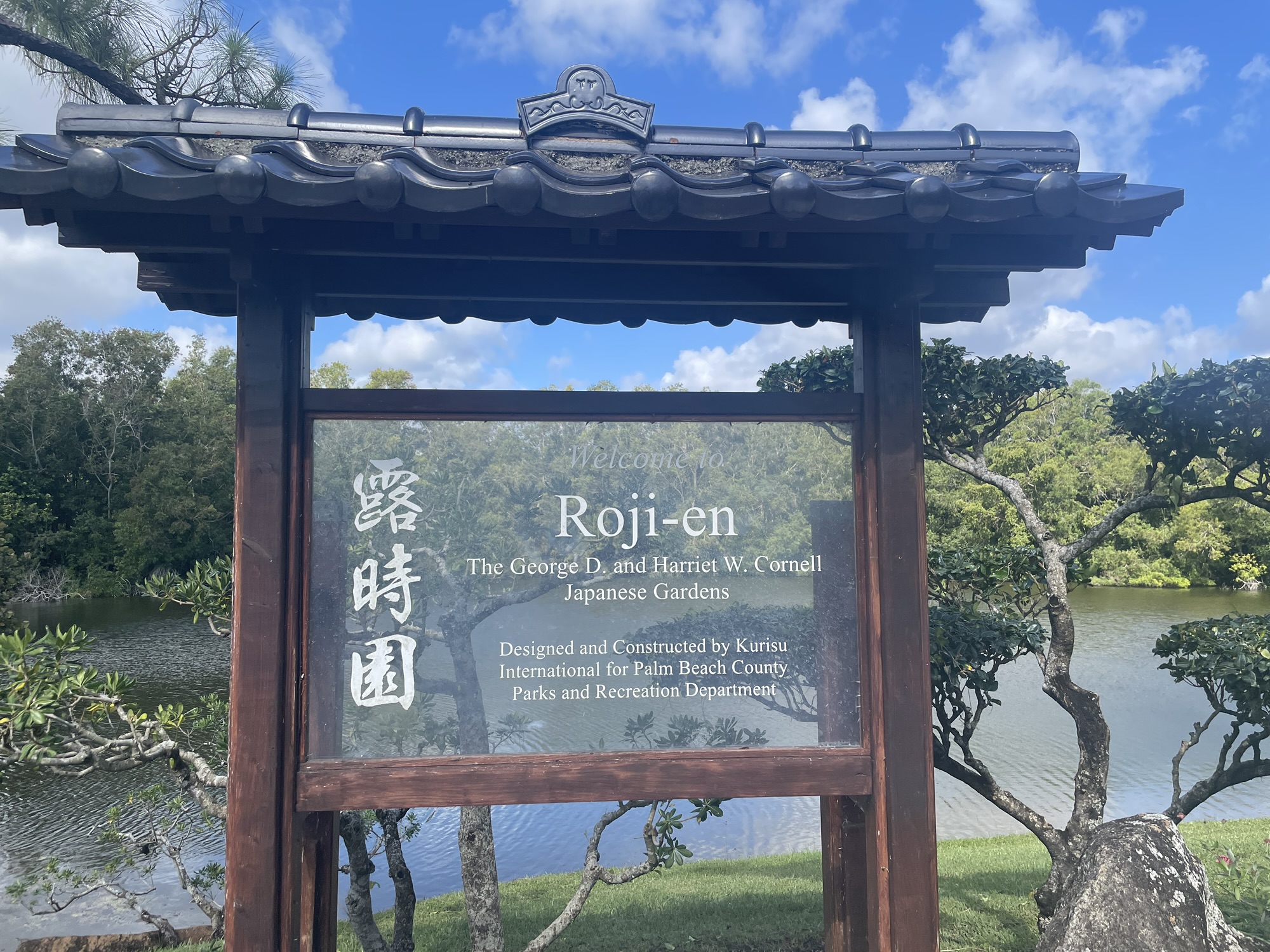
We walked the loop around the lake that had once been owned by a Japanese farmer. George Sukeji Morikami, who had come to Florida in the early 1900s with a group of other Japanese immigrants to start a farming community.  When he passed away, he donated 200 acres of his land to the community.  On this lovely piece of land, a Japanese Garden was built. The Roji-en Garden of the Drops of Dew.

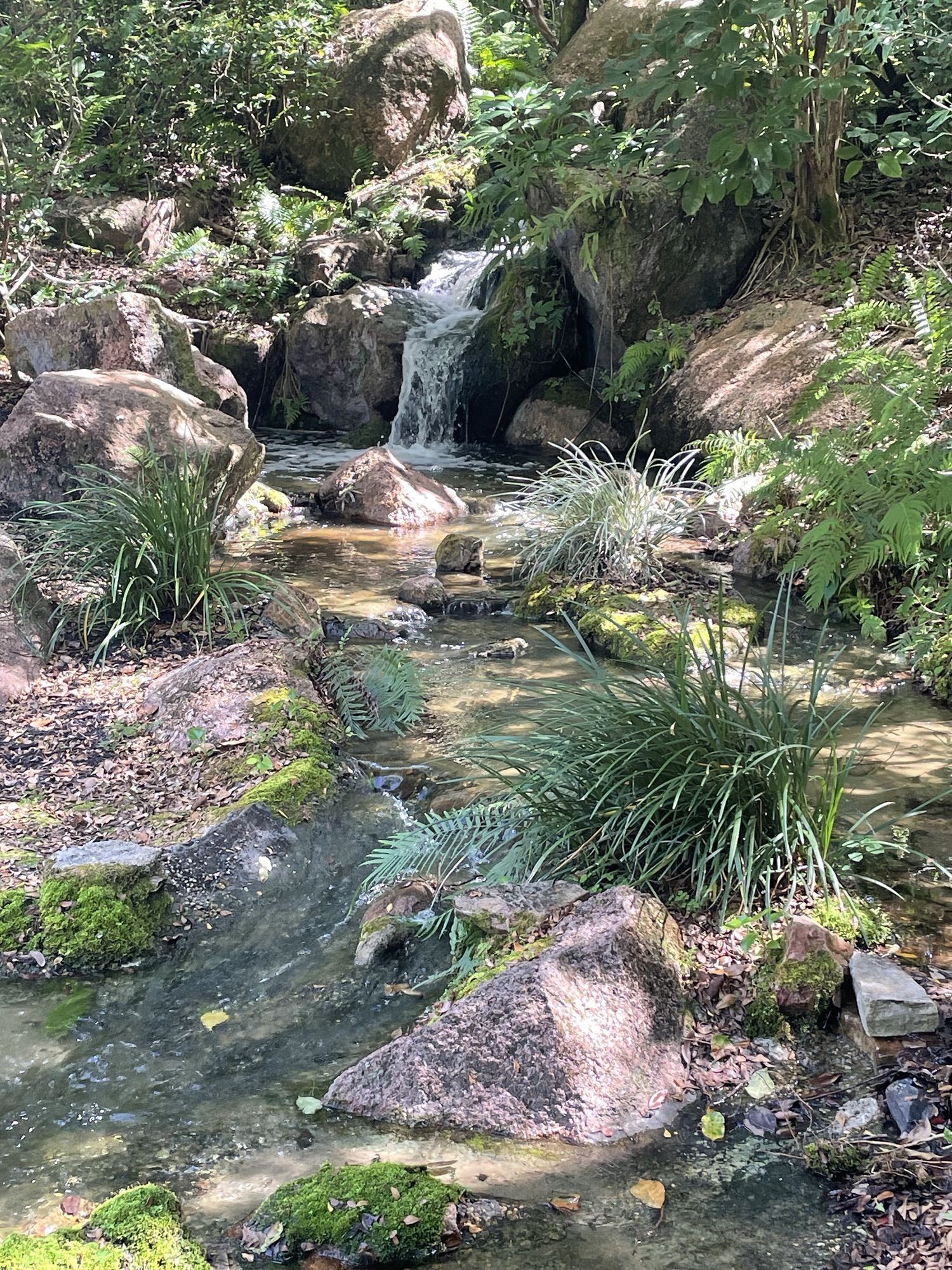
We walked the loop around the lake visiting all of the 25 marked attractions.  We were lucky to have wonderful weather to walk in and out of the shade trees, the quaking bamboo that wavered and clicked together in the wind.  We saw the statures, visited the bonsai collection on Yamato Island,  sat quietly at the two rock gardens, the Contemplation Pavilions and the Nelson Family Memorial Garden.  The peaceful areas also included waterfalls. Watching the water make its way down a small hillside through the rocks was relaxing after walking for a while.

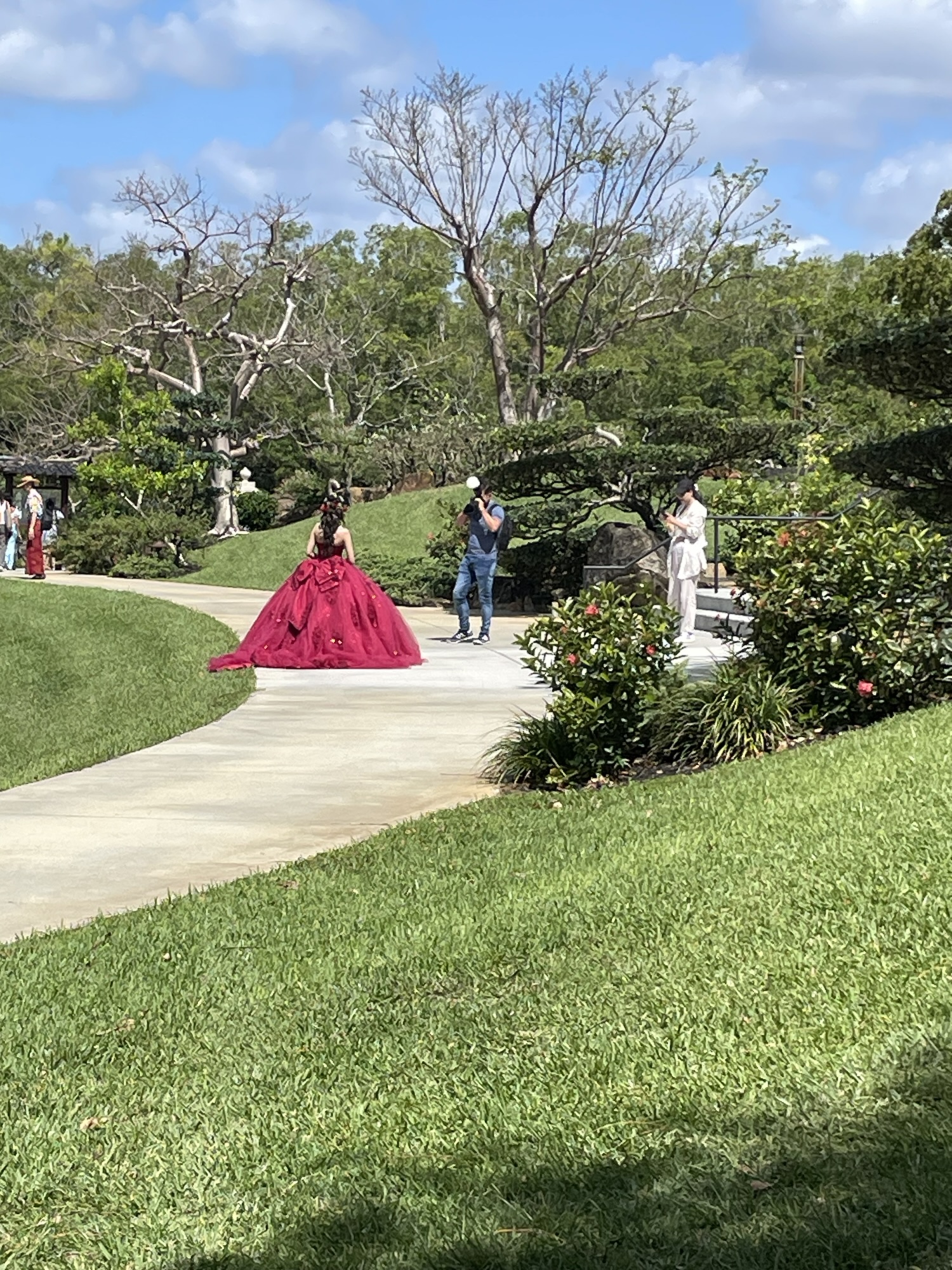
We were not the only ones enjoying the lovely weather and the beauty of the park.  There was a teen girl gettin her quinceanera photos.  I could see the park as a wonderful site for weddings! 

After our walk we had a delicious lunch at the café sitting outside and enjoying the view of the gardens.  Unfortunately, on the day we went, the museum was closed as they were getting new displays ready. But we did visit the tea room and of course donated to the garden and museum by our purchases at the gift shop.  I honestly cannot believe that I have been to Florida dozens of times, and never went to these gardens.

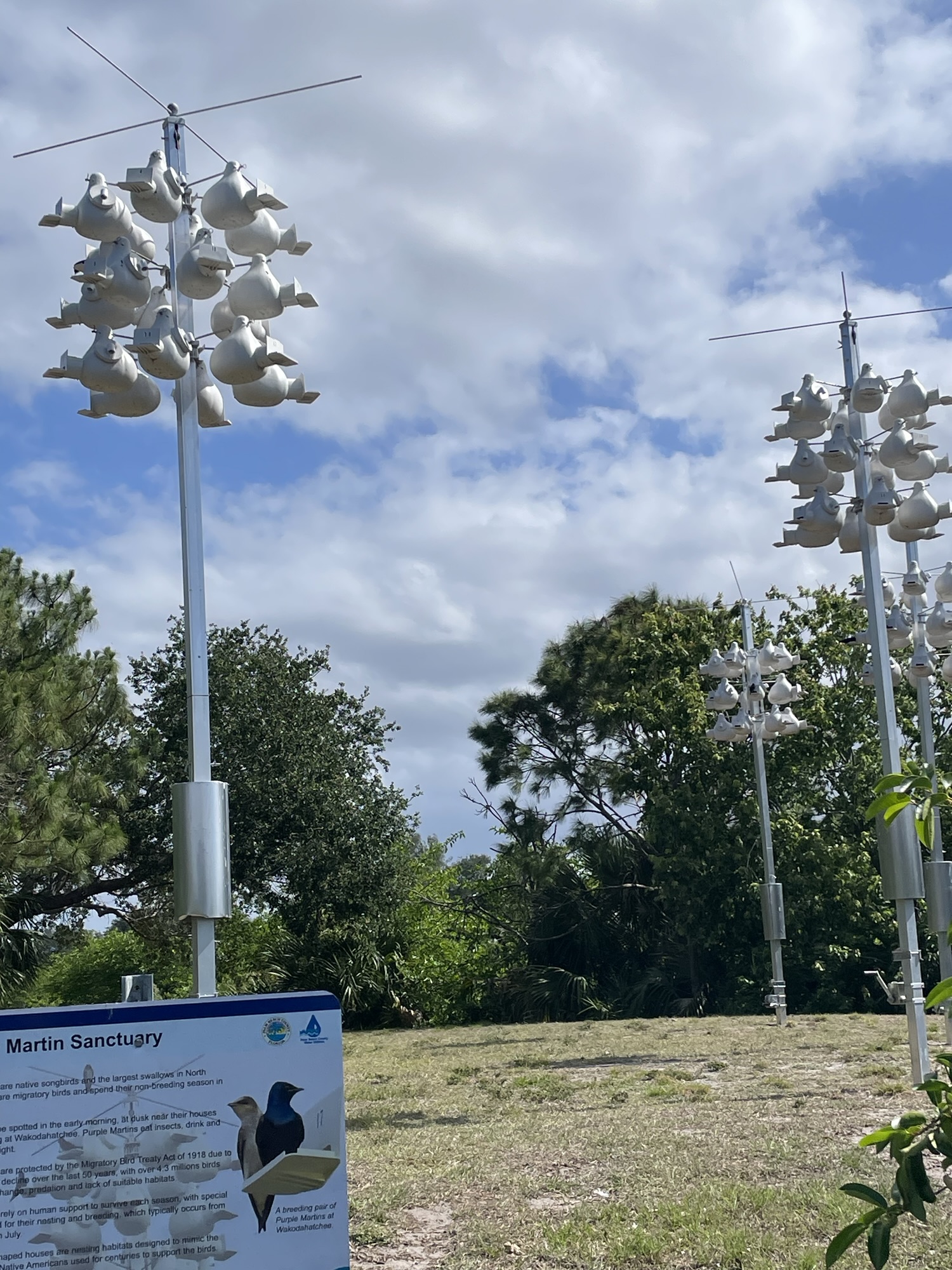
The next day my cousin had another place to visit not far from her home.  The Wakodahatchee Wetlands and Bird Sanctuary.  This was another looped walk but instead of in a garden around a lake, we were walking on a high wooden path through marshland and trees see the roosting Storks, Cranes, Purple Marlins, Egrets, Herons in the trees, as well as a few iguanas; and the alligators down in the water.

The wetlands were opened o the public in 1996 and is a 50-acre site of previous wastewater utility property. Now free and open to the public, the wetlands is the nesting place of many different birds.  What a great way to use this land for the community and for the wildlife.  It is just wonderful place to spend an hour or so.

It was amazing how close we could get to the birds. I do not think I have the words to describe the scene, so you will have to see my photos. But I will say this was not a quiet and peaceful walk, as the squealing of the young birds calling out to their parents for food was quite loud. 

I was walking around taking photos with my phone.  But there were many people with professional size cameras and massive telescope lenses to get much better photos.  In fact, throughout our walk, I kept thinking about a former student of mine who takes the most amazing bird and wildlife photos.  I wished he was there to enjoy the sights. Below is the website for the Wetlands which includes a live web stream!! Enjoy!

My recommendation to everyone who goes to Palm Beach County is to see both of these wonderful outdoor adventures. I am so glad my cousin insisted that we visit them.

A Small Beacon of Hope On Yom HaShoah

27 Apr

My husband loves to assign movies to holidays that impact us.  For Fourth of July, we watched 1776; for Ground Hogs Day, we watch Ground Hogs Day; for Israel Independence, we watch Exodus; and for Yom HaShoah, we watch Schindler’s List.

I have known for several years now that one of my grandfather’s cousins, one of the very few who survived the Shoah, was on Schindler’s List and survived as a member of his work force.  It made me think of this movie in a different light, because now one of those working and surviving was someone I once knew. 

But this year, my view of the movie will change even more.  For the first time, I now know that my grandfather’s cousin, Shalom, was one of the people who served as a pallbearer for Oscar Schindler at his funeral.  And for the first time, I have found out that my distant cousin was one of at least 10 people from his community who were saved by Schindler.

(Many thanks to Izabela Sekulska and Mayn Shtetele Mielec for discovering this information.)

I had to wonder, did they know each other?  There were about 5,000 Jewish souls who lived in the area of Mielec.  Only 100-200 survived.  Once they became part of the Schindler work force, of course they new each other. But did they work together to survive?  Did they become part of this unusual group together?

I know of one other story like Schindler’s list. My good friend’s mother and grandmother survived the Shoah with about 100 other women who worked making clothes and shoes for the German army.  The man who ran this factory saved them several times.  Once keeping them at the factory even over night when there was typhus disease raging through the camp.  A second time he actually went to the camp and getting his workers out from a transport to a death camp, saying he did not want to train new workers.  

Did he do this because he was emotionally attached to his workers?  Did he really work to save them?  We will never know. But my friend’s mother and grandmother survived. I knew them as well.  Their story can be found at the San Antonio’s Holocaust Memorial Museum. 

So on this Yom HaShoah, I will have a small beacon of light thinking about my grandfather’s cousin, Shalom; my girlfriend’s mother, Anna, who were saved by their work in a factory.  And I will have hope because people like Izabela in today’s Poland work to keep the Jewish cemeteries in good order and to find out what happened to the Jewish people who disappeared over 80 years ago.

Pre-Passover/Pesach Ponderings

8 Apr

At 70 years old, I envisioned that I would be sailing through my retirement years comfortable with my world.  Enjoying my family, watching my country continue to flourish, seeing the United States and its reputation be strong in the world, as my husband and I continued to travel and enjoy visiting new places.

This is a far distant vison than the one my great grandmother faced 82 years ago, when in April 1943, she was murdered by the Germans at age 70 in Poland.  It was the Thursday before Easter, and after her husband and four children had been murdered and her farm and property had been confiscated by the Germans.

My great grandmother is a bit different than the many unknown who were murdered during the Shoah, as there is a record of her last day taken during the trial held after the war for her murder.  I know what she did, what she said, and who killed her. (See blog below.)

For fifty years I had been on a quest to find out what happened to my grandfather’s family.  A quest that started after I spent my sophomore of college in Jerusalem.  A year when I met many members of my family who survived the Shoah and ended up living in Eretz Israel, the land of Israel.

When I returned home, I was the child who said, I need to know.  I sat with all of my grandparents to hear their stories.  I wrote everything down. In the 1970s there was no internet, no easy way to discovered what happened. But I kept my papers and over the years when I met other members of my family I wrote down what they said.  And slowly, slowly the stories came out.

In some instances, I found out history that perhaps I did not want to know.  I learned about my father’s family who came to the USA in the 1870s.  I learned of both tragedies and joys.    

I learned about a great uncle who ended up in a mental institution, a great aunt who died from the Spanish flu, multiple children who died in their infancies; family menbers who did not speak to each other and a child who was raised by an aunt and did not know till she got engaged.

For my mother’s family, both of her parents came to the USA in the early 1920s, I learned about the hundreds of cousins, siblings, parents, all many of relatives that were murdered in the Shoah, as well as ones who had been saved.

I learned about relatives who were on Schindler’s List.  Those who were saved by the Kinder Transport and ended up in England.  A cousin who survived the Kelce Pogrom. Others who hid in the forests near their home town and formed a group like the one in the movie, “Defiance,” but these were my family.

I learned about a relative who converted to Catholicism before the war, but during the war she tried to save her sibling and her children. She was not successful.  Their bodies were found buried in a field when construction was being done about three years ago. The driver of the vehicle was the grandson of the relative who converted, so Catholic himself.  He had dug up the bodies of his own dead Jewish great aunt and her family.  Can you imagine the irony of this? 

I learned that owning property or having money does not save you.  What might save you is luck, fortitude, or relatives who might have a chance to get your out.  But you also had to make your own luck.  You had to want to survive.

My great grandmother finally gave up. Everyone was dead, she had been hiding in the forest with others for a while.  But then she was done. It was too much sorrow. Too much loss.

In this world with the chaos and uncertainty surrounding the economy; the round up of immigrants, even those with legal residences; the job losses; the attacks on education; the attacks on the rights of LGBTQ communities; the rise in anti-Semitism and hatred toward Israels and Jews, I have had to re-evaluate.

Could our property be confiscated?  Could our savings be stolen?  Could people in the USA be forced to hide in the woods to stay safe?  Will people just give up?

Am I really so different from my great grandmother whom I am named after?  Should I consider my own exit strategy?  Believe me my mind often mulls over the options. 

But it is the Tuesday before Pesach and Easter.  It is two days before the 82nd anniversary of my great grandmother’s murder by the German mayor of Czermin, Jukub Hesler.

So I am pondering and considering and hoping that our Constitution is strong enough. That our courts are strong enough. That our elected politicians remember who they vow allegiance to:  The CONSTITUTION of the United States of America.  And who they serve, the people of their states and districts.

I wish everyone a Zissel Pesach, a happy Pesach.  And I wish all who celebrate Easter a happy Easter.  And I wish to everyone throughout the countries of the Earth a peaceful and joyful 2025.