Tag Archives: Yiddish

The Nuances of Nu!

4 Dec

It is amazing how two little letters can have so many meanings. Just an inflection of the voice, a shrug of the shoulders, a smile on the face, a touch of the hands, and ‘Nu” means something totally different.   It is not that surprising though, ‘Nu” is a Yiddish word. And translating it would be almost impossible.

Nu?

As a question “Nu” lets you say in one word so many sentences: Are you okay? Did everything go well? What are you planning to do? What will happen? What is the story? Do you need help? What do you need? What can I do?

All those questions from one two-letter word. But all are questions to show concern for another person.

Nu!

As an exclamation “Nu” has a different meaning. For a mother, this version of “Nu” is very important. Nu! Did you get your homework done?! Are you ready?! Let’s get going! I have had enough! Get your act together! Listen to me! What is going on here!

Mothers and fathers who use Yiddish have been asking/demanding of their children the “Nu” demand for generations. I can still hear my Grandmothers or my Mom saying “nu!” to me in my head.   Who needs a conscious when you have “Nu”?

There is another parental use of “Nu.” This is used for an older child with a long-term partner. This is the “are you getting married? What is happening? Nu? What is the story here? Do I get to plan a wedding?

Then there is always the parents’ very happy “Nu!” The Nu of joy comes about when you are almost a grandparent and you call to ask Nu? What does the doctor say? When? Or you can call your friends and say, “ Nu! I am a grandparent!”

So, Nu?

This more gentle version of the “Nu” question is more comforting. This is when you take someone’s hand in yours and try to offer comfort.   This is the compassionate Nu.

You went for your Mammogram today? So nu? How did it go?

Your Mom or Dad is sick? So nu? How are things going for them and for you?

Your child is having problems? So nu? Can I help?

You are depressed? So nu? You have friends, are you getting help.

The compassionate ‘Nu’ is very important. It is beyond just friendship. I think it shows compassion for acquaintances as well as close friends. So nu, I will be there for you. Don’t worry is part of tzedakah and rachmanis. We need to show others how we care. And the right ‘Nu’ at the right time can help.

Oy, Nu!

The Oy Nu is much more intent. The Oy Nu offers sympathy on a much higher level. Your parent passed away, “Oy Nu!” What can I do to help with the shiva with comforting you.

Your child was in a car accident. Oy Nu!

The Oy Nu! Is sort of an ‘I cannot believe that happened.   How? Why?’

A definition of “Nu” says it means “so.” But that is not really correct. It has many more meanings than that! Nu is nuanced. It is a small word with big aspirations. With intonations, inflections, shrugs and sighs, flashing eyes and temper, each of these changes the meaning of Nu.

I cannot imagine a world without this word. The nuances of ‘nu’ keep language fun and exciting, as well as simple. With one word, I can say so much!

My Five Levels of “OY”

4 Nov

I recently realized that in my mind there are actually five levels of Oy. These five different levels provide me the ability to express sorrow or sadness with an oy-statement.

The first, of course, is the simple ‘oy.’ This mean ‘oh’ or ‘ouch.’ I use OY when my cat jumps on my stomach or I drop something. Sometimes I use oy when someone is telling about an embarrassing experience they had. A response of “Oy” is always appreciated.

I never use oy when something bad has happened. It is usually used for events that are a little bit funny. I guess someone slipping on a banana peel without getting hurt would be an oy moment.

It sometimes has an “I cannot believe I did that,” feeling. After you do it, you think, “Oy! Why did I do that!”

But when I say “Oy Vey” I have amped up the response. Now I have feelings of woe, which is exactly what “oy vey” means, “oh woe!” I think the following is a good example of an oy vey experience.

The summer of 2013, on Fathers’ Day, my husband and I were at a party. During the party a storm blew in to the area. It was tornado weather in Kansas. We all took shelter in the house. Although the wind blew and the rain came down, it was not too bad where we were.

All those branches on the ground should be in the tree.  Oy Vey

All those branches on the ground should be in the tree.         Oy Vey

However, when we got home, OY VEY!!!   Our beautiful Sugar Maple was destroyed in a microburst of rain and wind. Branches and limbs were all over our front yard. Part of our fence was crushed.   It looked like a disaster zone in our neighborhood. And our house seemed to be the epicenter.

But it was only an Oy Vey, the second level of oy, because no one was hurt. No homes were damaged. Yes, the tree was going to have to be taken down, but in the long run it was just a second level oy experience.  My son and his friends came over and helped my husband collect all the branches and to get the big branch off the fence. Those branches were big and heavy!

The next day I called the tree service we use. Luckily they had trimmed that tree just six months before, which probably lessened the damage. I will admit watching the tree service actually take the tree down was a second oy vey experience. It was a very large tree! But they took care of everything, while I watched and took photos…all the time chanting, “Oy Vey!”

“Oy Vey Iz Mir” is a much stronger, “Woe is ME! “ When I say the entire sentence, then I am really worried. When I say, “Oy Vey IZ Mir,” something horrible has happened.   Someone I know is sick. Or an elderly parent is in hospice or has passed away. Sometimes I say that when someone has lost a job. It is a statement for a calamity, but not for a tragedy. Or maybe something scary has occurred.

When I was a child in the Catskills, the boys who lived in the house next door were shooting BB guns and aiming at a target made of wood. The BBs ricocheted into our yard. All I remember was the leaves rustling and my Dad, who had served in Korea, jumping on us yelling, “Get Down!! Get Down!!!”

One of my grandparents said “Oy Vey iz mir.” I think both because of the guns and because of Dad’s reaction. He stormed over to the house and yelled. After that there were no BBs for a while. Then I think they built a target with straw behind it. But that “Oy Vey iz mir” has stayed with me!

I think the English saying, “Woe is me” is an example of Yiddish phrasing in English. I have woe. I feel woeful. I am sad. Those are all English. But in Yiddish, Oy Vey iz Mir. Oh woe is me!!!

For a tragedy I have my fourth level of Oy. That is seven oys in a row followed by Vey Iz Mir.   “Oy oy oy oy oy oy oy vey iz mir.” That is when I feel absolutely terrible about what I have just heard: when some one has had a true tragedy. What could that be? A young person has passed away.   Someone’s son or daughter has been in a serious car accident. During my children’s teen years, there were unfortunately several times when the fourth level of oy was invoked.   A suicide is a definite fourth level of oy. Where I might forget why I used the first three levels of oy, when I have a fourth level of oy moment, it lives with me forever.

When I reach this level I usually need a piece of chocolate and a glass of tea. When I say this I know that I would love to speak to my Mom or Dad and debrief. The fourth level of oy moments are the times when I end up making phone calls or sending out emails to let others know, so that we can band together and help.

But I said there are five levels of Oy. So what could be worse than level four? Well there is level five, when I say, “Oy, a Bracha.” With this I am saying “woe is me, we need a blessing.” With the fifth level of oy I am calling on God to help.

When war breaks out in Israel, it is an “oy a bracha,” moment. With a daughter living in Tel Aviv and many family members throughout Israel, the threat of weapons, rockets, war, and destruction makes me very anxious.

For me 9/11 was a fifth level oy moment. We needed all the blessings we could get then. And so for me, it was saying “Oy, a Bracha!” Help us, bless us.

My five levels of oy have been part of my life as long as I can remember.   I am glad that most of my oy moments are level one and level two oys. But I am also glad I know a bit of Yiddish so I have a way to express exactly how I feel.

Speaking Yiddish Always Brings Me Holocaust Memories

28 Apr

My maternal grandparents were from Poland and Galicia. They came to the United States in the 1920s. Met and married when Grandma was 19, Grandpa was 29. At home they spoke to each other only in Yiddish, although both learned to speak excellent English. And Grandma was a ferocious reader in several languages.

When I stayed with them, they spoke Yiddish to me as well. As a young child I could respond and easily speak to them. But that ended when my parents realized that my siblings and I spoke and understood Yiddish. They had been using it as a secret language to discuss finances and personal matters. So the order went out…stop speaking Yiddish to the children. My Mother, in later years, would tell me that she regretted making that demand.

But Yiddish connected me to my grandparents. And I studied German in high school and Hebrew in college. Then I spent a year in Israel at Hebrew University. While there I spent so much time with my great uncle and great aunts, who spoke Yiddish at home. So my Yiddish slowly improved, and I became more fluent.

The kneeling sailor is speaking to my Mom;behind her my Uncle; behind him my Grandma.

The kneeling sailor is speaking to my Mom;behind her my Uncle; behind him my Grandma.

My Grandma’s family was lucky. She went to Europe in 1931 with my Mom and Uncle and stayed for six months. When she returned to the US in 1932, she told my grandfather that they had to get everyone out. And she started the process. She was able to get visas for her father and sister. They made my great aunt younger than her real age, so she could come in on her father’s passport. Her brothers and their wives were not as fortunate. But they did survive the war.

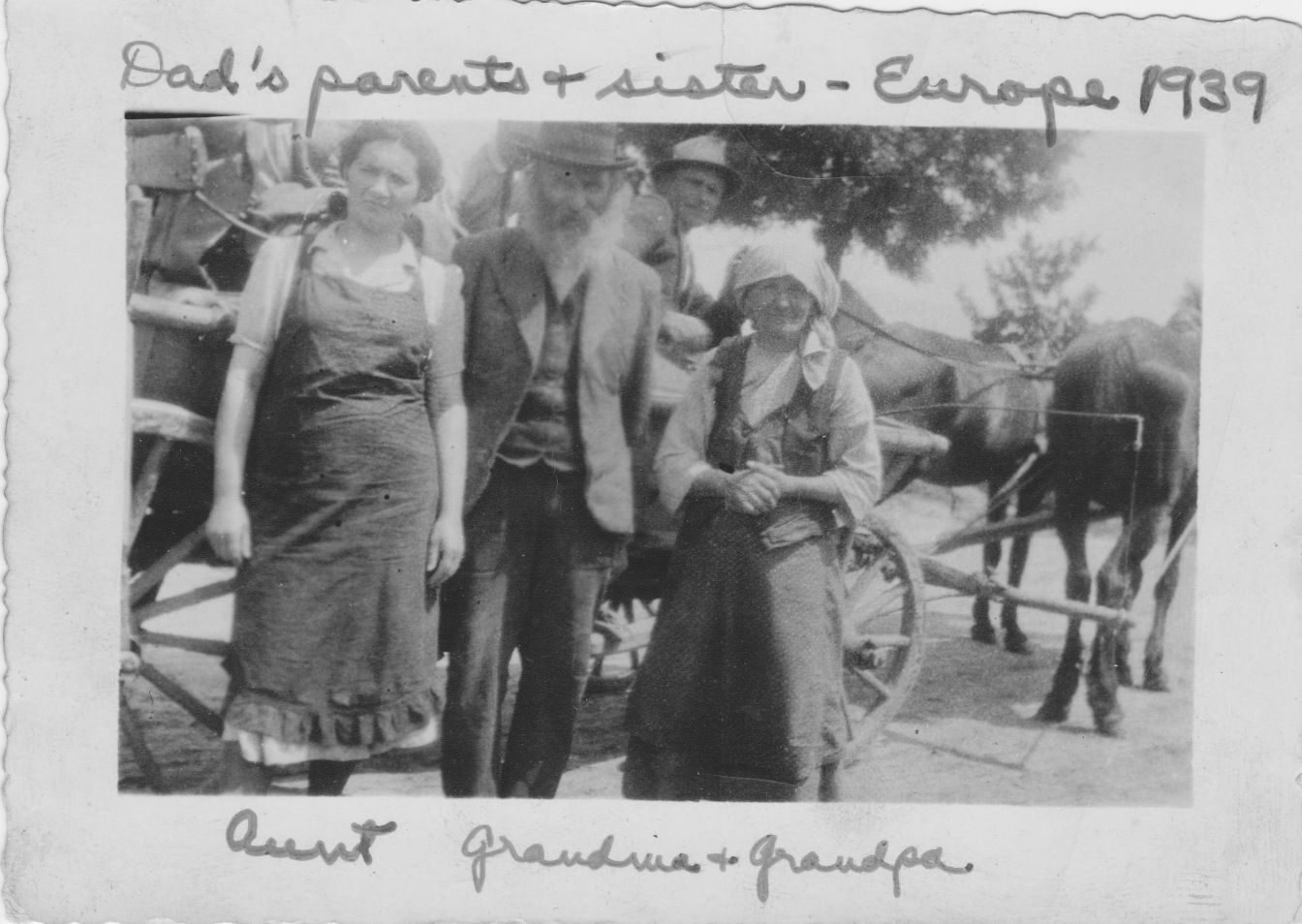
My great aunt Tova, my great Grandparents Gimple and Chava. The man driving is an Uncle. And the horses and cart they bought with the money my grandparents sent. They all perished.

My great aunt Tova, my great Grandparents Gimple and Chava. The man driving is an Uncle. And the horses and cart they bought with the money my grandparents sent. They all perished.

My Grandpa’s family was not fortunate at all. They all perished. My grandparents did send his parents money and visa to come to the US. But they could not believe what would happen. They took the money and bought a horse and cart. They did not want to leave their other children and grandchildren. And my grandparents could not get everyone visas.

My mother used to tell me that every morning after work, when he found out that his entire family was murdered, my grandfather would sit in the kitchen and cry. He was a baker…up all night. But before he went to sleep for the day, he cried for all he lost.

In the meantime, my grandparents thrived in the US. They had two children, five grandchildren; two businesses, both a bakery in New Jersey and a bungalow colony in the Catskills.

Grandma wrote to her brother in Israel often. When I went as a college sophomore, I spent a year of college at Hebrew University. I had a cousin who was my age, and my great uncle and aunts (one uncle had died in the 1950s.) I met a few other relatives who had survived the Shoah. But no one ever spoke to me about it. I was young. But my Hebrew and Yiddish were improving rapidly.

Then when I was a junior in college, I took my Grandma to Israel with me during winter break. She had not seen her brother in 42 years. We spent a month together. A month I will never, ever forget.

The phone calls at the hotel would be in Hebrew. Someone would call and speak to me. “I understand the Tova S. is here,” they would say. “Yes,” I would respond. They would then ask genealogy. Who were her parents? Where did she live? When all the right answers were given, I would hear. Yes. She is my mother’s or father’s or someone’s cousin. And they would set up an appointment to meet with us: to see my Grandma.

And the holocaust became real to me. Each person in Yiddish told my Grandma their story of how they survived the Shoah. And who had died during that horrible time. If I did not understand a word, Grandma would translate. Sometimes they would tell me the word in Hebrew. Day after day, week after week, I heard so many stories.

But then came the worst of all. Rafael came. I knew him and his wife and daughter. His mother and my great grandfather were siblings. Rafael and his wife had never spoken to me about their experiences. But when Rafael saw my Grandma, it was an outburst of pain and crying from both of them. Rafael was my Grandma’s first cousin. His sister, Tova Malcha, had been my Grandma’s best friend. And Tova Malcha had not survived. When Rafael and Grandma met their memories overflowed. Not only on death, but on the lives they had left behind.

At that moment, at that time, my Yiddish was at its best. I understood all.

After Rafael left, I asked Grandma why no one had ever told me these stories? Why I had not met all these people who kept showing up? Why Uncle had only introduced me to a few of the relatives when I spent my year there?

There was no answer.

When we returned to the US, my Grandpa was so happy to see Grandma. “Never leave me again,” he said. He did not come with us, because he refused to ever leave the United States.

She never left him again, till she died.

And I never speak Yiddish or hear Yiddish without the images and sounds of that month in Israel and the Shoah ever present in my mind.